anaheim-gazette 1902-02-27
Scanned page
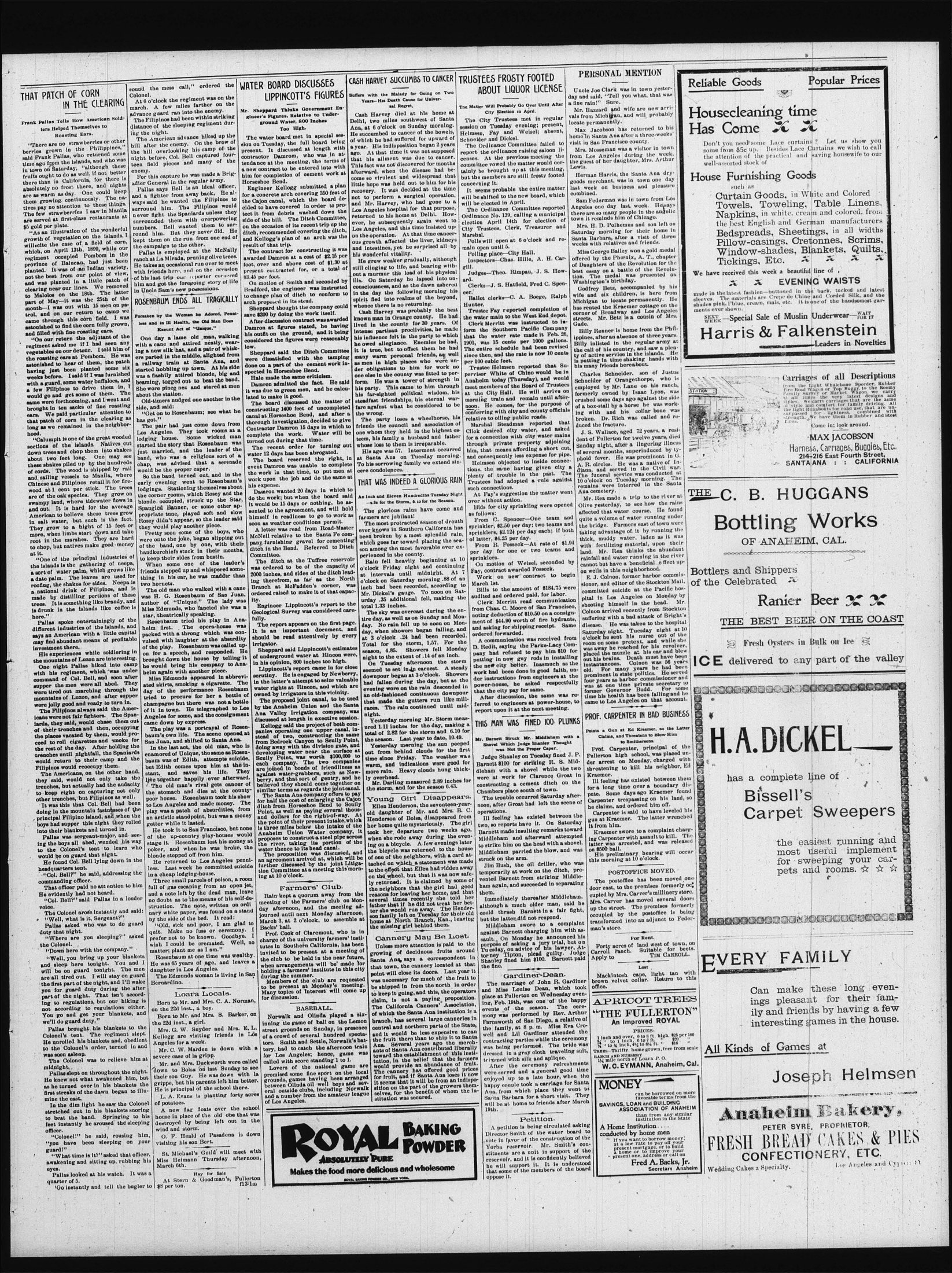
Searchable text
THAT PATCH OF CORN IN THE CLEARING
Frank Pallas Tells How American Soldiers Helped Themselves to Roasting Ears.
"There are no strawberries or other berries grown in the Philippines," said Frank Pallas, who returned some time ago from the islands, and who was in town on Saturday, "although these fruits ought to do as well, if not better there than in California, for there is absolutely no frost there, and nights are as warm as day. One could keep them growing continuously. The natives pay no attention to these things. The few strawberries I saw in Manila are served at first-class restaurants at $5 gold per plate.
"As an illustration of the wonderful growth of vegetation on the islands, I will cite the case of a field of corn, which, on April 13th, 1899, while our regiment occupied Pombom in the province of Balucan, had just been planted. It was of an Indian variety, not the best from our point of view, and was planted in a little patch of clearing near our lines. We removed to Malolos on the 18th. The latter part of May—it was the 25th of the month—I was out with 15 men on patrol, and on our return to camp we came through this corn field. I was astonished to find the corn fully grown, and filled with fine roasting ears.
"On our return the adjutant of the regiment asked me if I had seen any vegetables on our detour. I told him of the roasting ears at Pombom. He was astonished to hear of them, the patch having just been planted some six weeks before. I said if I was furnished with a guard, some water buffaloes, and a few Filipinos to drive them in, I would go and get some of them. The same were forthcoming, and I went and brought in ten sacks of fine roasting ears. We paid particular attention to that patch of corn in the clearing as long as we remained in the neighborhood.
"Calumpit is one of the great wooded sections of the islands. Natives cut down trees and chop them into shakes about two feet long. One may see these shakes piled up by the hundreds of cords. The wood is shipped by rail sound the mess call," ordered the Colonel.
At 6 o'clock the regiment was on the march. A few miles farther on the advance guard ran into the enemy.
The Filipinos had been within striking distance of the sleeping regiment during the night.
The American advance hiked up the hill after the enemy. On the brow of the hill overlooking his camp of the night before, Col. Bell captured fourteen field pieces and many of the enemy.
For this capture he was made a Brigadier General in the regular army.
Pallas says Bell is an ideal officer, and a fighter from away back. He always said he wanted the Filipinos to surround him. The Filipinos would never fight the Spaniards unless they surrounded them with overpowering numbers. Bell wanted them to surround him. But they never did. He kept them on the run from one end of the campaign to the other.
Pallas is employed at the McNally ranch at La Mirada, pruning olive trees. He takes an occasional run over to meet with friends here, and on the occasion of his last trip our reporter cornered him and got the foregoing story of life in Uncle Sam's new possessions.
ROSENBAUM ENDS ALL TRAGICALLY
Forsaken by the Woman he Adored, Pennless and in Ill Health, the Old Man Does Exeunt Act of "Unique."
One day a lame old man, walking with a cane and attired neatly, wearing a new silk hat, and a pair of whiskers parted in the middle, alighted from a railway train at Santa Ana, and started hobbling up town. At his side was a flashily attired blonde, big and beaming, toggled out to beat the band. She wore pince nez and stared at men about the station.
Old-timers nudged one another in the side, and said:
"Get on to Rosenbaum; see what he has got."
The pair had just come down from Los Angeles. They took rooms at a lodging house. Some wicked man started the story that Rosenbaum was just married, and the leader of the band, who was a religious sort of a chap, was advised that a serenade would be the proper caper.
WATER BOARD DISCUSSES LIPPINCOTT'S FIGURES
Mr. Sheppard Thinks Government Engineer's Figures, Relative to Underground Water, 800 Inches Too High.
The water board met in special session on Tuesday, the full board being present. It discussed at length with contractor Damrom, who was in attendance at the meeting, the terms of a new contract to be entered into with him for completion of cement work at Horseshoe Bend.
Engineer Kellogg submitted a plan for a concrete arch covering 350 feet of the Cajon canal, which the board decided to have covered in order to protect it from debris washed down the side of the hill. The Ditch Committee, on the occasion of its recent trip up the ditch, recommended covering the ditch, and Kellogg's plan of an arch was the result of that trip.
The contract for constructing it was awarded Damron at a cost of $2.15 per foot, over and above cost of $1.30 at present contracted for, or a total of $3.45 per foot.
On motion of Smith and seconded by Bradford, the engineer was instructed to change plan of ditch to conform to arch proposed in its stead.
Sheppard thought the company could save $200 by doing the work itself.
After discussion contract was awarded Damron at figures stated, he having his outfit on the ground, and it being considered the figures were reasonably low.
Sheppard said the Ditch Committee were dissatisfied with the tamping done on a part of the cement work inspected in Horseshoe Bend.
Hale made the same criticism.
Damron admitted the fact. He said it was due to green men, and he calculated to make it good.
The board discussed the matter of constructing 1400 feet of uncompleted canal at Horseshoe Bend, and after a thorough investigation, decided to give Contractor Damron 15 days in which to complete the work. Water will be turned out during that time.
The recent order for turning out water 12 days has been abrogated.
The board reserved the right, in event Damron was unable to complete the work in that time, to put men at
weeks before. I said if I was furnished with a guard, some water buffaloes, and a few Filipinos to drive them in, I would go and get some of them. The same were forthcoming, and I went and brought in ten sacks of fine roasting ears. We paid particular attention to that patch of corn in the clearing as long as we remained in the neighborhood.
"Calumpit is one of the great wooded sections of the islands. Natives cut down trees and chop them into shakes about two feet long. One may see these shakes piled up by the hundreds of cords. The wood is shipped by rail and sailing vessels to Manila, where Chinese and Filipinos retail it for firewood at 1 cent per stick. The trees are of the oak species. They grow on swampy land, where tidewater flows in and out. It is hard for the average American to believe these trees grow in salt water, but such is the fact. They grow to a height of 15 feet or more, when limbs start down and take root in the marshes. They are hard to chop, but natives make good money at it.
"One of the principal industries of the islands is the gathering of neepa, a sort of water palm, which grows like a date palm. The leaves are used for roofing, the shakes for sides. Neepa is a national drink of Filipinos, and is made by distilling portions of these trees. It is something like brandy, and is drunk in the islands like coffee is here."
Pallas spoke entertainingly of the different industries of the islands, says an American with a little capital may find abundant means of profitable investment there.
His experiences while soldiering in the mountains of Luzon are interesting.
One night Pallas hiked into camp with his regiment, which was under command of Col. Bell, and soon after supper the men were all abed. They were tired out marching through the mountains of Luzon, and after supper were jolly good and ready to turn in.
The Filipinos always said the Americans were not fair fighters. The Spaniards, they said, would chase them out of their trenches and then, occupying the places vacated by them, would proceed to roll cigarettes and smoke for the rest of the day. After holding the trenches until nightfall, the Spaniards would return to their camp and the Filipinos would reoccupy them.
The Americans, on the other hand, they said, would not only take the trenches, but actually had the audacity to keep right on capturing not only other trenches, but Filipinos as well.
It was this that Col. Bell had been doing in the mountain fastnesses of the principal Filipino island, and when the boys had supper this night they rolled into their blankets and turned in.
Pallas was sergeant-major, and seeing the boys all abed, wended his way to the Colonel's tent to learn who would be on guard that night.
He found Col. Bell lying down in the headquarters tent.
"Col. Bell?" he said, addressing the commanding officer.
That officer paid no attention to him He evidently had not heard.
"Calumpit is one of the great wooded sections of the islands. Natives cut down trees and chop them into shakes about two feet long. One may see these shakes piled up by the hundreds of cords. The wood is shipped by rail and sailing vessels to Manila, where Chinese and Filipinos retail it for firewood at 1 cent per stick. The trees are of the oak species. They grow on swampy land, where tidewater flows in and out. It is hard for the average American to believe these trees grow in salt water, but such is the fact. They grow to a height of 15 feet or more, when limbs start down and take root in the marshes. They are hard to chop, but natives make good money at it.
"One of the principal industries of the islands is the gathering of neepa, a sort of water palm, which grows like a date palm. The leaves are used for roofing, the shakes for sides. Neepa is a national drink of Filipinos, and is made by distilling portions of these trees. It is something like brandy, and is drunk in the islands like coffee is here."
Pallas spoke entertainingly of the different industries of the islands, says an American with a little capital may find abundant means of profitable investment there.
His experiences while soldiering in the mountains of Luzon are interesting.
One night Pallas hiked into camp with his regiment, which was under command of Col. Bell, and soon after supper the men were all abed. They were tired out marching through the mountains of Luzon, and after supper were jolly good and ready to turn in.
The Filipinos always said the Americans were not fair fighters. The Spaniards, they said, would chase them out of their trenches and then, occupying the places vacated by them, would proceed to roll cigarettes and smoke for the rest of the day. After holding the trenches until nightfall, the Spaniards would return to their camp and the Filipinos would reoccupy them.
The Americans, on the other hand, they said, would not only take the trenches, but actually had the audacity to keep right on capturing not only other trenches, but Filipinos as well.
It was this that Col. Bell had been doing in the mountain fastnesses of the principal Filipino island, and when the boys had supper this night they rolled into their blankets and turned in.
Pallas was sergeant-major, and seeing the boys all abed, wended his way to the Colonel's tent to learn who would be on guard that night.
He found Col. Bell lying down in the headquarters tent.
"Col. Bell?" he said, addressing the commanding officer.
That officer paid no attention to him He evidently had not heard.
"Calumpit is one of the great wooded sections of the islands. Natives cut down trees and chop them into shakes about two feet long. One may see these shakes piled up by the hundreds of cords. The wood is shipped by rail and sailing vessels to Manila, where Chinese and Filipinos retail it for firewood at 1 cent per stick. The trees are of the oak species. They grow on swampy land, where tidewater flows in and out. It is hard for the average American to believe these trees grow in salt water, but such is the fact. They grow to a height of 15 feet or more, when limbs start down and take root in the marshes. They are hard to chop, but natives make good money at it.
"One of the principal industries of the islands is the gathering of neepa, a sort of water palm, which grows like a date palm. The leaves are used for roofing, the shakes for sides. Neepa is a national drink of Filipinos, and is made by distilling portions of these trees. It is something like brandy, and is drunk in the islands like coffee is here."
Pallas spoke entertainingly of the different industries of the islands, says an American with a little capital may find abundant means of profitable investment there.
His experiences while soldiering in the mountains of Luzon are interesting.
One night Pallas hiked into camp with his regiment, which was under command of Col. Bell, and soon after supper the men were all abed. They were tired out marching through the mountains of Luzon, and after supper were jolly good and ready to turn in.
The Filipinos always said the Americans were not fair fighters. The Spaniards, they said, would chase them out of their trenches and then, occupying the places vacated by them, would proceed to roll cigarettes and smoke for the rest of the day. After holding the trenches until nightfall, the Spaniards would return to their camp and the Filipinos would reoccupy them.
The Americans, on the other hand, they said, would not only take the trenches, but actually had the audacity to keep right on capturing not only other trenches, but Filipinos as well.
It was this that Col. Bell had been doing in the mountain fastnesses of the principal Filipino island, and when the boys had supper this night they rolled into their blankets and turned in.
Pallas was sergeant-major, and seeing the boys all abed, wended his way to the Colonel's tent to learn who would be on guard that night.
He found Col. Bell lying down in the headquarters tent.
"Col. Bell?" he said, addressing the commanding officer.
That officer paid no attention to him He evidently had not heard.
"Calumpit is one of the great wooded sections of the islands. Natives cut down trees and chop them into shakes about two feet long. One may see these shakes piled up by the hundreds of cords. The wood is shipped by rail and sailing vessels to Manila, where Chinese and Filipinos retail it for firewood at 1 cent per stick. The trees are of the oak species. They grow on swampy land, where tidewater flows in and out. It is hard for the average American to believe these trees grow in salt water, but such is the fact. They grow to a height of 15 feet or more, when limbs start down and take root in the marshes. They are hard to chop, but natives make good money at it."
"Aone oftheprincipalindustriesoftheislands,andaysanAmericanwitha littlecapitalmayfindabundantmeansofprofitableinvestmentthere."
His experiences while soldiering inthemountainsofLuzonareinteresting.
OnenightPallashikedintocampwithhisregimentwhichwasundercommandofCol.Bell,andsoonaftersuppermenthemenwereallabed.TheweretiredoutmarchingthroughthemountainsofLuzon,andaftersuppermenthemenwerejollygoodandreadytoturnin.TheFilipinosalwayssaidtheAmericanswerenotfairfighters.TheSpaniards,theysaidwchasethemenoutoftheband,一byonewiththehandkerchiefstruckintheirmouths,towkeeptheirsidesfrombustin.Whensomeoneoftheleader'sfriendssteppedupandwhisperedomethinginhisearh,ewasmadderthantwohornets.Theoldmanwhowalkedwitha canewasH.G.RosenbaumofSanJuan.authorof“Unique.”The ladywasMissEdmundswhofanciedshewasastar,theatricallyspeaking.RosenbaumtriedhisplayinAnaheimfirst.Theoperahousewaspackedwithastrongwhichwasconvulsivedwithlaughterattheabsurdityoftheplay.Rosenbaumwascalledupfora speech,andresponded.HebroughtdownthehousebytellingithewouldbringhiscompanytoAnaheimagainwithanotherpiece.MissEdmundsappearedinabbreviatedskirts,s smokingacigarette.ThedayoftheperformanceRosenbaumtriedtoc procureforhera bottleofchampagnebuttherewasnota bottleofitin town.Hte掳graphedtoLosAngelesforsome,andtheconsignmentcamedownbyexpress.TheplaywasaportrayalofRosenbaum'sownlife.ThesceneopenedatSanJuan,andshiftedtoSanta Ana.Inthelastact,theoldman,whoisenamoredofUnique,thesameasRosenbaumwasofEdith,attemptssuicide,但Edithcomesuphimattheinstant,and saveshislife。Theylive together happily everafter.Oldman'srivalgets cancerofthe stomachand diesatthecountypoorhouse.Rosenbaum tookhisshowtoLosAngelesandmademoney.Theplaywasapatchofabsurdities,从anartisticstandpoint,butwasmoneygetterwhilelasted.He tookittoSanFrancisco,但noneoftheup-countryplay-houseswouldstageit.Rosenbaum losthismoneyatpoker,andwhenhewasbroke,theblonde stoppedofffromhim.HereturnedtoLosAngelespenniless.Lastweekhecommittedsuicideinacheap lodging-house.Treefullofgasescapingfromanopenjet,andnoteleftbythedeadman leavea notebythemeansofhisself-determinedatlengthinexecutivesession.Kelloggsaidtheprojectbothcompaniesoperatingoneuppercanal,intsteadoftwo,constructingthesamethedivisiongate,anddevelopingwaternearthesurfaceofScullyPoint.wasworth$100000eachcompany.Thetwocompaniesarejoinedbondsoffriendlinesagainwater-grabbers,suchasNewberry,andthatsortofgentry,andbelievedtheyshouldcome togethersimilartermsasregardsthejointcanals.TheSantaAnacompanyofforespecialfor halfcostofenlargingtheCajunditchfromHorseshoeBendToScullyPoint,aswellaspayingseveralthoughtanddollarsfortheright-of-way.thepointofthepresentintake,whichisthreemilesbelowtheintakeoftheAnaheimUnionWatercompany,proposestoconstructastexpipeacretheriver,takingitsportionofthewaterthencetoitsheadcanal.Thepropositionwasdiscussed,aan agreementarrivedatwhichwillfurtherdiscussedbythejointLittionCommitteeatmeetingthismonthat10o'clock."
It was this that Col. Bell had been doing in the mountain fastnesses of the principal Filipino island, and when the boys had supper this night they rolled into their blankets and turned in.
Pallas was sergeant-major, and seeing the boys all abed, wended his way to the Colonel's tent to learn who would be on guard that night.
He found Col. Bell lying down in the headquarters tent.
"Col. Bell?" he said, addressing the commanding officer.
That officer paid no attention to him. He evidently had not heard.
"Col. Bell?" said Pallas in a louder voice.
The Colonel arose instantly and said: "Well, what is it, Sergeant?"
Pallas asked who was to do guard duty that night.
"Where are you sleeping?" asked the Colonel.
"Down here with the company."
"Well, you bring up your blankets and sleep here tonight. You and I will be on guard tonight. The men are all tired out. I will stay on guard the first part of the night, and I'll wake you for guard duty during the after part of the night. That isn't according to regulations, but our hiking is not according to regulations either. You go and get your blankets, and we'll do guard duty."
Pallas brought his blankets to the Colonel's tent. The regiment slept. He unrolled his blankets and, obedient to the Colonel's order, turned in and was soon asleep.
The Colonel was to relieve him at midnight.
Pallas slept on throughout the night. He knew not what awakened him, but as he turned over in his blankets the first streaks of the dawn began to illuminate the east.
In the dim light he saw the Colonel stretched out in his blankets snoring to beat the band. Springing to his feet instantly he aroused the sleeping officer.
"Colonel!" he said, rousing him, "you have been sleeping on your guard!"
"What time is it?" asked that officer, awakening and sitting up, rubbing his eyes.
Pallas looked at his watch. It was a quarter of 5.
Go instantly and tell the bugler to poor house.
Rosenbaum took in the play as a patch of absurdities, from an artistic standpoint, but was a moneygetter while it lasted.
He took it to San Francisco, but none of the up-country play-houses would stage it. Rosenbaum lost his money at poker, and when he was broke, the blonde stopped off from him.
He returned to Los Angeles penniless. Last week he committed suicide in a cheap lodging-house.
Three small parcels of poison, a room full of gas escaping from an open jet, and a note left by the dead man, leave no doubt as to the means of his self-destruction. The note, written on ordinary white paper, was found on a stand by the side of the bed. It read:
"Old, sick and poor, I am glad to quit. Make no fuss or ceremony. I prefer not to be known. Goodbye. I wish I could be cremated. Well, no matter; plant me as I am."
Rosenbaum at one time was wealthy. He was 65 years of age, and leaves a daughter in Los Angeles.
The Edmunds woman is living in San Bernardino.
Loara Locals.
Born to Mr. and Mrs. C. A. Norman, on the 22d inst., a boy.
Born to Mr. and Mrs. S. Barker, on the 22d inst., a girl.
Mrs. G. W. Snyder and Mrs. E. L. Kellogg are visiting friends in Los Angeles for a week.
Mr. C. W. Marden is down with a severe case of la gripp.
Mr. and Mrs. Duckworth were called down to Bolsa on last Sunday to see their son Guy. He was down with la grippe, but his parents left him better. He is principal of the school there.
L. A. Evans is planting forty acres of potatoes.
A new flag floats over the school house in place of the old one that was destroyed by being left out in the wind and storm.
O. F. Heald of Pasadena is down visiting his son Bert.
St. Michael's Guild will meet with Miss Heimann Thursday afternoon, March 6th.
Hay for Sale
At Stern & Goodman's, Fullerton $8 per ton.
Farmers' Club.
Rain kept a quorum away from meeting of the Farmers' club on Monday afternoon, and the meeting journed until next Monday afternoon March 3, at 2 o'clock, to assemble Backs' hall.
Prof. Cook of Claremont, who is charge of the university farmers' institutes in Southern California, has been invited to be present at a meeting the club to be held in the near future when arrangements will be made holding a farmers' institute in this during the summer.
Members of the club are requested to be present at Monday's meeting Many topics of interest will come for discussion.
BASEBALL.
Norwalk and Olinda played an innning tie game of ball on the Least street grounds on Sunday, in press of a crowd of several hundred spectors. Smith and Settle, Norwalk's tery, had to catch the afternoon for Los Angeles; hence, game called with score standing 1 to 1.
Lovers of the national games promised some fine sport on the grounds, games having been arranged between Olinda oil well boys and eral outside clubs, including Norwalk and a number from the amateur leagues of Los Angeles.
Makes the food more
HARD DISCUSSES
MINCOTT'S FIGURES
Thinks Government Enprises, Relative to UnderWater, 800 Inches
Too High.
Board met in special sessory, the full board being
discussed at length with
Aromam, who was in attle meeting, the terms of
to be entered into with
mention of cement work at
and Kellogg submitted a plan
arch covering 350 feet of
al, which the board decovered in order to prodebris washed down the
al. The Ditch Committee,
on its recent trip up the
extended covering the ditch,
the plan of an arch was the
trip.
Jet for constructing it was
carron at a cost of $2.15 per
and above cost of $1.30 at
acted for, or a total of
$6.00 Smith and seconded by
engineer was instructed
of ditch to conform to
it in its stead.
thought the company could
doing the work itself.
Session contract was awarded
figures stated, he having
the ground, and it being
the figures were reasonably
said the Ditch Committee
assisted with the tamping
art of the cement work inhorseshoe Bend.
The same criticism.
Mitmitted the fact. He said
green men, and he calculate it good.
I discussed the matter of
1400 feet of uncompleted
horseshoe Bend, and after a
investigation, decided to give
Damron 15 days in which to
work. Water will be
curing that time.
Nent order for turning out
has been abrogated.
Reserved the right, in
ton was unable to complete
that time, to put men at
CASH HARVEY SUCCUMBS TO CANCER
Suffers with the Malady for Going on Two Years—His Death Cause for Universal Regret.
Cash Harvey died at his home at Delhi, two miles southwest of Santa Ana, at 6 o'clock on Sunday morning. He succumbed to cancer of the bowels, of which he had suffered for upward of a year. His indisposition began 2 years ago. At that time it was not supposed that his alliment was due to cancer. This fact was not discovered for months afterward, when the disease had become so virulent and widespread that little hope was held out to him for his recovery. It was decided at the time not to perform a surgical operation, and Mr. Harvey, who had gone to a Los Angeles hospital for that purpose, returned to his home at Delhi. However, he subsequently again went to Los Angeles, and this time insisted upon the operation. At that time cancerous growth affected the liver, kidneys and intestines, yet he surprised all by his wonderful vitality.
He grew weaker gradually, although still clinging to life, and bearing without a murmur the load of his physicalills. On Saturday he lapsed into unconsciousness, and as the dawn ushered in the day the following morning his spirit fled into realms of the beyond, whence there is no returning.
Cash Harvey was probably the best known man in Orange county. He had lived in the county for 30 years. Of intense partisan proclivities, he made his influence felt in the party to which he owed allegiance. Enemies he had, it is true, but to offset them he had warm personal friends, as well as men in high places who were under obligations to him for work no one else in the county was fitted to perform. He was a tower of strength in his party. This came to him through his far-sighted political wisdom, his steadfast friendships, his eternal warfare against what he considered to be the wrong.
The party loses a wheelhorse, his friends the council and association of one whom they held in the highest esteem, his family a husband and father whose loss to them is irreparable.
His age was 57. Interment occurred at Santa Ana on Tuesday morning. To his sorrowing family we extend sincere condolences.
TRUSTEES FROSTY FOOTED ABOUT LIQUOR LICENSE
The Matter Will Probably Go Over Until After City Election in April.
The City Trustees met in regular session on Tuesday evening; present, Helmsen, Fay and Weisel; absent, Schneider and Dickel.
The Ordinance Committee failed to report the ordinance raising saloon licenses. At the previous meeting the committee vowed the matter would certainly be brought up at this meeting, but the members are still frosty footed concerning it.
It seems probable the entire matter will be shifted to the new board, which will be elected in April.
The Ordinance Committee reported Ordinance No. 139, calling a municipal election April 14th for election of City Trustees, Clerk, Treasurer and Marshal.
Polls will open at 6 o'clock and remain open until 5.
Polling place—City Hall.
Inspectors—Chas. Hille, A. H. Cargill.
Judges—Theo. Rimpau, J. S. Howard.
Clerks—J. S. Hatfield, Fred C. Spencer.
Ballot clerks—C. A. Boege, Ralph Hunter.
Trustee Fay reported completion of the water main to the West End depot.
Clerk Merritt was instructed to inform the Southern Pacific Company that the water rate made it Feb. 26, 1901, was 15 cents per 1000 gallons. The entire schedule had been revised since then, and the rate is now 10 cents per 100 cubic feet.
Trustee Helmsen reported that Supervisor White of Chino would be in Anaheim today (Thursday), and would meet members of the Board of Trustees at the City Hall. He will arrive on morning train and remain until afternoon. He comes, for the purpose of conferring with city and county officials relative to oiling public roads.
Marshal Steadman reported that Click desired city water, and asked for a connection with city water mains through private property adjoining him, that means affording a short cut, and consequently less expense for pipe.
Helmsen objected to inside connections, the same having given city a plenty of trouble in the past.
PERSONAL MENTION
Uncle Joe Clark was in town yesterday and said, "Tell you what, that was a fine rain!" Sure.
Mr. Hazzard and wife are new arrivals from Michigan, and will probably locate permanently.
Max Jacobson has returned to his home in Santa Ana after a three-weeks visit in San Francisco county.
Mrs. Mosseman was a visitor in town from Los Angeles during the week; the guest of her daughter, Mrs. Arthur Lewis.
Herman Harris, the Santa Ana dry goods merchant, was in town one day last week on business and pleasure combined.
Sam Federman was in town from Los Angeles one day last week. He says there are so many people in the angelic town it reminds him of Chicago.
Mrs. H. D. Polhemus and son left on Saturday morning for their home in Santa Barbara, after a visit of three weeks with relatives and friends.
Miss George Bailey won a gold medal offered by the Phoenix, A.T., chapter of Daughters of the Revolution for the best essay on a battle of the Revolution. The medal was presented on Washington's birthday.
Godfrey Betz, accompanied by his wife and six children, is here from Michigan to locate permanently. He has rented the Kraemer cottage on the corner of Broadway and Los Angeles streete. Mr. Betz is a cousin of Mr. Gade.
Billy Renner is home from the Philippines, after an absence of three years. Billy infilited in the regular army; he called of his country, and saw a plea of active service in the islands. He is putting in time shaking hands with his many friends hereabout.
Charles Schneider, son of Justice Schneider of Orangethorpe, who employed by Mr. Lane on his ranch formerly owned by Isaac Lyon, crushed some days ago against the side of a box-stall by a horse he was working with and his collar bone was broken. Dr. Rich was called and didroduced the fracture.
J. S. Wallace, aged 72 years, a resident of Fullerton for twelve years, died Sunday night, after a lingering illness of several months, superduced by phoid fever. He was prominent in A.R. circles. He was a native of diana, and served in the Civil w
THAT WAS INDEED A GLORIOUS RAIN
An Inch and Eleven Hundredths Tuesday Night —2.84 for the Storm, 6.10 for the Season.
The glorious rains have come and farmers are jubilant!
The most protracted season of drought ever known in Southern California has been broken by a most splendid rain, which goes far toward placing the season among the most favorable ever experienced in the county.
Rain fell heavily beginning at 10 o'clock Friday night and continuing at intervals until midnight. At 7 o'clock on Saturday morning .88 of an inch had been recorded, according to Mr. Dickel's gauge. To noon on Saturday .35 additional fall, making the total 1.33 inches.
The sky was overcast during the entire day, as well as on Sunday and Monday. No rain fell up to noon on Monday, when showers began falling, and at 3 o'clock .24 had been recorded. Total for the storm, 1.57. For the season, 4.85. Showers fell Monday night to the extent of .14 of an inch.
On Tuesday afternoon the storm seemed to set in in earnest. A steady downpour began at 3 o'clock. Showers had fallen during the day, but as the evening wore on the rain descended in an old-fashioned continuous downpour that made the gutters run like millraces. The rain continued until midnight.
Yesterday morning Mr. Storm measured 1.11 inches for the day, making a total of 2.82 for the storm and 6.10 for the season. Last year to date, 10.49.
Yesterday morning the sun peeped out from behind clouds for the first time since Friday. The weather was warm, and indications were good for more rain. Heavy clouds hung thickly overhead.
Mr. Darling measured 2.89 inches for the storm, and for the season 6.43.
Young Girl Disappears.
Ellen Henderson, the seventeen-year-old daughter of Mr. and Mrs. B. C. Henderson of Bolsa, disappeared from her home quite mysteriously. The girl took her departure two weeks ago, when she rode away during the evening on a bicycle. A few evenings later the bicycle was returned to the house of one of the neighbors, with a card attached on which a statement was made to the effect that Ellen had ridden away on the wheel, but that it was now safely returned. It is claimed by some of the neighbors that the girl had good reasons for leaving her home, and that several times recently she told her pervisor White of Clink work (Thursday), and would meet members of the Board of Trustees at the City Hall. He will arrive on morning train and remain until afternoon. He comes, for the purpose of conferring with city and county officials relative to oiling public roads.
Marshal Steadman reported that Click desired city water, and asked for a connection with city water mains through private property adjoining him, that means affording a short cut, and consequently less expense for pipe.
Helmsen objected to inside connections, the same having given city a plenty of trouble in the past. The Trustees had adopted a rule against such connections.
At Fay's suggestion the matter went over without action.
Bids for city sprinkling were opened as follows:
From C. Spencer—One team and sprinkler, $2.50 per day; two teams and sprinklers, $2.124 per day each; if both of latter, $4.25 per day.
From R. Fosseck—At rate of $1.94 per day for one or two teams and sprinklers.
On motion of Weisel, seconded by Fay, contract awarded Fosseck.
Work on new contract to begin last list.
Bills to the amount of $184.75 were audited and ordered paid, for labor.
Clerk Merritt read communication from Chas. C. Moore of San Francisco, noting deduction of $10.50 on a consignment of $44.90 worth of fire hydrants, and asking for shipping receipt. Same ordered forwarded.
A communication was received from D. Redit, saying the Parke-Lacy Company had refused to pay him $10 for putting in new guy rods in installing the new city boiler. Inasmuch as the work had been done in good faith, under instructions from engineers at the power-house, he asked respectfully that the city pay for same.
After discussion, the same was referred to engineers at power-house, to report upon it at the next meeting.
THIS MAN WAS FINED 100 PLUNKS
Mr. Barnett Struck Mr. Middleham with a Shovel Which Judge Shanley Thought was Not the Proper Caper.
Judge Shanley on Tuesday fined J. P. Barnett $100 for striking R. S. Middleham with a shovel while the two were at work for Clarence Groat in constructing a cement ditch on the Chambers place south of town.
The trouble occurred Saturday afternoon, after Groat had left the scene of operations.
Ill feeling has existed between the two, so reports have it. On Saturday Barnett made insulting remarks toward Middleham and afterward attempted to strike him on the head with a shovel. Middleham parried the blow, and was struck on the arm.
Jim Bush, the oil driller, who was temporarily at work on the ditch, prevented Barnett from striking Middleham again, and succeeded in separating them.
Immediately thereafter Middleham,
Charles Schneider, son of Susan Schneider of Orangenthorpe, who employed by Mr. Lane on his range formerly owned by Isaac Lyon, crushed some days ago against the side of a box-stall by a horse he was working with and his collar bone broke. Dr. Rich was called and did not fracture.
J. S. Wallace, aged 72 years, a resident of Fullerton for twelve years, died Sunday night, after a lingering illness of several months, superinduced by phoid fever. He was prominent in Indiana, and served in the Civil War.
The funeral service was conducted 10 o'clock on Tuesday morning. The remains were interred in the Santa Ana cemetery.
Mr. Rea made a trip to the river Olive yesterday, to see how the rain affected that water course. He felt quite a volume of water running under the bridge. Farmers east of town took advantage of it by running thick, muddy water, laden as it did with fertilizing material, upon the land. Mr Rea thinks the abrupt rainfall and water running in cannot have a beneficial effect on wells in this neighborhood.
E.J. Colnon, former harbor commissioner, and editor of the Stockton Mail committed suicide at the Pacific Pit in Los Angeles on Monday shooting himself in the head. Colnon arrived recently from Stockton suffering with a bad attack of Brick disease. He was taken to the hospital Saturday night. Tuesday night he sent his nurse out on room on some pretext, and while was away he reached for his revolt placed the muzzle at his ear and out his brains. Death must have instantaneous. Colnon was 56 years old. For many years he had prominent in state politics. He spent four years as harbor commissioner was at one time private secretary former Governor Budd. For time his health has been falling came to Los Angeles on that accession.
PROF.CARPENTER IN BAD BUSIES
Points a Gun at Ed Kraemer, so that Claims, and Threatens to Blow Him to Smithereens.
Prof.Carpenter, principal of Fullerton high school, was placed der arrest on Monday, charged threatening to kill his neighbor Kraemer.
Ill feeling has existed between for a long time over a boundary pute. Some days ago Kraemer Carpenter trespassing on his life he claims, and ordered him off.
Carpenter is said to have leaved gun at Kraemer. The latter wilt from him.Kraemer swore to a complaint Carpenter with assault to kill latter was arrested, and was ridden on $500 bail.His preliminary hearing will this morning at 10 o'clock.
POSTOFFICE MOVED
The postoffice has been moved door east, to the premises formed cupped by Mrs. Carver's milliner..
Farmers' Club.
Kept a quorum away from the age of the Farmers' club on Monday, and the meeting adjourned until next Monday afternoon, at 2 o'clock, to assemble at hall.
Cook of Claremont, who is in charge of the university farmers' institute in Southern California, has been requested to be present at a meeting of the farmers' institute in this city the summer. Members of the club are requested present at Monday's meeting. Topics of Interest will come upcussion.
BASEBALL.
Walk and Olinda played a six-in-one game of ball on the Lemon grounds on Sunday, in presence of several hundred spectators Smith and Settle, Norwalk's bathed to catch the afternoon train Los Angeles; hence, game was with score standing 1 to 1.
Members of the national game are used some fine sport on the local fields, games having been arranged when Olinda oil well boys and seventh clubs, including Norwalk number from the amateur league in Angeles.
Cannery May Be Lost.
Unless more attention is paid to the growing of deciduous fruits around Santa Ana, says a correspondent in that town, the cannery located at that point will close its doors. Last year it was necessary for much of the fruit to be shipped in from the north in order to keep it going, and this, the operators claim, is not a paying proposition. The California Canners' Association, of which the Santa Ana institution is a branch, has several large canneries in central and northern parts of the State, and it would be less expensive to can the fruit there than to ship it to Santa Ana. Several years ago the merchants of Santa Ana contributed liberally toward the establishment of this institution, in the belief that the farmers would provide an abundance of fruit. The cannery has offered good prices for fruit, and if Santa Ana loses it now it seems that it will be from an indisposition on the part of the growers themselves, for the benefit of whom the institution was secured.
Gardiner-Dean.
The marriage of John R. Gardiner and Miss Louise Dean, which took place at Fullerton on Wednesday evening, Feb. 19th, was one of the happy events of the season. The ceremony was performed by Rev. Arthur Farnsworth of San Diego, a relative of the family, at 8 p.m. Miss Eva Crowell and Lil Gardiner attended the contracting parties while the ceremony was being performed. The bride was dressed in a gray cloth traveling suit, trimmed with silk and aplique.
After the ceremony refreshments were served and a general good time enjoyed up to a late hour, when the happy couple took a carriage for Santa Ana, from which place they went to Santa Barbara for a short visit. They will be at home to friends after March 19th.
Petition.
A petition is being circulated asking Director Smith of the water board to vote in favor of the construction of the Yorba reservoir. Mr. Smith's constituents are a unit in support of the reservoir, and it is confidently believed he will support it. It is understood that some of the members of the board oppose it.
RELIABLE GOODS
Popular Prices
Housecleaning time
Has Come
Don’t you need some Lace curtains? Let us show you some from 85¢ up. Besides Lace Curtains we wish to call the attention of the practical and saving housewife to our well-assorted stock of
House Furnishing Goods
such as
Curtain Goods, in White and Colored
Towels, Toweling, Table Linens,
Napkins, in white, cream and colored, from
the best English and German manufacturers
Bedspreads, Sheetings, in all widths
Pillow-casings, Cretonnes, Scrims,
Window-shades, Blankets, Quilts,
Tickings, Etc.
We have received this week a beautiful line of
EVENING WAISTS
made in the latest fashion—buttoned in the back, tucked and latest sleeves. The materials are Crepe de Chine and Corded Silk, and the shades pink, l’blue, cream, mais, etc. It is one of the handsomest garments ever shown.
NEXT WEEK — Special Sale of Muslin Underwear — WAIT FOR IT
Harris & Falkenstein
Leaders in Novelties
Carriages of all Descriptions
from the Light Whalebone Speeder, Rubber Fire Road Wagon or Top Buggy, to the Roomy Family Surrey or Market Wagon we carry at all times the very latest designs and styles. We carry carriages that are the acme of style and comfort for family driving. All the light Runabouts for road use, that are unsurpassed for lightness, combined with strength. We have them in Rubber and Steet Tires.
Come in; look around.
MAX JACOBSON
Harness, Carriages, Buggies, Etc.
214-216 East Fourth Street,
SANTA ANA : CALIFORNIA
CARRIAGES OF ALL DESCRIPTIONS
from the Light Whalebone Speeder, Rubber Fire Road Wagon or Top Buggy, to the Boomy Family Survey or Market. Wagon we carry at all times the very latest designs and styles. We carry carriages that are the acme of style and comfort for family driving. All the light Runabouts for road use, that are unsurpassed for lightness, combined with strength. We have them in Rubber and Steel Fires.
Come in; look around.
MAX JACOBSON
Harness, Carriages, Buggies, Etc.
214-216 East Fourth Street,
SANTA ANA : CALIFORNIA
THE C. B. HUGGANS
Bottling Works
OF ANAHEIM, CAL.
Bottlers and Shippers
of the Celebrated
Ranier Beer
THE BEST BEER ON THE COAST
Fresh Oysters in Bulk on Ice
ICE delivered to any part of the valley
H.A.DICKEL
has a complete line of
Bissell's
Carpet Sweepers
the easiest running and most useful implement for sweeping your carpets and rooms. ☆ ☆ ☆
Carpet Sweepers
the easiest running and most useful implement for sweeping your carpets and rooms.
EVERY FAMILY
Can make these long evenings pleasant for their family and friends by having a few interesting games in the house.
All Kinds of Games at
Joseph Helmsen
Anaheim Bakery,
PETER SYRE, PROPRIETOR,
FRESH BREAD CAKES & PIES CONFECTIONERY, ETC.
Wedding Cakes a Specialty. Los Angeles and Cyprus M