anaheim-gazette 1902-02-20
Scanned page
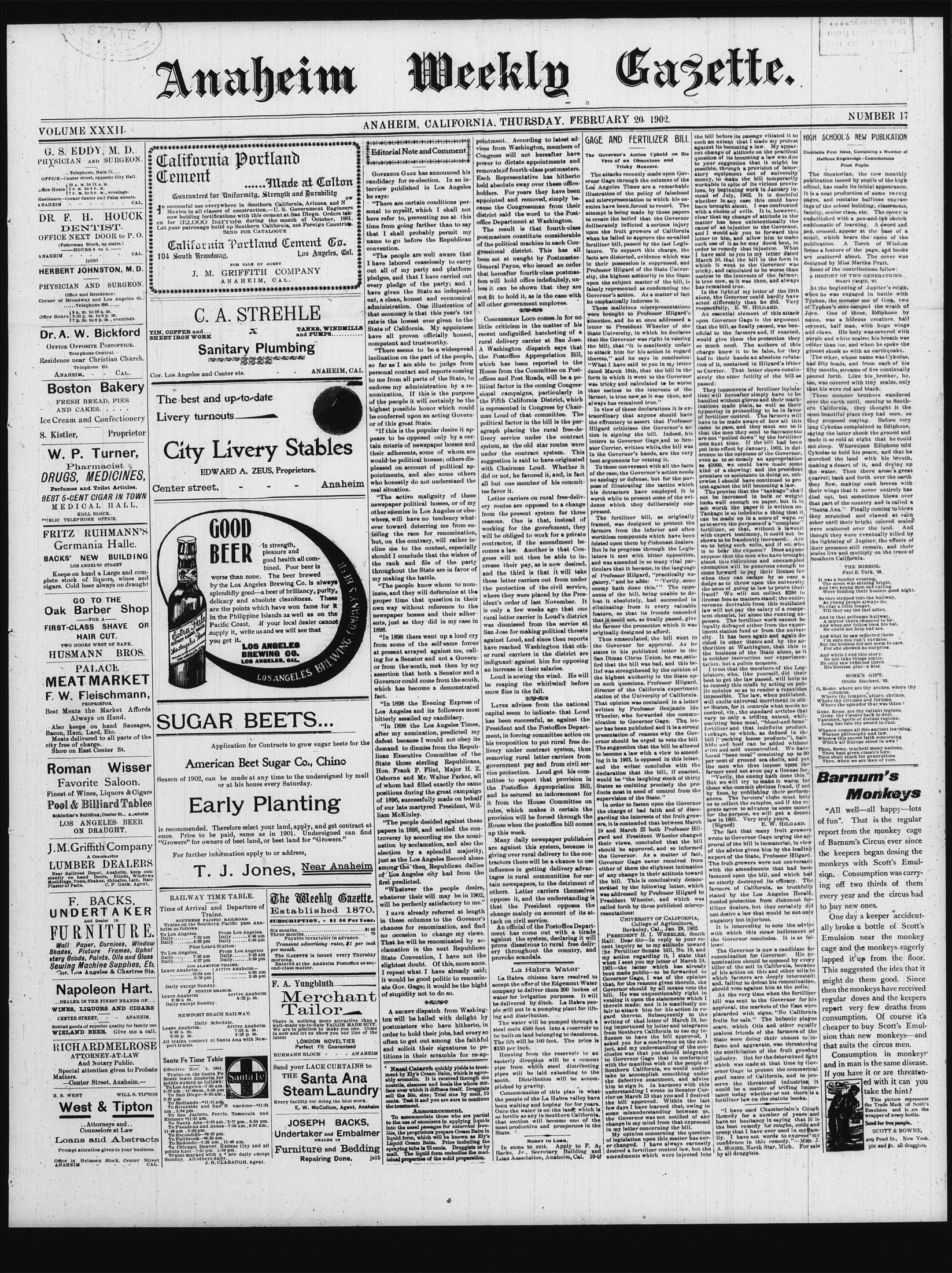
Searchable text
ANAHEIM
VOLUME XXXII.
G. S. EDDY, M. D.
PHYSICIAN AND SURGEON.
Telephone, Main 75...
OFFICE—Center street, opposite City Hall.
10 A.M. to 11 A.M.
Office Hours:
2 P.M. to 4 P.M.
7 P.M. to 8 P.M., evenings.
Residence—Corner Center and Palm streets.
ANAHEIM CAL.
DR. F. H. HOUCK
DENTIST.
OFFICE NEXT DOOR to P. O.
(Federman Block, up stairs.)
HOURS: 9 to 5.
ANAHEIM CAL.
Jy1541
HERBERT JOHNSTON, M. D.
PHYSICIAN AND SURGEON.
Office and Residence:
Corner of Broadway and Los Angeles St.
Telephone 660...
Office Hours:
9 a.m. to 10 a.m.
3:30 p.m. to 8 p.m.
7 p.m. to 8 p.m., evenings.
Dr. A. W. Bickford
OFFICE OPPOSITE POSTOFFICE.
Telephone Central.
Residence near Christian Church.
Telephone 101.
ANAHEIM CAL.
Boston Bakery
FRESH BREAD, PIES
AND CAKES.
Ice Cream and Confectionery
S. Kistler, Proprietor
W. P. Turner,
Pharmacist
California Portland Cement
Made at Colton
Guaranteed for Uniformity, Strength and Durability
In successful use everywhere in Southern California, Arizona and N
Mexico in all classes of construction.—U. S. Government Engineers
now building fortifications with this cement at San Diego. Orders taken
for 32,000 barrels during the month of October, 1901.
Let your patronage build up Southern California, not Foreign Countries.
SEND FOR CATALOGUE
California Portland Cement Co.
104 South Broadway,
Los Angeles, Cal.
FOR SALE BY AGENT
J. M. GRIFFITH COMPANY
ANAHEIM, CAL.
C. A. STREHLE
TIN, COPPER and...
SHEET IRON WORK
TANKS, WINDMILLS
and PUMPS...
Sanitary Plumbing
Cor. Los Angeles and Center sts.
The best and up-to-date
Livery turnouts
City Livery Stables
EDWARD A. ZEUS, Proprietors.
Boston Bakery
FRESH BREAD, PIES AND CAKES.
Ice Cream and Confectionery
S. Kistler, Proprietor
W. P. Turner,
Pharmacist
DRUGS, MEDICINES,
Perfumes and Toilet Articles.
BEST 5-CENT CIGAR IN TOWN MEDICAL HALL,
KOLL BLOCK.
PUBLIC TELEPHONE OFFICE.
FRITZ RUHMANN'S Germania Halle.
BACKS' NEW BUILDING
LOS ANGELES STREET
Keeps on hand a Large and complete stock of liquors, wines and cigars. Cold beer always on draught
GO TO THE Oak Barber Shop
FOR A FIRST-CLASS SHAVE OR HAIR CUT.
TWO DOORS WEST OF BANK.
HUSMANN BROS.
PALACE MEAT MARKET
F. W. Fleischmann,
PROPRIETOR.
Best Meats the Market Affords Always on Hand.
Also keeps on hand Sausages, Bacon, Ham, Lard, Etc.
Meats delivered to all parts of the city free of charge.
Shop on East Center St.
Roman Wisser
Favorite Saloon.
Finest of Wines, Liquors & Cigars
Pool & Billiard Tables
Sohindler's Building, Center St., Anaheim
LOS ANGELES BEER ON DRAUGHT.
J.M.Griffith Company
A CORPORATION
LUMBER DEALERS
Near Railroad Depot, Anaheim, keep constantly on hand Doors, Blinds, Windows Mouldings, Posts, Shakes, Shingles, Lath, Hair Plaster of Paris.
The best and up-to-date
Livery turnouts
City Livery Stables
EDWARD A. ZEUS, Proprietors.
Center street. - - - Anahei
GOOD BEER
Is strength, pleasure and good health all combined. Poor beer is worse than none. The beer brewed by the Los Angeles Brewing Co. is always splendidly good—a beer of brilliancy, purity, delicacy and absolute cleanliness. These are the points which have won fame for it in the Philippine Islands as well as on the Pacific Coast. If your local dealer cannot supply it, write us and we will see that you get it.
LOS ANGELES
BREWING CO.
LOS ANGELES, GAL.
SUGAR BEETS...
Application for Contracts to grow sugar beets for American Beet Sugar Co., Chino
Season of 1902, can be made at any time to the undersigned by or at his house every Saturday.
Early Planting
is recommended. Therefore select your land, apply, and get control once. Price to be paid, same as in 1901. Undersigned can "Growers" for owners of beet land, or beet land for "Growers."
For further information apply to or address,
T. J. Jones, Near Anaheim
Pool & Billiard Tables
Sohindler's Building, Center St., Anaheim
LOS ANGELES BEER ON DRAUGHT.
J.M. Griffith Company
A CORPORATION
LUMBER DEALERS
Near Railroad Depot, Anaheim, keep constantly on hand Doors, Blinds, Windows Mouldings, Posts, Shakes, shingles, Lath, Hair Plaster of Paris.
C. F. GRIM, Agent.
F. BACKS,
UNDERTAKER
And Dealer in
FURNITURE.
Wall Paper, Cornices, Window Shades, Picture Frames, Upholstery Goods, Paints, Oils and Glass Sewing Machine Supplies, Etc.
Cor. Los Angeles & Chartres Sts.
Napoleon Hart.
...DEALER IN THE FINEST BRANDS OF...
WINES, LIQUORS AND CIGARS
CENTER STREET, - ANAHEIM.
Bottled goods of superior quality for family use WIELAND BEER. Give me a call.
RICHARDMELROSE
ATTORNEY-AT-LAW
And Notary Public.
Special attention given to Probate Matters.
—Center Street, Anaheim.—
Z. B. WEST
WILL S. TIPTON
West & Tipton
Attorneys and...
Counselors at Law
Loans and Abstracts
Prompt attention given to your business.
Office in Helmsen Block, Center Street ANAHEIM CAL.
RAILWAY TIME TABLE.
Time of Arrival and Departure of Trains.
SOUTHERN PACIFIC RAILROAD.
Trains on the Southern Pacific pass Anaheim as follows:
To Los Angeles.
Daily.....7:52 am Daily.....9:49 am
Daily.....4:22 pm Daily.....6:06 pm
Pass Loara Station:
To Los Angeles.
Daily.....7:56 am Daily.....9:45 am
Daily.....4:27 pm Daily.....5:59 pm
LOS ALAMITOS TRAINS.
Leave Anaheim—
10:34 am 8:00 am
5:50 pm 3:05 pm
Daily except Sunday.
TUSTIN BRANCH.
Leave Anaheim Arrive Anaheim
9:49 a.m. 4:22 p.m.
Daily except Sunday.
NEWPORT BEACH RAILWAY.
Daily Schedule.
Leave Anaheim Arrive Anaheim
9:49 a.m. 7:52 a.m.
6:08 p.m. 4:23 p.m.
All trains connect at Santa Ana with Newport trains.
Santa Fe Time Table
Effective Nov. 4, 1901.
Trains on the Santa Fe Route leave Anaheim for points named as follows:
To Los Angeles—7:55 am, 11:49 am, 5:00 pm
To San Diego—9:35 am, 3:37 pm
To Redlands—11:31 am
To Riverside and San B nardino—11:31 am, 5:54 pm
To San Jacinto, Perris, Temecula and Elsinore—11:31 am
To Santa Ana—9:35 am, 3:37 pm, 5:54 pm
To Pasadena and Azusa—7:55 am, 9:57 am, 11:49 am, 5:05 pm
To Escondido—3:37 pm
To Fallbrook—3:37 pm
To Redondo—7:55 am, 11:49 am
To Chicago, Denver, Kansas City and all points East—5:05 pm, 5:54 pm
Trains marked with a * are daily except Sunday. All others daily.
J. H. CLABAUGH, Agent.
The Weekly Gazette
Established 1881
SUBSCRIPTION,- 91 50 Pe
Six months....Three months....Payable invariably in advance
Transient advertising rates,$1 per month.
The GAZETTE is issued every T morning.
Entered at the Anaheim Postoffice on-class matter.
F. A. Yungbluth
Merchandise Tailor
There is nothing more attractive well-made up-to-date TAILOR MAKE. We are in position to make you one in now and let us show you our latest
LONDON NOVELTIES Perfect Fit Guaranteed
RUHMANN BLOCK
Send your LACE CURTAIN
THE Santa An Steam Launcher Every facility for doing the best work E. W. McCollum, Agent
JOSEPH BACK
Undertaker and Embracer
DEALER IN Furniture and Bed Repairing Done,
Heim Weekly Gale
ANAHEIM, CALIFORNIA, THURSDAY, FEBRUARY 20. 1902.
Editorial Note and Comment
GOVERNOR GAGE has announced his candidacy for re-election. In an interview published in Los Angeles he says:
“There are certain conditions personal to myself, which I shall not here refer to, preventing me at this time from going farther than to say that I shall probably permit my name to go before the Republican convention.
“The people are well aware that I have labored ceaselessly to carry out all of my party and platform pledges, and that I have carried out every pledge of the party; and I have given the State an independent, a clean, honest and economical administration. One illustration of that economy is that this year’s tax rate is the lowest ever given to the State of California. My appointees have all proven officially honest, competent and trustworthy.
“There seems to be a widespread inclination on the part of the people, so far as I am able to judge from personal contact and reports coming to me from all parts of the State, to endorse my administration by a nomination. If this is the purpose of the people it will certainly be the highest possible honor which could be conferred upon an acting Governor of this great State.
“If this is the popular desire it appears to be opposed only by a certain coterie of newspaper bosses and their adherents, some of whom are would-be political bosses; others displeased on account of political appointments, and also some others pointment. According to latest advices from Washington, members of Congress will not hereafter have power to dictate appointments and removals of fourth-class postmasters. Each Representative has hitherto held absolute sway over these office-holders. For years they have been appointed and removed, simply because the Congressman from their district said the word to the Post-office Department at Washington.
The result is that fourth-class postmasters constitute considerable of the political machine in each Congressional district. This has all been set at naught by Postmaster-General Payne, who issued an order that hereafter fourth-class postmasters will hold office indefinitely, unless it can be shown that they are not fit to hold it, as in the case with all other government employs.
CONGRESSMAN LOUD comes in for no little criticism in the matter of his recent undignified hatcheting of a rural delivery carrier at San Jose. A Washington dispatch says that the Postoffice Appropriation Bill, which has been reported to the House from the Committee on Post offices and Post Roads, will be a political factor in the coming Congressional campaigns, particularly in the Fifth California District, which is represented in Congress by Chairman Loud of that committee. The political factor in the bill is the paragraph placing the rural free-delivery service under the contract system, as the old star routes were under the contract system. This suggestion is said to have originated with Chairman Loud. Whether it did not favor it and in fact
GAGE AND FERTILIZER
The Governor's Action Upheld Veto of an Obnoxious and Tricky Measure.
The attacks recently made upon Governor Gage through the columns in Los Angeles Times are a remain illustration of the policy of falsity and misrepresentation to which he emiles have been forced to resort. Attempt is being made by these efforts to create the belief that the Government deliberately inflicted a serious injury upon the fruit growers of Californi when he failed to approve the soil fertilizer bill, passed by the last lecture. To support this charge facts are distorted, evidence which in their possession is suppressed Professor Hilgard of the State University, the highest authority in the upon the subject matter of the falsely represented as condemnning Governor's action. As a matter he emphatically indorses it.
These malicious misrepresentations were brought to Professor Hilgard attention, and he at once addressed letter to President Wheeler of State University, in which he decried that the Governor was right in vowing that "it is manifestly intended to attack him for his action in thereto," and he says in concurance: "What I have said to you in my dated March 19th, that the bill form in which it went to the Gov was tricky and calculated to be less than useless to the interests of farmer, is true now as it was always has remained true."
In view of these declarations there is extraordinary that anyone should refuse to assert that Professor Hilgard criticises the Government in signing the bill. Indeed letters to Governor Gage and Senator Currier, written while she was in the Governor's hands, are the best arguments for vetting it.
To those conversant with all three of the case, the Governor's action
to me from all parts of the State, to endorse my administration by a renomination. If this is the purpose of the people it will certainly be the highest possible honor which could be conferred upon an acting Governor of this great State.
“If this is the popular desire it appears to be opposed only by a certain coterie of newspaper bosses and their adherents, some of whom are would-be political bosses; others displeased on account of political appointments, and also some others who honestly do not understand the real situation.
“The active malignity of these newspaper political bosses, or of my other enemies in Los Angeles or elsewhere, will have no tendency whatever toward deterring me from entering the race for renomination, but, on the contrary, will rather incline me to the contest, especially should I conclude that the wishes of the rank and file of the party throughout the State are in favor of my making the battle.
"The people know whom to nominate, and they will determine at the proper time that question in their own way without reference to the newspaper bosses and their adherents, just as they did in my case in 1898.
“In 1898 there went up a loud cry from some of the self-same forces at present arrayed against me, calling for a Senator and not a Governor from the south, met then by my assertion that both a Senator and a Governor could come from the south, which has become a demonstrated fact.
“In 1898 the Evening Express of Los Angeles and its followers most bitterly assailed my candidacy.
“In 1898 the Los Angeles Times, after my nomination, predicted my defeat because I would not obey its demand to dismiss from the Republican Executive Committee of the State those sterling Republicans, Hon. Frank P. Flint, Major H. Z. Osborne and Mr. Walter Parker, all of whom had filled exactly the same positions during the great campaign of 1896, successfully made on behalf of our late martyred President, William McKinley.
“The people decided against these papers in 1898, and settled the controversy by according me the nomination by acclamation, and also the election by a splendid majority, just as the Los Angeles Record alone among the then Republican dailies of Los Angeles city had from the first predicted.
“Whatever the people desire, whatever their will may be in 1902, offices and Post Roads, will be a political factor in the coming Congressional campaigns, particularly in the Fifth California District, which is represented in Congress by Chairman Loud of that committee. The political factor in the bill is the paragraph placing the rural free-delivery service under the contract system, as the old star routes were under the contract system. This suggestion is said to have originated with Chairman Loud. Whether it did or not, he favored it, and, in fact all but one member of his committee favor it.
Letter carriers on rural free-delivery routes are opposed to a change from the present system for three reasons. One is that, instead of working for the government, they will be obliged to work for a private contractor, if the amendment becomes a law. Another is that Congress will not then be able to increase their pay, as is now desired, and the third is that it will take these letter carriers out from under the protection of the civil service, where they were placed by the President’s order of last November. It is only a few weeks ago that one rural letter carrier in Loud’s district was dismissed from the service at San Jose for making political threats against Loud, and since then reports have reached Washington that other rural carriers in the district are indignant against him for opposing an increase in their salaries.
Loud is sowing the wind. He will be reaping the whirlwind before snow flies in the fall.
LATER advises from the national capital seem to indicate that Loud has been successful, as against the President and the Postoffice Department, in forcing committee action on his proposition to put rural free delivery under contract system, thus removing rural letter carriers from government pay and from civil service protection. Loud got his committee to report that provision in the Postoffice Appropriation Bill, and he secured an indorsement for it from the House Committee on rules, which makes it certain the provision will be forced through the House when the postoffice bill comes up this week.
Many daily newspaper publishers are against this system, because in giving over rural delivery to the contractors there will be a chance to use influence in getting delivery advantages in rural communities for certain newspapers, to the detriment of others. Letter carriers themselves impose it and the understanding is form in which it went to the Gov was tricky and calculated to be than useless to the interests of farmer, is true now as it was that always has remained true.”
In view of these declarations extraordinary that anyone should the effrontery to assert that President Hilgard criticises the Government in signing the bill. Indicators letters to Governor Gage andator Currier, written while she in the Governor’s hands, are the best arguments for vetoling it.
To those conversant with all three of the case, the Governor’s action no apology or defense, but for his pose of illustrating the tactic his detractors have employed worth while to present some of evidence which they deliberately pressed.
The fertilizer bill, as one framed, was designed to protect farmers from the inferior and worthless compounds which had folisted upon them by dishonest But in its progress through this literature it met with bitter opinions and was amended in so many variations that it became, in the hand of Professor Hilgard, “practical gory,” and he adds: “‘Verily enemy hath done this.’” The nents of the bill, being unable feat it absolutely, had success eliminating from it every feature, so that its friends that it could not, as finally pass the farmer the protection which originally designed to afford.
Thus emasculated, the bill—the Governor for approval states in his published letter San Dimas Citrus Union, he fled that the bill was bad, and lief was strengthened by the order of highest authority in this on such questions, Professor director of the California station of the University of CALIFORNIA.
That opinion was contained in written by Professor Benjie Wheeler, who forwarded themication to Governor Gage. The has been published and its presentation of reasons why he error should be urged to vet The suggestion that the bill he become a law with a view it in 1903, is opposed in it and the writer concludes declaration that the bill he would be “the laughing stock States as omitting precisely ducts most in need of control supervision of the State.”
In order to fasten upon them the charge of bad faith and garding the interests of theirs, it is contended that between 19 and March 23 both Progard and President Wheeler their views, concluded that should be approved, and said Governor. As a matter Governor Gage never received either of them the slightest of any change in their attitude the bill. This is conclusively stated by the following lea was addressed by Professor Wheeler and
The people decided against these papers in 1898, and settled the controversy by acclamation, and also the election by a splendid majority, just as the Los Angeles Record alone among the then Republican dailies of Los Angeles city had from the first predicted.
Whatever the people desire, whatever their will may be in 1902, will be perfectly satisfactory to me."
I have already referred at length in these columns to the Govenor's chances for renomination, and find no occasion to change my views. That he will be renominated by acclamation in the next Republican State Convention, I have not the slightest doubt. Of this, more anon. I repeat what I have already said; it would be good politic to renominate Gov. Gage; it would be the high of stupidity not to do so.
A recent dispatch from Washington will be hailed with delight by postmasters who have hitherto, in order to hold their jobs, had every so often to get out among the faithful and solicit their signatures to petitions in their scramble for re-ap-
Nasal Catarrh quickly yields to treatment by Ely's Cream Balm, which is agreeably aromatic. It is received through the nostrils, cleanses and heals the whole surface over which it diffuses itself. Druggists sell the 50c. size; Trial size by mail, 10 cents. Test it and you are sure to continue the treatment.
Announcement.
To accommodate those who are partial to the use of atomizers in applying liquids into the nasal passages for catarrhal troubles, the proprietors prepare Cream Balm in liquid form, which will be known as Ely's Liquid Cream Balm. Price including the spraying tube is 75 cents. Druggists or by mail. The liquid form embodies the medicinal properties of the solid preparation.
It from the House Committee on rules, which makes it certain the provision will be forced through the House when the postoffice bill comes up this week.
Many daily newspaper publishers are against this system, because in giving over rural delivery to the contractors there will be a chance to use influence in getting delivery advantages in rural communities for certain newspapers, to the detriment of others. Letter carriers themselves oppose it, and the understanding is that the President opposes the change mainly on account of its attack on civil service.
An official of the Postoffice Department has come out with a trade against the system, declaring it will prove disastrous to rural free delivery throughout the country, and provoke scandals.
La Habra Water
La Habra citizens have resolved to accept the offer of the Edgemont Water company to deliver them 200 inches of water for irrigation purposes. It will be delivered by ditch. La Habra people will put in a pumping plant for lifting and distribution.
The water will be pumped through a steel main 4500 feet into a reservoir to be built on land belonging to Sansinena. The lift will be 100 feet. The price is $350 per inch.
Running from the reservoir in an easterly direction will be a cement pipe from which steel distributing pipes will be laid extending to the south. Distribution will be accomplished by gravity.
Consummation of this plan is what the people of the La Habra valley have been waiting and hoping for years. Once the water is on the land, which is as fertile as any in Southern California, that section will become one of the most productive and prosperous in the State.
Money to Loan.
In sums to suit. Apply to F. A. Backs, Jr., Secretary Building and Loan Association, Anaheim, Cal. 10-t
Gazette.
JUARY 20. 1902.
HAGE AND FERTILIZER BILL
Governor's Action Upheld on His Veto of an Obnoxious and Tricky Measure.
The attacks recently made upon Governor Gage through the columns of the Los Angeles Times are a remarkable distortion of the policy of falsehood in representation to which his enemies have been forced to resort. The attempt is being made by these papers to create the belief that the Governor liberally inflicted a serious injury on the fruit growers of California when he failed to approve the so-called fertilizer bill, passed by the last Legislature. To support this charge, the laws are distorted, evidence which was their possession is suppressed, and Professor Hilgard of the State University, the highest authority in the State, has the subject matter of the bill, is merely represented as condemning the Governor's action. As a matter of fact emphatically indorses it.
These malicious misrepresentations were brought to Professor Hilgard's attention, and he at once addressed a letter to President Wheeler of the State University, in which he declares that the Governor was right in vetoing the bill; that "it is manifestly unfair attack him for his action in regard to preto," and he says in conclusion: that I have said to you in my letter dated March 19th, that the bill in the form in which it went to the Governor was tricky and calculated to be worse than useless to the interests of the farmer, is true now, as it was then, and always has remained true."
In view of these declarations it is extraordinary that anyone should have effrontery to assert that Professor Hilgard criticises the Governor's action in signing the bill. Indeed, his letters to Governor Gage and to Senator Currier, written while the bill was the Governor's hands, are the very best arguments for vetoing it.
To those conversant with all the facts of the case, the Governor's action needs the bill before its passage vitiated it to such an extent that I made my protest against its becoming a law. My apparent change of attitude on the practical question of its becoming a law was due to your suggestion that it might be possible, through a provision of laboratory equipment out of university money, to make the bill temporarily workable in spite of its vicious provisions, by beginning work in January instead of July, 1902. It is doubtful whether in any case this could have been brought about. I was confronted with a choice of evils. It is, however, clear that my change of attitude in the matter has been unintentionally the cause of an injustice to the Governor, and I would ask you to forward this letter to him, and allow him to make such use of it as he may deem best, in order to remedy that injustice. What I have said to you in my letter dated March 10, that the bill in the form in which it went to the Governor was tricky, and calculated to be worse than useless to the interests of the farmer, is true now, as it was then, and always has remained true.
In the light of my letter of the 19th alone, the Governor could hardly have acted differently than he did. Very respectfully, E. W. HILGARD.
An essential element of this attack upon Governor Gage is the argument that the bill, as finally passed, was beneficial to the farmers and, if enacted, would give them the protection they so much need. The authors of this charge knew it to be false, for they had in their hands an absolute refutation of it, contained in Hilgard's letter to Currier. That letter shows conclusively the utter futility of the bill as passed:
They (opponents of fertilizer legislation) will hereafter simply have to be handled without gloves and their machinations made plain, as well as their hypocrisy in pretending to be in favor of fertilizer control. The farmers will have to be made aware of how all this came to pass, and they must see to it that the men they send to Sacramento are not "pulled down" by the fertilizer men next time. If the bill had been put into effect by January, 1902, in deliberation to the opinions of the Governor, even as to so measly an appropriation as $1000, we could have made some kind of a showing; and the president creditable First Issue, Containing a Number of Halftone Engravings—Contributions From Pupils.
The Stentorlan, the new monthly publication issued by pupils of the high school, has made its initial appearance. It is a neat production of some twenty pages, and contains halftone engravings of the school building, classrooms, faculty; senior class, etc. The cover is embellished with a pen-and-ink sketch emblematic of learning. A sword and pen, crossed, appear at the base of a scroll, which bears the name of the publication. A Torch of Wisdom forms a feature of the page, and books are scattered about. The cover was designed by Miss Martha Pratt.
Some of the contributions follow:
A HISTORY OF TWO GENERATIONS.
Stuart Cargill.
At the beginning of Jupiter's reign, when he was engaged in battle with Typhon, the monster son of Gaea, two of Typhon's sons escaped the wrath of Jove. One of these, Ediphone by name, was a hideous creature, half serpent, half man, with huge wings and claws. His body was covered with purple and white scales; his breath was colder than ice, and when he spoke the ground shook as with an earthquake.
The other, whose name was Cykedas, had fifty heads, and from each of his fifty mouths, streams of fire continually poured forth. Like his brother, he, too, was covered with tiny scales, only that his were red and black.
These monster brothers wandered over the earth until, coming to Southern California, they thought it the most beautiful place they had seen, so they proposed staying. Before very long Cykedas complained to Ediphone, saying the latter shook the ground and made it so cold at night that he could not sleep. Whereupon Ediphone told Cykedas to hold his peace, and that he scorched the land with his breath, making a desert of it, and drying up the water. Then there arose a great
In which it went to the Governor was tricky and calculated to be worse useless to the interests of the farmer, is true now as it was then, and always has remained true."
In view of these declarations it is extraordinary that anyone should have effrontery to assert that Professor Hilgard criticises the Governor's action in signing the bill. Indeed, his letters to Governor Gage and to Senator Currler, written while the bill was the Governor's hands, are the very arguments for vetoing it.
To those conversant with all the facts of the case, the Governor's action needs apology or defense, but for the purpose of illustrating the tactics which detractors have employed, it is worth while to present some of the evidence which they deliberately suppressed.
The fertilizer bill, as originally named, was designed to protect the farmers from the inferior and often worthless compounds which have been listed upon them by dishonest dealers. But in its progress through the Legislature it met with bitter opposition, and was amended in so many vital particulars that it became, in the language of Professor Hilgard, "practically nu-tory," and he adds: "Verily, some enemy hath done this." The opponents of the bill, being unable to defeat it absolutely, had succeeded in eliminating from it every valuable feature, so that its friends conceded that it could not, as finally passed, give the farmer the protection which it was originally designed to afford.
Thus emasculated, the bill went to one Governor for approval. As he states in his published letter to the San Dimas Citrus Union, he was satisfied that the bill was bad, and this belief was strengthened by the opinion of the highest authority in the State upon such questions, Professor Hilgard, director of the California experiment station of the University of California. That opinion was contained in a letter written by Professor Benjamin Ide Wheeler, who forwarded the communication to Governor Gage. The letter has been published and it is a strong presentation of reasons why the Governor should be urged to veto the bill. The suggestion that the bill be allowed to become a law with a view to amending it in 1903, is opposed in this letter, and the writer concludes with the declaration that the bill, if enacted, would be "the laughing stock of thirty States as omitting precisely the products most in need of control from the supervision of the State."
In order to fasten upon the Governor the charge of bad faith and of disregarding the interests of the fruit growers, it is contended that between March 19 and March 23 both Professor Hilgard and President Wheeler changed their views, concluded that the bill should be approved, and so informed the Governor. As a matter of fact, Governor Gage never received from either of them the slightest intimation of any change in their attitude toward the bill. This is conclusively demonstrated by the following letter, which was addressed by Professor Hilgard to President Wheeler, and which was sively the utter futility of the bill as passed:
They (opponents of fertilizer legislation) will hereafter simply have to be handled without gloves and their machinations made plain, as well as their hypocrisy in pretending to be in favor of fertilizer control. The farmers will have to be made aware of how all this came to pass, and they must see to it that the men they send to Sacramento are not "pullled down" by the fertilizer men next time. If the bill had been put into effect by January, 1902. In reference to the opinions of the Governor, even as to so meally an appropriation as $1000, we could have made some kind of a showing; and the president promises us assistance in doing so, otherwise I should have continued to protest against the bill becoming a law.
The proviso that the "tankage" shall not be increased in bulk or weight looks well enough on paper, but it is not worth the paper it is written on. Tankage is so indefinite a thing that it can be made up in a score of ways, so as to serve the purposes of a "complete" fertilizer, so that, without a lawsuit with expert testimony, it could not be shown to be fraudently increased. Are we to bring such suits, and if so, who is to bear the expense? Does anyone suppose that the men who have brought about this ridiculous and unexamined exemption will be generous enough to come forward to pay their license fee when they can escape by so easy a dodge as to throw upon the university onus of going to law to prove their fraud? We will not collect $200 in license fees as matters stand; the entire revenue derivable from this mutilated law will not pay the salary of a competent chemist, let alone the running expenses. The fertilizer work cannot be legally defrayed either from the experiment station fund or from the university. It has been again and again decided in other States and by the authorities at Washington, that this is the business of the State alone, as it is neither instruction nor experimentation, but a police measure.
I trust that the members of the Legislature, who, like yourself, did their best to get the law passed, will help us to remedy this misfit by acting on public opinion so as to render a repetition impossible. The law, when published, will excite universal merriment in other States, for it controls what needs no control, viz., the standard articles that vary to only a trifling extent, while omitting bone meal, "blood-and-bone" fertilizer and that indefinite product tankage, to which, as defined in the bill ("packing house products"), hair hide and hoof can be added without stint and sold uncontrolled. We have found "bone meal" consisting up to 90 per cent of ground sea shells, and yet men who thus impose upon the farmer need not even pay a license fee.
"Verily, the enemy hath done this." But we will try to make it warm for those who commit obvious fraud, if not by fines, by publishing their performances. The farmers' clubs must help us to collect samples, and if they regents agree to advance us some money for the purpose, we will get a decent law in 1903. Very truly yours,
(Signed)
E. W. HILGARD.
The fact that many fruit growers wrote to Governor Gage urging the approval of the bill is immaterial, in view of the advice given him by the leading expert of the State, Professor Hilgard. The fruit growers were not conversant with the amendments that had been fastened upon the bill, and which had so utterly destroyed its efficacy. The farmers of California, as truthfully stated by the Los Angeles Herald,
poured forth. Like his brother, he too, was covered with tiny scales, only that his were red and black.
These monster brothers wandered over the earth until, coming to Southern California, they thought it most beautiful place they had seen, so they proposed staying. Before very long Cykedes complained to Ediphone, saying the latter shook the ground and made it so cold at night that he could not sleep. Whereupon Ediphone told Cykedes to hold his peace, and that he scorched the land with his breath, making such breeze with their wings that it never entirely has died out, but sometimes blows over that part of the country and is called a "Santa Ana." Finally coming to blews they scratched and clawed at each other until their bright colored scales were scattered over the land. And though they were eventually killed by the lightning of Jupiter, the effects of their presence still remain, and their scales live and multiply on the trees of Southern California.
THE MIRROR.
Paul E. Turk,'03.
It was a Sunday evening,
The moon was shining bright,
And two young men out calling,
Were bidding their hostess good night.
So they stepped into the hallway,
As young people always do,
To chat a little longer,
Till they say the last adieu.
And in that selfsame hallway,
A mirror there chanced to be;
And when one fellow took his hat,
He could not help but see.
And what he saw reflected there
I'm sure you can't surmise.
But the hostess did not seem to care.
For she showed no surprise.
And while I end this story,
Do not take things amiss!
He only saw reflected there
His hostess plus-a kiss.
ROME'S GIFT.
Ottille Stechert,'03.
O, Rome, where are thy arches, where thy columns,
Where thy temples, altars, shrines,
Where thy circuses and forums,
Where the splendor that was thine?
Gone. Rome are thy valiant legions,
Gone. thy Gaspers back to dust,
Vanished, spolls of distant regions;
Long has lain thy sword to rust.
Whence comes all this ancient learning,
Whence philosophy and law,
Whence this sacred faith concerning
Which all Europe stood in awe?
Thou, Rome, teachest many nations,
Thou hast given classless lore;
Thou shalt teach for generations
Then, when we are men of yore.
Barnum's Monkeys
"All well—all happy—lots of fun". That is the regular report from the monkey cage of Barnum's Circus ever since the keepers began dosing the monkeys with Scott's Emulsion. Consumption was carrying off two thirds of them every year and the circus had
In order to fasten upon the Governor the charge of bad faith and of disregarding the interests of the fruit growers, it is contended that between March 19 and March 23 both Professor Hilgard and President Wheeler changed their views, concluded that the bill should be approved, and so informed the Governor. As a matter of fact, Governor Gage never received from either of them the slightest intimation of any change in their attitude toward the bill. This is conclusively demonstrated by the following letter, which was addressed by Professor Hilgard to President Wheeler, and which was called forth by these published misrepresentations:
UNIVERSITY OF CALIFORNIA,
College of Agriculture,
Berkeley, Cal., Jan. 29, 1902.
PRESIDENT B. I. WHEELER, South Hall: Dear Sir—In reply to your recent inquiry as to my attitude toward the Fertilizer Senate bill, No. 19, and my action regarding it, I state that when I sent you my letter of March 19, 1901—the letter which has already been made public—to be forwarded to Governor Gage, I was of the opinion that, for the reasons given therein, the Governor should by all means veto the bill. He was unquestionably right in vetting it upon the statements which I therein made; and it is manifestly unfair to attack him for his action in regard thereto. Subsequently to the writing of that letter of March 19, being importuned by letter and telegrams from Southern California to use my influence to have the bill approved, I asked you for a conference on the subject, and my understanding of the conclusion was that you should telegraph to Governor Gage that in conformity with the manifest wish of the people of Southern California, we would undertake to accomplish something under the defective enactment, and advise him to sign it. In harmony with this understanding I wrote to Senator Currier on March 23 that you and I desired the bill approved. Within the last few days I have learned that, owing to some misunderstanding between us, the Governor was not notified of any change in my mind from that expressed in my letter concerning the bill.
My opinion concerning the question of legislation upon this matter has never changed. I have always earnestly desired a fertilizer control law, but the amendments which were injected into
"All well—all happy—lots of fun". That is the regular report from the monkey cage of Barnum's Circus ever since the keepers began dosing the monkeys with Scott's Emulsion. Consumption was carrying off two thirds of them every year and the circus had to buy new ones.
One day a keeper accidentally broke a bottle of Scott's Emulsion near the monkey cage and the monkeys eagerly lapped it up from the floor. This suggested the idea that it might do them good. Since then the monkeys have received regular doses and the keepers report very few deaths from consumption. Of course it's cheaper to buy Scott's Emulsion than new monkeys—and that suits the circus men.
Consumption in monkeys and in man is the same disease. If you have it or are threatened with it can you take the hint?
This picture represents the Trade Mark of Scott's Emulsion and is on the wrapper of every bottle.
Send for free sample.
SCOTT & BOWNE,
409 Pearl St., New York.
500c and $1. all druggists.