anaheim-gazette 1902-01-02
Scanned page
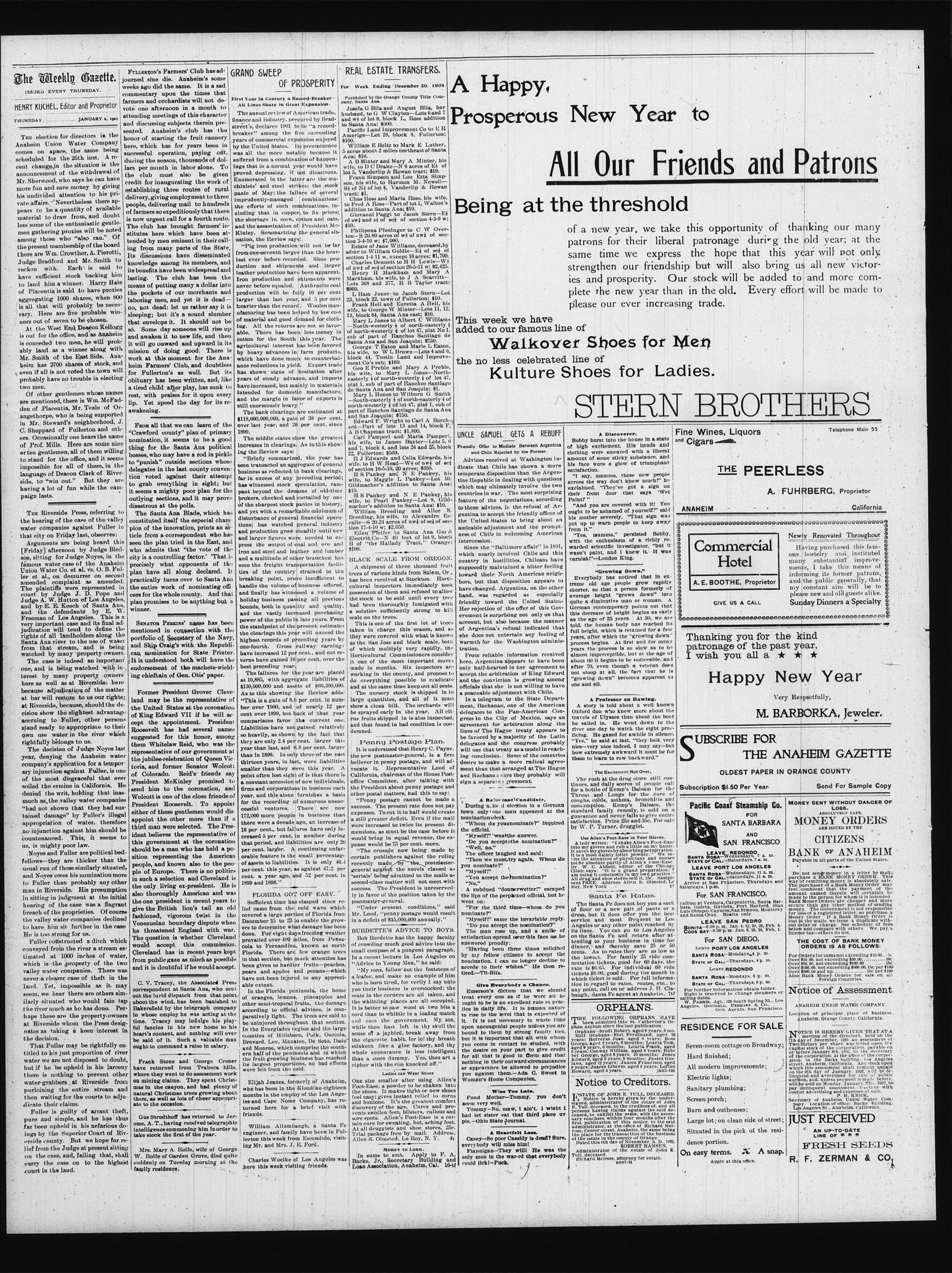
Searchable text
The election for directors in the Anaheim Union Water Company comes on apace, the same being scheduled for the 25th inst. A recent change in the situation is the announcement of the withdrawal of Mr. Sherwood, who says he can have more fun and save money by giving his undivided attention to his private affairs. Nevertheless there appears to be a quantity of available material to draw from, and doubt less some of the enthusiastic gentlemen gathering proxies will be noted among those who "also ran." Of the present membership of the board there are Wm. Crowther, A. Pierotti, Judge Bradford and Mr. Smith to reckon with. Each is said to have sufficient stock backing him to land him a winner. Harry Hale of Placentia is said to have proxies aggregating 1000 shares, when 800 is all that will probably be necessary. Here are five probable winners out of seven to be chosen.
At the West End Deacon Kellogg is out for the office, and as Anaheim is conceded two men, he will probably land as a winner along with Mr. Smith of the East Side. Anaheim has 2700 shares of stock, and even if all is not voted the town will probably have no trouble in electing two men.
Of other gentlemen whose names are mentioned, there is Wm. McFadden of Placentia, Mr. Teale of Orangethorpe, who is being supported in Mr. Steward's neighborhood, J. C. Sheppard of Fullerton and others. Occasionally one hears the name of Prof. Mills. Here are some nine or ten gentlemen, all of them willing to stand for the office, and it seems impossible for all of these, in the language of Deacon Clark of River-
Fullerton's Farmers' Club has adjourned sine die. Anaheim's some weeks ago did the same. It is a sad commentary upon the times that farmers and orchardists will not devote one afternoon in a month to attending meetings of this character and discussing subjects therein presented. Anaheim's club has the honor of starting the fruit cannery here, which has for years been in successful operation, paying out, during the season, thousands of dollars per month in labor alone. To the club must also be given credit for inaugurating the work of establishing three routes of rural delivery, giving employment to three people, delivering mail to hundreds of farmers so expeditiously that there is now urgent call for a fourth route. The club has brought farmers' institutes here which have been attended by men eminent in their calling from many parts of the State. Its discussions have disseminated knowledge among its members, and its benefits have been widespread and lasting. The club has been the means of putting many a dollar into the pockets of our merchants and laboring men, and yet it is dead—no, not dead: let us rather say it is sleeping; but it's a sound slumber that envelops it. It should not be so. Some day someone will rise up and awaken it to new life, and then it will go onward and upward in its mission of doing good. There is work at this moment for the Anaheim Farmers' Club, and doubtless for Fullerton's as well. But its obituary has been written, and, like a tired child after play, has sunk to rest, with praises for it upon every lip. Yet speed the day for its reawakening.
From all that we can learn of the "Crawford county" plan of primary nomination, it seems to be a good thing for the Santa Ana political bosses, who may have a rod in pickle to "punish" outside sections whose delegates in the last county convene-
GRAND SWEEP OF PROSPERITY
First Year In Century a Record-Breaker—All Lines Share in Great Expansion.
The annual review of American trade, finance and industry, prepared by Bradstreet's, declares 1901 to be "a record-breaker" among the five succeeding years of commercial expansion enjoyed by the United States. Its preeminence was all the more notable because it suffered from a combination of happenings that in a normal year would have proved depressing, if not disastrous. Enumerated in the latter are the machinists' and steel strikes; the stock panic of May; the failure of several imprudently-managed combinations: the efforts of such combinations, including that in copper, to fix prices; the shortage in corn, cotton and oats, and the assassination of President McKinley. Summarizing the general situation, the Review says:
"Pig iron production will not be far from one-seventh larger than the heaviest ever before recorded. Shoe production and shipments and larger leather production have been apparent. Iron production and shipments were never before equaled. Anthracite coal production will be fully 10 per cent larger than last year, and 5 per cent heavier than the record. Woolen manufacturing has been helped by low cost of material and good demand for clothing. All the returns are not so favorable. There has been less money in cotton for the South this year. The agricultural interest has been favored by heavy advances in farm products, which have done much to counterbalance reductions in yield. Export trade has shown signs of hesitation after years of steady advance, and imports have increased, but mainly in materials intended for domestic manufacture, and the margin in favor of exports is still enormously heavy."
The bank clearings are estimated at $118,000,000,000, a gain of 38 per cent. over last year, and 26 per cent. since 1899.
The middle states show the greatest increases in clearings. As to this showing the Review says:
"Briefly summarized, the year has seen transacted an aggregate of general business as reflected in bank clearings,"
Of other gentlemen whose names are mentioned, there is Wm. McFadden of Placentia, Mr. Teale of Orangethorpe, who is being supported in Mr. Steward's neighborhood, J. C. Sheppard of Fullerton and others. Occasionally one hears the name of Prof. Mills. Here are some nine or ten gentlemen, all of them willing to stand for the office, and it seems impossible for all of these, in the language of Deacon Clark of Riverside, to "win out." But they are having a lot of fun while the campaign lasts.
The Riverside Press, referring to the hearing of the case of the valley water companies against Fuller in that city on Friday last, observes:
Arguments are being heard this [Friday] afternoon by Judge Bledsoe, sitting for Judge Noyes, in the famous water case of the Anaheim Union Water Co. et al. vs. O. B. Fuller et al., on demurder on second amended complaint as amended. The plaintiffs were represented in court by Judge J. D. Pope and Judge A. W. Hutton of Los Angeles, and by E. E. Keech of Santa Ana, and the defendants by E. W. Freeman of Los Angeles. This is a very important case and its final adjudication will tend to define the rights of all landholders along the Santa Ana river to the use of water from that stream, and is being watched by many property owners.
The case is indeed an important one, and is being watched with interest by many property owners here as well as at Riverside; here because adjudication of the matter at bar will restore to us our rights; at Riverside, because, should the decision show the slightest advantage accruing to Fuller, other persons stand ready to appropriate to their own use water in the river which rightfully belongs to us.
The decision of Judge Noyes last year, denying the Anaheim water company's application for a temporary injunction against Fuller, is one of the most disgraceful that ever soiled the ermine in California. He denied the writ, holding that inasmuch as, the valley water companies "had not shown that they had sustained damage" by Fuller's illegal appropriation of water, therefore no injunction against him should be countenanced. This, it seems to us, is mighty poor law.
Noyes and Fuller are political bedfellows—they are thicker than the usual run of those similarly situated, and Noyes owes his nomination more to Fuller than probably any other man in Riverside. His presumption in sitting in judgment at the initial obituary has been written, and, like a tired child after play, has sunk to rest, with praises for it upon every lip. Yet speed the day for its awakening.
From all that we can learn of the "Crawford county" plan of primary nomination, it seems to be a good thing for the Santa Ana political bosses, who may have a rod in pickle to "punish" outside sections whose delegates in the last county convention voted against their attempt to grab everything in sight; but it seems a mighty poor plan for the outlying sections, and it may prove disastrous at the polls.
The Santa Ana Blade, which has constituted itself the especial champion of the innovation, prints an article from a correspondent who has seen the plan tried in the East, and who admits that "the vote of the city is a controlling factor." That is precisely what opponents of the plan have all along declared. It practically turns over to Santa Ana the entire work of nominating officers for the whole county. And that plan promises to be anything but a winner.
Senator Perkins' name has been mentioned in connection with the portfolio of Secretary of the Navy, and Skip Craig's with the Republican nomination for State Printer. It is understood both will have the endorsement of the machete-wielding chieftain of Gen. Otis' paper.
Former President Grover Cleveland may be the representative of the United States at the coronation of King Edward VII if he will accept the appointment. President Roosevelt has had several names suggested for this honor, among them Whitelaw Reid, who was the representative of our government at the jubilee celebration of Queen Victoria, and former Senator Wolcott of Colorado. Reid's friends say President McKinley promised to send him to the coronation, and Wolcott is one of the close friends of President Roosevelt. To appoint either of these gentlemen would disappoint the other more than if a third man were selected. The President believes the representative of this government at the coronation should be a man who has held a position representing the American people, and known also to the people of Europe. There is no politics in such a selection and Cleveland is the only living ex-president. He is also thoroughly American and was obituary has been written, and, like a tired child after play, has sunk to rest, with praises for it upon every lip. Yet speed the day for its rewakening.
The bank clearings are estimated at $118,000,000,000, a gain of 38 per cent, over last year, and 26 per cent since 1899.
The middle states show the greatest increases in clearings. As to this showing the Review says:
"Briefly summarized, the year has seen transacted an aggregate of general business as reflected in bank clearings, far in excess of any preceding period; has witnessed stock speculation, rampant beyond the dreams of old-time brokers, checked and curtailed by one of the sharpest stock panies in history, and yet with a remarkable minimum of disturbance of general financial operations; has watched general industry and production grow steadily until new and larger figures were needed to express the output of coal and ore and iron and steel and leather and lumber and a multitude of other branches; has seen the freight transportation facilities of the country strained to the breaking point, prove insufficient to handle the volume of business offered, and finally has witnessed a volume of holiday business passing all previous bounds, both in quantity and quality, and the vastly increased purchasing power of the public in late years. From the standpoint of the present estimates the clearings this year will exceed the highest records of preceding years by one-fourth. Gross railway earnings have increased 12 per cent., and net returns have gained 16 per cent, over the best preceding year.
The failures for the year are placed at 10,885, with aggregate liabilities of $130,000,000 and assets of $60,300,000. As to this showing the Review adds: "This is a gain of 8.6 per cent. in number over 1900, and of nearly 12 per cent over 1899, but back of that year comparisons favor the current one. Liabilities have not gained relatively so heavily, as shown by the fact that they are only 2.4 per cent. larger this year than last, and 6.8 per cent. larger than in 1899. In only three of the past thirteen years, in fact, were liabilities smaller than they were this year. A point often lost sight of is that there is a constant accession of new individuals firms and corporations in business each year, and this alone furnishes a basis for the recording of numerous unsuccessful ventures. There are now 172,000 more people in business than there were a decade ago, an increase of 16 per cent., but failures have only increased 5 per cent. in number during that period, and liabilities are only 20 per cent. larger. A continuing unfavorable feature is the small percentage of assets to liabilities. It is only 46.4 per cent. this year, as against 47.2 per cent. a year ago, and 52 per cent. in 1899 and 1898."
FLORIDA GOT OFF EASY.
much as the valley water companies "had not shown that they had sustained damage" by Fuller's illegal appropriation of water, therefore no injunction against him should be countenanced. This, it seems to us, is mighty poor law.
Noyes and Fuller are political bedfellows—they are thicker than the usual run of those similarly situated, and Noyes owes his nomination more to Fuller than probably any other man in Riverside. His presumption in sitting in judgment at the initial hearing of the case was a flagrant breach of the proprieties. Of course the valley water companies declined to have him sit further in the case He is too strong for us.
Fuller constructed a ditch which conveyed from the river a stream estimated at 1000 inches of water, which is the property of the two valley water companies. There was never a clearer case of theft in the land. Yet, impossible as it may seem, we hear there are others similarly situated who would fain tap the river much as he has done. Perhaps these are the property owners at Riverside whom the Press designates as taking a keen interest in the decision.
That Fullar may be rightfully entitled to his just proportion of river water we are not disposed to doubt, but if he be upheld in his larceny there is nothing to prevent other water-grabbers at Riverside from purloining the entire stream and then waiting for the courts to adjudicate their claims.
Fuller is guilty of arrant theft, pure and simple, and he has thus far been upheld in his nefarious doings by the Superior Court of Riverside county. But we hope for relief from the Judge at present sitting on the case, and, failing that, shall carry the case on to the highest court in the land.
President Roosevelt. To appoint either of these gentlemen would disappoint the other more than if a third man were selected. The President believes the representative of this government at the coronation should be a man who has held a position representing the American people, and known also to the people of Europe. There is no politics in such a selection and Cleveland is the only living ex-president. He is also thoroughly American and was the one president in recent years to give the British lion's tail an old fashioned, vigorous twist in the Venezuelan boundary dispute when he threatened England with war. The question is whether Cleveland would accept this commission. Cleveland has in recent years kept from public gaze as much as possible and it is doubtful if he would accept.
C. V. Tracey, the Associated Press correspondent at Santa Ana, who sent out the lurid dispatch from that point about the wind, has been banished to Bakersfield by the telegraph company in whose employ he was acting at the time. Tracey may indulge his playful fancies in his new home to his heart's content, and nothing will ever be said of it. Such a valuable man ought to command a raise in salary.
Frank Stone and George Croner have returned from Trabuca hills, where they went to do assessment work on mining claims. They spent Christmas in the canyon, and had plenty of natural Christmas trees growing about them, as well as lots of cheer appropriate to the occasion.
Gus Strodthoff has returned to Jerome, A. T., having received telegraphic intelligence summoning him in order to take stock the first of the year.
Mrs. Mary A. Rolfe, wife of George W. Rolfe of Garden Grove, died quite suddenly on Tuesday morning at the family residence.
FLORIDA GOT OFF EASY.
Sufficient time has elapsed since relief came from the cold wave which covered a large portion of Florida from December 15 to 23 to enable the growers to determine what damage has been done. For eight days freezing weather prevailed over 400 miles, from Pensacola to Fernandina, known as north Florida. There are few orange trees in that section, but much attention has been given to hardier fruits—peaches, pears and apples and pecans—which have not been injured to any appreciable extent.
In the Florida peninsula, the home of oranges, lemons, pineapples and other semi-tropical fruits, the damage according to official advises, is comparatively light. The trees are said to be uninjured throughout that section. In the Everglades region and the large counties of Hillsboro, Polk, Osceola, Brevard, Lee, Manatee, De Soto, Dade and Monroe, which comprise the southern half of the peninsula and in which the fruit growing business has reached its largest proportions, no bad effects were felt from the cold.
Elijah Jeanes, formerly of Anaheim, who has been in the Klondike eighteen months in the employ of the Los Angeles and Cape Nome Company, has returned here for a brief visit with friends.
William Allumbaugh, a Santa Fe engineer, and family have been in Fullerton this week from Escondido, visiting Mr. and Mrs. J. E. Ford.
Charles Woelke of Los Angeles was here this week visiting friends.
REAL ESTATE TRANSFERS.
For Week Ending December 30, 1901
Furnished by the Orange County Title Company, Santa Ana.
Josefa G Bila and August Bila, her husband, to G W Clayton—Lots 6 and 7 and w½ of lot 8, block L, Ross addition to Santa Ana; $300.
Pacific Land Improvement Co to E R Amerige—Lot 29, block 8, Fullerton; $100.
William E Beltz to Mark E Luther, 5 acres about 2 miles northeast of Santa Ana; $10.
A B Minter and Mary A Minter, his wife, to D C Drake—N 6 acres of E½ of lot 5, Vanderlip & Rowan tract; $10.
Frank Simpson and Lou Etta Simpson, his wife, to Harmon M. Newell—S½ of N½ of lot 4, Vanderlip & Rowan tract; $1.
Chas Ross and Maria Ross, his wife, to Fred A Ross—Part of lot 1, Walton’s addition to Santa Ana; $10.
Giovanni Paggi to Jacob Stern—E½ of sw½ and s½ of section 4-3-9 w; $10.
Philipena Pfeninger to C W Overton—S 20.80 acres of w½ of nw½ of section 3-4-10 w; $7,000.
Estate of Jane Williams, deceased, by admr to William Goldle—E½ of set¾ of section 1-4-11 w, except 10 acres; $1,700.
Charles Dennett to H H Lewis—W½ of nw½ of set¾ of section 26-5-11 w; $2,425.
Henry H Markham and Mary A Markham, his wife, to J A Scarritt—Lots 368 and 377, R B Taylor tract; $960.
L Ham Juner to Jacob Stern—Lot 23, block 22, town of Fullerton; $10.
Frank Heil and Euretta A Heil, his wife, to George W Minter—Lots 11, 12, 13, block 84, Santa Ana east; $10.
Mary L Jones to Albert C Williams—North-westerly¼ of north-easterly¼ of north-westerly¼ of lot 47, plat No 1, sub of part of Ranchos Santiago de Santa Ana and San Joaquin; $750.
George T Eaton and Marie L Eaton, his wife, to W L Brown—Lots 4 and 6, block 44, Tustin Land and Improvement Co’s sub; $160.
Geo E Preble and Mary A Preble, his wife, to Mary L Jones—North-easterly¼ of north-westerly¼ of lot 47, plat No 1, sub of part of Ranchos Santiago de Santa Ana and San Joaquin; $1.
Mary L Hones to Wilburn G Smith—South-easterly¼ of north-easterly¼ of north-westerly¼ of lot 47, plat No 1, sub of part of Ranchos Santiago de Santa Ana and San Joaquin; $750.
Edward F. Wright to Carl A Borchard—Part of lots 13 and 14, block F, A B Chapman tract; $1,800.
Carl Pamperl and Maria Pamperl, his wife, to James Baxter—Lots 5, 6 and 7, block 4, and lots 24 and 25, block 22, Fullerton; $560.
R J Edwards and Celia Edwards, his wife, to H W Head—W½ of nw½ of set¾ of section 16-5-10, 20 acres; $350.
H S Pankey and N E Pankey, his wife.
UNCLE SAMUEL GETS A REBUFF
Friendly Offer to Mediate Between Argentina and Chile Rejected by the Former.
Advices received at Washington indicate that Chile has shown a more temperate disposition than the Argentine Discoverer.
Bobby burst into the house in a state of high excitement. His hands and clothing were smeared with a liberal amount of some sticky substance, and his face wore a glow triumphant satisfaction.
UNCLE SAMUEL GETS A REBUFF
Friendly Offer to Mediate Between Argentina and Chile Rejected by the Former.
Advices received at Washington indicate that Chile has shown a more temperate disposition than the Argentine Republic in dealing with questions which may ultimately involve the two countries in war. The most surprising feature of the negotiations, according to these advices, is the refusal of Argentina to accept the friendly offices of the United States to bring about an amicable adjustment and the promptness of Chile in welcoming American intercession.
Since the "Baltimore affair" in 1891, which nearly involved Chile and this country in hostilities, Chileans have supposedly maintained a bitter feeling toward their North American neighbors, but that disposition appears to have changed. Argentina, on the other hand, was regarded as especially friendly toward the United States. Her rejection of the offer of this Government is surprising not only on that account, but also because the manner of Argentina's refusal indicated that she does not entertain any feeling of warmth for the Washington administration.
From reliable information received here, Argentina appears to have been only half-hearted in her agreement to accept the arbitration of King Edward and the conviction is growing among officials that she is not willing to have a peaceable adjustment with Chile.
In a telegram to the State Department, Buchanan, one of the American delegates to the Pan-American Congress in the City of Mexico, says an agreement for arbitration along the lines of The Hague treaty appears to be favored by a majority of the Latin delegates and the congress probably will use that treaty as a model in reaching conclusion. Some of the countries desire to make a more radical agreement than that arranged at The Hague and Buchanan says they probably will sign a separate agreement.
A Resistant Candidate.
During a local election in a German town only one man appeared at the nomination desk.
"Whom do you nominate?" inquired the official.
"Myself!" was the answer.
"Do you accept the nomination?"
"Well, no."
The officer laughed and said:
"Then we must try again. Whom do you nominate?"
"Myself!"
"You accept the nomination?"
"No."
A subdued "donnerwetter!" escaped the lips of the perplexed official, but he
A Discoverer.
Bobby burst into the house in a state of high excitement. His hands and clothing were smeared with a liberal amount of some sticky substance, and his face wore a glow of triumphant satisfaction.
"I say, mamma, those new people across the way don't know much!" he exclaimed. "They've got a sign on their front door that says 'Wet Palm!'"
"And you are covered with it! You ought to be ashamed of yourself!" said his mother severely. "That sign was put up to warn people to keep away from it."
"Yes, mamma," persisted Bobby, with the enthusiasm of a richly rewarded scientific investigator, "but it wasn't paint, and I knew it. It was varnish!"—London King.
Growing Down.
Everybody has noticed that in extreme old age people grow rapidly shorter, so that a person formerly of average height "grows down" into quite a diminutive man or woman. A German contemporary points out that this decrease of height begins as early as the age of 35 years. At 30, we are told, the human body has reached its full height, which is retained for a few years, after which the "growing down" process begins. At first and for many years the process is so slow as to be almost imperceptible, but at the age of about 60 it begins to be noticeable, and after 70, even though a veteran does not stoop at all, the fact that he is "growing down" becomes apparent to one and all.
A Professor on Rowing.
A story is told about a well known Oxford don who knew more about the travels of Ulysses than about the boat he sailed in. He went down to the river one day to watch the eight practicing. He gazed for awhile in silence. "Yes," he said at last, "they look very nice—very nice indeed. I may say—but how extremely awkward it must be for them to learn to row backward."
The Excitement Not Over.
The rush at the drug store still continues, and daily scores of people call for a bottle of Kemp's Balsam for the Throat and Lungs for the cure of coughs, colds, asthma, bronchitis and consumption. Kemp's Balsam, the standard family remedy, is sold on a guarantee and never fails to give entire satisfaction. Price 25c and 35c. For sale by W. P. Turner, druggist.
Use Allen's Foot-Ease in Your Gloves.
A lady writes: "I shake Allen's Foot-Ease into my gloves and rub a little on my hands. It saves my gloves by absorbing perspiration. It is a most dainty toilet powder." We invite the attention of physicians and nurses of the absolute purity of Allen's Foot-Ease. Dr. W. C. Abbott, editor of the Chicago Clinic says: "It is a grand preparation; am using it constantly in my own practice. All drug and shoe stores sell it." 25c. Sample sent FREE. Address Allen S. Olmsted, L.Roy, New York
Penny postage cannot be made a success. The present rate does not pay expenses. To cut it in half would create a still greater deficit. Even if the mail were increased to twice its present dimensions, as must be the case before it would bring in equal revenue, the expense would be 75 per cent more.
The crusade now being made by certain publishers against the ruling recently made by the postmaster-general against the novels classed as 'serials' being admitted to the mails as second-class matter will not meet with success. The President is unreservedly in favor of the position taken by the postmaster-general.
"Under present conditions," said Mr. Loud, "penny postage would result in a deficit of $35,000,000 annually."
BURDETTE'S ADVICE TO BOYS.
Bob Burdette has the happy faculty of crowding much good advice into the small compass of a pungent paragraph. In a recent lecture in Los Angeles on "Advice to Young Men," he said:
"My sons, follow not the footsteps of a leafer, and make no example of him who is born tired, for verily I say unto you their business is overstocked; the seats in the corners are all taken, and the whittling places are all occupied. It is better to saw wood at two bits a cord than to whittle in a loafing match and cuss the government. My son, while thou hast left in thy skull the sense of a jaybird, break away from the cigarette habit, for lo! thy breath stinketh like a glue factory, and thy whole appearance is less intelligent than a store dummy. Yes, thou art a cipher with the rim knocked off."
Ladies can Wear Shoes.
One size smaller after using Allen's Foot-Ease, a powder to be shaken into the shoes. It makes tight or new shoes feel easy; gives instant relief to corns and bunions. It's the greatest comfort discovery of the age. Cures and prevents swollen feet, blisters, callous and sore spots. Allen's Foot-Ease is a certain cure for sweating, hot, aching feet. At all druggists and shoe stores, 25c. Trial package free by mail. Address: Allen S. Olmsted, Le Roy, N.Y.
Money to Loan.
In sums to suit. Apply to F. A. Backs, Jr., Secretary Building and Loan Association, Anaheim, Cal.
A Relient Candidate.
During a local election in a German town only one man appeared at the nomination desk.
"Whom do you nominate?" inquired the official.
"Myself!" was the answer.
"Do you accept the nomination?"
Well, no.
The officer laughed and said:
"Then we must try again. Whom do you nominate?"
Myself!
"You accept the nomination?"
No.
A subdued "donner wetter!" escaped the lips of the perplexed official, but he went on:
"For the third time—whom do you nominate?"
Myself!" same the invariable reply.
"Do you accept the nomination?"
The man rose up, and a smile of satisfaction spread over his face as he answered proudly:
"Having been three times solicited by my fellow citizens to accept the nomination, I can no longer decline to accede to their wishes." He then retired.-Tit-Bits.
Give Everybody a Chance.
Emerson's dictum that we should treat every one as if he were all he ought to be is an excellent rule to practice in daily life. It is human nature to rise to the level that is expected of it. It is not necessary to waste time upon uncongenial people unless you are bound to them by strong family ties, but it is important that all with whom you come in contact be studied, with the desire on your part to give credit for all that is good in them and that nothing in their outward circumstances or appearance be allowed to prejudice you against them.-Ada C. Sweet in Woman's Home Companion.
Wise Too Late.
Fond Mother—Tommy, you don't seem very well.
Tommy—No, maw, I aln't. I wish I had let sister eat that third piece uv ple.-Ohio State Journal.
A Heartfelt Loss.
Casey—So poor Cassidy is dead? Sure, everybody will miss him!
Flannigan—They will! He was the only mon in the war-rd that everybody could lick!-Puck.
Notice to Creditors.
Estate of John E TULL, DECEASED.
Notice is hereby given by the under sign, administrator of the estate of John E. Tull, deceased, to the creditors of, and all persons having claims against the said deceased, to exhibit the same, with the necesary youchers, within four months after the first publication of this notice to the said administrator, at the office of Richard Melrose, Center street, Anaheim. The place for the transaction of the business of the estate in the county of Orange.
Dated this 6th day of November, A.D., 1907.
Administrator of the estate of John E Tull, deceased.
Richard Melrose, attorney for estate.
nov7-5t
New Year to
Our Friends and Patrons
threshold
new year, we take this opportunity of thanking our many
as for their liberal patronage during the old year; at the
time we express the hope that this year will not only
then our friendship but will also bring us all new victord prosperity. Our stock will be added to and more comthe new year than in the old. Every effort will be made to
our ever increasing trade.
Shoes for Men
of
es for Ladies.
ETERN BROTHERS
Fine Wines, Liquors
and Cigars
Telephone Main 55
THE PEERLESS
ETERN BROTHERS
Fine Wines, Liquors and Cigars
Telephone Main 55
THE PEERLESS
A. FUHRBERG, Proprietor
ANAHEIM California
Newly Renovated Throughout
Having purchased this famous hostelry and instituted many substantial improvements, I take this means of informing its former patrons, and the public generally, that my constant aim will be to please new and old guests alike.
Sunday Dinners a Specialty
Thanking you for the kind patronage of the past year,
I wish you all a ★★★
Happy New Year
Very Respectfully,
M. BARBORKA, Jeweler.
SUBSCRIBE FOR THE ANAHEIM GAZETTE
OLDEST PAPER IN ORANGE COUNTY
Subscription $1.50 Per Year. Send For Sample Copy
Pacific Coast Steamship Co.
FOR SANTA BARBARA AND SAN FRANCISCO
LEAVE REDONDO
SANTA ROSA—Wednesdays, 7 a.m.
STATE OF CAL.—Saturdays, 7 a.m.
LEAVE PORT LOS ANGELES
SANTA ROSA—Wednesdays, 11 a.m.
STATE OF CAL.—Saturdays, 11 a.m.
Arrive at San Francisco, Thursdays and Saturdays, 1 p.m.
MONEY SENT WITHOUT DANGER OF LOSS.
ABSOLUTELY SAFE.
MONEY ORDERS ARE ISSUED BY THE CITIZENS
BANK OF ANAHEIM
Payable in all parts of the United States.
Do not send money in a letter by mail; purchase a BANK MONEY ORDER. This way of remitting money is absolutely safe. The purchaser of a Bank Money Order may feel confident that the payment of the amount named therein will certainly be made to the person for whom it is intended.
PACIFIC COAST STEAMSHIP CO.
FOR
SANTA BARBARA
AND
SAN FRANCISCO
LEAVE REDONDO
SANTA ROSA—Wednesdays, 7 a.m.
STATE OF CAL.—Saturdays, 7 a.m.
LEAVE PORT LOS ANGELES
SANTA ROSA—Wednesdays, 11 a.m.
STATE OF CAL.—Saturdays, 11 a.m.
Arrive at San Francisco, Thursdays and Saturdays, 1 p.m.
For. SAN FRANCISCO,
calling at Ventura, Carpenteria, Santa Barbara, Goleta, Gaviota, Port Harford, (San Luis Obispo), Cayucos, San Simeon, Monterey and Santa Cruz. Bouita only.
LEAVE SAN PEDRO
BONITA—6:30 p.m. Jan. 4, 12, 20, 28 Feb. 5
COOS BAY—6:30 p.m. Jan. 8, 16, 24, Feb. 1.
For SAN DIEGO.
Leave PORT LOS ANGELES
SANTA ROSA—Mondays, 4 p.m.
STATE OF CAL.—Thursdays, 4 p.m.
Leave REDONDO
SANTA ROSA—Mondays, 8 p.m.
STATE OF CAL.—Thursdays, 8 p.m.
For further information obtain folder.
Right is reserved to change steamers or sailing dates.
W. PARRIS, Agt., 228 South Spring St., Los Angeles. GOODALL, PERKINS & Co.
Gen. Agents. San Francisco.
RESIDENCE FOR SALE
Seven-room cottage on Broadway;
Hard finished;
All modern improvements;
Electric lights;
Sanitary plumbing;
Screen porch;
Barn and outhouses;
Large lot; on clean side of street;
Situated in the pick of the residence portion.
On easy terms. A snap.
Apply at this office.
MONEY SENT WITHOUT DANGER OF LOSS.
ABSOLUTELY SAFE.
MONEY ORDERS
ARE ISSUED BY THE
CITIZENS
BANK OF ANAHEIM
Payable in all parts of the United States.
Do not send money in a letter by mail; purchase a BANK MONEY ORDER. This way of remitting money is absolutely safe. The purchaser of a Bank Money Order may feel confident that the payment of the amount named therein will certainly be made to the person for whom it is intended. Bank Money Orders are cheaper and more secure than any other method of sending money. The Government is not responsible for loss of a registered letter, so purchase a Money Order. If a Bank Money Order is lost in the mails, we issue a duplicate without delay or charge. See schedule of fees below and compare with others. We pay a license tax—others do not.
THE COST OF BANK MONEY ORDERS IS AS FOLLOWS:
For Orders for sums not exceeding $10.00...$10.00, not exceeding $20.00...$10.00, not exceeding $100.00...$15c per $100.00 and up...$100.00 and up.
Also Bank Money Orders for sale on all Foreign Countries.
Notice of Assessment
ANAHEIM UNION WATER COMPANY.
Location of principal place of business.
Anaheim, Orange County, California.
NOTICE IS HEREBY GIVEN THAT AT A meeting of the directors, held on the 7th day of December, 1901, an assessment of Two Dollars per share was levied upon the capital stock of the corporation, payable on or before January 8th, 1902, to the Secretary of the corporation, at the office of the corporation in the Backs building, Los Angeles street, Anaheim, California. Any stock upon which this assessment shall remain unpaid on the 9th day of January, 1902, will be delinquent and advertised for sale at public auction, and unless payment is made before will be sold on Monday, January 27th, 1902, to pay delinquent assessment together with cost of advertising and expenses of sale.
P. H. KRICK,
Secretary of Anaheim Union Water Company.
Location of office: Backs' building, Los Angeles St., Anaheim, California.
JUST RECEIVED
AN UP-TO-DATE
LINE OF FRESH SEEDS
R. F. ZERMAN & CO.