anaheim-gazette 1901-10-24
Scanned page
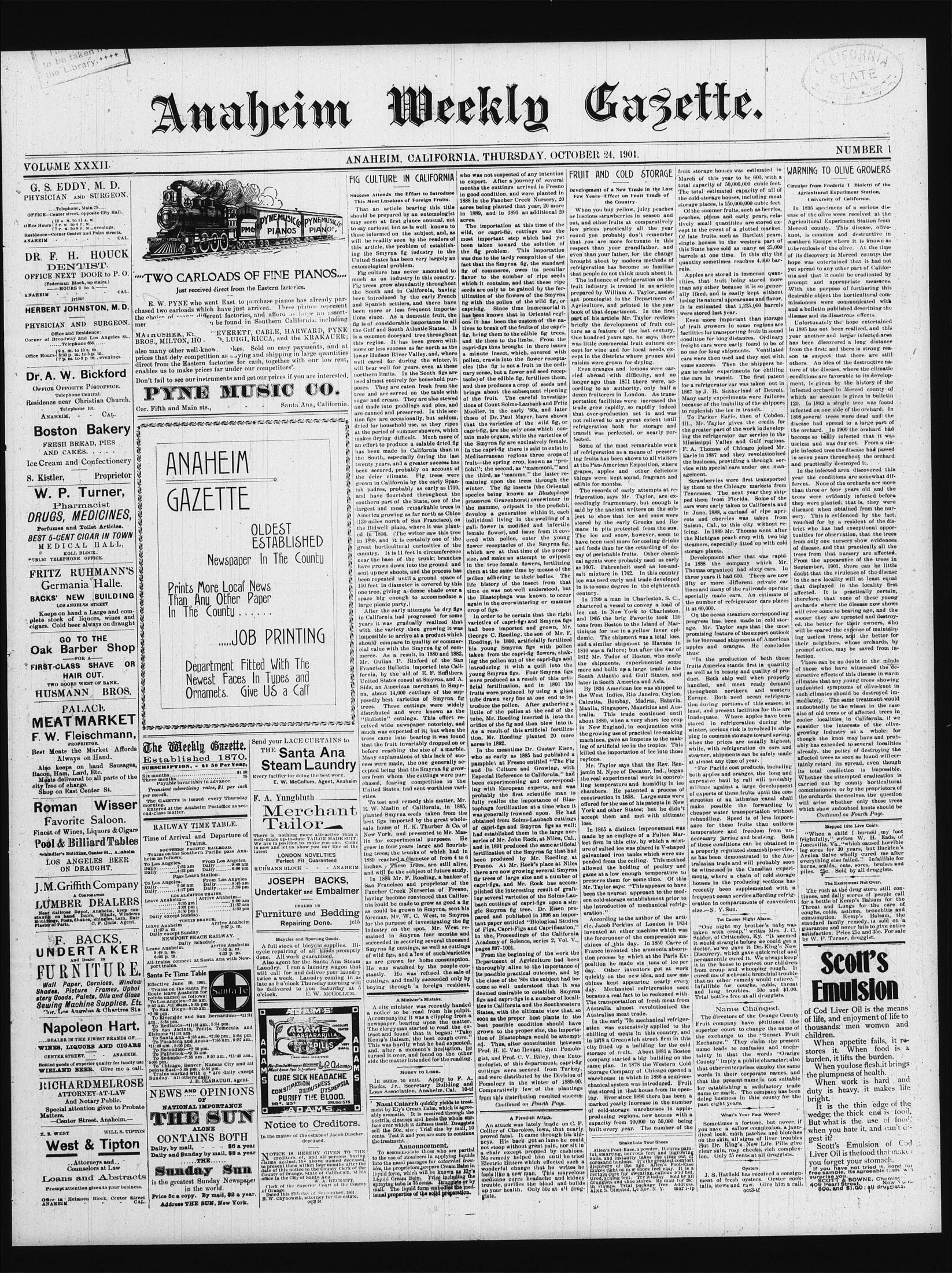
Searchable text
Anaheim
VOLUME XXXII.
G. S. EDDY, M. D.
PHYSICIAN AND SURGEON.
Telephone, Main 75...
OFFICE—Center street, opposite City Hall.
10 A. M. to 11 A. M.
Office Hours: 2 P. M. to 4 P. M.
7 P. M. to 8 P. M., evenings.
Residence—Corner Center and Palm streets.
ANAHEIM CAL.
DR. F. H. HOUCK
DENTIST.
OFFICE NEXT DOOR to P. O.
(Federman Block, up stairs.)
HOURS 9 to 6
ANAHEIM CAL.
jy154f
HERBERT JOHNSTON, M. D.
PHYSICIAN AND SURGEON.
Office and Residence:
Corner of Broadway and Los Angeles St.
Telephone 656...
Office Hours: 9 a. m. to 10 a. m.
3:30 p. m. to 5 p. m.
7 p. m. to 8 p. m., evenings.
Dr. A. W. Bickford
OFFICE OPPOSITE POSTOFFICE.
Telephone Central.
Residence near Christian Church.
Telephone 101.
ANAHEIM CAL.
Boston Bakery
FRESH BREAD, PIES
AND CAKES.
Ice Cream and Confectionery
"TWO CARLOADS OF FINE PIANOS..."
Just received direct from the Eastern factories.
E. W. PYNE who went East to purchase pianos has already purchased two carloads which have just arrived. These pianos represent the choice of many different factories, and afford as large an assortment be found in Southern California, including MATUSHEK, KING EVERETT, CABLE, HARWARD, PYNE BROS., MILTON, HO... LUIGI, RICCA, and the KRAKAUER; also many other well-known makes. Sold on easy payments, and at prices that defy competition as buying and shipping in large quantities direct from the Eastern factories for cash, together with our low rent, enables us to make prices far under our competitors'.
Don't fail to see our instruments and get our prices if you are interested.
PYNE MUSIC CO.
Cor. Fifth and Main sts., Santa Ana, California.
ANAHEIM
Dr. A. W. Bickford
OFFICE OPPOSITE POSTOFFICE.
Telephone Central.
Residence near Christian Church.
Telephone 101.
ANAHEIM, CAL.
Boston Bakery
FRESH BREAD, PIES AND CAKES.
Ice Cream and Confectionery
S. Kistler, Proprietor
W. P. Turner,
Pharmacist
DRUGS, MEDICINES,
Perfumes and Toilet Articles.
BEST 5-CENT CIGAR IN TOWN MEDICAL HALL,
KOLL BLOCK.
PUBLIC TELEPHONE OFFICE.
FRITZ RUHMANN'S Germania Halle.
BACKS' NEW BUILDING
LOS ANGELES STREET
Keeps on hand a Large and complete stock of liquors, wines and cigars. Cold beer always on draught
GO TO THE Oak Barber Shop
FOR A FIRST-CLASS SHAVE OR HAIR CUT.
TWO DOORS WEST OF BANK.
HUSMANN BROS.
PALACE MEAT MARKET
F. W. Fleischmann,
PROPRIETOR.
Best Meats the Market Affords Always on Hand.
Also keeps on hand Sausages, Bacon, Ham, Lard, Etc.
Meats delivered to all parts of the city free of charge.
Shop on East Center St.
Roman Wisser
Favorite Saloon.
Finest of Wines, Liquors & Cigars Pool & Billiard Tables
Schindler's Building, Center St., Anaheim
LOS ANGELES BEER ON DRAUGHT.
J.M. Griffith Company
A CORPORATION
Don’t fail to see our instruments and get our prices if you are interested.
PYNE MUSIC CO.
Cor. Fifth and Main sts., Santa Ana, California.
ANAHEIM
GAZETTE
OLDEST ESTABLISHED
Newspaper In The County
Prints More Local News Than Any Other Paper In The County ...
JOB PRINTING
Department Fitted With The Newest Faces In Types and Ornamets. Give US a Call
The Weekly Gazette,
Established 1870.
SUBSCRIPTION, - $1.50 Per Year,
Six months.....$1.00
Three months.....75
Payable invariably in advance.
Transient advertising rates, $1 per inch per month.
The Gazette is issued every Thursday morning.
Entered at the Anaheim Postoffice as second-class matter.
RAILWAY TIME TABLE.
Time of Arrival and Departure of Trains.
SOUTHERN PACIFIC RAILROAD.
Trains on the Southern Pacific pass Anaheim as follows:
To Los Angeles....From Los Angeles.
Daily.....7:52 am Dally.....9:49 am
Daily.....4:22 pm Dally.....8:06 pm
Pass Loara Station:
To Los Angeles....From Los Angeles
Daily.....7:56 am Dally.....9:45 am
Daily.....4:27 pm Dally.....5:59 pm
Los ALAMITOS TRAINS.
Send your LACE CURTAINS to THE Santa Ana Steam Laundry
Every facility for doing the best work.
E. W. McCollum, Agent, Anaheim
F. A. Yungbluth
Merchant Tailor
There is nothing more attractive than well-made up-to-date TAILOR MADE SUIT We are in position to make you one. Com in now and let us show you our line of the latest
LONDON NOVELTIES Perfect Fit Guaranteed
RUHMANN BLOCK ...ANAHEIM
JOSEPH BACKS, Undertaker and Embalme
Roman Wisser
Favorite Saloon.
Finest of Wines, Liquors & Cigars
Pool & Billiard Tables
Schindler's Building, Center St., Anaheim
LOS ANGELES BEER ON DRAUGHT.
J.M. Griffith Company
A CORPORATION
LUMBER DEALERS
Near Railroad Depot, Anaheim, keep constantly on hand Doors, Blinds, Windows Mouldings, Posts, Shakes, shingles, Lath, Hair Plaster of Paris.
C. P. OBIM. Agent.
F. BACKS,
UNDERTAKER
And Dealer in
FURNITURE.
Wall Paper, Cornices, Window Shades, Picture Frames, Upholstery Goods, Paints, Oils and Glass Sewing Machine Supplies, Etc.
Cor. Los Angeles & Chartres Sts.
Napoleon Hart.
...DEALER IN THE FINEST BRANDS OF...
WINES, LIQUORS AND CIGARS
CENTER STREET. -ANAHEIM.
Bottled goods of superior quality for family use WIELAND BEER. Give me a call.
RICHARDMELROSE
ATTORNEY-AT-LAW
And Notary Public.
Special attention given to Probate Matters.
—Center Street, Anaheim.—
Z. R. WEST
WILL S. TIPTON
West & Tipton
...Attorneys and..
Counselors at Law
Loans and Abstracts
Prompt attention given to your business.
Office in Helmsen Block, Center Street ANAHEIM
RAILWAY TIME TABLE.
Time of Arrival and Departure of Trains.
SOUTHERN PACIFIC RAILROAD.
Trains on the Southern Pacific pass Anaheim as follows:
To Los Angeles.
Daily.....7:52 am Dally.....9:49 am
Daily.....4:22 pm Dally.....6:06 pm
Pass Loara Station:
To Los Angeles.
Daily.....7:56 am Daily.....9:45 am
Daily.....4:27 pm Daily.....5:59 pm
LOS ALAMITOS TRAINS.
Leave Anaheim—Arrive Anaheim—
9:35 am 8:00 am
2:07 pm 11:37 am
5:50 pm 4:30 pm
Daily except Sunday.
TUSTIN BRANCH.
Leave Anaheim Arrive Anaheim
11:37 a.m 2:07 p.m.
Daily except Sunday.
NEWPORT BEACH RAILWAY.
Daily Schedule.
Leave Anaheim Arrive Anaheim
9:49 a.m 7:52 a.m.
6:03 p.m 4:23 p.m.
All trains connect at Santa Ana with Newport trains.
Santa Fe Time Table
Effective June 30, 1901.
Trains on the Santa Fe Route leave Anaheim for points named as follows:
To Los Angeles—7:55 am
9:57 am *11:49 am, 5:06 pm
To San Diego—9:35 am *2:50 pm
To Riverside and San Bernardino—*11:31 am, 5:54 pm.
To Redlands—*11:31 am, 5:54 pm.
To San Jacinto, Perris, Temecula and Elsinore *11:31 am.
To Santa Ana—9:35 am *2:50 pm, 5:54 pm.
To Pasadena and Azusa—7:55 am, 9:57 am *11:49 am, 5:06 pm.
To Escondido—*2:50 pm.
To Fallbrook—*2:50 pm.
To Badondo—7:55 am, 9:57 am *11:49 am, 5:06 pm.
To Chicago, Denver, Kansas City and all points East—5:06 pm, 5:54 pm.
Trains marked with a * are daily except Sunday. All others daily.
J. H. CLABAUGH. Agent.
NEWS AND OPINIONS OF
NATIONAL IMPORTANCE
THE SUN
ALONE
CONTAINS BOTH
Daily, by mail, $6 a year
Daily and Sunday by mail, $8 a year
THE
Sunday Sun is the greatest Sunday Newspaper in the world.
Price 5c a copy. By mail, $2 a year.
Address THE SUN, New York.
Merchant Tailor
There is nothing more attractive than well-made up-to-date TAILOR MADE SUITE. We are in position to make you one. Comin now and let us show you our line of the latest.
LONDON NOVELTIES Perfect Fit Guaranteed
JOSEPH BACKS,
Undertaker and Embalmer
DEALER IN Furniture and Bedding Repairing Done.
Bicycles and Sporting Goods.
A full stock of bicycle supplies. Bicycle repairing of all kinds prompt done. All work guaranteed.
Also agent for the Santa Ana Steak Laundry. I run a laundry wagon that will call for and deliver your laundry twice a week. Laundry coming in late as 9 o'clock Thursday morning we be delivered to you Saturday at o'clock.
E.W. McCOLLUM.
Notice to Creditors
In the matter of the estate of Jacob Duse deceased.
NOTICE IS HEREBY GIVEN TO THE creditors of, and all persons having claims against, the above named deceased to present them within four months after date of this notice to the County Clerk or County of Orange, State of California, office in the City of Santa Ana.
Clerk of the Superior Court of the County of Orange.
Dated this 27th day of September, 1601.
H. W. Chynoweth, attorney for the estate octu st
Weim Weekly Gazette
ANAHEIM, CALIFORNIA, THURSDAY, OCTOBER 24, 1901.
FIG CULTURE IN CALIFORNIA
Success Attends the Effort to Introduce This Most Luscious of Foreign Fruits.
That an article bearing this title should be prepared by an entomologist may seem at first glance unusual, not to say curious; but as is well known to those informed on the subject, and, as will be readily seen by the readers of this article, the problem of establishing the Smyrna fig industry in the United States has been very largely an entomological problem.
Fig culture has never amounted to much as an industry in this country. Fig trees grow abundantly throughout the South and in California, having been introduced by the early French and Spanish settlers, and there have been more or less frequent importations since. As a domestic fruit, the fig is of considerable importance in all the Gulf and South Atlantic States. It is a common dooryard tree throughout this region. It has been grown with more or less success as far north as the lower Hudson River Valley, and, where well cared for during the winter, it will bear well for years, even at these northern limits. In the South figs are used almost entirely for household purposes. They are eaten fresh from the tree and are served on the table with sugar and cream. They are also stewed and made into puddings and pies, and are canned and preserved. In this section figs are occasionally, but seldom, dried for household use, as they ripen at the period of summer showers, which makes drying difficult. Much more of an effort to produce a salable dried fig has been made in California than in the South, especially during the last twenty years, and a greater success has been secured, probably on account of who was not suspected of any intention to export. After a journey of several months the cuttings arrived in Fresno in good condition, and were planted in 1888 in the Fancher Creek Nursery, 20 acres being planted that year, 20 more in 1889, and in 1891 an additional 20 acres.
The importation at this time of the wild, or capri-fig, cuttings was the most important step which had yet been taken toward the solution of the fig problem. This importation was due to the tardy recognition of the fact that the Smyrna fig, the standard fig of commerce, owes its peculiar flavor to the number of ripe seeds which it contains, and that these ripe seeds are only to be gained by the fertilization of the flowers of the Smyrna fig with the pollen of the wild fig, or capri-fig. Since time immemorial it has been known that in Oriental regions it has been the custom of the natives to break off the fruits of the capri-fig, bring them to the edible fig trees, and tie them to the limbs. From the capri-figs thus brought in there issues a minute insect, which, covered with pollen, crawls into the flower receptacles (the fig is not a fruit in the ordinary sense, but a flower and seed receptacle) of the edible fig, fertilizes them, and thus produces a crop of seeds and brings about the subsequent ripening of the fruit. The careful investigations of Count Solms-Laubach and Fritz Mueller, in the early '80s, and later those of Dr. Paul Mayer, have shown that the varieties of the wild fig, or capri-fig, are the only ones which contain male organs, while the varieties of the Smyrna fig are exclusively female. In the capri-fig there is said to exist in Mediterranean regions three crops of fruit—the spring crop, known as "pro fichi"; the second, as "mammon," and the third as "mamme"—the latter re-development of a New Trade in the Last Few Years—Effect on Fruit Trade of the Country.
When you buy yellow, juicy peaches or luscious strawberries in season and out, and other fruits at comparatively low prices practically all the year round you probably don't remember that you are more fortunate in this respect than your grandfather, and even than your father, for the change brought about by modern methods of refrigeration has become so familiar that people do not think much about it.
The influence of refrigeration on the fruit industry is treated in an article prepared by William A. Taylor, assistant pomologist in the Department of Agriculture, and printed in the year book of that department. In the first part of his article Mr. Taylor reviews briefly the development of fruit culture as a feature of the last century. One hundred years ago, he says, there was little commercial fruit culture except for wine and for local needs, except in the districts where prunes and raisins were grown for drying.
Even oranges and lemons were carried abroad with difficulty, and no longer ago than 1871 there were, according to an authority, only half a dozen fruiterers in London. As transportation facilities were increased their trade grew rapidly, so rapidly indeed that over-production set in and was not relieved to any great extent until refrigeration both for storage and transit was perfected.
Some of the most remarkable work of refrigeration as a means of preserving fruits has been shown to all visitors at the Pan-American Exposition, when grapes, apples and other deliciou
In the early attempts to dry figs in California had progressed for some years it was gradually realized that with the variety then growing it was impossible to arrive at a product which should compare in quality or commercial value with the Smyrna fig of commerce. As a result, in 1880 and 1882, Mr. Gulian P. Rixford of the San Francisco Bulletin imported into California, by the aid of E. F. Smithers, United States consul at Smyrna, and A. Sida, an American merchant in Smyrna, about 14,000 cuttings of the supposedly best varieties of Smyrna fig trees. These cuttings were widely distributed and were known as the "Bulletin" cuttings. This effort received wide newspaper notoriety, and much was expected of it; but when the trees came into bearing it was found that the fruit invariably dropped on or before reaching the size of a marble. Many explanations of this lack of success were made, the one generally accepted being that the Smyrna fig growers from whom the cuttings were purchased, fearing competition in the United States, had sent worthless varieties.
To test and remedy this matter, Mr. E. W. Maslin of California, in 1885, planted Smyrna seeds taken from the best figs imported by the great wholesale house of H. K. Thurber & Co. of New York, and presented to Mr. Maslin for experimental purposes. He grew in four years large and flourishing trees; the trunks of which had in 1889 reached a diameter of from 4 to 6 inches. These trees are still alive, and will be the subject of future study.
In 1886 Mr. F. Roeding, a banker of San Francisco and proprietor of the Fancher Creek Nurseries of Fresno, having become convinced that California northern limits. In the South its use almost entirely for household purposes. They are eaten fresh from the tree and are served on the table with sugar and cream. They are also stewed and made into puddings and plies, and are canned and preserved. In this section figs are occasionally, but seldom, dried for household use, as they ripen at the period of summer showers, which makes drying difficult. Much more of an effort to produce a salable dried fig has been made in California than in the South, especially during the last twenty years, and a greater success has been secured, probably on account of the drier climate. Fig trees were grown in California by the early Spanish padres, probably as early as 1710, and have flourished throughout the southern part of the State, one of the largest and most remarkable trees in America growing as far north as Chico (130 miles north of San Francisco), on the Bidwell place, where it was planted in 1856. (The writer saw this tree in 1898, and it is certainly one of the great horticultural curiosities of the country. It is 11 feet in circumference near the base of the trunk; branches have grown down into the ground and sent up new shoots, and the process has been repeated until a ground space of 150 feet in diameter is covered by this one tree, giving a dense shade over a space big enough to accommodate a large picnic party.) After the early attempts to dry figs in California had progressed for some years it was gradually realized that with the variety then growing it was impossible to arrive at a product which should compare in quality or commercial value with the Smyrna fig of commerce. As a result, in 1880 and 1882, Mr. Gulian P. Rixford of the San Francisco Bulletin imported into California, by the aid of E. F. Smithers, United States consul at Smyrna, and A. Sida, an American merchant in Smyrna, about 14,000 cuttings of the supposedly best varieties of Smyrna fig trees. These cuttings were widely distributed and were known as the "Bulletin" cuttings. This effort received wide newspaper notoriety, and much was expected of it; but when the trees came into bearing it was found that the fruit invariably dropped on or before reaching the size of a marble. Many explanations of this lack of success were made, the one generally accepted being that the Smyrna fig growers from whom the cuttings were purchased, fearing competition in the United States, had sent worthless varieties.
To test and remedy this matter, Mr. E. W. Maslin of California, in 1885, planted Smyrna seeds taken from the best figs imported by the great wholesale house of H. K. Thurber & Co. of New York, and presented to Mr. Maslin for experimental purposes. He grew in four years large and flourishing trees; the trunks of which had in 1889 reached a diameter of from 4 to 6 inches. These trees are still alive, and will be the subject of future study.
In 1886 Mr. F. Roeding, a banker of San Francisco and proprietor of the Fancher Creek Nurseries of Fresno, having become convinced that Californian northern limits. In the South its use almost entirely for household purposes. They are eaten fresh from the tree and are served on the table with sugar and cream. They are also stewed and made into puddings and plies, and are canned and preserved. In this section figs are occasionally, but seldom, dried for household use, as they ripen at the period of summer showers, which makes drying difficult. Much more of an effort to produce a salable dried fig has been made in California than in the South, especially during the last twenty years, and a greater success has been secured, probably on account of the drier climate. Fig trees were grown in California by the early Spanish padres, probably as early as 1710, and have flourished throughout the southern part of the State, one of the largest and most remarkable trees in America growing as far north as Chico (130 miles north of San Francisco), on the Bidwell place, where it was planted in 1856. (The writer saw this tree in 1898, and it is certainly one of the great horticultural curiosities of the country. It is 11 feet in circumference near the base of the trunk; branches have grown down into the ground and sent up new shoots, and the process has been repeated until a ground space of 150 feet in diameter is covered by this one tree, giving a dense shade over a space big enough to accommodate a large picnic party.) After the early attempts to dry figs in California had progressed for some years it was gradually realized that with the variety then growing it was impossible to arrive at a product which should compare in quality or commercial value with the Smyrna fig of commerce. As a result, in 1880 and 1882, Mr. Gulian P. Rixford of the San Francisco Bulletin imported into California, by the aid of E. F. Smithers, United States consul at Smyrna, and A. Sida, an American merchant in Smyrna, about 14,000 cuttings of the supposedly best varieties of Smyrna fig trees. These cuttings were widely distributed and were known as the "Bulletin" cuttings. This effort received wide newspaper notoriety, and much was expected of it; but when the trees came into bearing it was found that the fruit invariably dropped on or before reaching the size of a marble. Many explanations of this lack of success were made, the one generally accepted being that the Smyrna fig growers from whom the cuttings were purchased, fearing competition in the United States, had sent worthless varieties.
To test and remedy this matter, Mr. E. W. Maslin of California, in 1885, planted Smyrna seeds taken from the best figs imported by the great wholesale house of H. K. Thurber & Co. of New York, and presented to Mr. Maslin for experimental purposes. He grew in four years large and flourishing trees; the trunks of which had in 1889 reached a diameter of from 4 to 6 inches. These trees are still alive, and will be the subject of future study.
In 1886 Mr. F. Roeding, a banker of San Francisco and proprietor of the Fancher Creek Nurseries of Fresno, having become convinced that Californian northern limits. In the South its use almost entirely for household purposes. They are eaten fresh from the tree and are served on the table with sugar and cream. They are also stewed and made into puddings and plies, and are canned and preserved. In this section figs are occasionally, but seldom, dried for household use, as they ripen at the period of summer showers, which makes drying difficult. Much more of an effort to produce a salable dried fig has been made in California than in the South, especially during the last twenty years, and a greater success has been secured, probably on account of the drier climate. Fig trees were grown down into the ground and sent up new shoots, and the process has been repeated until a ground space of 150 feet in diameter is covered by this one tree, giving a dense shade over a space big enough to accommodate a large picnic party.) After the early attempts to dry figs in California had progressed for some years it was gradually realized that with the variety then growing it was impossible to arrive at a product which should compare in quality or commercial value with the Smyrna fig of commerce. As a result, in 1880 and 1882, Mr. Gulian P. Rixford of the San Francisco Bulletin imported into California, by the aid of E. F. Smithers, United States consul at Smyrna, and A. Sida, an American merchant in Smyrna, about 14,000 cuttings of the supposedly best varieties of Smyrna fig trees.
These cuttings were widely distributed and were known as the "Bulletin" cuttings. This effort received wide newspaper notoriety, and much was expected of it; but when the trees came into bearing it was found that the fruit invariably dropped on or before reaching the size of a marble. Many explanations of this lack of success were made, the one generally accepted being that the Smyrna fig growers from whom the cuttings were purchased, fearing competition in the United States, had sent worthless varieties.
To test and remedy this matter, Mr. E.W.Maslin of California,in 1885plantedSmyrna seeds takenfromthebestfigsmittedbytheGreatwholesalemouseofH.K.Tthurber&Co.ofNewYork,andpresentedtoMr.Maslinforexperimentalpurposes.H grewinfouryearslargeandflourishtingtrees;thetrunksofwhichhadin1889reacheda diameteroffrom4to6inches.Thetreearestillalive,andwillbethesubjectoffuturestudy.
In 1886Mr.F.Roeding,abankerofSanFranciscoandproprietorfotheFancherCreekNurseriesofFresno,havingbeenconvincedthatCalifornianorthernlimits.IntheSouthitsuseinterdailyworkfordoingtheruntimeandhumidityintchambers.Hpatentadoprocessconstructionin1858.LargesumsofferedfortheuseofhispatientsinYorkandotherStates;buthedacceptthemandmetwithultimateloss.
In 1865a distinct improvementmadebyanemployeeofaFulton firminthiscity,buyingtherealexperimentalworkincountingtemperatureandhumidityintchambers.Hpatentadoprocessconstructionin1858.LargesumsofferedfortheuseofhispatientsinYorkandotherStates;buthedacceptthemandmetwithultimateloss.
In 1865a distinct improvementmadebyanemployeeofaFulton firminthiscity,buyingtherealexperimentalworkincountingtemperatureandhumidityintchambers.Hpatentadoprocessconstructionin1858.LargesumsofferedfortheuseofhispatientsinYorkandotherStates;buthedacceptthemandmetwithultimateloss.
In 1865a distinct improvementmadebyanemployeeofaFulton firminthiscity,buyingtherealexperimentalworkincountingtemperatureandhumidityintchambers.Hpatentadoprocessconstructionin1858.LargesumsofferedfortheuseofhispatientsinYorkandotherStates;buthedacceptthemandmetwithultimateloss.
In 1865a distinct improvementmadebyanemployeeofaFulton firminthiscity,buyingtherealexperimentalworkincountingtemperatureandhumidityintchambers.Hpatentadoprocessconstructionin1858.LargesumsofferedfortheuseofhispatientsinYorkandotherStates;buthedacceptthemandmetwithultimateloss.
In 1865a distinct improvementmadebyanemployeeofaFulton firminthiscity,buyingtherealexperimentalworkincountingtemperatureandhumidityintchambers.Hpatentadoprocessconstructionin1858.LargesumsofferedfortheuseofhispatientsinYorkandotherStates;buthedacceptthemandmetwithultimateloss.
In 1865a distinct improvementmadebyanemployeeofaFulton firminthiscity,buyingtherealexperimentalworkincountingtemperatureandhumidityintchambers.Hpatentadoprocessconstructionin1858.LargesumsofferedfortheuseofhispatientsinYorkandotherStates;buthedacceptthemandmetwithultimateloss.
In 1865a distinct improvementmadebyanemployeeofaFulton firminthiscity,buyingtherealexperimentalworkincountingtemperatureandhumidityintchambers.Hpatentadoprocessconstructionin1858.LargesumsofferedfortheuseofhispatientsinYorkandotherStates;buthedacceptthemandmetwithultimateloss.
In 1865a distinct improvementmadebyanemployeeofaFulton firminthiscity,buyingtherealexperimentalworkincountingtemperatureandhumidityintchambers.Hpatentadoprocessconstructionin1858.LargesumsofferedfortheuseofhispatientsinYorkandotherStates;buthedacceptthemandmetwithultimateloss.
In 1865a distinct improvementmadebyanemployeeofaFulton firminthiscity,buyingtherealexperimentalworkincountingtemperatureandhumidityintchambers.Hpatentadoprocessconstructionin1858.LargesumsofferedfortheuseofhispatientsinYorkandotherStates;buthedacceptthemandmetwithultimateloss.
In 1865a distinct improvementmadebyanemployeeofaFulton firminthiscity,buyingtherealexperimentalworkincountingtemperatureandhumidityintchambers.Hpatentadoprocessconstructionin1858.LargesumsofferedfortheuseofhispatientsinYorkandotherStates;buthedacceptthemandmetwithultimateloss.
In 1865a distinct improvementmadebyanemployeeofaFulton firminthiscity,buyingtherealexperimentalworkincountingtemperatureandhumidityintchambers.Hpatentadoprocessconstructionin1858.LargesumsofferedfortheuseofhispatientsinYorkandotherStates;buthedacceptthemandmetwithultimateloss.
In 1865a distinct improvementmadebyanemployeeofaFulton firminthiscity,buyingtherealexperimentalworkincountingtemperature和humidityintchambers.Hpatentadoprocessconstructionin1858.LargesumsofferedfortheuseofhispatientsinYorkandotherStates;但hedacceptthem和metwithultimateloss.
In 1865a distinct improvementmadebyanemployeeofaFulton firminthiscity,buyingtherealexperimentalworkincountingtemperature和humidityintchambers.Hpat恩adoprocessconstructionin1858.Largesumsoffered fortheuseofhispatientsinYork和otherStates;但hed接受them和metwithultimateloss.
In 1865a distinct improvementmadebyanemployeeofaFulton firminthiscity,buyingtherealexperimentalworkincountingtemperature和humidityintchambers.Hpat恩adoprocessconstructionin1858.Largesumsoffered fortheuseofhispatientsinYork和otherStates;但hed接受them和metwithultimateloss.
In 1865a distinct improvementmadebyanemployeeofaFulton firminthiscity,buyingtherealexperimentalworkincountingtemperature和humidityintchambers.Hpat恩adoprocessconstructionin1858.Largesumsoffered fortheuseofhispatientsinYork和otherStates;但hed接受them和metwithultimateloss.
In 1865a distinct improvementmadebyanemployeeofaFulton firminthiscity,buyingtherealexperimentalworkincountingtemperature和humidityintchambers.Hpat恩adoprocessconstructionin1858.Largesumsoffered fortheuseofhispatientsinYork和otherStates;但hed接受them和metwithultimateloss.
In 1865a distinct improvementmadebyanemployeeofaFulton firmINthiscity,buyingtherealexperimentalworkincountingtemperature和humidityintchambers.Hpat恩adoprocessconstructionINthiscity,buyingtherealexperimental workincountingtemperature和humidityintchambers.Hpat恩adoprocessconstructionINthiscity,buyingtherealexperimental workincountingtemperature和humidityintchambers.Hpat恩adoprocessconstructionINthiscity,buyingtherealexperimental workincountingtemperature和humidityintchambers.Hpat恩adoprocessconstructionINthiscity,buyingtherealexperimental workincountingtemperature和humidityintchambers.Hpat恩adoprocessconstructionINthiscity,buyingtherealexperimental workincountingtemperature和humidityintchambers.Hpat恩adoprocessconstructionINthiscity,buyingtherealexperimental workincountingtemperature和humidityintchambers.Hpat恩adoprocessconstructionINthiscity,buyingtherealexperimental workincountingtemperature和humidityintchambers.Hpat恩adoprocessconstructionINthiscity,buyingtherealexperimental workincountingtemperature和humidityintchambers.Hpat恩adoprocessconstructionINthiscity,buyingtherealexperimental workincountingtemperature和humidityintchambers.Hpat恩adoprocessconstructionINthiscity,buyingtherealexperimental workincountingtemperature和humidityintchambers.Hpat恩adoprocessconstructionINthiscity,buyingthe real experiential work inc countlng temperature indumption factors used for improving crop yields
In 1979A man in Charleston,S.C., chartered a vessel to convey a load out New York to Charleston,S.C., brig favorite took out fruits from Boston to The Island Of Manhattan tine to show that ice and snow were stored by the early Greeks and Rhamnus in pits protected from sunny eveils.A ship was failure but after war he made two ships protect from sunny eveils.A ship was failure but after war he made two ships protect from sunny eveils.A ship was failure but after war he made two ships protect from sunny eveils.A ship was failure but after war he made two ships protect from sunny eveils.A ship was failure but after war he made two ships protect from sunny eveils.A ship was failure but after war he made two ships protect from sunny eveils.A ship was failure but after war he made two ships protect from sunny eveils.A ship was failure but after war he made two ships protect from sunny eveils.A ship was failure but after war he made two ships protect from sunny eveils.A ship was failure but after war he made two ships protect from sunny eveils.A ship was failure but after war he made two ships protect from sunny eveils.A ship was failure but after war he made two ships protect from sunny eveils.A ship was failure but after war he made two ships protect from sunny eveils.A ship was failure but after war he made two ships protect from sunny eveils.A ship was failure but after war he made two ships protect from sunny eveils.A ship was failure but after war he made two ships protect from sunny eveils.A ship was failure but after war he made two ships protect from sunny eveils.A ship was failure but after war he made two ships protect from sunny eveils.A ship was failure but after war he made two ships protect from sunny eveils.A ship was failure but after war he made two ships protect from sunny eveils.A ship was failure but after war he made two ships protect from sunny eveils.A ship was failure but after war he made two ships protect from sunny eveils.A ship was failure but after war he made two ships protect from sunny eveils.A ship was failure but after war he made two ships protect from sunny eveils.A ship was failure but after war he made two ships protect from sunny eveils.A ship was failure but after war he made two ships protect from sunny eveils.A ship was failure but after war he made two ships protect from sunny eveils.A ship was failure but after war he made two ships protect from sunny eveils.A ship was failure but after war he made two ships protect from sunny eveils.A ship was failure but after war he made two ships protect from sunny eveils.A ship was failure but after war he made two ships protect from sunny eveils.A ship was failure but after war he made two ships protect from sunny eveils.A ship was failure but after war he made two ships protect from sunny eveils.A ship was failure but after war he made two ships protect from sunny eveils.A ship was failure but after war he made two ships protect from sunny eveils.A ship was failure but after war he made two ships protect from sunny eveils.A ship was failure but after war he made two ships protect from sunny eveils.A ship was failure but after war he made two ships protect from sunny eveils.A ship was failure but after war he made two ships protect from sunny eveils.A ship was failure but after war he made two ships protect从太阳到月亮,月光到太阳,月光到太阳,月光到太阳,月光到太阳,月光到太阳,月光到太阳,月光到太阳,月光到太阳,月光到太阳,月光到太阳,月光到太阳,月光到太阳,月光到太阳,月光到太阳,月光到太阳,月光到太阳,月光到太阳,月光到太阳,月光到太阳,月光到太阳,月光到太阳,月光到太阳,月光到太阳,月光到太阳,月光到太阳,月光到太阳,月光到太阳,月光到太阳,月光到太阳,月光到太阳,月光到太阳,月光到太阳,月光到太阳,月光到太阳,月光到太阳,月光到太阳,月光到太阳,月光到太阳,月光到太阳,月光到太阳,月光到太阳,月光到太阳,月光到太阳,月光到太阳,月光到太阳,月光到太阳,月光到太阳,月光到太阳,月光到太阳,月光到太阳,月光到太阳,月光到太阳,月光到太阳,月光到太阳,月光到太阳,月光到太阳,月光到太阳,月光到太阳,月光到太阳,月光到太阳,月光到太阳,月光到太阳,月光到太阳,月光到太阳,月光到太阳,月光到太阳,月光到太阳,月光到太阳,月光到太阳,月光到太阳,月光到太阳,月光到太阳,月光到太阳,月光到太阳,月光到太阳,月光到太阳,月光到太阳,月光到太阳,月光到太阳,月光到太阳,月光到太阳,月光到太阳,月光到太阳,月光到太阳,月光到太阳,月光到太阳,月光到太阳,月光到太阳,月光到太阳,月光到太阳,月光到太阳,月光到太阳,月光到太阳,月光到太阳,月光到阳光,阳光阳光阳光阳光阳光阳光阳光阳光阳光阳光阳光阳光阳光阳光阳光阳光阳光阳光阳光阳光阳光阳光阳光阳光阳光阳光阳光阳光阳光阳光阳光阳光阳光阳光阳光阳光阳光阳光阳光阳光阳光阳光阳光阳光阳光阳光阳光阳光阳光 sunlight sunlight sunlight sunlight sunlight sunlight sunlight sunlight sunlight sunlight sunlight sunlight sunlight sunlight sunlight sunlight sunlight sunlight sunlight sunlight sunlight sunlight sunlight sunlight sunlight sunlight sunlight sunlight sunlight sunlight sunlight sunlight sunlight sunlight sunlight sunlight sunlight sunlight sunlight sunlight sunlight sunlight sunlight sunlight sunlight sunlight sunlight sunlight sunlight sunlight sunlight sunlight sunlight sunlight sunlight sunlight sunlight sunlight sunlight sunlight sunlight sunlight sunlight sunlight sunlight sunlight sunlight sunlight sunlight sunlight曝光曝光曝光曝光曝光曝光曝光曝光曝光曝光曝光曝光曝光曝光曝光曝光曝光曝光曝光曝光曝光曝光曝光曝光曝光曝光曝光曝光曝光曝光曝光曝光曝光曝光曝光曝光曝光曝光曝光曝光曝光曝光曝光曝光曝光曝光曝光曝光曝光曝光曝光曝光曝光曝光曝光曝光曝光曝光曝光曝光曝光曝光曝光曝光曝光曝光曝光曝光曝光曝光曝光曝光曝光曝光曝光曝光曝光曝光曝光曝光曝光曝光曝光曝光曝光曝光度曝光度曝光度曝光度曝光度曝光度曝光度曝光度曝光度曝光度曝光度曝光度曝光度曝光度曝光度曝光度曝光度曝光度曝光度曝光度曝光度曝光度曝力度力度力度力度力度力度力度力度力度力度力度力度力度力度力度力度力度力度力度力度力度力度力度力度力度力度力度力度力度力度力度力度力度力度力度力度力度力度力度力度力度力度力度力度力度力度力度强度强度强度强度强度强度强度强度强度强度强度强度强度强度强度强度强度强度强度强度强度强度强度强度强度强度强度强度强度强度强度强度强度强度强度强度强度强度强度强度强度强度强度强度强度强度强度强度强度强度强度高度高度高度高度高度高度高度高度高度高度高度高度高度高度高度高度高度高度高度高度高度高度高度高度高度高度高度高度高度高度高度高度高度高度高度高度高度高度高度高度高度高度高度高度高度高度高度高度高度高度高度高度高度高度高度高度高度高度高度的高度height height height height height height height height height height height height height height height height height height height height height height height height height height height height height height height height height height height height height height height height height height height height height height height height height height heightHeight Height Height Height Height Height Height Height Height Height Height Height Height Height Height Height Height Height Height Height Height Height Height Height
To test and remedy this matter, Mr. E. W. Maslin of California, in 1885, planted Smyrna seeds taken from the best figs imported by the great wholesale house of H. K. Thurber & Co. of New York, and presented to Mr. Maslin for experimental purposes. He grew in four years large and flourishing trees; the trunks of which had in 1889 reached a diameter of from 4 to 6 inches. These trees are still alive, and will be the subject of future study.
In 1886 Mr. F. Roeding, a banker of San Francisco and proprietor of the Fancher Creek Nurseries of Fresno, having become convinced that California could be made to grow as good a fig as could be grown in Smyrna, sent his foreman, Mr. W. C. West, to Smyrna for the purpose of investigating the fig industry on the spot. Mr. West remained in Smyrna four months and succeeded in securing several thousand Smyrna fig cuttings, as well as cuttings of wild figs, and a few of such varieties as are grown for home consumption. He was watched by the people constantly. He was refused the sale of cuttings, and finally succeeded only by buying through a foreign resident,
A Minister's Mistake.
A city minister was recently handed a notice to be read from his pulpit. Accompanying it was a clipping from a newspaper bearing upon the matter. The clergyman started to read the extract and found that it began: "Take Kemp's Balsam, the best cough cure." This was hardly what he had expected, and after a moment's hesitation, he turned it over, and found on the other side the matter intended for the reading.
Money to Loan.
In sums to suit. Apply to F. A. Backs, Jr., Secretary Building and Loan Association, Anaheim, Cal. 10-tf
Nasal Catarrh quickly yields to treatment by Ely's Cream Balm, which is agreeably aromatic. It is received through the nostrils, cleanses and heals the whole surface over which it diffuses itself. Druggists sell the 50c size; Trial size by mail, 10 cents. Test it and you are sure to continue the treatment.
Announcement.
To accommodate those who are partial to the use of atomizers in applying liquids into the nasal passages for catarhal troubles, the proprietors prepare Cream Balm in liquid form, which will be known as Ely's Liquid Cream Balm. Price including the spraying tube is 75 cents. Druggists or by mail. The liquid form embodies the medicinal properties of the solid preparation.
A Flendish Attack.
An attack was lately made on C. F. Collier of Cherokee, Iowa, that nearly proved fatal. It came through his kidneys. His back got so lame he could not stoop without great pain, nor sit in a chair except propped by cushions. No remedy helped him until he tried Electric Bitters which effected such a wonderful change that he writes he feels like a new man. This marvelous medicine curbs headache and kidney trouble, purifies the blood and builds up your health. Only 50c at all drug-gists,
In 1865 a distinct improvement made by an employee of a Fulton firm in this city, by which a rare use of salted ice was placed in V-shallow galvanized iron tanks which were pended from the ceiling. This meant allowed the holding of poultry game at a low enough temperature to preserve them for some time. Mr. Taylor says: "This appears to have been the nearest approach to thedern cold-storage establishment prior to the introduction of mechanical re-operation."
According to the author of the article, Jacob Perkins of London invented an ether machine which forerunner of the compression chines of this day. In 1850 France invented the ammonia addition process by which at the Park position he made six tons of lime day. Other inventors got at quickly on the new idea, and new chines kept appearing nearly daily. Mechanical refrigeration became a real fact to be reckoned The transportation of fresh meat Australia almost revolutionize Australian meat trade.
In the early '70s mechanical relation was extensively applied to chilling of meats in this country in 1878 a Greenwich street firm city fitted up a building for the storage of fruit. About 1881 a company started a big building same plan. In 1878 the Western Storage Company of Chicago opens warehouse in which in 1886 a sechnical system was introduced was stored in that house from its ing. Ever since 1890 there has marked yearly increase in the number of cold-storage warehouses in producing regions, new houses capacity from 10,000 to 50,000 built every year. The number
Gazette.
MAR 24, 1901.
WARD COLD STORAGE
Count of a New Trade in the Last Years—Effect on Fruit Trade of the Country.
You buy yellow, juicy peaches or strawberries in season and other fruits at comparatively practically all the year. It probably don't remember that you more fortunate in this than your grandfather, and by your father, for the change about by modern methods of onion has become so familiar we do not think much about it. Sequence of refrigeration on the industry is treated in an article by William A. Taylor, assistantologist in the Department of Agriculture, and printed in the year that department. In the first article Mr. Taylor reviews the development of fruit culinary feature of the last century. Over years ago, he says, there commercial fruit culture exists and for local needs, extensive districts where prunes and were grown for drying.
Ranges and lemons were carried with difficulty, and no more than 1871 there were, except an authority, only half a literers in London. As transfacilities were increased the new rapidly, so rapidly indeed production set in and was devoted to any great extent until station both for storage and was perfected, or nearly perforated.
Of the most remarkable work operation as a means of preserves has been shown to all visitors in American Exposition, where apples and other delicious fruit storage houses was estimated in March of this year to be 600, with a total capacity of 50,000,000 cubic feet. The total estimated capacity of all of the cold-storage houses, including meat storage places, is 150,000,000 cubic feet.
Of the summer fruits, such as berries, peaches, plums and early pears, relatively small quantities are stored except in the event of a glutted market. Of late fruits, such as Bartlett pears, single houses in the western part of this State have sold as many as 25,000 barrels at one time. In this city the quantity sometimes reaches 4,000 barrels.
Apples are stored in immense quantities, that fruit being stored more than any other because it is so generally liked, and is easily kept without losing its natural appearance and flavor. It is estimated that 1,225,000 barrels were stored last year.
Even more important than storage of fruit growers in some regions are facilities for transporting fruit in sound condition for long distances. Ordinary freight cars were early found to be of no use for long shipments. Ventilated cars were then used and they met with some success. Then the shippers began to make experiments for chilling the cars in transit. The first patent for a refrigerator car was taken out in 1867 by J. B. Sutherland of Detroit. Many early experiments were failures because of the inability of the shippers to replenish the ice in transit.
To Parker Earle, then of Cobden, Ill., Mr. Taylor gives the credit for the greater part of the work in developing the refrigerator car service in the Mississippi Valley and Gulf regions. F. A. Thomas of Chicago joined Mr. Earle in 1887 and they revolutionized the business, providing a through service with special cars under one management.
WARNING TO OLIVE GROWERS
Circular from Frederic T. Bioletti of the Agricultural Experiment Station, University of California.
In 1895 specimens of a serious disease of the olive were received at the Agricultural Experiment Station from Merced county. This disease, olive-knot, is common and destructive in southern Europe where it is known as tuberculosis of the olive. At the time of its discovery in Merced county the hope was entertained that it had not yet spread to any other part of California and that it could be eradicated by prompt and appropriate measures. With the purpose of furthering this desirable object the horticultural commissioners were communicated with and a bulletin published describing the disease and its disastrous effects.
Unfortunately the hope entertained in 1895 has not been realized, and this year another and larger infected area has been discovered a long distance from the first; and there is strong reason to suspect that there are still others. An idea of the destructive nature of the disease, where the climatic conditions are favorable to its development, is given by the history of the infected orchard in Merced county of which an account is given in bulletin 120. In 1893 a single tree was found infected on one side of the orchard. In 1898 several trees were dead and the disease had spread to a large part of the orchard. In 1900 the orchard had become so badly infected that it was useless and was dug out. From a single infected tree the disease had passed in seven years throughout the orchard and practically destroyed it.
In the infected area discovered this
of the most remarkable work
operation as a means of preservation has been shown to all visitors
to North-American Exposition, where
apples and other delicious
were kept sound, fragrant and
fresh months.
Records of early attempts at recreation, says Mr. Taylor, are expensive fragmentary, but enough is
the ancient writers on the subsurface that ice and snow were
by the early Greeks and Romans
pits protected from the sun,
and snow, however, seem to
be used more for cooling drinks
than for the retarding of deferrishable fruits. Other chemiants were probably used as early
Fahrenheit used an ice-andfrost in 1762. In this country
used early and trade developed
some degree in the eighteenth
1809 a man in Charleston, S.C.,
had a vessel to convey a load of
water in New York to Charleston,
1855 the brig Favorite took 130
from Boston to the Island of Marlboro for use in a yellow fever epipticle. The shipment was a total loss,
similar shipment to Havana in
a failure; but after the war of
Mr. Tudor of Boston, who made
shipments, experimented some
and built up a large trade in the
Atlantic and Gulf States, and
South America and Asia.
1834 American ice was shipped to
West Indies, Rio Janeiro, Ceylon,
Taiwan, Bombay, Madras, Batavia,
Singapore, Mauritius and Aussia. This trade continued until
1880, when a very short ice crop
in England, in conjunction with
blowing use of practical ice-making
sites, gave an impetus to the makartificial ice in the tropics. This
is the importation of ice into those
areas.
Mr. Taylor says that the Rev. BenM. Nyce of Decatur, Ind., began
an experimental work in controltemperature and humidity in icemakers. He patented a process of
reduction in 1858. Large sums were
paid for the use of his patents in New
and other States; but he didn't
get them and met with ultimate
1865 a distinct improvement was
made by an employee of a Fulton Marterm in this city, by which a mixtusalized ice was placed in V-shaped
nised iron tanks which were sussible from the ceiling. This method
led the holding of poultry and
at a low enough temperature to
serve them for some time. Of this
Taylor says: "This appears to have
the nearest approach to the modulde storage establishment prior to
the cars in transit. The first patent
for a refrigerator car was taken out in
1867 by J. B. Sutherland of Detroit.
Many early experiments were failures
because of the inability of the shippers
to replenish the ice in transit.
To Parker Earle, then of Cobden,
Ill., Mr. Taylor gives the credit for
the greater part of the work in developing the refrigerator car service in the
Mississippi Valley and Gulf regions.
F. A. Thomas of Chicago joined Mr.
Earle in 1887 and they revolutionized
the business, providing a through service with special cars under one management.
Strawberries were first transported
by them to the Chicago markets from Tennessee. The next year they shipped them from Florida. Some of the cars were early taken to California and in June, 1888, a carload of ripe apricots and cherries was taken from Suisun, Cal., to this city without re-icing. In 1889 Mr. Thomas went after the Michigan peach crop with two big steamers, especially fitted up with cold storage plants.
Development after that was rapid.
In 1888 the company which Mr.
Thomas organized had sixty cars. In three years it had 600. There are now fifty or more different private car lines and many of the railroads operate specially made cars. An estimate of the number of refrigerator cars places it at 60,000.
On the ocean steamers corresponding progress has been made in cold storage. Mr. Taylor says that the most promising feature of the export outlook is for increased shipments of American apples and oranges. He concludes thus:
"In the production of both these fruits America stands first in quantity as well as in beauty and quality of product. Both ship well when properly handled, and meet ready demand throughout northern and western Europe. Both need ocean refrigeration during portions of this season, at least, and present facilities for this are inadequate. Where apples have been stored in refrigeration during the winter, serious risk is involved in shipping in common stowage toward spring, when the prices are usually highest, while with refrigeration on cars and steamer, shipments can be safely made at almost any time of year.
For Pacific cost products, including both apples and oranges, the long and expensive haul by rail will probably militate against a large development of exports of these fruits until the construction of an isthmian canal shall make possible the forwarding by cheaper water transportation without rehandling. Speed is of less importance for these fruits than uniform temperature and freedom from unnecessary jarring and bruising. Both of these conditions can be obtained in a properly regulated steamship service, as has been demonstrated in the Australasian trade and will probably soon be witnessed in the Canadian experiments, where a chain of cold storage houses in the producing sections has recently been supplemented with a frequent ocean service affording refrig-
conditions are favorable to its development, is given by the history of the infected orchard in Merced county of which an account is given in bulletin 120. In 1893 a single tree was found infected on one side of the orchard. In 1898 several trees were dead and the disease had spread to a large part of the orchard. In 1900 the orchard had become so badly infected that it was useless and was dug out. From a single infected tree the disease had passed in seven years throughout the orchard and practically destroyed it.
In the infected area discovered this year the conditions are somewhat different. None of the orchards are more than three or four years old and the trees were evidently infected before they were planted; that is, they were diseased when obtained from the nursery. This is evidenced by the fact, vouched for by a resident of the district who has had exceptional opportunities for observation, that the trees from only one nursery show evidences of disease, and that practically all the trees from that nursery are affected.
From the appearance of the trees in September, 1901 there can be little doubt that the virulence of the disease in the new locality will at least equal that displayed in the locality first affected. It is practically certain, therefore, that none of these young orchards where the disease now shows will ever come to bearing age, and the sooner they are uprooted and destroyed, the better for their owners, who will be spared the expense of maintaining useless trees, and the better for their neighbors, whose orchards, by prompt action, may be saved from infection.
There can be no doubt in the minds of those who have witnessed the destructive effects of this disease in warm climates that any young trees showing undoubted symptoms of olive-knot in such climates should be destroyed immediately. The same treatment would undoubtedly be the wisest in the case also of old trees or affected trees in cooler localities in California, if we consider the interests of the olive-growing industry as a whole; for though the knot may have and probably has extended to several localities already, the policy of destroying the affected trees as soon as found will certainly retard its spread, even though its total eradication is impossible.
Whether the attempted eradication is carried out by county horticultural commissioners or by the proprietors of the orchards themselves, the question will arise whether only those trees which show undoubted knots should be
Continued on Fourth Page.
Stepped Into Live Coals.
"When a child I burned my foot frightfully," writes W. H. Eads, of Jonesville, Va., "which caused horrible leg sores for 30 years, but Bucklen's Arnica Salve wholly cured me after everything else failed." Infallible for burns, scalds, cuts, sores, bruises and piles. 25c. Sold by all druggists.
The Excitement Not Over.
The rush at the drug store still continues, and daily scores of people call
1865 a distinct improvement was made by an employee of a Fulton Marterm in this city, by which a mixtusalized ice was placed in V-shaped
iron tanks which were sussed from the ceiling. This method
used the holding of poultry and
at a low enough temperature to
serve them for some time. Of this
Taylor says: "This appears to have
the nearest approach to the modold-storage establishment prior to
introduction of mechanical refrigeration."
According to the author of the artilacob Perkins of London in 1834
entitled an ether machine which was
worrierunner of the compression mases of this day. In 1850 Carre of
ice invented the ammonia absorpprocess by which at the Paris Extion he made six tons of ice per
Other inventors got at work
quickly on the new idea, and new maces kept appearing nearly every
Mechanical refrigeration soon
came a real fact to be reckoned with.
Transportation of fresh meat from
Australia almost revolutionized the
Australian meat trade.
The early '70s mechanical refrigration was extensively applied to the
cooling of meats in this country, and
in 1878 a Greenwich street firm in this
fitted up a building for the cold
stage of fruit. About 1881 a Boston
company started a big building on the
one plan. In 1878 the Western Cold
Storage Company of Chicago opened a
house in which in 1886 a semi-menical system was introduced. Fruit
stored in that house from its openness. Ever since 1890 there has been a
work yearly increase in the number
of cold-storage warehouses in appleeding regions, new houses with a
capacity from 10,000 to 50,000 being
built every year. The number of the
Shake Into Your Shoes
Allen's Foot-Ease, a powder. It cures pain,
smarting, nervous feet, and ingrowing
isms, and instantly takes the sting out of
mass and bunions. It's the greatest comfort
covery of the age. Allen's Foot-Ease
kinesis or new shoes feel easy. It is a
main cure for sweating, callous and hot,
feet, aching feet. Try it today. Sold by all
druggists and shoe stores. By mail for 25c.
stamps. Trial package free Address.
Ben S. Olmsted, Le Roy, N.Y.
Tot Causes Night Alarm.
"One night my brother's baby was taken with croup," writes Mrs. J. C.
Snider, of Crittenden, Ky. "It seemed it would strangle before we could get a doctor, so we gave it Dr. King's New Discovery, which gave quick relief and permanently cured it. We always keep it in the house to protect our children from croup and whooping cough. It cured me of a chronic bronchial trouble that no other remedy would relieve." Infallible for coughs, colds, throat and lung troubles. 50¢ and $1.00. Trial bottles free at all druggists.
Name Changed.
The directors of the Orange County Fruit company have petitioned the superior court to change the name of the exchange to the "Sunset Fruit Exchange." They claim the present name leads to confusion and uncertainty in that words "Orange County" imply a public character; also that other enterprises employ the same words in their corporate names, and that the present name is not suitable for establishing a satisfactory trade name or mark. The company has been doing business in this county for the past eight years.
What's Your Face Worth?
Sometimes a fortune, but never, if you have a sallow complexion, a jaundiced look, moth patches and blotches on the skin, all signs of liver troubles But Dr. King's New Life Pills give clear skin, rosy cheeks, rich complexion. Only 25 cents at all druggists.
Oysters:
J. S. Hatfield has received a consignment of fresh oysters. Oyster cocktails, stews and raw. Give him a call.
oct3-tf
Stepped Into Live Coals.
"When a child I burned my foot frightfully," writes W. H. Eads, of Jonesville, Va., "which caused horrible leg sores for 30 years, but Bucklen's Arnica Salve wholly cured me after everything else failed." Infallible for burns, scalds, cuts, sores, bruises and piles. 25¢. Sold by all druggists.
The Exotement Not Over.
The rush at the drug store still continues, and daily scores of people call for a bottle of Kemp's Balsam for the Throat and Lungs for the cure of coughs, colds, asthma, bronchitis and consumption. Kemp's Balsam, the standard family remedy, is sold on a guarantee and never fails to give entire satisfaction. Price 25¢ and 35¢. For sale by W. P. Turner, druggist.
Scott's Emulsion
of Cod Liver Oil is the means of life, and enjoyment of life to thousands: men women and children.
When appetite fails, it restores it. When food is a burden, it lifts the burden.
When you lose flesh, it brings the plumpness of health.
When work is hard and duty is heavy, it makes life bright.
It is the thin edge of the wedge; the thick end is food. But what is the use of food when you hate it, and can't digest it?
Scott's Emulsion of Cod Liver Oil is the food that makes you forget your stomach.
If you have not tried it, send for free sample, its agreeable taste will surprise you.
SCOTT & BOWNE, Chemist
409 Pearl Street,
New York,
50¢ and $1.00; all druggists.