anaheim-gazette 1901-09-26
Scanned page
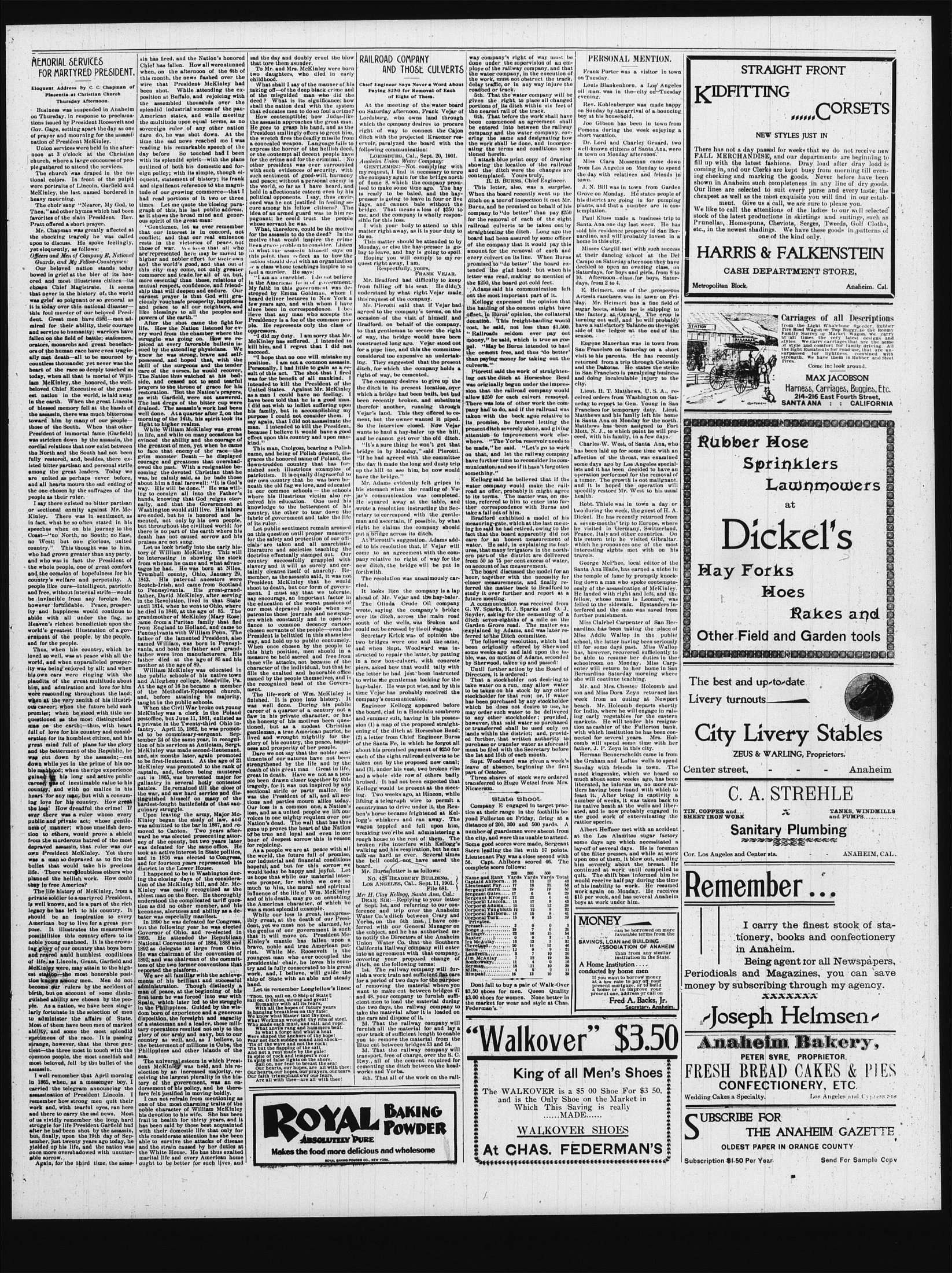
Searchable text
MEMORIAL SERVICES FOR MARTYRED PRESIDENT.
Eloquent Address by C. C. Chapman of Placentia at Christian Church Thursday Afternoon.
Business was suspended in Anaheim on Thursday, in response to proclamations issued by President Roosevelt and Gov. Gage, setting apart the day as one of prayer and mourning for the assassination of President McKinley.
Union services were held in the afternoon at 3 o'clock at the Christian church, where a large concourse of people gathered to attend the services.
The church was draped in national colors. In front of the pulpit were portraits of Lincoln, Garfield and McKinley, the last named bordered in heavy mourning.
The choir sang "Nearer, My God, to Thee;" and other hymns which had been favorites of the slain President. Rev. Pratt offered a short prayer.
Mr. Chapman was greatly affected at the shocking tragedy he was called upon to discuss. He spoke feelingly, yet eloquently, as follows:
Officers and Men of Company E, National Guards, and My Fellow-Countrymen:
Our beloved nation stands today bowed in grief at the bier of its honored and most illustrious citizen—its chosen Chief Magistrate. It seems that never in the history of the world was grief so poignant or so general as it is today over this national disaster—this foul murder of our beloved President. Great men have died—men admired for their ability, their courage and service to humanity; warriors have fallen on the field of battle; statesmen, orators, monarchs and great benefactors of the human race have even tragically met death—all to be mourned by countless thousands; yet never was the heart of the race so deeply touched as today, when all that is mortal of William McKinley, the honored, the well-beloved Chief Executive of the greatest nation in the world, is laid away in the earth. When the great Lincoln of blessed memory fell at the hands of the assassin, there was much bitterness toward him by many of our people—those of the South. When that other President of immortal fame (Garfield) was stricken down by the assassin, the cordial relations that now exist between the North and the South had not been fully restored, and, besides, there existed bitter partisan and personal strife among the great leaders. Today we sin has fired, and the Nation's honored Chief has fallen. How all were stunned when, on the afternoon of the 6th of this month, the news flashed over the wire that President McKinley had been shot. While attending the exposition at Buffalo, and rejoicing with the assembled thousands over the splendid industrial success of the pan-American states, and while meeting the multitude upon equal terms, as no sovereign ruler of any other nation dare do, he was shot down. At the time the sad news reached me I was reading his remarkable speech of the day before. So touched had I been with its splendid spirit—with the plans outlined of both his domestic and foreign policy; with its simple, though eloquent, statement of history; its frank and significant reference to the magnitude of our growing commerce—that I had read portions of it two or three times. Let me quote the closing paragraph of this, his last public address, as it shows the broad mind and generous spirit of the great man:
"Gentlemen, let us ever remember that our interest is in concord, not conflict; and that our real eminence rests in the victories of peace, not those of war. We hope that all who are represented here may be moved to higher and nobler effort for their own and the world's good, and that out of this city may come, not only greater commerce and trade for all of us, but, more essential than these, relations of mutual respect, confidence, and friendship that will deepen and endure. Our earnest prayer is that God will graciously vouchsafe prosperity, happiness and peace to all our neighbors, and like blessings to all the peoples and powers of the earth."
After the shot came the sight for life. How the Nation listened for every word from the chamber where the struggle was going on. How we rejoiced at every favorable bulletin issued by the attending physicians. We knew he was strong, brave and self-possessed, and hoped that, with the skill of the surgeons and the tender care of the nurses, he would recover. The Nation thus watched at his bedside, and ceased not to send tearful prayers to the throne of grace for his restoration. But the Nation's prayers, as with Garfield, were not answered. The last dregs of the bitter cup were drained. The assassin's work had been well done. At a quarter after 2, on the morning of the 14th, his spirit took its flight to higher realms.
While William McKinley was great in life, and while on many occasions he evinced the ability and the courage of the greatest of men, yet when he came to face that enemy of the race—the grim monster Death—he displayed courage and greatness that overshadowed the past. With a resignation becoming the devoted Christian that he sad the day and doubly cruel the blow that tore them asunder.
To Mr. and Mrs. McKinley were born two daughters, who died in early childhood.
What shall I say of the manner of his taking off—of the deep black crime and of the misguided man who did the deed? What is its significance; how shall the nation deal with the system that educates men to do so foul a crime?
How contemptible; how Judas-like the assassin approaches the great man. He goes to grasp his hand, and as the President smilingly offers to greet him, the wretch fires the deadly missile from a concealed weapon. Language fails to express the horror of the hellish deed, or the contempt all decent people have for the crime and for the criminal. No other president was ever surrounded with such evidences of security, with such sentiment of good-will, harmony and peace; without a personal enemy in the world, so far as I have heard, and held in affectionate esteem even by his political opponents. I say, thus envisioned was he not justified in feeling secure among his fellow citizens? The idea of an armed guard was to him repugnant; he could trust the people whose servant he was.
What, therefore, could be the motive for the assassin to do deed? In the motive that would inspire the crime lies a grave problem to consider. Listen to what the assassin himself says on this point; then reflect as to how the nation should deal with an organization or a class whose teachings inspire to so fool a murder. He says:
"I am an anarchist. I do not believe in American form of government. My faith in this government was destroyed by Emma Goldman, whom I heard deliver lectures in New York a few years ago, and with whom I have since been in correspondence. I believe that any man who accepts the Presidency is a foe of the common people. He represents only the class of oppressors."
"I did my duty. I am sorry that Mr. McKinley has suffered. I intended to kill him, and I regret that I did not succeed."
"I hope that no one will mistake my position. I am not a common assassin. Personally, I had little to gain as a result of this act. The shot that I fired was for the benefit of all mankind. I intended to kill the President of United States. Against Mr. McKinley as a man I could have no feeling. I have been told that he is a good man. I did not wish to inflict suffering upon his family, but in accomplishing my purpose I could not consider them. I say again, that I did not assassinate the man. I intended to kill the President because I believe it would have a good effect upon this country and upon mankind."
today, when all that is mortal of William McKinley, the honored, the well-beloved Chief Executive of the greatest nation in the world, is laid away in the earth. When the great Lincoln of blessed memory fell at the hands of the assassin, there was much bitterness toward him by many of our people—those of the South. When that other President of immortal fame (Garfield) was stricken down by the assassin, the cordial relations that now exist between the North and the South had not been fully restored, and, besides, there existed bitter partisan and personal strife among the great leaders. Today we are united as perhaps never before, and all hearts mourn the sad ending of the one chosen by the suffrages of the people as their ruler.
I say there existed no bitter partisan or sectional enmity against Mr. McKinley. There was in sentiment, as in fact, what he so often stated in his speeches when on his journey to the Coast—"no North, no South; no East, no West; but one glorious, united country." This thought was to him, who had grown greater than any party, and who was in fact the President of the whole people, one of great comfort and the occasion of hopefulness for his country's welfare and perpetuity. A people like ours—intelligent, patriotic and free, without internal strife—would be invincible from any foreign foe, however formidable. Peace, prosperity and happiness would continue to abide with all under the flag, as Heaven's richest benediction upon the world's greatest illustration of a government of the people, by the people, and for the people.
Thus, when his country, which he loved so well, was at peace with all the world, and when unparalleled prosperity was being enjoyed by all; and when his own cars were ringing with the plaudits of the great multitude about him, and admiration and love for him were resounding throughout the land; when at the very zenith of his illustrious career; when the future held such promise; when he stood with title unquestioned as the most distinguished man on the earth;—thus, with heart full of love for his country and consideration for its humblest citizen, and his great mind full of plans for the glory and the betterment of the Republic, he was cut down by the assassin;—cut down while yet in the prime of his noble hood; when the ripe experience gained in his long and active public career was of inestimable value to his country, and with no malice in his heart for any man, but with a consuming love for his country. How great the loss! How dreadful the crime! If ever there was a ruler whose every public and private act; whose gentleness of manner; whose unselfish devotion to others; would prove a shield from the murderous hatred of the most deprived assassin, that ruler was our own President McKinley. Yet there was a man so depraved as to fire the bullet that would take his precious life. There were doubtless others who planned the hellish work. How could they in free America?
The life history of McKinley, from a private soldier to a martyrred President,
the Nation thus watched at his bedside, and ceased not to send tearful prayers to the throne of grace for his restoration. But the Nation's prayers, as with Garfield, were not answered. The last dregs of the bitter cup were drained. The assassin's work had been well done. At a quarter after 2, on the morning of the 14th, his spirit took its flight to higher realms.
While William McKinley was great in life, and while on many occasions he evinced the ability and the courage of the greatest of men, yet when he came to face enemy of the race—the grim monster Death—he displayed courage and greatness that overshadowed the past. With a resignation becoming the devoted Christian that he was, he calmly said, as he bade those about him a final farewell: "It is God's way. His will be done." He was willing to consign all into the Father's hands, knowing that God reigns eternally, and that the Government at Washington would still live. His labors are ended, but he is honored and lamented, not only by his own people, but throughout the civilized world; for there is no part of the earth where his death has not caused sorrow and his praises are not sung.
Let us look briefly into the early history of William McKinley. This will be interesting in showing the stock from whence he came and what advantages he had. He was born at Niles, Trumbull county, Ohio, January 29, 1843. His paternal ancestors were Scotch-Irish, and came from Scotland to Pennsylvania. His great-grandfather, David McKinley, after serving in the Revolution, lived in that Stake until 1814, when he went to Ohio, where he died in 1840, at the age of 85. The grandmother of McKinley (Mary Rose) came from a Puritan family that fed from England to Holland, and came to Pennsylvania with William Penn. The father of the lamented President, also named William, was born in Pennsylvania, and both the father and grandfather were iron manufacturers. His father died at the age of 85 and his mother at the age of 89.
William McKinley was educated in the public schools of his native town and Allegheny college, Meadville, Pa. At the age of 16 he became a member of the Methodist-Episcopal church, and before attaining his majority, taught in the public schools.
When the Civil War broke out young McKinley was a clerk in the Poland postoffice, but June 11, 1861, enlisted as a private in the Twenty-third Ohio infantry. April 15, 1862, he was promoted to be commissary-sergeant. September 24 of the same year, in recognition of his services at Antietam, Sergt. McKinley was made second-leutenant, and six months later, again promoted to be first-lieutenant. At the age of 21 McKinley was promoted to the rank of captain, and before being mustered out in 1865, was brevetted major for gallantry in several hotly contested battles. He remained till the close of the war, and saw hard service and distinguished himself on many of the hardest-fought battlefields of thatanguinary struggle.
Upon leaving the army, Major McKinley began the study of law, and was admitted to the bar in 1867,and removed to Canton. Two years afterward he was elected prosecuting attorney of the county, but two years later was defeated for the same office. He took an active interest in State politics, and in 1876 was elected to Congress,and for fourteen years represented his district in the Lower House.
I happened to be in Washington during the closing days of the consideration of the McKinley bill, and Mr. McKinley was easily recognized as the ablest man on the floor. He thoroughly outwited all this act. The shot that fired was for the benefit of all mankind. I intended to kill the President of the United States. Against Mr. McKinley as a man I could have no feeling. I have been told that he is a good man. I did not wish to inflict suffering upon his family, but in accomplishing my purpose I could not consider them. I say again that I did not assassinate the man. I intended to kill the President because it believe it would have a good effect upon this country and upon mankind."
This man, Czolgosz, bearing a Polish name,and being of Polish descent,disgraces the honored name of Poland,the down-trodden country that has furnished such illustrious examples of patriotism. It is equally disgraceful to our own country that he was born beneath our old flag we love,and educated in our common schools—the schools where his illustrious victim also received his education. One used his knowledge to the betterment of his country,the other to tear downthe fabricof governmentandtakethelifeofitsruler.
Let public sentiment remain aroused on this question until proper measures forthe safetyandprotectionoffourcitiesare takenandallanarchistic literatureandsocietiesteachingthe doctrineeffectually stampedout.Ourcountrysuccessfullygrappledwithslaveryanditwillas surelyandcertainlycleaniseitselfanarchy.Remember,theassassinsaid,它wasnotPresidentMcKinleythathewouldshoottodeath,butouformofgovernment.Imustsaythatwe tolerate,nayencourage,nanimportantfactorintheeducationoftheworstpassionsofmostdeprivedpeoplewhenpatronizethosejournalsandnewspaperswhichconstantlyandinopendefiancetocommondecencycartoonchosenservantsofthepeople-eventhePresidentisbelittledthisshamelessway,andheldupuptobubliccontumely.Whenoncechosenbythepeopletothishighposition,menshouldinbeheldsacredandfreefromthecharacteroftheindividual,但thathefillstheexaltedand honorableofficenamedbythepeoplethemselves,andistherecognizedheadoftheGovernment.
The life-workofWm.McKinleyisfinished.它isgoneintohistory.它iswelldone.Duringhispubliccareerofaquarterofacenturynotaflawinhisprivatecharacter,或hasthe honestyofhismotivesbequestioned,但asamodestChristiangentleman,atrueAmericanpatriot,h livedandwroughtmightilyforthegloryofhiscountry,thepeace,happinessandprosperyofherpeople.
DarewenotsaythatthenoblerementsofournatureshavenotbeenstrengthenedbythelifeandbythedeathofthisgreatmanGreatinlife,greatin death.Havewenotasapoplebeendrawncloser togetherbythistragedy,对itwasnot inspiredbyanysectionstrifeorpartymalice.HewasthePresidentofall,andallsectionsandpartiesmournliketoday.Ourslossisacommonone,A Nation'sloss,andasunitedpeoplewe liftourvoicesinonemightrequilemoverourNation'sdead.ThewallthathasthusgoneupprovestheheartoftheNationtobetrueandloyalandeveninourbourseofdeepestsorrowthisisreasonforrejoicing.
Asapeopleweareatpeacewithalltheworld,thefuturefullofpromiseourindustrialandfinancialconditionshopeful,andbutforthissorrowwouldtodaybehappy和joyful.Letushopethatwhileourmaterialinterestsprosper,forkewoosmoihim,themoraland spiritual influenceofthelifeofWm.McKinleyandofhisdeath.maygoonennobling
ing love for his country. How great the loss! How dreadful the crime! If ever there was a ruler whose every public and private act; whose gentleness of manner; whose unselfish devotion to others, would prove a shield from the murderous hatred of the most depraved assassin, that ruler was our President McKinley. Yet there was a man so depraved as to fire the bullet that would take his precious life. There were doubtless others who planned the hellish work. How could they in free America?
The life history of McKinley, from a private soldier to a martyred President, is well known, and is a part of the rich legacy he has left to his country. It should be an inspiration to every American boy to live for a great purpose. It illustrates the measureless possibilities this country offers to its noble young manhood. It is the crowning glory of our country that boys born and reared amid humblest conditions of life, as Lincoln, Grant, Garfield and McKinley were, may attain to the highest station—the most honorable position known among men. Men do not become our rulers by the accident of birth, but on account of some distinguished ability are chosen by the people. As a nation, we have been singularly fortunate in the selection of men to administer the affairs of State. Most of them have been men of marked ability, and some the most splendid specimens of the race. It is passing strange, however, that the three gentlest—the three most in touch with the common people, the most unselfish and most beloved, fell by the bullet of the assassin.
I well remember that April morning in 1865, when, as a messenger boy, I carried the telegram announcing the assassination of President Lincoln. I remember how strong men quit their work and, with tearful eyes, ran here and there to carry the sad news. Most of us vividly remember the long, hard struggle for life President Garfield had after he had been shot by the assassin, but, finally, upon the 19th day of September, just twenty years ago today, he yielded up his life, and the nation was once more overshadowed with unutterable sorrow.
Again, for the third time, the assas-
Upon leaving the army, Major McKinley began the study of law, and was admitted to Canton. Two years afterward he was elected prosecuting attorney of the county, but two years later was defeated for the same office. He took an active interest in State politics, and in 1876 was elected to Congress, and for fourteen years represented his district in the Lower House.
I happened to be in Washington during the closing days of the consideration of the McKinley bill, and Mr. McKinley was easily recognized as the ablest man on the floor. He thoroughly understood the complicated tariff question as did no other member, and his keenness, alertness and ability as a debater was especially manifest.
In 1890 he was defeated for Congress, but the following year he was elected Governor of Ohio, and re-elected in 1893. He attended the Republican National Conventions of 1884, 1888 and 1892 as delegate at large from Ohio. He was chairman of the convention of 1892; and was chairman of the committees of the two former conventions that reported the platform.
We are all familiar with the achievements of his brilliant and successful administration. Though distinctly a man of peace, at the beginning of his first term he was forced into war with Spain, which later led to the struggle in the Philippines. Guided by the wisdom born of experience and a generous disposition, the foresight and sagacity of a statesman and a leader, these military operations resulted not only to the glory of our army and navy, but to our country as well, and, as I believe, to the betterment of millions in Cuba, the Philippines and other islands of the sea.
The universal esteem in which President McKinley was held, and his reelection by an increased majority, receiving the largest plurality in the history of the government, was an endorsement of his policy, and he therefore felt justified in moving boldly.
I can not refrain from mentioning as one of the most charming traits of the noble character of William McKinley his devotion to his wife. She has been frail in health for thirty years, and it has been said by those best acquainted with their domestic life that only for this considerate attention has she been able to survive the attacks of disease and the strain caused by her duties at the White House. He has thus exalted marital life and every American home ought to be better for such lives, and
RAILROAD COMPANY AND THOSE CULVERTS
Chief Engineer Says Never a Word About Paying $250 for Removal of Each of Eight Of Them.
At the meeting of the water board on Saturday afternoon, Frank Vejar of Lordsburg, who owns land through which the company desires to procure right of way to connect the Cajon ditch with the projected Kraemer reservoir, paralyzed the board with the following communication:
LORDSBURG, Cal., Sept. 20, 1901.
Anaheim Union Water Company:
GENTLEMEN:—Not complying with my request, I find it necessary to urge the company again for the bridge north of flume 8, which the company promised to make some time ago. The hay is ready to be baled, and the hay-presser is going to leave in four or five days, and cannot bale without the bridge. That means a loss of $250 to me, and the company is wholly responsible for this loss.
I wish your body to attend to this matter right away, as it is your duty to do so.
This matter should be attended to by Monday, or else the hay-presser is going to leave, and hay is going to spoil. Hoping you will comply to my request right away, I am,
Respectfully yours,
FRANK VEJAR.
Mr. Bradford had difficulty to keep from falling off his seat. He didn't understand by what right Vejar made this request of the company.
Mr. Pierotti said that if Vejar had agreed to the company's terms, on the occasion of the visit of himself and Bradford, on behalf of the company, to that gentleman to secure the right of way, the bridge would have been constructed long ago. Vejar stood out for a pipe line, and this the committee considered too expensive an undertaking. They suggested that the present ditch, for which the company holds a right of way, be cemented.
The company desires to give up the ditch in its present location, over which a bridge had been built, but had been recently broken, and substitute therefore another, running through Vejar's land. This they offered to cement, but the owner wanted it piped. So the interview closed. Now Vejar wants to haul a hay-baler up the hill, and he cannot get over the old ditch.
"It's a sure thing he won't get that bridge in by Monday," said Pierotti. "If he had agreed with the committee the day it made the long and dusty trip up the hill to see him, he now would way company's right of way must be done under the supervision of an employee of the railway company, and that the water company, in the execution of the work, must not obstruct the track, delay traffic, or in any way injure the roadbed or track.
5th. That the water company will be given the right to place all changed portions of its ditch within six feet of the nearest rail of the track.
6th. That before the work shall have been commenced an agreement shall be entered into between the railway company and the water company, covering the same and designating how the work shall be done, and incorporating the terms and conditions mentioned herein.
I attach blue print copy of drawing showing the location of the railroad and the ditch were the changes are contemplated. Yours truly,
R. B. BURNS, Chief Engineer.
This letter, also, was a surprise. When the board recently went up the ditch on a tour of inspection met Mr. Burns, and he promised on behalf of his company to "do better" than pay $250 for the removal of each of the eight railroad culverts to be taken out by straightening the ditch. Long ago the board had been assured by some officer of the company that it would pay this amount for the removal of each and every culvert on its line. When Burns promised to "do better" the board extended the glad hand; but when his letter was read, making no mention of the $250, the board got cold feet.
Adams said his communication left out the most important part of it.
Kellogg expressed the opinion that the hauling of the cement might have offset in Burns' opinion, the collateral donation. This freight-hauling would cost, he said, not less than $1.500.
"Railroads seldom ever pay out money," he said, which is true as gospel. "May be Burns intended to haul the cement free, and thus 'do better' than paying money for taking out the culverts."
Ploretti said the work of straightening out the ditch at Horseshoe Bend was originally begun under the impression that the railroad company would allow $250 for each culvert removed. There was lots of other work the company had to do, and if the railroad was taken with the buck ague relative to its promise, he favored letting the present ditch severely alone, and giving attention to improvement work elsewhere.
"The Yorba reservoir needs to be made," he said. "Let's go to work on that, and let the railway company have further time to reconsider its communication, and see if hasn't forgotten something."
Czolgosz, bearing a Polish beating of Polish descent, disowned name of Poland, the country that has furious illustrous examples of it. It is equally disgraceful to country that he was born before flag we love, and educated on school schools — the schools illustrious victim also reeducation. One used his to the betterment of his other to tear down the government and take the life sentiment remain aroused until proper measures and protection of our offi- taken and all anarchistic and societies teaching the actually stamped out. Our successfully grappled with it will as surely and cer- ease itself of anarchy. Re- the assassin said, it was not McKinley that he would but, but our form of govern- ture say that we tolerate, age, an important factor in one of the worst passions of repraved people when we chose journals and newspap- constantly and in open de- common decency cartoon acts of the people—even the belittled in this shameless old up to public continually chosen by the people to position, men should in a held sacred and free from attacks, not because of the individual, but that he halted and honorable office the people themselves, and is head of the Govern- work of Wm. McKinley is gone into history. It done. During his public quarter of a century not a private character, or has his motives been ques- as a modest Christian a true American patriot, he brought mightily for the country, the peace, happi- persperity of her people.
Not say that the nobler sen- natures have not been by the life and by the great man Great in life. Thigh. Have we not as a peo- nished closer together by this it was not inspired by any rifle or party malice. He resident of all, and all sec- taries mourn alike today. a common one, a Nation's united people we lift our mighty requilem over our d. The wall that has thus sweeps the heart of the Nation and loyal and even in our newest sorrow this is reason we are at peace with all the future full of promise, real and financial conditions but for this sorrow we be happy and joyful. Let while our material inter- for which we owe so much the moral and spiritual life of Wm. McKinley death, may go on enobling
The company desires to give up the ditch in its present location, over which a bridge had been built, but had been recently broken, and substitute therefor another, running through Vejar's land. This they offered to cement, but the owner wanted it piped. So the interview closed. Now Vejar wants to haul a hay-baler up the hill, and he cannot get over the old ditch.
It's a sure thing he won't get that bridge in by Monday," said Pierotti. "If he had agreed with the committee the day it made the long and dusty trip up the hill to see him, he now would have the bridge."
Mr. Adams evidently felt gripes in his stomach when the reading of Vejar's communication was completed. He squared away at the table, and wrote a resolution instructing the Secretary to correspond with the gentleman and ascertain, if possible, by what right he claims the company should put a bridge across its ditch.
At Pierotti's suggestion, Adams added to his resolution that, if Vejar will come to an agreement with the company relative to right of way for the new ditch, the bridge will be put in forthwith.
The resolution was unanimously carried.
It looks like the company is a lap ahead of Mr. Vejar and the hay-baler.
The Olinda Crude Oil company wrote, saying the company's bridge over its ditch, across the main road south of the wells, was broken and could not be crossed by its oil wagons.
Secretary Krick was of opinion the two bridges were one and the same, and when Supt. Woodward was instructed to repair the latter, by putting in a new box-culvert, with concrete piers, asked how that would tally with the letter he had just been instructed to write the gentleman looking for the hay-baler. He was put wise, and by this time Vejar has probably received the company's communication.
Engineer Kellogg appeared before the board, clad in a Honolulu sombrero and summer suit, having in his possession (1) a map of the proposed straightening of the ditch at Horseshoe Bend; (2) a letter from Chief Engineer Burns of the Santa Fe, in which he forgot all about his promised payment of $250 for each of the eight railroad culverts to be taken out by the proposed new canal; and (3), under his vest, two broken ribs and a whole side row of others badly bruised. It had not been expected that Kellogg would be present at the meeting. Two weeks ago, at Hincon, while lifting a telegraph wire to permit a countryman to drive under it, the Reuben's horse became frightened at Kellogg's whiskers and ran away. The wagon toppled and fell upon him, breaking two ribs and administering a rough house to the rest of them. The broken ribs interfere with Kellogg's walking and his respiration, but he can talk as hard as ever. Several times the bell could not have saved the board.
Mr. Burns letter is as follows:
No. 428 BRADBURY BUILDING,
LOS ANGELES, Cal., Sept. 11, 1901.
File 681
Mr H. Clay Kellogg, Santa Ana, Cal.-
The company desires to give up the ditch in its present location, over which a bridge had been built, but had been recently broken, and substitute therefor another, running through Vejar's land. This they offered to cement, but the owner wanted it piped. So the interview closed. Now Vejar wants to haul a hay-baler up the hill, and he cannot get over the old ditch.
It's a sure thing he won't get that bridge in by Monday," said Pierotti. "If he had agreed with the committee the day it made the long and dusty trip up the hill to see him, he now would have the bridge."
Mr. Adams evidently felt gripes in his stomach when the reading of Vejar's communication was completed. He squared away at the table, and wrote a resolution instructing the Secretary to correspond with the gentleman and ascertain, if possible, by what right he claims the company should put a bridge across its ditch.
At Pierotti's suggestion, Adams added to his resolution that, if Vejar will come to an agreement with the company relative to right of way for the new ditch, the bridge will be put in forthwith.
The resolution was unanimously carried.
It looks like the company is a lap ahead of Mr. Vejar and the hay-baler.
The Olinda Crude Oil company wrote, saying the company's bridge over its ditch, across the main road south of the wells, was broken and could not be crossed by its oil wagons.
Secretary Krick was of opinion the two bridges were one and the same, and when Supt. Woodward was instructed to repair the latter, by putting in a new box-culvert, with concrete piers, asked how that would tally with the letter he had just been instructed to write the gentleman looking for the hay-baler. He was put wise, and by this time Vejar has probably received the company's communication.
Engineer Kellogg appeared before the board, clad in a Honolulu sombrero and summer suit, having in his possession (1) a map of the proposed straightening of the ditch at Horseshoe Bend; (2) a letter from Chief Engineer Burns of the Santa Fe, in which he forgot all about his promised payment of $250 for each of the eight railroad culverts to be taken out by the proposed new canal; and (3), under his vest, two broken ribs and a whole side row of others badly bruised. It had not been expected that Kellogg would be present at the meeting. Two weeks ago, at Hincon, while lifting a telegraph wire to permit a countryman to drive under it, the Reuben's horse became frightened at Kellogg's whiskers and ran away. The wagon toppled and fell upon him, breaking two ribs and administering a rough house to the rest of them. The broken ribs interfere with Kellogg's walking and his respiration, but he can talk as hard as ever. Several times the bell could not have saved the board.
Mr. Burns letter is as follows:
No. 428 BRADBURY BUILDING,
LOS ANGELES, Cal., Sept. 11, 1901.
File 681
Mr H. Clay Kellogg, Santa Ana, Cal.-
The company desires to give up the ditch in its present location, over which a bridge had been built, but had been recently broken, and substitute therefor another, running through Vejar's land. This they offered to cement, but the owner wanted it piped. So the interview closed. Now Vejar wants to haul a hay-baler up the hill, and he cannot get over the old ditch.
It's a sure thing he won't get that bridge in by Monday," said Pierotti. "If he had agreed with the committee the day it made the long and dusty trip up the hill to see him, he now would have the bridge."
Mr. Adams evidently felt gripes in his stomach when the reading of Vejar's communication was completed. He squared away at the table, across the main road south of the wells, was broken and could not be crossed by its oil wagons.
Secretary Krick was of opinion the two bridges were one and the same, and when Supt. Woodward was instructed to repair the latter, by putting in a new box-culvert, with concrete piers, asked how that would tally with the letter he had just been instructed to write the gentleman looking forthe hay-baler. He was put wise,and by this time Vejar has probably receivedthe company's communication.
Engineer Kellogg appeared beforethe board,clad ina Honolulu sombreroandsummer suit,havinginhispossession(1)amapoftheproposedstraighteningoftheditchatHorseshoeBend;(2)aletterfromChiefEngineerBurnsoftheSantaFe,inwhichheforgotallabouthimpromise(allthepromotionworkelsewhere."TheYorbareservoirneedstobemade,"hesaid."Let'sgotoworkonthat,andletltherailwaycompanyhavefurthertimetoreconsideritscommunication,andseeifithasn'tforgotten something."
Kellogg said he believed that ifthewatercompanywouldmaketherailroadanoffer,probablyitagreateritoitemss.Wherematerialwasonmotion,rereferredtohimtoenterintoreturncorrespondencewithBurnsandtakefalloutofhim.
Bradford exhibitedamodelofhismeasuring-gate,theattatlastmeetinghe saidhehadretired,owingtothefactthattheboardapparentlydidnotcareforan honestmeasureofwater.Hewaid.inexplainingitsfeatures,thatmanyirrigatorsinthenorthernpartofthedistrictaredeliveredfrom50to75percentexcessofwater,onaccountoflaxmeasurement.
The board discussedthemodelforanhour,togetherwiththenecessityforclosermeasurestochartbackt Bradfordtostudytothever furtherandreportatafuturemeeting.
A communicationwasreceivedfromG.W.Sparks,R.J.SparksandO.J.Snyder,saskeringforthecementingofaditchseven-eighthsofa mileontheGardenGroveroad.The matterwasexplainedbyAdams,andwaslaterreferredtotheDitchcommittee.
The following resolution,michown然 originally offeredbySherwoodsomeweeksagoandladuponthetable.was.onmotionofAdams,thesecondbySherwood,takenupandpassed:
Until further actionbytheBoardOfDirectors,它isordered:
That:a stockholdernotdesiringtotakewateronarun,mayallowwatertobeknowntouseonthisstockholderforthatrun;or,fwaterhasbeenpurchasedbyanystockholderwhichhedoesnot desiretouse,Hewmayordersuchwatertobe deliveredtoanyotherstockholder;providedhow,theaidwaterso purchasedortransferredshallbeusedonlyonlandswithinthedistrict;and,providedfurtherthatwrittenauthoritytorpurchaseortransferwaterasforesaidmustbelfiledwiththeSecretarybeforethelatand15thofeachmonth.
Supt.Woodwardwasgivenweeksleaveofabsence,beginningthefirstpartofOctober.
ThreesharesofstockwereorderedtransferredtoHugoWetzelfromMrs.Nicerson.
State ShootCompanyEengagedintargetpracticeatthelrangeinthefoothillsbeyondFullertonFriday,firingat达距离200、300和500 yards.Anumberofguardsmenwereabsentfromthecity,andwerethusunabletoattend.Somegood scoresweremade,SergeantSternleadingthelistwith57points.LieutenantFaywasaclosesecondwith56.Capt.Ahlborn scored46.Thecompletescorefollows:
NameandBankYardsYardsYardsTotal
CaptainAlphorn161746
LeventainPay...181921
SergentGates191629
SergeantGates192329
$41
"Walkover” $3.50
King of all Men’s Shoes
The WALKOVER is a $5 00 Shoe For $3 50,
and is the Only Shoe on the Market in
Which This Saving is really
MADE……
WALKOVER SHOES
At CHAS. FEDERMAN’S
PERSONAL MENTION.
Bark Porter was a visitor in town today.
Blankenhorn, a Los Angeles man, was in the city on Tuesday morning.
Kohlenberger was made happy by the arrival of a bouncing his household.
Gibson has been in town from a during the week enjoying a vacation.
Lord and Charley Gruard, two town citizens of Santa Ana, were on Monday afternoon.
Clara Mosseman came down to Los Angeles on Monday to spend time with relatives and friends in Bill was in town from Garden on Monday. He states people of district are going in for pumping and that a number are in condition.
Kluss made a business trip to Ana one day last week. He has residence property in San Berger, and will probably invest in this city.
Cargill met with such success dancing school at the Delton Saturday afternoon they have to open an evening class, on boys, for boys and girls, from 8 to 9 o'clock. class for boys, Saturday 2 to 4.
Heimert, one of the prosperous branchers, was in town on Friday. Heimert has a fine field of streets, which he is shipping to Gary at Oxnard. The crop is out well, and he will probably satisfactory balance on the right ledger at the end of the Mauerhan was in town from Francisco on Saturday on a short trip from a trip through Colorado Dakota. He states the strike Francisco is paralyzing business in calculable injury to the H.T. Matthews, U.S.A., recorders from Washington on Saturday report to Gen. Young in San Diego for temporary duty. Lieut. Davis and his family left his home Ana on Monday for the north. Davis has been assigned to Fort J., to which point he will pro- tach his family, in a few days.
W.W. West, of Santa Ana, who laid up for some time with an office of the throat, was examined years ago by Los Angeles special- it has been decided to have an performed for the removal of
STRAIGHT FRONT
KIDFITTING ... CORSETS
NEW STYLES JUST IN
There has not a day passed for weeks that we do not receive new FALL MERCHANDISE, and our departments are beginning to fill up with the latest fashions. Dray load after dray load is coming in, and our Clerks are kept busy from morning till evening checking and marking the goods. Never before have been shown in Anaheim such completeness in any line of dry goods. Our lines are selected to suit every purse and every taste; the cheapest as well as the most exquisite you will find in our estab- ment. Give us a call, we are sure to please you.
We like to call the attentions of the ladies to our well selected stock of the latest productions in skirtings and suits, such as Prunellas, Homespuns, Cheviots, Serges, Tweeds, Golf Cloths, etc., in the newest shadings. We have these goods in patterns of one of the kind only.
HARRIS & FALKENSTEIN
CASH DEPARTMENT STORE,
Metropolitan Block.
Anaheim, Cal.
Carriages of all Descriptions
from the Light Whalebone Speeder, Rubber Fire Road Wagon or Top Buggy, to the Roomy Family Surrey or Market Wagon, we carry at all times the very latest designs and styles. We carry carriage that are the same of style and comfort for family driving. All the light Runabouts for road use, that are unsurpassed for lightness, combined with strength. We have them in Rubber and Steel Fires.
Come in: look around.
MAX JACOBSON
Harness, Carriages, Buggies, Etc.
214-216 East Fourth Street,
SANTA ANA : CALIFORNIA
Rubber Hose
Sprinklers
Rubber Hose
Sprinklers
Lawnmowers
at
Dickel's
Hay Forks
Hoes
Rakes and
Other Field and Garden tools
The best and up-to-date
Livery turnouts
City Livery Stables
ZEUS & WARLING, Proprietors.
Center street, Anaheim
C. A. STREHLE
TIN, COPPER and...
SHEET IRON WORK
TANKS, WINDMILLS
and PUMPS.
Sanitary Plumbing
Cor. Los Angeles and Center sts.
ANAHEIM, CAL.
Remember...
TIN, COPPER and...
SHEET IRON WORK
TANKS, WINDMILLS
and PUMPS.
Sanitary Plumbing
Cor. Los Angeles and Center sts.
ANAHEIM, CAL.
Remember ...
I carry the finest stock of stationery, books and confectionery in Anaheim.
Being agent for all Newspapers, Periodicals and Magazines, you can save money by subscribing through my agency.
Joseph Helmsen
Anaheim Bakery,
PETER SYRE, PROPRIETOR.
FRESH BREAD CAKES & PIES CONFECTIONERY, ETC.
Wedding Cakes a Specialty.
Los Angeles and Cypress Sts
SUBSCRIBE FOR THE ANAHEIM GAZETTE,
OLDEST PAPER IN ORANGE COUNTY
Subscription $1.50 Per Year.
Send For Sample Copy