anaheim-gazette 1901-09-19
Scanned page
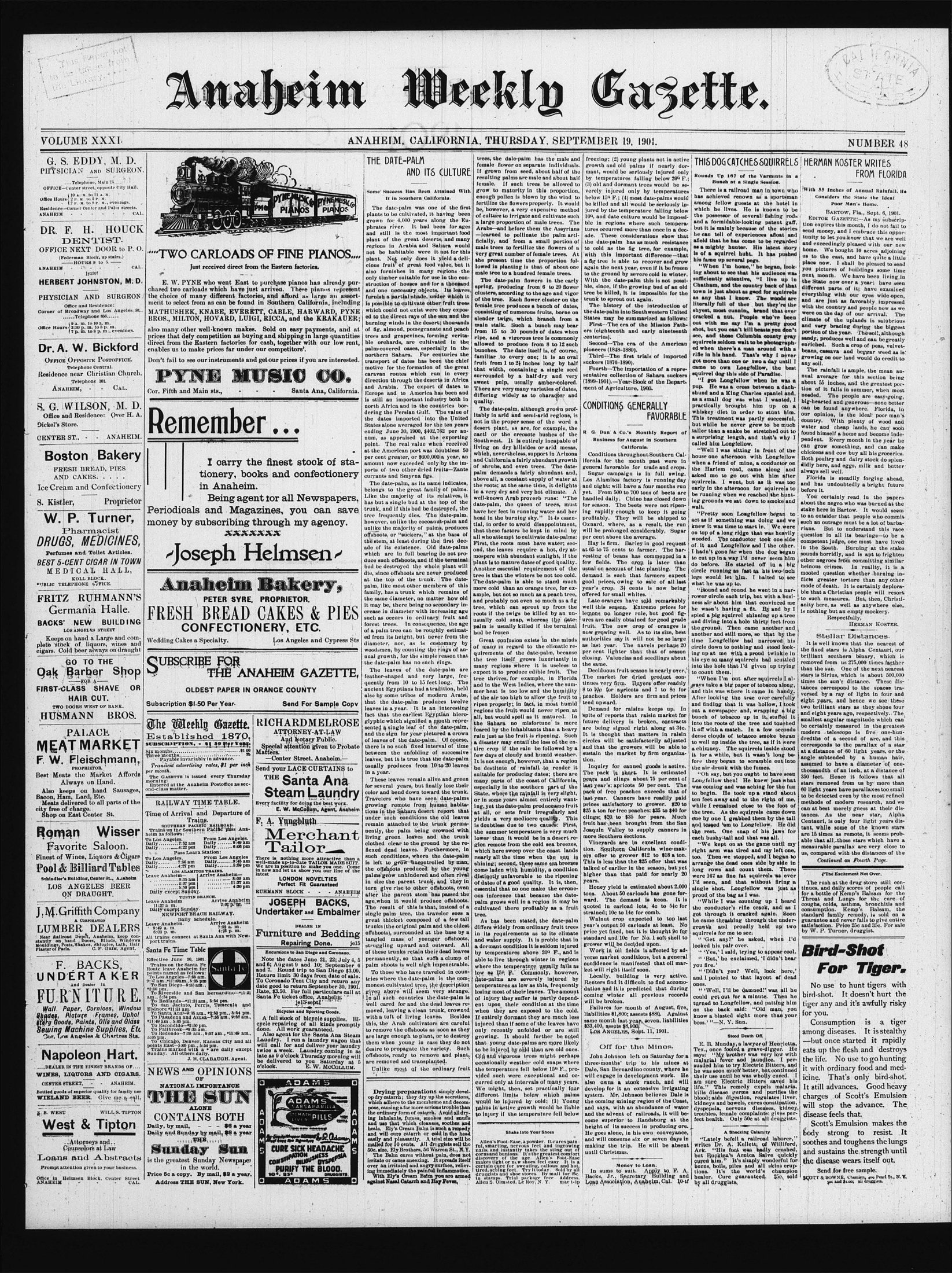
Searchable text
Anaheim
VOLUME XXXI.
G. S. EDDY, M. D.
PHYSICIAN AND SURGEON.
Telephone, Main 75...
OFFICE—Center street, opposite City Hall.
10 A. M. to 11 A. M.
Office Hours: 2 P. M. to 4 P. M.
7 P. M. to 8 P. M., evenings.
Residence—Corner Center and Palm streets.
ANAHEIM - CAL.
DR. F. H. HOUCK
DENTIST.
OFFICE NEXT DOOR to P. O.
(Federman Block, up stairs.)
HOURS 9 to 6
ANAHEIM - CAL.
Jy154t
HERBERT JOHNSTON, M. D.
PHYSICIAN AND SURGEON.
Office and Residence:
Corner of Broadway and Los Angeles St..
Telephone 656...
9 a. m. to 10 a. m.
3:30 p. m. to 5 p. m.
7 p. m. to 8 p. m., evenings.
Dr. A. W. Bickford
OFFICE OPPOSITE POSTOFFICE.
Telephone Central.
Residence near Christian Church.
Telephone 101.
ANAHEIM - CAL.
S. G. WILSON, M. D.
Office and Residence: Over H. A.
Dickel's Store.
CENTER ST.. - ANAHEIM.
Boston Bakery
FRESH BREAD, PIES
"TWO CARLOADS OF FINE PIANOS."
Just received direct from the Eastern factories.
E. W. PYNE who went East to purchase pianos has already purchased two carloads which have just arrived. These pianos represent the choice of many different factories, and afford as large an assortment to select from as can be found in Southern California, including MATHUSHEK, KNABE, EVERETT, CABLE, HARWARD, PYNESBROS., MILTON, HOVARD, LUIGI, RICCA, and the KRAKAUER also many other well-known makes. Sold on easy payments, and prices that defy competition as buying and shipping in large quantities direct from the Eastern factories for cash, together with our low rent enables us to make prices far under our competitors'.
Don't fail to see our instruments and get our prices if you are interested.
PYNE MUSIC CO.
Cor. Fifth and Main sts., Santa Ana, California
Remember...
Residence near Christian Church.
Telephone 101.
ANAHEIM, CAL.
S. G. WILSON, M. D.
Office and Residence: Over H. A.
Dickel's Store.
CENTER ST., ANAHEIM.
Boston Bakery
FRESH BREAD, PIES
AND CAKES.
Ice Cream and Confectionery
S. Kistler, Proprietor
W. P. Turner,
Pharmacist
DRUGS, MEDICINES,
Perfumes and Toilet Articles.
BEST 5-CENT CIGAR IN TOWN
MEDICAL HALL,
KOLL BLOCK.
PUBLIC TELEPHONE OFFICE.
FRITZ RUHMANN'S
Germania Halle.
BACKS' NEW BUILDING
LOS ANGELES STREET
Keeps on hand a Large and complete stock of liquors, wines and cigars. Cold beer always on draught
GO TO THE Oak Barber Shop
FOR A FIRST-CLASS SHAVE OR HAIR CUT.
TWO DOORS WEST OF BANK.
HUSMANN BROS.
PALACE MEAT MARKET
F. W. Fleischmann,
PROPRIETOR.
Best Meats the Market Affords Always on Hand.
Also keeps on hand Sausages, Bacon, Ham, Lard, Etc.
Meats delivered to all parts of the city free of charge.
Shop on East Center St.
Roman Wisser
Favorite Saloon.
Finest of Wines, Liquors & Cigaree Pool & Billiard Tables
Schindler's Building, Center St., Anaheim
LOS ANGELES BEER ON DRAUGHT.
PYNE MUSIC CO.
Cor. Fifth and Main sts., Santa Ana, California
Remember...
I carry the finest stock of stationery, books and confectionery in Anaheim.
Being agent for all Newspapers Periodicals and Magazines, you can save money by subscribing through my agency.
Joseph Helmsen
Anaheim Bakery,
PETER SYRE, PROPRIETOR.
FRESH BREAD CAKES & PIES CONFECTIONERY, ETC.
Wedding Cakes a Specialty. Los Angeles and Cypress St.
SUBSCRIBE FOR THE ANAHEIM GAZETTE
OLDEST PAPER IN ORANGE COUNTY
Subscription $1.50 Per Year. Send For Sample Copy.
The Weekly Gazette.
Established 1870.
SUBSCRIPTION, - $1.50 Per Year.
Six months... $1.00
Three months... 75
Payable invariably in advance.
Transient advertising rates, $1 per inch per month.
The GAZETTE is issued every Thursday morning.
Entered at the Anaheim Postoffice as second-class matter.
RAILWAY TIME TABLE.
Time of Arrival and Departure of Trains.
SOUTHERN PACIFIC HAILROAD.
Trains on the Southern Pacific pass Anaheim as follows:
To Los Angeles. From Los Angeles.
Daily... 7:52 am Daily... 9:49 am
Daily... 4:22 pm Daily... 6:06 pm
Pass Loara Station:
To Los Angeles. From Los Angeles.
Daily... 7:56 am Daily... 9:45 am
Daily... 4:27 pm Daily... 5:59 pm
LOS ALAMITOS TRAINS.
Leave Anaheim Arrive Anaheim—
9:35 am 8:00 am
2:07 pm 11:37 am
5:50 pm 4:30 pm
Daily except Sunday.
RICHARDMELROSE ATTORNEY-AT-LAW And Notary Public.
Special attention given to Probate Matters.
Center Street, Anaheim.
Send your LACE CURTAINS to THE Santa Ana Steam Laundry
Every facility for doing the best work.
E. W. McCollum, Agent, Anahei
F. A. Youngbluth Merchant Tailor
There is nothing more attractive than well-made up-to-date TAILOR MADE SUIT We are in position to make you one. Com in now and let us show you our line of the latest
LONDON NOVELTIES Perfect Fit Guaranteed
RUHMANN BLOCK ... ANAHEI
Roman Wisser
Favorite Saloon.
Finest of Wines, Liquors & Cigars
Pool & Billiard Tables
Schindler's Building, Center St., Anaheim
LOS ANGELES BEER ON DRAUGHT.
J.M. Griffith Company
A CORPORATION
LUMBER DEALERS
Near Railroad Depot, Anaheim, keep constantly on hand Doors, Blinds, Windows Mouldings, Posts, Shakes, Shingles, Lath, Hair Plaster of Paris.
C. F. GRIM, Agent.
F. BACKS,
UNDERTAKER
And Dealer in
FURNITURE.
Wall. Paper, Cornices, Window Shades, Picture Frames, Upholstery Goods, Paints, Oils and Glass Sewing Machine Supplies, Etc.
Cor. Los Angeles & Chartres Sta.
Napoleon Hart.
...DEALER IN THE FINEST BRANDS OF...
WINES, LIQUORS AND CIGARS.
CENTER STREET, ANAHEIM.
Bottled goods of superior quality for family use WIELAND BEER. Give me a call.
B. WEST
WILL S. TIPTON
West & Tipton
Attorneys and Counselors at Law
Loans and Abstracts
Prompt attention given to your business.
Office in Helmsen Block, Center Street ANAHEIM
RAILWAY TIME TABLE.
Time of Arrival and Departure of Trains.
SOUTHERN PACIFIC RAILROAD.
Trains on the Southern Pacific pass Anaheim as follows:
To Los Angeles.
Daily.....7:52 am Dally.....9:49 am
Daily.....4:22 pm Dally.....6:06 pm
Pass Loara Station:
To Los Angeles.
Daily.....7:56 am Dally.....9:45 am
Daily.....4:27 pm Dally.....5:59 pm
LOS ALAMITOS TRAINS.
Leave Anaheim.....Arrive Anaheim
9:35 am 8:00 am
2:07 pm 11:37 am
5:50 pm 4:30 pm
Daily except Sunday.
TUSTIN BRANCH.
Leave Anaheim Arrive Anaheim
11:37 a.m. 2:07 p.m.
Daily except Sunday.
NEWPORT BEACH RAILWAY.
Daily Schedule.
Leave Anaheim Arrive Anaheim
9:49 a.m. 7:52 a.m.
6:03 p.m. 4:23 p.m.
All trains connect at Santa Ana with Newport trains.
Santa Fe Time Table
Effective June 30, 1901.
Trains on the Santa Fe Route leave Anaheim for points named as follows:
To Los Angeles--7:55 am.
9:37 am *11:49 am..5:06 pm
To San Diego--9:35 am..
*2:50 pm.
To Riverside and San Bernardino--11:21 am..5:54 pm.
To Redlands--*11:31 am..5:54 pm.
To San Jacinto, Perris, Temecula and Elsinore--*11:31 am.
To Santa Ana--9:35 am..*3:05 pm..5:54 pm.
To Pasadena and Azusa--7:55 am..9:57 am..
*11:49 am..5:05 pm.
To Esccondido--*2:50 pm.
To Fallbrook--*9:35 am.
To Redondo--7:55 am..9:57 am..*11:49 am..
5:05 pm.
To Chicago, Denver, Kansas City and all points East--5:05 pm..5:54 pm.
Trains marked with a * are daily except Sunday. All others daily.
J. H. CLABAUGH. Agent.
NEWS AND OPINIONS OF
NATIONAL IMPORTANCE
THE SUN
ALONE
CONTAINS BOTH
Daily, by mail, $6 a year
Daily and Sunday by mail, $8 a year
THE
Sunday Sun is the greatest Sunday Newspaper in the world.
Price 5c a copy. By mail, $2 a year.
Address THE SUN, New York.
THE DATE-PALM AND ITS CULTURE
Some Success Has Been Attained With It in Southern California.
The date-palm was one of the first plants to be cultivated, it having been grown for 4,000 years along the Euphrates river. It had been for ages and still is the most important food plant of the great deserts, and many regions in Arabia and Sahara would not be habitable were it not for this plant. Not only does it yield a delicious fruit of great food value, but it also furnishes in many regions the only timber suitable for use in the construction of houses and for a thousand and one necessary objects. Its leaves furnish a partial shade, under which it is possible to cultivate other fruit trees which could not exist were they exposed to the direct rays of the sun and the burning winds in the desert; thousands of fig, almond, pomegranate and peach trees and grapevines, forming veritable orchards, are cultivated in the palm-covered oases, especially in the northern Sahara. For centuries the transport of dates has been the chief motive for the formation of the great caravan routes which run in every direction through the deserts in Africa and Arabia. The export of dates to Europe and to America has been and is still an important industry both in north Africa and in the countries bordering the Persian Gulf. The value of the dates imported into the United States alone averaged for the ten years ending June 30, 1900, $402,762 per annum, as appraised at the exporting point. The real value when received at the American port was doubtless 50 per cent greater, or $600,000 a year, an amount now exceeded only by the imports of two other dried fruits—Zante trees, the dale-palm has the male and female flower on separate individuals. If grown from seed, about half of the resulting palms are male and about half female. If such trees be allowed to grow to maturity in this proportion, enough pollen is blown by the wind to fertilize the flowers properly. It would be, however, a very expensive method of culture to irrigate and cultivate such a large proportion of male trees. The Arabs—and before them the Assyrians—learned to pollinate the palm artificially, and from a small portion of male trees to fertilize the flowers of a very great number of female trees. At the present time the proportion followed in planting is that of about one male tree to a hundred female trees.
The date-palm flowers in the early spring, producing from 6 to 20 flower clusters, according to the age and vigor of the tree. Each flower cluster on the female tree produces a bunch of dates, consisting of numerous fruits, borne on slender twigs, which branch from a main stalk. Such a bunch may bear from 15 to 30 pounds of dates when ripe, and a vigorous tree is commonly allowed to produce from 8 to 12 such bunches. The date itself is, of course, familiar to every one; it is an oval fruit from 1 to 2¼ inches long by half that width, containing a single seed surrounded by a half-dry and very sweet pulp, usually amber-colored. There are very many varieties of dates, differing widely as to character and quality.
The date-palm, although grown profitably in arid and semi-arid regions, is not in the proper sense of the word a desert plant, as are, for example, the cacti or the creosote bushes of the Southwest. It is entirely incapable of living on dry hillsides or arid mesas, which, nevertheless, support in Arizona and California a fairly abundant growth of shrubs, and even trees. The date-palm demands a fairly abundant and freezing; (2) young plants not in growth and old palms if nearly mant, would be seriously injured by temperatures falling below 2(3) old and dormant trees would severely injured only by temperatures below 15° F.; (4) most date-palms be killed and all would be seriously jured by the temperature falling 10°, and date culture would be imminent in regions where such temperatures occurred more than once in a decade. These considerations show that the date-palm has as much resistance to cold as the fig tree, for example with this important difference: a fig tree is able to recover and again the next year, even if it be too ground by severe cold in winter. With the date-palm this is not able, since, if the growing bud of a tree be killed, it is impossible for trunk to sprout out again.
The history of the introduction of the date-palm into Southwestern U.S. states may be summarized as follows:
First—The era of the Missioners (eighteenth and early nineteenth centuries).
Second—The era of the Amelia pioneers (1848-1880).
Third—The first trials of impulse suckers (1876-1890).
Fourth—The importation of a representative collection of Sahara superscripted (1899-1901). Year-Book of the Department of Agriculture, 1900.
CONDITIONS GENERALLY FAVORABLE
R. G. Dun & Co.'s Monthly Report Business for August in Southern California.
Conditions throughout Southernifornia for the month past were general favorable for trade and sugar campaign is in full success stock of staand confectionery
best stock of stand confectionery
all Newspapers,
you can save
high my agency.
bakery,
PRIETOR.
KES & PIES
Y, ETC.
Los Angeles and Cypress Sts
IM GAZETTE,
THE COUNTY
Send For Sample Copy
HARDMELROSE
TORTORNEY-AT-LAW
And Notary Public.
Amal attention given to Probate
enter Street, Anaheim.
our LACE CURTAINS to
Santa Ana
team Laundry
ability for doing the best work.
W. McCollum, Agent, Anaheim
Youngbluth
Lerchant
tailor
nothing more attractive than a cup-up-date TAILOR MADE SUIT.
position to make you one. Come and let us show you our line of the
LONDON NOVELTIES
Perfect Fit Guaranteed
AN BLOCK
caravan routes which run in every direction through the deserts in Africa and Arabia. The export of dates to Europe and to America has been and is still an important industry both in north Africa and in the countries bordering the Persian Gulf. The value of the dates imported into the United States alone averaged for the ten years ending June 30, 1900, $402,762 per annum, as appraised at the exporting point. The real value when received at the American port was doubtless 50 per cent greater, or $600,000 a year, an amount now exceeded only by the imports of two other dried fruits—Zante currants and Smyrna figs.
The date-palm, as its name indicates, belongs to the great family of palms. Like the majority of its relatives, it has but a single bud at the top of the trunk, and if this bud be destroyed, the tree frequently dies. The date-palm, however, unlike the cocoanut-palm and unlike the majority of palms, produces offshoots, or "suckers," at the base of the stem, at least during the first decade of its existence. Old date-palms which are in full bearing do not produce such offshoots, and if the terminal bud be destroyed the whole plant will die, since offshoots are never produced at the top of the trunk. The date-palm, like most other members of this family, has a trunk which remains of the same diameter, no matter how old it may be, there being no secondary increase in diameter with increasing age such as occurs in ordinary fruit and forest trees. In consequence, the age of a palm tree can be roughly estimated from its height, but never from the diameter, nor, as is customary by woodsmens, by counting the rings of annual growth, for the simple reason that the date-palm has no such rings.
The leaves of the date-palm are feather-shaped and very large, frequently from 10 to 15 feet long. The ancient Egyptians had a tradition, held also by some tribes of modern Arabs, that the date-palm produces twelve leaves in a year. It is an interesting fact that the earliest Egyptian hieroglyphic which signified a month represented a single leaf of the date-palm, and the sign for year pictured a crown of leaves of the date-palm. Of course, there is no such fixed interval of time between the unfolding of successive leaves, but it is true that the date-palm usually produces from 10 to 20 leaves in a year.
These leaves remain alive and green for several years, but finally lose their color and bend down toward the trunk. Travelers who have seen date-palms growing remote from human habitations in the Sahara desert report that under such conditions the old leaves remain attached to the trunk permanently, the palm being crowned with living green leaves and the trunk clothed clear to the ground by the reflexed dead leaves. Furthermore, in such conditions, where the date-palm is left to grow uncontrolled by man, the offshoots produced by the young palms grow unhindered and often rival in size the parent trunk, and they in turn give rise to other offshoots, even after the parent stem has passed the caravan routes which run in every direction through the deserts in Africa and Arabia. The export of dates to Europe and to America has been and is still an important industry both in north Africa and in the countries bordering the Persian Gulf. The value of the dates imported into the United States alone averaged for the ten years ending June 30, 1900, $402,762 per annum, as appraised at the exporting point. The real value when received at the American port was doubtless 50 per cent greater, or $600,000 a year, an amount now exceeded only by the imports of two other dried fruits—Zante currants and Smyrna figs.
The date-palm, although grown profitably in arid and semi-arid regions, is not in the proper sense of the word a desert plant, as are, for example, the cacti or the creosote bushes of the Southwest. It is entirely incapable of living on dry hillsides or arid mesas, which nevertheless, support in Arizona and California a fairly abundant growth of shrubs, and even trees. The date-palm demands a fairly abundant and above all, a constant supply of water at the roots; at the same time, it delights in a very dry and very hot climate. A well-known Arab proverb runs: "The date-palm, the queen of trees, must have her feet in running water and her head in the burning sky." It is essential, in order to avoid disappointment, that these factors be kept in mind by all who attempt to cultivate date-palms: First, the roots must have water; second, the leaves require a hot, dry atmosphere with abundant sunlight; if the plant is to mature dates of good quality. Another essential requirement of the tree is that the winters be not too cold. The date-palm is able to stand much more cold than an orange tree, for example, but not so much as a peach tree, and probably not even so much as a fig tree, which can sprout up from the roots if the twigs be killed by an unusually cold snap, whereas the date-palm is usually killed if the terminal bud be frozen.
Great confusion exists in the minds of many in regard to the climatic requirements of the date-palm because the tree itself grows luxuriantly in many regions where it is useless to expect it to produce edible fruit. The tree thrives, for example, in Florida and in the West Indies, where the summer heat is too low and the humidity of the air too high to allow the fruit to ripen properly; in fact, in most humid regions the fruit would never ripen at all, but would spoil as it matured. In the Sahara no misfortune is more feared by the inhabitants than a heavy rain just as the fruit is ripening. Such a disaster may entail the loss of the entire crop if the rain be followed by a few days of cloudy and humid weather. It is not enough, however, that a region be destitute of rainfall to render it suitable for producing dates; there are many parts of the coast of California, especially in the southern part of the State, where the rainfall is very slight, or in some years almost entirely wanting, yet the date-palm produces no fruit at all, or sets fruit irregularly and yields a very mediocre quality. This is doubtless due to two causes: First, the summer temperature is very much lower than it would be in a desert region remote from the cold sea breezes, which here sweep over the coast lands nearly all the time when the sun is shining; second, these same sea breezes come laden with humidity, a condition distinctly unfavorable to the ripening of dates of a good quality. It is then, essential that no one make the erroneous inference that because the date-palm is firm.
CONDITIONS GENERALLY FAVORABLE
R. G. Dun & Co.'s Monthly Report Business for August in Southern California.
Conditions throughout Southern California for the month past were general favorable for trade and commerce.
Sugar campaign is in full swing Los Alamitos factory is running night; will have a four month break handled daily. Chino has closed for season. The beets were not ripe rapidly enough to keep it profitable. They will be shipped Oxnard, where, as a result, they will be prolonged considerably. Some percent above the average.
Hay is firm. Barley in good reel at 65 to 75 cents to farmer. The vesting of beans has commenced few fields. The crop is later usual on account of late planting. Demand is such that farmers earn good prices; owing to sale of all year's crop. 31 cents is now offered for small whites.
Late oranges have sold remarkably well this season. Extreme price lemmons no longer rule, but good ures are easily obtained for good fruit. The new crop of oranges now growing well. As to its size authorities say it will not be so as last year. The navels perhaps per cent lighter than that of sealing. Valencias and seedlings are also sustainthe market by firm organization.
Inquiry for canned goods is adaption of reports that raisin markets future delivery is broken; containere being signed right along with it. It is thought that matters in circles will be satisfactorily adjudicated and that the growers will be able sustainthe market by firm organization.
Inquiry for canned goods is adaption of reports that raisin markets offer to grower $12 to $18. This is less than the $25 offer that talked of earlier in the season, but higher than that paid for nearby years.
Honey yield is estimated about tons. About 50 carloads has gone worthward.
Travelers who have seen date-palm growing remote from human habitations in the Sahara desert report that under such conditions the old leaves remain attached to the trunk permanently, the palm being crowned with living green leaves and the trunk clothed clear to the ground by the reflexed dead leaves. Furthermore, in such conditions, where the date-palm is left to grow uncontrolled by man, the offshoots produced by the young palms grow unhindered and often rival in size the parent trunk, and they in turn give rise to other offshoots, even after the parent stem has passed the age when it would produce offshoots. The result of this is that, instead of a single palm tree, the traveler sees a great thicket composed of a few tall trunks (the original palm and the oldest offshoots), surrounded at the base by a tangled mass of younger offshoots, struggling upward and outward. All of these trunks retain their dead leaves permanently, so that such a clump of palm shoots is well nigh impenetrable.
To those who have traveled in countries where the date-palm is the commonest cultivated tree, the description given above will seem very strange. In all such countries the date-palm is well cared for and the dead leaves removed, leaving a clean trunk, crowned with a tuft of living leaves. Besides this, the Arab cultivators are careful to remove the offshoots as soon as they are large enough to plant, or to destroy them when young in case they do not desire to propagate the variety. Such offshoots, ready to remove and plant, are removed and transplanted.
Unlike most of the ordinary fruit drying preparations simply develop dry catarrh; they dry up the secretions which adhere to the membrane and decompose, causing a far more serious trouble than the ordinary form of catarrh. Avoid all drying inhalants, fumes, smokes and sniffs and use that which cleanssea, soothes and heals. Ely's Cream Balm is such a remedy and will cure catarrh or cold in the head easily and pleasantly. A trial size will be mailed for 10 cents. All druggists sell the 50c. size. Ely Brothers, 56 Warren St., N.Y.
The Balm cures without pain, does not irritate or cause sneezing. It spreads itself over an irritated and angry surface, relieving immediately the painful inflammation.
With Ely's Cream Balm you are armed against Nasal Catarrh and Hay Fever,
Drying preparations simply develop dry catarrh; they dry up the secretions which adhere to the membrane and decompose, causing a far more serious trouble than the ordinary form of catarrh. Avoid all drying inhalants, fumes, smokes and sniffs and use that which cleanssea, soothes and heals. Ely's Cream Balm is such a remedy and will cure catarrh or cold in the head easily and pleasantly. A trial size will be mailed for 10 cents. All druggists sell the 50c. size. Ely Brothers, 56 Warren St., N.Y.
The Balm cures without pain, does not irritate or cause sneezing. It spreads itself over an irritated and angry surface, relieving immediately the painful inflammation.
With Ely's Cream Balm you are armed against Nasal Catarrh and Hay Fever,
Shake Into Your Shoes
Allen's Foot-Ease, a powder. It cures painful, smarting, nervous feet and ingrowing nails, and instantly takes the sting out of corns and bunions. It's the greatest comfort discovery of the age. Allen's Foot-Ease makes tight or new shoes feel easy. It is a certain cure for sweating, callous and hot tired, aching feet. Try it today. Sold by all druggists and shoe stores. By mail for 25c. in stamps. Trial package free Address: Allen S. Olmsted, Le Roy, N.Y.
In some years almost entirely wanting yet the date-palm produces no fruit at all, or sets fruit irregularly and yields a very mediocre quality. This is doubtless due to two causes: First, the summer temperature is very much lower than it would be in a desert region remote from the cold sea breezes, which here sweep over the coast lands nearly all the time when the sun is shining; second, these same sea breezes come laden with humidity, a condition distinctly unfavorable to the ripening of dates of a good quality. It is then, essential that no one make the erroneous inference that because the date-palm grows well in a region it may be cultivated there profitably as a fruit tree.
As has been stated, the date-palm differs widely from ordinary fruit trees in its requirements as to its climate and water supply. It is problet that in a dormant condition it is seldom injured by temperatures above 20° F., and is able to live through winter in regions where the temperature usually falls as low as 159 F. Commonly, however, date-palm are severely injured by temperatures as low as this, frequently losing most of their leaves. The amount of injury they suffer is partly dependent upon their condition at the time when they are exposed to the cold. If entirely dormant they are much less injured than if some of the leaves have only recently unfolded or are still growing. It should further be noted that young date-palms are more likely to be injured by cold than are old ones. Old and vigorous trees might perhaps occasionally weather cold snaps where the temperature fell below 15° F., provided such were exceptional and occurred only at intervals of many years.
We might then set practically four different limits below which palms would be injured by cold: (1) Young palms in active growth would be liable to injury if the temperature fell below
Gazette.
NOBER 19, 1901.
NUMBER 48
zing; (2) young plants not in active growth and old palms if nearly dormant, would be seriously injured only by temperatures falling below 20° F.; old and dormant trees would be severely injured only by temperatures falling below 15° F.; (4) most date-palms would be killed and all would be seriously injured by the temperature falling below 15° F.; and date culture would be impossible in regions where such temperatures occurred more than once in a decade.
These considerations show that date-palm has as much resistance as the fig tree, for example, this important difference—that the tree is able to recover and grow on the next year, even if it be frozen or ground by severe cold in winter.
In the date-palm this is not possible, if the growing bud of an old tree be killed, it is impossible for the root to sprout out again.
The history of the introduction of date-palm into Southwestern United States may be summarized as follows: The era of the Mission Fath- eighteenth and early nineteenth centuries.
Second—The era of the American Beers (1848-1880).
Third—The first trials of imported beers (1876-1890).
Fourth—The importation of a repre- sentative collection of Sahara suckers (1901).—Year-Book of the Depart- ment of Agriculture, 1900.
EDITIONS GENERALLY FAVORABLE
Dun & Co.'s Monthly Report of Business for August in Southern California.
Conditions throughout Southern Cali- fia for the month past were in general favorable for trade and crops. Our campaign is in full swing.
THIS DOG CATCHES SQUIRRELS
Rounds Up 167 of the Varmints in a Bunch at a Single Session.
There is a railroad man in town who has achieved renown as a sportsman among fellow guests at the hotel in which he lives. He is known to be the possessor of several fishing rods and a formidable-looking patent gaff, but it is mainly because of the stories he can tell of experiences afloat and afield that he has come to be regarded as a mighty hunter. His latest story is of a squirrel huht. It has pushed his fame up several pegs.
"When I'm home," he began, looking about to see that his audience was sufficiently attentive, "I live up in Chatham, and the country back of that town is just about as good for squirrels as any that I know. The woods are literally full of them but they're the shyest, most cunning brand that ever cracked a nut. People who've been out with me say I'm a pretty good shot, but you can't kill beasts you don't see, and those Columbia county gray squirrels seldom wait to be photographed when there's a man around with a rifle in his hand. That's why I never got more than one or two a day until I came to own Longfellow, the best squirrel dog this side of Paradise.
"I got Longfellow when he was a pup. He was a cross between a dachshund and a King Charles spaniel and, as a small dog was what I wanted, I practically brought him up on a whiskey diet in order to stunt him. This treatment was partly successful, but while he never grew to be much taller than a snake he stretched out to a surprising length, and that's why I called him Longfellow.
"Well I was sitting in front of the house one afternoon with Longfellow when a friend of mine, a conductor on the Harlem road, came along and asked me to go out with big after."
HERMAN KOSTER WRITES FROM FLORIDA
With 55 Inches of Annual Rainfall. He considers the State the Ideal Poor Man's Home.
BARTOW, Fla., Sept. 6, 1901.
EDITOR GAZETTE:—As my subscription expires this month, I do not fail to send money, and I embrace this opportunity to let you know that we are well and exceedingly pleased with our new home. We bought 10 acres adjoining us to the east, and have quite a little place now. I shall be pleased to send you pictures of buildings some time next month. We have been living in the State now over a year; have seen different parts of it; have examined everything with our eyes wide open, and are just as favorably impressed with the country and people now as we were on the day of our arrival. The climate of the uplands is salubrious and very bracing during the biggest portion of the year. The soil, although sandy, produces well and can be greatly enriched. Such a crop of peas, velvet-beans, cassava and beggar weed as is growing on our land would do credit to any soil.
The rainfall is ample, the mean annual average for this section being about 55 inches, and the greatest portion of it falls in summer, when most needed. The people are easy-going, big-hearted and generous—none better can be found anywhere. Florida, in our opinion, is the ideal poor man's country. With plenty of wood and water and cheap lands, he can soon found himself a home and become independent. Every month in the year he can grow something, and can make chickens and cow buy all his groceries. Both poultry and dairy stock do splendidly here, and eggs, milk and butter always sell well.
CONDITIONS GENERALLY FAVORABLE
Dun & Co.'s Monthly Report of Business for August in Southern California.
Conditions throughout Southern California for the month past were in general favorable for trade and crops. Sugar campaign is in full swing. Alamitos factory is running daylight; will have a four months run from 500 to 700 tons of beets are dried daily. Chino has closed down season. The beets were not ripen rapidly enough to keep it going easily. They will be shipped to Madrid, where, as a result, the run was prolonged considerably. Sugar content above the average.
By is firm. Barley in good request to 75 cents to farmer. The harping of beans has commenced in fields. The crop is later than on account of late planting. The land is such that farmers expect prices, owing to sale of all last crop. 3½ cents is now being paid for small whites.
The oranges have sold remarkably this season. Extreme prices for has no longer rule, but good figures easily obtained for good grade. The new crop of oranges is growing well. As to its size, best qualities say it will not be so large last year. The navels perhaps 20 cent lighter than that of season egg. Valencias and seedlings about same.
Fiduous fruit season is nearly over. Market for dried product consists very firm. Buyers offer readily up for apricots and 7 to 8¢ for pears. Holders are firm and prices upward.
Command for raisins keeps up. In of reports that raisin market for delivery is broken, contracts being signed right along at 3½ cent thought that matters in raisin nuts will be satisfactorily adjusted that the growers will be able to join the market by firm organization for canned goods is active.
Pack is short. It is estimated that oil and olings about 75 per cent of year's; apricots 50 per cent. The free peaches exceeds that of year. Canners have readily paid as satisfactory to grower. $20 to ton for free peaches: $35 to $40 for pears; $20 to $35 for pears. Much has been brought from the San Juan Valley to supply canners in Southern sections.
Hay yards are in excellent condition. Southern California wine-maker to grower $12 to $18 a ton. Is less than the $25 offer that was made of earlier in the season, but yet farther than that paid for nearly 20 years yield is estimated about 2,000 About 50 carloads has gone forward.
"I got Longfellow when he was a pup. He was a cross between a dachshund and a King Charles spaniel and, as a small dog was what I wanted, I practically brought him up on a whiskey diet in order to stunt him. This treatment was partly successful, but while he never grew to be much taller than a snake be stretched out to a surprising length, and that's why I called him Longfellow.
"Well I was sitting in front of the house one afternoon with Longfellow when a friend of mine, a conductor on the Harlem road, came along and asked me to go out with him after squirrels. I went, but as it was too early in the afternoon for squirrels to be running when we reached the hunting grounds we sat down to smoke and wait.
"Pretty soon Longfellow began to act as if something was doing and we knew it was time to start in. We were on top of a long ridge that was heavily wooded. The conductor took one side of it and Longfellow and I the other. I hadn't gone far when the dog began to cut up in a way I'd never seem him do before. He started off in a big circle running as fast as his two-inch legs would let him. I halted to see what he was up to.
"Round and round he went in a narrower circle each trip, but with a business air about him that convinced me he wasn't having a fit. By and by I spied a big squirrel shinning up a tree and diving into a hole thirty feet from the ground. Then came another and another and still more, so that by the time Longfellow had narrowed his circle down to nothing and stood looking up at me with a proud twinkle in his eye so many squirrels had scuttled into the hole that I'd given up trying to count them.
"When I'm out after squirrels I always take a big paper of tobacco along, and this was where it came in handy. After looking the tree over carefully and finding that it was hollow, I took out a newspaper and, wrapping a big bunch of tobacco up in it, stuffed it into the roots of the tree and touched it off with a match. In a few seconds dense clouds of tobacco smoke began to well up inside the tree, as if it were a chimney. The squirrels inside stood it for a while, but it wasn't long before they began to scramble out into the air drunk with the fumes.
"Oh say, but you ought to have seen Longfellow then! He knew just what was coming and was aching for the fun to begin. He took up a stand about ten feet away and to the right of me, while I remained close to the foot of the tree. As the squirrels came down one by one I grabbed them by the tail and tossed them to Longfellow. He did the rest. One snap of his jaws for each bushy-tail and that was all.
"We kept on at the game until my right arm was tired and my left one, too. Then we stopped, and I began to arrange the dead ones side by side in long rows and count them. There were 167 as fine fat squirrels as ever I'd seen, and that without firing a single shot. Longfellow was just as proud of the bag as I was."
Final average for this section being about 55 inches, and the greatest portion of it falls in summer, when most needed. The people are easy-going, big-hearted and generous—none better can be found anywhere. Florida, in our opinion, is the ideal poor man's country. With plenty of wood and water and cheap lands, he can soon found himself a home and become independent. Every month in the year he can grow something, and can make chickens and cow buy all his groceries. Both poultry and dairy stock do splendidly here, and eggs, milk and butter always sell well.
Florida is steadily forging ahead, and has undoubtedly a bright future before it.
You certainly read in the papers about the negro who was burned at the stake here in Bartow. It would seem to an outsider that people who commit such an outrage must be a lot of barbarians. But to understand this race question in all its bearings—to be a competent judge, one must have lived in the South. Burning at the stake sounds horridly, and apt to frighten other negroes from committing similar heinous crimes. In reality, it is a mooted question whether burning inflicts greater torture than any other mode of death. It is certainly deplorable that a Christian people will resort to such measures. But, then, Christianity here, as well as anywhere else, is nothing but an empty mockery.
Respectfully,
HERMAN KOSTER.
Stellar Distances.
It is well known that the nearest of the fixed stars is Alpha Centauri, our brilliant southern binary, which is removed from us 275,000 times farther than the sun. One of the next nearest stars is Sirius, which is about 500,000 times the sun's distance. These distances correspond to the spaces traversed by a ray of light in four and eight years, and hence we see these two brilliant stars as they shone four and eight years ago, respectively. The smallest angular magnitude which can be certainly measured in the greatest modern telescope is five one-hundredths of a second of arc, and this corresponds to the parallax of a star at a distance of 60 light years, or the angle subtended by a human hair, assumed to have a diameter of one-thousandths of an inch, at a distance of 350 feet. Hence it follows that all stars removed from us by more than 60 light years have parallaxes too small to be detected even by the most refined methods of modern research, and we can at best merely guess at their distances. As the near star, Alpha Centauri, is only four light years distant, while some of the known stars are 15 times as remote, it seems probable that all those stars which have a measurable parallax are very close to us, compared with the distances of the Continued on Fourth Page.
The Excitement Not Over.
The rush at the drug store still continues, and daily scores of people call for a bottle of Kemp's Balsam for the Throat and Lungs for the cure of
Money to Loan.
Sums to suit. Apply to F. A.
Xrs., Jr., Secretary Building and
Association, Anaheim, Cal. 10-t
Off for the Mines.
John Johnson left on Saturday for a
se-months' trip to his mines at
San Bernardino county, where he
engage in development work. He
owns a stock ranch, and will
stop for it an extensive irrigating
item. Mr. Johnson believes Dale is
blooming mining region of the Coast,
says, with an abundance of water
the advent of railroads, it will be
superior to Randsburg at the
right of its success in producing ore.
goes alone, in his own conveyance,
will consume six or seven days in
being the trip. He will be absent
in Christmas.
Bird-Shot For Tiger.
No use to hunt tigers with bird-shot. It doesn't hurt the tiger any and it's awfully risky for you.
Consumption is a tiger among diseases. It is stealthy—but once started it rapidly eats up the flesh and destroys the life. No use to go hunting it with ordinary food and medicine. That's only bird-shot. It still advances. Good heavy charges of Scott's Emulsion will stop the advance. The disease feels that.
Scott's Emulsion makes the body strong to resist. It soothes and toughens the lungs and sustains the strength until the disease wears itself out.
Send for free sample:
SCOTT & BOWNE, Chemists, 400 Pearl St., N.Y.
900 and $1.00; all druggists.