anaheim-gazette 1901-09-12
Scanned page
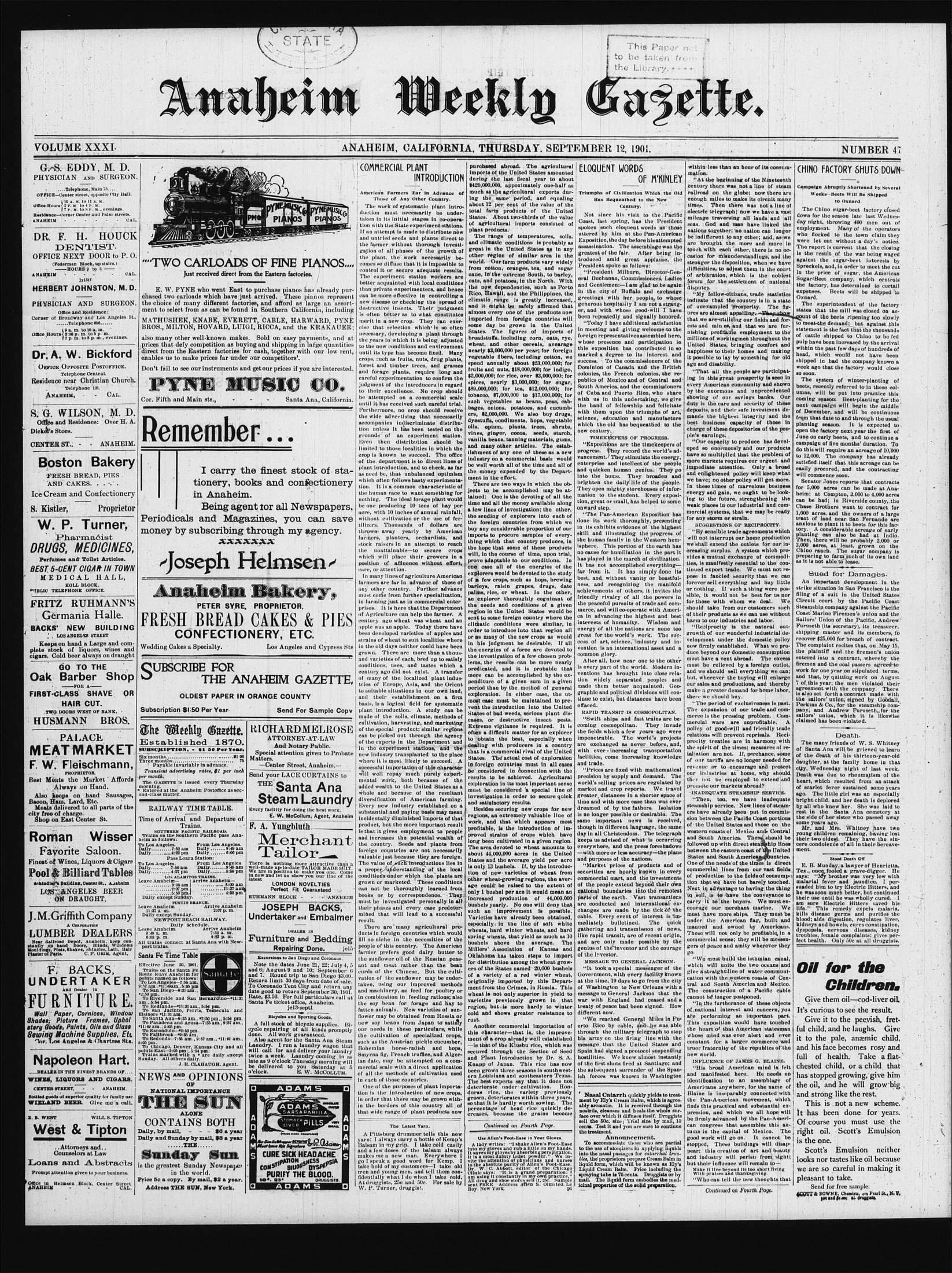
Searchable text
VOLUME XXXI.
G. S. EDDY, M. D. PHYSICIAN AND SURGEON.
Telephone, Main 75...
OFFICE—Center street, opposite City Hall.
10 A.M. to 11 A.M.
2 P.M. to 4 P.M.
7 P.M. to 8 P.M., evenings.
Residence—Corner Center and Palm streets.
ANAHEIM CAL.
DR. F. H. HOUCK DENTIST.
OFFICE NEXT DOOR to P. O.
(Federman Block, up stairs.)
HOURS 9 to 5
ANAHEIM CAL.
jy15tf
HERBERT JOHNSTON, M. D.
PHYSICIAN AND SURGEON.
Office and Residence:
Corner of Broadway and Los Angeles St..
Telephone 656....
9 a.m. to 10 a.m.
3:30 p.m. to 5 p.m.
7 p.m. to 8 p.m., evenings.
Dr. A. W. Bickford
OFFICE OPPOSITE POSTOFFICE.
Telephone Central.
Residence near Christian Church.
Telephone 101.
ANAHEIM, CAL.
S. G. WILSON, M. D.
Office and Residence: Over H. A. Dickel's Store.
CENTER ST., - ANAHEIM.
Boston Bakery
"TWO CARLOADS OF FINE PIANOS..."
Just received direct from the Eastern factories.
E. W. PYNE who went East to purchase pianos has already purchased two carloads which have just arrived. These pianos represent the choice of many different factories, and afford as large an assortment to select from as can be found in Southern California, including MATHUSHEK, KNABE, EVERETT, CABLE, HARWARD, PYNE BROS., MILTON, HOVARD, LUIGI, RICCA, and the KRAKAUER; also many other well-known makes. Sold on easy payments, and at prices that defy competition as buying and shipping in large quantities direct from the Eastern factories for cash, together with our low rent, enables us to make prices far under our competitors'.
Don't fail to see our instruments and get our prices if you are interested.
PYNE MUSIC CO.
Cor. Fifth and Main sts., Santa Ana, California.
Remember...
I carry the finest stock of sta-
Residence near Christian Church.
Telephone 101.
ANAHEIM, CAL.
S. G. WILSON, M. D.
Office and Residence: Over H. A. Dickel's Store.
CENTER ST., ANAHEIM.
Boston Bakery
FRESH BREAD, PIES AND CAKES.
Ice Cream and Confectionery
S. Kistler, Proprietor
W. P. Turner,
Pharmacist
DRUGS, MEDICINES,
Perfumes and Toilet Articles.
BEST 5-CENT CIGAR IN TOWN MEDICAL HALL,
KOLL BLOCK.
PUBLIC TELEPHONE OFFICE.
FRITZ RUHMANN'S Germania Halle.
BACKS' NEW BUILDING
LOS ANGELES STREET
Keeps on hand a Large and complete stock of liquors, wines and cigars. Cold beer always on draught
GO TO THE Oak Barber Shop
FOR A FIRST-CLASS SHAVE OR HAIR CUT.
TWO DOORS WEST OF BANK.
HUSMANN BROS.
PALACE MEAT MARKET
F. W. Fleischmann,
PROPRIETOR.
Best Meats the Market Affords Always on Hand.
Also keeps on hand Sausages, Bacon, Ham, Lard, Etc.
Meats delivered to all parts of the city free of charge.
Shop on East Center St.
Roman Wisser
Favorite Saloon.
Finest of Wines, Liquors & Cigare Pool & Billiard Tables
Schindler's Building, Center St., Anaheim
LOS ANGELES BEER ON DRAUGHT
PYNE MUSIC CO.
Cor. Fifth and Main sts., Santa Ana, California.
Remember...
I carry the finest stock of stationery, books and confectionery in Anaheim.
Being agent for all Newspapers, Periodicals and Magazines, you can save money by subscribing through my agency.
Joseph Helmsen
Anaheim Bakery,
PETER SYRE, PROPRIETOR.
FRESH BREAD CAKES & PIES CONFECTIONERY, ETC.
Wedding Cakes a Specialty. Los Angeles and Cypress Sts
SUBSCRIBE FOR THE ANAHEIM GAZETTE,
OLDEST PAPER IN ORANGE COUNTY
Subscription $1.50 Per Year. Send For Sample Copv
The Weekly Gazette.
Established 1870.
SUBSCRIPTION, - $1.50 Per Year.
Six months... $1.00
Three months... 75
Payable invariably in advance.
Transient advertising rates, $1 per inch per month.
The Gazette is issued every Thursday morning.
Entered at the Anaheim Postoffice as second-class matter.
RAILWAY TIME TABLE.
Time of Arrival and Departure of Trains.
SOUTHERN PACIFIC RAILBOAD.
Trains on the Southern Pacific pass Anaheim as follows:
To Los Angeles. From Los Angeles.
Daily... 7:52 am Dally... 9:49 am
Daily... 4:22 pm Dally... 6:06 pm
Pass Loaara Station:
To Los Angeles. From Los Angeles.
Daily... 7:56 am Dally... 9:45 am
Daily... 4:27 pm Dally... 5:59 pm
Los ALAMITOS TRAINS.
Leave Anaheim... Arrive Anaheim...
Daily except Sunday.
RICHARD MELROSE
ATTORNEY-AT-LAW
And Notary Public.
Special attention given to Probate Matters.
—Center Street, Anaheim—
Send your LACE CURTAINS to THE Santa Ana Steam Laundry
Every facility for doing the best work.
E. W. McCollum, Agent, Anaheim
F. A. Yungbluth
Merchant Tailor
There is nothing more attractive than a well-made up-to-date TAILOR MADE SUIT. We are in position to make you one. Come in now and let us show you our line of the latest
LONDON NOVELTIES
Perfect Fit Guaranteed
RUHMANN BLOCK
Roman Wisser
Favorite Saloon.
Finest of Wines, Liquors & Cigars
Pool & Billiard Tables
Schindler's Building, Center St., Anaheim
LOS ANGELES BEER ON DRAUGHT.
J.M. Griffith Company
A CORPORATION
LUMBER DEALERS
Near Railroad Depot, Anaheim, keep constantly on hand Doors, Blinds, Windows Mouldings, Posts, Shakes, Shingles, Lath, Hair Plaster of Paris.
C.F. GRIM, Agent.
F. BACKS,
UNDERTAKER
And Dealer in FURNITURE.
Wall Paper, Cornices, Window Shades; Picture Frames, Upholstery Goods, Paints, Oils and Glass Sewing Machine Supplies, Etc.
For Los Angeles & Chartres Sts.
Napoleon Hart.
...DEALER IN THE FINEST BRANDS OF...
WINES, LIQUORS AND CIGARS.
CENTER STREET, ANAHEIM.
Bottled goods of superior quality for family use WIELAND BEER. Give me a call.
2. B. WEST
WILL S. TIPTON
Attorneys and...
Counselors at Law
Loans and Abstracts
Prompt attention given to your business.
Office in Helmsen Block, Center Street ANAHEIM
RAILWAY TIME TABLE.
Time of Arrival and Departure of Trains.
SOUTHERN PACIFIC RAILROAD.
Trains on the Southern Pacific pass Anaheim as follows:
To Los Angeles.
Daily.....7:52 am Dally.....9:49 am
Daily.....4:23 pm Dally.....6:06 pm
Pass Loara Station:
To Los Angeles.
Daily.....7:56 am Daily.....9:45 am
Daily.....4:27 pm Daily.....5:59 pm
LOS ALAMITOS TRAINS.
Leave Anaheim—Arrive Anaheim—
9:35 am 8:00 am
2:07 pm 11:37 am
5:50 pm 4:30 pm
Daily except Sunday.
TUSTIN BRANCH.
Leave Anaheim Arrive Anaheim
11:37 a.m 2:07 p.m.
Daily except Sunday.
NEWPORT BEACH RAILWAY.
Daily Schedule.
Leave Anaheim Arrive Anaheim
9:49 a.m 7:52 a.m.
6:03 p.m 4:23 p.m.
All trains connect at Santa Ana with Newport trains.
Santa Fe Time Table
Effective June 30, 1901.
Trains on the Santa Fe Route leave Anaheim for points named as follows:
To Los Angeles--7:55 am.
9:57 am *11:49am, 5:05 pm
To San Diego--9:35 am,
*2:50 pm.
To Riverside and San Bernardino--*11:31 am, 5:54 pm.
To Redlands--*11:31 am, 5:54 pm.
To San Jacinto, Perris, Temecula and Elsinore --*11:31 am.
To Santa Ana--9:35 am,.*2:50 pm,.5:54 pm.
To Pasadena and Azusa--7:55 am,.9:57 am..
*11:49 am,.5:05 pm.
To Escondido--*2:50 pm.
To Fallbrook--*0:35 am.
To Redondo--7:55 am,.9:57 am,.*11:49 am,.5:05 pm.
To Chicago, Denver, Kansas City and all points East--5:05 pm,.5:54 pm.
Trains marked with a * are daily except Sunday. All others daily.
J. H. CLABAUGH. Agent.
NEWS AND OPINIONS OF
NATIONAL IMPORTANCE
THE SUN
ALONE
CONTAINS BOTH
Daily, by mail, $6 a year
Daily and Sunday by mail,$8 a year
The Sunday Sun is the greatest Sunday Newspaper in the world.
Price 5c a copy. By mail,$2 a year.
Address THE SUN, New York.
Steam Laundry
Every facility for doing the best work.
E. W. McCollum, Agent, Anaheim
F. A. Yungbluth
Merchant Tailor
There is nothing more attractive than a well-made up-to-date TAILOR MADE SUIT. We are in position to make you one. Come in now and let us show you our line of the latest
LONDON NOVELTIES
Perfect Fit Guaranteed
RUHMANN BLOCK
ANAHEIM
JOSEPH BACKS,
Undertaker and Embalmer
DEALEHR IN
Furniture and Bedding Repairing Done.
Excursions to San Diego and Coronado.
Note the dates June 21, 22; July 4, 5 and 6; August 9 and 10; September 6 and 7. Round trip to San Diego $3.00. Return limit 30 days from date of sale. To Coronado Tent City and return any date good to return September 30, 1901. Rate,$3.50. For full particulars call at Santa Fe ticket office, Anaheim.
jel3-septl
Bicycles and Sporting Goods.
A full stock of bicycle supplies. Bicycle repairing of all kinds promptly done. All work guaranteed.
Also agent for the Santa Ana Steam Laundry. I run a laundry wagon that will call for and deliver your laundry twice a week. Laundry coming in as late as 9 o'clock Thursday morning will be delivered to you Saturday at 5 o'clock.
E. W. McCollum.
ANAHEIM, CALIFORNIA, THURSDAY. SEPTEMBER 12, 1901.
COMMERCIAL PLANT INTRODUCTION
American Farmers Far in Advance of Those of Any Other Country.
The work of systematic plant introduction must necessarily be undertaken in its initial stages in co-operation with the State experiment stations. If an attempt is made to distribute new and untried seeds and plants direct to the farmer without thorough investigation of all phases of the growth of the plant, the work necessarily becomes so diffuse that it is impossible to control it or secure adequate results. The experiment station workers are better acquainted with local conditions than private experimenters, and hence can be more effective in controlling a new disease or checking the spread of destructive insects. Their judgment is often better as to what constitutes merit in a new crop. They can exercise that selection which is so often necessary, developing a plant through the years in which it is being adjusted to the new conditions and environment until its type has become fixed. Many crops, such as fruits, nuts, drug plants, forest and timber trees, and grasses and forage plants, require long and careful experimentation to confirm the judgment of the introducers in regard to their excellence. No crop should be attempted on a commercial scale until it has received such careful trial. Furthermore, no crop should receive the wide advertising that necessarily accompanies indiscriminate distribution unless it has been tested on the grounds of an experiment station. Even then distribution should be limited to those localities in which the crop is known to succeed. The office of the department is to direct lines of plant introduction, and to check, as far as need be, that unbalanced optimism purchased abroad. The agricultural imports of the United States amounted during the last fiscal year to about $420,000,000, approximately one-half as much as the agriculturals exports during the same period, and equaling about 12 per cent of the value of the total farm products of the United States. About two-thirds of the value of agricultural imports consisted of plant products.
The range of temperatures, soils, and climatic conditions is probably as great in the United States as in any other region of similar area in the world. Our farm products vary widely from cotton, oranges, tea, and sugar cane, in the extreme South, to barley, oats, and potatoes, in the North. With the new dependencies, such as Porto Rico, Hawaii, and the Philippines, the climatic range is greatly increased, and it might be safely affirmed that almost every one of the products now imported from foreign countries will some day be grown in the United States. The figures of imports of breadstuffs, including corn, oats, rye, wheat, and other cereals, average nearly $3,000,000 per year; for foreign vegetable fibers, including cotton, we spend annually about $23,000,000; for fruits and nuts, $18,000,000; for indigo, $2,000,000; for rice, over $3,000,000; for spices, nearly $3,000,000; for sugar, $89,000,000; for tea, $12,000,000; for tobacco, $7,000,000 to $17,000,000; for such vegetables as beans, peas, cabbages, onions, potatoes, and cucumbers, $2,000,000. We also buy drugs, dyestuffs, condiments, hops, vegetable oils, opium, plants, trees, shrubs, vines, ginger, cocoa, seeds, starch, vanilla beans, tanning materials, gums, and many other articles. The establishment of any one of these as a new industry on a commercial basis would be well worth all of the time and all of the money expended by the Department.
ELOQUENT WORDS OF M'KINLAND
Triumphs of Civilization Which the Has Bequeathed to the New Century.
Not since his visit to the Pacific Coast, last spring, has the President spoken such eloquent words as he uttered by him at the Pan-American Exposition,the day before his attempt assassination. The assemblage was greatest of the fair. After being produced amid great applause,the President spoke as follows:
"President Milburn, Director-Geral Buchanan,Commissioners,Lady and Gentlemen:—I am glad to be again in the city of Buffalo and exchange greetings with her people,to whose generous hospitality I am not a stranger,and with whose good-will I have been repeatedly and signally honored."
"Today I have additional satisfaction in meeting and giving welcome to foreign representatives assembled here whose presence and participation this exposition has contributed in marked degree to its interest." To the commissioners of Dominion of Canada and the British colonies,the French colonies,the publics of Mexico and of Central America,and the commissioners of Cuba and Puerto Rico,who share with us in this undertaking,we give the hand of fellowship and felicitia with them upon the triumphs of science,education and manufacture which the old has bequeathed to our new century.
TIMEKEEPERS OF PROGRESS.
"Expositions are the timekeeper's progress. They record the world's vancement. They stimulate the energy enterprise and intellect of the people and quicken human genius. They
stock of stadion confectionery
all Newspapers,
you can save
with my agency.
MENSON
BKERY,
PIES & PIES,
ETC.
Angeles and Cypress Sts
MGAZETTE,
COUNTY
Send For Sample Copv
ARDMELROSE
TORNEY-AT-LAW
and Notary Public.
attention given to Probate
er Street, Anaheim.
LACE CURTAINS to
Santa Ana
Dam Laundry
by doing the best work.
N.W. McCollum, Agent, Anaheim
ungbluth
merchant tailor
thing more attractive than a
promise TAILOR MADE SUIT.
position to make you one. Come
us show you our line of the
INDON NOVELTIES
fect Fit Guaranteed
BLOCK
careful experimentation to confirm the judgment of the introducers in regard to their excellence. No crop should be attempted on a commercial scale until it has received such careful trial. Furthermore, no crop should receive the wide advertising that necessarily accompanies indiscriminate distribution unless it has been tested on the grounds of an experiment station. Even then distribution should be limited to those localities in which the crop is known to succeed. The office of the department is to direct lines of plant introduction, and to check, as far as need be, that unbalanced optimism which often follows hasty experimentation. It is a common characteristic of the human race to want something for nothing. The ideal forage plant would be one producing 10 tons of hay per acre, with 10 inches of annual rainfall, without cultivation or the use of fertilizers. Thousands of dollars are thrown away yearly by American farmers, planters, orchardists, and stock raisers in an attempt to reach the unattainable—to secure crops which will place their growers in a position of alliance without effort, care, or attention.
In many lines of agriculture American farmers are far in advance of those of any other country. Further advance must come from further specialization, in farming just as in commercial enterprises. It is here that the Department of Agriculture can help the farmer. A century ago wheat was wheat and an apple was an apple. Today there have been developed varieties of apples and strains of wheat to suit localities where in the old days neither could have been grown. There are more than a thousand varieties of each, bred up to satisfy conditions, uses, and tastes which a century ago did not exist. A transfer of many of the localized plant industries of Europe, Asia, and the Orient to suitable situations in our own land, and their establishment on a firm basis, is a logical field for systematic plant introduction. A study can be made of the soils, climate, methods of cultivation, harvesting, and marketing of the special product; similar regions can be picked out through the agency of the experts in the Department and in the experiment stations, and the new industry transplanted to the place where it is most likely to succeed. A successful importation of this character will well repay much purely experimental work, both because of the added wealth to the United States as a whole and because of the resultant diversification of American farming. Every new industry established on a substantial and paying basis may mean incidentally diminished imports of that product, but the more important result is that it gives employment to people and increases the potential wealth of the country. Seeds and plants from foreign countries are not necessarily valuable just because they are foreign. The value of such introductions lies in a proper understanding of the local conditions under which the plants are grown or marketed. These conditions cannot be thoroughly learned from books or by correspondence. They require careful experimentation to confirm the judgment of the introducers in regard to their excellence. No crop should be attempted on a commercial scale until it has received such careful trial. Furthermore, no crop should receive the wide advertising that necessarily accompanies indiscriminate distribution unless it has been tested on the grounds of an experiment station. Even then distribution should be limited to those localities in which the crop is known to succeed. The office of the department is to direct lines of plant introduction, and to check, as far as need be, that unbalanced optimism which often follows hasty experimentation. It is a common characteristic of the human race to want something for nothing. The ideal forage plant would be one producing 10 tons of hay per acre, with 10 inches of annual rainfall, without cultivation or the use of fertilizers. Thousands of dollars are thrown away yearly by American farmers, planters, orchardists, and stock raisers in an attempt to reach the unattainable—to secure crops which will place their growers in a position of alliance without effort, care, or attention.
In many lines of agriculture American farmers are far in advance of those of any other country. Further advance must come from further specialization, in farming just as in commercial enterprises. It is here that the Department of Agriculture can help the farmer. A century ago wheat was wheat and an apple was an apple. Today there have been developed varieties of apples and strains of wheat to suit localities where in the old days neither could have been grown. There are more than a thousand varieties of each, bred up to satisfy conditions, uses, and tastes which a century ago did not exist. A transfer of many of the localized plant industries of Europe, Asia, and the Orient to suitable situations in our own land, and their establishment on a firm basis, is a logical field for systematic plant introduction. A study can be made of the soils, climate, methods of cultivation, harvesting, and marketing of the special product; similar regions can be picked out through the agency of the experts in the Department and in the experiment stations, and the new industry transplanted to the place where it is most likely to succeed. A successful importation of this character will well repay much purely experimental work, both because of the added wealth to the United States as a whole and because of the resultant diversification of American farming. Every new industry established on a substantial and paying basis may mean incidentally diminished imports of that product, but the more important result is that it gives employment to people and increases the potential wealth of the country. Seeds and plants from foreign countries are not necessarily valuable just because they are foreign. The value of such introductions lies in a proper understanding of the local conditions under which the plants are grown or marketed. These conditions cannot be thoroughly learned from books or by correspondence. They require careful experimentation to confirm the judgment of the introducers in regard to their excellence. No crop should be attempted on a commercial scale until it has received such careful trial. Furthermore, no crop should receive the wide advertising that necessarily accompanies indiscriminate distribution unless it has been tested on the grounds of an experiment station. Even then distribution should be limited to those localities in which the crop is known to succeed. The office of the department is to direct lines of plant introduction, and to check, as far as need be, that unbalanced optimism which often follows hasty experimentation. It is a common characteristic of the human race to want something for nothing. The ideal forage plant would be one producing 10 tons of hay per acre, with 10 inches of annual rainfall, without cultivation or the use of fertilizers. Thousands of dollars are thrown away yearly by American farmers, planters, orchardists, and stock raisers in an attempt to reach the unattainable—to secure crops which will place their growers in a position of alliance without effort, care, or attention.
In many lines of agriculture American farmers are far in advance of those of any other country. Further advance must come from further specialization, in farming just as in commercial enterprises. It is here that the Department of Agriculture can help the farmer. A century ago wheat was wheat and an apple was an apple. Today there have been developed varieties of apples and strains of wheat to suit localities where in the old days neither could have been grown. There are more than a thousand varieties of each, bred up to satisfy conditions, uses, and tastes which a century ago did not exist. A transfer of many of the localized plant industries of Europe, Asia, and the Orient to suitable situations in our own land, and their establishment on a firm basis, is a logical field for systematic plant introduction. A study can be made of the soils, climate, methods of cultivation, harvesting, and marketing of the special product; similar regions can be picked out through the agency of the experts in the Department and in the experiment stations, and the new industry transplanted to the place where it is most likely to succeed. A successful importation of this character will well repay much purely experimental work, both because of the added wealth to the United States as a whole and because of the resultant diversification of American farming. Every new industry established on a substantial and paying basis may mean incidentally diminished imports of that product, but the more important result is that it gives employment to people and increases the potential wealth of the country. Seeds and plants from foreign countries are not necessarily valuable just because they are foreign. The value of such introductions lies in a proper understanding of the local conditions under which the plants are grown or marketed. These conditions cannot be thoroughly learned from books or by correspondence. They require careful experimentation to confirm the judgment of the introducers in regard to their excellence. No crop should be attempted on a commercial scale until it has received such careful trial. Furthermore, no crop should receive the wide advertising that necessarily accompanies indiscriminate distribution unless it has been tested on the grounds of an experiment station. Even then distribution should be limited to those localities in which the crop is known to succeed. The office of the department is to direct lines of plant introduction, and to check, as far as need be, that unbalanced optimism which often follows hasty experimentation. It is a common characteristic of the human race to want something for nothing. The ideal forage plant would be one producing 10 tons of hay per acre, with 10 inches of annual rainfall, without cultivation or the use of fertilizers. Thousands of dollars are thrown away yearly by American farmers, planters, orchardists, and stock raisers in an attempt to reach the unattainable—to secure crops which will place their growers in a position of alliance without effort, care, or attention.
In many lines of agriculture American farmers are far in advance of those of any other country. Further advance must come from further specialization, in farming just as in commercial enterprises. It is here that the Department of Agriculture can help the farmer. A century ago wheat was wheat and an apple was an apple. Today there have been developed varieties of apples and strains of wheat to suit localities where in the old days neither could have been grown. There are more than a thousand varieties of each, bred up to satisfy conditions, uses, and tastes which a century ago did not exist. A transfer of many of the localized plant industries of Europe, Asia, and the Orient to suitable situations in our own land, and their establishment on a firm basis, is a logical field for systematic plant introduction. A study can be made of the soils, climate, methods of cultivation, harvesting, and marketing of the special product; similar regions can be picked out through the agency of the experts in the Department and in the experiment stations, and the new industry transplanted to the place where it is most likely to succeed. A successful importation of this character will well repay much purely experimental work, both because of the added wealth to the United States as a whole and because of the resultant diversification of American farming. Every new industry established on a substantial and paying basis may mean incidentally diminished imports of that product, but the more important result is that it gives employment to people and increases the potential wealth of the country. Seeds and plants from foreign countries are not necessarily valuable just because they are foreign. The value of such introductions lies in a proper understanding of the local conditions under which the plants are grown or marketed. These conditions cannot be thoroughly learned from books or by correspondence. They require careful experimentation to confirm the judgment of the introducers in regard to their excellence. No crop should be attempted on a commercial scale until it has received such careful trial. Furthermore, no crop should receive the wide advertising that necessarily accompanies indiscriminate distribution unless it has been tested on the grounds of an experiment station. Even then distribution should be limited to those localities in which the crop is known to succeed. The office of the department is to direct lines of plant introduction, and to check, as far as need be, that unbalanced optimism which often follows hasty experimentation. It is a common characteristic of the human race to want something for nothing. The ideal forage plant would be one producing 10 tons of hay per acre, with 10 inches of annual rainfall, without cultivation or its conditioned at a given region in the United States would be sent to some foreign country wherethe climatic conditions were similarin order to introduce into that region all or as manyofthe new crops wouldin his judgmentbe desirableIf allthe energiesofa forceare devotedtothe investigationofa few chosen problems,the resultscanbemore nearlypredicated,anditisprobablethatmorecanbeaccomplishedbytheexpenditureofa given sumina given periodthanbythe methodofgeneral exploration.In either case,theutmostcasemustbemaintaintobreventtheintroductionintotheUnitedStatesofbadweeds,serialplant diseases,或destructive insect pests.Extreme vigilanceis requiredIt is oftena difficult matterforanexplorertoobtainthebest,easelywhendealingwithproducersinabountrythatisacommercialrivaloftheUnitedStates.Theactualcostofexplorationinforeigncountriesmustinallcasesbeconsideredinconnectionwiththeresultstobachevelled.Agriculturalexplorationinitsmostimportantsensemustbeconsidered'aspeciallineofinvestigationordetailquackandsatisfactoryresults.Besidessecuringnewcropsfornewregions,anextremelyvaluablelineofwork,andthatwhichappearsmostprofitable,是the Introductionofimprovedstrainsofcropswhichhavelongbeencultivatedinagivenregion.Theareadevotedtowheatamountstoabout440000acreinTheUnitedStatesandtheaverageyieldperacreisonly13bushelsIf,bylextroducingnewvarietiesofwheatfromotherwheat-growingregions,theaveragecouldberaisedtotheextentofonly1bushelperaceitwouldmeananincreasedproductionof440000acre
Isolatedisno longer possible or desirable.Termsameimportantnewsisreceivedthoughindifferentlanguage,thesdayinallChristendiam.Thetelegramkeepsusadvisedofwhatisoccurringeverywhere,andthepressforeshade—withmoreorlessaccuracy—theplansandpurposesofthenations.
Market pricesofproductsandsecuritiesarehourlyknownineverycommercialmart,andtheinvestmentofthepeopleextendbeyondthecircularboundariesintotheremotepartsofthearth.Vasttransaction
Every new industry established on a substantial and paying basis may mean incidentally diminished imports of that product, but the more important result is that it gives employment to people and increases the potential wealth of the country. Seeds and plants from foreign countries are not necessarily valuable just because they are foreign. The value of such introductions lies in a proper understanding of the local conditions under which the plants are grown or marketed. These conditions can not be thoroughly learned from books or by correspondence. They must be investigated personally in all their phases and every case predetermined that will lead to a successful result.
There are many agricultural products in foreign countries which would fill no niche in the necessities of the people of this country. The American farmer prefers good dairy butter to the sunflower oil of the Russian peasant and meat rather than the bean curds of the Chinese. But the cultivation of the sunflower may be undertaken, using our improved methods and machinery, as feed for poultry or in combination in feeding rations; also the soy bean for forage and hay to fatten animals. New varieties of sunflower may be obtained from Russia or new soy beans from Japan to satisfy our needs in these particulars, while the cultivation of specialized crops, such as the Austrian pickle cucumber, Bohemian horse-radish and hops, Smyrna fig, French truffle, and Algerian date, may be attempted on a commercial scale with a direct application of all the methods of cultivation used in each of those countries.
One of the purposes of plant importation is the introduction of new crops, in order that there may be grown within the borders of this country all of that wide range of plant products now
The Latest Yarn.
A Pittsburg drummer tells this new yarn: I always carry a bottle of Kemp's Balsam in my grip. I take cold easily and a few doses of the balsam always makes me a new man. Everywhere I go I speak a good word for Kemp. I take hold of my customers—I take old men and young men, and tell them confidentially what I do when I take cold, At druggists, 25c and 50c. For sale by W. P. Turner, druggist.
Besides securing new crops for new regions, an extremely valuable line of work, and that which appears most profitable, is the introduction of improved strains of crops which have long been cultivated in a given region. The area devoted to wheat amounts to about 44,000,000 acres in the United States and the average yield per acre is only 13 bushels. If, by the introduction of new varieties of wheat from other wheat-growing regions, the average could be raised to the extent of only 1 bushel per acre it would mean an increased production of 44,000,000 bushels yearly. No one will deny that such an improvement is possible. Varieties have already been obtained, especially in the line of soft white wheats, hard winter wheats, and hard spring wheats, that yield as much as 10 bushels above the average. The Millers' Association of Kansas and Oklahoma has taken steps to import for distribution among the wheat growers of the States named 20,000 bushels of a variety of a red winter wheat, originally imported by this Department from the Crimea, in Russia. This wheat is not only superior in yield to varieties previously grown in that region, but is more hardy to winter cold and shows greater resistance to rust.
Another commercial importation of this character—that is, the improvement of a crop already well established—is that of the Kiushu rice, which was secured through the Section of Seed and Plant Introduction by Dr. S. A. Knapp of Japan. This rice has now grown three seasons in southwestern Louisiana and southeastern Texas. The best experts say that it does not deteriorate under cultivation. Honduras rice, the variety previously grown, deteriorates within three years, so that it is hardly worth sowing. The percentage of head rice quickly decreases, because the grains become
Continued on Fourth Page.
Use Allen's Foot-Ease in Your Gloves.
A lady writes: "I shake Allen's Foot-Ease into my gloves and rub a little on my hands. It saves my gloves by absorbing perspiration. It is a most daisy toilet powder." We invite the attention of physicians and nurses to the absolute purity of Allen's Foot-Ease. Dr. W. C. Abbott, editor of the Chicago Clinic says: "It is a grand preparation: I am using it constantly in my own practice." All drug and shoe stores sell it; 25c. Sample sent FREE Address Allen S. Olmsted Le Roy, New York.
Besides securing new crops for new regions, an extremely valuable line of work, and that which appears most profitable, is the introduction of improved strains of crops which have long been cultivated in a given region. The area devoted to wheat amounts to about 44,000,000 acres in the United States and the average yield per acre is only 13 bushels. If, by the introduction of new varieties of wheat from other wheat-growing regions, the average could be raised to the extent of only 1 bushel per ace it would mean an increased production of 44,000,000 bushels yearly. No one will deny that such an improvement is possible. Varieties have already been obtained, especially in the line of soft white wheats, hard winter wheats, and hard spring wheats, that yield as much as 10 bushels above the average. The Millers' Association of Kansas and Oklahoma has taken steps to import for distribution among the wheat growers of the States named 20,000 bushels of a variety of a red winter wheat, originally imported by this Department from the Crimea, in Russia. This wheat is not only superior in yield to varieties previously grown in that region, but is more hardy to winter cold and shows greater resistance to rust.
Another commercial importation of this character—that is, the improvement of a crop already well established—is that of the Kiushu rice, which was secured through the Section of Seed and Plant Introduction by Dr. S. A. Knapp of Japan. This rice has now grown three seasons in southwestern Louisiana and southeastern Texas. The best experts say that it does not deteriorate under cultivation. Honduras rice, the variety previously grown, deteriorates within three years, so that it is hardly worth sowing. The percentage of head rice quickly decreases, because the grains become time and with more ease than was expected by the fathers. Isolation is no longer possible or desirable. The same important news is received though in different language, the same day in all Christendom. The telegram keeps us advised of what is occurring everywhere, and the press foreshadows—with more or less accuracy—the plans and purposes of the nations.
"Market prices of products and securities are hourly known in every commercial mart, and the investment of the people extend beyond their national boundaries into the remote parts of the earth. Vast transactions are conducted and international changes are made by the tick off cable. Every event of interest is mediately bulleted. The quail gathering and transmission of new like rapid transit, are of recent origin and are only made possible by genius of the inventor and the course of the investor.
MESSAGE TO GENERAL JACKSON
"It took a special messenger of Government, with every facility known at the time, 19 days to go from the city to Washington to New Orleans with message to General Jackson that war with England had ceased and treaty of peace had been signed. He different now.
"We reached General Miles in Puerto Rico by cable, and he was able through military telegraph to send his army on the firing line with message that the United States had signed a protocol suspending hostilities. We knew almost instant of the first shots fired at Santiago; the subsequent surrender of the Spanish forces was known in Washington."
Nasal Catarrh quickly yields to treatment by Ely's Cream Balm, which is agly aromatic. It is received through nostrils, cleanses and heals the whole face over which it diffuses itself. Drugs sell the 50c size; Trial size by mail cents. Test it and you are sure to continue the treatment.
Announcement.
To accommodate those who are parched to use of atomizers in applying liquid into the nasal passages for catarrhal therapy, the proprietors prepare Cream Balm liquid form, which will be known as Ely Liquid Cream Balm. Price including spraying tube is 75 cents. Druggists on mail. The liquid form embodies the mucinal properties of the solid preparations...
Gazette.
OCTER 12, 1901.
FUENT WORDS OF M'KINLEY
Since his visit to the Pacific last spring, has the President such eloquent words as those by him at the Pan-American Convention, the day before his attempted nation. The assemblage was the out of the fair. After being ined amid great applause, the sent spoke as follows:
President Milburn, Director-Genuchanan, Commissioners, Ladies gentlemen:—I am glad to be again in city of Buffalo and exchange gifts with her people, to whose us hospitality I am not a strang- with whose good-will I have repeatedly and signally honored. May I have additional satisfaction ting and giving welcome to the representatives assembled here, presence and participation in disposition has contributed in so a degree to its interest and.
To the commissioners of the Union of Canada and the British Isles, the French colonies, the re- of Mexico and of Central and America, and the commissioners and Puerto Rico, who share in this undertaking, we give kind of fellowship and felicitate them upon the triumphs of art, education and manufacture the old has bequeathed to the century.
MEKEEPERS OF PROGRESS.
Positions are the timekeepers of us. They record the world's ad-ent. They stimulate the energy, rise and intellect of the peopleicken human genius. They go within less than an hour of its consum- mation.
"At the beginning of the Nineteenth century there was not a line of steam railroad on the globe; now there are enough miles to make its circuit many times. Then there was not a line of electric telegraph; now we have a vast mileage traversing all lands and all seas. God and man have linked the nations together; no nation can longer be indifferent to any other; and, as we are brought the more and more in touch with each other, there is no occasion for misunderstandings, and the stronger the disposition, when we have difficulties, to adjust them in the court of arbitration, which is the noblest forum for the settlement of national disputes.
My fellow-citizens, trade statistics indicate that the country is in a state of unexamplied prosperity. The figures are almost appalling. They show that we are utilizing our fields and forests and mines, and that we are furnishing profitable employment to the millions of working men throughout the United States, bringing comfort and happiness to their homes and making it possible to lay by something for old age and disability.
That all the people are participating in this great prosperity is seen in every American community and shown by the enormous and unprecedented showing of our savings banks. Our duty is the care and security of these deposits, and their safe investment demands the highest integrity and the best business capacity of those in charge of these depositories of the people's earnings.
Our capacity to produce has developed so enormously and our products have so multiplied that the problem of more markets requires our urgent and immediate attention. Only a broad and enlightened policy will keep what
CHINO FACTORY SHUTS DOWN
Campaign Abruptly Shortened by Several Weeks—Beets Will Be Shipped to Oxnard.
The Chino sugar-beet factory closed down for the season late last Wednesday night, throwing 400 men out of employment. Many of the operators who flocked to the town claim they were let out without a day's notice. The report is current that the closing is the result of the war being waged against the sugar-beet interests by Spreckels, and, in order to meet the cut in the price of sugar, the American Sugar-Beet company, which controls the factory, has determined to curtail expenses. Beets will be shipped to Oxnard.
The superintendent of the factory states that the mill was closed on account of the beets ripening too slowly to meet the demand; but against this statement is the fact that the thousands of cattle shipped to Chino to be fed pulp have been increased by the arrival within the past few days of hundreds of head, which would not have been shipped in had the company known a week ago that the factory would close so soon.
The system of winter-planting of beets, recently referred to in these columns, will be put into practice this coming season. Beet-planting for the next campaign will begin the middle of December, and will be continuous from that date to and through the usual planting season. It is expected to open the factory next year the first of June on early beets, and to continue a campaign of five months' duration. To do this will require an acreage of 10,000 to 12,000. The company has already satisfied itself that this acreage can be easily procured, and the contracting will commence soon.
MEKEEPERS OF PROGRESS.
Positions are the timekeepers of us. They record the world's advent. They stimulate the energy, wise and intellect of the people,icken human genius. They go home. They broaden and open mighty storehouses of information to the student. Every expositet or small, has helped to some step.
Pan-American Exposition has work thoroughly, presenting exhibits evidence of the highest and illustrating the progress of man family in the Western hemisphere. This portion of the earth has been for humiliation in the part it lived in the march of civilization. It not accomplished everything—from it. It has simply done its work without vanity or boastful and recognizing the manifold moments of others, it invites the rivalry of all the powers in peaceful pursuits of trade and command will co-operate with Ameri-advancing the highest and best arts of humanity. Wisdom and knowledge of all the nations are none too for the world's work. The successt art, science, industry and industry is an international asset and an glory.
All, how near one to the other part of the world. Modern insists has brought into close rela- tively separated peoples and them better acquainted. Geo-ence and political divisions will con- exist, but distances have been made with mathematical logic by supply and demand. The selling prices are regulated by tax and crop reports. We travel distances in a shorter space of land with more ease than was ever used by the fathers. Isolation longer possible or desirable. The important news is received, in different language, the same call Christendom. The telegraph is advised of what is occurring there, and the press foreshadows more or less accuracy—the plans proposes of the nations.
Market prices of products and of services are hourly known in every special mart, and the investments people extend beyond their own boundaries into the remotest of the earth. Vast transactions in this great prosperity is seen in every American community and shown by the enormous and unprecedented showing of our savings banks. Our duty is the care and security of these deposits, and their safe investment demands the highest integrity and the best business capacity of those in charge of these depositories of the people's earnings.
"Our capacity to produce has developed so enormously and our products have so multiplied that the problem of more markets requires our urgent and immediate attention. Only a broad and enlightened policy will keep what we have; no other policy will get more. In these times of marvelous business energy and gain, we ought to be looking to the future, strengthening the weak places in our industrial and commercial systems, that we may be ready for any storm or strain.
SUGGESTIONS OF RECIPROCITY.
"By sensible trade agreements which will not interrupt our home production we shall extend the outlets for our increasing surplus. A system which provides a mutual exchange of commodities, is manifestly essential to the continued export trade. We must not repose in fancied security that we can forever sell everything and buy little or nothing. If such a thing were possible, it would not be best for us nor for those with whom we deal. We should take from our customers such of their products as we can use without harm to our industries and labor.
"Reciprocity is the natural outgrowth of our wonderful industrial development under the domestic policy now firmly established. What we produce beyond our domestic consumption must have a vent abroad. The excess must be relieved by a foreign outlet, and we should sell everything we can; but, wherever the buying will enlarge our sales and productions, and thereby make a greater demand for home labor, there we should buy.
"The period of exclusiveness is past. The expansion of our trade and commerce is the pressing problem. Commercial wars are unprofitable. A policy of good-will and friendly trade relations will prevent reprisals. Reciprocity treaties are in harmony with the spirit of the times; measures of retaliation are not. If, perchance, some of our tariffs are no longer needed for revenue or to encourage and protect our industries at home, why should they not be employed to extend and promote our markets abroad?
INADEQUATE STEAMSHIP SERVICE.
Then, too, we have inadequate steamship service. New lines of steamers have already been put in commission between the Pacific Coast portions of the United States and those on the western coasts of Mexico and Central and South America. These should be followed up with direct steamship lines between the eastern coast of the United States and South American countries. One of the needs of the times is direct commercial lines from our vast fields of production to the fields of consumption that we have but barely touched. Next in advantage to having the thing to sell, is to have the conveyance to
The system of winter-planting of beets, recently referred to in these columns, will be put into practice this coming season. Beet-planting for the next campaign will begin the middle of December, and will be continuous from that date to and through the usual planting season. It is expected to open the factory next year the first of June on early beets, and to continue a campaign of five months' duration. To do this will require an acreage of 10,000 to 12,000. The company has already satisfied itself that this acreage can be easily procured, and the contracting will commence soon.
Senator Jones reports that contracts for 5,000 acres can be made at Anaheim; at Compton, 3,000 to 4,000 acres can be had; in Riverside county, the Chase Brothers want to contract for 1,000 acres, and the owners of a large tract of land near San Fernando are anxious to plant it to beets for this factory. A considerable acreage of early planting can also be had at Indio. Then, there will be probably 2,000 or 3,000 acres, at least, grown on the Chino ranch. The sugar company is preparing to farm such of its own land as it is not able to lease.
Sued for Damages.
An important development in the strike situation in San Francisco is the filing of a suit in the United States Circuit court by the Pacific Coast Steamship company against the Pacific Coast Marine Firemen's union and the Sailors' Union of the Pacific, Andrew Furuseth (its secretary), its treasurer, shipping master and its members, to recover $25,000 for breach of contract. The complaint recites that, on May 15, the plaintiff and the firemen's union entered into a contract, whereby the firemen and the coal passers agreed to work for one year on stipulated terms, and that, by quitting work on August 7 of this year, the men violated their agreement with the company. There is also set forth a contract made with the sailors' union, signed by Goodall, Perkins & Co., for the steamship company, and Andrew Furuseth, for the sailors' union, which it is likewise claimed has been violated.
Death.
The many friends of W. S. Whitney of Santa Ana will be grieved to learn of the death of his thirteen-year-old daughter, at the family home in that city, Wednesday night of last week. Death was due to rheumatism of the heart, which resulted from an attack of scarlet fever sustained some years ago. The little girl was an especially bright child, and her death is deplored by all who knew her. She was laid to rest in the Santa Ana cemetery at the side of her sister who passed away some years ago.
Mr. and Mrs. Whitney have two young children remaining, having lost their two oldest. They have the sincere condolence of all in their bereavement.
Stood Death Off.
E. B. Munday, lawyer of Henrietta Tex., once fooled a grave-digger. He says: "My brother was very low with malarial fever and jaundice. I persuaded him to try Electric Bitters, and he was soon much better, but continued their use until he was wholly cured."
Oil for the Children.
Give them oil—cod-liver oil. It's curious to see the result.
Give it to the peevish, fretful child, and he laughs. Give it to the pale, anaemic child, and his face becomes rosy and full of health. Take a flat-chested child, or a child that has stopped growing, give him the oil, and he will grow big and strong like the rest.
This is not a new scheme. It has been done for years. Of course you must use the right oil. Scott's Emulsion is the one.
Scott's Emulsion neither looks nor tastes like oil because we are so careful in making it pleasant to take.
Send for free sample.
SCOTT & BOWNE, Chemists, 409 Pearl St., N.Y., goc and fr. com. al. druggists.