anaheim-gazette 1901-09-05
Scanned page
Searchable text
GOES TO COLORADO TO PUT UP BEET-DUMPS
Tim Carroll and his son George departed on Sunday afternoon for Colorado, where they have contracts for the erection of 12 beet-dumps. Six of the dumps are already in course of erection, at Rocky Ford, and work upon the remainder will begin this week. They will be used for beets.
Mr. Carroll has his dumping apparatus in operation at many points in Orange county and other places in California. The fame of the apparatus has reached beyond the borders of this State, and he is now engaged in giving attention to an order for an even dozen of them from Colorado. He will superintend their construction, and receives a royalty for every ton handled by them. The success of the apparatus is an old story to be-growers hereabout, where it has been in operation for a number of years past.
Mr. Carroll and his son will be absent about two months, and will visit Salt Lake City and other points of interest before their return.
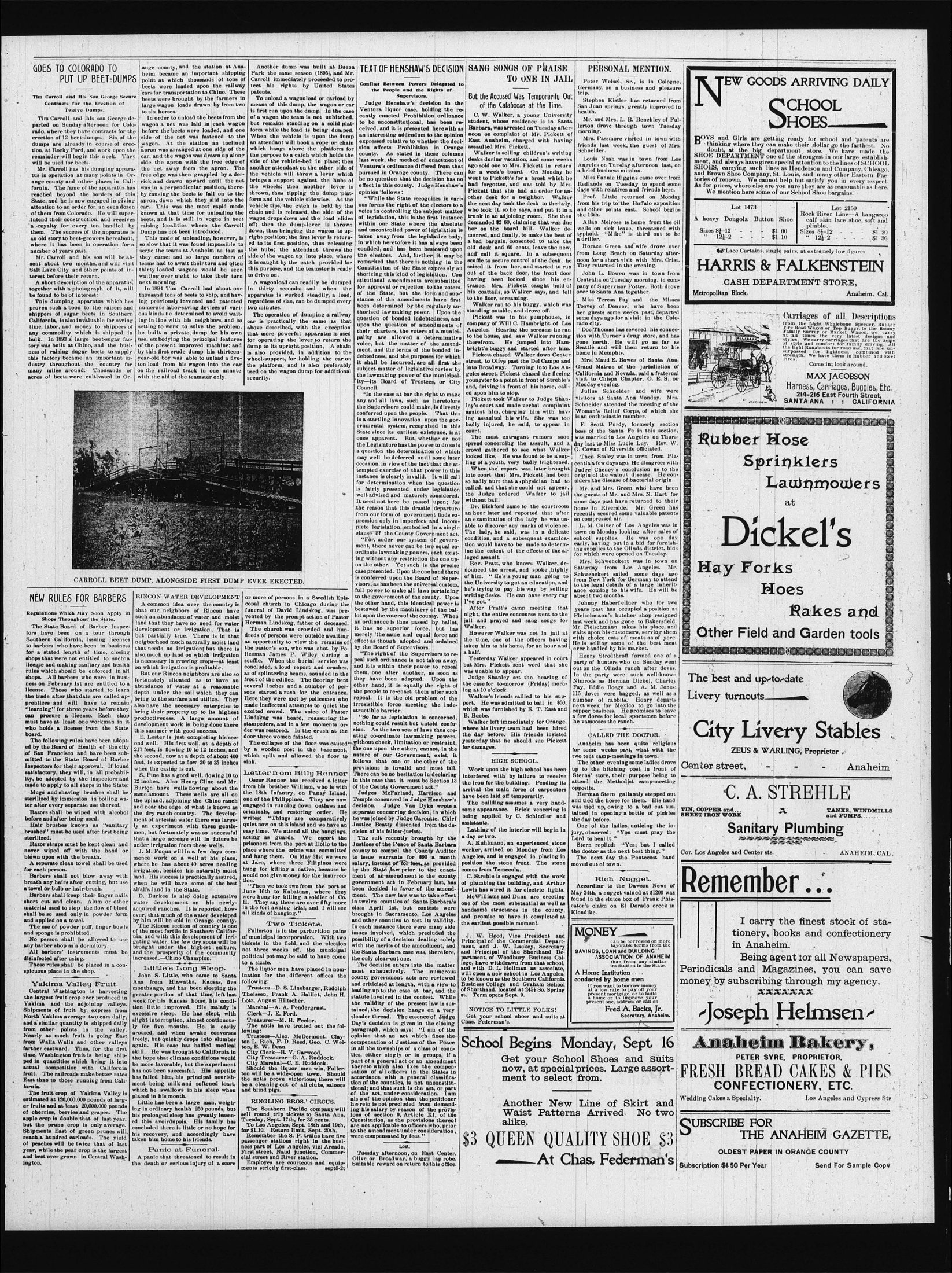
A short description of the apparatus, together with a photograph of it, will be found to be of interest:
This dumping apparatus which has proven such a boon to the raisers and shippers of sugar beets in Southern California, is also invaluable for saving time, labor, and money to shippers of any commodity which is shipped in bulk. In 1893 a large beet-sugar factory was built at Chino, and the business of raising sugar beets to supply this factory became an important industry throughout the country for many miles around. Thousands of acres of beets were cultivated in Orange county, and the station at Anaheim became an important shipping point at which thousands of tons of beets were loaded upon the railway cars for transportation to Chino. These beets were brought by the farmers in large wagon loads drawn by from two to six horses.
In order to unload the beets from the wagon a net was laid in each wagon before the beets were loaded, and one side of the net was fastened to the wagon. At the station an inclined apron was arranged at one side of the car, and the wagon was drawn up along side the apron with the free edge of the net away from the apron. The free edge was then grappled by a derick and drawn upward until the net was in a perpendicular position, thereby causing the beets to fall on to the apron, down which they slid into the car. This was the most rapid mode known at that time for unloading the beets, and it is still in vogue in beet raising localities where the Carroll Dump has not been introduced.
This mode of unloading, however, is so slow that it was found impossible to serve the teams at Anaheim as fast as they came; and so large numbers of teams had to await their turn and often thirty loaded wagons would be seen waiting over night to take their turn next morning.
In 1894 Tim Carroll had about one thousand tons of beets to ship, and having previously invented and patented numerous labor-saving devices of various kinds he determined to avoid waiting in line with his neighbors, and so setting to work to solve the problem, he built a private dump for his own use, embodying the principal features of the present improved machine; and by this first crude dump his thirteenth-year-old boy was able to unload a five-ton load from his wagon into the car on the railroad track in one minute with the aid of the teamster only.
Another dump was built at Buena Park the same season (1895), and Mr. Carroll immediately proceeded to protect his rights by United States patents.
To unload a wagonload or carload by means of this dump, the wagon or car is first run upon the dump. In the case of a wagon the team is not unhitched, but remains standing on a solid platform while the load is being dumped. When the vehicle is upon the dump an attendant will hook a rope or chain which hangs above the platform for the purpose to a catch which holds the side of the vehicle-bed in place; then another attendant on the other side of the vehicle will throw a lever which brings a support against the hubs of the wheels; then another lever is thrown, thus tipping the dump platform and the vehicle sidewise. As the vehicle tips, the catch is held by the chain and is released, the side of the wagon drops down and the load slides off; then the dump-lever is thrown down, thus bringing the wagon up-right position; the first lever is returned to its first position, thus releasing the hubs; the attendant throws the side of the wagon up into place, where it is caught by the catch provided for this purpose, and the teamster is ready to drive on.
A wagonload can readily be dumped in thirty seconds; and when the apparatus is worked steadily, a load, regardless of size, can be dumped every two minutes.
The operation of dumping a railway car is practically the same as that above described, with the exception that more powerful apparatus is used for operating the lever to return the dump to its upright position. A chain is also provided, in addition to the wheel-support, for holding the car on the platform, and is also preferably used on the wagon dump for additional security.
NEW RULES FOR BARBERS
Regulations Which May Soon Apply in Shops Throughout the State.
The State Board of Barber Inspectors have been on a tour through Southern California, issuing licenses to barbers who have been in business for a stated length of time, closing shops that were not entitled to such a license and making sanitary and health rules which should be enforced in all shops. All barbers who were in business on February 1st are entitled to a license. Those who started to learn the trade after that date are called apprentices and will have to remain "learning" for three years before they can procure a license. Each shop must have at least one workman in it who holds a license from the State board.
The following rules have been adopted by the Board of Health of the city of San Francisco and have been submitted to the State Board of Barber Inspectors for their approval. If found satisfactory, they will, in all probability, be adopted by the inspectors and made to apply to all shops in the State:
Mugs and shaving brushes shall be sterilized by immersion in boiling water after every separate use thereof.
Razors shall be wiped with alcohol before and after being used.
Hair brushes known as "sanitary brushes" must be used after first being sterilized.
Razor straps must be kept clean and never wiped off with the hand or blown upon with the breath.
A separate clean towel shall be used for each person.
Barbers shall not blow away with breath any hairs after cutting, but use a towel or bulb or hair-brush.
Barbers shall keep their finger nails
RINCON WATER DEVELOPMENT
A common idea over the country is that our neighbors of Rincon have such an abundance of water and moist land that they have no need for water development or irrigation. That is but partially true. There is in that neighborhood much naturally moist land that needs no irrigation; but there is also much up land on which irrigation is necessary in growing crops—at least on which irrigation is profitable.
But our Rincon neighbors are also so fortunately situated as to have an abundance of water at a reasonable depth under the soil which they can bring to the surface and utilize. They also have the necessary enterprise to bring their property up to its highest productiveness. A large amount of development work is being done there this summer with good success.
E. Lester is just completing his second well. His first well, at a depth of 217 feet, is flowing 10 to 12 inches, and the second, now at a depth of about 400 feet, is expected to flow 20 to 25 inches when the casing is cut.
S. Pine has a good well, flowing 10 to 12 inches. Also Henry Cline and Mr. Burton have wells flowing about the same amount. These wells are all on the upland, adjoining the Chino ranch and near the edge of what is known as the dry ranch country. The development of artesian water there was largely an experiment with these gentlemen, but fortunately was so successful that a large acreage will in future be under irrigation from these wells.
J. M. Fuqua will in a few days commence work on a well at his place, where he has about 40 acres needing irrigation, besides his naturally moist land. His success is practically assured, when he will have some of the best alfalfa land in the State.
D. Durkee is also doing extensive or more of persons in a Swedish Episcopal church in Chicago during the funeral of David Lindskog, was prevented by the prompt action of Pastor Herman Lindskog, father of deceased.
The church was crowded and hundreds of persons were outside awaiting an opportunity to view the remains of the pastor's son, who was shot by Policeman James P. Wiley during a scuffle. When the burial service was concluded, a loud report and crashes, as of splintering beams, sounded in the front of the edifice. The flooring bent several inches and a number of persons started a rush for the entrance. Here they were met by policemen who made ineffectual attempts to quiet the excited crowd. The voice of Pastor Lindskog was heard, reassuring the stampeders, and in a few moments order was restored. In the crush at the door three women fainted.
The collapse of the floor was caused by a wooden post in the basement, which split and allowed the floor to sink.
Letter from Billy Renner
Oscar Renner has received a letter from his brother William, who is with the 18th Infantry, on Panay Island, one of the Philippines. They are now engaged in running down outaws and criminals, and restoring order. He writes: "Things are comparatively quiet now on this island and we have an easy time. We attend all the hangings, acting as guards. We escort the prisoners from the port at Iloilo to the place where the crime was committed and hang them. On May 31st we were at Jaro, where three Filipinos were hung for killing a native, because he would not give money for the insurrection."
"Then we took two from the port on June 16th to Kabatuan, where they were hung for killing a soldier of Co."
Razors shall be wiped with alcohol before and after being used.
Hair brushes known as "sanitary brushes" must be used after first being sterilized.
Razor straps must be kept clean and never wiped off with the hand or blown upon with the breath.
A separate clean towel shall be used for each person.
Barbers shall not blow away with breath any hairs after cutting, but use a towel or bulb or hair-brush.
Barbers shall keep their finger nails short cut and clean. Alum or other material used to stop the flow of blood shall be so used only in powder form and applied on a towel.
The use of powder puff, finger bowls and sponge is prohibited.
No person shall be allowed to use any barber shop as a dormitory.
All barbers' instruments must be disinfected after using.
These rules shall be placed in a conspicuous place in the shop.
Yakima Valley Fruit.
Central Washington is harvesting the largest fruit crop ever produced in Yakima and the adjoining valleys. Shipments of fruit by express from North Yakima average two cars daily, and a similar quantity is shipped daily from other points in the valley. Nearly as much fruit is going East from Walla Walla and other valleys farther eastward. Thus, for the first time, Washington fruit is being shipped in quantities which bring it into actual competition with California fruit. The railroads make better rates East than to those running from California.
The fruit crop of Yakima Valley is estimated at 120,000,000 pounds of larger fruits and at least 20,000,000 pounds of cherries, berries and grapes. The apple crop is double that of last year, but the prune crop is only average. Shipments East of green prunes will reach a hundred carloads. The yield of peaches will be twice that of last year, while the pear crop is the largest and best ever grown in Central Washington.
Little's Long Sleep.
John S. Little, who came to Santa Ana from Hiawatha, Kansas, five months ago, and has been sleeping the greater portion of that time, left last week for his Kansas home, his condition little improved. His malady is excessive sleep. He has slept, with slight interruption, almost continuously for five months. He is easily aroused, and when awake converses freely, but quickly drops into slumber again. His case has baffled medical skill. He was brought to California in the hope that climate conditions would be more favorable, but the experiment has not been successful. His appetite has failed him, his principal nourishment being milk and softened toast, which he swallows in his sleep when placed in his month.
Little has been a large man, weighing in ordinary health 250 pounds, but his prolonged sleep has greatly lessened this avoiddupois. His family has concluded there is little or no hope for his recovery, and accordingly have taken him home to his friends.
Panic at Funeral.
A panic that threatened to result in the death or serious injury of a score
Two Tickets.
Fullerton is in the parturition pains of municipal incorporation. With two tickets in the field, and the election not three weeks off, the municipal political pot may be said to have come to a sizzle.
The liquor men have placed in nomination for the different offices the following:
Trustees—D. S. Linebarger, Rudolph Theissen, Frank A. Balliet, John H. Lotz, August Hiltscher.
Marshal—A. A. Pendergrast,
Clerk—J. E. Ford.
Treasurer—M. H. Peelor.
The antis have trotted out the following:
Trustees—Alex. McDermont, Clayton L. Rich, F. D. Reed, Geo. C. Welton, E. W. Dean.
City Clerk—B. V. Garwood.
City Treasurer—G. A. Ruddock.
City Marshal—C. E. Ruddock.
Should the liquor men win, Fullerton will be a wide-open town. Should the antis prove victorious, there will be a cleaning out of all clubs, saloons and blind pigs.
RINGLING BROS.' CIRCUS.
The Southern Pacific company will sell round trip tickets to Santa Ana, Tuesday, Sept. 17th, for 35 cents.
To Los Angeles, Sept. 18th and 19th, for $1.10. Return limit, Sept. 20th.
Remember the S. P. trains have five passenger stations right in the business part of Los Angeles, viz: Arcade, First street, Naud junction, Commercial street and River station.
Employees are courteous and equipments strictly first-class.
The dump was built at Buena Vista same season (1895), and immediately proceeded to pro-rights by United States.
And a wagonload or carload by this dump, the wagon or car upon the dump. In the case of the team is not unhitched, as standing on a solid platform the load is being dumped. The vehicle is upon the dump that will hook a rope or chain tags above the platform for use to catch which holds the vehicle-bed in place; thenendant on the other side of the will throw a lever which support against the hubs of its; then another lever is tipping the dump plate, vehicle sidewise. As the catch is held by the released, the side of the down and the load slides the dump-lever is thrown bringing the wagon up upon; the first lever is return-st position, thus releasing the attendant throws the wagon up into place, where by the catch provided for, and the teamster is ready road can readily be dumped seconds; and when the is worked steadily, a load, of size, can be dumped every time.
ation of dumping a railway typically the same as that observed, with the exception powerful apparatus is used giving the lever to return the upright position. A chain divided, in addition to the art, for holding the car on, and is also preferably wagon dump for additional TEXT OF HENSHAW'S DECISION
Conflict Between Powers Delegated to the People and the Rights of Supervisors.
Judge Henshaw's decision in the Ventura liquor case, holding the recently enacted Prohibition ordinance to be unconstitutional, has been received, and it is presented herewith as an interesting addendum to the opinion expressed relative to whether the decision affects Prohibition in Orange county. As stated in these columns last week, the method of enactment of Ventura's ordinance differed from that pursued in Orange county. There can be no question that the decision has no effect in this county. Judge Henshaw's opinion follows:
"While the State recognizes in various forms the right of the electors to a voice in controlling the subject matter of legislation, this is the first instance within our State where the absolute and uncontrolled power of legislation is taken away from the legislative body, in which heretofore it has always been confided, and has been bestowed upon the electors. And, further, it may be remarked that there is nothing in the Constitution of the State expressly au thorizing this kind of legislation. Constitutional amendments are submitted for approval or rejection to the voters of the State, but the form and substance of the amendments have first been determined by the regularly authorized lawmaking power. Upon the question of bonded indebtedness, and upon the question of amendments of their charters, the voters of a municipality are allowed a determinative voice, but the matter of the amendment, and the terms of the bonded indebtedness, and the purposes for which it shall be incurred, are all first the subject matter of legislative review by the lawmaking power of the municipality—its Board of Trustees, or City Council.
"In the case at bar the right to make any and all laws, such as heretofore the Supervisors could make, is directly conferred upon the people. That this is a startling innovation upon the governmental system, recognized in this State since its earliest existence, is at once apparent. But, whether or not the Legislature has the power to do so is a question the determination of which may well be deferred until some later occasion, in view of the fact that the attempted exercise of that power in this
SANG SONGS OF PRAISE TO ONE IN JAIL
But the Accused Was Temporarily Out of the Calaboose at the Time.
C. W. Walker, a young University student, whose residence is in Santa Barbara, was arrested on Tuesday afternoon on complaint of Mr. Pickett of East Anaheim, charged with having assaulted Mrs. Pickett.
Walker is selling children's writing desks during vacation, and some weeks ago sold one to Mrs. Pickett in return for a week's board. On Monday he went to Pickett's for a brush which he had forgotten, and was told by Mrs. Pickett that she had an order for another desk for a neighbor. Walker next day took the desk to the lady, who took it, so he says, and put it in a trunk in an adjoining room. She then demanded $2 60, claiming that was due her on the board bill. Walker demurred, and finally, to make the best of a bad bargain, consented to take the old desk and 60 cents, leave new, and call it square. In a subsequent scuffle to secure control of the desk, he seized it from her, and started to run out of the back door, the front door having been locked since his entrance. Mrs. Pickett caught hold of his coattails, so Walker says, and fell to the floor, screaming.
Walker ran to his buggy, which was standing outside, and drove off.
Pickett was in his pumphouse, in company of Will C. Hambright of Los Angeles. Hearing the screams he ran to the house, and saw Walker running therefrom. He jumped into Hambright's buggy and started after him.
Pickett chased Walker down Center street, to Olive past the Del Campo and into Broadway. Turning into Los Angeles street, Pickett chased the fleeing youngster to a point in front of Strehl's and, driving in front of his horse, called upon him to stop.
Pickett took Walker to Judge Shanley's court and made verbal complaint against him, charging him with having assaulted his wife. She was too badly injured, he said, to appear in court.
The most extragant rumors soon spread concerning the assault, and a crowd gathered to see what Walker looked like. He was found to be a sapping of a youth, very badly frightened.
When the report was later brought into court that Mrs. Pickett had been
PERSONAL MENTION.
Peter Weisel, Sr., is in Cologne Germany, on a business and please trip.
Stephen Kistler has returned from San Juan springs, greatly improved health.
Mr. and Mrs. L. B. Benchley of Raleon drove through town Tuesdays morning.
Mrs. Passmore visited in town with friends last week, the guest of Mr. Schneider.
Louis Noah was in town from Angles on Tuesday afternoon last; a brief business mission.
Miss Fannie Higgins came over from Redlands on Tuesday to spend some days with relatives and friends here.
Prof. Little returned on Monday from his trip to the Buffalo exposition and other points east. School began at 16th.
Allan Melrose is home from wells on sick leave, threatened with typhoid. "Mike" is third out to a driller.
Horace Green and wife drove over from Long Beach on Saturday afternoon for a short visit with Mrs. Crisi They returned in the evening.
John L. Bowen was in town from Centralria on Tuesday morning, in company of Supervisor Potter. Both drove over to Santa Ana together.
Miss Teresa Fay and the Miss Toovey of Denver, who have been her guests some weeks past, departed some days ago for a visit in the Colorado city.
Doc Thomas has severed his connection with Turner's drug store, and he gone north. He will go as far as Seattle and will then return to home in Memphis.
Mrs. Maud E. Bowes of Santa Ana Grand Matron of the jurisdiction California and Nevada, paid a fraternity visit to Chispa Chapter, O. E. S., Monday evening.
Julius Schneider and wife were visitors at Santa Ana Monday. Mrs Schneider attended the meeting of The Woman's Relief Corps, of which she is an enthusiastic member.
F. Scott Purdy, formerly section boss of the Santa Fe in this section was married in Los Angeles on Thursday last to Miss Lucile Luy. Rev. V.G. Cowan of Riverside officiated.
Theo. Staley was in town from Phentia a few days ago. He disagrees with Judge Cheney's conclusion as to the origin of the walnut disease. He co-
In the case at bar the right to make any and all laws, such as heretofore the Supervisors could make, is directly conferred upon the people. That this is a startling innovation upon the governmental system, recognized in this State since its earliest existence, is at once apparent. But, whether or not the Legislature has the power to do so is a question the determination of which may well be deferred until some later occasion, in view of the fact that the attempted exercise of that power in this instance is clearly invalid. It will call for determination when the question is fairly presented under legislation well-advised and maturely considered. It need not here be passed upon; for the reason that this drastic departure from our form of government finds expression only in imperfect and incomplete legislation, embodied in a single clause of the County Government act.
"For, under our system of government, there never can be two equal coordinate lawmaking powers, each existing without any restriction the one upon the other. Yet such is the precise case presented. Upon the one hand there is conferred upon the Board of Supervisors, as has been the universal custom, full power to make all laws pertaining to the government of the county. Upon the other hand, this identical power is bestowed by the machinery of the ballot upon the voters of the county. When an ordinance is thus passed by ballot, it has no superior force, but has merely 'the same and equal force and effect as though adopted and ordained by the Board of Supervisors.
"The right of the Supervisors to repeal such ordinance is not taken away, and it is within their power to repeal them, one after another, as soon as they have been adopted. Upon the other hand, it is equally the right of the people to re-enact them after such repeal. It is the old problem of the irresistible force meeting the indestructible barrier.
"So far as legislation is concerned, nothing could result but untold confusion. As the two sets of laws thus creating co-ordinate lawmaking powers, without check, limitation or restraint, the one upon the other, cannot, in the nature of our Government, exist, it follows that one or other of the provisions is invalid and must fall. There can be no hesitation in declaring in this case that it must be Section 13 of the County Government act."
Judges McFarland, Harrison and Temple concurred in Judge Henshaw's decision. Judge Van Dyke wrote a separate concurring decision, in which he was joined by Judge Garoutte. Chief Justice Beatty dissented from the decision of his fellow-jurists.
The suit recently brought by the Justices of the Peace of Santa Barbara county to compel the County Auditor to issue warrants for $90 a month salary, instead of for fees, as provided by the State law prior to the enactment of an amendment to the county government act in February last, has been decided in favor of the amendment. The new law was to take effect
In the case at bar the right to make any and all laws, such as heretofore the Supervisors could make, is directly conferred upon the people. That this is a startling innovation upon the governmental system, recognized in this State since its earliest existence, is at once apparent. But, whether or not the Legislature has the power to do so is a question the determination of which may well be deferred until some later occasion, in view of the fact that the attempted exercise of that power in this instance is clearly invalid. It will call for determination when the question is fairly presented under legislation well-advised and maturely considered. It need not here be passed upon; for the reason that this drastic departure from our form of government finds expression only in imperfect and incomplete legislation, embodied in a single clause of the County Government act.
"For, under our system of government, there never can be two equal coordinate lawmaking powers, each existing without any restriction the one upon the other. Yet such is the precise case presented. Upon the one hand there is conferred upon the Board of Supervisors, as has been the universal custom, full power to make all laws pertaining to the government of the county. Upon the other hand, this identical power is bestowed by the machinery of the ballot upon the voters of the county. When an ordinance is thus passed by ballot, it has no superior force, but has merely 'the same and equal force and effect as though adopted and ordained by the Board of Supervisors.
"The right of the Supervisors to repeal such ordinance is not taken away, and it is within their power to repeal them, one after another, as soon as they have been adopted. Upon the other hand, it is equally the right of the people to re-enact them after such repeal. It is the old problem of the irresistible force meeting the indestructible barrier.
"So far as legislation is concerned, nothing could result but untold confusion. As the two sets of laws thus creating co-ordinate lawmaking powers, without check, limitation or restraint, the one upon the other, cannot, in the nature of our Government, exist, it follows that one or other of the provisions is invalid and must fall. There can be no hesitation in declaring in this case that it must be Section 13 of the County Government act."
Judges McFarland, Harrison and Temple concurred in Judge Henshaw's decision. Judge Van Dyke wrote a separate concurring decision, in which he was joined by Judge Garoutte. Chief Justice Beatty dissented from the decision of his fellow-jurists.
The suit recently brought by the Justices of the Peace of Santa Barbara county to compel the County Auditor to issue warrants for $90 a month salary, instead of for fees, as provided by the State law prior to the enactment of an amendment to the county government act in February last, has been decided in favor of the amendment. The new law was to take effect
In the case at bar the right to make any and all laws, such as heretofore the Supervisors could make, is directly conferred upon the people. That this is a startling innovation upon the governmental system, recognized in this State since its earliest existence, is at once apparent. But, whether or not the Legislature has the power to do so is a question the determination of which may well be deferred until some later occasion, in view of the fact that the attempted exercise of that power in this instance is clearly invalid. It will call for determination when the question is fairly presented under legislation well-advised and maturely considered. It need not here be passed upon; for the reason that this drastic departure from our form of government finds expression only in imperfect and incomplete legislation, embodied in a single clause of the County Government act.
"For, under our system of government, there never can be two equal coordinate lawmaking powers, each existing without any restriction the one upon the other. Yet such is the precise case presented. Upon the one hand there is conferred upon the Board of Supervisors, as has been the universal custom, full power to make all laws pertaining to the government of the county. Upon the other hand, this identical power is bestowed by the machinery of the ballot upon the voters of the county. When an ordinance is thus passed by ballot, it has no superior force, but has merely 'the same and equal force and effect as though adopted and ordained by the Board of Supervisors.
"The right of the Supervisors to repeal such ordinance is not taken away, and it is within their power to repeal them, one after another, as soon as they have been adopted. Upon the other hand, it is equally the right of the people to re-enact them after such repeal. It is the old problem of the irresistible force meeting the indestructible barrier.
"So far as legislation is concerned, nothing could result but untold confusion. As the two sets of laws thus creating co-ordinate lawmaking powers, without check, limitation or restraint, the one upon the other, cannot, in the nature of our Government, exist, it follows that one or other of the provisions is invalid and must fall. There can be no hesitation in declaring in this case that it must be Section 13 of the County Government act."
Temple concurred in Judge Henshaw's decision. Judge Van Dyke wrote a separate concurring decision, in which he was joined by Judge Garoutte. Chief Justice Beatty dissented from the decision of his fellow-jurists.
The suit recently brought by the Justices of the Peace of Santa Barbara county to compel the County Auditor to issue warrants for $90 a month salary, instead of for fees, as provided by the State law prior to the enactment of an amendment to the county government act in February last, has been decided in favor of the amendment. The new law was to take effect in twelve counties of Santa Barbara's class April 1st, but contests were brought in Sacramento, Los Angeles and other counties to test its validity. In each instance there were many side issues involved, which precluded the possibility of a decision dealing solely with the merits of the amendment, and the Santa Barbara case was, therefore, the only clear-cut one.
The decision enters into the matter most exhaustively. The numerous county government acts are reviewed and criticised at length, with a view to leading up to the case at bar, and the statute involved in the contest. While the validity of the present law is sustained, the decision hangs on a very slender thread. The essence of Judge Day's decision is given in the closing paragraph, which says: "I am of the opinion that an act which fixes the compensation of Justices of the Peace in all the townships of a class of counties, either singly or in groups, if a part of a general act or an amendment thereto which also fixes the compensation of all officers in the States in accordance with a general classification of the counties, is not unconstitutional; and that such is the act, or part of the act, under consideration. I am also of the opinion that the petitioner he rein is not precluded from demanding his salary by reason of the provisions of section 9, Article XI, of the Constitution, as the provisions thereof are not applicable to officers who, prior to the amendment under consideration, were compensated by fees."
School Begins Monday, Sept. 16
Get your School Shoes and Suits now, at special prices. Large assortment to select from.
Another New Line of Skirt and Waist Patterns Arrived. No two alike.
$3 QUEEN QUALITY SHOE $3
At Chas, Federman's
NEW GOODS ARRIVING DAILY
SCHOOL SHOES
BOYS and Girls are getting ready for school and parents are thinking where they can make their dollar go the farthest. No doubt, at the big department store. We have made the SHOE DEPARTMENT one of the strongest in our large establishment, and always have given special attention to the lines of SCHOOL SHOES, carrying such lines as Henderson and Company, Chicago, and Brown Shoe Company, St. Louis, and many other Eastern Factories of renown. We cannot help but satisfy you in every respect. As for prices, where else are you sure they are as reasonable as here. We mention here some of our School Shoe bargains.
Lot 1473
A heavy Dongola Button Shoe
Sizes 8½-12 $1.00
“ 12½-2 $1.10
Lot 2150
Rock River Line—A kangaroo calf skin lace shoe, soft and pliable.
Sizes 8½-12 $1.20
“ 12½-2 $1.36
Lace Curtains, single pairs, at extremely low figures
HARRIS & FALKENSTEIN
CASH DEPARTMENT STORE,
Metropolitan Block,
Anaheim, Cal.
Carriages of all Descriptions
from the Light Whalebone Speeder, Rubber Fire Road Wagon or Top Buggy, to the Roomy Family Surrey or Market Wagon, we carry at all times the very latest designs and styles. We carry carriages that are the acme of style and comfort for family driving. All the light Runabouts for road use, that are unsurpassed for lightness, combined with strength. We have them in Rubber and Steel Pires.
Come in; look around.
MAX JACOBSON
Harness, Carriages, Buggies, Etc.
214-216 East Fourth Street,
SANTA ANA : : CALIFORNIA
Rubber Hose
Sprinklers
Rubber Hose
Sprinklers
Lawnmowers
at
Dickel's
Hay Forks
Hoes
Rakes and
Other Field and Garden tools
The best and up-to-date
Livery turnouts
City Livery Stables
ZEUS & WARLING, Proprietor.
Center street, - - Anaheim
C. A. STREHLE
TIN, COPPER and...
SHEET IRON WORK
TANKS, WINDMILLS
and PUMPS.
Sanitary Plumbing
Cor. Los Angeles and Center sts.
ANAHEIM, CAL.
Remember...
TIN, COPPER and...
SHEET IRON WORK
Sanitary Plumbing
Cor. Los Angeles and Center sts.
ANAHEIM, CAL.
Remember...
I carry the finest stock of stationery, books and confectionery in Anaheim.
Being agent for all Newspapers, Periodicals and Magazines, you can save money by subscribing through my agency.
Joseph Helmsen
Anaheim Bakery,
PETER SYRE, PROPRIETOR.
FRESH BREAD CAKES & PIES CONFECTIONERY, ETC.
Wedding Cakes a Specialty. Los Angeles and Cypress Sts
SUBSCRIBE FOR THE ANAHEIM GAZETTE,
OLDEST PAPER IN ORANGE COUNTY
Subscription $1.50 Per Year Send For Sample Copy