anaheim-gazette 1901-08-29
Scanned page
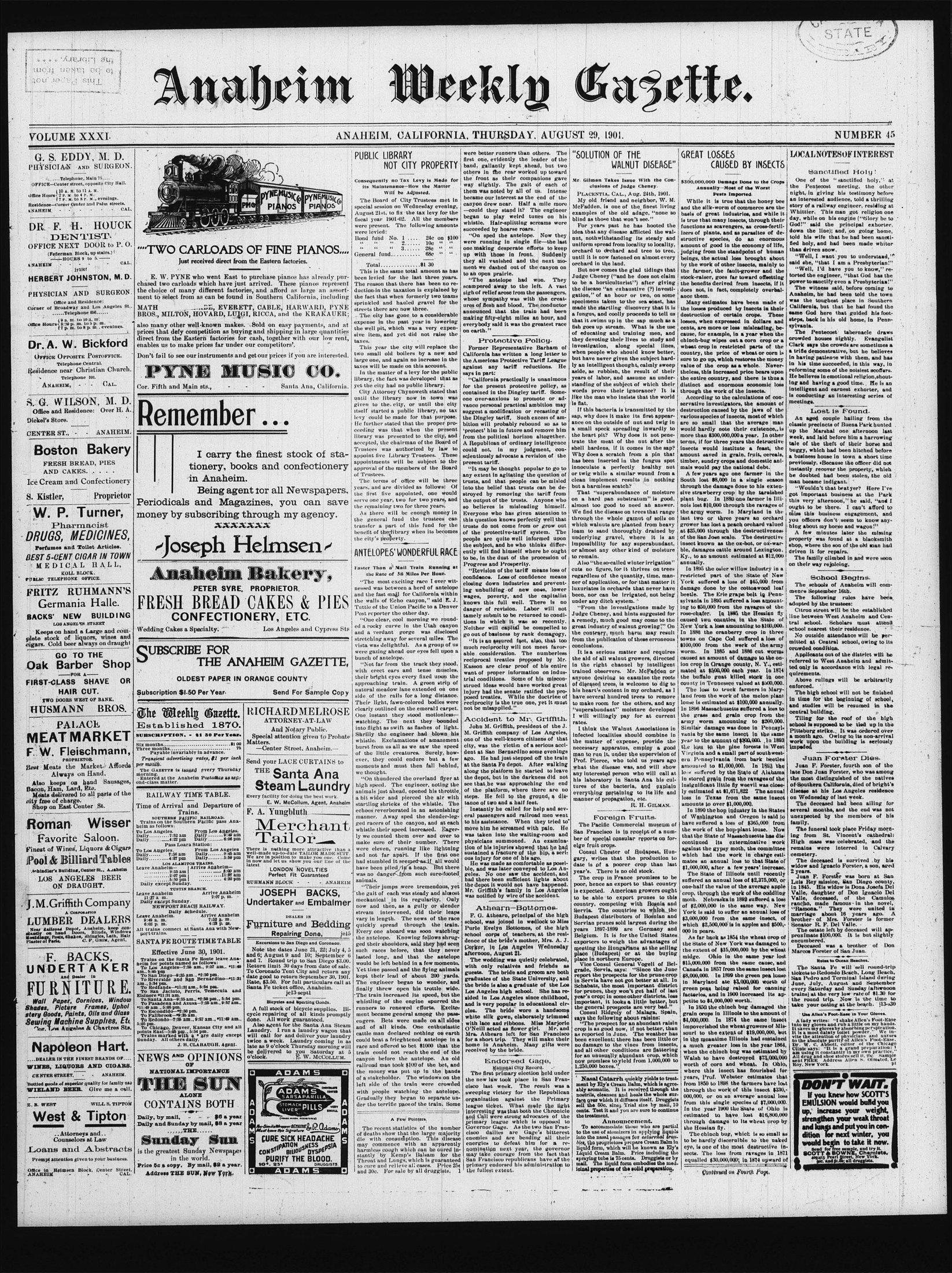
Searchable text
Anaheim
VOLUME XXXI.
G. S. EDDY, M. D.
PHYSICIAN AND SURGEON.
Telephone, Main 75...
OFFICE—Center street, opposite City Hall.
10 A. M. to 11 A. M.
Office Hours: 2 P. M. to 4 P. M.
7 P. M. to 8 P. M., evenings.
Residence—Corner Center and Palm streets.
ANAHEIM CAL.
DR. F. H. HOUCK
DENTIST.
OFFICE NEXT DOOR to P. O.
(Federman Block, up stairs.)
HOURS 9 to 5.
ANAHEIM CAL.
jy184f
HERBERT JOHNSTON, M. D.
PHYSICIAN AND SURGEON.
Office and Residence:
Corner of Broadway and Los Angeles St.
Telephone 666...
Office Hours: 9 a.m. to 10 a.m.
3:20 p.m. to 5 p.m.
7 p.m. to 8 p.m., evenings.
Dr. A. W. Bickford
OFFICE OPPOSITE POSTOFFICE.
Telephone Central.
Residence near Christian Church.
Telephone 101.
ANAHEIM CAL.
S. G. WILSON, M. D.
Office and Residence: Over H. A.
Dickel's Store.
CENTER ST... ANAHEIM.
Boston Bakery
FRESH BREAD, PIES
AND CAKES.
"TWO CARLOADS OF FINE PIANOS..."
Just received direct from the Eastern factories.
E. W. PYNE who went East to purchase pianos has already purchased two carloads which have just arrived. These pianos represent the choice of many different factories, and afford as large an assortment to select from as can be found in Southern California, including MATH DE, EVERETT, CABLE, HARWARD, PYNE BROS., MILTON, HOVARD, LUIGI, RICCA, and the KRAKAUER; also many other well-known makes. Sold on easy payments, and at prices that defy competition as buying and shipping in large quantities direct from the Eastern factories for cash, together with our low rent, enables us to make prices far under our competitors'.
Don’t fail to see our instruments and get our prices if you are interested.
PYNE MUSIC CO.
Cor. Fifth and Main sts., Santa Ana, California.
Remember...
I carry the finest stock of stationery, books and confectionery
Telephone 101.
ANAHEIM, CAL.
S. G. WILSON, M. D.
Office and Residence: Over H. A.
Dickel's Store.
CENTER ST., ANAHEIM.
Boston Bakery
FRESH BREAD, PIES
AND CAKES.
Ice Cream and Confectionery
S. Kistler, Proprietor
W. P. Turner,
Pharmacist
DRUGS, MEDICINES,
Perfumes and Toilet Articles.
BEST 5-CENT CIGAR IN TOWN
MEDICAL HALL,
KOLL BLOCK.
PUBLIC TELEPHONE OFFICE.
FRITZ RUHMANN'S
Germania Halle.
BACKS' NEW BUILDING
LOS ANGELES STREET
Keeps on hand a Large and complete stock of liquors, wines and
cigars. Cold beer always on draught
GO TO THE
Oak Barber Shop
FOR A
FIRST-CLASS SHAVE OR
HAIR CUT.
TWO DOORS WEST OF BANK.
HUSMANN BROS.
PALACE
MEAT MARKET
F. W. Fleischmann,
PROPRIETOR.
Best Meats the Market Affords
Always on Hand.
Also keeps on hand Sausages,
Bacon, Ham, Lard, Ete.
Meats delivered to all parts of the city free of charge.
Shop on East Center St.
Roman Wisser
Favorite Saloon.
Finest of Wines, Liquors & Cigare
Pool & Billiard Tables
Schindler's Building, Center St., Anaheim
LOS ANGELES BEER ON DRAUGHT.
Remember...
I carry the finest stock of stationery, books and confectionery
in Anaheim.
Being agent for all Newspapers,
Periodicals and Magazines, you can save money by subscribing through my agency.
Joseph Helmsen
Anaheim Bakery,
PETER SYRE, PROPRIETOR.
FRESH BREAD CAKES & PIES
CONFECTIONERY, ETC.
Wedding Cakes a Specialty. Los Angeles and Cypress Sts
SUBSCRIBE FOR
THE ANAHEIM GAZETTE,
OLDEST PAPER IN ORANGE COUNTY
Subscription $1.50 Per Year. Send For Sample Copy
The Weekly Gazette.
Established 1870.
SUBSCRIPTION, - $1.50 Per Year.
Six months... $1.00
Three months... 75
Payable invariably in advance.
Transient advertising rates, $1 per inch per month.
The Gazette is issued every Thursday morning.
Entered at the Anaheim Postoffice as sepond-class matter.
RAILWAY TIME TABLE.
Time of Arrival and Departure of Trains.
SOUTHERN PACIFIC RAILROAD.
Trains on the Southern Pacific pass Anaheim as follows:
To Los Angeles.
Daily... 7:52 am Daily... 6:06 pm
Pass Loara Station:
To Los Angeles.
Daily... 7:56 am Daily... 5:59 pm
Los ALAMITOS TRAINS:
Leave Anaheim... Arrive Anaheim...
2:07 pm 11:37 am
5:50 pm 4:30 pm
Daily except Sunday.
RICHARD MELROSE
ATTORNEY-AT-LAW
And Notary Public.
Special attention given to Probate Matters.
Center Street, Anaheim.
Send your LACE CURTAINS to
THE Santa Ana Steam Laundry
Every facility for doing the best work.
E. W. McCollum, Agent, Anaheim
F. A. Yungbluth
Merchant Tailor
There is nothing more attractive than a well-made up-to-date TAILOR MADE SUIT. We are in position to make you one. Come in now and let us show you our line of the latest
LONDON NOVELTIES
Perfect Fit Guaranteed
RUHMANN BLOCK ... ANAHEIM
JOSEPH BACKS,
Roman Wisser
Favorite Saloon.
Finest of Wines, Liquors & Cigars
Pool & Billiard Tables
Schindler's Building, Center St., Anaheim
LOS ANGELES BEER ON DRAUGHT.
J.M.Griffith Company
A CORPORATION
LUMBER DEALERS
Near Railroad Depot, Anaheim, keep constantly on hand Doors, Blinds, Windows Mountings, Posts, Shakes, Shingles, Lath, Hair Plaster of Paris.
C.F. GRIM, Agent.
F. BACKS,
UNDERTAKER
And Dealer in
FURNITURE.
Wall Paper, Cornices, Window Shades, Picture Frames, Upholstery Goods, Paints, Oils and Glass Sewing Machine Supplies, Etc.
Cor. Los Angeles & Chartres Sts.
Napoleon Hart.
DEALER IN THE FINEST BRANDS OF...
WINES, LIQUORS AND CIGARS.
CENTER STREET, ANAHEIM.
Bottled goods of superior quality for family use WIELAND BEER. Give me a call.
Z.B.WEST
WILL S.TIPTON
West & Tipton
Attorneys and...
Counselors at Law
Loans and Abstracts
Prompt attention given to your business.
Office in Helmsen Block, Center Street, ANAHEIM
Time of Arrival and Departure of Trains.
SOUTHERN PACIFIC RAILROAD.
Trains on the Southern Pacific pass Anaheim as follows:
To Los Angeles... From Los Angeles.
Daily... 7:52 am Daily... 9:49 am
Daily... 4:22 pm Daily... 6:06 pm
Pass Loara Station:
To Los Angeles... From Los Angeles
Daily... 7:56 am Daily... 9:45 am
Daily... 4:27 pm Daily... 5:59 pm
LOS ALAMITOR TRAINS.
Leave Anaheim—Arrive Anaheim—
9:35 am 8:00 am
2:07 pm 11:37 am
5:50 pm 4:30 pm
Daily except Sunday.
TUSTIN BRANCH.
Leave Anaheim Arrive Anaheim
11:37 a.m. 2:07 p.m.
Daily except Sunday.
NEWPORT BEACH RAILWAY.
Daily schedule.
Leave Anaheim Arrive Anaheim
9:49 a.m. 7:52 p.m.
6:03 p.m. 4:28 p.m.
All trains connect at Santa Ana with Newport-trains.
SANTA FE ROUTE TIMETABLE
Effective June 30, 1901.
Trains on the Santa Fe Route leave Anaheim for points named as follows:
To Los Angeles—7:55 am, 9:37 am,...*11:49 am
am...5:46 pm
To San Diego—9:35 am,...*2:50 pm
To Riverside and San Bernardino—*11:31 am,...5:54 pm
To Redlands—*11:31 am,...5:54 pm
To San Jacinto, Perris, Temecula and Elsinore—*11:31 am
To Santa Ana—9:35 am,...*2:50 pm,...5:54 pm
To Pasadena and Azusa—7:55 am,...9:57 am...
*11:49 am,...5:06 pm
To Escondido—*2:50 pm
To Fallbrook—*9:35 am
To Redondo—7:55 am,...9:57 am,...*11:49 am...
5:06 pm
To Chicago, Denver, Kansas City and all points East—5:46 pm,...5:54 pm
Trains marked with a * are daily except Sunday. All others daily.
J.H. CLABAUGH. Agent.
NEWS AND OPINIONS OF
NATIONAL IMPORTANCE
THE SUN
ALONE
CONTAINS BOTH
Daily, by mail, $8 a year
Daily and Sunday by mail, $8 a year
Sunday Sun is the greatest Sunday Newspaper in the world.
Price 5¢ a copy. By mail, $2 a year.
Address THE SUN, New York.
F.A.Yungbluth
Merchant Tailor
There is nothing more attractive than a well-made up-to-date TAILOR MADE SUIT. We are in position to make you one. Come in now and let us show you our line of the latest
LONDON NOVELTIES
Perfect Fit Guaranteed
RUHMANN BLOCK
ANAHEIM
JOSEPH BACKS,
Undertaker and Embalmer
DEALER IN
Furniture and Bedding Repairing Done,
je15
Excursions to San Diego and Coronado.
Note the dates June 21, 22; July 4, 5 and 6; August 9 and 10; September 6 and 7. Round trip to San Diego $3.00. Return limit 30 days from date of sale. To Coronado Tent City and return any date good to return September 30, 1901. Rate, $3.50. For full particulars call at Santa Fe ticket office, Anaheim.
je13-septl
Bicycles and Sporting Goods.
A full stock of bicycle supplies. Bicycle repairing of all kinds promptly done. All work guaranteed.
Also agent for the Santa Ana Steam Laundry. I run a laundry wagon that will call for and deliver your laundry twice a week. Laundry coming in as late as 9 o'clock Thursday morning will be delivered to you Saturday at 5 o'clock.
E.W.MCCOLLUM.
ANAHEIM, CALIFORNIA, THURSDAY, AUGUST 29, 1901.
PUBLIC LIBRARY
NOT CITY PROPERTY
Consequently no Tax Levy is Made for its Maintenance—How the Matter Will be Adjusted.
The Board of City Trustees met in special session on Wednesday evening, August 21st, to fix the tax levy for the fiscal year 1901-02. All the members were present. The following amounts were levied:
Bond fund No. 1 ... 24c on $100
" " " 2 ... 10c " "
" " " 3 ... 28c " "
General fund... 68c " " "
Total ... $1,30
This is the same total amount as has been levied for the last three years. The reason that there has been no reduction in the taxation is explained by the fact that when formerly two teams sprinkled and hauled gravel for the streets there are now three.
The city has gone to a considerable expense in the past year in lowering the well pit, which was a very expensive item, and yet did not raise the taxes.
This year the city will replace the two small old boilers by a new and large one, and again no increase in the taxes will be made on this account.
In the matter of a levy for the public library, the fact was developed that as yet the city had no public library.
City Attorney Chynoweth stated that until the library now in town was given to the city, or until the city itself started a public library, no tax levy could be made for that purpose. He further stated that the proper proceeding was that when the present library was presented to the city, and accepted, the chairman of the Board of Trustees was authorized by law to appoint five Library Trustees. These appointments will be subject to the approval of the members of the Board of Trustees.
were better runners than others. The first one, evidently the leader of the band, gallantly kept ahead, but two others in the rear worked up toward the front as their companions gave way slightly. The gait of each of them was noted by all of us. Intense became our interest as the end of the canyon drew near. Half a mile more—could they stand it? The engineer began to play weird tunes on his whistle. Hair-splitting screams were succeeded by hoarse roars.
"On sped the antelope. Now they were running in single file—the last one making desperate efforts to keep up with those in front. Suddenly they all vanished and the next moment we dashed out of the canyon on to an open prairie.
"The antelope had won. They scampered away to the left. A vast sigh of relief arose from the passengers, whose sympathy was with the creatures of flesh and blood. The conductor announced that the train had been making fifty-eight miles an hour, and everybody said it was the greatest race on earth."
Protective Policy.
Former Representative Barham of California has written a long letter to the American Protective Tariff League against any tariff reductions. He says in part:
"California practically is unanimous for the present protective policy, as contained in the Dingley tariff. Someone over-anxious to promote or advance personal practical ambition may suggest a modification or recasting of the Dingley tariff. Such excess of ambition will probably rebound so as to 'protect' him in future and remove him from the political horizon altogether. A Republican of ordinary intelligence could not, in my judgment, conscientiously advocate a revision of the present tariff.
"It may be thought popular to go to any extent in agitating the question of"
"SOLUTION OF THE WALNUT DISEASE"
Mr. Gilman Takes Issue With the Conclusions of Judge Cheney.
PLACENTIA, CAL., Aug. 24th, 1901.
My old friend and neighbor, W. M. McFadden, is one of the finest living examples of the old adage, "none shall blind as those that won't see."
For years past he has hooted that idea that any disease afflicted the walnut, notwithstanding its steady and uniform spread from locality to locality, orchard to orchard and tree to tree; until it is now fastened on almost every orchard in the land.
But now comes the glad tidings that Judge Cheney ("and he does not claim to be a horticulturist") after giving the disease "an exhaustive (?) investigation," of an hour or two, on some specimens taken to the sea coast, having made the startling discovery that it is a fungus, and coolly proceeds to tell us that it swims up in the sap much as a fish goes up stream. What is the use of educating and training men, and they devoting their lives to study and investigation, along special lines when people who should know better but have never given the subject hardyly an intelligent thought, calmly sweep aside, as rubbish, the result of their years of labor, and assume an understanding of the subject of which their words prove their ignorance? It is like the man who insists that the world is flat.
If this bacteria is transmitted by the sap, why does it make its first appearance on the outside of nut and twig in a small speck spreading inwardly to the heart pit? Why does it not penetrate the meat of the nut after the shell hardens, if it comes in the sap? Why does a scratch from a pin that has been inserted in the fungus spur innoculate a perfectly healthy nut or twig while a similar wound from
In the matter of a levy for the public library, the fact was developed that as yet the city had no public library.
City Attorney Chynoweth stated that until the library now in town was given to the city, or until the city itself started a public library, no tax levy could be made for that purpose. He further stated that the proper proceeding was that when the present library was presented to the city, and accepted, the chairman of the Board of Trustees was authorized by law to appoint five Library Trustees. These appointments will be subject to the approval of the members of the Board of Trustees.
The terms of office will be three years, and are divided as follows: Of the first five appointed, one would serve one year, two for two years, and the remaining two for three years.
As there will be enough money in the general fund the trustees can transfer a part of this fund for the benefit of the library when its becomes the city's property.
ANTELOPES' WONDERFUL RACE
Faster Than a Mail Train Running at the Rate of 58 Miles Per Hour.
"The most exciting race I ever witnessed was between a herd of antelope and the fast mail for California within the walls of Echo canyon," said E. J. Tuttle of the Union Pacific to a Denver Post reporter the other day.
"One clear, cool morning we rounded a rocky curve in the Utah canyon and a verdant gorge was disclosed stretching away for several miles. The vista was delightful. As a group of us were gazing ahead our eyes fell upon a bunch of antelope.
"Not far from the track they stood, with erect ears and tense muscles, their bright eyes every fixed upon the approaching train. A green strip of natural meadow lane extended on one side of the rails for a long distance. Their light, fawn-colored bodies were clearly outlined on the emerald carpet. One instant they stood motionless—watching. The next they bounded into flight as swift as flashes of light. Shrilly the engineer had blown his whistle. Exclamations of amazement burst from us all as we saw the speed of the little creatures. Surely, however, they could endure but a few moments and must then fall behind, we thought.
"On thundered the overland flyer at high speed. The engineer, noting the animals just ahead, opened his throttle, a bit wider and pierced the air with starling shrieks of the whistle. The echoes reverberated in an astonishing manner. Away sped the slender-legged racers of the canyon, and at each whistle their speed increased. Eagerly we counted them over and over to make sure of their number. There were eleven, running like lightning and not far apart. If the first one had stumbled it seemed as if all would have been piled in a heap. But there was no danger from such sure-footed animals."
"Their jumps were tremendous, yet the gait of each was steady and almost mechanical in its regularity. Only says in part.
"California practically is unanimous for the present protective policy, as contained in the Dingley tariff. Someone over-anxious to promote or advance personal practical ambition may suggest a modification or recasting of the Dingley tariff. Such excess of ambition will probably rebound so as to 'protect' him in future and remove him from the political horizon altogether. A Republican of ordinary intelligence could not, in my judgment, conscientiously advocate a revision of the present tariff.
"It may be thought popular to go to any extent in agitating the question of trusts, and that people can be misled into the belief that trusts can be destroyed by removing the tariff from the output of the trusts. Anyone who so believes is misleading himself. Everyone who has given attention to this question knows perfectly well that trusts do not come from or grow out of the protective-tariff system. The people are quite well informed upon the subject, and he who thinks differently will find himself where he ought to be, in the dust of the procession of Progress and Prosperity.
"Revision of the tariff means loss of confidence. Loss of confidence means closing down industries and preventing unbuilding of new ones, lower wages, poverty, and the capitalist knows this full well. There is no danger of revision. Labor will not tamely submit to be returned to conditions in which it was so recently. Neither will capital be compelled to go out of business by rank demagogy.
"It is an assured foot, also, that too much reciprocity will not meet favorable consideration. The numberless reciprocal treaties proposed by Mr. Kasson are clear proof of his entire want of proper information on industrial conditions. Some of his misconstrained ideas would have worked great injury had the senate ratified the proposed treaties. While the doctrine of reciprocity is the true one, yet it must not be misapplied."
Accident to Mr. Griffith.
John M. Griffith, president of the J. M. Griffith company of Los Angeles, one of the well-known citizens of that city, was the victim of a serious accident at San Bernardino some evenings ago. He had just stepped off the train at the Santa Fe depot. After walking along the platform he started to leave the depot, but in the darkness did not see that he was approaching the end of the platform, where there are no steps. He fell to the ground, a distance of two and a half feet.
Instantly he called for help and several passengers and railroad men went to his assistance. When they tried to move him he screamed with pain. He was taken into the waiting-room and physicians summoned. An examination of his injuries showed that he had sustained a fracture of the hip, a serious injury for one of his age.
He was made as comfortable as possible, and was later conveyed to Los Angeles. No one saw the accident, and had there been sufficient lights about the depot it would not have happened. Mr. Griffith's family in Los Angeles was notified by wire of the accident.
If this bacteria is transmitted by this sap, why does it make its first appearance on the outside of nut and twig in a small speck spreading inwardly to the heart pit? Why does it not penetrate the meat of the nut after the shell hardens, if it comes in the sap? Why does it scratch from a pin that has been inserted in the fungus sporococcus a perfectly healthy nut or twig while a similar wound from a clean implement results in nothing but a harmless search?
That "superabundance of moisture on a hard pan substratum" is good almost too good to need an answer. We find the disease on trees that range through the whole gamut of soils on which walnuts are planted from heavy loam to sand thoroughly drained by underlying gravel, where it is an impossibility for any superabundant or almost any other kind of moisture to remain.
Also "the so-called winter irrigation" cuts no figure, for it thrives on trees regardless of the quantity, time, manner of application, or for that matter in luxuriates in orchards that never have been, nor can be irrigated, not being under any ditch system.
"From the investigations made by Judge Cheney, and hints suggested for a remedy, much good may come to the great industry of walnut growing!" On the contrary, much harm may result from the publication of these erroneous conclusions.
It is a serious matter and requires the aid of all walnut growers, directed in the right channel by intelligent trained observers. Mr. McFadden or anyone desiring to examine the root of diseased trees, is welcome to dig his heart's content in my orchard, as have several hundred trees to remove to make room for others, and any "superabundant" moisture developed I will willingly pay for at current rates.
I think the Walnut Associations is infected localities should combine in the matter of expense, provide necessary apparatus, employ a good man to run it under the supervision of Prof. Pierce, who told us years ago what the disease was, and will show any interested person who will call his laboratory in Santa Ana his cultures of the bacteria, and explain everything pertaining to its life and manner of propagation, etc.
R. H. GILMAN.
Foreign Fruits.
The Pacific Commercial museum at San Francisco is in receipt of a number of special consular reports on foreign fruit crops.
Consul Chester of Budapest, Hungary, writes that the production date is of a poorer crop than last year's. There is no old stock.
The crop in France promises to be poor, hence an export to that country is expected. American growers ought to be able to export prunes to this
A Few Pointers
The recent statistics of the number of deaths show that the large majority die with consumption. This disease may commence with an apparently harmless cough which can be cured instantly by Kemp's Balsam for the Throat and Lungs, which is guaranteed to cure and relieve all cases. Price 25¢ and 30c. For sale by all druggists.
Instantly he called for help and several passengers and railroad men went to his assistance. When they tried to move him he screamed with pain. He was taken into the waiting-room and physicians summoned. An examination of his injuries showed that he had sustained a fracture of the hip, a serious injury for one of his age.
He was made as comfortable as possible, and was later conveyed to Los Angeles. No one saw the accident, and there been sufficient lights about the depot it would not have happened. Mr. Griffith's family in Los Angeles was notified by wire of the accident.
Athearn-Bottomes.
F. G. Athearn, principal of the high school, was joined in wedlock to Miss Purle Evelyn Bottomes, of the high school corps of teachers, at the residence of the bride's mother, Mrs. A. J. Corker, in Los Angeles Wednesday afternoon, August 21.
The wedding was quietly celebrated, with only relatives and friends as guests. The bride and groom are both graduates of the State University, and the bride is also a graduate of the Los Angeles high school. She has resided in Los Angeles since childhood, and is very popular in educational circles. The bride wore a handsome white silk gown, elaborately trimmed with lace and ribbons. Miss Marjorie O'Neill acted as flower girl. Mr. and Mrs. Athearn left for San Francisco for a short trip. They will make their home in Anaheim. Many gifts were received by the bride.
Endorsed Gage,
National City Record.
The first primary election held under the new law took place in San Francisco last week. The result was a sweeping victory for the Republican organization against the Primary league ticket. What made the light interesting was that both the Chronicle and Call were strong advocates of the primary league which is opposed to Governor Gage. As the two San Francisco dailies are Gage's bitterest enemies and are bending all their energies to defeat him for a nomination next year, the governor may take courage from the fact that San Francisco republicans have at the primary endorsed his administration to the fullest extent.
Foreign Fruits.
The Pacific Commercial museum of San Francisco is in receipt of a number of special consular reports on foreign fruit crops.
Consul Chester of Budapest, Hungary, writes that the production date is of a poorer crop than last year's. There is no old stock.
The crop in France promises to be poor, hence an export to that country is expected. American growers ought to be able to export prunes to this country, competing with Rosnia and Servia. The countries to which the Budapest distributors of Bosnian and Servian prunes sold largest during the years 1897-1899 are Germany and Belgium. It is for the United States exporters to weigh the advantages meeting the Hungarians at the selling place (Budapest) or at the buying place in northern Europe.
Vice Consul General Vogell of Begrade, Servia, says: "Since the June report the prospects for the prune crop in Servia have not got better at all." Schabatz, the most important district for prunes, they won't get half of last year's crop; in some other districts, important, it looks a little better, but the general prospects are very bad."
Consul Ridgely of Malaga, Spain says the following about raisins:
"The prospect for an abundant raisin crop is as good now, if not better, than as reported in June. The weather has been excellent; there has been little damage to the vines from insect infestation and all other conditions are flattering for an unusually abundant crop, which now promises to yield from 1,000,000 to 1,250,000 boxes."
Gazette.
TION OF THE WALNUT DISEASE"
An Takes Issue With the Conclusions of Judge Cheney.
NTIA, CAL., Aug. 24th, 1901.
A friend and neighbor, W. M.
M. is one of the finest living
of the old adage, "none so
chose that won't see."
Years past he has hooted the
any disease afflicted the walwithstanding its steady and
spread from locality to locality,
to orchard and tree to tree,
now fastened on almost every
in the land.
Now comes the glad tidings that
heney ("and he does not claim
horticulturist") after giving
use "an exhaustive (?) investiof an hour or two, on some
is taken to the sea coast, has
startling discovery that it is
and coolly proceeds to tell us
lims up in the sap much as a
up stream. What is the use
using and training men, and
telling their lives to study and
tion, along special lines,
apple who should know better,
never given the subject hardligent thought, calmly sweep
rubbish, the result of their
labor, and assume an underof the subject of which their
love their ignorance? It is
man who insists that the world
bacteria is transmitted by the
does it make its first appearone outside of nut and twig in
speck spreading inwardly to
pit? Why does it not penemeat of the nut after the
dens, if it comes in the sap?
Is a scratch from a pin that
inserted in the fungus spot
a perfectly healthy nut
while a similar wound from a
GREAT LOSSES CAUSED BY INSECTS
$300,000,000 Damage Done to the Crops
Annually—Most of the Worst
Pests Imported.
While it is true that the honey bee
and the silk-worm of commerce are the
basis of great industries, and while it
is true that many insects, through their
functions as scavengers, as cross-fertilizers of plants, and as parasites of destructive species, do an enormous amount of good in the economy of life,
judging from the standpoint of human beings, the actual loss brought about by the work of other insects, mainly to the farmer, the fault-grower and the stock-raiser, goes far toward offsetting the benefits derived from insects, if it does not, in fact, completely overbalance them.
Many estimates have been made of the losses produced by insects in their destruction of certain crops. These losses, when expressed in dollars and cents, are more or less misleading, because, for example, in a year when the chinch-bug wipes out a corn crop or a wheat crop in restricted parts of the country, the price of wheat or corn is sure to go up, which restores the money value of the crop as a whole. Nevertheless, this increased price bears upon the entire country, and there is thus a distinct and enormous economic loss through the work of the insects.
According to the calculations of conservative investigators, the amount of destruction caused by the jaws of the various species of insects, most of which are so small that the average man would hardly note their existence,, is more than $300,000,000 a year. In other terms, if for three years the detractive insects would institute a feast, the amount saved in grain, fruit, cereals, timber, sundry crops and domestic animals would pay the national debt.
LOCAL NOTES OF INTEREST
Sanotified Holy!
One of the "sanctified holy," at the Pentecost meeting, the other night, in giving his testimony before an interested audience, told a thrilling story of a railway engineer, residing at Whittier. This man got religion one day, while on his engine ("Glory be to God!" said the principal exhorter, down the line); and, on going home, told his wife that he had been sanctified holy, and had been made whiter than driven snow.
"Well, I want you to understand," said she, "that I am a Presbyterian!"
"Well, I'd have you to know," retorted the engineer, "that God has the power to sanctify even a Presbyterian!"
The witness said, before coming to Anahsiim, he had been told the town was the toughest place in Southern California, but that he had found the same God here that guided his footsteps, back in his old home, in Pennsylvania.
The Pentecost tabernacle draws crowded houses nightly. Evangelist Clark says the crowds are sometimes a trifle demonstrative, but he believes in having patience with them, and has in his time succeeded, in this way, in reforming some of the noisiest scoffers. He believes in emotional religion, shouting and having a good time. He is an intelligent and earnest exhorter, and is conducting an interesting series of meetings.
Lost is Found.
An aged couple hailing from the olastic precincts of Buena Park hunted up the Marshal one afternoon last week, and laid before him a harrowing tale of the theft of their horse and buggy, which had been hitched before a business house in town a short time previously. Because the officer did not instantly recover the property, which he deftly had been stolen.
Labor, and assume an underof the subject of which their
move their ignorance? It is
man who insists that the world
bacteria is transmitted by the
does it make its first appearthe outside of nut and twig in
speck spreading inwardly to
pit? Why does it not penetmeat of the nut after the
dens, if it comes in the sap?
Is a scratch from a pin that
inserted in the fungus spot
a perfectly healthy nut
while a similar wound from a
implement results in nothing
less scatch?
Superabundance of moisture
and pan substratum" is good,
so good to need an answer.
The disease on trees that range
the whole gamut of soils on
shrubs are planted from heavy
and thoroughly drained by
gravel, where it is an
ability for any superabundant,
any other kind of moisture.
The so-called winter irrigation"
figure, for it thrives on trees
of the quantity, time, manplication, or for that matter it
is orchards that never have
can be irrigated, not being
ditch system.
The investigations made by
eney, and hints suggested for
much good may come to the
industry of walnut growing." On
eary, much harm may result
publication of these erroneous
ins.
Serious matter and requires
all walnut growers, directed
right channel by intelligent
observers. Mr. McFadden or
resiring to examine the roots
and trees, is welcome to dig to
its content in my orchard, as I
heral hundred trees to remove
room for the others, and any
boundant" moisture developed
willingly pay for at current
In the Walnut Associations in localities should combine in order of expense, provide the apparatus, employ a good man, under the supervision oferce, who told us years ago his disease was, and will show esteemed person who will call at laboratory in Santa Ana his culture the bacteria, and explain pertaining to its life and of propagation, etc.
R. H. GILMAN.
Foreign Fruits.
Pacific Commercial museum of Nancisco is in receipt of a numpecial consular reports on fort crops.
Chester of Budapest, Hunltes that the production toof a poorer crop than last There is no old stock.
Drop in France promises to be once an export to that country used. American growers ought able to export prunes to this
According to the calculations of conservative investigators, the amount of destruction caused by the jaws of the various species of insects, most of which are so small that the average man would hardly note their existence,, is more than $300,000,000 a year. In other terms, if for three years the detractive insects would institute a feast, the amount saved in grain, fruit, cereals, timber, sundry crops and domestic animals would pay the national debt.
A few years ago one farmer in the South lost $8,000 in a single season through the damage done to his extensive strawberry crop by the tarnished plant bug. In 1880 one farmer in Illinois lost $10,000 through the ravages of the army worm. In Maryland in the last two or three years an orchard grower has lost a peach orohard valued at $25,000 through the destructiveness of the San Jose scale. The destructive insect known as the ox-bot, or ox-warle, damages cattle around Lexington, Ky., to an amount estimated at $12,000 annually.
In 1895 the osier willow industry in a restricted part of the State of New York suffered a loss of $45,000 from damage done by the cottonwood leaf beetle. The Erie grape belt in Pennsylvania in 1895 suffered a loss amounting to $50,000 from the ravages of the rose-chaber. In 1885 the Hessian fly caused two counties in the State of New York a loss amounting to $100,000. In 1886 the oranberry crop in three towns on Cape Cod suffered a loss of $100,000 from the work of the army worm. In 1885 and 1886 cut worms caused an amount of damage to the onion crop in Orange county, N.Y., estimated at $500,000 each year. In 1874 the buffalo gnat killed stock in one county in Tennessee valued at $500,000.
The loss to truck farmers in Maryland from the work of the melon plant louse is estimated at $100,000 annually. In 1896 Massachusetts suffered a loss to the grass and grain crop from the army worm amounting to $260,000. Similar damage was done in Pennsylvania by the same insect in the same year to the amount of $300,000. In 1893 the loss to the pine forests in West Virginia and a small part of southwestern Pennsylvania from bark beetles amounted to $1,000,000. In 1893 the loss suffered by the State of Alabama in stored grain from the ravages of the insignificant little fly weevil was closely estimated at $1,671,822 The annual loss in Texas from the same insect amounts to over $1,000,000.
In 1890 the hop industry in the States of Washington and Oregon is said to have suffered a loss of $365,000 from the work of the hop-plant louse. Now that the State of Massachusetts has discontinued its exterminative work against the gypsy moth, the committee which had the work in charge estimates an annual loss to that State of $1,000,000, after a few years' increase.
The State of Illinois until recently suffered an annual loss of $2,375,000, or one-half the value of the average apple crop, through the work of the coddling moth. Nebraska in 1898 suffered a loss
He believes in emotional religion, shouting and having a good time. He is an intelligent and earnest exhorter, and is conducting an interesting series of meetings.
Lost is Found.
An aged couple hailing from the classic precincts of Buena Park hunted up the Marshal one afternoon last week, and laid before him a harrowing tale of the theft of their horse and buggy, which had been hitched before a business house in town a short time previously. Because the officer did not instantly recover the property, which he doubted had been stolen, the old man became indignant.
"Wouldn't that beat yer? Here I've got important business at the Park this very afternoon," he said, "and I ought to be there. I can't afford to miss this business engagement, and you officers don't seem to know anything about my horse and wagon!"
A few minutes later the missing property was found at a blacksmith shop, where the son of the old man had driven it for repairs.
The family climbed in and were soon on their way rejoicing.
School Begins.
The schools of Anaheim will commence September 16th.
The following rules have been adopted by the trustees:
Citron street will be the established line between West Anaheim and Central school. Scholars must attend school nearest their residence.
No outside attendance will be permitted at Central school, owing to its orrowed condition.
Applicants out of the district will be referred to West Anaheim and admitted only in accordance with legal requirements.
Above rullings will be arbitrarily enforced.
The high school will not be finished in time for the beginning of school,and studies will be resumed in the central building.
Tiling for the roof of the high school is supposed to be tied up in the Pittsburgh strike.. It was ordered over a month ago. Owing to its non-arrival work upon the building is seriously impeded.
Juan Forster Dies.
Juan F. Forster, fourth son of the late Don Juan Forster, who was among the most distinguished of the natives of Southern California,died of bright's disease at his Los Angeles residence on Wednesday of last week.
The deceased had been ailing for several months,and the end was not unexpected by the members of his family.
The funeral took place Friday morning from St. Vincent's cathedral: High mass was celebrated,and the remains were interred in Calvary cemetery.
The deceased is survived by his widow and Ignacio Forster,a son,aged 2 years.
Juan F. Forster was born at San Luis Rey mission,San Diego county,
in 1845. His widow is Dona Josefa Del Valle,daughter of Don Ignacio Del Valle.deceased.of.the Camulos
Foreign Fruits.
Pacific Commercial museum of Francisco is in receipt of a num- pecial consular reports on for- ture crops.
Chester of Budapest, Hun- lites that the production to- of a poorer crop than last there is no old stock.
Crop in France promises to be once an export to that country used. American growers ought able to export prunes to this competing with Bosnia and The countries to which the distributors of Bosnian and prunes sold largest during the 1897-1899 are Germany and It is for the United States to weigh the advantages of the Hungarians at the selling (Budapest) or at the buying northern Europe.
Consul General Vogell of Belarvia, says: "Since the June prospects for the prune crop have not got better at all, the most important district lies, they won't get half of last crop; in some other districts, less nut, it looks a little better, but general prospects are very bad."
Ridgely of Malaga, Spain, following about raisins:
Prospect for an abundant raisin is good now, if not better, than dried in June. The weather has excellent; there has been little or no to the vines from insects, other conditions are flattering unusually abundant crop, which implies to yield from 1,000,000 to 100 boxes."
Catarrh quickly yields to treat- Ely's Cream Balm, which is agree- matic. It is received through the cleanses and heals the whole sur- which it diffuses itself. Druggists 50c. size; Trial size by mail, 10 best it and you are sure to continueement.
Announcement.
Commodulate those who are partial use of atomizers in applying liquids nasal passages for catarrhal treat- proprietors prepare Cream Balm in form, which will be known as Ely's Cream Balm. Price including the tube is 75 cents. Druggists or by the liquid form embodies the med- properties of the solid preparation.
In 1890 the hop industry in the States of Washington and Oregon is said to have suffered a loss of $365,000 from the work of the hop-plant louse. Now that the State of Massachusetts has discontinued its exterminative work against the gypsy moth, the committee which had the work in charge estimates an annual loss to that State of $1,000,000, after a few years' increase.
The State of Illinois until recently suffered an annual loss of $2,375,000, or one-half the value of the average apple crop, through the work of the oddling moth. Nebraska in 1899 suffered a loss of $2,000,000 in the same way. New York is said to suffer an annual loss of $3,000,000 from the same insect, of which $2,500,000 is in apples and $500,-000 in pears.
As far back as 1854 the wheat crop of the State of New York was damaged to the extent of $15,000,000 by the wheat midge. Ohio in the same year lost $15,000,000 from the same cause, and Canada in 1857 from the same insect lost $8,000,000. In 1899 the green pea louse in Maryland ate $3,000,000 worth of green peas being raised for canning factories, and in 1900 increased its appetite to $4,000,000 worth.
In 1850 the chinch bug damaged the grain crops in Illinois to the amount of $4,000,000. In 1874 the same insect impoverished the wheat growers of Missouri to the extent of $19,000,000, but in the meantime Illinois had sustained a much greater loss in the year 1864, when the chinch bug was estimated by Walsh to have destroyed $73,000,000 worth of corn and wheat. In Ohio, where this insect has flourished for years, Prof. Webster estimates that from 1850 to 1898 the farmers have lost through the work of this insect $330,- 000,000, or on an average annual loss from this single species of $7,000,000. In the year 1900 the State of Ohio is estimated to have lost $16,800,000 through damage to its wheat crop by the Hessian fly.
The chinch bug, which is so small as to be hardly discernible to the naked eye, is one of the most destructive insects. The loss from ravages in 1871 equalled $30,000,000; in 1874 upward of
DON'T WAIT.
If you knew how SCOTT'S EMULSION would build you up, increase your weight, strengthen your weak throat and lungs and put you in condition for next winter, you would begin to take it now.
SCOTT & BOWNE Chemists,
492415 Pearl Street New York,
Jones and $.69 all druggists.