anaheim-gazette 1901-07-11
Scanned page
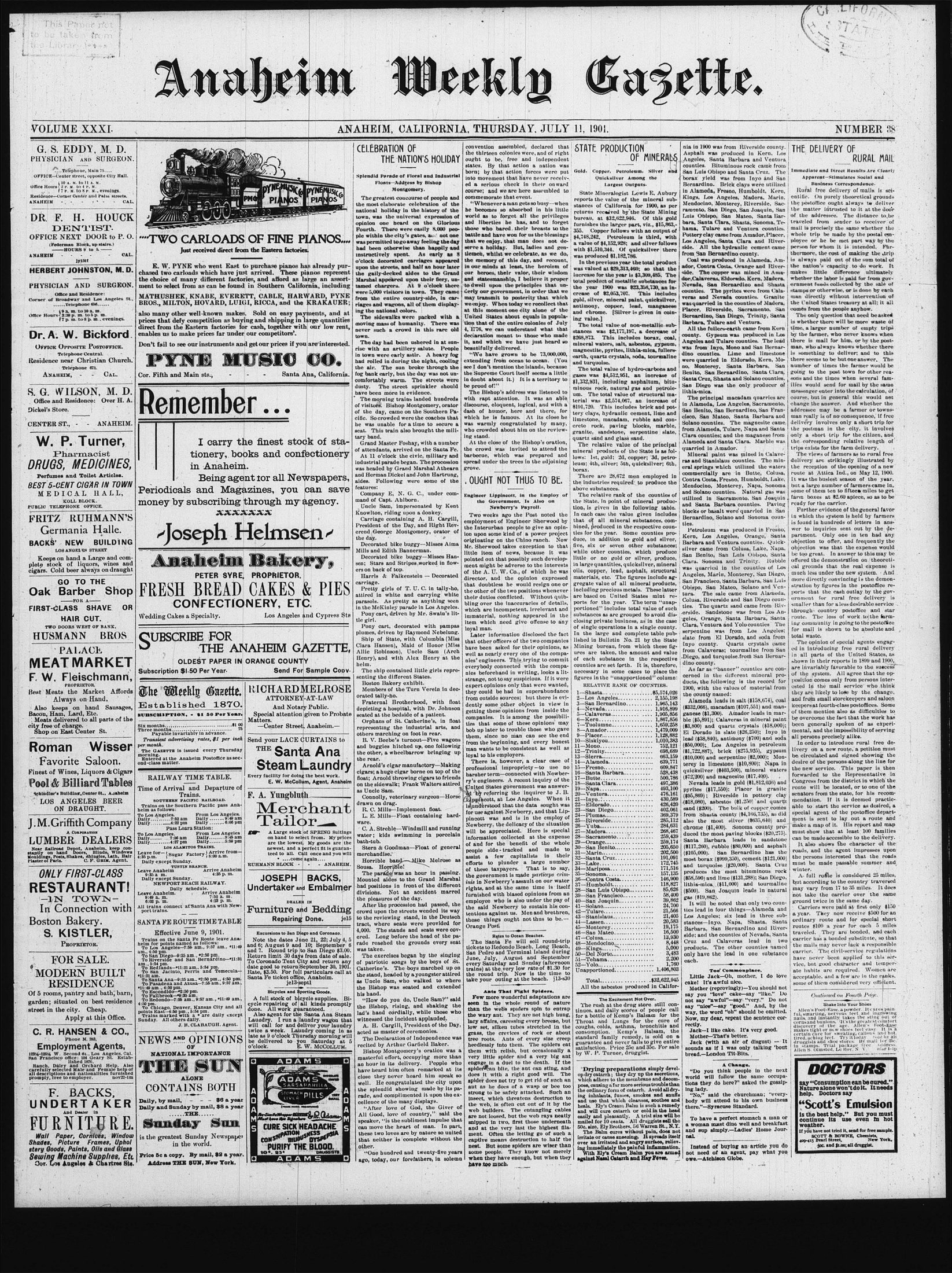
Searchable text
Anaheim
VOLUME XXXI.
G. S. EDDY, M. D.
PHYSICIAN AND SURGEON.
Telephone, Main 75...
OFFICE—Center street, opposite City Hall.
10 A.M. to 11 A.M.
Office Hours
2 P.M. to 4 P.M.
7 P.M. to 8 P.M., evenings.
Residence—Corner Center and Palm streets.
ANAHEIM CAL.
DR. F. H. HOUCK
DENTIST.
OFFICE NEXT DOOR to P. O.
(Federman Block, up stairs.)
HOURS 9 to &
ANAHEIM CAL.
HERBERT JOHNSTON, M. D.
PHYSICIAN AND SURGEON.
Office and Residence:
Corner of Broadway and Los Angeles St..
Telephone 636....
9 a.m. to 10 a.m.
3:30 p.m. to 5 p.m.
7 p.m. to 8 p.m., evenings.
Dr. A. W. Bickford.
OFFICE OPPOSITE POSTOFFICE.
Telephone Central.
Residence near Christian Church.
Telephone 671.
ANAHEIM, CAL.
S. G. WILSON, M. D.
Office and Residence: Over H. A. Dickel's Store.
CENTER ST., ANAHEIM.
W. P. Turner,
Pharmacist
DRUGS, MEDICINES,
"TWO CARLOADS OF FINE PIANOS..."
Just received direct from the Eastern factories.
E. W. PYNE who went East to purchase pianos has already purchased two carloads which have just arrived. These pianos represent the choice of many different factories, and afford as large an assortment to select from as can be found in Southern California, including MATHUSHEK, KNABE, EVERETT, CABLE, HARWARD, PYNE BROS., MILTON, HOVARD, LUIGI, RICCA, and the KRAKAUER; also many other well-known makes. Sold on easy payments, and at prices that defy competition as buying and shipping in large quantities direct from the Eastern factories for cash, together with our low rent, enables us to make prices far under our competitors'.
Don't fail to see our instruments and get our prices if you are interested.
PYNE MUSIC CO.
Cor. Fifth and Main sts., Santa Ana, California.
Remember...
I carry the finest stock of stationery, books and confectionery in Anaheim.
S. G. WILSON, M. D.
Office and Residence: Over H. A. Dickel's Store.
CENTER ST., - ANAHEIM.
W. P. Turner,
Pharmacist
DRUGS, MEDICINES,
Perfumes and Toilet Articles.
BEST 5-CENT CIGAR IN TOWN
MEDICAL HALL,
KOLL BLOCK.
PUBLIC TELEPHONE OFFICE.
FRITZ RUHMANN'S
Germania Halle.
BACKS' NEW BUILDING
LOS ANGELES STREET
Keeps on hand a Large and complete stock of liquors, wines and cigars. Cold beer always on draught
GO TO THE Oak Barber Shop
FOR A FIRST-CLASS SHAVE OR HAIR CUT.
TWO DOORS WEST OF BANK.
HUSMANN BROS
PALACE MEAT MARKET
F. W. Fleischmann,
PROPRIETOR.
Best Meats the Market Affords Always on Hand.
Also keeps on hand Sausages, Bacon, Ham, Lard, Etc.
Meats delivered to all parts of the city free of charge.
Shop on East Center St.
Roman Wisser
Favorite Saloon.
Finest of Wines, Liquors & Cigars
Pool & Billiard Tables
Schindler's Building, Center St., Anaheim
LOS ANGELES BEER ON DRAUGHT.
J.M. Griffith Company
A CORPORATION
LUMBER DEALERS
Near Railroad Depot, Anaheim, keep constantly on hand doors, Blinds, Windows Mouldings, Posts, Shakes, shingles, Lath, Hair Plaster of Paris.
ONLY FIRST-CLASS RESTAURANT!
Remember...
I carry the finest stock of stationery, books and confectionery in Anaheim.
Being agent for all Newspapers, Periodicals and Magazines, you can save money by subscribing through my agency.
Joseph Helmsen
Anaheim Bakery,
PETER SYRE, PROPRIETOR.
FRESH BREAD CAKES & PIES CONFECTIONERY, ETC.
Wedding Cakes a Specialty. Los Angeles and Cypress Sts
SUBSCRIBE FOR THE ANAHEIM GAZETTE,
OLDEST PAPER IN ORANGE COUNTY
Subscription $1.50 Per Year. Send For Sample Copy.
The Weekly Gazette.
Established 1870.
SUBSCRIPTION, - $1.50 Per Year.
Six months... $1.00
Three months... 75
Payable invariably in advance.
Transient advertising rates, $1 per inch per month.
The GAZETTE is issued every Thursday morning.
Entered at the Anaheim Postoffice as second-class matter.
RAILWAY TIME TABLE.
Time of Arrival and Departure of Trains.
SOUTHERN PACIFIC RAILROAD.
Trains on the Southern Pacific pass Anaheim as follows:
To Los Angeles. From Los Angeles.
Dally... 7:52 am Dally... 9:49 am
Daily... 4:22 pm Dally... 6:06 pm
Pass Loara Station:
To Los Angeles. From Los Angeles
Dally... 7:56 am Dally... 9:45 am
Daily... 4:27 pm Dally... 5:59 pm
Los ALAMITOS TRAINS.
Leave for—Sugar Factory Arrive from 4:35 p.m. Daily except Sunday.
TUSTIN BRANCH.
Leave Anaheim Arrive Anaheim 9:35 a.m. 4:35 p.m.
Daily except Sunday.
NEWPORT BEACH RAILWAY.
Daily Schedule.
Leave Anaheim Arrive Anaheim 9:49 a.m. 7:52 a.m.
LOS ANGELES BEER ON DRAUGHT.
J.M. Griffith Company
A CORPORATION
LUMBER DEALERS
Near Railroad Depot, Anaheim, keep constantly on hand Doors, Blinds, Windows Mouldings, Posts, Shakes, Shingles, Lath, Hair Plaster of Paris.
ONLY FIRST-CLASS RESTAURANT!
IN TOWN—In Connection with Boston Bakery.
S. KISTLER,
PROPRIETOR.
FOR SALE.
MODERN BUILT RESIDENCE
Of 5 rooms, pantry and bath, barn, garden; situated on best residence street in the city. Cheap.
Apply at this Office.
C. R. HANSEN & CO., Phone M. 383.
Employment Agents,
123¼-125¼ W. Second St., Los Angeles, Cal.
San Francisco office: 104 Geary St. Established 1876.
Ranch, Dairy and Orchard Help. Also carefully selected Male and Female help of all descriptions and nationalities furnished promptly, free to employer.
F. BACKS, UNDERTAKER
And Dealer in FURNITURE.
Wall Paper, Cornices, Window Shades, Picture Frames, Upholstery Goods, Paints, Oils and Glass Sewing Machine Supplies, Etc.
Cor. Los Angeles & Chartres Sts.
SOUTHERN PACIFIC RAILROAD.
Trains on the Southern Pacific pass Anaheim as follows:
To Los Angeles.
Daily...7:52 am Daily...9:49 am
Daily...4:22 pm Daily...6:06 pm
Pass Loara Station:
To Los Angeles.
Daily...7:56 am Daily...9:45 am
Daily...4:27 pm Daily...5:59 pm
LOS ALAMITOS TRAINS.
Leave for—Sugar Factory Arrive from—4:35 p.m.
Daily except Sunday.
TUSTIN BRANCH.
Leave Anaheim Arrive Anaheim
9:35 a.m. 4:35 p.m.
Daily except Sunday.
NEWPORT BEACH RAILWAY.
Daily Schedule.
Leave Anaheim Arrive Anaheim
9:49 a.m. 7:52 a.m.
6:08 p.m. 4:28 p.m.
All trains connect at Santa Ana with Newport trains.
SANTA FE ROUTE TIMETABLE
Effective June 9, 1901.
Trains on the Santa Fe Route leave Anaheim for points named as follows:
To Los Angeles—7:58 am., 9:57 am., *11:49 am., 4:50 pm.
To San Diego—9:35 am., *2:50 pm.
To Riverside and San Bernardino—*11:31 am., 5:54 pm.
To San Jacinto, Perris and Temecula—*11:31 am.
To Santa Ana—9:35 am., *2:50 pm., 4:50 pm.
To Pasadena and Azusa—7:55 am., 9:57 am., *11:49 am., 4:50 pm.
To Escondido—*2:50 pm.
To Fallbrook—*9:35 am.
To Redondo—7:55 am., 9:57 am., *11:49 am., 4:50 pm.
To Chicago, Denver, Kansas City and all points East—4:50 pm., 5:54 pm.
Trains marked with a * are daily except Sunday. All others daily.
J. H. CLABAUGH. Agent.
NEWS AND OPINIONS OF
NATIONAL IMPORTANCE
THE SUN
ALONE
CONTAINS BOTH
Daily, by mail, $6 a year
Daily and Sunday by mail, $8 a year
THE
Sunday Sun
is the greatest Sunday Newspaper in the world.
Price 5c a copy. By mail, $2 a year.
Address THE SUN, New York.
Merchant Tailor
A Large stock of SPRING Suitings on hand to select from. My prices are the lowest. My goods are the newest, and a perfect fit is guaranteed to all. Call once and you will come again.
JOSEPH BACKS,
Undertaker and Embalmer
DEALER IN
Furniture and Bedding Repairing Done.
Excursions to San Diego and Coronado.
Note the dates June 21, 22; July 4, 5 and 6; August 9 and 10; September 6 and 7. Round trip to San Diego $3.00. Return limit 30 days from date of sale. To Coronado Tent City and return any date good to return September 30, 1901. Rate, $3.50. For full particulars call at Santa Fe ticket office, Anaheim.
je13-septl
Bicycles and Sporting Goods.
A full stock of bicycle supplies. Bicycle repairing of all kinds promptly done. All work guaranteed.
Also agent for the Santa Ana Steam Laundry. I run a laundry wagon that will call for and deliver your laundry twice a week. Laundry coming in as late as 9 o'clock Thursday morning will be delivered to you Saturday at 5 o'clock.
E. W. McCOLLUM.
ANAHEIM, CALIFORNIA, THURSDAY, JULY 11, 1901.
CELEBRATION OF THE NATION'S HOLIDAY
Splendid Parade of Floral and Industrial Floats—Address by Bishop Montgomery.
The greatest concourse of people and the most elaborate celebration of the national holiday in the history of the town, was the universal expression of opinion one heard on the Glorious Fourth. There were easily 8,000 people within the city's gates, and not one was permitted to go away feeling the day had been otherwise than happily and instructively spent. As early as 8 o'clock decorated carriages appeared upon the streets, and half an hour later the gaily-decked aides to the Grand Marshal appeared upon their fiery, untamed chargers. At 9 o'clock there were 5,000 visitors in town. They came from the entire country-side, in carriages and wagons, all of them displaying the national colors.
The sidewalks were packed with a moving mass of humanity. There was never such a crowd in this rare old town.
The day had been ushered in at sunrise with an artillery salute. People in town were early astir. A heavy fog had rolled in during the night, cooling the air. The sun broke through the fog bank early, but the day was not uncomfortable warm. The streets were dusty. The street sprinkler should have been more in evidence.
The morning trains landed hundreds of visitors. Bishop Montgomery, orator of the day, came on the Southern Pacific. So crowded were the coaches that he was unable for a time to secure a seat. This train also brought the military band.
Grand Master Foshay, with a number of attendants, arrived on the Santa Fe.
At 11 o'clock the civic, military and industrial parade began. The procession was headed by Grand Marshal Athorne and Hermann Dickel and John Hartung.
convention assembled, declared that the thirteen colonies were, and of right ought to be, free and independent states. By that action a nation was born; by that action forces were put into movement that have never received a serious check in their onward course; and we are here assembled to commemorate that event.
"Whenever a man gets so busy—when he becomes so absorbed in his little world as to forget all the privileges and liberties he has, and to forget those who bared their breasts to the battle and have won for us the blessings that we enjoy, that man does not deserve a holiday. But, ladies and gentlemen, whilst we celebrate, as we do, the memory of this day, and recount, in our minds at least, the heroism of our heroes, their valor, their wisdom and statesmanship, I believe it proper to dwell upon the principles that underly our government, in order that we may transmit to posterity that which we enjoy. When today we recollect that at this moment one city alone of the United States about equals in population that of the entire colonies of July 4, 1776, we can understand what that declaration meant to those who made it, and which we have just heard so beautifully delivered.
"We have grown to be 73,000,000, extending from ocean to ocean. (You see I don't mention the islands, because the Supreme Court itself seems a little in doubt about it.) It is a territory to be proud of!"
The Bishop's address was listened to with rapt attention. It was an able discourse, eloquent, logical, and with a dash of humor, here and there, for which he is famous. At its close he was warmly congratulated by many, who crowded about him on the reviewing stand.
At the close of the Bishop's oration, the crowd was invited to attend the barbecue, which was prepared and spread under the trees in the adjoining grove.
STATE PRODUCTION OF MINERALS
Gold, Copper, Petroleum, Silver and Quicksilver Among the Largest Outputs.
State Mineralogist Lewis E. Auburn reports the value of the mineral substances of California for 1900, as per returns received by the State Minerals Bureau, at $32,622,946. Of this gold furnishes the larger part, viz., $15,863,355. Copper follows with an output of $4,748,242. Petroleum is third, with a value of $4,152,928; and silver follows with $1,510,344. Of quicksilver there was produced $1,182,786.
In the previous year the total product was valued at $29,313,460; so that the increase for the year is $3,309,485. The total product of metallic substances for the year 1900 was $23,358,730, an increase of $2,053,707. This includes gold, silver, mineral paint, quicksilver antimony, copper, lead, manganese and chrome. [Silver is given in coinage value.]
The total value of non-metallic substances was $2,177,197; a decrease of $268,873. This includes borax, coa-mineral waters, salt, asbestos, gypsum magnestite, pyrites, lithia-mica, fullerene earth, quartz crystals, soda, tourmaline and turquoise.
The total value of hydro-carbons and gases was $4,512,951; an increase of $1,332,931; including asphaltum, bituminous rock, natural gas and petroleum. The total value of structural material was $2,574,067; an increase of $191,720. This includes brick and pottery clays, hydraulic cement, lime and limestone, macadam, rubble and concrete rock, paving blocks, marble granite, sandstone, serpentine slate quartz sand and glass sand.
The relative value of the principal mineral products of the State is as follows: 1st gold; 2d copper; 3d petroleum; 4th silver; 5th quicksilver; 6th borax.
The morning trains landed hundreds of visitors. Bishop Montgomery, orator of the day, came on the Southern Pacific. So crowded were the coaches that he was unable for a time to secure a seat. This train also brought the military band.
Grand Master Foshay, with a number of attendants, arrived on the Santa Fe. At 11 o'clock the civic, military and industrial parade began. The procession was headed by Grand Marshal Athearn and Herman Dickel and John Harttrung, aides. Following were some of the features:
Company E, N. G. C., under command of Capt. Ahlborn.
Uncle Sam, impersonated by Kent Knowlton, riding upon a donkey.
Carriage containing A. H. Cargill, President of the Day, and Right Reverend George Montgomery, orator of the day.
Decorated bike buggy—Misses Alma Mills and Edith Bannerman.
Decorated bike buggy—Misses Hansen; Stars and Stripes worked in flowers on back of top.
Harris & Falkenstein — Decorated carriage.
Pretty girls of T. U. C. in tally-ho, attired in white and carrying white parasols. As pretty as anything seen in the McKinley parade in Los Angeles.
Pony cart, driven by Mr. Swain's little girl.
Pony cart, decorated with pampas plumes, driven by Raymond Nebelung.
Ship of State, with Columbia (Miss Clara Hansen), Maid of Honor (Miss Allie Robinson), Uncle Sam (Arch Henry), and with Alex Henry at the helm.
The ship contained little girls representing the different States.
Boston Bakery exhibit.
Members of the Turn Verein in decorated tally-ho.
Fraternal Brotherhood, with float depicting a hospital, with Dr. Johnson seated at the bedside of a patient.
Orphans of St. Catherine's, in float representing the industrial arts, and others marching on foot in rear.
B. V. Beebe's turnout—Five wagons and buggies hitched up, one following the other, a wheelbarrow bringing up the rear.
Arnold's cigar manufactory—Making cigars; a huge cigar borne on top of the float; Arnold throwing cigars to friends on the sidewalk; Frank Walters attired as Uncle Sam.
Connolly, veterinary surgeon—Horse drawn on drag.
R. C. Mills—Implement float.
L. E. Mills—Float containing hardware.
C. A. Strehle—Windmill and running water; kids swimming in porcelain bath-tub.
Stern & Goodman—Float of general merchandise.
Horrible band—Mike Melrose as Sousa. Horrible!
The parade was an hour in passing. Mounted aides to the Grand Marshal had positions in front of the different divisions. Not an accident marred the pleasures of the day.
The Bishop's address was listened to with rapt attention. It was an able discourse, eloquent, logical, and with a dash of humor, here and there, for which he is famous. At its close he was warmly congratulated by many, who crowded about him on the reviewing stand.
At the close of the Bishop's oration, the crowd was invited to attend the barbecue, which was prepared and spread under the trees in the adjoining grove.
OUGHT NOT THUS TO BE.
Engineer Lippincott, in the Employ of the Government, is Also on Newberry's Payroll.
Two weeks ago the Post noted the employment of Engineer Sherwood by Interurban people to give an opinion upon some kind of a power project originating on the Chino ranch. Now Mr. Sherwood takes exception to that little item of news, because it was pointed out that possibly development might be adverse to the interests of the A.U.W.Co., of which he was director, and the opinion expressed that doubtless he would resign one or the other of the two positions whenever their duties conflicted. Without quibbling over the inaccuracies of details, which are incompetent, irrelevant and immaterial, nothing appeared in the item which need give offense to any loyal man.
Later information disclosed the fact that other officers of the two companies have been asked for their opinions, as well as nearly every one of the companies' engineers. This trying to commit everybody connected with the companies beforehand in writing, looks a litstrange, not to say suspicious. If it were expert opinions only that were wanted, they could be had in superabundance from outside sources; but there is evidently some other object in view getting these opinions from inside the companies. It is among the possibilities that some of these opinions may bop up later to trouble those who gave them, since no man can see the end from the beginning, and every honest man wants to be consistent as well as loyal to his employers.
There is, however, a clear case of professional impropriety—to use no harsher term—connected with Newberry's engineers. A recent inquiry of the United States government was answered by referring the inquirer to J. B. Lapplcott, at Los Angeles. When it is understood that the data sought was for use against Newberry, and that Lapplcott was and is in the employ of Newberry, the delicacy of the situation will be appreciated. Here is special information collected at the expense of and for the benefit of the whole people side-tracked and made to assist a few capitalists in their efforts to plunder a large number of these taxpayers. That is to say, the government is made particeps criminis in Newberry's assault on our water rights, and at the same time is itself furnished with biased opinions from an
RELATIVE RANK OF COUNTIES.
1-Shasta $5,574,00
2-Los Angeles 2,155,18
3-San Bernardino 1,965,18
4-Nevada 1,916,88
5-Calaveras 1,905,88
6-Kern 1,867,88
7-Tuolumne 1,659,28
8-Amador 1,479,00
9-Placer 1,128,88
10-Siskiyou 1,010,33
11-Mono 752,11
12-Trinity 698,66
13-Sierra 663,14
14-Alameda 639,77
15-Fresno 609,88
16-Santa Barbara 528,44
17-Butte 500,77
18-Santa Clara 497,39
19-Napa 493,14
20-Ventura 476,11
21-Inyo 430,55
22-Eldorado 426,48
23-San Diego 402,00
24-Plumas 369,33
25-Riverside 285,14
26-Yuba 284,66
27-Madera 288,44
28-Sacramento 259,44
29-Orange 259,19
30-San Benito 205,66
31-Marin 202,55
32-Santa Cruz 191,00
33-Lake 172,77
34-Mariposa 171,55
35-Sonoma 157,11
36-Contra Costa 146,96
37-Humboldt 118,88
38-San Luis Obispo 85,66
39-San Francisco 58,44
Merchant tailor
Large stock of SPRING Suitings and to select from. My prices the lowest. My goods are the best, and a perfect fit is guaranteed to all. Call once and you will come again.
DEALER IN
Pure and Bedding
Repairing Done. je15
to San Diego and Coronado.
dates June 21, 22; July 4, 5
t9 and 10; September 6
and trip to San Diego $3.00.
st30 days from date of sale.
to Tent City and return any
return September 30, 1901.
For full particulars call at
kett office, Anaheim.
je13-septl
les and Sporting Goods.
back of bicycle supplies. Biting of all kinds promptly work guaranteed.
at for the Santa Ana Steam run a laundry wagon that or deliver your laundry rack. Laundry coming in as block Thursday morning will be to you Saturday at 5 E.W. McCOLLUM.
ADAMS
ADAMS
SARSAPARILLA
STOMACH PILLS
LIVER
DEAIMON
BIPATION
BLUOSNESS
DYSPEPSIA
RIFY THE BLOOD.
DRUGGISTS.
ADAMS
R.C. Mills—Implement float.
L.E. Mills—Float containing hardware.
C.A. Strehle—Windmill and running water; kids swimming in porcelain bath-tub.
Stern & Goodman—Float of general merchandise.
Horrible band—Mike Melrose as Sousa. Hoprible!
The parade was an hour in passing. Mounted aides to the Grand Marshal had positions in front of the different divisions. Not an accident marred the pleasures of the day.
After the procession had passed, the crowd upon the streets wended its way to the reviewing stand, in the Deutsch tract, where seats were provided for 4,000. The stands and seats were covered. Long before the head of the parade reached the grounds every seat was taken.
The exercises began by the singing of patriotic songs by the boys of St. Catherine's. The boys marched up on the stand, headed by a youngster attired as Uncle Sam, who walked to where the Bishop was seated and extended his hand.
"How do you do, Uncle Sam?" said the Bishop, rising, and shaking the lad's hand cordially, while those who witnessed the incident applauded.
A.H. Cargill, President of the Day, acted as master of ceremonies.
The Declaration of Independence was recited by Arthur Garfield Baker.
Bishop Montgomery's oration was a masterful effort, occupying more than an hour in its delivery. People who have heard him often remarked at its close they never heard him speak so well. He congratulated the city upon the splendid showing made by its parade, and complimented it upon the excellence of the many displays.
"After love of God, the Giver of All Good, love of country," said the speaker, "is the sublimest impulse that can move the heart of man. In part, these two loves are by nature so united that neither is complete without the other.
"One hundred and twenty-five years ago, today, our forefathers, in solemn
Ants That Fight Spiders.
Few more wonderful adaptations are seen in the whole round of nature than the webs spiders spin to entrap the wary ant. They are not high hung, lacy affairs, caressing every breeze, but low set, silken tubes stretched in the grass, the crevices of rock or about tree roots. Ants of every size creep heedlessly into them. The spiders eat them with relish, but occasionally a very little spider and a very big ant engage in a duel to the death. If the spider can bite, the ant can sting, and does it with a right good will. The spider does not try to get rid of such an ant as he does of a wasp or bee too strong to be safely attacked. Such an insect, which threatens destruction to the web, is often cut out of it by the web builders. The entangling cables are not loosed, but the web rays neatly snapped in two, first those underneath and at the very last the highest filament. Often the letting go of such a captive means destruction to half the nest. But some spiders are wiser than some people. They know not merely when they have enough, but when they have too much.
Ants That Fight Spiders.
The Santa Fe will sell round-trip tickets to Redondo Beach, Long Beach, San Pedro and Terminal Island during June, July, August and September every Saturday and Sunday (afternoon trains) at the very low rate of $1.30 for the round trip. Now is the time to take your outing at the beach. j13-s30
Drying preparations simply develop dry catarrh; they dry up the secretion which adheres to the membrane and decope, causing a far more serious trouble than ordinary form of catarrh. Avoid all ing inhalants, fumes, smokes and smoke and use that which cleanses, soothes and heals. Ely's Cream Balm is such a remedy and will cure catarrh or cold in the hot easily and pleasantly. A trial size will mailed for 10 cents. All druggists sell 50c. size. Ely Brothers, 56 Warren St., N.Y.
The Balm cures without pain, does it irritate or cause sneezing. It spreads it over an irritated and angry surface, relating immediately to painful inflammation.
With Ely's Cream Balm you are armed against Nasal Catarrh and Hay Fever.
PRODUCTION OF MINERALS
copper, Petroleum, Silver and Quicksilver Among the Largest Outputs.
Mineralogist Lewis E. Aubury the value of the mineral sub- of California for 1900, as per received by the State Mining at $32,622,946. Of this gold is the larger part, viz., $15,863; copper follows with an output of 2. Petroleum is third, with an output of $4,152,928; and silver follows 10,344. Of quicksilver there produced $1,182,786.
Previous year the total product was at $29,313,460; so that the for the year is $3,309,485. The product of metallic substances for 1900 was $23,358,730, an in- of $2,053,707. This includes silver, mineral paint, quicksilver, copper, lead, manganese ore. [Silver is given in coin-]
Total value of non-metallic sub- was $2,177,197, a decrease of This includes borax, coal, waters, salt, asbestos, gypsum, tepte, pyrites, lithia-mica, fullersartz crystals, soda, tourmaline noise.
Total value of hydro-carbons and metals including asphaltum, bitu-rock, natural gas and petrole- total value of structural ma- was $2,574,067, an increase of This includes brick and pot- hydraulic cement, lime and macadam, rubble and con- paving blocks, marble, sandstone, serpentine slate, sand and glass sand.
Relative value of the principal products of the State is as fol- gold; 2d, copper; 3d, petro- silver; 5th, quicksilver; 6th,
nia in 1900 was from Riverside county. Asphalt was produced in Kern, Los Angeles, Santa Barbara and Ventura counties. Bituminous rock came from San Luis Obispo and Santa Cruz. The borax yield was from Inyo and San Bernardino. Brick clays were utilized in Alameda, Fresno, Humboldt, Kern, Kings, Los Angeles, Madera, Marin. Mendocino, Monterey, Riverside, Sacramento, San Diego, San Joaquin, San Luis Obispo, San Mateo, Santa Barbara, Santa Clara, Shasta, Sonoma, Tehama, Tulare and Ventura counties. Pottery clay came from Amador, Placer, Los Angeles, Santa Clara and River-side. All the hydraulic cement came from San Bernardino county.
Coal was produced in Alameda, Amador, Contra Costa, Orange and River-side. The copper was mined in Amador,Calaveras, Eldorado, Kern,Madera,Nevada,San Bernardino and Shasta counties. The pyrites were from Calaveras and Nevada counties. Granite was quarried in the counties of Madera, Placer,Riverside,Sacramento,San Bernardino,San Diego,Trinity,Santa Barbara,Tulare and Ventura.
All the fullers-earth came from Kern county. Gypsum was produced in Los Angeles and Tulare counties. The lead was from Inyo,Mono and San Bernardino counties. Lime and limestone were quarried in Eldorado.Kern,Mono,Monterey,Santa Barbara,San Benito,San Bernardino,Santa Clara,Santa Cruz.Shasta and Solano counties.San Diego was the only producer of lithia-mica.
The principal macadam quarries are in Alameda,Los Angeles,Sacramento,San Benito,San BernardinoSan Francisco,San Mateo,Santa Barbara and Solano counties. The magnesite came from Alameda,Tulare,Napa and Santa Clara counties; and the maganese from Alameda and Santa Clara. Marble was quarried in Amador.
Mineral paint was mined in Calaveras and Stanislaw counties. The mineral springs which utilized the waters commercially are in Butte.Colusa.
THE DELIVERY OF RURAL MAIL
Immediate and Direct Results Are Clearly Apparent—Stimulates Social and Business Correspondence.
Rural free delivery of mails is scientific. On purely theoretical grounds the postoffice ought always to deliver the matter intrusted to it at the door of the addressee. The distance to be traveled from sender to receiver of mail is precisely the same whether the whole trip be made by the postal employee or he be met part way by the person for whom it is intended. Furthermore,the cost of making the strip is always paid out of the sum total of the nation's capacity to do work. It makes little difference ultimately whether the labor is paid for from government funds collected by the sale of stamps or otherwise,and is done by each man directly without intervention of the United States treasury at all;it all comes from the people anyhow.
The only question that need be asked is whether there will be more waste of time,a larger number of empty trips by the farmer who never knows when there is mail for him,或by the postmanwho always knows whether there is something to deliver;and to this there seems to be but one answer.The number of times the farmer would be going to the post town for other reasons and the times when several families would send for mail by the same messenger enter into the calculation.of course,但 in general this would not change the answer.And whether the addressee may be a farmer or townsman really is of no consequence;if free delivery involves only a short trip for the postman in the city,它 involves only a short trip for the citizen,and the corresponding relative length of trips exists for the farm delivery.
The views of farmers as to rural free delivery are strikingly illustrated by the reception of the opening of a new route at Attica Ind., on May 12, 1900.
This includes brick and pottery, hydraulic cement, lime and macadam, rubble and concrete, paving blocks, marble, sandstone, serpentine slate, and glass sand.
Relative value of the principal products of the State is as follows: gold; 2d, copper; 3d, petroleum; silver; 5th, quicksilver; 6th, quartz.
Native rank of the counties of the State in point of mineral production in the following table. Some counties provide addition to gold and silver, or seven other substances; others counties which produce no gold or silver, produce quantities, quicksilver, mineral paper, lead, asphalt, structural glass, etc. The figures include relative value of all mineral products, including precious metals. These latter on United States mint reserve the year. The term "unapportioned" includes total value of such items as are grouped to avoid disdivide business, as in the case operations in a single county. Large and complete table publishes Bulletin No. 21 by the State Bureau, from which these figures taken, the amount and value of substance in the respective are set forth. It is, therefore, easy in some cases to place them in the "unapportioned" column:
ACTIVE RANK OF COUNTIES.
Baltimore $5,574,026
Angeles 2,155,198
Bernardino 1,965,143
Cadaa 1,916,899
Viveras 1,905,856
Mn 1,867,856
Sumne 1,659,258
Dorid 1,479,009
Mer 1,128,882
Youlou 1,010,383
Oto 752,121
City 698,689
Tara 663,159
Mededa 639,771
Noon 609,847
La Barbara 528,438
Lee 500,786
Claura 497,386
Ana 493,100
Tatura 476,161
Larado 430,589
Diego 426,420
Nasas 402,061
Perside 369,379
Sierra 285,112
Ana 284,631
Serra 268,467
Amendojo 259,439
Jorge 259,174
Benito 205,650
Inn 202,500
Sta Cruz 191,091
Peleo 172,745
Iposa 171,516
oma 157,135
Tra Costa 146,900
Imboldt 118,827
Luis Obispo 85,626
Francisco 58,400
The principal macadam quarries are in Alameda, Los Angeles, Sacramento, San Benito, San Bernardino, San Francisco, San Mateo, Santa Barbara and Solano counties. The magnesite came from Alameda, Tulare, Napa and Santa Clara counties; and the maganese from Alameda and Santa Clara. Marble was quarried in Amador.
Mineral paint was mined in Calaveras and Stanislaus counties. The mineral springs which utilized the waters commercially are in Butte, Colusa, Contra Costa, Fresno, Humboldt Lake, Mendocino, Monterey, Napa, Sonoma and Solano counties. Natural gas was utilized in Sacramento. San Joaquin and Santa Barbara counties. Paving blocks or basalt were quarried in San Bernardino, Solano and Sonoma counties.
Petroleum was produced in Fresno, Kern, Los Angeles, Orange, Santa Barbara and Ventura counties. Quicksilver came from Colusa Lake, Napa, San Benito, San Luis Obispo, Santa Clara. Sonoma and Trinity. Rubble was quarried in the counties of Los Angeles, Marin, Monterey, San Diego, San Francisco, Santa Barbara and San Luis Obispo. San Mateo, Solano and Ventura. The sale came from Alameda, Colusa. Riverside and San Diego counties. The quartz sand came from Riverside. Sandstone was from Los Angeles, Orange, Santa Barbara, Santa Clara. Ventura and Yolo counties. The serpentine was from Los Angeles; slate from El Dorado; and soda from Inyo county. Quartz crystals came from Calaveras; tourmaline from San Diego; and turquoise from San Bernardino county.
As far as "banner" counties are concerned in the different mineral products,the following is the record for 1900 with the values of material from the county named:
Alameda leads in salt ($158,674), coal ($332,066), macadam ($107,551) and manganese ($1,300). Amador leads in marble ($5,891); Calaveras in mineral paint ($3,800) and quartz crystals ($18,000); El Dorado in slate ($26,250); Inyo in lead ($38,840), antimony ($700) and soda ($50,000); Los Angeles in petroleum ($1,722,887), brick ($275,925), gypsum ($10,000) and serpentine ($2,000). Monterey in limestone ($10,800); Napa in quicksilver ($403,500), mineral waters ($72,200) and magnesite ($17,400).
Nevada leads in gold ($1,812,036) and pyrites ($17,550). Placer in granite ($95,869); Riverside in pottery clay ($18,080), asbestos ($1,250) and quartz sand ($200). The bulk of copper comes from Shasta county ($4,166,735), as did also the most silver ($635,640) and chrome ($1,400). Sonoma county produced the most paving blocks ($20,275). Santa Barbara leads in sandstone ($117,260), rubble ($80,000) and asphalt ($105,000). San Bernardino has the most borax ($999,350), cement ($121,000) and turquoise ($20,000). Santa Cruz produces the most bituminous rock ($58,590) and lime ($131,288); San Diego lithia-mica ($11,000) and tourmaline ($500). San Joaquin leads in natural gas ($19,882).
The views of farmers as to rural free delivery are strikingly illustrated by the reception of the opening of a new route at Attica Ind., on May 12,1900. It was the busiest season of the year,but a large number of farmers came in,some of them ten to fifteen miles to get farm boxes at $2.60 apiece,s so as to be ready for the carrier.
Further evidence of the general favor in which the system is held by farmers is found in hundreds of letters in answer to inquiries sent out by the department. Only one in ten had any objection to offer,and frequently the objection was that the expense would be too great.In answer to this may be offered the demonstration on theoretical grounds that the real expense is much less under the new system.And more directly convincing is the demonstration by figures in the postoffice reports that the cash outlay by the government for rural free delivery is smaller than for a less desirable service through country postoffice and star route.The loss of work to the farming community in going to the postoffice for mail is shown to be absolute and total waste.
The opinion of special agents engaged in introducing free rural delivery in all parts of the United States.as shown in their reports in 1899 and 1900,a invariably favorable to the success of the system.All agree that the opposition comes only from persons interested in the mail service who think they are likely to lose by the change,and from small storekeepers and saloon keepers at fourth-class postoffices.Some of them mention also as difficulties to be overcome the fact that the work has been generally spoken of as experimental,and the impossibility of serving all persons precisely alike.
In order to introduce rural free delivery on a new route,a petition must be circulated and signed showing the desire of the persons along the line for the new service. This paper is then forwarded to the Representative in Congress from the district in which the route will be located,或 to one of the senators from the state.for his recommendation.If it is deemed practicable to start the service as desired,a special agent of the postoffice department is sent to lay out a route and make a map of it.His report and map must show that at least 100 families can be made accessible to the delivery.
It also shows the character of the roads,and the agent impresses upon the persons interested that the roads must be made passable summer and winter.
A full route is considered 25 miles,but according to the country traversed may vary from 17 to 35 miles.It does not take the carrier over the same
The Excitement Not Over.
Push at the drug store still conmand daily scores of people call
tattle of Kemp's Balsam for the
and Lungs for the cure of
colds, asthma, bronchitis and
potion. Kemp's Balsam, the
family remedy, is sold on a
free and never fails to give entire
action. Price 25c and 35c. For sale
P. Turner, druggist.
Ing preparations simply develcatarrh; they dry up the secretions,
there to the membrane and decomsising a far more serious trouble than
normal form of catarrh. Avoid all drylants, fumes, smokes and snuffs
that which cleanses, soothes and
Ely's Cream Balm is such a remedy
for cure catarrh or cold in the head
and pleasantly. A trial size will be
for 10 cents. All druggists sell thom. Ely Brothers, 56 Warren St., N.Y.
Balm cures without pain, does not
or cause sneezing. It spreads itself
irritated and angry surface, reliciably the painful inflammation.
Ely's Cream Balm you are armed
Nasal Catarrh and Hay Fever.
Too' Commonplace.
Little Jack—Oh, mother, I do love cake! It's awful nice.
Mother (reprovingly)—You should not say you "love" cake—say "like." Do not say "awful"—say "very." Do not say "nice"—say "good." And, by the way, the word "oh" should be omitted. Now, my dear, repeat the sentence correctly.
Jack—I like cake. It's very good.
Mother—That's better.
Jack (with an air of disgust) — It sounds as if I was only talking 'bout bread.—London Tit-Bits.
A Change.
"Do you think people in the next world will follow the same occupations they do here?" asked the gossiping lady.
"No," said the churchman; "everybody will attend to his own business there."—Syracuse Standard.
To have a perfect stomach a man or a woman must dine well and breakfast and sup simply.—Ladies' Home Journal.
Instead of buying an article you do not need of an agent, pay what you owe.—Atchison Globe.
If it is deemed practicable to start the service as desired, a special agent of the postoffice department is sent to lay out a route and make a map of it. His report and map must show that at least 100 families can be made accessible to the delivery.
It also shows the character of the roads, and the agent impresses upon the persons interested that the roads must be made passable summer and winter.
A full route is considered 25 miles, but according to the country traversed may vary from 17 to 35 miles. It does not take the carrier over the same ground twice in the same day.
Carriers were paid at first only $150 a year. They now receive $500 for an ordinary route and for special short routes $100 a year for each 5 miles traveled. They are bonded, and each carrier has a bonded substitute, so that the mails may never lack a responsible carrier. The civil-service regulations have never been applied to this service, but good character and temperate habits are required. Women are acceptable, and a few are in the ranks, some of them considered very efficient.
Continued on Fourth Page.
Shake Into Your Shoes
Allen's Foot-Ease, a powder. It cures pain,
smarting, nervous feet and ingrowing nails,
and instantly takes the sting out of corns and bunions. It's the greatest comfort discovery of the age. Allen's Foot-Ease makes tight or new shoes feel easy. It is a certain care for sweating, callous and hot tired, aching feet. Try it today. Sood by all druggists and shoe stores. By mail for 25c in stamps. Trial package free address.
Allen S. Olinsted, Le Roy, N.Y.
DOCTORS
say "Consumption can be cured."
Nature alone won't do it. It needs help. Doctors say
"Scott's Emulsion
is the best help." But you must continue its use even in hot weather.
If you have not tried it, send for free sample.
SCOTT & BOWNE, Chemists,
409-415 Pearl Street,
New York,
50c. and $1.00; all druggist.