anaheim-gazette 1901-07-04
Scanned page
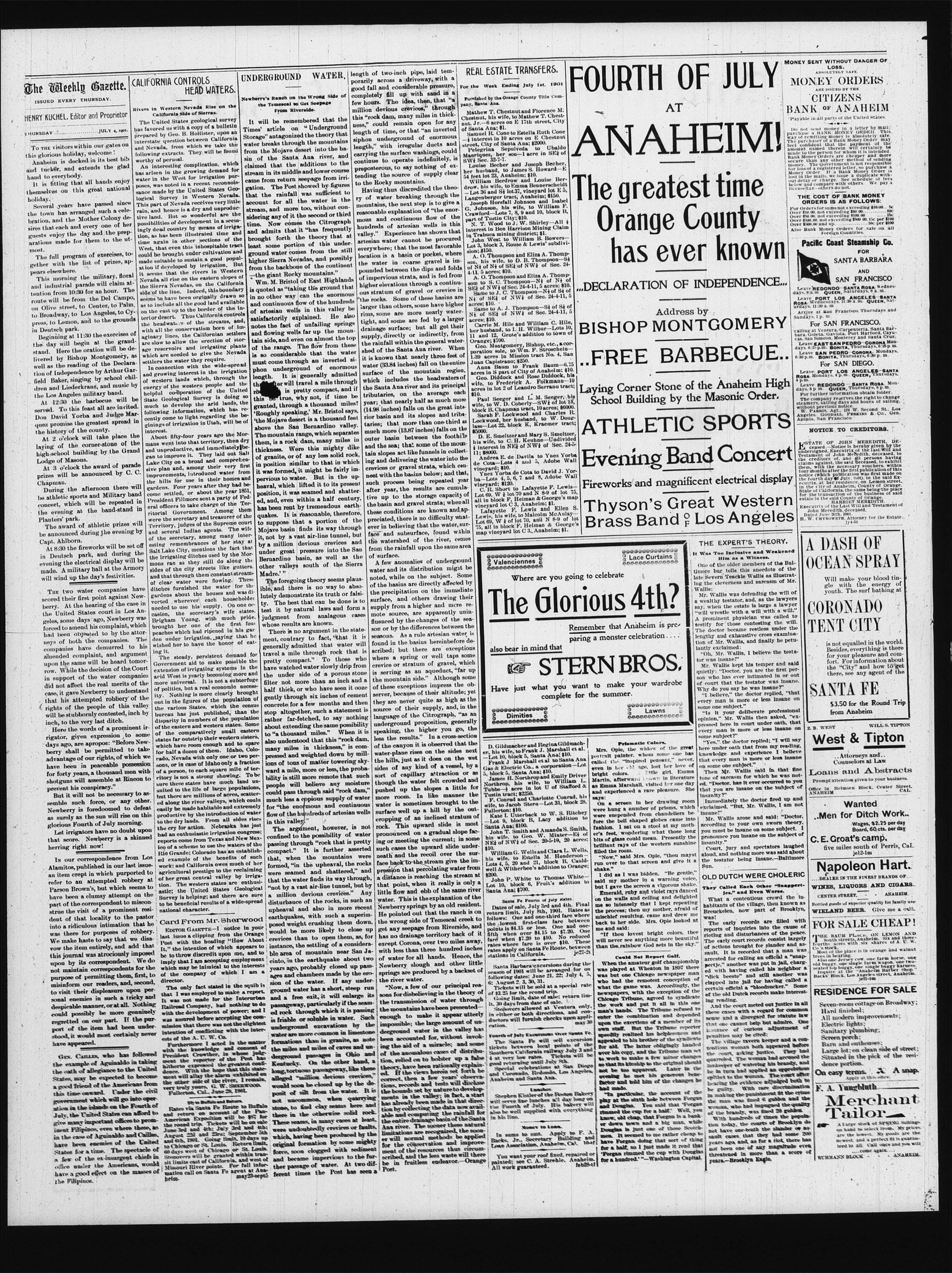
Searchable text
The Weekly Gazette.
ISSUED EVERY THURSDAY.
HENRY KUCHEL, Editor and Proprietor
THURSDAY... JULY 4, 1901.
To the visitors within our gates on this glorious holiday, welcome!
Anaheim is decked in its best bib and tucker, and extends the glad hand to everybody.
It is fitting that all hands enjoy themselves on this great national holiday.
Several years have passed since the town has arranged such a celebration, and the Mother Colony desires that each and every one of her guests enjoy the day and the preparations made for them to the utmost.
The full program of exercises, together with the list of prizes, appears elsewhere.
This morning the military, floral and industrial parade will claim attention from 10:30 for an hour. The route will be from the Del Campo, on Olive street, to Center, to Palm, to Broadway, to Los Angeles, to Cypress, to Lemon, and to the grounds in Deutsch park.
Beginning at 11:30 the exercises of the day will begin at the grandstand. Here the oration will be delivered by Bishop Montgomery, as well as the reading of the Declaration of Independence by Arthur Garfield Baker, singing by school children and Liederkranz, and music by the Los Angeles military band.
At 12:30 the barbecue will be served. To this feast all are invited. Don David Yorba and Judge Marquez promise the greatest spread in the history of the county.
At 2 o'clock will take place the laying of the corner-stone of the high-school building by the Grand Lodge of Masons.
At 3 o'clock the award of parade prizes will be announced by C. C.
CALIFORNIA CONTROLS HEAD WATERS.
Rivers in Western Nevada Rise on the California Side of Sierra.
The United States geological survey has favored us with a copy of a bulletin prepared by Geo. B. Hollister, upon an interstate question between California and Nevada, from which we take the following extracts. They will be found worthy of perusal.
An interesting complication, which has arisen in the growing demand for water in the West for irrigation purposes, was noted in a recent reconnoissance made by the United States Geological Survey in Western Nevada. This part of Nevada receives very little rain, and hence is a dry and unproductive land. But so wonderful are the possibilities of development in a seemingly dead country by means of irrigation, as has been illustrated time and time again in other sections of the West, that even this inhospitable tract could be brought under cultivation and made suitable to sustain a good population if developed by irrigation. But it seems that the rivers in Western Nevada all rise on the eastern slopes of the Sierra Nevadas, on the California side of the line. Indeed, this boundary seems to have been originally drawn so as to include all the good land available on the east up to the border of the interior desert. Thus California controls the headwaters of the streams, and, with all the conservatism born of imaginary lines, the Californian settlers are slow to allow the erection of storage reservoirs and irrigating plants which are needed to give the Nevada settlers the water they require.
In connection with the wide-spread and growing interest in the irrigation of western lands which, through the energy of the western people and their helpful co-operation of the United State Geological Survey is doing so much to develop the arid lands, the following information, which has recently come to light regarding the beginnings of irrigation in Utah, will be of interest.
About fifty-four years ago the Mormans went into that territory, then dry and unproductive, and immediately began to improve it. They laid out Salt Lake City on a broad and comprehensive plan and, among their very first improvements, introduced water from
UNDERGROUND WATER.
Newberry's Ranch on the Wrong Side of the Temescal to Get Seepage From Riverside.
It will be remembered that the Times' article on "Underground Storage" antagonized the theory that water breaks through the mountains from the Mojave desert into the basin of the Santa Ana river, and claimed that the additions to the stream in its middle and lower course came from return seepage from irrigation. The Post showed by figures that the rainfall was sufficient to account for all the water in the stream, and more too, without considering any of it the second or third time. Now comes the Citrograph and admits that it "has frequently brought forth the theory that at least some portion of this underground water comes from the still higher Sierra Nevadas, and possibly from the backbone of the continent—the giant Rocky mountains."
Wm. M. Bristol of East Highlands is quoted as "taking the ground that in no other way can be enormous and continuous flow of the hundreds of artesian wells in this valley be satisfactorily explained. He also notes the fact of unfailing springs and flowing wells far up the mountain side, and even on almost the top of the range. The flow from these is so considerable that the water must come through an inverted siphon underground of enormous length. It is generally admitted that water will travel a mile through rock; it is pretty compact, and if this be true, why not, if time be granted, through a thousand miles 'Roughly speaking,' Mr. Bristol says 'the Mojave desert is a thousand feet above the San Bernardino valley.' The mountain range, which separates them, is a rock dam, many miles in thickness. Were this mighty disk of granite, or of any less solid rock in position similar to that in which it was formed, it might be fairly in
field Baker, singing by school children and Liederkranz, and music by the Los Angeles military band.
At 12:30 the barbecue will be served. To this feast all are invited. Don David Yorba and Judge Marquez promise the greatest spread in the history of the county.
At 2 o'clock will take place the laying of the corner-stone of the high-school building by the Grand Lodge of Masons.
At 3 o'clock the award of parade prizes will be announced by C. C. Chapman.
During the afternoon there will be athletic sports and Military band concert, which will be repeated in the evening at the band-stand in Planters' park.
The award of athletic prizes will be announced during the evening by Capt. Ahlborn.
At 8:30 the fireworks will be set off in Deutsch park, and during the evening the electrical display will be made. A military ball at the Armory will wind up the day's festivities.
The two water companies have scored their first point against Newberry. At the hearing of the case in the United States court in Los Angeles, some days ago, Newberry was forced to amend his complaint, which had been objected to by the attorneys of both the companies. The companies have demurred to his amended complaint, and argument upon the same will be heard tomorrow. While the decision of the Court in support of the water companies did not affect the real merits of the case, it gave Newberry to understand that his attempted robbery of the rights of the people of this valley will be stubbornly contested, inch by inch, to the very last ditch.
Here the words of a prominent irrigator, given expression to some days ago, are apropos: "Before Newberry shall be permitted to take advantage of our rights, of which we have been in peaceable possession for forty years, a thousand men with shotguns will assemble at Rincon to prevent his conspiracy."
But it will not be necessary to assemble such force, or any other. Newberry is foredoomed to defeat as surely as the sun will rise on this glorious Fourth of July morning.
Let irrigators have no doubt upon that score. Newberry is a skinned herring right now!
In our correspondence from Los Alamitos, published in our last issue an item crept in which purported to refer to an attempted robbery at Parson Brown's, but which seems to have been a clumsy attempt on the
about fifty-four years ago the Morris went into that territory, then dry and unproductive, and immediately began to improve it. They laid out Salt Lake City on a broad and comprehensive plan and, among their very first improvements, introduced water from the hills for use in their homes and gardens. Four years after they had become settled, or about the year 1851, President Fillmore sent a party of Federal officers to take charge of the Territorial Government. Among them were the secretary and treasurer of the Territory, judges of the Supreme court and several Indian agents. The wife of the secretary, among many interesting remembrances of her stay at Salt Lake City, mentions the fact that the irrigating ditches used by the Morris ran as they still do along the sides of the city streets like gutters. And that through them constant streams of clear water were flowing. These ditches furnished the water for the gardens about the houses and was diverted wherever each householder needed to use his supply. On one occasion, the secretary's wife states, Brigham Young, with much pride, brought her one of the first four peaches which had ripened in his garden under irrigation, saying that he wished her to have the honor of eating it.
The steady, persistent demand for Government aid to make possible the extension of irrigating systems in the arid West is yearly becoming more and more universal. It is not a subterfuge of politics, but a real economic necessity. Nothing is more clearly brought out in the figures of the population of the various States, which the census bureau has just published, than disparity in numbers of the population of the eastern and western states. Some of the comparatively small eastern states far outstrip their western sisters, which have room enough and to spare for half a dozen of them. Idaho, Colorado, Nevada with only one or two persons, or in case of Idaho only a fraction of a person, to each square mile of territory is not a strong showing. To be sure these states have much land unsuited to the life of large populations, but there are millions of acres, scattered along the river valleys, which could easily be made habitable and extremely productive by the introduction of water to the dry lands. From all sides rises the cry for action. Nebraska has just had an enthusiastic irrigation congress; reports come from Texas and New Mexico of a scheme to use the waters of the Rio Grande; Colorado has an established example of the benefits of such work; and California owes much of her agricultural prestige to the reclaiming of her great central valley by irrigation. The western states are enthusiastic; the United States Geological Survey is helping; and there are sure and growing interests in western lands which, through the energy of the western people and helpful co-operation of the United State Geological Survey is doing so much to develop the arid lands, the following information, which has recently come to light regarding the beginnings of irrigation in Utah, will be of interest.
It is generally admitted that water will travel a mile through rock is pretty compact, and this be true, why not, if time be granted, through a thousand miles 'Roughly speaking', Mr. Bristol says 'the Mojave desert is a thousand feet above the San Bernardino valley.' The mountain range, which separates them, is a rock dam, many miles in thickness. Were this mighty dike of granite, or of any less solid rock in position, it was seamed and shattered, and even within a half century has been rent by tremendous earthquakes. It is reasonable, therefore to suppose that a portion of the Mojave basin finds its way through it, not by a vast air-line tunnel, but by a million devious crevices and under great pressure into the San Bernardino basin, as well as to other valleys south of the Sierra Madre.'
The foregoing theory seems plausible, and there is no way to abut lately demonstrate its truth or falsity. The best that can be done is test it by natural laws and for judgment from analagous cases whose results are known.
There is no argument in the statement contrary to fact, "that it generally admitted that water travel a mile through rock that pretty compact." To those who have watched water slowly drip from under side of a porous soil filter not more than an inch ash half thick, or who have seen it gently through six inches of cement for a few months and stop altogether, such a statement rather far-fetched, to say not about extending the same possibility to "a thousand miles." When also understood that this "rock" may many miles in thickness," is pressed and weighted down by tons of tons of matter towering ward a mile, more or less, the probability is still more remote that people will believe any moor could pass through said "rock" much less a oppious supply of water for "the enormous and continuous flow of the hundreds of artesian in this valley."
The argument, however, is confined to the possibility of passing through "rock that is pouch compact." It is further assented that, when the mountains formed, "in the upheaval, they were seamed and shattered," that the water finds its way "not by a vast air-line tunnel, but a million devious crevices."
Newberry is foredoomed to defeat as surely as the sun will rise on this glorious Fourth of July morning.
Let irrigators have no doubt upon that score. Newberry is a skinned herring right now!
In our correspondence from Los Alamitos, published in our last issue an item crept in which purported to refer to an attempted robbery at Parson Brown's, but which seems to have been a clumsy attempt on the part of the correspondent to misconstrue the visit of a prominent resident of that locality to the pastor into a ridiculous intimation that he was there for purposes of robbery. We make haste to say that we disavow the item entirely, and add that this journal was atrociously imposed upon by its correspondent. We do not maintain correspondents for the purpose of permitting them, first, to misinform our readers, and second, to visit their displeasure upon personal enemies in such a tricky and despicable manner, or at all. Nothing could possibly be more genuinely regretted on our part. If the port of the item had been understood, it would most certainly never have appeared.
Gex. Cailles, who has followed the example of Aguinaldo in taking the oath of allegiance to the United States, may be expected to become a good friend of the Americans from this time onward. Under the civil government which will go into operation in the islands on the Fourth of July, the United States can afford to give many important offices to prominent Filipinos, even where these, as in the case of Aguinaldo and Cailles, have been enemies of the United States for a time. The spectacle of a few of the ex-insurgent chiefs in office under the Americans, would have a good effect on the masses of the Filipinos.
Card From Mr. Sherwood
EDITOR GAZETTE—I notice in your last issue a clipping from the Orange Post with the heading "How About It," the intention of which appears to be to throw discredit upon me, and to imply that I am accepting employment which may be inimical to the interests of the company of which I am a director.
The only fact stated in the squib is that I was employed to make a report. It was not made for the Interurban Railroad Company, had nothing to do with the development of power; and I was assured before accepting the commission that there was not the slightest intention of conflicting with the interests of the A. U. W. Co.
Furthermore I acted in the matter with the knowledge and consent of President Crowther, in whose judgment the reporter of the Post has hitherto expressed the greatest confidence. With the hope that this statement will allay the alarm exhibited on the other side of the river, I remain very truly yours, G. W. Sherwood.
Fullerton, Cal., June 28, 1901.
Rates via Santa Fe Route to Buffalo and return on account of the Pan-American Exposition will be $87 for the round trip. Tickets will be on sale June 3rd and 4th; July 3rd and 4th; August 22nd and 23rd; September 5th and 6th, 1904. Going limit, 10 days up to Chicago or St. Louis. Return limit, 60 days west of Chicago or St. Louis. Stopovers will be granted within transit limits east of California, and west of Missouri River points. For full information call on Santa Fe agent at Anaheim.
Much less a copious supply of water for "the enormous and continuous flow of the hundreds of artesian in this valley."
The argument, however, is confined to the possibility of passing through "rock that is compact." It is further asserted that, when the mountains were formed, "in the upheaval, they were seamed and shattered," that the water finds its way through "not by a vast air-line tunnel, but a million devious crevices." disturbance of the rocks, in surpise upheaval and also in more earthquakeous forms would be more likely to close crevices than to open them, instance, the settling of a considerable area of mountain near Sintico, in the earthquake about years ago, probably closed up ages and chambers made by the sion of the water. If any ground water has a short, steep and a free exit, it will enlarge passageway, particularly if there ed rock through which it is possible or soluble in water. underground excavations by water are more common in limestone than in granite, and derground passages in Ohio Kentucky. On the other hand, long tortuous passageway, like alleged "million devious crevices would soon be closed up by the posit of silt from the waters not uncommon, when quarre stone, to find clay seams here in the otherwise solid These seams, in many cases are undoubtedly crevices on which, having been produced original formation by some force, soon clogged with sediment and became impervious to ther passage of water. At different times the Post has
FOURTH
ANALYSIS
The greatest Orange has ever
DECLARATION
Add
BISHOP MO
...FREE B
Laying Corner Stone
School Building b
ATHLETES
Evening H
length of two-inch pipe, laid temporarily across a driveway, with a good fall and considerable pressure, completely fill up with sand in a few hours. The idea, then, that "a million devious crevices," through this "rock dam, many miles in thickness," could remain open for any length of time, or that "an inverted siphon underground of enormous length," with irregular ducts and carrying the surface washings, could continue to operate indefinitely, is preposterous, to say nothing of extending the source of supply clear to the Rocky mountains.
Having thus discredited the theory of water breaking through the mountains, the next step is to give a reasonable explanation of "the enormous and continuous flow of the hundreds of artesian wells in this valley." Experience has shown that artesian water cannot be procured everywhere; that the most favorable location is a basin or pocket, where the water in coarse gravel is impounded between the dips and folds of impervious strata, and is fed from higher elevations through a continuous stratum of gravel or crevice in the rocks. Some of these basins are larger than others, some have higher rims, some are more nearly water-tight, and some are fed by a larger drainage surface; but all get their supply, directly or indirectly, from the rainfall within the general watershed of the Santa Ana river. When it is known that nearly three feet of water (33.84 inches) fall on the entire surface of the mountain region, which includes the headwaters of the Santa Ana river and its principal tributaries, on the average each year; that nearly half as much more (14.98 inches) falls on the great interior basin and its slopes and tributaries; that more than one-third as much more (13.87 inches) falls on the outer basin between the foothills and the sea; that some of the mountain slopes act like funnels in collecting and delivering the water into the crevices or gravel strata, which connect with the basins below; and that,
REAL ESTATE TRANSFERS.
For the Week Ending July 1st, 1901
Furnished by the Orange County Title Company, Santa Ana.
Mathew T. Chestnut and Florence M. Chestnut, his wife, to Mathew T. Chestnut, Jr.—6 acres on E 17th street, City of Santa Ana; $1.
Samuel R. Cone to Estella Ruth Cone—interest in 10 acres on E Chestnut street, City of Santa Ana; $2000.
Pelegrina Sepulveda to Ubaldo Manriquez, her son—1 acre in SE‡ of SW‡ Sec. 32-7-7.
Louise Becher and Joseph Becher, her husband, to James S. Howard—E 54 feet lot 23, Anaheim; $10.
William Berdrow and Louise Berdrow, his wife, to Emma Bennerscheldt—Lot 36 and S‡ lot 37, vineyard lot E 5, Langenberger tract, Anaheim; $150.
Joseph Horsfall Johnson and Isabel G. Johnson, his wife, to William F. Crawford—Lots 7, 8, 9 and 10, block B, part of Tustin City; $10.
N. T. Wood to J. W. Shirley—All interest in Ben Harrison Mining Claim in Trabuca mining district; $1.
John West to William B. Bowers—Lot 3, block 3, Rouse & Lewis' subdivision; $150.
A. O. Thompson and Eliza A. Thompson, his wife, to D. B. Thompson—S‡ of N‡ of SE‡ of NW‡ of Sec. 24-4-11, 5 acres; $10.
A. O. Thompson and Eliza A. Thompson—N‡ of N‡ of SE‡ of NW‡ of Sec. 24-4-11, 5 acres; $10.
Same to J. C. Thompson—N‡ of S‡ of N‡ of SE‡ of NW‡ of Sec. 24-4-11, 5 acres; $10.
Same to A. J. Thompson—S‡ of S‡ of N‡ of SE‡ of NW‡ of Sec. 24-4-11, 5 acres; $10.
Carrie M. Hile and William C. Hile, her husband, to I. H. Wilbur—Lots 10, 11 and 12, Grote's addition to town of Orange; $700.
Geo. Montgomery, Bishop, etc., a corporation sole, to Wm. F. Stroschelin—1.39 acres in Mission tract No. 4, San Juan Capistrano; $250.
Anna Baum to Frank Baum—6.75 acres in S part of City of Anaheim; $10.
Geo. Diddock and Rose Diddock, his wife, to Frederick A. Folkmann—10 acres in lot 2 of Leandro Serrano tract; $10.
Paul Seeger and L. M. Seeger, his wife, to W. D. Coberly—SW‡ of lot 15, block B, Chapman tract, 10 acres; $6000.
Sarah F. Lockwood and Charles R. Lockwood, her husband, to W. Douglass—Lot 22, block K, Kraemer tract; $5000.
D. E. Smeltzer and Mary S. Smeltzer, his wife, to C. H. Keuhne—Undivided interest in NE‡ of NW‡ of Sec. 24-5-11; $8000.
Andrea E. de Davila to Ynez Yorba de Cota—Lots 4 and 5, Adobe Wall vineyard; $10.
Ynez Yorba de Cota to David J. Yorba
It is generally admitted that water will travel a mile through a true, why not, if time be brought a thousand miles? Speaking, Mr. Bristol says, have desert is a thousand feet San Bernardino valley. Mountain range, which separates a rock dam, many miles in. Were this mighty dike, or of any less solid rock, similar to that in which formed, it might be fairly im- to water. But in the up- which lifted it to its present age, it was seamed and shattered even within a half century, on rent by tremendous earth- It is reasonable, therefore, pose that a portion of the basin finds its way through by a vast air-line tunnel, but million devious crevices and great pressure into the San Dino basin, as well as the valleys south of the Sierra.
Foregoing theory seems plausible there is no way to abso- demonstrate its truth or falsi- the best that can be done is to sit by natural laws and form a cement from analogous cases results are known.
There is no argument in the state contrary to fact, "that it is really admitted that water will a mile through rock that is very compact." To those who watched water slowly drip from under side of a porous stone not more than an inch and a thick, or who have seen it ooze through six inches of cementette for a few months and then altogether, such a statement is far-fetched, to say nothing about extending the same possibility thousand miles." When it is understood that this "rock dam, my miles in thickness," is com- and weighted down by millions of tons of matter towering sky- a mile, more or less, the proba- still more remote that such will believe any moisture pass through said "rock dam," less a copious supply of water the enormous and continuous of artesian wells this valley."
The argument, however, is not limited to the possibility of water flowing through "rock that is pretty impact." It is further asserted when the mountains were closed, "in the upheaval, the rocks are seamed and shattered," and the water finds its way through by a vast air-line tunnel, but by million devious crevices." Any such case of underground water and its distribution might be noted, while on the subject. Some of the basins are directly affected by the precipitation on the immediate surface, and others drawing their supply from a higher and more remote source, are apparently uninfluenced by the changes of the season or by the differences between the seasons. As a rule artesian water is found in the basins hereinbefore described; but there are exceptions where a spring or well taps some crevice or stratum of gravel, which is serving as an aqueduct, "far up the mountain side." Although some of these exceptions impress the observer, because of their altitude; yet they are never quite as high as the source of their supply, and, in the language of the Citrograph, "as an underground proposition, generally speaking, the higher you go, the less the results." In a cross-section of the canyon it is observed that the water-plane rises on the sides next the hills, just as it does on the wet sides of any kind of a vessel, by a sort of capillary attraction or as though the water felt crowded and pushed up the slopes a little for more room. In like manner the water is sometimes brought to the surface well up a hill by the outcropping of an inclined stratum of rock. This upward slide is most pronounced on a gradual slope facing or meeting the current; in some such cases the upward slide underneath and the recoil over the surface back to the stream give the impression that percolating water from a distance is reaching the stream at that point, when it really is only a little flow and ebb of the same river water. This is explanation of the
Laying Corner Stone School Building
ATHLETES
Evening Fireworks and mag
Thyson's G Brass Band
Valenciennes
Where are you going to celebrate The Glorious 4th
Remember that Anaheim is pr paring a monster celebration .
also bear in mind that STERN BROSS
Have just what you want to make your wardrobe complete for the summer.
Dimities
Lawns
D. Gildmacher and Regina Gildmacher, his wife, to Frank J. Marshall et al.—Lot 10, block 5, Santa Ana; $10.
Frank J. Marshall et al to Santa Ana Gas & Electric Co., a corporation—Lot 5, block 5, Santa Ana; $10.
James H. Northrop and Emily Driver Northrop, his wife, to William L. Tubbs—acre in lot U of Stafford & Tustin tract; $2250.
F. Conrad and Charlotte Conrad, his wife, to Jacob Stern—Lot 31, block 28. Fullerton; $10.
Kate I. Utterback to W. S. Ritchey—Lot 9, block B, Lacy addition to Santa Ana; $100.
John T. Smith and Amanda S. Smith, his wife, to Geo. W. Miner—E of NE of NW of Sec. 20-5-10, 20 acres; $10.
William G. Wells and Clara L. Wells, his wife, to Estella M. Henderson—Lots 4, 5, 20 and 21, block B. Candwell & Witherbee's addition to Orange; $200.
John P. White to Thomas White—Lot 10, block 6, Fruit's addition to Santa Ana; $700.
Prismatic Colors.
Mrs. Ople, the widow of tha portrait painter whom some called the "Inspired peasant" even in her 61st age lost her bright colors.
Little girl Martin, afterward known in E as Emma Marshall, visited her and experienced a rare pleasure says:
On a screen in her drawbridge were hung a number of prisms were suspended from chandelier the bell shaped globes capped fashion. I sat on a stool at mer's feet, wondering what bits of glass could mean. Press brilliant rays of the western filled the room.
"Now," said Mrs. Ople, "the run over to that screen and shake."
I did as I was bidden. "Be said my mother in a warnin but I gave the screen a vigor Emerald, ruby and violet rays on the walls and ceiling and
In particular, the access play at the sixth hole between and Douglas. You said the rimmed the cup for a half." know, old chap, that Forgan or down town and a big men. It seemed to me rather have Forgan doing that so far a half, so I just made 'Forgan rimmed the cup with for a hundred.'—Washington
On a screen in her drawing were hung a number of prism were suspended from chandelier the bell shaped globes cove fashion. I sat on a stool at her feet, wondering what bits of glass could mean. Press brilliant rays of the western filled the room.
"Now," said Mrs. Ople, "the run over to that screen and shake."
I did as I was bidden. "Be said my mother in a warm but I gave the screen a vigor. Emerald, ruby and violet rays on the walls and ceiling and me so intensely that I kept the process; then my mother, mischief resulting, came and back to her side. Mrs. Ople me and said:
"If thou lovest bright color will never see anything more than the rainbow God sets in"
Could Not Report Go
When the amateur golf club was played at Wheaton it was but one Chicago newspaper who had the remotest concern what the game was. Accord newspapers, with the exception Chicago Tribune, agreed to the work and put it all man's hands. The Tribune entered the combination and upon the exertions of a men's staff. But the Tribune speedily realized his helple appaled to his brother of the aid. The latter obliging over his copy, and the Tribune to work to make a few minu so that its kinship to the origin not be too apparent. Late evening he met his general factor and told him of the case.
"In particular, the access play at the sixth hole between and Douglas. You said the rimmed the cup for a half." know, old chap, that Forgan or down town and a big men. It seemed to me rather have Forgan doing that so far a half, so I just made 'Forgan rimmed the cup with for a hundred.'—Washington
FOURTH OF JULY
AT
ANAHEIM!
The greatest time Orange County has ever known
DECLARATION OF INDEPENDENCE...
Address by
SHOP MONTGOMERY
FREE BARBECUE..
ing Corner Stone of the Anaheim High School Building by the Masonic Order,
ATHLETIC SPORTS
evening Band Concert
MONEY SENT WITHOUT DANGER OF LOSS.
ABSOLUTELY SAFE.
MONEY ORDERS
ARE ISSUED BY THE CITIZENS BANK OF ANAHEIM
Payable in all parts of the United States.
Do not send money in a letter by mail; purchase a BANK MONEY ORDER. This way of remitting money is absolutely safe. The purchaser of a Bank Money Order may feel confident that the payment of the amount named therein will certainly be made to the person for whom it is intended. Bank Money Orders are cheaper and more secure than any other method of sending money. The Government is not responsible for loss of a registered letter, so purchase a Money Order. If a Bank Money Order is lost in the mails, we issue a duplicate without delay or charge. See schedule of fees below and compare with others. We pay a license tax—others do not.
THE COST OF BANK MONEY ORDERS IS AS FOLLOWS:
For Orders for sums not exceeding $10.00... 5c
Over $10.00, not exceeding $50.00... 10c
Over $50.00, not exceeding $100.00... 15c
Over $100.00, not exceeding $500.00, 15c per $100
Over $500.00 and up... 10c per $100
Also Bank Money Orders for sale on all Foreign Countries.
Pacific Coast Steamship Co.
FOR
SANTA BARBARA
AND
SAN FRANCISCO
Leave REDONDO—SANTA ROSA, Wednesdays, 8 a.m., QUEEN, Saturdays, 8 a.m.
Leave PORT LOS ANGELES—SANTA ROSA, Wednesdays, 11:30 a.m., QUEEN, Saturdays, 11:30 a.m.
Arrive at San Francisco, Thursdays and Sundays, 1 p.m.
For SAN FRANCISCO, calling at Ventura, Carpenteria, Santa Barbara, Goleta, Gaviota, Port Harford, Cayucas, San Simeon, Monterey and Santa Cruz.
Leave EAST SAN PEDRO—CORONA Mondays, 6:25 p.m., BONITA, Thursdays, 6:25 p.m.
Leave SAN PEDRO—CORONA Mondays, 6:30 p.m., BONITA, Thursdays, 6:30 p.m.
For SAN DIEGO.
Leave PORT LOS ANGELES—SANTA ROSA, Mondays, 4 p.m., QUEEN, Thursdays, 4 p.m.
Leave REDONDO—SANTA ROSA, Mondays, 8 p.m., QUEEN, Thursdays, 8 p.m.
For further information obtain folder.
The company reserves the right to change steamers, sailing days and hours of sailing without previous notice.
W. PARRIS, Agt., 124 W. Second St., Los Angeles, GOODALL PERKINS & CO., Gen. Agents, San Francisco.
NOTICE TO CREDITORS.
ESTATE OF JOHN MEREDITH DEceased. Notice is hereby given by the undersigned, Executrix of the last Will and Testament of John Meredith deceased, to the creditors of and all persons having claims against the said deceased, to exhibit them, with the necessary vouchers, within four months after the first publication of this notice (which publication was first made on
ING Corner Stone of the Anaheim High School Building by the Masonic Order.
ATHLETIC SPORTS
Evening Band Concert
New works and magnificent electrical display
Physon’s Great Western Brass Band in Los Angeles
Lace Curtains
Dus 4th?
ber that Anaheim is premonster celebration .
NBROS,
to make your wardrobe
the summer.
Lawns
Prismatic Colors.
Mrs. Ople, the widow of the great buttrait painter, whom some one has called the "inspired peasant," never, even in her old age, lost her love of light colors.
Little girl. Emma Martin, afterward known in literature by Emma Marshall, visited her one day and experienced a rare pleasure. She says:
On a screen in her drawing room were hung a number of prisms, which were suspended from chandeliers before the bell shaped globes came into fashion. I sat on a stool at my mother's feet, wondering what those long bits of glass could mean. Presently the brilliant rays of the western sunshine filled the room.
"Now," said Mrs. Ople, "thou mayst run over to that screen and give it a shake."
I did as I was bidden. "Be gentle," said my mother in a warning voice, but I gave the screen a vigorous shake. Emerald, ruby and violet rays danced on the walls and ceiling and delighted
THE EXPERT’S THEORY.
It Was Too Inclusive and Weakened Him as a Witness.
One of the older members of the Baltimore bar tells this anecdote of the late Severn Teackle Wallis as illustrating the cleverness and sarcasm of Mr. Wallis:
Mr. Wallis was defending the will of a wealthy testator, and, as the lawyers say, when the estate is large a lawyer "will wrestle with a will with a will." A prominent physician was called to testify for those contesting the will. The doctor became restless under the lengthy and exhaustive cross examination of Mr. Wallis, and finally he petulantly exclaimed:
"Oh, Mr. Wallis, I believe the testator was insane!"
Mr. Wallis kept his temper and said quietly: "Doctor, you are the first person who has ever intimated in or out of court that the testator was insane. Why do you say he was insane?"
"I believe," the doctor replied, "that every man is more or less insane on some one subject."
"Is it your deliberate professional opinion," Mr. Wallis then asked, "expressed here in court under oath, that every man is more or less insane on some one subject."
Then Mr. Wallis said in that fine tone of sarcasm for which he was noted. "Doctor, has it ever occurred to you that you are insane on the subject of insanity?"
Immediately the doctor fired up and exclaimed, "But, Mr. Wallis, I am not insane!"
Mr. Wallis arose and said: "Doctor, according to your own sworn theory, you must be insane on some subject. I pronounce you insane on the subject of insanity."
Court, jury and spectators laughed aloud, and nothing more was said about the testator being insane—Baltimore Sun.
OLD DUTCH WERE CHOLERIC
They Called Each Other "Snappertjes," and Even Worse.
What a contentious crowd the in-
ROSA Mondays, 4 p.m. QUEEN, Thursdays, 4 p.m.
Leave REDONDO — SANTA ROSA. Mon-days, 8 p.m. QUEEN, Thursdays, 8 p.m.
For further information obtain folder.
The company reserves the right to change steamers, sailing days and hours of sailing without previous notice.
W. PARRIS, Arg., 124 W. Second St., Los Angeles, GOODALL, PERKINS & Co., Gen. Agents, San Francisco.
NOTICE TO CREDITORS.
STATE OF JOHN MEREDITH. Deceased—Notice is hereby given by the undersigned, Executrix of the last Will and Testament of John Meredith, deceased, to the creditors of, and all persons having claims against, the said deceased, to exhibit them, with the necessary vouchers within four months after the first publication of this notice (reliability publication was first made on the fourth day of July, 1901), to the said Executrix, at her residence, on Lemon street, in the City of Anaheim, County of Orange. State of California; the same being the place for the transaction of the business of said estate in the said County of Orange.
HARRIET MEREDITH.
Executrix of the Last Will and Testament of John Meredith, deceased.
Dated June 30th, 1901.
H. W. CHYNOWEETH. Attorney for the Estate.
Z.B.WEST WILL S.TIPTON
West & Tipton
Attorneys and Counselors at Law
Loans and Abstracts
Prompt attention given to your business.
Office in Helmsen Block, Center Street, ANAHEIM
Wanted
..Men for Ditch Work..
Wages, $2.25 per day
Board, 60 cts. per day
C.E. Groat’s camp.
five miles south of Perris, Cal.
jel2-1m
Napoleon Hart.
DEALER IN THE FINEST BRANDS OF...
WINES, LIQUORS AND CIGARS...
On a screen in her drawing room were hung a number of prisms, which were suspended from chandeliers before the bell shaped globes came into fashion. I sat on a stool at my mother's feet, wondering what those long bits of glass could mean. Presently the brilliant rays of the western sunshine called the room.
"Now," said Mrs. Ople, "thou mayst run over to that screen and give it a shake."
I did as I was bidden. "Be gentle," said my mother in a warning voice, but I gave the screen a vigorous shake. Emerald, ruby and violet rays danced on the walls and ceiling and delighted me so intensely that I kept repeating the process; then my mother, afraid of mischief resulting, came and drew me back to her side. Mrs. Ople looked at me and said:
"If thou lovest bright colors, thee will never see anything more beautiful than the rainbow God sets in the sky."
Could Not Report Golf.
When the amateur golf championship was played at Wheaton in 1897 there was but one Chicago newspaper man who had the remotest conception of what the game was. Accordingly, the newspapers, with the exception of the Chicago Tribune, agreed to syndicate the work and put it all in this one man's hands. The Tribune refused to enter the combination and depended upon the exertions of a member of its own staff. But the Tribune reporter speedily realized his helplessness and appealed to his brother of the syndicate for aid. The latter obligingly handed over his copy, and the Tribune man set to work to make a few minor changes so that its knightship to the original should not be too apparent. Later in the evening he met his generous benefactor and told him of the changes he had made.
"In particular, the account of the play at the sixth hole between Forgan and Douglas. You said that 'Forgan rimmed the cup for a half.' Well, you know, old chap, that Forgan is a banker down town and a big man, while Douglas is just one of those Scotchmen. It seemed to me rather cheap to have Forgan doing that sort of thing for a half, so I just made it read that 'Forgan rimmed the cup with Douglas for a hundred.'"—Washington Capital.
Immediately the doctor fired up and exclaimed, "But, Mr. Wallis, I am not insane!"
Mr. Wallis arose and said: "Doctor, according to your own sworn theory, you must be insane on some subject. I pronounce you insane on the subject of insanity."
Court, jury and spectators laughed aloud, and nothing more was said about the testator being insane.—Baltimore Sun.
OLD DUTCH WERE CHOLERIC
They Called Each Other "Snappertjes," and Even Worse.
What a contentious crowd the inhabitants of the village, then known as Breuckelen, now part of Brooklyn, was!
The early records are filled with reports of inquiries into the cause of rioting and disturbances of the peace. The early court records consist largely of actions brought for slander and assault. It is recorded that a man was arrested for calling an official a "snappertje," another was put in jail, charged with having called his neighbor a "dick beeste" and still another was clapped into jail for having called a certain official a "bloodsucker." Some of the old Dutch records make interesting reading.
And the court meted out justice in all these cases with a regard for common sense and a disregard for statute law that one cannot help but admire. One instance of curious adjustment of penalties may be cited:
The village tavern keeper and a contentious woman both appeared before the court, asking justice. They had quarreled. The woman had accused the tavernkeeper of watering his brandy, and he in turn had applied an apprehension epithet to the woman. The court after hearing the evidence adjudged both to be guilty. With rare discrimination in making the punishment fit the crime the man was fined $6 golden and the woman, who had imagined the quality of the brandy, was fined 20 golden.
With hundreds of times the population today, the courts of Brooklyn do not have one truth the shamder or assault cases that they had some 200 years ago, and, as for a riot, there has not been one of any magnitude even threatened in more than a score of years.—Brooklyn Eagle.
Wanted
..Men for Ditch Work..
Wages, $2.25 per day
Board, 60 cts. per day
C.E. Groat's camp.
five miles south of Perris, Cal.
jel2-1m
Napoleon Hart.
...DEALER IN THE FINEST BRANDS OF...
WINES, LIQUORS AND CIGARS.
CENTER STREET,
ANAHEIM.
Bottled goods of superior quality for family use
WIELAND BEER.
Give me a call.
FOR SALE CHEAP!
THE BAUM PLACE, ON LEMON AND South streets, Anaheim, Six and three-fourth acres with six shares of A.U.W.C.Y stock.
Most of the place is in orange and walnut trees in bearing.
Also one Jersey cow, one farm horse, one old buggy, one single farm wagon, one two-seated top buggy, one single buggy harness.
Inquire at the "Anaheim Barber Shop."
Backs' Block, Los Angeles street, Anaheim.
je27-1m
RESIDENCE FOR SALE
Seven-room cottage on Broadway;
Hard finished;
All modern improvements;
Electric lights;
Sanitary plumbing;
Screen porch;
Barn and outhouses;
Large lot; on clean side of street;
Situated in the pick of the residence portion.
On easy terms.
A snap.
Apply at this office.
F.A.Yangbluth
Merchant Tailor
A large shock of SPING Sailing-on hand to select from. My prices are the lowest. My goods are the newest, and a perfect fit is guaranteed to all. Call once and you will come again....