anaheim-gazette 1901-06-13
Scanned page
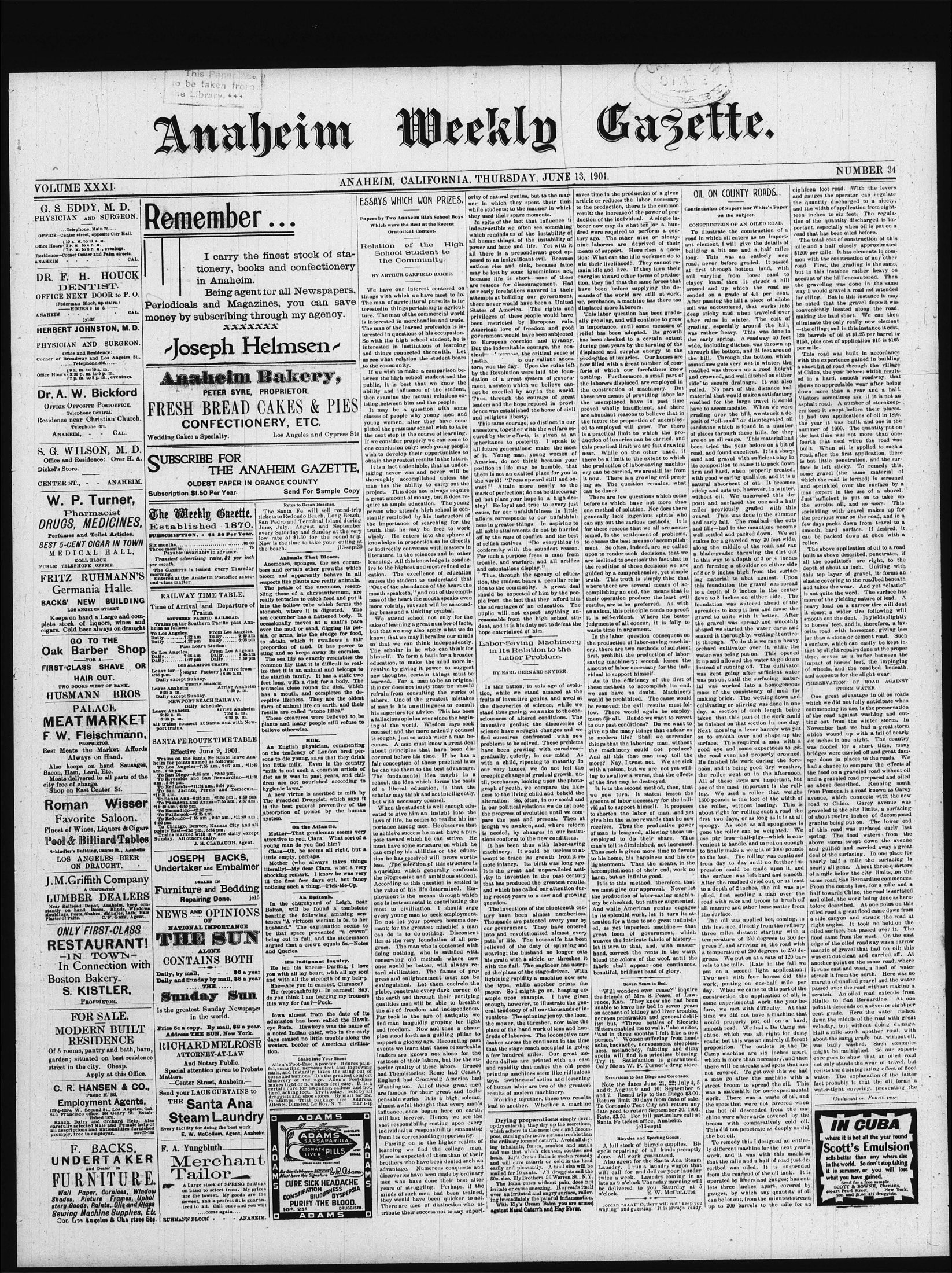
Searchable text
Anaheim
VOLUME XXXI.
G. S. EDDY, M. D.
PHYSICIAN AND SURGEON.
Telephone, Main 75...
OFFICE—Center street, opposite City Hall.
10 A. M. to 11 A. M.
2 P. M. to 4 P. M.
7 P. M. to 8 P. M., evenings.
Residence—Corner Center and Palm streets.
ANAHEIM CAL.
DR. F. H. HOUCK
DENTIST.
OFFICE NEXT DOOR to P. O.
(Federman Block, up stairs.)
HOURS 9 to 6.
ANAHEIM CAL.
HERBERT JOHNSTON, M. D.
PHYSICIAN AND SURGEON.
Office and Residence:
Corner of Broadway and Los Angeles St..
Telephone 664...
Office Hours
9 a. m. to 10 a. m.
3:30 p. m. to 5 p. m.
7 p. m. to 8 p. m., evenings.
Dr. A. W. Bickford
OFFICE OPPOSITE POSTOFFICE.
Telephone Central.
Residence near Christian Church.
Telephone 671.
ANAHEIM, CAL.
S. G. WILSON, M. D.
Office and Residence: Over H. A.
Dickel's Store.
Remember...
I carry the finest stock of stationery, books and confectionery in Anaheim.
Being agent for all Newspapers,
Periodicals and Magazines, you can save money by subscribing through my agency.
Joseph Helmsen
Anaheim Bakery,
PETER SYRE, PROPRIETOR.
FRESH BREAD CAKES & PIES CONFECTIONERY, ETC.
Wedding Cakes a Specialty. Los Angeles and Cypress St
SUBSCRIBE FOR THE ANAHEIM GAZETTE
Dr. A. W. Bickford
OFFICE OPPOSITE POSTOFFICE.
Telephone Central.
Residence near Christian Church.
Telephone 671.
ANAHEIM, CAL.
S. G. WILSON, M. D.
Office and Residence: Over H. A.
Dickel's Store.
CENTER ST., - ANAHEIM.
W. P. Turner,
Pharmacist
DRUGS, MEDICINES,
Perfumes and Toilet Articles.
BEST 5-CENT CIGAR IN TOWN
MEDICAL HALL,
KOLL BLOCK.
PUBLIC TELEPHONE OFFICE.
FRITZ RUHMANN'S
Germania Halle.
BACKS' NEW BUILDING
LOS ANGELES STREET
Keeps on hand a Large and complete stock of liquors, wines and cigars. Cold beer always on draught
GO TO THE Oak Barber Shop
FOR A
FIRST-CLASS SHAVE OR HAIR CUT.
TWO DOORS WEST OF BANK.
HUSMANN BROS
PALACE MEAT MARKET
F. W. Fleischmann,
PROPRIETOR.
Best Meats the Market Affords Always on Hand.
Also keeps on hand Sausages, Bacon, Ham, Lard, Ete.
Meats delivered to all parts of the city free of charge.
Shop on East Center St.
Roman Wisser
Favorite Saloon.
Finest of Wines, Liquors & Cigare Pool & Billiard Tables
hindler's Building, Center St., Anaheim
LOS ANGELES BEER ON DRAUGHT.
J.M.Griffith Company
A CORPORATION
The Weekly Gazette.
Established 1870.
SUBSCRIPTION, - $1.50 Per Year.
Six months...$1.00
Three months...75
Payable invariably in advance.
Transient advertising rates,$1 per inch per month.
The GAZETTE is issued every Thursday morning.
Entered at the Anaheim Postoffice as second-class matter.
RAILWAY TIME TABLE.
Time of Arrival and Departure of Trains.
SOUTHERN PACIFIC RAILROAD.
Trains on the Southern Pacific pass Anaheim as follows:
To Los Angeles. From Los Angeles.
Daily 7:52 am Daily 9:49 am
Daily 4:28 pm Daily 6:06 pm
Pass Loara Station:
To Los Angeles. From Los Angeles.
Daily 7:56 am Daily 9:45 am
Daily 4:27 pm Daily 5:50 pm
Los ALAMITOS TRAINS.
Leave for—Sugar Factory Arrive from 4:35 p.m. 8:00 a.m.
Daily except Sunday.
TUSTIN BRANCH.
Leave Anaheim Arrive Anaheim 9:35 a.m. 4:35 p.m.
Daily except Sunday.
NEWPORT BEACH RAILWAY.
Daily Schedule.
Leave Anaheim Arrive Anaheim 9:49 a.m. 7:52 a.m.
6:03 p.m. 4:28 p.m.
All trains connect at Santa Ana with Newport trains.
SANTA FE ROUTE TIME TABLE
Effective June 9, 1901.
Trains on the Santa Fe Route leave Anaheim for points named as follows:
To Los Angeles-7:55 am 9:57 am.*11:49 am., San Diego-9:35 am.*2:50 pm.
To Riverside and San Bernardino*11:31 am., 5:54 pm.
To Redlands*11:31 am., 5:54 pm.
To San Jacinto, Perris and Temecula*11:31 am.
To Santa Ana-9:35 am.*4:50 pm.
To Pasadena and Azusa-7:55 am.9:57 am.*11:09 am.*4:50 pm.
To Escondido*-2:50 pm.
To Fallbrook*-2:50 pm.
To Redondo-7:55 am.9:57 am.*11:49 am.*4:50 pm.
To Chicago, Denver, Kansas City and all Dolphin Railway-4:50 pm., 5:54 pm.
Trains marked with a * are daily except Sunday. All others daily.
JOSEPH BACKS,
Undertaker and Embalmer
DEALER IN
Furniture and Bedding RepairingDone.jel5
Retes to Ocean Beaches.
The Santa Fe will sell round-trip tickets to Redondo Beach, Long Beach, San Pedro and Terminal Island during June, July, August and September every Saturday and Sunday at the very low rate of $1.30 for the round trip. Now is the time to take your outing to the beach.
Animals That Bloom.
Anemones, sponges, the sea cucumbers and certain other growths which bloom and apparently behave in a respects like plants are really animal-like. The petals of the anemone, resembling those of a chrysanthemum, really tentacles to catch food and put into the hollow tube which forms the stomach, where it is digested. The sea cucumber has a flattened body occasionally moves at a small's pace over the mud or sand, digging its palms, or arms, into the sludge for food to obtain which it swallows a proportion of mud. It has power stinging and so keeps away its enemies. The sea lily so exactly resembles common lily that it is difficult to realize that it is an animal and belongs to the starfish family. It has a stalk to feet long, with a disk for a body. The tentacles close round the disk, which has a mouth, and completes the receptive likeness. They are the old form of animal life on earth, and their fossils are called "stone lilies." These creatures were believed to plants and many people still refuse believe otherwise.
Milk.
An English physician, commenting on the tendency of London bred sons to die young, says that they do too little milk. Even in the country "milk is not such a common article diet as it was in past years, and dren are not nourished according to hygienic laws."
A new virtue is ascribed to milk. The Practical Druggist, which says is the best general preventive of absorption of poison by the human system.
On the Atlantic.
Mother—That gentleman seems attentive to you, Clara. What sort young man do you find him?
Clara—Oh, he seems all right, but little empty, perhaps.
Mother (who always takes the literally)—My dear Clara, what a shocking remark. I know he was ill the first few days out, but noticing such a thing—Pick-Me-Up.
An Epitaph.
Roman Wisser
Favorite Saloon.
Finest of Wines, Liquors & Cigarettes
Pool & Billiard Tables
Schindler's Building, Center St., Anaheim
LOS ANGELES BEER ON DRAUGHT.
J.M.Griffith Company
A CORPORATION
LUMBER DEALERS
Near Railroad Depot, Anahiem, keep constantly on hand Doors, Blinds, Windows Mouldings, Posts, Shakes, Shingles, Lath, Hair Plaster of Paris.
C.F. GRIM, Agent.
ONLY FIRST-CLASS RESTAURANT!
IN TOWN—In Connection with Boston Bakery.
S. KISTLER,
PROPRIETOR.
FOR SALE.
MODERN BUILT RESIDENCE
Of 5 rooms, pantry and bath, barn, garden; situated on best residence street in the city. Cheap.
Apply at this Office.
C. R. HANSEN & CO., Phone M. 383.
Employment Agents,
1234-1234 W. Second St., Los Angeles, Cal.
San Francisco office: 104 Geary St. Established 1876.
Ranch, Dairy and Orchard Help. Also carefully selected Male and Female help of all descriptions and nationalities furnished promptly, free to employer.
F. BACKS,
UNDERTAKER
And Dealer in FURNITURE.
Wall Paper, Cornices, Window Shades, Picture Frames, Upholstery Goods, Paints, Oilis and Glass Sewing Machine Supplies, Etc.
Cor. Los Angeles & Charts St.
JOSEPH BACKS,
Undertaker and Embalmer
DEALER IN
Furniture and Bedding Repairing Done.
NEWS AND OPINIONS OF
NATIONAL IMPORTANCE
THE SUN
ALONE
CONTAINS BOTH
Daily, by mail, $6 a year
Daily and Sunday by mail, $8 a year
THE
Sunday Sun
is the greatest Sunday Newspaper in the world.
Price 5c a copy. By mail, $2 a year.
Address THE SUN, New York.
RICHARDMELROSE ATTORNEY-AT-LAW
And Notary Public.
Special attention given to Probate Matters.
—Center Street, Anaheim.
Send your LACE CURTAINS to THE Santa Ana Steam Laundry
Every facility for doing the best work.
E. W. McCollum, Agent, Anaheim
F. A. Yungbluth
Merchant Tailor
A Large stock of SPRING Suitings on hand to select from. My prices are the lowest. My goods are the newest, and a perfect fit is guaranteed to all. Call once and you will come again.
RUHMANN BLOCK — ANAHEIM.
The Practical Druggist, which says it is the best general preventive of absorption of poison by the human system.
On the Atlantic.
Mother—That gentleman seems attentive to you, Clara. What sort young man do you find him?
Clara—Oh, he seems all right, but little empty, perhaps.
Mother (who always takes the literally)—My dear Clara, what a shocking remark. I know he was ill the first few days out, but for noticing such a thing—Pick-Me-Up.
An Epitaph.
In the churchyard of Leigh, Bolton, will be found a tombs bearing the following amazing tence: "A virtuous woman is 5s. to husband." The explanation seem be that space prevented "a creature cut in full, and the stonemark argued that a crown equals 5s." and Queries.
His Indignant Inquiry.
He (on his knees)—Darling, I you with all my heart, with all my mind and with all the strength of my body She—Are you in earnest, Claren He (repronachfully)—In earnest! do you think I am bagging my trot this way for fun?—Puck.
Iowa almost from the date of admission has been called the Eye State. Hawkeye was the name a noted Indian chief, who in the days caused no little trouble along western border of American civilization.
Shake Into Your Shoes
Allen's Foot-Ease, a powder. It cureful, smarting, nervous feet and ingnails, and instantly takes the sting corns and bunions. It's the greatest discovery of the age. Allen's Foot makes tight or new shoes feel easy certain cure for sweating, callous a tired, aching feet. Try it today. So druggists and shoe stores. By mail in stamps. Trial package free. Allen S. Olmsted, Le Roy, N.Y.
ANAHEIM, CALIFORNIA, THURSDAY, JUNE 13, 1901.
ESSAYS WHICH WON PRIZES.
Papers by Two Anaheim High School Boys
Which were the Best at the Recent Oratorical Contest.
Relation of the High School Student to the Community.
BY ARTHUR GARFIELD BAKER.
We have our interest centered on things with which we have most to do. The man of agricultural pursuits is interested in things pertaining to agriculture. The man of the commercial world is interested in merchandise and trade. The man of the learned profession is interested in questions of his occupation. So with the high school student, he is interested in institutions of learning and things connected therewith. Let us see what relation the student bears to the community.
If we wish to make a comparison between the high school student and the public, it is best that we know the ability and influence of the student, then examine the mutual relations existing between him and the people.
It may be a question with some classes of people why young men and young women, after they have completed the grammar school wish to take the next step in the course of learning. If we consider properly we can come to one conclusion only: such young people wish to develop their opportunities to obtain the greatest results in the future.
It is a fact undeniable, that an undertaking never was and never will be worthy of natural genius, but to the manner in which they spent their time while students; to the manner in which they used their spare moments.
In spite of the fact that influence is indestructible we often see something which reminds us of the instability of all human things, of the instability of power and fame and life. Yet with it all there is a preponderant good opposed to an insignificant evil. Because nations rise and sink, because fame may be lost by some ignominious act, because life is short—none of these are reasons for discouragement. Had our early forefathers wavered in their attempts at building our government, there never would have been a United States of America. The rights and privileges of these people would have been restricted by European rule. American love of freedom and good government would have been subjected to European coercion and tyranny. But the indomitable courage, the continuity of purpose, the critical sense of justice, to our valiant ancestors, won the day. Upon the ruins left by the Revolution were laid the foundation of a great system of government, a system which we believe cannot be excelled by any in the world. Thus, through the courage of great leaders and the hope reposed in providence was established the home of civil and religious liberty.
This same courage, so distinct in our ancestors, together with the welfare secured by their efforts, is given as an inheritance to posterity. I speak to all future generations: make the most of it. Young man, young women of America, do not think because your position in life may be humble, that there is not an exalted place for you in saves time in the production of a give article or reduces the labor necessary to the production, there is the common result: the increase of the power of production of the individual. A single borer now may do what ten or a hundred were required to perform a century ago. The other nine or ninety laborers are deprived of the means of support. Here rises a question: What can the idle workmen do win their livelihood? They cannot main idle and live. If they turn their energies toward other forms of production, they find that the same forces they have before supplying them mands of the world are still at work or perchance, a machine has there displaced more laborers.
This labor question has been greatly growing, and will continue to grow in importance, until some measures relief has been adopted. Its growth has been checked to a certain extent during past years by the turning off displaced and surplus energy to production of luxuries. Our homes now filled with a great number of comforts of which our forefathers knew nothing. Furthermore, a small part of the laborers displaced are employed in the construction of machinery. These two means of providing labor the unemployed have in past proved wholly insufficient, and there are abundant reasons to believe that the future the proportion of unemployment to employed will grow. For this is a practical limit to which the production of luxuries can be carried, this practical limit we are fast drawn near. While on the other hand there be a limit to the extent to which the production of labor-saving machinery can be carried, we are still far
BRIETOR.
MKES & PIES
BY, ETC.
Los Angeles and Cypress Sts
HEIM GAZETTE,
THE COUNTY
Send For Sample Copy
Retes to Ocean Beaches.
Santa Fe will sell round-trip to Redondo Beach, Long Beach, and Terminal Island during July, August and September the Saturday and Sunday at the very time of $1.30 for the round trip. The time to take your outing at jl3-sept30
Animals That Bloom.
Mones, sponges, the sea cucumbers and certain other growths which like plants are really animals. Petals of the anemone, resembling of a chrysanthemum, are tentacles to catch food and put it in the hollow tube which forms the tube, where it is digested. The number has a flattened body. It usually moves at a small's pace in mud or sand, digging its petals, into the sludge for food, in which it swallows a fair amount of mud. It has power to send so keeps away its enemies. Sea lily so exactly resembles the anilly that it is difficult to realise it is an animal and belongs to fish family. It has a stalk two long, with a disk for a body. The mes close round the disk, which mouth, and completes the delicateness. They are the oldest of animal life on earth, and their care called "stone lilies."
The creatures were believed to be many people still refuse to otherwise.
Milk.
English physician, commenting on tendency of London bred perle young, says that they drink milk. Even in the country it not such a common article of it was in past years, and children not nourished according to old laws."
New virtue is ascribed to milk by practical Druggist, which says it best general preventive of the notion of poison by the human.
On the Atlantic.
Other—T gentleman seems very alive to you, Clara. What sort of a man do you find him?
Oh, he seems all right, but a empty, perhaps.
Other (who always takes things truly)—My dear Clara, what a very long remark. I know he was very first few days out, but fancy such a thing.—Pick-Me-Up.
An Epitaph.
tween the high school student and the public, it is best that we know the ability and influence of the student, then examine the mutual relations existing between him and the people.
It may be a question with some classes of people why young men and young women, after they have completed the grammar school wish to take the next step in the course of learning. If we consider properly we can come to one conclusion only: such young people wish to develop their opportunities to obtain the greatest results in the future.
It is a fact undeniable, that an undertaking never was and never will be thoroughly accomplished unless the man has the ability to carry out the project. This does not always require a great amount of money, but it does require an ample education. The young person who attends high school is constantly reminded by his instructors of the importance of searching for the truth that he may be free to work wisely. He enters into the sphere of knowledge in proportion as he directly or indirectly converses with masters in literature, in the sciences and in other learning. All this knowledge is conducive to the highest and most refined education. The excellence of education causes the student to understand that "Out of the abundance of the heart the mouth speak's even more volubly, but such will be as sound brass and a tinkling cymbal.
We attend school not only for the sake of learning a great number of facts, but that we may also apply what we do know; that we may liberalize our minds so that we can think independently. The scholar is he who can think for himself. To form a basis for a broader education, to make the mind more inventive by giving it power to suggest new thoughts, certain things must be learned. For a man to be an original thinker does not imply that he should refrain from consulting the works of others. One of the greatest mistakes of man is his unwillingness to consult his superiors for advice. This has been a fallacious opinion ever since the beginning of the world. Wisdom says seek counsel; and the more ardently counsel is sought, just so much wiser a man becomes. A man know a great deal about principles that have been discovered before his time. If he has a fair conception of these practical laws he can use them to the best advantage. The fundamental idea taught in a school, the idea which forms the basis of a liberal education, is that the scholar may think and act intelligently, but with necessary counsel.
When the student is well enough educated to give him an insight into the laws of life, he comes to realize his importance among men. He observes that to achieve success he must have a purpose toward which he can strive. He must have some structure on which he can employ his abilities or the education he has received will prove worthless. The selection of this structure is a question which generally confronts the progressive and ambitious student. According as this question is settled is the value of his life determined. Employment is the means through which by the revolution of a great system of government, a system which we believe cannot be excelled by any in the world. Thus, through the courage of great leaders and the hope reposed in providence was established the home of civil and religious liberty.
This same courage, so distinct in our ancestors, together with the welfare secured by their efforts, is given as an inheritance to posterity. I speak to all future generations: make the most of it. Young man, young woman of America, do not think because your position in life may be humble, that there is not an exalted place for you in the world! "Press upward still and onward!" Attain more nearly to the mark of perfection; do not be discouraged, but place your hope in a high destiny! Be loyal and true to every just cause, for our unfaithfulness in little affairs corresponds to our unfaithfulness in greater things. In aspiring to all noble attainments do not be hurried off by the rage of conflict and the best of selfish motives. "Do everything in conformity with the soundest reason. For such a purpose frees a man from trouble, and warfare, and all artifice and ostentatious display."
Thus, through the agency of education, the student bears a peculiar relation to the community. A great deal should be expected of him by the people from the fact that they afford him the advantages of an education. The public will not expect anything unreasonable from the high school student, and it is his duty not to defeat the hope entertained of him.
Labor-Saving Machinery in Its Relation to the Labor Problem.
BY EARL BERNARD SNYDER.
In this nation, in this age of evolution, while we stand amazed at the fruits of inventive genius, and awel at the discoveries of science, while we stand thus gazing; we awake to the consciousness of altered conditions. The inventive genius; the discoveries of science have wrought changes and we find ourselves confronted with new problems to be solved. These problems have been growing with ourselves gradually, quietly, in our mids. As with a child, ripening to maturity in our very homes, we do not feel the creeping change of gradual growth until, perchance, looking upon the photograph of youth, we compare the likeness to the living child and behold the alteration. So often, in our social and in our political relations we do not note the progress of evolution until we compare the past and present. Then at length we awaken, and where reform is needed, by changes in our institutions conform to the new conditions.
It has been thus with labor-saving machinery. It would be useless to attempt to trace its growth from it remote infancy. Its birth was long ago. It is the great and unparalleled activity in invention in the past century that has produced the greatest results, and which has called our attention during recent years to a new and growing nothing.
Furthermore, a small part of laborers displaced are employed; these two means of providing labor are unemployed in past proof wholly insufficient, and there are abundant reasons to believe that the future proportion of unemployed to employed will grow. For there is a practical limit to which production luxuries can be carried; this practical limit we are fast drawn near. While on the other hand there be a limit to the extent to which production of labor-saving machinery can be carried; we are still far away now. There is a growing evil problem; can be done?
There are few questions which before us which have not more than one method of solution. Nor does generally lack ingenious spirits; can spy out various methods; for these reasons that we all are torned in the settlement of problem to choose best means of accommodation. So often indeed, we upon to render such decisions, that are inclined to overlook the fact that the rendition of those decisions guided by a comprehensive, yet truth. This truth is simply this where there are several means for accomplishing an end, the means to their operation produce the less results, are to be preferred. As an axiom, this principle needs now it is self-evident. Where there is judgments of all concurr., it is for waste time in argument.
In the labor question consequencethe production of labor-saving machinery; there are two methods of so first prohibit the production of saving machinery; second less amount of labor necessary for their vitalual to support himself.
As to the efficiency of these methods to accomplish it we can have no doubt. Mac would be prohibited. The cause be removed; the evil results may low. There would again be eminent for all. But do we want to our past conditions? Do we give up up many things that end to modern life? Shall we succeed things that the laboring man would—the machinery could not permit And all this that man may try more? Nay, I trust not. We with a poison, but we are not yet ingering to swallow a worse, that thereof of the first may be destroyed.
It is to the second method, that we now turn. It states: less amount of labor necessary for their vitalual to support himself. It piles shorten the labor of man; gives him the same rewards that receives. Thus the productive man is lessened, allowing them employed to do their share man's toll is diminished; not injure Thus each is given more time than to his home; his happiness and lightement. Thus the mean accomplishment of their end harm, but an infinite good.
It is to this method, therefore we must give our approval. No production of labor-saving machinery...
On the Atlantic.
Other—That gentleman seems very alive to you, Clara. What sort of a man do you find him?
—Oh, he seems all right, but aEmpty perhaps.
Other (who always takes things really)—My dear Clara, what a very long remark. I know he was very first few days out, but fancying such a thing.—Pick-Me-Up.
An Epitaph.
The churchyard of Leigh, near man, will be found a tombstone along the following amazing sentence: "A virtuous woman is 5s. to her hand." The explanation seems to that space prevented "a crown" cut in full, and the stonemason had that a crown equals 5s.—Notes Queries.
His Indignant Inquiry.
(on his knees)—Darling, I love with all my heart, with all my soul with all the strength of my being.—Are you in earnest, Clarence? (reproachfully)—In earnest! Say, you think I am bagging my trousers away for fun?—Puck.
We almost from the date of its mission has been called the Hawk-State. Hawkeye was the name of United Indian chief, who in the early era caused no little trouble along the eastern border of American civilization.
Shake Into Your Snecks.
Men's Foot-Ease, a powder. It cures pain-marting, nervous feet and ingrowing severity of the age. Allen's Foot-Ease is tight or new shoes feel easy. It is a pain cure for sweating, callous and hot, aching feet. Try it today. Sold by all artists and shoe stores. By mail for 25c. stamps. Trial package free. Address, U.S. Olmsted, Le Roy, N.Y., mar 1-1p
When the student is well enough educated to give him an insight into the laws of life, he comes to realize his importance among men. He observes that to achieve success he must have a purpose toward which he can strive. He must have some structure on which he can employ his abilities or the education he has received will prove worthless. The selection of this structure is a question which generally confronts the progressive and ambitious student. According as this question is settled is the value of his life determined. Employment is the means through which one is instrumental in contributing the most to civilization. I should urge every young man to seek employment. Do not let your powers become dormant; for the greatest mischief a man can do is to do nothing. Discontent lies at the very foundation of all progress. The man who is contented with doing nothing, who is satisfied with conserving old methods where new ones would be better, will always regard civilization. The flames of progress and enlightenment must not be extinguished. Let them encircle the globe, penetrate every dark corner of the earth and through their purifying qualities man will be able to breathe the air of freedom and independence. Far back in the age of antiquity we find man languidly groping for light and freedom. Now and then a champion stood forth as a guiding pillar to support a gloomy age. Recounting past events we learn that these remarkable leaders are known not alone for the superior quality of these labors. Greece had Themistocles; Rome had Ceasar; England had Cromwell; America had Washington. All of these great men are famous for their great and indispensable works. It is a high, solemn, almost awful thought that every man's influence, once begun here on earth, will last forever. Hence, we see the vast responsibility resting upon every individual; a responsibility emanating from its corresponding opportunity.
Passing on to the higher realms of learning we find the college men. More is expected of them than of their brothers who have been denied such an advantage. Numerous conquests and discoveries have been made by ordinary men who have done their best after years of struggling. Perhaps, if the minds of such men had been trained, they would have been quicker to act. There are men of distinction who attribute their success not to any superlative. So often, in our social and in our political relations we do not note the progress of evolution until we compare the past and present. Then at length we awaken, and, where reform is needed, by changes in our institutions conform to the new conditions.
It has been thus with labor-saving machinery. It would be useless to attempt to trace its growth from remote infancy. Its birth was long ago. It is the great and unparalleled activity in invention in the past century that has produced the greatest results, and which has called our attention during recent years to a new and growing question.
The inventions of the nineteenth century have been almost numberless. Thousands are patented every year by our government. They have entered into and revolutionized almost every path of life. The housewife has been relieved of the duty of spinning and weaving; the husband no longer cuts his grain with a sickle or threshes it with the flail. The engineer has usurped the place of the stage-driver. With lightning rapidity a machine now sets the type, while another prints the paper. So I might go on, heaping example upon example. I have given enough, however, to illustrate the general tendency of all our thousands of inventions. The spinning jenny, the loom, the mower, the thresher, now take the place of the hand work of tens and hundreds of laborers. The locomotive now dashes across the continent in the time that the stage coach occupied in going a few hundred miles. Our great modern dailies are printed with an ease and rapidity that makes the old press printing machines seem like ridiculous toys. Swiftness of action and lessening of human labor are two of the greatest results of modern machinery.
Working together, these two results lead to another. Whether a machine
Drying preparations simply develop dry catarrh; they dry up the secretions, which adhere to the membrane and decompose, causing a far more serious trouble than the ordinary form of catarrh. Avoid all drying inhalants, fumes, smokes and snus and use that which cleanses, soothes and heals. Ely's Cream Balm is such a remedy and will cure catarrh or cold in the head easily and pleasantly. A trial size will be mailed for 10 cents. All druggists sell the 50c.size.Ely Brothers, 56 Warren St., N.Y.
The Balm cures without pain, does not irritate or cause sneezing. It spreads itself over an irritated and angry surface, relieving immediately the painful inflammation.
With Ely's Cream Balm you are armed against Nasal Catarrh and Hay Fever.
Seven Years in Bed.
"Will wonders ever cease?" the friends of Mrs. S.Paceyrence, Kan. They knew she unable to leave her bed in seaworthiness on account of kidney and liver nervous prostration and generality: but, "Three bottles of Bitters enabled me to walk," said "and in three months I felt like person." Women suffering from ache, backache, nervousness, ness, melancholy, fainting or spells will find it a priceless Try it. Satisfaction is great Only 50c at W.P.Turner's day
Excursions to San Diego and Colorado.
Note the dates June 21, 22nd and 6; August 9 and 10; September 7th; Round trip to San Diego Return limit 30 days from date To Coronado Tent City and return good to return September Rate,$3.50 For full particular Santa Fe ticket office, Anaheim je13-sept1
Bicycles and Sporting Goods.
A full stock of bicycle supply cycle repairing of all kinds done. All work guaranteed also agent for the Santa Laundry I run a laundry will call for and deliver twice a week. Laundry cost late as 9 o'clock Thursday may be delivered to you Saturday o'clock.
Jordan "AAAI" Cutlery will not wait waiting" and guessing." It is al
Gazette.
NUMBER 34
OIL ON COUNTY ROADS.
Continuation of Supervisor White's Paper on the Subject.
CONSTRUCTION OF AN OILED ROAD.
To illustrate the construction of a road in which oil enters as an important element, I will give the details of building a bit one and a half miles long. This was an entirely new road, never before graded. It passed at first through bottom land, with soil varying from loose sand to clayey loam; then it struck a hill around and up which the road ascended on a grade of 4.5 per cent. After passing the hill a piece of adobe soil was encountered, that works into deep sticky mud when traveled over after rains in winter. The cost of grading, especially around the hill, was rather heavy. This was done in the early spring. A roadway 40 feet wide, including ditches, was thrown up through the bottom, and 24 feet around the hill. Through the bottom, which sometimes gets very wet in winter, the roadbed was thrown up a good height and crowned, and well ditched on either side to secure drainage. It was also rolled. No part of the distance had material that would make a satisfactory roadbed for the large travel it would have to accommodate. When we were grading over the hill, we struck a deposit of "oil-sand" or disintegrated oil sandstone which is found in a number of places through these hills, for they are on an oil range. This material had been tried the year before on a bit of road, and found excellent. It is a sharp sand and gravel with sufficient clay in its composition to cause it to pack down firm and hard, when properly treated.
eighteen foot road. With the levers and gauges the operator can regulate the quantity discharged to a nicety, and the width of application from eighteen inches to six feet. The regulation of the quantity discharged is important, especially when oil is put on a road that has been oiled before.
The total cost of construction of this mile and a half closely approximated $1200 per mile. It has elements in common with the construction of any other road. First, the grading is the same, but in this instance rather heavy on account of the hill encountered. Then the gravelling was done in the same way I would gravel a road not intended for oiling. But in this instance it may be noted that the gravel deposit was conveniently located along the road, making the haul short. We can then eliminate the only really new element—the oiling; and in this instance it cost, 120 barrels of oil at $1.25 per barrel if $150, plus cost of application $15 is $165 per mile.
This road was built in accordance with the experience gained in building a short bit of road through the village of Chino, the year before; which resulted in a hard, smooth roadway, that shows no appreciable wear after being down more than a year and a half. Visitors sometimes ask if it is not an asphalt road. A number of storekeepers keep it swept before their places. It had two applications of oil in 1899, the year it was built, and one in the summer of 1900. The quantity put on the last time was not more than one-fourth that used when the road was built. When oil is applied to such a road, after the first application, there is but little penetration, and the surface is left sticky. To remedy this, some gravel (the same material of
Furthermore, a small part of porpoises displaced are employed in construction of machinery. But two means of providing labor for unemployed have in past time and wholly insufficient, and there are abundant reasons to believe that in the proportion of unemploy-ment will grow. For there practical limit to which the production of luxuries can be carried, and practical limit we are fast drawing near. While on the other hand, if we be a limit to the extent to which the production of labor-saving machin-ness be carried, we are still far from now. There is a growing evil press-ure. The question remains, what are done?
There are few questions which come up us which have not more than one method of solution. Nor does there generally lack ingenious spirits who apply out the various methods. It is these reasons that we all are accustomed, in the settlement of problems, to choose the best means of accomplis-ment. So often indeed, are we called to render such decisions, that we unclined to overlook the fact that in condition of those decisions we are forced by a comprehensive, yet simple truth. This truth is simply this: that there are several means of accomplishing an end, the means that in our operation produce the least evil results, are to be preferred. As with xylom, this principle needs no proof; as self-evident. Where the better arguments of all concur, it is folly to take time in argument.
In the labor question consequent on the production of labor-saving machin-ness there are two methods of solution; prohibit the production of labor-saving machinery; second, lessen the amount of labor necessary for the individual to support himself.
As to the efficiency of the first of these methods to accomplish its end, can have no doubt. Machinery should be prohibited. The cause would be removed; the evil results must follow. There would again be employment for all. But do we want to revert your past conditions? Do we want to up the many things that endear us modern life? Shall we surrenderings that the laboring man, without the machinery could not produce? And all this that man may toll the fire? Nay, I trust not. We are sick with a poison, but we are not yet willing to swallow a worse, that the effects of the first may be destroyed.
It is to the second method, then, that now turn. It states: lessen the amount of labor necessary for the individual to support himself. It proposes shorten the labor of man, and yet give him the same rewards that he now receives. Thus the productive power man is lessened, allowing those unemployed to do their share. Thus man's toll is diminished, not increased. Thus each is given more time to devote his home, his happiness and his enlightenment. Thus the means, in the accomplishment of their end, work no warm, but an infinite good.
It is to this method, therefore, that we must give our approval. Never let the production of labor-saving machin-ness be displaced are employed in construction of machinery. But two means of providing labor for unemployed have in past time and wholly insufficient, and there are abundant reasons to believe that in the proportion of unemploy-ment will grow. For there practical limit to which the production of luxuries can be carried, and practical limit we are fast drawing near. While on the other hand, if we be a limit to the extent to which the production of labor-saving machin-ness be carried, we are still far from now. There is a growing evil press-ure. The question remains, what are done?
Here are few questions which come up us which have not more than one method of solution. Nor does there generally lack ingenious spirits who apply out the various methods. It is these reasons that we all are accustomed, in the settlement of problems, to choose the best means of accomplishment. So often indeed, are we called to render such decisions, that we unclined to overlook the fact that in condition of those decisions we are forced by a comprehensive, yet simple truth. This truth is simply this: that there are several means of accomplishing an end, the means that in our operation produce the least evil results, are to be preferred. As with xylom, this principle needs no proof; as self-evident. Where the better arguments of all concur, it is folly to take time in argument.
In the labor question consequent on the production of labor-saving machin-ness there are two methods of solution; prohibit the production of labor-saving machinery; second, lessen the amount of labor necessary for the individual to support himself.
As to the efficiency of the first of these methods to accomplish its end, can have no doubt. Machinery should be prohibited. The cause would be removed; the evil results must follow. There would again be employ-ment for all. But do we want to revert your past conditions? Do we want to up the many things that endear us modern life? Shall we surrenderings that the laboring man, without the machinery could not produce? And all this that man may toll the fire? Nay, I trust not. We are sick with a poison, but we are not yet willing to swallow a worse, that the effects of the first may be destroyed.
It is to the second method, then, that now turn. It states: lessen the amount of labor necessary for the individual to support himself. It proposes shorten the labor of man, and yet give him the same rewards that he now receives. Thus the productive power man is lessened, allowing those unemployed to do their share. Thus man's toll is diminished, not increased. Thus each is given more time to devote his home, his happiness and his enlightenment. Thus the means, in the accomplishment of their end, work no warm, but an infinite good.
It is to this method, therefore, that we must give our approval. Never let the production of labor-saving machin-ness be displaced are employed in construction of machinery. But two means of providing labor for unemployed have in past time and wholly insufficient, and there are abundant reasons to believe that in the proportion of unemploy-ment will grow. For there practical limit to which the proproduction of luxuries can be carried, and practical limit we are fast drawing near. While on the other hand, if we be a limit to the extent to which the production of labor-saving machin-ness be carried, we are still far from now. There is a growing evil press-ure. The question remains, what are done?
Here are few questions which come up us which have not more than one method of solution. Nor does there generally lack ingenious spirits who apply out the various methods. It is these reasons that we all are accustomed, in the settlement of problems, to choose the best means of accomplishment. So often indeed, are we called to render such decisions, that we unclined to overlook the fact that in condition of those decisions we are forced by a comprehensive, yet simple truth. This truth is simply this: that there are several means of accomplishing an end, the means that in our operation produce the least evil results, are to be preferred. As with xylom, this principle needs no proof; as self-evident. Where the better arguments of all concur, it is folly to take time in argument.
In the labor question consequent on the production of labor-saving machin-ness there are two methods of solution; prohibit the production of labor-saving machinery; second, lessen the amount of labor necessary for the individual to support himself.
As to the efficiency of the first of these methods to accomplish its end, can have no doubt. Machinery should be prohibited. The cause would be removed; the evil results must follow. There would again be employ-ment for all. But do we want to revert your past conditions? Do we want to up the many things that endear us modern life? Shall we surrenderings that the laboring man, without the machinery could not produce? And all this that man may toll the fire? Nay, I trust not. We are sick with a poison, but we are not yet willing to swallow a worse, that the effects of the first may be destroyed.
It is to the second method, then, that now turn. It states: lessen the amount of labor necessary for the individual to support himself. It proposes shorten the labor of man, and yet give him the same rewards that he now receives. Thus the productive power man is lessened, allowing those unemployed to do their share. Thus man's toll is diminished, not increased. Thus each is given more time to devote his home, his happiness and his enlightenment. Thus the means, in the accomplishment of their end, work no warm, but an infinite good.
It is to this method, therefore, that we must give our approval. Never let the production of labor-saving machin-ness be displaced are employed in construction of machinery. But two means of providing labor for unemployed have in past time and wholly insufficient, and there are abundant reasons to believe that in the proportion of unemploy-ment will grow. For there practical limit to which the proproduction of luxuries can be carried, and practical limit we are fast drawing near. While on the other hand, if we be a limit to the extent to which the production of labor-saving machin-ness be carried, we are still far from now. There is a growing evil press-ure. The question remains, what are done?
Here are few questions which come up us which have not more than one method of solution. Nor does there generally lack ingenious spirits who apply out the various methods. It is these reasons that we all are accustomed, in the settlement of problems, to choose the best means of accomplishment. So often indeed, are we called to render such decisions, that we unclined to overlook the fact that in condition of those decisions we are forced by a comprehensive, yet simple truth. This truth is simply this: that there are several means of accomplishing an end, the means that in our operation produce the least evil results, are to be preferred. As with xylom, this principle needs no proof; as self-evident. Where the better arguments of all concur, it is folly to take time in argument.
In the labor question consequent on the production of labor-saving machin-ness there are two methods of solution; prohibit the production of labor-saving machinery; second, lessen the amount of labor necessary for the individual to support himself.
As to the efficiency of the first of these methods to accomplish its end, can have no doubt. Machinery should be prohibited. The cause would be removed; the evil results must follow. There would again be employ-ment for all. But do we want to revert your past conditions? Do we want to up the many things that endear us modern life? Shall we surrenderings that the laboring man, without the machinery could not produce? And all this that man may toll the fire? Nay, I trust not. We are sick with a poison, but we are not yet willing to swallow a worse, that the effects of the first may be destroyed.
It is to the second method,then,that now turn。It states:lessentheamountoflabornecessaryforindividualtosupporthimself。Itproposeshortensthelaborofman,andyethemismewithhishome,hishappinessandhisenhancement。Thusthemeans,intheaccomplishmentoftheendworknoarmbutaninfinitegood。
Itistothismethod,therefore,thatwemustgiveourapproval。Neverlettheproductionoflabor-savingmachin-nessbeplacedareemployedinhconstructionofmachinery。Buttwomeansofprovidinglaborforunemployedhaveinpasttimeandwhollyinsufficient,andthereareabundantreasonstoclievertheconditionoftheendworknoarmbutaninfinitegood。
mount of labor necessary for the individual to support himself. It proposes shorten the labor of man, and yet give him the same rewards that he now receives. Thus the productive power man is lessened, allowing those unemployed to do their share. Thus man's toll is diminished, not increased. Thus each is given more time to devote his home, his happiness and his enlightenment. Thus the means, in the accomplishment of their end, work no harm, but an infinite good.
It is to this method, therefore, that we must give our approval. Never let the production of labor-saving machinery be checked, but rather augmented, and while American genius engages its splendid work, let it turn its attention for a time to one great unfinished, as yet imperfect machine — that great loom of government, which leaves the intricate fabric of history — not it turn to that, and, with master-hand, correct the rents in the warp, blend the colors of the woof, until the fabric shall appear one continuous, beautiful, brilliant band of glory.
Seven Years in Bed.
"Will wonders ever cease?" inquire the friends of Mrs. S. Pease, of Lawrence, Kan. They knew she had been unable to leave her bed in seven years on account of kidney and liver trouble, nervous prostration and general debility; but, "Three bottles of Electric Bitters enabled me to walk," she writes, "and in three months I felt like a new person." Women suffering from headache, backache, nervousness, sleeplessness, melancholy, fainting and dizzy spells will find it a priceless blessing. Try it. Satisfaction is guaranteed. Only 50c at W. P. Turner's drug store.
Excursions to San Diego and Coronado.
Note the dates June 21, 22; July 4, 5 and 6; August 9 and 10; September 6 and 7. Round trip to San Diego $3.00. Return limit 30 days from date of sale. To Coronado Tent City and return any date good to return September 30, 1901. Rate, $3.50. For full particulars call at Santa Fe ticket office, Anaheim.
je13-septl
Bicycles and Sporting Goods.
A full stock of bicycle supplies. Bicycle repairing of all kinds promptly done. All work guaranteed.
Also agent for the Santa Ana Steam Laundry. I run a laundry wagon that will call for and deliver your laundry twice a week. Laundry coming in as late as 9 o'clock Thursday morning will be delivered to you Saturday at 5 o'clock.
E. W. McCOLLUM.
Jordan "AAAI" Cutlery will not "keep you waiting" and guessing. It is always ready.
The oil was applied hot, coming, in this instance, directly from the refinery three miles distant; starting with a temperature of 250 degrees to 300 degrees F. and arriving on the road with a temperature of 200 degrees to 250 degrees. We put on at a rate of 120 barrels to the mile. (Late in the fall we put on a second light application.) Two men with four horses did this work, putting on one-half mile per day. When we came to this part of the construction the application of oil, in some experimental work the year before, we met with difficulty. At that time we did not have a machine that would properly put oil on a hard, smooth road. We had a De Camp machine, which was all right for dusty roads; but this was an entirely different proposition. The outlets in the De Camp machine are six inches apart, which is more than necessary, and then there will be streaks and spots that are not covered. To get over this we had a man go after the machine with a street broom to spread the oil. This was a makeshift for our experimental work. There was a waste of oil, and the spots that were not covered when the hot oil descended from the machine were afterwards covered by the broom with comparatively cold oil. This did not penetrate as deeply as did the hot oil.
To remedy this I designed an entirely different machine for the next year's work, and it was with this machine that the mile and a half of road just described was oiled. It is suspended from the rear end of the oil tank. It is operated by levers and gauges; has outlets three inches apart, covered by gauges, by which any quantity of oil can be let out, from the minutest stream up to 200 barrels to the mile for an avenue, which connects road to Chino. Garey avenue was graveled to the city limits, a surfacing of about twelve inches of decomposed granite being put on. The lower end of this road was surfaced early last spring. The flood waters from the above storm swept down the avenue and gullied and carried away a great deal of the surfacing. In one place for nearly half a mile the surfacing is nearly all gone. About three-quarters of a mile below the city limits, on the same road, San Bernardino commences. From the county line, for a mile and a half towards Chino, the road is surfaced and oiled, the work being done as heretofore described. At one point on this oiled road a great flood came down from a side canyon and struck the road at right angles. It took no hold on the oiled surface, but passed over it. The flood came from the west. On the east edge of the oiled roadway was a narrow margin of gravel that had no oil; this was cut out clean and carried off. At another point on the same road, where it runs east and west, a flood of water struck it from the north. Here was no margin of unoiled gravel and the water passed over the road without making a scratch. An oiled road extends from Rialto to San Bernardino. At one point it descends on a seven or eight per cent grade. Here the water rushed down middle of the road with great velocity, but without doing damage. Half a mile south another road, with about the same grade but without oil, was badly washed. Such examples might be multiplied. So our experience goes to show that an oiled road not only stands the wear of travel, but resists the disintegrating effect of flood water. The explanation of the latter fact probably is that the oil forms a water-tight covering preventing the
Continued on Fourth page