anaheim-gazette 1901-06-06
Scanned page
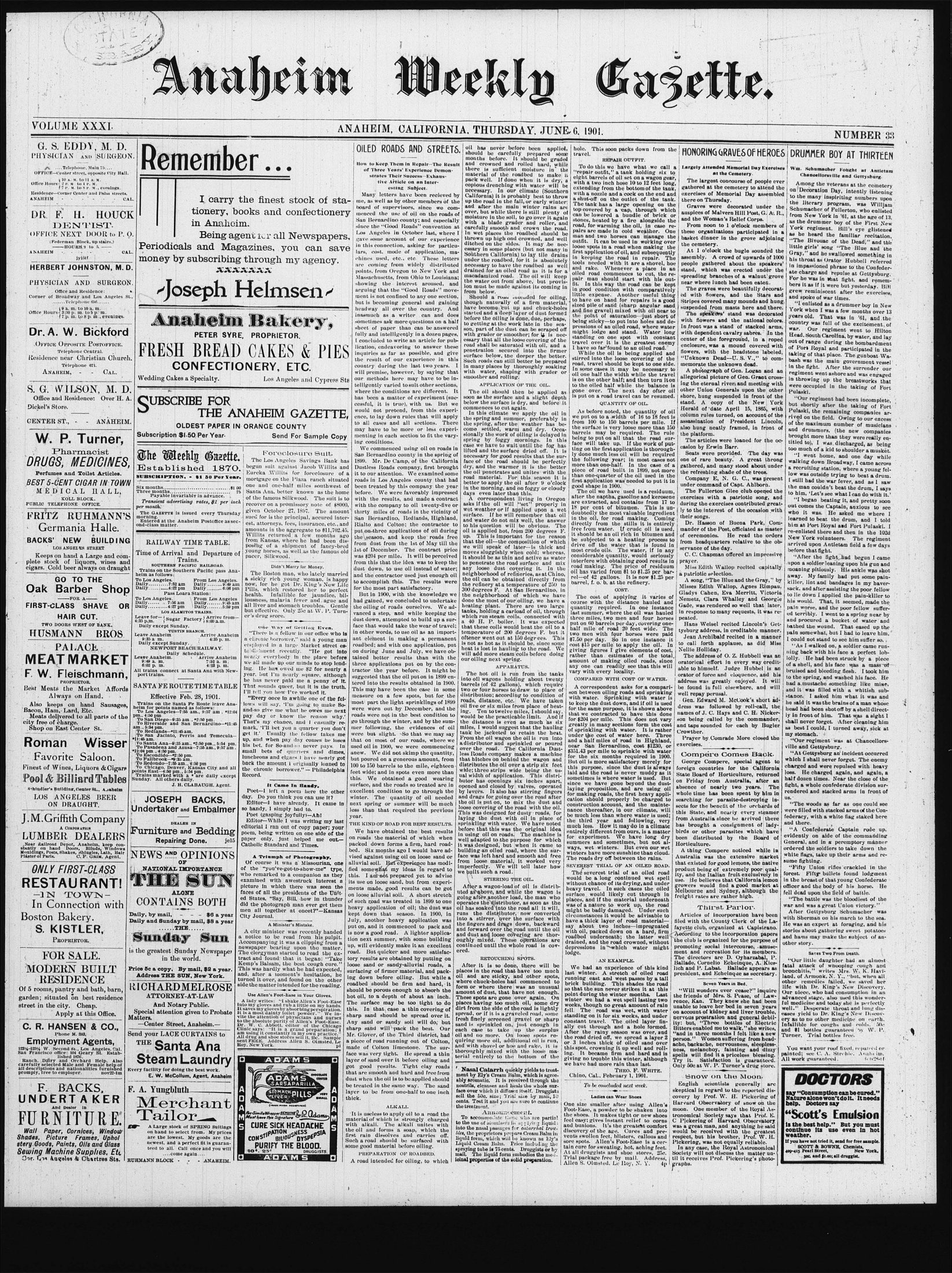
Searchable text
Anaheim
VOLUME XXXI.
G. S. EDDY, M. D. PHYSICIAN AND SURGEON.
Telephone, Main 75...
OFFICE—Center street, opposite City Hall.
10 A.M. to 11 A.M.
Office Hours: 2 P.M. to 4 P.M.
7 P.M. to 8 P.M., evenings.
Residence—Corner Center and Palm streets.
ANAHEIM CAL.
DR. F. H. HOUCK DENTIST.
OFFICE NEXT DOOR to P.O.
(Federman Block, up stairs.)
HOURS 9 to A
ANAHEIM CAL.
jy16f
HERBERT JOHNSTON, M.D.
PHYSICIAN AND SURGEON.
Office and Residence:
Corner of Broadway and Los Angeles St.
Telephone 656...
9 a.m. to 10 a.m.
Office Hours: 3:30 p.m. to 5 p.m.
7 p.m. to 8 p.m., evenings.
Dr. A. W. Bickford
OFFICE OPPOSITE POSTOFFICE.
Telephone Central.
Residence near Christian Church.
Telephone 671.
ANAHEIM, CAL.
S. G. WILSON, M.D.
Office and Residence: Over H. A. Dickel's Store.
CENTER ST., - ANAHEIM.
W. P. Turner,
Pharmacist
DRUGS, MEDICINES,
Perfumes and Toilet Articles.
Remember...
I carry the finest stock of stationery, books and confectionery in Anaheim.
Being agent for all Newspapers, Periodicals and Magazines, you can save money by subscribing through my agency.
Joseph Helmsen
Anaheim Bakery,
PETER SYRE, PROPRIETOR.
FRESH BREAD CAKES & PIES CONFECTIONERY, ETC.
Wedding Cakes a Specialty. Los Angeles and Cypress Sts
SUBSCRIBE FOR THE ANAHEIM GAZETTE,
OLDEST PAPER IN ORANGE COUNTY
Subscription $1.50 Per Year. Send For Sample Copy
The Weekly Gazette.
Established 1870.
Foreclosure Suit.
The Los Angeles Savings Bank has begun suit against Jacob Willits and Eureka Willits for foreclosure of a
S. G. WILSON, M. D.
Office and Residence: Over H. A.
Dickel's Store.
GENTER ST., - ANAHEIM.
W. P. Turner,
Pharmacist
DRUGS, MEDICINES,
Perfumes and Toilet Articles.
BEST 5-CENT CIGAR IN TOWN
MEDICAL HALL,
KOLL BLOCK.
PUBLIC TELEPHONE OFFICE.
FRITZ RUHMANN'S
Germania Halle.
BACKS' NEW BUILDING
LOS ANGELES STREET
Keeps on hand a Large and complete stock of liquors, wines and cigars. Cold beer always on draught
GO TO THE Oak Barber Shop
FOR A FIRST-CLASS SHAVE OR HAIR CUT.
TWO DOORS WEST OF BANK.
HUSMANN BROS
PALACE MEAT MARKET
F. W. Fleischmann,
PROPRIETOR.
Best Meats the Market Affords Always on Hand.
Also keeps on hand Sausages, Bacon, Ham, Lard, Etc.
Meats delivered to all parts of the city free of charge.
Shop on East Center St.
Roman Wisser
Favorite Saloon.
Finest of Wines, Liquors & Cigars Pool & Billiard Tables
shindler's Building, Center St., Anaheim
LOS ANGELES BEER ON DRAUGHT.
J.M.Griffith Company
A CORPORATION
LUMBER DEALERS
Near railroad Depot, Anaheim, keep constantly on hand Doors, Blinds, Windows Mouldings, Posts, Shakes, Shingles, Lath, Hair Plaster of Paris.
C.F. GRIM, Agent.
ONLY FIRST-CLASS RESTAURANT!
IN TOWN
Wedding Cakes a Specialty.
Los Angeles and Cypress Sts
SUBSCRIBE FOR THE ANAHEIM GAZETTE,
OLDEST PAPER IN ORANGE COUNTY
Subscription $1.50 Per Year.
Send For Sample Copy
The Weekly Gazette.
Established 1870.
SUBSCRIPTION, - $1.50 Per Year.
Six months.....$1.00
Three months.....75
Payable invariably in advance.
Transient advertising rates, $1 per inch per month.
The Gazette is issued every Thursday morning.
Entered at the Anaheim Postoffice as second-class matter.
RAILWAY TIME TABLE.
Time of Arrival and Departure of Trains.
SOUTHERN PACIFIC RAILROAD.
Trains on the Southern Pacific pass Anaheim as follows:
To Los Angeles....From Los Angeles.
Daily.....7:52 am.Daily.....9:49 am.Daily.....4:22 pm.Daily.....6:06 pm
Pass Loara Station:
To Los Angeles....From Los Angeles.
Daily.....7:56 am.Daily.....9:45 am.Daily.....4:27 pm.Daily.....5:59 pm
LOS ALAMITOS TRAINS.
Leave for—Sugar FactoryArrive from—4:35 p.m.Daily except Sunday.TUSTIN BRANCH.
Leave AnaheimArrive Anaheim9:35 a.m.Daily except Sunday.NEWPORT BEACH RAILWAY.Daily Schedule.
Leave AnaheimArrive Anaheim9:49 a.m.Daily except Sunday.NEWPORT BEACH RAILWAY.Daily Schedule.
Leave AnaheimArrive Anaheim9:49 a.m.Daily except Sunday.NEWPORT BEACH RAILWAY.Daily Schedule.
Redlands—*11:45 am.To San Jacinto,Perris and Temecula—*11:45 am.To Santa Ana—*9:35 am.*2:50 pm.,5:54 pm.To Pasadena and Azusa—7:55 am.,9:57 am.*12:04 pm.,4:00 pm.To Escondido—2:50 pm.To Fallbrook—9:35 am.To Redondo—7:55 am.,4:50 pm.To Chicago,Denver,Kansas City and all points East—4:50 pm.,5:54 pm.Trains marked with a *are daily except Sunday.All others daily.J.H.CLABAUGH.Agent.
JOSEPH BACKS,
Undertaker and Embalmer
DEALER IN
Furniture and Bedding Repairing Done.jel5
NEWS AND OPINIONS OF NATIONAL IMPORTANCE THE SUN
ALONE
Foreclosure Suit.
The Los Angeles Savings Bank has begun suit against Jacob Willits and Eureka Willits for foreclosure of a mortgage on the Plaza ranch situated one and one-half miles southwest of Santa Ana,better known as the home of the famous Silkwood.The suit is to recover on a promissory note of $8000,given October 27,1897.The amount sued for is the principal,accured interest,attorneys,fees,insurance,eTC,and amounts in the aggregate to $11,702.45.Willits returned a few months ago from Kansas,where he had been disposing of a shipment of fancy-bred young horses,as well as the famous old pacer,Silkwood.
Didn't Marry for Money.
The Boston man,who lately married a sickly rich young woman,is happy now,nor he got Dr.King's New Life Pills which restored her to perfect health.Infallible for jaundice,biliousness,malaia fever and ague and all liver and stomach troubles.Gentle but effective Only 25e at W.P.Turner's drug sore.
One Way of Getting Even.
"There is a fellow in our office who is a chronic borrower,"said a young man employed in a large Market street establishment recently."He got into nearly everybody in the place before we all made up our minds to stop lending. He has owed me $2 for nearly a year,但I'm nearly square although he has never paid me a penny of it That sounds queer,but it is the truth.I'll tell you how I've worked it.
"Every once in awhile one of the fellows will say,'I'm going to make So-and-so give me what he owes me next pay day or know the reason why.'That's my chance,and I casually remark,'I'll bet you a quarter you don't get it.'Usually the fellow takes me up,and when pay day comes he loses his bet.for So-and-so never pays.In small bots of quarters and dimes,Luncheons and cigars I have nearly got back the amount I originally loaned to the chronic borrower."—Philadelphia Record.
It Came In Handy.
Poet-I left a poem here the other day.Do you think you can use it?
Editor-I have already. It came in so handy.I simply had to.
Poet (gasping joyfully)—Ah!
Editor-While I was writing my last editorial I ran out of copy paper;your poem,being written on one side of the paper only,just helped me out-Catholic Standard and Times.
A Triumph of Photography.
Of course it was a Missourian,one of the "you've-got-to-show-me" type,who remarked to a companion as they examined with awestruck interest a picture in which there was seen the faces of all the presidents of the United States."Say,Bill how in thunder
ONLY FIRST-CLASS RESTAURANT!
IN TOWN—In Connection with Boston Bakery.
S. KISTLER,
PROPRIETOR.
FOR SALE.
MODERN BUILT RESIDENCE
Of 5 rooms, pantry and bath, barn, garden; situated on best residence street in the city. Cheap.
Apply at this Office.
C. R. HANSEN & CO., Phone M. 383, Employment Agents,
123¼-125¼ W. Second St., Los Angeles, Cal.
San Francisco office: 104 Geary St. Established 1876.
Ranch, Dairy and Orchard Help. Also carefully selected Male and Female help of all descriptions and nationalities furnished promptly, free to employer.
F. BACKS,
UNDERTAKER
And Dealer in FURNITURE.
Wall Paper, Cornices, Window Shades, Picture Frames, Upholstery Goods, Paints, Oils and Glass Sewing Machine Supplies, Etc.
Cor. Los Angeles & Chartres Sts.
JOSEPH BACKS,
Undertaker and Embalmer
DEALER IN
Furniture and Bedding Repairing Done.
NEWS AND OPINIONS OF
NATIONAL IMPORTANCE
THE SUN
ALONE
CONTAINS BOTH
Daily, by mail, $6 a year
Daily and Sunday by mail, $8 a year
THE
Sunday Sun
is the greatest Sunday Newspaper in the world.
Price 5¢ a copy. By mail, $2 a year.
Address THE SUN, New York.
RICHARDMELROSE ATTORNEY-AT-LAW
And Notary Public.
Special attention given to Probate Matters.
—Center Street, Anaheim.
Send your LACE CURTAINS to THE Santa Ana Steam Laundry
Every facility for doing the best work.
E. W. McCollum, Agent, Anaheim
F. A. Yungbluth
Merchant Tailor
A Large stock of SPRING Suitings on hand to select from. My prices are the lowest. My goods are the newest, and a perfect fit is guaranteed to all. Call once and you will come again.
RUHMANN BLOCK · · ANAHEIM.
Editor—I have already. It came in so handy, I simply had to.
Poet (gasping joyfully)—Ah!
Editor—While I was writing my last editorial I ran out of copy paper; your poem, being written on one side of the paper only, just helped me out—Catholic Standard and Times.
A Triumph of Photography.
Of course it was a Missourian, one of the "you've-got-to-show-me" type, who remarked to a companion as they examined with awestruck interest a picture in which there was seen the faces of all the presidents of the United States. "Say, Bill, how in thunder did the photograph man ever get them men all together at once?"—Kansas City Journal.
A Minister's Mistake.
A city minister was recently handed a notice to be read from his pulpit. Accompanying it was a clipping from a newspaper bearing upon the matter. The clergyman started to read the extract and found that it began: "Take Kemp's Balsam, the best cough cure." This was hardly what he had expected, and after a moment's hesitation, he turned it over, and found on the other side the matter intended for the reading.
Use Allen's Foot-Ease in Your Gloves.
A lady writes: "I shake Allen's Foot-Ease into my gloves and rub a little on my hands. It saves my gloves by absorbing perspiration. It is a most dainty toilet powder." We invite the attention of physicians and nurses to the absolute purity of Allen's Foot-Ease. Dr. W. C. Abbott, editor of the Chicago Clinic says: "It is a grand preparation; I am using it constantly in my own practice." All drug and shoe stores sell it, 2¢. Sample sent FREE. Address Allen S. Olmsted, Le Roy, New York.
ANAHEIM, CALIFORNIA, THURSDAY, JUNE 6, 1901.
OILED ROADS AND STREETS.
How to Keep Them in Repair—The Result of Three Years' Experience Demonstrates Their Success—Exhaustive Article on an Interesting Subject.
Many letters have been recieved by me, as well as by other members of the board of supervisors, since we commenced the use of oil on the roads of San Bernardino county; and especially since the "Good Roads" convention at Los Angeles in October last, where I gave some account of our experience in this connection, asking for particulars, cost, mode of application, machines used, etc., etc. These letters are coming from widely distributed points, from Oregon to New York and Massachusetts, from Ohio to Louisiana; showing the interest aroused, and arguing that the "Good Roads" movement is not confined to any one section, but is becoming general and gaining headway all over the country. And inasmuch as a writer can and does sometimes ask more questions on a half sheet of paper than can be answered fully and intelligently in a dozen pages, I concluded to write an article for publication, endeavoring to answer these inquiries as far as possible, and give the result of our experience in this country during the last two years. I will premise, however, by saying that our methods here may have to be intelligently varied to suit other sections, where the conditions are different. It has been a matter of experiment (successful, it is true), with us. But we would not pretend, from this experience, to lay down rules that will apply to all cases and all sections. There may have to be more or less experimenting in each section to fit the varying conditions.
We commenced using oil on roads in San Bernardino county in the spring of 1899. Mr. De Camp, of the California Dustless Roads company, first brought it to our attention. We examined some oil has never before been applied, should be carefully prepared some months before. It should be graded and crowned and rolled hard, while there is sufficient moisture in the material of the roadbed to make it pack well. If done when it is dry, a copious drenching with water will be necessary. In our climate (Southern California) it is probably best to throw up the road in the fall, or early winter; and after the main winter rains are over, but while there is still plenty of moisture in the soil, to go over it again with a blade grader and roller, and carefully smooth and crown the road. In wet places the roadbed should be thrown up high on crowded, and well ditched on the sides. It may be necessary in some places (but not many in Southern California) to lay tile drains under the roadbed, for it is absolutely necessary to have the roadbed as well drained for an oiled road as it is for a macadamized road. The oil will keep the water out from above, but provision must be made against its coming in from below.
Should a road intended for oiling, though naturally of a firm material, have become cut up and chuck-holes started and a deep layer of dust formed before the oiling is done, due, perhaps, to getting at the work late in the season, part of the dust can be scraped off with grader or smoother; for it is necessary that all the loose covering of the road shall be saturated with oil, and a penetration secured into the firmer surface below, the deeper the better. Such roads can still better be prepared in many places by thoroughly soaking with water, shaping with grader or smoother and rolling.
APPLICATION OF THE OIL.
The oil should then be applied as soon as the surface and a slight depth below the surface is dry, and before it commences to cut again.
In this climate we apply the oil in the spring and summer, preferably in the spring, after the weather has become settled, warm and dry. Occasionally the work of oiling is delayed in spring by foggy mornings. In this case we have to wait until the fog has lifted and the surface dried off. It is necessary for good results that the surface of the road should be perfectly dry, and the warmer it is the better the oil penetrates and unites with the hole. This soon packs down from the travel.
REPAIR OUTFIT.
To do this we have what we call "repair outfit," a tank holding six eight barrels of oil set on a wagon gear with a two inch hose 10 to 12 feet long extending from the bottom of the tank with a nozzle and a cock on the end and a shut-off on the outlet of the tank. The tank has a large opening on the top covered by a cap, through which can be lowered a bundle of brick or stones, heated by a fire alongside the road, for warming the oil, in case re-pairs are made in cold weather. One man and two horses can manage their outfit. It can be used in working over loose spots in a road when making the first application of oil, and subsequently in keeping the road in repair. The tools needed with it are a shovel, boots and rake. Whenever a place in an oiled road commences to cut, the repair man should start with his outfit. In this way the road can be kept in good condition with comparatively little expense. Another useful thing to have on hand for repairs is a good sized pile of sand (sharp angular sand and fine gravel) mixed with oil near to the point of saturation—just short of being sticky—to put into holes and de-creations of an oiled road, where water might lodge and stand. Water long standing on one spot with constant travel over it is the greatest enemy. I have so far found an oiled road.
While the oil is being applied and stirred into the loose covering of the road, travel should be kept to one side. In some cases it may be necessary to oil one half the width while the traverse is on the other half; and then turn it to the oiled half while the balance is gone over. The next day after oil is put on a road travel can be resumed.
QUANTITY OF OIL.
As before noted, the quantity of oil we put on to a width of 16 to 18 feet is from 100 to 150 barrels per mile. In the surface is very loose more than 150 barrels may be required. The rule being to put on all that the road surface will take up. If the work of putting on the first application is thoroughly done much less oil will be required following year; in most cases no more than one-half. In the case of a piece of road built in 1899, not more than one quarter of the oil used in it.
DECLOSURE SUIT.
Angeles Savings Bank has against Jacob Willits and its lions for foreclosure of a plaza ranch situated half miles southwest of better known as the home Silkwood. The suit is to promissory note of $8000, dated 27, 1897. The amount is principal, accured interests, fees, insurance, etc., and the aggregate to $11,702.45 earned a few months ago where he had been disshipment of fancy-bred, as well as the famous old wood.
We commenced using oil on roads in San Bernardino county in the spring of 1899. Mr. De Camp, of the California Dustless Roads company, first brought it to our attention. We examined some roads in Los Angeles county that had been treated by this company the year before. We were favorably impressed with the results, and made a contract with the company to oil twenty-five or thirty miles of roads in the vicinity of San Bernardino, Redlands, Highland, Rialto and Colton; the contractor to put on three applications of oil during the season, and keep the roads free from dust from the 1st of May till the 1st of December. The contract price was $24 per mile. It will be perceived from this that the idea was to keep the dust down, to use oil instead of water; and the contractor used just enough oil to accomplish this. The results were for the most part satisfactory.
But in 1900, with the knowledge we had gained, we concluded to undertake the oiling of roads ourselves. We advanced a step, and while keeping the dust down, attempted to build up a surface that would take the wear of travel; in other words, to use oil as an important element in making a permanent roadbed; and with one application, put on during June and July, we have obtained better results than with the three applications put on by the contractor the year before. It might be suggested that the oil put on in 1899 entered into the results obtained in 1900. This may have been the case in some measure on a few spots, but for the most part the light sprinklings of 1899 were worn out by December, and the roads not in the best condition to go through the winter, and by the summer following, the evidences of oil were but slight. So that we may say that on most of our roads, where we used oil in 1900, we were commencing anew. We did not skimp the quantity, but poured on a generous amount, from 100 to 150 barrels to the mile, eighteen-feet wide; and in spots even more than this. We obtained a good wearing surface, and the roads so treated are in excellent condition to go through the winter. The quantity of oil needed next spring or summer will be much less than that required the previous year.
THE KIND OF ROAD FOR BEST RESULTS.
We have obtained the best results on roads the material of which when packed down forms a firm, hard roadbed. Six months ago I would have advised against using oil on loose sand or alluvial soil. But experience has modified somewhat my ideas in regard to this. I am not prepared yet to advise its use on loose sand, but from experiments made, good results can be got on loose alluvial soil. A short stretch
APPLICATION OF THE OIL.
The oil should then be applied as soon as the surface and a slight depth below the surface is dry, and before it commences to cut again.
In this climate we apply the oil in the spring and summer, preferably in the spring, after the weather has become settled, warm and dry. Occasionally the work of oiling is delayed in spring by foggy mornings. In this case we have to wait until the fog has lifted and the surface dried off. It is necessary for good results that the surface of the road should be perfectly dry, and the warmer it is the better the oil penetrates and unites with the road material. For this season it is better to apply the oil after 9 o'clock in the morning, and on foggy or cloudy days even later than this.
A correspondent living in Oregon asks if the oil will "set" properly in wet weather or if applied upon a wet surface. If he will remember that oil and water do not mix well, the answer to his question will be obvious. The oil is applied hot, from 200 degrees F. up. This is important for the reason that the oil—the composition of which we will speak of later—is thick and moves sluggishly when cold; whereas it should be as thin and active as water to penetrate the road surface and mix any loose dust covering it. In the neighborhood of refineries, as at Chino, the oil can be obtained directly from the refinery at a temperature of 250 to 300 degrees F. At San Bernardino, in the neighborhood of which we have done the most of our oiling, we have a heating plant. There are two large tanks holding a carload of oil, through which run steam coils, connected with a 40 H.P. boiler. It was expected that these coils would heat the oil to a temperature of 200 degrees F. but it oftener went out at 150 degrees. This is not as hot as it should be, since some heat is lost in hauling to the road. We will add more steam coils before doing our oiling next spring.
APPARATUS.
The hot oil is run from the tanks into oil wagons holding about twenty barrels (of 42 gallons), which require two or four horses to draw to place of distribution; according to condition of roads, distance, etc. We have taken oil five or six miles from place of heating. Ten to twelve miles, I should say, would be the practicable limit. And if the distance is even as much as six miles, I would suggest that the hauling tank be jacketed to retain the heat. From the oil wagon the油 is run into a distributor and sprinkled or poured over the road. The California Dustless Roads company makes a machine that hitches on behind the wagon and distributes the oil over a strip six feet wide; three strips wide being the usual width of application. This distributor has openings six inches apart, opened and closed by valves, operated by levers. It also has stirring fingers and drags for going over the road after the油 is put on, to mix the dust and loose covering of the road with the oil. This was designed for dusty roads, for laying the dust with oil in place of sprinkling with water. We have noted before that this was the original idea in using oil on roads. The machine is well adapted to the purpose for which it was designed, but when it came to building an oiled road, where the surface was left hard and smooth and free from loose material, it worked very imperfectly. We will tell later how we built such a road.
STIRRING THE OIL.
After a wagon-load of oil is distributed as above, and while the wagon is going after another load, the man who
QUANTITY OF OIL.
As before noted, the quantity of oil we put on a width of 16 to 18 feet in from 100 to 150 barrels per mile. In the surface is very loose more than 150 barrels may be required. The rule being to put on all that the read surface will take up. If the work of putting on the first application is thoroughly done much less oil will be required following year; in most cases no more than one-half. In the case of a piece of road built in 1899, not more than one-quarter of the oil used in the first application was needed to put it in good shape in 1900.
The oil we have used is a residuum after the naptha, gasoline and kerosene are extracted, and contains from 17 to 18 per cent of bitumen. This is un doubtedly the most valuable ingredient in the oil, for road making. Coming directly from the stills it is entirely free from water. If crude oil is used it should be an oil rich in bitumen and be subjected to a heating process to drive off the water that is found in most crude oils. The water, if in any considerable quantity, would seriously interfere with obtaining good results in road making. The price of residuum oil has varied from $1 to $1.25 per barrel—of 42 gallons. It is now $1.25 per barrel—of 42 gallons.
COST.
The cost of applying it varies of course with the distance hauled and quantity required. In one instance last summer, where the油 was hauled three miles, two men and four horses put on 60 barrels per day, covering one-half mile of road 20 feet wide. The two men with four horses were paid $7.50 per day. So in one instance it cost $15 per mile to apply the oil. In giving figures I give elements of cost, rather than estimates of the total amount of making oiled roads, since any one can readily see that this will vary with every locality.
COMPARED WITH COST OF WATER.
A correspondent asks for a comparison between oiling roads and sprinkling with water. Sprinkling with water is to keep the dust down, and if oil is used for the same purpose, it is shown above that we contracted to have this done for $204 per mile. This does not vary greatly in many sections form the cost of sprinkling with water. It is rather under the cost of water here. Three and a half miles of road in Highland, near San Bernardino, cost $1230, or $513.4 per mile to sprinkle with water for six months required in 1900. But oil is more satisfactory merely for this purpose, since the dust is always laid and the road is never muddy as it sometimes is where water is used. But since we have gone beyond the dust-laying proposition, and are using oil for making roads, the first heavy application should properly be charged to construction account, and the maintenance thereafter, in our climate, will be much less than where water is used; third year and following; very much less. How it may do in a climate entirely different from ours, is a matter for experiment. We have long dry summers and sometimes, but not always, wet winters. But even our wet winters have more sunshine than cloud. The roads dry off between the rains.
SEVEREST TRIAL OF AN OILED ROAD.
The severest trial of an oiled road would be a long continued wet spell without chance of its drying, and under heavy travel. In such cases the oiled surface would likely cut through in places and if the material underneath
The kind of road for best results.
We have obtained the best results on roads the material of which when packed down forms a firm, hard roadbed. Six months ago I would have advised against using oil on loose sand or alluvial soil. But experience has modified somewhat my ideas in regard to this. I am not prepared yet to advise its use on loose sand, but from experiments made, good results can be got on loose alluvial soil. A short stretch of such road was treated in 1899 to one heavy application of oil; the dust was kept down that season. In 1900, in July, another heavy application was put on, and it commenced to pack and is now a good road. A lighter application next summer, with some building up, will evidently make it an excellent road. But quicker and more satisfactory results are obtained by putting on loose sand or sandy-alluvial roads, a surfacing of firmer material, and packing down before oiling. But while a roadbed should be firm and hard, it should be porous enough to absorb the hot oil, to a depth of about an inch. The surface may be too tight to do this. In that case a thin covering of sharp sand should be spread over it. Any sand or sandy soil will do; but sharp sand will pack the best. Our Mr. Glover, of the Third district, had a piece of road running out of Colton, made of Colton limestone. The surface was very tight. He spread a thin layer of sand over it before oiling and got good results. Tight clay roads that are smooth and hard free from dust when the oil is to be applied should be treated in the same way. The sand layer to be from one-half to one inch thick.
ALKali.
It is useless to apply oil to a road the material of which is strongly charged with alkali. The alkali unites with the oil and forms a soap, which the first rain dissolves and carries off. Such a road should be surfaced with some good material before oiling.
PREPARATION OF ROADBED.
A road intended for oiling, to which
STIRRING THE OIL.
After a wagon-load of oil is distributed as above, and while the wagon is going after another load, the man who operates the distributor, as soon as the oil has soaked into the road all it will, runs the distributor, now converted into a stirrer, over the surface with the fingers and drags down, backward and forward over the road until the oil and dust and loose covering are thoroughly mixed. These operations are continued until the whole road is covered.
RETOUCHING SPOTS.
After it is so done, there will be places in the road that have too much oil and are sticky, and other spots, where chuck-holes had commenced to form or where there was an unusual amount of dust, that have not enough. These spots are gone over again. On places having too much oil, some dry dirt from the side of the road is lightly spread, or if it is a graveled road, some fresh finely screened gravel or sharp sand is sprinkled on, just enough in each case to take up the surplus oil and no more. On loose spots requiring more oil, additional oil is run, and with shovel or hoe and rake, it is thoroughly mixed with the loose material entirely to the bottom of the
Nasal Catarrh quickly yields to treatment by Ely's Cream Balm, which is agreeably aromatic. It is received through the nostrils, cleanses and heals the whole surface over which it diffuses itself. Druggists sell the 50c. size; Trial size by mail, 10 cents. Test it and you are sure to continue the treatment.
Announcement.
To accommodate those who are partial to the use of atomizers in applying liquids into the nasal passages for catarrhal troubles, the proprietors prepare Cream Balm in liquid form, which will be known as Ely's Liquid Cream Balm. Price including the spraying tube is 75 cents. Druggists or by mail. The liquid form embodies the medicinal properties of the solid preparation.
AN EXAMPLE.
We had an experience of this kind last winter. A stretch of oiled road running east and west passes by a tall brick building. This shades the road so that the sun never strikes it at this point during the winter months. Last winter we had a wet spell lasting two weeks, though no great amount of rain fell. The road was wet, with water standing on it for six weeks, and under constant travel. The oiled layer finally cut through and a hole formed. After the rainy season was over, and the road dried off, we spread a layer 2 or 3 inches thick of oiled sand over this spot, crowding it up well and rolling. It became firm and hard and is giving no trouble this winter, although we have had more rain than last.
THEO. F. WHITE.
Chino, Cal., February 1, 1901.
To be concluded next week.
Ladies can Wear Shoes
One size smaller after using Allen's Foot-Ease, a powder to be shaken into the shoes. It makes tight or new shoes feel easy; gives instant relief to corns and bunions. It's the greatest comfort discovery of the age. Cures and prevents swollen feet, blisters, callous and sore spots. Allen's Foot-Ease is a certain cure for sweating, hot, aching feet. At all druggists and shoe stores, 25c. Trial package free by mail. Address, Allen S. Olmsted, Le Roy, N.Y. 4p
Gazette.
11. NUMBER 33
this soon packs down from the REPAIR OUTFIT.
This we have what we call a boutfit," a tank holding six to ten barrels of oil set on a wagon gear, two inch hose 10 to 12 feet long, lying from the bottom of the tank,uzzle and a cock on the end and on the outlet of the tank.
It has a large opening on the bed by a cap, through which watered a bundle of brick or cement by a fire alongside the warming the oil, in case remade in cold weather. One two horses can manage the task can be used in working over it in a road when making theication of oil, and subsequently going the road in repair. The bed with it are a shovel, hoe. Whenever a place in an ad commences to cut, the reen should start with his outisls way the road can be kept condition with comparatively dense. Another useful thing on hand for repairs is a good of sand (sharp angular sand travel) mixed with oil near to that saturation—just short of dryy—to put into holes and deof an oiled road, where water edge and stand. Water long on one spot with constant over it is the greatest enemy far found to an oiled road.
The oil is being applied and to the loose covering of the vel should be kept to one side. Cases it may be necessary to half the width while the travel other half; and then turn it off half while the balance is over. The next day after oil a road travel can be resumed.
QUANTITY OF OIL.
We noted, the quantity of oil to a width of 16 to 18 feet is to 150 barrels per mile. If ice is very loose more than 150 may be required. The rule out on all that the read sur-take up. If the work of puthe first application is thorough much less oil will be required swing year; in most cases not in one-half. In the case of a road built in 1899, not more quarter of oil.
HONORING GRAVES OF HEROES
Largely Attended Memorial Day Exercises at the Cemetery.
The largest concourse of people ever gathered at the cemetery to attend the exercises of Memorial Day assembled there on Thursday.
Graves were decorated under the auspices of Malvern Hill Post, G. A. R., and the Woman's Relief Corps.
From noon to 1 o'clock members of these organizations participated in a basket dinner in the grove adjoining the cemetery.
At 1 o'clock the bugle sounded the assembly. A crowd of upwards of 1000 people gathered about the speakers' stand, which was erected under the spreading branches of a walnut grove near where lunch had been eaten.
The graves were beautifully decorated with flowers, and the Stars and Stripes covered many mounds and hung suspended from masts here and there.
The speakers' stand was decorated with flowers and the national colors. In front was a stand of stacked arms, with dependent cavalry sabres. In the center of the foreground, in a roped enclosure, was a mound covered with flowers, with the headstone labeled, "Unknown Dead—U. S. V." to commemorate the unknown dead.
A photograph of Gen. Logan and an allegorical picture of Gen. Grant crossing the eternal river and meeting with other Union Generals upon the other shore, hung suspended in front of the stand. A copy of the New York Herald of date April 15, 1865, with column rules turned, on account of the assassination of President Lincoln, also hung neatly framed, in front of the platform.
The articles were loaned for the occasion by Erwin Barr.
Seats were provided. The day was one of rare beauty. A great throng gathered, and many stood about under the refreshing shade of the trees.
DRUMMER BOY AT THIRTEEN
Wm. Schumacher Fought at Antietam Chancellorsville and Gettysburg.
Among the veterans at the cemetery on Decoration Day, intently listening to the many inspiriting numbers upon the literary program, was William Schumacher of Fullerton, who enlisted from New York in '61, at the age of 13, as the drummer boy of the First New York regiment. Bill's eye glistened as he heard the familiar recitation, "The Bivouac of the Dead," and the little girls' song "The Blue and the Gray," and he swallowed something in his throat as Orator Hubbell referred in impassioned phrase to the Confederate charge and repulse at Gettysburg. For he was in that fight, and remember it as if it were but yesterday. Bill grew reminiscent after the exercises, and spoke of war times.
"I enlisted as a drummer boy in New York when I was a few months over 13 years old. That was in '61, and the country was full of the excitement of war. Our regiment went to Hilton Head, South Carolina, by water, and lay out of range during the bombardment of Port Royal and participated in the taking of that place. The gunboat Wabash was the main government vessel in the fight. After the surrender our regiment went ashore and was engaged in throwing up the breastworks that were occupied in the taking of Fort Pulaski.
"Our regiment had been incomplete, but shortly after the taking of Fort Pulaski, the remaining companies arrived on the field. Owing to our excess of the maximum number of musicians and drummers, (the new companies brought more than they were really entitled to), I was discharged, as being too much of a kid to shoulder a musket.
"I went home, and one day while walking down Broadway, I came across a recruiting station, where a young fellow was outside trying to beat down
QUANTITY OF OIL.
We have noted, the quantity of oil to be a width of 16 to 18 feet is to 150 barrels per mile. If ice is very loose more than 150 may be required. The rule about all that the read sur-take up. If the work of put-ure first application is thorough much less oil will be required during year; in most cases not on one-half. In the case of a road built in 1899, not more quarter of the oil used in the excavation was needed to put it in use in 1900.
We have used is a residuum, naphtha, gasoline and kerosene noted, and contains from 17 to 10 percent of bitumen. This is un-der the most valuable ingredient for road making. Coming from the stills it is entirely water. If crude oil is used, there an oil rich in bitumen and added to a heating process to the water that is found in the oils. The water, if in any variable quantity, would seriously with obtaining good results in mining. The price of residuum dried from $1 to $1.25 per bar-gallons. It is now $1.25 per b. at the refinery.
COST.
Most of applying it varies with the distance hauled and required. In one instance here, where the oil was hauled two men and four horses barrels per day, covering one-of-road 20 feet wide. With four horses were paid daily. So in one instance it for mile to apply the oil. In measures I give elements of cost, can estimates of the total, making oiled roads, since can readily see that this will every locality.
EDDING WITH COST OF WATER.
Dependent asks for a comparison oiling roads and sprinkling water. Sprinking with water is a dust down, and if oil is used the purpose, it is shown above contracted to have this done for mile. This does not vary many sections form the cost along with water. It is rather cost of water here. Three miles of road in Highland, Bernardino, cost $1230, or mile to sprinkle with water six months required in 1900. More satisfactory merely for ease, since the dust is always the road is never muddy as it is where water is used. But have gone beyond the dust-position, and are using oil roads, the first heavy appli-cable properly be charged to an account, and the maintenance, in our climate, will less than where water is used; year and following, very how it may do in a climate different from ours, is a matterinent. We have long dry and sometimes, but not al-winters. But even our wet we more sunshine than cloudy dry off between the rains.
METRICAL OF AN OILED ROAD.
Rest trial of an oiled road long continued wet spell of its drying, and under it. In such cases the oiled could likely cut through in front of the material underneath.
ALLEGORICAL picture of Gen. Grant crossing the eternal river and meeting with other Union Generals upon the other shore, hung suspended in front of the stand. A copy of the New York Herald of date April 15, 1865, with column rules turned, on account of the assassination of President Lincoln, also hung neatly framed, in front of the platform.
The articles were loaned for the occasion by Erwin Barr.
Seats were provided. The day was one of rare beauty. A great throng gathered, and many stood about under the refreshing shade of the trees.
Company E, N. G. C., was present under command of Capt. Ahlborn.
The Fullerton Glee club opened the exercises with a patriotic song, and during the exercises contributed greatly to the interest of the occasion with their songs.
Dr. Hasson of Buena Park, Commander of the Post, officiated as master of ceremonies. He read the orders from headquarters relative to the observance of the day.
C. C. Chapman offered an impressive prayer.
Miss Edith Wallop recited capitally a patriotic selection.
A song, "The Blue and the Gray," by Misses Edith Wallop, Agnes Rimpau, Gladys Cahen, Eva Merritt, Victoria Nemetz, Clara Whalley and Georgie Gade, was rendered so well that later, in response to many requests, it was repeated.
Hans Weisel recited Lincoln's Gettsburg address, in creditable manner.
Jean Archibald recited in a manner to call forth applause, as did Miss Nellie Holliday.
The address of O. Z. Hubbell was an oratorical effort in every way creditable to himself. Judge Hubbel is an orator of force and eloquence, and his address was greatly enjoyed. It will be found in full elsewhere, and will well repay perusal.
Gen. Edward M. McCook's short address was followed by roll-call, the names of J. C. Hays and C. H. Nickerson being called by the commander, and taps sounded for each by Bugler Crowther.
Prayer by Comrade More closed the exercises.
Compere Comes Back.
George Compere, special agent to foreign countries for the California State Board of Horticulture, returned on Friday from Australia, after an absence of nearly two years. The whole time has been spent by him in searching for parasite-destroying insects for the benefit of the orchards of this State, and nearly every steamer from Australia since he arrived there has brought a consignment of lady-birds or other parasites which have been distributed by the Board of Horticulture.
A thing Compere noticed while in Australia was the extensive market that existed for good lemons, the native product being of extremely poor quality, and the Italian fruit exclusively in use. He believes that California lemon growers would find a good market at Melbourne and Sydney, although the freight rates are rather high.
Our regiment had been incomplete, but shortly after the taking of Fort Pulaski, the remaining companies arrived on the field. Owing to our excess of the maximum number of musicians and drummers, (the new companies brought more than they were really entitled to), I was discharged, as being too much of a kid to shoulder a musket.
"I went home, and one day while walking down Broadway, I came across a recruiting station, where a young fellow was outside trying to beat a drum. I still had the war fever, and as I saw the man couldn't beat the drum, I says to him, 'Let's see what I can do with it.'
"I began beating it, and pretty soon out comes the Captain, anxious to see who it was. He asked me where I learned to beat the drum, and I told him at Port Royal and Fort Pulaski. I re-enlisted there and then in the 102d New York volunteers. The regiment arrived upon Antietam field a few days before that fight.
"After the fight had begun I came upon a soldier leaning upon his gun and moaning pitiously. His ankle was shot away. My family had put some painkiller, lint and bandages in my haversack, and after assisting the poor fellow to lie down I applied the pain-killer to his wound. That, it seemed, made the pain worse, and the poor fellow suffered terribly. I went to a spring near by and procured a bucket of water and bathed the wound. That eased up the pain somewhat, but I had to leave him. I could not stand to see him suffer so."
As I walked on, a soldier came running back with his face a perfect loblolly. He had been struck by a piece of a shell, and his face was a mass of bruised and bleeding flesh. I took him to the spring, and washed his face. He had a mustache something like mise,and it was filled with a whitish substance. I asked him what it was and he said it was the brains of a man whose head had been shot off by a shell directly in front of him. That was a sight I shall never forget. After cleaning him as best I could, I turned away, sick at my stomach.
"Our regiment was at Chancellorsville and Gettysburg."
At Gettysburg an incident occurred which I shall never forget. The enemy charged and were repulsed with heavy loss. He charged again, and again,a half dozen times.Near the close of the fight,a whole confederate division surrendered and stacked arms in front of us.
"The woods as far as one could see were filled with stacked arms of the Confederacy,with a white flag staked here and there."
"A Confederate Captain rode up.evidently on side of the commanding General,and in a peremptory manner ordered the soldiers to take down the white flags,take up their arms and resume fighting.
"Fifty Union rifles crackled in the forest.Fifty bullets found lodgment in the breast of that young Confederate officer and the body of his horse.He fell dead upon the field of battle."
THE TRIAL OF AN OILED ROAD.
A rest trial of an oiled road long continued wet spell since of its drying, and under rain. In such cases the oiled would likely cut through in half the material underneath to work up, the road badly damaged. Under such cases it would be advisable to lay layer of road material—two inches—impregnated stuck down on a hard, firm underneath; the latter well and the road crowned, without in which water might be confluent.
AN EXAMPLE.
An experience of this kind A stretch of oiled road east and west passes by a tall ring. This shades the road run never strikes it at this or winter months. Last had a wet spell lasting two high no great amount of rain road was wet, with water lit for six weeks, and under level. The oiled layer finough and a hole formed. Rainy season was over, and fed off, we spread a layer 2 thick of oiled sand over owning it up well and rollame firm and hard and is double this winter, although more rain than last.
THEO. F. WHITE.
February 1, 1901.
concluded next week.
DIES can Wear Shoes
aller after using Allen's powder to be shaken into it makes tight or new shoes less instant relief to corns It's the greatest comfort the age. Cures and pre-feet, blisters, callous and Allen's Foot-Ease is a cerasweating, hot, aching feetists and shoe stores, 25c. free by mail. Address, posted, Le Roy, N. Y.
Snow on the Moon.
English scientists generally are skeptical in regard to the reported discovery by Prof. W. H. Pickering of Harvard Observatory of snow on the moon. One member of the Royal Astronomical Society says that Prof. E. C. Pickering of Harvard Observatory was a great man, and anything he said would be received with the greatest respect, but his brother, Prof. W. H. Pickering, was not equally reliable.
In any case, the Royal Astronomical Society will not discuss the matter until it receives Prof. Pickering's photographs.
"The woods as far as one could see were filled with stacked arms of the Confederacy, with a white flag staked here and there.
"A Confederate Captain rode up evidently on a side of the commanding General, and in a peremptory manner ordered the soldiers to take down the white flags, take up their arms and resume fighting.
"Fifty Union rifles crackled in the forest. Fifty bullets found lodgment in the breast of that young Confederate officer and the body of his horse. He fell dead upon the field of battle.
"The battle was the bloodiest of the war and was a great Union victory."
After Gettysburg Schumacher was with Sherman on his march to the sea. He was an expert at foraging, and his stories about gathering sweet potatoes and hams may make the subject of another story.
Saves Two From Death.
"Our little daughter had an almost fatal attack of whooping cough and bronchitis," writes Mrs. W. K. Haviland, of Armonk, N. Y., "but, when all other remedies failed, we saved her life with Dr. King's New Discovery. Our niece, who had consumption in an advanced stage, also used this wonderful medicine and today she is perfectly well." Desperate throat and lung diseases yield to Dr. King's New Discovery as to no other medicine on earth. Infallible for coughs and colds, 50c and $1 bottles guaranteed by W. P. Turner. Trial bottles free.
You want your roof fixed, repaired or painted; see C. A. Strehle, Anathem. All work guaranteed.
DOCTORS say "Consumption can be cured."
Nature alone won't do it. It needs help. Doctors say
"Scott's Emulsion is the best help." But you must continue its use even in hot weather.
If you have not tried it, send for free sample.
SCOTT & BOWNE, Chemista,
409-415 Pearl Street,
New York,
50c. and $1.00; all druggist.