anaheim-gazette 1901-05-23
Scanned page
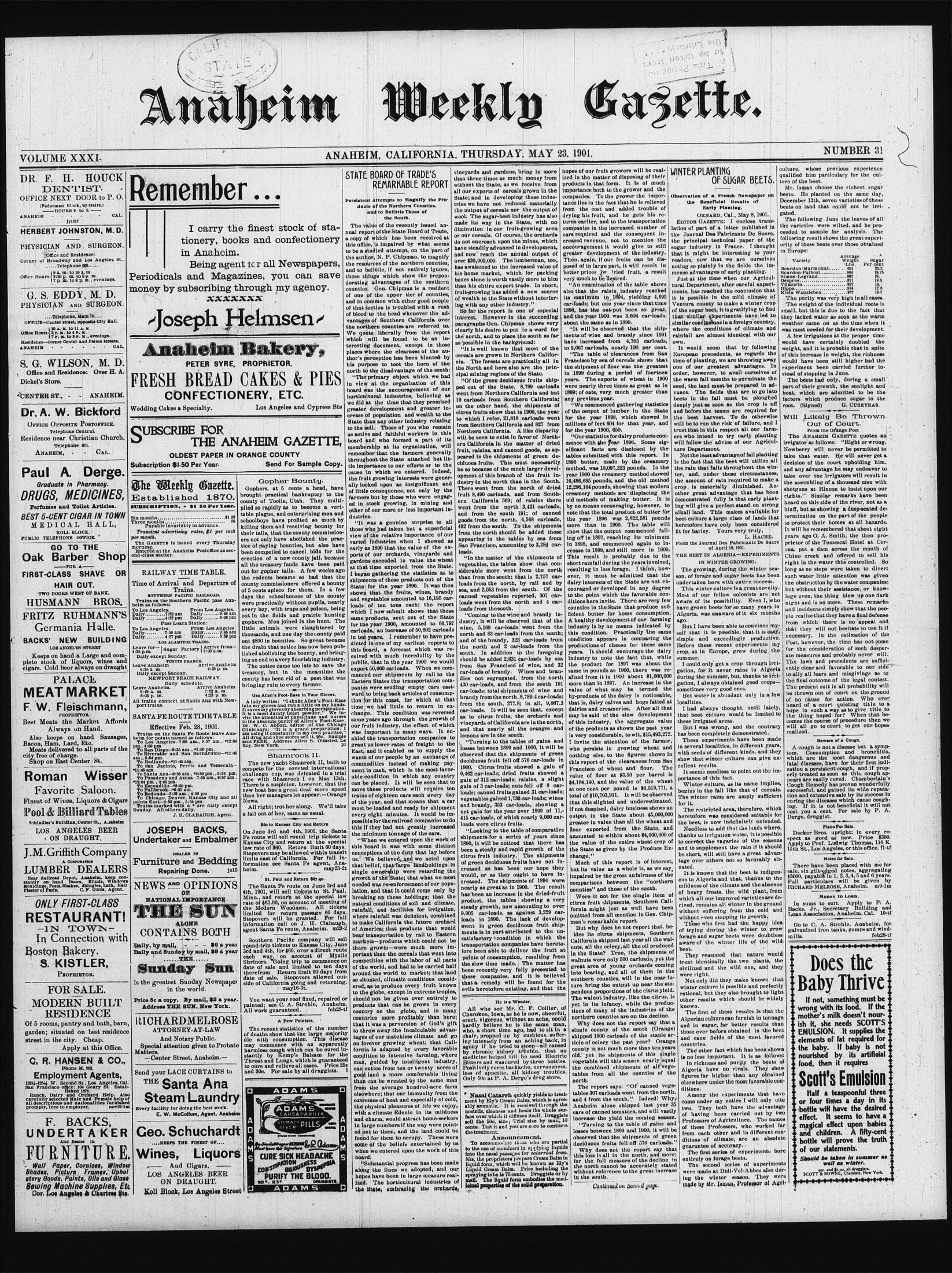
Searchable text
Anaheim
VOLUME XXXI.
DR. F. H. HOUCK
DENTIST.
OFFICE NEXT DOOR to P. O.
(Federman Block, up stairs.)
HOURS 9 to &
ANAHEIM CAL.
Jy15tf
HERBERT JOHNSTON, M. D.
PHYSICIAN AND SURGEON.
Office and Residence:
Corner of Broadway and Los Angeles St..
Telephone 608...
Office Hours
9 a.m. to 10 a.m.
3:30 p.m. to 8 p.m.
7 p.m. to 8 p.m., evenings.
G. S. EDDY, M. D.
PHYSICIAN AND SURGEON.
Telephone, Main 75...
OFFICE—Center street, opposite City Hall.
Office Hours
10 A.M. to 11 A.M.
2 P.M. to 4 P.M.
7 P.M. to 8 P.M., evenings.
Residence—Corner Center and Palms streets.
ANAHEIM CAL.
S. G. WILSON, M. D.
Office and Residence: Over H. A. Dickel's Store.
CENTER ST., - ANAHEIM.
Dr. A. W. Bickford
OFFICE OPPOSITE POSTOFFICE.
Telephone Central.
Residence near Christian Church.
Telephone 671.
ANAHEIM, - CAL.
Paul A. Derge.
Remember...
I carry the finest stock of stationery, books and confectionery in Anaheim.
Being agent for all Newspapers,
Periodicals and Magazines, you can save money by subscribing through my agency.
Joseph Helmsen
Anaheim Bakery,
PETER SYRE, PROPRIETOR.
FRESH BREAD CAKES & PIES CONFECTIONERY, ETC.
Wedding Cakes a Specialty. Los Angeles and Cypress Sts
SUBSCRIBE FOR THE ANAHEIM GAZETTE,
OLDEST PAPER IN ORANGE COUNTY
Subscription $1.50 Per Year. Send For Sample Copy.
Dr. A. W. Bickford
OFFICE OPPOSITE POSTOFFICE.
Telephone Central.
Residence near Christian Church.
Telephone 671.
ANAHEIM,
CAL.
Paul A. Derge.
Graduate in Pharmaoy.
DRUGS, MEDICINES,
Perfumes and Toilet Articles.
BEST 5-CENT CIGAR IN TOWN
MEDICAL HALL,
KOLL BLOCK.
PUBLIC TELEPHONE OFFICE.
GO TO THE
Oak Barber Shop
FOR A
FIRST-CLASS SHAVE OR
HAIR CUT.
TWO DOORS WEST OF BANK.
HUSMANN BROS.
FRITZ RUHMANN'S
Germania Halle.
BACKS' NEW BUILDING
LOS ANGELES STREET
Keeps on hand a Large and complete stock of liquors, wines and cigars. Cold beer always on draught
PALACE MEAT MARKET
F. W. Fleischmann,
PROPRIETOR.
Best Meats the Market Affords Always on Hand.
Also keeps on hand Sausages, Bacon, Ham, Lard, Etc.
Meats delivered to all parts of the city free of charge.
Shop on East Center St.
Roman Wisser
Favorite Saloon.
Finest of Wines, Liquors & Cigare Pool & Billiard Tables
Schindler's Building, Center St., Anaheim
LOS ANGELES BEER ON DRAUGHT.
J.M.Griffith Company
A CORPORATION
LUMBER DEALERS
Near Railroad Depot, Anaheim, keep constantly on hand Doors, Blinds, Windows Mouldings, Posts, Shakes, shingles lath, Hair Plaster of Paris.
C.F. GRIM, Agent.
FRESH BREAD CAKES & PIES CONFECTIONERY, ETC.
Wedding Cakes a Specialty.
Los Angeles and Cypress Sts
SUBSCRIBE FOR THE ANAHEIM GAZETTE,
OLDEST PAPER IN ORANGE COUNTY
Subscription $1.50 Per Year.
Send For Sample Copy.
The Weekly Gazette.
Established 1870.
SUBSCRIPTION, - $1.50 Per Year.
Six months.....$1.00
Three months.....75
Payable invariably in advance.
Transient advertising rates, $1 per inch per month.
The GAZETTE is issued every Thursday morning.
Entered at the Anaheim Postoffice as second-class matter.
RAILWAY TIME TABLE.
Time of Arrival and Departure of Trains.
SOUTHERN PACIFIC RAILROAD.
Trains on the Southern Pacific pass Anaheim as follows:
To Los Angeles...From Los Angeles.
Daily...7:52 am Dally...9:49 am
Daily...4:22 pm Dally...6:00 pm
Pass Loara Station:
To Los Angeles...From Los Angeles
Daily...7:56 am Dally...9:45 am
Daily...4:27 pm Dally...5:59 pm
Los ALAMITOS TRAINS.
Leave for—Sugar Factory Arrive from 4:35 p.m.
Daily except Sunday.
TUSTIN BRANCH.
Leave Anaheim Arrive Anaheim 9:35 a.m. 4:35 p.m.
Daily except Sunday.
NEWPORT BEACH RAILWAY.
Daily Schedule.
Leave Anaheim Arrive Anaheim 9:49 a.m. 7:52 a.m. 6:08 p.m. 4:28 p.m.
All trains connect at Santa Ana with Newport trains.
SANTA FE ROUTE TIMETABLE
Effective Feb. 28, 1901.
Trains on the Santa Fe Route leave Anaheim for points named as follows:
To Los Angeles-7:55 am., 9:57 am., *12:04 pm., 4:50 pm.
To San Diego-9:35 am., *2:50 pm., 5:54 pm.
To Riverside and San Bernardino-*11:45 am., 5:54 pm.
To Redlands-*11:45 am.
To San Jacinto, Perris and Temecula-*11:45 am.
To Santa Ana-9:35 am., *2:50 pm., 5:54 pm.
To Pasadena and Azusa-7:55 am., 9:57 am.*12:04 pm., 4:50 pm.
To Escondido-*2:50 pm.
To Fallbrook-*9:35 am.
To Redondo-7:55 am., *4:50 pm.
To Chicago, Denver, Kansas City and all points East-4:50 pm., 5:54 pm.
Trains marked with a * are daily except Sunday. All others daily.
JOSEPH BACKS,
Undertaker and Embalmer
DEALER IN
Furniture and Bedding Repairing Done.
NEWS AND OPINIONS OF
NATIONAL IMPORTANCE
Gopher Bounty.
Gophers, at 5 cents a head, have brought practical bankruptcy to the county of Toolle, Utah. They multiplied so rapidly as to become a veritable plague, and enterprising men and schoolboys have profited so much by killing them and receiving bounty for their tails, that the county commissioners not only have abolished the practice of paying bounties, but also have been compelled to cancel. bids for the erection of a new county jail, because all the treasury funds have been paid out for gopher tails. A few weeks ago the rodents became so bad that the county commissioners offered a bounty of 5 cents apiece for them. In a few days the schoolhouses of the county were practically without pupils, nearly every boy, with traps and poison, being out in the fields and prairie hunting gophers. Men joined in the hunt. The little animals were slaughtered by thousands, and one day the county paid out $800 in bounties. So great became the drain that notice has now been published abolishing the bounty, and bringing an end to a very flourishing industry.
The notice came too late to save the treasury, but in the meantime the county has been rid of a pest that was bringing ruin to every farmer.
Use Allen's Foot-Ease in Your Gloves.
A lady writes: "I shake Allen's Foot-Ease into my gloves and rub a little on my hands. It saves my gloves by absorbing perspiration. It is a most dainty toilet powder." We invite the attention of physicians and nurses to the absolute purity of Allen's Foot-Ease. Dr. W. C. Abbott, editor of the Chicago Clinic says it is a good preparation! I am using it constantly in my own practice." All drug and shoe stores sell it, 25c. Sample sent FREE. Address Allen S. Olmsted, Le Roy, New York.
Shamrock II.
The new yacht Shamrock II, built to compete for the coveted international challenge cup, was defeated in a trial race with Shamrock I on May 13th. There is a suspicion, however, that the new boat has a great deal more speed than her managers let appear.-Orange News.
All right; trot her along. We'll take a fall out of her, same as usual.
$60 to Kansas City and Return
On June 3rd and 4th, 1901, the Santa Fe route will sell round trip tickets to Kansas City and return at the special low rate of $60. Return limit 60 days. Stopovers may be allowed within transit limits east of California. For full information see Santa Fe agent, Anaheim.
St. Paul and Return $67.90.
The Santa Fe route on June 3rd and 4th, 1901, will sell tickets to St. Paul, Minn., and return at the special low
JOSEPH BACKS,
Undertaker and Embalmer
DEALER IN
Furniture and Bedding
Repairing Done.
NEWS AND OPINIONS OF
NATIONAL IMPORTANCE
THE SUN
ALONE
CONTAINS BOTH
Daily, by mail, $6 a year
Daily and Sunday by mail, $8 a year
THE
Sunday Sun
is the greatest Sunday Newspaper in the world.
Price 5c a copy. By mail, $2 a year.
Address THE SUN, New York.
RICHARD MELROSE
ATTORNEY-AT-LAW
And Notary Public.
Special attention given to Probate Matters.
—Center Street, Anaheim.
Send your LACE CURTAINS to
THE Santa Ana Steam Laundry
Every facility for doing the best work.
E. W. McCollum, Agent, Anaheim
Geo. Schuchardt
...KEEPS THE FINEST OF...
Wines, Liquors
And Oigars.
LOS ANGELES BEER ON DRAUGHT.
Koll Block, Los Angeles Street
ADAMS
ADAMS
SARSAPARILLA
STOMACH LIVER PILLS
CURE SICK HEADACHE
CONSTIPATION
BLOODNESS
DYSPEPSIA
PURIFY THE BLOOD.
ADAMS
ANAHEIM, CALIFORNIA, THURSDAY, MAY 23, 1901.
STATE BOARD OF TRADE'S REMARKABLE REPORT
Persistent Attempts to Magnify the Products of the Northern Counties, and to Belittle Those of the South.
The value of the recently issued annual report of the State Board of Trade, a copy of which has been received at this office, is impaired by what seems to be a studied attempt, on the part of the author, N. P. Chipman, to magnify the resources of the northern counties, and to belittle, if not entirely ignore, those things which show the preponderating advantages of the southern counties. Gen. Chipman is a resident of one of the upper tier of counties, and in common with other good people of that section is troubled with a rush of blood to the head whenever the advantages of Southern California over the northern counties are referred to. We quote liberally from the report which will be found to be an interesting document, except in those places where the clearness of the author's perception has been blunted by his purpose to toot the horn of the north to the disadvantage of the south:
"The primary object which we had in view at the organization of this board was the encouragement of our horticultural industries, believing as we did at the time that they promised greater development and greater increase of population and wealth to the State than any other industry relating to the soil. Those of you who remain as active and faithful workers in this board and who formed a part of its membership at its organization, will remember that the farmers generally throughout the State attached but little importance to our efforts or to the cause in which we entered. Indeed,
vineyards and gardens, bring in more than three times as much money from without the State, as we receive from all our exports of cereals grown in the State; and in developing these industries we have not reduced materially the output of cereals nor the output of wool. The sugar-beet industry has also made its way in the State, with no diminution in our fruit-growing area or our cereals. Of course, the orchards do not encroach upon the mines, which have steadily advanced in development, and now reach the annual output of over $30,000,000. The lumberman, too, has awakened to the increased value of his home market, which for packing boxes alone is worth vastly more to him than his ehtire export trade. In short, fruit-growing has added a new source of wealth to the State without interfering with any other industry."
So far the report is one of especial interest. However in the succeeding paragraphs Gen. Chipman shows very clearly his desire to put in a word for the north, and to place the south as far as possible in the background:
"It is well known that most of the cereals are grown in Northern California. The forests are practically all in the North and here also are the principal mining regions of the State.
"Of the green deciduous fruits shipped out of the State, 8,799 carloads went from Northern California and but 19 carloads from Southern California; on the other hand, the shipments of citrus fruits show that in 1900, the year to which I refer, 21,818 carloads went from Southern California and 827 from Northern California. A like disparity will be seen to exist in favor of Northern California in the matter of dried fruit, raisins, and canned goods, as appeared in the shipments of green deciduous fruits. This must necessarily be so because of the much larger development of this branch of the fruit industry."
hopes of our fruit growers will be realized in the matter of disposing of their products in that form. It is of much importance both to the grower and the companies. To the grower the importance lies in the fact that he is relieved from the cost and added trouble of drying his fruit, and he gets his returns earlier, and to the transportation companies in the increased number of cars required and the consequent increased revenue, not to mention the encouragement it would give to still greater development of the industry. Then, again, if our fruits can be disposed of in large part, it will result in better prices for dried fruit, a result very much to be desired.
"An examination of the table shows also that the raisin industry reached its maximum in 1894, yielding 4,695 car-loads; but one year since that time 1898, has the out-put been so great, and the year 1900 was 3,604 car-loads, about the same as in 1899.
"It will be observed that the shipments of wine and brandy since 1891 have increased from 4,765 carloads, to 9,067 carloads, nearly 100 per cent.
"The table of clearances from San Francisco by sea of cereals shows that the shipment of flour was the greatest in 1894 during a period of fourteen years. The exports of wheat in 1900 were nearly three times as great as in 1899; of oats, very much greater than any previous year.
"We commenced gathering statistics of the output of lumber in the State for the year 1898, which showed in millions of feet 604 for that year, and for the year 1900, 650.
"Our statistics for dairy products commence with the year 1896. Some significant facts are disclosed by the tables submitted with this report. In 1896 butter, made by the creamy method, was 10,097,323 pounds. In the year 1900 the creamy method showed..."
"The primary object which we had in view at the organization of this board was the encouragement of our horticultural industries, believing as we did at the time that they promised greater development and greater increase of population and wealth to the State than any other industry relating to the soil. Those of you who remain as active and faithful workers in this board and who formed a part of its membership at its organization, will remember that the farmers generally throughout the State attached but little importance to our efforts or to the cause in which we entered. Indeed, the fruit growing interests were generally looked upon as insignificant and of little consequence, not only by the farmers but by those who were engaged in stock growing, in mining and other of our more or less important industries.
"It was a genuine surprise to all those who had taken but a superficial view of the relative importance of our varied industries when I showed as early as 1890 that the value of the exports of our orchards, vineyards and gardens exceeded in value the wheat at that time exported from the State. I began gathering the statistics as to shipments of these products out of the State for the year 1890. It was then shown that the fruits, wines, brandy and vegetables amounted to 16,195 carloads of ten tons each; the report which I now submit shows that these same products, sent out of the State for the year 1900, amounted to 66,797 carloads, an increase of 50,602 carloads in ten years. I remember to have predicted in one of my earliest reports to this board, a forecast which was received with much incredulity by the public, that in the year 1900 we would export 50,000 carloads. When we commenced our ships by rail to the Eastern States the transportation companies were sending empty cars eastward to bring back articles of consumption for this coast, for which at that time we had little to return in exchange. This condition was reversed some years ago through the growth of our fruit industry, the effect of which was important in many ways. It enabled the transportation companies to grant us lower rates of freight to the East, and it enabled us to supply the wants of our people by an exchange of commodities instead of making payment in cash, which is the most favorable condition in which any country can be placed. It will be seen that to move these products will require ten trains of eighteen cars each every day of the year, and that means that a car must be loaded and ready for shipment every eight minutes. It would be impossible for the railroad companies to do this if they had not greatly increased the minimum tonnage of the cars.
"When we entered upon the work of this board it was with some distinct conceptions of the duty that lay before us. We believed, and we acted upon that belief, that large landholdings in single ownership were retarding the growth of the State; that what we most needed was re-enforcement of our population, and that it could come only by breaking up these holdings; that the capital mining regions of the State,
"Of the green deciduous fruits shipped out of the State, 8,799 carloads went from Northern California and but 19 carloads from Southern California; on the other hand, the shipments of citrus fruits show that in 1900, the year to which I refer, 21,818 carloads went from Southern California and 827 from Northern California. A like disparity will be seen to exist in favor of Northern California in the matter of dried fruit, raisins, and canned goods, as appeared in the shipments of green deciduous fruits. This must necessarily be so because of the much larger development of this branch of the fruit industry in the north than in the South. There went from the north of dried fruit 8,490 carloads, and from Southern California 369; of raisins there went from the north 3,421 carloads, and from the south 191; of canned goods from the north, 4,568 carloads, 492 from the south. To the shipments from the north should be added those appearing in the tables by sea from San Francisco, amounting to 3,284 carloads.
"In the matter of the shipments of vegetables, the tables show that considerable more went from the north than from the south; that is 2,757 carloads from the north; by rail and by sea, and 2,053 from the south. Of the canned vegetables reported, 307 carloads went from the north and 4 carloads from the south.
"Coming to the wine and brandy industry, it will be observed that of the wine, 5,169 carloads went from the north and 83 carloads from the south; and of the brandy, 325 carloads from the north and 2 carloads from the south. In addition to the foregoing should be added 2,831 carloads by sea from San Francisco of wine, and 32 carLOADS of brandy. Wines and brandy not segregated, from the north 430 carLOADS and from the south 191 carLOADS; total shipments of wine and brandy from the north, 8,789.4 carLOADS; from the south, 277.8; in all, 9,067.3 carLOADS. It will be seen that, except as to citrus fruits, the orchards and vineyards of California are in the north, and that nearly all the oranges and lemons are in the south.
"Turning to the tables of gains and losses between 1899 and 1900, it will be observed that the shipments of green deciduous fruit fell off 576 carLOADS in 1900. Citrus fruits showed a gain of 9,462 carLOADS; dried fruits showed a gain of 312 carLOADS; raisins, a slight gain of 3 carLOADS; nuts fell off 8 carLOADS; canned fruits gained 31 carLOADS; vegetables gained 1,736 carLOADS; wines and brandy, 353 carLOADS, showing a net gain for the year over 1899 of 11,-415 carLOADS, of which nearly 9,000 carLOADS were citrus fruits.
"Looking to the table of comparative shipments for a series of years since 1890, it will be noticed that there has been a steady and rapid growth of the citrus fruit industry. The shipments of green deciduous fruits have not increased as has been our hope they would, or as they ought to have increased. The shipments of 1894 were nearly as great as in 1900. The result has been an increase in the dried-fruit capital mining regions of the State.
"Of the green deciduous fruits shipped out of the State, 8,799 carLOADS went from Northern California and but 19 carLOADS from Southern California; on the other hand, the shipments of citrus fruits show that in 1900, the year to which I refer, 21,818 carLOADS went from Southern California and 827 from Northern California. A like disparity will be seen to exist in favor of Northern California in the matter of dried fruit, raisins, and canned goods, as appeared in the shipments of green deciduous fruits. This must necessarily be so because of the much larger development of this branch of the fruit industry in the north than in the South. There went from the north of dried fruit 8,490 carLOADS,and from Southern California 369;of raisins there went fromthe north3,421carLOADs,andfromthe south191;ofcannedgoodsfromthenorth430carLOADs,andfromthesouth191carLOADs;totalshipmentsofwineandbrandyfromthenorth8,789.4carLOADs;fromthesouth277.8;在all,9,067.3carLOADs。Itwillbeseenthatexceptastocitrusfruits,theorchardsandvineyardsofCaliforniaareinthenorth,andthatnearlyalltheorangesandlemonsareinthenorth.
"Turningtothetableofcomparativeshippmentsforaseriesofyearssince1890,它willbeobservedthattheshipmentsofgreendeciduousfruitfelloff576carLOADsin1900.Citrusfruitsshowedaigainof312carLOADsaigainof3gainof3carLOADsaigainof3carLOADsaigainof3carLOADsaigainof3carLOADsaigainof3carLOADsaigainof3carLOADsaigainof3carLOADsaigainof3carLOADsaigainof3carLOADsaigainof3carLOADsaigainof3carLOADsaigainof3carLOADsaigainof3carLOADsaigainof3carLOADsaigainof3carLOADsaigainof3carLOADsaigainof3carLOADsaigainof3carLOADsaigainof3carLOADsaigainof3carLOADsaigainof3carLOADsaigainof3carLDsaigainof3carLDsaigainof3carLDsaigainof3carLDsaigainof3carLDsaigainof3carLDsaigainof3carLDsaigainof3carLDsaigainof3carLDsaigainof3carLDsaigainof3carLDsaigainof3carLDsaigainof3carLDsaigainof3carLDsaIGAINOF3CARLDSAIGAINOF3CARLDSAIGAINOF3CARLDSAIGAINOF3CARLDSAIGAINOF3CARLDSAIGAINOF3CARLDSAIGAINOF3CARLDSAIGAINOF3CARLDSAIGAINOF3CARLDSAIGAINOF3CARLDSAIGAINOF3CARLDSAIGAINOF3CARLDSAIGAINOF
of the year, and that means that a car must be loaded and ready for shipment every eight minutes. It would be impossible for the railroad companies to do this if they had not greatly increased the minimum tonnage of the cars.
"When we entered upon the work of this board it was with some distinct conceptions of the duty that lay before us. We believed, and we acted upon that belief, that large landholdings in single ownership were retarding the growth of the State; that what we most needed was re-enforcement of our population, and that it could come only by breaking up these holdings; that the natural conditions of soil and climate, rainfall, and facilities for irrigation, where rainfall was deficient, combined to make California the future orchard of America; that products that would bear transportation by rail to Eastern markets—products which could not be there grown—were much more important than the cereals that went into competition with the labor of all parts of the world, and had to be carried half around the world to market; that land so situated, climatic conditions considered, as to produce every fruit known to the globe, except in extreme tropics, should not be given over entirely to products that can be grown in every country on the globe, and in many countries more profitably than here; that it was a perversion of God's gift to throw away the incalculable advantages of our matchless climate and go on forever growing wheat; that California is adapted by every favorable condition to intensive farming, where man, guided by intelligent industry, can entice from ten or twenty acres of good land a more comfortable living than can be wrested by the same man from the average hundred-acre farm elsewhere; that our immunity from the extremes of heat and especially of cold, the physical pleasures of life we enjoy, with a climate Edenic in its mildness and charm, would attract home-seekers in large numbers if the way were pointed out to them, and the land could be found for them to occupy. These were some of the beliefs entertained by us when we entered upon the work of this board.
"Substantial progress has been made along the lines we adopted, and our hopes have been in large measure realized. The horticultural industries of the State, embracing the orchards,
Nasal Catarrh quickly yields to treatment by Ely's Cream Balm, which is agreeably aromatic. It is received through the nostrils, cleanses and heals the whole surface over which it diffuses itself. Druggists sell the 50c. size; Trial size by mail, 10 cents. Test it and you are sure to continue the treatment.
Announcement.
To accommodate those who are partial to the use of atomizers in applying liquids into the nasal passages for catarrhal troubles, the proprietors prepare Cream Balm in liquid form, which will be known as Ely's Liquid Cream Balm. Price including the spraying tube is 75 cents. Druggists or by mail. The liquid form embodies the medicinal properties of the solid preparation.
Looking to the table of comparative shipments for a series of years since 1890, it will be noticed that there has been a steady and rapid growth of the citrus fruit industry. The shipments of green deciduous fruits have not increased as has been our hope they would, or as they ought to have increased. The shipments of 1894 were nearly as great as in 1900. The result has been an increase in the dried-fruit product, the tables showing a very steady growth, now amounting to over 9,005 carloads, as against 3,229 carloads in 1890. The lack of development in green deciduous fruit shipments is in part attributed to the unsatisfactory condition in which the transportation companies have heretofore been able to deliver the fruit at points of consumption, resulting from the slow time made. The matter has been recently very fully presented to these companies, and it is believed that a remedy will be found for the evils heretofore existing, and that the
He is a Wonder.
All who see Mr. C. F. Collier, of Cherokee, Iowa, as he is now, cheerful, erect, vigorous, without an ache, could hardly believe he is the same man, who a short time ago, had to sit in a chair, propped up by cushions, suffering intensely from an aching back, in agony if he tried to stoop—all caused by chronic kidney trouble. That no medicine helped till he used Electric Bitters and was cured by three bottles. Positively cures backache, nervousness, loss of appetite, all kidney troubles. Only 50c at P. A. Derge's drug store.
Why does not the report say that single county of the south (Orange county) is not much more than ten years old, yet its shipments of this single vegetable will this season nearly equal the combined shipments of all vegetables from all the counties of the north.
The report says: "Of canned vegetables 307 carloads went from the north and 4 from the south." Indeed! Why Anaheim alone shipped last year 32 cars of canned tomatoes, and will vastly increase the yield the coming season?
"Turning to the table of gains and losses between 1899 and 1900, it will be observed that the shipments of green deciduous fruits fell off 576 carloads.
Why does not the report say that this loss is all in the north, and more for the full measure of the decline in the north cannot be accurately stated without reference to the great increase in the south."
Continued on Second page.
WINTER PLANTING OF SUGAR BEETS.
Observation of a French Newspaper on the Beneficial Results of Early Planting.
OXNARD, Cal., May 8, 1901.
EDITOR GAZETTE: I enclose translation of part of a letter published in the Journal Des Fabricants De Sucre, the principal technical paper of the sugar industry in France. I thought that it might be interesting to your readers, now that we are ourselves noting so plainly in the fields the immense advantages of early planting.
Just at the time when our Agricultural Department, after careful experiments, has reached the conclusion that it is possible in the mild climate of Ventura county to make a winter crop of the sugar beet, it is gratifying to find that similar experiments have led to similar conclusions in a foreign country, where the conditions of climate and rainfall are almost identical with our own.
It would seem that by following European precedents, as regards the time of planting, we are throwing away one of our greatest advantages. In order, however, to avail ourselves of the warm fall months to germinate the seed, the land must be prepared in advance. The fields that are to go into beets in the fall must be ploughed deeply just as soon as the crop is off and before the teams are required for the beet harvest. To do otherwise will be to run the risk of failure, and I trust that in this respect all our farmers who intend to try early planting will follow the advice of our Agriculture Department.
Not the least advantage of fall planting is the fact that the beet will utilize all the rain that falls throughout the winter, and under these circumstances culture, whose previous experience qualified him particularly for the culture of the beet.
Mr. Isman choose the richest sugar beets. He planted on the same day, December 13th, seven varieties of these beets on land that could not be irrigated.
The following June the leaves of all the varieties were wilted, and he proceeded to sample for analysis. The following result shows the great superiority of these beets over those obtained in Europe:
| Variety | Average Weight Lbs. | Sugar Per cent |
| :--- | :--- | :--- |
| Bourdon-Marmilhat | 681 | 21.2 |
| Bourdon-Palbost | 864 | 18.75 |
| Simon-Legrand | 882 | 19. |
| Desprez | 871 | 19.5 |
| Vilmorin | 937 | 18. |
| Dipppe | 974 | 17.6 |
| Klein Wansleben | 937 | 19.2 |
The purity was very high in all cases.
The weight of the individual roots is small, but this is due to the fact that they lacked water as soon as the warm weather came on at the time when it was most needed for their development.
A few irrigations at proper time would have certainly doubled the weight, and it is probable that in spite of this increase in weight, the richness would have been still higher had the experiment been carried further instead of stopping in June.
The beets had only, during a small part of their growth, the sunlight and heat, which are admitted to be the factors which produce sugar in the root. (Signed) G. CUREYRAS.
Will Likely Be Thrown Out of Court.
From the Orange Post
The ANAHEIM GAZETTE quotes an irrigator as follows: "Right or wrong, Newberry will never be permitted to take that water. He will never get a decision of the court upholding him, and any advantage he may endeavor to take."
Commenced gathering statistics of lumber in the State Year 1896, which showed in beet 604 for that year, and 1900, 650.
Statistics for dairy products come the year 1896. Some signs are disclosed by the fitted with this report. In 1897, made by the creamery is 10,097,323 pounds. In the creamery method showed amounts, and the old method bounds, showing that modern methods are displacing the use of making butter. It is encouraging, however, to total product of butter for 1896 was 2,822,581 pounds in 1900. The table will output commenced fall-1897, reaching its minimum and commenced again to increase in lessorage. I think, how must be admitted that the beets of the State are not developed in any degree but which the favorable conditions invite. There are very few in the State that produce sufferer for home consumption. Development of our farming by no means indicated by action. Practically the same appears in comparing the uses of cheese for these same should encourage the dairy note the fact that, while beet for 1897 was about the bounds as 1900, there was relied on it in 1900 $1,000,000 in 1897. An increase in what may be termed the uses of the dairy is noticeable, dairy calves and hogs fatted at creameries. After all that had of the slow development industry, the aggregate valueDUCTS as shown the past year considerable, to wit, $15,493,272. The attention of the farmer, beets in growing wheat and rye, to the figures shown in that of the clearances from San of wheat and flour. The flour at $3.50 per barrel is and the value of the wheat at per pound is $6,519,771, a $7,033,911. It will be observed lighted and underestimated, raised, dairy business shows an increase in the State about $5,000,000 in value than all the wheat and shorted from the State, and so within about $4,000,000 of the entire wheat crop of was given by the Produce Ex-
If this report is of interest, value as a whole is, as we say, by the gross unfairness of the gains between the "northern and those of the south."
The warm fall months to germinate the seed, the land must be prepared in advance. The fields that are to go into beets in the fall must be ploughed deeply just as soon as the crop is off and before the teams are required for the beet harvest. To do otherwise will be to run the risk of failure, and I trust that in this respect all our farmers who intend to try early planting will follow the advice of our Agriculture Department.
Not the least advantage of fall planting is the fact that the beet will utilize all the rain that falls throughout the winter, and under these circumstances, the amount of rain required to make a crop is materially diminished. Another great advantage that has been demonstrated fully is that early planting will give a perfect stand on strong alkali land. This makes available for beet culture a large class of lands that heretofore have only been considered fit for barley. Yours very truly,
L. HACHE.
From the Journal Des Fabricants De Sucre of April 10, 1901.
THE BEET IN ALGERIA—EXPERIMENTS IN WINTER GROWING.
The growing, during the winter season, of forage and sugar beets has been undertaken here with entire success.
This winter culture is a great novelty. Most of our fellow colonists are not aware of its possibility. Even I, who have grown beets for so many years in Algeria, was unaware of it six months ago.
But I have been able to convince myself that it is possible, that it is easy, simple and exceedingly productive. Before these recent experiments my crop, as in Europe, grew during the summer.
I could only get a crop through irrigation, for it never rains in Algeria during the summer, but thanks to irrigation, I always obtained good crops—sometimes very good ones.
But water is abundant only in a few localities.
I had always thought, until lately, that beet culture would be limited to these irrigated areas.
But I was wrong, and the contrary has been completely demonstrated.
These experiments have been made in several localities, in different years, with seeds of different kinds, and they show that winter culture can give excellent results.
It seems needless to point out the importance of this fact.
Winter culture, as its name implies, begins in the fall like that of cereals. The winter rains are amply sufficient for it.
The restricted area, therefore, which heretofore was considered suitable for the beet, is now indefinitely extended.
Needless to add that the lands where, thanks to irrigation water, it is possible to correct the vagaries of the seasons and to supplement the rain if it should be short, will still have a great advantage over others not so favorably situated.
It is known that the beet is indigenous to Algeria and that, thanks to the mildness of the climate and the absence of heavy frosts, the wild plant, from which all our improved varieties are de-
The beets had only, during a small part of their growth, the sunlight and heat, which are admitted to be the factors which produce sugar in the root. (Signed)
G. CUREYRAS.
Will Likely Be Thrown Out of Court.
From the Orange Post
The ANAHEIM GAZETTE quotes an irrigator as follows: "Right or wrong Newberry will never be permitted to take that water. He will never get a decision of the court upholding him, and any advantage he may endeavor to take over the irrigators will result in the assembly of a thousand men with shotguns at Rincon to insist upon our rights." Similar remarks have been heard on this side of the river, not as a bluff, but as showing a deep-seated determination on the part of the people to protect their homes at all hazards. It will be remembered that about eight years ago O. A. Smith, the then proprietor of the Temescal Hotel at Corona, put a dam across the mouth of Chino creek and offered to sell his right in the water thus controlled. So long as no steps were taken to divert such water little attention was given the obstruction by the water companies; but without their assistance, or knowledge even, the thing blew up one dark night and is no more. These remarks and incidents simply show that the people realize that they have a final defense from which there is no appeal and that they will not hesitate to use it if necessary. In the estimation of the Post, however, the time has not come for the consideration of such desperate measures and probably never will. The laws and precedents are sufficiently clear and favorable to our side to ally all fears and misgivings as to the final outcome of the legal contest. The present suit in all probability will be thrown out of court on the ground of no cause for action. Who ever heard of a court quieting title to a hope in such a way as to give title to the thing hoped for? When that becomes the course of procedure then we will all go to court to get our hopes realized.
Beware of a Cough.
A cough is not a disease but a symptom. Consumption and bronchitis, which are the most dangerous and fatal diseases, have for their first indication a persistent cough, and if properly treated as soon as this cough appears are easily cured. Chamberlain's Cough Remedy has proven wonderfully successful, and gained its wide reputation and extensive sale by its success in curring the diseases which cause coughing. If it is not beneficial it will not cost you a cent. For sale by P. A. Derge, druggist.
Piano For Sale.
Decker Bros. upright; in every respect as good as new. Price $300. Apply to Prof. Ludwig Thomas, 116 E. 15th St., Los Angeles, or this office. fl-tf
Notes for Sale.
There have been placed with me for sale, six gilt-edged notes, aggregating $5000, payable in 1, 2, 3, 4, 5 and 6 years. Full particulars will be given by RICHARD MELROSE, Anaheim. m9-1m
Money to Loan.
Does the Baby Thrive
If not, something must be wrong with its food. If the mother’s milk doesn’t nourish it, she needs SCOTT’S EMULSION. It supplies the elements of fat required for the baby. If baby is not nourished by its artificial food, then it requires Scott’s Emulsion.
Half a teaspoonful three or four times a day in its bottle will have the desired effect. It seems to have a magical effect upon babies and children. A fifty-cent bottle will prove the truth of our statements.
Should be taken in summer as well as winter.
SCOTT & BOWNE, Chemists, New York.