anaheim-gazette 1901-05-02
Scanned page
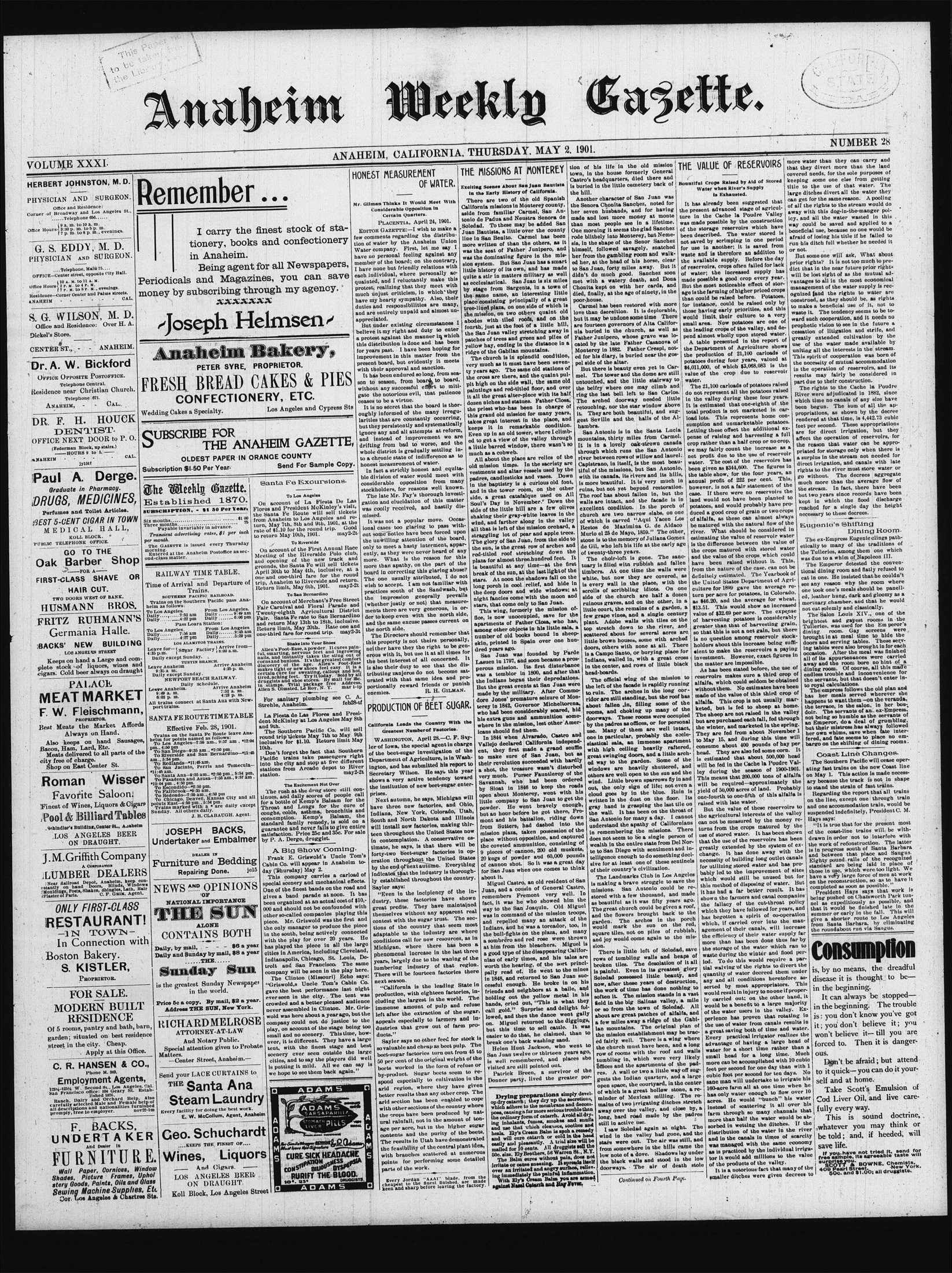
Searchable text
Anaheim
VOLUME XXXI.
HERBERT JOHNSTON, M.D.
PHYSICIAN AND SURGEON.
Office and Residence:
Corner of Broadway and Los Angeles St.
Telephone 650...
9 a.m. to 10 a.m.
3:50 p.m. to 5 p.m.
7 p.m. to 8 p.m., evenings.
G. S. EDDY, M.D.
PHYSICIAN AND SURGEON.
Telephone, Main 75...
OFFICE—Center street, opposite City Hall.
10 a.m. to 11 a.m.
2 p.m. to 4 p.m.
7 p.m. to 8 p.m., evenings.
Residence—Corner Center and Palms streets.
ANAHEIM CAL.
S. G. WILSON, M.D.
Office and Residence: Over H. A. Dickel's Store.
CENTER ST., ANAHEIM.
Dr. A. W. Bickford
OFFICE OPPOSITE POSTOFFICE.
Telephone Central,
Residence near Christian Church.
Telephone 671.
ANAHEIM, CAL.
DR. F. H. HOUCK
DENTIST.
OFFICE NEXT DOOR to P. O.
(Federman Block, up stairs.)
HOURS 9 to 5.
ANAHEIM CAL.
Remember...
I carry the finest stock of stationery, books and confectionery in Anaheim.
Being agent for all Newspapers, Periodicals and Magazines, you can save money by subscribing through my agency.
Joseph Helmsen
Anaheim Bakery,
PETER SYRE, PROPRIETOR.
FRESH BREAD CAKES & PIES CONFECTIONERY, ETC.
Wedding Cakes a Specialty. Los Angeles and Cypress Sts
SUBSCRIBE FOR THE ANAHEIM GAZETTE,
OLDEST PAPER IN ORANGE COUNTY
Subscription $1.50 Per Year.
Send For Sample Copy.
OFFICE OPPOSITE POSTOFFICE.
Telephone Central.
Residence near Christian Church.
Telephone 671.
ANAHEIM, CAL.
DR. F. H. HOUCK
DENTIST.
OFFICE NEXT DOOR to P. O.
(Federman Block, up stairs.)
HOURS 9 to 5.
ANAHEIM, CAL.
Paul A. Derge.
Graduate in Pharmaoy.
DRUGS, MEDICINES,
Perfumes and Toilet Articles.
BEST 5-CENT CIGAR IN TOWN
MEDICAL HALL,
KOLL BLOCK.
PUBLIC TELEPHONE OFFICE.
GO TO THE
Oak Barber Shop
FOR A
FIRST-CLASS SHAVE OR
HAIR CUT.
TWO DOORS WEST OF BANK.
HUSMANN BROS.
FRITZ RUHMANN'S
Germania Halle.
BACKS' NEW BUILDING
LOS ANGELES STREET
Keeps on hand a Large and complete stock of liquors, wines and cigars. Cold beer always on draught
PALACE
MEAT MARKET
F. W. Fleischmann,
PROPHIETOR
Best Meats the Market Affords Always on Hand.
Also keeps on hand Sausages, Bacon, Ham, Lard, Etc.
Meats delivered to all parts of the city free of charge.
Shop on East Center St.
Roman Wisser
Favorite Saloon:
Finest of Wines, Liquors & Cigars
Pool & Billiard Tables
Schindler's Building, Center St., Anaheim
LOS ANGELES BEER ON DRAUGHT.
J.M.Griffith Company
A CORPORATION
LUMBER DEALERS
Near Railroad Depot, Anaheim, keep constantly on hand Doors, Blinds, Windows Mouldings, Posts, Shakes, shingles, Lath, Hair Plaster of Paris.
FRESH BREAD CAKES & PIES CONFECTIONERY, ETC.
Wedding Cakes a Specialty.
SUBSCRIBE FOR THE ANAHEIM GAZETTE,
OLDEST PAPER IN ORANGE COUNTY
Subscription $1.50 Per Year.
Send For Sample Copy.
The Weekly Gazette.
Established 1870.
SUBSCRIPTION, - $1.50 Per Year.
Six months.....$1.00
Three months.....75
Payable invariably in advance.
Transient advertising rates,$1 per inch per month.
The GAZETTE is issued every Thursday morning.
Entered at the Anaheim Postoffice as second-class matter.
RAILWAY TIME TABLE.
Time of Arrival and Departure of Trains.
SOUTHERN PACIFIC RAILROAD.
Trains on the Southern Pacific pass Anaheim as follows:
To Los Angeles....From Los Angeles.
Daily...7:52 am Daily...9:49 am
Daily...4:22 pm Daily...6:06 pm
Pass Loara Station:
To Los Angeles....From Los Angeles
Daily...7:56 am Daily...9:45 am
Daily...4:27 pm Daily...5:56 pm
Los ALAMITOS TRAINS.
Leave for—Sugar Factory Arrive from 4:35 p.m.
Daily except Sunday.
TUSTIN BRANCH.
Leave Anaheim Arrive Anaheim 9:35 a.m. 4:35 p.m.
Daily except Sunday.
NEWPORT BEACH RAILWAY.
Daily Schedule.
Leave Anaheim Arrive Anaheim 9:49 a.m. 7:52 a.m.
6:08 p.m. 4:28 p.m.
All trains connect at Santa Ana with Newport trains.
SANTA FE ROUTE TIMETABLE
Effective Feb. 28, 1901.
Trains on the Santa Fe Route leave Anaheim for points named as follows:
To Los Angeles-7:55 am., 9:57 am.*12:04 pm.
To San Diego-9:35 am.*2:50 pm.
To Riverside and San Bernardino-*11:45 am., 5:54 pm.
To Redlands-*11:45 am.
To San Jacinto, Perris and Temecula-*11:45 am.
To Santa Ana-9:35 am.*2:50 pm., 5:54 pm.
To Pasadena and Azusa-7:55 am., 9:57 am.*12:04 pm., 4:30 pm.
To Escondido-*2:50 pm.
To Fallbrook-*9:35 am.
To Redondo-7:55 am.; 4:50 pm.
To Chicago, Denver, Kansas City and all points Eastern-6:54 pm.
Trains marked with a *are daily except Sunday. J. H. CLABAUGH. Agent.
JOSEPH BACKS,
Undertaker and Embalmer
DEALER IN
Furniture and Bedding Repairing Done. jel5
NEWS AND OPINIONS OF
Santa Fe Excursions.
To Los Angeles
On account of La Fiesta De Las Flores and President McKinley's visit the Santa Fe Route will sell tickets from Anaheim to Los Angeles and return, May 7th, 8th and 9th, 1901, at the rate of $1.10 for the round trip. Good to return May 10th, 1901.
To Riverside
On account of the First Annual Race Meeting of the Riverside Polo club and opening of the new track and grounds, the Santa Fe will sell ticket April 30th to May 4th, inclusive, at one and one-third fare for the round trip. Anaheim to Riverside and return Return limit, May 6th, 1901.
To San Bernardino
On account of Merchant's Free Street Fair Carnival and Floral Parade and Twenty-eighth Agricultural District Fair. Santa Fe rate to San Bernardino and return May 13th to 18th, inclusive Return limit, May 20th. Rate one and one-third fare for round trip. may2-
Shake Into Your Shoes
Allen's Foot-Ease, a powder. It cures painful, smarting, nervous feet and ingrowns nails, and instantly takes the sting out cornsand bunions. It's the greatest comfort discovery of the age. Allen's Foot-Ease tight for new shoes feel easy. It is certain cure for sweating, callous and tired, aching feet. Try it today. Sold by drummists and shoe stores. By mail for in stamps. Trial package free. Address Allen S. Olmsted, Le Roy, N.Y.
For sanitary plumbing see C. Strehle, Anaheim.
La Fiesta de Las Flores and President McKinley at Los Angeles May 8th and 9th.
The Southern Pacific Co. will send round trip tickets May 7th to May 9th inclusive for $1.10. Return limit M 10th.
Don't forget the fact that Southern Pacific trains take passengers right into the city and stop at five different stations from Arcade depot to RI station.
The Excitement Not Over
The rush at the drug store still omines, and daily scores of people for a bottle of Kemp's Balsam for Throat and Lungs for the cure coughs, colds, asthma, bronchitis consumption. Kemp's Balsam, standard family remedy, is sold on guarantee and never fails to give en satisfaction. Price $25c and $35c. For by P. A. Derge, druggist.
A Big Show Coming
Frank E. Griswold's Uncle T Cabin Co. will appear in Anaheim day (Thursday) May 2.
This company carries a carload special scenery and mechanical effect One of the finest bands on the road gives a band parade at noon. It
Finest of Wines, Liquors & Cigars
Pool & Billiard Tables
Schindler's Building, Center St., Anaheim
LOS ANGELES BEER ON DRAUGHT.
J.M. Griffith Company
A CORPORATION
LUMBER DEALERS
Near Railroad Depot, Anaheim, keep constantly on hand Doors, Blinds, Windows Mouldings, Posts, Shakes, Shingles, Lath, Hair Plaster of Paris.
ONLY FIRST-CLASS RESTAURANT!
IN TOWNIn Connection with Boston Bakery.
S. KISTLER,
PROPRIETOR.
FOR SALE.
MODERN BUILT RESIDENCE
Of 5 rooms, pantry and bath, barn, garden; situated on best residence street in the city. Cheap.
Apply at this Office.
C. R. HANSEN & CO., Phone M. 383,
Employment Agents,
1234-1234 W. Second St., Los Angeles, Cal.
San Francisco office: 104 Geary St. Established 1876.
Ranch, Dairy and Orchard Help. Also carefully selected Male and Female help of all descriptions and nationalities furnished promptly, free to employer.
F. BACKS,
UNDERTAKER
And Dealer in FURNITURE.
Wall Paper, Cornices, Window Shades, Picture Frames, Upholstery Goods, Paints, Oils and Glass Sewing Machine Supplies, Etc.
Cor. Los Angeles & Chartres Sts.
JOSEPH BACKS,
Undertaker and Embalmer
DEALER IN
Furniture and Bedding Repairing Done.
NEWS AND OPINIONS OF
NATIONAL IMPORTANCE
THE SUN
ALONE
CONTAINS BOTH
Daily, by mail, $6 a year
Daily and Sunday by mail, $8 a year
THE
Sunday Sun is the greatest Sunday Newspaper in the world.
Price 5c a copy. By mail, $2 a year.
Address THE SUN, New York.
RICHARD MELROSE ATTORNEY-AT-LAW
And Notary Public.
Special attention given to Probate Matters.
—Center Street, Anaheim—
Send your LACE CURTAINS to THE Santa Ana Steam Laundry
Every facility for doing the best work.
E. W. McCollum, Agent, Anaheim
Geo. Schuchardt ...KEKPS THE FINEST OF...
Wines, Liquors
And Gigars.
LOS ANGELES BEER ON DRAUGHT.
Koll Block, Los Angeles Street
A Big Show Coming
Frank E. Griswold's Uncle Tom's Cabin Co. will appear in Anaheim day (Thursday) May 2.
This company carries a carloan special scenery and mechanical effect. One of the finest bands on the road gives a band parade at noon. It been organized at an actual cost of 1000 and should not be confounded with other so-called companies playing piece. Mr. Griswold was the first the only manager to produce the play in the south, being actively connected with the play for over 20 years. has played the piece in all the cities in America, including Cleveland Indianapolis, Chicago, St. Louis, trott and San Francisco. The company will be seen in the play.
The Clinton (Missouri) Echo "Griswold's Uncle Tom's Cabin gave the best performance last ever seen in the city. The tent crowded and a better pleased auditor assembled in Clinton. Mr. wold was here about a year ago, but company could not do justice to play, on account of the stage being small and no scenery. This time, ever it is different. They have a tent, with the finest stage and scenery ever seen outside the cities, and to say the players did is putting it mild. All we can hope to see them back again.
ANAHEIM, CALIFORNIA, THURSDAY, MAY 2, 1901.
HONEST MEASUREMENT OF WATER.
Mr. Gilman Thinks It Would Meet With Considerable Opposition in Certain Quarters.
PLACENTIA, April 24, 1901.
EDITOR GAZETTE:—I wish to make a few comments regarding the distribution of water by the Anaheim Union Water company. First, let me say I have no personal feeling against any member of the board; on the contrary, I have none but friendly relations with each individual, where personally acquainted, and I reluctantly make this protest, realizing that they meet with much unjust criticism, in which they have my hearty sympathy. Also, their duties and responsibilities are many, and are entirely unpaid and almost unappreciated.
But under existing circumstances I believe it my right and duty to enter a protest against the manner in which this distribution is done and has been for years past. I have been hoping for improvement in this matter from the present board, but evidently it meets with their approval and sanction.
It has been endured so long from season to season, from board to board, without any successful effort to mitigate the notorious evil, that patience ceases to be a virtue.
It is no secret that the board is thoroughly informed of the many irregularities that are constantly occurring, but they persistently and systematically ignore any and all attempts at reform, and instead of improvement we are drifting from bad to worse, and the whole district is gradually settling into a chronic state of indifference as to honest measurement of water.
In fact a strictly honest and equitable stock of station confectionery will Newspapers, you can save in my agency.
MKERY,
METOR.
IES & PIES,
ETC.
Angeles and Cypress Sts
THE MISSIONS AT MONTEREY
Exciting Scenes About San Juan Bautista in the Early History of California.
There are two of the old Spanish California missions in Monterey county, aside from familiar Carmel, San Antonio de Padua and Neustra Senora de Soledad. To these may be added San Juan Bautista, a little over the county line in San Benito. Carmel has been more written of than the others, as it was the seat of Father Junipero, and was the dominating figure in the mission system. But San Juan has a smart little history of its own, and has made quite a stir in matters military as well as ecclesiastical. San Juan is six miles by stage from Sargents, in a town of the same name, an interesting little place consisting principally of a great tree-lined plaza, on one side of which is the mission, on two others quaint old abodes with tiled roofs, and on the fourth, just at the foot of a little hill, the San Juan valley stretching away in patches of trees and green and piles of yellow hay, ending in the distance in a ridge of the Gabilian mountains.
The church is in splendid condition, very much as it must have been seventy years ago. The same old stations of the cross are there, and the quaint pulpit high on the side wall, the same old paintings and red-titled floor, and over it all the great alter-place with its half dozen niches and statues. Father Closa, the priest who has been in charge of this grand old mission for many years, takes great interest in the place, and keeps it in remarkable condition. Even up in an old tower, where I climbed to get a view of the valley through a little barred window, there wasn't so much as a cobweb.
All about the place are relics of the old mission times. In the sacristy are vestments and altar vessels used by the station of his life in the old mission town, in the house formerly General Castro's headquarters, died there and is buried in the little cemetery back of the hill.
Another character of San Juan was the Senora Chonita Sanchez, noted for her seven husbands, and for having made and lost more money at monte than most people see in a lifetime. One morning it seems the glad Sanchez rode blithely into Monterey, but Nemesis, in the shape of the Senor Sanchez himself, followed savagely, snatched her from the gambling room and walked her, at the head of his horse, clear to San Juan, forty miles away. But she didn't do much good. Sanchez soon met with a watery death, and Don Chonita kept on with her cards, and died finally, at the age of ninety, in the poor-house.
Carmel has been restored with more love than decretion. It is deplorably but it may be undone some time. There are fourteen governors of Alta California buried in the church, as well as Father Junipero, whose grave was located by the late Father Casanova Monterey in 1882. Father Crespi, not for his diary, is buried near the gopel side of the altar.
But there is beauty even yet in Carmel. The tower and the dome are still untouched, and the little stairway to the belfry where one may climb around the last bell left to San Carlos. The arched doorway needed little retouching, nor the star window about it. They are both beautiful, and suggest Seville and the halls of the hambra.
San Antonio is in the Santa Lucia mountains, thirty miles from Carmel. It is in a lovely oak-strewn canyon which runs the San Antonio river between rows of willow and laurel Capistrano, in itself, is the most beautiful of the missions, but San Antonio
It has been endured so long from season to season, from board to board, without any successful effort to mitigate the notorious evil, that patience ceases to be a virtue.
It is no secret that the board is thoroughly informed of the many irregularities that are constantly occurring, but they persistently and systematically ignore any and all attempts at reform, and instead of improvement we are drifting from bad to worse, and the whole district is gradually settling in to a chronic state of indifference as to honest measurement of water.
In fact a strictly honest and equitable division of water would meet with considerable opposition from many stockholders, for reasons well known.
The late Mr. Fay's thorough investigation and elucidation of this matter was coolly received, and hastily dismissed.
It was not a popular move. Occasional cases too glaring to pass without some notice have been forced upon the unwilling attention of the board, only to meet a hasty interment, apparently, as they were never heard of any more. What is the reason for this more than apathy, on the part of the board in correcting this glaring abuse? The one usually attributed, I do not wish to accept. I am not familiar with practices south of the Sandwash, but the impression generally prevails (whether justly or not) that measurements there are very generous, in order to keep even with the north side, and the same excuse passes current on the north side.
The Directors should remember that this property is not theirs personally, neither have they the right to be generous with it, but use it at all times for the best interest of all concerned. It is also their duty to see that the distributing zanjeros do not become saturated with that same idea and proportionally reward friends or punish enemies.
R. H. GILMAN.
PRODUCTION OF BEET SUGAR.
California Leads the Country With the Greatest Number of Factories.
WASHINGTON, April 28.—C. F. Sayler of Iowa, the special agent in charge of the beet-sugar investigation of the Department of Agriculture, is in Washington, and has submitted his report to Secretary Wilson. He says, this year shows a very active tendency toward the institution of new beet-sugar enterprises.
Next autumn, he says, Michigan will have three new factories, and Ohio, Indiana, New York, Colorado, Utah, South and North Dakota and Illinois will install new factories, making thirteen throughout the United States now in contemplation. A conservative estimate, he says, is that there will be forty-two beet-sugar factories in operation throughout the United States by the end of next autumn. Everything indicates that the industry is thoroughly established throughout the country. Sayler says:
"Even in the incipiency of these factories have shown the cross are there, and the quaint pulpit high on the side wall, the same old paintings and red-titled floor, and over all the great alter-piece with its half dozen niches and statues. Father Closa, the priest who has been in charge of this grand old mission for many years, takes great interest in the place, and keeps it in remarkable condition. Even up in an old tower, where I climbed to get a view of the valley through a little barred window, there wasn't so much as a cobweb.
All about the place are relics of the old mission times. In the sacristy are vestments and altar vessels used by the padre, candlesticks and vases. Down in the baptistry is a curious old font, and in the tower room, on the other side, a great catafalque used on All Soul's Day in November.* Down the side of the little hill are a few olives shaking their gray-white leaves in the wind, and farther along in the valley all that is left of the mission orchard, a straggling lot of pear and apple trees. The glory of San Juan, from the side to the sun, is the great row of arches and red-titled roof stretching down the plaza for almost three hundred feet. It is beautiful at any time—at the first break of the sun, at the last light of the stars. At noon the shadows fall on the long porch in cool relief, and hide in deep doors and wide windows; at night fancies come with the moon and stars, that come only to San Juan.
This wing, formerly the mission office, is now unoccupied, save for the apartments of Father Closa, who has, among other objects in his little sala, a number of old books bound in sheep-skin, printed in Spain over one hundred years ago.
San Juan was founded by Parde Lasuen in 1797, and soon became a prosperous mission. Its first disturbance was a temblor in 1800, and after that the Indians began their depredations. But the great events at San Juan were made by the military. After Commodore Jones' premature seizure of Monterey in 1842, Governor Michelorena, who had been considerably scared, hid his extra guns and ammunition somewhere in the mission, lest other Americans should find them.
In 1844 when Alvarado, Castro and Vallejo declared California independent, they first made a grand scuffle to make sure of San Juan, but as their revolution succeeded with hardly a shot, the treasure wasn't disturbed very much. Purser Fauntleroy of Savannah, who had been ordered by Sloat in 1846 to keep the roads open about Monterey, went with his little company to San Juan to get the powder. He went bravely enough, but an hour before he got there, Fremont and his battalion, riding down from Sutters, had dashed into the mission plaza, taken possession of the place without opposition, and captured the coveted ammunition, consisting of 9 pieces of cannon, 200 old muskets, 20 kegs of powder and 60,000 pounds of cannon shot. So it was a great day for San Juan when one comes to think about it.
Miguel Castro, an old resident of San Juan, and a cousin of General Castro, remembers Fremont very well. In mel. The tower and the dome are seen untouched, and the little stairway ringing the last bell left to San Carlos. The arched doorway needed little retouching, nor the star window about it. They are both beautiful, and most Seville and the halls of the bamba.
San Antonio is in the Santa Lucia mountains, thirty miles from Carrara; it is in a lovely oak-strewn canyon between rows of willow and laurel Capistrano, in itself; is the most beautiful of the missions, but San Antonio with its Canada, its rivers and its hills are more beautiful. It is very much ruins, but not yet beyond restoration. The roof has about fallen in, but walls are intact, and the facade is excellent condition. In the porch church are two narrow slabs, one of which is carved "Aquil Yacnero" Restos de Maximina G. de Aldo Murlo el 25 de Mayo, 1859." The other stone is to the memory of Juliana Gale de Gil, who left his life at the early twenty-three years.
The choir-loft is gone. The tuary is filled with rubbish and timbers. At one time the walls are white, but now they are covered with every wall in the place with scrolls of scribbling idiots. One side of the church are half a ruined graves, and on other little court, the remains of a garden; few grape vines, and a single plant. Adobe walls with tiles on top stretch down to the river; scattered about for several acres; little brown houses; some with doors; others with none at all.
Is a Campo Santo, or burying plants in the center, and rows of little head-boards.
The official wing of the missile left off the facade is rapidly ruined; The arches in the long rider are still standing; but the rear about fallen in; filling some rooms; and choking up many doorways. These rooms were occupied by the padres as offices, or for purposes. Many of them are well placed in particular; probably there is a slantal sala; an immense space with high ceiling heavily raked; great swinging doors; and a little way to the garden. Little windows are heavily shuttered; others are well open to the sun at wind. Little brown sparrows fly out; the only sign of life; not cloud goes by in the blue. It written in the dust on the floor; gray hand is grasping the last wall. It has been on the third San Antonio for many a day. Understand the apathy of Californians remembering the missions. Does not seem to be a single person wealth in the entire state from here to San Diego with sentiment intelligence enough to do somethingive for at least one of these six members of their country's civilization.
The Landmarks Club in Los Angeles is making a brave struggle to rescue missions. San Antonio could store with a few thousand dollars.
Big Show Coming.
Mark E. Griswold's Uncle Tom's Co. will appear in Anaheim to Thursday May 2.
The company carries a carload of soil scenery and mechanical effects of the finest bands on the road and band parade at noon. It has organized at an actual cost of $10.00 should not be confounded with so-called companies playing this game. Mr. Griswold was the first and only manager to produce the piece south, being actively connected to the play for over 20 years. He played the piece in all the large cities in America, including Cleveland, Annapolis, Chicago, St. Louis, Detroit and San Francisco. The same man will be seen in the play here.
Clinton (Missouri) Echo says: Griswold's Uncle Tom's Cabin Co. is the best performance last night seen in the city. The tent was filled and a better pleased audience assembled in Clinton. Mr. Griswold was here about a year ago, but the company could not do justice to the account of the stage being too ill and no scenery. This time, however, it is different. They have a large row with the finest stage and best ever seen outside the large ones, and to say the players did well putting it mild. All we can say is hope to see them back again."
Next autumn, he says, Michigan will have three new factories, and Ohio, Indiana, New York, Colorado, Utah, South and North Dakota and Illinois will install new factories, making thirteen throughout the United States now in contemplation. A conservative estimate, he says, is that there will be forty-two beet-sugar factories in operation throughout the United States by the end of next autumn. Everything indicates that the industry is thoroughly established throughout the country. Sayler says:
"Even in the inclipency of the industry, these factories have shown great profits. They have maintained themselves without any apparent real contest with the sugar trust. The sections of the country that seem most adaptable to the industry are where conditions call for new resources, as in Michigan, where there has been a phenomenal increase in the last three years, largely due to the waning of the lumbering industry of that region. There will be fourteen factories there next season.
"California is the leading State in production, with eighteen factories, including the largest in the world. The immense amount of pulp and refuse left after the extraction of the sugar, appeals especially to farmers and industries that grow out of farm products."
Sayler says no other feed for stock is so valuable and cheap as beet pulp. The beet-sugar factories turn out from 45 to 50 per cent of the original weight of the beets worked in the form of refuse or by-product. Sugar beets seem to respond especially to cultivation in the arid region, where they have given better results than any other crop. The arid section has been enabled to cope with other sections of the country where the crops have been produced by natural rainfall, not in the amount of tonage per acre, but in the higher sugar contents and the purity of the beets. The results in Utah have demonstrated the feasibility of the central plant idea, with branches scattered at numerous points for performing some detailed parts of the work.
Every Jordan "AAA1" blade, from the cheapest to the finest finished, are made keen and sharp before leaving the factory.
Drying preparations simply develop dry catarrh; they dry up the secretions, which adhere to the membrane and decompose, causing a far more serious trouble than the ordinary form of catarrh. Avoid all drying inhalants, fumes, smokes and sniffs and use that which cleanses, soothes and heals. Ely's Cream Balm is such a remedy and will cure catarrh or cold in the head easily and pleasantly. A trial size will be mailed for 10 cents. All druggists sell the 50c size. Ely Brothers, 56 Warren St., N.Y.
The Balm cures without pain, does not irritate or cause sneezing. It spreads itself over an irritated and angry surface, relieving immediately the painful inflammation.
With Ely's Cream Balm you are armed against Nasal Catarrh and Hay Fever.
Miguel Castro, an old resident of San Juan, and a cousin of General Castro, remembers Fremont very well. In fact, it was he who showed him the way to the San Joaquin. Old Miguel was in command of the mission troops, and repelled many an attack of the Indians, and he was a torreador, too, in the bull-fights on the plaza, and many a sombrero and red rose were thrown at him from the bleachers. Miguel is a good type of the disappearing California of early times, and his tales are worth the hearing, of the sort principally read of. He went to the mines in 1848, and returned to San Juan successful enough. He broke in on his friends and neighbors at a baile, and holding out the yellow metal in his hands, cried out, "This is what they call gold." Surprise and delight followed, and then the dance went gaily on. Miguel returned to the diggings, but this time to sell cattle. It was easier to do that, he claimed, than to break one's back washing sand.
Helen Hunt Jackson, who went to San Juan twelve or thirteen years ago, is well remembered, and places she visited are still pointed out.
Patrick Breen, a survivor of the Donner party, lived the greater por-
There is little left of Soledad rows of tumbling walls and broken tiles. The desolation is painful. Even in its greatest Soledad possessed little beauty now, after these years of desolation of time has done nothing it. The mission stands field in the big Salinas valley or so from the town of Soledad about are great patches of air a few miles away a ridge of low mountains. The original mission establishment made fairly well. There is a wall row of rooms with the roof tumbling in, which were vacant offices and the apartments of res. A wall or two a little west gests the Indian quarters, a open space, the courtyard, in which is a great hollow midden of Mexican milling mains of two irrigating ditches away over the valley, and long hard road made by still in active use.
I saw Soledad again at their wind in the valley had gone stars were out. The air was from somewhere in the hills low note of a dove. Shadowed black walls and stood doorways. The air of
THE VALUE OF RESERVOIRS
Bountiful Crops Raised by Aid of Stored Water when River's Supply is Exhausted.
It has already been suggested that the present advanced stage of agriculture in the Cache la Poudre Valley was made possible by the construction of the storage reservoirs which have been described. The water stored is not saved by scrimping in one period for use in another; it is saved from waste and is therefore an addition to the available supply. Before the day of reservoirs, crops often failed for lack of water; the increased supply has made possible a good crop every year. But the most noticeable effect of storage is the farming of higher priced crops than could be raised before. Potatoes, for instance, could be raised only by those having early priorities, and this would limit their culture to a very small area. Now potatoes are one of the leading crops of the valley, and depend almost wholly upon stored water.
A table presented in the report of the Department of Agriculture shows the production of 21,100 carloads of potatoes during four years, valued at $4,011,000, of which $3,068,083 is the value of the crop due to reservoir water.
The 21,100 carloads of potatoes raised do not represent all the potatoes raised in the valley during these four years. It is estimated that one-eighth of the total product is not marketed in carload lots. This represents home consumption and unmarketable potatoes. Letting these offset the additional expense of raising and harvesting a full crop rather than a half crop or no crop, we may fairly count the increase as a net profit due to the use of reservoir water. The cost of the reservoirs has been given as $344,600. The figures in the table show, for the four years, an more water than they can carry and that they divert more than the land covered needs, for the sole purposes of keeping some one else from getting title to the use of that water. The large ditches divert all the water they can get for the same reason. A pooling of all the rights to the stream would do away with this dog-in-the-manger policy, and all the water wasted in this way could be saved and applied to a beneficial use, because no one would be afraid of losing his title if he failed to run his ditch full whether he needed it or not.
But some one will ask, What about prior rights? It is not too much to predict that in the near future prior rights will be lost sight of as the mutual advantages to all in the most economical management of the water supply is recognized and the rights to water are construed, as they should be, as rights to make a beneficial use of it, not to waste it. The tendency seems to be toward such cooperation, and it needs no prophetic vision to see in the future a cessation of litigation and strife, and greatly extended cultivation by the use of the water made available by uniting all the interests in the stream. This spirit of cooperation was born of the necessity of mutual accommodation in the operation of reservoirs, and its results may fairly be considered in part due to their construction.
The rights to the Cache la Poudre River were adjudicated in 1882, since which time no canals of any size have begun. The sum of all the appropriations, as shown by the decree rendered at that time, is 4,442.73 cubic feet per second. These appropriations are for direct irrigation, but they affect the operation of reservoirs, for the reason that water can be appropriated for storage only when there is a surplus in the stream not needed for direct irrigation, and canals with late rights to the river must store water or
Antonio is in the Santa Lucia
mills, thirty miles from Carmel,
with which runs the San Antonio
between rows of willow and laurel.
Gano, in itself, is the most beautiful of the missions, but San Antonio,
has canada, its rivers and its hills,
is beautiful. It is very much in
but not yet beyond restoration.
Of has about fallen in, but the
rare intact, and the facade is in
present condition. In the porch of
which are two narrow slabs, on one
which is carved "Aqui Yacen Los
de Maximina G. de Aldaco"
bel 25 de Mayo, 1859." The other,
to the memory of Juliana Gomez,
who left his life at the early age
twenty-three years.
The choir-loft is gone. The sancfies filled with rubbish and fallen
worms. At one time the walls were
built, but now they are covered, as
every wall in the place, with the
uses of scribbling idiots. On one
of the church are half a dozen
rushes graves, and on the other, in a
court, the remains of a garden, a
grave vines, and a single century
Adobe walls with tiles on the
stretch down to the river, and
seemed about for several acres are
the brown houses, some with arched
others with none at all. There
Campo Santo, or burying place for
mans, walled in, with a great cross
center, and rows of little black
boards.
The official wing of the mission to
left of the facade is rapidly running
rain. The arches in the long corter are still standing, but the roof has
not fallen in, filling some of the
rooms, and choking up many of the
ways. These rooms were occupied
by padres as offices, or for personal
Many of them are well intact,
in particular, probably the ecclesical sala, an immense apartment
with high ceiling heavily raftered,
at swinging doors, and a little archway to the garden. Some of the windows are heavily shuttered, and doors are well open to the sun and the wind. Little brown sparrows fly in and out, the only sign of life; not even a bird goes by in the blue. Ruin isitten in the dust on the floor. Its may hand is grasping the last tile on the wall. It has been on the throat of Antonio for many a day. I cannot understand the apathy of Californians remembering the missions. There does not seem to be a single person of health in the entire state from Del Norto San Diego with sentiment and intelligence enough to do something decisive for at least one of these sentinels their country's civilization.
The Landmarks Club in Los Angeles making a brave struggle to save the missions. San Antonio could be re-raised with a few thousand, and made value of the crop due to less water.
The 21,100 carloads of potatoes raised do not represent all the potatoes raised in the valley during these four years. It is estimated that one-eighth of the total product is not marketed in carload lots. This represents home consumption and unmarketable potatoes. Letting these offset the additional expense of raising and harvesting a full crop rather than a half crop or no crop, we may fairly count the increase as a net profit due to the use of reservoir water. The cost of the reservoirs has been given as $344,600. The figures in the table show, for the four years, an annual profit of 222 per cent. This, however, is not a fair statement of the case. If there were no reservoirs the land would not have been planted to potatoes, and would probably have produced a good crop of grain or two crops of alfalfa, as these can almost always be matured with the natural flow of the river. What should be considered in estimating the value of reservoir water is the difference between the value of the crops matured with stored water and the value of the crops which could have been raised without it. This, from the nature of the case, can not be definitely estimated. The Yearbook of the United States Department of Agriculture for 1899 gave the average return per acre for potatoes, in Colorado as $46.20, and the average for wheat, $13.51. This would show an increased value of $32.69 per acre. The expense of harvesting potatoes is considerably greater than that of harvesting grain, so that this is not a net gain, but there is no question among reservoir stockholders about this increase being sufficient to make the reservoirs a paying investment. However, exact figures in the matter are impossible.
As has been stated before, the use of reservoirs makes sure a third crop of alfalfa, which could seldom be obtained without them. No estimates have been made of the value of this third crop of alfalfa. This crop is not usually marketed, but is fed to sheep at home. The sheep are not raised in the valley but are purchased each fall, fed through the winter, and marketed in the spring. They are fed from about November 1 to May 15, and during this time will consume about 400 pounds of hay per head. They are also fed some corn. It is estimated that about 500,000 head will be fed in the Cache la Poudre Valley during the season of 1900-1901. This means that 200,000 tons of alfalfa will be required—approximately the yield of 50,000 acres of land. Probably one-fourth to one-fifth of this alfalfa is raised with late water.
But the value of these reservoirs to the agricultural interests of the valley cannot be measured by the money returns from the crops matured by the use of stored water. It has been shown that the use of the reservoirs has been greatly extended by the system of exchange. It has done away with the necessity of building long outlet canals for utilizing stored water and has probably led to the improvement of sites which would still be unused but for this method of disposing of water. But it has had a far better result. It has shown the farmers and canal companies results may fairly be considered in part due to their construction.
The rights to the Cache la Poudre River were adjudicated in 1882, since which time no canals of any size have begun. The sum of all the appropriations, as shown by the decree rendered at that time, is 4,442.73 cubic feet per second. These appropriations are for direct irrigation, but they affect the operation of reservoirs, for the reason that water can be appropriated for storage only when there is a surplus in the stream not needed for direct irrigation, and canals with late rights to the river must store water or go without. The decrees aggregate much more than the average flow of the stream. In fact, there have been but two years since records have been kept in which the flood discharge reached for a single day the height necessary to these decrees.
Eugenie's Shifting
Dining Room
The ex-Empress Eugenia clings pathetically to many of the traditions of the Tuilleries, among them one which was due to a whim of Napoleon III.
The Emperor detested the conventional dining room and flatly refused to eat in one. He insisted that he couldn't see any reason why the room where one took one's meals should be panellled, leather hung, dark and gloomy as a mortuary chamber, and that he would not eat solemnly and classically.
The Salon Louis XIV., one of the brightest and gayest rooms in the Tuilleries, was used for the Emperor's dining room. Gay screens were brought in at meal time to hide the doors and serving tables. These serving tables were also brought in for each occasion. After the meal was finished all of its appurtenances were carried away and the room bore no hint of a dining room. Of course, all this made endless trouble and inconvenience for the servants, but that doesn't enter into royal calculations.
The empress follows the old plan and has her meals served wherever she happens to want them—on the veranda, terrace, in the salon, in her boudoir. The servants of an ex-Empress, not being so humble as the servants of an Emperor, do a deal of grumbling, but their mistress has always followed her own whims, save when fate interfered, and fate seems to place no embargo on the shifting of dining rooms.
Coast Line Changes.
The Southern Pacific will cease operating fast trains on on new Coast line on May 1. This action is made necessary because the track is not in shape to stand the strain of fast trains.
Regarding the report that all trains on the line, except one through train and one accommodation train, would be suspended indefinitely, President C. M. Hays says:
"It is true that for the present most of the coast-line trains will be withdrawn in order not to interfere with the work of reconstruction. The latter is in progress south of Santa Barbara and between that place and Saugus. Eighty pound rails of the recognized standard are being laid in place of those in use, which were too light. We have a very large force of men at work on the reconstruction, so as to have it completed as soon as possible."
President Hays says that work is being pushed on Chatsworth Park tunne
written in the dust on the floor. Its hand is grasping the last tile on the wall. It has been on the throat of San Antonio for many a day. I cannot understand the apathy of Californians remembering the missions. There does not seem to be a single person of health in the entire state from Del Norro to San Diego with sentiment and intelligence enough to do something decisive for at least one of these sentinels their country's civilization.
The Landmarks Club in Los Angeles is making a brave struggle to save the missions. San Antonio could be re-covered with a few thousand, and made beautiful as it was fifty years ago. The great church could be given a roof, and the flowers brought back to the garden. The arches in the porch would mark the sun on the red, square tiles, not on piles of rubbish, and joy would come again to the mission.
There is little left of Soledad, save rows of tumbling walls and heaps of broken tiles. The desolation of it all is painful. Even in its greatest glory Soledad possessed little beauty, and now, after these years of destruction, the work of time has done nothing to soften it. The mission stands in a vast field in the big Salinas valley, a mile or so from the town of Soledad. All about are great patches of alfalfa, and a few miles away a ridge of the Gabriolan mountains. The original plan of the mission establishment may be traced fairly well. There is a wing where the church must have been, and a long row of rooms with the roof and walls tumbling in, which were very likely offices and the apartments of the padres.
A wall or two a little way off suggests the Indian quarters, and a large open space, the courtyard, in the center of which is a great hollow stone, a reminder of Mexican milling. The remains of two irrigating ditches stretch away over the valley, and close by, a long, hard road made by the padre still in active use.
I saw Soledad again at night. The wind in the valley had gone, and the stars were out. The air was still, and from somewhere in the hills came the low note of a dove. Shadows lay under the black walls and stood in the low doorways. The air of death stole
But the value of these reservoirs to the agricultural interests of the valley can not be measured by the money returns from the crops matured by the use of stored water. It has been shown that the use of the reservoirs has been greatly extended by the system of exchange. It has done away with the necessity of building long outlet canals for utilizing stored water and has probably led to the improvement of sites which would still be unused but for this method of disposing of water. But it has had a far better result. It has shown the farmers and canal companies the fallacy of the cut-throat policy which they have followed for years, and has begotten a spirit of co-operation which, if carried over into the management of their canals, will increase the efficiency of their water supply far more than has been done thus far by the storage of the water which ran to waste during the winter and flood period. To do this would require a partial waiving of the rights to divert the quantity of water decreed them under any and all conditions heretofore asserted by most appropriators. This would result in injury to no one if properly carried out; on the other hand, it would be a benefit to a large majority of the water users in the valley. Experience has proven that rotating in the use of water from canals results in a great saving both of time and water. Every practical irrigator realizes the advantage of having a large head of water for a short time rather than a small head for a long time. Much more can be accomplished with 10 cubic feet per second for one day than with 1 cubic foot per second for ten days. No sane man will undertake to irrigate his 160-acre farm all at one time when he has only water enough to flow over 10 acres. He would "bunch" his water instead of scattering it all over his farm through so many channels that more than half the water would be absorbed in wetting the ditches. If the distribution of the water in the river and in the canals in times of scarcity was managed with the same economy as is practiced by the individual irrigator it would add millions to the value of the products of the valley.
It is a notorious fact that many of the smaller ditches were given decrees to
Consumption is, by no means, the dreadful disease it is thought to be—in the beginning.
It can always be stopped—in the beginning. The trouble is: you don't know you've got it; you don't believe it; you won't believe it—till you are forced to. Then it is dangerous.
Don't be afraid; but attend to it quick—you can do it yourself and at home.
Take Scott's Emulsion of Cod Liver Oil, and live carefully every way.
This is sound doctrine, whatever you may think or be told; and, if heeded, will save life.
If you have not tried it, send for free sample. Its agreeable taste will surprise you.
SCOTT & BOWNE, Chemists.
409 Pearl Street,
New York.
50c. and $1.00; all druggists.