anaheim-gazette 1901-04-25
Scanned page
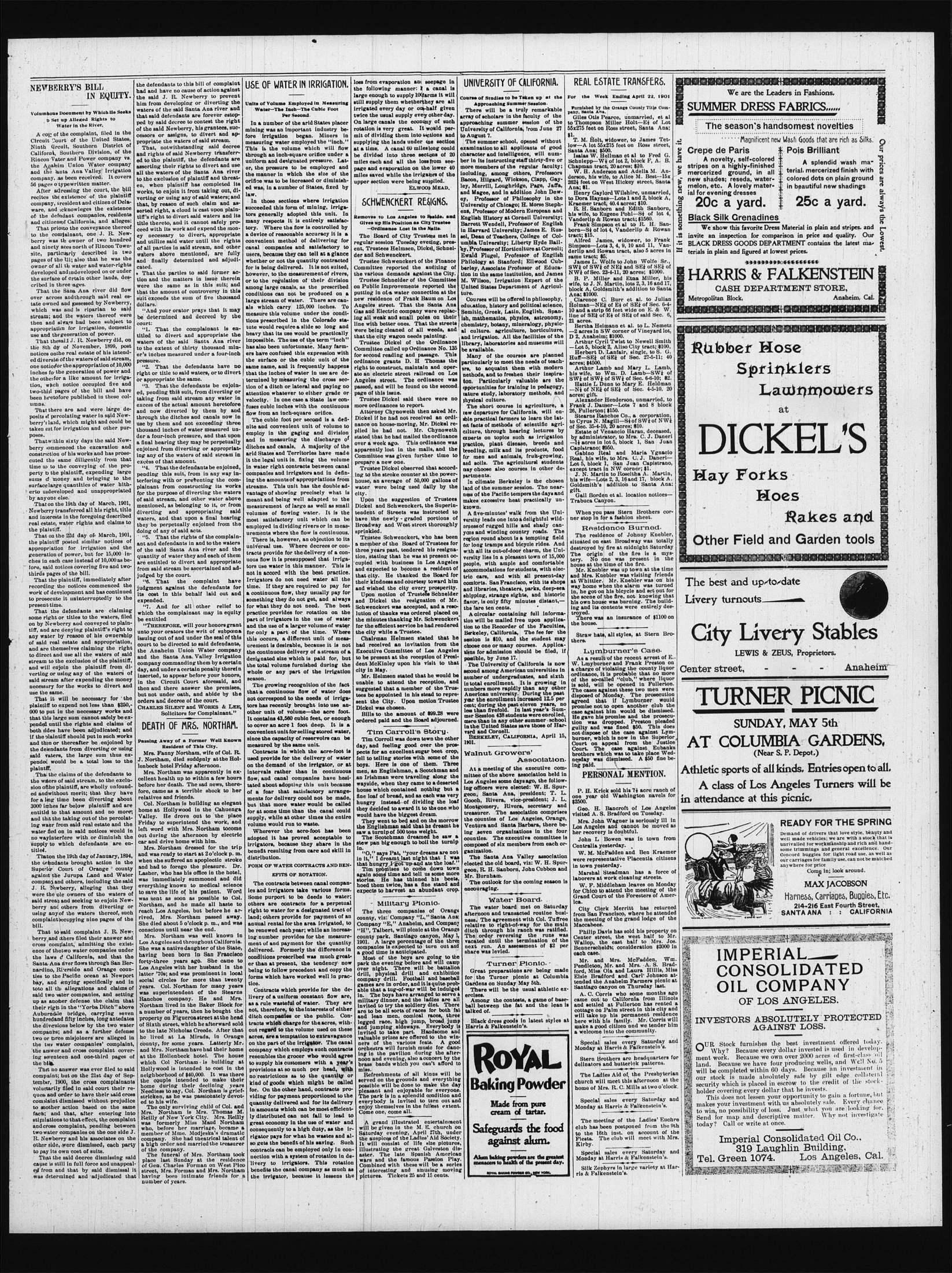
Searchable text
NEWBERRY'S BILL IN EQUITY.
Volumous Document by Which He Seeks to Set up Alleged Rights to Water in the River.
A copy of the complaint, filed in the Circuit Court of the United States, Ninth Circuit, Southern District of California, Southern Division, of the Rincon Vater and Power company vs. the Anakim Union Water company and the Santa Ana Valley Irrigation company, as been received. It covers 56 pages of typewritten matter.
After addressing the court, the bill recites the existence of the plaintiff company, president and citizen of Delaware, and acknowledges the existence of the defendant companies, residents and citizens of California, and alleges:
That prioto the conveyance thereof to the complainant, one J. R. Newberry was the owner of two hundred and ninety acres north of Rincon Townsite, particularly described in two pages of the bill; also that he was the owner of all the water and water-rights developed and developed on or under the surface of certain other lands, described in three ages.
That the Santa Ana river did flow over across and through said real estate owned and possessed by Newberry, which was and is riparian to said stream; and the waters thereof were then and always had been subject to appropriation for irrigation, domestic use and the generation of power.
That the said J. R. Newberry did, on the 8th day of November, 1899, post notices on the real estate of his intended diversion of the waters of said stream, one notice or the appropriation of 10,000 inches to the generation of power and the other for a like amount for irrigation, which notice occupied five and two-third pages of the bill and have been heetefore published in these columns.
That there are and were large deposits of percolating water in said Newberry's land, which might and could be taken out for irrigation and other purposes.
That within sixty days the said Newberry commenced the excavation and construction of his works and has prosecuted the same diligently from that time to the conveying of the property to the plaintiff, expending large defendants to this bill of complaint had and have no cause of action against the said J. R. Newberry to prevent him from developing or diverting the waters of the said Santa Ana river and that said defendants are forever estopped by said decree to contest the right of the said Newberry, his grantees, successors or assigns, to divert and appropriate the waters of said stream.
That, notwithstanding said decree and rights of said Newberry transferred to the plaintiff, the defendants are asserting their rights to divert and use all the waters of the Santa Ana river to the exclusion of plaintiff and threaten, when plaintiff has completed its works, to enjoin it from taking out, diverting or using any of said waters; and that, by reason of such claim and asserted right, a cloud is cast upon plaintiff's right to divert said waters and its title thereto, and it cannot safely proceed with its work and expend the money necessary to divert, appropriate and utilize said water until the rights of all parties in said stream, and other waters above mentioned, are fully and finally determined and adjudicated.
That the parties to said former action and the matters in issue therein were the same as in this suit; and that the amount of controversy in this suit exceeds the sum of five thousand dollars.
"And your orator prays that it may be determined and decreed by the court:
1. That the complainant is entitled to divert and appropriate the waters of the said Santa Ana river to the extent of thirty thousand miner's inches measured under a four-inch pressure.
2. That the defendants have no right or title to said waters, or to divert or appropriate the same.
3. That the defendants be enjoined, pending this suit, from diverting or taking from said stream any water in excess of the actual amount heretofore and now diverted by them by and through the ditches and canals now in use by them and not exceeding three thousand inches of water measured under a four-inch pressure, and that upon a final hearing they may be perpetually enjoined from diverting or appropriating any of the waters of said stream in excess of that amount.
4. That the defendants be enjoined, pending this suit, from in any way in use of water in irrigation."
USE OF WATER IN IRRIGATION.
Units of Volume Employed in Measuring Water—The Inch—The Cubic Foot Per Second.
In a number of the arid States placer mining was an important industry before irrigation began. Miners in measuring water employed the "inch." This is the volume which will flow through an inch-square orifice under a uniform and designated pressure. Later, the pressure to be employed and the manner in which the size of the orifice was to be increased or diminished was, in a number of States, fixed by law.
In those sections where irrigation succeeded this form of mining, irrigators generally adopted this unit. In many respects it is entirely satisfactory. Where the flow is controlled by a device of reasonable accuracy it is a convenient method of delivering for canal companies and satisfactory to users because they can tell at a glance whether or not the quantity contracted for is being delivered. It is not suited, however, to the measurement of rivers, or to the regulation of their division among large canals, as the prescribed conditions can not be produced on a large stream of water. There are canals which carry 125,000 inches. To measure this volume under the conditions prescribed in the Colorado statute would require a slide so long and heavy that its use would be practically impossible. The use of the term "inch" has also been unfortunate. Many farmers have confused this expression with the surface or the cubic unit of the same name, and it frequently happens that the inches of water in use are determined by measuring the cross section of a ditch or lateral and paying no attention whatever to either grade or velocity. In one case a State law confuses cubic inches with the continuous flow from an inch-square orifice.
The cubic foot per second is a definite and convenient unit of volume to employ in the gaging and division and in measuring the discharge of ditches and canals. A majority of the arid States and Territories have made it the legal unit in fixing the volume in water right contracts between canal companies and irrigators and in defin-
That there are and were large deposits of percolating water in said Newberry's head, which might and could be taken out for irrigation and other purposes.
That within sixty days the said Newberry commenced the excavation and construction of his works and has prosecuted the same diligently from that time up to the conveying of the property to the plaintiff, expending large sums of money and bringing to the surface large quantities of water hitherto undeveloped and unappropriated by anyone else.
That on the 19th day of March, 1901, Newberry transferred all his right, title and interests in the foregoing described real estate, water rights and claims to the plaintiff.
That on the 22d day of March, 1901, the plaintiff posted similar notices of appropriation for irrigation and the generation of power, but for 15,000 inches in each case instead of 10,000 as before, said notices covering five and two-thirds pages of the bill.
That the plaintiff, immediately after recording the notices commenced the work of development and has continued to prosecute it uninterruptedly to the present time.
That the defendants are claiming some right or titles to the waters, filed on by Newberry and conveyed to plaintiff, and are denying plaintiff's right to any water by reason of his ownership of said real estate and appropriation, and are themselves claiming the right to direct and use all the waters of said stream to the exclusion of the plaintiff, and will enjoin the plaintiff from diverting or using any of the waters of said stream after expending the money necessary for the works to divert and use the same.
That it will be necessary for the plaintiff to expend not less than $250,000 to put in the necessary works and that this large sum cannot safely be expended until the rights and claims of both sides have been adjudicated; and if the plaintiff should put in such works and then or thereafter be enjoined by the defendants from diverting or using said waters, the large sum thus expended would be a total loss to the plaintiff.
That the claims of the defendants to the waters of said stream, to the exclusion of the plaintiff, are wholly unfounded and without merit; that they have for a long time been diverting about 3000 inches far below plaintiff and are entitled to that amount and no more; and that the taking out of the percolating water from said real estate and the water fled on in said notices would in no way interfere with or diminish the supply to which defendants are entitled.
That on the 19th day of January, 1894, the defendants brought action in the Superior Court of Orange county against the Jurupa Land and Water company and others, including the said J. R. Newberry, alleging that they were the sole owners of the waters of Newberry.
DEATH OF MRS. NORTHAM.
Passing Away of a Former Well Known Resident of This City.
Mrs. Fanny Northam, wife of Col. R. J. Northam, died suddenly at the Hollenbeck hotel Friday afternoon.
Mrs. Northam was apparently in excellent health up to within a few hours before her death. The sad news, therefore, came as a terrible shock to her relatives and friends.
Col. Northam is building an elegant home at Hollywood in the Cahuenga Valley. He drove out to the place Friday to superintend the work, and left word with Mrs. Northam to come out during the afternoon by electric car and drive home with him.
Mrs. Northam dressed for the trip and was ready to start at 2 o'clock p.m. when she suffered an apoplectic stroke and had to forego the pleasure. Dr. Lasher, who has his office in the hotel, was immediately summoned and did everything known to medical science to save the life of his patient. Word was sent as soon as possible to Col.
"3. That the defendants be enjoined, pending this suit, from diverting or taking from said stream any water in excess of the actual amount heretofore and now diverted by them by and through the ditches and canals now in use by them and not exceeding three thousand inches of water measured under a four-inch pressure, and that upon a final hearing they may be perpetually enjoined from diverting or appropriating any of the waters of said stream in excess of that amount.
"4. That the defendants be enjoined, pending this suit, from in any way interfering with or preventing the complainant from constructing its works for the purpose of diverting the waters of said stream, and other water above mentioned, as belonging to it, or from diverting and appropriating said waters, and that upon a final hearing they be perpetually enjoined from doing of any of said acts.
"5. That the rights of the complainant and defendants in and to the waters of the said Santa Ana river and the quantity of water they and each of them are entitled to divert and appropriate from said stream be ascertained and adjudged by the court.
"6. That the complaint have judgment against the defendants for its cost in this behalf laid out and expended.
"7. And for all other relief to which the complainant may in equity be entitled
"THEREFORE, will your honors grant unto your orators the writ of subpoena issuing out of and under the seal of this court to be directed to said defendants, the Anaheim Union Water company and the Santa Ana Valley Irrigation company commanding them by a certain day, and under a certain penalty therein inserted, to appear before your honors, in the Circuit Court aforesaid, and then and there answer the premises, but not under oath, and abide by the orders and decree of the court.
CHARLES SILENT AND WORKS & LEE,
Solicitors for Complainant."
DEATH OF MRS. NORTHAM.
Passing Away of a Former Well Knnown Resident of This City.
Mrs. Fanny Northam, wife of Col. R. J. Northam, died suddenly at the Hollenbeck hotel Friday afternoon.
Mrs. Northam was apparently in excellent health up to within a few hours before her death. The sad news, therefore, came as a terrible shock to her relatives and friends.
Col. Northam is building an elegant home at Hollywood in the Cahuenga Valley. He drove out to the place Friday to superintend the work, and left word with Mrs. Northam to come out during the afternoon by electric car and drive home with him.
Mrs. Northam dressed for the trip and was ready to start at 2 o'clock p.m. when she suffered an apoplectic stroke and had to forego the pleasure. Dr. Lasher, who has his office in the hotel, was immediately summoned and did everything known to medical science to save the life of his patient. Word was sent as soon as possible to Col.
"3. That the defendants be enjoined, pending this suit, from diverting or taking from said stream any water in excess of the actual amount heretofore and now diverted by them by and through the ditches and canals now in use by them and not exceeding three thousand inches of water measured under a four-inch pressure, and that upon a final hearing they may be perpetually enjoined from diverting or appropriating any of the waters of said stream in excess of that amount.
"4. That the defendants be enjoined, pending this suit, from in any way interfering with or preventing the complainant from constructing its works for the purpose of diverting the waters of said stream, and other water above mentioned, as belonging to it, or from diverting and appropriating said waters, and that upon a final hearing they be perpetually enjoined from doing of any of said acts.
"5. That the rights of the complainant and defendants in and to the waters of the said Santa Ana river and the quantity of water they and each of them are entitled to divert and appropriate from said stream be ascertained and adjudged by the court.
"6. That the complaint have judgment against the defendants for its cost in this behalf laid out and expended.
"7. And for all other relief to which the complainant may in equity be entitled
"THEREFORE, will your honors grant unto your orators the writ of subpoena issuing out of and under the seal of this court to be directed to said defendants, the Anaheim Union Water company and the Santa Ana Valley Irrigation company commanding them by a certain day, and under a certain penalty therein inserted, to appear before your honors, in the Circuit Court aforesaid, and then and there answer the premises, but not under oath, and abide by the orders和 decree ofthe court.
CHARLES SILENT AND WORKS & LEE,
Solicitors for Complainant."
DEATH OF MRS. NORTHAM.
Passing Away of a Former Well Knnown Resident of This City.
Mrs. Fanny Northam, wife of Col. R. J. Northam, died suddenly at the Hollenbeck hotel Friday afternoon.
Mrs. Northam was apparently in excellent health up to within a few hours before her death. The sad news, therefore, came as a terrible shock to her relatives and friends.
Col. Northam is building an elegant home at Hollywood in the Cahuenga Valley. He drove out to the place Friday to superintend the work, and left word with Mrs. Northam to come out during the afternoon by electric car and drive home with him.
Mrs. Northam dressed for the trip and was ready to start at 2 o'clock p.m. when she suffered an apoplectic stroke and had to forego the pleasure. Dr. Lasher, who has his office in the hotel, was immediately summoned and did everything known to medical science to save the life of his patient. Word was sent as soon as possible to Col.
"3. That the defendants be enjoined, pending this suit, from diverting or taking from said stream any water in excess ofthe actual amount heretofore and now diverted by them by and through the ditches and canals now in use by them and not exceeding three thousand inches of water measured under a four-inch pressure, and that upon a final hearing they may be perpetually enjoined from diverting or appropriating any ofthe waters of said stream in excess of that amount.
"4. That the defendants be enjoined, pending this suit, from in any way interfering with or preventingthe complainant from constructing its works forthe purposeof divertingthe watersofsaidstream,andotherwaterabovementioned,theadertainmentandadjudgmentofthewatersofsaidstreaminexcessofthatamount."
"5. Thattherightsofthecomplaintanddefendantsinandtothewatersofsaidstreamareentitledtodivertingtothewatersofsaidstreamandotherwaterabovementioned,theadertainmentandadjudgmentofthewatersofsaidstreaminexcessofthatamount."
"6.Thatthecomplainthavejudgmentagainstthedefendantsforitscostinthisbelfrontlaidoutandexpended."
"7.Andforallotherrelieftowhichthecomplaintmayinuexpertlybeentitled"
"Thethereis,hhowever,theobjectiontoitsuniversaluse.WheredefreesorcontractsprovideforyethedeliveryofacousflowitistpresupposedthatirrigatorsusewaterinthismannerThisisnotaccordwiththebestpractice.IrrigatorsdonotneedwaterallthetimeIftheyarerequiredtopayforacontinuousflow,theyusuallypayfor somethingtheydonotget,andalwaysforwhattheydonotneed.Thebestpracticeprovidesforrotationonthepartifirigatorsintheuseofwaterandtheuseofa largervolumeofwateronlyapartialmenteasmeantandbeingwelladaptedtothemeasurementisdesirable,becauseitisnotthecontinuousdeliveryofacousflowofa designatedsizewhichispaidforbut,thetotalvolumefurnishedduringthewholeoranypartoftheirigationseason."
The growing recognitionofthefactthatacontinuousflowofwaterdoesnotcorrespondtotheneedsofirrigatorshasreallybroughtintouseanotherunitofvolume—theacrefootItcontains43,560cubicfeet,或enoughtocoveranacre1footdeepItisa convenientunitforsellingstoredwater,sincethecapacityoffresherverscanbemeasuredbythesameunit."
Contractsinwhichtheacre-footisusedprovidefordeliveryofwateronthedemandoftheirigator.oratintervalsrather thanincontinuousflow,andcanalcompanieshavehesitatedabout adoptingthisunitbecauseofafearthatsatisfactoryarrangementsfordeliverycouldnotbemade,但thatmore水 would be calledforatsometimethanthe canal couldsupply,而atothertimesthe entirevolumewouldruntowaste."
Wherevertheacre-foothasbeenadoptedithasprovedacceptabletoirrigators,becausetheyshareinbenefitresultingfromcareandskillindistribution."
FORMOFWATERCONTRACTSANDBENEFITSOFROTATION.
Thecontractbetweencanalcompaniesandirrigatorstakevariousforms.Somepurporttobeusedtowater;
for a long time been diverting about 3000 inches far below plaintiff and are entitled to that amount and no more; and that the taking out of the percolating water from said real estate and the water fled on in said notices would in no way interfere with or diminish the supply to which defendants are entitled.
That on the 19th day of January, 1894, the defendants brought action in the Superior Court of Orange county against the Jurupa Land and Water company and others, including the said J. R. Newberry, alleging that they were the sole owners of the waters of said stream and seeking to enjoin Newberry and others from diverting or using any of the waters thereof, such complaint occupying nine pages of the bill.
That to said complaint J. R. Newberry and others filed their answer and cross complaint, admitting the existence of the two water companies under the laws of California, and that the Santa Ana river flows through San Bernardino, Riverside and Orange counties to the Pacific ocean at Newport bay, and enying specifically and in toto all the allegations and claims of said two water companies, and setting up as another defense the claim that their right in the "Yorba Ditch" above Auburndale bridge, carrying seven hundred and fifty inches, long autedates the diversions below by the two water companies; and as a further defense two or three misjoiners are alleged in the two water companies' complaint, the answer and cross complaint covering seventeen and one-third pages of the bill.
That no answer was ever filed to said complaint; but on the 21st day of September, 1900, the cross complainants voluntarily filed in said court their reques and order to have their said cross complaint dismissed without prejudice to another action based on the same facts; and that, after entering into stipulations to that effect, the complaint and cross complaint, pending between two water companies on the one side J. R. Newberry and his associates on the other side, were dismissed, each party to pay its own cost of suits.
That the said decree dismissing said cause is still in full force and unappealed from and that by said dismissal it was determined and adjudicated that
Col. Northam is building an elegant home at Hollywood in the Cahuenga Valley. He drove out to the place Friday to superintend the work, and left word with Mrs. Northam to come out during the afternoon by electric car and drive home with him.
Mrs. Northam dressed for the trip and was ready to start at 2 o'clock p.m. when she suffered an apoplectic stroke and had to forego the pleasure. Dr. Lasher, who has his office in the hotel, was immediately summoned and did everything known to medical science to save the life of his patient. Word was sent as soon as possible to Col. Northam, and he made all haste to reach Los Angeles, but before he arrived, Mrs. Northam passed away. She died about 5 o'clock p.m., and was conscious until near the end.
Mrs. Northam was well known in Los Angeles and throughout California. She was a native daughter of the State, having been born in San Francisco forty-three years ago. She came to Los Angeles with her husband in the latter '70s; and was prominent in local social circles for more than twenty years. Col. Northam for many years was superintendent of the Stearns Ranchos company. He and Mrs. Northam lived in the Baker Block for a number of years, then he bought the property on Figueroa street at the head of Sixth street, which he afterward sold to the late Nicholas Creede. After that he lived at La Mirada, in Orange county, for some years. Latterly Mr. and Mrs. Northam have had their home at the Hollenbeck hotel. The house which Col Northam is building at Hollywood is intended to cost in the neighborhood of $40,000. It was there the couple intended to make their home during their declining years Needless to say, Col. Northam is grief stricken, as he was passionately devoted to his wife.
The only surviving child of Col. and Mrs. Northam is Mrs. Thomas M. Reilly of New York City. Mrs. Reilly was formerly Miss Maud Northam who, before her marriage, became a member of Mme Modjeska's dramatic company. She had theatrical talent of a high order and married the treasurer of the company.
The funeral of Mrs. Northam took place last Sunday at the residence of Gen. Charles Forman on West Pico street, Mrs. Forman and Mrs. Northam having been intimate friends for a number of years.
The contracts between canal companies and irrigators take various forms. Some purport to be deeds to water; others are contracts for a perpetual right to water for a designated tract of land; others provide for payment of an annual rental for the area irrigated, to be renewed each year; while an increasing number provides for the measurement of and payment for the quantity delivered. Formerly the difference in conditions prescribed was much greater than at present, the tendency now being to follow precedent and copy the forms which have worked well in practice.
Contracts which provide for the delivery of a uniform constant flow are, as a rule wasteful of water. They are not, therefore, to the interests of either ditch companies or the public. Contracts which charge for the acres, without regard to the volume used on these acres, are a temptation to extravagance on the part of the irrigator. The canal company which employs such contracts resembles the grocer who would agree to supply his customers with a year's provisions at so much per head, with no restrictions as to the quantity or kind of goods which might be called for. On the other hand, contracts providing for payment proportioned to the quantity delivered and for its delivery in amounts which can be most efficiently distributed cannot fail to lead to great economy in the use of water and consequently to a high duty, as the irrigator pays for what he wastes and also gets the benefit of his saving. Such contracts can be employed only in connection with a system of rotation in delivery to irrigators. This rotation benefits the canal company as much as the irrigator, because it lessens the
WATER IN IRRIGATION.
Home Employed in Measuring the Inch—The Cubic Foot Per Second.
For of the arid States placer an important industry beion began. Miners in water employed the "inch." volume which will flow inch-square orifice under a designated pressure. Latitude to be employed and on which the size of the be increased or diminish number of States, fixed by sections where irrigation is form of mining, irrigally adopted this unit. In it is entirely satisfactory the flow is controlled by reasonable accuracy it is a method of delivering for canles and satisfactory to use they can tell at a glance not the quantity contracted delivered. It is not suited, the measurement of rivers, regulation of their division canals, as the prescribed cannot be produced on a scale of water. There are cannary 125,000 inches. To volume under the condition in the Colorado state require a slide so long and as use would be practically the use of the term "inch" unfortunate. Many farm-fused this expression with or the cubic unit of the land it frequently happens of water in use are demeasuring the cross section or lateral and paying no greater to either grade or one case a State law concludes with the continuous inch-square orifice.
Foot per second is a deficient unit of volume to the gaging and division ensuring the discharge of canals. A majority of the and Territories have made unit in fixing the volume that contracts between canal and irrigators and in defin-
loss from evaporation and seepage in the following manner: I a canal is large enough to supply 100 farms it will still supply them whether they are all irrigated every day or on-half given twice the usual supply every other day. On large canals the economy of such rotation is very great. It would permit dividing them into sections and supplying the lands under one section at a time. A canal 60 miles long could be divided into three sections of 20 miles each and all the loss from seepage and evaporation on the lower 40 miles saved while the irrigators of the upper section were being supplied.
ELWOOD MEAD.
SCHWENCKERT RESIGNS.
Removes to Los Angeles to Reside, and Gives up His Position as City Trustee — Ordinance Lost in the Nails.
The Board of City Trustees met in regular session Tuesday evening, present, Trustees Helmsen, Dickel, Schneider and Schwenckert.
Trustee Schwenckert of the Finance Committee reported the auditing of the various demands against the City.
Trustee Schneider of the Committee on Public Improvements reported the putting in of a water connection at the new residence of Frank Baum on Los Angeles street. That the Santa Ana Gas and Electric company were replacing all weak and small poles on their line with better ones. That the streets were being cleaned of all weeds, and that the city wagon needs painting.
Trustee Dickel of the Ordinance Committee called up Ordinance No. 135 for second reading and passage. This ordinance grants D. H Thomas the right to construct, maintain and operate an electric street railroad on Los Angeles street. The ordinance was passed, and will be found on the second page of this issue.
Trustee Dickel said there were no more ordinances to report.
Attorney Chynoweth then asked Mr. Dickel if he had not received an ordinance on house-moving, Mr. Dickel replied he had not. Mr. Chynoweth stated that he had mailed the ordinance over a week ago. This ordinance was apparently lost in the mails, and the Committee was given further time to prepare a new one.
Trustee Dickel observed that according to the stroke counter at the power-
UNIVERSITY OF CALIFORNIA.
Course of Studies to be Taken up at the Approaching Summer Session.
There will be a truly remarkable array of scholars in the faculty of the approaching summer session of the University of California, from June 27 to August 7.
The summer school, opened without examination to all applicants of good character and intelligence, will number in its instructing staff thirty-five or more members of the regular faculty; including, among others, Professors Bacon, Hilgard, Wickson, Clapp, Gayley, Merrill, Loughridge, Page, Jaffa, and Magee, and in addition John Dewey, Professor of Philosophy in the University of Chicago; H. Morse Stephens, Professor of Modern European and English History at Cornell University; Barrett Wendell, Professor of English in Harvard University; James E. Russell, Dean of Teachers, College of Columbia University; Liberty Hyde Bailey, Professor of Horticulture at Cornell; Ewald Flugel, Professor of English Philology at Stanford; Ellwood Cubley, Associate Professor of Education in the same institution, and James M. Wilson, Irrigation Expert of the United States Department of Agriculture.
Courses will be offered in philosophy, education, history and political science, Semitic, Greek, Latin, English, Spanish, mathematics, physics, astronomy, chemistry, botany, mineralogy, physical culture, agriculture, horticulture, and irrigation. All the facilities of the library, laboratories and museums will be available.
Many of the courses are planned particularly to meet the needs of teachers, to acquaint them with modern methods, and to freshen their inspiration. Particularly valuable are the opportunities for training in pedagogy, nature study, laboratory methods, and physical culture.
The short course in agriculture, a new departure for California, will enable practical farmers to learn the latest facts of methods of scientific agriculture through hearing lectures by experts on topics such as irrigation practice, plant disease, breeds and breeding, milk and its products, food for men and animals, fruit-growing, aid soils. The agricultural students may choose also courses in other departments.
REAL ESTATE TRANSFERS.
For the Week Ending April 22, 1901
Furnished by the Orange County Title Company, Santa Ana.
Giles Otis Pearce, unmarried, et al to Thompson Miller Holt—E† of Lot 55x275 feet on Ross street, Santa Ana; $1.
T. M. Holt, widower, to James Tetlow—A lot 55x275 feet on Ross street, Santa Ana; $500.
Isalas W. Hellman et al to Fred G. Schniepp—W† of lot 2, block F, A. B. Chapman tract, 20 acres; $10.
W. H. Anderson and Adella M. Anderson, his wife, to Alice M. Best—15x262‡ feet on West Hickey street, Santa Ana; $1.
Henry Gaylord Wilshire, unmarried to Dora Haynes—Lots 1 and 2, block A, Kraemer tract, 40.4 acres; $10.
R. H. Sanborn and Edith Sanborn his wife, to Eugene Pohl—S‡ of lot 4, Vanderlip & Rowan tract; $1560.
Frank Simpson et al to R. H. Sanborn—S‡ of lot 4, Vanderlip & Rowan tract; $15.
Alfred James, widower, to Frank Simpson—Lots 3, 4, 9, 10 and 11, Vanderlip and Rowan tract; also 5 acres in same tract; $5.
James L. Wolfe to John Wolfe Sr., SW‡ of SW‡ of NE‡ and SE‡ of SE‡ of NW‡ Sec. 23-4-11, 20 acres; $1000.
B. P. Miller and Etna Miller his wife, to J. N. Martin lots 2, 3, 16 and 17 block A, Goldsmith's addition to Santa Ana; $1000.
Clarence C. Burr et al. to Julian Holman—NE‡ of E‡ of SE‡ of Sec. 6-4-10 and a strip 66 feet wide on E. & W.line of SE‡ of E‡ of SE‡ of said Sec. 6,
21 acres.
Bertha Heimann et al. to L. Nemetz—2 acres in SW corner of Vineyard lot,
D 2, Anaheim; $1000.
Arthur Cyril Twist to Newell Smith—Lot 5 block 2, Aliso City tract; $100.
Herbert D. Lanfair single to S. G.Huff—SE‡ of SE‡ of Sec. 27-5-11; 40 acres; $4500.
Arthur Lamb and Mary L. Lamb his wife, to Wm. D. Lamb—SW‡ of SW‡ of Sec. 6-6-10; $2.
Hattie L Dunn to Mary E. Heldman—N‡ of NE‡ of SE‡ of Sec. 4-5-10; 20 acres; gift.
Alexander Henderson unmarried, to Frank J. Dauser—Lots 7 and 8 block 26,Fullerton;$150.
Stearns Ranchos Co., a corporation to Cyrus N. Magill—S‡ of SW‡ of NW‡ Sec. 35-4-10; 20 acres; $10.
Estate of Venancio Haran deceased by administrator to Mrs. C. J.Daneri—1¼ acres in lot 5 block 1,San Juan Capistrano;$950.
Gabino Real and Maria Ygnacio Real his wife to Mrs.C.J.Daneri—Lot 5 block 1,San Juan Capistrano except tract in NW corner;$1.
J.N.Martin to Roselia A.Martin
recognition of the fact
unconscious flow of water does not lead to the needs of irrigation brought into use of volume—the acre foot, 3,560 cubic feet, or enough acre 1 foot deep. It is a unit for selling stored water, capacity of reservoirs can be the same unit.
In which the acre-foot is used for the delivery of water and of the irrigator, or at another than in continuous canal companies have hesitating this unit because that satisfactory arrangement could not be made; more water would be called time than the canal could be at other times the entire field run to waste.
The acre-foot has been proved acceptable to because they share in the letting from care and skill in water contracts between canal companiators take various forms. It is to be deeds to water;
foot per second is a deficient unit of volume to the gaging and division ensuring the discharge of canals. A majority of the and Territories have made it in fixing the volume that contracts between canal and irrigators and in definitions of appropriations from this unit has the double adjoining precisely what is being well adapted to the cost of large as well as small flowing water. It is the factory unit which can be divided rivers or in measure where the flow is continuous, however, an objection to its location. Where decrees or conditions for the delivery of a consensuated presupposed that irrigation in this manner. This is with the best practice. Do not need water all the way they usually pay for they do not get, and always do not need. The best provides for rotation on the actors in the use of water of a larger volume of water part of the irrigation recognition of the fact unconscious flow of water does not lead to the needs of irrigation brought into use of volume—the acre foot, 3,560 cubic feet, or enough acre 1 foot deep. It is a unit for selling stored water, capacity of reservoirs can be the same unit.
Tim Carroll's Story.
Tim Corroll was down town the other day, and feeling good over the prospects for an excellent sugar beet crop, fell to telling stories with some of the boys. Here is one of them. Three men, an Englishman, a Scotchman and an Irishman were traveling along the wayside, when they came to a deserted house which contained nothing but a fine loaf of bread, and as each was very hungry instead of dividing the loaf they decided to award it to the one who would have the biggest dream.
They went to bed and on the morrow the Englishman said that he dreamt he saw a turnip of 500 tons weight.
The Scotchman dreamed he saw a stew pan big enough to boil the turnip in.
"O," says Pat, "your dreams are not in it," I dreamt last night that I was that hungry I got up and ate the loaf."
Tim promises to come down town again some time and tell us some more stories. He has thinned his beets, hoed them twice, has a fine stand and expects to harvest an abundant crop.
Attorney Chynoweth then asked Mr. Dickel if he had not received an ordinance on house-moving, Mr. Dickel replied he had not. Mr. Chynoweth stated that he had mailed the ordinance over a week ago. This ordinance was apparently lost in the mails, and the Committee was given further time to prepare a new one.
Trustee Dickel observed that according to the stroke counter at the power-house, an average of 50,000 gallons of water were being used daily by the city.
Upon the suggestion of Trustees Dickel and Schwenckert, the Superintendent of Streets was instructed to have the newly-graded portions of Broadway and West street thoroughly sprinkled.
Trustee Schwenckert, who has been a member of the Board of Trustees for three years past, tendered his resignation, stating that he was at present occupied with business in Los Angeles and expected to become a resident of that city. He thanked the Board for their kindness and courtesy toward him and wished the city every prosperity.
Upon motion of Trustees Schneider and Dickel the resignation of Mr. Schwenckert was accepted, and a resolution of thanks was ordered placed on the minutes thanking Mr. Schwenckert for the efficient service he had rendered the city while a Trustee.
Chairman Helmsen stated that he had received an invitation from the Executive Committee of Los Angeles to be present at the reception of President McKinley upon his visit to that city in May.
Mr. Helmsen stated that he would be unable to attend the reception, and suggested that a member of the Trustees be appointed in his stead to represent the City. Upon motion Trustee Dickel was chosen.
Bills to the amount of $99.28 were ordered paid and the Board adjourned.
Tim Carroll's Story.
Tim Corroll was down town the other day, and feeling good over the prospects for an excellent sugar beet crop, fell to telling stories with some of the boys. Here is one of them. Three men, an Englishman, a Scotchman and an Irishman were travelling along the wayside, when they came to a deserted house which contained nothing but a fine loaf of bread, and as each was very hungry instead of dividing the loaf they decided to award it to the one who would have the biggest dream.
They went to bed and on the morrow the Englishman said that he dreamt he saw a turnip of 500 tons weight.
The Scotchman dreamed he saw a stew pan big enough to boil the turnip in.
"O," says Pat, "your dreams are not in it," I dreamt last night that I was that hungry I got up and ate the loaf."
Tim promises to come down town again some time and tell us some more stories. He has thinned his beets, hoed them twice, has a fine stand and expects to harvest an abundant crop.
The short course in agriculture, a raw departure for California, will enable practical farmers to learn the latest facts of methods of scientific agriculture through hearing lectures by experts on topics such as irrigation practice, plant disease, breeds and breeding, milk and its products, food for men and animals, fruit-growing, and soils. The agricultural students may choose also courses in other departments.
In climate Berkeley is the chosen land of the summer session. The nearness of the Pacific temperates days and makes excessive heat practically unknown.
A five-minutes' walk from University leads one into a delightful wilderness of rugged hills and shady canyons and winding country roads. The region round about is a tempting field for long tramps and bicycle rides. And with all its out-of-door charm, the University lies in a pleasant town of 15,000 people, with ample and comfortable accommodations for students, with electric cars, and with all present-day comforts. San Francisco, with its shops and libraries, theater parks, deep-sea shipping, strange sights, and historic flavor, is only fifty minutes distant—the fare ten cents.
A circular containing full information will be mailed free upon application to the Recorder of the Faculties, Berkeley, California. The fee for the session is $10, and the student may choose one or many courses. Applications for admission should be filed, if possible, by June 17.
The University of California is now second among American universities in number of undergraduate degrees, and sixth in total enrollment. It is growing in numbers more rapidly than any other American university. During the past year the enrollment increased 12.5 per cent; during the past eleven years, no less than fivefold. In last year's Summer Session 438 students were enrolled more than in any other summer school in the United States save those of Harvard and Cornell.
BERKELEY, CALIFORNIA, April 15, 1901.
Walnut Growers'
Association.
At a meeting of the executive committee of the above association held in Los Angeles some days ago, the following officers were elected: W. H. Spurgeon, Santa Ana, president; T. L. Gooch, Rivera, vice-president; J. L. Montgomery, Rivera, secretary and treasurer. The association comprises the counties of Los Angeles, Orange, Ventura and Santa Barbara, there being seven organizations in four counties. The executive committee is composed of six members from each organization.
The Santa Ana Valley association elected the old board, viz: W. H. Spurgeon, R. H. Sanborn, John Cubbon and Mr. Burnham.
The outlook for the coming season is encouraging.
Victor Board
P. H. Krick sold his 7½ acres ranch on one year old Washington navels for $2500.
Geo. H. Bancroft of Los Angeles visited A. S. Bradford on Tuesday.
Mrs. John Wagner is seriously ill in Los Angeles and cannot be moved after her recovery is doubtful.
John L Bowen was in town from Centralia yesterday.
W. M. McFadden and Ben Kraeme were representative Placentia citizen in town yesterday.
Marshal Steadman has a force of laborers at work cleaning streets.
W. F. Middleham leaves on Monday for Chico to attend the meeting of the Grand Court of the Foresters of America
WATER CONTRACTS AND BENEFITS OF ROTATION.
A contract between canal companies take various forms. It must be deeds to water; contracts for a perpetual power for a designated tract of land provide for payment of an annual fee; the area irrigated, to reach year; while an increase provides for the measurement of payment for the quantity. Formerly the difference in prescribed was much greater, the tendency now follows precedent and copy the same have worked well in practice which provide for the deniform constant flow are wasteful of water. They are rare, to the interests of either canies or the public. Connexion charge for the acres, with so the volume used on these temptation to extravagance of the irrigator. The canal which employs such contracts the grocer who would agree his customers with a year's rent so much per head, withrons as to the quantity or kinds which might be called by other hand, contracts pro-payment proportioned to the delivered and for its delivery which can be most efficient can not fall to lead toomy in the use of water and only to a high duty, as the irrigator for what he wastes and al-benefit of his saving. Such can be employed only in conjunction a system of rotation in desirigators. This rotation the canal company as much asATOR, because it lessens the hungry instead-of dividing the loaf they decided to award it to the one who would have the biggest dream.
They went to bed and on the morrow the Englishman said that he dreamt he saw a turnip of 500 tons weight.
The Scotchman dreamed he saw a stew pan big enough to boil the turnip.
"O," says Pat, "your dreams are not in it." I dreamt last night that I was that hungry I got up and ate the loaf."
Tim promises to come down town again some time and tell us some more stories. He has thinned his beets, hoed them twice, has a fine stand and expects to harvest an abundant crop.
Military Plionic.
The three companies of Orange county, viz: Company "L," Santa Ana Company "E," Anaheim, and Company "H", Talbert, will plionic at the Orange county park, Santiago canyon, May 1, 1901. A large percentage of the three companies is expected to turn out and a good time is anticipated.
Most of the boys are going to the park the evening before and will camp over night. There will be battalion drill, physical drill and exhibition company drill. Football and baseball games are in order, and it is quite probable that a tug-of-war will be indulged in. The boys have arranged to serve a military dinner, and the ladies are all invited to try the soldiery diet. There are to be all sorts of races for both fat and lean men, comical races, three legged race, high jump, broad jump and jumping sideways. Everybody is invited to take part. Handsome and valuable prizes are offered to the winners of the various feats. A good orchestra will furnish music for dancing in the pavilion during the afternoon and evening; also a concert by the brass bands which you can't afford to miss.
Refreshments of all kinds will be served on the grounds and everything possible will be done to make the day pleasant and enjoyable for everyone. The park is in a splendid condition and everybody is invited to turn out and enjoy themselves in the fullest extent. Come one, come all.
A grand illustrated entertainment will be given in the M.E. church on Saturday evening, April 27th, under the auspices of the Ladies' Aid Society. It will consist of life size pictures, illustrating the great Galveston disaster. The late Spanish American wars and the famous Passion Play. Combined with these will be a series of interesting and amusing moving pictures. Tickets 25 and 15 cents.
Water Board.
The water board met on Saturday afternoon and transacted routine business. The agreement with Col. Tuffree relative to right-of-way for the main ditch through his ranch was ratified. The order reversing the runs was vacated until the termination of the next run. An assessment of $2 per share was levied.
Turner Plionic.
Great preparations are being made for the Turner plionic at Columbia Gardens on Sunday May 5th.
There will be the usual athletic exercises.
Among the contests, a game of baseball between the fat and the lean is talked of.
Black dress goods in latest styles at Harris & Falkenstein's.
ROYAL Baking Powder
Made from pure cream of tartar.
Safeguards the food against alum.
Alum baking powders are the greatest menacers to health of the present day.
Geo. H. Bancroft of Los Angeles visited A. S. Bradford on Tuesday.
Mrs. John Wagner is seriously ill in Los Angeles and cannot be moved after her recovery is doubtful.
John L Bowen was in town from Centralia yesterday.
W. M. McFadden and Ben Kraemer were representative Placentia citizen in town yesterday.
Marshal Steadman has a force of laborers at work cleaning streets.
W. F. Middleham leaves on Monday for Chico to attend the meeting of the Grand Court of the Foresters of America.
City Clerk Merritt has returned from San Francisco, where he attended the meeting of the grand lodge of the Maccabees.
Philip Davis has sold his property on Center street, the west half to Mrs. Wallop, the east half to Mrs. Jojn Bennerscheldt; consideration $2000 for each case.
Mr. and Mrs. McFadden, Wm Pendleton, Mr. and Mrs. A.S.Bradford, Miss Ola and Laura Hillis, Miss Elsie Bradford and Carl Johnson attended the Anaheim Farmers picnic at Santiago canyon on Thursday last.
A.C.Corris who some months ago came out to California from Illinois and settled at Fullerton has rented cottage on Palm street in this city and will take up his permanent residence here with his family. Mr. Corris will make a good citizen and we tender him a welcome into the community.
Special sales every Saturday and Monday at Harris & Falkenstein's.
Stern Brothers are headquarters for delinators and butterick patterns.
The Ladies Aid of the Presbyterian church will meet this afternoon at home of Mrs.R.C.Mills at two o'clock.
Special sales every Saturday and Monday at Harris & Falkenstein's.
Silk Zephyrs in large variety at Harris & Falkenstein's.
We are the Leaders in Fashions.
SUMMER DRESS FABRICS...
The season's handsomest novelties
Magnificent new Wash Goods that are rich as Silks.
Crepe de Paris
A novelty, self-colored stripes on a highly-finished mercerized ground, in all new shades; reseda, watermelon, etc. A lovely material for evening dresses
20c a yard.
25c a yard.
Black Silk Grenadines
We show this favorite Dress Material in plain and stripes, and invite an inspection for comparison in price and quality. Our BLACK DRESS GOODS DEPARTMENT contains the latest materials in plain and figured at lowest prices.
HARRIS & FALKENSTEIN
CASH DEPARTMENT STORE,
Metropolitan Block,
Anaheim, Cal.
Rubber Hose
Sprinklers
Lawnmowers
at
DICKEL'S
Lawnmowers at
DICKEL'S
Hay Forks
Hoes
Rakes and
Other Field and Garden tools
The best and up-to-date
Livery turnouts
City Livery Stables
LEWIS & ZEUS, Proprietors.
Center street, Anaheim
TURNER PICNIC
SUNDAY, MAY 5th
AT COLUMBIA GARDENS,
(Near S. P. Depot.)
Athletic sports of all kinds. Entries open to all.
A class of Los Angeles Turners will be in attendance at this picnic.
READY FOR THE SPRING
Demand of drivers that love style, beauty and well made vehicles; we are with a stock that is unrivalled for workmanship and rich and handsome trimmings and general excellence. Our Concord buggies for light road use, as well as our carriages for family use, can not be matched anywhere for price.
Come in; look around.
MAX JACOBSON
Harness, Carriages, Buggies, Etc.
READY FOR THE SPRING
Demand of drivers that love style, beauty and well made vehicles; we are with a stock that is unrivalled for workmanship and rich and handsome trimmings and general excellence. Our Concord buggies for light road use, as well as our carriages for family use, can not be matched anywhere for price.
Come in; look around.
MAX JACOBSON
Harness, Carriages, Buggies, Etc.
214-216 East Fourth Street,
SANTA ANA : CALIFORNIA
IMPERIAL CONSOLIDATED OIL COMPANY
OF LOS ANGELES.
INVESTORS ABSOLUTELY PROTECTED AGAINST LOSS.
OUR Stock furnishes the best investment offered today.
Why? Because every dollar invested is used in development work. Because we own over 2000 acres of first-class oil land. Because we have four producing wells, and Well No.5 will be completed within 60 days. Because an investment in our stock is made absolutely safe by gilt edge collateral security which is placed in escrow to the credit of the stock-holder covering every dollar that he invests.
This does not lessen your opportunity to gain a fortune, but makes your investment with us absolutely safe. Every chance to win, no possibility of loss. Just what you are looking for. Send for map and descriptive matter. Why not investigate today? Call or write at once.
Imperial Consolidated Oil Co.,
319 Laughlin Building,
Tel. Green 1074. Los Angeles, Cal.