anaheim-gazette 1901-04-18
Scanned page
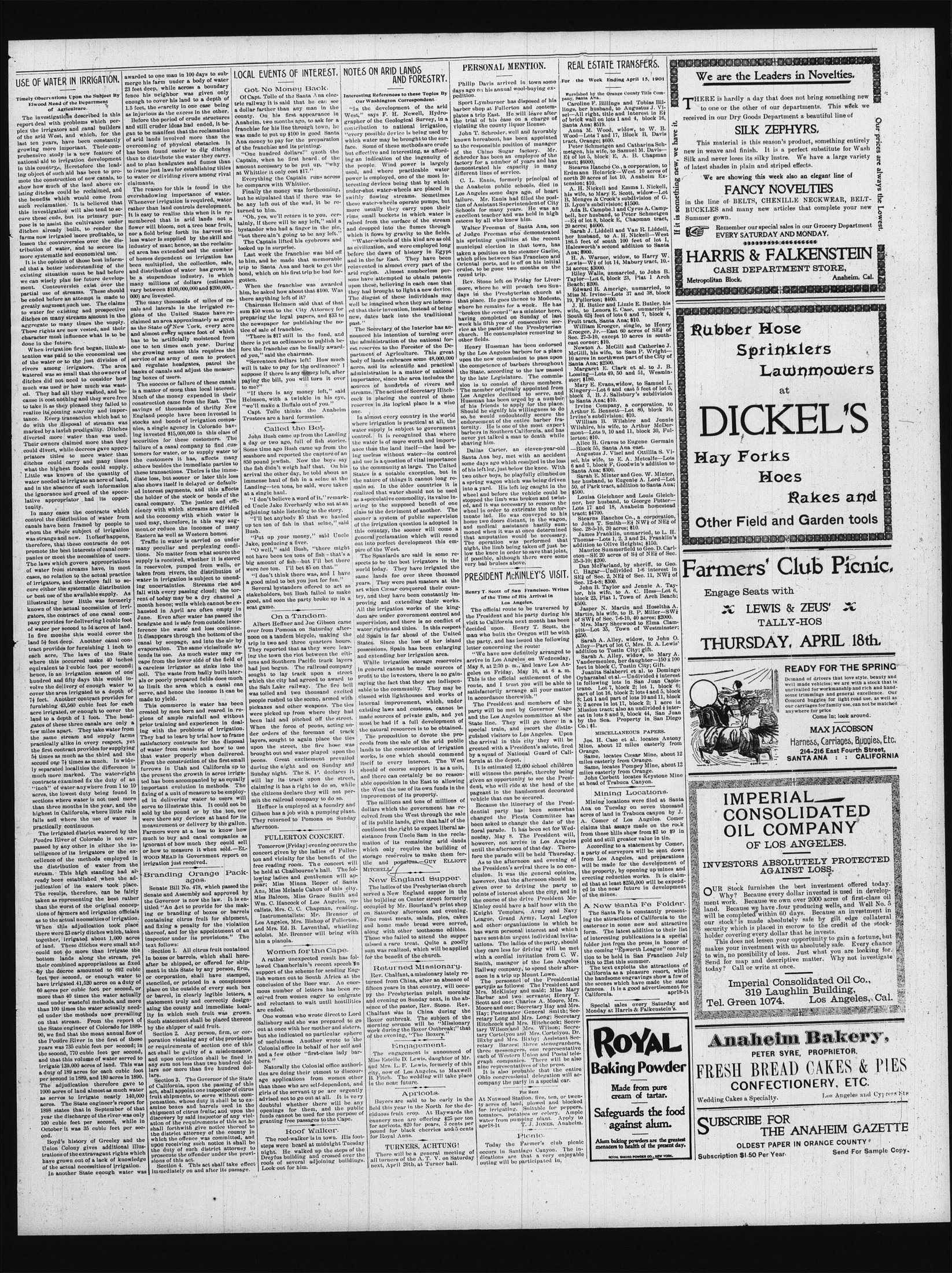
Searchable text
USE OF WATER IN IRRIGATION.
Timely Observations Upon the Subject By Elwood Mead of the Department of Agriculture.
The investigations described in this report deal with problems whichplex the irrigators and canal buildersof the arid West, and which,for thelast ten years, have been constantlygrowing more important. Theircomprehensive study is a new feature ofnational aid to irrigation developmentin this country. Heretofore theleading object of such aid has been topromote the construction of new canals,toshow how much of the land aboveexisting ditches could be reclaimed,andthe benefits which would come fromsuch reclamation. It is believed thatthis investigation will also tend tosecure these ends, but its primarypurpose is to assist the cultivators underditches already built, to render thefarms now irrigated more profitable, tolessen the controversies over thedistribution of water, and to secure itsmore systematic and economical use.
It is the opinion of those best informedthat a better understanding ofthe existing situation must be had beforewe can wisely plan for future development. Controversies exist overthe partial use of streams. These shouldbe ended before an attempt is made togreatly augment such use. The claimsto water for existing and prospectiveditches on many streams amount in theaggregate to many times the supply.These rights are now vested, and theircharacter must influence what is to bedone in the future.
When irrigation first began,littleattention was paid to the economicaluse of the water or to the just division ofrivers among irrigators. The areawatered was so small that the owners ofditches did not need to considerhow much was used or how much waswasted. They had all they wanted, andbecause it cost nothing and they were freeto take it as they pleased they failed torealize its coming scarcity and importance.Every transaction which had todo with the disposal of streams wasmarked by a lavish prodigality. Ditchesdiverted more water than was used.Their owners claimed more than theycould divert, while decrees gaveappropriator titles to more water thanditches could carry and many timeswhat the highest floods could supply.Little was known of the quantity ofawarded to one man in 100 days to submerge his farm under a body of water23 feet deep, while across a boundaryfence his neighbor was given onlyenough to cover his land to a depth of1.5 feet, the scarcity in one case beingas injurious as the excess in the other.
Before the period of crude structuresand still cruder ideas had ended,it began to be manifest that the reclamationof arid lands involved more than theovercoming of physical obstacles. Ithas been found easier to dig ditchesthan to distribute the water they carry,and to plan headgates and flumes thanto irame just laws for establishing titlesto water or dividing rivers among rivalclaimants.
The reason for this is found in theovershadowing importance of water.Whenever irrigation is required, waterrather than land controls development.It is easy to realize this when it isremembered that in arid lands not aflower will bloom, not a tree bear fruit,nor a field bring forth its harvest unlesswater is supplied by the skill andindustry of man; hence, as the reclaimedarea has extended and the numberof homes dependent on irrigation hasbeen multiplied, the collection, sale,and distribution of water has grown tobe a stupendous industry, in whichmany millions of dollars (estimatesvary between $100,000,000 and $200,000,-000) are invested.
The many thousands of miles ofcanals and laterals in the irrigatedregions of the United States havereclaimed an area approximately as greatas the State of New York, every acrealmost every square foot ofwhich has to be artificial moistenedfrom one to ten times each year.Duringthe growing season this requiresthe service of an army of men to protectand regulate headgates, patrolthe banks of canals and adjustthe measuringboxes of users.
The success or failure of these canalsis a matter of more than local interest.Much of the money expended in theirconstruction came from the East. Thesavings of thousands of thrifty NewEngland people have been investedin stocks and bonds of irrigation companies,a single agency in Colorado havinginvested $15,000,000 in this classofsecurities for these customers. Thefailure of a canal company to findcustomers for water, or to supply water tothe customers it has, affects manyothers besides the immediate parties tothese transactions. Theirs is the imme-
LOCAL EVENTS OF INTEREST.
Got No Money Back.
Of Capt. Tolle of the Santa Ana electric railway it is said that he can seea dollar farther than any man in thecounty. On his first appearance inAnaheim, two months ago, to ask for afranchise for his line through town,he was made to put up $100 in good Santa Ana money to pay for the preparationof the franchise and its printing.
"One hundred dollars!" quoththe Captain, when he first heard ofthe amount necessary to be put up, "whyat Whittier it only cost $17."
Everything the Captain runs acrosshe compares with Whittier.
Finally the money was forthcoming,but he stipulated that if there wasto be any left out of the wad, it bereturned to him.
"Oh, yes, we'll return it to you,certainly, If there will be any left," said abystander who had a finger in the pie,"but there ain't going to be any left."
The Captain lifted his eyebrowsand looked up in surprise.
Last week the franchise was bid offto him, and he made that memorabletrip to Santa Ana and back to getthe bond, which on his first trip he had forgotten.
When the franchise was awardedhim, he asked how about that $100. Wasthere anything left of it?
Chairman Helmsen said that of thatsum $50 went to the City Attorneyfor preparing the legal papers, and $33to the newspaper for publishing thenotice of sale of franchise.
"There is $17 still in the fund, andthere is yet an ordinance to publishbefore the franchise can be finally awardedyou," said the chairman.
"Seventeen dollars left! How muchwill it take to pay for the ordinance? Isuppose if there is any money left, afterpaying the bill, you will turn it overto me?"
"If there is any money left," saidHelmsen, with a twinkle in his eye,"we'll make a Buffalo out of you."
Capt. Tolle thinks the AnaheimTrustees are a hard formation.
Called the Bet.
John Bush came up from the Landinga day or two ago, full of fish stories.Some time ago Bush came up from theseashore and reported the captureof an850 pound jewfish. Now the boys saythe fish didn't weigh half that. On his arrival the other day, he told about an
watered was so small that the owner of ditches did not need to consider how much was used or how much was wasted. They had all they wanted, and because it cost nothing and they were free to take it as they pleased they failed to realize its coming scarcity and importance. Every transaction which had to do with the disposal of streams was marked by a lavish prodigality. Ditches diverted more water than was used. Their owners claimed more than they could divert, while decrees gave appropriators titles to more water than ditches could carry and many times what the highest floods could supply. Little was known of the quantity of water needed to irrigate an acre of land, and in the absence of such information the ignorance and greed of the speculative appropriator had its opportunity.
In many cases the contracts which control the distribution of water from canals have been framed by people to whom the whole subject of irrigation was strange and now. It often happens, therefore, that these contracts do not promote the best interests of canal companies or meet the necessities of users. The laws which govern appropriations of water from streams have, in most cases, no relation to the actual practice of irrigators, and therefore fail to secure either the systematic distribution or best use of the available supply. As illustrating how little was formerly known of the actual necessities of irrigators, the contract of one canal company provides for delivering 1 cubic foot of water per second to 54 acres of land. In five months this would cover the land 5½ feet deep. Another canal contract provides for furnishing 1 inch to each acre. The laws of the State where this occurred make 40 inches equivalent to 1 cubic foot per second; hence, in an irrigation season of one hundred and fifty days this would involve the delivery of enough water to cover the area irrigated to a depth of 7¼ feet. Another contract provides for furnishing 43,560 cubic feet for each acre irrigated, or enough to cover the land to a depth of 1 foot. The headgates of these three canals are only a few miles apart. They take water from the same stream and supply farms practically alike in every respect, yet the first contract provides for supplying 5¼ times as much as the third and the second one 7½ times as much. In widely separated localities the difference is much more marked. The water-right contracts examined fix the duty of an "inch" of water anywhere from 1 to 10 acres, the lowest duty being found in sections where water is not used more than three months in the year, and the highest in California, where little rain falls and where the use of water is practically continuous.
The irrigated district watered by the Poudre River of Colorado is not surpassed by any other in either the intelligence of its irrigators or the excellence of the methods employed in the distribution of water from the stream. This high standing had already been established when the adjudication of its waters took place. The results, therefore, can be fairly taken as representing the best rather
The success or failure of these canals is a matter of more than local interest. Much of the money expended in their construction came from the East. The savings of thousands of thrifty New England people have been invested in stocks and bonds of irrigation companies, a single agency in Colorado having invested $15,000,000 in this class of securities for these customers. The failure of a canal company to find customers for water, or to supply water to the customers it has, affects many others besides the immediate parties to these transactions. Theirs is the immediate loss, but sooner or later this loss also shows itself in delayed or defaulted interest payments, and this affects the holder of the stock or bonds of the canal company. The justice and efficiency with which streams are divided and the economy with which water is used may, therefore, in this way augment or reduce the incomes of many Eastern as well as Western homes.
Traffic in water is carried on under many peculiar and perplexing conditions. No matter from what source the supply is received, whether it is stored in reservoirs, pumped from wells, or taken from rivers, the distribution of water in irrigation is subject to unending uncertainties. Streams rise and fall with every passing cloud; the torrent of today may be a dry channel a month hence; wells which cannot be exhausted in April are often empty in June. Even after water has passed the headgate and is safe from outside interference the waste and loss continue. It disappears through the bottom of the canal by seepage, and into the air by evaporation. The same vicissitudes attend its use. As much water may escape from the lower side of the field of a careless irigator as sinks into the soil. The waste from badly built laterals or poorly prepared fields does much to limit the area which a canal can serve, and hence the income it can be made to yield.
This commerce in water has been created by men born and reared in regions of ample rainfall and without prior training and experience in dealing with the problems of irrigation. They had to learn by trial how to frame satisfactory contracts for the disposal of water from canals and how to use that water properly when delivered. From the construction of the first small furrows in Utah and California up to the present the growth in acres irrigated has been accompanied by an equally important evolution in methods. The fixing of a unit of measure to be employed in delivering water to users will serve to illustrate this. It could not be sold by the pound or by the ton, nor were there any devices at hand for its measurement or delivery by the gallon. Farmers were at a loss to know how much to buy and canal companies as ignorant of how much they could sell or how to measure it when sold.—ELWOOD MEAD in Government report on irrigation just received.
Branding Orange Packages.
Senate Bill No. 478, which passed the Senate and Assembly and approved by Congress.
Called the Bet.
John Bush came up from the Landing a day or two ago, full of fish stories. Some time ago Bush came up from the seashore and reported the capture of an 850 pound jewfish. Now the boys say the fish didn’t weigh half that. On his arrival the other day, he told about an immense haul of fish in a seine at the Landing—ten tons, he said, were taken at a single haul.
“I don’t believe a word of it,” remarked Uncle Jake Everhardy who sat at an adjoining table listening to the story.
“I’ll bet anybody $5 that we hauled up ten ton of fish in that seine,” said Bush.
“Put up your money,” said Uncle Jake, producing a fiver.
“O well,” said Bush, “there might not have been ten tons of fish—that’s a big amount of fish—but I’ll bet there were two ton. I’ll bet $5 on that.”
“I don't think there was, and I have a good mind to bet you just for fun.”
Several bystanders offered to act as stakeholders, but Bush failed to make good, and soon the party broke up in a scat game.
On a Tandem.
Albert Heffner and Joe Gibson came over from Pomona on Saturday afternoon on a tandem bicycle, making the trip in two and three quarters hours. They reported that as they were leaving the town riot between the citizens and Southern Pacific track layers had just begun. The railroad company sought to lay track upon a street which the city had agreed to award to the Salt Lake railway. The fire bell was tollled and two thousand excited people rushed to the scene, armed with pickaxes and other weapons. The ties were picked up from where they had been laid and pitched off the street. When the force of peons, acting under orders of the foreman of track layers, sought to again place the ties upon the street, the fire hose was brought out and water played upon the peons. Great excitement prevailed during the night and on Sunday and Sunday night. The S. P. declares it will lay its track upon the street, claiming it has a right to do so, while the citizens declare they will not permit the railroad company to do so.
Heffner is employed at a foundation and Gibson has a job with a pumping plant. They returned to Pomona on Sunday afternoon.
FULLERTON CONCERT.
Tomorrow (Friday) evening occurs the concert given by the ladies of Fullerton and vicinity for the benefit of the free reading room. The concert will be held at Chadbourne's hall. The following ladies and gentlemen will appear: Miss Minna Roper of Santa Ana, Miss Melanie Cahen of this city Miss Balcony, Miss Grace Smith and
The irrigated district watered by the Poudre River of Colorado is not surpassed by any other in either the intelligence of its irrigators or the excellence of the methods employed in the distribution of water from the stream. This high standing had already been established when the adjudication of its waters took place. The results, therefore, can be fairly taken as representing the best rather than the worst of the original conceptions of farmers and irrigation officials as to the actual necessities of irrigation. When this adjudication took place there were 23 early ditches which, taken together, irrigated about 1,000 acres of land. These ditches were small and could not do more than irrigate the bottom lands along the stream, yet their combined appropriations as fixed by the decree amounted to 692 cubic feet per second, or enough water to have irrigated 41,520 acres on a duty of 60 acres per cubic foot per second, or more than 40 times the water actually used under wasteful methods, and more than 100 times the water actually needed under the methods now prevailing on that stream. From the report of the State engineer of Colorado for 1889-90, we find that the mean annual flow of the Poudre River in the first of these years was 735 cubic feet per second; in the second, 770 cubic feet per second, and that this volume of water served to irrigate 139,000 acres of land. This was a duty of 189 acres for each cubic foot per second in 1889, and 180 acres in 1890. The adjudication therefore gave to 1000 acres of land almost as much water as serves to irrigate nearly 140,000 acres. The State engineer's report for 1898 states that in September of that year the discharge of the river was only 100 cubic feet per second, while in October it was 35 cubic feet per second.
Boyd's history of Greeley and the Union Colony gives additional illustrations of the extravagant rights which have grown out of a lack of knowledge of the actual necessities of irrigation.
In another State enough water was ed in delivering water to users will serve to illustrate this. It could not be sold by the pound or by the ton, nor were there any devices at hand for its measurement or delivery by the gallon. Farmers were at a loss to know how much to buy and canal companies as ignorant of how much they could sell or how to measure it when sold.—ELWOOD MEAD in Government report on irrigation just received.
Branding Orange Packages.
Senate Bill No. 478, which passed the Senate and Assembly and approved by the Governor is now the law. It is entitled "An Act to provide for the making or branding of boxes or barrels containing citrus fruit for shipment, and fixing a penalty for the violation thereof, and for the appointment of an inspector under its provisions." The text follows:
Section 1. All citrus fruit contained in boxes or barrels, which shall hereafter be shipped, or offered for shipment in this State by any person, firm, or corporation, shall have stamped, stenciled, or printed in a conspicuous place on the outside of every such box or barrel, in clearly legible letters, a statement truly and correctly designating the county and immediate locality in which such fruit was grown. Such statement shall be placed thereon by the shipper of said fruit.
Section 2. Any person, firm, or corporation violating any of the provisions or requirements of section one of this act shall be guilty of a misdemeanor, and upon conviction shall be fined in any sum not less than two hundred dollars nor more than five hundred dollars.
Section 3. The Governor of the State of California, upon the passing of this act, shall appoint one inspector of citrus fruit shipments, to serve without compensation, whose duty it shall be to examine boxes and barrels used in the shipment of citrus fruits; and upon the discovery by said inspector of any violation of the requirements of this act he shall forthwith give notice thereof to the district attorney of the county in which the offence was committed, and upon receiving such notice it shall be the duty of such district attorney to prosecute the offender under the provisions of this act.
Section 4. This act shall take effect immediately on and after its passage.
FULLERTON CONCERT.
Tomorrow (Friday) evening occurs the concert given by the ladies of Fullerton and vicinity for the benefit of the free reading room. The concert will be held at Chadbourne's hall. The following ladies and gentlemen will appear; Miss Minna Roper of Santa Ana, Miss Melanie Cahen of this city, Miss Balcom, Miss Grace Smith and Wm. C. Hancock of Los Angeles, vocalists, Mrs. C. C. Chapman, reading instrumentalists: Mr. Brenner of Los Angeles, Mrs. Bishop of Fullerton and Mrs. Ed. B. Laventhal, whistling soloist. Mr. Brenner will bring with him a pianola.
Women for the Cape.
A rather unexpected result has followed Chamberlain's recent speech support of the scheme for sending English women out to South Africa at the conclusion of the Boer war. An enormous number of letters has been received from women eager to emigrate and reluctant to wait until hostilities are ended.
One woman who wrote direct to Los Salisbury said she was prepared to go out at once with her mother and sister but she indicated no particular sphere of usefulness. Another wrote to the Colonial office in behalf of her self-advised not to go out at all. It is very doubtful whether there will be any openings for them, and the public funds cannot be used for the purpose granting free passages to the Cape.
Roof Walker.
The roof-walker is in town. His steps were heard at midnight Tuesday night. He walked up the steps of Dreyfus building and crossed over rooftops of several adjoining buildings Look-out for him.
NOTES OF INTEREST.
Money Back.
Of the Santa Ana elecsaid that he can see
than any man in the
first appearance in
months ago, to ask for a
line through town, he
up $100 in good Santa
pay for the preparation
and its printing.
dollars!" quoth the
first heard of the
way to be put up, "why
only cost $17."
The Captain runs across
Whittier.
Money was forthcoming,
and that if there was to
of the wad, it be return it to you, cerwill be any left," said a
finger in the pie,
going to be any left."
Lifted his eyebrows and
perseize.
The franchise was bid off
made that memorable
Ana and back to get the
his first trip he had forfranchise was awarded
know about that $100. Was
left of it?
Delmsen said that of that
to the City Attorney for
legal papers, and $33 to
for publishing the nofranchise.
It still in the fund, and ordinance can be finally awardthe chairman.
Dollars left! How much
pay for the ordinance? I
live is any money left, after
you will turn it over
is any money left," said
a twinkle in his eye,
Buffalo out of you."
He thinks the Anaheim
hard formation.
Ed the Bet.
Came up from the Landing
ago, full of fish stories.
No Bush came up from the reported the capture of an infish. Now the boys say weigh half that. On his other day, he told about an
NOTES ON ARID LANDS AND FORESTRY.
Interesting References to these Topics By Our Washington Correspondent.
"In the development of the arid West," says F. H. Newell, Hydrographer of the Geological Survey, in a contribution to national irrigation,
"every possible device is being used by which water may be brought to the surface. Some of these methods are crude but effective and interesting, as affording an indication of the ingenuity of the people. Wind power is largely used, and where practicable water power is employed, one of the most interesting devices being that by which under-shot water-wheels are placed in swiftly flowing streams. Sometimes these water-wheels operate pumps, but more usually they carry upon their rims small buckets in which water is raised from the surface of the stream and dropped into the flumes through which it flows by gravity to the fields.
"Water-wheels of this kind are as old as civilization, and were employed long before the dawn of history in Egypt and in the far East. They have been reinvented in almost every part of the arid region. Almost numberless persons have attempted to obtain patents upon these, believing in each case that they had brought to light a new device. The disgust of these individuals may well be imagined when they are informed that their invention, instead of being new, dates back into the traditional past."
The Secretary of the Interior has announced his intention of turning over the administration of the national forest reserves to the Forester of the Department of Agriculture. This great body of lands embraces some 48,000,000 acres, and its scientific and practical administration is a matter of national importance, since the area includes the sources of hundreds of rivers and streams. The action of Secretary Hitchcock in placing the control of these reserves in its logical place is a wise one.
In almost every country in the world where irrigation is practical at all, the water supply is subject to government control. It is recognized that where the water is of more worth and importance than the land itself—the land being useless without water—its control and use is a question of vital importance to the community at large. The United States is a notable exception, but in
PERSONAL MENTION.
Philip Davis arrived in town some days ago on his annual wool-buying expedition.
Sport Lymburner has disposed of his barber shop at Fullerton and contemplates a trip East. He will leave after the trial of his case on a charge of violating the county liquor license.
John T. Schroder, well and favorably, has been appointed to the responsible position of manager of the Chino Sugar factory. Mr. Schroder has been an employee of the factory for a number of years and has demonstrated his capacity in many different lines of service.
C. L. Ennis, formerly principal of the Anaheim public schools, died in Los Angeles some days ago, of heart failure. Mr. Ennis had filled the position of Assistant Superintendent of City Schools for many years. He was an excellent teacher and was held in high esteem by all who knew him.
Walter Freeman of Santa Ana, son of Judge Freeman who demonstrated his sprinting qualities at the recent municipal election in that town, has taken a position on the steamer Gaelic, which plies between San Francisco and Oriental ports, and is off on his initial cruise, to be gone two months on the round trip.
Rev. Stone left on Friday for Livermore, where he will preach two Sundays in the Presbyterian church at that place. He goes thence to Modesto, where he remains for a week. He has "broken the record" as a minister here, having completed on Sunday last week his fifth year of consecutive service as the pastor of the Presbyterian church. He contemplates removing to other fields.
Henry Hussman has been endorsed by the Los Angeles barbers for a place upon the new commission to pass upon the competence of barbers throughout the State, according to the law passed by the late Legislature. The commission is to consist of three members. The member originally appointed from Los Angeles declined to serve, and Hussman has been urged by a number of his friends to apply for the place. Should he signify his willingness to do so, he would undoubtedly secure the endorsement of the entire barber fraternity. He is one of the most expert barbers in Southern California, and has never yet talked a man to death while shaving him.
Dallas Carter, an eleven-year-old Santa Ana boy, met with an accident some days ago which resulted in the loss of his left leg, just below the knee. With another boy he playfully climbed on
REAL ESTATE TRANSFERS.
For the Week Ending April 15, 1901
Furnished by the Orange County Title Company, Santa Ana.
Caroline F. Billings and Tobias Billings, her husband, to Augustus J. Vislel—All right, title and interest in Ei of brick wall on lots 1 and 4, block 16, Santa Ana; $519.
Anna M. Wood, widow, to W. B. Wood—Lots 7 and 17, Block B, Davis tract, Orange; $600.
Peter Schmetgen and Catharina Schmetgen, his wife, to Samuel M. Davis—Ei of lot 5, block E, A. B. Chapman tract; $6000.
Stearns Rancho Co., a corporation, to Erdmann Heinrick—West 10 acres of north 20 acres of lot 10, Anaheim Extension; $10.
A. H. Nickell and Emma I. Nickell, his wife, to Mary E. Scott, widow—Lot B, Menges & Crook's subdivision of G. B. Lyons' subdivision; $1500.
Ada B. Campbell and Cyrus A. Campbell, his husband, to Peter Schmetgen—Ei of lot 8, block E, Chapman tract; $2000.
Sarah J. Liddell and Van R. Liddell, her husband, to A. H. Nickell—West 186.5 feet of south 100 feet of lot 1, Halesworth's second addition to Santa Ana; $900.
H. A. Warner, widow, to Harry W. Lewis—Wi of lot 14, Mabury tract; 10.-34 acres; $3000.
Riley Walls, unmarried, to John B. Taylor—Lot 6, block 23, Plat 1 Arch Beach; $200.
Edward R. Amerige, unmarried, to Miss M. Irvine—Lots 37 and 38, block 19, Fullerton; $400.
J. H. Butler and Lizzie E. Butler, his wife, to Lenora E. Case, unmarried—South 62% feet of lots 6 and 7 block 4, Fruit tract, Santa Ana; $10.
William Kroeger, single, to Henry Kroeger, Jr.-East 60 acres of SEi of Sec. 27-3-10, except 10 acres in southeast corner; $10.
Newton A. McGill and Catherine J. McGill, his wife, to Sam P. Wright—10 acres in northwest part of the City of Santa Ana; $2500.
Margaret E. Clark et al. to J. B. Lossing—Lots 49, 50 and 51, Wesimster; $180.
Mary E. Evans, widow, to Samuel L. Kingery—Lot 6 and east 5 feet of lot 5, block 3, B.J. Salisbury's subdivision to Santa Ana; $10.
Irvine Company, a corporation, to Arthur E. Bennett—Lot 80, block 10, Irvine's subdivision; $10.
William B. Wilshire and Jennie Wilshire, his wife, to Arthur McDermont—Lots 9, 10 and 11, block 30, Fullerton; $10.
Alice H. Graves to Eugene Germain—Block 55, Santa Ana east.
Augustus J. Visel and Ottillia S. Visel his wife, to E.A. Metcalfe—Lots 6 and 7,block F,Goodwin's addition to Santa Ana; $300.
George E. Minter and Geo.W.Minter
Aided the Bet.
Came up from the Landing
ago, full of fish stories.
Bush came up from the reported capture of an fish.
Now the boys say weigh half that. On his other day, he told about an old fish in a seine at the tons, he said, were taken.
Believe a word of it," remarked Everhardy who sat at an eyeball listening to the story.
Body $5 that we hauled fish in that seine," said your money," said Uncle being a fiver.
Said Bush, "there might be ten tons of fish—that's a lot of fish—but I'll bet there I'll bet $5 on that."
Ink there was, and I have to bet you just for fun."
Standers offered to act as but Bush failed to make on the party broke up in a
On a Tandem.
Offerner and Joe Gibson came on Saturday afternoon bicycle, making the three quarters hours. Used that as they were leaving in the riot between the citithern Pacific track layers run. The railroad company lay track upon a street city had agreed to award to take railway. The fire bell and two thousand excited to the scene, armed with and other weapons. The ties up from where they had pitched off the street. Force of peons, acting unof the foreman of track right to again place the ties street, the fire hose was lit and water played upon the great excitement prevailed night and on Sunday and night. The S. P. declares it tracks upon the street, has a right to do so, while its declare they will not perilroad company to do so.
Employed at a foundry and is a job with a pumping plant. Turned to Pomona on Sunday
LERTON CONCERT.
Now (Friday) evening occurs the given by the ladies of Fuller-inity for the benefit of the living room. The concert will Chadbourne's hall. The foldies and gentlemen will applaud Minna Roper of Santa Melanie Cahen of this city, room, Miss Grace Smith and hard formation.
Administration is a major importance since the area includes the sources of hundreds of rivers and streams. The action of Secretary Hitchcock in placing the control of these reserves in its logical place is a wise one.
In almost every country in the world where irrigation is practical at all, the water supply is subject to government control. It is recognized that where the water is of more worth and importance than the land itself—the land being useless without water—its control and use is a question of vital importance to the community at large. The United States is a notable exception, but in nature of things it cannot long remain so. In the older countries it is realized that water should not be used as speculative commodity, its value incurring to the supposed benefit of one class to the detriment of another. The sooner a system of public supervision of the irrigation question is adopted in this country, the sooner will come a general reclamation which will round out into perfect development this empire of the West.
The Spaniards are said in some respects to be the best irrigators in the world today. They have irrigated the same lands for over three thousand years. They were past masters at the art when Caesar conquered their country, and they have been constantly improving and extending their works. All the irrigation works of the kingdom are under government control and supervision, and there is no conflict of water rights and titles. In this respect old Spain is far ahead of the United States. Since the loss of her island possessions, Spain has been enlarging and extending her irrigation area.
While irrigation storage reservoirs in general cannot be made sources of profit to the investors, there is no gain-saying the fact that they are indispensable to the community. They may be classed with lighthouses and works of internal improvement, which, under existing laws and customs, cannot be made sources of private gain, and yet must be had if a full development of the natural resources is to be obtained.
The proposition to devote the proceeds from the sale of the arid public lands to the construction of irrigation works, is one which should commend itself to every interest. The West should of course support it as a unit, and there can certainly be no reasonable opposition in the East to allowing the West the use of its own funds in the improvement of its property.
The millions and tens of millions of dollars which the government has received from the West through the sale of its public lands, give that half of the continent the right to expect liberal assistance from Uncle Sam in the reclamation of its remaining arid lands which only require the building of storage reservoirs to make them fertile and populous.—Guy ELLIOTT MITCHELL.
New England Supper.
The ladies of Presbyterian church served a New England supper in the building on Center street formerly.
PRESIDENT McKINLEY'S VISIT.
Henry T. Scott of San Francisco, Writes of Time of His Arrival in Los Angeles.
The official route to be traversed by the President and his party during his visit to California next month has been decided upon. Henry T. Scott, the man who built the Oregon will be with the party, and has issued the following letter concerning the route:
"We have now definitely arranged to arrive in Los Angeles on Wednesday, May 8, at 2:30 p.m., and leave Los Angeles on Friday, May 10, at 6 a.m. This is the official settlement of route, and I trust you will be able to satisfactorily arrange all your matter in accordance therewith."
The President and members of the party will be met by Governor Gage and the Los Angeles committee at the State line. They will go there in a special train, and escort the distinguished visitors to Los Angeles. Upon the arrival in this city they will be greeted with a President's salute, fired by a squad of National Guard of California at the depot.
It is estimated 12,000 school children will witness the parade, thereby being given an opportunity to see the President, who will ride at the head of the pageant in the handsomest decorated vehicle that can be secured.
Because the itinerary of the Presidential party has been somewhat changed the Fiesta Committee has been asked to change date of floral parade. It has been set for Wednesday, May 8. The President will, however, not arrive in Los Angeles until the afternoon of that day. Therefore the parade will be held Thursday.
As to the afternoon and evening of the President's arrival there is no conclusion. It was the general opinion, however, that the afternoon should be given over to driving the party to points of interest about the city, and in course of the drive President Mclate by late Legislature.
The commission is to consist of three members. The member originally appointed from Los Angeles declined to serve, and Hussain has been urged by a number of his friends to apply for the place. Should he signify his willingness to do so, he would undoubtedly secure the endorsement of the entire barber fraternity. He is one of the most expert barbers in Southern California, and has never yet talked a man to death while shaving him.
Dallas Carter, an eleven-year-old Santa Ana boy, met with an accident some days ago which resulted in the loss of his left leg, just below the knee. With two other boys, he playfully climbed on a spring wagon which was being driven into a yard. His left leg caught in the wheel and before the vehicle could be stopped the limb was broken and twisted, and it was necessary to remove the wheel in order to extricate the unfurate lad. He was conveyed to his home two doors distant, in the wagon, and medical assistance hastily summoned when it was at once determined that amputation would be necessary. The operation was performed that night, the limb being taken off just below the knee in order to save that joint, if possible, although there were some very bad bruises above.
Stearns Ranchos Co., a corporation to John T. Smith—EI NW of NE ocea Sec. 28-5-10, 20 acres; $10.
James Franklin, unmarried, to L.E Thomas—Lots 1, 2, 3 and 24; Franklin addition to Olive Heights; $150.
Maurice Summerfield to Geo.D.Carleton—SE 20 acres of St OF NE ocea Sec. 35-3-10; $200.
Dan McFarland, by sheriff, to Geo.C.Hagar—Undivided 1-6 interest in SE ocea Sec. 2, NE ocea Sec. 11, NW ocea Sec. 12-4-8; $300.
John B.Taylor and Jennie A.Taylor, his wife, to A.C.Hess—Lot block 23, Plat 1 Town of Arch Beach; $500.
Jasper N. Martin and Hoseltha A.Martin, his wife, to B.P.Miller—SW of SW ocea Sec. 7-6-10, 40 acres; $2000.
Mrs.Mary Sherwood to Elma Clarkitt—Plat 35 Town of Westminster; $250.
Sarah A.Alley, widow, to John Alley—Part of lot C Mrs.B.A.Lew addition to Tustin City; gift.
Sarah A.Alley, widow, to Mary Vandermeulen, her daughter—10 x 1 feet in block C; Thirsty City; Gift.
Juanita Salaberrini et al. to Domine Oyharzabal et al.-Undivided interest in following lots in San Juan Caprano. Lot 7 block; block 2 lot; block part of lot 16; block 2 lots 4 and 5 blocks; lot 1 and part of lots 10 and 11 blocks; 2 acres in lot 17; block 2; 1 mission tract; also an undivided interest in lots 8 and 9; block 44; San Juan bythe Sea. Property in San Diego Co.; $1.
MISCELLANEOUS PAPERS.
Jos.H.Case et al.locates Ante Mine, about 12 miles easterly from Orange.
Same, locates Caesar Mine, about miles easterly from Orange.
John Corbett locates Keystone Mine at head of Trabuca Canyon.
Mining Locations.
Mining locations were filed at San Ana on Tuesday on seven thousand acres of land in Trabuca canyon by A.Comer of Los Angeles. Co., claims that assays made on the hills show from $2 to $4 gold and still greater value in tin.
According to a statement by Corbett a party of surveyors will be sent off from Los Angeles, and preparati will be made for the development ther property, by opening up mines erecting reduction works. It is ceded that at least $250,000 will be expired in near future in developmof the mines.
ALERTON CONCERT.
Row (Friday) evening occurs the evening by the ladies of Fuller-incinity for the benefit of the living room. The concert will be Chadbourne's hall. The follies and gentlemen will appress Minna Roper of Santa Melanie Cahen of this city. Room, Miss Grace Smith and Mancock of Los Angeles, volunteers. C. C. Chapman, readingimentalists: Mr. Brenner oficles, Mrs. Bishop of Fullerton, Ed. B. Laventhal, whistling Mr. Brenner will bring with vanola.
Men for the Cape.
Never unexpected result has followed Chamberlain's recent speech in the scheme for sending Engineers out to South Africa at the end of the Boer war. An enrolment of letters has been received from women eager to emigrate reluctant to wait until hostilities ended.
Woman who wrote direct to Lord Chalfant said she was prepared to go face with her mother and sisters, indicated no particular sphere of interest. Another wrote to the office in behalf of her self and new other "first-class lady barrally the Colonial office authorizing their utmost to discourage applications from women other those who are self-dependent, and the servant type are urgently not to go out at all. It is very clear whether there will be any signs for them, and the public cannot be used for the purpose of free passages to the Cape.
Roof Walker.
Roof-walker is in town. His foot where heard at midnight Tuesday He walked up the steps of the building and crossed over the street several adjoining buildings, out for him.
New England Supper.
The ladies of the Presbyterian church served a New England supper in the building on Center street formerly occupied by Mr. Bourland's print shop on Saturday afternoon and evening. Fine roast meats, salads, pies, cakes and home made bread were served, along with other toothsome edibles. Those who failed to attend the supper missed a rare treat. Quite a goodly sum was realized, which will be applied for the benefit of the church.
Returned Missionary.
Rev. Chalfant, a missionary lately returned from China, after an absence of fifteen years in that country, will occupy the Presbyterian pulpit morning and evening on Sunday next, in the absence of the pastor, Rev. Stone. Rev. Chalfant was in China during the Boxer outbreak. The subject of the morning sermon will be "Missionary work during the Boxer Outbreak;" that of the evening, "The Boxers."
Engagement.
The engagement is announced of Miss Estelle D. Lewis, daughter of Mr. and Mrs. L. F. Lewis, formerly of this city, now of Los Angeles, to Maxwell B. Fitch. The wedding will take place in the near future.
Apricots.
Buyers are said to be early in the field this year in the North for the deciduous fruit crop. At Haywards the cannery men are offering $25 per ton for apricots, $20 for pears, 3 cents per pound for black cherries and 5 cents for Royal Ann's.
TURNERS, ACHTUNG!
There will be a general meeting of all turners of the A. T. V. on Saturday next, April 20th, at Turner hall.
Because the itinerary of the Presidential party has been somewhat changed the Fiesta Committee has been asked to change the date of the floral parade. It has been set for Wednesday, May 8. The President will, however, not arrive in Los Angeles until the afternoon of that day. Therefore the parade will be held Thursday.
As to the afternoon and evening of the President's arrival there is no conclusion. It was the general opinion, however, that the afternoon should be given over to driving the party to points of interest about the city, and in the course of the drive President McKinley could have a half hour with the Knight Templars, Army and Navy League, Grand Army, Loyal Legion and other organizations in which he has warm personal interest and which he sent him urgent individual invitations. The ladies of the party, should they care less for driving will be met with a cordial invitation from C. W. Smith, manager of the Los Angeles Railway company, to spend their afternoon in a trip up Mount Lowe.
The personnel of the Presidential party as follows: The President and Mrs. McKinley and maid; Miss Mary Barbar and two servants; Henry T. Scott and one; Charles A. Moore, Mrs. Moore and one; Secretary Hay and Mrs. Hay; Postmaster General Smith; Secretary Long and Mrs. Long; Secretary Hitchcock and Mrs. Hitchcock; Secretary Wilson and Mrs. Wilson; Secretary Cortelyou and Mrs. Cortelyou, Dr. Bixby and Mrs. Bixby; Assistant Secretary Barnes; three stenographers, three messengers, one representative each of Western Union and Postal telegraph companies. There will be also nine representatives of the press.
It is also probable that the entire Ohio congressional delegation will accompany the party in a special car.
For Rent
At Nutwood Station, five, ten, or twenty acres of land, plowed and blocked for irrigating. Suitable for peppers, tomatoes, potatoes or celery. Ample water from pumping plant. Apply to apr18-It.
Picnic
Today the Farmer's club picnic occurs in Santiago Canyon. The indications are that a very enjoyable outing will be participated in,
Mining locations were filed at San Ana on Tuesday on seven thousand acres of land in Trabuca canyon by A. Comer of Los Angeles. Co-claims that assays made on the mine from these hills show from $2 to $4 gold and still greater value in tin.
According to a statement by Co-credita party of surveyors will be sent off from Los Angeles, and preparations will be made for the development property, by opening up mines erecting reduction works. It is credited that at least $250,000 will be expended in the near future in development of the mines.
A New Santa Fe Fold
The Santa Fe is constantly preening the attractions of California to easterner in some new and attractive form. The latest addition to their interesting publications is a spooler just from the press in honour of coming "Epworth League" convention to be held in San Francisco 18th to 21st this summer.
The text exploits the attraction California as a pleasure resort, the handsome engravings show at the scenes which have made this famous. It is a good advertisement California.
Special sales every Saturday Monday at Harris & Falkenstein
WE ARE THE LEADERS IN NOVELTIES.
THERE IS HARDLY A DAY THAT DOES NOT BREAK SOMETHING NEW TO ONE OR THE OTHER OF OUR DEPARTMENTS. THIS WEEK WE RECEIVED IN OUR DRY GOODS DEPARTMENT A BEAUTIFUL LINE OF SILK ZEPHYRS.
This material is this season's product, something entirely new in weave and finish. It is a perfect substitute for Wash Silk and never loses its silky lustre. We have a large variety of latest shades in plain and striped effects.
We are showing this week also an elegant line of FANCY NOVELTIES in the line of BELTS, CHENILLE NECKWEAR, BELT-BUCKLES and many new articles that complete your new Summer gown.
Remember our special sales in our Grocery Department EVERY SATURDAY AND MONDAY.
HARRIS & FALKENSTEIN
CASH DEPARTMENT STORE,
Metropolitan Block,
Anaheim, Cal.
Rubber Hose
Sprinklers
Lawnmowers
at
DICKEL'S
Hay Forks
at
DICKEL'S
Hay Forks
Hoes
Rakes and
Other Field and Garden tools
Farmers' Club Picnic,
Engage Seats with
LEWIS & ZEUS'
TALLY-HOS
THURSDAY, APRIL 18th.
READY FOR THE SPRING
Demand of drivers that love style, beauty and well made vehicles; we are with a stock that is unrivalled for workmanship and rich and handsome trimmings and general excellence. Our Concord buggies for light road use, as well as our carriages for family use, can not be matched anywhere for price.
Come in; look around.
MAX JACOBSON
Harness, Carriages, Buggies, Etc.
214-216 East Fourth Street,
SANTA ANA : CALIFORNIA
IMPERIAL CONSOLIDATED OIL COMPANY
OF LOS ANGELES.
INVESTORS ABSOLUTELY PROTECTED AGAINST LOSS.
OUR Stock furnishes the best investment offered today.
Why? Because every dollar invested is used in developover 2000 acres of first-class oil
IMPERIAL CONSOLIDATED OIL COMPANY
OF LOS ANGELES.
INVESTORS ABSOLUTELY PROTECTED AGAINST LOSS.
OUR Stock furnishes the best investment offered today.
Why? Because every dollar invested is used in development work. Because we own over 2000 acres of first-class oil land. Because we have four producing wells, and Well No. 5 will be completed within 60 days. Because an investment in our stock is made absolutely safe by gilt edge collateral security which is placed in escrow to the credit of the stockholder covering every dollar that he invests.
This does not lessen your opportunity to gain a fortune, but makes your investment with us absolutely safe. Every chance to win, no possibility of loss. Just what you are looking for. Send for map and descriptive matter. Why not investigate today? Call or write at once.
Imperial Consolidated Oil Co.,
319 Laughlin Building,
Tel. Green 1074. Los Angeles, Cal.
Anaheim Bakery,
PETER SYRE, PROPRIETOR.
FRESH BREAD CAKES & PIES CONFECTIONERY, ETC.
Wedding Cakes a Specialty. Los Angeles and Cypress Sts
SUBSCRIBE FOR THE ANAHEIM GAZETTE
OLDEST PAPER IN ORANGE COUNTY
Subscription $1.50 Per Year. Send For Sample Copy.