anaheim-gazette 1901-04-18
Scanned page
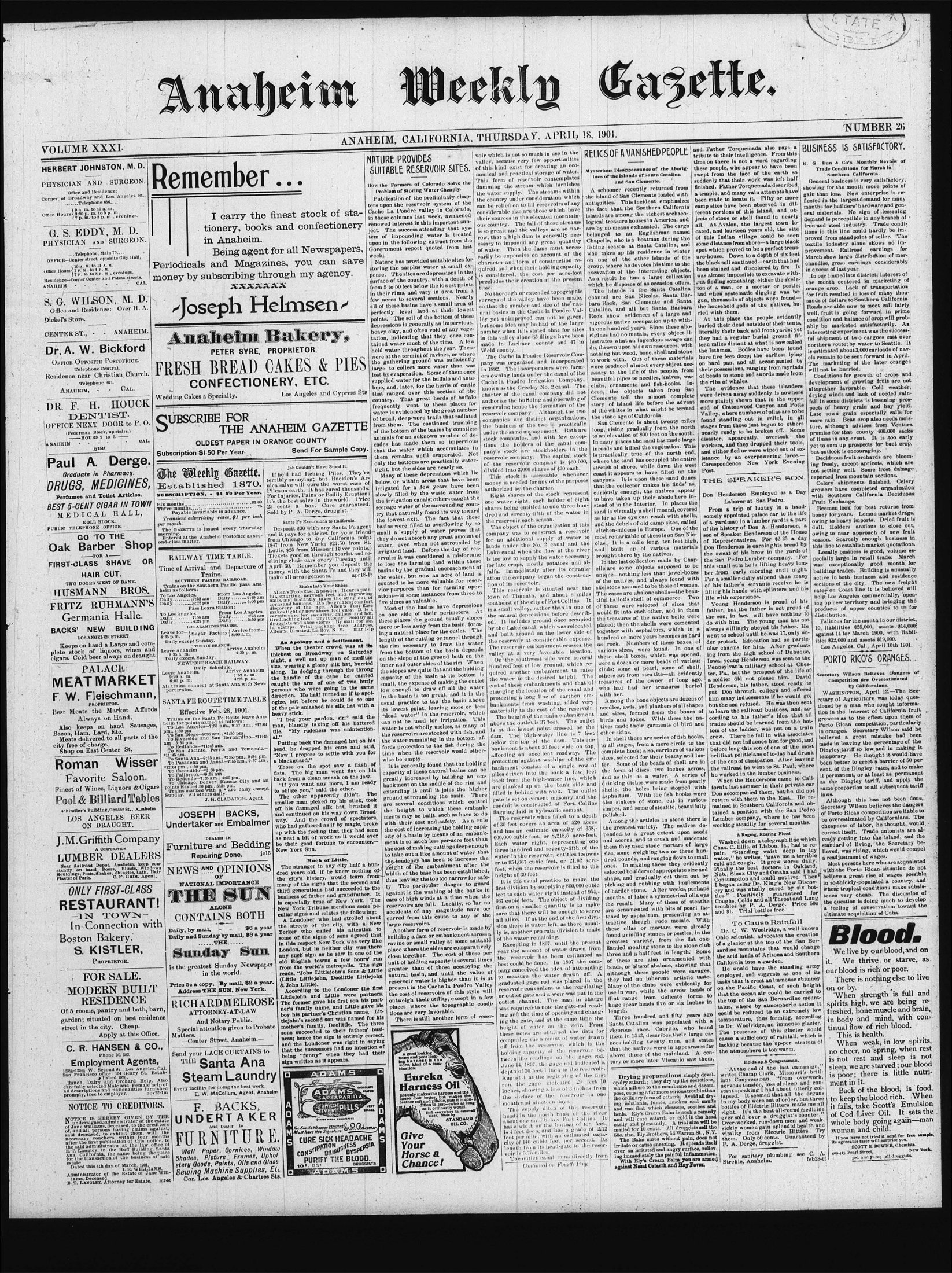
Searchable text
Anaheim
VOLUME XXXI.
HERBERT JOHNSTON, M.D.
PHYSICIAN AND SURGEON.
Office and Residence:
Corner of Broadway and Los Angeles St.
Telephone 656...
9 a.m. to 10 a.m.
3:30 p.m. to 5 p.m.
7 p.m. to 8 p.m., evenings.
G. S. EDDY, M.D.
PHYSICIAN AND SURGEON.
Telephone, Main 75...
OFFICE—Center street, opposite City Hall.
10 a.m. to 11 a.m.
2 p.m. to 4 p.m.
7 p.m. to 8 p.m., evenings.
Residence—Corner Center and Palms streets.
ANAHEIM CAL.
S. G. WILSON, M.D.
Office and Residence: Over H. A. Dickel's Store.
CENTER ST., - ANAHEIM.
Dr. A. W. Bickford
OFFICE OPPOSITE POSTOFFICE.
Telephone Central.
Residence near Christian Church.
Telephone 671.
ANAHEIM, CAL.
DR. F. H. HOUCK
DENTIST.
OFFICE NEXT DOOR to P. O.
(Federman Block, up stairs.)
HOURS 9 to 5.
ANAHEIM CAL.
Paul A. Derge.
Graduate in Pharmacy.
Remember...
I carry the finest stock of stationery, books and confectionery in Anaheim.
Being agent for all Newspaper Periodicals and Magazines, you can save money by subscribing through my agency.
Joseph Helmsen
Anaheim Bakery,
PETER SYRE, PROPRIETOR.
FRESH BREAD CAKES & PIED CONFECTIONERY, ETC.
Wedding Cakes a Specialty. Los Angeles and Cypress
SUBSCRIBE FOR THE ANAHEIM GAZETTE
OLDEST PAPER IN ORANGE COUNTY
Subscription $1.50 Per Year.
Send For Sample C
Residence near Christian Church.
Telephone 671.
ANAHEIM, CAL.
DR. F. H. HOUCK
DENTIST.
OFFICE NEXT DOOR to P. O.
(Federman Block, up stairs.)
HOURS 9 to 5.
ANAHEIM, CAL.
Paul A. Derge.
Graduate in Pharmacy.
DRUGS, MEDICINES,
Perfumes and Toilet Articles.
BEST 5-CENT CIGAR IN TOWN
MEDICAL HALL,
KOLL BLOCK.
PUBLIC TELEPHONE OFFICE.
GO TO THE
Oak Barber Shop
FOR A
FIRST-CLASS SHAVE OR
HAIR CUT.
TWO DOORS WEST OF BANK.
HUSMANN BROS.
FRITZ RUHMANN'S
Germania Halle.
BACKS' NEW BUILDING
LOS ANGELES STREET
Keeps on hand a Large and complete stock of liquors, wines and cigars. Cold beer always on draught
PALACE MEAT MARKET
F. W. Fleischmann,
PROPRIETOR.
Best Meats the Market Affords Always on Hand.
Also keeps on hand Sausages, Bacon, Ham, Lard, Etc.
Meats delivered to all parts of the city free of charge.
Shop on East Center St.
Roman Wisser
Favorite Saloon.
Finest of Wines, Liquors & Cigare Pool & Billiard Tables
Schindler's Building, Center St., Anaheim
LOS ANGELES BEER ON DRAUGHT.
J.M.Griffith Company
A CORPORATION
LUMBER DEALERS
Near Railroad Depot, Anaheim, keep constantly on hand Doors, Blinds, Windows Mouldings, Posts, Shakes, Shingles, Lath, Hair Plaster of Paris.
ONLY FIRST-CLASS
CONFECTIONERY, ETC.
Wedding Cakes a Specialty.
Los Angeles and Cypress
SUBSCRIBE FOR THE ANAHEIM GAZETTE
OLDEST PAPER IN ORANGE COUNTY
Subscription $1.50 Per Year.
Send For Sample C
The Weekly Gazette.
Established 1870.
SUBSCRIPTION, - $1.50 Per Year.
Six months.....$1.00
Three months.....75
Payable invariably in advance.
Transient advertising rates, $1 per inch per month.
The Gazette is issued every Thursday morning.
Entered at the Anaheim Postoffice as second-class matter.
RAILWAY TIME TABLE.
Time of Arrival and Departure of Trains.
SOUTHERN PACIFIC RAILROAD.
Trains on the Southern Pacific pass Anaheim as follows:
To Los Angeles....From Los Angeles.
Daily.....7:52 am Daily.....9:49 am
Daily.....4:22 pm Daily.....6:06 pm
Pass Loara Station:
To Los Angeles....From Los Angeles
Daily.....7:56 am Daily.....9:45 am
Daily.....4:27 pm Daily.....5:59 pm
LOS ALAMITOS TRAINS.
Leave for—Sugar Factory Arrive from—4:35 p.m.
Daily except Sunday.
TUSTIN BRANCH.
Leave Anaheim Arrive Anaheim
9:35 a.m. 4:35 p.m.
Daily except Sunday.
NEWPORT BEACH RAILWAY.
Daily Schedule.
Leave Anaheim Arrive Anaheim
9:49 a.m. 7:52 a.m.
6:03 p.m. 4:28 p.m.
All trains connect at Santa Ana with Newport trains.
SANTA FE ROUTE TIME TABLE
Effective Feb. 28, 1901.
Trains on the Santa Fe Route leave Anaheim for points named as follows:
To Los Angeles—7:55 am., 9:57 am., *12:04 pm., 4:50 pm.
To San Diego—9:35 am., *2:50 pm., 5:54 pm.
To Riverside and San Bernardino—*11:45 am., 5:54 pm.
To Redlands—*11:45 am.
To San Jacinto, Perris and Temecula—*11:45 am.
To Santa Ana—9:35 am., *2:50 pm., 5:54 pm.
To Pasadena and Azusa—7:55 am., 9:57 am., *12:04 pm., 4:50 pm.
To Escobedo—7:55 am., *4:50 pm.
To Chicago, Denver, Kansas City and all points East—4:50 pm., 5:54 pm.
Trains marked with a * are daily except Sunday. All others daily.
J.H. CLABAUGH. Agent.
JOSEPH BACKS,
Undertaker and Embalmer
DEALER IN
Furniture and Bedding Repairing Done.
NEWS AND OPINIONS OF
NATIONAL IMPORTANCE
Job Couldn't Have Stood It.
If he'd had Iteching Piles. The terribly annoying; but Bucklen's nica salve will cure the worst case Piles on earth. It has cured thousands For Injuries, Pains or Bodily Eruption it's the best salvage in the world.
25 cents a box. Cure guarantee Sold by P.A. Derge, druggist.
Sante Fe Excursions to California.
Desposit $30 with any Santa Fe and it pays for a ticket for your from Chicago to any California ($47 from New York; $27.50 from Louis; $25 from Missouri River Park). Tickets good on through tourist elining chair cars every Tuesday April 30. Remember you deposit money with the Santa Fe and they make all arrangements.
Shake Into Your Shoes
Allen's Foot-Ease, a powder. It cureful, smarting, nervous feet and ingnails, and instantly takes the sting and corral and bunions. It's the greatest discovery of the age. Allen's Foot makes tight or new shoes feel easy, certain cure for sweating, calloused, tired, aching feet. Try today so drugists and shoe stores. By mail in stamps. Trial package free. Allen S. Olmsted, Le Roy, N.Y.
An Apology and a Settlement
When the theater crowd was thickest on Broadway on Saturday night, a well set up man of no size, wearing a glossy silk hat, along. In dodging through the handle of the cane he caught the arm of one of two persons who were going in the direction. He half turned as if to ogize, but before he could do of the pair smashed his silk hat heavy stick.
"I beg your pardon, sir," said man, blandly taking off his tie. "My rudeness was unhinged."
Putting back the damaged head, he dropped his cane and "Now I propose to settle with a blackguard."
Those on the spot saw a fists. The big man went flat back from a clean smash on the "If you want any more, I am to oblige you," said the other.
The other apparently didn't smaller man picked up his stitches off his damaged silk hat, braid and continued on his way down way. And the crowd of spies who had gathered as if by maggup with the feeling that they as neat a bit of work as it would be their good fortune to encroach New York Sun.
Much of Little.
The stranger in any city had dred years old, if he knew the city's history, would leave many of the signs that the third generations had succeeded business of father and grandfather."
ONLY FIRST-CLASS RESTAURANT!
IN TOWN—In Connection with Boston Bakery.
S. KISTLER,
PROPRIETOR.
FOR SALE.
MODERN BUILT RESIDENCE
Of 5 rooms, pantry and bath, barn, garden; situated on best residence street in the city. Cheap.
Apply at this Office.
C. R. HANSEN & CO., Phone M. 383, Employment Agents,
1234-1234 W. Second St., Los Angeles, Cal.
San Francisco office: 104 Geary St. Established 1876.
Ranch, Dairy and Orchard Help. Also carefully selected Male and Female help of all descriptions and nationalities furnished promptly, free to employer.
NOTICE TO CREDITORS.
NOTICE IS HEREBY GIVEN BY THE undersigned; administrator of the estate of Jane Williams, deceased, to the creditors of, and all persons having claims against, said deceased, to exhibit them, with the necessary vouchers, within four months after the first publication of this notice, to the said administrator, at the law office of E. T. Langley, in the Huff Building, Santa Ana, California, the same being the place for the transaction of the business of said estate.
Dated this 4th day of March, 1901.
L. R. WILLIAMS,
Administrator of the Estate of Jane Williams, Deceased.
E. T. LANGLEY, Attorney for Estate.
JOSEPH BACKS,
Undertaker and Embalmer
DEALER IN
Furniture and Bedding Repairing Done.
NEWS AND OPINIONS OF
NATIONAL IMPORTANCE
THE SUN
ALONE
CONTAINS BOTH
Daily, by mail, $6 a year
Daily and Sunday by mail, $8 a year
THE
Sunday Sun is the greatest Sunday Newspaper in the world.
Price 5c a copy. By mail, $2 a year.
Address THE SUN, New York.
RICHARDMELROSE
ATTORNEY-AT-LAW
And Notary Public.
Special attention given to Probate Matters.
—Center Street, Anaheim.
Send your LACE CURTAINS to THE Santa Ana Steam Laundry
Every facility for doing the best work.
E. W. McCollum, Agent, Anaheim
F. BACKS,
UNDERTAKER
AND DEaler in
FURNITURE.
Wall Paper, Cornices, Window Shades, Picture Frames, Upholstery Goods, Paints, Oils and Glass Sewing Machine Supplies, Etc.
Cor. Los Angeles & Chartres Sts.
ANAHEIM, CALIFORNIA, THURSDAY. APRIL 18, 1901.
NATURE PROVIDES SUITABLE RESERVOIR SITES.
How the Farmers of Colorado Solve the Problem of Storing Water Cheply.
Publication of the preliminary chapters upon the reservoir system of the Cache La Pondre valley in Colorado, in these columns last week, awakened renewed interest in this important subject. The success attending that system of impounding water is treated upon in the following extract from the Government report quoted from last week:
Nature has provided suitable sites for storing the surplus water at small expense. The sites are depressions in the surface of the country, with a depth of from 5 to 50 feet below the lowest points in their rims, and vary in area from a few acres to several sections. Nearly all of these basins have a small area of perfectly level land at their lowest points. The soil of the bottom of these depressions is generally an impervious, heavy clay, and often void of any vegetation, indicating that they once contained water much of the time. A few held water throughout the year. These were at the termini of ravines, or where the gathering ground was sufficiently large to collect more water than was lost by evaporation. Some of them once supplied water for the buffalo and antelope, and, later, for the herds of cattle that ranged over this section of the country. That great herds of buffalo frequently went to these places for water is evidenced by the great number of broad, deep-worn trails that radiated from them. The continued tramping of the bottom of the basins by countless animals for an unknown number of decades has made them so impervious that the water which accumulates in them remains until evaporated. Not only the bottoms are practically water-tight, but the sides are nearly so.
Many of these depressions which lie voir which is not so much in use in the valley, because very few opportunities of this kind exist for creating an economical and practical storage of water. This form of reservoir contemplates damming the stream which furnishes the water supply. The streams within the country under consideration which can be relied on to fill reservoirs of any considerable size are those which have their sources in the elevated mountainous country. The fall of these streams is so great; and the valleys are so narrow, that a high dam is generally necessary to impound any great quantity of water. Then the dams must necessarily be expensive on account of the character and form of construction required, and when their holding capacity is considered, the cost per acre-foot precludes their creation at the present time.
No thorough or extended topographic surveys of the valley have been made, so that the number and size of the natural basins in the Cache la Pondre Valley yet unimproved can not be given, but some idea may be had of the large number when it is stated that for sites in this valley alone 65 filings have been made in Larimer county and 47 in Weld county.
The Cache la Pondre Reservoir Company was organized and incorporated in 1892. The incorporators were farmers owning lands under the canal of the Cache la Pondre Irrigation Company, known as the Greeley No. 2 canal. The charter of the canal company did not authorize the building and operating of reservoirs; hence the formation of the reservoir company. Although the two companies are distinct organizations, the business of the two is practically under the same management. Both are stock companies, and with few exceptions the holders of the canal company's stock are stockholders in the reservoir company. The capital stock of the reservoir company is $60,000, divided into 3,000 shares of $20 each.
RELICS OF A VANISHED PEOPLE
Mysterious Disappearance of the Mines of the Islands of Santa Catalina and San Clemente.
A schooner recently returned to the island of San Clemente loaded antiquities. This incident emphasized the fact that the Southern California islands are among the richest and logical treasure houses in America are by no means exhausted. They belonged to an Englishman Chapeille, who is a boatman during fishing season at Santa Catalina who takes up his residence in one of the other islands group, where he devotes his time excavation of the interesting caves. As a result he has a large colony which he disposes of as occasionally.
The islands in the Santa Catalina channel are San Nicolas, San Barbara Rock, San Clemente and Cataline, and all but Santa Catalina rock show evidences of a large vigorous native occupation up to one hundred years. Since then rigines had no metals, every object illustrates what an ingenious savior do, thrown upon his own resource nothing but wood, bone, shell and to work with. Out of these materials were produced almost every object necessary to life of the people beautiful pipes to needles, knives clubs, ornaments and fish-hooks deed, the objects taken from Clemente tell the almost story of island life before they of the whites in what might be the stone age of California.
San Clemente is about twenty long, rising gradually from thirteen to an elevation of 800 feet on thirteen many places the sand has maimed and killed the vegetation is practically true of the now where the sand has occupied the stretch of shore, while down coast it appears to have filled...
HIRY, ETC.
Los Angeles and Cypress Sts
HEIM GAZETTE
ANGE COUNTY
Send For Sample Copy.
Job Couldn't Have Stood It.
He'd had Itching Piles. They're ably annoying; but Bucklen's Arsive will cure the worst case of on earth. It has cured thousands of injuries, Palins or Bodily Eruptions the best sale in the world. Price cents a box. Cure guaranteed by P. A. Derge, druggist.
Sante Fe Excursions to California.
It pays for a ticket for your friend to Chicago to any California point from New York; $27.50 from St. Louis; $25 from Missouri River points). Sets good on through tourist and resting chair cars every Tuesday until 30. Remember you deposit the key with the Santa Fe and they will be all arrangements. apr18-It
Shake Into Your Shoes.
Men's Foot-Ease, a powder. It cures painstaking, nervous feet and ingrams and naturally takes the sting out of bunions. It's the greatest comfort recovery of the age. Allen's Foot-Ease is tight or new shoes feel easy. It is a pain cure for sweating, callous, and hot dugging through the strong handle of the cane he carried right arm of one of two burly persons who were going in the same section. He half turned as if to apolize, but before he could do so one the pair smashed his silk hat with aavy stick.
I beg your pardon, sir," said the man, blandly taking off his battered sack. "My rudeness was unintentionally putting back the damaged hat on his head, he dropped his cane and said, how I propose to settle with you for blackguard."
Those on the spot saw a flash of sticks. The big man went flat on his kick from a clean smash on the jaw. "If you want any more, I am ready oblige you," said the other.
The other apparently didn't. The smaller man picked up his stick, took off his damaged silk hat, brushed it and continued on his way down Broadway. And the crowd of spectators who had gathered as if by magic, broke up with the feeling that they had seen a neat bit of work as it would ever be their good fortune to encounter—New York Sun.
Much of Little.
The stranger in any city half a hundred years old, if he knew nothing of the city's history, would learn from many of the signs that the second and third generations had succeeded to the business of father and grandfather. It lost by evaporation. Some of these supplies water for the buffalo and antelope, and later, for the herds of cattle that ranged over this section of the country. That great herds of buffalo frequently went to these places for water is evidenced by the great number of broad, deep-worn trails that radiated from them. The continued tramping of the bottom of the basins by countless animals for an unknown number of decades has made them so impervious that the water which accumulates in them remains until evaporated. Not only the bottoms are practically water-tight, but the sides are nearly so.
Many of these depressions which lie below or within areas that have been irrigated for a few years have been slowly filled by the waste water from the irrigation canals; others caught the seepage water of the surrounding country that naturally found its way toward the lowest exit. The fact that these basins were filled to overflowing by so small a supply of water proves that they do not absorb any great amount of water, even when not surrounded by irrigated land. Before the day of reservoirs it was considered a misfortune to lose the farming land within these basins by the gradual encroachment of the water, but now an acre of land is counted to be more valuable for reservoir purposes than for farming operations—in some instances from three to five times as valuable.
Most of the basins have depressions on one side of their perimeters. At these places the ground usually slopes more or less away from the basin, forming a natural place for the outlet. The length of the cutting or tunnel through the rim necessary to draw the water from the bottom of the basin depends on the slope of the ground both on the inner and outer sides of the rim. When the slopes are quite flat and the holding capacity of the basin at its bottom is small, the expense of making the outlet low enough to draw off all the water in the basin is too great, and it is the usual practice to tap the basin above its lowest point, leaving more or less "dead water" in the reservoir, which cannot be used for irrigation. This water is not wholly useless, as many of the reservoirs are stocked with fish, and the water remaining in the bottom affords protection to the fish during time when the reservoir would otherwise be empty.
It is generally found that the holding capacity of these natural basins can be greatly increased by building an embankment on the saddle of the rim and extending it until it joins the higher ground surrounding the basin. There are several conditions which control the height to which these embankments may be built, such as have to do with their cost and safety. As a rule the cost of increasing the holding capacity of a basin by means of an embankment is so much less per-acre foot than the cost of making cuttings deep enough to take out a like amount of water that tendency has been to increase the height of the embankment after the width of the base has been established, thus leaving the top too narrow for safety. The particular danger to guard against is the washing of the banks in case of high winds at a time when the reservoir when filled to a depth of 30 feet covers an area of 520 acres and has an estimate capacity of 358,000,000 cubic feet, or 8,218.5 acre-feet. Each water right, representing one three hundred and seventy-fifth of the water in the reservoir, entitles its owner to 954,667 cubic feet, or 21.62 acre-feet, when the reservoir is filled to the height of 30 feet.
It is the usual practice to make the first division by supplying 800,000 cubic feet to each water right instead of 954,667 cubic feet. The object of dividing owners own lands under the canal of the Cache la Poudre Irrigation Company, known as the Greeley No. 2 canal. The charter of the canal company did not authorize the building and operating of reservoirs; hence the formation of the reservoir company. Although two companies are distinct organizations, the business of two is practically under the same management. Both are stock companies, and with few exceptions—the holders of the canal company's stock are stockholders in the reservoir company. The capital stock of the reservoir company is $60,000, divided into 3,000 shares of $20 each.
This stock is assessable whenever money is needed for any of our purposes authorized by the charter.
Eight shares of the stock represent one water right, each holder of eight shares being entitled to one three hundred and seventy-fifth of the water in the reservoir each season.
The object of the organization of this company was to construct a reservoir for an additional supply of water to lands under the No. 2 canal and the Lake canal when the flow of the river is too low to supply the water necessary for late crops, mostly potatoes and alfalfa. Immediately after its organizationthe company began construction of its reservoir.
This reservoir is situated near the town of Tunnath, and about 6 miles southeast of the city of Fort Collins. It is a small valley, rather than in one of the natural depressions before described by it includes ground once occupied by the Lake canal, which was relocated and built around on lower side of the reservoir at considerable expense. The reservoir embankment crosses the valley at a very favorable location.
On the southwest side were several hundred feet of low ground, which required another embankment to raise water to the desired height. The cost of these embankments and that of changing the location of the canal and protecting a long line of earthen embankments from washing, added very materially to cost of the reservoir.
The height of main embankment above the outlet is 37 feet. The outlet is at the lowest point crossed by the dam. The high-water line is 7 feet below top of the dam. This embankment is about 20 feet wide on top, affording an excellent roadway. The protection against washing ofthe embankment consists of a single row of piles driven intothe bank a few feet back fromthe high-water line,which are planked up onthe bank side and filled in behind with rock.The outlet gate is set on cement masonry andthe conduit is constructedofFortCollinsflagging laid in hydraulic cement.
The reservoir when filled to a depth of 30 feet covers an areaof 520 acresandhasanestimatecapacityof358,000,cubicfeetor8,218.5acre-feet.Eachwaterrightrepresentingonethreehundredandseventy-fifthofthewaterinthereservoirentitlesitsownerto954,667cubicfeetor21.62acre-feetwhenthereservoirisfilledtotheheightof30feet.
It istheusualpracticetomakethefirstdivisionbysupplying800,000cubicfeettoceachwaterright insteadof954,667cubicfeetor21.62acre-feetwhenthereservoirisfilledtotheheightof30feet.
Itistheusualpracticetomakethefirstdivisionbysupplying800,000cubicfeettoceachwaterright insteadof954,667cubicfeetor21.62acre-feetwhenthereservoirisfilledtotheheightof30feet.
Itistheusualpracticetomakethefirstdivisionbysupplying800,000cubicfeettoceachwaterright insteadof954,667cubicfeetor21.62acre-feetwhenthereservoirisfilledtotheheightof30feet.
Itistheusualpracticetomakethefirstdivisionbysupplying800,000cubicfeettoceachwaterright insteadof954,667cubicfeetor21.62acre-feetwhenthereservoirisfilledtotheheightof30feet.
Itistheusualpracticetomakethefirstdivisionbysupplying800,000cubicfeettoceachwaterright insteadof954,667cubicfeetor21.62acre-feetwhenthereservoirisfilledtotheheightof30feet.
Itistheusualpracticetomakethefirstdivisionbysupplying800,000cubicfeettoceachwaterright insteadof954,667cubicfeetor21.62acre-feetwhenthereservoirisfilledtotheheightof30feet.
Itistheusualpracticetomakethefirstdivisionbysupplying800,000cubicfeettoceachwaterright insteadof954,667cubicfeetor21.62acre-feetwhenthereservoirisfilledtotheheightof30feet.
Itistheusualpracticetomakethefirstdivisionbysupplying800,000cubicfeетtoceachwaterright insteadof954,667cubicfeетtoceachwaterright insteadof954,667cubicfeетtoceachwaterright insteadof954,667cubicfeетtoceachwaterright insteadof954,667cubicfeетtoceachwaterright insteadof954,667cubicfeетtoceachwaterright insteadof954,667cubicfeетtoceachwaterright insteadof954,
667cubicfeетtoceachwaterright insteadof954,
667cubicfeетtoceachwaterright insteadof954,
667cubicfeетtoceachwaterright insteadof954,
667cubicfeетtoceachwaterright insteadof954,
667cubicfeетtoceachwaterright insteadof954,
667cubicfeетtoceachwaterright insteadof954,
667cubicfeетtoceachwaterright insteadof954,
667cubicfeетtoceachwaterright insteadof954,
667cubicfeетtoceachwaterright insteadof954,
667cubicfeетtoceachwaterright insteadof954,
667cubicfeетtoceachwaterright insteadof954,
667cubicfeетtoceachwaterright insteadof954,
667cubicfeетtoceachwaterright insteadof954,
667cubicfeетtoceachwaterright insteadof954,
667cubicfeетtoceachwaterright insteadof954,
667cubicfeетtoceachwaterright insteadof954,
667cubicfeетtoceachwaterright insteadof954,
667cubicfeетtoceachwaterright insteadof954,
667cubicfeётnocheckwaterright insteadof954,
667cubicfeedcotcheckwaterright insteadof954,
667cubefeedcotcheckwaterright insteadof954,
667cubefeedcotcheckwaterright insteadof954,
667cubefeedcotcheckwaterright insteadof954,
667cubefeedcotcheckwaterright insteadof954,
667cubefeedcotcheckwaterright insteadof954,
667cubefeedcotcheckwaterright insteadof954,
667cubefeedcotcheckwaterright insteadof954,
безбезбезбезбезбезбезбезбезбезбезбезбезбезбезбезбезбезбезбезбезбезбезбезбезбезбезбезбезбезбезбезбезбезбезбезбезбезбезбезбезбезбезбезбезбезбезбезбезбезБезБезБезБезБезБезБезБезБезБiezБiezБiezБiezБiezБiezБiezБiezБiezБiezБiezБiezБierzБierzБierzБierzБierzБierzБierzБierzБierzБierzБierzБierzБierzБierzБierzБierzБierzБierzБierzБierzБierzБierzБierzБierzБierzБierzБierzБierzБierzБierzБierzБierzБierzБierzБierzБierzБierzБierz БiezВiezВiezВiezВiezВiezВiezВiezВiezВiezВiezВiezВiezВiezВiezВiezВiezВiezВiezВiezВiezВiezВiezВiezВiezВiezВiezВiezВiezВiezВiezВiezВiezВiezВiezВiezВiezВiezВiezВiezВieszВiezВiezВiezВiezВiezВiezВiezВieszВызвызвызвызвызвызвызвызвызвызвызвызвызвызвызвызвызвызвызвызвызвызвызвызвызвызвызвызвызвызвызвызвызвызвызвызвизывазызаывазызаывазызаывазызаывазызаывазызаывазызаывазызаывазызаывазызаывазызаывазызаывазызаываyzerзаважаyzerзаважаyzerзаважаyzerзаважаyzerзаважаyzerзаважаyzerзаважаyzerзаважаyzerзаважаyzerзаважаyzerзаважаyzerзаважаyzerзаважаyzerзаважаyzerзаважаyzerзаважаyzerзаважаyzerзаважаyzerзаважаyzerзаважаyzerзаважаyzerзаважаyzerзаважаyzerзаважаyzerзаважаyzerзаважаyzerзаважаyzerзаважаyzerзаважаyzerзаважаyzerзаважаyzerзаважаyzerзаважаyzerсаеважаyzerсаеважаyzerсаеважаyzerсаеважаyzerсаеважаyzerсаеважаyzerсаеважаyzerсаеважаyzerсаеважаyzerсаеважаyzerсаеважаyzerсаеважаyzerсаеважаyzerсаеважаyzerсаеваждаусядаусядаусядаусядаусядаусядаусядаусядаусядаусядаусядаусядаусядаусядаусядаусядаусядаусядаусядаусядаусядаусядаусядаусядаусяداусяداусяداусяداусяداусяداусяداусяداусяداусяداусяداусяداусяداусяداусяداусяداусяداУ兹У兹У兹У兹У兹У兹У兹У兹У兹У兹У兹У兹У兹У兹У兹У兹У兹У兹У兹У兹У兹У兹У兹У兹У兹У兹У兹У兹У兹У兹У兹У兹У兹У兹У兹У兹У兹У兹У兹У兹У兹У兹У兹У兹У兹У兹У兹У兹У兹 У兹 У兹 У兹 У兹 У兹 У兹 У兹 У兹 У兹 У兹 У兹 У兹 У兹 У兹 У兹 У兹 У兹 У应聘.U应聘.U应聘.U应聘.U应聘.U应聘.U应聘.U应聘.U应聘.U应聘.U应聘.U应聘.U应聘.U应聘.U应聘.U应聘.U应聘.U应聘.U应聘.U应聘.U应聘.U应聘.U应聘.U应聘.U应聘.U应聘.U应聘.U应聘.U应聘.U应聘.U应聘.U应聘.U应聘.U应聘..U应聘.U应聘.U应聘.U应聘.U应聘.U应聘.U应聘.U应聘.U应聘.U应聘.U应聘.U应聘.U应聘.U应聘.U应聘.U应聘.U应聘.U应聘.U应聘.U应聘.U应聘.U应聘.U应聘.U应聘.U应聘.U应聘.U应聘.U应聘.U应聘.U应聘.U应聘.U应聘.U应聘.U应聘.U应聘.U应聘.U应聘..U应聘..U应聘..U应聘..U应聘..U应聘..U应聘..U应聘..U应聘..U应聘..U应聘..U应聘..U应聘..U应聘..U应聘..U应聘..U应聘..U应聘..U应聘..U应聘..U应聘..U应聘..U应聘..U应聘..U应聘..U应聘..U应聘..U应聘..U应聘..U应聘..U应聘..U应聘...U应聘...U应付.....U应付.....U应付.....U应付.....U应付.....U应付.....U应付.....U应付.....U应付.....U应付.....U应付.....U应付.....U应付.....U应付.....U应付.....U应付.....U应付.....U应付.....U应付.....U应付.....U应付.....U应付.....U应付.....U应付.....U应付.....U应付.....U应付.....U应付.....U应付.....U应付.....U应付.....U应付.....U应付..... U应付..... U应付..... U应付..... U应付..... U应付..... U应付..... U应付..... U应付..... U应付..... U应付..... U应付..... U应付..... U应付..... U应付..... U应付..... U应付..... U应付..... U应付..... U应付..... U应付..... U应付..... U应付..... U应付..... U应付..... U应付..... U应付..... U应付 ..... U应付 ..... U应付 ..... U应付 ..... U付出 .....付出 .....付出 .....付出 .....付出 .....付出 .....付出 .....付出 .....付出 .....付出 .....付出 .....付出 .....付出 .....付出 .....付出 .....付出 .....付出 .....付出 .....付出 .....付出 .....付出 .....付出 .....付出 .....付出 .....付出 .....付出 .....付出 .....付出 .....付出 .....付出 .....付出 .....付出 ....付出 ....付出 ....付出 ....付出 ....付出 ....付出 ....付出 ....付出 ....付出 ....付出 ....付出 ....付出 ....付出 ....付出 ....付出 ....付出 ....付出 ....付出 ....付出 ....付出 ....付出 ....付出 ....付出 ....付出 ....付出 ....付出 ....付出 ....付出 ....付出 ....付出 ....付出 ....付出 ....付出 ....付出 ....付出 ....付出 ....付出 ....付出 ....付出 ....付出 ....付出 ....退出 .....退出 .....退出 .....退出 .....退出 .....退出 .....退出 .....退出 .....退出 .....退出 .....退出 .....退出 .....退出 .....退出 .....退出 .....退出 .....退出 .....退出 .....退出 .....退出 .....退出 .....退出 .....退出 .....退出 .....退出 .....退出 .....退出 .....退出 .....退出 .....退出 .....退出 .....退出 ...退出 ...退出 ...退出 ...退出 ...退出 ...退出 ...退出 ...退出 ...退出 ...退出 ...退出 ...退出 ...退出 ...退出 ...退出 ...退出 ...退出 ...退出 ...退出 ...退出 ...退出 ...退出 ...退出 ...退出 ...退出 ...退出 ...退出 ...退出 ...退出 ...退出 ...退出 ...退出 ...退出 ...退出 ...退出 ...退出 ...退出 ...退出 ...退出 ...退出 ...退出 ...退出 ...退出 ...超出 ...超出 ...超出 ...超出 ...超出 ...超出 ...超出 ...超出 ...超出 ...超出 ...超出 ...超出 ...超出 ...超出 ...超出 ...超出 ...超出 ...超出 ...超出 ...超出 ...超出 ...超出 ...超出 ...外出 ...外出 ...外出 ...外出 ...外出 ...外出 ...外出 ...外出 ……外出 ……外出 ……外出 ……外出 ……外出 ……外出 ……外出 ……外出 ……外出 ……外出 ……外出 ……外出 ……外出 ……外出 ……外出 ……外出 ……外出 ……外出 ……外出 ……外出 ……外出 ……外出 ……外出 ……外出 ……外出 ……外出 ……外出 ……外出 ……外出 ……外出 ……外出 ……外出 …….外来 …….外来 …….外来 …….外来 …….外来 …….外来 …….外来 …….外来 …….外来 …….外来 …….外来 …….外来 …….外来 …….外来 …….外来 …….外来 …….外来 …….外来 …….外来 …….外来 …….外来 …….外来 …….外来 …….外来 …….外来 …….外来 …….外来 …….外来 …….外来 …….外来 …….外来 …….外来 …….外来
.....
.....
.....
.....
.....
.....
.....
.....
.....
.....
.....
.....
.....
.....
.....
.....
.....
.....
.....
.....
.....
.....
.....
.....
.....
.....
.....
.....
.....
.....
.....
.....
.....
.....
.....
.....
.....
.....
.....
....
....
....
....
....
....
....
....
....
....
....
....
....
....
....
....
....
....
....
....
....
....
....
....
....
....
....
....
....
....
....
....
....
....
....
....
....
....
....
....
....
....
....
....
....
....
....
....
....
....
....
....
....
....
....
....
....
....
....
....
....
....
....
....
....
...
..
..
..
..
..
..
..
..
..
..
..
..
..
..
..
..
..
..
..
..
..
..
..
..
..
..
..
..
..
..
..
..
..
..
..
…
..
…
…
…
…
…
…
…
…
…
…
…
…
…
…
…
…
…
…
…
…
…
…
…
…
…
…
…
…
…
…
…
…
…
…
…
…
…
…
…
…
…
…
…
…
…
…
……
…
……
……
……
……
……
……
……
……
……
……
……
……
……
……
……
……
……
……
……
……
……
……
……
……
……
……
……
……
……
……
……
……
……
……
……
……
……
……
……
……
……
……
……
……
……
……”
”
”
”
”
”
”
”
”
”
”
”
”
”
”
”
”
”
”
”
”
”
”
”
”
”
”
”
”
”
”
”
”
”
”
”
”
”
”
”
”
”
”
”
”
”
”
”
”
”
”
”
”
”
”
’
`
`
`
`
`
`
`
`
`
`
`
`
`
`
`
`
`
`
`
`
`
`
`
`
`
`
`
`
`
`
`
`
`
`
`
`
`
`
`
`
`
`
`
`
`
`
`
`
`
`
`
`
`
`
`
`
`
`
`
`
`
Wait, let me re-read line 1: "The stranger in any city half a hundred years old,the city half a hundred years old,the city half a hundred years old,the city half a hundred years old,the city half a hundred years old,the city half a hundred years old,the city half a hundred years old,the city half a hundred years old,the city half a hundred years old,the city half a hundred years old,the city half a hundred years old,the city half a hundred years old,the city half a hundred years old,the city half a hundred years old,the city half a hundred years old,the city half a hundred years old,the city half a hundred years old,the city half a hundred years old,the city half a hundred years old,the city half a hundred years old."
Line 2: "The stranger in any city half a hundred years old,the city half a hundred years old,the city half a hundred years old,the city half a hundred years old,the city half a hundred years old,the city half a hundred years old,the city half a hundred years old,the city half a hundred years old,the city half a hundred years old,the city half a hundred years old,the city half a hundred years old,the city half a hundred years old,the city half a hundred years old,the city half a hundred years old,the city half a hundred years old."
Line 3: "The stranger in any city half a hundred years old,the city half a hundred years old,the city半a hundred years old,the city半a hundred years old,the city半a hundred years old,thecity半a hundred years old,thecity半a hundred years old,thecity半a hundred years old,thecity半a hundred yardsold,thecity半a hundred yardsold,thecity半a hundred yardsold,thecity半a hundred yardsold,thecity半a hundred yardsold,thecity半a hundred yardsold,thecity半a hundred yardsold,thecity半a hundred yardsold,thecity半a hundred yardsold,thecity半a hundred yardsold,thecity半a hundred yardsold,thecity半a hundred yardsold.thecity半a hundred yardsold.thecity半a hundred yardsold.thecity半a hundred yardsold.thecity半a hundred yardsold.thecity半a hundred yardsold.thecity半a hundred yardsold.thecity半a hundred yardsold.thecity半a hundred yardsold.thecity半a hundred yardsold.thecity半a hundred yardsold.thecity半a hundred yardsold."
Line 4: "The stranger in any city half a hundred years old,the city半a Hundred Years Old."
Wait, let me re-read line 1: "The stranger in any city half a Hundred Years Old,"
Line 2: "The stranger in any city Half A Hundred Years Old,"
Line 3: "The stranger in any city Half A Hundred Years Old,"
Line 4: "The stranger in any city Half A Hundred Years Old,"
Let me re-read line
Much of Little.
The stranger in any city half a hundred years old, if he knew nothing of the city's history, would learn from many of the signs that the second and third generations had succeeded to the business of father and grandfather. It is especially true of New York. The New York Tribune mentions some peculiar signs and relates the following:
A Londoner who had strolled about the streets of the city with a New Yorker who called his attention to some of the signs of sons agreed that in this respect New York was very like London, but in neither city was there any such sign as he saw in one of the old English towns a few hours' run from the world's metropolis. The sign reads, "John Littlejohn's Sons & Little (Little Littlejohn, Doolittle Littlejohn & John Little).
According to the Londoner the first Littlejohn and Little were partners. The former gave his first son his partner's family name, and Little gave his boy his partner's Christian name. Littlejohn's second son was named for his mother's family, Doolittle. The three sons succeeded to their fathers' business; hence the sign is entirely correct, and the Londoner was right in saying that the successors had no intention of being "funny" when they had their sign written as it appears.
Another form of reservoir is made by building a dam or embankment across a ravine or small valley at some suitable place where the sides are comparatively close together. The cost of these per unit of holding capacity is several times greater than of those occupying the natural basin, and until the value of reservoir water is higher than it is at present in the Cache la Poudre Valley the cost of reservoirs of this style will outweigh their utility, except in a few places where the topographic conditions are very favorable.
There is still another form of reser-
Continued on Fourth Page.
Gazette.
1901. NUMBER 26
MICS OF A VANISHED PEOPLE
Serious Disappearance of the Aborigines of the Islands of Santa Catalina and San Clemente.
A schooner recently returned from Isla de San Clemente loaded with equities. This incident emphasizes fact that the Southern California lands are among the richest archaeological treasure houses in America, and by no means exhausted. The cargo belonged to an Englishman named Pepelle, who is a boatman during the spring season at Santa Catalina, and he takes up his residence in winter one of the other islands of the Cup, where he devotes his time to the exploration of the interesting objects. As a result he has a large collection which he disposes of as occasion offers. The islands in the Santa Catalina Channel are San Nicolas, Santa Barbara Rock, San Clemente and Santa Cataline, and all but Santa Barbara Rock show evidences of a large and numerous native occupation up to with some hundred years. Since these aboriginals had no metals, every object illustrates what an ingenious savage can throw upon his own resources, with thing but wood, bone, shell and stone work with. Out of these materials were produced almost every object necessary to the life of the people, from beautiful pipes to needles, knives, war clubs, ornaments and fish-hooks. Indeed, the objects taken from San Clemente tell the almost complete story of island life before the advent of the whites in what might be termed the stone age of California.
San Clemente is about twenty miles long, rising gradually from the north an elevation of 800 feet on the south. In many places the sand has made large roads and killed the vegetation. This is practically true of the north end, where the sand has occupied the entire stretch of shore, while down the west coast it appears to have filled up the and Father Torquemada also pays a tribute to their intelligence. From this time on there is not a word regarding these people, who appear to have been swept from the face of the earth so suddenly that their work was left half finished. Father Torquemada described a temple, and many vain attempts have been made to locate it. Fifty or more camp sites have been observed in different portions of this island, and objects of stone or shell found in nearly all. At Avalon, the largest town located, and fourteen years old, the site of this Indian village could be seen some distance from shore—a large black spot which proved to be a perfect treasure-house. Down to a depth of six feet the black soil continued—earth that had been stained and discolored by fire. It was almost impossible to excavate without finding something, either the skeleton of a man, or a mortar or pestle; and when systematic digging was begun, thousands of objects were found—the household gods of the natives, buried with them.
At this place the people evidently buried their dead outside of their tents, literally their back and front yards; yet they had a regular burial ground fifteen miles distant at what is now called the Isthmus. Bodies have been found five feet deep; the earliest lying on hard pan, and all accompanied by their possessions, ranging from myriads of beads to stone and swords made from the ribs of whales.
The evidence that these islanders were driven away suddenly is nowhere more plainly shown that in the upper end of Cottonwood Canyon and Potts Valley, where numbers of ollas are to be found standing out in relief, in all stages from those just begun to others nearly ready to be broken off. Some disaster, apparently, overtook the workers, and they dropped their tools, and either fled or were wiped out of existence by an overpowering force. Corespondence New York Evening Post.
BUSINESS IS SATISFACTORY.
R. G. Dun & Co.'s Monthly Review of Trade Conditions for March in Southern California.
General business is very satisfactory, showing for the month more points of gain than loss. New enterprise is reflected in the largest demand for many months for builders' hardware and general materials. No sign of lessening demand is perceptible in any branch of iron and steel industry. Trade conditions in this line could hardly be improved from standpoint of seller. The textile industry alone shows no improvement. Railroad earnings for March show large distribution of merchandise, gross earnings considerably in excess of last year.
In our immediate district, interest of the month centered in marketing of orange crop. Lack of transportation for fruit resulted in loss of many thousands of dollars to Southern California. Roads are able now to meet call fairly well, fruit is going forward in prime condition and balance of crop will probably be marketed satisfactorily. An interesting experiment was the successful shipment of two cargoes east over northern route; by water to Seattle. It is estimated about 3,000 carloads of navels remain to be sent forward in April. The marketing of the later oranges will not be hurried.
Conditions for growth of crops and development of growing fruit are not altogether favorable. Cold weather, drying winds and lack of needed rainfall in some districts is lessening prospects of heavy grain and hay yield. Late sown grain especially calls for more rain. Bean crop also needs moisture, although advices from Ventura promise for that county 400,000 sacks of limas in any event. It is too early yet to sum up prospects for beet crop, but outlook is encouraging.
Deciduous fruit orchards are blooming freely, except apricots, which are not setting well. Some frost damage
San Clemente is about twenty miles long, rising gradually from the north to an elevation of 800 feet on the south. In many places the sand has made large roads and killed the vegetation. This practically true of the north end, where the sand has occupied the entire stretch of shore, while down the west coast it appears to have filled up the canyons. It is upon these sand dunes that the collector makes his finds’ as curiously enough, the natives appear to have taken up their abode here instead of in the interior. In places the sand is virtually a shell mound, covered as far as the eye can reach with shells, and the debris of old camp sites, called kitchen-midens in Europe. One of the most remarkable of these is on San Nicolas. It is a mile long, ten feet high, and built up of various materials brought there by the natives.
In the last collection made by Chapelle are some objects supposed to be unique—nothing less than jewel-boxes of the natives, and always found with skeletons assumed to be those of women. The cases are abalone shells—the beautiful haliotis shell of commerce. Two of these were selected of sizes that would fit into each other, and in them the treasures of the native belle were placed; then the shells were cemented together with asphaltum, which in a hundred or more years becomes as hard as rock. Numbers of these boxes, various sizes, were found. In one of these shell boxes, which was opened, were a dozen or more beads of various kinds; some of pearl, some of shell, others cut from stea tite—all evidently treasures of the owner of long ago, who had had her treasures buried with her.
Among the bone objects are dozens of needles, awls, and pinchers of all shapes and sizes, formed from the bones of birds and foxes. With these the natives made their garments of bird and other skins.
In shell there are series of fish hooks, in all stages, from a mere circle to the complete hook; also, earrings of various sizes, selected for their beauty and luster. Some of the beads of shell are in the form of discs, two inches across, and as thin as a wafer. A series of drinking dishes were made from pearly shells, the holes being stopped with asphaltum. With the fish hooks were also sinkers of stone, cut in various shapes, and some of steatite, beautifully polished.
Among the articles in stone there is the greatest variety. The natives depended to a great extent upon seeds and acorns, and to crush and macerate them they used stone mortars of large size, some weighing two or three hundred pounds, and ranging down to small ones. In making these they evidently selected boulders of appropriate size and shape, and gradually cut them out by picking and rubbing with implements of harder stone. After weeks, perhaps months, of labor a symmetrical olla was beautiful pipes to needles, knives, warriors, ornaments and fish-hooks. Indeed, the objects taken from San Clemente tell the almost complete story of island life before the advent of the whites in what might be termed the stone age of California.
Don Henderson Employed as a Day Laborer at San Pedro.
From a trip of luxury in a handsomely appointed palace car to the life of a yardman in a lumber yard is a part of the history of Don A. Henderson, a son of Speaker Henderson of the House of Representatives. For $2.25 a day Don Henderson is earning his bread by the sweat of his brow in the yards of the San Pedro Lumber company. For this small sum he is lifting heavy lumber from early morning until night. For a smaller daily stipend than many of his father’s servants receive he is filling his hands with splinters and his life with experience.
Young Henderson is proud of his father, but the father is not proud of the son, in fact will have nothing to do with him. The young man has not always willingly obeyed his father. He went to school until he was 17, only under protest. Education had no particular charms for him. After graduating from the high school of Dubuque, Iowa, young Henderson was sent to the Pennsylvania military school at Chester, Pa., but the prospect of the life of a soldier did not please him. David Henderson, his father, stood ready to put Don through college and offered him many inducements if he would go, but the son refused. He was then sent to learn the railroad business, and according to his father’s idea that all trades should be learned from the bottom of the ladder, was put on a train crew. There he fell in with associates that did not influence him for good, and before long this son of one of the most brilliant politicians of to-day had drunk of the cup of dissipation. After leaving the railroad he went to St. Paul, where he worked in the lumber business.
When the Henderson came to California last summer in their private car Don accompanied them, but he did not return with them to the East. He remained in Southern California and obtained a position with the San Pedro Lumber company, where he has been working steadily for several months.
A Raging, Roaring Flood
Washed down a telegraph line which Chas. C. Ellis, of Lisbon, Ia., had to repair.“Standing waist deep in ice water,” he writes.“gave me a terrible cold and cough.” It grew worse daily. Finally the best doctors in Oakland, Neb., Sioux City and Omaha said I had Consumption and could not live. Then I began using Dr. King’s New Discovery and was wholly cured by six bottles.” Positively guaranteed for conditions for growth of crops and development of growing fruit are not altogether favorable. Cold weather, drying winds and lack of needed rainfall in some districts is lessening prospects of heavy grain and hay yield. Late sown grain especially calls for more rain. Bean crop also needs moisture, although advises from Ventura promise for that county 400,000 sacks of limas in any event. It is too early yet to sum up prospects for beet crop, but outlook is encouraging.
Deciduous fruit orchards are blooming freely, except apricots, which are not setting well. Some frost damage reported from mountain sections.
Celery shipments finished. Celery growers have completed organization with Southern California Deciduous Fruit Exchange.
Beemen look for best returns from honey for years. Lemon market drags owing to heavy imports. Dried fruit is dull. Holders anxious to close out, owing to near approach of new fruit season. Scarcely enough business in this line to establish market quotations.
Locally business is good, volume especially large in retail trade. March was exceptionally good month for building trades. Building is unusually active in both business and residence sections of the city. The new freight rates on Coast line it is believed will help Los Angeles commercially, opening up new territory and bringing the products of upper counties to us for distribution.
Failures for the month in our district, 10, liabilities $25,000, assets $14,000; against 14 for March 1900, with liabilities $32,000 and assets $19,000.
Los Angeles, Cal., April 10th 1901.
PORTO RICO'S ORANGES.
Secretary Wilson Believes Dangers of Competition are Overestimated by Californians.
WASHINGTON, April 12.-The Secretary of Agriculture was today questioned by a man who sought information in the interest of California fruit growers as to the effect upon them of Porto Rican competition, particularly in oranges. Secretary Wilson said he believed a great mistake had been made in leaving the percentage of the Dingle tariff so low and in making it temporary. He thought it would have been better to erect a barrier of 50 percent of the Dingle tariffs, and to make it permanent, or at least as permanent as the Dingle tariff, and apply the same proportion to all subsequent tariff laws.
Although this has not been done, Secretary Wilson believes the dangers of Porto Rican competition are liable to be overestimated by Californians. The cheapness of labor, he thought, would correct itself. Trade unionists are already getting into the island, and the standard of living,the Secretary believed was rising,which would compel a readjustment of wages.
Most persons here who are acquainted with the Porto Rican situation do not believe a great rise of wages possible in so thickly-populated a country,and where tropical conditions make subsistence very cheap.The discussion of
also sinkers of stone, cut in various shapes, and some of steatite, beautifully polished.
Among the articles in stone there is the greatest variety. The natives depended to a great extent upon seeds and acorns, and to crush and macerate them they used stone mortars of large size, some weighing two or three hundred pounds, and ranging down to small ones. In making these they evidently selected boulders of appropriate size and shape, and gradually cut them out by picking and rubbing with implements of harder stone. After weeks, perhaps months, of labor a symmetrical olla was the result. Many of these of steatite are ornamented with bits of pearl fastened by asphaltum, presenting an attractive though rude mosaic. With these ollas or mortars were already found grinding stones, or pestles, in the greatest variety, from the flat one-fanded mealing stone to the stone club three and a half feet in length. Some of these are also ornamented with beads, or bits of abalone, showing that although these people were savages, they had an inherent artistic taste. Many of the clubs were evidently for use in war, while the arrow heads of flint range from delicate forms to huge spear heads five or six inches in length.
Three hundred and fifty years ago Santa Catalina was populated with a vigorous race. Cabrillo, who found them in 1542, describes their large canoes holding twenty men, and states that the natives were in appearance far above those of the mainland. A century or more later Viscanio saw them,
Drying preparations simply develop dry catarrh; they dry up the secretions, which adhere to the membrane and decompose, causing a far more serious trouble than the ordinary form of catarrh. Avoid all drying inhalants, fumes, smokes and snuffs and use that which cleanses, soothes and heals. Ely's Cream Balm is such a remedy and will cure catarrh or cold in the head easily and pleasantly. A trial size will be mailed for 10 cents. All druggists sell the 50c. size. Ely Brothers, 56 Warren St., N.Y.
The Balm cures without pain, does not irritate or cause sneezing. It spreads itself over an irritated and angry surface, relieving immediately the painful inflammation.
With Ely's Cream Balm you are armed against Nasal Catarrh and Hay Fever.
A Ragging, Roaring Flood
Washed down a telegraph line which Chas. C. Ellis, of Lisbon, Ia., had to repair. "Standing waist deep in ice water," he writes, "gave me a terrible cold and cough. It grew worse daily. Finally the best doctors in Oakland, Neb., Sioux City and Omaha said I had Consumption and could not live. Then I began using Dr. King's New Discovery and was wholly cured by six bottles." Positively guaranteed for Coughs, Colds and all Throat and Lung troubles by P. A. Derge. Price 50c and $1. Trial bottles free.
To Cause Rainfall
Dr. C. W. Woolridge, a well-known Ohio scientist, advocates the creation of a glacier at the top of the San Bernardino mountains that would change the arid lands of Arizona and Southern California into a garden.
He would have the standing army employed, and suggests as one of its tasks that it erect an immense chimney on the Pacific Coast, of such height that the ocean air could be carried to the top of the San Bernardino mountains, where by atmospheric action it could be reduced to an extremely low temperature, thus forming, according to Dr. Woolridge, an immense glacier. The presence of this glacier would cause a sufficiency of rainfall, which is lacking because the up-per stratum of the atmosphere is too warm.
Holds up A Congressman.
"At the end of the last campaign," writes Champ Clark, Missouri's brilliant Congressman, "from overwork, nervous tension, loss of sleep and constant speaking I had about utterly collapsed. It seemed that all the organs in my body were out of order, but three bottles of Electric Bitters made me all right. It's the best all-round medicine ever sold over a druggist's counter." Over-worked, run-down men and weak, sickly women gain splendid health and vitality from Electric Bitters. Try them. Only 50 cents. Guaranteed by P. A. Derge, druggist.
For sanitary plumbing see C. A. Strehlle, Anaheim.
Although this has not been done, Secretary Wilson believes the dangers of Porto Rican competition are liable to be overestimated by Californians. The cheapness of labor, he thought, would correct itself. Trade unionists are already getting into the island, and the standard of living, the Secretary believed, was rising, which would compel a readjustment of wages.
Most persons here who are acquainted with the Porto Rican situation do not believe a great rise of wages possible in so thickly-populated a country, and whose tropical conditions make subsistence very cheap. The discussion of the question is doing much to develop a feeling of conservatism toward the ultimate acquisition of Cuba.
Blood.
We live by our blood, and on it. We thrive or starve, as our blood is rich or poor.
There is nothing else to live on or by.
When strength is full and spirits high, we are being refreshed, bone muscle and brain, in body and mind, with continual flow of rich blood.
This is health.
When weak, in low spirits, no cheer, no spring, when rest is not rest and sleep is not sleep, we are starved; our blood is poor; there is little nutrition in it.
Back of the blood, is food, to keep the blood rich. When it fails, take Scott's Emulsion of Cod Liver Oil. It sets the whole body going again—man woman and child.
If you have not tried it, send for free sample, its agreeable taste will surprise you.
SCOTT & BOWNE, Chemists
409-415 Pearl Street,
New York,
50c. and $1.00; all druggists.