anaheim-gazette 1901-02-28
Scanned page
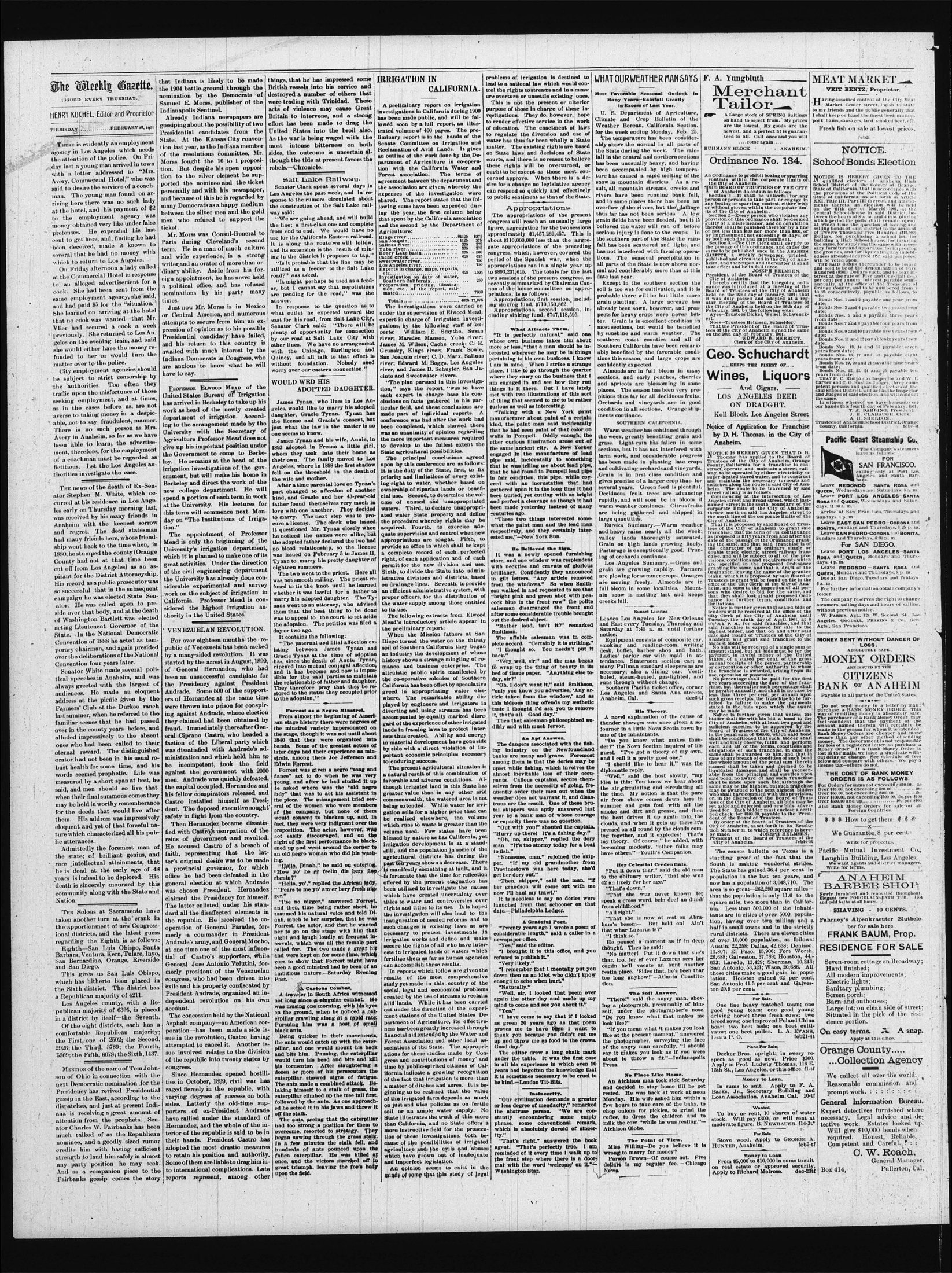
Searchable text
THERE is evidently an employment agency in Los Angeles which needs the attention of the police. On Friday last a young man arrived in town with a letter addressed to "Mrs. Avery, Commercial Hotel," who was said to desire the services of a coachman. The young man found on arriving here there was no such lady at the hotel, and his payment of $2 to the employment agency was money obtained very like under false pretenses. He expended his last cent to get here, and, finding he had been deceived, made it known to several that he had no money with which to return to Los Angeles.
On Friday afternoon a lady called at the Commercial Hotel in response to an alleged advertisement for a cook. She had been sent from the same employment agency, she said, and had paid $5 for the "situation." She learned on arriving at the hotel that no cook was wanted—that Mr. Vlier had secured a cook a week previously. She returned to Los Angeles on the evening train, and said she would either have the money refunded to her or would turn the matter over to the police.
City employment agencies should be subject to strict censorship by the authorities. Too often they traffic upon the misfortunes of those seeking employment, and at times, as in the cases before us, are not averse to taking money in a despicable, not to say fraudulent, manner. There is no such person as Mrs. Avery in Anaheim, so far as we have been able to learn; the advertisement, therefore, for the employment of a coachman must be regarded as fictitious. Let the Los Angeles authorities investigate the case.
that Indiana is likely to be made the 1904 battle-ground through the nomination by the Democrats of Samuel E. Morss, publisher of the Indianapolis Sentinel.
Already Indiana newspapers are gossiping about the possibility of two Presidential candidates from the State. At the Kansas City convention last year, as the Indiana member of the resolutions committee, Mr. Morss fought the 16 to 1 proposition. But despite his open opposition to the silver element he supported the nominee and the ticket personally and with his newspaper, and because of this he is regarded by many Democrats as a happy medium between the silver men and the gold men who refused to support the ticket.
Mr. Morss was Consul-General to Paris during Cleveland's second term. He is a man of much culture and wide experience, is a strong writer, and an orator of more than ordinary ability. Aside from his foreign appointment, he has never held a political office, and has refused nominations by his party many times.
Just now Mr. Morss is in Mexico or Central America, and numerous attempts to secure from him an expression of opinion as to his possible Presidential candidacy have failed, and his return to this country is awaited with much interest by the Indiana Democrats in Congress, who are anxious to know what he will have to say.
PROFESSOR ELWOOD MEAD of the United States Bureau of Irrigation has arrived in Berkeley to take up his work as head of the newly created department of irrigation. According to the arrangement made by the University with the Secretary of Agriculture Professor Mead does not give up his important position under the Government to come to Berkeley. He remains at the head of the irrigation investigations of the government but will make his home things, that he has impressed British vessels into his service destroyed a number of others were trading with Trinidad. " acts of violence may cause Britain to intervene, and a effort has been made to draw United States into the broil. As the war is being waged with most intense bitterness on both sides, the outcome is uncertain though the tide at present favors rebels.—Chronicle.
Salt Lake Railway
Senator Clark spent several days in Los Angeles the past week, and spoke to the rumors circulated around the construction of the Salt Lake way said:
"We are going ahead, and will the line; a first-class one and come from end to end. We would hire for the California Eastern railway. It is along the route we will find its extension is the result of in the district it proposes to."
"Is it probable that the line not utilized as a feeder to the Salt road?" was asked.
"It might perhaps be used as ever, but I cannot say that negotiation are pending for the road," was answer.
In response to the question what outlet he expected towards east for his road, from Salt Lake Senator Clark said: "There plenty of opportunity for connection by our road at Salt Lake City other lines. We have no arrangement with the Chicago, Burlington Quincy, and all talk to that extent without foundation. Nobody worry over our eastern connections."
WOULD WED HIS ADOPTED DAUGHTER
James Tynan, who lives in Los Angeles, would like to marry his daughter, Gracie Tynan. Tynan the license and Gracie's consent just what the law in the matter one seems to know.
James Tynan and his wife, Anne 1893 adopted in Fresno a little whom they took into their home their own. The family moved Angeles, where in 1898 the first fell on the threshold in the
The news of the death of Ex-Senator Stephen M. White, which occurred at his residence in Los Angeles early on Thursday morning last, was received by his many friends in Anaheim with the keenest sorrow and regret. The dead statesman had many friends here, whose friendship went back to the time when, in 1880, he stumped the county (Orange County) not at that time been cut off from Los Angeles) as an aspirant for the District Attorneyship. His record as a public prosecutor was so successful that in the subsequent campaign he was elected State Senator. He was called upon to preside over that body, and at the death of Washington Bartlett was elected acting Lieutenent Governor of the State. In the National Democratic Convention of 1888 he acted as temporary chairman, and again presided over the deliberations of the National Convention four years later.
Senator White made several political speeches in Anaheim, and was always greeted with the largest of audiences. He made an eloquent address at the picnic given by the Farmers' Club at the Durkee ranch last summer, when he referred to the familiar scenes that he had passed over in the county years before, and alluded impressively to the absent ones who had been called to their eternal reward. The distinguished orator had not been in his usual robust health for some time, and his words seemed prophetic. Life was measured by a short span at best, he said, and men should so live that when their final summons comes they may be held in worthy rememberance for the deeds that would live after them. His address was impressively eloquent and yet of that forceful nature which characterized all his public utterances.
Admittedly the foremost man of the state; of brilliant genius, and rare intellectual attainments, that he is dead at the early age of 48 years is indeed to be deplored. His death is sincerely mourned by this community along with the State and Nation.
PROFESSOR ELWOOD MEAD of the United States Bureau of Irrigation has arrived in Berkeley to take up his work as head of the newly created department of irrigation. According to the arrangement made by the University with the Secretary of Agriculture Professor Mead does not give up his important position under the Government to come to Berkeley. He remains at the head of the irrigation investigations of the government, but will make his home in Berkeley and direct the work of the new college department. He will spend a portion of each term in work at the University. His lectures for this term will commence next Monday on "The Institutions of Irrigation."
The appointment of Professor Mead is only the beginning of the University's irrigation department, which it is planned to make one of its great activities. Under the direction of the civil engineering department the University has already done considerable experimental and survey work on the subject of irrigation in California. Professor Mead is considered the highest irrigation authority in the United States.
VENEZUELAN REVOLUTION.
For over eighteen months the republic of Venezuela has been racked by a many-sided revolution. It was started by the arrest in August, 1899, of General Hernandez, who had been an unsuccessful candidate for the Presidency against President Andrade. Some 500 of the supporters of Hernandez at the same time were thrown into prison for conspiring against Andrade, whose election they claimed had been obtained by fraud. Immediately thereafter General Ciprano Castro, who headed a faction of the Liberal party which was dissatisfied with Andrade's administration and which held him to be incompetent, took the field against the government with 2000 men. Andrade was quickly defeated, the capital occupied, Hernandez and his fellow conspirators released and Castro installed himself as President. The deposed executive sought safety in flight from the country.
Then Hernandez became dissatisfied with Castro's usurpation of the reins of government and revolted. He accused Castro of a breach of faith, representing that the latter's original desire was to be made a provincial governor, for which office he had been defeated in the general election at which Andrade was chosen President. Hernandez claimed the Presidency for himself.
WOULD WED HIS ADOPTED DAUGHTER
James Tynan, who lives in Los Angeles, would like to marry his daughter, Gracie Tynan. Tynan the license and Gracie's consent just what the law in the matter one seems to know.
James Tynan and his wife, Alicia 1893 adopted in Fresno a little whom they took into their own their own. The family moved to Angeles, where in 1898 the first fell on the threshold in the city the wife and mother.
After a time parental love on part changed to affection of kind, and Gracie and her 43-year father found themselves very love with one another. They try to marry. The next step was cure a license. The clerk who questioned Mr. Tynan close he noticed the names were all the adopted father declared she no blood relationship, so she was issued on February 5 to Jamaica to marry his pretty daughter eighteen summers.
The two went to the priest. Was not smooth sailing. The pussified to tie the knot until he whether it was lawful for a fighter his adopted daughter. Nans went to an attorney, who them that 'the best thing to be was to appeal to the court to see the adoption. The petition was day or two ago.
It contains the following:
"The paternal and filial affliction between James Tynan Gracie Tynan at the time of his has since the death of Anniel ripened into mutual conjugal affection and it has become and now issible for the said parties to meet the relationship of father and daughter. They therefore pray that they stored to the status they occupy to the adoption."
Forrest as a Negro Minister From almost the beginning of can stage history there were no minstrel variety impersonate stage, though it was not until 1840 that they were organized bands. Some of the greatest a later days had their experience strels, among them Joe Jeffery Edwin Forrest.
Forrest was given a negro "dance" act to do when he woung, and after he had studied he asked where was the "old lady" that was to act his assishe piece. The management tried al of the women who were none would consent to blacken up, fact, they were very indignant proposition. The actor, however not easily discouraged, and night of the first performance he ended up and went around on an old negro woman who did hung.
"Hello, Dinah," he said on e-How yo' be er feelin dis b-ehenin"
"Hello, yo'," replied the African "Pears to me yo' am er bery fr-ger."
may be held in worthy rememberance for the deeds that would live after them. His address was impressively eloquent and yet of that forceful nature which characterized all his public utterances.
Admittedly the foremost man of the state; of brilliant genius, and rare intellectual attainments, that he is dead at the early age of 48 years is indeed to be deplored. His death is sincerely mourned by this community along with the State and Nation.
The Solons at Sacramento have taken another turn at the crank in the apportionment of new Congressional districts, and the latest guess regarding the Eighth is as follows:
Eighth—San Luis Obispo, Santa Barbara, Ventura, Kern, Tulare, Inyo, San Bernardino, Orange, Riverside and San Diego.
This gives us San Luis Obispo, which has hitherto been placed in the Sixth district. The district has a Republican majority of 4211.
Los Angeles county, with a Republican majority of 6395, is placed in a district by itself—the Seventh.
Of the eight districts, each has a comfortable Republican majority; the First, one of 2502; the Second, 2926; the Third, 3789; the Fourth, 5369; the Fifth, 6078; the Sixth, 1437.
Mention of the name of Tom Johnson of Ohio in connection with the next Democratic nomination for the Presidency has revived Presidential gossip in the East, according to the dispatches, and just at present Indiana is receiving a great amount of attention from the prophets. Senator Charles W. Fairbanks has been much talked of as the Republican nominee, and a goodly sized rumor credits him with having sufficient strength to land him safely in almost any party position he may seek. And as a companion piece to the Fairbanks gossip comes the story Castro installed himself as President. The deposed executive sought safety in flight from the country.
Then Hernandez became dissatisfied with Castro's usurpation of the reins of government and revolted. He accused Castro of a breach of faith, representing that the latter's original desire was to be made a provincial governor, for which office he had been defeated in the general election at which Andrade was chosen President. Hernandez claimed the Presidency for himself. The latter enlisted under his standard all the disaffected elements in the republic. He received the cooperation of General Parades, formerly a commander in President Andrade's army, and General Mocho, at one time one of the most influential of Castro's supporters, while General Jose Antonio Velutini, former president of the Venezuelan congress, who had been driven into exile and his property confiscated by President Andrade, organized an independent revolution on his own account.
The concession held by the National Asphalt company—an American corporation—has been made a side issue in the revolution, Castro having attempted to cancel it. Another issue involved relates to the division of the republic into twenty states by congress.
Since Hernandez opened hostilities in October, 1899, civil war has raged fiercely in the republic, with varying degrees of success on both sides. Latterly the old-time supporters of ex-President Andrade have rallied under the standard of Hernandez, and the whole of the interior of the republic is said to be in their hands. President Castro has adopted the most drastic measures to retain his position and authority. Some of them are liable to drag him into international complications. Late reports represent, among other...
Salt Lake Railway.
Senator Clark spent several days in Angeles the past week, and in response to the rumors circulated about construction of the Salt Lake railway:
"We are going ahead, and will build line; a first-class one and complete end to end. We would have no for the California Eastern railroad. It is along the route we will follow, its extension is the result of mines in the district it proposes to tap."
Is it probable that the line may be utilized as a feeder to the Salt Lake District?" was asked.
It might perhaps be used as a feed but I cannot say that negotiations pending for the road," was the answer.
In response to the question as to what outlet he expected toward the east for his road, from Salt Lake City, Senator Clark said: "There will be plenty of opportunity for connection on our road at Salt Lake City with other lines. We have no arrangement with the Chicago, Burlington and Dulce, and all talk to that effect is without foundation. Nobody need worry over our eastern connection."
WOULD WED HIS ADOPTED DAUGHTER.
James Tynan, who lives in Los Angeles, would like to marry his adopted daughter, Gracie Tynan. Tynan has the license and Gracie's consent, but what the law in the matter is no seems to know.
James Tynan and his wife, Annie, in 1835 adopted in Fresno a little girl, whom they took into their home as their own. The family moved to Los Angeles, where in 1898 the first shadow on the threshold in the death of
IRRIGATION IN CALIFORNIA.
A preliminary report on irrigation investigations in California during 1900 has been made public, and will be followed soon by a full report, an illustrated volume of 400 pages. The preliminary report is in the hands of the Senate Committee on Irrigation and Reclamation of Arid Lands. It gives an outline of the work done by the Department of Agriculture in co-operation with the California Water and Forest association. The terms of agreement between the department and the association are given, whereby the expenses of the investigation were shared. The report states that the following sums have been expended during the year, the first column being that spent by the California association and the second by the Department of Agriculture:
Kings river... $1125 $875
San Joaquin... 1125 $375
Salinas river... 375 $375
Yuba river... 375 $375
Honey Lake basin... 375 $500
Cache creek... 625 $625
Sweetwater river... 750
Los Angeles river... 750
Experts in charge, maps, reports, etc. ... 625 $1500
Investigation on duty of water, Southern California... 250
Preparation, printing, illustration, etc., of the report, estimated... 7000
Totals... 4625 12,875
The investigations were carried on under the supervision of Elwood Mead, expert in charge of irrigation investigations, by the following staff of experts: William E. Smythe, Susan river; Marsden Manson, Yuba river; James M. Wilson, Cache creek; C. E. Grunsky, Kings river; Frank Soule, San Joaquin river; C. D. Marx, Salinas river; Edward M. Boggs, Los Angeles river; and James D. Schuyler, San Jacinto and Sweetwater rivers.
"The plan pursued in this investigation," says the report, "was to have each expert in charge base his conclusions on facts gathered in his particular field, and these conclusions are made part of individual reports. A conference was had after the work had been completed, which showed there was an unanimity of opinion regarding the more important measures required to develop to the fullest extent the State agricultural possibilities.
The principal conclusions agreed upon by this conference are as follows: It is the duty of the State, first, to fix problems of irrigation is destined to lead to a national law which would control the rights to streams and in a measure overturn or unsettle existing ones.
This is not the present or ulterior purpose of those in charge of these investigations. They do, however, hope to render effective service in the work of education. The enactment of laws to regulate the diversion and use of water has thus far been wholly a State matter. The existing rights are based on State laws and decisions of State courts, and there is no reason to believe these rights will be overturned, or ought to be except as those most concerned approve. When there is a desire for a change no legislative agency can respond so quickly and effectively to public sentiment as that of the State.
Appropriations.
The appropriations of the present congress will reach an unusually large figure, aggregating for the two sessions approximately $1,457,269,457. This is about $110,000,000 less than the aggregate appropriations of the preceding congress, which, however, covered the period of the Spanish war, when the appropriations ran in a single year up to $893,231,615. The totals for the last two sessions of the present congress, as recently summarized by Chairman Canon of the house committee on appropriations, is as follows:
Appropriations, first session, including sinking fund, $710,150,862.
Appropriations, second session, including sinking fund, $747,118,595.
What Attracts Them.
"It is perfectly natural," said one whose own business takes him about more or less, "that a man should be interested wherever he may be in things pertaining to his own business. I know I am in mine. When I strike a strange place, I like to go through the quarter where they carry on the business that I am engaged in and see how they run things in it there. But I have lately met with two illustrations of this sort of thing that seemed to me to be rather curious as well as interesting.
"Talking with a New York paint manufacturer about paint of a certain kind, the paint man said incidentally that he had seen paint of that color on walls in Pompei. Oddly enough; the other curious illustration arose out of the same ancient city. A New Yorker engaged in the manufacture of lead pipe said, incidentally to something that he was telling me about lead pipe that he had found in Pompei lead pipe"
WHAT OUR WEATHER MAKE?
Most Favorable Seasonal Observation Many Years—Rainfall Growth In Excess of Last Year.
U. S. Department of Agriculture Climate and Crop Bulletin Weather Bereau, California
For the week ending Monday,
The temperature has been probably above the normal in all the State during the week.
Fall in the central and northern has been unusually heavy, and been accompanied by high tides has caused a rapid melt snow in mountain districts.
Sult, all mountain streams, can rivers have been running here and in some places there has been overflow of the rivers, but this thus far has not been serious grain fields have been flooded believed the water will run serious injury is done to the southern part of the State fall has been scattered and has not interfered with farming.
The seasonal precipitation all parts of the State is now mal and considerably more than date last year.
Except in the southern soil is too wet for cultivation probable there will be but low grain planting. A large acorn already been sown, however peects for heavy crops were taken.
Grain is in excellent condition most sections, but would be by sunshine and warm weather southern coast counties and Southern California have been benefited by the favorable conditions this season, and large confidence expected.
Almonds are in full bloom sections, and early peaches and apricots are blossoming places. The season has been pitious thus far for all deciduous Orchards and vineyards are condition in all sections. Orchments continue.
SOUTHERN CALIFORNIA
Warm weather has continued the week, greatly benefiting grass. Light rain has fallen sections, but it has not interrupted farm work, and considerable has been made in planting and cultivating orchards and Grain is in first class con
Would WED HIS ADOPTED DAUGHTER.
James Tynan, who lives in Los Angeles, would like to marry his adopted daughter, Gracie Tynan. Tynan has the license and Gracie's consent, but what the law in the matter is no seems to know.
James Tynan and his wife, Annie, in 1933 adopted in Fresno a little girl, from they took into their home as their own. The family moved to Los Angeles, where in 1898 the first shadow on the threshold in the death of the wife and mother.
After a time parental love on Tynan's last changed to affection of another kind, and Gracie and her 43-year-old father found themselves very much in love with one another. They decided marry. The next step was to procreate a license. The clerk who issued questioned Mr. Tynan closely when noticed the names were alike, but he adopted father declared the two had no blood relationship, so the license was issued on February 5 to James H. Tynan to marry his pretty daughter of eighteen summers.
The two went to the priest. Here all was not smooth sailing. The priest refused to tie the knot until he learned that it was lawful for a father to marry his adopted daughter. The Tynans went to an attorney, who advised them that the best thing to be done was to appeal to the court to set aside the adoption. The petition was filed by any or two ago.
It contains the following:
"The paternal and filial affection existing between James Tynan and Gracie Tynan at the time of adoption, since the death of Annie Tynan, opened into mutual conjugal affection, and it has become and now is impossible for the said parties to maintain the relationship of father and daughter. They therefore pray that they be rejoined to the status they occupied prior to the adoption."
Forrest as a Negro Minstrel.
From almost the beginning of American stage history there were negroes of the minstrel variety impersonated on the stage, though it was not until about 40 that they were organized into bands. Some of the greatest actors of older days had their experience as minstrels, among Joe Jefferson and Dawn Forrest.
Forrest was given a negro "song and dance" act to do when he was very young, and after he had studied it up asked where was the "old negro only" that was to act his assistant in the piece. The management tried several of the women who were members of the company, but none of them should consent to blacken up, and, in fact, they were very indignant over the opposition. The actor, however, was not easily discouraged, and on the night of the first performance he blackened up and went around the corner to an old negro woman who did his washing.
Hello, Dinah," he said on entering. How yo' be feelin dis bery fine ennin?
Hello, yo'" replied the African lady. Pears to me yo' am er bery fresh nigra."
The principal conclusions agreed upon by this conference are as follows: It is the duty of the State, first, to fix priority and limitations of every existing right to water, whether based on ownership of riparian lands or beneficial use. Second, to determine the volume of unused and unappropriated waters. Third, to declare unappropriated water State property and define the procedure whereby rights may be acquired. Fourth, to exercise adequate supervision and control when new appropriations are sought. Fifth, to provide an office in which shall be kept a complete record of each perfected right, of each application and of each permit for the new division and use. Sixth, to divide the State into administrative divisions and districts, based on drainage lines. Seventh, to provide an efficient administrative system, with proper officers, for the distribution of the water supply among those entitled to its use.
The following extracts from Elwood Mead's introductory article appear in the preliminary report:
When the Mission fathers at San Diego turned the water on the thirsty soil of Southern California they began an industry the development of whose history shows a strange mingling of romance and business enterprise. The altruistic public spirit manifested by the co-operative colonies of Southern California has been offset by speculative greed in appropriating water elsewhere. The remarkable ability displayed by engineers and irrigators in diverting and using streams has been accompanied by equally marked disgard of the experience of other irrigated lands in framing laws to protect interests thus created. Ability and energy in material development have gone side by side with a direct violation of important economic principles necessary to enduring success.
The present agricultural situation is a natural result of this combination of favorable and adverse conditions. Although irrigated land in this State has greater value than in any other arid commonwealth, the watered area is not being extended. While water for irrigation sells for a higher price than can be realized elsewhere, the volume which runs to waste is greater than the volume used. Few states have been blessed by nature as has California, yet irrigation development is at a standstill, and the population in some of the agricultural districts has during the past ten years shown a decrease. There is manifestly something at fault, and it is fortunate that the time for reflection offered by the present stagnation has been utilized to investigate the causes which have created uncertainty over cincinto and Sweetwater rivers.
"The plan pursued in this investigation," says the report, "was to have each expert in charge base his conclusions on facts gathered in his particular field, and these conclusions are made part of individual reports. A conference was had after the work had been completed, which showed there was an unanimity of opinion regarding the more important measures required to develop to the fullest extent the State agricultural possibilities.
The principal conclusions agreed upon by this conference are as follows: It is the duty of the State, first, to fix priority and limitations of every existing right to water, whether based on ownership of riparian lands or beneficial use. Second, to determine the volume of unused and unappropriated waters. Third, to declare unappropriated water State property and define the procedure whereby rights may be acquired. Fourth, to exercise adequate supervision and control when new appropriations are sought. Fifth, to provide an office in which shall be kept a complete record of each perfected right, of each application and of each permit for the new division and use. Sixth, to divide the State into administrative divisions and districts, based on drainage lines. Seventh, to provide an efficient administrative system, with proper officers, for the distribution of the water supply among those entitled to its use.
The following extracts from Elwood Mead's introductory article appear in the preliminary report:
When the Mission fathers at San Diego turned the water on the thirsty soil of Southern California they began an industry the development of whose history shows a strange mingling of romance and business enterprise. The altruistic public spirit manifested by the co-operative colonies of Southern California has been offset by speculative greed in appropriating water elsewhere. The remarkable ability displayed by engineers and irrigators in diverting and using streams has been accompanied by equally marked disgard of the experience of other irrigated lands in framing laws to protect interests thus created. Ability and energy in material development have gone side by side with a direct violation of important economic principles necessary to enduring success.
The present agricultural situation is a natural result of this combination of favorable and adverse conditions. Although irrigated land in this State has greater value than in any other arid commonwealth, the watered area is not being extended. While water for irrigation sells for a higher price than can be realized elsewhere, the volume which runs to waste is greater than the volume used. Few states have been blessed by nature as has California, yet irrigation development is at a standstill, and the population in some of the agricultural districts has during the past ten years shown a decrease. There is manifestly something at fault, and it is fortunate that the time for reflection offered by the present stagnation has been utilized to investigate the causes which have created uncertainty over cincinto and Sweetwater rivers.
"The plan pursued in this investigation," says the report, "was to have each expert in charge base his conclusions on facts gathered in his particular field, which has been completed, which showed there was an unanimity of opinion regarding the more important measures required to develop to the fullest extent the State agricultural possibilities.
The principal conclusions agreed upon by this conference are as follows: It is the duty of the State, first, to fix priority and limitations of every existing right to water, whether based on ownership of riparian lands or beneficial use. Second, to determine the volume of unused and unappropriated waters. Third, to declare unappropriated water State property and define the procedure whereby rights may be acquired. Fourth, to exercise adequate supervision and control when new appropriations are sought. Fifth, to provide an office in which shall be kept a complete record of each perfected right, of each application and of each permit for the new division and use. Sixth, to divide the State into administrative divisions and districts, based on drainage lines. Seventh, to provide an efficient administrative system, with proper officers, for the distribution of the water supply among those entitled to its use.
The following extracts from Elwood Mead's introductory article appear in the preliminary report:
When the Mission fathers at San Diego turned the water on the thirsty soil of Southern California they began an industry the development of whose history shows a strange mingling of romance and business enterprise. The altruistic public spirit manifested by the co-operative colonies of Southern California has been offset by speculative greed in appropriating water elsewhere. The remarkable ability displayed by engineers and irrigators in diverting and using streams has been accompanied by equally marked disgard of the experience of other irrigated lands in framing laws to protect interests thus created. Ability and energy in material development have gone side by side with a direct violation of important economic principles necessary to enduring success.
The present agricultural situation is a natural result of this combination of favorable and adverse conditions. Although irrigated land in this State has greater value than in any other arid commonwealth, the watered area is not being extended. While water for irrigation sells for a higher price than can be realized elsewhere, the volume which runs to waste is greater than the volume used. Few states have been blessed by nature as has California, yet irrigation development is at a standstill, and the population in some of the agricultural districts has during the past ten years shown a decrease. There is manifestly something at fault, and it is fortunate that the time for reflection offered by the present stagnation has been utilized to investigate the causes which have created uncertainty over cincinto and Sweetwater rivers.
"The plan pursued in this investigation," says the report, "was to have each expert in charge base his conclusions on facts gathered in his particular field, which has been completed, which showed there was an unanimity of opinion regarding the more important measures required to develop to the fullest extent the State agricultural possibilities."
The principal conclusions agreed upon by this conference are as follows: It is the duty of the State, first, to fix priority and limitations of every existing right to water, whether based on ownership of riparian lands or beneficial use. Second, to determine the volume of unused and unappropriated waters. Third, to declare unappropriated water State property and define the procedure whereby rights may be acquired. Fourth, to exercise adequate supervision and control when new appropriations are sought. Fifth, to provide an office in which shall be kept a complete record of each perfected right, of each application and of each permit for the new division and use. Sixth, to divide the State into administrative divisions and districts, based on drainage lines. Seventh, to provide an efficient administrative system, with proper officers, for the distribution ofthe water supply among those entitled to its use.
The following extracts from Elwood Mead's introductory article appear in the preliminary report:
When the Mission fathers at San Diego turned the water on thirsty soil of Southern California they began an industry the development of whose history shows a strange mingling of romance and business enterprise. The altruistic public spirit manifested by the co-operative colonies of Southern California has been offset by speculative greed in appropriating water elsewhere. The remarkable ability displayed by engineers and irrigators in diverting and using streams has been accompanied by equally marked disgard ofthe experience of other irrigated lands in framing laws to protect interests thus created. Ability and energy in material development have gone side by side with a direct violation of important economic principles necessary to enduring success.
The present agricultural situation is a natural result of this combination of favorable and adverse conditions. Although irrigated land in this State has greater value than in any other arid commonwealth, the watered area is not being extended. While water for irrigation sells for a higher price than can be realized elsewhere, the volume which runs to waste is greater than the volume used. Few states have been blessed by nature as has California, yet irrigation development is at a standstill, andthe population in some localitiesaind snow is melting fast ocreeks full.
Forrest was given a negro "song and dance" act to do when he was very young,and after he had studied it up asked where was she "old negro only" that was to act his assistant in his piece.The management tried severalofthe women who were membersofthe company,但noneofthemshouldconsenttoblackenup,andinfact,thewereveryindignantovertheposition.Theactor,hiswearedonentryinaLittleNovaScottlandbuthednotgeta theory?I'vegotatheoryoandIcallitaprettygoodoandIshouldliketohearmysystem.Iof course,thebecomingmodesty,"otherhaveothers."—Youth'sCom
Forrest as a Negro Minstrel.
From almostthe beginningofAmericaindstagehistorytherewerenegrosoftheminstrelvarietyimpersonatedonthestagethoughitwasnotuntilabout40thattheywereorganizedintands.SomeofthegreatestactorsoftheworlddayshadtheexperienceasminstrelsamongtheJoeJeffersonandDawnForrest.
Forrestasgivena negro"songanddance"acttodowhenhewasveryyoung,andafterhehadstudieditupaskedwherewasshe"oldnegroonly"thatwastoacthisassistantinhispiece.Themanagementtriedseveralofthewomenwhosemembersofthecompany,但noneofthemshouldconsenttoblackenup,andinfact,thewereveryindignantovertheposition.Theactor,hiswearedonentryinaLittleNovaScottlandbuthednotgeta theory?I'vegotatheoryoandIcallitaprettygoodoandIshouldliketohearmysystem.Iof course,thebecomingmodesty,"otherhaveothers."—Youth'sCom
LeavesLosAngelesforNoyalandEasteveryTuesdayThursdayat7:45a.m.unnotice.Equipmentconsistsofcompossmokingandreading-rowdesk,buffet,barbershopladiesparlorcarwithmattendance.StateroomseeksmanyPullmanstandardsleepnecessary;alsobathingsteamediameter;steamedamselflowhearted steam-heatedgasrunsthroughwithoutchangeSouthernPacificticketofforLosAngelesandSantaAnaheim.Cal.
HisTheory.A novelexplanationofthethundershowerswasoncejourneriainlittleNovaScottoneoftheinhabitants.DoYouknowwhatmatter?"theNovaScottianinquire.guest"I'vegotatheoryoandIcallitaprettygoodoandIshouldliketohearmysystem.Iof course,thebecomingmodesty,"otherhaveothers."—Youth'sCom
HerCelestialCredence.“Putitdownthat,"saidtoitobituarywriter,"the42anlikelyferherage.”“That’sdown.”“That shewuzneverpainted”—Earthward
"Putit down that," saidtoitobituarywriter,"the42anlikelyferherage.”“That’sdown.”“That shewuzneverpainted”—Earthward
The management tried several of the women who were members of the company, but none of them would consent to blacken up, and, in fact, they were very indignant over the proposition. The actor, however, was not easily discouraged, and on the night of the first performance he blackened up and went around the corner to an old negro woman who did his washing.
"Hello, Dinah," he said on entering. "How do you be feelin dis bery fine evening?"
"Hello, yo,'" replied the African lady. "Pears to me yo'am er bery fresh nigrur."
"I'ze no nigger," answered Forrest, and then, time being rather short, he assumed his natural voice and told Dinah, much to her surprise, that he wasForrest, the actor, and that he wanted to go on the stage with him that night and laugh loudly at frequent intervals, which was all the female part called for. The two made a great hit and were kept on for some time, which does to show that Forrest might have been a good minstrel had he been of an ambitious nature.—Saturday Evening Post.
A Curious Combat.
A traveler in South Africa witnessed not long since a singular combat. He was musing one morning, with his eyes on the ground, when he noticed a caterpillar crawling along at a rapid rate, pursuing him was a host of small black ants.
Being quicker in their movements, the ants would catch up with the caterpillar, and one would mount his back and bite him. Pausing, the caterpillar would turn his head and bite and kill its tormentor. After slaughtering a frozen or more of his persecutors the caterpillar showed signs of fatigue. The ants made a combined attack. Beaking himself to a stalk of grass, the caterpillar climbed up the tree tall first, followed by the ants. As one approach he seized it in his jaws and threw it at the stalk.
The ants, seeing that the caterpillar had too strong a position for them to overcome, resorted to strategy. They began sawing through the grass stalk in a few minutes the stalk fell, and hundreds of ants pounced upon the fallen caterpillar. He was killed at once, and the victors marched off in great triumph, leaving the foe's body upon the field.
An opinion seems to exist in the minds of some that this study of legal weather does not warrant it, and misuses the result. One of these brutal skippers was aptly answered last year by a bank man whose courage or capacity there was no question.
"Out with you!" shouted the captain. "Hurry up there! It's a fishing day."
Oh, no, skipper," replied the dory man. "It's too stormy today for a boat to fish."
Nonsense, man," rejoined the skipper. "If my old grandmother from Provincetown was here today, she'd get her dory out."
Then, skipper," said the man, "if her grandson will come out with me now I'll haul my trawl."
It is needless to say no dories were launched from that schooner on that date.—Philadelphia Ledger.
A Grateful Poet.
Twenty years ago I wrote a poem of considerable length," said a caller in a newspaper office.
"Yes," said the editor.
"I brought it to this office, and you refused to publish it."
Very likely.
"I remember that I mentally put you down then as an idiot who didn't know enough to ache when hurt."
Naturally.
"Well, sir, I looked that poem over again the other day and made up my mind to come and see you about it."
Yes."
"I have come to say that if I looked as green 20 years ago as that poem proves me to have been I want to thank you because you didn't cut me up and throw me as food to the crows. Good day."
The editor drew a long chalk mark under the table. It was the first case in all his experience in which even 20 years had begotten the knowledge that it is sometimes necessary to be cruel to be kind.—London Tit-Bita.
Insincerity.
Our civilization demands a greater or less degree of mendacity," remarked the abstruse person. "We are constantly encountering some empty phrase, some conventional remark, which is absolutely devoid of sincerity."
That's right," answered the book agent. "That's perfectly true. I am reminded of it every time I walk up to the front step where there is a door-mat with the word 'welcome' on it."—Washington Star.
Her Celestial Credence.
"Put it down thar." said to the obituary writer, "the 42 an likely fer her age."
"That's down."
"That she wuz never speak a cross word, beln de from childhood."
"All right."
"That she is now at rest ham's bosom— But hold that whar Lazarus is?"
"I think so."
He paused a moment as thought. Then he said:
"No matter! Put it down thar, too, fer ef ever Lazar comin' he'll vacate an hu restin place. 'Sides that, he too long anyhow!'—Atlantic tion.
The Soft Answer.
"There!" said the angry photograph, presume self, under the photograph: "Do you know what that look like?"
"If you mean what it may like at the present moment the photographer, survey of the angry man carefully say it makes you look as about to throw a fit."—Press.
No Place Like Hear.
An Atchison man took shot and decided to stay home rested. He was back at work Monday. His wife asked how hours to take care of chop onions for pickles, coffee, to dress the child milk the cow "while he waited Atchison Globe.
The Point of Viz.
Miss Willing—Do you wrong to marry for money?
Parson Brown—Of course dollars is my regular fee News.
WHAT OURWEATHER MAN SAYS
Most Favorable Seasonal Outlook in Many Years—Rainfall Greatly in Excess of Last Year.
U. S. Department of Agriculture, Climate and Crop Bulletin of the Weather Bureau, California Section. For the week ending Monday, Feb. 25. The temperature has been considerably above the normal in all parts of the State during the week. The rainfall in the central and northern sections has been unusually heavy, and having been accompanied by high temperature has caused a rapid melting of the snow in mountain districts. As a result, all mountain streams, creeks and rivers have been running bank full, and in some places there has been an overflow of the rivers, but the damage thus far has not been serious. A few grain fields have been flooded, but it is believed the water will run off before serious injury is done to the crops. In the southern part of the State the rainfall has been scattered and light, and has not interfered with farming operations. The seasonal precipitation in all parts of the State is now above normal and considerably more than at this date last year.
Except in the southern section the soil is too wet for cultivation, and it is probable there will be but little more grain planting. A large acreage has already been sown, however, and prospects for heavy crops were never better. Grain is in excellent condition in most sections, but would be benefited by sunshine and warm weather. The southern coast counties and all of Southern California have been remarkably benefited by the favorable conditions this season, and large crops are confidently expected.
Almonds are in full bloom in many sections, and early peaches, cherries and apricots are blossoming in some places. The season has been very propitious thus far for all deciduous fruits. Orchards and vineyards are in good condition in all sections. Orange shipments continue.
SOUTHERN CALIFORNIA.
Warm weather has continued through the week, greatly benefiting grain and grass. Light rain has fallen in some sections, but it has not interfered with farm work, and considerable progress has been made in planting late crops and cultivating orchards and vineyards.
F. A. Yungbluth
Merchant Tailor
A Large stock of SPRING Suitings on hand to select from. My prices are the lowest. My goods are the newest, and a perfect fit is guaranteed to all. Call once and you will come again.
RUHMANN BLOCK - ANAHEIM.
Ordinance No. 134.
An Ordinance to prohibit boxing or sparring contests within the corporate limits of the City of Anaheim.
THE BOARD OF TRUSTEES OF THE CITY OF Anaheim do ordain as follows:
Section 1- It shall be unlawful for any person or persons to take part or engage in any boxing or sparring contest, either with or without gloves, within the corporate limits of the City of Anaheim.
Section 2- Every person who violates any provision of this ordinance shall be deemed guilty of a misdemeanor, and on conviction thereof shall be punished therefor by a fine of not less than $100 nor more than $300, or by imprisonment not exceeding 60 days, or by both such fine and imprisonment.
Section 3- The City Clerk shall certify to the passage of this ordinance, and cause the same to be published once in the Anaheim Gazette, a weekly newspaper, printed, published and circulated in the City of Anaheim, and thereupon thereafter it shall take effect and be in full force.
JOSEPH HELMSEN.
President of the Board of Trustees of the City of Anaheim.
I hereby certify that the foregoing ordinance was introduced at a meeting of the Board of Trustees of the City of Anaheim held on the 22nd day of January, 1901; that it was duly passed and adopted at a regular meeting of the Board of Trustees of the City of Anaheim held on the 26th day of February, 1901, by the following vote:
Ayes—Trustees Dickel, Weisel, Schwenckert.
Noes—Trustees Helmsen, Schneider.
That the President of the Board of Trustees of the City of Anaheim signed the same on the 26th day of February, 1901.
EDWARD B. MERRITT.
Clerk of the City of Anaheim.
Geo. Schuchardt
...KEEPES THE FINEST OF...
Wines, Liquors
And Cigars.
LOS ANGELES BEER ON DRAUGHT.
Koll Block, Los Angeles Street
Notice of Application for Franchise by D. H. Thomas, in the City of Anaheim.
NOTICE IS HEREBY GIVEN THAT D. H. Thomas has applied to the Board of Trustees of the City of Anaheim, Orange County, California, for a franchise to construct, operate and maintain a street railway to be operated by either electricity or gas.
MEAT MARKET
VEIT BENTZ, Proprietor.
Having assumed control of the City Meat Market, Center street, I wish to state to my friends and the public generally that I shall keep on hand the finest beef mutton, pork, hams, sausages, lard, smoked beef etc.
Fresh fish on sale at lowest prices.
feb21
NOTICE.
School Bonds Election
NOTICE IS HEREBY GIVEN TO THE qualified electors of Anaheim High School District of the County of Orange. State of California, that in accordance with the provisions of the Political Code of the State of California, as set forth in Article XXI, Title III, Part III thereof, and amendments thereto, an election will be held on the fifth day of March 1901, at the Central School-house in said District; between the hours of 8 A.M. and 4 P.M. (during which period these polls shall remain open at which time the question of issuing and selling bonds of said district to the amount of Twelve Thousand Five Hundred ($12,500) Dollars, for purchasing a school lot; for building a High School house; for insuring the same; for supplying the same with necessary furniture and apparatus; for improving the grounds; and for liquidating any indebtedness already incurred for said purposes, will be voted upon.
THE SAID BONDS thereunder to be issued and sold to be of the denomination of Five Hundred ($500) Dollars and to bear interest at the rate of Five and One-Half ($5.) per cent per annum; interest payable semiannually; at the office of the Treasurer of Orange County; and to be numbered from 1 to 6 consecutive payable as follows: to wit:
Bonds Nos. 1 and 2 payable one year from date;
Bonds Nos. 3 and 4 payable two years from date;
Bonds Nos. 5 and 6 payable three years from date;
Bonds Nos. 7 and 8 payable four years from date;
Bonds Nos. 9 and 10 payable five years from date;
Bonds Nos. 11 and 12 payables six years from date;
Bonds Nos. 13, 14 and 15 payable seven years from date;
Bonds Nos. 16, 17 and 18 payable eight years from date;
Bonds Nos. 19, 20 and 21 payable nine years from date;
Bonds Nos. 22, 23, 24 and 25 payable ten years from date;
THAT F. C. Rimpau as Inspector and W. F. Carver and C. O. Rust as Judges, three competent persons and qualified electors of the said School District will act as the Inspector and Judges of said election; and will conduct the same.
In witness whereof we have hereunto set our hands this fourth day of February, 1901.
T. A. DARLING. President.
J. H. CLABAUGH. Clerk.
A. H. SHELDON.
Trustees of Anaheim School District, Orange County, California.
jeb7-4
Warm weather has continued through the week, greatly benefiting grain and grass. Light rain has fallen in some sections, but it has not interfered with farm work, and considerable progress has been made in planting late crops and cultivating orchards and vineyards. Grain is in first class condition and gives promise of a larger crop than for several years. Green feed is plentiful. Deciduous fruit trees are advancing rapidly, and will soon be in bloom if warm weather continues. Citrus fruits are being gathered and shipped in large quantities.
Eureka Summary.—Warm weather and heavy rains nearly all the week; valley lands thoroughly saturated. Grain on high lands growing finely. Pasturage is exceptionally good. Pruning of orchards continues.
Los Angeles Summary.—Grass and grain are growing rapidly. Farmers are plowing for summer crops. Oranges are moving freely. Almonds are in full bloom in some localities. Mountain snow is melting fast and keeps creeks full.
Sunset Limited
Leaves Los Angeles for New Orleans and East every Tuesday, Thursday and Saturday at 7:45 a.m. until further notice.
Equipment consists of composite car, smoking and reading-room, writing desk, buffet, barber shop and bath. Ladies' parlor car with maid in attendance. Statateroom section car; as many Pullman standard sleepers as are necessary; also a dining car. Vestibulbed, steam-heated, gas-lighted, and runs through without change.
Southern Pacific ticket office, corner Los Angeles and Santa Ana streets, Anaheim, Cal.
dec6-tf
His Theory.
A novel explanation of the cause of thunder showers was once given a sojourner in a little Nova Scotia town by one of the inhabitants.
"Do you know what makes thunder?" the Nova Scotian inquired of his guest. "I've got a theory of my own, and I call it a pretty good one."
"I should like to hear it," was the diplomatic reply.
Well," said the host slowly, "my idea is this: You know we hear about the air circulating and circulating all the time. My notion is that the pure air from above comes down here in summer and gets foul with all the smoke and dirt and grease, and then the heat drives it up again into the clouds, and when it gets up there it's pressed on all round by the clouds coming together, and it explodes! That's my theory. Of course," he added, with becoming modesty, "other folks may have others."—Youth's Companion.
Her Celestial Credentials.
"Put it down thar," said the old man to the obituary writer, "that she wuz 42 an likely fer her age."
"That's down."
"That she wuz never known ter"
The census bulletin on Texas is a startling proof of the fact that the South is making wonderful strides. The State has gained 36.4 per cent in population in the last ten years, and now has a population of 3,048,710. The area is so great—262,290 square miles—the population is only 11.6 to the
Wines, Liquors
And Cigars.
LOS ANGELES BEER ON DRAUGHT.
Koll Block, Los Angeles Street
Notice of Application for Franchise by D.H. Thomas, in the City of Anaheim.
NOTICE IS HEREBY GIVEN THAT D.H. Thomas has applied to the Board of Trustees of the City of Anaheim Orange County, California, for a franchise to construct, operate and maintain a street railway to be operated by either electricity or super-heated stored water, and to construct and maintain the necessary turnouts and switches along the route in said City of Anaheim to be traversed by said street railway is as follows:
Commencing at the intersection of Los Angeles street and Broad street, which last-named street is the south boundary of the corporate limits of the City of Anaheim; thence north on said Los Angeles street to the north line of the corporate limits of the City of Anaheim;
That it is proposed by said Board of Trustees of the City of Anaheim to grant said franchise; that the term of its continuance as proposed is fifty years from and after the date of the passage of the Ordinance granting that sale to said firm of the character of an ordinary single or double track electric street railway franchise, and will subject to all of the provisions, conditions and requirements which are specified in the proposed Ordinance granting the same, and that a draft of the Ordinance granting that sale to said firm of the character of an ordinary single or double track electric street railway franchise, and will subject to all of the provisions, conditions and requirements which are specified in the proposed Ordinance granting the same, and that a draft of the Ordinance granting that sale to said firm of the character of an ordinary single or double track electric street railway franchise, and will subject to all of the provisions, conditions and requirements which are specified in the proposed Ordinance granting the same, and that a draft of the Ordinance granting that sale to said firm of the character of an ordinary single or double track electric street railway franchise, and will subject to all of the provisions, conditions and requirements which are specified in the proposed Ordinance granting the same, and that a draft of the Ordinance granting that sale to said firm of the character of an ordinary single or double track electric street railway franchise, and will subject to all of the provisions, conditions and requirements which are specified in the proposed Ordinance granting the same, and that a draft of the Ordinance granting that sale to said firm of the character of an ordinary single or double track electric street railway franchise, and will subject to all ofthe provisions, conditions and requirements which are specified in the proposed Ordinance granting the same, and that a draft of the Ordinance granting that sale to said firm of the character of an ordinary single or double track electric street railway franchise, and will subject to all ofthe provisions, conditions and requirements which are specified in the proposed Ordinance granting the same, and that a draft of the Ordinance granting that sale to said firm of the character of an ordinary single or double track electric street railway franchise, and will subject to allofthe provisions, conditions and requirements which are specified in the proposed Ordinance granting the same, and that a draft of the Ordinance granting that sale to said firm of the character of an ordinary single or double track electric street railway franchise, and will subject to allofthe provisions, conditions and requirements which are specified in the proposed Ordinance granting the same, and that a draft of the Ordinance granting that sale to said firm of the character of an ordinary single or double track electric street railway franchise, and will subject to allofthe provisions, conditions and requirements which are specified in the proposed Ordinance granting the same, and that a draft ofthe Ordinance granting that sale to said firm of the character of an ordinary single or double track electric street railway franchise, and will subject to allofthe provisions, conditions and requirements which are specified in the proposed Ordinance granting the same, and that a draft ofthe Ordinance granting that sale to said firm ofthe character of an ordinary single or double track electric street railway franchise, and will subject to allofthe provisions, conditions and requirements which are specified in the proposed Ordinance granting the same, and that a draft ofthe Ordinance granting that sale to said firm ofthe character of an ordinary single or double track electric street railway franchise, and will subject to allofthe provisions, conditions and requirements which are specified inthe proposedOrdinance grantingthe same,the same,the same,the same,the same,the same,the same,the same,the same,the same,the same,the same,the same,the same,the same,the same,the same,the same,the same,the same,the same,the same,the same,the same,the same,the same,the same,the same,the same,the same,the same,the same,the same,the same,the same,the same,the same,the same,the same,the same,the same,the same,the same,the same,the same,the same,the same,the same,the same,the same.the same.the same.the same.theSame.theSame.theSame.theSame.theSame.theSame.theSame.theSame.theSame.theSame.theSame.theSame.theSame.theSame.theSame.theSame.theSame.theSame.theSame.theSame.theSame.theSame.theSame.theSame.theSame.theSame.theSame.theSame.theSame.theSame.theSame.theSame.theSame.theSame.theSame.theSame.theSame.theSame.theSame.theSame.theSame.theSame.theSame.theSame.theSame.theSame.theSame.theSame.theSame.TheName.TheName.TheName.TheName.TheName.TheName.TheName.TheName.TheName.TheName.TheName.TheName.TheName.TheName.TheName.TheName.TheName.TheName.TheName.TheName.TheName.TheName.TheName.TheName.TheName.TheName.TheName.TheName.TheName.TheName.TheName.TheName.TheName.TheName.TheName.TheName.TheName.TheName.TheName.TheName.TheName.TheName.TheName.TheName.TheName.TheName.TheName.TheName.TheName.TheName.Name.Name.Name.Name.Name.Name.Name.Name.Name.Name.Name.Name.Name.Name.Name.Name.Name.Name.Name.Name.Name.Name.Name.Name.Name.Name.Name.Name.Name.Name.Name.Name.Name.Name.Name.Name.Name.Name.Name.Name.Name.Name.Name.Name.Name.Name.Name.Name.Name.Name.Name.Name.Name.Name.Name.Name.Name.Name.Name.Namename.Namename.Namename.Namename.Namename.Namename.Namename.Namename.Namename.Namename.Namename.Namename.Namename.Namename.Namename.Namename.Namename.Namename.Namename.Namename.Namename.Namename.Namename.Namename.Namename.Namename.Namename.Namename.Namename.Namename.Namename.Namename.Namename.Namename.Namename.Namename.Namename.Namename.Namename.Namename.Namename.Namename.Namename.Namename.Namename.Namename.Namame.Nama.Mama.Mama.Mama.Mama.Mama.Mama.Mama.Mama.Mama.Mama.Mama.Mama.Mama.Mama.Mama.Mama.Mama.Mama.Mama.Mama.Mama.Mama.Mama.Mama.Mama.Mama.Mama.Mama.Mama.Mama.Mama.Mama.Mama.Mama.Mama.Mama.Mama.Mama.Mama.Mama.Mama.Mama.Mama.Mama.Mama.Mama.Mama.Mama.Mama.Mama.Mamas.Mamas.Mamas.Mamas.Mamas.Mamas.Mamas.Mamas.Mamas.Mamas.Mamas.Mamas.Mamas.Mamas.Mamas.Mamas.Mamas.Mamas.Mamas.Mamas.Mamas.Mamas.Mamas.Mamas.Mamas.Mamas.Mamas.Mamas.Mamas.Mamas.Мама.Мама.Мама.Мама.Мама.Мама.Мама.Мама.Мама.Мама.Мама.Мама.Мама.Маша.Маша.Маша.Маша.Маша.Маша.Маша.Маша.Маша.Маша.Маша.Маша.Маша.Маша.Маша.Маша.Маша.Маша.Маша.Маша.Маша.Маша.Маша.Маша.Маша.Маша.Маша.Маша.Маша.Маша.Маша.Маша.Маша.Маша.Маша.Маша.Маша.Маша.Маша.Маша.Маша.Пшаши.Пшаши.Пшаши.Пшаши.Пшаши.Пшаши.Пшаши.Пшаши.Пшаши.Пшаши.Пшаши.Пшаши.Пшаши.Пшаши.Пшаши.Пшаши.Пшаши.Пшаши.Пшаши.Пшащий.Пшащий.Пшащий.Пшащий.Пшащий.Пшащий.Пшащий.Пшащий.Пшащий.Пшащий.Пшащий.Пшащий.Пшащий.Пшащий.Pшащий.Pшащий.Pшащий.Pшащий.Pшащий.Pшащий.Pшащий.Пшащий.Пшащий.Пшащий.Пшащий.Пшащий.Пшащий.Пшащий.Пшащий.Ппщ尹.Ппщ尹.Ппщ尹.Ппщ尹.Ппщ尹.Ппщ尹.Ппщ尹.Ппщ尹.Ппщ尹.Ппщ尹.Ппщ尹.Ппщ尹.Ппщ尹.Ппщ尹.Ппщ尹.Ппщ尹.Ппщ尹.Ппщ尹.Ппщ尹.Ппщ尹.Ппщ尹.Ппщ尹.Ппщ尹.Ппщ尹.Ппщ尹Ппщ尹Ппщ尹Ппщ尹Ппщ尹Пп什щ尹П什什щ尹П什什什什什什什什什什什什什什什什什什什什什什什什什什什什什什什什什什什什什什什什什什什付付付付付付付付付付付付付付付付付付付付付付付付付付付付付付付付付付付付付付付付付付付付付付付付付付付付付付付付付付付付付付付付付付付付付付付付付付付付付付付付付费付费付费付费付费付费付费付费付费付费付费付费付费付费付费付费付费付费付费付费付费付费付费付费付费付费付费付费付费付费付费付费付费付费付费付费付费付费付费付费付费付费花费花费花费花费花费花费花费花费花费花费花费花费花费花费花费花费花费花费花费花费花费花费花费花费花费花费花费花费花费花费花费花费花费花费花费花费花费花费花费花费花费花费花费花费花费浪费浪费浪费浪费浪费浪费浪费浪费浪费浪费浪费浪费浪费浪费浪费浪费浪费浪费浪费浪费浪费浪费浪费浪费浪费浪费浪费浪费浪费浪费浪费浪费浪费浪费浪费浪费浪费浪费浪费浪费浪费浪费浪费浪费浪费浪费浪费浪费浪费浪费浪费浪费浪费浪费浪费浪费浪费浪费浪费浪费浪费浪费浪费浪费浪费浪费浪费浪费浪费浪费浪费浪费浪费浪费浪费
WHERE WAS THE COMPANY IN THIS FIELD?
THE COMPANY IN THIS FIELD?
THE COMPANY IN THIS FIELD?
THE COMPANY IN THIS FIELD?
THE COMPANY IN THIS FIELD?
THE COMPANY IN THIS FIELD?
THE COMPANY IN THIS FIELD?
THE COMPANY IN THIS FIELD?
THE COMPANY IN THIS FIELD?
THE COMPANY IN THIS FIELD?
THE COMPANY IN THIS FIELD?
THE COMPANY IN THIS FIELD?
THE COMPANY IN THIS FIELD?
THE COMPANY IN THIS FIELD?
THE COMPANY IN THIS FIELD?
THE COMPANY IN THIS FIELD?
THE COMPANY IN THIS FIELD?
THE COMPANY IN THIS FIELD?
THE COMPANY IN THIS FIELD?
THE COMPANY IN THIS FIELD?
THE COMPANY IN THIS FIELD?
THE COMPANY IN THIS FIELD?
THE COMPANY IN THIS FIELD?
THE COMPANY IN THIS FIELD?
THE COMPANY IN THIS FIELD?
THE COMPANY IN THIS FIELD?
THE COMPANY IN THIS FIELD?
THE COMPANY IN THIS FIELD?
THE COMPANY IN THIS FIELD?
THE COMPANY IN THIS FIELD?
THE COMPANY IN THIS FIELD?
THE COMPANY IN THIS FIELD?
THE COMPANY IN THIS FIELD?
THE COMPANY IN THIS FIELD?
THE COMPANY IN THIS FIELD?
THE COMPANY IN THIS FIELD?
THE COMPANY IN THIS FIELD?
THE COMPANY IN THIS FIELD?
THE COMPANY IN THIS FIELD?
THE COMPANY IN THIS FIELD?
THE COMPANY IN THIS FIELD?
THE COMPANY IN THIS FIELD?
THE COMPANY IN THIS FIELD?
THE COMPANY IN THIS FIELD?
THECOMPANYINTHISFIELDFIELDFIELDFIELDFIELDFIELDFIELDFIELDFIELDFIELDFIELDFIELDFIELDFIELDFIELDFIELDFIELDFIELDFIELDFIELDFIELDFIELDFIELDFIELDFIELDFIELDFIELDFIELDFIELDFIELDFIELDFIELDFIELDFIELDFIELDFIELDFIELDFIELDFIELDFIELDFIELDFIELDFIELDFIELDFIELDFIELDFIEL DFIELDFIELDFIELDFIELDFIELDFIELDFIELDFIELDFIELDFIELDFIELDFIELDFIELDFIELDFIELDFiel DFiel DFiel DFiel DFiel DFiel DFiel DFiel DFiel DFiel DFiel DFiel DFiel DFiel DFiel DFiel DFiel DFiel DFiel DFiel DFiel DFiel DFiel DFiel DFiel DFiel DFiel DFiel DFiel DFiel DFiel DFiel DFiel DFiel DFiel DFiel DFiel DFiel DFiel DFiel DFiel DFiel DFiel DFiel DFiel DFiel DFiel DFiel DFiel DFiel DFiel
WHERE WAS THE COMPANY IN THISFELDFIELDFIELDFIELDFIELDFIELDFIELDFIELDFIELDFIELDFIELDFIELDFIELDFIELDFIELDFIELDFIELDFIELDFIELDFIELDFILED菲尔德菲尔德菲尔德菲尔德菲尔德菲尔德菲尔德菲尔德菲尔德菲尔德菲尔德菲尔德菲尔德菲尔德菲尔德菲尔德菲尔德菲尔德菲尔德菲尔德菲尔德菲尔德菲尔德菲尔德菲尔德菲尔德菲尔德菲尔德菲尔德菲尔德菲尔德菲尔德菲尔德菲尔德菲尔德菲尔德菲尔德菲尔德菲尔德菲尔德菲尔德菲尔德菲尔德菲尔德菲尔德菲尔德菲尔德菲尔德菲尔德菲尔德
WHERE WAS THE COMPANY IN THISFELDERFIELDERFELDERFELDERFELDERFELDERFELDERFELDERFELDERFELDERFELDERFELDERFELDERFELDERFELDERFELDERFELDERFELDERFELDERFELDERFELDERFELDERFELDERFELDERFELDERFELDERFELDERFELDERFELDERFELDERFELDERFELDERFELDERFELDERFELDER
WHERE WAS THE COMPANY IN THISFELDERFILDLENDERFILDLENDERFILDLENDERFILDLENDERFILDLENDERFILDLENDERFILDLENDERFILDLENDERFILDLENDERFILDLENDERFILDLENDERFILDLENDERFILDLENDERFILDLENDERFILDLENDERFILDLENDERFILDLENDERFILDLENDERFILDLENDERFILDLENDERFILDLENDER
WHERE WAS THE COMPANY IN THISFELDERFLILDENDERFLILDENDERFLILDENDERFLILDENDERFLILDENDERFLILDENDERFLILDENDERFLILDENDERFLILDENDERFLILDENDERFLILDENDERFLILDENDERFLILDENDERFLLDENDERFLLDENDERFLLDENDERFLLDENDERFLLDENDERFLLDENDERFLLDENDERFLLDENDERFLLDENDERFLLDENDERFLLDENDERFLLDENDERFLLDENDERFLLDENDERFLLDENDERFLLDENDERFLLDENDERFLLDENDERFLLDENDERFLLDENDERFLLDENDERFLLDND
WHERE WAS THE COMPANY IN THISFELDERFLILDENDERFLILDENDERFLILDENDERFLILDENDERFLILD@ender FLILD@ender FLILD@ender FLILD@ender FLILD@ender FLILD@ender FLILD@ender FLILD@ender FLILD@ender FLILD@ender FLILD@ender FLILD@ender FLILD@ender FLILD@ender FLILD@ender FLILD@ender FLILD@ender FLILD@ender FLILD@ender FLILD@ender FLILD@ender FLILD@ender FLILD@ender FLILD@ender FLILD@ender FLILD@ender FLILD@ender FLILD@ender FLLD@ender FLLD@ender FLLD@ender FLLD@ender FLLD@ender FLLD@ender FLLD@ender FLLD@ender FLLD@ender FLLD@end者 FL LD@end者 FL LD@end者 FL LD@end者 FL LD@end者 FL LD@end者 FL LD@end者 FL LD@end者 Fl LD@end者 Fl LD@end者 Fl LD@end者 Fl LD@end者 Fl LD@end者 Fl LD@end者 Fl LD@end者 Fl LD@end者 Fl LD@end者 Fl LD@end者 Fl LD@end者 Fl LD@end者 Fl LD@end者 Fl LD@end者 Fl LD@end者 Fl LD@end者 Fl LD@end者 Fl LD@end者 Fl LD@end者 Fl LD@end者 Fl LD@end者 Fl LD@end者 Fl LD@end者 Fl LD@end者也 Fl LD-end者也 Fl LD-end者也 Fl LD-end者也 Fl LD-end者也 Fl LD-end者也 Fl LD-end者也 Fl LD-end者也 Fl LD-end者也 Fl LD-end者也 Fl LD-end者也 Fl LD-end者也 Fl LD-end者也 Fl LD-end者也 Fl LD-end者也 Fl LD-end者也 Fl LD-end者也 Fl LD-end者也 Fl LD-end者也 Fl LD-end者也 Fl LD-end者也 Fl LD-end者也 Fl LD-end者也 Fl LD-end者也 Fl LD-end者也
WHERE WAS THE COMPANY IN THISFILOLLANDERSINITIALANDERSINITIALANDERSINITIALANDERSINITIALANDERSINITIALANDERSINITIALANDERSINITIALANDERSINITIALANDERSINITIALANDERSINITIALANDERSINITIALANDERSINITIALANDERSINITIALANDERSINITIALANDERSINITIALANDERSINITIALANDERSINITIALANDERSINITIALANDERSINITIALANDERSINITIALANDERSINITIALANDERSINITIALANDERSINITIALANDERSINITIALANDERSINITIALANDERSINITIALANDERSINITIALANDERSINITIALANDERSINITIALANDERSINITIALANDERSINITIALANDERSINITIALANDERSINITIALANDERSINITIALANDERSINITIALANDERSINITIALANDERSINITIALANDERSINITIALANDERSINITIALANDERSINITIALANDERSINITIALANDERSINITIALANDERSINITIALANDERSINITIALANDERSINITIALANDERSINITIALANDERSINITIALANDERSINITIALANDERSINITIALANDERSINITIAL AND
WHERE WAS THE COMPANY IN THISFILOLLANDERSINITIALANDERSINITIALANDERSINITICALANDERSINITICAL ANDTERMSINDICATION ANDTERMSINDICATION ANDTERMSINDICATION ANDTERMSINDICATION ANDTERMSINDICATION ANDTERMSINDICATION ANDTERMSINDICATION ANDTERMSINDICATION ANDTERMSINDICATION ANDTERMSINDICATION ANDTERMSINDICATION ANDTERMSINDICATION ANDTERMSINDICATION ANDTERMSINDICATION ANDTERMSINDICATION ANDTERMSINDICATION ANDTERMSINDICATION ANDTERMSINDICATION ANDTERMSINDICATION ANDTERMSINDICATION ANDTERMSINDICATION ANDTERMSINDICATION ANDTERMSINDICATION ANDTERMSINDICATION ANDTERMSINDICATION ANDTERMSINDICATION ANDTERMSINDICATION ANDTERMSINDICATION ANDTERMSINDICATION ANDTERMSINDICATION ANDTERMSINDICATION ANDTERMSINDICATION ANDTERMSINDICATION
WHERE WAS THE COMPANY IN THISFILOLLANDERSINITICALANDERSINITICAL ANDTERMSINDICATION ANDTERMSINDICATION ANDTERMSINDICATION ANDTERMSINDICATION ANDTERMSINDICATION ANDTERMSINDICATION ANDTERMSINDICATION ANDTERMSINDICATION ANDTERMSINDICATION ANDTERMSINDICATION ANDTERMSINDICATION ANDTERMSINDICATION ANDTERMSINDICATION ANDTERMSINDICATION ANDTERMSINDICATION ANDTERMSINDICATION ANDTERMSINDICATION ANDTERMSINDICATION ANDTERMSINDICATION ANDTERMSINDICATION ANDTERMSIndication AndTermsIndication AndTermsIndication AndTermsIndication AndTermsIndication AndTermsIndication AndTermsIndication AndTermsIndication AndTermsIndication AndTermsIndication AndTermsIndication AndTermsIndication AndTermsIndication AndTermsIndication AndTermsIndication AndTermsIndication AndTermsIndication AndTermsIndication AndTermsIndication AndTermsIndication AndTermsIndication AndTermsIndication AndTermsIndication AndTermsIndication AndTermsIndication AndTermsIndication AndTermsIndication AndTermsIndication AndTermsIndication AndTermsIndication AndTermsIndication AndTermsIndicationAndTermsIndicationAndTermsIndicationAndTermsIndicationAndTermsIndicationAndTermsIndicationAndTermsIndicationAndTermsIndicationAndTermsIndicationAndTermsIndicationAndTermsIndicationAndTermsIndicationAndTermsIndicationAndTermsIndicationAndTermsIndicationAndTermsIndicationAndTermsIndicationAndTermsIndicationAndTermsIndicationAndTermsIndicationAndTermsIndicationAndTermsIndicationAndTermsIndicationAndTermsIndicationAndTermsIndicationAndTermsIndicationAndTermsIndicationAndTermsIndicationAndTermsIndicationAndTermsIndicationsAndTermsIndicationsAndTermsIndicationsAndTermsIndicationsAndTermsIndicationsAndTermsIndicationsAndTermsIndicationsAndTermsIndicationsAndTermsIndicationsAndTermsIndicationsAndTermsIndicationsAndTermsIndicationsAndTermsIndicationsAndTermsIndicationsAndTermsIndicationsAndTermsIndicationsAnd TermSindicationsAnd TermSindicationsAnd TermSindicationsAnd TermSindicationsAnd TermSindicationsAnd TermSindicationsAnd TermSindicationsAnd TermSindicationsAnd TermSindicationsAnd TermSindicationsAnd TermSindicationsAnd TermSindicationsAnd TermSindicationsAnd TermSindicationsAnd TermSindicationsAnd TermSindicationsAnd TermSindicationsAnd TermSindicationsAnd TermSindicationsAnd TermSindications和 TermSindications和 TermSindications和 TermSindications和 TermSindications和 TermSindications和 TermSindications和 TermSindications和 TermSindications和 TermSindications和 TermSindications和 TermSindications和 TermSindications和 TermSindications和 TermSindications和 TermSindications和 TermSindications和 Term Sindications和 Term Sindications和 Term Sindicutionsand Term Sindicutionsand Term Sindicutionsand Term Sindicutionsand Term Sindicutionsand Term Sindicutionsand Term Sindicutionsand Term Sindicutionsand Term Sindicutionsand Term Sindicutionsand Term Sindicutionsand Term Sindicutionsand Term Sindicutionsand Term Sindicutionsand Term Sindicutionsand Term S sindicutionsand Term S sindicutionsand Term S sindicutionsand Term S sindicutionsand Term S sindicutionsand Term S sindicutionsand Term S sindicutionsand Term S sindicutionsand Term S sindicutionsand Term S sindicitionsand Term S sindicptionsand Term S sindicptionsand Term S sindicptionsand Term S sindicptionsand Term S sindicptionsand Term S sindicptionsand Tern S sindicptionsand Tern S sindicptionsand Tern S sindicptionsand Tern S sindicptionsand Tern S sindicptionsand Tern S sindICptionsand Tern S sindICptionsand Tern S sindICptionsand Tern S sindICptionsand Tern S sindICptionsand Tern S sindICptionsand Tern S sindICptionsand Tern S sindICptionsand Tern S sindICptionsand Tern S sindICptionsand Tern S sindICptionsand Tern S sindICptionsand Tern S sindICptionsand Tern S sindICptionsand Tern
WHERE WAS THE COMPANY IN THISFILOLLANDERSINITICALANDERSINITICALAND
Her Celestial Credentials.
"Put it down thar," said the old man to the obituary writer, "that she wuz 42 an likely fer her age."
"That’s down."
"That she wuz never known ter speak a cross word, bein deef an dumbl from childhood."
"All right."
"That she is now at rest on Abraham’s bosom—But hold on! Aln’t that whar Lazarus is?"
"I think so."
He paused a moment as if in deep thought. Then he said:
"No matter! Put it down that she’s thar, too, fer ef ever Lazarus sees her comin’ he’ll vacate an hunt another restin place. 'Slides that, he been thar too long anyhow!"—Atlanta Constitution.
The Soft Answer.
"There!” said the angry man, shoving a photograph, presumably of himself, under the photographer’s nose. "Do you know what that makes me look like?"
"If you mean what it makes you look like at the present moment," answered the photographer, surveying the face of the angry man carefully. "I should say it makes you look as if you were about to throw a fit."—Indianapolis Press.
No Place Like Home.
An Atchison man took sick Saturday and decided to stay home till he got rested. He was back at work at noon Monday. His wife asked him within a few hours to take care of the baby, to chop onions for pickles, to grind the coffee, to dress the children and to milk the cow “while he was resting.”—Atchison Globe.
The Point of View.
Miss Willing—Do you believe it is wrong to marry for money?
Parson Brown—Of course not. Five dollars is my regular fee. —Chicago News.
The census bulletin on Texas is a startling proof of the fact that the South is making wonderful strides. The State has gained 36.4 percent in population in the last ten years, and now has a population of 3,048,710. The area is so great—262,290 square miles—the population is only 11.6 to the square mile, two more than in California. Less than 500,000 of the inhabitants are in cities of over 5000 population, having over two million and a half in small towns and in the strictly rural districts. There are eleven cities of over 10,000 population, as follows: Austin; 22,258; Dallas; 42,638; Denison; 11,807; El Paso; 15,906; Fort Worth; 28,688; Galveston; 37,789; Houston; 44,-633; Laredo; 13,429; Sherman; 10,243; San Antonio; 53,321; Waoo; 20,686. All these cities make a good gain in population. Houston gained 62 per cent, San Antonio 41.5 per cent and Galveston 29.9 per cent.
For Sale.
One fine heavy matched team; one good young team; one good young driving horse; three fresh cows; two brood sows; one improved Poland China boar; two beet beds; one beet cultivator; one beet puller. L. A. EVANS, Loara P. O.
Piano For Sale.
Decker Bros. upright; in every respect as good as new. Price $300. Apply to Prof. Ludwig Thomas, 116 E. 15th St., Los Angeles, or this office. f1-tf
Money to Loan.
In sums to suit. Apply to F. A. Backs, Jr., Secretary Building and Loan Association, Anaheim, Cal. 10-tf
Wanted.
To buy or rent, 10 shares of water stock. Will pay $300, or will rent at moderate figure. B. NEWBAUER. f14-3t*
For Sale.
Stove wood. Apply to GEORGE A. HUNTER, Anaheim.
Money to Loan.
From $5,000 to $10,000 in sums to suit on real estate or approved security, Apply to Richard Melrose.
How to get them.
We Guarantee 8 per cent
Write for prospectus.
Pacific Mutual Investment Co., Laughlin Building, Los Angeles.
We want agents and district managers Write for terms.
ANAHEIM BARBER SHOP
Newly furnished and renovated throughout.
Elegant new PORCELAIN-BATH TUB Hot and cold baths at all hours.
SHAVING · 10 CENTS.
Fahrney’s Alpenkrauter Blutbeleber for sale here.
FRANK BAUM, Prop.
RESIDENCE FOR SALE
Seven-room cottage on Broadway;
Hard finished;
All modern improvements;
Electric lights;
Sanitary plumbing;
Screen porch;
Barn and outhouses;
Large lot; on clean side of street;
Situated in the pick of the residence portion.
On easy terms. A snap.
Apply at this office.
Orange County....
Collection Agency
We collect all over the world.
Reasonable commission and prompt work.
General Information Bureau.
Expert detectives furnished where necessary. Legal advice and detection work. Estates looked up.
Will give $10,000 bonds when required. Honest, Reliable, Competent and Careful.
C. W. Roach,
General Manager.
Box 414,
Pullerton, Cal.