anaheim-gazette 1901-02-21
Scanned page
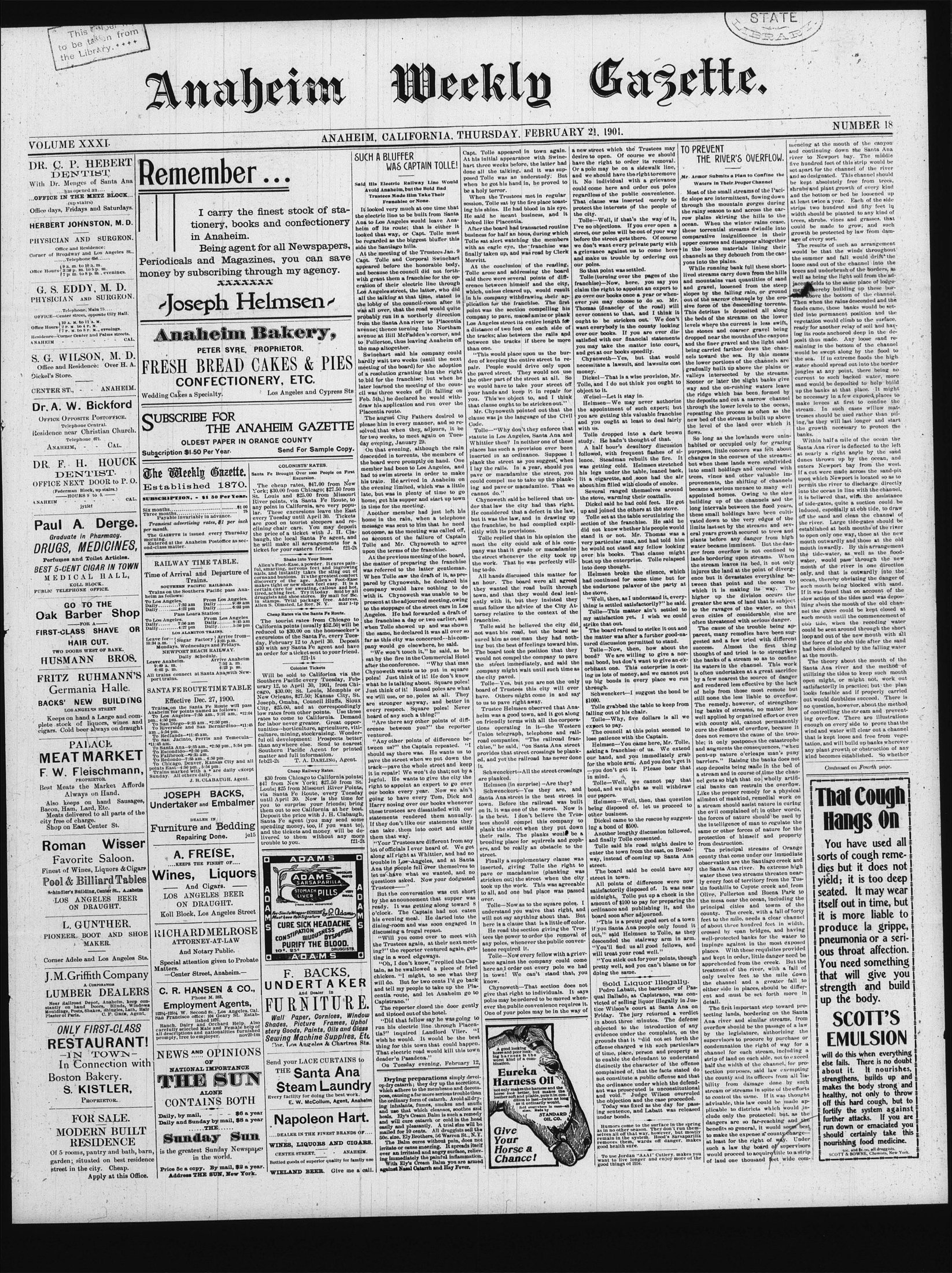
Searchable text
Anaheim
VOLUME XXXI.
DR. C. P. HEBERT
DENTIST
With Dr. Menges of Santa Ana
has opened an...
OFFICE IN THE METZ BLOCK...
(up stairs)
Office days, Fridays and Saturdays.
HERBERT JOHNSTON, M.D.
PHYSICIAN AND SURGEON.
Office and Residence:
Corner of Broadway and Los Angeles St.
Telephone 656....
9 a.m. to 10 a.m.
3:20 p.m. to 5 p.m.
7 p.m. to 8 p.m., evenings.
G. S. EDDY, M.D.
PHYSICIAN AND SURGEON.
Telephone, Main 75...
OFFICE—Center street, opposite City Hall.
10 A.M. to 11 A.M.
2 P.M. to 4 P.M.
7 P.M. to 8 P.M., evenings.
Residence—Corner Center and Palms streets.
ANAHEIM - CAL.
S. G. WILSON, M.D.
Office and Residence: Over H. A. Dickel's Store.
CENTER ST., - ANAHEIM.
Dr. A. W. Bickford
OFFICE OPPOSITE POSTOFFICE.
Telephone Central.
Residence near Christian Church.
Telephone 671.
ANAHEIM, - CAL.
DR. F. H. HOUCK
DENTIST.
Remember...
I carry the finest stock of stationery, books and confectionery in Anaheim.
Being agent for all Newspapers,
Periodicals and Magazines, you can save money by subscribing through my agency.
Joseph Helmsen
Anaheim Bakery,
PETER SYRE, PROPRIETOR.
FRESH BREAD CAKES & PIES CONFECTIONERY, ETC.
Wedding Cakes a Specialty. Los Angeles and Cypress Sts
SUBSCRIBE FOR
THE ANAHEIM GAZETTE
OLDEST PAPER IN ORANGE COUNTY
Subscription $1.50 Per Year. Send For Sample Copy.
The Weekly Gazette.
COLONISTS' RATES.
Santa Fe Brought Over 1000 People on First
Dr. A. W. Bickford
Office Opposite Postoffice.
Telephone Central.
Residence near Christian Church.
Telephone 671.
ANAHEIM, CAL.
DR. F. H. HOUCK
DENTIST.
OFFICE NEXT DOOR to P. O.
(Federman Block, up stairs.)
HOURS 9 to 5.
ANAHEIM, CAL.
Paul A. Derge.
Graduate in Pharmacy.
DRUGS, MEDICINES,
Perfumes and Toilet Articles.
BEST 5-CENT CIGAR IN TOWN
MEDICAL HALL,
KOLL BLOCK.
PUBLIC TELEPHONE OFFICE.
GO TO THE
Oak Barber Shop
FOR A
FIRST-CLASS SHAVE OR
HAIR CUT.
TWO DOORS WEST OF BANK.
HUSMANN BROS.
FRITZ RUHMANN'S
Germania Halle.
BACKS' NEW BUILDING
LOS ANGELES STREET
Keeps on hand a Large and complete stock of liquors, wines and cigars. Cold beer always on draught
PALACE MEAT MARKET
F. W. Fleischmann,
PROPRIETOR
Best Meats the Market Affords Always on Hand.
Also keeps on hand Sausages, Bacon, Ham, Lard, Etc.
Meats delivered to all parts of the city free of charge.
Shop on East Center St.
Roman Wisser
Favorite Saloon.
Finest of Wines, Liquors & Cigars Pool & Billiard Tables
Schindler's Building, Center St., Anaheim
LOS ANGELES BEER
CONFECTIONERY, ETC.
Wedding Cakes a Specialty.
Los Angeles and Cypress Sts
SUBSCRIBE FOR THE ANAHEIM GAZETTE
OLDEST PAPER IN ORANGE COUNTY
Subscription $1.50 Per Year.
Send For Sample Copy.
The Weekly Gazette,
Established 1870.
SUBSCRIPTION, - $1.50 Per Year.
Six months.....$1.00
Three months.....75
Payable invariably in advance.
Transient advertising rates, $1 per inch per month.
The Gazette is issued every Thursday morning.
Entered at the Anaheim Postoffice as second-class matter.
RAILWAY TIME TABLE.
Time of Arrival and Departure of Trains.
SOUTHERN PACIFIC RAILROAD.
Trains on the Southern Pacific pass Anaheim as follows:
To Los Angeles.
Daily...7:52 am Dally...9:49 am Dally...4:22 pm Dally...6:03 pm
Pass Loara Station:
To Los Angeles.
Daily...7:56 am Dally...9:45 am Dally...4:27 pm Dally...5:59 pm
LOS ALAMITOS TRAINS.
Leave for—(Sugar Factory) Arrive from 10:34 a.m.
Mondays, Wednesdays and Fridays.
NEWPORT BEACH RAILWAY.
Daily Schedule.
Leave Anaheim.
9:49 a.m. Dally...7:52 a.m. Dally...6:03 p.m.
All trains connect at Santa Ana with Newport trains.
SANTA FE ROUTE TIMETABLE
Effective Dec. 27, 1900.
Trains on the Santa Fe Route will pass Anaheim for points named as follows:
To Los Angeles-7:58 am..9:57 am..*12:04 pm...
To San Diego-9:35 am..*2:50 pm..
To Riverside and San Bernardino-*11:45 am..5:54 pm.
To Redlands-*11:45 am..
To San Jacinto, Perris and Temecula-*11:45 am..
To Santa Ana-9:35 am..*2:50 pm..5:54 pm.
To Exconido-*2:50 pm..
To Fallbrook-*9:35 am..
To Redondo-7:55 am..4:50 pm.
To Chicago, Denver, Kansas City and all points East-4:50 pm..5:54 pm.
Trains marked with a * are daily except Sunday. All others daily.
JOSEPH BACKS,
Undertaker and Embalmer
DEALER IN
Furniture and Bedding
Repairing Done. je15
A. FREISE,
...KEeps THE FINEST OF....
Wines, Liquors
And Cigars.
LOS ANGELES BEER
COLONISTS' RATES.
Santa Fe Brought Over 1000 People on First Excursion.
The cheap rates, $47.00 from New York; $30.00 from Chicago; $27.50 from St. Louis and $25.00 from Missouri River points, via Santa Fe Route, to any point in California, are very popular. These excursions leave the East every Tuesday until April 30. Tickets are good on tourist sleepers and reclining chair cars. You may deposit the price of a ticket with J. H. Chabaugh, the local Santa Fe agent, and he will make all arrangements for a ticket for your eastern friend.
Shake Into Your Shoes
Allen's Foot-Ease, a powder. It cures painful, smarting, nervous feet and ingrowing nails, and instantly takes the sting out of cornsand business its the greatest comfort discovery of the age. Allen's Foot-Ease makes tight or new shoes feel easy. It is certain cure for sweating, callous and hot taching, aching feet. Try it today. Sold by all druggists and shoe stores. By mail for in stamps. Trial package free. Address Allen S. Olmsted, Le Roy, N.Y.
Cheap Rates via the Santa Fe Route.
The tourist rates from Chicago to California points (usually $22.50) will be reduced to $30.00 on the home seeker excursions of the Santa Fe, every Tuesday, February 12 to April 30. Deposit $30 with any Santa Fe agent and have an order for a ticket sent to your friend f21-1t
Colonist Tickets
Will be sold to California via the Southern Pacific every Tuesday, February 12, to April 30, 1901, from Chicago, $30.00; St. Louis, Memphis or New Orleans, $27.50; Kansas City, S.Joseph, Omaha, Council Bluffs, Sioux City, $25.00, and at corresponding low rates from other points. Use these rates to come to California. Demand for labor never greater. Great opportunities—horticulture, agriculture, vit culture, mining, stockraising. Wonderful oil development: Prospects better than anywhere else. Send to near Southern Pacific Agent for print matter and full information.
feb21-2t
T.A.DARLING, Agent
Cheap Railway Rates.
$30 from Chicago to California point $47 from New York; $27.50 from Louis; $25 from Missouri River Point via Santa Fe Route, every Tuesday until April 30. Now is the time you to surprise your friends; bring them out to see California at her Deposit the price with J. H. Chabaugh Santa Fe agent (you may send so spending money, too, if you want and the tickets and money will be livered to them without any trouble to you).
Also keeps on hand Sausages, Bacon, Ham, Lard, Etc.
Meats delivered to all parts of the city free of charge.
Shop on East Center St.
Roman Wisser
Favorite Saloon.
Finest of Wines, Liquors & Cigars
Pool & Billiard Tables
Shindler's Building, Center St., Anaheim
LOS ANGELES BEER ON DRAUGHT.
L. GUNTHER.
PIONEER BOOT AND SHOE MAKER.
Corner Adele and Los Angeles Sts.
J.M.Griffith Company
A CORPORATION
LUMBER DEALERS
Near Railroad Depot, Anaheim, keep constantly on hand Doors, Blinds, Windows Mouldings, Posts, Shakes, shingles, Lath, Hair Plaster of Paris.
C. F. GRIM, Agent.
ONLY FIRST-CLASS RESTAURANT!
IN TOWNIn Connection with Boston Bakery.
S. KISTLER,
PROPRIETOR.
FOR SALE.
MODERN BUILT RESIDENCE
Of 5 rooms, pantry and bath, barn, garden; situated on best residence street in the city. Cheap.
Apply at this Office.
Undertaker and Embalmer
DEALER IN
Furniture and Bedding
Repairing Done. je15
A. FREISE,
...KEEPS THE FINEST OF...
Wines, Liquors
And Cigars.
LOS ANGELES BEER ON DRAUGHT.
Koll Block, Los Angeles Street
RICHARDMELROSE
ATTORNEY-AT-LAW
And Notary Public.
Special attention given to Probate Matters.
—Center Street, Anaheim—
C. R. HANSEN & CO.,
Phone M. 383,
Employment Agents,
123%-125% W. Second St., Los Angeles, Cal.
San Francisco office: 104 Geary St. Established 1876.
Ranch, Dairy and Orchard Help. Also carefully selected Male and Female help of all descriptions and nationalities furnished promptly, free to employer.
NEWS AND OPINIONS OF NATIONAL IMPORTANCE
THE SUN
ALONE CONTAINS BOTH
Daily, by mail, $6 a year
Daily and Sunday by mail, $8 a year
THE
Sunday Sun is the greatest Sunday Newspaper in the world.
Price 5c a copy. By mail, $2 a year.
Address THE SUN, New York.
F. BACKS,
UNDERTAKER
AND Dealer in FURNITURE
Wall Paper, Cornices, Win Shades, Picture Frames, Upstory Goods, Paints, Oils and Gear Sewing Machine Supplies,
Cor. Los Angeles & Chartres
Send your LACE CURTAINS
THE Santa Ana Steam Launcher
Every facility for doing the best work.
E. W. McCollum, Agent,
Napoleon Ha...
DEALER IN THE FINEST BRANDS
WINES, LIQUORS AND CIGARS
CENTER STREET.
ANAHEIM
Bottled goods of superior quality for faraway places.
ANAHEIM, CALIFORNIA, THURSDAY, FEBRUARY 21, 1901.
SUCH A BLUFFER WAS CAPTAIN TOLLE!
Said His Electric Railway Line Would Avoid Anaheim, but the Bold Bad Trustees Made Him Take Their Franchise or None.
It looked very much at one time that the electric line to be built from Santa Ana to Los Angeles would leave Anaheim off its route; that is either it looked that way, or Capt. Tolle must be regarded as the biggest bluffer this side the Santiago hills.
At the meeting of the Trustees Jan. 9 Capt. Tolle and Corporal Swinehart appeared before the honorable body, and because the council did not forthwith grant them a franchise for the operation of their electric line through Los Angeles street, the latter, who did all the talking at that time, stated in the lobby of the council-room after it was all over, that the road would quite probably run in a northerly direction from the Santa Ana river to Placentia avenue; thence turning into Northam avenue at Bill McFadden's corner, and to Fullerton, thus leaving Anaheim off the map altogether.
Swinehart said his company could hardly wait two weeks (until the next meeting of the board) for the adoption of a resolution granting him the right to bid for the franchise; but when he later learned the meeting of the council was three weeks off (it falling on Feb. 5th), he declared he would withdraw his application and run over the Placentia route.
The august City Fathers desired to please him in every manner, and so resolved that when they adjourn, it be for two weeks, to meet again on Tuesday evening, January 29.
On that evening, although the rain descended in torrents, the members of the board were promptly on hand. One member had been to Los Angeles, and had to swim streets in order to make Capt. Tolle appeared in town again. At his initial appearance with Swinehart three weeks before, the latter had done all the talking, and it was supposed Tolle was an understudy. But when he got his hand in, he proved to be a holy terror.
When the Trustees met in regular session, Tolle sat by the fire place toasting his shins. He had blood in his eye. He said he meant business, and it looked like Placentia.
After the board had transacted routine business for half an hour, during which Tolle sat alert watching the members with an eagle eye, the franchise was finally taken up, and was read by Clerk Merritt.
At the conclusion of the reading, Tolle arose and addressing the board said there were several points of difference between himself and the city, which, unless cleared up, would result in his company withdrawing their application for the franchise. The first point was the section compelling his company to pave, macadamize or plank Los Angeles street its entire length for a distance of two feet on each side of the tracks; also between the rails and between the tracks if there be more than one.
“This would place upon us the burden of keeping the entire street in repair. People would drive only upon the paved street. They would not use the other part of the street at all. So we would have to take your street off your hands and keep it in repair for you. This we object to, and I think that clause ought to be stricken out.”
Mr. Chynoweth pointed out that the clause was in the language of the Civil Code.
Tolle—“Why don’t they enforce that statute in Los Angeles, Santa Ana and Whittier then? In neither one of these places has such a provision ever been inserted in an ordinance. Suppose I plank the street as you suggest, when I lay the rails. In a year, should you save or macadamize the street, you a new street which the Trustees may desire to open. Of course we should have the right to order its removal. Or a pole may be on a sidewalk line and we should have the right to remove it. No individual with a grievance could come here and order out poles regardless of the public convenience. That clause was inserted merely to protect the interests of the people of the city.
Tolle—Well, if that’s the way of it I’ve no objections. If you ever open a street, our poles will be out of your way before the street gets there. Of course we don’t want every private party with a grievance against us to come here and make us trouble by ordering our poles.
So that point was settled.
Tolle (turning over the pages of the franchise)—Now, here, you say you claim the right to appoint an expert to go over our books once a year or whenever you may choose to do so. Mr Thomas (financier of the road) never consent to that, and I think ought to be stricken out. We don’t want everybody in the county looking over our books. If you are ever satisfied with our financial statement you may take the matter into court and get at our books speedily.
Chynoweth—Yes, but that would necessitate a lawsuit, and lawsuits on money.
Dickel—That is a wise provision, Mr Tolle, and I do not think you ought to object to it.
Welsel—Let it stay in.
Helmsen—We may never authorize the appointment of such expert; you are getting this valuable franchise and you ought at least to deal fairly with us.
Tolle dropped into a dark brook study. He hadn’t thought of that.
A half hour’s desultory discussed with frequent flashes of lence. Steadman rebuilt the fire. Was getting cold. Helmsen stretched his legs under the table, leaned back
A resolution granting permission to bid for the franchise; but when he later learned the meeting of the council was three weeks off (it falling on Feb. 5th), he declared he would withdraw his application and run over the Placentia route.
The August City Fathers desired to please him in every manner, and so resolved that when they adjourn, it be for two weeks, to meet again on Tuesday evening, January 29.
On that evening, although the rain descended in torrents, the members of the board were promptly on hand. One member had been to Los Angeles, and had to swim streets in order to make his train. He arrived in Anaheim on the evening limited, which was a little late, but was in plenty of time to go home, get his supper and start up town in time for the meeting.
Another member had just left his home in the rain, when a telephone message was sent to him that he need not come, as the meeting was called off, on account of the failure of Captain Tolle and Mr. Chynoweth to agree upon the terms of the franchise.
At the previous meeting of the board, the matter of preparing the franchise was referred to the latter gentleman. When Tolle saw the draft of it, as prepared by Chynoweth, he declared his company would have nothing to do with it. Chynoweth was unable to be present at the adjourned meeting, owing to the stoppage of the street cars in Los Angeles. He had forwarded a draft of the franchise a day or two earlier, and when Tolle showed up and was shown the same, he declared it was all over so far as this city was concerned—his company would go elsewhere, he said.
"We won't touch it," he said, as he sat by the fire in the Commercial Hotel after the conference. "Why that man Chynoweth wants us to put in square poles! Just think of it! He don't know what he is talking about. Square poles! Just think of it! Round poles are what we will use, or no poles at all. They are stronger anyway, and better in every respect. Square poles! Never heard of any such thing!"
"Are there any other points of difference between you?" the reporter ventured.
"Any other points of difference between us?" the Captain repeated. "I should say there was. He wants us to pave the street when we put down the track—pave the whole street and keep it in repair! We won't do that; not by a jugful. He wants to give the city the right to appoint an expert to go over our books every year. Now we ain't going to have every Tom, Dick and Harry nosing over our books whenever these trustees are dissatisfied with our statements rendered them annually. If they don't like our statements they can take them into court and settle them that way."
"Your Trustees are different from any lot of officials I ever heard of. We got along all right at Whittier, and had no trouble in Los Angeles, and at Santa Ana the people fell over themselves to let us have what we wanted, and no questions asked. Now your dodgested Trustees—"
But the conversation was cut short by the announcement that supper was over.
Tolle—"Why don't they enforce that statute in Los Angeles, Santa Ana and Whittier then? In neither one of these places has such a provision ever been inserted in an ordinance. Suppose I plank the street as you suggest, when I lay the rails. In a year, should you pave or macadamize the street, you could compel me to take up the planking and pave or macadamize. That we cannot do."
Chynoweth said he believed that under that law the city had that right. He considered that a defect in the law, but it was the law, and in drawing up the franchise, he had complied explicitly with its provisions.
Tolle replied that in his opinion the most the city could ask of his company was that it grade or macadamize the street whenever the city took up the work. That he was perfectly willing to do.
All hands discussed this matter for an hour. The board were all agreed they wanted the road built through town, and that they would deal leniently with it, but they insisted they must follow the advice of the City Attorney relative to the context of the franchise.
Tolle said he believed the city did not want his road, but the board assured him as one man they had nothing but the best of feelings toward him. The board took the position that they would notcompelthecompanytopavethestreetimmediately,andsaidthecompanymightwaituntilsuchtimeasthecitypaved.
Tolle—Yes, but you are not the only board of Trustees this city will ever have. Others might come in and say to us to pave right away.
Trustee Helmsen observed that Anaheim was a good town, and it got along on friendly terms with all the corporations operating in it—the Western Union telegraph, telephone and railroad companies. "The railroad franchise," he said, "on Santa Ana street provides that street crossings be planked, and yet the railroad has never done it.
Schwenckert—All the street crossings are planked.
Helmsen (in surprise)—Are they?
Schwenckert—Yes they are, and Santa Ana street is the best street in town. Before the railroad was built on it, it was one of the worst. Now it is best. I don't believe the Trustees should compel this company to plank the street when they put down their rails. The planks would be a breeding place for squirrels and gophers, and be really an obstacle to the street.
Finally a supplementary clause was inserted, giving Tolle the right to pave or macadamize (planking was stricken out) the street when the city took up the work. This was agreeable to all, and one bad place was passed over.
Dickel—That is a wise provision, M.Tolle, and I do not think you ought object to it.
Weisel—Let it stay in.
Helmsen—We may never authorize the appointment of such expert; you are getting this valuable franchise and you ought at least to deal fairly with us.
Tolle dropped into a dark brook study. He hadn't thought of that.
A half hour's desultory discussion followed, with frequent flashes of lence. Steadman rebuilt the fire. Was getting cold. Helmsen stretched his legs under the table, leaned back lit a cigarette, and soon had them about him filled with clouds of smoke.
Several ranged themselves around the stove, warming their coattails.
Dickel said he had cold feet. He up and joined the others at the stove.
Tolle set at the table scrutinizing section of the franchise. He said did not know whether his people would stand it or not. Mr. Thomas was very particular man, and had told he would not stand any fellow lover over his books. That clause meant bust up the enterprise. Tolle related into deep thought.
Helmsen broke the silence, who had continued for some time but undertoone palaver of the part with the stove.
"Well, then, as I understand it, everything is settled satisfactorily?" he Tolle—This matter ain't settling my satisfaction yet. I wish we strike that out.
The board refused to strike it out the matter was after a further good-timed discussion permitted to stand.
Tolle—Now, then, how about bond? We are willing to give a mal bond, but don't want to give an orbitant one. This enterprise is using lots of money, and we can up big bonds in every place through.
Schwenckert—I suggest the book $1000.
Tolle grabbed the table to keep falling out of his chair.
Tolle—Why, five dollars is a expect to pay.
The council at this point seems lose patience with the Captain.
Helmsen—You came here, Mr. asking a franchise of us. We our hand, and you immediately for the whole arm. And you don't get it. Please bear in mind.
Tolle—Well, we cannot pay bond, and we might as well write our papers.
Helmsen—Well, then, that quitting being disposed of, let us proceed other business.
Dickel came to the rescue by saying a bond of $500.
Another lengthy discussion for and finally Tolle consented.
Tolle said his road might enter the town from the east, one way instead of coming up San Street.
The board said he could hit street in town.
All points of difference were satisfactorily disposed of. It was midnight. Toll put up a check
going to have every Tom, Dick, and Jane Harry nosing over our books whenever these trustees are dissatisfied with our statements rendered them annually. If they don't like our statements they can take them into court and settle them that way.
"Your Trustees are different from any lot of officials I ever heard of. We got along all right at Whittier, and had no trouble in Los Angeles, and at Santa Ana the people fell over themselves to let us have what we wanted, and no questions asked. Now your dodgasted Trustees—"
But the conversation was cut short by the announcement that supper was ready. It was getting along toward 8 o'clock. The Captain had not eaten his evening meal. He darted into the dining-room and was soon engaged in discussing a frugal repast.
"Will you come over to meet with the Trustees again, at their next meeting?" the reporter ventured again, getting in a word edgeways.
"Oh, I don't know," replied the Captain, as he swallowed a piece of fried chicken. "I might, to see what they will do. But for two cents I'd go back and tell my people to take up the Placentia route, and let Anaheim go to Capistrano."
The reporter closed the door gently and tiptoed out of the hotel.
"Did that fellow say he was going to run his electric line through Placentia?" inquired Landlord Vlier. "I wish he would. It would be the best thing for this town that could happen. That electric road would kill this town deader'n Pasadena."
On Tuesday evening, February 12,
Drying preparations simply develop dry catarrh; they dry up the secretions, which adhere to the membrane and decompose, causing a far more serious trouble than the ordinary form of catarrh. Avoid all drying inhalants, fumes, smokes and snuffs and use that which cleanses, soothes and heals. Ely's Cream Balm is such a remedy and will cure catarrh or cold in the head easily and pleasantly. A trial size will be mailed for 10 cents. All druggists sell the 50c. size. Ely Brothers, 56 Warren St., N.Y.
The Balm cures without pain, does not irritate or cause sneezing. It spreads itself over an irritated and angry surface, relieving immediately the painful inflammation.
With Ely's Cream Balm you are armed against Nasal Catarrh and Hay Fever.
A good looking horse and poor-looking harness is the worst kind of combination.
Eureka Harness Oil
not only makes the harness and the horse look better, but makes the leather soft and pliable, puts it in condition to last—twice as long as it ordinarily would.
Sold Liquor Illegal
Pedro Labatt, the bartender qual Ballade, at Capistrano, victed of selling liquor illegally. Wilson's court at Santa Friday. The jury returned in about three minutes. The objected to the introduction evidence under the complaint grounds that it "did not set offense charged with such price of time, place, person and price to enable the defendant to undistinctly the character of the complained of, that the facts not constitute a public offense the ordinance under which the ant was prosecuted is uncondual and void." Judge Wilson the objection and the case proceeded today was fixed as the day's ing sentence, and Labatt waived under bonds.
Humors come to the surface in as in no other season. They don't selves all off that way, however, remain in the system. Hood's sinks remove them, wards off damage good health sure.
To use Jordan "AAAI" Cutlery want to live longer and enjoy good things of life.
TO PREVENT
THE RIVER'S OVERFLOW.
Mr. Armor Submits a Plan to Confine the Waters in Their Proper Channel
Most of the small streams of the Pacific slope are intermittent, flowing down through the mountain gorges during the rainy season to and across the narrow plains skirting the hills to the ocean. When the winter rains cease, these torrential streams dwindle into comparative insignificence in their upper courses and disappear altogether in the loose materials lining their channels as they debouch from the canyons into the plains.
While running bank full these short-lived streams carry down from the hills and mountains vast quantities of sand and gravel, loosened from the steep slopes by the falling rain, or ground out of the narrow channels by the erosive force of the descending torrents. This detritus is deposited all along the beds of the streams on the lower levels where the current is less swift, the stones and coarser gravel being dropped near the mouths of the canyons and the finer gravel and the light sand being carried farther down the channels toward the sea. By this means the lower portions of the channels are gradually built up above the plains or valleys intersected by the streams. Sooner or later the slight banks give way and the on-rushing waters leave the ridge which has been formed by the deposits and cut a narrow channel through the lower levels to the ocean, repeating the process as often as the new bed of the stream is built up above the level of the land over which it flows.
So long as the lowlands were uninhabited or occupied only for grazing purposes, little concern was felt about changes in the courses of the streams; but when these lands were subdivided into small holdings and covered with other valuable immencing at the mouth of the canyon and continuing down the Santa Ana river to Newport bay. The middle five hundred feet of this strip would be set apart for the channel of the river and so designated. This channel should be kept absolutely free from trees, shrubs and plant growth of every kind and the bottom or bed be loosened up at least twice a year. Each of the side strips two hundred and fifty feet in width should be planted to any kind of trees, shrubs, vines and grasses, that could be made to grow, and such growth be protected by law from damage of every sort.
The results of such an arrangement would be that the winds throughout the summer and fall would drift the loose sand out of the channel into the trees and underbrush of the borders, as well as bring the light soil from the adjacent fields to the same place of lodgement thereby building up these borders above the bottom of the channel. Then when the rains descended and the floods came, these banks would be settled into permanent position and the vegetation would climb to the surface, ready for another relay of soil and having its roots anchored deep in the deposit thus made. Any loose sand remaining in the bottom of the channel would be swept along by the flood to the sea. If in extreme floods the high water should spread out into the border jungles at any point, there being no current to such backed water, more sand would be deposited to help build up the banks at that place. It might be necessary in a few exposed places to make levees at first to confine the stream. In such cases willow mattresses should be used rather than piling, as they will last longer and start the growth necessary to protect the banks.
Within half a mile of the ocean the Santa Ana river is deflected to the left at nearly a right angle by the sand dunes thrown up by the ocean, and enters Newport bay from the west. If a cut were made across the sand-pit
He hadn't thought of that.
Half hour's desultory discussion had, with frequent flashes of silence, Steadman rebuilt the fire. It getting cold. Helmsen stretched legs under the table, leaned back, cigarette, and soon had the air him filled with clouds of smoke. A rangelanged themselves around love, warming their coattails. Hells said he had cold feet. He got joined the others at the stove. He set at the table scrutinizing the menu of the franchise. He said he not know whether his people would eat it or not. Mr. Thomas was a particular man, and had told him should not stand any fellow looking into his books. That clause might stop the enterprise. Tolle relapsed deep thought.
Helmsen broke the silence, which continued for some time but for undertone palaver of the party at love. Well, then, as I understand it, everybody is settled satisfactorily?" he said. Tolle—This matter isn't settled to satisfaction yet. I wish we could see that out.
The board refused to strike it out and matter was after a further good-naught discussion permitted to stand. Tolle—Now, then, how about the question? We are willing to give a nor-bond, but don't want to give an-existant one. This enterprise is costless lots of money, and we cannot put big bonds in every place we run through.
Whwenckert—I suggest the bond be 100.
Tolle grabbed the table to keep from going out of his chair. Tolle—Why, five dollars is all we need to pay.
The council at this point seemed to patience with the Captain. Helmsen—You came here, Mr. Tolle, being a franchise of us. We extend hand, and you immediately grab the whole arm. And you don't get it you don't get it. Please bear that mind.
Tolle—Well, we cannot pay that kind, and we might as well withdraw papers.
Helmsen—Well, then, that question long disposed of, let us proceed to other business.
Pickel came to the rescue by suggesting a bond of $500.
Another lengthy discussion followed, finally Tolle consented.
Tolle said his road might desire to enter the town from the east, on Broadway, instead of coming up Santa Ana street.
The board said he could have any street in town.
All points of difference were now satisfactorily disposed of. It was near midnight. Tolle put up a check in valleys intersected by the streams. Sooner or later the slight banks give way and the on-rushing waters leave the ridge which has been formed by the deposits and cut a narrow channel through the lower levels to the ocean, repeating the process as often as the new bed of the stream is built up above the level of the land over which it flows.
So long as the lowlands were uninhabited or occupied only for grazing purposes, little concern was felt about changes in the courses of the streams; but when these lands were subdivided into small holdings and covered with trees, vines and other valuable improvements, the shifting of channels became a serious menace to many well appointed homes. Owing to the slow building up of the channels and the long intervals between the flood years, these small holdings have been cultivated down to the very edges of the limits last set by the streams and several years growth secured to trees and plants before any danger from high water became imminent. But the danger from overflow is not confined to lands bordering upon streams. When the stream leaves its bed, it not only injures the land at the point of divergence but it devastates everything between that point and the ocean to which it is making its way. The higher up the division occurs the greater area of land that is subject to the ravages of the water, so that even cities of considerable size are often threatened with serious danger.
The cause of the trouble being apparent, many remedies have been suggested and a few tried with different success. Almost the first thing thought of and tried is to strengthen the banks of a stream so as to confine its waters in the channel. This work is often undertaken at a great sacrifice by a few nearest source of danger and rendered less effective by the lack of help from those most remote but still none the less liable to overflow.
The remedy, however, of strengthening banks of streams, no matter how well applied by organized effort or even with county aid, cannot permanently cure the disease of overflow, because it does not remove the cause of the trouble; it only postpones the catastrophe and augments the consequences," when pent-up nature o'erleaps man's puny barriers." Raising the banks does not stop deposits being made in the bed of a stream and in course of time the channel gets so high that no wholly artificial banks can restrain the overflow. Like the proper remedy for a physical aliment of mankind, remedial work on a stream should assist nature in curing the evil complained of; in other words, the forces of nature should be used by the intelligence of man to regulate the same or other forces of nature for the protection of himself and property from destruction.
The principal streams of Orange county that come under our immediate observation are the Santiago creek and the Santa Ana river. In extreme high water these two streams threaten nearly every foot of territory from the Tustin foothills to Coyote creek and from Olive, Fullerton and Buena Park to the ocean, including the
Continued on Fourth page.
That Cough Hangs On
You have used all sorts of cough remedies but it does not yield; it is too deep seated. It may wear
Helmsen—Well, then, that question being disposed of, let us proceed to other business.
Bickel came to the rescue by suggestion on a bond of $500.
Another lengthy discussion followed, and finally Tolle consented.
Tolle said his road might desire to enter the town from the east, on Broadway, instead of coming up Santa Ana street.
The board said he could have any street in town.
All points of difference were now satisfactorily disposed of. It was near midnight, Tolle put up a check in the amount of $100 to pay for preparing the ordinance and publishing it, and the board soon after adjourned.
“This is a pretty good sort of a town you Santa Ana people only found it out,” said Helmsen to Tolle, as they descended the stairway arm in arm. You’ll find us all good fellows, and will treat your road well.”
“You stick out for your points, though pretty well, and you can’t blame us for doing the same.
Sold Liquor Illegally.
Pedro Labatt, the bartender of Pasual Ballade, at Capistrano, was convicted of selling liquor illegally in Justice Wilson’s court at Santa Ana on Friday. The jury returned a verdict on about three minutes. The defense objected to the introduction of any evidence under the complaint, on the grounds that it “did not set forth the offense charged with such particulars of time, place, person and property as so enable the defendant to understand distinctly the character of the offense complained of, that the facts stated do not constitute a public offense and that the ordinance under which the defendant was prosecuted is unconstitutional and void.” Judge Wilson overruled the objection and the case proceeded.
Today was fixed as the day for passing sentence, and Labatt was released under bonds.
Humors come to the surface in the spring as in no other season. They don’t run themselves all off that way, however, but mostly remain in the system. Hood’s Sarsaparilla removes them, wards off danger, makes good health sure.
To use Jordan "AAAI" Cutlery, makes you want to live longer and enjoy more of the good things of life.