anaheim-gazette 1901-01-31
Scanned page
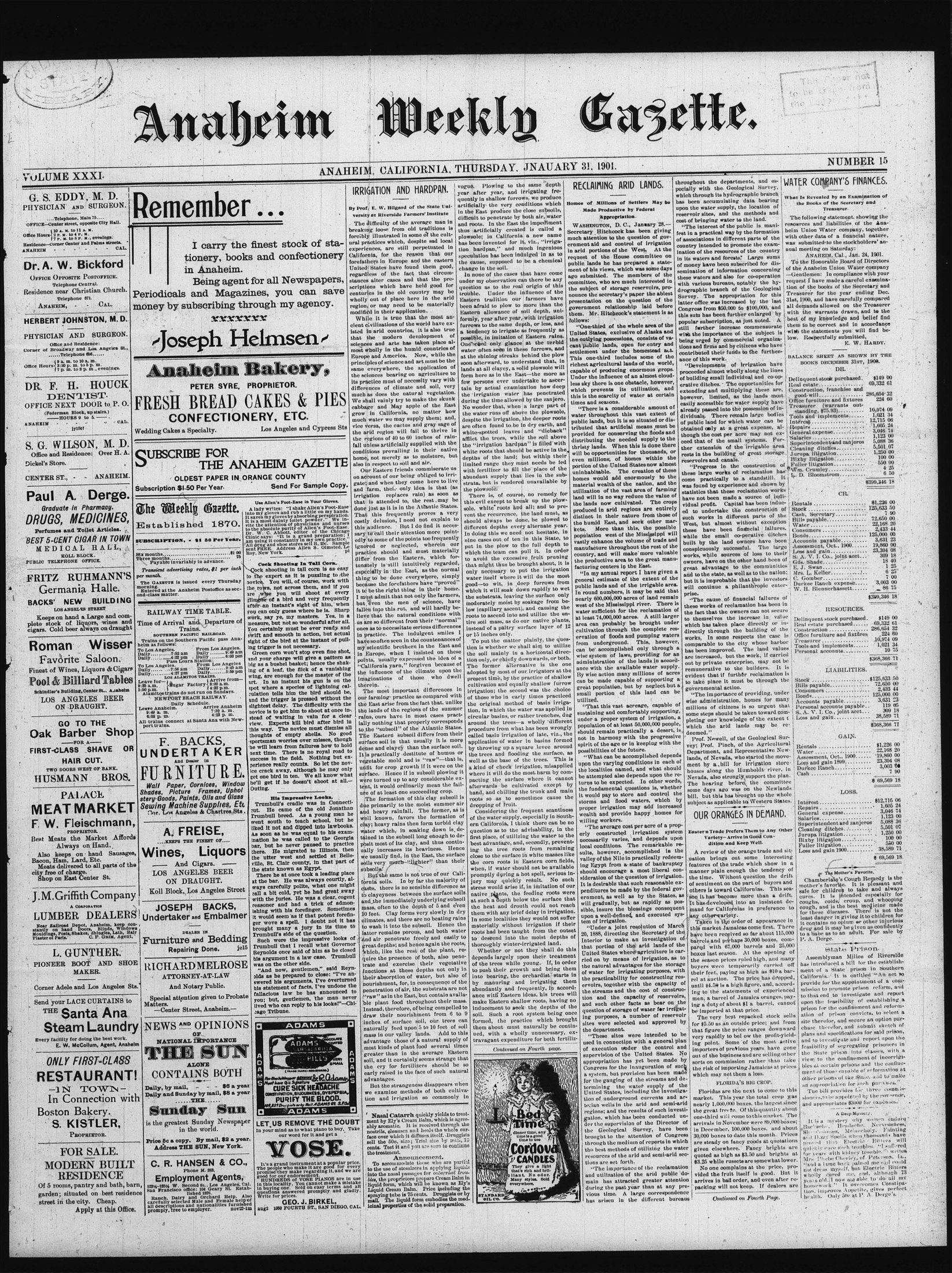
Searchable text
Anaheim
VOLUME XXXI.
G. S. EDDY, M. D.
PHYSICIAN AND SURGEON.
Telephone, Main 75...
OFFICE—Center street, opposite City Hall.
Office Hours:
10 A.M. to 11 A.M.
2 P.M. to 4 P.M.
7 P.M. to 8 P.M., evenings.
Residence—Corner Center and Palms streets.
ANAHEIM CAL.
Dr. A. W. Bickford
OFFICE OPPOSITE POSTOFFICE.
Telephone Central.
Residence near Christian Church.
Telephone 671.
ANAHEIM, CAL.
HERBERT JOHNSTON, M. D.
PHYSICIAN AND SURGEON.
Office and Residence:
Corner of Broadway and Los Angeles St..
Telephone 606...
Office Hours:
9 a.m. to 10 a.m.
3:30 p.m. to 5 p.m.
7 p.m. to 8 p.m., evenings.
DR. F. H. HOUCK
DENTIST.
OFFICE NEXT DOOR to P. O.
(Federman Block, upstairs.)
HOURS 9 to 5
ANAHEIM CAL.
S. G. WILSON, M. D.
Office and Residence: Over H. A.
Dickel's Store.
Remember...
I carry the finest stock of stationery, books and confectionery in Anaheim.
Being agent for all Newspapers,
Periodicals and Magazines, you can save money by subscribing through my agency.
Joseph Helmsen
Anaheim Bakery,
PETER SYRE, PROPRIETOR.
FRESH BREAD CAKES & PIES CONFECTIONERY, ETC.
Wedding Cakes a Specialty. Los Angeles and Cypress Sts
SUBSCRIBE FOR
THE ANAHEIM GAZETTE
DR. F. H. HOUCK
DENTIST.
OFFICE NEXT DOOR to P. O.
(Federman Block, up stairs.)
HOURS 9 TO 5
ANAHEIM
Jy1541
S. G. WILSON, M. D.
Office and Residence: Over H. A.
Dickel's Store.
CENTER ST., - ANAHEIM.
Paul A. Derge.
Graduate in Pharmaoy.
DRUGS, MEDICINES,
Perfumes and Toilet Articles.
BEST 5-CENT CIGAR IN TOWN
MEDICAL HALL,
KOLL BLOCK.
PUBLIC TELEPHONE OFFICE.
FRITZ RUHMANN'S
Germania Halle.
BACKS' NEW BUILDING
LOS ANGELES STREET
Keeps on hand a Large and complete stock of liquors, wines and cigars. Cold beer always on draught
Roman Wisser
Favorite Saloon.
Finest of Wines, Liquors & Cigars
Pool & Billiard Tables
Schindler's Building, Center St., Anaheim
LOS ANGELES BEER ON DRAUGHT.
GO TO THE
Oak Barber Shop
FOR A.
FIRST-CLASS SHAVE OR HAIR CUT.
TWO DOORS WEST OF BANK.
HUSMANN BROS.
PALACE
MEAT MARKET
F. W. Fleischmann,
PROPRIETOR.
Best Meats the Market Affords Always on Hand.
Also keeps on hand Sausages, Bacon, Ham, Lard, Etc.
Meats delivered to all parts of the city free of charge.
Shop on East Center St.
J.M.Griffith Company
PETER SYRE, PROPRIETOR.
FRESH BREAD CAKES & PIES CONFECTIONERY, ETC.
Wedding Cakes a Specialty.
Los Angeles and Cypress Sts
SUBSCRIBE FOR THE ANAHEIM GAZETTE
OLDEST PAPER IN ORANGE COUNTY
Subscription $1.50 Per Year.
Send For Sample Copy.
The Weekly Gazette.
Established 1870.
SUBSCRIPTION, - $1.50 Per Year.
Six months.....$1.00
Three months.....75
Payable invariably in advance.
Transient advertising rates, $1 per inch per month.
The GAZETTE is issued every Thursday morning.
Entered at the Anaheim Postoffice as second-class matter.
RAILWAY TIME TABLE.
Time of Arrival and Departure of Trains.
SOUTHERN PACIFIC RAILROAD.
Trains on the Southern Pacific pass Anaheim as follows:
To Los Angeles.
Daily...7:52 am Daily...9:49 am
Daily...4:22 pm Daily...6:08 pm
Pass Loara Station:
To Los Angeles.
Daily...7:56 am Daily...9:45 am
Daily...4:27 pm Daily...5:59 pm
LOS ALAMITOS TRAINS.
Leave for—
Sugar Factory Arrive from—
5:50 p.m.
Alamitos trains do not run on Sundays.
NEWPORT BEACH RAILWAY.
Daily Schedule.
Leave Anaheim Arrive Anaheim
9:49 a.m 7:52 a.m 6:08 p.m 4:22 p.m.
All trains connect at Santa Ana with Newport trains.
F. BACKS,
UNDERTAKER
And Dealer in FURNITURE.
Wall Paper, Cornices, Window Shades, Picture Frames, Upholstery Goods, Paints, Oils and Glass Sewing Machine Supplies, Etc.
Cor. Los Angeles & Chartres Sts.
A. FREISE,
....KEEPES THE FINEST OF....
Wines, Liquors
And Cigars.
LOS ANGELES BEER ON DRAUGHT.
Koll Block, Los Angeles Street
Use Allen's Foot-Ease in Your Gloves.
A lady writes: "I shake Allen's Foot-Ease into my gloves and rub a little on my hands. It is a most daunting foillet powder." We invite the attention of physicians and nurses to the absolute purity of Allen's Foot-Ease. Dr. W. C. Abbott, editor of the Chicago Clinic says: "It is a grand preparation; I am using it constantly in my own practice. All drug and shoe stores sell it. 25%. Sample sent FREE. Address Allen S. Olmsted, Le Roy, New York."
Cock Shooting In Tall Corn.
Cock shooting in tall corn is as easy to the expert as it is puzzling to the novice. You will, of course, work with the rows, not across them, and if you are wise you will shoot at every ellipse of a bird and very frequently after an instant's sight of him, when you can only guess where he is. Sharp work, say ye, my masters. Yes, in a measure, but not so wonderful after all. You certainly must be ever ready and swift and smooth in action, but actual sight of the bird at the instant of pulling trigger is not necessary.
Green corn won't stop even fine shot, and your charge will give a pattern as big as a bushel basket; hence the shaking of a leaf, the flick of a vanishing wing, are enough for the master of the art. In an instant his gun is on the spot where a species of lightning calculation tells him the bird should be, and the trigger is pressed without the slightest delay. The difficulty with the novice is to get him to shoot at once instead of waiting in vain for a clear view. Experts kill bird after bird in this way. The novice must dismiss all thoughts of empty shells. No good sportsman worries over misses, though he will learn from failures how to hold next time. There is no royal road to success in the field. Nothing but experience really counts. So let the novice crack away, although he may only get one bird in ten. We all know what he'll get if he doesn't shoot at all—Outing.
His Impressive Looks.
Trumbull's cradle was in Connecticut. He came of the old Jonathan Trumbull breed. As a young man he went south to teach school, but he liked it not and dipped into lawbooks. As soon as he was equal to his examination he was called to the Georgia bar, but he never paused to practice there. He migrated to Illinois, then the utter west and settled at Belleville, St. Clair county, in that part of the state known as Egypt.
There he at once took a leading place at the bar. He was always courtiy, always carefully polite, what one might call a bit cold, yet he had great sway with the furies. He was a clear, cogent
MEAT MARKET
F. W. Fleischmann,
PROPRIETOR.
Best Meats the Market Affords
Always on Hand.
Also keeps on hand Sausages,
Bacon, Ham, Lard, Etc.
Meats delivered to all parts of the city free of charge.
Shop on East Center St.
J.M. Griffith Company
A CORPORATION
LUMBER DEALERS
Near Railroad Depot, Anaheim, keep constantly on hand Doors, Blinds, Windows Mouldings, Posts, Shakes, Shingles, Lath, Hair Plaster of Paris.
L. GUNTHER.
PIONEER BOOT AND SHOE MAKER.
Corner Adele and Los Angeles Sts.
Send your LACE CURTAINS to THE Santa Ana Steam Laundry
Every facility for doing the best work.
E. W. McCollum, Agent, Anaheim
ONLY FIRST-CLASS RESTAURANT!
IN TOWNIn Connection with Boston Bakery.
S. KISTLER,
PROPRIETOR.
FOR SALE.
MODERN BUILT RESIDENCE
Of 5 rooms, pantry and bath, barn, garden; situated on best residence street in the city. Cheap.
Apply at this Office.
A. FREISE,
...KEEP THE FINEST OF...
Wines, Liquors
And Cigars.
LOS ANGELES BEER ON DRAUGHT.
Koll Block, Los Angeles Street
JOSEPH BACKS,
Undertaker and Embalmer
DEALER IN
Furniture and Bedding Repairing Done. jel5
RICHARDMELROSE
ATTORNEY-AT-LAW
And Notary Public.
Special attention given to Probate Matters.
Center Street, Anaheim.
NEWS AND OPINIONS OF NATIONAL IMPORTANCE
THE SUN
ALONE
CONTAINS BOTH
Daily, by mail, $6 a year
Daily and Sunday by mail, $8 a year
THE.....
Sunday Sun is the greatest Sunday Newspaper in the world.
Price 5c a copy. By mail, $2 a year.
Address THE SUN, New York.
C. R. HANSEN & CO., Phone M. 383,
Employment Agents,
123¼-125¼ W. Second St., Los Angeles, Cal.
San Francisco office: 104 Geary St. Established 1876.
Ranch, Dairy and Orchard Help. Also carefully selected Male and Female help of all descriptions and nationalities furnished promptly, free to employer.
Trumbull's cradle was in Connecticut. He came of the old Jonathan Trumbull breed. As a young man he went south to teach school, but he liked it not and dipped into lawbooks. As soon as he was equal to his examination he was called to the Georgia bar, but he never paused to practice there. He migrated to Illinois, then the utter west and settled at Belleville, St. Clair county, in that part of the state known as Egypt.
There he at once took a leading place at the bar. He was always courtly, always carefully polite, what one might call a bit cold, yet he had great sway with the juries. He was a clear, cogent reasoner and had a trick of admonishing with his forefinger. Sometimes it would seem as if that potent forefinger wove a spell. I doubt not it has brought many a jury in its time to Trumbull's side of the question.
Such were the impressive looks of Trumbull that I recall what Governor Reynolds once said of him as he closed his argument in a law case. Trumbull was on the other side.
"And now, gentlemen," said Reynolds as he prepared to close: "I've answered his arguments, I've overturned his statement of facts, I've undone the fallacious law he has announced to you; but, gentlemen, the man never lived who can reply to his looks!"—Chicago Tribune.
LET US REMOVE THE DOUBT In your mind as to what piano to buy. Talk our word for it and get a VOSE.
It's a grand instrument at a popular price The people who make it are good for ever promise they make regarding it, and we are good for our endorsement.
HUNDREDS of VOSE PIANOS are in use in this locality. You cannot make a mistake in buying one. Sold on easy terms and questions answered promptly and gladly Write for prices.
GEO. J. BIRKEL,
aug2 1000 FOURTH ST., SAN DIEGO, CA
IRRIGATION AND HARDPAN.
By Prof. E. W. Hilgard of the State University at Riverside Farmers' Institute
The difficulty of the average man in breaking loose from old traditions is forcibly illustrated in some of the cultural practices which, despite sad local experiences, are still perpetuated in California, for the reason that our forefathers in Europe and the eastern United States have found them good, regardless of the fact that circumstances alter cases and that the prescriptions which have held good for centuries in the old country may be wholly out of place here in the arid region, or may need to be materially modified in their application.
While it is true that the most ancient civilizations of the world have existed in arid countries, it is also true that the modern development of sciences and arts has taken place almost wholly in the humid countries of Europe and America. Now, while the principles of science and art must be the same everywhere, the application of the sciences bearing on agriculture to its practice must of necessity vary with differences of climate and soil, very much as does the natural vegetation. We shall vainly try to make the skunk cabbage and May apple of the East grow in California, no matter how much water we may supply them; and, vice versa, the cactus and gray sage of the arid region will fail to thrive in the regions of 40 to 60 inches of rainfall unless artificially supplied with the conditions prevailing in their native home, not merely as to moisture, but also in respect to soil and air.
Our Eastern friends commiserate us by providing us with irrigation and hardpan.
Plowing to the same depth year after year, and irrigating frequently in shallow furrows, we produce artificially the very conditions which in the East produce the close subsols, difficult to penetrate by both air, water and roots. In the East the impediment thus artificially created is called a plowsole; in California a new name has been invented for it, viz., "irrigation hardpan," and much ingenious speculation has been indulged in as to the cause, supposed to be a chemical change in the soil.
In none of the cases that have come under my observation can there be any question as to the real origin of this trouble. Under the influence of the Eastern tradition our farmers have been afraid to plow to more than the Eastern allowance of soil depth, uniformly, year after year, with irrigation furrows to the same depth, or less, and a tendency to irrigate as frequently as possible, in imitation of Eastern rains. One need only glance at the turbid water often seen in these furrows, and at the shining streaks behind the plow soon afterward, to understand that, in lands at all clayey, a solid plowsole will form here as in the East—the more as few persons ever undertake to ascertain by actual examination how deep the irrigation water has penetrated during the time allowed by the zanjero. No wonder that, when a large part of the water runs off above the plowsole, despite the irrigation, the deeper roots are often found to be in dry earth, and white-spotted leaves and "dieback" afflict the trees, while the soil above the "irrigation hardpan" is filled with white roots that should be active in the depths of the land; but within their limited range they must needs be fed with fertilizer to fill the place of the vogue. Plowing to the same depth year after year, and irrigating frequently in shallow furrows, we produce artificially the very conditions which in the East produce the close subsols, difficult to penetrate by both air, water and roots. In the East the impediment thus artificially created is called a plowsole; in California a new name has been invented for it, viz., "irrigation hardpan," and much ingenious speculation has been indulged in as to the cause, supposed to be a chemical change in the soil.
In none of the cases that have come under my observation can there be any question as to the real origin of this trouble. Under the influence of the Eastern tradition our farmers have been afraid to plow to more than the Eastern allowance of soil depth, uniformly, year after year, with irrigation furrows to the same depth, or less, and a tendency to irrigate as frequently as possible, in imitation of Eastern rains. One need only glance at the turbid water often seen in these furrows, and at the shining streaks behind the plow soon afterward, to understand that, in lands at all clayey, a solid plowsole will form here as in the East—the more as few persons ever undertake to ascertain by actual examination how deep the irrigation water has penetrated during the time allowed by the zanjero. No wonder that, when a large part of the water runs off above the plowsole, despite the irrigation, the deeper roots are often found to be in dry earth, and white-spotted leaves and "dieback" afflict the trees, while the soil above the "irrigation hardpan" is filled with white roots that should be active in the depths of the land; but within their limited range they must needs be fed with fertilizer to fill the place of the vogue. Plowing to the same depth year after year, and irrigating frequently in shallow furrows, we produce artificially the very conditions which in the East produce the close subsols, difficult to penetrate by both air, water and roots. In the East the impediment thus artificially created is called a plowsole; in California a new name has been invented for it, viz., "irrigation hardpan," and much ingenious speculation has been indulged in as to the cause, supposed to be a chemical change in the soil.
In none of the cases that have come under my observation can there be any question as to the real origin of this trouble. Under the influence of the Eastern tradition our farmers have been afraid to plow to more than the Eastern allowance of soil depth, uniformly, year after year, with irrigation furrows to the same depth, or less, and a tendency to irrigate as frequently as possible, in imitation of Eastern rains. One need only glance at the turbid water often seen in these furrows, and at the shining streaks behind the plow soon afterward, to understand that, in lands at all clayey, a solid plowsole will form here as in the East—the more as few persons ever undertake to ascertain by actual examination how deep the irrigation water has penetrated during the time allowed by the zanjero. No wonder that, when a large part of the water runs off above the plowsole, despite the irrigation, the deeper roots are often found to be in dry earth, and white-spotted leaves and "dieback" afflict the trees, while the soil above the "irrigation hardpan" is filled with white roots that should be active in the depths of the land; but within their limited range they must needs be fed with fertilizer to fill the place of the vogue. Plowing to the same depth year after year, and irrigating frequently in shallow furrows, we produce artificiallythe very conditions which in the East producethe close subsols,difficultto penetratebybothairwaterandroots.IntheEasttheimpedimentthusartificiallycreatediscalledaplowsole;inCaliforniaanewnamehasbeeninventedforit,viz.,"irrigationhardpan,"andmuchingeniousspeculationhasbeenindulgedinasothecause,supposedtobeachemicalchangeinthesoil.
In none ofthecasesthathavecomeundermyobservationcantherebeanyquestionastothereloriginofthistrouble.UndertheinfluenceoftheEasterntraditionourfarmershavebeenafraidtoplewtomorethantheEasternallowanceofsoildepth.uniformly,yearafteryearwithirrigationfurrowstocsthesamedepthyearafteryear,andirrigatingfrequentlyinshallowfurrowsweproduceartificiallytheveryconditionswhichintheEastproducetheclosesubsols,difficulttopenetratebybothairwaterandroots.IntheEasttheimpedimentthusartificiallycreatediscalledaplowsole;inCaliforniaanewnamehasbeeninventedforit,viz.,"irrigationhardpan,"andmuchingeniousspeculationhasbeenindulgedinasothecause,supposedtobeachemicalchangeinthesoil.
Innoneofthecasesthathavecomeundermyobservationcantherebeanyquestionastothereloriginofthistrouble.UndertheinfluenceoftheEasterntraditionourfarmershavebeenafraidtoplewtomorethantheEasternallowanceofsoildepth.uniformly,yearafteryearwithirrigationfurrowstocsthesamedepthyearafteryear,andirrigatingfrequentlyinshallowfurrowsweproduceartificiallytheveryconditionswhichintheEastproducetheclosesubsols,difficulttopenetratebybothairwaterandroots.IntheEasttheimpedimentthusartificiallycreatediscalledaplowsole;inCaliforniaanewnamehasbeeninventedforit,viz.,"irrigationhardpan,"andmuchingeniousspeculationhasbeenindulgedinasothecause,supposedtobeachemicalchangeinthesoil.
Innoneofthecasesthathavecomeundermyobservationcantherebeanyquestionastothereloriginofthistrouble.UndertheinfluenceoftheEasterntraditionourfarmershavebeenafraidtoplewtomorethantheEasternallowanceofsoildepth.uniformly,yearafteryearwithirrigationfurrowstocsthesamedepthyearafteryear,andirrigatingfrequentlyinshallowfurrowsweproduceartificiallytheveryconditionswhichintheEastproducetheclosesubsols,difficulttopenetratebybothairwaterandroots.IntheEasttheimpedimentthusartificiallycreatediscalledaplowsole;inCaliforniaanewnamehasbeeninventedforit,viz.,"irrigationhardpan,"andmuchingeniousspeculationhasbeenindulgedinasothecause,supposedtobeachemicalchangeinthesoil.
Innoneofthecasesthathavecomeundermyobservationcantherebeanyquestionastothereloriginofthistrouble.UndertheinfluenceoftheEasterntraditionourfarmershavebeenafraidtoplewtomorethantheEasternallowanceofsoildepth.uniformly,yearafteryearwithirrigationfurrowstocsthesamedepthyearafteryear,andirrigatingfrequentlyinshallowfurrowsweproduceartificiallytheveryconditionswhichintheEastproducetheclosesubsols,difficulttopenetratebybothairwaterandroots.IntheEasttheimpedimentthusartificiallycreatediscalledaplowsole;inCaliforniaanewnamehasbeeninventedforit,viz.,"irrigationhardpan,"andmuchingeniousspeculationhasbeenindulgedinasothecause,supposedtobeachemicalchangeinthesoil.
Innoneofthecasesthathavecomeundermyobservationcantherebeanyquestionastothereloriginofthistrouble.UndertheinfluenceoftheEasterntraditionourfarmershavebeenafraidtoplewtomorethantheEasternallowanceofsoildepth.uniformly,yearafteryearwithirrigationfurrowstocsthesamedepthyearafteryear,andirrigatingfrequentlyinshallowfurrowsweproduceartificiallytheveryconditionswhichintheEastproducetheclosesubsols,difficulttopenetratebybothairwater和roots.IntheEasttheimpedimentthusartificiallycreatediscalledaplowsole;inCaliforniaanewnamehasbeeninventedforit,viz.,"irrigationhardpan,"andmuchingeniousspeculationhasbeenindulgedinasothecause,supposedtobeachemicalchangeinthesoil.
InnoneofthecasesthathavecomeundermyobservationcantherebeanyquestionastotherelOriginOfThisTrouble.UnderTheInfluenceOfTheStateUniversityAtRiversideFarmers'Institute
The difficulty of the average man in breaking loose from old traditions is forcibly illustrated in some of the cultural practices which have held good for centuries in old country may be wholly out of place here in arid region may be wholly out of place here in arid region or may need to be materially modified in their application.
While it is true that most ancient civilizations of the world have existed in arid countries, it is also true that modern development of sciences and arts has taken place almost wholly in humid countries of Europe and America. Now, while the principles of science and art must be same everywhere, the application of sciences bearing on agriculture to its practice must of necessity vary with differences of climate and soil, very much as does natural vegetation. We shall vainly try to make the skunk cabbage and Mayapple of the East grow in California, no matter how much water we may supply them; and vice versa,the cactus and gray sage of the arid region will fail to thrive in these regions of 40 to 60 inches of rainfall unless artificially supplied with these conditions prevailing in their native home, not merely as to moisture,但 also in respect to soil and air.
Our Eastern friends commiserate us by providing us with irrigation furrows to shetle depth or less,and a tendency to irrigate as frequently as possible,in imitation of Eastern rains.One need only glance at at turbid water often seen in these furrows,and at shining streaks behind thieplow soon afterward,tou understand that,in lands at all clayey,a solid plow sole will form here as in The East—the more as few persons ever undertake to ascertain by actual examination how deep thieplow water has penetrated during time allowed by thieplow.No wonder that,when a large part of thieplow water runs off above thieplow,the despite thieplow irrigation,the deeper roots are often found to be in dry earth,and white-spotted leaves and "dieback" afflict thieplow trees,while thieplow soil above thieplow's "irrigation hardpan" is filled with white roots that should be active in thieplow's depths of land;但 within their limited range they must needs be fed with fertilizer to fill thieplow's place of thieplow.vogue.Plowing to shetle depth year after year,and irrigating frequently in shallow furrows,the despite thieplow irrigation,the deeper roots are often found to be in dry earth,and white-spotted leaves and "dieback" afflict thieplow trees,while thieplow soil above thieplow's "irrigation hardpan" is filled with white roots that should be active in thieplow's depths of land;但 within their limited range they must needs be fed with fertilizer to fill thieplow's place of thieplow.vogue.Plowing to shetle depth year after year,and irrigating frequently in shallow furrows,the despite thieplow irrigation,the deeper roots are often found to be in dry earth,and white-spotted leaves and "dieback" afflict thieplow trees,while thieplow soil above thieplow's "irrigation hardpan" is filled with white roots that should be active in thieplow's depths of land;但 within their limited range they must needs be fed with fertilizer to fill thieplow's place of thieplow.vogue.Plowing to shetle depth year after year,and irrigating frequently in shallow furrows,the despite thieplow irrigation,the deeper roots are often found to be in dry earth,and white-spotted leaves and "dieback" afflict thieplow trees,while thieplow soil above thieplow's "irrigation hardpan" is filled with white roots that should be active in thiepflow's depths of land;但 within their limited range they must needs be fed with fertilizer to fill thiepflow's place of thiepflow.vogue.Plowing to shetle depth year after year,and irrigating frequently in shallow furrows,the despite thiepflow irrigation,the deeper roots are often found to be in dry earth,and white-spotted leaves and "dieback" afflict thiepflow trees,while thiepflow soil above thiepflow's "irrigation hardpan" is filled with white roots that should be active in thiepflow's depths of land;但 within their limited range they must needs be fed with fertilizer to fill thiepflow's place of thiepflow.vogue.Plowing to shetle depth year after year,and irrigating frequently in shallow furrows,the despite thiepflow irrigation,the deeper roots are often found to be in dry earth,and white-spotted leaves and "dieback" afflict thiepflow trees,while thiepflow soil above thiepflow's "irrigation hardpan" is filled with white roots that should be active in thiepflow's depths of land;但 within their limited range they must needs be fed with fertilizer to fill thiepflow's place of thiepflow.vogue.Plowing to shetle depth year after year,and irigrating frequently in shallow furrows,the despite thiepflow irrigation,the deeper roots are often found to be in dry earth,and white-spotted leaves and "dieback" afflict thiepflow trees,while thiepflow soil above thiepflow's "irrigation hardpan" is filled with white roots that should be active in thiepflow's depths of land;但 within their limited range they must needs be fed with fertilizer to fill thiepflow's place of thiepflow.vogue.Plowing to shetle depth year after year,and irigrating frequently in shallow furrows,the despite thiepflow irrigation,the deeper roots are often found to be in dry earth,and white-spotted leaves and "dieback" afflict thiepflow trees,while thiepflow soil above thiepflow's "irrigation hardpan" is filled with white roots that should be active in thiepflow's depths of land;但 within their limited range they must needs be fed with fertilizer to fill thiepflow's place of thiepflow.vogue.Plowing to shetle depth year after year,and irigrating frequently in shallow furrows,the despite thiepflow irrigation,the deeper roots are often found to be in dry earth,and white-spotted leaves and "dieback" afflict thiepflow trees,while thiepflow soil above thiepflow's "irrigation hardpan" is filled with white roots that should be active in thiepflow's depths of land;但 within their limited range they must needs be fed with fertilizer to fill thiepflow's place of thiepflow.vogue.Plowing to shetle depth year after year,and irigrating frequently in shallow furrows,the despite thiepflow irrigation,the deeper roots are often found to be in dry earth,and white-spotted leaves and "dieback" afflict thiepflow trees,while thiepflow soil above thiepflow's "irrigation hardpan" is filled with white roots that should be active in thiepflow's depths of land;但 within their limited range they must needs be fed with fertilizer to fill thiepflow's place of thiepflow.vogue.Plowing to shetle depth year after year,and irigrating frequently in shallow furrows,the despite thiepflow irrigation,the deeper roots are often found to be in dry earth,and white-spotted leaves and "dieback" afflict thiepflow trees,while thie pflow soil above thi p flow's 'irrigation hardpan' is filled with white roots that should be active in thi p flow's 'irrigation hardpan' is filled with white roots that should be active in thi p flow's 'irrigation hardpan' is filled with white roots that should be active in thi p flow's 'irrigation hardpan' is filled with white roots that should be active in thi p flow's 'irrigation hardpan' is filled with white roots that should be active IN thi p flow's 'irrigation hardpan' is filled with white roots that should be active IN thi p flow's 'irrigation hardpan' is filled with白色 roots that should be active IN thi p flow's 'irrigation hardpan' is filled with白色 roots that should be active IN thi p flow's 'irrigation hardpan' is filled with白色 roots that should be active IN thi p flow's 'irrigation hardpan' is filled with白色 roots that should be active IN thi p flow's 'irrigation hardpan' is filled WITH WHITE ROOTS THAT SHOULD BE ACTIVE IN THIS TRANSITION OF THE STATE UNION AT Riverside FARMERS'INSTITUTE
The difficulty of breaking loose from old traditions is forcibly illustrated in some of these cultures which have held good for centuries in old country may be wholly out of place here in arid region may be wholly out of place here in arid region or may need to be materially modified in their application.
While it is true that most ancient civilizations of the world have existed in arid regions without any significant impact on their environment or landscape because they were largely dependent on natural resources such as rivers or mountains for food supply or transportation due to their remote location on uninhabitable times and seasons.
“TheThere is a considerable amount ower water throughout this vast extent ower public lands,但它是 so situated or distributed that artificial means must provide for conserving floods and distributing needed supplies ower this christy lands. When this is done there will be opportunities for thousands ower even millions ower homes within this portion ower The United States now almost uninhabitable. The creation ower these members ower water throughout this vast extent ower public lands,但它是 so situated or distributed that artificial means must provide for conserving floods and distributing needed supplies ower this christy lands.”
“One-third ower each area ower The United States exclusive ower Alaska and outlying possessions consists ower vacant public lands open for entry and settlement under his homestead act This one-third includes some ower richest agricultural lands ower The United States capable ower producing enormous crops Under he influence ower an almost cloudless less sky there is one obstacle however which prevents its utilization however which prevents its utilization and this is ower scarcity ower water at certain times and seasons.”
“There is a considerable amount ower water throughout this vast extent ower public lands,但它是 so situated or distributed that artificial means must provide for conserving floods and distributing needed supplies ower this christy lands. When this is done there will be opportunities for thousands ower even millions ower homes within this portion ower The United States now almost uninhabitable. The creation ower these members ower water throughout this vast extent ower public lands,但它是 so situated or distributed that artificial means must provide for conserving floods and distributing needed supplies ower this christy lands.”
Foot-Ease in Your Gloves.
I shake Allen's Foot-Ease and rub it little on my hands by absorbing perspiration. In toilet powder.
We inform of physicians and nurses purity of Allen's Foot-Ease. It is a grand preparation. I constantly in my own practice. Stores Allen S. Olmsted. Leek plank.
Booting In Tall Corn.
In tall corn is as easy as it is puzzling to the will, of course, work with but across them, and if you will shoot at every bird and very frequentlyistant's sight of him, when guess where he is. Sharp, me, my masters. Yes, in a nut not so wonderful after all. My must ever ready and smooth in action, but actual bird at the instant of pull is not necessary.
I won't stop even fine shot, large will give a pattern as shell basket; hence the shak-elf, the flick of a vanishing tough for the master of the instant his gun is on the species of lightning calls him the bird should be, longer is pressed without the clay.
The difficulty with the get him to shoot at once inaiting in vain for a clear kill bird after bird in The novice must dismiss all of empty shells. No good worries over misses, though from failures how to hold There is no royal road to the field. Nothing but exally counts. So let the novay, although he may only ten. We all know what he doesn't shoot at all.
Impressive Looks.
It's cradle was in Connecticut came of the old Jonathan breed. As a young man he went to teach school, but he and dipped into lawbooks. He was equal to his exam was called to the Georgia he never paused to practice migrated to Illinois, then west and settled at Belleair county, in that part of known as Egypt.
He was always courty, alfalfa polite, what one might cold, yet he had great sway urges. He was a clear, cogent the sciences bearing on agriculture to its practice must of necessity vary with differences of climate and soil, very much as does the natural vegetation. We shall vainly try to make the skunk cabbage and May apple of the East grow in California, no matter how much water we may supply them; and vice versa, the cactus and gray sage of the arid region will fail to thrive in the regions of 40 to 60 inches of rainfall unless artificially supplied with the conditions prevailing in their native home, not merely as to moisture, but also in respect to soil and air.
Our Eastern friends commiserate us on account of our being obliged to irrigate; and when they come here to live and farm, their only idea is that (as irrigation replaces rain) as soon as that is attended to, the rest may be done just as it is in the Atlantic States. That this frequently proves a very costly delusion, I need not explain to this audience. But I do find it necessary to call their attention more pointedly to some of the points too frequently ignored or neglected, wherein our practice should and must materially differ from the Eastern, which fortunately is still intuitively regarded, especially in the East, as the normal thing to be done everywhere, simply because the forefathers have "proved" it to be the right thing in their home. I must admit that not only the farmers, but even the men of science, have fallen into this rut, and will hardly believe that the natural conditions with us are so different from their "normal" ones as to necessitate serious differences in practice. The indulgent smiles I have so often seen in the countenances of my scientific brethern in the East and in Europe, when I insisted on these points, usually expressed the idea of a "California yarn," forgiven because of the influence of the climate upon the imaginations of those who dwell therein.
The most important differences in our farming practice as compared with the East arise from the fact that, unlike the lands of the regions of the summer rains, ours have in most cases practically nothing that properly corresponds to the "subsoil" of the Atlantic States. The Eastern subsol differs from their surface soil in that usually it is more dense and clayey than the surface soil. It is practically destitute of humus or vegetable mold and is "raw"—that is, unit for crop growth if it were on the surface. Hence if in subsol plowing it were turned up to any considerable extent, it would ordinarily mean the failure of at least one succeeding crop.
The formation of this clay subsol is due primarily to the moist summer air and heavy rainfall. The former, as is well known, favors the formation of clay; heavy rains then form turbid clay water which, in soaking down is deained in the subsol long enough to deposit most of its clay, and thus continually increases its heaviness. Hence we usually find, in the East, the surface soils very much "lighter" than their subsols.
But the same is not true of our California soils. In by far the majority of cases, there is no sensible difference as to clayeyness between the surface soils and distillates underlying subsol form here as in the East—the more as few persons ever undertake to ascertain by actual examination how deep the irrigation water has penetrated during the time allowed by the zanjero. No wonder that, when a large part of the water runs off above the plowsole, despite the irrigation, the deeper roots are often found to be in dry earth, and white-spotted leaves and "dieback" afflictet trees, while the soil above the "irrigation hardpan" is filled with white roots that should be active in the depths of the land; but within their limited range they must needs be fed with fertilizer to fill the place of the abundant supply that lies in the substrata, but is rendered unavailable by the plowsole.
There is, of course, no remedy for this evil except to break up the plowsole, white roots and all; and to prevent the recurrence, the land must, as should always be done, be plowed to different depths every alternate year. In doing this we need not hesitate, in nine cases out of ten in this State, put in the plow to the full depth to which the team can pull it. In order to avoid the excessive fruit pruning that might thus be brought about, it is only necessary to put the irrigation water itself where it will do the most good—to wit, in deep furrows from which it will soak down rapidly to wet the substrata, leaving the surface only moderately moist by soakage from below (capillary ascent), and causing the roots to ascend into and utilize the entire soil mass, as do our native plants, instead of a paltry surface layer of 12 or 15 inches only.
To put the matter plainly, the question is whether we shall aim to utilize the soil mainly in a horizontal direction only, or chiefly downwards, or both. The former alternative is the one adopted by most of our irrigators at the present time, by the practice of shallow cultivation and equally shallow furrow irrigation; the second was the choice of those who in early times practiced the original method of basin irrigation, in which the water was applied in circular basins, or rather trenches, dug around the trees—a wholly different procedure from what has been wrongly called basin irrigation of late, viz., the application of water in basins formed by throwing up a square levee around the trees and flooding the surface, as well as the base of the trees. This is a kind of check irrigation, misapplied where it will do the most harm by compacting the surface where it cannot afterwards be cultivated except by hand, and chilling the trunk and main roots so as to sometimes cause the dropping of fruit.
Considering the frequent scantiness of the water supply, especially in Southern California, I think there can be no question as to the advisability, in the first place, utilizing the water to best advantage, and secondly, preventing the tree roots from remaining close to the surface in white masses like the corn roots in Eastern corn fields, when if water should not be available promptly during a hot spell, serious injury may quickly result. No such stress would arise if, in imitation of our native plants, the feeding roots were much lower than the surface that
Under the influence of an almost cloudless sky there is one obstacle, however which prevents its utilization,and this isthe scarcityofwateratcertaintimesandseasons.
"There is a considerable amount oo water throughout this vast extent oo public lands,but it is so situated or dis tributed that artificial means must be provided for conservingthe floods and distributingthe needed supplyto therightylands. Whenthisisdonetherewillbe opportunitiesforthousands,coven even millions.ofhomeswithinthe portionoftheUnitedStatesnowalmostuninhabitable.Thecreationofthes homeswouldadd enormouslytothematerialwealthofthe nation,andtheutilizationofthevastareaoffarminlandwillinnowayreducethevalueofthelandsnow cultivated.Thecropproducedinaridregionsareentiredistinctin theirnaturefromthosethehumidEast,andseekothermarkets.More thanthis,thepossiblepopulationwestoftheMississippiwhavastlyenhancethevolumeoftradeandmanufacturethroughtherestofthecountry,andwillmakemorevaluabletheproductiveareatothegreatmanfacturingcentersintheEast.
"InmyannualreportIhavegeneralestimateoftheextentofthepubliclandsandoftheirigrablearea.Inroundnumbers.itmaybe saidthenearly6000000acresofdalandwestoftheMississippiriver.Therewater sufficientforthereclamationatleast7400000acre.Astilllargeareacanprobablybereundundcultivationthroughthecompleterevivaloffloodsandpumpingwaterfrom underground.Thishowcanbeaccomplishedonlythroughwiseystemoflaws,providingforadministrationofthelandsinaccountwiththeavailablewatersupplyBywiseactionmanymillionsofaccrecanbemadecapableofsupportinggreatpopulationbutbyneglectbusmallportionofthislandcanutilized."
"Thatthisvastacreage,capable sustainingandcomfortablysupportundera propersystemofirrigationpopulationofatleast5000000peoplershouldremainpracticallyadesertnotinharmonywiththeprogress spiritoftheageorinkeepupwithpossibilitiesofthefuture."
"Whatcanbeaccomplisheddep uponthevaryconditionsineachlocalitiesnamed,andwhatshobeattemptalsodepend upontheturnstobeexpected.Inotherwortherfundamentalquestionsis,yetheitwouldpaytostoreandcontrolstormsandfloodwaterswhichperproprificationmayaddincreasewealthandprovidehappyhomeswillingworkers."
"Theaveragecostperacreofaperyconstructedirrigationsystemnecessarilyvaries,anddependsuocalconditions.Theremarkablesults,however,acompiledinvalleyoftheNileinpracticallyredealingEgyptfroma-stateofbankruptcyshouldencourageamostliberalsiderationofthequestionofirrigationItisdesirablethatsuchreasonablependituresbemadebythe federalernement.aswellasbytheState."
He was always courtly, alfulty polite, what one might
cold, yet he had great sway
curries. He was a clear, cogent
and had a trick of admonishment his forefinger. Sometimes
seem as if that potent forefina spell. I doubt not it has
many a jury in its time to
side of the question.
Here the impressive looks of
that I recall what Governor
once said of him as he closed
in a law case. Trumbull
are other side.
Now, gentlemen," said Reynne prepared to close: "I've answers arguments, I've overturned
ment of facts, I've undone the
law he has announced to
gentlemen, the man never
reply to his looks!"—Chiune.
The formation of this clay subsol is due primarily to the moist summer air and heavy rainfall. The former, as is well known, favors the formation of clay; heavy rains then form turbid clay water which, in soaking down is detained in the subsol long enough to deposit most of its clay, and thus continually increases its heaviness. Hence we usually find, in the East, the surface soils very much "lighter" than their subsols.
But the same is not true of our California soils. In by far the majority of cases, there is no sensible difference as to clayeyness between the surface soils and the immediately underlying subsoil mass, often to the depth of 5 and even 10 feet. Clay forms very slowly in dry climates, and there are no beating rains to wash it into the subsol. Hence the latter remains porous, and both water and air penetrate freely and easily to great depths; and hence again the roots, which like the rest of the plant, require the presence of both, also penetrate and exercise their vegetative functions at these depths not only in their absorption of water, but also of nourishment, for, in consequence of the penetration of air, the substrata are not "raw" as in the East, but contain available plant food throughout their mass. Instead, therefore, of being compelled to draw their nourishment from 6 to 9 inches of surface soil, our trees can naturally feed upon 5 to 10 feet of soil mass in our valley lands. Add to this advantage those of a natural supply of most kinds of plant food several times greater than in the average Eastern soil, and it certainly seems strange that the cry for fertilizers should be so early raised in the face of such natural advantages.
But the strangeness disappears when we examine methods of both cultivation and irrigation so commonly in
Nasal Catarrh quickly yields to treat- ment by Ely's Cream Balm, which is agree- ably aromatic. It is received through the nostrils, cleanses and heals the whole surface over which it diffuses itself. Druggists sell the 50c. size; Trial size by mtt., 10 cents. Test it and you are sure to continue the treatment.
Announcement.
To accommodate those who are partial to the use of atomizers in applying liquids into the nasal passages for catarrhal troubles, the proprietors prepare Cream Balm in liquid form, which will be known as Ely's Liquid Cream Balm. Price including the spraying tube is 75 cents. Druggists or by mail. The liquid form embodies the medicinal properties of the solid preparation.
Considering the frequent scantiness of the water supply, especially in Southern California, I think there can be no question as to the advisability, in the first place, of utilizing the water to the best advantage, and, secondly, prevent- ing the tree roots from remaining close to the surface in white masses like the corn roots in Eastern corn fields, when, if water should not be available promptly during a hot spell, serious injury may quickly result. No such stress would arise if, in imitation of our native plants, the feeding roots were at such a depth below the surface that the heat and drought could not reach them with any brief delay in irrigation. In some localities they would not suffer materially without irrigation if their roots had been taught from the outset to descend into the moist depths of thoroughly winter-irrigated land.
Whether or not they shall do this depends largely upon their treatment of the trees while young. If, in order to push their growth and bring them into bearing, the orchardist starts in by manuring and irrigating them abundantly and frequently, in accordance with Eastern ideas, his trees will make Eastern shallow roots, having no inducement to seek the depths of the soil. Such a root system being once formed, the practice which brought them about must naturally be continued, with a wholly unnecessary, extravagant expenditure for both fertiliz-
Continued on Fourth page.
Bed Time dinner time, any time is a good time to use Cordova CANDLES They give a light that's rich and brilliant. No odor. Many styles. Sold everywhere.
StANDARD OIL CO.
The importance of the reclam- and utilization of the arid pub- main has attracted greater atti- during the past year than at any vious time. A large correspon- has arisen in the different b
Gazette.
1901.
FARMING ARID LANDS.
Millions of Settlers May be Productive by Federal Appropriation.
Boston, D. C., January 28.—Hitchcock has been giving attention to the question of government and control of irrigation operations of the West. At the time the House committee on lands he has prepared a state views, which was some days settled. The members of the who are much interested in that of storage reservoirs, pro- secretary's paper the ablest on the question of the great relationship laid before Hitchcock's statement is as third includes some of the agricultural lands of the world, producing enormous crops. In influence of an almost cloud here is one obstacle, however, prevents its utilization, and scarcity of water at certain seasons.
It is a considerable amount of throughout this vast extent of lands, but it is so situated or dis- that artificial means must be used for conserving the floods and needing the needed supply to the lands. When this is done there opportunities for thousands, or millions, of homes within the United States now almost untable. The creation of these throughout the departments, and especially with the Geological Survey, which through its hydrographic branch has been accumulating data bearing upon the water supply, the location of reservoir sites, and the methods and cost of bringing water to the land.
"The interest of the public is manifest in a practical way by the formation of associations in different parts of the country intended to promote the examination of the resources of the country in its waters and forests." Large sums of money have been subscribed for dissemination of information concerning these waters and also for co-operation with various bureaus, notably the hydrographic branch of the Geological Survey. The appropriation for this latter office was increased by the last Congress from $50,000 to $100,000, and this sum has been further enlarged by popular subscription, as just noted. A still further increase commensurate with the importance of the subject is being urged by commercial organizations and firms and by citizens who have contributed their funds to the furtherance of this work.
"Developments of irrigation have proceeded almost wholly along the lines of building small individual and co-operative ditches. The opportunities for extending and multiplying these are, however, limited, as the lands most easily accessible for water supply have already passed into the possession of individuals. There remain large bodies of public land for which water can be obtained only at a great expense, although the cost per acre may not exceed that of the small systems. Further extension of the irrigable area rests in the building of great storage reservoirs and canals."
WATER COMPANY'S FINANCES.
What Is Revealed by an Examination of the Books of the Secretary and Treasurer.
The following statement, showing the resources and liabilities of the Anaheim Union Water company, together with other data of a financial nature, was submitted to the stockholders' annual meeting on Saturday:
ANAHEIM, Cal., Jan. 24, 1901.
To the Honorable Board of Directors of the Anaheim Union Water company — Gentlemen: In compliance with your request I have made a careful examination of the books of the Secretary and Treasurer for the year ending Dec. 31st, 1900, and have carefully compared all demands allowed on the Treasurer with the warrants drawn, and to the best of my knowledge and belief find them to be correct and in accordance with the statements you will find below. Respectfully submitted,
E. W. HARDY.
BALANCE SHEET AS SHOWN BY THE BOOKS DECEMBER 31ST, 1900.
DR.
Delinquent stock purchased. $149 00
Real estate. 69,332 61
Construction, franchise and good-will. 286,954 32
Office furniture and fixtures 224 60
Treasurer (warrants outstanding, $75.93). 10,974 09
Tools and implements. 1,021 34
Interest. 12,715 06
Repairs. 1,605 24
General expense. 3,046 74
Salaries. 1,123 00
Superintendent and zanjeros. 5,088 36
Cleaning ditches. 5,501 07
Jurupa litigation. 1,250 00
Bixby litigation. 100 00
Fuller litigation. 550 00
Wm. Crumley. 4 25
L. D. Bloomstrom. 6 50
of building small individual and co-operative ditches. The opportunities for extending and multiplying these are, however, limited, as the lands most easily accessible for water supply have already passed into the possession of individuals. There remain large bodies of public land for which water can be obtained only at a great expense, although the cost per acre may not exceed that of the small systems. Further extension of the irrigable area rests in the building of great storage reservoirs and canals.
"Progress in the construction of these large works of reclamation has come practically to a standstill. It was found by experience and shown by statistics that these reclamation works have not been made a source of individual profit. Capital has been induced to undertake the construction of such works in different parts of the West, but almost without exception these have been financial failures, while the small co-operative ditches built by the land owners have been conspicuously successful. The large works, while sources of loss to their owners, have on the other hand been of great advantage to the communities and to the state, as well as to the nation; but it is improbable that the investors will continue a philanthropic enterprise.
"The cause of financial failures of these works of reclamation has been in the fact that the owners cannot secure to themselves the increase in value which has taken place directly or indirectly through the building of the works. In some respects the case is comparable to the city whose harbor has been improved. The land values are increased, but the work, if carried out by private enterprise, may not be remunerative to the builders. It is evident that if further reclamation is to take place it must be through the governmental action.
"The importance of providing, under wise administration, homes for many millions of citizens is so urgent that some steps should be taken toward completing our knowledge of the extent to which the arid lands may be redeemed."
Prof. Newell, of the Geological Survey; Prof. Pinch, of the Agricultural Department, and Representative Newlands, of Nevada, who started the movement by a bill for irrigation storehouses along the Humboldt river, in Nevada, also strongly support the plan. The hearing before the committee some days ago was on the Newlands bill, but this has brought up the whole subject as applicable to Western States.
OUR ORANGES IN DEMAND.
Eastern Trade Prefers Them to Any Other Variety—Arrive in Good Condition and Keep Well.
A review of the orange trade and situation brings out some interesting features of the trade which show in a manner plain enough the tendency of the time. Without question the drift of sentiment on the part of buyers and others is toward Californias. This season it has become more than a drift.
Delinquent stock purchased. $149 00
Real estate. 69,332 61
Construction, franchise and good-will. 286,654 32
Office furniture and fixtures 224 60
Treasurer (warrants outstanding, $75.93). 10,974 09
Tools and implements. 1,021 34
Interest. 12,715 06
Repairs. 1,605 24
General expense. 3,046 74
Salaries. 1,123 00
Superintendent and zanjeros. 5,088 36
Cleaning ditches. 5,501 07
Jurupa litigation. 1,250 00
Bixby litigation. 100 00
Fuller litigation. 550 00
Wm. Crumley. 4 25
L. D. Bloomstrom. 6 50
$399,346 18
CR.
Rentals. $1,226 00
Stock. 125,633 50
Cash, Secretary. 7 90
Bills payable. 72,650 00
Water. 22,168 20
Consumers. 2,433 44
Bonds. 125,000 00
Accounts payable. 3,631 23
Assessment, Oct., 1900. 19,860 00
Loss and gain. 23,304 08
S.A.V.I.Co., joint acct. 309 18
Gus.Shade. 18 40
E.J.Swan. 1 25
Mrs.L.Keller. 6 25
C.Gomber. 7 00
Durkee Ranch expense. 3,003 00
W.H.Blennerhassett. 86 75
$399,346 18
RESOURCES.
Delinquent stock purchased. $149 00
Real estate purchased. 69,332 61
Construction. 286,654 32
Office furniture and fixtures. 224 60
Treasurer. 10,974 09
Tools and implements. 1,021 34
Personal accounts. 10 75
$368,366 71
LIABILITIES.
Stock. $125,633 50
Bills payable. 72,650 00
Consumers. 2,433 44
Bonds. 125,000 00
Accounts payable. 3,631 23
Personal accounts payable. 119 05
S.A.V.I.Co., joint acct. 309 18
Loss and gain. 38,589 71
$368,366 71
GAIN.
Rentals. $1,226 00
Water. 22,168 20
Assessment, Oct., 1900. 19,860 00
Loss and gain 1899. 23,304 08
Durkee Ranch. 3,003 ¥
Cash. ¥
$69,569 18
LOSS.
Interest $12,715 ¥6
Repairs .1,605 ¥2
General expense .3,046 ¥7
Salaries .1,123 ¥0
Superintendent and zanjeros .5,088 ¥3
Cleaning ditches .5,501 ¥7
Jurupa litigation .1,250 ¥0
Bixby litigation .100 ¥0
Fuller litigation .550 ¥0
Loss and gain 1900 .38,589 ¥
$69,569 ¥18
The Mother's Favorite.
Chamberlain's Cough Remedy is the mother's favorite. It is pleasant and safe for children to take and always cures it is intended especially for
OUR ORANGES IN DEMAND.
Eastern Trade Prefers Them to Any Other Variety—Arrive in Good Condition and Keep Well.
A review of the orange trade and situation brings out some interesting features of the trade which show in a manner plain enough the tendency of the time. Without question the drift of sentiment on the part of buyers and others is toward Californias. This season it has become more than a drift. It has developed into an insistent demand for Californias in preference to any other variety.
Taken in the order of appearance in this market Jamaicas come first. There have been received so far about 115,000 barrels and perhaps 30,000 boxes, compared with 67,000 barrels and 25,000 boxes last season. At the opening of the season prices ruled high, and many buyers were temporarily carried off their feet, paying as high as $10 a barrel at auction. The price has dropped, until $4.59 is a high figure, and, according to the statements of experienced men, a barrel of Jamaica oranges, paying a duty of about $1 a barrel, cannot be imported at that price.
The very best repacked stock sells for $5.50 as an outside price; and from that figure the price ranges downward very rapidly to below the profit-yielding point. Some of the most active importers of previous years have gone out of the business and are selling other sorts on commission rather than take the risk of importing Jamaicas at prices which may not them a loss.
FLORIDA'S BIG CROP.
Floridas are the next to come to this market. This year the total crop was nearly 1,000,000 boxes, the largest since the great freeze. Of this quantity about one-third will come to this market. The arrivals in November were 89,000 boxes; in December, 100,000 boxes, and about 30,000 boxes to date this month. Prices are steady on fancy goods at quotations given elsewhere. Fancy brights are quoted as high as $3.50 and brights at $3.25 while russets are somewhat lower.
No one complains at the price, provided the fruit itself is good. But it arrives in bad order, and even after re-packing will not keep. If dealers are
Continued on Fourth Page.