anaheim-gazette 1900-12-13
Scanned page
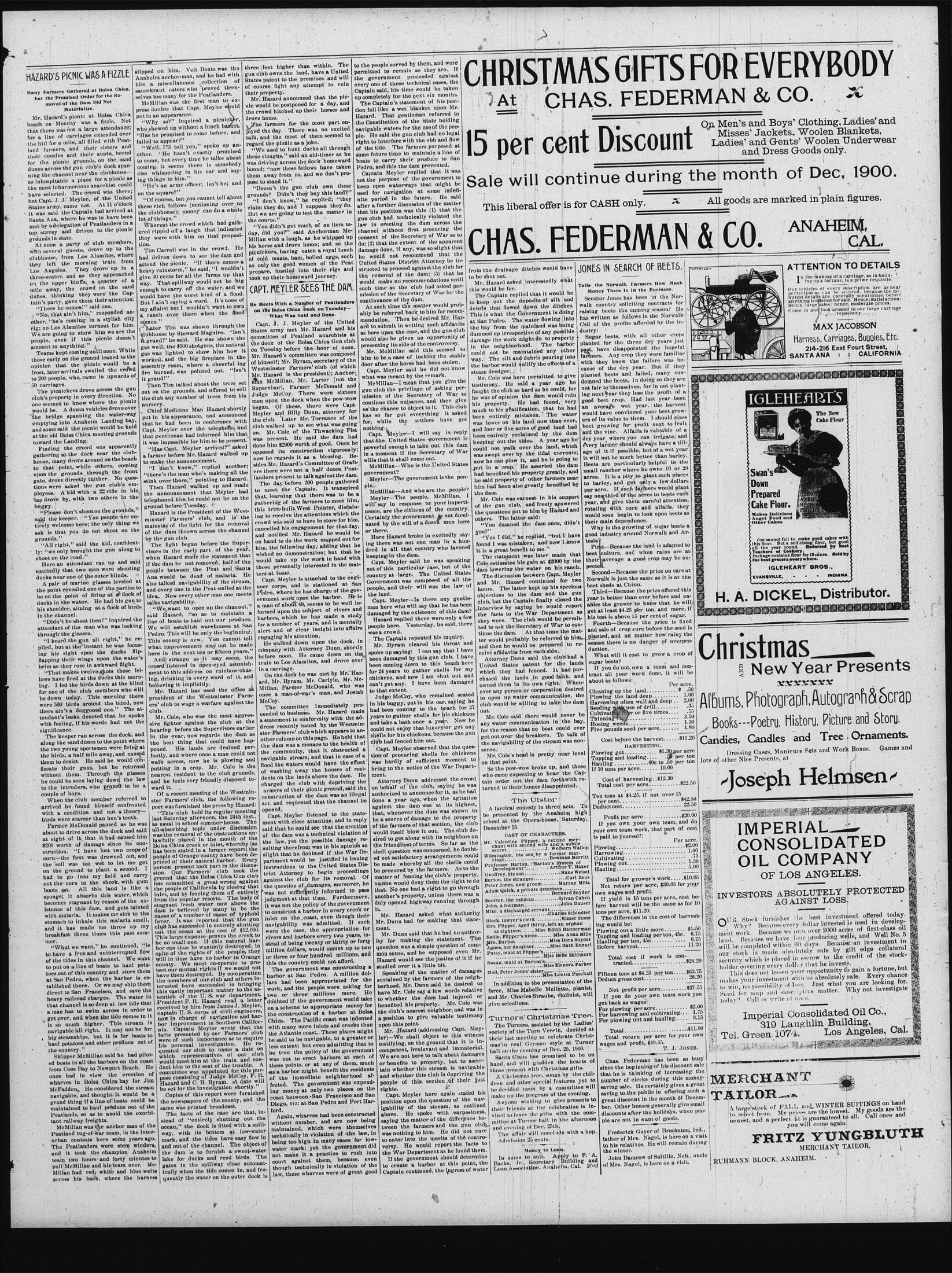
Searchable text
HAZARD'S PICNIC WAS A FIZZLE
Many Farmers Gathered at Bolsa Chica,
but the Promised Order for the Removal of the Dam Did Not Materialize.
Mr. Hazard's picnic at Bolsa Chica beach on Monday was a fizzle. Not that there was not a large attendance; for a line of carriages extended over the hill for a mile, all filled with Peatland farmers, and their sisters and their cousins and their aunts, bound for the picnic grounds, on the sand dunes across the gun club's dock spanning the channel near the clubhouse—as inhospitable a place for a picnic as the most Inharmonious anarchist could have selected. The crowd was there; but Capt. J. J. Meyler, of the United States army, came not. At 11 o'clock it was said the Captain had arrived at Santa Ana, where he was to have been met by a delegation of Peatlanders in a top surrey and driven to the picnic grounds in state.
At noon a party of club members, with several guests, drove up to the clubhouse, from Los Alamitos, where they left the morning train from Los Angeles. They drove up in a three-seater, and as they approached on the upper bluffs, a quarter of a mile away, the crowd on the sand dunes, thinking they were the Captain's party, gave them their attention.
"There he comes!" said one.
"No, that ain't him," responded another, "he's coming in a stylish city rig; no Los Alamitos turnout for him. We are going to show him we are the people, even if this picnic doesn't amount to anything."
Teams kept coming until noon. While those early on the ground leaned to the opinion that the picnic would be a frost, later arrivals swelled the crowd to 200 people, who came in upwards of 50 carriages.
The picnickers drove across the gun club's property in every direction. No one seemed to know where the picnic would be. A dozen vehicles drove over the bridge spanning the water-way emptying into Anaheim Landing bay, and some said the picnic would be held at the old Bolsa Chica meeting grounds toward the Landing.
Finding the crowd was apparently gathering at the dock near the club-house, many drove around on the beach to that point, while others, coming upon the grounds through the front slipped on him. Veit Bentz was the Anaheim anchor-man, and he had with him a miscellaneous collection of sauerkraut eaters who proved themselves too many for the Peatlanders.
McMillan was the first man to express doubts that Capt. Meyler would put in an appearance.
"Why so?" inquired a picnicker, who showed up without a lunch basket. "Has he promised to come before, and failed to appear?"
"Well, I'll tell you," spoke up another. "He hasn't exactly promised to come, but every time he talks about coming, it seems there is somebody else whispering in his ear and saying things to him."
"He's an army officer, isn't he; and on the square?"
"Of course, but you cannot tell about these rich fellows (motioning over to the clubhouse); money can do a whole lot of things."
Whereat the crowd which had gathered ripped off a laugh that indicated they were with him on that proposition.
Tim Carroll was in the crowd. He had driven down to see the dam and attend the picnic. "If there comes a heavy rainstorm," he said, "I wouldn't give 30 cents for all the farms up that way. That spillway would not be big enough to carry off the water, and we would have the worst kind of a flood. But I ain't saying a word. It's none of my affairs; but I wouldn't want to own a ranch over there when the flood comes."
Later Tim was shown through the clubhouse by Steward Maguire. "Isn't it grand!" he said. He was shown the gas well, the $500 shotguns, the natural gas was lighted to show him how it worked, and the big fireplace in the assembly room, where a cheerful log fire burned, was pointed out. "Isn't it grand!"
Then Tim talked about the trees set out on the grounds, and offered to sell the club any number of trees from his nursery.
Chief Medicine Man Hazard shortly put in his appearance, and announced that he had been in conference with Capt. Meyler over the telephone, and that gentleman had informed him that it was impossible for him to be present.
"Has Capt. Meyler arrived?" asked a farmer before Mr. Hazard walked up to make the announcement.
"I don't know," replied another; "there's the man who's making all the three feet higher than within. The gun club owns the land, have a United States patent to the premises and will of course fight any attempt to ruin their property.
Mr. Hazard announced that the picnic would be postponed for a day, and the crowd hitched up their horses and drove home.
The farmers for the most part enjoyed the day. There was no excited talk, and the most of them seemed to regard the picnic as a joke.
"We used to hunt ducks all through these sloughs," said an old-timer as he was driving across the dock homeward bound; "now these fellows have taken them away from us, and we don't propose to stand it."
"Doesn't the gun club own these grounds? Didn't they buy this land?"
"I don't know," he replied; "they claim they do, and I suppose they do. But we are going to test the matter in the courts."
"You didn't get much of an item today, did you?" said Anchorman McMillan with a laugh, as he whipped up his horse and drove home; and so the picnickers, having eaten a royal lunch of cold meats, ham, boiled eggs, such as only the good women of the Peat prepare, hustled into their rigs and took up their homeward journey.
CAPT. MEYLER SEES THE DAM.
He Meets With a Number of Peatlanders on the Bolsa Chica Dock on Tuesday—What Was Said and Done.
Capt. J. J. Meyler of the United States army met Mr. Hazard and his committee of Peatland anarchists at the dock of the Bolsa Chica Gun club on Tuesday before the hour of noon. Mr. Hazard's committee was composed of himself; Mr. Byram, secretary of the Westminster Farmers' club (of which Mr. Hazard is the president); Anchorman McMillan, Mr. Larter (not the Supervisor), Farmer McDonald and Judge McCoy. There were sixteen men upon the dock when the pow-wow began. Of these, there were Capt. Meyler and Billy Dunn, attorney for the club. Later Mr. Torrance of the club walked up to see what was going on. Mr. Cole of the Thwacking Fish was present. He said the dam had done him $2000 worth of good. Once he opposed its construction vigorously now he regards it as a blessing. Besides Mr. Hazard's Committee of Graffers there were not a half dozen Peatlands
The picnickers drove across the gun club's property in every direction. No one seemed to know where the picnic would be. A dozen vehicles drove over the bridge spanning the water-way emptying into Anaheim Landing bay, and some said the picnic would be held at the old Bolsa Chica meeting grounds toward the Landing.
Finding the crowd was apparently gathering at the dock near the clubhouse, many drove around on the beach to that point, while others, coming upon the grounds through the front gate, drove directly thither. No questions were asked the gun club's employees. A kid with a 22 rifle in his lap drove by, with two others in the buggy.
"Please don't shoot on the grounds," said the keeper. "You people are entirely welcome here; the only thing we ask is that you do not shoot on the grounds."
"All right," said the kid, confidently: "we only brought the gun along to shoot on the road."
Here an attendant ran up and said excitedly that two men were shooting ducks near one of the outer blinds.
A pair of marine glasses leveled at the point revealed one of the parties to be on the point of firing at a flock of ducks in the water. He had his gun to his shoulder, aiming at a flock of birds in the channel.
"Didn't he shoot then?" inquired the attendant of the man who was looking through the glasses.
"I heard the gun all right," he replied, but at the instant he was focusing his sight upon the ducks flipping their wings upon the water's brim as they rose in awkward flight.
"That makes twelve shots those fellows have fired at the ducks this morning. I fed the birds down at the blind for one of the club members who will be down today. This morning there were 500 birds around the blind, now there ain't a doggoned one." The attendant's looks denoted that he spoke with feeling, if his words had not the significance.
The keeper ran across the dock, and along the sand dunes to the point where the two young sportsmen were firing at the birds, a half mile away, and caused them to desist. He said he would confiscate their guns, but he returned without them. Through the glasses he could be seen laying down the law to the intruders, who proved to be a couple of boys.
When the club member referred to arrived he found himself confronted with a condition and not a theory—birds were scarcer than hen's teeth.
Farmer McDonald paused as he was about to drive across the dock and said at sight of it that it had caused him $200 worth of damage since its construction. "I have lost two crops of corn—the first was drowned out, and the soil was too wet to let me get on the ground to plant a second. I had to go into my field and carry out the corn in the shock, with gum boots on. All this land is like a sponge; it absorbs this water, which Then Tim talked about the trees set out on the grounds, and offered to sell the club any number of trees from his nrnsery.
Chief Medicine Man Hazard shortly put in his appearance, and announced that he had been in conference with Capt. Meyler over the telephone, and that gentleman had informed him that it was impossible for him to be present.
"Has Capt. Meyler arrived?" asked a farmer before Mr. Hazard walked up to make the announcement.
"I don't know," replied another; "there's the man who's making all the stink over there," pointing to Hazard.
Then Hazard walked up and made the announcement that Meyler had telephoned him he could not be on the ground before Tuesday.
Hazard is the President of the Westminster Farmers' club, and is the mainstay of the fight for the removal of the dam thrown across the channel by the gun club.
The fight began before the Supervisors in the early part of the year, when Hazard made the statement that if the dam be not removed, half of the people between the Peat and Santa Ana would be dead of malaria. He also talked navigability of the stream, and every one in the Peat smiled at the idea. Now every other man one meets talks navigability.
"We want to open up the channel," said Hazard, "so as to maintain a line of boats to haul out our produce. We will establish warehouses at San Pedro. This will be only the beginning. This county is new. You cannot tell what improvements may not be made here in the next ten or fifteen years."
And strange as it may seem, the crowd listened in open-eyed astonishment to this address on rainbow-chasing, drinking in every word of it, and believing it implicitly.
Mr. Hazard has used the office as president of the Westminster Farmers' club to wage a warfare against the club.
Mr. Cole, who was the most aggressive fighter against the club at hearing before the Supervisors earlier in the year, now regards the dam as best thing that could have happened. His lands are drained perfectly, and where once a man could not walk across, now he is plowing and putting in a crop. Mr. Cole is the nearest resident to the club grounds, and he feels very friendly disposed toward it.
Of a recent meeting of the Westminster Farmers' club, the following report was furnished by Hazard:
"This club held its regular meeting last Saturday afternoon, at 24th inst., as usual in school summer-house. The all-absorbing topic under discussion was the removal of the obstructions unlawfully placed in the mouth of the Bolsa Chica creek or inlet, whereby (as has been stated in a former report) the people of Orange county have been deprived of their natural harbor. Every person present took part in the discussion. Our Farmers' club took the ground that the Bolsa Chica Gun club has committed a great wrong against the people of California by closing that inlet, and by fencing them off entirely from the popular resorts. The body of Mr. Hazard is the presidenter; Auctioneer McMillan, Mr. Larter (notthe Supervisor), Farmer McDonald and Judge McCoy. There were sixteen men upon the dock when the pow-wow began. Of these, there were Captain Meyler and Billy Dunn, attorney for the club. Later Mr. Torrance of the club walked up to see what was going on. Mr. Cole of the Thwacking Fish was present. He said the dam had done him $2000 worth of good. Once he opposed its construction vigorously now he regards it as a blessing. Be sides Mr. Hazard's Committee of Graffers there were not a half dozen Peat landers present to talk against the dam.
The day before 200 people gathered to meet the Captain. It transpired that, learning that there was to be a gathering of the farmers to meet him this trim-built West Pointer, disdainting to receive the attentions which this crowd was said to have in store for him cancelled his engagement for that day and notified Mr. Hazard he would be on hand to do the work mapped out for him, the following day, adding that he wished no demonstration; but that he would take up work in hand with those personally interested in the matters at issue.
Capt. Meyler is attached to engineer corps, and is stationed at St.Pedro, where he has charge of government work upon harbor. He a man of about 40, seems to be well formed upon the subject of rivers and harbors, which he has made a study for a number of years, and is mentally alert and of clear insight into affair engaging his attention.
He walked down upon the dock company with Attorney Dunn, shortly before noon. He came down on train to Los Alamitos, and drove out in a carriage.
On the dock he was met by Mr. Hardy, Mr. Byram, Mr. Carlyle, Mr. Millan, Farmer McDonald, who once a man-of-war's man, and Josie McCoy.
The committee immediately proceeded to business. Mr. Hazard made a statement in conformity with this dress recently issued by the Westminster Farmers' club which appears in other column on this page. He held in this dam was a menace to the health community, that it obstructed navigable stream, and that in case floodthe waters would havethe effect of washing awaythe housesof residents onthelandsabovethedam.chargedtheclubwithdeprivingarmersofthepicnicground,saidconstructionofthedamwasanillactandrequestedthatthechannelopened.
Capt.Meylerlistenedtothestatementwithcloseattention,andinrealsaidthathecouldseethatthecreedofthedamwasatechnicalviolationthelaw,yetthepossibledamageultlingtherefromwasinhisopinicslightthathe doubtediftheWarpartmentwouldbejustifiedinissuctionstotheUnitedStatestrictAttorneytobeginprocessagainsttheclubforitsremovalthequestionofdamages,moreoverwasnotsufficientlyinfothedoughtattime.Further
When the club member referred to arrived he found himself confronted with a condition and not a theory—birds were scarcer than hen's teeth.
Farmer McDonald paused as he was about to drive across the dock and said at sight of it that it had caused him $200 worth of damage since its construction. "I have lost two crops of corn—the first was drowned out, and the soil was too wet to let me get on the ground to plant a second. I had to go into my field and carry out the corn in the shock, with gum boots on. All this land is like a sponge; it absorbs this water, which becomes stagnant by reason of the existence of this dam, and gets tainted with malaria. It makes me sick to the stomach to inhale this malaria smell, and it has made me throw up my breakfast three times this past summer."
"What we want," he continued, "is to have a free and uninterrupted flow of the tides in this channel. We want to put on a line of boats to haul potatoes out of this country and store them at San Pedro, when the harbor is established there. Or we may ship them direct to San Francisco, and save the heavy railroad charges. The water in that channel is so deep at low tide that a man has to swim across in order to get over, and when the tide comes in it is so much higher. This stream is navigable all right. It may not be for big steamships, but it is for boats to haul potatoes and other produce out of the country."
Skipper McMillan said he had piloted boats in all the harbors on the coast from Coos Bay to Newport Beach. He once had in view the erection of wharves in Bolsa Chica bay for Jim McFadden. He considered the stream navigable, and thought it would be a grand thing if a line of boats could be maintained to haul produce out of the Peatlands, so as to avoid the exorbitant railway freights.
McMillan was the anchor man of the Peatland tug-of-war team, in the interurban contests here some years ago. The Peatlanders were stem winders, and it took the champion Anaheim team two hours and forty minutes to pull McMillan and his team over. McMillan had red, white and blue welts across his back, where the harness
The facts of the case are that, instead of "entirely shutting out the ocean," the dock is fitted with a spillway, with its bottom at low-water mark, and the tides have easy flow in and out of the channel. The object of the dam is to furnish a sweet-water lake for ducks and reed birds. The gates in the spillway close automatically when the tide comes in, and frequently the water on the outer dock is
Capt. Meyler listened to the statement with close attention, and in reply that he could see that the creed of the dam was a technical violation of the law, yet the possible damage sulting therefrom was in his opinion slight that he doubted if the War partment would be justified in issuing instructions to the United States trict Attorney to begin proceed against the club for its removal of the question of damages, moreover was not sufficiently informed to judgment at that time. Furthermore it was not the policy of the government to construct a harbor in every crew inlet on the coast, even though navigability was admitted. If were the case, the appropriation rivers and harbors every two year stead of being twenty or thirty or million dollars, would mount up or three or four hundred millions this country could not afford.
The government was constructed harbor at San Pedro. A million dollars had been appropriated for work, and the people were asking two or three millions more doubted if the government would on a scheme to appropriate more the construction of a harbor at Chica. The Pacific coast was insured with many more inlets and creeks at Atlantic coast. These places be said to be navigable, to a greater extent; but even admitting it be true the policy of the government was not to erect harbors at these points, or at any of them as a harbor might benefit the rest of the immediate neighborhood.
The government was earning money at only two places coast between-San Francisco and Diego, viz: at San Pedro and Poford.
Again, wharves had been consigned without number, and are now maintained, which were technically in violation of their being too high in many cases for water mark; yet the government not make it a practice to run court against them, because though technically in violation law, these wharves were of great
CHRISTMAS GIFTS
At CHAS. FEDERAL
15 per cent Discount
Sale will continue during
This liberal offer is for CASH only.
CHAS. FEDERAL
With a Number of Peatlanders
Chas Chica-Dock on Tuesday—but Was Said and Done.
J. Meyler of the United
City met Mr. Hazard and his
of Peatland anarchists at
of the Bolsa Chica Gun club
before the hour of noon.
His committee was composed
Mr. Byram, secretary of the
Farmers' club (of which
is the president); AnchorMillan, Mr. Larter (not the
Mr.), Farmer McDonald and
McCoy. There were sixteen
in the dock when the pow-wow
of these, there were Captand Billy Dunn, attorney for
Later Mr. Torrance of the
up to see what was going
Cole of the Thwacking Fist
ent. He said the dam had
$2000 worth of good. Once he
its construction vigorously;
gards it as a blessing. BeHazard's Committee of Graftwere not a half dozen Peatto the people served by them, and were permitted to remain as they are. If the government proceeded against every one of these technical cases, the Captain said, his time would be taken up completely for the next six months.
The Captain's statement of his position fell like a wet blanket upon Mr. Hazard. That gentleman referred to the Constitution of the State holding navigable waters for the use of the people. He said the gun club had no legal right to interfere with the ebb and flow of the tide. The farmers purposed at some future time to maintain a line of boats to carry their produce to San Pedro, and this the dam prevented.
Captain Meyler replied that it was not the purpose of the government to keep open waterways that might be used for navigation at some indefinite period in the future. He said after a further discussion of the matter that his position was this (1) that the gun club had technically violated the law in erecting the dam across the channel without first procuring the consent of the Secretary of War so to do; (2) that the extent of the apparent damage done, if any, was so slight that he would not recommend that the United States District Attorney be instructed to proceed against the club for the removal of the dam; (3) that he would make no recommendations until such time as the club had asked permission of the Secretary of War for the continuance of the dam.
At such time the matter would probably be referred back to him for recommendation. Then he desired Mr. Hazard to submit in writing such affidavits as bore upon the case, and the gun club would also be given an opportunity of presenting its side of the controversy.
Mr. McMillan said this seemed to him to be a case of locking the stable door after the horse had been stolen.
Capt. Meyler said he did not know what was meant by the remark.
McMillan—I mean that you give the gun club the privilege of asking permission of the Secretary of War to continue this nuisance, and then give us the chance to object to it. This club has so far got everything it asked for, while the settlers have got nothing.
Capt. Meyler—I will say in reply that the United States government is powerful enough to take out this dam in a moment if the Secretary of War wills that it shall come out.
McMillan—Who is the United States government?
from the drainage ditches would have to be shut out.
Mr. Hazard asked interestedly what this would be for.
The Captain replied that it would be to keep out the deposits of silt and debris that flowed down the ditches. This is what the Government is doing at San Pedro. The water flowing into the bay from the mainland was being dammed up irrespective of any possible damage the work might do to property in the neighborhood. The harbor could not be maintained any other way. The silt and debris pouring into the harbor would nullify the effects of a steam dredger.
Mr. Cole was here permitted to give testimony. He said a year ago he fought the club as hard as he could, for he was of opinion the dam would ruin his property. He had found, very much to his gratification, that he had been entirely mistaken. The water was lower on his land now than ever, and four or five acres of good land had been entirely reclaimed by the dam keeping out the tides. A year ago he could not walk over the land, which was swept over by the tidal currents; now he can plow it, and he is going to put in a crop. He asserted the dam had benefited his property greatly, and
JONES IN SEARCH OF BEETS
Tells the Norwalk Farmers How Much Money There Is in the Business.
Senator Jones has been in the Norwalk country soliciting contracts raising beets the coming season/ has written as follows in the Norwalk Call of the profits afforded by the dustry:
Sugar beets, with all other crops planted for the three dry years past, have disappointed the hop farmers. Any crop they were farming with they knew the failure was cause of the dry year. But if planted beets and failed, many demned the beets. In doing so they not fair to themselves, for in not putting next year they lose the profit good beet crop. Had last year an average wet year, the haud would have convinced your beet growers of its value to them. I should beet growing for profit next to and the vine. Alfalfa is valuable dry year where you can irrigate every farmer should always have age of it if possible, but of a wet it will not be much better than beetrees are particularly helpful to small rancher where he owns 10%
McMillan—I mean that you give the gun club the privilege of asking permission of the Secretary of War to continue this nuisance, and then give us the chance to object to it. This club has so far got everything it asked for, while the settlers have got nothing.
Capt. Meyler—I will say in reply that the United States government is powerful enough to take out this dam in a moment if the Secretary of War wills that it shall come out.
McMillan—Who is the United States government?
Meyler—The government is the people.
McMillan—and who are the people?
Meyler—The people, McMillan, I will say in response to your impertinence, are the citizens of the country. Certainly the government is not dominated by the will of a dozen men here or there.
Here Hazard broke in excitedly saying there was not one man in a hundred in all that country who favored keeping in the dam.
Capt. Meyler said he was speaking not of this particular case, but of the country at large. The United States Government was composed of all the people, and their will was the law of the land.
Capt. Meyler—Is there any gentleman here who will say that he has been damaged by the existence of this dam?
Hazard replied there were only a few people here. Yesterday, he said, there was a crowd.
The Captain repeated his inquiry.
Mr. Byram cleared his throat and spoke up saying: I can say that I have been damaged by this gun club. I have been coming down to this beach here for 24 years to gather shells for my chickens, and now I am shut out and can't get any. I have been damaged to that extent.
Judge McCoy, who remained seated in his buggy, put in his oar, saying he had been coming to the beach for 27 years to gather shells for his chickens and take a bath once a year. Now he could not enjoy that luxury or get any shells for his chickens, because the gun club had fenced him out.
Capt. Meyler observed that the question of procuring shells for chickens was hardly of sufficient moment to bring to the notice of the War Department.
Attorney Dunn addressed the crowd on behalf of the club, saying he was authorized to announce for it, as he had done a year ago, when the agitation against the dam was at its highest, that, whenever the dam was shown to be a source of damage to the property of the farmers of that section, the club would itself blow it out. The club desired to get along with its neighbors on the friendliest of terms. So far as the shell question was concerned, he doubted not satisfactory arrangements could be made whereby all the shells could be procured by the farmers. As to the matter of fencing the club's property, no one would deny them the right to do that. No one had a right to go through another's property, unless there was a what was meant by the remark.
McMillan—I mean that you give the gun club the privilege of asking permission of the Secretary of War to continue this nuisance, and then give us the chance to object to it. This club has so far got everything it asked for, while the settlers have got nothing.
Capt. Meyler—I will say in reply that the United States government is powerful enough to take out this dam in a moment if the Secretary of War wills that it shall come out.
McMillan—Who is the United States government?
Meyler—The government is the people.
McMillan—and who are the people?
Meyler—The people, McMillan, I will say in response to your impertinence, are the citizens of the country. Certainly the government is not dominated by the will of a dozen men here or there.
Here Hazard broke in excitedly saying there was not one man in a hundred in all that country who favored keeping in the dam.
Capt. Meyler said he was speaking not of this particular case, but of the country at large. The United States Government was composed of all the people, and their will was the law of the land.
Capt. Meyler—Is there any gentleman here who will say that he has been damaged by the existence of this dam?
Hazard replied there were only a few people here. Yesterday, he said, there was a crowd.
The Captain repeated his inquiry.
Mr. Byram cleared his throat and spoke up saying: I can say that I have been coming down to this beach here for 24 years to gather shells for my chickens, and now I am shut out and can't get any. I have been damaged to that extent.
Judge McCoy, who remained seated in his buggy, put in his oar, saying he had been coming down to this beach for 27 years to gather shells for his chickens and take a bath once a year. Now he could not enjoy that luxury or get any shells for his chickens, because the gun club had fenced him out.
Capt. Meyler observed that the question of procuring shells for chickens was hardly of sufficient moment to bring to the notice of the War Department.
Attorney Dunn addressed the crowd on behalf of the club, saying he was authorized to announce for it, as he had done a year ago, when the agitation against the dam was at its highest, that, whenever the dam was shown to be a source of damage to the property of the farmers of that section, the club would itself blow it out. The club desired to get along with its neighbors on the friendliest of terms. So far as the shell question was concerned, he doubted not satisfactory arrangements could be made whereby all the shells could be procured by the farmers. As to the matter of fencing the club's property, no one would deny them the right to do that. No one had a right to go through another's property, unless there was a what was meant by the remark.
McMillan—I mean that you give the gun club the privilege of asking permission of the Secretary of War to continue this nuisance, and then give us the chance to object to it. This club has so far got everything it asked for, while the settlers have got nothing.
Capt. Meyler—I will say in reply that the United States government is powerful enough to take out this dam in a moment if the Secretary of War wills that it shall come out.
McMillan—Who is the United States government?
Meyler—The government is the people.
McMillan—and who are the people?
Meyler—The people, McMillan, I will say in response to your impertinence, are the citizens of the country. Certainly the government is not dominated by the will of a dozen men here or there.
Here Hazard broke in excitedly saying there was not one man in a hundred in all that country who favored keeping in the dam.
Capt. Meyler said he was speaking not of this particular case, but of the country at large. The United States Government was composed of all the people, and their will was the law of the land.
Capt. Meyler—Is there any gentleman here who will say that he has been damaged by the existence of this dam?
Hazard replied there were only a few people here. Yesterday, he said, there was a crowd.
The Captain repeated his inquiry.
Mr. Byram cleared his throat and spoke up saying: I can say that I have been coming down to this beach here for 24 years to gather shells for my chickens, and now I am shut out and can't get any. I have been damaged to that extent.
Judge McCoy, who remained seated in his buggy, put in his oar, saying he had been coming down to this beach here for 27 years to gather shells for my chickens and take a bath once a year. Now he could not enjoy that luxury or get any shells for his chickens, because the gun club had fenced him out.
Capt. Meyler observed that the question of procuring shells for chickens was hardly of sufficient moment to bring to the notice of the War Department.
Attorney Dunn addressed the crowd on behalf of the club, saying he was authorized to announce for it, as he had done a year ago, when the agitation against the dam was at its highest, that, whenever the dam was shown to be a source of damage to the property of the farmers of that section, the club would itself blow it out. The club desired to get along with its neighbors on the friendliest of terms. So far as the shell question was concerned, he doubted not satisfactory arrangements could be made whereby all the shells could be procured by the farmers. As to the matter of fencing the club's property, no one would deny them the right to do that. No one had a right to go through another's property, unless there was a what was meant by the remark.
McMillan—I mean that you give the gun clubthe privilegeof asking permissionoftheSecretaryOfWartocontinuethisnuisance,andthengiveusthechancetotakeoutthisdaminamemberoftheattentionswhichtheissaidtohaveinstoreforhimandinagermarketforthatday,fiedMr.Hazardhewouldbeodoftheworkmappedoutforfollowingday;addingthathedemonstration;butthathetakeuptheworkinhandpersonallyinterestedinthematissue.Meyleris attachedtotheengineers,andisabout40seemstobewellinbetweenthesubjectofriversandwhichhehasmadeastudymemberofyears,andismentallyadofclearinsightintoaffairsgivinghisattention.
Alkekdown uponthe dock,intywithAttorneyDunn,shorthoon.ThecamedownontheLosAlamitos,anddroveoverriage.DockhebewasmetbyMr.HazerByram,Mr.Carlyle,Mr.McFarmerMcDonaldwhowasman-of-war'mans,andJosiahcommitteeimmediatelyprotectbmusiness.MyHazardmadementinconformitywiththeadecentlyissuedbytheWestminers'clubwhichappearsinancolumnonthispage.Heheldthathamwasmakenaceoftheworldandthemenwhosecommunity,mitthatobstructedablestream,andthatincaseofthewaterswouldhavetheffectthingawaythehousesofresistancethelandsabovethedam.Hedidtheclubwithdeprivingthesisofthepiericground,saidthequirementofdamwantanillegalandrequestedthatthechannelbelieved.Meylerlistenedtothestate-withcloseattention,andinreplythathecouldseethattheerectionldamwas Technical violationofyet,thepossible damageregardingtherefromwasinhisopinionsohathe doubtediftheWartreatmentwouldbejustifiedinissuingactionstotheUnitedStatesDisastertobeginproceedingsattheclubforitsremoval.Ofquestionofdamages,moreover,hownot sufficiently informedtouspectmentatthattime.Furthermore,
Mr.Colewasherepermittedtogivetestimony.Hesaidayearagohefoughttheclubashardashecouldforhewiselfhad everandhecouldnotwalk overthelandwhichwassweptoverthetidal currents;nowhecanplowit,andheisgoingtoputinacrop.Hesasserthedamhad benefitedhisproperty greatly,andhesaidpropertyofotherfarmersnearhimhadbeenalsogreatlybenefitedbythedam.Mr.Colewasearnestinhissupportofthegnnclub,andfreelyansweredthequestionsputtohimbyHazardandothers.Latersaid:
"Youdamnedthedamonce,didn'tyou?"
"YesI did,"he replied,"butI havefoundIwasmistaken,andnowIknowitisa great benefitto me."
The statementwaslatermadethatColeestimateshigat$2000bythedamloweringthewateronhisranch.ThediscussionbetweenGcylem勒andMr.Hazardcontinuedfortwohours.The latterkeptuphis speciousto-thedamandthegunbuck,buttheCaptainfinalclosedtheinterviewbysayinghewouldreportthe factstotheWarDepartmentastheywere.TheclubwouldbepermittedtoasktheSecretaryOfWartocontinuethedam.Atthattimetherematterprobablycouldbereferredtohimandthenhewouldbepreparedtocreceiveaffidaviasfromeachside.
AttorneyDunn saidtheclubhadaUnitedStatespatentforthelandswhich theyhadfenced.ithadpurchasedthelandsingoodfaith,andownedtheminitsownright.Weneveranypersonorcorporationdesiredtoopenupwatercommunication,theclubwouldbewillingtothedamout
Mr.Colesaheadisprettynearlevelonthatpoint.Sothepow-wowbrokedup,andthosewho cameexpectingtohearTheCaptainorderoutthedamforwithdrawtedto theirhomesdisappointed.
TheUlster
Afarcalcomedyinthreeacts.TobepresentedbytheAnaheimhighschoolattheOpera-house,SaturdayDecember15.
CASTOFCHARACTERS
Mr.ValentineFlipper,a retired merchantwithsecond wifeanda subtlesecret.J.WelbornWallopWilmington,his sonbya former merrittBowmanMerrrittProfessorBarton'SystemofDevelopment"ArthurT.BakerGeoffrey,his sonHansWeiselBurton,the strangerCarlZeusPeterJones,新groomMurrayMillsAdamQuick,aprivatedetectsvernumberSchnyCohenSylvanCahen
Meyler listened to the state with close attention, and in reply that he could see that the erection of the dam was a technical violation of law, yet the possible damage therefrom was in his opinion so that he doubted if the War Department would be justified in issuing instructions to the United States District Attorney to begin proceedings against the club for its removal. Of question of damages, moreover, he not sufficiently informed to pass at that time. Furthermore, he did not the policy of the government instruct a harbor in every creek or on the coast, even though their viability was admitted. If such case, the appropriation for bills and harbors every two years, instead of being twenty or thirty or forty million dollars, would mount up to two treasury or four hundred millions, and the country could not afford.
The government was constructing a harbor at San Pedro. A million dollar had been appropriated for the harbor, and the people were asking for it or three millions more. He noted if the government would take scheme to appropriate money for construction of a harbor at Bolsa Vista. The Pacific coast was indented by many more inlets and creeks than Atlantic coast. These places might have to be navigable, to a greater extent; but even admitting that to true the policy of the government it not to erect harbors at each of these points, or at any of them, much harbor might benefit the residents of the immediate neighborhood affected. The government was expenditure money at only two places on the east between San Francisco and San Diego, viz: at San Pedro and Port Harold.
Again, wharves had been constructed without number, and are now being maintained, which were themselves technically in violation of the law, in doing too high in many cases for lower mark: yet the government did not make it a practice to rush into hurt against them, because, even though technically in violation of the law, these wharves were of great good done a year ago, when the agitation against the dam was at its highest, that, whenever the dam was shown to be a source of damage to the property of the farmers of that section, the club would itself blow it out. The club desired to get along with its neighbors on the friendliest of terms. So far as the shell question was concerned, he doubted not satisfactory arrangements could be made whereby all the shells could be procured by the farmers. As to the matter of fencing the club's property, no one would deny them the right to do that. No one had a right to go through another's property, unless there was a duly opened highway running through it.
Mr. Hazard asked what authority Mr. Dunn had for making that statement.
Mr. Dunn said that he had no authority for making the statement. The question was a simple question of common sense, and he supposed even Mr. Hazard would see the justice of it if he studied over it a little bit.
Speaking of the matter of damages sustained by the farmers of the neighborhood, Mr. Dunn said he desired to have Mr. Cole say a few words relative to whether the dam had injured or benefited his property. Mr. Cole was the club's nearest neighbor, and was in a position to give valuable testimony upon this point.
Mr. Hazard (addressing Capt. Meyler)—We shall object to this witness testifying, on the ground that it is incompetent, irrelevant and immaterial. We are not here to talk about damages or benefits to property, but to ascertain whether this stream is navigable and whether this club is depriving the people of this section of their just rights.
Capt. Meyler here again stated his position upon the question of the navigability of the stream, as outlined above. He spoke with earnestness, saying the matter of the difference between the farmers and the gun club was nothing to him. He did not care to enter into the merits of the controversy. He would report the facts to the War Department as he found them.
If the government should determine to create a harbor at this point, the Captain continued, the ingress of water
The Ulster
A farcical comedy in three acts. To be presented by the Anaheim high school at the Opera-house, Saturday, December 15.
CAST OF CHARACTERS.
Mr. Valentine Flipper, a retired merchant with second wife and a subtle secret ... J. Welborn Wallop
Wilmington, his son by a former marriage ... Howman Merritt
Professor Barton. "Barton's System of Development" ... Artbur T. Baker
Geoffrey, his son ... Hans Welsel
Burton, the stranger ... Carl Zeus
Peter Jones, new groom ... Murray Mills
Adam Quick, a private detective ... Bernard Snyder
Snorter, the cabman ... Sylvan Cahen
John, a footman ... John Dauser
Mike, a discharged servant ... Charles Schindler
Block, lawyer's clerk ... Elmer Stone
Mrs. Flipper, aged thirty, left an orphan at eighteen ... Miss Edith Bannerman
Sadie, Flipper's niece ... Miss Alma Mills
Mrs. Barton ... Miss Dora Snyder
Agnes, her daughter ... Miss Ruth Enearl
Patsy, maid at Flipper's ... Miss Belle Skidmore
Susan, maid at Barton's ... Miss Elenora Parker
Moll, Peter Jones' sister ... Miss Louisa Paschall
In addition to the presentation of the farce, Miss Mabelle Mellette, pianist, and Mr. Charles Straube, violinist will give selections.
Turners' Christmas Tree.
The Turners, assisted by the Ladies' society of the Turn Verein, decided at their last meeting to celebrate Christmas in real German style at Turner hall on the evening of Dec. 25, 1900.
Santa Claus has promised to be on hand, and will gladden the hearts of those present with Christmas gifts.
A Christmas tree, songs by the children and other special features yet to be decided upon by a committee will make up the program of the evening.
Anyone wishing to give presents to their friends at the celebration is invited to leave the gifts with the committee at Turner hall in the afternoon and evening of Dec. 25th.
The affair will conclude with a hop. Admission 25 cents.
Money to Loan.
In sums to suit. Apply to F. A. Backs, Jr., Secretary Building and Loan Association. Anaheim, Cal. 10-1f
per cent.
Deduct cost.
Profit per acre.
If you own your own team your own team work, that paris is paid to yourself:
Plowing
Harrowing
Cultivating
Plowing out
Hauling
Total for grower's work.
Net return per acre,$30.00 own wages and profit.
If yield is 15 tons per acre fore harvest will be the same tons per acre,$11.20.
The difference in the cost of ing would be:
Plowing out a little more.
Topping and loading per ton.
Hauling per ton, 45c.
Before harvest.
Total cost if work is traced.
Fifteen tons at $4.25 per ton.
Deduct gross cost.
Net profit per acre.
If you do your own team get back as wages:
For plowing per acre.
For harrowing and cultivation.
For plowing out and hauling
Total.
Total return per acre for wages and profit,$49.45.
Chas. Federman has been since the beginning of his career number of clerks during saving sale. He certainly gave saving to.the public in off-great discount in the month ber. Other houses generally discounts after the holiday ple are not in want of good Frederick Guyer of Brook father of Mrs. Nagel is hard to his relatives. He will rethe winter.
John Damrow of Saltillo of Mrs. Nagel is here on a
S GIFTS FOR EVERYBODY
S. FEDERMAN & CO.
Discount
On Men's and Boys' Clothing, Ladies' and Misses' Jackets, Woolen Blankets,
Ladies' and Gents' Woolen Underwear
and Dress Goods only.
Due during the month of Dec, 1900.
ASH only. All goods are marked in plain figures.
DERMAN & CO. ANAHEIM, CAL.
IN SEARCH OF BEETS.
The Norwalk Farmers How Much Money There Is in the Business.
Victor Jones has been in the Norcountry soliciting contracts for beets the coming season. He written as follows in the Norwalk of the profits afforded by the inbeets, with all other crops and for the three dry years just have disappointed the hopeful farmers. Any crop they were familiar they knew the failure was beof the dry year. But if they had beets and failed, many condied the beets. In doing so they are air to themselves, for in not plant- next year they lose the profit of a beet crop. Had last year been average wet year, the harvest will have convinced your beet growits value to them. I should class growing for profit next to fruit the vine. Alfalfa is valuable of a year where you can irrigate, and farmer should always have a till- of it if possible, but of a wet year not be much better than barley. Are particularly helpful to the rancher where he owns 10 or 20
ATTENTION TO DETAILS
In the making of a carriage, as in building up a fortune, is a prime requisite.
Our vehicles of every description are as near perfection as can be secured, because the minutest details are carefully scrutinized before anything is offered for sale. Hence: satisfaction:
hence, large sales; hence, moderate prices.
Come in and look around in our large carriage repository...
MAX JACOBSON
Harness, Carriages, Buggies, Etc.
214-216 East Fourt Street,
SANTA ANA : CALIFORNIA.
IGLEHEART'S
The New Cake Flour
IGLEHEART'S
The New Cake Flour
Swan's Down Prepared Cake Flour.
Makes Delicious Angel Food and Other Cakes.
You cannot fail to make good cakes with this flour. Not a self-rising flour, but good all the year round. Endorsed by best Teachers of Cookery.
Package contains flour for 12 cakes. Sold by the best grecers everywhere.
IGLEHEART BROS., EVANSVILLE, INDIANA.
H. A. DICKEL, Distributor.
Christmas AND New Year Presents
Albums, Photograph, Autograph & Scrap Books---Poetry, History, Picture and Story.
Candies, Candles and Tree Ornaments,
Dressing Cases, Manicure Sets and Work Boxes. Games and lots of other Nice Presents, at
Joseph Helmsen
IMPERIAL CONSOLIDATED OIL COMPANY OF LOS ANGELES.
INVESTORS ABSOLUTELY PROTECTED
IMPERIAL CONSOLIDATED OIL COMPANY OF LOS ANGELES.
INVESTORS ABSOLUTELY PROTECTED AGAINST LOSS.
OUR Stock furnishes the best investment offered today.
Why? Because every dollar invested is used in development work. Because we own over 2000 acres of first-class oil land. Because we have four producing wells, and Well No.5 will be completed within 60 days. Because an investment in our stock is made absolutely safe by gilt edge collateral security which is placed in escrow to the credit of the stockholder covering every dollar that he invests.
This does not lessen your opportunity to gain a fortune, but makes your investment with us absolutely safe. Every chance to win, no possibility of loss. Just what you are looking for. Send for map and descriptive matter. Why not investigate today? Call or write at once.
Imperial Consolidated Oil Co., 319 Laughlin Building,
Tel. Green 1074. Los Angeles, Cal.
MERCHANT TAILOR
A large stock of FALL and WINTER SUITINGS on hand to select from. My prices are the lowest. My goods are the newest, and a perfect fit is guaranteed to all. Call once and you will come again.
FRITZ YUNGBLUTH
MERCHANT TAILOR,
RUHMANN BLOCK, ANAHEIM.