anaheim-gazette 1900-11-15
Scanned page
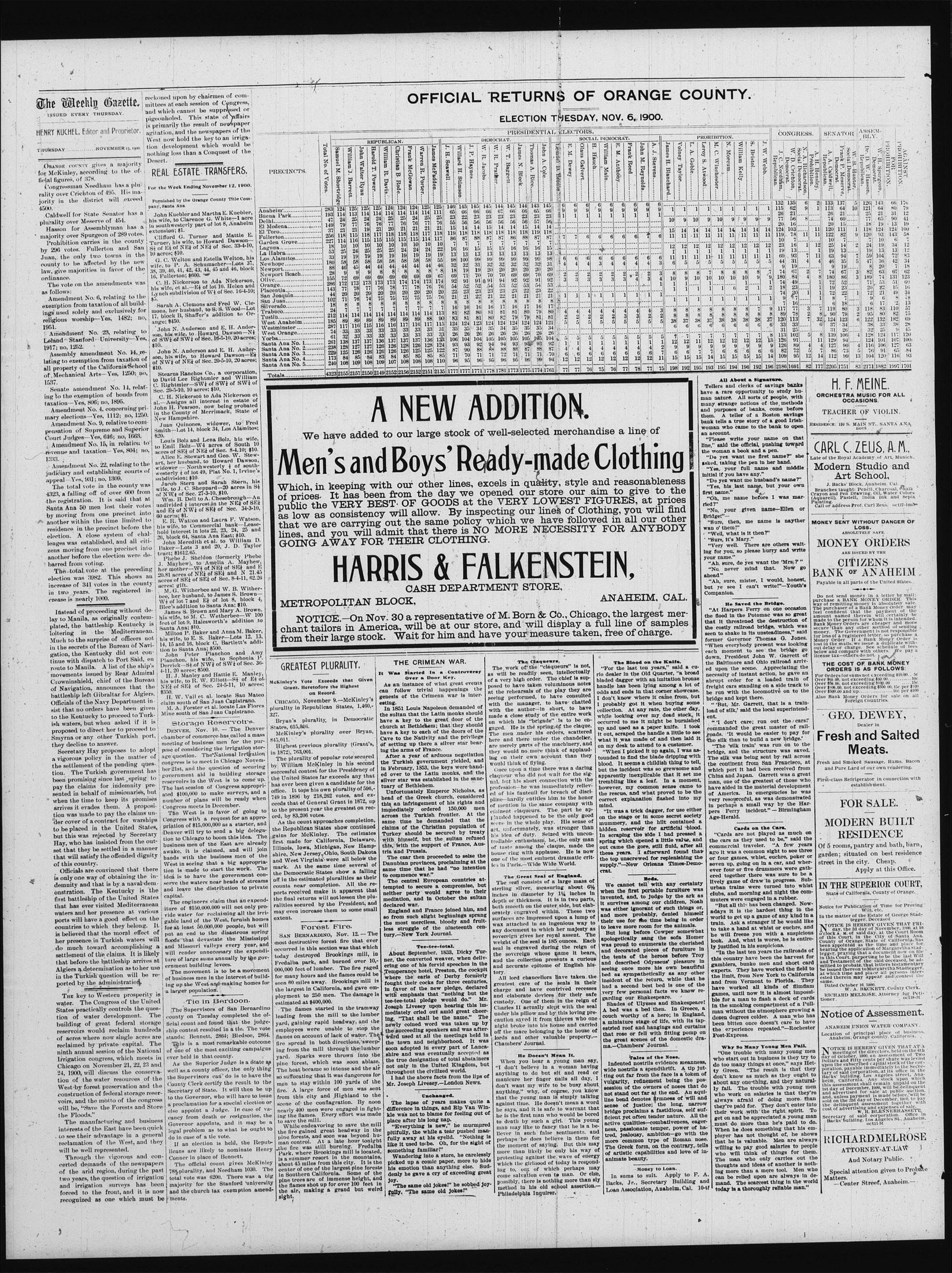
Searchable text
ORANGE COUNTY gives a majority for McKinley, according to the official figures, of 378.
Congressman Needham has a plurality over Crichton of 495. His majority in the district will exceed 4500.
Caldwell for State Senator has a plurality over Meserve of 454.
Hasson for Assemblyman has a majority over Spurgeon of 289 votes.
Prohibition carries in the county by 296 votes. Fullerton and San Juan, the only two towns in the county to be affected by the new law, give majorities in favor of the ordinance.
The vote on the amendments was as follows:
Amendment No. 6, relating to the exemption from taxation of all buildings used solely and exclusively for religious worship—Yes, 1482; no, 1951.
Amendment No. 23, relating to Leland Stanford University—Yes, 1917; no, 1252.
Assembly amendment No. 14, relating to exemption from taxation of all property of the California School of Mechanical Arts—Yes, 1250; no, 1537.
Senate amendment No. 14, relating to the exemption of bonds from taxation—Yes, 806; no, 1895.
Amendment No. 4, concerning primary elections—Yes, 1112; no, 1250.
Amendment No. 9, relative to compensation of Supreme and Superior Court Judges—Yes, 646; no, 1663.
Amendment No. 15, in relation to revenue and taxation—Yes, 804; no, 1333.
Amendment No. 22, relating to the judiciary and establishing courts of reckoned upon by chairmen of committees at each session of Congress, and which cannot be suppressed or pigeonholed. This state of affairs is primarily the result of newspaper agitation, and the newspapers of the West now hold the key to an irrigation development which would be nothing less than a Conquest of the Desert.
REAL ESTATE TRANSFERS.
For the Week Ending November 12, 1900.
Furnished by the Orange County Title Company, Santa Ana.
John Kuebler and Martha E. Kuebler, his wife, to Clarence G. White—I acre in southwesterly part of lot 8, Anaheim extension; $1.
Clifford G. Turner and Mattie E. Turner, his wife, to Howard Dawson—S† of E† of NE† of Sec. 33-4-10, 10 acres; $10.
G. C. Welton and Estella Welton, his wife, to P. A. Schumacher—Lots 37, 38, 39, 40, 41, 42, 43, 44, 45 and 46, block 16, Fullerton; $600.
C. H. Nickerson to Ada Nickerson, his wife, et al.—E† of lot 10. Helen and Lynch subdivision of W† of Sec. 16-4-10; $5.
Sarah A. Clemons and Fred W. Clemons, her husband, to S. S. Wood—Lot 17, block B, Shaffer's addition to Orange; $450.
John N. Anderson and E. H. Anderson, his wife, to Howard Dawson—N† of SW† of SW† of Sec. 16-5-10, 20 acres; $10.
John N. Anderson and E. H. Anderson, his wife, to Howard Dawson—E† of NW† of Sec. 20-5-10, 20 acres; $10.
Stearns Ranchos Co., a corporation, to David Lee Rightmier and William C. Rightmier—SW† of SW† of SW† of Sec. 29-5-10, 10 acres; $10.
C. H. Nickerson to Ada Nickerson et al.—Assigns all interest in estate of John H. Pearson, now being probated in the County of Merrimack, State of New Hampshire.
Juan Quinones, widower, to Fred Smith—Lot 14, block 34, Los Alamitos; $20.
Louis Bolz and Lena Bolz, his wife, to Emil Bolz—W4 acres of South 10 acres of SE† of NE† of Sec. 8-4-10; $10.
Alice E. Stewart and Geo. W. Stewart, her husband, to Howard Dawson, widower — Northwesterly ‡ of lot 49, Plat No. I, Irvine's
Senate amendment No. 14, relating to the exemption of bonds from taxation—Yes, 806; no, 1895.
Amendment No. 4, concerning primary elections—Yes, 1112; no, 1250.
Amendment No. 9, relative to compensation of Supreme and Superior Court Judges—Yes, 646; no, 1663.
Amendment No. 15, in relation to revenue and taxation—Yes, 804; no, 1333.
Amendment No. 22, relating to the judiciary and establishing courts of appeal—Yes, 931; no, 1309.
The total vote in the county was 4323, a falling off of over 600 from the registration. It is said that at Santa Ana 50 men lost their votes by moving from one precinct into another within the time limited to residence in the precinct before the election. A close system of challenges was established, and all citizens moving from one precinct into another before the election were barred from voting.
The total vote at the preceding election was 3982. This shows an increase of 341 votes in the county in two years. The registered increase is nearly 1000.
Instead of proceeding without delay to Manila, as originally contemplated, the battleship Kentucky is loitering in the Mediterranean. Much to the surprise of officers not in the secrets of the Bureau of Navigation, the Kentucky did not continue with dispatch to Port Said, en route to Manila. A list of the ship's movements issued by Rear Admiral Crowninshield, chief of the Bureau of Navigation, announces that the battleship left Gibraltar for Algiers. Officials of the Navy Department insist that no orders have been given to the Kentucky to proceed to Turkish waters, but when asked if it is proposed to direct her to proceed to Smyrna or any other Turkish port, they decline to answer.
Secretary Hay proposes to adopt a vigorous policy in the matter of the settlement of the pending question. The Turkish government has been promising since last spring to pay the claims for indemnity presented in behalf of missionaries, but when the time to keep its promises arrives it evades them. A proposition was made to pay the claims under cover of a contract for warships to be placed in the United States, but this was rejected by Secretary Hay, who has insisted from the outset that they be settled in a manner that will satisfy the offended dignity of this country.
Officials are convinced that there is only one way of obtaining the indemnity and that is by a naval demonstration. The Kentucky is the first battleship of the United States
Storage Reservoirs.
DENVER, Nov. 10. — The Denver chamber of commerce has called a mass meeting of business men for the purpose of considering the irrigation storage question. The National Irrigation congress is to meet in Chicago November 21st, and the question of securing government aid in building storage reservoirs in the West is to come up. The last session of Congress appropriated $100,000 to make surveys, and a number of plans will be ready when Congress meets in December.
The West is in favor of going to Congress with a request for an appropriation of $15,000,000 as a starter, and Denver will try to send a big delegation to Chicago to boom this idea. The business men of the East are already awake, it is claimed, and will join bands with the business men of the West in seeing that a big appropriation is made to start the work. The idea is to have the government conserve the waters near heads of streams and leave the distribution to private capital.
C. H. Nickerson to Ada Nickerson et al.—Assigns all interest in estate of John H. Pearson, now being probated in the County of Merrimack, State of New Hampshire.
Juan Quinones, widower, to Fred Smith—Lot 14, block 34, Los Alamitos; $20.
Louis Bolz and Lena Bolz, his wife, to Emil Bolz—W4 acres of South 10 acres of SE‡ of NE‡ of Sec. 8-4-10; $10.
Alice E. Stewart and Geo. W. Stewart, her husband, to Howard Dawson, widower—Northwesterly ‡ of south-westerly ‡ of lot 49, Plat No.1, Irvine's subdivision; $10.
Jacob Stern and Sarah Stern, his wife, to J. C. Sheppard—20 acres in S‡ of NW‡ of Sec. 27-3-10; $10.
Wm. B. Dell to A. Chesebrough—An undivided ‡ interest in the NE‡ of SE‡ and E‡ of NW‡ of SE‡ of Sec. 34-3-10, 60 acres; $1.
E. R. Watson and Laura F. Watson, his wife, to Commercial bank—Leasehold interest in lots 22, 23, 24, 25 and 26, block 64, Santa Ana East; $10.
John Meredith et al. to William D. Baker—Lots 3 and 20, J. D. Taylor tract; $1612.65.
Phebe J. Sheldon (formerly Phebe J. Mayhew), to Amelia A. Mayhew, her mother—W‡ of NE‡ of SE‡ and E‡ of NW‡ of SE‡ and N 21:45 acres of SE‡ of SE‡ of Sec. 8-4-11, 62:26 acres; gift.
M. G. Witherbee and W. B. Witherbee, her husband, to James S. Brown—W‡ of lot 7 and E‡ of lot 8, block 4, Blee's addition to Santa Ana; $10.
James S. Brown and Mary A. Brown his wife, to M. C. Wetherbee—W 100 feet of lot 9, Halesworth's addition to Santa Ana; $10.
Milton P. Baker and Anna M. Baker his wife, to E. S. Baker—Lots 12, 13, 14, 15 and 16, block C., Bartlett's addition to Santa Ana; $500.
John Peter Planchon and Amy Planchon his wife, to Sophonia P. Derrick—S‡ of NW‡ of SW‡ of Sec. 36-4-11, 20 acres; $500.
H.J.Manley and Hattie E.Manley his wife, to R.W.Elliott—S‡ of E‡ of SE‡ of Sec. 24-5-11, 10 acres; $350.
H.W.Vail et al. locate San Mateo claim south of San Juan Capistrano.
M.A.Forster et al.locate Las Flores Mine south of San Juan Capistrano.
Storage Reservoirs.
DENVER, Nov. 10. — The Denver chamber of commerce has called a mass meeting of business men for the purpose of considering the irrigation storage question. The National Irrigation congress is to meet in Chicago November 21st, and the question of securing government aid in building storage reservoirs in the West is to come up. The last session of Congress appropriated $100,000 to make surveys,and a number of plans will be ready when Congress meets in December.
The West is in favor of going to Congress with a request for an appropriation of $15,000,000 as a starter, and Denver will try to send a big delegation to Chicago to boom this idea.The business men of the East are already awake,它 is claimed,and will join bands with the business men of the West in seeing that a big appropriation is made to start the work.The idea is to have the government conserve the waters near heads of streams and leave the distribution to private capital.
As the count approaches commute the Republican States show gains for McKinley.The first made for California,Den Illinois Iowa Michigan Newshire New Jersey Ohio South and West Virginia were all be mark.At the same time seethe Democratic States show off in the estimated pluralities counts near completion.All ports received make it appearthe final returns will not lessen
when the time to keep its promises arrives it evades them. A proposition was made to pay the claims under cover of a contract for warships to be placed in the United States, but this was rejected by Secretary Hay, who has insisted from the outset that they be settled in a manner that will satisfy the offended dignity of this country.
Officials are convinced that there is only one way of obtaining the indemnity and that is by a naval demonstration. The Kentucky is the first battleship of the United States that has ever visited Mediterranean waters and her presence at various ports will have a good effect on the countries to which they belong. It is believed that the moral effect of her presence in Turkish waters will do much toward accomplishing a settlement of the claims. It is likely that before the battleship arrives at Algiers a determination as to her use in the Turkish question will be reported by the administration.
The key to Western prosperity is water. The Congress of the United States practically controls the question of water development. The building of great federal storage reservoirs would reclaim hundreds of acres where now single acres are reclaimed by private capital. The ninth annual session of the National Irrigation congress, which meets in Chicago on November 21, 22, 23 and 24, 1900, will discuss the conservation of the water resources of the West by forest preservation and the construction of federal storage reservoirs, and the motto of the congress will be, "Save the Forests and Store the Floods."
The manufacturing and business interests of the East have been quick to see their advantage in a general reclamation of the West, and they will be well represented.
Through the vigorous and concerted demands of the newspapers of the arid region, during the past two years, the question of irrigation and irrigation surveys has been forced to the front, and it is now recognized as one which must be numbered plans will be ready when Congress meets in December.
The West is in favor of going to Congress with a request for an appropriation of $15,000,000 as a starter, and Denver will try to send a big delegation to Chicago to boom this idea. The business men of the East are already awake, it is claimed, and will join hands with the business men of the West in seeing that a big appropriation is made to start the work. The idea is to have the government conserve the waters near heads of streams and leave the distribution to private capital.
The engineers claim that an expenditure of $150,000,000 will not only provide water for reclaiming all the irrigable land of the West, furnish homes for at least 50,000,000 people, but will put an end to the disastrous spring floods that devastate the Mississippi and Missouri valleys every year, and will render unnecessary the expenditure of large sums annually by the government building levees.
The movement is to be a movement of business men in the interest of building up the West and making homes for a larger population.
Tie in Berdoon.
The Supervisors of San Bernardino county on Tuesday completed the official count and found that the judge-ship contest resulted in a tie. The vote stands: Bennett, 2864; Bledsoe, 2864.
This is a most remarkable outcome of one of the most exciting campaigns ever held in that county.
As the Superior Judge is a State as well as a county officer, the only thing the Supervisors can do is to have the County Clerk certify the result to the Secretary of State. It will then be up to the Governor, who will have to issue a proclamation for a special election or else appoint a Judge. In case of vacancy from death or resignation, the Governor appoints, and it may be a legal problem as to what he ought to do in case of a tie vote.
If an election is held, the Republicans are likely to nominate Henry Conner in place of Bennett.
The official count gives McKinley 788 plurality, and Needham 1030. The total vote was 6200. There was a big majority for the Stanford university and the church tax exemption amendments.
As the count approaches commissure of the Republican States show contests for McKinley. The earliest made for California, Delaware Illinois, Iowa, Michigan, Newshire, New Jersey, Ohio, South Carolina and West Virginia were all marked. At the same time seized the Democratic States show off in the estimated pluralities secured by the President may even increase them to some extent.
Forest Fire.
SAN BERNARDINO, Nov. 18
most destructive forest fire that occurred in this section was today destroyed Brookings Fredalba park, and burned over 000,000 feet of lumber. The fire for many hours and the flames seen 60 miles away. Brookings largest in California, and employment to 250 men. The estimated at $400,000.
The flames started in the leading from the mill to the yard, gaining rapid headway employees were unable to flame on account of lack of fire spread in both directions from the mill through the yard. Sparks were thrown pine forest, which was soot. The heat became so intense and so suffocating that it was dangerous men to stay within 100 yards fire. A large force of men from this city and Highland scene of the conflagration nearly 400 men were engaged in the flames. Every effort was made to save the mill.
While endeavoring to save fire gained great headwave pine forests, and soon was being man control. At a late hour fire was still burning.
Park, where Brookings mill is a summer resort in the center about 45 miles from this city, center of one of the largest pines in Southern California. Some pine trees are of immense height; these flames shot up for over 100 feet, making a grand sight.
OFFICIAL RETURNS OF ORANGE
ELECTION TUESDAY, NOV. 6, 1900.
PRESIDENTIAL ELECTORS.
REPUBLICAN.
DEMOCRAT.
SOCIAL DEMOCRAT.
ECINCTS.
Total No. of Votes.
283 124 125 125 124 124 124 125 125
193 114 113 114 114 114 114 114
47 24 25 24 24 25 24 25
149 79 77 76 77 76 77 76
37 21 21 21 20 21 21 21
256 118 115 118 117 118 118 117
227 114 116 115 115 115 115 114
18 10 10 10 10 10 10 10
53 25 24 25 25 24 24 24
33 19 19 19 19 19 19
180 58 58 58 58 58 58
88 46 45 44 44 44 44
28 9 9 9 9 8 8 8
155 72 69 69 69 69 69
286 172 173 173 173 174 174
143 77 78 77 76 78 76
44 20 20 20 20 20 20
102 71 76 74 75 75
18 88 88
24 77
212 114 114 114
185 89 89
287 117 116
74 33
33
61
James H. Blanchard
A NEW ADDITION.
We have added to our large stock of well-selected merchandise a line of Men's and Boys' Ready-made Clothing.
A NEW ADDITION.
We have added to our large stock of well-selected merchandise a line of
Men's and Boys' Ready-made Clothing.
Which, in keeping with our other lines, excels in quality, style and reasonableness of prices. It has been from the day we opened our store our aim to give to the public the VERY BEST OF GOODS at the VERY LOWEST FIGURES, at price as low as consistency will allow. By inspecting our lines of Clothing, you will find that we are carrying out the same policy which we have followed in all our other lines, and you will admit that there is NO MORE NECESSITY FOR ANY BOYS GOING AWAY FOR THEIR CLOTHING.
HARRIS & FALKENSTEIN,
CASH DEPARTMENT STORE,
METROPOLITAN BLOCK,
ANAHEIM, CA
NOTICE.—On Nov. 30 a representative of M. Born & Co., Chicago, the largest merchant tailors in America, will be at our store, and will display a full line of samples from their large stock. Wait for him and have your measure taken, free of charge.
GREATEST PLURALITY.
Inley's Vote Exceeds that Given Grant. Heretofore the Highest on Record.
CHICAGO, November 9.—McKinley's plurality in Republican States, 1,460,- Bryan's plurality, in Democratic States, 615,816.
McKinley's plurality over Bryan, 2011.
Highest previous plurality (Grant's, 1872), 763,001.
The plurality of popular vote secured by William McKinley in his second successful contest for the Presidency of United States far exceeds any that he ever been given a candidate for the vice. It tops his own plurality of 596,- in 1896 by 218,262 votes, and exceeds that of General Grant in 1872, up the present year the greatest on record, by 83,206 votes.
As the count approaches completion, the Republican States show continued gains for McKinley. The estimates just made for California, Delaware, Illinois, Iowa, Michigan, New Hampshire, New Jersey, Ohio, South Dakota and West Virginia were all below the mark. At the same time several of the Democratic States show a falling in the estimated pluralities as their counts near completion. All the reports received make it apparent that final returns will not lessen the plumage.
THE CRIMEAN WAR.
It Was Started In a Controversy Over a Door Key.
As an instance of what great events can follow trivial happenings the genesis of the Crimean war is interesting.
In 1851 Louis Napoleon demanded of the sultan that the Latin monks should have a key to the great door of the church at Bethlehem; that they should have a key to each of the doors of the Cave to the Nativity and the privilege of setting up there a silver star bearing the arms of France.
After a year of arduous negotiation the Turkish government yielded, and in February, 1853, the keys were handed over to the Latin monks, and the silver star was established in the sanctuary of Bethlehem.
Unfortunately Emperor Nicholas, as head of the Greek church, considered this an infringement of his rights and immediately ordered 150,000 men across the Turkish frontier. At the same time he demanded that the claims of the Christian population of Turkey should be secured by treaty with himself, but the sultan refused this, with the support of France, Austria and Prussia.
The czar then proceeded to seize the Danubian provinces, proclaiming at the same time that he had "no intention to commence war."
The central European countries attempted to secure a compromise, but neither party would agree to their mediation and in October the sultan
The Claqueurs.
The work of the "claqueurs" is not, as will be readily seen, intellectually of a very high order. The chief is supposed to have taken voluminous notes at the rehearsals of the play they are seeing performed, to have consulted with the manager, to have chatted with the author—in short, to have made a close study of the entire work on which his "brigade" is to be engaged. He is the spring of the claque. The men under his orders, scattered here and there under the chandelier, are merely parts of the machinery, and they would no more think of applauding on their own account than they would think of flying.
Once upon a time there was a daring claqueur who did not wait for the signal, but his short connection with the profession—he was immediately relieved of his fauteuil for breach of discipline—hardly entitles him to the honor mention in the same company with eminent claqueurs. The part he appealed happened to be the only good scene in the whole play. His sense of art, unfortunately, was stronger than his idea of duty. Seized with uncontrollable enthusiasm, he, the only man of taste among the claque, made the house ring with applause. He is now one of the most eminent dramatic critics in Paris.—Wide Wide World.
The Blood on the Knife.
"For the last ten years," Mr. Rio dealer in the Old Quarter bladed dagger with an imitator handle has been lying among odds and ends in that corner. I don't know where it came out. I probably got it when buys collection. At any rate, he while looking over my dead occured to me it might be up and used as a paper knife it out, scraped the handle a bit what it was made of and tuck on my desk to attend to a cuckoo." When I picked it up against touned to find the blade drilled blood. It seems a childish thief apparently inexplicable that trembling like a leaf. In however, my common sense the rescue, and what senses correct explanation flashed mind.
"It was a trick dagger, for on the stage or in some see mummery, and the hilt capped hidden reservoir for artifice. In scraping the side I had spring which opened a little out came the gore, still flicked these years. I afterward at the top unscrewed for replica supply."—New Orleans Trotter.
Beds.
We cannot tell with any when the first portable fun invented, and to judge by
Forest Fire.
JASAN BERNARDINO, Nov. 12. — The most destructive forest fire that ever occurred in this section was that which today destroyed Brookings mill, in Fredalba park, and burned over 10,000,000 feet of lumber. The fire raged for many hours and the flames could be seen 60 miles away. Brookings mill is the largest in California, and gave employment to 250 men. The damage is estimated at $400,000.
The flames started in the tramway leading from the mill to the lumber yard, gaining rapid headway, and the employees were unable to stop the flames on account of lack of water. The fire spread in both directions, sweeping from the mill through the lumber yard. Sparks were thrown into the pine forest, which was soon ablaze. The heat became so intense and the air so suffocating that it was dangerous for them to stay within 100 yards of the fire. A large force of men was sent from this city and Highland to the scene of the conflagration. By noon nearly 400 men were engaged in fighting the flames. Every effort was made to save the mill.
While endeavoring to save the mill the fire gained great headway in the pine forests, and soon was beyond human control. At a late hour tonight the fire was still burning. Fredalba Park, where Brookings mill is located, is a summer resort in the mountains, about 45 miles from this city. It is the center of one of the largest pine forests in Southern California. Some of the pine trees are of immense height, and the flames shot up for over 100 feet in the air, making a grand but weird sight.
The central European countries attempted to secure a compromise, but neither party would agree to their mediation, and in October the sultan declared war.
England and France joined him, and so from such slight beginnings sprang the most merciless, bloody and fruitless struggle of the nineteenth century.—New York Journal.
Tee-tee-total.
About September, 1833, Dicky Turner, the converted weaver, when delivering one of his fervid speeches in the Temperature hotel, Preston, the cockpit where the earls of Derby formerly fought their cocks for three centuries, in favor of the new pledge, declared with emphasis that "nothing but the tee-tee-total pledge would do." Mr. Joseph Livesey upon hearing this immediately cried out amid great cheering. "That shall be the name." The newly coined word was taken up by the succeeding speakers and was afterward used at all the meetings held in the town and neighborhood. It was soon adopted in every part of Lancashire and was eventually accepted as the true designation of total abstainers not only in the United Kingdom, but throughout the civilized world.
I had the above facts from the lips of Mr. Joseph Livesey.—London News.
Unchanged.
The lapse of years makes quite a difference in things, and Rip Van Winkle was not to blame for feeling out of place after his long nap.
"Everything is new," he murmured pitifully, while a tear pushed manfully away at his eyelid. "Nothing is like it used to be. Oh, for the sight of something familiar!"
Wandering into a store, he carelessly picked up a comic paper, more to hide his emotion than anything else. Suddenly he gave a cry of exceeding great joy.
"The same old jokes!" he sobbed joyfully. "The same old jokes!"
The Great Seal of England.
The seal consists of a large mass of sterling silver, measuring about 6½ inches in diameter by 1¼ inches in depth or thickness. It is in two parts, both smooth on the outer side, but elaborately engraved within. These two surfaces are impressed upon a lump of wax attached in an ingenious way to any document to which her majesty as sovereign gives her royal assent. The weight of the seal is 185 ounces. Each seal is engraved during the reign of the sovereign whose name it bears, and the collection presents a curious and accurate epitome of English history.
All lord chancellors have taken the greatest care of the seals in their charge and have contrived recesses and elaborate devices for their safe custody. One of them in the reign of Charles II actually slept with the seal under his pillow and by this loving precaution saved it from thieves who one night broke into his house and carried off the mace belonging to the house of lords and other valuable property.—Chambers' Journal.
He Doesn't Mean It.
When you hear a young man say, "I don't believe in a woman having anything to do but sit and read or manicure her finger nails all day, I don't want my wife to be busy about anything," why, of course, you know that the young man is simply talking against time. He doesn't mean a word he says, and it is safe to warrant that he is the first man who would be bored to death by such a girl. This young man may like to fancy that he is a believer in such false sentiments, and perhaps he does believe in them for the moment of saying. But this may more than likely be only his way of protesting against the wave of energy which the girlhood of today is responding to, out of which perhaps may come salvation even to man. Or else, possibly there is nothing more than sly method in his old school assertion.—Philadelphia Inquirer.
Tales of the No.
Indented nostrils evidence wide nostrills a spendthrifting out far from the face; vulgarity, refinement belief of the owners of me not stand out far at the end line bend denotes firmness sense of justice; the bridge proclaims a fastidious yet often tender naive qualities—combative ness, passionate temper, tred, jealousy, ambition—more common type of The Greek form on the ode of artistic capabilities and animate beauty.
Money to Loan
In sums to suit. Ap Backs, Jr., Secretary of Loan Association, Anahe
ORANGE COUNTY.
NOV. 6, 1900.
PROHIBITION.
CONGRESS.
SENATOR.
ASSEMBLY.
AGAINST PROHIBITION.
ALL About a Signature.
Tellers and clerks of savings banks have a rare opportunity to study human nature. All sorts of people, with many strange notions of the methods and purposes of banks, come before them. A teller of a Boston savings bank tells a true story of a good Irishwoman who came to the bank to open an account.
"Please write your name on that line," said the official, pushing toward the woman a book and a pen.
"Do you want me first name?" she asked, taking the pen in her hand.
"Yes, your full name and middle initial if you have any."
dise a line of
Clothing
and reasonableness
him to give to the
GURES, at prices
thing, you will find
in all our other
FOR ANYBODY
EIN,
ANAHEIM, CAL.
go, the largest merfull line of samples
a, free of charge.
The Blood on the Knife.
"For the last ten years," said a curio dealer in the Old Quarter, "a broad bladed dagger with an imitation bronze handle has been lying among a lot of odds and ends in that corner showcase. I don't know where it came from, but I probably got it when buying some collection. At any rate, the other day, while looking over my dead stock, it occurred to me it might be burnished up and used as a paper knife. I took it out, scraped the handle a little to see what it was made of and then laid it on my desk to attend to a customer.
"When I picked it up again, I was astounded to find the blade dripping with blood. It seems a childish thing to tell, but the incident was so grewsome and apparently inexplicable that it set me trembling like a leaf. In a moment, however, my common sense came to the rescue, and what proved to be the correct explanation flashed into my mind.
"It was a trick dagger, for use either on the stage or in some secret society mummery, and the hilt contained a hidden reservoir for artificial blood. In scraping the side I had pressed a spring which opened a little value, and out came the gore, still fluid, after all these years. I afterward found that the top unscrewed for replenishing the supply."—New Orleans Times-Democrat.
Beds.
We cannot tell with any certainty when the first portable furniture was invented, and, to judge by the ark as
All About a Signature.
Tellers and clerks of savings banks have a rare opportunity to study human nature. All sorts of people, with many strange notions of the methods and purposes of banks, come before them. A teller of a Boston savings bank tells a true story of a good Irishwoman who came to the bank to open an account.
"Please write your name on that line," said the official, pushing toward the woman a book and a pen.
"Do yez want me first name?" she asked, taking the pen in her hand.
"Yes, your full name and middle initial if you have any."
"Do yez want me husband's name?"
"Yes, his last name, but your own first name."
"Oh, me name before I was married?"
"No, your given name—Ellen or Bridger!"
"Sure, then, me name is nayther wan o' them!"
"Well, what is it then?"
"Sure, it's Mary."
"Very well. There are others waiting for you; so please hurry and write your name."
"Ah sure, do yez want the 'Mrs.'"
"No. never mind that. Now go ahead."
"Ah, sure, mister, I would, honest, but ye see I can't write!"—Youth's Companion.
He Saved the Bridge.
"At Harpers Ferry on one occasion the flood in the Potomac was so great that it threatened the destruction of the costly railroad bridge, which was seen to shake in its unsteadiness," said former Governor Thomas G. Jones.
"When everybody present was looking each moment to see the bridge go down, President John W. Garrett of the Baltimore and Ohio railroad arrived upon the scene. Appreciating the necessity of instant action, he gave an abrupt order for a loaded train of freight cars standing on a side track to be run with the locomotive on to the bridge and kept there.
"But, Mr. Garrett, that is a train load of silk," said the local superintendent.
"I don't care; run out the cars!" commanded the great master of railroads. "It would be easier to pay for the silk than to build a new bridge."
"The 'silk train' was run on to the bridge, and the structure was saved. The silk being sent by rail across the continent from San Francisco, at which port it had been received from China and Japan. Garrett was a great man, one of the greatest of those who have helped in the material development of America. In emergencies he was very resourceful, as was demonstrated in perhaps a small way by the Harpers Ferry incident."—Birmingham Age-Herald.
Cards on the Cars.
"Cards are not played as much on the cars as they used to be," said the commercial traveler. "A few years ago it was a common sight to see three or four games, whist, euchre, poker or seven up, going on in a car, and wherever four or five drummers were gathered together there was sure to be a lively game of draw in progress. Suburban trains were turned into whist clubs, and morning and night the computers were engaged in a rubber."
H. F. MEINE.
ORCHESTRA MUSIC FOR ALL OCCASIONS.
TEACHER OF VIOLIN.
RESIDENCE: 110 S. MAIN ST., SANTA ANA NOVS
CARL C. ZEUS, A.M.
Late of the Royal Academy of Art, Munich.
Modern Studio and Art School,
J. Backs' Block, Anahaim Cal.
Branches taught: Pencil, Charcoal, Chalk Crayon and Pen Drawing; Oil, Water Colors (Acquarell), Pastell, India ink and Sepia Painting.
Call or address Prof. Carl Zeus, oct17-18
MONEY SENT WITHOUT DANCER OF LOSS.
ABSOLUTELY SAFE.
MONEY ORDERS
ARE ISSUED BY THE
CITIZENS
BANK OF ANAHEIM
Payable in all parts of the United States.
Do not send money in a letter by mail; purchase a BANK MONEY ORDER. This way of remitting money is absolutely safe. The purchaser of a Bank Money Order may feel confident that the payment of the amount named therein will certainly be made to the person for whom it is intended. Bank Money Orders are cheaper and more secure than any other method of sending money. The Government is not responsible for loss of a registered letter; so purchase a Money Order If a Bank Money Order is lost in the mails; we issue a duplicate without delay or charge. See schedule of fees below and compare with others. We pay a license tax—others do not.
THE COST OF BANK MONEY ORDERS IS AS FOLLOWS:
For Orders for sums not exceeding $10.00...$ Over $10.00, not exceeding $20.00...$ Over $50.00, not exceeding $100.00...$ Over $50.00, not exceeding $500.00...$ Over $500.00 and up...$ Over $100 Also Bank Money Orders for sale on all Foreign Countries.
GEO. DEWEY,
Dealer in
Fresh and Salted Meats.
Fresh and Smoked Sausage, Hams, Bacon and Pure Lard of our own rendering.
First-class Refrigerator in connection with establishment.
FOR SALE.
MODERN BUILT RESIDENCE
Of 5 rooms, pantry and bath, barn garden; situated on best residence street in the city. Cheap.
Apply at this Office.
IN THE SUPERIOR COURT,
State of California, County of Orange.
"It was a trick dagger, for use either on the stage or in some secret society mummery, and the hilt contained a hidden reservoir for artificial blood. In scraping the side I had pressed a spring which opened a little valve, and out came the gore, still fluid, after all these years. I afterward found that the top unscrewed for replenishing the supply."—New Orleans Times-Democrat.
Beds.
We cannot tell with any certainty when the first portable furniture was invented, and to judge by the ark as it survives among our children, Noah was either ignorant of such things or, and more probably, denied himself their use for the time being in order to leave more room for the animals.
But long before Cowper somewhat apologetically sang the sofa Homer was proud to enumerate the cherished and decorated pieces of furniture in the tents of the heroes before Troy and described Odysseus' pleasure in seeing once more his own beautiful bed as sympathetically as any other incident of the return, while that he had a second best bed is one of the very few personal facts we know regarding our Shakespeare.
Shades of Ulysses and Shakespeare! A bed was a bed then. In Greece, a couch worthy of a hero; in England, a miniature stage of life, with its tapestried roof and hangings and curtains that rose or fell with fitting pomp on the great scenes of the domestic drama.—Chambers' Journal.
Tales of the Nose.
Indented nostrils evidence meanness, wide nostrils a spendthrift. A tip jutting out far from the face is a token of vulgarity, refinement being the possession of the owners of noses that do not stand out far at the end. An aquiline bend denotes firmness of will and sense of justice; the long, narrow bridge proclaims a fastidious, self-sufficient yet often tender nature. All the active qualities—combativeness, eagerness, passionate temper, power of hatred, jealousy, ambition—go with the more common type of Roman nose. The Greek form, on the contrary, tells of artistic capabilities and love of imanimate beauty.
Money to Loan.
In sums to suit. Apply to F. A. Backs, Jr., Secretary Building and Loan Association, Anaheim, Cal. 10-tf
Cards on the Cars.
"Cards are not played as much on the cars as they used to be," said the commercial traveler. "A few years ago it was a common sight to see three or four games, whist, euchre, poker or seven up, going on in a car, and wherever four or five drummers were gathered together there was sure to be a lively game of draw in progress. Suburban trains were turned into whist clubs, and morning and night the commuters were engaged in a rubber.
"But all this has been changed. Nowadays it is the hardest thing in the world to get up a game of any kind in a train. Ask a stranger if he would like to take a hand at whist or euchre, and he will freeze you with a suspicious look. And, what is worse, he is entirely justified in his suspicions.
"In the last ten years the railroads of this country have been the harvest for gamblers, bunko men and short card experts. They have worked the field to the limit, from New York to California and from Vermont to Florida. They have worked all kinds of flimflam games, until now it is almost impossible for a man to flash a deck of cards in the smoking compartment of a Pullman without the atmosphere growing a dozen degrees colder. A man who has been bitten once doesn't care to have the experience repeated."—Rochester Post-Express.
Why So Many Young Men Fall.
"One trouble with many young men who start out in business is they try to do too many things at once," says Hetty Green. "The result is that they don't know as much as they ought to about any one thing, and they naturally fail. The trouble with young men who work on salaries is that they're always afraid of doing more than they're paid for. They don't enter into their work with the right spirit. To get on and be appreciated a young man must do more than he's paid to do. When he does something that his employer has not thought of, he shows that he is valuable. Men are always willing to pay good salaries to people who will think of things for them. The man who only carries out the thoughts and ideas of another is nothing more than a mere tool. Men who can be relied upon are always in demand. The scarcest thing in the world today is a thoroughly reliable man."
FOR SALE.
MODERN BUILT RESIDENCE
Of 5 rooms, pantry and bath, barn, garden; situated on best residence street in the city. Cheap.
Apply at this Office.
IN THE SUPERIOR COURT,
State of California, County of Orange.
Notice Publication of Time for Proving Will, etc.
In the matter of the Estate of George Stadtegger, Deceased
NOTICE IS HEREBY GIVEN THAT FRIDAY, the 2d day of November, 1900, at 10 o'clock A.M. of said day, at the Court Room of this Court, in the City of Santa Ana, County of Orange, State of California, has been appointed as the time and place for hearing the application of Margaret Stadegger, praying that a document now on file in this Court, purporting to be the last Will and Testament of the said deceased, be admitted to probate that letters testamentary be issued thereon to Margaret Stadegger, at which time and place all persons interested therein may appear and contest the same.
Dated October 16, 1900.
W. A. BECKETT, County Clerk.
RICHARD MELROSE, Attorney for Petitioner.
Notice of Assessment.
ANAHEIM UNION WATER COMPANY.
Location of principal place of business.
Anaheim, Orange county, California.
NOTICE IS HEREBY GIVEN THAT AT A meeting of the directors, held on the 6th day of October, 1900, an assessment of Two Dollars and Fifty cents per share was levied upon the subscribed capital stock of the corporation, payable immediately to the Secretary of said corporation, at its office in the Back's building, Los Angeles street, Anaheim, California. Any stock upon which this assessment shall remain unpaid on the 1st day of December, 1900, will be delinquent and advertised for sale at public auction, and, unless payment is made before will be sold on the 2nd day of December, 1900, to pay the delinquent assessment together with cost of advertising and expenses for sale.
W.H.BLENNERHASSETT,
Secretary of said corporation. Office in Back's building. Los Angeles St., Anaheim.
RICHARD MELROSE
ATTORNEY-AT-LAW
And Notary Public.
Special attention given to Probate Matters.
—Center Street, Anaheim.—