anaheim-gazette 1900-08-30
Scanned page
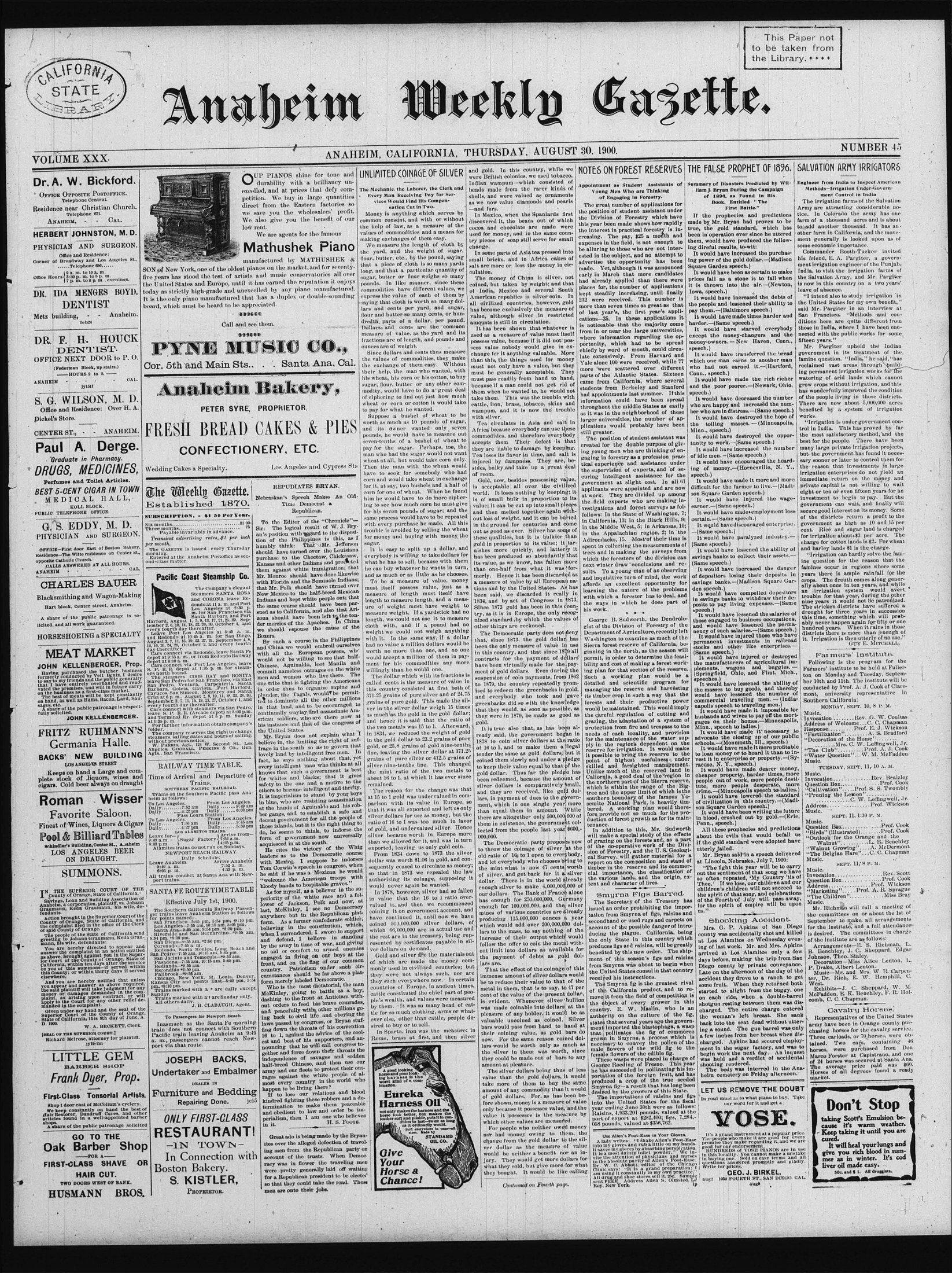
Searchable text
CALIFORNIA
STATE
LIBRARY
Anaheim
VOLUME XXX.
Dr. A. W. Bickford.
OFFICE OPPOSITE POSTOFFICE.
Telephone Central.
Residence near Christian Church.
Telephone 671.
ANAHEIM, - CAL.
HERBERT JOHNSTON, M. D.
PHYSICIAN AND SURGEON.
Office and Residence:
Corner of Broadway and Los Angeles St..
...Telephone 656....
Office Hours
9 a.m. to 10 a.m.
3:30 p.m. to 5 p.m.
7 p.m. to 8 p.m., evenings.
DR. IDA MENGES BOYD.
DENTIST
Metz building, - Anaheim.
feb24
DR. F. H. HOUCK
DENTIST.
OFFICE NEXT DOOR to P. O.
(Federman Block, up stairs.)
HOURS 9 to 5
ANAHEIM, - CAL.
jy154f
S. G. WILSON, M. D.
Office and Residence: Over H. A.
Dickel's Store.
CENTER ST., - ANAHEIM.
Paul A. Derge.
Graduate in Pharmacy.
DRUGS, MEDICINES,
UP PIANOS shine for tone and durability with a brilliancy unexcelled, and at prices that defy competition. We buy in large quantities direct from the Eastern factories so we save you the wholesalers' profit. We also give you the benefit of our low rent.
We are agents for the famous Mathushek Piano manufactured by MATHUSHEK & SON of New York, one of the oldest pianos on the market, and for seventy-five years has stood the test of artists and music conservatories all over the United States and Europe, until it has earned the reputation it enjoys today as strictly high-grade and unexcelled by any piano manufactured. It is the only piano manufactured that has a duplex or double-sounding board, which must be heard to be appreciated.
Call and see them.
PYNE MUSIC CO.,
Cor. 5th and Main Sts., Santa Ana, Cal.
Anaheim Bakery,
PETER SYRE, PROPRIETOR.
FRESH BREAD CAKES & PIES CONFECTIONERY, ETC.
Wedding Cakes a Specialty. Los Angeles and Cypress St.
Anaheim Bakery,
PETER SYRE, PROPRIETOR.
FRESH BREAD CAKES & PIES
CONFECTIONERY, ETC.
Wedding Cakes a Specialty.
Los Angeles and Cypress St.
The Weekly Gazette.
Established 1870.
SUBSCRIPTION. - $1 50 Per Year.
Six months. $1 00
Three months. 75
Payable invariably in advance.
Transient advertising rates, $1 per inch per month.
The GAZETTE is issued every Thursday morning.
Entered at the Anaheim Postoffice as second-class matter.
Pacific Coast Steamship Co.
The Company's elegant Steamers SANTA ROSA and CORONA leave Redondo at 11 a.m. and Port Los Angeles at 2:30 p.m. for San Francisco via Santa Barbara and Port Harford, August 1, 5, 9, 13, 17, 21, 25, 29, September 2, 6, 10, 14, 18, 22, 26, 30, October 4, and every fourth day thereafter.
Leave Port Los Angeles at 5:45 a.m. and Redondo at 10:45 a.m. for San Diego, August 1, 15, 19, 23, 27, 31, September 4, 8, 12, 16, 20, 24, 28, October 2, and every fourth day thereafter.
Cars connect via Redondo, leave Santa Fe depot at 9:55 a.m., or from Redondo Railway depot at 8:10 a.m.
Cars connect via Port Los Angeles, leave Santa F. Depot at 1:35 p.m. for steamers north bound.
The steamers COOS BAY and BONITA leave San Pedro for San Francisco, via East San Pedro, Ventura, Carpenteria, Santa Barbara, Goleta, Gaviota, Port Harford, Cayucos, San Simeon, Montevideo, Santa Cruz at 6 p.m., August 10, 14, 18, 22, 26, 30, September 4, 7, 11, 15, 19, 23, 27, October 1, and every fourth day thereafter.
Cars connect with steamers via San Pedro; leave S. P. R.R. (Arcade depot) at 8:03 p.m. and Terminal Ry. depot at 5 p.m. Sunday at 1:35 p.m.
For further information obtain company's folder.
The company reserves the right to change steamers, sailing dates and hours of sailing without previous notice.
W. PARRIS, Agt., 124 W. Second St., Los Angeles. Goodall. Perkins & Co., Gen. Agts., San Francisco.
RAILWAY TIME TABLE.
Time of Arrival and Departure of Trains.
SOUTHERN PACIFIC RAILROAD.
Trains on the Southern Pacific pass Anaheim as follows:
To Los Angeles. From Los Angeles.
Daily...7:52 a.m. Daily...9:49 a.m.
Daily...4:22 p.m. Daily...6:03 ppm
Pass Loa Station:
To Los Angeles. From Los Angeles.
Daily...7:56 a.m. Daily...9:45 a.m.
Daily...4:27 ppm Daily...5:89 ppm
LOS ALAMITOS TRAINS:
Leave for—
Sugar Factory Arrive from—
Sugar Factory Arrive from—
6:03 ppm
Alamitos trains do not run on Sundays.
NEWPORT BEACH RAILWAY.
Daily Schedule.
Leave Anaheim. Arrive Anaheim
9:49 a.m. ...7:52 a.m.
6:03 ppm ...4:23 ppm
All trains connect at Santa Ana with Newport trains.
SANTA FE ROUTE TIME TABLE
REPUDIATES BRYAN.
Nebraskan's Speech Makes An Old Time Democrat a Republican.
To the Editor of the "Chronicle"—Sir: The logical result of W. J. Bryan's position with regard to the disposition of the Philippines is this, as humble think: That Mr. Jefferson should have turned over the Louisiana purchase to the Choctaw, Chickasaw Kansas and other Indians and protect them against white immigration; thus Mr. Monroe should have done likewise with Florida and the Seminole Indians that Mr. Polk should have turned over New Mexico to the half-breed Mexican Indians and kept white people out; thus the same course should have been pursued as to California, and also that Arizona should have been left to the territories merces of the Apaches. In China we should espouse the cause of the Boxers.
By such a course in the Philippines and China we would embroil ourselves with all the European powers who would not be willing to see thatahl Chinese, Agninaldo, loot Manila and commit nameless outrages on the whiten men and women who live there. The one tribe that is fighting the American in order thus to organize rapine and plunder the Tagals would be permitted to dominate all the other million in that land, and to be encouraged in continually waylay and assassinate American soldiers who are there now his instance and that of the congress of the United States.
Mr. Bryan does not explain what believe in, the limiting right of self defence in the south so as to govern the lovely land by intelligent free men fact, he says nothing about that; yet every intelligent man who thinks at knows that such a government is best for whites and blacks; that it gives safety to the one and a motive to teach others to become intelligent and thrift. It is imperialism to stand by your boots in blue, who are resisting assassination at the hands of Agninaldo and his rober gangs, and to establish a safe decent government for all the peoples those islands, but it is the right thing do he seems to think, to indorse the form of government now universally acquiesced in at the south.
He cites the victory of the WH leaders as to the Democratic counse with Mexico. I suppose he indorse Tom Corwin's speech in congress, which he said if he was a Mexican he wrote "welcome the American troops willy bloody hands to hospitable graves."
As for myself, as a believer in the superiority of the white race and a
Roman Wisser
Favorite Saloon.
Finest of Wines, Liquors & Cigars
Pool & Billiard Tables
Schindler's Building, Center St., Aalheim
LOS ANGELES BEER ON DRAUGHT.
SUMMONS.
IN THE SUPERIOR COURT OF THE County of Orange, State of California,
Savings, Loan and Building Association of Anaheim, a corporation, plaintiff vs. Johann Graumann, Keda Graumann, his wife, defendants.
Action brought in the Superior Court of the County of Orange, State of California, and the complaint filed in the office of the Clerk of said County of Orange.
The people of the State of California send greeting to Johann Graumann, Keda Graumann, his wife, defendants;
You are hereby directed to appear and answer the complaint in an action entitled as above, brought against you in the Superior Court of the County of Orange, State of California, within ten days after the service on you of this summons—if served within this County; or within thirty days if served elsewhere.
And you are hereby notified that unless you appear and answer as above required, the said plaintiff will take judgment for any money or damages demanded in the complaint, or will apply to the Court for any other relief demanded in the complaint.
Given under my hand and the seal of the Superior Court of the County of Orange, State of California, this 8th day of June, A.D. 1900.
W. A. BECKETT, Clerk.
[SEAL OF THE SUPERIOR COURT:]
Richard Melrose, attorney for plaintiff.
LITTLE GEM
BARBER SHOP
Frank Dyer, Prop.
First-Class Tonsorial Artists.
Shop 1 door east of McCollum’s cyclery.
We keep constantly on hand the best of hair Restorer, Dandruff Cures, and other articles found in a well-appointed barber shops.
A share of the public patronage solicited
GO TO THE Oak Barber Shop
FOR A FIRST-CLASS SHAVE OR HAIR CUT.
TWO DOORS WEST OF BANK.
HUSMANN BROS.
TO Los Angeles
Daily...7:52 am Daily...9:49 am
Daily...4:22 pm Daily...6:03 pm
Pass Loara Station:
To Los Angeles
Daily...7:56 am Daily...9:45 am
Daily...4:27 pm Daily...5:59 pm
Los ALAMITOS TRAINS.
Leave for—Sugar Factory 7:52 a.m. 4:25 p.m.
6:03 p.m.
Alamitos trains do not run on Sundays.
NEWPORT BEACH KAILWAY.
Daily Schedule.
Leave Anaheim. Arrive Anaheim 9:49 a.m. 7:52 a.m. 6:03 p.m.
All trains connect at Santa Ana with Newport trains.
SANTA FE ROUTE TIMETABLE
Effective July 1st, 1900.
The Southern California Railway Passenger trains leave Anaheim Station as follows for points named:
San Francisco—5:05 pm, 5:54 pm, 18:10 pm.
Los Angeles—7:55 am, 10:15 am, 5:05 pm.
Santa Ana—9:55 am, 5:54 pm, 2:50 pm.
Riverside and San Bernardino—9:55 am, 5:54 pm, 18:10 pm.
San Diego—9:55 am, *2:50 pm.
Coronado—7:55 a.m.
Redondo, Santa Monica, Long Beach and San Pedro—7:55 am, 10:15 am, 5:05 pm.
San Jacinto and Temecula—*9:55 am.
Pasadena—7:55 am, 10:15 am, 5:05 pm.
Redlands—9:55 am
Escondido*2:50 pm.
Fallbrook—9:55 am.
Chicago, New York, St. Louis, Denver, Kansas City and points East—5:05 pm, 5:54 pm, 18:10 pm.
Trains marked with a * are daily except Sunday.
Trains marked with a † are Sunday only.
All others daily.
To Passengers for Newport Beach.
Inasmuch as the Santa Fe morning train does not connect with Southern Pacific train leaving Anaheim at 9:49 a.m., passengers cannot reach Newport via that route.
JOSEPH BACKS,
Undertaker and Embalmer
DEALER IN
Furniture and Bedding Repairing Done. jel5
ONLY FIRST-CLASS RESTAURANT!
-IN TOWNIn Connection with Boston Bakery.
S. KISTLER,
PROPRIETOR.
in blue, who are resisting assassination at the hands of Aguinaldo and his rober gangs, and to establish a safe decent government for all the people those islands, but it is the right thing to do, he seems to think, to indorse the form of government now universally acquiesced in at the south.
He cites the victory of the White leaders as to the Democratic countrie with Mexico. I suppose he indorse Tom Corwin’s speech in congress, whahe said if he was a Mexican he wore “welcome the American troops we bloody hands to hospitable graves.”
As for myself, as a believer in the superiority of the white race and a lower of Jackson, Polk and now last, McKinley, I see no Democrat anywhere but in the Republican party. As a former confederate soldier believing in the constitution, while when I surrendered, I swore to support and defend. I believe in stand by the army in time of war, and give no aid or comfort to armed enemies engaged in firing on our boys at front, and on the flag of our country. Patriotism under such circumstances should be far above a person merely labeled Democratic.
Who is the most dictatorial, the McKinley, going to battle as a bashing to the front at Antietam while out orders to feed his brave comrade and peacefully with other millions being back to civil life and obeying laws passed by congress, or Bryan saying down the throats of his convent 16 to 1, against the advice of the oest and best of his supporters, and nouncing that he will call congress together and force down their throats independence of savages and sodds half-breed Chinese, and then use army and our fleets to protect their rages against the white people of most every country in the world happen to be living there?
If to lose our relations and kindred fighting these robbers and a termination to make them peaceful and obedient to law and order be imperialism, then I am one who believes in it.
H. S. Footer
Heim Weekly Gazette
ANAHEIM, CALIFORNIA, THURSDAY, AUGUST 30, 1900.
UNLIMITED COINAGE OF SILVER
The Mechanic, the Laborer, the Clerk and Every Man Receiving Pay for Services Would Find His Compensation Cut in Two.
Money is anything which serves by common consent, and with or without the help of law, as a measure of the values of commodities and a means for making exchanges of them easy.
We measure the length of cloth by the yard, and the weight of sugar, flour, butter, etc., by the pound, saying that a piece of cloth is so many yards long, and that a particular quantity of sugar, butter or flour weighs so many pounds. In like manner, since these commodities have different values, we express the value of each of them by saying that cloth is worth so many dollars and cents per yard, and sugar, flour and butter so many cents, or hundredth parts of a dollar, per pound. Dollars and cents are the common measure of value, as the yard and its fractions are of length, and pounds and ounces are of weight.
Since dollars and cents thus measure the values of commodities, they make the exchange of them easy. Without their help, the man who wanted, with his wheat, his corn or his cotton, to buy sugar, flour, butter or any other commodity, would have to do a great deal of ciphering to find out just how much wheat or corn or cotton it would take to pay for what he wanted.
Suppose a bushel of wheat to be worth as much as 10 pounds of sugar, and its owner wanted only seven pounds, he would have to measure out seven-tenths of a bushel of wheat to pay for the sugar. Perhaps, too, the man who had the sugar would not want wheat at all, but would take corn only. Then the man with the wheat would have to seek for somebody who had gold. In this country, while we were British colonies, we used tobacco, Indian wampum—which consisted of beads made from the rarer kinds of shells, and were valued as ornaments as we now value diamonds and pearls—and furs.
In Mexico, when the Spaniards first discovered it, the beans out of which cocoa and chocolate are made were used for money, and in the same country pieces of soap still serve for small change.
In some parts of Asia tea pressed into small bricks, and in Africa cakes of salt are more or less the money in circulation.
The money of China is silver, not coined, but taken by weight; and that of India, Mexico and several South American republics is silver coin. In all civilized countries, however, gold has become exclusively the measure of value, although silver in restricted amounts is still in circulation.
It has been shown that whatever is used as a measure of value must itself possess value because if it did not possess value nobody would give in exchange for it anything valuable. More than this, the things used for money must not only have a value, but they must be generally acceptable. They must pass readily from hand to hand, because if a man could not get rid of them when he wanted to, he would not take them. This was the trouble with cattle, iron, brass, tobacco, skins and wampum, and it is now the trouble with silver.
Tea circulates in Asia and salt in Africa because everybody can use these commodities, and therefore everybody accepts them. Their defect is that they are liable to damage by keeping. Tea loses its flavor in time, and salt is injured by dampness. They are besides bulky and take up a great deal of room.
NOTES ON FOREST RESERVE
Appointment as Student Assistants Young Men Who are Thinking of Engaging in Forestry.
The great number of applications the position of student assistant under the Division of Forestry which has this year been made shows how rapidly interest in practical forestry is creasing. The pay, $25 a month expenses in the field, is not enough be alluring to those who are not interested in the subject, and no attempt advertise the opportunity has been made. Yet, although it was announced early in March that more candidates had already applied than there were places for, the number of applicants kept steadily increasing, until financed were received. This number more than seven times as great as that of last year's, the first year's applications—35. In these applications is noticeable that the majority come from in or near the large university where information regarding their portunity, which had to be spared chiefly by word of mouth, could close extensively. From Harvard Yale alone 100 were received, while more were scattered over different parts of the Atlantic States. Six came from California, where seven students from Berkeley and Stanford had appointments last summer. If information could have been spread throughout the middle States as easily as it was in the neighborhood of larger universities, the number of applications would probably have been still greater.
The position of student assistant created for the double purpose of ing young men who are thinking of gaging in forestry as a profession typical experience and assistance u
Bakery,
Makes & Pies
Y, ETC.
Los Angeles and Cypress Sts
EPUDIATES BRYAN.
Man's Speech Makes An OldTime Democrat a Republican.
The Editor of the "Chronicle"—the logical result of W. J. Bryton with regard to the disposition of the Philippines is this, as I think: That Mr. Jefferson have turned over the Louisiana to the Choctaw, Chickasaw, and other Indians and protected against white immigration; that tree should have done likewise Frida and the Seminole Indians; Polk should have turned over Mexico to the half-breed Mexican and kept white people out; that course should have been purified California, and also that Arizona would have been left to the tenies of the Apaches. In China old espouse the cause of the such a course in the Philippines we would embroil ourselves in the European powers, who not be willing to see that half-Anginaldo, loot Manila and nameless outrages on the white women who live there. The idea that is fighting the Americans thus to organize rapine and the Tagals, would be permitimate all the other millions land, and to be encouraged to truly waylay and assassinate Amor officers, who are there now at once and that of the congress of United States.
Bryton does not explain what I mean, the limiting right of suffrage so as to govern that by intelligent free men. In says nothing about that, yet intelligent man who thinks at all that such a government is best blacks and whites; that it gives to the one and a motive to the become intelligent and thrifty. Imperialism to stand by your boys who are resisting assassination bands of Aguinaldo and his robbers, and to establish a safe and government for all the people of lands, but it is the right thing to seem to think, to indorse the self-government now universally used in at the south.
Ittes the victory of the Whig as to the Democratic course Mexico. I suppose he indores Marwin's speech in congress, when if he was a Mexican he would name the American troops with hands to hospitable graves."
For myself, as a believer in the suity of the white race and a folly of the race and a folly of the race and a folly of the race and a folly of the race and a folly of the race and a folly of the race and a folly of the race and a folly of the race and a folly of the race and a folly of the race and a folly of the race and a folly of the race and a folly of the race and a folly of the race and a folly of the race and a folly of the race and a folly of the race and a folly of the race and a folly of the race and a folly of the race and a folly of the race and a folly of the race and a folly of the race and a folly of the race and a folly of the race and a folly of the race and a folly of the race and a folly of the race and a folly of the race and a folly of the race and a folly of the race and a folly of the race and a folly of the race and a folly of the race and a folly of the race and a folly of the race and a follyness.
Suppose a bushel of wheat to be worth as much as 10 pounds of sugar, and its owner wanted only seven pounds, he would have to measure out seven-tenths of a bushel of wheat to pay for the sugar. Perhaps, too, the man who had the sugar would not want wheat at all, but would take corn only. Then the man with the wheat would have to seek for somebody who had corn and would take wheat in exchange for it, at say, two bushels and a half of corn for one of wheat. When he found him he would have to do more ciphering to see how much corn he must give for his seven pounds of sugar; and the same process would have to be repeated with every purchase he made. All this trouble is avoided by selling the wheat for money and buying with money, the sugar.
It is easy to split up a dollar, and everybody is willing to take dollars for what he has to sell, because with them he can buy whatever he wants in turn, and as much or as little as he chooses.
To be a measure of value, money must itself possess value, just as a measure of length must itself have length to measure length, and a measure of weight must have weight to measure weight. If a yardstick had no length, we could not use it to measure cloth with, and if a pound had no weight we could not weigh anything with it. In the same way, if a dollar had no value a million dollars would be worth no more than one, and no one would accept a million of them in payment for his commodities any more willingly than he would one.
The dollar which with its fractions is called cents is the measure of value in this country consisted at first both of 371.25 grains of pure silver and of 24.75 grains of pure gold. This made the silver in the silver dollar weigh 15 times as much as the gold in the gold dollar; and hence it is said that the ratio of the two metals was 15 to 1. Afterward, in 1834, we reduced the weight of gold in the gold dollar to 23.2 grains of pure gold, or 25.8 grains of gold nine-tenths fine, leaving the silver dollar at 371.25 grains of pure silver or 412.5 grains of silver nine-tenths fine. This changed the mint ratio of the two metals to about 16 to 1, at which it has ever since remained.
The reason for the change was that at 15 to 1 gold was undervalued in comparison with its value in Europe, so that it was all exported and left us only silver dollars for use as money, but the ratio of 16 to 1 was too much in favor of gold, and undervalued silver. Hence silver became worth in Europe more than we allowed for it, and was in turn exported, leaving us only gold coin.
From 1834 down to 1873 the silver dollar was worth $1.06 in gold, and consequently ceased to circulate as money; so that in 1873 we repealed the law authorizing its coinage, supposing it would never again be wanted.
In 1878, however, silver had so fallen in value that the 16 to 1 ratio over his wheat, his corn or his cotton, to buy sugar, flour, butter or any other commodity, would have to do a great deal of ciphering to find out just how much wheat or corn or cotton it would take to pay for what he wanted.
Suppose a bushel of wheat to be worth as much as 10 pounds of sugar, and its owner wanted only seven pounds, he would have to measure out seven-tenths of a bushel of wheat to pay for the sugar. Perhaps, too, the man who had the sugar would have to be repeated with every purchase he made. All this trouble is avoided by selling the wheat for money and buying with money, the sugar.
It is easy to split up a dollar, and everybody is willing to take dollars for what he has to sell, because with them he would have to do more ciphering to see how much corn he must give for his seven pounds of sugar; and the same process would have to be repeated with every purchase he made. All this trouble is avoided by selling the wheat for money and buying with money, the sugar.
It is easy to split up a dollar, and everybody is willing to take dollars for what he has to sell, because with them he would have to do more ciphering to see how much corn he must give for his seven pounds of sugar; and the same process would have to be repeated with every purchase he made. All this trouble is avoided by selling the wheat for money and buying with money, the sugar.
It is easy to split up a dollar, and everybody is willing to take dollars for what he has to sell, because with them he would have to do more ciphering to see how much corn he must give for his seven pounds of sugar; and the same process would have to be repeated with every purchase he made. All this trouble is avoided by selling the wheat for money and buying with money, the sugar.
It is easy to split up a dollar, and everybody is willing to take dollars for what he has to sell, because with them he would have to do more ciphering to see how much corn he must give for his seven pounds of sugar; and
who are resisting assassination
bands of Aguinaldo and his robings, and to establish a safe and
government for all the people of
Islands, but it is the right thing to
seems to think, to indorse the
of government now universally
peaced in at the south.
States the victory of the Whig
as to the Democratic course
Mexico. I suppose he indorses
Corwin's speech in congress, when
if he was a Mexican he would
name the American troops with
hands to hospitable graves."
I myself, as a believer in the suy of the white race and a follof Jackson, Polk and now, at
McKinley, I see no Democracy
but in the Republican platter. As a former confederate soldier,
lug in the constitution, which,
surrendered, I swore to support
defend, I believe in standing
army in time of war, and giving
or comfort to armed enemies
and in firing on our boys at the
land on the flag of our common
mercy. Patriotism under such circumstances should be far above a platterly labeled Democratic.
The most dictatorial, the man
heley, going to battle as a boy,
giving to the front at Antietam withtog to feed his brave comrades,
peacefully with other millions gock to civil life and obeying the
passed by congress, or Bryan stuffwn the throats of his convention
al, against the advice of the coolbest of his supporters, and anning that he will call congress to
and force down their throats the
inducement of savages and sodden
treed Chinese, and then use our
and our fleets to protect their outagainst the white people of allevery country in the world who
can be living there?
To lose our relations and blood
and fighting these robbers and a delation to make them peaceable
pedient to law and order be imsmert, then I am one who believes
H. S. FOOTE.
What ado is being made by the Bryanover the alleged defection of travelmen from the Republican party on
out of the trusts. When Democus in flower the traveling men
pretty generally laid off waiting
Republican president to be elected
that they could take the road. Those
are onto their jobs.
Give Your Horse a Chance!
Continued on Fourth page.
Gazette.
1900. NUMBER 45
ON FOREST RESERVES
Summary of Disasters Predicted by William J. Bryan During the Campaign of 1896, as Found in His Book, Entitled "The First Battle."
If the prophecies and predictions made by Mr. Bryan had proven to be true, the gold standard, which has been in operation ever since he uttered them, would have produced the following direful results, to-wit:
It would have increased the purchasing power of the gold dollar.—(Madison Square Garden speech.)
It would have been as certain to make prices fall as a stone is to fall when it is thrown into the air.—(Newton, Iowa, speech.)
It would have increased the debts of the people and lessened their ability to pay them.—(Baltimore speech.)
It would have made times harder and harder.—(Same speech.)
It would have starved everybody except the money-changers and the money-owners. — New Haven, Conn., speech.)
It would have transferred the bread which one man earns to another man who had not earned it.—(Hartford, Conn., speech.)
It would have made the rich richer and the poor poorer.—(Newark, Ohio, speech.)
It would have decreased the number who are happy and increased the number who are in distress.—(Same speech.)
It would have destroyed the hope of the toiling masses. — (Minneapolis, Minn., speech.)
It would have destroyed the opportunity to work.—(Same speech.)
It would have increased the number of idle men.—(Same speech.)
It would have encouraged the hoarding of money.—(Hornesville, N.Y., speech.)
SALVATION ARMY IRRIGATORS
Engineer from India to Inspect American Methods—Irrigation Under-Government Control in India
The irrigation farms of the Salvation Army are attracting considerable notice. In Colorado the army has one farm of a thousand acres and is about to add another thousand. It has another farm in California, and the movement generally is looked upon as of some economic importance.
Commander Booth-Tucker invited his friend, E. A. Pargiter, a government irrigation engineer of the Punjab, India, to visit the irrigation farms of the Salvation Army, and Mr. Pargiter is now in this country on a two years' leave of absence.
"I intend also to study irrigation in the United States for my own benefit," said Mr. Pargiter in an interview at San Francisco. "Methods and conditions here are quite different from those in India, where I have been connected with the public works for some fifteen years."
Mr. Pargiter upheld the Indian government in its treatment of the famine question. "India," he said, "has reclaimed vast areas through building permanent irrigation works for the watering of arid lands which cannot grow crops without irrigation, and this has wonderfully improved the condition of the people living in those districts. There are now about 5,000,000 acres benefited by a system of irrigation works."
"Irrigation is under government control in India. This has proved by far the most satisfactory method, and the best for the people. There have been many large private irrigation projects, but the government has found it necessary sooner or later to control them for the reason that investments in large irrigation enterprises do not yield an
It would have made the rich richer and the poor poorer.—(Newark, Ohio, speech.)
It would have decreased the number who are happy and increased the number who are in distress.—(Same speech.)
It would have destroyed the hope of the toiling masses.—(Minneapolis, Minn., speech.)
It would have destroyed the opportunity to work.—(Same speech.)
It would have increased the number of idle men.—(Same speech.)
It would have encouraged the hoarding of money.—(Hornesville, N. Y., speech.)
It would have made it more and more difficult for the farmer to live.—(Madison Square Garden speech.)
It would have injured the wage earner.—(Same speech.)
It would have made employment less certain.—(Same speech.)
It would have discouraged enterprise.—(Same speech.)
It would have paralyzed industry.—(Same speech.)
It would have lessened the ability of savings banks to collect their assets.—(Same speech.)
It would have increased the danger of depositors losing their deposits in savings banks.—(Madison Square Garden speech.)
It would have compelled depositors in savings banks to withdraw their deposits to pay living expenses.—(Same speech.)
It would have lessened the salaries of those engaged in business occupations, and would have lessened the permanency of such salaries.—(Same speech.)
It would have injured those who have permanent investments in railroad stocks and other like enterprises.—(Same speech.)
It would have injured or destroyed the manufacturers of agricultural implements, wagons and buggies.—(Springfield, Ohio, and Flint, Mich., speeches.)
It would have lessened the ability of the masses to buy goods, and thereby would have lessened the number of commercial traveling men.—(Indianapolis speech to traveling men.)
It would have made it impossible for husbands and wives to pay off the mortgages on their homes.—Minneapolis, Minn., speech to ladies.)
It would have made it necessary to advocate the closing up of our public schools.—Monmouth, Ill., speech.)
It would have made it more profitable to loan money or to hoard it than to invest it in enterprise or property.—(Syracuse, N. Y., speech.)
It would have made dearer money, cheaper property, harder times, more people out of work, more people destitute, more people desperate, more crime.—(Minneapolis speech to ladies.)
It would lowered the standard of civilization in this country.—(Madison Square Garden speech.)
It would have been writing the future in blood, crushed out by gold.—(Erie, Penn., speech.)
All these prophecies and predictions about the evils that would befall us if the gold standard were adopted have utterly failed.
Mr. Bryan said in a speech delivered at Lincoln, Nebraska, July 7, 1900:
"The fight this year will be to carry out the sentiment of that song we have so often repeated, 'My Country 'tis of Thee.' If we lose our children and our children's children will not succeed to the spirit of that song, and celebrations of the Fourth of July will pass away.
watering of arid lands which cannot grow crops without irrigation, and this has wonderfully improved the condition of the people living in those districts. There are now about 5,000,000 acres benefited by a system of irrigation works.
"Irrigation is under government control in India. This has proved by far the most satisfactory method, and the best for the people. There have been many large private irrigation projects, but the government has found it necessary sooner or later to control them for the reason that investments in large irrigation enterprises do not yield an immediate return on the money and private capital is not willing to wait eight or ten or even fifteen years for an investment to begin to pay. But the government can wait, and finally will secure good interest on its money. Some of the districts return a profit to the government as high as 10 and 15 per cent. Rice and sugar land is charged for irrigation about $3 per acre. The charge for cotton lands is $2. For wheat and barley lands $1 is the charge."
"Irrigation can hardly solve the famine question for the reason that the famines occur in regions where some years there is ample rainfall for the crops. The drought comes along generally about once in ten years, and while an irrigation system would avert trouble for that year, during the other nine years it would not be patronized. The stricken districts have suffered a drought for three years in succession this time, something which will probably never happen again for fifty or one hundred years. When it rains in those districts there is more than enough of it. Irrigation is then utterly no use."
Smyrna Figs Barred.
The Secretary of the Treasury has issued an order prohibiting the importation from Smyrna of figs, raisins and woodhand or used rugs and carpets on account of the possible danger of introducing the plague. California, being the only State in this country which produces figs and raisins, will be greatly benefited by this new order. The shipment of this season's figs and raisins from Smyrna was about to begin when the United States consul in that country received his instructions.
The Smyrna fig is the greatest rival to the California product, and to receive it from the field of competition is the object of every grower in this country. E. W. Maslin, who is an authority on the culture of the fig, states that several years ago the government imported the blastophaga, a wasp that pollinates the fig of commerce grown in Smyrna, a process which is necessary to convey the pollen of the male flowers of the wild fig to the female flowers of the edible fig.
These wasps were placed in charge of George Roeding of Fresno. This year he succeeded in pollinating his importation of the foreign fruit, and has produced a crop of the true seeded Smyrna fig—a result that has long been desired by the growers of this State.
The importations of raisins and figs into the United States for the fiscal year ending June 30th were as follows: raisins, 4,933,201 pounds, valued at the port of export at $282,400; figs, 7,284,-188 pounds, valued at $356,762.
Use Allen's Foot-Ease in Your Gloves.
A lady writes: "I shake Allen's Foot-Ease to my gloves and rub a little on my hands. Save my gloves by absorbing perspiration, is a most dainty toilet powder." We invite the attention of physicians and nurses the absolute purity of Allen's Foot-Ease. Dr. W. C. Abbott, editor of the Chicago Clinic says: "It is a grand preparation; I am using it constantly in my own practice."
All drug and shoe stores sell it, 25c. Sample sent FREE. Address Allen S. Olmsted, Leoy, New York.
LET US REMOVE THE DOUBT
In your mind as to what plano to buy. Take our word for it and get a
VOSE.
It's a grand instrument at a popular price.
The people who make it are good for every promise they make regarding it, and we are good for our endorsement.
HUNDREDS of VOSE PIANOS are in use in locality. You cannot make a mistake in buying one. Sold on easy terms and all questions answered promptly and gladly. Write for prices.
GEO. J. BIRKEL,
aug2 1050 FOURTH ST., SAN DIEGO, CA.
SEPT. 11, 1:30 P.M.
Music.
Question Box... Prof. Cook
"Birds" (illustrated)... Prof. Cook
"Outlook for the Orange and the Walnut"... L. B. Benchley
"Walnut Growing"... A. McDermont
"The Belgian Hare"... C. C. Chapman Music.
SEPT. 11, 8 P.M.
Music.
Invocation... Rev. Scott
Question Box... Prof. Cook
Address... Prof. Wickson
"Marketing"... Prof. A. R. Sprague
"The Children"... Miss Bray Music.
Mr. Richman will call a meeting of the committees on or about the 1st of September to make all arrangements for the institute, and a full attendance is desired. The committees in charge of the institute are as follows:
Arrangements—E. S. Richman, L. B. Benchley, J. C. Sheppard, Edgar Johnson, Theo Staley.
Decoration—Miss Alice Lenton, L. P. Drake, Albert Lenton.
Music—Mr. and Mrs. W.R.Carpenter, Dr. Rich, E.W.Hemphill, C.West.
Exhibits—J.C.Sheppard,W.M.CFadden,E.K.Benchley,F.R.Holcomb,C.CChapman.
Cavalry Horses;
Representatives of the United States army have been in Orange county purchasing horses for the cavalry service.
Three carloads, or 70 horses, were obtained. Two cars, containing 46 horses, were purchased from Don Marco Forster at Capistrano, and one of 24 horses was secured at Santa Ana.
The average price paid was $60. Horses of all degrees found a ready market.
Don't Stop taking Scott's Emulsion because it's warm weather. Keep taking it until you are cured.
It will heal your lungs and give you rich blood in summer as in winter. It's cod liver oil made easy.
50c. and $1. All druggists.