anaheim-gazette 1900-07-26
Scanned page
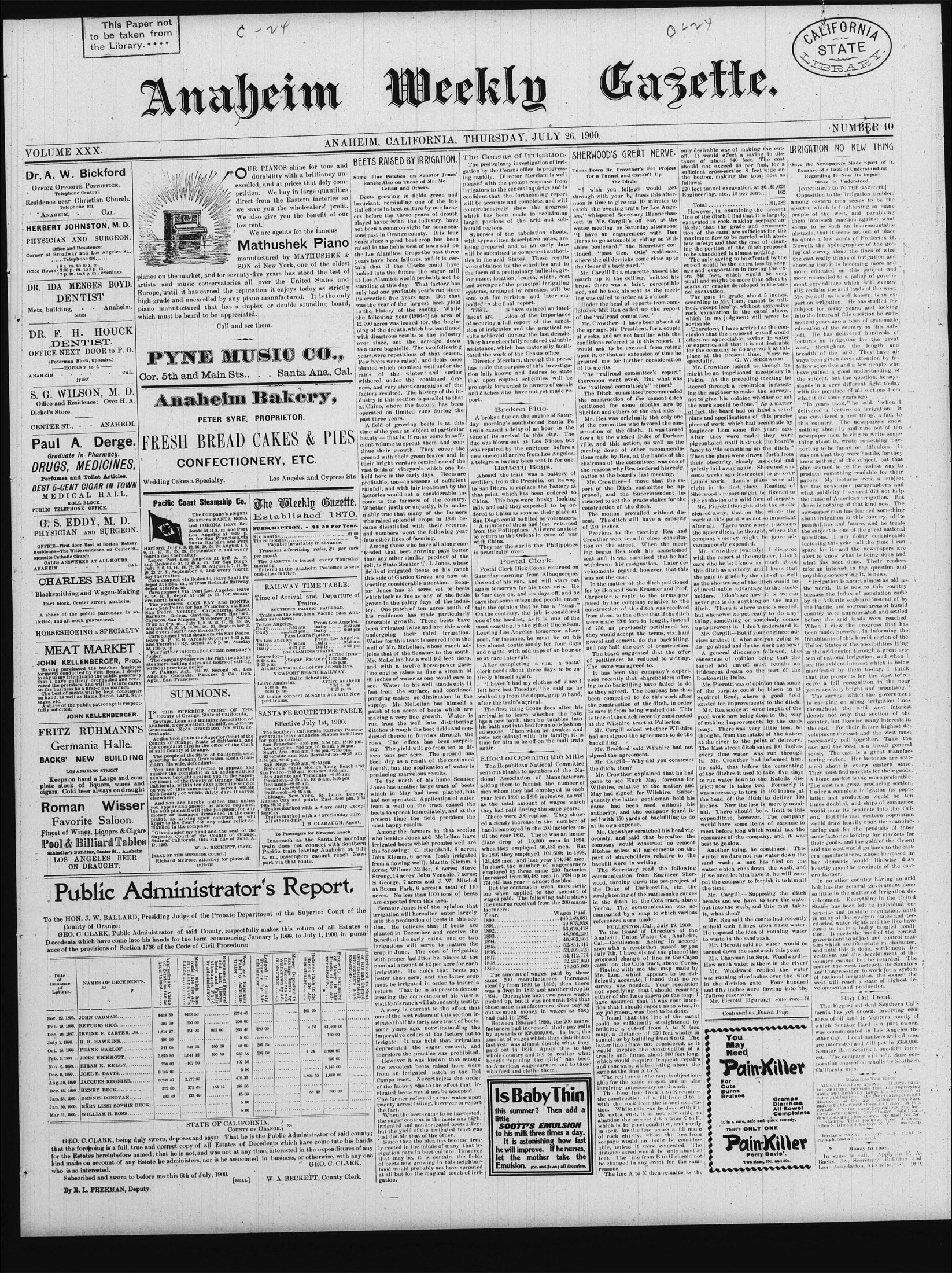
Searchable text
This Paper not to be taken from the Library.
Anaheim
VOLUME XXX.
Dr. A. W. Bickford
Office Opposite Postoffice.
Telephone Central.
Residence near Christian Church.
Telephone 671.
ANAHEIM, CAL.
HERBERT JOHNSTON, M. D.
PHYSICIAN AND SURGEON.
Office and Residence:
Corner of Broadway and Los Angeles St..
Telephone 656...
9 a.m. to 10 a.m.
3:30 p.m. to 5 p.m.
7 p.m. to 8 p.m., evenings.
DR. IDA MENGES BOYD.
DENTIST
Metz building, Anaheim.
feb24
DR. F. H. HOUCK
DENTIST.
OFFICE NEXT DOOR to P. O.
(Federman Block, up stairs.)
HOURS 9 to 5
ANAHEIM, CAL.
S. G. WILSON, M. D.
Office and Residence: Over H. A. Dickel's Store.
CENTER ST., ANAHEIM.
Paul A. Derge.
Graduate in Pharmacy.
DRUGS, MEDICINES,
OUR PIANOS shine for tone and durability with a brilliancy unexcelled, and at prices that defy competition. We buy in large quantities direct from the Eastern factories so we save you the wholesalers' profit. We also give you the benefit of our low rent.
We are agents for the famous Mathushek Piano manufactured by MATHUSHEK & SON of New York, one of the oldest pianos on the market, and for seventy-five years has stood the test of artists and music conservatories all over the United States and Europe, until it has earned the reputation it enjoys today as strictly high grade and unexcelled by any piano manufactured. It is the only piano manufactured that has a duplex or double sounding board, which must be heard to be appreciated.
Call and see them.
PYNE MUSIC CO.,
Cor. 5th and Main Sts., Santa Ana, Cal.
Anaheim Bakery,
PETER SYRE, PROPRIETOR.
FRESH BREAD CAKES & PIES
CONFECTIONERY, ETC.
S. G. WILSON, M. D.
Office and Residence: Over H. A. Dickel's Store.
CENTER ST., - ANAHEIM.
Paul A. Derge.
Graduate in Pharmacy.
DRUGS, MEDICINES,
Perfumes and Toilet Articles.
BEST 5-GENT CIGAR IN TOWN
MEDICAL HALL,
KOLL BLOCK.
PUBLIC TELEPHONE OFFICE.
G. S. EDDY, M. D.
PHYSICIAN AND SURGEON.
OFFICE—First door East of Boston Bakery,
Residence—The Witte residence on Center St.,
opposite Catholic Church.
CALLS ANSWERED AT ALL HOURS.
ANAHEIM - CAL.
CHARLES BAUER
Blacksmithing and Wagon-Making
Hart block, Center street, Anaheim.
A share of the public patronage is solicited, and all work guaranteed.
HORSESHOEING a SPECIALTY
MEAT MARKET
JOHN KELLENBERGER, Prop.
Having purchased the butcher business formerly conducted by Velt Bentz, I desire to say to my friends and the public generally that I have entirely overhailed and renovated the premises, and will in future carry on the business as a first-class market.
The best of meats will be kept constantly on hand, as well as Hams, Bacon, Lard, Sau-sages, etc.
A share of the public patronage is respectfully solicited.
JOHN KELLENBERGER.
FRITZ RUHMANN'S
Germania Halle.
BACKS' NEW BUILDING
LOS ANGELES STREET
Keeps on hand a Large and complete stock of liquors, wines and cigars. Cold beer always on draught
Roman Wisser
Favorite Saloon.
Finest of Wines, Liquors & Cigars
Pool & Billiard Tables
Schindler's Building, Center St., Anaheim
LOS ANGELES BEER ON DRAUGHT.
Pacific Coast Steamship Co.
The Company's elegant Steamers SANTA ROSA and CORONA leave Redondo at 11 a.m. and Port Los Angeles at 2:30 p.m. for San Francisco, via Santa Barbara and Port Harford. July 4, 8, 12, 16, 20, 24, 28 August 1, 5, 9, 13, 17, 21, 25, 29 September 2, and every fourth day thereafter.
Leave Port Los Angeles at 5:45 a.m. and Redondo at 10:45 a.m. for San Diego. July 2, 6, 10, 14, 18, 22, 20, 30 August 3, 7, 11, 15, 19, 23, 26, 30 September 4, and every fourth day thereafter.
Cars connect via Redondo, leave Santa Fe depot at 9:55 a.m., or from Redondo Railway depot at 8:10 a.m.
Cars connect via Port Los Angeles, leave S. P. R.R. depot at 1:35 p.m. for steamers north bound.
The steamers COOSE BAY and BONITA leave San Pedro for San Francisco, via East San Pedro. Ventura, Carpenteria, Santa Barbara, Goleta, Gaviota, Port Harford, Cayucos, San Simeon, Monterey and Santa Cruz at 6 p.m., July 1, 9, 13, 17, 21, 25, 29 August 2, 6, 10, 14, 18, 22, 26, 30 September 3, and fourth day thereafter.
Cars connect with steamers via San Pedro leave S. P. R.R. (Arcade depot) at 5:08 p.m. and Terminal Ry. depot at 5 p.m. Sunday at 1:35 p.m.
For further information obtain company's folder.
The company reserves the right to change steamers, sailing dates and hours of sailing without previous notice.
W. PARKIS, Agt., 124 W. Second St., Los Angeles. GOODALL PERKINS & Co., Gen. Agts., San Francisco.
SUMMONS.
IN THE SUPERIOR COURT OF THE County of Orange, State of California.
Savings, Loan and Building Association of Anaheim, a corporation, plaintiff vs. Johann Graumann, Keda Graumann, his wife, defendants.
Action brought in the Superior Court of the County of Orange, State of California, and the complaint filed in the office of the Clerk of said County of Orange.
The people of the State of California send greeting to Johann Graumann, Keda Graumann, his wife, defendants:
You are hereby directed to appear and answer the complaint in an action entitled as above, brought against you in the Superior Court of the County of Orange, State of California, within ten days after the service on you of this summons if served within this county; or within thirty days if served elsewhere.
And you are hereby notified that unless you appear and answer as above required the said plaintiff will take judgment for any money or damages demanded in the complaint, as arising upon contract, or will apply to the Court for any other relief demanded in the complaint.
Given under my hand and the seal of the Superior Court of the County of Orange, State of California this 8th day of June A.D. 1900.
W. A. BECKETT, Clerk.
[SEAL OF THE SUPERIOR COURT.]
Richard Melrose, attorney for plaintiff.
jy19-2m
The Weekly Gazette
Established 1870
SUBSCRIPTION,- $150 Per Year
Six months....81
Three months....79
Payable invariably in advance.
Transient advertising rates,$1 per inch per month.
The GAZETTE is issued every Thursday morning.
Entered at the Anaheim Postoffice as second-class matter.
RAILWAY TIME TABLE.
Time of Arrival and Departure of Trains.
SOUTHERN PACIFIC RAILROAD.
Trains on the Southern Pacific pass Anaheim as follows:
To Los Angeles.
Daily.....7:55 am Daily.....9:49 am Daily.....4:23 pm Daily.....Daily.....Pass Loara Station:
To Los Angeles.
Daily.....7:56 am Daily.....9:45 am Daily.....4:27 pm Daily.....Daily.....Los ALAMITOS TRAINS:
Leave for...
9:49 a.m. Sugar Factory
7:52 a.m. 4:25 p.m.
Alamitos trains do not run on Sundays.
NEWPORT BEACH RAILWAY.
Daily Schedule:
Leave Anaheim
9:49 a.m
6:03 p.m
6:03 p.m
All trains connect at Santa Ana with No port trains.
SANTA FE ROUTE TIME TABLE
Effective July 1st, 1900.
The Southern California Railway Passenger trains leave Anaheim Station as follow for points named:
San Francisco...5:50 p.m. 5:54 p.m. 8:18 p.m.
Los Angeles...7:55 p.m. 10:15 p.m. 5:05 p.m.
Santa Ana...7:55 p.m. 10:15 p.m. 5:05 p.m.
Riverdale and San Bernardino...9:55 p.m. 5:54 p.m. 8:18 ppm.
San Diego...9:55 am.*2:50 ppm.
Redondo,Santa Monica,Long Beach
San Pedro...7:55 am.10:15 am.5:05 pm.
San Jacinto and Temecula...9:55 am.
Pasadena...7:55 am.10:15 am.5:05 pm.
Redondo...9:55 am.
Secondido*2:50 ppm.
Fallbrook*9:55 am.
Chicago.New YorkSt.LouisDenKansas CityandpointsEast-5:05pm,pm8:10pm.Trainsmarkedwitha*aredailyexSunday.Trainsmarkedwitha*aredailyonAllothersdaily.J.H.CLABAUGH,Agen
To Passengers for Newport Beach.
InasmuchastheSantaFemoretraindoesnotconnectwithSouthPacifictrainleavingAnaheimat.a.m.,passengerscannotreachNortheastportviathatroute.
Roman Wisser
Favorite Saloon.
Finest of Wines, Liquors & Cigars
Pool & Billiard Tables
Schindler's Building, Center St., Anaheim
LOS ANGELES BEER ON DRAUGHT.
And you are hereby notified that unless you appear and answer as above required, the said plaintiff will take judgment for any money or damages demanded in the complaint, as arising upon contract, or will apply to the Court for any other relief demanded in the complaint.
Given under my hand and the seal of the Superior Court of the County of Orange, State of California, this 8th day of June, A.D. 1900.
W. A. BECKETT, Clerk.
[SEAL OF THE SUPERIOR COURT.]
Richard Melrose, attorney for plaintiff.
To Passengers for Newport Beach.
Inasmuch as the Santa Fe more train does not connect with South Pacific train leaving Anaheim at a.m., passengers cannot reach Newport via that route.
Public Administrator's Report,
To the HON. J. W. BALLARD, Presiding Judge of the Probate Department of the Superior Court of the County of Orange:
GEO. C. CLARK, Public Administrator of said County, respectfully makes this return of all Decedents which have come into his hands for the term commencing January 1, 1900, to July 1, 1900, in pursuance of the provisions of Section 1786 of the Code of Civil Procedure:
Date of Issuance of Letters NAMES OF DECEDENTS Approximate Value of Estate as far as Ascertained... Money which has come into the Administrator's hands... Expenses of Puneral and Last Inness, Debts and Family Allowances Paid by Administrator... Fees and Expenses Paid by Administrator... Locked in County Treasury by Administrator... Money Deposited in Savings banks by the Decedents not Withdrawn by Administrator... Balance Cash in the Hands of the Administrator... Property Exclusive on Money in the Hands of the Administrator... Executors
Nov. 22, 1895. JOHN CADMAN..... $438 50
Feb. 19, 1896. REFUGIO RIOS.... 200 00
Dec. 10, 1897. IRVINE F. CARTER, Jr.... 1,814 97
July 1, 1898. H. H. HAWKINS.... 150 00
Oct. 18, 1898. FRANK BARLOF.... 341 05
Feb. 3, 1899. JOHN HICKMOTT.... 5,875 86
Nov. 6, 1899. HIRAM R. KELLY.... 750 00
Dec. 8, 1899. JOELE E. DAVIS.... 8,145 00
Aug. 10, 1899. JACQUES REGNIER.... 3,249 57
Dec. 15, 1899. HENRY BECK.... 372 68
Jan. 23, 1900. DENNIS DONOVAN.... 633 49
Jan. 30, 1900. MARY LISSI SOPHIE BECK.....
May 21, 1900. WILLIAM H. ROSS.... ...
STATE OF CALIFORNIA,
COUNTY OF ORANGE.
GEO. C. CLARK, being duly sworn, deposes and says: That he is the Public Administrator of said county that the foregoing is a full, true and correct copy of all Estates of Decedents which have come into his hands for the Estates hereinbefore named; that he is not, and was not at any time, interested in the expenditures made on account of any Estate he administers, nor is he associated in business, or otherwise, with anyone who is so interested.
Subscribed and sworn to before me this 6th of July, 1900.
[SEAL] W. A. BECKETT, County Clerk
By R. L. FREEMAN, Deputy.
ANAHEIM, CALIFORNIA, THURSDAY, JULY 26, 1900.
BEETS RAISED BY IRRIGATION.
Some Fine Patches on Senator Jones' Ranch; Also on Those of Mr. McLellan and Others.
Beets growing in fields green and luxuriant, reminding one of the initial efforts in beet culture by our farmers before the three years of drought played havoc with the industry, have not been a common sight for some seasons past in Orange county. It is four years since a good beet crop has been raised in the fields west of town and on the Los Alamitos. Crops the past three years have been failures, and it is certain that if the Clarks could have looked into the future the sugar mill at Los Alamitos would probably not be standing at this day. That factory has only had one profitable year's run since its erection five years ago. But that was the year of the largest beet yield in the history of the county. While the following year (1896-7) an area of 12,000 acres was looked for, the beginning of the drought, which has continued with disastrous results to the industry ever since, cut the acreage down to a mere bagatelle. The two following years were repetitions of that season. Few beets were raised, and fields once planted which promised well under the rains of the winter and spring withered under the continued dryness, and very short campaigns of the factory resulted. The history of the industry in this section is parallel to that at Chino, where the factory has been operated on limited runs during the past three years.
A field of growing beets is at this time of the year an object of particular beauty — that is, if rains come in sufficient volume to sprout them and continue their growth. They cover the ground with their green leaves and in their bright verdure remind one of the vast fields of vineyards which one beidle in the early days. Beets are
The Census of Irrigation.
The preliminary investigation of irrigation by the Census office is progressing rapidly. Director Merriam is well pleased with the prompt response from irrigators to the census inquiries and is confident that the forthcoming report will be accurate and complete, and will comprehensively show the progress which has been made in reclaiming large portions of the arid and subhumid regions.
Synopses of the tabulation sheets, with typewritten descriptive notes, are being prepared, and at an early date will be submitted to competent authorities in the arid States. These results were obtained by the schedules and in the form of a preliminary bulletin, giving name, location, length, width, cost and acreage of the principal irrigating systems, arranged by counties, will be sent out for revision and later embodied in the final report.
The officers have evinced an intelligent aporation of the importance of securing a full report of the condition of irrigation and the practical results achieved during the last decade. They have cheerfully rendered valuable assistance, which has materially facilitated the work of the Census office.
Director Merriam, through the press, has made the purpose of this investigation fully known and desires to state that upon request schedules will be promptly forwarded to owners of canals and ditches who have not yet made report.
Broken Flue.
A broken flue on the engine of Saturday morning's south-bound Santa Fe train caused a delay of an hour in the time of its arrival in this city. The flue was blown out at Los Nietos, but was repaired by the engineer before a new one could arrive from Los Angeles, a telegram having been sent in for one.
Battery Boys.
Aboard the train was a battery of
SHERWOOD'S GREAT NERVES.
Turns Down Br. Crowther's Pet Project for a Tunnel and Cut-Off Up the Ditch.
"I wish you fellows would go through with your business this afternoon in time to give me 10 minutes to catch the evening train for Los Angeles," whispered Secretary Blennerhamsett in Mr. Cargill's off ear, at the water meeting on Saturday afternoon.
"I have an engagement with Dr Burns to go automobile riding on WVshire boulevard," the Secretary continued, "past Gen. Otis' residence where the oil derricks come close up to the General's back yard."
Mr. Cargill lit a cigarette, tossed to match up to the ceiling, knitted his brow: there was a faint, perceptible nod, and he took his seat as the meeting was called to order at 2 o'clock.
Under the head of reports from committees, Mr. Rea called up the report of the "railroad committee."
Mr. Crowther—I have been absent from the springs, Mr President, for a couple of weeks, and am not familiar with conditions referred to in this report; would ask to be excused from voting upon it, or that an extension of time granted me for further consideration of its merits.
The "railroad committee's report thereupon went over. But what is the "railroad committee's" report?
The Ditch committee recommends the construction of the cement ditch petitioned for some months ago Sheldon and others on the east side.
Mr. Rea was originally the only of the committee who favored the construction of the ditch. It was turned down by the wicked Duke of Durville, and this action, as well as turning down of other recommendations made by Rea, at the hands of chairman of the committee, was on the reasons why Rea tendered his reservation at the board's last meeting.
A field of growing beets is at this time of the year an object of particular beauty — that is, if rains come in sufficient volume to sprout them and continue their growth. They cover the ground with their green leaves and in their bright verdure remind one of the vast fields of vineyards which one behold here in the early days. Beets are profitable, too—in seasons of sufficient rainfall, and with fair treatment by the factors would not a considerable income to the farmers of the country. Whether justly or unjustly, it is undeniably true that many of the farmers who raised splendid crops in 1896 became dissatisfied with their returns, and numbers went the following year into other lines of farming.
Among those who have all along contended that beet growing pays better than any other similar product of the soil, is State Senator T. J. Jones, whose fields of irrigated beets on his ranch this side of Garden Grove are now attracting considerable attention. Senator Jones has 45 acres set to beets which look as fine as any of the fields grown in the palmy days of the industry. One patch of ten acres south of his residence has made particularly favorable growth. These beets have been irrigated twice and are this week undergoing their third irrigation. Water for this tract is secured from the well of Mr. McLellan, whose ranch adjoins that of the Senator to the south. Mr. McLellan has a well 165 feet deep, and with a twelve horse-power gasoline engine raises as fine a stream of 60 inches of water as one would care to see. Water in his well stands only 11 feet from the surface, and continued pumping makes no diminution in the supply. Mr. McLellan himself a patch of ten acres of beets which are making a very fine growth. Water is run from the well into distributing ditches through the beet fields and conducted thence in furrows through the rows. The effect has been surprising. The yield will go from ten to fifteen tons per acre. The ground has been dry as a result of the continued drought, but the application of water is producing marvelous results.
To the north of his home Senator Jones has another large tract of beets which in May had been planted, but had not sprouted. Application of water from a well on the tract caused the beets to sprout immediately, and at the present time the field promises the most happy results.
Among the farmers in that section who besides Jones and McLellan have irrigated beets which promise well are the following: C. Riemland, 6 acres; John Klemm, 6 acres (both irrigated from a flowing well); Martin Klemm, 4 acres; Wilmer Miller, 6 acres; Steve Strong, 14 acres; John Venable, 7 acres; S. George, 7 acres and J. W. Mitchel at Buena Park, 6 acres; a total of 110 acres. No less than 1000 tons of beets withered under the continued dryness, and very short campaigns of the factory resulted. The history of the industry in this section is parallel to that at Chino, where the factory has been operated on limited runs during the past three years.
A field of growing beets is at this time of the year an object of particular beauty — that is, if rains come in sufficient volume to sprout them and continue their growth. They cover the ground with their green leaves and in their bright verdure remind one of the vast fields of vineyards which one behold here in the early days. Beets are profitable, too—in seasons of sufficient rainfall, and with fair treatment by the factories would not a considerable income to the farmers of the country. Whether justly or unjustly, it is undeniably true that many of the farmers who raised splendid crops in 1896 became dissatisfied with their returns, and numbers went the following year into other lines of farming.
Among those who have all along contended that beet growing pays better than any other similar product of the soil, is State Senator T. J. Jones, whose fields of irrigated beets on his ranch this side of Garden Grove are now attracting considerable attention. Senator Jones has 45 acres set to beets which look as fine as any of the fields grown in the palmy days of the industry. One patch of ten acres south of his residence has made particularly favorable growth. These beets have been irrigated twice and are this week undergoing their third irrigation. Water for this tract is secured from the well of Mr. McLellan, whose ranch adjoins that of the Senator to the south. Mr. McLellan has a well 165 feet deep, and with a twelve horse-power gasoline engine raises as fine a stream of 60 inches of water as one would care to see. Water in his well stands only 11 feet from the surface, and continued pumping makes no diminution in the supply. Mr. McLellan himself a patch of ten acres of beets which are making a very fine growth. Water is run from the well into distributing ditches through the beet fields and conducted thence in furrows through the rows. The effect has been surprising. The yield will go from ten to fifteen tons per acre. The ground has been dry as a result of the continued drought, but the application of water is producing marvelous results.
To the north of his home Senator Jones has another large tract of beets which in May had been planted, but had not sprouted. Application of water from a well on the tract caused the beets to sprout immediately, and at the present time the field promises the most happy results.
Among the farmers in that section who besides Jones and McLellan have irrigated beets which promise well are the following: C. Riemland, 6 acres; John Klemm, 6 acres (both irrigated from a flowing well); Martin Klemm, 4 acres; Wilmer Miller, 6 acres; Steve Strong, 14 acres; John Venable, 7 acres; S. George, 7 acres and J. W. Mitchel at Buena Park, 6 acres; a total of 110 acres. No less than 1000 tons of beets withered under the continued dryness, and very short campaigns of the factory resulted.
The history of the industry in this section is parallel to that at Chino, where the factory has been operated on limited runs during the past three years.
A field of growing beets is at this time of the year an object of particular beauty — that is, if rains come in sufficient volume to sprout them and continue their growth. They cover the ground with their green leaves and in their bright verdure remind one of the vast fields of vineyards which one behold here in the early days. Beets are profitable, too—in seasons of sufficient rainfall, and with fair treatment by the factories would not a considerable income to the farmers of the country. Whether justly or unjustly, it is undeniably true that many of the farmers who raised splendid crops in 1896 became dissatisfied with their returns, and numbers went the following year into other lines of farming.
Among those who have all along contended that beet growing pays better than any other similar product of the soil, is State Senator T. J. Jones, whose fields of irrigated beets on his ranch this side of Garden Grove are now attracting considerable attention. Senator Jones has 45 acres set to beets which look as fine as any of the fields grown in the palmy days of the industry. One patch of ten acres south of his residence has made particularly favorable growth. These beets have been irrigated twice and are this week undergoing their third irrigation. Water for this tract is secured from the well of Mr. McLellan, whose ranch adjoins that of the Senator to the south. Mr. McLellan has a well 165 feet deep, and with a twelve horse-power gasoline engine raises as fine a stream of 60 inches of water as one would care to see. Water in his well stands only 11 feet from the surface, and continued pumping makes no diminution in the supply. Mr. McLellan himself a patch of ten acres of beets which are making a very fine growth. Water is run from the well into distributing ditches through the beet fields and conducted thence in furrows through the rows. The effect has been surprising. The yield will go from ten to fifteen tons per acre. The ground has been dry as a result of the continued drought, but the application of water is producing marvelous results.
To the north of his home Senator Jones has another large tract of beets which in May had been planted, but had not sprouted. Application of water from a well on the tract caused the beets to sprout immediately, and at the present time the field promises the most happy results.
Among the farmers in that section who besides Jones and McLellan have irrigated beets which promise well are the following: C. Riemland, 6 acres; John Klemm, 6 acres (both irrigated from a flowing well); Martin Klemm, 4 acres; Wilmer Miller, 6 acres; Steve Strong, 14 acres; John Venable, 7 acres; S. George, 7 acres and J. W. Mitchel at Buena Park, 6 acres; a total of 110 acres. No less than 1000 tons of beets withered under the continued dryness, and very short campaigns of the factory resulted.
The history of the industry in this section is parallel to that at Chino, where the factory has been operated on limited runs during the past three years.
A field of growing beets is at this time of the year an object of particular beauty — that is, if rains come in sufficient volume to sprout them and continue their growth. They cover the ground with their green leaves and in their bright verdure remind one of the vast fields of vineyards which one behold here in the early days. Beets are profitable, too—in seasons of sufficient rainfall, and with fair treatment by the factories would not a considerable income to the farmers of the country. Whether justly or unjustly, it is undeniably true that many of the farmers who raised splendid crops in 1896 became dissatisfied with their returns, and numbers went into other lines of farming.
Among those who have all along contended that beet growing pays better than any other similar product of the soil, is State Senator T. J. Jones, whose fields of irrigated beets on his ranch this side of Garden Grove are now attracting considerable attention. Senator Jones has 45 acres set to beets which look as fine as any of the fields grown in the palmy days of the industry. One patch of ten acres south of his residence has made particularly favorable growth. These beets have been irrigated twice and are this week undergoing their third irrigation. Water for this tract is secured from the well of Mr. McLellan, whose ranch adjoins that of the Senator to the south. Mr. McLellan has a well 165 feet deep, and with a twelve horse-power gasoline engine raises as fine a stream of 60 inches of water as one would care to see. Water in his well stands only 11 feet from the surface, and continued pumping makes no diminution in the supply. Mr. McLellan himself a patch of ten acres of beets which are making a very fine growth. Water is run from the well into distributing ditches through the beet fields and conducted thence in furrows through the rows. The effect has been surprising. The yield will go from ten to fifteen tons per acre. The ground has been dry as a result of the continued drought, but the application of water is producing marvelous results.
Tothe northofhishomeSenatorJoneshasothereliaStationasnamedincaseofAnahiemStationasfollowedsinceitwasagreedtoit.MrCrowtherImovethentheportoftheDitchcommitteebeproved,andtheSuperintendentstructuredtostegradestakesforconstructionoftheditch.
The motion prevailed without sent.Theditchwillhaveacapof200inches.PrevioustothemeingReaCrowtherwereseeninclosecontectiononthestreet.WinteringbeganRea tookhisaccustomedandsewedhimwithdrawnhisresignation.Latevelopmentsprovedhowever,thewasnotthecase.InthematteroftheditchpetiforBenandSamKraemerandCarpenter,areplytothetermposedbythecompanyrelativeconstructionoftheditch.littoreffectifthatfewmade1200feetinlength,iid750,thepreviouslypetitiontheywouldaccepttheterms,vigravelandcement,dohandpayhalfthecostofconstructionswhyRe tenderedhisrunatThewildirectatFullertheMrCargillaskedwhetherWhadnotsignedtheagreementtowbackfilling.MrBradfordsaidWilshire signedthe agreement.MrCargill—Why didyoucetheditch then?
Mr.CrowtherexplainedthatgonetoseeHughMay,foreWilshire,relativetothematMayhadsignedforWilshire,quentlythe lattergentlemannamehadbeensusedwithauthority,andthecompanyforselfwith150yardsofbackfilliatownexpense.MrCrowtherscratchedhisborough,and saidthatherecompanywouldconstructnothitchesunlessallagementspartofshareholdersrelativebackfill wereinwriting.
TheSecretaryreadthecommunicationfromEnginewood,turningdownthepetpardukeTheDukeofDurkeeville,straighteningoftherattlesnailedfromNewportBeach.muchastheSantaFe morningdoesnotconnectwithAnaheimStationasfollowedsinceitwasagreedtoit.MrCrowtherexplainedthatgonetoseeHughMay,foreWilshire,relativetothematMayhadsignedforWilshire,quentlythe lattergentlemannamehadbeensusedwithauthority,andthecompanyforselfwith150yardsofbackfilliatownexpense.MrCrowtherscratchedhisborough,and saidthatherecompanywouldconstructnothitchesunlessallagementspartofshareholdersrelativebackfill wereinwriting.
TheRepublicanNationalCommitteesent outblankstomembersoftheNationalAssociationOfManufacturersaskingthemto furnishthenumberofmenwhom theyhad employedin eachyearfrom1890to1899inclusive,aswellasthetotalamountofwageswhichtheyhadpaidduringthesameyears:
There were200 replies.Showedasteadyincreaseindiscoveryinthenumberofhandesmpliedinthe200factoriesuntiltheyear1893.Dere was an immediatedropof10,000menin1894whentheyemployed90,483men.Butin1897theyemployed109,600men.in189813428men,andlastyear174,645men.Inshort,thenumberwage-earnersempledbythesame200factoriesincreasedfrom90,483menin1894upto174,645lastyear—almost doubled.
Butthecontrastisevenmore strikingwhenappliedtotheamountofwagespaid.Followingtableshows
Report,
of the Superior Court of the
this return of all Estates o
1900, to July 1, 1900, in pursumuch as the Santa Fe morning
does not connect with Southern
the train leaving Anaheim at 9:49
passengers cannot reach Newwa that route.
Among the farmers in that section
besides Jones and McLellan have
irrigated beets which promise well are
the following: C. Riemland, 6 acres;
John Klemm, 6 acres, (both irrigated
from a flowing well); Martin Klemm, 4
acres; Wilmer Miller, 6 acres; Steve
Strong, 14 acres; John Venable, 7 acres;
S. George, 7 acres and J. W. Mitchel
at Buena Park, 6 acres; a total of 110
acres. No less than 1000 tons of beets
are expected from this area.
Senator Jones is of the opinion that
irrigation will hereafter enter largely
into the production of beets in this section. He believes that if beets are
planted in December and receive the
benefit of the early rains, one or two
irrigations will serve to mature the crop in June. The cost of irrigating
with proper facilities he places at the nominal amount of $2 per acre for each irrigation. He holds that beets pay better than corn, and the latter crop must be irrigated in order to insure a return. That he is at present demonstrating the correctness of his view a visit to his ranch will abundantly testify.
A story is current to the effect that one of the beet raisers of this section irrigated half his forty acre tract of beets, some years ago, notwithstanding the imperative orders of the factory not to irrigate. It was held that irrigation deprociated the sugar content, and therefore the practice was prohibited.
However it was known that among the sweetest beets raised here were from an irrigated patch in the Del Campo tract. Nevertheless the order of the factory was to the effect that irrigated beets would not be accepted. The farmer referred to ran water upon twenty acres; failing, however to report the fact.
When the beets came to be harvested, the sugar content in the beets was high, irrigated and non-irrigated beets alike; but the yield of the irrigated tract was just double that of the other.
Since then the idea has become firmly rooted in the minds of many that irrigation pays in beet culture. However that may be, it is certain the fields of beets now growing in this neighborhood would probably not have sprouted at all but for the magical touch of irrigation.
There were 200 replies. They showed a steady increase in the number of hands employed in the 200 factories until the year 1893. There was an immediate drop of 10,000 men in 1894, when they employed 90,483 men. But in 1897 they employed 109,600; in 1898, 131,428 men, and last year 174,645 men. In short, the number of wage earners employed by these same 200 factories increased from 90,483 men in 1894 up to 174,645 last year—almost doubled.
But the contrast is even more striking when applied to the amount of wages paid. The following table shows the returns received from the 200 manufacturers:
Year: Wages Paid.
1890 $45,149,081
1891 49,875,858
1892 53,619,418
1893 48,966,250
1894 40,803,866
1895 52,851,317
1896 53,209,420
1897 54,412,774
1898 62,247,940
1899 78,835,069
The amount of wages paid by these same 200 manufacturers increased steadily from 1890 to 1892, then there was a drop in 1893 and another drop in 1894. During the next two years wages picked up, but it was not until 1897 that these same manufacturers were paying out as much money in wages as they had paid in 1892.
Between 1894 and 1899, the 200 manufacturers had increased their pay rolls by upwards of $38,000,000. In fact, the amount of wages which they distributed last year was almost double what they paid out in 1894. Apply this to the whole country and try to realize what benefit "opening the mills" has been to American wage earners and to those who feed and clothe them.
Having with me the map Mr. Lum, which appears to efficiently accurate, I found that survey was needed. Your not specifying that I should either of the lines shown on it have assumed that it was your judgment, was best to be.
I found that the line of could be sufficiently straight building a cut-off from A map), a distance of 270 feet tunnel; or by building from S latter line I have not considered would involve the construction trestle and flume, about 300 which would require frequent and renewals, while costing same as the line A to X.
The red line on the map is able for the same reason and involving unnecessary earthwork.
The blue line from A to the construction of a fill from the rock from the tunnel. While this can be done extra cost, it is not adabandon the present ditch from which is in good condition in rock, for the line across a rock chilly where the seepage would no doubt be able, unless it were come distance saved would be one foot. The line from E to G be changed in any event for reasons.
The line A to X then rem
CALIFORNIA STATE LIBRARY
Gazette.
D. NUMBER 40
WOOD'S GREAT NERVE.
Down Br. Crowther's Pet Project
on Tunnel and Cut-Off Up
the Ditch.
Wish you fellows would get
with your business this afternoon to
me evening train for Los Angeles Suspended Secretary BlennerhasMr. Cargill's off ear, at the
meeting on Saturday afternoon;
an engagement with Dan
go automobile riding on Willevard," the Secretary con-
"past Gen. Otis' residence,
the oil derricks come close up to
general's back yard."
Cargill lit a cigarette, tossed the
up to the ceiling, knitted his
there was a faint, perceptible
he took his seat as the meetcalled to order at 2 o'clock.
For the head of reports from comMr. Rea called up the report
of railroad committee."
Crowther—I have been absent at
ings, Mr President, for a couple
s, and am not familiar with the
ons referred to in this report. I
ask to be excused from voting
or that an extension of time be
me for further consideration
merits.
"railroad committee's report"
mon went over. But what was
railroad committee's" report?
Ditch committee recommended
instruction of the cement ditch
for some months ago by
Rea and others on the east side.
Rea was originally the only one
committee who favored the conof the ditch. It was turned
by the wicked Duke of Durkeeand this action, as well as the
big down of other recommendamade by Rea, at the hands of the
man of the committee, was one of
reasons why Rea tendered his resigtance to the board's last meeting.
only desirable way of making the cut-off. It would effect a saving in distance of about 840 feet. The cost should not exceed $6 per foot, for a sufficient cross-section 8 feet wide on the bottom, making the total cost as follows:
270 feet tunnel excavation, at $6..$1,620 Engineering, etc., 10 per cent.... 162
Total ..... $1,782
However, in examining the present line of the ditch I find that it is largely excavated in rock, making seepage unlikely; that the grade and cross-section of the canal are sufficient for the maximum flow to be carried with absolute safety; and that the cost of cleaning the portion of the ditch proposed to be abandoned is almost nothing.
The only saving to be effected by the cut-off would be the extra loss by seepage and evaporation in flowing the extra 840 feet, which would be very small and might be more than offset by seams or cracks developed in the tunnel excavation.
The gain in grade, about 5 inches, according to Mr. Lum, cannot be utilized, except locally, without expensive rock excavation in the canal above, which in my judgment will never be advisable.
Therefore, I have arrived at the conclusion that the proposed cut-off would effect no appreciable saving in water or expense, and that it is not desirable for the company to do any work at this place at the present time. Very respectfully,
G. W. SHERWOOD.
Mr. Crowther looked as though he might be an imprisoned missionary in Pekin. At the preceding meeting he steered through a resolution instructing the engineer to make the surveys, not to give his opinion whether or not the work should be done. As a matter of fact, the board had on hand a set of plans and specifications of this precise piece of work, which had been made by Engineer Lum some five years ago. After they were made, they were pigeonholed until it struck the board's fancy to "do something up the ditch." Then the plans were drawn forth from their obscurity, closely inspected and quietly laid away again. Sherwood was some weeks ago instructed to go over
IRRIGATION NO NEW THING
Once the Newspapers Made Sport of it.
Because of a Lack of Understanding
Regarding It Now Its Importance is Understood.
[CONTRIBUTED TO THE GAZETTE]
Opposition to the irrigation problem among eastern men seems to be the spectre which is frightening so many people of the west, and paralyzing them into such inaction against what seems to be such an insurmountable obstacle, that it seems not out of place to quote a few words of Frederick H. Newell, the hydrographer of the geological survey along the lines of what the east really thinks of irrigation and showing that it is becoming more and more educated on this subject and more reconciled to a policy of government expenditure which will eventually reclaim the arid lands of the west.
Mr. Newell, as is well known, is an expert on irrigation. He has studied the subject for many years, and looking into the future of this question he commenced years ago a plan of systematic education of the country on this subject. He has delivered hundreds of lectures on irrigation for the great west, throughout the length and breadth of the land. They have always been given deep attention by his fellow scientists and a few people who have gained a good understanding of the subject, but the question, he says, stands in a very different light to-day with the populace of all sections from what it did some years ago.
"In years back," he said, "when I delivered a lecture on irrigation, it was considered a new thing, a fad, to this country. The newspapers knew nothing about it, and nine out of ten newspaper men, having to write something about it, wrote something purporting to be funny or ridiculous. It was not that they were hostile, for they knew nothing of the subject, but that plan seemed to be the easiest way to produce something readable for their
Ditch committee recommended construction of the cement ditch needed for some months ago by Rea and others on the east side.
Rea was originally the only one committee who favored the concession of the ditch. It was turned by the wicked Duke of Durkee and this action, as well as the long down of other recommendations made by Rea, at the hands of the man of the committee, was one of reasons why Rea tendered his resignation at the board's last meeting.
Crowther—I move that the re-issue of the Ditch committee be appended, and the Superintendent inquired to set the grade stake for the construction of the ditch.
The motion prevailed without disruption. The ditch will have a capacity of 100 inches.
Previous to the meeting Rea and Crowther were seen in close consultation on the street. When the meet-and-began Rea took his accustomed hand it was surmised that he had drawn his resignation. Later documents proved, however, that this not the case.
In the matter of the ditch petitioned by Ben and Sam Kraemer and Prof. Pender, a reply to the terms proposed by the company relative to the construction of the ditch was received from them, to the effect that if the ditch was made 1200 feet in length, instead of 750, as previously petitioned for, they would accept the terms; viz: haul level and cement, do the backfilling, pay half the cost of construction. The board suggested that the offer petitioners be reduced to writing. The same was agreed to.
It has been the company's experience recently that shareholders offered to do backfilling have failed to do they agreed. The company has thus compelled to do this work after construction of the ditch, in order leave it from being washed out. This true of the ditch recently constructed by Wilshire tract at Fullerton.
Mr. Cargill asked whether Wilshire did not signed the agreement to do the backfilling.
Mr. Bradford said Wilshire had not signed the agreement.
Mr. Cargill—Why did you construct the ditch, then?
Mr. Crowther explained that he had come to see Hugh May, foreman for Wilshire, relative to the matter, and may had signed for Wilshire. Subsequently the latter gentleman held his name had been used without his authority, and the company found itself with 150 yards of backfilling to do its own expense.
Mr. Crowther scratched his head vigorously, and said that hereafter the company would construct no cement patches unless all agreements on the part of shareholders relative to the backfill were in writing.
The Secretary read the following communication from Engineer Sherwood, turning down the pet project of the Duke of Durkeeville, viz: the straightening of the rattlesnake curves on the Gate street shore.
At the preceding meeting he steered through a resolution instructing the engineer to make the surveys, not to give his opinion whether or not the work should be done. As a matter of fact, the board had on hand a set of plans and specifications of this precise piece of work, which had been made by Engineer Lum some five years ago. After they were made, they were pigeonholed until it struck the board's fancy to "do something up the ditch." Then the plans were drawn forth from their obscurity, closely inspected and quietly laid away again. Sherwood was some weeks ago instructed to go over Lum's work. Lum's plans were all right in the first place. Reading of Sherwood's report might be likened to the explosion of a mild form of torpedo.
Mr. Pierotti thought, after the smoke cleared away, that on the whole work at this point was not so important after all. There were worse places on the upper ditch, he thought, where the company's money might be more advantageously expended.
Mr. Crowther (warmly) I disagree with the report of the engineer. I don't care who he is; I know as much about this ditch as anybody, and I know that the gain in grade by the cut-off as well as the shortening of the ditch would be of inestimable advantage to the stockholders. I don't see how it is we can never get to do anything on the main ditch. There is where work is needed, but whenever we get ready to do anything, something or somebody comes up to prevent it. I don't understand it.
Mr. Cargill—But if your engineer advises against it, what are you going to do—ahead and do the work anyhow?
A general discussion followed, the consensus of opinion being that the tunnel and cut-off must remain an iridescent dream on the part of the Durkeeville Duke.
Mr. Pierotti was of opinion that some of the surplus could be blown in at Squirrel Bend, where a good field existed for improvements to the ditch.
Mr. Rea spoke at some length of the good work now being done in the way of making improvements by the company. There was very little loss, he thought, from the intake of the waters at the river to the point of delivery. The East street ditch saved 100 inches every time water was run through it. Mr. Crowther had informed him, he said, that before the cementing of the ditches it used to take five days to run water down to the Katella district; now it takes two. Formerly it was necessary to turn in 400 inches at the head of the ditch to deliver 100 inches. Now the loss is merely nominal. There should be a limit to this expenditure, however. The company would have some items of expense to meet before long which would tax the resources of the company, and it was best to go slow.
Another thing, he continued: This winter we dare not run water down the sand wash; a man has filed on the water which runs down the wash, and if we once let him have it, he will compel the company to furnish it to him all time.
Mr. Cargill — Supposing the ditch might be an imprisonment sentence for Pekin. At the preceding meeting he steered through a resolution instructing the engineer to make the surveys, not to give his opinion whether or not the work should be done. As a matter of fact, the board had on hand a set of plans and specifications of this precise piece of work, which had been made by Engineer Lum some five years ago. After they were made, they were pigeonholed until it struck the board's fancy to "do something up the ditch." Then the plans were drawn forth from their obscurity, closely inspected and quietly laid away again. Sherwood was some weeks ago instructed to go over Lum's work. Lum's plans were all right in the first place. Reading of Sherwood's report might be likened to the explosion of a mild form of torpedo.
Mr. Pierotti thought, after the smoke cleared away, that on the whole work at this point was not so important after all. There were worse places on the upper ditch, he thought, where the company's money might be more advantageously expended.
Mr. Crowther (warmly) I disagree with the report of the engineer. I don't care who he is; I know as much about this ditch as anybody, and I know that the gain in grade by the cut-off as well as the shortening of the dutch would be of inestimable advantage to the stockholders. I don't see how it is we can never get to do anything on the main ditch. There is where work is needed, but whenever we get ready to do anything, something or somebody comes up to prevent it. I don't understand it.
Mr. Cargill—But if your engineer advises against it, what are you going to do—ahead and do the work anyhow?
A general discussion followed, the consensus of opinion being that the tunnel and cut-off must remain an iridescent dream on the part of the Durkeeville Duke.
Mr. Pierotti was of opinion that some of the surplus could be blown in at Squirrel Bend, where a good field existed for improvements to the ditch.
Mr. Rea spoke at some length of the good work now being done in the way of making improvements by the company. There was very little loss, he thought, from the intake of the waters at the river to the point of delivery. The East street dutch saved 100 inches every time water was run through it. Mr. Crowther had informed him, he said, that before the cementing ofthe ditches it used to take five days to run water down tothe Katella district;nowit takes two.Formerlyitwasnecessarytowind400inchesattheheadoftheditchtodeliver100inches.NowthelossismerelynominalThereshouldbealimittothisexpenditure,however.Thecompanywouldhavesomeitemsofexpensetomeetbeforelongwhichwouldtaxtheresourcesofthecompany,anditwasbesttogoslow.
Another thing, he continued: This winter we dare not run water downthe sand wash;a man has filed onthewaterwhichrunsdownthewash,andifweoncelethimhaveithewillcompelthecompanytocurnishittohimallthetime.
Mr. Cargill — Supposingthedutchmightbean imprisonmentstatementhesteeredthroughathresolutioninstructingtheengineertomakethesurveysnotgivehisopinionwhetherornottheworkshouldbedeased.Amathereffectedfactthatgivesitsopinionwhetherornottheworkshouldbedeased.Amathereffectedfactthatgivesitsopinionwhetherornottheworkshouldbedeased.Amathereffectedfactthatgivesitsopinionwhetherornottheworkshouldbedeased.Amathereffectedfactthatgivesitsopinionwhetherornottheworkshouldbedeased.Amathereffectedfactthatgivesitsopinionwhetherornottheworkshouldbedeased.Amathereffectedfactthatgivesitsopinionwhetherornottheworkshouldbedeased.Amathereffectedfactthatgivesitsopinionwhetherornottheworkshouldbedeased.Amathereffectedfactthatgivesitsopinionwhetherornottheworkshouldbedeased.Amathereffectedfactthatgivesitsopinionwhetherornottheworkshouldbedeased.Amathereffectedfactthatgivesitsopinionwhetherornottheworkshouldbedeased.Amathereffectedfactthatgivesitsopinionwhetherornottheworkshouldbedeased.Amathereffectedfactthatgivesitsopinionwhetherornottheworkshouldbedeased.Amathereffectedfactthatgivesitsopinionwhetherornottheworkshouldbedeased.Amathereffectedfactthatgivesitsopinionwhetherornottheworkshouldbedeased.Amathereffectedfactthatgivesitsopinionwhetherornottheworkshouldbedeased.Amathereffectedfactthatgivesitsopinionwhetherornottheworkshouldbedeased.Amathereffectedfactthatgivesitsopinionwhetherornottheworkshouldbedeased.Amathereffectedfactthatgivesitsopinionwhetherornottheworkshouldbedeased.Amathereffectedfactthatgivesitsopinionwhetherornottheworkshouldbedeased.Amathereffectedfactthatgivesitsopinionwhetherornottheworkshouldbedeased.Amathereffectedfactthatgivesitsopinionwhetherornottheworkshouldbedeased.Amathereffectedfactthatgivesitsopinionwhetherornottheworkshouldbedeased.Amathereffectedfactthatgivesitsopinionwhetherornottheworkshouldbedeased.Amathereffectedfactthatgivesitsopinionwhetherornottheworkshouldbedeased.Amathereffectedfactthatgivesitsopinionwhetherornottheworkshouldbedeased.Amathereffectedfactthatgivesitsopinionwhetherornottheworkshouldbedeased.Amathereffectedfactthatgivesitsopinionwhetherornottheworkshouldbedeased.Amathereffectedfactthatgivesitsopinionwhetherornottheworkshouldbedeased.Amathereffectedfactthatgivesitsopinionwhetherornottheworkshouldbedeased.Amathereffectedfactthatgivesitsopinionwhetherornottheworkshouldbedeased.Amathereffectedfactthatgivesitsopinionwhetherornottheworkshouldbedeased.Amathereffectedfactthatgivesitsopinionwhetherornottheworkshouldbedeased.Amathereffectedfactthatgovesitsopinionwhetherornottheworkshouldbebeledanddoethebackfillwentwithoutanyinterest.inthiscountrybecausetheninflictonsubstanceabouteveryeasternstateTheymustfindmarketsfor theirgoodsAhomemarketismorepreferableThewestisagreatproducingsectionUnderacompleteirrigationitispopulationandproductionwouldbetentimes doubled,andshipsofcommercewouldpouritissuppliesintoTheOrientButthis vastwestern populationwoulddrawheavilyuponthemanufacturingeastfortheproductsofthosesamefactorieslookingformarketsfor theirgoods,andthe goldofTheOrientandthewestwouldgobacktoethe easternmanufacturerswhoseincreasedlabordemandswouldlikewithheproductsofthosesamefactorieslookingformarketsfor theirgoods,andthe goldofTheOrientandthewestwouldgobacktoethe easternmanufacturerswhoseincreasedlabordemandswouldlikewithheproductsofthosesamefactorieslookingformarketsfor theirgoods,andthe goldofTheOrientandthewestwouldgobacktoethe easternmanufacturerswhoseincreasedlabordemandswouldlikewithheproductsofthosesamefactorieslookingformarketsfor theirgoods,andthe goldofTheOrientandthewestwouldgobacktoethe easternmanufacturerswhoseincreasedlabordemandswouldlikewithheproductsofthosesamefactorieslookingformarketsfor theirgoods,andthe goldofTheOrientandthewestwouldgobacktoethe easternmanufacturerswhoseincreasedlabordemandswouldlikewithheproductsofthosesamefactorieslookingformarketsfor theirgoods,andthe goldofTheOrientandthewestwouldgobacktoethe easternmanufacturerswhoseincreasedlabordemandswouldlikewithheproductsofthosesamefactorieslookingformarketsfor theirgoods,andthe goldofTheOrientandthewestwouldgobacktoethe easternmanufacturerswhoseincreasedlabordemandswouldlikewithheproductsofthosesamefactorieslookingformarketsfor theirgoods,andthe goldofTheOrientandthewestwouldgobacktoethe easternmanufacturerswhoseincreasedlabordemandswouldlikewithheproductsofthosesamefactorieslookingformarketsfor theirgoods,andthe goldofTheOrientandthewestwouldgobacktoethe easternmanufacturerswhoseincreasedlabordemandswouldlikewithheproductsofthosesamefactorieslookingformarketsfor theirgoods,andthe goldofTheOrientandthewestwouldgobacktoethe easternmanufacturerswhoseincreasedlabordemandswouldlikewithheproductsofthosesamefactorieslookingformarketsfor theirgoods,andthe goldofTheOrientandthewestwouldgobacktoethe easternmanufacturerswhoseincreasedlabordemandswouldlikewithheproductsofthosesamefactorieslookingformarketsfor theirgoods,andthe goldofTheOrientandthewestwouldgobacktoethe easternmanufacturerswhoseincreasedlabordemandswouldlikewithheproductsofthosesamefactorieslookingformarketsfor theirgoods,andthe goldofTheOrientandthewestwouldgobacktoethe easternmanufacturerswhoseincreasedlabordemandswouldlikewithheproductsofthosesamefactorieslookingformarketsfor theirgoods,andthe goldofTheOrientandthewestwouldgobacktoethe easternmanufacturerswhoseincreasedlabordemandswouldlikewithheproductsofthosesamefactorieslookingformarketsfor theirgoods,andthe goldofTheOrientandthewestwouldgobacktoethe easternmanufacturerswhoseincreasedlabordemandswouldlikewithheproductsofthosesamefactorieslookingformarketsfor theirgoods,andthe goldofTheOrientandthewestwouldgobacktoethe easternmanufacturerswhoseincreasedlabordemandswouldlikewithheproductsofthosesamefactorieslookingformarketsfor theirgoods,andthe goldofTheOrientandthewestwouldgo背边到东部的海岸。This country because then inflictonsubstanceabouteveryeasternstateTheymustfindmarketsfor theirgoodsAhomemarketismorepreferableThewestisagreatproducingsectionUnderacompleteirrigationitispopularity would pouritissuppliesintoTheOrientButthis vastwestern population would drawheavilyuponthemanufacturingeast forthe productsofthosesamefactorieslookingformarketsfor theirgoods,AhomemarketismorepreferableThe westisagreatproducing sectionUndera completeirrigationitispopularity would pouritissuppliesintoTheOrientButthis vastwestern population would drawheavilyuponthemanufacturingeast forthe productsofthosesame factories looking for markets for their goods,A home market is more preferable The west is greater areas of humid country were appropriated and settled before arid lands were reached When I view therelationship this year—all therelationship through each inhabitant of this homeland region through a great system of national irrigation and when I see e evident interest which is being manifested by them tio-day I think therelationship for this time—all therelationship through each inhabitant of this homeland region through a great system of national irrigation and when I see e evident interest which is being manifested by them tio-day I think therelationship for this time—all therelationship through each inhabitant of this homeland region through a great system of national irrigation and when I see e evident interest which is being manifested by them tio-day I think therelationship for this time—all therelationship through each inhabitant of this homeland region through a great system of national irrigation and when I see e evident interest which is being manifested by them tio-day I think therelationship for this time—all therelationship through each inhabitant of this homeland region through a great system of national irrigation and when I see e evident interest which is being manifested by them tio-day I think therelationship for this time—all therelationship through each inhabitant of this homeland region through a great system of national irrigation and when I see e evident interest which is being manifested by them tio-day I think therelationship for this time—all therelationship through each inhabitant of this homeland region through a great system of national irrigation and when I see e evident interest which is being manifested by them tio-day I think therelationship for this time—all therelationship through each inhabitant of this homeland region through a great system of national irrigation and when I see e evident interest which is being manifested by them tio-day I think therelationship for this time—all therelationship through each inhabitant of this homeland region through a great system of national irrigation and when I see e evident interest which is being manifested by them tio-day I think therelationship for this time—all therelationship through each inhabitant of this homeland region through a great system of national irrigation and when I see e evident interest which is being manifested by them tio-day I think therelationship for this time—all therelationship through each inhabitant of this homeland region through a great system of national irrigation and when I see e evident interest which is being manifested by them tio-day I think therelationship for this time—all therelationship through each inhabitant of this homeland region through a great system of national irrigation and when I see e evident interest which is being manifested by them tio-day I think therelationship for this time—all therelationship through each inhabitant of this homeland region through a great system of national irrigation and when I see e evident interest which is being manifested by them tio-day I think therelationship for this time—all therelationship through each inhabitant of this homeland region through a great system of national irrigation and when I see e evident interest which is being manifested by them tio-day I think therelationship for this time—all therelationship through each inhabitant of this homeland region through a great system of national irrigation and when I see e evident interest which is being manifested by them tio-day I think therelationship for this time—all therelationship through each inhabitant of this homeland region through a great system of national irrigation and when I see e evident interest which is being manifested by them tio-day I think therelationship for this time—all therelationship through each inhabitant of this homeland region through a great system of national irrigation and when I see e evident interest which is being manifested by them tio-day I think therelationship for this time—all therelationship through each inhabitant of this homeland region through a great system of national irrigation and when I see e evident interest which is being manifested by them tio-day I think therelationship for this time—all therelationship through each inhabitant of this homeland region through a great system of national irrigation and when I see e evident interest which is being manifested by them tio-day I think therelationship for this time—all therelationship through each inhabitant of this homeland region through a great system of national irrigation and when I see e evident interest which is being manifested by them tio-day I think therelationship for this time—all therelationship through each inhabitant of this homeland region through a great system of national irrigation and when I see e evident interest which is being manifested by them tio-day I think therelationship for this time—all therelationship through each inhabitant of this homeland region through a great system of national irrigation and when I see e evident interest which is being manifested by them tio-day I think therelationship for this time—all therelationship through each inhabitant of this homeland region through a great system of national irrigation and when I see e evident interest which is being manifested by them tio-day I think therelationship for this time—all therelationship through each inhabitant of this homeland region through a great system of national irrigation and when I see e evident interest which is being manifested by them tio-day I think therelationship for this time—all therelationship through each inhabitant of this homeland region through a great system of national irrigation and when I see e evident interest which is being manifested by them tio-day I think therelationship for this time—all therelationship through each inhabitant of this homeland region through a great system of national irrigation and when I see e evident interest which is being manifested by them tio-day I think therelationship for this time—all therelationship through each inhabitant of this homeland region through a great system of national irrigation and when I see e evident interest which is being manifested by them tio-day I think therelationship for this time—all therelationship through each inhabitant of this homeland region through a great system of national irrigation and when I see e evident interest which is being manifested by them tio-day I think therelationship for this time—all therelATIONS throughout each inhabitation within every area state They must find markets for their goods Ahome marketismorepreferableThe westisagreatproducing sectionUndera completeirrigationitispopularity would pouritissuppliesintoTheOrientButthis vastwestern population would drawheavilyuponthemanufacturingeast forthe productsofthosesame factories looking for markets for their goods,Ahome marketismorepreferableThe westisagreatproducing sectionUndera completeirrigationitispopularity would pouritissuppliesintoTheOrientButthis vastwestern population would drawheavilyuponthemanufacturingeast forthe productsofthosesame factories looking for markets for their goods,Ahome marketismorepreferableThe westisagreatproducing sectionUndera completeirrigationitispopularity would pouritissuppliesintoTheOrientButthis vastwestern population would drawheavilyuponthemanufacturingeast forthe productsofthosesame factories looking for markets for their goods,Ahome marketismorepreferableThe westisagreatproducing sectionUndera completeirrigationitispopularity would pouritissuppliesintoTheOrientButthis vastwestern population would drawheavilyuponthemanufacturingeast forthe productsofthosesame factories looking for markets for their goods,Ahome marketismorepreferableThe westisagreatproducing sectionUndera completeirrigationitispopularity would pouritissuppliesintoTheOrientButthis vastwestern population would drawheavilyuponthemanufacturingeast forthe productsofthosesame factories looking for markets for their goods,Ahome marketismorepreferableThe westisagreatproducing sectionUndera completeirrigationitispopularity would pouritissuppliesintoTheOrientButthis vastwestern population would drawheavilyuponthemanufacturingeast forthe productsofthosesame factories looking for markets for their goods,Ahome marketismorepreferableThe westisagreatproducing sectionUndera completeirrigationitispopularity would pouritissuppliesintoTheOrientButthis vastwestern population would drawheavilyuponthemanufacturingeast forthe productsofthosesame factories looking for markets for their goods,Ahome marketismorepreferableThe westisagreatproducing sectionUndera completeirrigationitispopularity would pouritissuppliesintoTheOrientButthis vastwestern population would drawheavilyuponthemanufacturingeast forthe productsofthosesame factories looking for markets for their goods,Ahome marketismorepreferableThe westisagreatproducing sectionUndera completeirrigationitispopularity would pouritissuppliesintoTheOrientButthis vastwestern population would drawheavilyuponthemanufacturingeast forthe productsofthosesame factories looking for markets for their goods,Ahome marketismorepreferableThe westisagreatproducing sectionUndera completeirrigationitispopularity would pouritissuppliesintoTheOrientButthis vastwestern population would drawheavilyuponthemanufacturingeast forthe productsofthosesame factories looking for markets for their
The Secretary read the following communication from Engineer Sherwood, turning down the pet project of the Duke of Durkeeville, viz: the straightening of the rattlesnake curves in the ditch in the Cota tract, above Orba. The communication was accompanied by a map to which various references were made:
FULLERTON, Cal., July 19, 1900.
To the Board of Directors of the Anaheim Union Water Co., Anaheim, Cal.—Gentlemen; Acting in accordance with a resolution passed by you July 7th, I have visited the place of the proposed change of line on the Cajon canal on the Cota tract, above Yorba.
Having with me the map made by Mr. Lum, which appears to be sufficiently accurate, I found that no survey was needed. Your resolution not specifying that I should resurvey either of the lines shown on the map, I have assumed that it was your intention that I should report as to what, in any judgment, was best to be done.
I found that the line of the canal could be sufficiently straightened by building a cut-off from A to X (see map), a distance of 270 feet wholly in tunnel; or by building from S to G. The latter line I have not considered, as it would involve the construction of a trestle and flume, about 300 feet long, which would require frequent repairs and renewals, while costing about the same as the line A to X.
The red line on the map is objectionable for the same reason, and as also involving unnecessary earthwork.
The blue line from A to E requires the construction of a fill from D to E with the rock from the tunnel excavation. While this can be done with little extra cost, it is not advisable to abandon the present ditch from X to E, which is in good condition, and partly in rock, for the line across a fill made of rock chilly, where the loss from seepage would no doubt be considerable, unless it were cemented. The distance saved would be only about 50 feet. The line from E to G should not be changed in any event for the same reasons.
The line A to X then remains as the