anaheim-gazette 1900-06-21
Scanned page
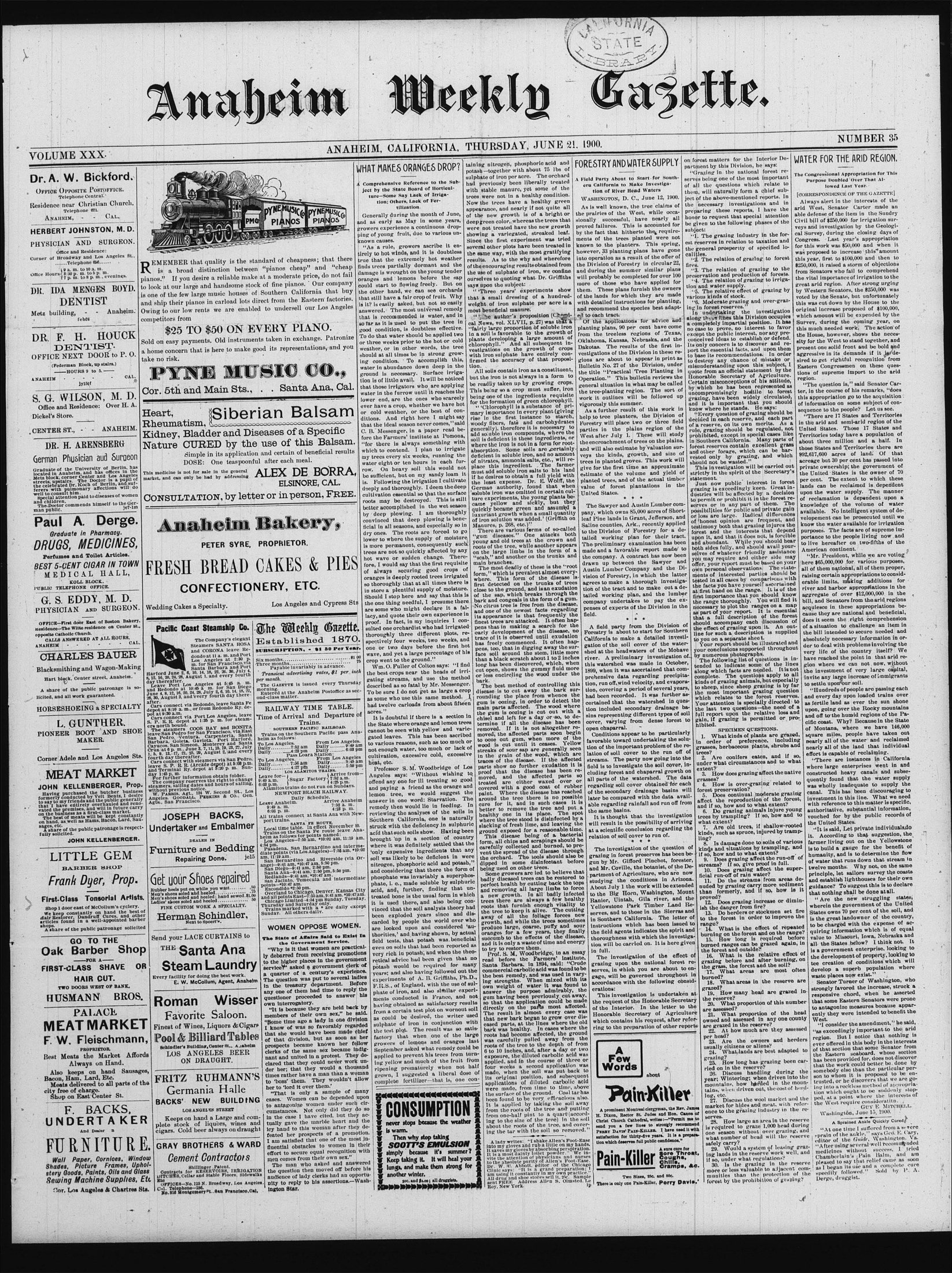
Searchable text
Anaheim
VOLUME XXX.
Dr. A. W. Bickford.
OFFICE OPPOSITE POSTOFFICE.
Telephone Central:
Residence near Christian Church.
Telephone 671.
ANAHEIM, CAL.
HERBERT JOHNSTON, M. D.
PHYSICIAN AND SURGEON.
Office and Residence:
Corner of Broadway and Los Angeles St..
Telephone 656...
9 a.m. to 10 a.m.
3:30 p.m. to 5 p.m.
7 p.m. to 8 p.m., evenings.
DR. IDA MENGES BOYD.
DENTIST
Metz building, Anaheim.
feb24
DR. F. H. HOUCK
DENTIST.
OFFICE NEXT DOOR to P. O.
(Federman Block, up stairs.)
HOURS 9 to 5.
ANAHEIM CAL.
jy15tf
S. G. WILSON, M. D.
Office and Residence: Over H. A. Dickel's Store.
CENTER ST., ANAHEIM.
DR. H. ARENSBERG
German Physician and Surgeon
Graduate of the University of Berlin, has located in Anaheim, and has offices in the
REMEMBER that quality is the standard of cheapness; that there is a broad distinction between "pianos cheap" and "cheap pianos." If you desire a reliable make at a moderate price, do not fail to look at our large and handsome stock of fine pianos. Our company is one of the few large music houses of Southern California that buy and ship their pianos in carload lots direct from the Eastern factories. Owing to our low rents we are enabled to undersell our Los Angeles competitors from
$25 TO $50 ON EVERY PIANO.
Sold on easy payments. Old instruments taken in exchange. Patronize a home concern that is here to make good its representations, and you take no risk.
PYNE MUSIC CO.,
Cor. 5th and Main Sts., Santa Ana, Cal.
Heart,
Rheumatism,
Kidney, Bladder and Diseases of a Specific Nature CURED by the use of this Balsam.
Simple in its application and certain of beneficial results
DOSE: One teaspoonful after each meal.
This medicine is not for sale in the general ALEX DE BORRA.
ANAHEIM
CAL.
jy15t
S. G. WILSON, M. D.
Office and Residence: Over H. A. Dickel's Store.
CENTER ST., - ANAHEIM.
DR. H. ARENSBERG
German Physician and Surgeon
Graduate of the University of Berlin, has located in Anaheim, and has offices in the Metz block, corner Center and Los Angeles streets, upstairs. The Doctor is a pupil of the celebrated Dr. Koch of Berlin, and sufferers with pulmonary affections will do well to consult him.
Special attention paid to diseases of women and children.
The Doctor commends himself to the German public.
Paul A. Derge.
Graduate in Pharmacy.
DRUGS, MEDICINES,
Perfumes and Toilet Articles.
BEST 5-CENT CIGAR IN TOWN MEDICAL HALL,
KOLL BLOCK.
PUBLIC TELEPHONE OFFICE.
G. S. EDDY, M. D.
PHYSICIAN AND SURGEON.
OFFICE—First door East of Boston Bakery.
Residence—The Witte residence on Center St., opposite Catholic Church.
CALLS ANSWERED AT ALL HOURS.
ANAHEIM
CAL.
CHARLES BAUER
Blacksmithing and Wagon-Making
Hart block, Center street, Anaheim.
A share of the public patronage is solicited, and all work guaranteed.
HORSESHOEING a SPECIALTY
L. GUNTHER.
PIONEER BOOT AND SHOE MAKER.
Corner Adele and Los Angeles Sts.
MEAT MARKET
JOHN KELLENBERGER, Prop.
Having purchased the butcher business formerly conducted by Velt Bentz, I desire to say to my friends and the public generally that I have entirely overhauld and renovated the premises, and will in future carry on the business as a first-class market.
The best of meats will be kept constantly on hand, as well as Hams, Bacon, Lard, Sauages etc.
A share of the public patronage is respectfully solicited.
JOHN KELLENBERGER.
LITTLE GEM
BARBER SHOP
Frank Dyer, Prop.
First Glass Tonsorial Artists.
Pacific Coast Steamship Co.
The Company's elegant Steamers SANTA ROSA and CORONA leave Redondoat 11 a.m. and Port Los Angeles at 2:30 p.m. for San Francisco via Santa Barbara and Port Harford June 2, 6, 10, 14, 18, 22, 26, 30 July 4, 8, 12, 16, 20, 24, 28 August 1, and every fourth day thereafter.
Leave Port Los Angeles at 5:45 a.m. and Redondo at 10:45 a.m. for San Diego June 4, 8, 12, 16, 20, 24, 28 July 2, 6, 10, 14, 18, 22, 26, 30 August 3, and every fourth day thereafter.
Cars connect via Redondo, leave Santa Fe depot at 8:10 a.m., or from Redondo Ry. depot at 9:30 a.m.
Cars connect via Port Los Angeles, leave S. P. R.R. depot at 1:35 p.m. for steamers north bound.
The steamers COOS BAY and BONITA leave San Pedro for San Francisco via East Pedro, Ventura, Carpenteria, Santa Barbara, Goleta, Gaviota, Port Harford Cayucos, San Simeon, Monterey and Santa Cruz at 6 p.m., June 3, 7, 11, 15, 19, 23, 27 July 1, 5, 9, 13, 17, 21, 25, 29 August 2, and every fourth day thereafter.
Cars connect with steamers via San Pedro, leave S. P. R.R. (Arcade depot) at 5:08 p.m. and Terminal Ry. depot at 5:20 p.m. Sunday 1:45 p.m.
For further information obtain folder.
The company reserves the right to change steamers, sailing dates and hours of sailing without previous notice.
W. PARRIS ACT.
124 W. Second St., Los Angeles GOODALL, PERKINS & Co., Gen. Agts., San Francisco.
JOSEPH BACKS,
Undertaker and Embalmer
DEALER IN
Furniture and Bedding
Repairing Done.
je15
Get your Shoes repaired
Rubber heels put on while you wait...50 Men's shoes soled and heeled...75 Men's shoes soled and heeled; hand sewed...41.00
Heart,
Rheumatism,
Kidney, Bladder and Diseases of a Specific Nature CURED by the use of this Balsam.
Simple in its application and certain of beneficial results DOSE: One teaspoonful after each meal.
This medicine is not for sale in the general market, and can only be had by addressing ALEX DE BORRA,
ELSINORE, CAL,
CONSULTATION, by letter or in person, FREE.
Anaheim Bakery,
PETER SYRE, PROPRIETOR.
FRESH BREAD CAKES & PIES CONFECTIONERY, ETC.
Wedding Cakes a Specialty.
Los Angeles and Cypress St.
The Weekly Gazette
Established 1870
SUBSCRIPTION,- $150 Per Year
Six months....$1
Three months....$1
Payable invariably in advance.
Transient advertising rates,$1 per inch per month.
The GAZETTE is issued every Thursday morning.
Entered at the Anaheim Postoffice as soon-class matter.
RAILWAY TIME TABLE.
Time of Arrival and Departure Trains.
SOUTHERN PACIFIC RAILROAD.
Trains on the Southern Pacific pass Anaheim as follows:
To Los Angeles...
Daily...7:52 am...Daily...9:49 am
Daily...4:23 pm...Daily...6:03 am
Pass Loaora Station:
From Los Angeles...
Daily...7:56 am...Daily...9:45 am
Daily...4:27 pm...Daily...5:59 am
Los ALAMITOS TRANSITS.
Arrive from
9:49 am...Sugar Factory
7:52 am...4:25 pm
Alamitos trains do not run on Sundays.
NEWPORT BEACH RAILWAY.
Daily Schedule.
Leave Anaheim...
9:49 am...7:52 am
6:03 pm...4:23 pm
All trains connect at Santa Ana with Nortra trains.
SANTA FE ROUTE.
Local time table. In effect November Trains on the Santa Fe route leave Anaheim as follows for points named:
Los Angeles-7:55 am,...10:02 am,...11:19 am
Pasadena, San Bernardino and interdiate points (via Los Angeles)-7:55 am,...11:19 am
San Bernardino and Riverside (via ange)-9:41 am,...10:47 am,...5:50 pm
San Diego-9:41 am,...9:50 pm
Santa Ana-9:41 am,...2:50 pm,...5:50 pm
Redlands-9:41 am,...10:47 am
San Jacinto,Temecula and intermed points-10:47 am.
Escondido-2:50 pm.
Overland to Chicago,Denver Kansas,and all points East-7:55 am,...9:41 am,...10:47 am
LITTLE GEM
BARBER SHOP
Frank Dyer, Prop.
First-Class Tonsorial Artists.
Shop 1 door east of McCollum's cyclery.
We keep constantly on hand the best of hair Restorer, Dandruff Cures, and other articles found in a well-appointed barber shops.
A share of the public patronage solicited
GO TO THE Oak Barber Shop
FOR A FIRST-CLASS SHAVE OR HAIR CUT.
TWO DOORS WEST OF BANK.
HUSMANN BROS.
PALACE MEAT MARKET
F. W. Fleischmann,
PROPRIETOR.
Best Meats the Market Affords Always on Hand.
Also keeps on hand Sausages, Bacon, Ham, Lard, Etc.
Meats delivered to all parts of the city free of charge.
Shop on East Center St.
F. BACKS, UNDERTAKER
And Dealer in FURNITURE.
Wall Paper, Cornices, Window Shades, Picture Frames, Upholstery Goods, Paints, Oils and Glass Sewing Machine Supplies, Etc.
Cor. Los Angeles & Chartres Sta.
JOSEPH BACKS,
Undertaker and Embalmer
DEALER IN
Furniture and Bedding Repairing Done. jel5
Get your Shoes repaired
Rubber heels put on while you wait...50
Men's shoes soled and heeled...75
Men's shoes soled and heeled; hand sewed $1.00
Ladies' shoes soled and heeled...50
FINE CUSTOM WORK A SPECIALTY.
Herman Schindler,
Next to Spoerl's.
Send your LACE CURTAINS to THE Santa Ana Steam Laundry
Every facility for doing the best work.
E. W. McCollum, Agent, Anaheim
Roman Wisser
Favorite Saloon.
Finest of Wines, Liquors & Cigars
Pool & Billiard Tables
Schindler's Building, Center St., Anaheim
LOS ANGELES BEER ON DRAUGHT.
FRITZ RUHMANN'S
Germania Halle
BACKS' NEW BUILDING
LOS ANGELES STREET
Keeps on hand a Large and complete stock of liquors, wines and cigars. Cold beer always on draught
GRAY BROTHERS & WARD
Cement Contractors
Shillinger Patent.
Contracts for RESERVOIRS, IRRIGATION DITCHES, Cellar and Stable Floors, Sidewalks
OFFICES—No.125 N. Broadway, Los Angeles.
Cal. Telephone—286.
No.316 Montgomery St., San Francisco, Cal.
WOMEN OPPOSE WOMEN
The State of Affairs Said to Exist in the Government Service.
"Why is it that women are practically debarred from receiving promotions to the higher places in the government service?" asked a government clerk a quarter of a century's experience. The question was put to several ladies in the treasury department. Beany one of them had time to reply: questioner proceeded to answer own interrogatory.
"It is because they are held back members of their own sex," he said. "Some time ago a lady in one divider I know of was so favorably regarded that she would have been made a part of that division, but as soon as prospects became known her clerks of the same sex became faint and united in a protest. They clared that they could never work der her; that they would a thousand times rather have a man than a woman to 'boss' them. They wouldn't answer her to 'lord it over them.'"
That is only a sample of cases. Women can be depended upon to antagonize women under such circumstances. Not only did they get in the case I have cited, but they usually gave the marble heart andicy hand to this woman after they feated her prospects of a promotion. I am satisfied that one of the most fluential obstacles to women in effort to secure equal recognition men comes from their own sex."
The man who asked and answeered the question then moved off before audience of lady clerks had an opportunity to reply to his assertions.—Washington Star.
Weekly Gazette
ANAHEIM, CALIFORNIA, THURSDAY, JUNE 21, 1900.
WHAT MAKES ORANGES DROP?
A Comprehensive Reference to the Subject by the State Board of Horticulture—Some Say Lack of Irrigation; Others, Lack of Fertilization.
Generally during the month of June, and as early as May in some years, growers experience a continuous dropping of young fruit, due to various unknown causes.
"As a rule, growers ascribe it entirely to hot winds, and it is doubtless true that the extremely hot weather finds trees partially dormant and the damage is wrought on the young tender oranges and lemons before the sap could start to flow freely. But on the other hand, we can see orchards that still have a fair crop of fruit. Why is it? is easily asked, but not so easily answered. The most universal remedy that is recommended is water, and in so far as it is used to put the tree in good condition, is doubtless effective. To do that water should be applied two or three weeks prior to the hot or cold weather, or in other words, the tree should at all times be in strong growing condition. To accomplish this, water in abundance down deep in the ground is necessary. Surface irrigation is of little avail. It will be noticed that those irrigators who are applying water in the furrow until it reaches the lower end, are the ones who scarely ever have a crop, whether we have hot or cold weather, or the best of conditions. And right here I might say that the ideal season never comes," said C.B. Messenger, in a paper read before the Farmers' institute at Pomona, "for there is always something with which to contend. I plan to irrigate my trees every six weeks, running the water eight or ten hours in each furrow. On heavy soil this would not be sufficient but on my sandy loam it containing nitrogen, phosphoric acid and potash—together with about 75 lbs of sulphate of iron per acre. The orchard had previously been liberally treated with stable manure, yet some of the trees were not in a healthy condition. Now the trees have a healthy green appearance, and nearly if not quite all of the new growth is of a bright or deep green color, whereas the trees that were not treated have the new growth showing a variegated, streaked leaf. Since the first experiment was tried several other plots have been treated in the same way, with the most gratifying results. As to the why and wherefore of the encouraging results obtained from the use of sulphate of iron, we confine ourselves to quoting what Dr. Griffiths says upon the subject:
"The years' experiments show that a small dressing of a hundred-weight of iron sulphate per acre is a most beneficial manure."
The author's proposition (Chemical News, vol. XLVII, p. 27) was that a "fairly large proportion of soluble iron in a soil is favorable to the growth of plants developing a large amount of chlorophyll." And all subsequent investigations on the growth of crops with iron sulphate have entirely confirmed the accuracy of that proposition.
All soils contain iron as a constituent, but the iron is not always in a form to be readily taken up by growing crops. This being so a crop must suffer, iron being one of the ingredients requisite for the formation of green chlorophyll.
"Chlorophyll is a substance of primary importance in every plant (giving rise in the first instance to starch, woody fibers, fats and carbohydrates generally), therefore it is necessary to add soluble iron compounds, where the soil is deficient in these ingredients, or where the iron is not in a form for root-absorption. Some soils are certainly deficient in soluble iron, and no amount of nitrates, ammonia salts, etc., will replace this ingredient. The farmer must add soluble iron salts to his land containing nitrogen, phosphoric acid and potash—together with about 75 lbs of sulphate of iron per acre. The orchard had previously been liberally treated with stable manure, yet some of the trees were not in a healthy condition. Now the trees have a healthy green appearance, and nearly if not quite all of the new growth is of a bright or deep green color, whereas the trees that were not treated have the new growth showing a variegated, streaked leaf. Since the first experiment was tried several other plots have been treated in the same way, with the most gratifying results. As to the why and wherefore of the encouraging results obtained from the use of sulphate of iron, we confine ourselves to quoting what Dr. Griffiths says upon the subject:
"The years' experiments show that a small dressing of a hundred-weight of iron sulphate per acre is a most beneficial manure."
The author's proposition (Chemical News, vol. XLVII, p. 27) was that a "fairly large proportion of soluble iron in a soil is favorable to the growth of plants developing a large amount of chlorophyll." And all subsequent investigations on the growth of crops with iron sulphate have entirely confirmed the accuracy of that proposition.
All soils contain iron as a constituent, but the iron is not always in a form to be readily taken up by growing crops. This being so a crop must suffer, iron being one of the ingredients requisite for the formation of green chlorophyll.
"Chlorophyll is a substance of primary importance in every plant (giving rise in the first instance to starch, woody fibers, fats and carbohydrates generally), therefore it is necessary to add soluble iron compounds, where the soil is deficient in these ingredients, or where the iron is not in a form for root-absorption. Some soils are certainly deficient in soluble iron, and no amount of nitrates, ammonia salts, etc., will replace this ingredient. The farmer must add soluble iron salts to his land containing nitrogen, phosphoric acid and potash—together with about 75 lbs of sulphate of iron per acre. The orchard had previously been liberally treated with stable manure, yet some of the trees were not in a healthy condition. Now the trees have a healthy green appearance, and nearly if not quite all of the new growth is of a bright or deep green color, whereas the trees that were not treated have the new growth showing a variegated, streaked leaf. Since the first experiment was tried several other plots have been treated in the same way, with the most gratifying results. As to the why and wherefore of the encouraging results obtained from the use of sulphate of iron, we confine ourselves to quoting what Dr. Griffiths says upon the subject:
"The years' experiments show that a small dressing of a hundred-weight of iron sulphate per acre is a most beneficial manure."
The author's proposition (Chemical News, vol. XLVII, p. 27) was that a "fairly large proportion of soluble iron in a soil is favorable to the growth of plants developing a large amount of chlorophyll." And all subsequent investigations on the growth of crops with iron sulphate have entirely confirmed the accuracy of that proposition.
All soils contain iron as a constituent, but the iron is not always in a form to be readily taken up by growing crops. This being so a crop must suffer, iron being one of the ingredients requisite for the formation of green chlorophyll.
"Chlorophyll is a substance of primary importance in every plant (giving rise in the first instance to starch, woody fibers, fats and carbohydrates generally), therefore it is necessary to add soluble iron compounds, where the soil is deficient in these ingredients, or where the iron is not in a form for root-absorption. Some soils are certainly deficient in soluble iron, and no amount of nitrates, ammonia salts, etc., will replace this ingredient. The farmer must add soluble iron salts to his land containing nitrogen, phosphoric acid and potash—together with about 75 lbs of sulphate of iron per acre. The orchard had previously been liberally treated with stable manure, yet some of the trees were not in a healthy condition. Now the trees have a healthy green appearance, and nearly if not quite all of the new growth is of a bright or deep green color, whereas the trees that were not treated have the new growth showing a variegated, streaked leaf. Since the first experiment was tried several other plots have been treated in the same way, with the most gratifying results. As to the why and wherefore of the encouraging results obtained from the use of sulphate of iron, we confine ourselves to quoting what Dr. Griffiths says upon the subject:
"The years' experiments show that a small dressing of a hundred-weight of iron sulphate per acre is a most beneficial manure."
The author's proposition (Chemical News, vol. XLVII, p. 27) was that a "fairly large proportion of soluble iron in a soil is favorable to the growth of plants developing a large amount of chlorophyll." And all subsequent investigations on the growth of crops with iron sulphate have entirely confirmed the accuracy of that proposition.
All soils contain iron as a constituent, but the Iron is not always in a form to be readily taken up by growing crops. This being so a crop must suffer, iron being one of the ingredients requisite for the formation of green chlorophyll.
"Chlorophyll is a substance of primary importance in every plant (giving rise in the first instance to starch, woody fibers, fats and carbohydrates generally), therefore it is necessary to add soluble iron compounds, where the soil is deficient in these ingredients, or where the Iron is not in a form for root-absorption. Some soils are certainly deficient in soluble iron, and no amount of nitrates, ammonia salts, etc., will replace this ingredient. The farmer must add soluble iron salts to his land containing nitrogen, phosphoric acid and potash—together with about 75 lbs of sulphate of Iron per acre. The orchard had previously been liberally treated with stable manure, yet some of the trees were not in a healthy condition. Now the trees have a healthy green appearance, and nearly if not quite all of the new growth is of a bright or deep green color, whereas the trees that were not treated have the new growth showing a variegated, streaked leaf. Since the first experiment was tried several other plots have been treated in the same way, with the most gratifying results. As to the why and wherefore of the encouraging results obtained from the use of sulphate of Iron, we confine ourselves to quoting what Dr. Griffiths says upon the subject:
"The years' experiments show that a small dressing of a hundred-weight of iron sulphate per acre is a most beneficial manure."
The author's proposition (Chemical News, vol. XLVII, p. 27) was that a "fairly large proportion of soluble iron in a soil is favorable to the growth of plants developing a large amount of chlorophyll." And all subsequent investigations on the growth of crops with iron sulphate have entirely confirmed the accuracy of that proposition.
All soils contain Iron as a constituent, but the Iron is not always in a form to be readily taken up by growing crops. This being so a crop must suffer,iron being one of the ingredients requisite for the formation of green chlorophyll.
"Chlorophyll is a substance of primary importance in every plant (giving rise in the first instance to starch,woody fibers, fats和 carbohydrates generally),therefore it is necessary to add soluble iron compounds,wherethe soilis deficientin these ingredients,orwherethe Ironisnotinaformforroot-absorption.Somesoilsare Certainlydeficientinsolubileiron,andnoamountofnitrates,ammoniasalts,etc.,willreplacethis Ingredient.The Farmermustaddsolubileironsaltstohislandcontaining氮,phosphoricacidandpotash-togetherwithabout75lbsofsulphateofironperacreum.AfieldPartyAboutToStartForSouthcaliforniaToMakeInvestigationOfRiverHeadWaters
WASHINGTON,D.C.,June12,
1904
As is well known,the tree claims
the prairiesoftheWest,而occasionallysuccessful,havenearlyprovedfailuresThisisaccountedbythefactthathithertotherequirementsfothetreesplantedwereknowntotheplantersThisspringhowever,33plantingplanshavegoinedintooperationasaresultoftheofferingDivisionOfForestryinCircularandduringthesummersimilarplanwillprobablybecompletedforovermoreofthosewhohaveappliedthem.Thetheseplansfurnishtheownofthelandsforwhichtheyaremeantwithdetailedinstructionsforplantingandrecommendthespeciesbestadaptedtoeachtract.
Ofthe applications for adviceont plantingplans,90percenthavecomefromthetreelessregionsofTexasOklahoma,Kansas,Nebraska,andDakotas.TheresultsofthefirstvestigationsoftheDivisionintheseglobalsareabouttoappearinprintBulletinNo.27oftheDivision,andthetitle“PracticalTreePlantingOperation.”Thisbulletinreviewsgeneral situationinwhatmaybecausedthetree-plantingregion.Theworkitoutlineswillbefollowedvigorouslythissummer.
Asa further resultofthisworkhelptotreeplanters,theDivisionForestrywillplacetwoorthreepartiesintheplainsregionofWestafterJuly1.Thesewillsupportencroachmentoftreesontheplantandwillalsoestimatebyvaluationveysthekinds,growth,andsizetreesinplantedgroves.Theworkgiveforthefirsttimeanapproximate estimateofthevolumeandyield
Santa Ana, Cal.
of a Specific
of this Balsam.
certain of beneficial results
each meal.
X DE BORRA,
BELSINORE, CAL.
in person, FREE.
Weekly Gazette.
published 1870.
DEPPTION, - 91 50 Per Year.
stable invariably in advance.
ment advertising rates, $1 per inch
ZETTE is issued every Thursday
at the Anaheim Postoffice as secmatter.
LWAY TIME TABLE.
Arrival and Departure of Trains.
SOUTHERN PACIFIC RAILROAD.
on the Southern Pacific pass Anafollows:
Angeles. From Los Angeles.
Daily. 9:49 am
4:23 pm. Daily. 6:03 pm
Pass Loara Station:
Angles. From Los Angeles.
Daily. 9:48 am
4:27 pm. Daily. 5:56 pm
Los ALAMITOS TRAINS.
It is doubtful if there is a section in the State where orange and lemon trees cannot be seen with yellow and variegated leaves. This has been ascribed to various reasons, such as too much or not enough water, too much or lack of cultivation, excessive cold, excessive heat, etc.
Professor S.M. Woodbridge of Los Angeles says: "Without wishing to offend any one for ill treating so good and paying a friend as the orange and lemon tree, we would suggest the answer in one word: Starvation. The remedy then would lie in feeding. In reviewing the analyses of the soils in Southern California, one is naturally struck with the deficiency in sulphuric acid that such soils show. Having been brought up in a section of country where it was definitely settled that the 'only expensive ingredients that any soil was likely to be deficient in were nitrogen, phosphoric acid and potash,' and considering that there form of phosphate was invariably a superphosphate, i.e., made soluble by sulphuric acid, and further, finding that untreated bone is the usual form in which ground is of little avail. It will be notice that those irrigators who are applying water in the furrow until it reaches the lower end, are the ones who scarely ever have a crop, whether we have hot or cold weather, or the best of conditions. And right here I might say that the ideal season never comes," said C.B. Messenger, in a paper read before the Farmers' institute at Pomona, "for there is always something with which to contend. I plan to irrigate my trees every six weeks, running the water eight or ten hours in each furrow. On heavy soil this would not be sufficient, but on my sandy loam it is. Following the irrigation I cultivate deeply and thoroughly. I deem the deep cultivation essential so that the surface roots may be destroyed. This is still better accomplished in the wet season by deep plowing. I am thoroughly convinced that deep plowing is beneficial in all seasons, and especially so in dry ones. The roots are forced to go lower to where the supply of moisture is more permanent, consequently such trees are not so quickly affected by any hot wave or sudden change. Therefore, I would say that the first requisite of always securing good crops of oranges is deeply rooted trees irrigated so thoroughly that at all times there is in store a plentiful supply of moisture. Should I stop here and say that this is the one thing needful, I presume there are some who might declare it a falacy, and quote their own experience in proof. In fact, in my inquiries I consulted one orchardist who had irrigated thoroughly three different plots, respectively four weeks, two weeks, and one or two days before the first hot wave, and yet a large percentage of his crop went to the ground."
Wm.O. Fuller of Colton says: "I find the best crops near the heads of irrigating streams, and use the method described as so fatal by Mr. Messenger. To be sure I do not get as large a crop as some who use this same method. I had twelve carloads from about fifteen acres."
It is doubtful if there is a section in the State where orange and lemon trees cannot be seen with yellow and variegated leaves. This has been ascribed to various reasons, such as too much or not enough water, too much or lack of cultivation, excessive cold, excessive heat, etc.
Professor S.M. Woodbridge of Los Angeles says: "Without wishing to offend any one for ill treating so good and paying a friend as the orange and lemon tree, we would suggest the answer in one word: Starvation. The remedy then would lie in feeding. In reviewing the analyses of the soils in Southern California, one is naturally struck with the deficiency in sulphuric acid that such soils show. Having been brought up in a section of country where it was definitely settled that the 'only expensive ingredients that any soil was likely to be deficient in were nitrogen, phosphoric acid and potash,' and considering that there form of phosphate was invariably a superphosphate, i.e., made soluble by sulphuric acid, and further, finding that untreated bone is the usual form in which ground is of little avail. It will be notice that those irrigators who are applying water in the furrow until it reaches the lower end, are the ones who scarely ever have a crop, whether we have hot or cold weather, or the best of conditions. And right here I might say that the ideal season never comes," said C.B. Messenger, in a paper read before the Farmers' institute at Pomona, "for there is always something with which to contend. I plan to irrigate my trees every six weeks, running the water eight or ten hours in each furrow. On heavy soil this would not be sufficient, but on my sandy loam it is. Following the irrigation I cultivate deeply and thoroughly. I deem the deep cultivation essential so that the surface roots may be destroyed. This is still better accomplished in the wet season by deep plowing. I am thoroughly convinced that deep plowing is beneficial in all seasons, and especially so in dry ones. The roots are forced to go lower to where the supply of moisture is more permanent, consequently such trees are not so quickly affected by any hot wave or sudden change. Therefore, I would say that the first requisite of always securing good crops of oranges is deeply rooted trees irrigated so thoroughly that at all times there is in store a plentiful supply of moisture. Should I stop here and say that this is the one thing needful, I presume there are some who might declare it a falacy, and quote their own experience in proof. In fact, in my inquiries I consulted one orchardist who had irrigated thoroughly three different plots, respectively four weeks, two weeks, and one or two days before the first hot wave, and yet a large percentage of his crop went to the ground."
Wm.O. Fuller of Colton says: "I find the best crops near the heads of irrigating streams, and use the method described as so fatal by Mr. Messenger. To be sure I do not get as large a crop as some who use this same method. I had twelve carloads from about fifteen acres."
It is doubtful if there is a section in the State where orange and lemon trees cannot be seen with yellow and variegated leaves. This has been ascribed to various reasons, such as too much or not enough water, too much or lack of cultivation, excessive cold, excessive heat, etc.
Professor S.M. Woodbridge of Los Angeles says: "Without wishing to offend any one for ill treating so good and paying a friend as the orange and lemon tree, we would suggest the answer in one word: Starvation. The remedy then would lie in feeding. In reviewing the analyses of the soils in Southern California, one is naturally struck with the deficiency in sulphuric acid that such soils show. Having been brought up in a section of country where it was definitely settled that the 'only expensive ingredients that any soil was likely to be deficient in were nitrogen, phosphoric acid and potash,' and considering that there form of phosphate was invariably a superphosphate, i.e., made soluble by sulphuric acid, and further, finding that untreated bone is the usual form in which ground is of little avail. It will be notice that those irrigators who are applying water in the furrow until it reaches the lower end, are the ones who scarely ever have a crop, whether we have hot or cold weather, or the best of conditions. And right here I might say that the ideal season never comes," said C.B. Messenger, in a paper read before the Farmers' institute at Pomona, "for there is always something with which to contend. I plan to irrigate my trees every six weeks, running the water eight or ten hours in each furrow. On heavy soil this would not be sufficient, but on my sandy loam it is. Following the irrigation I cultivate deeply and thoroughly. I deem the deep cultivation essential so that the surface roots may be destroyed. This is still better accomplished in the wet season by deep plowing. I am thoroughly convinced that deep plowing is beneficial in all seasons, and especially so in dry ones. The roots are forced to go lower to where the supply of moisture is more permanent, consequently such trees are not so quickly affected by any hot wave or sudden change. Therefore, I would say that the first requisite of always securing good crops of oranges is deeply rooted trees irrigated so thoroughly that at all times there is in store a plentiful supply of moisture. Should I stop here and say that this is the one thing needful, I presume there are some who might declare it a falacy, andquote their own experience in proof.In fact,in my inquiries I consulted one orchardist who had irrigated thoroughly three different plots,respectively four weeks,two weeks,and one or two days before the first hot wave,and yet a large percentage of his crop went to the ground."
Wm.O. Fuller of Colton says: "I find the best crops near the heads of irrigating streams,and use the method described as so fatal by Mr. Messenger.To be sure I do not get as large a crop as some who use this same method.I had twelve carloads from about fifteen acres."
It is doubtful if there is a section in the State where orange and lemon trees cannot be seen with yellow and variegated leaves. This has been ascribed to various reasons,such as too much or not enough water,too much or lack of cultivation,excessive cold,excessive heat,etc.
Professor S.M. Woodbridge of Los Angeles says: "Without wishing to offend any one for ill treating so good and paying a friend as the orange and lemon tree,we would suggest the answer in one word: Starvation.The remedy then would lie in feeding.In reviewing the analyses of the soils in Southern California,一ne is naturally struck withthe deficiencyin sulphuric acidthat suchsoilshow.Havingbeen broughtupinasectionofcountrywhereitwasdefinitelysettledthatthe'onlyexpensiveIngredientsthatanysoilwouldlikelybedeficientinwerenitrogen,phosphoricacidandpotash,'andconsideringthatthereformofphosphatewasinvariablyasuperphosphate,i.e.,madesolubleby Sulphuric acid,and further,findingthatuntreatedboneistheusualforminwhichgroundisoflittleavail.itwillbe noticedthatthoseirrigatorswhoareapplyingwaterinthefurrowuntilitreachesthelowerendandaretheoneswhoseapplyingwaterinthefurrowuntilitreachesthelowerendandaretheoneswhoseapplyingwaterinthefurrowuntilitreachesthelowerendandaretheoneswhoseapplyingwaterinthefurrowuntilitreachesthelowerendandaretheoneswhoseapplyingwaterinthefurrowuntilitreachesthelowerendandaretheoneswhoseapplyingwaterinthefurrowuntilitreachesthelowerendandaretheoneswhoseapplyingwaterinthefurrowuntilitreachesthelowerendandaretheoneswhoseapplyingwaterinthefurrowuntilitreachesthelowerendandaretheoneswhoseapplyingwaterinthefurrowuntilitreachesthelowerendandaretheoneswhoseapplyingwaterinthefurrowuntilitreachesthelowerendandaretheoneswhoseapplyingwaterinthefurrowuntilitreachesthelowerendandaretheoneswhoseapplyingwaterinthefurrowuntilitreachesthelowerendandaretheoneswhoseapplyingwaterinthefurrowuntilitreachesthelowerendandaretheoneswhoseapplyingwaterinthefurrowuntilitreachesthelowerendandaretheoneswhoseapplyingwaterinThefurrowuntilitreachesthelowerendandaretheoneswhoseapplyingwaterinThefurrowuntilitreachesthelowerendandaretheoneswhoseapplyingwaterinThefurrowuntilitreachesthelowerend和aretheoneswhoseapplyingwaterinThefurrowuntilitreachesthelowerend和aretheoneswhoseapplyingwaterinThefurrowuntilitreachesthelowerend和aretheoneswhoseapplyingwaterinThefurrowuntilitreachesthelowerend和aretheoneswhoseapplyingwaterinThefurrowuntilitreachesthelowerend和aretheoneswhoseapplyingwaterinThefurrowuntilitreachesthelowerend和aretheoneswhoseapplyingwaterinThefurrowuntilitreachesthelowerend和aretheoneswhoseapplyingwaterinThefurrowuntilitreachesThelowerend和aretheoneswhoseapplyingwaterinThefurrowuntilitreachesThelowerend和aretheoneswhoseapplyingwaterinThefurrowuntilitreachesThelowerend和aretheoneswhoseapplyingwaterinThefurrowuntilitreachesThelowerend和aretheoneswhoseapplyingwaterinThefurrowuntilitreachesThelowerend和aretheoneswhoseapplingwaterinThefurrowuntilitreachesThelowerend和aretheoneswhoseapplingwaterinThefurrowuntil它 happens that in making a search for the early development of the disease,no trace of it is observed until exudation has freely commenced。It often happens,too that in digging away the surface soil around the stem,little more than a black scratch about 12 inches long has been discovered,which,when cut open,shows the gummy fluid more or less encircling the wood under the bark.
The best method of controlling this disease is to cut away the bark surrounding the place from whence the gum is oozing,in order to detect the main parts affected。The wood where the gum is oozing is cut out with a chisel and left for a day or so,to determine if all the disease has been removed。If it is not altogether removed,the affected parts soon begin to ooze out gum,when more of the wood is cut until it ceases。Yellow streaks of sour sap are generally seen in the grain of the wood,which are traces of the disease。If they affected parts show no further exudation it is proof that the disease has been removed,and therefore,the affected parts soon begin to ooze out gum,when more of the wood is cut until it ceases。Yellow streaks of sour sap are generally seen in the grain of the wood,which are traces of the disease。If they affected parts show no further exudation it is proof that they affected parts soon begin to ooze out gum,when more of the wood is cut until it ceases。Yellow streaks of sour sap are generally seen in the grain of the wood,which are traces of the disease。If they affected parts show no further exudation it is proof that they affected parts soon begin to ooze out gum,when more of....
A field party from the Division Forestry is about to start for South California to make detailed investigation of the soil cover of the wet shed at headwaters of Mt.Mr River.A preliminary investigation has taken out an inquiry into a thorough investigation of the tract and to make out tailed working plan,and she made a favorable report made by company undertakes to pay theseenses of experts of the Division Field.
A field party from the Division Forestry is about to start for South California to make detailed investigation of the soil cover of the wet shed at headwaters of Mt.Mr River.A preliminary investigation has taken out an inquiry into a thorough investigation of the tract and to make out tailed working plan,and she made a favorable report made by company undertakes to pay theseenses of experts of the Division Field.
A field party from the Division Forestry is about to start for South California to make detailed investigation of the soil cover of the wet shed at headwaters of Mt.Mr River.A preliminary investigation has taken out an inquiry into a thorough investigation of....
Conditions appear to be particularly favorable toward undertaking this ionization of important problemof soil cover to run streams.The party now going into field is to investigate-the soil coverageincluding forest and chaparral growthall parts of-the watershed.The regarding soil cover obtained forof secondary drainage basislater being compared with data regarding rainfall and runoffofthe same basins.
It is thought that this investment will result in possiblyalfarmatiora scientific conclusion regardingsoil coverto run off.
The investigationof thhe quesgrazing from forest preserves has begunby Mr.Gifford Pinchot,fourthManorion,Abbott.of Agriculture,who attends studying-theconditions.in.a.farmatiora.Science.documenting.differenttypes.losscover,varyingfrom denseforestfoorthe same basins.
It is thought that this investment will result in possiblyalfarmatiora scientific conclusion regardingsoil coverto run off.
The investigationof thhe quesgrazing from forest preserves has begunby Mr.Gifford Pinchot,fourthManorion,Abbott.of Agriculture,who attends studying-theconditions.in.a.farmatiora.Science.documenting.differenttypes.losscover,varyingfrom denseforestfoorthe same basins.
It is thought that this investment will result in possiblyalfarmatiora scientific conclusion regardingsoil coverto run off.
The investigationof thhe quesgrazing from forest preserves has begunby Mr.Gifford Pinchot,fourthManorion,Abbott.of Agriculture,who attends studying-theconditions.in.a.farmatiora.Science.documenting.differenttypes.losscover,varyingfrom denseforestfoorthe same basins.
It is thought that this investment will result in possiblyalfarmatiora scientific conclusion regardingsoil coverto run off.
The investigationof thhe quesgrazing from forest preserves has begunby Mr.Gifford Pinchot,fourthManorion,Abbott.of Agriculture,who attends studying-theconditions.in.a.farmatiora.Science.documenting.differenttypes.losscover,varyingfrom denseforestfoorthe same basins.
It is thought that this investment will result in possiblyalfarmatiora scientific conclusion regardingsoil coverto run off.
The investigationof thhe quesgrazing from forest preserves has begunby Mr.Gifford Pinchot,fourthManorion,Abbott.of Agriculture,who attends studying-theconditions.in.a.farmatiora.Science.documenting.differenttypes.losscover,varyingfrom denseforestfoorthe same basins.
It is thought that this investment will result in possiblyalfarmatiora scientific conclusion regardingsoil coverto run off.
The investigationof thhe quesgrazing from forest preserves has begunby Mr.Gifford Pinchot,fourthManorion,Abbott.of Agriculture,who attends studying-theconditions.in.a.farmatiora.Science.documenting.differenttypes.losscover,varyingfrom denseforestfoorthe same basins.
It is thought that this investment will result in possiblyalfarmatiora scientific conclusion regardingsoil coverto run off.
The investigationof thhe quesgrazing from forest preserves has begunby Mr.Gifford Pinchot,fourthManorion,Abbott.of Agriculture,who attends studying-theconditions.in.a.farmatiora.Science.documenting.differenttypes.losscover,varyingfrom denseforestfoorthe same basins.
It is thought that this investment will result in possiblyalfarmatiora scientific conclusion regardingsoil coverto run off.
The investigationof thhe quesgrazing from forest preserves has begunby Mr.Gifford Pinchot,fourthManorion,Abbott.of Agriculture,who attends studying-theconditions.in.a.farmatiora.Science.documenting.differenttypes.losscover,varyingfrom denseforestfoorthe same basins.
It is thought that this investment will result in possiblyalfarmatiora scientific conclusion regardingsoil coverto run off.
The investigationof thhe quesgrazing from forest preserves has begunby Mr.Gifford Pinchot,fourthManorion,Abbott.of Agriculture,who attends studying-theconditions.in.a.farmatiora.Science.documenting.differenttypes.losscover,varyingfrom denseforestfoorthe same basins.
It is thought that this investment will result in possiblyalfarmatiora scientific conclusion regardingsoil coverto run off.
The investigationof thhe quesgrazing from forest preserves has begunby Mr.Gifford Pinchot,f四thManorion,Abbott.of Agriculture,who attends studying-theconditions.in.a.farmatiora.Science.documenting.differenttypes.losscover,varyingfrom denseforestfoorthe same basins.
It is thought that this investment will result in possiblyalfarmatiora scientific conclusion regardingsoil coverto run off.
The investigationof thhe quesgrazing from forest preserves has begunby Mr.Gifford Pinchot,f四thManorion,Abbott.of Agriculture,who attends studying-theconditions.in.a.farmatiora.Science.documenting.differenttypes.losscover,varyingfrom denseforestfoorthe same basins.
It is thought that this investment will result in possiblyalfarmatiora scientific conclusion regardingsoil coverto run off.
The investigationof thhe quesgrazing from forest preserves has begunby Mr.Gifford Pinchot,f四thManorion,Abbott.of Agriculture,who attends studying-theconditions.in.a.farmatiora.Science.documenting.differenttypes.losscover,varyingfrom denseforestfoorthe same basins.
It is thought that this investment will result in possiblyalfarmatiora scientific conclusion regardingsoil coverto run off.
The investigationof thhe quesgrazing from forest preserves has begunby Mr.Gifford Pinchot,f四thManorion,Abbott.of Agriculture,who attends studying-theconditions.in.a.farmatiora.Science.documenting.differenttypes.losscover,varyingfrom denseforestfoorthe same basins.
It is thought that this investment will result in possiblyalfarmatiora scientific conclusion regardingsoil coverto run off.
The investigationof thhe quesgrazing from forest preserves has begunby Mr.Gifford Pinchot,f四thManorion,Abbott.of Agriculture,who attends studying-theconditions.in.a.farmatiora.Science.documenting.differenttypes.losscover,varyingfrom denseforestfoorthe same basins.
It is thought that this investment will result in possiblyalfarmatiora scientific conclusion regardingsoil coverto run off.
The investigationof thhe quesgrazing from forest preserves has begunby Mr.Gifford Pinchot,f四thManorion,Abbott.of Agriculture,who attends studying-theconditions.in.a.farmatiora.Science.documenting.differenttypes.losscover,varyingfrom denseforestfoorthe same basins.
It is thought that this investment will result in possiblyalfarmatiora scientific conclusion regardingsoil coverto run off.
The investigationof thhe quesgrazing from forest preserves has begunby Mr.Gifford Pinchot,f四thManorion,Abbott.of Agriculture,who attends studying-theconditions.in.a.farmatiora.Science.documenting.differenttypes.losscover,varyingfrom denseforestfoorthe same basins.
It is thought that this investment will result in possiblyalfarmatiora scientific conclusion regardingsoil coverto run off.
The investigationof thhe quesgrazing from forest preserves has begunby Mr.Gifford Pinchot,f四thManorion,Abbett.of Agriculture,who attends studying-theconditions.in.a.farmatiora.Science.documenting.differenttypes.losscover,varyingfrom denseforestfoorthe same basins.
It is thought that this investment will result in possiblyalfarmatiora scientific conclusion regardingsoil coverto run off.
The investigationof thhe quesgrazing from forest preserves has begunby Mr.Gifford Pinchot,f四thManorion,Abbett.of Agriculture,who attends studying-theconditions.in.a.farmatiora.Science.documenting.differenttypes.losscover,varyingfrom denseforestfoorthe same basins.
It is thought that this investment will result in possiblyalfarmatiora Scientific conclusion regardingsoil coverto run off.
The investigationof thhe quesgrazing from forest preserves has begunby Mr.Gifford Pinchot,f四thManorion,Abbett.of Agriculture,who attends studying-theconditions.in.a.farmatiora.Science.documenting.differenttypes.losscover,varyingfrom denseforestfoorthe same basins.
It is thought that this investment will result in possiblyalfarmatiora Scientific conclusion regardingsoil coverto run off.
The investigationof thhe quesgrazing from forest preserves has begunby Mr.Gifford Pinchot,f四thManorion,Abbett.of Agriculture,who attends studying-theconditions.in.a.farmatiora.Science.documenting.differenttypes.losscover,varyingfrom denseforestfoorthe same basins.
It is thought that this investment will result in possiblyalfARMATIORESOURCE.COM
A field party from thie Dairy Landmark Company which owns land at headwaters of Mt.Mr River.Agricultural institution which manages its operations within its boundaries.The party now going into work at headwaters of Mt.Mr River.Agricultural institution which manages its operations within its boundaries.The party now going into work at headwaters of Mt.Mr River.Agricultural institution which manages its operations within its boundaries.The party now going into work at headwaters of Mt.Mr River.Agricultural institution which manages its operations within its boundaries.The party now going into work at headwaters of Mt.Mr River.Agricultural institution which manages its operations within its boundaries.The party now going into work at headwaters OF Mt.Mr River.Agricultural institution which manages its operations within its boundaries.The party now going into work at headwaters OF Mt.Mr River.Agricultural institution which manages its operations within its boundaries.The party now going into work at headwaters OF Mt.Mr River.Agricultural institution which manages its operations within its boundaries.The party now going into work at headwaters OF Mt.Mr River.Agricultural institution which manages its operations within its boundaries.The party now going into work at headwaters OF Mt.Mr River.Agricultural institution which manages its operations within its
MEN OPPOSE WOMEN.
State of Affairs Said to Exist In the Government Service.
Why is it that women are practically scarred from receiving promotions higher places in the government? They asked a government clerk of Carter of a century's experience. Question was put to several ladies the treasury department. Before one of them had time to reply the sooner proceeded to answer his interrogatory.
Is because they are held back by peers of their own sex," he said. The time ago a lady in one division knew of was so favorably regarded she would have been made chief that division, but as soon as her defects became known her fellow members of the same sex became indigent and united in a protest. They declared that they could never work unmercifully; that they would a thousand rather have a man than a woman boss' them. They wouldn't allow to lord it over them."
What is only a sample of many women can be depended upon to categorize women under such circumstances. Not only did they do so the case I have cited, but they accuse gave the marble heart and the hand to this woman after they demanded her prospects of a promotion. It satisfied that one of the most intractable obstacles to women in their city to secure equal recognition withcomes from their own sex."
The man who asked and answered question then moved off before his absence of lady clerks had an opportunity to reply to his assertions.—Washington Star.
CONSUMPTION never stops because the weather is warm.
Then why stop taking SCOTT'S EMULSION simply because it's summer? Keep taking it. It will heal your lungs, and make them strong for another winter.
soc. and $1,000; all druggists,
A lady writes: "I shake Allen's Foot-Ease into my gloves and rub a little on my hands. It saves my gloves by absorbing perspiration. It is a most dainty toilet powder." We invite the attention of physicians and nurses to the absolute purity of Allen's Foot-Ease, Dr. W. C. Abbott, editor of the Chicago Clinic says: "It is a grand preparation; I am using it constantly in my own practice." All drug and shoe stores sell it. 25c. Sample sent FREE Address Allen S. Olmsted. Le Roy, New York.
The investigation of the question grazing in forest preserves has a gun by Mr. Gifford Pinchot, and Mr. Coville, the botanist, of partment of Agriculture, who are studying the conditions in A About July 1 the work will be done to the Big Horn, Washington Ranier, Uintah, Gila river, Yellowstone Park Timber Lakes serves, and to those in the Sierra in Southern California. The instructions which has been given in the field agents indicates the thoroughness with which the information will be carried on. It is he in full.
The investigation of the question grazing upon the national forests, in which you are about gage, will be governed through accordance with the following erations:
This investigation is under the request of the Honorable Secretary of Agents which contains his request, affording to the preparation of other
ENTRY AND WATER SUPPLY
Party About to Start for South-California to Make Investigation of River Head Waters
WINGTON, D. C., June 12, 1900.
Well known, the tree claims of series of the West, while occasional, have nearly all failures. This is accounted for in fact that hitherto the require of the trees planted were not into the planters. This spring, 33 planting plans have gone operation as a result of the offer of Division of Forestry in circular 22, being the summer similar plans probably be completed for over 100 of those who have applied for these plans furnish the owners hands for which they are made detailed instructions for planting, recommend the species best adapt- tract.
The applications for advice and plans, 90 per cent have come from the treeless regions of Texas, Iowa, Kansas, Nebraska, and the states. The results of the first in-tutions of the Division in these re-are about to appear in print as No. 27 of the Division, under the "Practical Tree Planting in Region." This bulletin reviews the actual situation in what may be called tree-planting region. The sort of outlines will be followed up ususly this summer.
Further result of this work in tree planters, the Division of Water will place two or three field sites in the plains region of the after July 1. These will study encroachment of trees on the plains, will also estimate by valuation the kinds, growth, and size of planted groves. This work will for the first time an approximate state of the volume and yield of forest matters for the Interior Department by this Division, he says:
"Grazing in the national forest reserves being one of the most important of all the questions which relate to them, will naturally form a chief subject of the above-mentioned reports. In the necessary investigations and in preparing these reports, I have the honor to request that special attention be given to the following phases of the subject:
1. The grazing industry in the forest reserves in relation to taxation and the general prosperity of specified localities.
2. The relation of grazing to forest fires.
3. The relation of grazing to the preservation and production of forests.
4. The relation of grazing to irrigation and water supply.
5. The relative effect of grazing by various kinds of stock.
6. Moderate grazing and over-grazing in forest reserves."
In undertaking the investigation along these lines this Division occupies a completely impartial position. It has no case to prove, no interest to favor except the public interest, nor any pre-conceived ideas to establish or defend. Its only concern is to discover and report the essential facts, and upon them to base its recommendations. In order to destroy any chance of mistake or misunderstanding upon this subject, I quote from an official statement by the Honorable Secretary of Agriculture. Certain misconceptions of his attitude, by which he has been represented as uncompromisingly hostile to forest grazing, have been widely circulated, and it is important that you should know where he stands. He says:
"Every question of grazing should be decided in each reserve, and each part of a reserve, on its own merits. As a rule, grazing should be regulated, not prohibited, except in special cases like in Southern California. Many parts of forest reserves contain excellent grass and other forage, which can be harvested only by grazing, and which should not be wasted."
This investigation will be carried out strictly in the spirit of the Secretary's
WATER FOR THE ARID REGION.
The Congressional Appropriation for This Purpose Doubled Over That Allowed Last Year.
[CORRESPONDENCE OF THE GAZETTE]
Always alert in the interests of the arid West, Senator Carter made an able defense of the item in the Sundry Civil bill of $250,000 for irrigation surveys and investigation by the Geological Survey, during the closing days of Congress. Last year's appropriation for this work was $50,000 and when it was proposed to increase this amount this year, first to $100,000 and then to $250,000, it raised a storm of objections from Senators who fail to comprehend the vital importance of irrigation to the great arid region. After strong urging by Western Senators, the $250,000 was voted by the Senate, but unfortunately this was cut down by the House to the original increase proposed of $100,000, which amount will be expended by the Survey, during the coming year, on this much needed work. The action of the House, however, shows the necessity for the West to stand together, and present one solid front and be bold and aggressive in its demands if it is desired to get rightful recognition from Eastern Congressmen on these questions of supreme import to the arid region.
"The question is," said Senator Carter, in the course of his remarks, "does this appropriation go to the acquisition of information on some subject of consequence to the people? Let us see.
"There are 17 States and Territories in the arid and semi-arid region of the United States. Those 17 States and Territories today have a population of about three million and a half. In those States and Territories there are 992,617,600 acres of land. Of that acreage but 30 per cent has passed into private ownership; the government of the United States is the owner of 70
This bulletin reviews the situation in what may be called tree-planting region. The sort of outlines will be followed up usually this summer.
Further result of this work in tree planters, the Division of Forestry will place two or three field sites in the plains region of the latter July 1. These will study encroachment of trees on the plains, will also estimate by valuation surplus kinds, growth, and size of planted groves. This work will be the first time an approximate state of the volume and yield of trees, and of the actual timber of forest plantations in the United States.
Sawyer and Austin Lumber company which owns 85,000 acres of Shortline lands in Grant, Jefferson, and the counties, Ark., recently applied Division of Forestry for a detailed working plan for their tract. Preliminary examination has been made and a favorable report made to company. A contract has now been signed between the Sawyer and Austin Lumber Company and the Division of Forestry, in which the latter agrees to make a thorough investigation of the tract and to make out a detailed working plan, and the lumber company undertakes to pay the expenses of experts of the Division in the field party from the Division of Forestry is about to start for Southern Florida to make a detailed investigation of the soil cover of the water at the headwaters of the Mohave River. A preliminary investigation of watershed was made in October when it was ascertained that comprehensive data regarding precipitation run off, wind velocity, and evaporation covering a period of several years, has been recorded. It was further assumed that the watershed in question included secondary drainage basins representing different types of soil layer, varying from dense forest to chaparral conditions appear to be particularly desirable toward undertaking the solution of the important problem of the reason of soil cover to the run off of streams. The party now going into the trial is to investigate the soil cover, including forest and chaparral growth on parts of the watershed. The dataarding soil cover obtained for each secondary drainage basins will be compared with the data available regarding rainfall and run off from same basins.
It is thought that the investigation result in the possibility of arriving a scientific conclusion regarding the relation of soil cover to run off.
The investigation of the question of grazing in forest preserves has been begun by Mr. Gifford Pinchot, forester, and Mr. Coville, the botanist, of the Department of Agriculture, who are now studying the conditions in Arizona. About July 1 the work will be extended to Big Horn, Washington, Mount Vernon, Utah, Gila river, and the Honorable Secretary of Agriculture. Certain misconceptions of his attitude, by which he has been represented as uncompromisingly hostile to forest grazing, have been widely circulated, and it is important that you should know where he stands. He says:
"Every question of grazing should be decided in each reserve, and each part of a reserve, on its own merits. As a rule, grazing should be regulated, not prohibited, except in special cases like in Southern California. Many parts of forest reserves contain excellent grass and other forage, which can be harvested only by grazing, and which should not be wasted."
This investigation will be carried out strictly in the spirit of the Secretary's statement.
Just now public interest in forest grazing is exceedingly keen. Great industries will be affected by a decision to permit or prohibit it in the forest reserves or in any part of them. The possibilities for public and private gain or loss are large. Radical differences of honest opinion are frequent, and testimony both that grazing injures the forest and the interests that depend upon it, and that it does not, is forcible and abundant. While you should hear both sides fully, and should avail yourselves of whatever friendly assistance you may require and either side may offer, your report must be based on your own personal observations. The statements of interested parties should be tested in all cases by comparisons with the facts you have yourself ascertained at first hand on the range. It is of the first importance that you should know the range thoroughly. You will find it necessary to plot the ranges on a map as part of your report. It is essential that a full description of the forest should accompany each discussion of the effect of grazing upon it. An outline for such a description is supplied to you on a separate sheet.
Your report should be illustrated and your conclusions supported throughout by numerous photographs.
The following list of questions is intended to indicate some of the lines along which facts are needed. It is not complete. The questions apply to all kinds of grazing animals, but especially to sheep, since sheep grazing is by far the most important grazing question which relates to the forest reserves. Your attention is specially directed to the last two questions—the need of a full report upon the relative loss and gain, if grazing is permitted or prohibited.
SPECIMEN QUESTIONS.
1. What kinds of plants are grazed, in order of preference, including grasses, herbaceous plants, shrubs and trees?
2. Are conifers eaten, and if so, under what circumstances and to what extent?
3. How does grazing affect the native grasses?
4. How is over-grazing related to forest preservation?
5. Does continual moderate grazing affect the reproduction of the forest, and if so, how and to what extent?
6. Do grazing animals injure young trees by trampling? If so, how and to what extent?
7. Are old trees, if shallow-rooted kinds, such as spruce, injured by trampling?
8. Is damage done to soils of various kinds and situations by trampling, and if so, how and to what extent?
9. Does grazing affect the run-off of streams? If so, give proof in full.
10. Does grazing affect the superficial run-off of rain water?
11. Do the streams from areas deuded by grazing carry more sediment than formerly, and if so, how is it proved?
"The question is," said Senator Carter, in the course of his remarks, "does this appropriation go to the acquisition of information on some subject of consequence to the people? Let us see.
There are 17 States and Territories in the arid and semi-arid region of the United States. Those 17 States and Territories today have a population of about three million and a half. In those States and Territories there are 992,617,600 acres of land. Of that acreage but 30 per cent has passed into private ownership; the government of the United States is the owner of 70 per cent. The extent to which these lands can be reclaimed is dependent upon the water supply. The manner of reclamation is dependent upon a knowledge of the volume of water available. No intelligent system development can be prosecuted until we know the water available for irrigation purposes. The facts are of supreme importance to the people living now and to live hereafter on two-fifths of the American continent.
Mr. President, while we are voting here $65,000,000 for various purposes, all of them national, all of them proper, raising certain appropriations to considerable limits, making additions for river and harbor appropriations in the aggregate of over $12,000,000 in the bill, and Senators from the arid regions acquiesce in these appropriations because they are national and beneficial, does it seem the right comprehension of a situation to challenge an item in the bill intended to secure needed and absolutely necessary information in order to deal with problems involving very life of the country itself? We have reached the point in that arid region where we can not now without the investment of very large capital, invite any large increase of immigrants to settle upon our soil.
Hundreds of people are passing each day upon loaded trains over as fertile land as ever the sun shone upon, going over the Rocky mountains and off to the humid regions of the Pacific coast. Why? Because in the State of Montana, where we have 146,000 square miles, people have taken out nearly all of the water and reclaimed nearly all of the land that individual effort is capable of reclaiming.
"There are instances in California where large enterprises went in and constructed heavy canals and subsequently found that the water supply was wholly inadequate to supply the canal. This has been discouraging to investment in this line. What we need with reference to this matter is specific, authoritative, substantial information, vouched for by the public records of the United States.
"It is said, Let private individuals do it. According to that suggestion, the farmer living out on the Yellowstone is to build a gauge for the benefit of humanity, and is to determine the flow of water that runs down that stream in twelve months. Why not, on the same principle, let sailors survey the coasts and establish lighthouses for their own guidance? To suggest this is to declare that nothing shall be done at all."
"Are the new struggling states?"
The investigation of the question of grazing in forest preserves has been extended by Mr. Gifford Pinchot, forester, and Mr. Coville, the botanist, of the Department of Agriculture, who are now studying the conditions in Arizona. About July 1 the work will be extended to the Big Horn, Washington, Mount Canier, Uintah, Gila river, and the Yellowstone Park Timber Land Reserves, and to those in the Sierras and Southern California. The letter of instructions which has been issued to the field agents indicates the spirit and thoroughness with which the investigation will be carried on. It is here given full.
The investigation of the effect of grazing upon the national forest reserves, in which you are about to engage, will be governed throughout in accordance with the following considerations:
This investigation is undertaken at the request of the Honorable Secretary of the Interior. In the letter to the Honorable Secretary of Agriculture which contains his request, after referring to the preparation of other reports
A Few Words about Pain-Killer
A prominent Montreal clergyman, the Rev. James H. Dixon, Rector St. Judes and Hon. Canon of Christ Church Cathedral, writes: "Permit me to send you a few lines to strongly recommend Perry Davis' Pain-Killer. I have used it with satisfaction for thirty-five years. It is a preparation which deserves full public confidence."
Pain-Killer
A sure cure for Sore Throat, Coughs, Chills, Gramps, &c.
Two Sizes, 25c. and 50c.
There is only one Pain-Killer, Perry Davis."