anaheim-gazette 1900-05-03
Scanned page
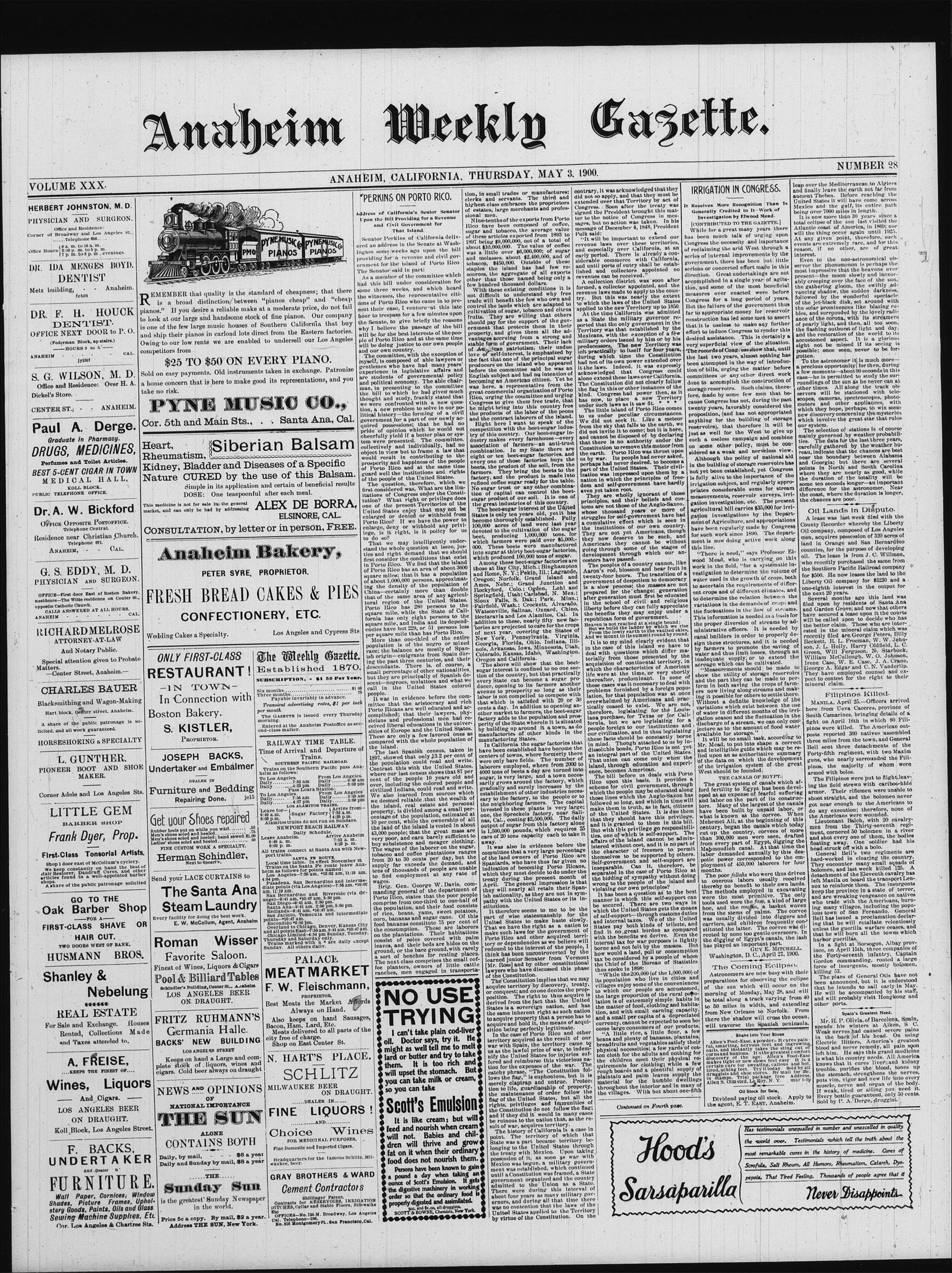
Searchable text
Anaheim
VOLUME XXX.
HERBERT JOHNSTON, M.D.
PHYSICIAN AND SURGEON.
Office and Residence:
Corner of Broadway and Los Angeles St..
Telephone 656...
9 a.m. to 10 a.m.
3:30 p.m. to 5 p.m.
7 p.m. to 8 p.m., evenings.
DR. IDA MENGES BOYD.
DENTIST
Metz building, - Anaheim.
feb24
DR. F. H. HOUCK
DENTIST.
OFFICE NEXT DOOR to P.O.
(Federman Block, up stairs.)
HOURS 9 to 5
ANAHEIM CAL.
jy15tf
S. G. WILSON, M.D.
Office and Residence: Over H.A.
Dickel's Store.
CENTER ST., - ANAHEIM.
Paul A. Derge.
Graduate in Pharmacy.
DRUGS, MEDICINES,
Perfumes and Toilet Articles.
BEST 5-CENT CIGAR IN TOWN
REMEMBER that quality is the standard of cheapness; that there is a broad distinction between "pianos cheap" and "cheap pianos." If you desire a reliable make at a moderate price, do not fail to look at our large and handsome stock of fine pianos. Our company is one of the few large music houses of Southern California that buy and ship their pianos in carload lots direct from the Eastern factories. Owing to our low rents we are enabled to undersell our Los Angeles competitors from
$25 TO $50 ON EVERY PIANO.
Sold on easy payments. Old instruments taken in exchange. Patronize a home concern that is here to make good its representations, and you take no risk.
PYNE MUSIC CO.,
Cor. 5th and Main Sts., Santa Ana, Cal.
Heart,
Rheumatism,
Kidney, Bladder and Diseases of a Specific
S. G. WILSON, M. D.
Office and Residence: Over H. A. Dickel's Store.
CENTER ST., - ANAHEIM.
Paul A. Derge.
Graduate in Pharmacy.
DRUGS, MEDICINES,
Perfumes and Toilet Articles.
BEST 5-CENT CIGAR IN TOWN
MEDICAL HALL,
KOLL BLOCK.
PUBLIC TELEPHONE OFFICE.
Dr. A. W. Bickford.
OFFICE OPPOSITE POSTOFFICE.
Telephone Central.
Residence near Christian Church.
Telephone 671.
ANAHEIM, - - CAL.
G. S. EDDY, M. D.
PHYSICIAN AND SURGEON.
OFFICE—First door East of Boston Bakery.
Residence—The Witte residence on Center St., opposite Catholic Church.
CALLS ANSWERED AT ALL HOURS.
ANAHEIM, - - CAL.
RICHARD MELROSE
ATTORNEY-AT-LAW
And Notary Public.
Special attention given to Probate Matters.
—Center Street, Anaheim.
CHARLES BAUER
Blacksmithing and Wagon-Making
Hart block, Center street, Anaheim.
A share of the public patronage is solicited, and all work guaranteed.
HORSESHOEING a SPECIALTY
L. GUNTHER.
PIONEER BOOT AND SHOE MAKER.
Corner Adele and Los Angeles Sts.
LITTLE GEM
BARBER SHOP
Frank Dyer, Prop.
First-Class Tonsorial Artists.
Shop 1 door east of McColum's cycleery.
We keep constantly on hand the best of hair Restorer, Dandruff Cures, and other articles found in a well-appointed barber shops.
A share of the public patronage solicited.
GO TO THE
PYNE MUSIC CO., Cor. 5th and Main Sts., Santa Ana, Cal.
Heart,
Rheumatism,
Kidney, Bladder and Diseases of a Specific Nature CURED by the use of this Balsam.
Simple in its application and certain of beneficial results.
DOSE: One teaspoonful after each meal.
This medicine is not for sale in the general market, and can only be had by addressing ALEX DE BORRA, ELSINORE, CAL.
CONSULTATION, by letter or in person, FREE.
Anaheim Bakery,
PETER SYRE, PROPRIETOR.
FRESH BREAD CAKES & PIES CONFECTIONERY, ETC.
Wedding Cakes a Specialty. Los Angeles and Cypress Stores
ONLY FIRST-CLASS RESTAURANT!
- IN TOWN -
In Connection with Boston Bakery.
S. KISTLER,
PROPRIETOR.
JOSEPH BACKS,
Undertaker and Embalmer
DEALER IN
Furniture and Bedding Repairing Done. jel5
Get your Shoes repaired
Rubber heels put on while you want...50
Men's shoes soled and heeled...75
Men's shoes soled and heeled; hand sewed $1.00
Ladies' shoes soled and heeled...50
FINE CUSTOM WORK A SPECIALTY.
Herman Schindler,
Next to Spoer'l's.
Send your LACE CURTAINS to The Santa Ana
The Weekly Gazette
Established 1870
SUBSCRIPTION, - $1 50 Per Year
Six months...$1
Three months...$1
Payable invariably in advance.
Transient advertising rates, $1 per month.
The GAZETTE is issued every Thursday morning.
Entered at the Anaheim Postoffice as second-class matter.
RAILWAY TIME TABLE.
Time of Arrival and Departure Trains.
SOUTHERN PACIFIC RAILROAD.
Trains on the Southern Pacific pass Anaheim as follows:
To Los Angeles....From Los Angeles
Daily.....7:52 am Dally.....9:49 am
Daily.....4:23 pm Dally.....6:00 pm
Pass Loara Station:
To Los Angeles....From Los Angeles
Daily.....7:56 am Dally.....9:45 am
Daily.....4:27 pm Dally.....5:56 am
Los ALAMITOS TRAINS.
Leave for—Sugar Factory Arrive from 9:49 a.m. 7:52 a.m. 4:25 p.m.
6:03 p.m. Alamitos trains do not run on Sundays.
NEWPORT BEACH RAILWAY.
Daily Schedule.
Leave Anaheim.
9:49 a.m. 7:52 a.m. 4:25 p.m.
6:03 p.m. All trains connect at Santa Ana with port trains.
SANTA FE ROUTE.
Local time table. In effect November.
Trains on the Santa Fe route leave Anaheim as for points named:
Los Angeles—7:55 am, *10:02 am, 11:19 pm.
Pasadena, San Bernardino and interstate points (via Los Angeles)—7:55 am, am, 11:19 am.
San Bernardino and Riverside (via Pasadena)—9:41 am, *10:47 am, 5:50 pm.
LITTLE GEM
BARBER SHOP
Frank Dyer, Prop.
First-Class Tonsorial Artists.
Shop 1 door east of McCollum's cyclery.
We keep constantly on hand the best of hair Restorer, Dandruff Cures, and other articles found in a well-appointed barber shops.
A share of the public patronage solicited
GO TO THE Oak Barber Shop
FOR A FIRST-CLASS SHAVE OR HAIR CUT.
TWO DOORS WEST OF BANK.
HUSMANN BROS.
Shanley & Nebelung
REAL ESTATE
For Sale and Exchange. Houses Rented, Collections Made and Taxes attended to.
A. FREISE,
...KEEPS THE FINEST OF...
Wines, Liquors
And Cigars.
LOS ANGELES BEER ON DRAUGHT.
Koll Block, Los Angeles Street.
F. BACKS,
UNDERTAKER
And Dealer in
FURNITURE.
Wall Paper, Cornices; Window Shades, Picture Frames, Upholstery Goods, Paints, Oils and Glass Sewing Machine Supplies, Etc.
Cor. Los Angeles & Chartres Sts.
Get your Shoes repaired
Rubber beels put on while you wait...50 Men's shoes soled and heeled...75 Men's shoes soled and heeled; hand sewed $1.00 Ladies' shoes soled and heeled...50 FINE CUSTOM WORK A SPECIALTY.
Herman Schindler,
Next to Spoerl's.
Send your LACE CURTAINS to The Santa Ana Steam Laundry
Every facility for doing the best work.
E. W. McCollum, Agent, Anahelm
Roman Wisser
Favorite Saloon.
Finest of Wines, Liquors & Cigars Pool & Billiard Tables
Schindler's Building, Center St., Anaheim
LOS ANGELES BEER ON DRAUGHT.
FRITZ RUHMANN'S Germania Halle.
BACKS' NEW BUILDING
LOS ANGELES STREET
Keeps on hand a Large and complete stock of liquors, wines and cigars. Cold beer always on draught.
NEWS AND OPINIONS OF NATIONAL IMPORTANCE
THE SUN
ALONE CONTAINS BOTH
Daily, by mail, $6 a year
Daily and Sunday by mail, $8 a year
THE
Sunday Sun is the greatest Sunday Newspaper in the world.
Price 5¢ a copy. By mail, $2 a year.
Address THE SUN, New York.
PALACE MEAT MARKET
F. W. Fleischman
PROPRIETOR.
Best Meats the Market Always on Hand.
Also keeps on hand Sauce Bacon, Ham, Lard, Etc.
Meats delivered to all parts of city free of charge.
Shop on East Center St.
N. HART'S PLACE
SCHLITZ
MILWAUKEE BEER ON DRAUGHT
DEALER IN...
FINE LIQUOR
Choice Win FOR MEDICINAL PURPOSES
Fine Domestic and Imported Cigars.
Headquarters for the famous Schlwaukee beer.
GRAY BROTHERS & W
Cement Contractor
Shillinger Patent.
Contracts for RESERVOIRS, IRRITABLE ITCHES, Cellar and Stable Floors, Ete
OFFICES—No. 126 N. Broadway. Los Cal. Telephone—236.
No. 316 Montgomery St., San Francisco.
ANAHEIM, CALIFORNIA, THURSDAY, MAY 3, 1900.
PERKINS ON PORTO RICO.
Address of California's Senior Senator Upon the Bill Providing for a Revenue and Civil Government for That Island.
Senator Perkins of California delivered an address in the Senate at Washington some weeks ago upon the bill providing for a revenue and civil government for the island of Porto Rico. The Senator said in part:
As a member of the committee which had this bill under consideration for some three weeks, and which heard the witnesses, the representative citizens of Porto Rico who came in to present their case, I venture at this late hour to trespass for a few minutes upon the Senate, to give briefly the reasons why I believe the passage of the bill will be for the best interests of the people of Porto Rico and at the same time will be doing justice to our own people and our own country.
The committee, with the exception of myself, is composed of able lawyers or gentlemen who have had many years' experience in legislative affairs and are students of governmental policy and political economy. The able chairman, in presenting to the committee the bill to which he had given much thought and study, frankly stated that we were confronted with a new question, a new problem to solve in our political history—the forming of a civil government for a part of our newly acquired possessions; that he had no pride of opinion which he would not cheerfully yield if a better plan or system were presented. The committee collectively and individually, had no object in view but to frame a law that would result in contributing to the prosperity and happiness of the people of Porto Rico and at the same time guard well the institutions and rights tion, in small trades or manufactures; clerks and servants. The third and highest class embraces the proprietors of estates, large merchants and professional men.
Nine-tenths of the exports from Porto Rico have been composed of coffee, sugar and tobacco, the average value of these articles exported from 1893 to 1897 being $9,000,000, out of a total of about $10,000,000. The value of coffee was a little over $6,000,000; of sugar and molasses, about $2,400,000, and of tobacco, $450,000. Outside of these staples the island has had few resources, the aggregate of all exports other than those named being only a few hundred thousand dollars.
With these existing conditions it is not difficult to understand why free trade will benefit the few who own and control the lands which are adapted to cultivation of sugar, tobacco and citrus fruits. They are willing that others should pay for the support of the government that protects them in their property, and gives them all the advantages accruing from a strong and stable form of government. Their lack of American patriotism, their undue love of self-interest, is emphasized by the fact that one of the principal sugar producers on the island who appeared before the committee said he was an English subject and had no intention of becoming an American citizen. Yet he was here, a representative from the great commercial organization of Porto Rico, urging the committee and urging Congress to give them free trade, that he might bring into this country free products of the labor of the peons and the contract laborers of the island.
Right here I want to speak of the competition with the beet-sugar industry of this country. Our beet-sugar industry makes every farmhouse—every association of farmers—an anti-trust combination. In my State there are eight or ten beet-sugar factories, and every one of those factories buys the beets, the product of the soil, from the farmers. They bring the beets to the contrary, it was acknowledged that they did not so apply, and that they must extend over that Territory by act of Congress. Soon after the treaty was signed the President brought this matter to the notice of Congress in messages, but no action was taken. In his message of December 4, 1848, Presidency Polk said:
"It will be important to extend our revenue laws over these territories and especially over California, at early period. There is already a considerable commerce with California and until ports of entry shall be established and collectors appointed revenues can be received."
A collection district was soon affirmed, a collector appointed, and the revenue laws made to apply to the country. But this was nearly the extent to which the laws of the United States applied to the new Territory up to 1848.
At the time California was admitted as a State the military governor reported that the only government in Territory was that established by the Mexicans, with the exception of a few military orders issued by him or by predecessors. The new Territory would left practically to itself for four years during which time the Constitution had not of its own power extended on it the laws. Indeed, it was expressly acknowledged that Congress could alone extend these laws over California. The Constitution did not clearly follow the flag in this or other instances of kind. Congress had power then, as has now, to place a new Territory under such laws as it saw fit.*
The little island of Porto Rico comes to us under peculiar circumstances. We did not seek it. Like a met from the sky that falls to the earth, did not invite it to come; but it is hard and cannot be disposed of by declaring that there is no authority under Constitution to remove this meteor from the earth. Porto Rico was thrust us by war. Its people had never asked perhaps had never desired, to become part of the United States. Their constitution was impressed upon them.
are students of governmental policy and political economy. The able man, in presenting to the committee the bill to which he had given much thought and study, frankly stated that we were confronted with a new question, a new problem to solve in our political history—the forming of a civil government for a part of our newly acquired possessions; that he had no pride of opinion which he would not cheerfully yield if a better plan or system were presented. The committee collectively and individually, had no object in view but to frame a law that would result in contributing to the prosperity and happiness of the people of Porto Rico and at the same time guard well the institutions and rights of the people of the United States.
The question, therefore, which we first considered was, What are the limitations of Congress under the Constitution? What right or privilege does one of the present Territories of the United States enjoy that may not be enlarged or denied or withheld from Porto Rico? If we have the power to enlarge, deny or withhold any privilege, is it right, is it policy for us to do so?
That we may intelligently understand the whole question at issue, justice and right demand that we should first consider the conditions that exist in Porto Rico. We find that the island of Porto Rico has an area of about 3600 square miles; that it has a population of about 1,000,000 persons, approximating the density of the population of China—certainly more than double that of the same area of any agricultural region of the United States. Porto Rico has 280 persons to the square mile, while the State of California has only eight persons to the square mile, and India and its dependencies have but 229, or 51 persons less per square mile than has Porto Rico.
More than one-third of the entire population is of the negro or mixed race; the balance are mostly of Spanish origin—emigrants from Spain during the past three centuries, and their descendants. There is, of course, a small percentage of other nationalities, but they are principally of Spanish descent—negroes, mulattoes and what we call in the United States colored people.
It was in evidence before the committee that the aristocracy and rich Porto Ricans are well educated and accomplished; that their lawyers, physicians and professional men had received liberal educations in the universities of Europe and the United States. These are only a few favored ones as compared with the whole population of the island.
The last Spanish census, taken in 1897, showed that only 13.2 per cent of the population could read and write. Contrast this with the United States, where our last census shows that 87 per cent of the people 10 years old and over, including the colored people and civilized Indians, could read and write. We also learned from sources which we deemed reliable: that the wealth of the island, real estate and personal property, is divided among a small percentage of the population, estimated at 10 per cent, while the ownership of all the land of the island is vested in about 43,000 people; that the great mass are very poor, and earn barely sufficient to buy subsistence and meager clothing.
The wages of the laborer on the sugar, tobacco and coffee plantations ranges from 20 to 30 cents per day, but the supply far exceeds the demand, tens of thousands of people are unable to find employment at any rate of wages.
Brig. Gen. George W. Davis, commanding general of the department of Porto Rico, states that the poor people English subject and had no intention of becoming an American citizen. Yet he was here, a representative from the great commercial organization of Porto Rico, urging the committee and urging Congress to give them free trade, that he might bring into this country free products of the labor of the peons and the contract laborers of the island.
Right here I want to speak of the competition with the beet-sugar industry of this country. Our beet-sugar industry makes every farmhouse—every association of farmers—an anti-trust combination. In my State there are eight or ten beet-sugar factories, and every one of those factories buys the beets, the product of the soil, from the farmers. They bring the beets to the factory, and the product is made into refined coffee sugar ready for the table. No sugar trust or any other combination of capital can control the beet-sugar product of our soil. It is one of the great industries of this country.
The beet-sugar interest of the United States is only ten years old, yet it has become thoroughly established. Fully 100,000 acres of land were last year devoted to the cultivation of the sugar beet, producing 1,000,000 tons for which farmers were paid over $5,000,000. These beets were manufactured into sugar at thirty beet-sugar factories, which produced 100,000 tons of sugar.
Among these beet-sugar factories are those at Bay City, Mich.; Binghamton and Rome, N.Y.; Pekin, Ill.; Lagrange, Oregon; Norfolk, Grand Island and Ames, Nebr.; Grand Junction and Rockyford, Colo.; Ogden, Lehi and Springfield, Utah; Carlsbad, N.M.; Sioux Falls, S. Dak.; Park, Minn.; Fairfield, Wash.; Crockett, Alvarado; Watsonville, Salinas, Oxnard, Chino; Beetaravia and Los Alamitos, Cal. In addition to these nearly fifty new factories are projected to care for the crops of next year, covering the States of New York, Pennsylvania, Virginia, Georgia, Florida, Ohio, Indiana, Illinois, Arkansas, Iowa, Minnesota, Utah Colorado, Kansasas Idaho Washington Oregon and California.
The above will show that the beet-sugar interest is confined to no one section of the country, but that practically every State can become a sugar producer, opening to its farmers another avenue to prosperity so long as their labor is not compelled to compete with that which is satisfied with 20 or 30 cents a day. In addition to opening another market to farmers, the beet-sugar factory adds to the population and prosperity of the State wherein it is situated by building up around it a town, as do manufacturers of other kinds in the manufacturing States.
In California the sugar factories that have been established have become the centers of towns where formerly there were only bare fields. The number of laborers employed, where from 2000 to 4000 tons of beets a day are turned into sugar, is very large, and a town necessarily grows around the factory which gradually and surely increases by the establishment of other industries necessary to the factory; to the people or to the neighboring farmers. The capital invested in these plants is very large; one,the Spreeks factory,near Saltnas,Cal.,costing$2,500,000.The daily output of sugar from this factory alone is 1,500,000 pounds which requires 25 cars of 20 tons capacity each to take it away.
It was also in evidence before the committee that a very large percentage of the land owners of Porto Rico are Spaniards who have thus far given no indication of becoming Porto Ricans which they must decide to do under the treaty during the present month of April. The general impression is that they will nearly all retain their Spanish nationality, as they are not in sympathy with their own principles?
It has been a question as to whether this self-serving representation in this newspaper represents an official position within our organization.
The Constitution did not clearly follow its flag in this or other instances of kind. Congress had power then; she has now to place a new Territory under such laws as it saw fit.*
The little island of Porto Rico contends to us under peculiar circumstances. We did not seek it. Like a merchant from the sky that falls to the earth did not invite it to come; but it is hard and cannot be disposed by a declaration that there is no authority under Constitution to remove this meteor from the earth. Porto Rica was thrust upon us by war. Its people had never asked perhaps had never desired; to become part of the United States. Their constitution was impressed upon them by nation in which the principles of dom and self-government have even yet taken root.
They are wholly ignorant of their principles,and their beliefs and tones are not those of the Anglo-Saxon whose thousand years or more struggles for self-government have a cumulative effect which is seen in the institutions of our own country. They are not yet Americans,they now deserve to be such,Americans they cannot be wishing through some of the stage development through which our ancestors have passed.
The peoples of a country cannot Aaron's rod,bloomessand bear freedom twenty-four hours. The transition government of despotism to democracy is a slow process;the masses are prepared for the change;genera after generation must first be educated in the school of civil and religious before they can fully approve benefits they may enjoy under republican form of government.
Heaven is not reached at any point.Built by the ladder at by which we From lowly earth by which we Mount to its summit round by itself.
It is to my mind clearly evidenced in case of this island we have dealt with questions which differentially from those presented by acquisition of continental territory whichthe characteristicsof America life were at the time,或very thereafter,predominant.In no these cases was it necessary for problems furnished by a foreign for that population was an overwhelmed by Americans and tically ceased to exist.Were therefore,elegisiting forthe Anglo-Saxon purchase,forkesorTexasorforIndiabutwearelegislatingourpeopleforeigntoourinstitutionourcivilization,andinthislegislationthe facts should be constantly in mind.Though attached to our dissoluble bonds,Porto Rico is an integral partoftheUnitedStatethrougheducationandencebecomesAmerican.
The bill before us deals with Rico upon this basis. It proposes for civil governmentwhichthepeoplemaybeeducatedthoselineswhichtheAnglo-Saxonfollowssolong,andwhichinthatoftheUnitedStates.itisdidthattheyshouldhavethisprincipleButwiththisprivilegegorespecialaffairsofthe岛couldbeestablishedwithoutcost,anditisnotthecharacteroffreementobesupportedbySelf-governmentandself-supposeinparaphrase.CanitethereseparatedinthecaseofPortoRicobiddingofsympathywithworsttothepeopleoftheislandviolatingoursownprinciples?
It has been a question as to whether this self-serving representation in this newspaper represents an official position within our organization.
NO USE TRYING
I can’t take plain cod-liver oil. Doctor says, try it. He might as well tell me to melt lard or butter and try to take them. It is too rich and will upset the stomach. But you can take milk or cream, so you can take Scott’s Emulsion.
It is like cream; but will feed and nourish when cream will not. Babies and children will thrive and grow fat on it when their ordinary food does not nourish them.
Persons have been known to gain a pound a day when taking an ounce of Scott’s Emulsion. It gets the digestive machinery in working order so that the ordinary food is properly digested and assimilated.
SCOTT & BOWNE, Chemists, New York.
The Constitution implies that we may acquire territory by discovery, treaty, or conquest; and do no denies the proposition. The right to thus acquire is derived from the fact that the United States is a sovereign nation, and has the same inherent right as such nation to acquire property that a person has to acquire and hold it, the means of acquisition being perfectly legitimate.
In the case of Porto Rico and other territory acquired as the result of our war with Spain, the territory came to us as the lawful prize of war, to indemnify the United States for injuries suffered and reimburse this victorious nation for the expenses of the war. The catchy phrase, “The Constitution follows the flag,” is euphonious, but it is merely claptrap and untrue. Protection to life, guardianship of property, the maintenance of order follow the flag of the United States, but all the rights, privileges and immunities of the Constitution do not follow the flag; and if they did it would in many cases be ruinous to the nation that, as the result of war, acquires territory.
The history of California is a case in point. The territory of which State was a part became territory belonging to the United States through the treaty with Mexico. Upon taking possession of it, as soon as war with Mexico was begun, a military government was established, which continued until a Constitution was framed, a State government organized and the country admitted to the Union as a State. There were during this interval of about four years as many military governors, and during all that time there was no contention that the laws of the United States applied to the Territory by virtue of the Constitution. On the
Gazette.
NUMBER 28
IRRIGATION IN CONGRESS.
It Receives More Recognition Than Is Generally Credited to It—Work of Investigation by Elwood Mead.
[CONTRIBUTED TO THE GAZETTE.]
While for a great many years there has been much talk of urging upon Congress the necessity and importance of reclaiming the arid West through a series of internal improvements by the government, there has been but little serious or concerted effort made in this direction. Great undertakings are not accomplished in a single year of agitation, and some of the most beneficial measures ever enacted were before Congress for a long period of years. But the failure of the government thus far to appropriate money for reservoir construction has led some men to assert that it is useless to make any further effort to induce Congress to render this desired assistance. This is certainly a very superficial view of the situation. The records of Congress show that, until the last two years, almost nothing has been attempted in the way of introduction of bills, urging the matter before committees or any other direct work done to accomplish the construction of storage reservoirs. Such claims, therefore, made by some few men that because Congress has not, during the past twenty years, favorably considered the proposition, (and has not appropriated anything for the building of storage reservoirs), that therefore it will be just as well for the West to give up such a useless campaign and combine on some other policy, must be considered as a weak and nerveless view.
Although the policy of national aid in the building of storage reservoirs has not yet been established, yet Congress leap over the Mediterranean to Algiers and finally leave the earth not far from ancient Thebes. Before reaching the United States it will have come across Mexico and the gulf, its entire path being over 7000 miles in length.
It is now more than 30 years since a total eclipse of the sun last visited the Atlantic coast of America, in 1869; nor will the thing occur again until 1925. At any given point, therefore, such events are extremely rare, and for this reason, if no other, are of great interest.
Even to the non-astronomical observer the phenomenon is perhaps the most impressive that the heavens ever present—the moon slowly and inexorably creeping over the face of the sun, the gathering gloom, the swiftly advancing shadow, the sudden darkness, followed by the wonderful spectacle of the jet-black disk, set around with the solar prominences like blazing rubles, and surrounded by the lovely radiance of the corona, with its streamers of pearly light, and then, all too soon, the flashing outburst of light and day, and the restoration of the world to its accustomed aspect. It is a glorious sight not be missed if its seeing is possible; once seen, never to be forgotten.
To the astronomer it is much more—a precious opportunity; for then, during a few moments—about 90 seconds in this case—he is permitted to study the surroundings of the sun as he never can at other times. All along the track observers will be stationed with telescopes, cameras, spectroscopes, photometers and other appliances, with which they hope, perhaps, to win some new discovery concerning the mysteries which involve the great star that rules our system.
The selection of stations is of course mainly governed by weather probabilities. The data for the last three years, carefully gathered by the weather bureau, indicate that the chances are best near the boundary between Alabama and Georgia; but there are several points in North and South Carolina where they are nearly as good, while
extend these laws over California. Constitution did not clearly follow in this or other instances of the Congress had power then, as it now, to place a new Territory such laws as it saw fit. * * * Little island of Porto Rico comes under peculiar circumstances. And not seek it. Like a meteor the sky that falls to the earth, we invite it to come; but it is here, cannot be disposed of by declaring there is no authority under the constitution to remove this meteor from North. Porto Rico was thrust upon war. Its people had never asked, and had never desired, to become the United States. Their civilization was impressed upon them by a law in which the principles of free and self-government have hardly yet taken root.
They are wholly ignorant of those triples, and their beliefs and customs not those of the Anglo-Saxon. Thousand years or more of Angles for self-government have hadulative effect which is seen in constitutions of our own country. We are not yet Americans, though we now deserve to be such, and Americans they cannot be without through some of the stages of development through which our ancestors have passed.
The peoples of a country cannot, like men's rod, blossom and bear fruit in thirty-four hours. The transition of government of despotism to democracy slow process; the masses are not forced for the change; generation must first be educated before they can fully appreciate benefits they may enjoy under a public form of government.
When is not reached at a single bound; we build the ladder by which we rise from the lowly earth to the vaulted skies; we mount its summit round by round; it is to my mind clearly evident that the case of this island we have to with questions which differ mainly from those presented by the division of continental territory, in which the characteristics of American affairs at the time, or very shortly after, predominant. In none of the cases was it necessary to deal with problems furnished by a foreign population, for that population was at once overwhelmed by Americans and practically ceased to exist. We are not, therefore, legislating for the Louisiana purchase, for Texas or for California, but we are legislating for a people foreign to our institutions and civilization, and in thus legislating these facts should be constantly borne mind. Though attached to us by insoluble bonds, Porto Rico is not yet integral part of the United States that union can come only when the land, through education and experience, becomes American.
The bill before us deals with Porto Rico upon this basis. It provides a scheme for civil government, through which the people may be educated along those lines which the Anglo-Saxon has allowed so long, and which in time will take them in truth, as in fact, citizens of the United States. It is due them that they should have this privilege. And it is granted to them in this bill, but with this privilege go responsibilities one, of which is self-support. The factions of the island cannot be administered without cost, and it is no part of the character of freemen to permit themselves to be supported by others. Self-government and self-support are separable. Can it, therefore, be separated in the case of Porto Rico at the bidding of sympathy without doing wrong to the people of the island and isolating our own principles?
It has been a question as to the best constitution in which this self-support can committees or any other direct work done to accomplish the construction of storage reservoirs. Such claims, therefore, made by some few men that because Congress has not, during the past twenty years, favorably considered the proposition, (and has not appropriated anything for the building of storage reservoirs), that therefore it will be just as well for the West to give up such a useless campaign and combine on some other policy, must be considered as a weak and nerveless view.
Although the policy of national aid in the building of storage reservoirs has not yet been established, yet Congress is fully alive to the importance of the irrigation subject, and regularly appropriates considerable sums for stream measurements, reservoir surveys, irrigation investigation, etc. The present agricultural bill carries $35,000 for irrigation investigations by the Department of Agriculture, and appropriations have been regularly made by Congress for such work since 1890. The department is now doing active work along this line.
“There is need,” says Professor Elwood Mead, who is carrying on this work in the field, “for a systematic investigation to determine the volume of water used in the growth of crops, both to ascertain the requirements of different crops and of different climates, and to determine the relation between the variations in the demands of crops and the fluctuations in the flow of streams. This information is needed as a basis for proper diversion of streams by administrative officers. It is needed by canal builders in order to properly design these structures, and it is needed by farmers to promote the saving of water and thus limit losses, through an inadequate supply, or to extend the acreage which can be cultivated.
“Measurements should be made to show the utility of storage reservoirs and the part they can be made to perform in both saving the crops of farmers now living along streams and making it possible for others to settle there. Without a definite knowledge of the variations which exist between the use of water in different months of the irrigation season and the fluctuation in the discharge of a stream, we can only conjecture as to the amount of flood water available for storage.”
It will be no small task, according to Mr. Mead, to put into shape a correct and intelligible guide which may be relied upon as authoritative summary of the data on which the development of the irrigation system of the great West should be founded.
THE CANALS OF EGYPT.
The great system of canals which afford fertility to Egypt has been developed at an expense of fearful suffering and labor on the part of its constructors. Many of the largest of the canals have been built by unpaid labor, or what is known as the corvee. When Mehemet Ali, at the beginning of this century, began the canals which today cut up the country, corvees of more than 300,000 men were seen, drafted from every part of Egypt, digging the Mahmoudich canal. At that time the labor demanded annually by this despotic power corresponded to the employment of 450,000 laborers for four months.
The poor fellahs who were thus driven on onerous labors usually received thereby no benefit to their own lands. The methods employed in excavating were most primitive. The only case—he is permitted to study the surroundings of the sun as he never can at other times. All along the track observers will be stationed with telescopes, cameras, spectroscopes, photometers and other appliances, with which they hope, perhaps, to win some new discovery concerning the mysteries which involve the great star that rules our system.
The selection of stations is of course mainly governed by weather probabilities. The data for the last three years carefully gathered by the weather bureau, indicate that the chances are best near the boundary between Alabama and Georgia; but there are several points in North and South Carolina where they are nearly as good, while the duration of the totality will be some ten seconds longer—an important difference for the astronomer. Near the coast, where the duration is longer, the chances are poor.
Oil Lands in Dispute.
A lease was last week filed with the County Recorder whereby the Liberty Oil company, composed of Los Angeles men, acquires possession of 320 acres of land in Orange and San Bernardino counties, for the purpose of developing oil. The lease is from J.C. Willmon, who recently purchased the same from the Southern Pacific Railroad company for $500. He now leases the land to the Liberty Oil company for $3230 and a one-eighth interest in the output for the next 20 years.
Several months ago this land was filed upon residents of Santa Ana and Garden Grove; and now that others have secured a lease upon it,the courts will be called upon to decide who has better claim. Those who are interested in the mineral claim which was recently filed are George Peters, Billy Beckett, R.L. Freeman, W.W. Johnson, J.L.Holly,Harry Oldfield,L.C Green,Will Ferguson,N. Starbuck William McCullough.W.O.Johnson Irene Case,W.E.Case,j.A.Crane George A.Edgar and C.N.Vanderlip. They have employed counsel and expect to contest for the right to their mineral claim.
Filipinos Killed.
MANILA April 25.-Officers arrived here from Ueva Caceres, province of South Camarines,bringing details of a fight on April 16th in which 80 Filipinos were killed. The American outposts reported 300 natives assembled three miles from town,and General Bell sent three detachments of the Forty-fifth regiment,以两 Maxim guns,who nearly surroundedthe Filipinos,the majorityof whomwere armedwith bolos.
The Filipinos were put to flightleavingthe field strewnwith cariboo-hide armor.Their riflemen were unableto shoot straight,andthebolomenevergotnear enoughtotheAmericanstodoanyexecution;therefore,noneoftheAmericanswerewounded.
Lieutenant Balch,with 20 cavalrymenfromtheThirty-seventhregiment,cornered50bolomensina riverandshoteveryoneofthem,thebodiesfloatingaway.One soldierhadhisheadstruckoffwitha boole.
General Bell's two regimentsarehard-workedinclearingthecountry.Theencountermanysmallsquadsofbolomen,andlastweekkilled125.AdetachmentoftheEleventhcavalryhasleftManilaonboardthetransportLenoxto reinforcethem.Theinsurgentskeeptheprovinceinata stateofterror,andarewakingvengeanceonnatives
Hood's Sarsaparilla
Has testimonials unequalled in number and unexcelled in quality
the world over. Testimonials which tell the truth about the
most remarkable cures in the history of medicine. Cures of
Scrofula, Salt Rheum, All Humors, Rheumatism, Catarth, Dyspepsia. That Tired Feeling. Thousands of people agree that it
Never Disappoints.