anaheim-gazette 1900-04-19
Scanned page
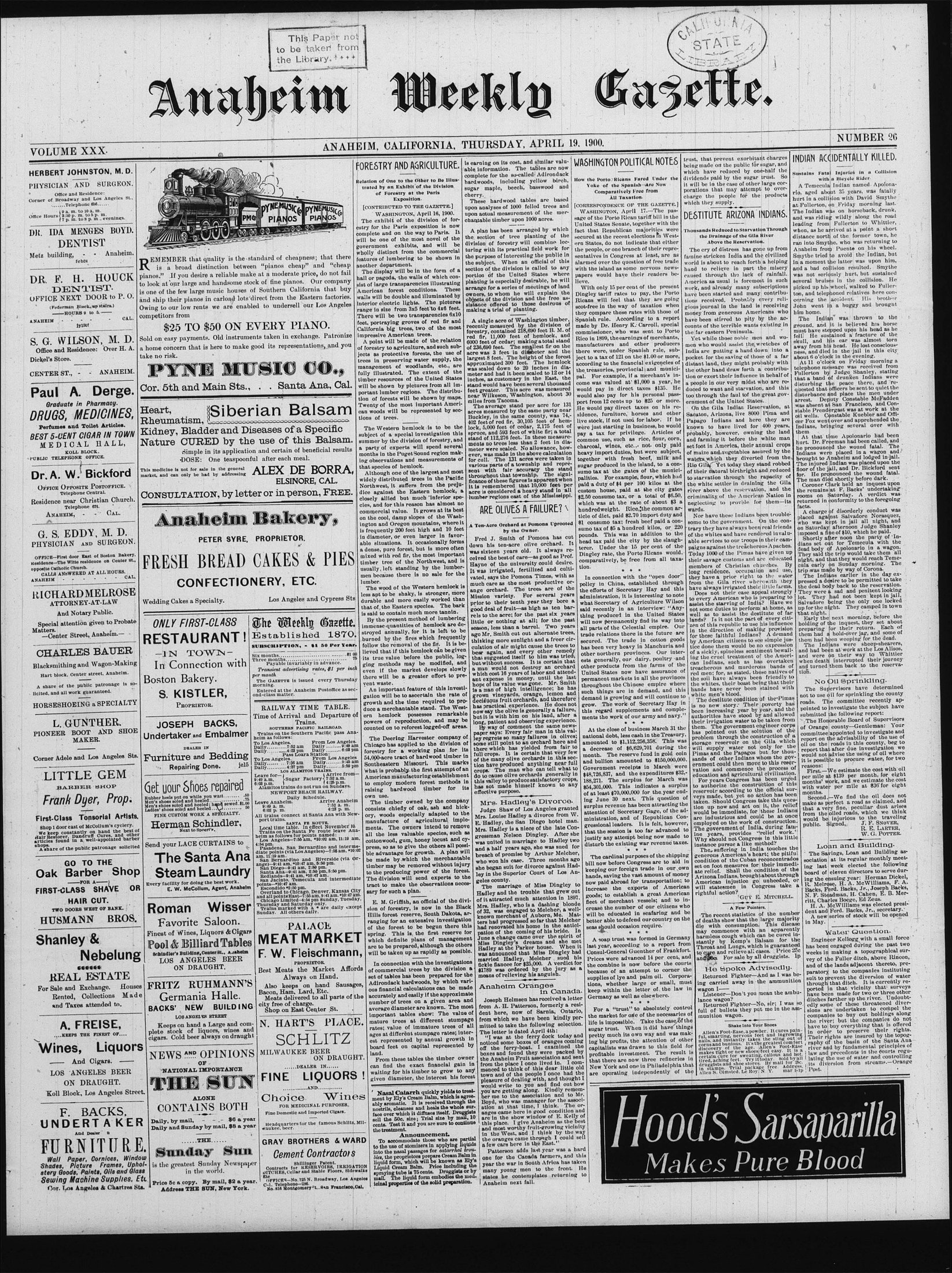
Searchable text
Anaheim
VOLUME XXX.
HERBERT JOHNSTON, M.D.
PHYSICIAN AND SURGEON.
Office and Residence:
Corner of Broadway and Los Angeles St.
Telephone 656...
9 a.m. to 10 a.m.
8:30 p.m. to 5 p.m.
7 p.m. to 8 p.m., evenings.
DR. IDA MENGES BOYD.
DENTIST
Metz building, Anaheim.
feb24
DR. F. H. HOUCK
DENTIST.
OFFICE NEXT DOOR to P.O.
(Federmann Block, up stairs.)
HOURS 9 to 5
ANAHEIM CAL.
jy15tf
S. G. WILSON, M.D.
Office and Residence: Over H. A. Dickel's Store.
CENTER ST., Anaheim.
Paul A. Derge.
Graduate in Pharmacy.
DRUGS, MEDICINES,
Perfumes and Toilet Articles.
BEST 5-CENT CIGAR IN TOWN
MEDICAL HALL,
KOLL BLOCK.
PUBLIC TELEPHONE OFFICE.
This Paper no
to be taken from
the Library.
REMEMBER that quality is the standard of cheapness; that there
is a broad distinction between "pianos cheap" and "cheap
pianos." If you desire a reliable make at a moderate price, do not fail
to look at our large and handsome stock of fine pianos. Our company
is one of the few large music houses of Southern California that buy
and ship their pianos in carload lots direct from the Eastern factories.
Owing to our low rents we are enabled to undersell our Los Angeles
competitors from
$25 TO $50 ON EVERY PIANO.
Sold on easy payments. Old instruments taken in exchange. Patronize
a home concern that is here to make good its representations, and you
take no risk.
PYNE MUSIC CO.,
Cor. 5th and Main Sts., Santa Ana, Cal.
Heart,
Rheumatism,
Kidney, Bladder and Diseases of a Specific
Nature CURED by the use of this Balsam.
Simple in its application and certain of beneficial results
DOSE: One teaspoonful after each meal.
ALEX DE BORRA,
Paul A. Derge.
Graduate in Pharmacy.
DRUGS, MEDICINES,
Perfumes and Toilet Articles.
BEST 5-CENT CIGAR IN TOWN
MEDICAL HALL,
KOLL BLOCK.
PUBLIC TELEPHONE OFFICE.
Dr. A. W. Bickford
OFFICE OPPOSITE POSTOFFICE.
Telephone Central.
Residence near Christian Church.
Telephone 671.
ANAHEIM, CAL.
G. S. EDDY, M. D.
PHYSICIAN AND SURGEON.
OFFICE—First door East of Boston Bakery.
residence—The Witte residence on Center St., opposite Catholic Church.
CALLS ANSWERED AT ALL HOURS.
ANAHEIM, CAL.
RICHARDMELROSE
ATTORNEY-AT-LAW
And Notary Public.
Special attention given to Probate Matters.
—Center Street, Anaheim—
CHARLES BAUER
Blacksmithing and Wagon-Making
Hart block, Center street, Anaheim.
A share of the public patronage is solicited, and all work guaranteed.
HORSESHOEING a SPECIALTY
L. GUNTHER.
PIONEER BOOT AND SHOE MAKER.
Corner Adele and Los Angeles Sts.
LITTLE GEM
BARBER SHOP
Frank Dyer, Prop.
First-Class Tonsorial Artists.
Shop 1 door east of McCollum's cyclery.
We keep constantly on hand the best of hair Restorer, Dandruff Cures, and other articles found in a well-appointed barber shops.
A share of the public patronage solicited
GO TO THE Oak Barber Shop
FOR A FIRST-CLASS SHAVE OR HAIR OUT
Cor. 5th and Main Sts., Santa Ana, Cal.
Heart,
Rheumatism,
Kidney, Bladder and Diseases of a Specific Nature CURED by the use of this Balsam.
Simple in its application and certain of beneficial results
DOSE: One teaspoonful after each meal.
This medicine is not for sale in the general market, and can only be had by addressing ALEX DE BORRA,
ELSINORE, CAL.
CONSULTATION, by letter or in person, FREE.
Anaheim Bakery,
PETER SYRE, PROPRIETOR.
FRESH BREAD CAKES & PIES CONFECTIONERY, ETC.
Wedding Cakes a Specialty. Los Angeles and Cypress Sts.
ONLY FIRST-CLASS RESTAURANT!
—IN TOWN—
In Connection with Boston Bakery.
S. KISTLER,
PROPRIETOR.
JOSEPH BACKS,
Undertaker and Embalmer
DEALER IN
Furniture and Bedding Repairing Done. je15
Get your Shoes repaired
Rubber heels put on while you want...50
Men's shoes soled and heeled...75
Men's shoes soled and heeled; hand sewed $1.00
Ladies' shoes soled and heeled...50
FINE CUSTOM WORK A SPECIALTY.
Herman Schindler,
Next to Spoerl's.
Send your LACE CURTAINS to The Santa Ana Steam Laundry
Every facility for doing the best work.
E. W. McCollum, Agent, Anaheim
The Weekly Gazette,
Established 1870.
SUBSCRIPTION, - $1 50 Per Year
Six months....$1 00
Three months....$75
Payable invariably in advance.
Transient advertising rates, $1 per incipient month.
The GAZETTE is issued every Thursday morning.
Entered at the Anaheim Postoffice as second-class matter.
RAILWAY TIME TABLE.
Time of Arrival and Departure of Trains.
SOUTHERN PACIFIC RAILROAD.
Trains on the Southern Pacific pass Anaheim as follows:
To Los Angeles. From Los Angeles Daily...7:52 am Daily...9:49 am Daily...4:23 pm Daily...6:03 pm Pass Loara Station:
To Los Angeles. From Los Angeles Daily...7:56 am Daily...9:45 am Daily...4:37 pm Daily...5:59 pm LOS ALAMITOS TRAINS.
Leave for...
9:49 a.m. Sugar Factory 7:52 a.m. 4:25 p.m.
Alamitos trains do not run on Sundays.
NEWPORT BEACH RAILWAY.
Daily Schedule.
Leave Anaheim. Arrive Anaheim 9:49 a.m. 7:52 a.m. 4:25 p.m.
All trains connect at Santa Ana with Newport trains.
SANTA FE ROUTE.
Local time table. In effect November 10.
Trains on the Santa Fe route leave Anaheim as follows for points named:
Los Angeles—7:55 am, *10:02 am, 11:19 am
Pasadena, San Bernardino and intermidiate points (via Los Angeles)—7:55 am, *10:19 am, 11:19 am
San Bernardino and Riverside (via Orange)—9:41 am, *10:47 am, 5:56 pm
San Diego—9:41 am, 2:59 pm
Santa Ana—9:41 am, 2:59 pm
Redlands—9:41 am, *10:47 am
San Jacinto, Temecula and intermedia points—*10:47 am.
Escondido*2:50 pm
Overland to Chicago, Denver, Kansas City and all points East—7:55 am, *9:41 am, *10:47 am
Frank Dyer, Prop.
First-Class Tonsorial Artists.
Shop 1 door east of McCollum's cyclery.
We keep constantly on hand the best of hair Restorer, Dandruff Cures, and other articles found in a well-appointed barber shops.
A share of the public patronage solicited
GO TO THE Oak Barber Shop
FOR A FIRST-CLASS SHAVE OR HAIR CUT.
TWO DOORS WEST OF BANK.
HUSMANN BROS.
Shanley & Nebelung
REAL ESTATE
For Sale and Exchange. Houses Rented, Collections Made and Taxes attended to.
A. FREISE,
KEEPS THE FINEST OF...
Wines, Liquors
And Cigars.
LOS ANGELES BEER ON DRAUGHT.
Koll Block, Los Angeles Street.
F. BACKS,
UNDERTAKER
And Dealer in FURNITURE.
Wall Paper, Cornices, Window Shades, Picture Frames, Upholstery Goods, Paints, Oils and Glass Sewing Machine Supplies, Etc.
Cor. Los Angeles & Chartres Sts.
Herman Schindler,
Next to Speer's.
Send your LACE CURTAINS to The Santa Ana Steam Laundry
Every facility for doing the best work.
E. W. McCollum, Agent, Anaheim
Roman Wisser
Favorite Saloon.
Finest of Wines, Liquors & Cigars Pool & Billiard Tables
Schindler's Building, Center St., Anaheim
LOS ANGELES BEER ON DRAUGHT.
FRITZ RUHMANN'S Germania Halle.
BACKS' NEW BUILDING
LOS ANGELES STREET
Keeps on hand a Large and complete stock of liquors, wines and cigars. Cold beer always on draught.
NEWS AND OPINIONS OF NATIONAL IMPORTANCE
THE SUN
ALONE CONTAINS BOTH
Daily, by mail, $6 a year
Daily and Sunday by mail, $8 a year
THE Sunday Sun is the greatest Sunday Newspaper in the world.
Price 5c a copy. By mail, $2 a year.
Address THE SUN, New York.
PALACE MEAT MARKET
F. W. Fleischmann
PROPRIETOR.
Best Meats the Market Afford Always on Hand.
Also keeps on hand Sausage Bacon, Ham, Lard, Etc.
Meats delivered to all parts of the city free of charge.
Shop on East Center St.
N. HART'S PLACE
SCHLITZ
MILWAUKEE BEER ON DRAUGHT
DEALER IN...
FINE LIQUORS
AND...
Choice Wine FOR MEDICINAL PURPOSES,
Fine Domestic and Imported Cigars.
Headquarters for the famous Schlitz, waukee, beer.
GRAY BROTHERS & WAKEE
Cement Contractors
Shillinger Patent.
Contracts for RESERVOIRS, IRRIGATION CHES, Cellar and Stable Floors, Side Ete
OFFICES—No. 125 N. Broadway, Los Ancal Telephone—236.
No. 916 Montgomery St., San Francisco,
This Paper not to be taken from the Library.
ANAHEIM, CALIFORNIA, THURSDAY, APRIL 19, 1900.
FORESTRY AND AGRICULTURE.
Relation of One to the Other to Be Illustrated by an Exhibit of the Division of Forestry at the Paris Exposition.
[CONTRIBUTED TO THE GAZETTE.]
WASHINGTON, April 16, 1900.
The exhibit of the division of forestry for the Paris exposition is now complete and on the way to Paris. It will be one of the most novel of the government exhibits, and will be wholly distinct from the commercial features of lumbering to be shown in another department.
The display will be in the form of a hall or pagoda, the walls of which consist of large transparencies illustrating American forest conditions. These walls will be double and illuminated by interior electric lights. The pictures range in size from 3x5 feet to 4x6 feet. There will be two transparencies 6x10 feet, portraying groves of red fir and California big trees, two of the most impressive American trees.
A point will be made of the relation of forestry to agriculture, and such subjects as protective forests, the use of trees in preserving water supply, the management of woodlands, etc., are fully illustrated. The extent of the timber resources of the United States will be shown by pictures from all important lumber regions. The distribution of forests will be shown by maps. Twenty of the most important American woods will be represented by sections of trees.
The Western hemlock is to be the subject of a special investigation this summer by the division of forestry, and a party of experts will spend several months in the Puget Sound region making observations and measurements of that species of hemlock.
Although one of the largest and most is earning on its cost, and similar valuable information. The tables are now complete for the so-called Adirondack hardwoods, including yellow birch, sugar maple, beech, basswood and cherry.
These hardwood tables are based upon analyses of 1000 felled trees and upon actual measurement of the merchantable timber upon 1000 acres.
A plan has been arranged by which the section of tree planting of the division of forestry will combine lecturing with its practical field work for the purpose of interesting the public in the subject. When an official of this section of the division is called to any portion of the United States where planting is especially desirable, he will arrange for a series of meetings of land owners, to whom he will explain the objects of the division and the free assistance offered to those desirous of making a trial of planting.
A single acre of Washington timber, recently measured by the division of forestry, contained 218,690 feet B.M. of red fir, 11,000 feet of hemlock, and 6000 feet of cedar; making a total stand of 238,690 feet. The smallest fir on the acre was 3 feet in diameter and the largest 8 feet. The height of the forest approximated 300 feet. The hemlock was scaled down to 20 inches in diameter and had it been scaled to 12 or 14 inches, as customary in the East, the stand would have been several thousand feet greater. This acre was measured near Wilkeson, Washington, about 30 miles from Tacoma.
The average stand per acre for 131 acres measured by the same party near Buckley, in the same county, was 74,-402 feet of red fir, 30,105 feet of hemlock, 5,000 feet of cedar, 2,175 feet of spruce, and 593 feet of white fir; a total stand of 112,276 feet. In these measurements no trees less than 2 feet in diameter were scaled. No allowance, however, was made in the above calculation for cull. The 131 acres were taken in various parts of a township and represent with fair accuracy the stand throughout that township.
WASHINGTON POLITICAL NOTES.
How the Porto Rican tariff bill in the United States Senate, together with the fact that Republican majorities were secured at the recent elections in Western States, do not indicate that either the people, or one branch of their representatives in Congress at least, are alarmed over the question of free trade with the island as some nervous new papers would have their readers b lieve.
With only 15 percent of the present Dingley tariff rates to pay, the Porto Ricans will feel that they are going Scot-free in the way of taxation when they compare these rates with those in Spanish rule. According to a report made by Dr. Henry K. Carroll, commissioner, who was sent to Porto Rico in 1899, the earnings of merchandise manufacturers and other producers there were under Spanish rule, subject to a tax of 121 on the $1.00 or more according to the financial exigencies the treasuries, provincial and municipal. For example, if a merchant's come was valued at $1,000 a year, would pay in direct taxes $135. would also pay for his personal payment from 12 cents up to $25 or more. He would pay direct taxes on his residence, furniture, horses and other live stock, if not used for labor. If were just starting in business, he would pay a tax for privilege. Articles common use, such as rice, flour, charcoal, wines, etc., not only provide heavy import duties but were subject together with fresh beef, milk sugar produced in the island, to a sumo tax at the gates of the mun...
The Western hemlock is to be the subject of a special investigation this summer by the division of forestry, and a party of experts will spend several months in the Puget Sound region making observations and measurements of that species of hemlock.
Although one of the largest and most widely distributed trees in the Pacific Northwest, it suffers from the prejudice against the Eastern hemlock, a closely allied but much inferior species, and for this reason has almost no commercial value. It grows at its best on the cool, damp slopes of the Washington and Oregon mountains, where it is frequently 200 feet high and 10 feet in diameter, or even larger in favorable situations. It occasionally forms a dense, pure forest, but is more often mixed with red fir, the most important timber tree of the Northwest, and is usually left standing by the lumbermen because there is no sale for the lumber.
The wood of the Western hemlock is less apt to be shaky, is stronger, more durable and more easily worked than that of the Eastern species. The bark is said to contain much more tannin.
By the present method of lumbering immense quantities of hemlock are destroyed annually, for it is left to be burned by the fires which frequently follow the removal of the fir. It is believed that if this hemlock can be given its true value before the public, logging methods may be modified, and even if the market develops slowly there will be a greater effort to prevent waste.
An important feature of this investigation will be to ascertain the rate of growth and the time required to produce a merchantable stand. The Western hemlock possesses remarkable powers of reproduction, and may be counted on to reforest logged-off areas.
The Deering Harvester company of Chicago has applied to the division of forestry for a working plan for its 54,000-acre tract of hardwood timber in Southeastern Missouri. This marks what is probably the first attempt of an American manufacturing establishment to employ modern forest methods in raising hardwood timber for its own use.
The timber owned by the company consists chiefly of oak, ash and hickory, woods especially adapted to the manufacture of agricultural implements. The owners intend to remove all the less valuable species, such as cottonwood, gum, honey locust and cypress, so as to give the others all possible advantage for growth. A plan will be made by which the merchantable timber may be removed without injury to the producing power of the forest. The division will send experts to the tract to make the observations necessary for such a plan.
The average stand per acre for 131 acres measured by the same party near Buckley, in the same county, was 74-402 feet of red fir, 30,105 feet of hemlock, 5,000 feet of cedar, 2,175 feet of spruce, and 593 feet of white fir; a total stand of 112,276 feet. In these measurements no trees less than 2 feet in diameter were scaled. No allowance, however, was made in the above calculation for cull. The 131 acres were taken in various parts of a township and represent with fair accuracy the stand throughout that township. The significance of these figures is apparent when it is remembered that 10,000 feet per acre is considered a heavy stand in all lumber regions east of the Mississippi.
ARE OLIVES A FAILURE? \
A Ten-Acro Orchard at Pomona Uprooted by the Owner.
Fred J. Smith of Pomona has cut down his ten-acre olive orchard. It was sixteen years old. It always received the best care—as good as Prof. Hayne of the university could desire. It was irrigated, fertilized and cultivated, says the Pomona Times, with as much care as the most productive orange orchard. The trees are of the Mission variety. For several years prior to their tenth year they bore a good deal of fruit—as high as ten barrels to the acre; for the past six years little or nothing at all; for the past season, less than a barrel. Two years ago Mr. Smith cut out alternate trees, thinking more sunlight and a freer circulation of air might cause the trees to bear again, and every other remedy that suggested itself to him was tried, but without success. It is certain that a man would not destroy an orchard which cost 16 years of labor and attendant expense in money, until the last hope of its value was gone. Mr. Smith is a man of high intelligence; he has grown vineyards, orange, lemon and deciduous fruit orchards, and therefore has practical experience. He does not now say the olive is generally a failure, but it is with him on his land, after a long, patient and observing experience.
By way of comment the same newspaper says: Every fair man in this valley regrets so many failures in olives; some still point to an orchard here and there which has yielded from fair to full crops. It is certain that very few of the many olive orchards in this section have produced anything near full crops. The man who can tell what to do cause olive orchards generally in this valley to produce satisfactory crops, has not made himself known to any effective purpose.
Mrs. Hadley's Divorce.
Judge Shaw of Los Angeles granted Mrs. Louise Hadley a divorce from W. E. Hadley, the San Diego hotel man. Mrs. Hadley is a niece of the late Congressman Nelson Dingley. After she was united in marriage to Hadley two and a half years ago, she was sued for breach of promise by Arthur Melcher. Three months ago she began suit for divorce against Hadley in the Superior Court of Los Angeles county.
The marriage of Miss Dingley to Hadley and the trouble that grew out of it attracted much attention in 1897.
For example, if a merchant's come was valued at $1,000 a year, he would pay in direct taxes $135. He would also pay for his personal payment from 12 cents up to $25 or more.
He would direct taxes on his sideline furniture, horses and other live stock, if not used for labor. If he were just starting in business, he would pay a tax for privilege. Articles common use, such as rice, flour, charcoal, wines, etc., not only require heavy import duties, but were subject together with fresh beef, milk or sugar produced in the island, to a sumo tax at the gates of the municipalities. For example, flour, which paid a duty of $4 per 100 kilos at custom house, paid at the city gate $2.50 consumo tax, or a total of $6 which was at the rate of about $hundredweight. Rice,the common title of diet,paid $2.70 import duty,$1 consumo tax; fresh beef paid a sumo tax of $5 a hundred kilos,或 pounds. This was in addition to head tax paid the city by the slave terer.Under the 15 per cent tax will now permanently find its way all parts of the Celestial empire trade relations there in the future secured.The trade in cotton gins has been very heavy in Manchuria other northern provinces.Ours eat generally our dairy,poultry other products from the farms of United States now have assurance permanent markets in all the provinces throughout the Chinese empire with such things are in demand,and demand is growing and will continue grow.The work of Secretary Hess this regard supplements and complements the work of our army and navy.
At the close of business March 3 national debt,less cash in the Treasury amounted to $1,112,256,358.This decrease of $6,629,701 during month.The reserve fund in gold and bullion amounted to $150,000 Government receipts in March $48,726,837,and the expenditures 188,271.The surplus for March $54,301,000.This indicates a sum of at least $70,000,000 for the year June 30 next.This question surplus revenue has been attracting attention of Secretary Gage.ofthe ministry,andofRepublican congressional leaders.Its felt,how that the session is too far advanced justify any attempt being now made disturb the existing war revenue.
The cardinal purposes of the ship bill now before Congress are to keep our foreign trade in our hands,saving the vast amount of new paid abroad for transportation increase the exports of America goods;to establish a great American
The timber owned by the company consists chiefly of oak, ash and hickory, woods especially adapted to the manufacture of agricultural implements. The owners intend to remove all the less valuable species, such as cottonwood, gum, honey locust and cypress, so as to give the others all possible advantage for growth. A plan will be made by which the merchantable timber may be removed without injury to the producing power of the forest. The division will send experts to the tract to make the observations necessary for such a plan.
E. M. Griffith, an official of the division of forestry, is now in the Black Hills forest reserve, South Dakota, arranging for an extensive investigation of the forest to be begun there this spring. This is the first reserve for which definite plans of management are to be prepared, although the others will be taken up as rapidly as possible.
In connection with the investigations of commercial trees by the division a set of tables has been prepared for the Adirondack hardwoods, by which various financial calculations can be made accurately and easily if the approximate number of trees on a given area and average diameter are known. The most important tables show: The value of mature trees at different stumpage rates; value of immature trees of all ages at different stumpage rates; interest represented by annual growth in board feet on capital represented by land.
From these tables the timber owner can find the exact financial gain in waiting for his timber to grow to any given diameter, the interest his forest
Nasal Catarrh quickly yields to treatment by Ely's Cream Balm, which is agreeably aromatic. It is received through the nostrils, cleanses and heals the whole surface over which it diffuses itself. Druggists sell the 50c. size; Trial size by mail, 10 cents. Test it and you are sure to continue the treatment.
Announcement.
To accommodate those who are partial to the use of atomizers in applying liquids into the nasal passages for catarrhal troubles, the proprietors prepare Cream Balm in liquid form, which will be known as Ely's Liquid Cream Balm. Price including the spraying tube is 75 cents. Druggists or by mail. The liquid form embodies the medicinal properties of the solid preparation.
Mrs. Hadley's Divorce.
Judge Shaw of Los Angeles granted Mrs. Louise Hadley a divorce from W. E. Hadley, the San Diego hotel man. Mrs. Hadley is a niece of the late Congressman Nelson Dingley. After she was united in marriage to Hadley two and a half years ago, she was sued for breach of promise by Arthur Melcher, who won his case. Three months ago she began suit for divorce against Hadley in the Superior Court of Los Angeles county.
The marriage of Miss Dingley to Hadley and the trouble that grew out of it attracted much attention in 1897. Mrs. Hadley, who is a dashing blonde of 32, was engaged to Melcher, a well-known merchant of Auburn, Me. Matters had progressed so far that Melcher had renovated his home in the anticipation of the coming of his bride. In June a change came over the spirit of Miss Dingley's dreams and she met Hadley at the Parker house. When it was announced that Miss Dingley had married Hadley, Melcher sued his fickle fiancée for $25,000. A verdict for $1789 was ordered by the jury as a means of relieving his anguish.
Anaheim Oranges
in Canada.
Joseph Helmsen has received a letter from A. H. Patterson, formerly a resident here, now of Sarnia, Ontario, from which we have been kindly permitted to take the following selection.
The letter is dated April 4th:
"I was at the ferry dock today and noticed some boxes of oranges coming off the ferry-boat. I examined the boxes and found they were packed by the Anaheim Fruit association and sent from the place I once lived in. I commenced to think of this dear little old town and of the people I once had the pleasure of dealing with, and thought I would write to you and find out how you are getting along. Kindly remember me to the association and to Mr. Boyd, who was manager for the association at that time, I think. The oranges came here in good condition and are in the show window of E. Kelly of this place. I give Anaheim as the best and most worthy fruit-growing vicinity in the West, and I think by the way the oranges came through I could sell a few cars here in the East."
Patterson adds last year was a hard one for the Canada farmers, and this year the war in South Africa has taken many young men to the front. He states he contemplates returning to Anaheim next fall.
INGTON POLITICAL NOTES
Porto Ricans Fared Under the
Ree of the Spanish Are Now
Comparatively Free from
All Taxation.
PONDENCE OF THE GAZETTE.
INGTON, April 17.—The pasthe Porto Rican tariff bill in the
States Senate, together with the
Republican majorities were
at the recent elections in Westernes, do not indicate that either
role, or one branch of their represents in Congress at least, are as
over the question of free trade
island as some nervous newswould have their readers beonly 15 per cent of the present
tariff rates to pay, the Porto
will feel that they are going
in the way of taxation when
compare these rates with those of
rule. According to a report by
Dr. Henry K. Carroll, special
sioner, who was sent to Porto
1899, the earnings of merchants,
stuffers and other producers
were, under Spanish rule, subtaxed of 121 on the $1.00 or more,
going to the financial exigencies of
subscribes, provincial and municipal
example, if a merchant's invasion valued at $1,000 a year, he
pay in direct taxes $135. He also pay for his personal passon 12 cents up to $25 or more.
He would pay direct taxes on his refurniture, horses and other
rick, if not used for labor. If he
first starting in business, he would
tax for privilege. Articles of
use, such as rice, flour, corn,
al, wines, etc., not only paid
import duties, but were subject,
or with fresh beef, milk and
produced in the island, to a contax at the gates of the municipal trust, that prevent exorbitant charges being made on the public for sugar, and which have reduced by one-half the dividends paid by the sugar trust. So it will be in the case of other large corporsations that may attempt to overcharge the people for the products which they supply.
DESTITUTE ARIZONA INDIANS.
Thousands Reduced to Starvation Through
the Drainage of the Gila River
Above the Reservation.
The cry of distress has gone up from famine stricken India and the civilized world is about to reach forth a helping hand to relieve in part the misery caused through the lack of rainfall. America as usual is foremost in such work, and already many subscriptions have been started and many contributions received. Probably every religious journal in the land is receiving money from generous Americans who have been stirred to pity by the accounts of the terrible wants existing in the far eastern Peninsula.
Yet while those noble men and women who would assist the wretches of India are putting a hand down into a pocket for the saving of those of a far distant land, they might probably with the other hand draw forth a contribution or exert their influence in behalf of a people in our very midst who are reduced to want and starvation, and this too through the fault of the great government of the United States.
On the Gila Indian Reservation, at Sacaton, Arizona, live 8000 Pima and Papago Indians and here they are known to have lived for 400 years, probably, however, owning the land and farming it before the white man set foot in America, their annual crops of maize and vegetables assured by the waters which they diverted from the Rio Gila. Yet today they stand robbed of their natural birthright and reduced
INDIAN ACCIDENTALLY KILLED.
Sustains Fatal Injuries in a Collision with a Bicycle Rider.
A Temecula Indian named Apolonario, aged about 35 years, was fatally hurt in a collision with David Smythe at Fullerton, on Friday morning last. The Indian was on horseback, drunk, and was riding wildly along the road leading from Fullerton to Whittier, when, as he arrived at a point a short distance north of the former town, he ran into Smythe, who was returning to Anaheim from Puente on his wheel. Smythe tried to avoid the Indian, but in a moment the latter was upon him, and a bad collision resulted. Smythe was not seriously hurt, but sustained several bruises in the collision. He picked up his wheel, walked to Fullerton, and telephoned relatives here concerning the accident. His brother John went in a buggy and brought him home.
The Indian was thrown to the ground, and it is believed his horse must have stepped upon his head as he fell. He sustained a fracture of the skull, and his ear was almost torn away from his head. He lost consciousness, and died in the jail in this city about 6 o'clock in the evening.
At 11 o'clock on Friday morning a telephone message was received from Fullerton by Judge Shanley, stating that a band of drunken Indians were disturbing the peace there, and requested that officers be sent to quiet the disturbance and place the men under arrest. Deputy Constable McFadden was absent at San Francisco, and Constable Prendergast was at work at the oil wells. Constable Kuebler and Officer Fox went over and apprehended the Indians, bringing several over with them.
At that time Apolonaario had been hurt. Dr. Freeman had been called, and he pronounced the wound fatal. The Indians were placed in a wagon and brought to Anaheim and lodged in jail. The injured Indian was placed upon the floor of the jail, and Dr. Bickford sent for. He pronounced the wound fatal.
For example, if a merchant's interest was valued at $1,000 a year, he may pay for his personal passport 12 cents up to $25 or more.
Pld direct taxes on his residence, furniture, horses and other goods, if not used for labor. If he starts in business, he would tax for privilege. Articles of use, such as rice, flour, corn, walnuts, wines, etc., not only paid import duties, but were subject to fresh beef, milk and produced in the island, to a concession at the gates of the municipality. For example, flour, which had a duty of $4 per 100 kilos at the house, paid at the city gates consumo tax, or a total of $6.50 was at the rate of about $3 a dayweight. Rice, the common ardu diet, paid $2.70 import duty and consumo tax; fresh beef paid a cost of $5 a hundred kilos, or 220. This was in addition to the tax paid by the city by the slaughter. Under the 15 percent of the pay rate, the Porto Ricans would, respectively, be free from all taxa-
Connection with the "open door" in China, established through ports of Secretary Hay and this institution, is interesting to note Secretary of Agriculture Wilson recently in an interview: "Any introduced in the United States now permanently finds its way into parts of the Celestial empire. Our relations there in the future are bad. The trade in cotton goods been very heavy in Manchuria and northern provinces. Our inter-generally, our dairy, poultry and products from the farms of the And States now have assurance of present markets in all the provinces without the Chinese empire where things are in demand, and this end is growing and will continue to.
The work of Secretary Hay in regard supplements and completes the work of our army and navy."
The close of business March 31 the final debt, less cash in the Treasury, amounted to $1,112,256,358. This increase to $6,629,701 during the month. The reserve fund in gold coin amounted to $150,000,000. Payment receipts in March were 266,837, and the expenditures $327.1. The surplus for March was 101,000. This indicates a surplus least $70,000,000 for the year end-June 30 next. This question of revenue has been attracting attention of Secretary Gage, of the administration, and of Republican Consolateral leaders. It is felt, however, that the session is too far advanced to justify any attempt being now made to curb the existing war revenue taxes.
The cardinal purposes of the shipping now before Congress are to aid in bringing our foreign trade in our own fields, saving the vast amount of money paid abroad for transportation; to lease the exports of American ships; to establish a great American nation or exert their influence in behalf of a people in our very midst who are reduced to want and starvation, and this too through the fault of the great government of the United States.
On the Gila Indian Reservation, at Sacaton, Arizona, live 8000 Pima and Papago Indians and here they are known to have lived for 400 years, probably, however, owning the land and farming it before the white man set foot in America, their annual crops of maize and vegetables assured by the waters which they diverted from the Rio Gila. Yet today they stand robbed of their natural birthright and reduced to starvation through the rapacity of the white settler in draining the Gila river above the reservation, and the criminality of the American Nation in neglecting to provide for them—its wards.
Nor have these Indians been troublesome to the government. On the contrary they have always been real friends of the whites and have rendered invaluable services to our troops in their campaigns against the treacherous Apaches. Today 1000 of the Pimas have given up their savage customs and are educated members of Christian churches. By long residence, occupation and use, they have a prior right to the water from the Gila river wherewith they have always irrigated their little farms.
Does not their case appeal strongly to every American who is preparing to assist the starving of India? Have we not some duties to perform at home, as well as to assist the destitute of far lands? Is it not the part of every citizen of this republic to use his influence in the direction of making provision for these faithful Indians? A demand by American citizens to see simple justice done them would be no expression of a sickly, spineless sentiment bewailing the cruel treatment of the American Indians, such as has overtaken treacherous and murderous bands of red men; for, as stated, these natives of the soil have always been friendly to the whites, their boast being that their hands have never been stained with white men's blood.
The destitute condition of the Pimas is no new story. Their poverty has been increasing year by year, and the authorities have stood by and allowed their irrigation water to be taken from them. The government engineer corps has pointed out the solution of the problem through the construction of a storage reservoir on the Gila which will supply water not only for the Pimas and the Papagos but for thousands of other Indians whom the government could then move to this reservation and commence the process of education and agricultural civilization.
For years Congress has been urged to authorize the construction of this reservoir according to the official surveys made, but yet no action has been taken. Should Congress take this question up now and act on it, the relief would be immediate; for these Indians are industrious and could be at once employed on the work of construction. The government of India, during famine years, provides "relief work." Why should not Congress in this little instance pursue a like method?
The suffering in India touches the generous American's heart; the pitiful condition of the Cuban reconcentrado set on foot measures for their immediate relief. Shall the condition of the Arizona Indians brought about through American injustice go unheeded, or will statesmen in Congress take a rightful action?
GUY E. MITCHELL.
At that time Apolonario had been hurt. Dr. Freeman had been called, and he pronounced the wound fatal. The Indians were placed in a wagon and brought to Anaheim and lodged in jail. The injured Indian was placed upon the floor of the jail, and Dr. Bickford sent for. He pronounced the wound fatal. The man died shortly before dark.
Coroner Clark held an inquiry upon the remains at F. Backs' undertaking rooms on Saturday. A verdict was returned in conformity to the foregoing facts.
A charge of disorderly conduct was placed against Salvadore Norasquez, who was kept in jail all night, and on Saturday afternoon Judge Shanley imposed a fine of $10, which he paid.
Shortly after noon the party of Indians set out for Temecula with the dead body of Apolonario in a wagon. They said the trip would take them all night, and that they would reach Temecula early on Sunday morning. The trip was made by way of Corona.
The Indians earlier in the day expressed a desire to be permitted to take the dead body back to the reservation. They were a sad and penitent looking lot. They had not been kept in jail; Salvadore being only one locked up for the night. They camped in town that night.
Early next morning, before the holding of the inquest, they set about preparing for their return. Each of them had a hold-over jag, and some of them had been weeping for the dead.
The Indians were sheep-shearers, and had been at work at the Los Alisos, and were on their way to Whittier when death interrupted their journey and turned them back to the reservation.
No Oil Sprinkling.
The Supervisors have determined not to use oil for sprinkling the county roads. The committee recently appointed to investigate the subject have submitted the following report:
The Honorable Board of Supervisors of Orange county—Gentleman: Your committee appointed to investigate and report on the advisability of the use of oil on the roads in this county; beg to report that after due investigation we would not advise using oil where it is possible to procure water; for two reasons:
First—We estimate the cost with oil per mile at $139 per month; for eight months' work, and we estimate the cost with water per mile at $36 for eight months.
Second—We find that oil does not make as perfect a road as claimed; and that a very fine, peculiar dust arises from the oiled roads, which we think would be injurious to the traveling public. Signed,
J.F. SNover,
R.E.LARTER,
W.G.POTTER.
Loan and Building.
The Savings, Loan and Building association at its regular monthly meeting last week elected the following board of eleven directors to serve during the ensuing year: Herman Dickel,
R.Melrose,
H.A.McWilliams,
F.A.Backs,
Ferd.Backs,
Jr., Joseph Backs,
N.F.Steadman,
H.Cahen,
E.B.MerCharles Rooge Ed Zeus."
Hood's Sarsaparilla
Makes Pure Blood