anaheim-gazette 1900-04-12
Scanned page
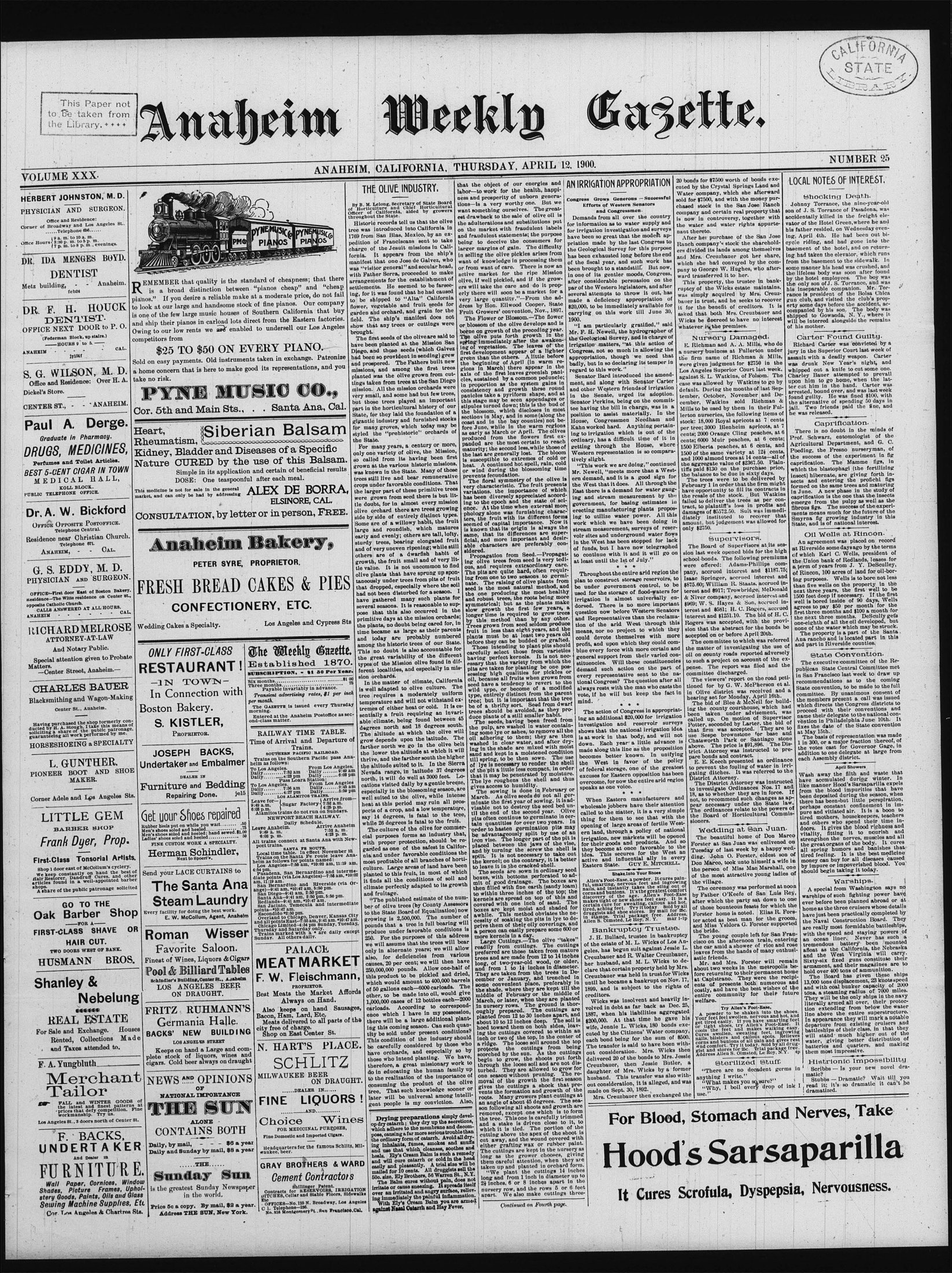
Searchable text
This Paper not to be taken from the Library.
Anaheim
VOLUME XXX.
HERBERT JOHNSTON, M.D.
PHYSICIAN AND SURGEON.
Office and Residence:
Corner of Broadway and Los Angeles St.
Telephone 656...
9 a.m. to 10 a.m.
3:30 p.m. to 8 p.m.
7 p.m. to 8 p.m., evenings.
DR. IDA MENGES BOYD.
DENTIST
Metz building, Anaheim.
feb24
DR. F. H. HOUCK
DENTIST.
OFFICE NEXT DOOR to P.O.
(Federman Block, up stairs.)
HOURS 9 to 5
ANAHEIM CAL.
jy154f
S. G. WILSON, M.D.
Office and Residence: Over H.A. Dickel's Store.
CENTER ST., Anaheim.
Paul A. Derge.
Graduate in Pharmacy.
DRUGS, MEDICINES,
Perfumes and Toilet Articles.
BEST 5-CENT CIGAR IN TOWN
REMEMBER that quality is the standard of cheapness; that there is a broad distinction between "pianos cheap" and "cheap pianos." If you desire a reliable make at a moderate price, do not fail to look at our large and handsome stock of fine pianos. Our company is one of the few large music houses of Southern California that buy and ship their pianos in carload lots direct from the Eastern factories. Owing to our low rents we are enabled to undersell our Los Angeles competitors from
$25 TO $50 ON EVERY PIANO.
Sold on easy payments. Old instruments taken in exchange. Patronize a home concern that is here to make good its representations, and you take no risk.
PYNE MUSIC CO.,
Cor. 5th and Main Sts., Santa Ana, Cal.
Heart,
Rheumatism,
Kidney, Bladder and Diseases of a Specific Nature CURED by the use of this Balsam.
Simple in its application and certain of beneficial results
S. G. WILSON, M.D.
Office and Residence: Over H. A.
Dickel's Store.
CENTER ST., - - ANAHEIM.
Paul A. Derge.
Graduate in Pharmacy.
DRUGS, MEDICINES,
Perfumes and Toilet Articles.
BEST 5-CENT CIGAR IN TOWN
MEDICAL HALL,
KOLL BLOCK.
PUBLIC TELEPHONE OFFICE.
Dr. A. W. Bickford
OFFICE OPPOSITE POSTOFFICE.
Telephone Central.
Residence near Christian Church.
Telephone 671.
ANAHEIM, - - CAL.
G. S. EDDY, M. D.
PHYSICIAN AND SURGEON.
OFFICE—First door East of Boston Bakery.
residence—The Witte residence on Center St.,
opposite Catholic Church.
CALLS ANSWERED AT ALL HOURS.
ANAHEIM - - CAL.
RICHARDMELROSE
ATTORNEY-AT-LAW
And Notary Public.
Special attention given to Probate Matters.
—Center Street, Anaheim.
CHARLES BAUER
Blacksmithing and Wagon-Making
Center St., Anaheim.
Having purchased the shop formerly conducted by H. A. Stough, I take this means of soliciting a share of the public patronage, guaranteeing all work performed by me.
HORSESHOEING a SPECIALTY
L. GUNTHER.
PIONEER BOOT AND SHOE MAKER.
Corner Adele and Los Angeles Sts.
LITTLE GEM
BARBER SHOP
Frank Dyer, Prop.
First-Class Tonsorial Artists.
Shop 1 door east of McCollum's cycley.
We keep constantly on hand the best of hair Restorer, Dandruff Cures, and other articles found in a well-appointed barber shops.
A share of the public patronage solicited
PYNE MUSIC CO., Cor. 5th and Main Sts., Santa Ana, Cal.
Heart,
Rheumatism,
Kidney, Bladder and Diseases of a Specific Nature CURED by the use of this Balsam.
Simple in its application and certain of beneficial results
DOSE: One teaspoonful after each meal.
This medicine is not for sale in the general market, and can only be had by addressing ALEX DE BORRA, ELSINORE, CAL.
CONSULTATION, by letter or in person, FREE.
Anaheim Bakery,
PETER SYRE, PROPRIETOR.
FRESH BREAD CAKES & PIES CONFECTIONERY, ETC.
Wedding Cakes a Specialty. Los Angeles and Cypress Sts
ONLY FIRST-CLASS RESTAURANT!
-IN TOWNIn Connection with Boston Bakery.
S. KISTLER,
PROPRIETOR.
JOSEPH BACKS,
Undertaker and Embalmer
DEALER IN
Furniture and Bedding
Repairing Done. jel5
Get your Shoes repaired
Rubber heels put on while you wait...50
Men's shoes soled and heeled...75
Men's shoes soled and heeled; hand sewed.$1.00
Ladies' shoes soled and heeled...50
FINE CUSTOM WORK A SPECIALTY.
Herman Schindler,
Next to Spoerl's.
Send your LACE CURTAINS to The Santa Ana Steam Laundry
The Weekly Gazette.
Established 1870.
SUBSCRIPTION, - $1 50 Per Year.
Six months...$1 00
Three months...$75
Payable invariably in advance.
Transient advertising rates,$1 per inch per month.
The GAZETTE is issued every Thursday morning.
Entered at the Anaheim Postoffice as second-class matter.
RAILWAY TIME TABLE.
Time of Arrival and Departure of Trains.
SOUTHERN PACIFIC RAILROAD.
Trains on the Southern Pacific pass Anaheim as follows:
To Los Angeles.
Daily...7:52 am Dally...9:49 am Dally...4:23 pm Dally...6:08 pm Pass Loa Station:
To Los Angeles.
Daily...7:56 am Dally...9:45 am Dally...4:27 pm Dally...5:59 pm Los ALAMITOS TRAINS.
Leave for—Sugar Factory Arrive from 9:49 a.m. 7:82 a.m. 6:08 p.m.
Alamitos trains do not run on Sundays.
NEWPORT BEACH RAILWAY.
Daily Schedule.
Leave Anaheim.
Arrive Anaheim
9:49 a.m. 7:52 a.m. 6:08 p.m.
All trains connect at Santa Ana with Newport trains.
SANTA FE ROUTE.
Local time table. In effect November 10.
Trains on the Santa Fe route leave Anaheim as follows for points named:
Los Angeles—7:56 am, *10:02 am, 11:19 am
4:54 pm.
Passadena, San Bernardino and intermediate points (via Los Angeles)—7:56 am, *10:00 am, 11:19 am
San Bernardino and Riverside (via Orange)—9:41 am, 5:50 pm.
San Diego—9:41 am, 2:50 pm.
Santa Ana—9:41 am, 2:50 pm, 5:50 pm.
LITTLE GEM
BARBER SHOP
Frank Dyer, Prop.
First-Class Tonsorial Artists.
Shop 1 door east of McCollum's cyclery.
We keep constantly on hand the best of hair Restorer, Dandruff Cures, and other articles found in a well-appointed barber shops.
A share of the public patronage solicited
GO TO THE Oak Barber Shop
FOR A FIRST-CLASS SHAVE OR HAIR CUT.
TWO DOORS WEST OF BANK.
HUSMANN BROS.
Shanley & Nebelung
REAL ESTATE
For Sale and Exchange. Houses Rented, Collections Made and Taxes attended to.
F. A. Yungbluth
Merchant Tailor
FALL and WINTER GOODS of the latest and finest patterns at prices that defy competition. Fine workmanship. Try us.
Los Angeles St., 3 doors north of Center St.
F. BACKS,
UNDERTAKER
And Dealer in FURNITURE.
Wall Paper, Cornices, Window Shades, Picture Frames, Upholstery Goods, Paints, Oils and Glass Sewing Machine Supplies, Etc.
Cor. Los Angeles & Chartres Sts.
Get your Shoes repaired
Rubber heels put on while you wait...50
Men's shoes soled and heeled...75
Men's shoes soled and beeled; hand sewed $1.00
Ladies' shoes soled and heeled...50
FINE CUSTOM WORK A SPECIALTY.
Herman Schindler,
Next to Spoerl's.
Send your LACE CURTAINS to The Santa Ana Steam Laundry
Every facility for doing the best work.
E. W. McCollum, Agent, Anaheim
Roman Wisser
Favorite Saloon.
Finest of Wines, Liquors & Cigars
Pool & Billiard Tables
Schindler's Building, Center St., Anaheim
LOS ANGELES BEER ON DRAUGHT.
FRITZ RUHMANN'S Germania Halle.
BACKS' NEW BUILDING
LOS ANGELES STREET
Keeps on hand a Large and complete stock of liquors, wines and cigars. Cold beer always on draught
NEWS AND OPINIONS OF NATIONAL IMPORTANCE
THE SUN
ALONE CONTAINS BOTH
Daily, by mail, - - - $8 a year
Daily and Sunday by mail, $8 a year
THE
Sunday Sun is the greatest Sunday Newspaper in the world.
Price 5c a copy. By mail, $2 a year.
Address THE SUN, New York.
PALACE MEAT MARKET
F. W. Fleischmann PROPRIETOR.
Best Meats the Market Afford Always on Hand.
Also keeps on hand Sausage Bacon, Ham, Lard, Etc.
Meats delivered to all parts of the city free of charge.
Shop on East Center St.
N. HART'S PLACE
SCHLITZ
MILWAUKEE BEER ON DRAUGHT
DEALER IN....FINE LIQUORS
AND....Choice Wine FOR MEDICINAL PURPOSES,
Fine Domestic and Imported Cigars.
Headquarters for the famous Schlitz, waukee, beer.
GRAY BROTHERS & WAKECEMENT CONTRACTORS
Shillinger Patent.
Contracts for RESERVOIRS, IRRIGATION, FITCHES, Cellar and Stable Floors, Sidewet Ete.
OFFICES—No. 125 N. Broadway, Los Angles C.I. Telephone—236.
No. 316 MontgomeryPt. San Francisco.C.
IN WEEKLY GAZ
ANAHEIM, CALIFORNIA, THURSDAY, APRIL 12, 1900.
THE OLIVE INDUSTRY.
By B. M. Lelong, Secretary of State Board of Horticulture and Chief Horticultural Officer of California, aided by growers throughout the State.
Historic records tell us that the olive tree was introduced into California in 1769 from San Blas, Mexico, by an expedition of Franciscans sent to take charge of the Jesuit missions in California. It appears from the ship's manifest that one Jose de Galvez, who was "visitor general" and secular head, with Father Serra, proceeded to make arrangements for the establishment of settlements. He seemed to be farseeing, for it was found that he had caused to be shipped to "Alta" California flower, vegetable and fruit seeds for garden and orchard, and grain for the field. The ship's manifest does not show that any trees or cuttings were brought.
The first seeds of the olive are said to have been planted at the Mission San Diego, and those seeds (which Galvez had been so provident in sending) grew and prospered. The Fathers built new missions, and among the first trees planted was the olive grown from cuttings taken from trees at the San Diego mission. All the mission orchards were very small, and some had but few trees, but those trees played an important part in the horticultural history of our State, for they laid the foundation of a gigantic industry and furnished stocks for many groves, which today may be styled the "prehistoric" orchards of the State.
For many years, a century or more, only one variety of olive, the Mission, so called from its having been first grown at the various historic missions, was known in the State. Many of those that the object of our energies and labor—to work for the health, happiness and prosperity of unborn generations—is a very worthy one. But we want something ourselves. The greatest drawback to the sale of olive oil is the adulterations and substitutions put on the market with fraudulent labels and fraudulent statements; the purpose being to deceive the consumers for larger margins of gain. The difficulty in selling the olive pickles arises from want of knowledge in processing them or from want of care. There is now an active market for the ripe Mission olive, if well pickled, and if the growers will take the care and do it properly there will soon be a market for a very large quantity."—From the address by Hon. Ellwood Cooper, State Fruit Growers' convention, Nov., 1897.
The Flower or Blossom.—The flower or blossom of the olive develops and is borne on growth of the preceding year. The olive puts forth growth in the spring immediately after the awakening of vegetation. The leaves of the first development appear of a lighter green than the others. A little before the beginning of April (in warm regions in March) there appear in the axis of the first leaves greenish panicles, sustained by a common peduncle; in proportion as the system gains in consistency and growth these round panicles take a pyriform shape, and at this stage may be seen appendages or stipules turned down; this is the bud of the blossom, which discloses in most sections in May, and in some (along the coast and in the bay counties) not before June, while in the warm regions as early as March or April. The olives produced from the flowers first expanded are the most certain to reach maturity; the second less, while those of the last are generally lost. The bloom is susceptible to extremes of cold or heat. A continued hot spell, rain, cold or wind during the blossoming time.
AN IRRIGATION APPROPRIATION
Congress Grows Generous — Successful Efforts of Western Senators and Congressmen.
Demands from all over the country for information as to water supply and for irrigation investigation and surveys have been so great that the modest appiration made by the last Congress to the Geological Survey for this purpose has been exhausted long before the end of the fiscal year, and such work has been brought to a standstill. But now, in one of its gentler moods, Congress, after considerable persuasion on the par of the Western legislators, and after several attempts to throw it out, has made a deficiency appropriation of $20,000, to be immediately available for carrying on this work till June 30, 1900.
"I am particularly gratified," said Mr. F. H. Newell, the hydrographer of the Geological Survey, and in charge of irrigation matters, "at this action of Congress, not so much in allowing the appropriation, though we need that badly, but in so declaring its temper in regard to this work."
Senator Bard introduced the amendment, and along with Senator Carter and other Western friends of irrigation in the Senate, urged its adoption. Senator Perkins, being on the committee having the bill in charge, was in a position to assist materially. In the House, Congressmen Needham and Kahn worked hard. Anything pertaining to irrigation which is out of ordinary, has a difficult time of it in getting through the House, where Western representation is so comparatively slight.
“This work we are doing,” continue Mr. Newell, “meets more than a West
planted was the olive grown from cuttings taken from trees at the San Diego mission. All the mission orchards were very small, and some had but few trees, but those trees played an important part in the horticultural history of our State, for they laid the foundation of a gigantic industry and furnished stocks for many groves, which today may be styled the “prehistoric” orchards of the State.
For many years, a century or more, only one variety of olive, the Mission, so called from its having been first grown at the various historic missions, was known in the State. Many of those trees still live and bear remunerative crops under favorable conditions. That the larger part of these primitive trees were grown from seed there is but little doubt, for in almost every mission olive orchard there are trees growing side by side of entirely distinct types. Some are of a willowy habit, the fruit large and roundish, which matures early and evenly; others are tall, lofty, sturdy trees, bearing elongated fruit and of very uneven ripening; while still others are of a dwarfish habit of growth, the fruit small and of very little value. It is not uncommon to find olive plants that have sprung up spontaneously under trees from pits of fruit that dropped, especially where the soil had not been disturbed for a season. I have gathered many such plants for several seasons. It is reasonable to suppose that this also occurred in the primitive days at the mission orchards; the plants, no doubt being cared for, in time became as large as their parents and today are probably numbered among the historic trees of our State. This no doubt is also accountable for the great variability of the different types of the Mission olive found in different localities, and especially in mission orchards.
In the matter of climate, California is well adapted to olive culture. The tree requires a moderately uniform temperature and will not withstand extremes of either heat or cold. It is essentially a fruit requiring an invariable climate, being found between 45 degrees north and 18 degrees south. The altitude at which the olive will grow depends upon the latitude. The farther north we go in the olive belt the lower the altitude at which it will thrive, and the farther south the higher the altitude suited to it. In the Sierra Nevada range, in latitude 37 degrees north, it will do well at 3000 feet. Locations visited daily by a gentle breeze, especially in the blossoming season, are well suited to the olive, while intense heat at this period may ruin all prospects of a crop, and a low temperature, say 14 degrees, is fatal to the tree, while 26 degrees is fatal to the fruit.
The culture of the olive for commercial purposes forms an industry that, with proper protection, should be regarded as one of the safest in California and under favorable conditions the most profitable of all branches of horticulture. Large areas of land have been planted to this fruit, in most of which it finds all the conditions of soil and climate perfectly adapted to its growth and fruiting.
The published estimate of the num-
axis of the first leaves green on cicles, sustained by a common peduncle; in proportion as the system gains in consistency and growth these round panicles take a pyriform shape, and at this stage may be seen appendages or stipules turned down; this is the bud of the blossom, which discloses in most sections in May, and in some (along the coast and in the bay counties) not before June, while in the warm regions as early as March or April. The olives produced from the flowers first expanded are the most certain to reach maturity; the second less, while those of the last are generally lost. The bloom is susceptible to extremes of cold or heat. A continued hot spell, rain, cold or wind during the blossoming time prevents fecundation.
The floral symmetry of the olive is very characteristic. The fruit presents variations, the importance of which has been diversely appreciated according to the epoch and the state of science. At the time when external morphology alone was furnishing characters, the fruit with its different forms seemed of capital importance. Now it is known that its origin is always the same, that its differences are superficial, and more important and desirable characters are preferably considered.
Propagation from Seed.—Propagating olive trees from seed is very tedious, and requires extraordinary care. The pits are quite hard, often requiring from one to two seasons to germinate. The raising of olive plants from seed is the most natural method, and the one producing the most healthy and robust trees, the roots being more symmetrical; but as the plants make slow growth the first few years, a longer time is required to grow trees by this method than by any other. Trees grown from seed seldom produce fruit in less than eight years, and the plants must be at least two years old before they can be budded or grafted.
Those intending to plant pits should carefully select those from varieties having perfect kernels. It is not necessary that the variety from which the pits are taken for planting be one possessing high qualities for pickles or oil, because all fruits when grown from seed have a tendency to revert to wild type, or become of a modified type, entirely distinct from the parent tree; but it is important that the tree be of a thrifty sort. Seed from dwarf trees should be avoided, as they produce plants of a still smaller habit.
The seeds, having been freed from the pulp, are washed in water containing some lye or ashes, to remove all the oil adhering to them; they are then washed in clear water, and after drying in the shade are mixed with moist sand and kept in a moistened condition till spring; to be then sown. The use of lye is necessary to render the shell of the pit a little less compact, in order that it may be penetrated by moisture. The lye roughens the shell and thus gives access to humidity.
The sowing is done in February or March. As olive seeds do not all germinate the first year of sowing, it is advisable not to destroy the seed bed until the end of the second year. Olive pits often continue to germinate in certain quantities for over two years. In order to hasten germination pits may be advantageously split by use of an iron vise. The longer part of the pit is placed between the jaws of the vise, and by turning the screw shear shell is split. It is not necessary to take out the kernel; on the contrary, it is better to leave it in the cracked shell.
The seeds are sown in ordinary seed boxes, with bottoms perforated to admit of good drainage. The boxes are then filled with fine earth (sandy loam) to within three inches of the top; the kernels are spread on top of this and Senator Bard introduced the amendment, and along with Senator Carter and other Western friends of irrigation in the Senate, urged its adoption; Senator Perkins, being on the committee tee having the bill in charge, was in a position to assist materially. In this House, Congressmen Needham and Kahn worked hard. Anything pertaining to irrigation which is out of this ordinary has a difficult time of it in getting through the House, where Western representation is so comparatively slight.
“This work we are doing,” continues Mr. Newell, “meets more than a Western demand, and it is a good sign for the West that it does. All through East there is a demand for water gauge and stream measurement by this government, for basing estimates in erecting manufacturing plants proposing to utilize water power. All this work which we have been doing in stream measurement, surveys of reservoir sites and underground water flow in the West has been stopped for lack of funds, but I have now telegraphed to continue with it and it will go on at least until the 1st of July.”
Throughout the entire arid region plan to construct storage reservoirs, be under government control, to be used for the storage of flood-waters for irrigation is almost universally adopted. There is no more important question now before Western Senate and Representatives than the reclamation of the arid West through these means, nor no project to which could devote themselves with more profit, and upon which they could continue every force with more certain general support from their varied constituencies. Will these constituency demand such action on the part every representative sent to this national Congress? The question after always rests with the man who casts vote, if he will but keep the face mind.
The action of Congress in appropriating an additional $20,000 for irrigation investigation and reservoir survey shows that the national irrigation is at work in that body, and will down. Each year a little advance made along this line as the proposition becomes better known. In unity The West in favor of the poor federal storage, one of the greatest excuses for Eastern opposition has overcome, for now entire arid region speaks as one voice.
When Eastern manufacturers wholesale jobbers have their attention called to the matter, it is a very sinful thing for them to see that with opening of large areas of fertile Wren land, through a policy of native irrigation, new markets will be opened for their goods and products. And they become at once favorable to idea. This secures for the West active and influential ally in eastern State.
Shake Into Your Shoes
Allen's Foot-Ease,a powder. It curses ful,martizing,nervous feet and ingrins nails,and instantly takesthe sting cornand bunions.Itsthegreatest discoveryoftheage.AmethoFoot-Ease
Drying preparations simply develop dry catarrh; they dry up the secretions, which adhere to the membrane and decompose, causing a far more serious trouble than the ordinary form of catarrh. Avoid all drying inhalants, fumes, smokes and snuffs and use that which cleanses, soothes and heals. Ely's Cream Balm is such a remedy and will cure catarrh or cold in the head easily and pleasantly. A trial size will be mailed for 10 cents. All druggists sell the 50c. size. Ely Brothers, 56 Warren St., N.Y.
The Balm eures without pain, does not irritate or cause sneezing. It spreads itself over an irritated and angry surface, relieving immediately the painful inflammation.
With Ely's Cream Balm you are armed against Nasal Catarrh and Hay Fever.
Continued on Fourth page.
Gazette.
NATION APPROPRIATION
Norrows Generous — Successful
Missions of Western Senators
and Congressmen.
from all over the country
tion as to water supply and
on investigation and surveys
so great that the modest apade by the last Congress to
theical Survey for this purpose
chaused long before the end
of year, and such work has
right to a standstill. But now,
its gentler moods, Congress,
diderable persuasion on the
Western legislators, and after
emptys to throw it out, has
deficiency appropriation of
be immediately available for
on this work till June 30,
particularly gratified," said Newell, the hydrographer of
rical Survey, and in charge of matters, "at this action of
not so much in allowing the
ion, though we need that
in so declaring its temper in
this work."
Bard introduced the amendal along with Senator Carter
Western friends of irrigation
Senate, urged its adoption.
Werkins, being on the commiting the bill in charge, was in a
to assist materially. In the
Congressmen Needham and
ked hard. Anything pertainigation which is out of the
has a difficult time of it in
through the House, where
representation is so comparaght.
work we are doing," continued
well, "meets more than a West-
20 bonds for $7500 worth of bonds executed by the Crystal Springs Land and Water company, which she afterward sold for $7500, and with the money purchased stock in the San Jose Ranch company and certain real property that is now in controversy, together with the water and water rights appurtenant thereto.
After her purchase of the San Jose Ranch company's stock the shareholder divided its lands among themselves and Mrs. Creuzbauer got her share, which she had conveyed by the company to George W. Hughes, who afterward transferred it to her.
This property, the trustee in bankruptcy of the Wicks estate maintains, was simply acquired by Mrs. Creuzbauer in trust, and he seeks to recover it for the benefit of creditors. It is asked that both Mrs. Creuzbauer and Wicks be decreed to have no interest whatever in the premises.
Nursery Damaged.
E. Richman and A. A. Mills, who do a nursery business at Fullerton under the firm name of Richman & Mills, were given judgment for $2750 in the Los Angeles Superior Court last week, against S. L. Watkins, of Folsom. The case was allowed by Watkins to go by default. During the months of last September, October, November and December, Watkins sold Richman & Mills to be used by them in their Fullerton nurseries, the following items of stock: 18,000 Royal apricots at 7 cents per tree; 3000 Blenheim apricots, at 7 cents; 2000 Orange Cling peaches, at 6 cents; 6000 Muir peaches, at 6 cents; 1500 Elberta peaches, at 6 cents, and 1500 of the same variety at 12½ cents, and 1000 almond trees at 14 cents—all of the aggregate value of $2367.50. Plaintiffs paid $130 on the purchase price, the balance to be due in sixty days.
LOCAL NOTES OF INTEREST.
Shocking Death.
Johnny Torrance, the nine-year-old son of J. S. Torrance of Pasadena, was accidentally killed in the freight elevator of the Hotel Green, where he and his father resided, on Wednesday evening, April 4th. He had been out bicycle riding, and had gone into the basement of the hotel, and on returning had taken the elevator, which runs from the basement to the sidewalk. In some manner his head was crushed, and the lifeless body was soon after found by the hotel employees. The boy was the only son of J. S. Torrance, and was his inseparable companion. Mr. Torrance is president of the Bolsa Chica gun club, and visited the club's property some days before the accident, accompanied by his son. The body was shipped to Gowanda, N. Y., where it will be interred alongside the remains of his mother.
Carter Found Guilty.
Richard Carter was convicted by a jury in the Superior Court last week of assault with a deadly weapon. Carter was drunk New Year's night, and whipped out a knife to cut some one. Charley Bauer attempted to prevail upon him to go home, when the latter cut him in the hand. Carter was arrested, bound over, and was last week found guilty. He was fined $100, with the alternative of spending 50 days in jail. Two friends paid the fine, and he was released.
Caprification.
There is no doubt in the minds of Prof. Schwarz, entomologist of the Agricultural Department, and G. C. Poeding, the Fresno nurseryman, of the success of the experiment in fig caprification. The Mamme figs, in which the blastophagi (the fertilizing insect) hibernate are giving forth in-
Bard introduced the amendments along with Senator Carter Senate, urged its adoption. Berkins, being on the committee the bill in charge, was in no position to assist materially. In the Congressmen Needham and Ked hard. Anything pertaining which is out of the has a difficult time of it in through the House, where representation is so comparatively weak.
Work we are doing," continued Bell, "meets more than a Westland, and it is a good sign for that it does. All through the issue is a demand for water gauge stream measurement by the present, for basing estimates in manufacturing plants proposing to utilize water power. All this which we have been doing in measurement, surveys of reservoirs and underground water flows has been stopped for lack but I have now telegraphed notice with it and it will go on until the 1st of July."
Although the entire arid region the construct storage reservoirs, to our government control, to be the storage of flood-waters for them is almost universally enforced. There is no more important now before Western Senators representatives than the reclamation of the arid West through this minor no project to which they devote themselves with more and upon which they could compy force with more certain and support from their varied conglomerates. Will these constituencies such action on the part of representative sent to the national congress? The question after all rests with the man who casts the he will keep the fact in
Action of Congress in appropriation additional $20,000 for irrigationigation and reservoir surveys that the national irrigation idea work in that body, and will not each year a little advance in this line as the proposition better known. In unifying West in favor of the policy central storage, one of the greatest issues for Eastern opposition has been here, for now the entire arid region has one voice.
When Eastern manufacturers and sale jobbers have their attention to the matter, it is a very simple for them to see that with the range of large areas of fertile Westland, through a policy of nationalization, new markets will be opened their goods and products. And so become at once favorable to the This secures for the West an influence ally in everyern State. GUY E. MITCHELL.
Shake Into Your Shoes
N's Foot-Ease, a powder. It cures painting, nervous feet and ingrowing or bunions. It's the greatest comfort for the age. Amenn's Foot-Ease feel easy. It is a against S. L. Watkins, of Folsom. The case was allowed by Watkins to go by default. During the months of last September, October, November and December, Watkins sold Richman & Mills to be used by them in their Fullerton nurseries, the following items of stock: 18,000 Royal apricots at 7 cents per tree; 3000 Blenheim apricots, at 7 cents; 2000 Orange Cling peaches, at 6 cents; 6000 Muir peaches, at 6 cents; 1500 Elberta peaches, at 6 cents, and 1500 almond trees at 14 cents—all of the aggregate value of $2367.50. Plaintiffs paid $130 on the purchase price, the balance to be due in sixty days.
The trees were to be delivered by February I in order that the firm might have opportunity to fill its contracts in the resale of the stock. But Watkins failed to deliver the trees as per contract, to plaintiff's loss in profits and damages of $5572.50. Suit was immediately instituted to recover that amount, but judgement was allowed for only $2750.
Supervisors.
The Board of Supervisors at its session last week opened bids for the high school bonds. The following premiums were offered: Adams-Phillips company, accrued interest and $1187.75; Isaac Springer, accrued interest and $875.60; William R. Staats, accrued interest and $917; Trowbridge, McDonald & Niver company, accrued interest and $969; W. S. Hayes & Son, accrued interest and $1251.10. The bid of H. C. Rogers was accepted, with the provision that the abstract for the bonds be accepted on or before April 20th.
The committee to which was referred the matter of investigating the use of oil on county roads reported adversely to such a project on account of the expense. The report was filed and the committee discharged.
The viewers' report on the road petitioned for by G. W. McPherson et al. in Olive district was received and a hearing set for Monday, April 16th.
The bid of Blee & McNeil for building the county courthouse, which had been taken under advisement, was called up. On motion of Supervisor Potter, seconded by Larter, the bid of that firm was accepted. They are to use Sespe brownstone for base and Chatsworth Park or Santiago stone above. The price is $91,896. The District Attorney was instructed to prepare bonds and contract.
E. E. Keech presented an ordinance to prevent the fouling of water in irrigating ditches. It was referred to the District Attorney.
The District Attorney was instructed to investigate Ordinances Nos. 17 and 18, as to whether they are in force. If not, to recommend such changes as appear necessary under the State law. The ordinances relate to the powers of the Board of Horticultural Commissioners.
Wedding at San Juan.
The beautiful home of Don Marco Forster at San Juan was enlivened on Tuesday of last week by a happy wedding. John O. Forster, eldest son of Don Marco, took unto himself a wife in the person of Miss Mae Marshall, one of the most attractive young ladies of the village.
The ceremony was performed at noon by Father O'Keefe of San Luis Rey, county set down to one Charley Bauer attempted to prevail upon him to go home when the latter cut him in hand. Carter was arrested, bound over, and was last week found guilty. He was fined $100, with the alternative of spending 50 days in jail. Two friends paid the fine, and he was released.
Caprification.
There is no doubt in the minds of Prof. Schwarz, entomologist of the Agricultural Department, and G. C. Poeding, the Fresno nurseryman, of the success of the experiment in fig caprification. The Mamme figs, in which the blastophagi (the fertilizing insect) hibernate, are giving forth insects and entering the profichi figs formed on the same trees and maturing in June. A new phase in the study of caprification is the one that the insects emerge from the pulpy as well as the fibrous figs. The success of the experiments means much for the future of the Smyrna fig growing industry in this State, and is of national interest.
Oil Wells at Rincon.
An agreement was placed on record at Riverside some days ago by the terms of which Karl C. Wells, president of the Union bank of Redlands, leases for a term of years from J. Y. DeSculley, of Rincon, 100 acres of land for oil-boring purposes. Wells is to bore not less than five wells on the property in the next three years, the first well to be 1500 feet deep if necessary. If the first well is bored inside of 90 days, Wells agrees to pay $50 per month for the first three months and $100 a month for the next three months. DeScully gets one-eighth of all the oil developed, but none of the water which may be struck.
The property is a part of the Santa Ana rancho and is located part in this and part in Riverside counties.
State Convention.
The executive committee of the Republican State Central Committee met in San Francisco last week to draw up recommendations as to the coming State convention, to be made to the full committee. By unanimous consent of the members present a call was issued which directs the Congress districts to proceed with their conventions and name their delegate to the national convention in Philadelphia June 10th. It fixes the date of the State convention at May 15th.
The basis of representation was made 1 in 300, or a major fraction thereof, of the votes cast for Governor Gage, in addition to one delegate at large from each Assembly district.
April Showers
Wash away the filth and waste that have accumulated during winter. In like manner Hood's Sarsaparilla expels from the blood impurities that have been deposited during the season, when there has been but little perspiration, perhaps constant confinement in impure and vitiated air. It is a boon to tired mothers, housekeepers, teachers and others who spend their time indoors. It gives the blood richness and vitality, fitting it to nourish and strengthen the nerves, muscles and all the great organs of the body. It cures all spring humors and banishes that tired feeling. It is the best medicine money can buy for all diseases caused by impure or impoverished blood. You should begin taking it today.
Warships.
A special from Washington says no warships of such fighting power have
For Blood, Stomach and Nerves, Take Hood's Sarsaparilla
It Cures Scrofula, Dyspepsia, Nervousness.
Wedding at San Juan.
The beautiful home of Don Marco Forster at San Juan was enlivened on Tuesday of last week by a happy wedding. John O. Forster, eldest son of Don Marco, took unto himself a wife in the person of Miss Mae Marshall, one of the most attractive young ladies of the village.
The ceremony was performed at noon by Father O'Keefe of San Luis Rey, after which the party sat down to one of those bountiful feasts for which the Forster home is noted. Elias R. Forster acted as best man for the groom, and Miss Ysidora G. Forster supported the bride.
The young couple left for San Francisco on the afternoon train, entering the car amid a shower of rice and rose leaves from the hands of many enthusiastic friends.
Mr. and Mrs. Forster will remain about two weeks in the metropolis before returning to their permanent home at Capistrano. They were the recipients of presents both numerous and costly, and have the best wishes of the entire community for their future welfare.
Try Allen's Foot-Ease,
A powder to be shaken into the shoes. Your feet feel swollen, nervous and hot, and get tired easily. If you have smarting feet or tight shoes, try Allen's Foot-Ease. It cools the feet and makes walking easy. Cures swollen, sweating feet, ingrowing nails, blisters and callous spots. Relieves corns and bunions of all pain and gives rest and comfort. Try it today. Sold by all drugstores for 25c. Trial package free.
Sterilized Stuff.
“There are no decadent germs in anything I write.”
“What makes you so sure?”
“Why, I boil every drop of ink I use.”
Warships.
A special from Washington says no warships of such fighting power have ever before been planned abroad or at home as the three cruisers whose details have just been practically completed by the Naval Construction Board. They are really most formidable battleships, with the speed and staying powers of an ocean liner. Never has such a tremendous battery been mounted afloat as the California, the Nebraska and the West Virginia will carry. Sixty-six fixed guns constitute their armament, and their magazines are to hold over 400 tons of ammunition.
The Board has given these ships 13,000 tons displacement, 23 knots speed and with coal bunker capacity of 2000 tons, a steaming radius of 7000 miles. They will be the only ships in the navy literally armed all over, their protection extending from below the water line above the entire superstructure. In appearance they will mark a notable departure from existing cruisers and battleships of their class, in that they will stand much higher out of the water, giving better distribution of batteries and quarters, and making them most impressive.
Histrionic Impossibility
Scribbles — Is your new novel dramatic?
Stubbs — Dramatic? Wait till you read it; it's so dramatic it can't be dramatized.