anaheim-gazette 1900-03-01
Scanned page
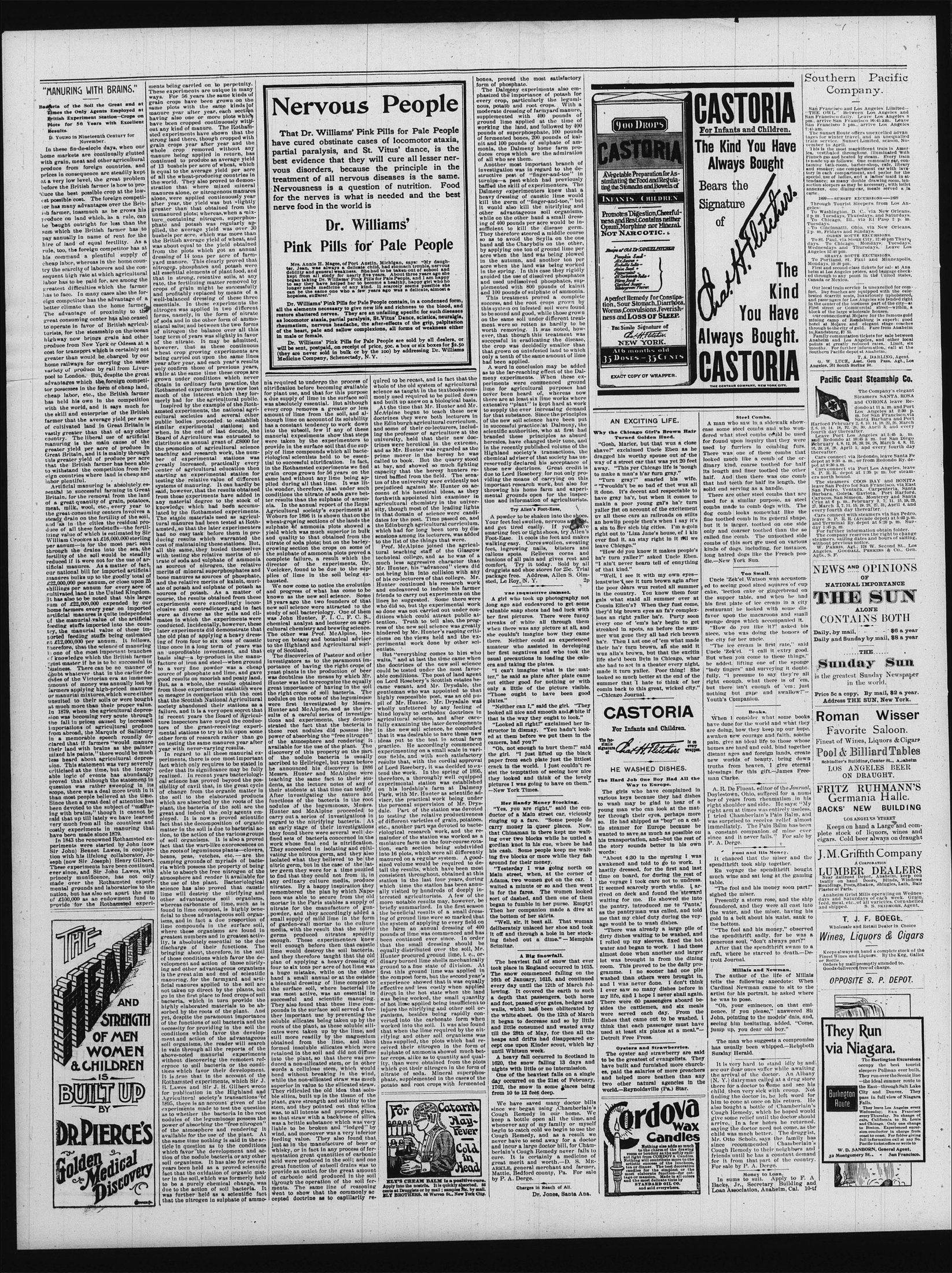
Searchable text
"MANURING WITH BRAINS."
Bacteria of the Soil the Great and at Times the Only Agents Employed at British Experiment Station—Crops on Plots for 50 Years with Excellent Results.
D. Young in Nineteenth Century for November.
In these fin-de-siecle days, when our home markets are continually glutted with grain, meat and other agricultural produce from foreign countries, and prices in consequence are steadily kept at a very low level, the great problem before the British farmer is how to produce the best possible crop at the lowest possible cost. The foreign competitor has many advantages over the British farmer, inasmuch as he grows his produce on land which, as a rule, can be bought outright for less than the sum which the British farmer has to pay annually in name of rent for the hire of land of equal fertility. As a rule, too, the foreign competitor has at his command a plentiful supply of cheap labor, whereas in the home country the scarcity of laborers and the consequent high rate at which agricultural labor has to be paid for, are among the greatest difficulties which the farmer has to face. In many cases also the foreign competitor has the advantage of a better climate than the home farmer. The advantage of proximity to the great consuming center has also ceased to operate in favor of British agriculturists, for the steamship on the ocean highway now brings grain and other produce from New York or Odessa at a cost for transport which is certainly not greater than would be charged by our home railways for carrying the same variety of produce by rail from Liverpool to London. But, despite the great advantages which the foreign competitor possesses in the form of cheap land, cheap labor, etc., the British farmer has held his own in the competition with the world, and it says much for the skill and enterprise of the British farmer that the average yield per acre of cultivated land in Great Britain is vastly greater than that of any other country. The liberal use of artificial manuring is the main cause of the greater yield per acre of produce in Great Britain, and it is mainly through this greater yield of produce per acre that the British farmer has been able to withstand the competition from foreign countries where land is cheap and materials being carried on to perpetuity. These experiments are unique in many ways. For 56 years the same kinds of grain crops have been grown on the same plots with the same kinds of manure year after year, each section having also one or more plots which have been cropped continuously without any kind of manure. The Rothamsted experiments have shown that the strong land there, though cropped with grain crops year after year and the whole crop removed without any manure being applied in return, has continued to produce an average yield of 13 bushels per acre of wheat, which is equal to the average yield per acre of all the wheat-producing countries in the world. They also proved to demonstration that where mixed mineral manures alone, or nitrogenous manures after year, the yield was but slightly greater than that obtained from the unmanured plots; whereas, when a mixture containing nitrogen, superphosphate and potash was regularly applied, the average yield was over 30 bushels per acre, which was more than the British average yield of wheat, and was about equal to the yield obtained from the plots which got an annual dressing of 14 tons per acre of farmyard manure. This clearly proved that nitrogen was applied in two different forms, namely, in the form of nitrate of soda and in the other form of ammoniacal salts; and between the two forms of nitrogen the balance over all this long term of years was slightly in favor of the nitrate. It may be admitted, however, that as these continuous wheat crop growing experiments are being carried out upon the same lines year after year, and each year's results only confirm those of previous years, while at the same time these crops are grown under conditions which never obtain in ordinary farm practice, the Rothamsted experiments have now lost much of the interest which they formerly had for the agricultural public.
Inspired by the example of the Rothamsted experiments, the national agricultural societies and several other public bodies proceeded to establish similar experimental stations; and when, in the end of last decade, the Board of Agriculture was entrusted to distribute an annual grant of £8000 for the promotion of agricultural science teaching and research work, the number of experimental stations was greatly increased, practically every center of agricultural education then starting an experimental station for
Nervousness is a quirk for all nerves is what nerve food in the world.
Dr. W.
Pink Pills
Mrs. Annie H. Magee, of Portland ter, Jean, was always a deliciable debility and general weakness kept from all study for near began taking Dr. Williams' Pills to say they have helped burgeoning needs medicine of an age can be the same one who a hopeless, sufferer."
Dr. Williams' Pink Pills for all the elements necessary to give restore shattered nerves. They as locomotor ataxia, partial paracrineumatism, nervous headache of the heart, pale and sallow oak in male or female.
Dr. Williams' Pink Pills will be sent, postpaid, on receipt (they are never sold in bulk Medicine Company, Schenectad).
nia required to undergo the process nitrification before becoming available for plant use, and that for this purpose a due supply of lime in the surface was absolutely essential. But although every crop removes a greater amount of lime from the soil, and though lime on account of its solution has a constant tendency to work into the subsoll, few if any of them manurial experiments show that were taken by the experimenter provide in the surface soil that due plenty of lime compounds which all biological scientists held to be essential to successful nitrification. In addition to Rothamsted experiments we grain crops grown for 56 years on
But despite the great advantages which the foreign competitor possesses in the form of cheap land, cheap labor, etc., the British farmer has held his own in the competition with the world, and it says much for the skill and enterprise of the British farmer that the average yield per acre of cultivated land in Great Britain is vastly greater than that of any other country. The liberal use of artificial manuring is the main cause of the greater yield per acre of produce in Great Britain, and it is mainly through this greater yield of produce per acre that the British farmer has been able to withstand the competition from foreign countries where land is cheap and labor plentiful.
Artificial manuring is absolutely essential to successful farming in Great Britain, for the removal from the land of a great quantity of grain, potatoes, meat, milk, wool, etc., every year to the great consuming centers involves a steady drain on the fertility of the soil, and as in the cities the residual produce of all these foodstuffs—the fertilizing value of which is estimated by Sir William Crookes at £16,000,000 sterling per annum—is for the most part sent through the drains into the sea, the fertility of the soil would be steadily reduced if it were not for the use of artificial manures. As a matter of fact, our national bill for imported artificial manures bulks up to the goodly total of £22,000,000 per annum, or close upon 25 shillings per annum for every acre of cultivated land in the United Kingdom. It has also to be noted that this large sum of £22,000,000 expended by our home farmers every year on imported artificial manures is quite independent of the manual value of the artificial feeding stuffs imported into the country, the manural value of these imported feeding stuffs being estimated at £12,000,000 per annum. It follows therefore, that the science of manuring is one of the most important branches of knowledge which the British farmer must master if he is to be successful in business. There can be no manner of doubt whatever that in the earlier decades of the Victorian era an immense amount of money was annually lost by farmers applying high-priced manures or manural mixtures, which were either unsuited to their soils or were bought at much more than their proper value. In 1879, when the agricultural depression was becoming very acute through the fall in prices caused by increased importations of agricultural produce from abroad, the Marquis of Salisbury in a memorable speech roundly declared that if farmers "would manure their land with brains as the painter mixed his paints," there would be much less heard about agricultural depression. This statement was very severely criticised at the time, but the inexorable logic of events has abundantly proved that although the statement in question was rather sweeping in its scope, there was a deal more truth in it than most people believed at the time. Since then a great deal of attention has been devoted to the subject of "manuring with brains," though it cannot be said that up till lately we have learned very much from all the countless and costly experiments in manuring that have been made since 1879.
In 1843 the renowned Rothamsted experiments were started by John (now Sir John) Bennet Lawes, in conjunction with his lifelong collaborator, Joseph (now Sir Joseph) Henry Gilbert. These experiments have been continued ever since, and Sir John Lawes, with princely munificence, has not only made over the Rothamsted experimental grounds and laboratories to the nation, but has also set apart the sum of £100,000 as an endowment fund to white at the same time that they never grown under conditions which never obtain in ordinary farm practice, the Rothamsted experiments have now lost much of the interest which they formerly had for the agricultural public.
Inspired by the example of the Rothamsted experiments, the national agricultural societies and several other public bodies proceeded to establish similar experimental stations; and when, in the end of last decade, the Board of Agriculture was entrusted to distribute an annual grant of £8000 for the promotion of agricultural science teaching and research work, the number of experimental stations was greatly increased, practically every center of agricultural education then starting an experimental station for testing the relative value of different systems of manuring. It can hardly be said, however, that the results obtained from these experiments have added in any material degree to the stock of knowledge which had been accumulated by the Rothamsted experiments. The staple materials used as agricultural manures had been tested at Rothamsted, so that the later experimenters had no easy task before them in producing results which warranted the cost of maintaining these stations. But, all the same, they busied themselves with testing the relative merits of nitrate of soda and sulphate of ammonia as sources of nitrogen, the relative merits of mineral superphosphates and bone manures as sources of phosphate, and the relative merits of kainit, muriate of potash and sulphate of potash as sources of potash. As a matter of course, the results obtained from these experiments were exceedingly inconclusive and contradictory, and in fact were as diverse as the soils and climates in which the experiments were conducted. Incidentally, however, these later experiments did demonstrate that the old plan of applying a heavy dressing of from four to six tons of caustic lime in a long term of years was an unprofitable investment, and that basis slag—a by-product in the manufacture of iron and steel—when ground to a very fine powder was a cheap source of phosphate and lime, and gave good results on moorish and peaty land. But, as a whole, the results obtained from these experimental statistics were so meager in comparison with the cost that the Scottish National Agricultural society abandoned their stations as a failure, and it is a very open secret that in recent years the Board of Agriculture inspectors have urged the conductors of the grant-receiving experimental stations to try to hit upon some other form of research rather than go on testing the same manures year after year with never-varying results.
In regard to all these manurial experiments, there is one most important fact which only requires to be stated in order that its significance may be fully realized. In recent years bacteriological science has proved beyond the possibility of cavil that, in the great cycle of change from the organic matter in the soil to the elaborated products which are absorbed by the roots of plant, the bacteria of the soil are the greatest and indeed only agents employed. It is now a proved scientific fact that the decomposition of organic matter in the soil is due to bacterial action, to the action of various groups of soil organisms. It is also a proved fact that the wart-like excrescences on the roots of leguminous plants—clovers, beans, peas, vetches, etc.—are the camping grounds of myriads of bacteria which possess the property of being able to absorb the free nitrogen of the atmosphere and render it available for use of the plant. Bacteriological science has also proved that caustic lime will destroy the nitrifying and other advantageous soil organisms.
The discoveries of Pasteur and investigators as to the paramount importance of having right organic yeast plants in the production of was doubtless means by which Hunter was led to recognize that great importance of having in the right crops of soil bacteria nodules on the roots of leguminosae M Hunter and McAlpine were first investigated by M Hunter and McAlpine, and as to results of a careful series of investigations and experiments, they demonstrated that these root nodules did possess power of absorbing the "free nitrite" of atmospheric and rendered available for use of the plants discovery of this property on those nodule bacteria is not ascribed to Hellriegel, but years later he announced his discovery in Messrs. Hunter and McAlpine teaching the same fact to their students as at that time can do. After investigating natural functions of bacteria in these nodules of leguminosae M Hunter and McAlpine proceeded carry out a series of investigations regarding to the nitrifying bacteria an early stage of their investigation they found there were several well-fined sets of bacteria concerned work whose final end is nitrification. They succeeded in isolating and vating the nitrous germ, and that isolated what they believed to be nitric germ but in the case of this terrestrial germ they were for a time too find that they could not from any ordinary culture media, nor nitrites. By a happy inspiration remembered the plan by which leon was able to secure from
Since then a great deal of attention has been devoted to the subject of "manuring with brains," though it cannot be said that up till lately we have learned very much from all the countless and costly experiments in manuring that have been made since 1879.
In 1843 the renowned Rothamsted experiments were started by John (now Sir John) Bennet Lawes, in conjunction with his lifelong collaborator, Joseph (now Sir Joseph) Henry Gilbert. These experiments have been continued ever since, and Sir John Lawes, with princely munificence, has not only made over the Rothamsted experimental grounds and laboratories to the nation, but has also set apart the sum of £100,000 as an endowment fund to provide for the Rothamsted experi-
The strength of men women & children is built up by Dr. Pierce's Golden Medical Discovery
Nervous People
That Dr. Williams' Pink Pills for Pale People have cured obstinate cases of locomotor ataxia, partial paralysis, and St. Vitus' dance, is the best evidence that they will cure all lesser nervous disorders, because the principle in the treatment of all nervous diseases is the same. Nervousness is a question of nutrition. Food for the nerves is what is needed and the best serve food in the world is
Dr. Williams'
Pink Pills for Pale People
Mrs. Annie H. Magee, of Port Austin, Michigan, says: "My daughter, Jean, was always a delicate child, had stomach trouble, nervous debility and general weakness. She had to be taken out of school and kept from all study for nearly five years. About three years ago she began taking Dr. Williams' Pink Pills for Pale People, and I am happy to say they have helped her to become a healthy, happy girl who no longer needs medicine of any kind. It scarcely seems possible she can be the same one who a few years ago was a delicate, almost hopeless, sufferer."
Dr. Williams' Pink Pills for Pale People contain, in a condensed form, all the elements necessary to give new life and richness to the blood, and restore shattered nerves. They are an unfailing specific for such diseases as locomotor ataxia, partial paralysis, St.Vitus' Dance, sciatica, neuralgia, pneumatism, nervous headache, the after-effects of the grip, palpitation of the heart, pale and sallow complexions, all forms of weakness either on male or female.
Dr. Williams' Pink Pills for Pale People are sold by all dealers, or will be sent, postpaid, on receipt of price, 50c. a box or six boxes for $2.50 (they are never sold in bulk or by the 100) by addressing Dr. Williams Medicine Company, Schenectady, N.Y.
required to undergo the process of excitation before becoming available for use, and that for this purpose supply of lime in the surface soil absolutely essential. But although crop removes a greater or less amount of lime from the soil, and although lime on account of its solubility has constant tendency to work down the subsol, few if any of these special experiments show that steps taken by the experimenters to make in the surface soil that due to lime compounds which all bacterial scientists held to be essential to successful nitrification. In fact, Rothamsted experiments we find crops grown for 56 years on the bones, proved the most satisfactory form of phosphate.
The Dalmeny experiments also emphasized the importance of potash for every crop, particularly the leguminous, potato and root crops. With a moderate dressing of farmyard manure, supplemented with 400 pounds of ground lime applied at the time of working the land, and followed by 400 pounds of superphosphate, 100 pounds of fermented bones, 200 pounds of kainit and 100 pounds of sulphate of ammonia, the Dalmeny home farm produces crops which are the admiration of all who see them.
Another most important branch of investigation was in regard to the destructive pest of "finger-and-toe" in turnips—a pest which had previously baffled the skill of experimenters. The Dalmeny experimenters knew that a heavy dressing of caustic lime would kill the germ of "finger-and-toe," but it would also kill the nitrifying and other advantageous soil organisms, while on the other hand a small dressing of 400 pounds per acre would be insufficient to kill the disease germ. They therefore steered a middle course so as to avoid the Scylla on the one hand and the Charybdis on the other, by applying one ton of ground lime per acre when the land was being plowed in the autumn, and another ton per acre when the land was being worked in the spring. In this case they rigidly avoided the use of dissolved phosphates and used undissolved phosphates, supplemented with 800 pounds of kainit and 100 pounds of sulphate of ammonia.
This treatment proved a complete success, and the root crops grown by this system on infested soil were found to be sound and good, while those grown on the same soil under different treatment were so rotten as hardly to be worth removing. It was noted, however, that though this treatment was successful in eradicating the disease, the crop was decidedly smaller than that grown on uninfested land to which only a tenth of the same amount of lime had been applied.
A word in conclusion may be added as to the far-reaching effect of the Dalmeny experiments. When these experiments were commenced ground lime for agricultural purposes had never been heard of, whereas now there are at least six lime works where extensive "plant" is kept hard at work to supply the ever increasing demand for that substance. Since the principles of the new soil science have been put in successful practice at Dalmeny, the scientific authorities, who at first had branded these principles as absurd heresies, have changed their tune, and in the recently published volume of the Highland society's transactions, the chemical adviser of that society has unreservedly declared his acceptance of these new doctrines. Great credit is due to Lord Roseryber for not only pro-
AN EXCITING LIFE
Why the Chicago Girl's Brother Turned Golden Hued
"Gosh, Marler, but that wushave!" exclaimed Uncle Ebru dragged his worthy spouse on way of a street car that was away. "This yer Chicago life to make a man's bark turn grape."
required to undergo the process of education before becoming available for use, and that for this purpose supply of lime in the surface soil absolutely essential. But although crop removes a greater or less amount of lime from the soil, and although lime on account of its solubility constant tendency to work down the subsoll, few if any of these terrestrial experiments show that steps taken by the experimenters to take in the surface soil that due supra-lime compounds which all bacteriological scientists held to be essentially successful nitrification. In fact, Rothamsted experiments we find crops grown for 56 years on the land without any lime being applied during all that time. It was littered, therefore, that under such conditions the nitrate of soda gave bethesda than the sulphate of ammonia. In the annual report of the Royal cultural society's experiments at turn for 1896 it is shown that on the tree-growing sections of the lands the state of ammonia plots showed a which was much superior in bulk quality to that obtained from the state of soda plots; but on the barley-section section the crops on some of sulphate of ammonia plots proved a failure, a result which the editor of the experiments, Dr. Mackler, found to be due to the suppression of lime in the soil being exerted.
The now come to notice the evolution progress of what has come to be known as the new soil science. Some years ago the two founders of that soil science were attracted to the study of soil biotechnology. One of them John Hunter, F.I.C., F.C.S., technical analyst and lecturer on agricultural chemistry and brewing science. Another was Prof. McAlpine, lecturer on botany and botanical adviser on Highland and Agricultural Society of Scotland.
The discoveries of Pasteur and other investigators as to the paramount importance of having the right crops of plants in the production of beer doubtless the means by which Mr. Hunter was led to recognize the equally important importance of having in the soil right crops of soil bacteria. The studies on the roots of the leguminoseae first investigated by Messrs. Mackler and McAlpine, and as the result of a careful series of investigations and experiments, they demonstrated the fact that the bacteria in the root nodules did possess the power of absorbing the "free nitrogen" at the atmosphere and rendering it available for the use of the plant. The discovery of this property on the part of the nodule bacteria is usually attributed to Hellriegel, but years before announced his discovery in 1886 years. Hunter and McAlpine were finding the same fact to their students, as the lecture notes of any of our students at that time can testify their investigating the nature and functions of the bacteria in the root nodules of the leguminoseae. Messrs. Mackler and McAlpine proceeded to try out a series of investigations in order to nitrify bacteria. At early stage of their investigations they found there were several well-designed sets of bacteria concerned in the whole final end is nitrification. They succeeded in isolating and culturing the nitrous germ, and they also explained what they believed to be the germ, but in the case of the latermight they were for a time puzzled that they could not from it, in ordinary culture media, produce gases. By a happy inspiration they remembered the plan by which Napoleon was able to secure from the old crop removes a greater or less amount of lime from the soil, and although lime on account of its solubility constant tendency to work down the subsoll, few if any of these terrestrial experiments show that steps taken by the experimenters to take in the surface soil that due supra-lime compounds which all bacterial scientists held to be essentially successful nitrification. In fact, Rothamsted experiments we find crops grown for 56 years on the land without any lime being applied during all that time. It was littered, therefore, that under such conditions the nitrate of soda gave bethesda than the sulphate of ammonia. In the annual report of the Royal cultural society's experiments at turn for 1896 it is shown that on the tree-growing sections of the lands the state of ammonia plots showed a which was much superior in bulk quality to that obtained from the state of soda plots; but on the barley-section section the crops on some of sulphate of ammonia plots proved a failure, a result which the editor of the experiments, Dr. Mackler, found to be due to the suppression of lime in the soil being exerted.
The now come to notice the evolution progress of what has come to be known as the new soil science. Some years ago the two founders of that soil science were attracted to the study of soil biotechnology. One of them John Hunter, F.I.C., F.C.S., technical analyst and lecturer on agricultural chemistry and brewing science. Another was Prof. McAlpine, lecturer on botany and botanical adviser on Highland and Agricultural Society of Scotland.
The discoveries of Pasteur and other investigators as to the paramount importance of having the right crops of plants in the production of beer doubtless the means by which Mr. Hunter was led to recognize the equally important importance of having in the soil right crops of soil bacteria. The studies on the roots of the leguminoseae first investigated by Messrs. Mackler and McAlpine, and as the result of a careful series of investigations and experiments, they demonstrated the fact that the bacteria in the root nodules did possess the power of absorbing the "free nitrogen" at the atmosphere and rendering it available for use of the plant. The discovery of this property on the part of the nodule bacteria is usually attributed to Hellriegel, but years before announced his discovery in 1886 years. Hunter and McAlpine were finding the same fact to their students, as the lecture notes of any of our students at that time can testify their investigating the nature and functions of the bacteria in the root nodules of the leguminoseae. Messrs. Mackler and McAlpine proceeded to try out a series of investigations in order to nitrify bacteria. At early stage of their investigations they found there were several well-designed sets of bacteria concerned in the whole final end is nitrification. They succeeded in isolating and culturing the nitrous germ, and they also explained what they believed to be the germ, but in the case of the latermight they were for a time puzzled that they could not from it, in ordinary culture media, produce gases. By a happy inspiration they remembered the plan by which Napoleon was able to secure from the old crop removes a greater or less amount of lime from the soil, and although lime on account of its solubility constant tendency to work down the subsoll, few if any of these terrestrial experiments show that steps taken by the experimenters to take in the surface soil that due supra-lime compounds which all bacterial scientists held to be essentiated nitrification. In fact, Rothamsted experiments we find crops grown for 56 years on the land without any lime being applied during all that time. It was littered, therefore, that under such conditions the nitrate of soda gave bethesda than the sulphate of ammonia. In the annual report of the Royal cultural society's experiments at turn for 1896 it is shown that on the tree-growing sections of the lands the state of ammonia plots showed a which was much superior in bulk quality to that obtained fromthe stateof soda plots; but onthe barley-section sectionthe crops onsomeofsulphateofammoniaplotsproveda failure,aresultwhichtheeditoroftheexperiments,dotheffectsofhavingtherightcropsintheplantsintheproductionofbeerdoubtlessthemeansbywhichMr.Hunterwasledtorecognizetheequalityintheimportanceofhavinginthesoilrightcropsofsoilbacteria.TherulesontherootsoftheleguminoseaefirstinvestigatedbyMessrs.MacklerandMcAlpine,andastheresultofafairseriesofinvestigationsandexperiments,thedemonstratedthefactthatthebacteriaintherootnodulesdidpossessthepowerofabsorbingthe"freenitrogen"attheatmosphereandrenderingitavailableforuseoftheplant.ThecoveryofthispropertyonthepartofthenodulebacteriaisusuallyattributedtoHellriegelbutyearsbeforeannouncedhisdiscoveryin1886years.HunterandMcAlpinewerefindtherewereseveralwell-designedsetsofbacteriaconcernedinthewholefinalendisnitrification.buyingthesamefacttothirsituatesasatherectnoteofanyourstudentsatthattimecantestifyherinvestigatingthenatureandfunctionsofthebacteriaintherootnodulesdidpossessthepowerofabsorbingthe"freenitrogen"attheatmosphereandrenderingitavailableforuseoftheplant.ThecoveryofthispropertyonthepartofthenodulebacteriaisusuallyattributedtoHellriegelbutyearsbeforeannouncedhisdiscoveryin1886years.HunterandMcAlpinewerefindtherewereseveralwell-designedsetsofbacteriaconcernedinthewholefinalendisnitrification.buyingthesamefacttothirsituatesasatherectnoteofanyourstudentsatthattimecantestifyherinvestigatingthenatureandfunctionsofthebacteriaintherootnodulesdidpossessthepowerofabsorbingthe"freenitrogen"attheatmosphereandrenderingitavailableforuseoftheplant.ThecoveryofthispropertyonthepartofthenodulebacteriaisusuallyattributedtoHellriegelbutyearsbeforeannouncedhisdiscoveryin1886years.HunterandMcAlpinewerefindtherewereseveralwell-designedsetsofbacteriaconcernedinthewholefinalendisnitrification.buyingthesamefacttothirsituatesasatherectnoteofanyourstudentsatthattimecantestifyherinvestigatingthenatureandfunctionsofthebacteriaintherootnodulesdidpossessthepowerofabsorbingthe"freenitrogen"attheatmosphereandrenderingitavailableforuseoftheplant.ThecoveryofthispropertyonthepartofthenodulebacteriaisusuallyattributedtoHellriegelbutyearsbeforeannouncedhisdiscoveryin1886years.HunterandMcAlpinewerefindtherewereseveralwell-designedsetsofbacteriaconcernedinthewholefinalendisnitrification.buyingthesamefacttothirsituatesasatherectnoteofanyourstudentsatthattimecantestifyherinvestigatingthenatureandfunctionsofthebacteriaintherootnodulesdidpossessthepowerofabsorbingthe"freenitrogen"attheatmosphereandrenderingitavailableforuseoftheplant.ThecoveryofthispropertyonthepartofthenodulebacteriaisusuallyattributedtoHellriegelbutyearsbeforeannouncedhisdiscoveryin1886years.HunterandMcAlpinewerefindtherewereseveralwell-designedsetsofbacteriaconcernedinthewholefinalendisnitrification.buyingthesamefacttothirsituatesasatherectnoteofanyourstudentsatthattimecantestifyherinvestigatingthenatureandfunctionsofthebacteriaintherootnodulesdidpossessthepowerofabsorbingthe"freenitrogen"attheatmosphereandrenderingitavailableforuseoftheplant.ThecoveryofthispropertyonthepartofthenodulebacteriaisusuallyattributedtoHellriegelbutyearsbeforeannouncedhisdiscoveryin1886years.HunterandMcAlpinewerefindtherewereseveralwell-designedsetsofbacteriaconcernedinthewholefinalendisnitrification.buyingthesamefacttothirsituatesasatherectnoteofanyourstudentsatthattimecantestifyherinvestigatingthenatureandfunctionsofthebacteriaintherootnodulesdidpossessthepowerofabsorbingthe"freenitrogen"attheatmosphereandrenderingitavailableforuseoftheplant.ThecoveryofthispropertyonthepartofthenodulebacteriaisusuallyattributedtoHellriegelbutyearsbeforeannouncedhisdiscoveryin1886years.HunterandMcAlpinewerefindtherewereseveralwell-designedsetsofbacteriaconcernedin-thewholefinalendisnitrification.buyingthesamefacttothirsituatesasatherectnoteofanyourstudentsatthattimecantestifyherinvestigatingthenatureandfunctions-ofthebacteriaintherootnodulesdidpossess_thepower_of_absorbing_the"freenitrogen"at_the_atmosphere_and_renewable_environment_for_a_little_difference_in_the_view_of_the_plant_.The_discoveries_of_Pasteur_andother investigators as to.theparamountimportance.of.having_the_right_crops_in_the_root_nodules_did_possess_the_power_of_absorbing_the"freenitrogen".The_discoveries_of_Pasteur_andother investigators as to.theparamountimportance.of.having_the_right_crops_in_the_root_nodules_did_possess_the_power_of_absorbing_the"freenitrogen".The_discoveries_of_Pasteur_andother investigators as to.theparamountimportance.of.having_the_right_crops_in_the_root_nodules_did_possess_the_power_of_absorbing_the"freenitrogen".The_discoveries_of_Pasteur_andother investigators as to.theparamountimportance.of.having_the_right_crops_in_the_root_nodules_did_possess_the_power_of_absorbing_the"freenitrogen".The_discoveries_of_Pasteur_andother investigators as to.theparamountimportance.of.having_the_right_crops_in_the_root_nodules_did_possess_the_power_of_absorbing_the"freenitrogen".The_discoveries_of_Pasteur_andother investigators as to.theparamountimportance.of.having_the_right_crops_in_the_root_nodules_did_possess_the_power_of_absorbing_the"freenitrogen".The_discoveries_of_Pasteur_andother investigators as to.theparamountimportance.of.having_the_right_crops_in_the_root_nodules_did_possess_the_power_OF_ABSORBING_THIS_WATER_OVER THE SOIL_EFFECTS OF HYDROGEN IN THE ROOT NODULES DID POSSESS THE POWER OF ABSORBING THIS WATER OVER THE SOIL EFFECTS OF HYDROGEN IN THE ROOT NODULES DID POSSESS THE POWER OF ABSORBING THIS WATER OVER THE SOIL EFFECTS OF HYDROGEN IN THE ROOT NODULES DID POSSESS THE POWER OF ABSORBING THIS WATER OVER THE SOIL EFFECTS OF HYDROGEN IN THE ROOT NODULES DID POSSESS THE POWER OF ABSORBING THIS WATER OVER THE SOIL EFFECTS OF HYDROGEN IN THE ROOT NODULES DID POSSESS THE POWER OF ABSORBING THIS WATER OVER THE SOIL EFFECTS OF HYDROGEN IN THE ROOT NODULES DID POSSESS THE POWER OF ABSORBING THIS WATER OVER THE SOIL EFFECTS OF HYDROGEN IN THE ROOT NODULES DID POSSESS THE POWER OF ABSORBING THIS WATER OVER THE SOIL EFFECTS OF HYDROGEN IN THE ROOT NODULES DID POSSESS THE POWER OF ABSORBING THIS WATER OVER THE SOIL EFFECTS OF HYDROGEN IN THE ROOT NODULES DID POSSESS THE POWER OF ABSORBING THIS WATER OVER THE SOIL EFFECTS OF HYDROGEN IN THE ROOT NODULES DID POSSESS THE POWER OF ABSORBING THIS WATER OVER THE SOIL EFFECTS OF HYDROGEN IN THE ROOT NODULES DID POSSESS THE POWER OF ABSORBING THIS WATER OVER THE SOIL EFFECTS OF HYDROGEN IN THE ROOT NODULES DID POSSESS THE POWER OF ABSORBING THIS WATER OVER THE SOIL EFFECTS OF HYDROGEN IN THE ROOT NODULES DID POSSESS THE POWER OF ABSORBING THIS WATER OVER THE SOIL EFFECTS OF HYDROGEN IN THE ROOT NODULES DID POSSESS THE POWER OF ABSORBING THIS WATER OVER THE SOIL EFFECTS OF HYDROGEN IN THE ROOT NODULES DID POSSESS THE POWER OF ABSORBING THIS WATER OVERTHE SOIL EFFECTS OF HYDROGEN IN THE ROOT NODULES DID POSSESS THE POWER OF ABSORBING THIS WATER OVERTHE SOIL EFFECTS OF HYDROGEN IN THE ROOT NODULES DID POSSESS THE POWER OF ABSORBING THIS WATER OVERTHE SOIL EFFECTS OF HYDROGEN IN THE ROOT NODULES DID POSSESS THE POWER OF ABSORBING THIS WATER OVERTHE SOIL EFFECTS OF HYDROGEN IN THE ROOT NODULES DID POSSESS THE POWER OF ABSORBING THIS WATER OVERTHE SOIL EFFECTS OF HYDROGEN IN THE ROOT NODULES DID POSSESS THE POWER OF ABSORBING THIS WATER OVERTHE SOIL EFFECTS OF HYDROGEN IN THE ROOT NODULES DID POSSESS THE POWER OF ABSORBING THIS WATER OVERTHE SOIL EFFECTS OF HYDROGEN IN THE ROOT NODULES DID POSSESS THE POWER OF ABSORBING THIS WATER OVERTHE SOIL EFFECTS OF HYDROGEN IN THE ROOT NODULES DID POS SESS THE POWER OF ABSORBING THIS WATER OVERTHE SOIL EFFECTS OF HYDROGEN IN THE ROOT NODULES DID POS SESS THE POWER OF ABSORBING THIS WATER OVERTHE SOIL EFFECTS OF HYDROGEN IN THE ROOT NODULES DID POS SESS THE POWER OF ABSORBING THIS WATER OVERTHE SOIL EFFECTS OF HYDROGEN IN THE ROOT NODULES DID POS SESS The Power Of Absorbing The Water Over The Soil Environment For A Lifetime On The Board For During All The Years That I Have To Take In The Theater Even If I Have Completed This Great Work With Charming Back To The Lord Gym Where I Will Be Asked To Go Yesterday Poem I Just Lifted Up The Black Paper From Each Plate Just The Little Crack In The World I Just Couldn't Resist The Temptation Of Seeing How Nice They Looked And Think Of The Lovely Pictures I Was Going To Have On Them."—None Of The Kind."
Well, I see it with my own eyes leastwise I see it turn brown after I have worn out my gals what stalk all summer Cousins Ellen's? When they fell'd big brown eyes an fawl'ons an right yaller ha'r! Every one of 'em'm ha'r beg streaked in spots an unbelied mer wuz gone they all had r'n'r! Then I ast one of 'em'm ha'r turn brown after I have worn out my gals what stalk all summer Cousins Ellen's? When they fell'd big brown eyes an fawl'ons an right yaller ha'r! Every one of 'em'm ha'r beg streaked in spots an unbelied mer wuz gone they all had r'n'r! Then I ast one of 'em'm ha'r turn brown after I have worn out my gals what stalk all summer Cousins Ellen's? When they fell'd big brown eyes an fawl'ons an right yaller ha'r! Every one of 'em'm ha'r beg streaked in spots an unbelied mer wuz gone they all had r'n'r! Then I ast one of 'em'm ha'r turn brown after I have worn out my gals what stalk all summer Cousins Ellen's? When they fell'd big brown eyes an fawl'ons an right yaller ha'r! Every one of 'em'm ha'r beg streaked in spots an unbelied mer wuz gone they all had r'n'r! Then I ast one of 'em'm ha'r turn brown after I have worn out my gals what stalk all summer Cousins Ellen's? When they fell'd big brown eyes an fawl'ons an right yaller ha'r! Every one of 'em'm ha'r beg streaked in spots an unbelied mer wuz gone they all had r'n'r! Then I ast one of 'em'm ha'r turn brown after I have worn out my gals what stalk all summer Cousins Ellen's? When they fell'd big brown eyes an fawl'ons an right yaller ha'r! Every one of 'em'm ha'r beg streaked in spots an unbelied mer wuz gone they all had r'n'r! Then I ast one of 'em'm ha'r turn brown after I have worn out my gals what stalk all summer Cousins Ellen's? When they fell'd big brown eyes an fawl'ons an right yaller ha'r! Every one of 'em'm ha'r beg streaked in spots an unbelied mer wuz gone they all had r'n'r! Then I ast one of 'em'm ha'r turn brown after I have worn out my gals what stalk all summer Cousins Ellen's? When they fell'd big brown eyes an fawl'ons an right yaller ha'r! Every one of 'em'm ha'r beg streaked in spots an unbelied mer wuz gone they all had r'n'r! Then I ast one of 'em'm ha'r turn brown after I have worn out my gals what stalk all summer Cousins Ellen's? When they fell'd big brown eyes an fawl'ons an right yaller ha'r! Every one of 'em'm ha'r beg streaked in spots an unbelied mer wuz gone they all had r'n'r! Then I ast one of 'em'm ha'r turn brown after I have worn out my gals what stalk all summer Cousins Ellen's? When they fell'd big brown eyes an fawl'ons an right yaller ha'r! Every one of 'em'm ha'r beg streaked in spots an unbelied mer wuz gone they all had r'n'r! Then I ast one of 'em'm ha'r turn brown after I have worn out my gals what stalk all summer Cousins Ellen's? When they fell'd big brown eyes an fawl'ons an right yaller ha'r! Every one of 'em'm ha'r beg streaked in spots an unbelied mer wuz gone they all had r'n'r! Then I ast one of 'em'm ha'r turn brown after I have worn out my gals what stalk all summer Cousins Ellen's? When they fell'd big brown eyes an fawl'ons an right yaller ha'r! Every one of 'em'm ha'r beg streaked in spots an unbelied mer wuz gone they all had r'n'r! Then I ast one of 'em'm ha'r turn brown after I have worn out my gals what stalk all summer Cousins Ellen's? When they fell'd big brown eyes an fawl'ons an right yaller ha'r! Every one of 'em'm ha'r beg streaked in spots an unbelied mer wuz gone they all had r'n'r! Then I ast one of 'em'm ha'r turn brown after I have worn out my gals what stalk all summer Cousins Ellen's? When they fell'd big brown eyes an fawl'ons an right yaller ha’r! Every one of 'em’m ha’rg streaked in spots an unbelied mer wuz gone they all had r'n’r! Then I ast one of ‘em’m ha’rg streaked in spots an unbelied mer wuz gone they all had r'n’r! Then I ast one of ‘em’m ha’rg streaked in spots an unbelied mer wuz gone they all had r'n’r! Then I ast one of ‘em’m ha’rg streaked in spots an unbelied mer wuz gone they all had r'n’r! Then I ast one of ‘em’m ha’rg streaked in spots an unbelied mer wuz gone they all had r'n’r! Then I ast oneOf‘em’m ha’rg streaked in spots an unbelied mer wuz gone they all had r'n’r! Then I ast oneOf‘em’m ha’rg streaked in spots an unbelied mer wuz gone they all had r'n’r! Then I ast oneOf‘em’m ha’rg streaked in spots an unbelied mer wuz gone they all had r'n’r! Then I ast oneOf‘em’m ha’rg streaked in spots an unbelied mer wuz gone they all had r'n’r! Then I ast oneOf‘em’m ha’rg streaked in spots an unbelied mer wuz gone they all had r'n’r! Then I ast oneOf‘em’m ha’rg streaked in spots an unbelied mer wuz gone they all had r'n’r! Then I ast oneOf‘em’m ha’rg streaked in spots an unbelied mer wuz gone they all had r'n’r! Then I ast oneOf‘em’m ha’rg streaked in spots an unbelied mer wuz gone they all had r'n’r! Then I ast oneOf‘em’m ha’rg streaked in spots an unbelied mer wuz gone they all had r'n’r! Then I ast oneOf‘em’m ha’rg streaked in spots an unbelied mer wuz gone they all had r'n’r! Then I ast oneOf‘em’m ha’rg streaked in spots an unbelied mer wuz gone they all had r'n’r! Then I ast oneOf‘em’m ha’rg streaked in spots an unbelied mer wuz gone they all had r'n’r! Then I ast oneOf‘em’m ha’rg streaked in spots an
The experiments knew enough before then that caustic acid would destroy the soil bacteria, and they therefore taught that the old method of applying a heavy dressing of water to six tons per acre of hot lime was a huge mistake, while on the other hand a small annual or at the outside of a tenacious dressing of lime compost to the surface soil, where bacterial life was most active, was an essential in successful and scientific manuring. They also found that these lime compounds in the surface soil served a furious important use by preventing theuble silicates being taken up by the roots of the plant, as these soluble silicates were taken up by the lime, and more readily by the magnesium contained from the lime, and then formed insoluble silicates which were retained in the soil and did not diffuse into the plant, so that there was provided a non-silicated stem, or in other words a cellulose stem, which would be without breaking in the wind, while the non-silicated straw was much superior in value to the silicated straw. They ridiculed the old idea that solubile silica, built up in the tissue of the plant, gave strength and solidity to the soil, and they pointed out that silica is to all intents and purposes, glass, that straw with a backbone of silica is a brittle substance which was very liable to be broken and "lodged" by sand, and moreover was a very inferior binding value. They also found that it was in the manufacture of beer or malt, or in fact in any process of fermentation great quantities of carbonic acid were produced in the soil; and one great function of subsolldrains was to provide an outlet for the great amount of carbonic acid produced in the soil through the operation of the soil ferments. The same line of reasoning went on to show that the commonly accepted doctrine as to capillarity re-viser, the practical work being under the personal supervision of Mr. Drysdale. Part of the station was devoted to testing the relative productiveness of different varieties of grain, potatoes, etc., another part was devoted to bacteriological research work, and the remainder of the station was worked as a miniature farm on the four-course rotation, each section being subdivided into 16 plots, which were all differently manured on a regular system. A good-sized volume would be required to detail the results, which have been most consistent throughout, obtained at this station in the last four years, during which time the station has been annually visited by hundreds of deeply interested agriculturists. A few of the more notable results may, however, be briefly summarized. In the first season the beneficial results of a small dressing of ground lime were so marked that the system of applying to every field on the farm an annual dressing of 400 pounds of lime was commenced and has been continued ever since. In order that the small dressing should be equally distributed over the soil, Mr. Hunter procured ground lime, i.e., ordinary burned lime shells mechanically ground to a fine state of division. At first this ground lime was applied in the compost form, but the second year's experience showed that it was equally effective and less costly when applied direct in the hot state when the land was being worked, the small quantity of hot lime applied being insufficient to injure the nitrifying and other soil organisms, besides being rapidly converted into the carbonate form when worked into the soil. It was also found that when the lime required by the nitrifying and other soil organisms was thus supplied, the plots which had received their nitrogen in the form of sulphate of ammonia showed much better crops, alike as to quantity and quality, than were obtained from the plots which got their nitrogen in the form of nitrate of soda. Mineral superphosphate supplemented in the cases of the potato and root crops with fermented
Her Handy Money Stocking.
"Yes, you are right," said the conductor of a Main street car, viciously ringing up a fare. "Some people do carry money in queer places. Now, that Chinaman in there kept me waiting over two blocks while he untied a gordian knot in his cue, where he had his cash. Some people keep me waiting five blocks or more while they fish around for their money.
"Yesterday I was going north on Main street, when, at the corner of Adams, two women got on the car. I waited a minute or so and then went in for the fares. The women looked sort of dashed, and then one of them began to fumble in her purse. Empty! Then her companion made a dive at the bottom of her skirts.
"Well, sir, it beat all. That woman deliberately unlaced her shoe and took it off and through a hole in her stocking fished out a dime." — Memphis Scimitar.
A Big Snowfall.
The heaviest fall of snow that ever took place in England occurred in 1615. The snow commenced falling on the 10th of January, 1615, and continued every day until the 12th of March following. It covered the earth to such a depth that passengers, both horse and foot, passed over gates, hedges and walls, which had been obliterated by the white sheet. On the 12th of March it began to decrease and so by little and little consumed and wasted away till the 28th of May, for then all the heaps and drifts had disappeared except one upon Kinder scout, which lay until Whitsun week.
A heavy fall occurred in Scotland in 1620, the snow falling 13 days and nights with little or no intermission.
One of the heaviest falls on a single day occurred on the 21st of February, 1762, the snow in some places being from 10 to 12 feet deep.
We have saved many doctor bills since we began using Chamberlain's Cough Remedy in our home. We keep a bottle open all the time, and whenever any of my family or myself begin to catch cold we begin to use the Cough Remedy, and as a result we never have to send away for a doctor and incur a large doctor bill, for Chamberlain's Cough Remedy never fails to cure. It is certainly a medicine of great merit and worth.—D. S. MARKLEL, general merchant and farmer, Mattie, Bedford county, Pa. For sale by P. A. Derge.
Charges in Reach of All.
Dr. Jones, Santa Ana.
CASTORIA
For Infants and Children.
The Kind You Have Always Bought
Bears the Signature of
The Kind You Have Always Bought.
CASTORIA
AN EXCITING LIFE.
Why the Chicago Girl's Brown Hair Turned Golden Hued.
"Gosh, Marler, but that wuz a close have!" exclaimed Uncle Eben as he ragged his worthy spouse out of the way of a street car that was yet 20 feet away. "This yer Chicago life is 'nough to make a man's h'ar turn gray."
Steel Combs.
A man who saw in a sidewalk show-case some steel combs and who wondered what steel combs could be used for found upon inquiry that they were used by furriers in combing furs. There was one of these combs that looked much like a comb of the ordinary kind, coarse toothed for half its length and finer toothed the other.
Southern Pacific Company.
San Francisco and Los Angeles Limited—THE OWL. Between Los Angeles and San Francisco daily. Leave Los Angeles 8 pm., arrive San Francisco 10:45 am. Leave San Francisco 5 pm., arrive Los Angeles 7:45 am.
The Sunset Route offers unexcelled advantages for winter travel, and an unequalled train service. Sunset Limited, season November to April.
This is the most magnificent train in America, vestibulated throughout, illuminated with Pintsch gas and heated by steam. Every train is made up as follows: One composite car, containing bath-room, barber-shop, cafe, library and smoker; one compartment car with lavatory in each compartment, and parlor for the special use of ladies, and a ladies' maid in attendance; as many double drawing room, ten-section sleepers as may be necessary, with toilet annexes, one dining-car, meals served a la carte.
1899 — SUNSET EXCURSIONS — 1899
Through Tourist Sleepers from Los Angeles:
To Washington, D. C., via New Orleans, 2 p.m. Tuesdays, Thursdays, and Saturdays.
To Chicago, Ill., via El Paso 2 p.m. Tuesdays.
To Cinchnattl, Ohio, via New Orleans, 2 p.m. Fridays and Sundays.
OGDEN ROUTE EXCURSIONS.
To St. Paul, via Sioux City, 12:40 pm Thursday days. To Chicago. Mondays, Tuesdays, Wednesdays and Thursdays. Leave Los Angeles 12:40 pm.
SHASTA ROUTE EXCURSIONS.
To Portland, St. Paul and Minneapolis, Mondays, 10:20 pm.
First and second-class tickets for sale at Anaheim at Los Angeles prices, and baggage checked through to any point in the United States, Canada or Mexico.
Our local train service is unexcelled for comfort. Day coaches are equipped with the celebrated Scarritt seats, luxuriously upholstered, and passengers for Los Angeles are lended right in the center of the business part of the city—at First street or Commercial street—within a block of the large wholesale houses.
Our connection at Mojave for the famous gold mining camp of Randsburg is superb; good hotel at Mojave; elegant stage coaches through to the city of gold. Fare from Anaheim to Randsburg, 47.55.
Family commutation tickets for sale between Anaheim and Los Angeles, and other local points at greatly reduced rates. Limit six months. For further information, call at the Southern Pacific depot at Anaheim.
T. A. DARLING, Agent.
G. W. LUCE, Asst. Gen Pass. Agt., Los Angeles, 261 South Spring St.
Pacific Coast Steamship Co.
The Company's elegant Steamers SANTA, ROSA and CORONA leave Redondo at 11 a.m. and Port Los Angeles at 2:30 p.m. for San Francisco via Santa Barbara and Port Harford February 2, 6, 10, 14, 18, 22, 26, 30, April 3, and every fourth day thereafter.
Leave Port Los Angeles at 5:45 a.m. and Redondo at 10:45 a.m. for San Diego February 4, 8, 12, 16, 20, 24, 28, March 4, 8, 12, 16, 20, 24, 28. April 1, and every fourth day thereafter.
Cars connect via Redondo, leave Santa Fe depot at 9:55 a.m., or from Redondo Ry. depot at 9:30 a.m.
Cars connect via Port Los Angeles, leave S. P. R.R. depot at 1:35 p.m. for steam-
AN EXCITING LIFE.
Why the Chicago Girl's Brown Hair Turned Golden Hued.
"Gosh, Marler, but that wuz a close have!" exclaimed Uncle Eben as he dragged his worthy spouse out of the way of a street car that was yet 20 feet away.
"This yer Chicago life is nough to make a man's h'ar turn gray."
"Turn gray!" snarled his wife.
"Twouldn't be so bad ef thet wuz all it done. It's decent and respectable to have gray ha'r, but when it comes to makin a poor young gal's ha'r turnaller jist on account of the excitement avl all these cars an railroads on stilts an howlin people then's when I say it's a sin to dev slev big cities. I'm a-goin right out to 'Liza Jane's house, if I kin never find it, an stay right in it we leave Chicago."
"How do you know it makes people's ha'r turn yaller?" asked Uncle Eben. "I aln't never hear tell of ennything of that kind."
"Well, I see it with my own eyes—beastwise I see it turn brown agin after the poor dears wuz rested all summer in the country. You know them four gals what stald all summer over at Cousin Ellen's? When they fust come, they'd big brown eyes an fa'r complexions an right yaller ha'r. Purty soon every one of 'em's ha'r begin to get streaked in spots, an before the summer wuz gone they all had rich brown ha'r. Then I ast one of 'em made their ha'r turn brown, an she said it wuz alla's brown, but that the excitin life she'd been livin in Chicago, wha she had to act in a theater every night, made it turn yaller. Poor thing! She looked so much better at the end of the summer that I hate to think of her comin back to this great, wicked city." —Chicago Journal.
CASTORIA
For Infants and Children.
HE WASHED DISHES.
The Hard Job One Boy Had All the Way to Europe.
The girls who have complained in various keys because they had dishes to wash may be glad to hear of a young man who can look at the matter through their eyes, perhaps more so. He had shipped as "boy" on a cat steamer for Europe because he wanted to save as much as possible on his transportation,—and—but the rest of the story sounds better in his own words:
"About 4:30 in the morning I was awakened and told to go to work. I hastily dressed, for the first and last time on board, for during the rest of the voyage I took care not to undress. It seemed scarcely worth while. I arrived on deck and found the steward waiting for me. He showed me into Steel Combs.
A man who saw in a sidewalk show-case some steel combs and who wondered what steel combs could be used for found upon inquiry that they were used by furriers in combing furs. There was one of these combs that looked much like a comb of the ordinary kind, course toothed for half its length and finer toothed the other half. And then there was one comb that had teeth for half its length, the solid end serving as a handle.
There are other steel combs that are used for a similar purpose, as steel combs made to comb dogs with. The dog comb looks somewhat like the fine toothed comb in its general shape, but it is larger, toothed on one side only and coarser toothed than the so-called fine comb. The untoothed side combs of this sort gre used on various kinds of dogs, including, for instance, long haired dogs like the French poo-dle.—New York Sun.
Too Small.
Uncle 'Zek'el Watson was accustomed to seeing good sized squares of cup cake, 'lection cake or gingerbread on the supper table, and when he had his first plate of ice cream in a city restaurant he looked with some dis-favor upon the macaroons and small sponge drops which accompanied it.
"How do you like it?" asked his niece, who was doing the honors of the city for her uncle.
"The ice cream is first rate," said Uncle 'Zek'el. "I call it entry good. But when you come to these things," he added, lifting one of the sponge "lady fingers" and surveying it doubtfully. "I presume to say they're all right enough, what there is of 'em, but there isn't enough of 'em; just nothing but gape and swallow!" —Youth's Companion.
Books.
When I consider what some books have done for the world and what they are doing, how they keep up our hope, awaken new courage and faith, soothe pain, give an ideal life to those whose homes are hard and cold. bind together distant ages and foreign lands, create new worlds of beauty, bring down truths from heaven. I give eternal blessings for this gift—James Freeman Clarke.
A.R. De Fluent, editor of the Journal, Doylestown, Ohio, suffered for a number of years from rheumatism in his right shoulder and side. He says: "My right arm at times was entirely useless. I tried Chamberlain's Pain Balm, and was surprised to receive relief almost immediately. The Pain Balm has been a constant companion of mine ever since and it never fails." For sale by P.A. Derge.
Fool and His Money.
It chanced that the miser and the spendthrift took ship together.
En voyage the spendthrift bought much wine and sat long at the gaming table.
"The fool and his money soon part!" sighed the miser.
Pacific Coast Steamship Co.
The Company's elegant Steamers SANTA, ROSA and CORONA leave Redondo at 11 a.m. and Port Los Angeles at 2:30 p.m. for San Francisco via Santa Barbara and Port Harford February 2, 6, 10, 14, 18, 22, 26, March 2, 6, 10, 14, 18, 22, 26, March 2, 6, 10, 14, 18, 22, 26, March 2, 6, 10, 14, 18, 22, 26, March 2, 6, 10, 14, 18, 22,
and every fourth day thereafter.
Leave Port Los Angeles at 5:45 a.m. and Redondo at 10:45 a.m. for San Diego February 4, 8, 12, 16, 20, 24, 28, March 4, 8, 12,
16, 20, 24, 28. April 1,and every fourth day thereafter.
Cars connect via Redondo; leave Santa Fe depot at 9:55 a.m., or from Redondo Ry.dept at 9:30 a.m.
Cars connect via Port Los Angeles; leave S.P.R.R depot at 1:35 p.m.for steamers north bound.
The steamers COOS BAY and BONIPA leave San Pedro for San Francisco; via East San Pedro; Ventura; Garcia; Port Harford; San Carlos; San Simeon; Monterey and Santa Cruz at 6 p.m.; February 3,7,,11,,15,,19,,28,,27,,31,April4,and every fourth day thereafter.
Cars connect with steamers via San Pedro; S.P.R.R (Arcade depot) at 5:03 p.m. and Terminal Ry.dept at 5:20 p.m.Sunday 1:45 p.m.
For further information obtain folder.
The company reserves the right to change steamers,sailing dates and hours of sailing without previous notice.
W. PAHRIUS Agt.,124 W.Second St.,Los Angeles.GOODALL,PERKINS & CO.,Gen.Agts.,S.F.
NEWS AND OPINIONS OF NATIONAL IMPORTANCE
THE SUN
ALONE CONTAINS BOTH
Daily.by mail,
Daily and Sunday by mail,$8 a year
THE
Sunday Sun is the greatest Sunday Newspaper in the world.
Price $c copy. By mail,$2 a year.Address THE SUN.New York.
Roman Wisser Favorite Saloon.
Finest of Wines,Liquors & Cigars Pool & Billiard Tables
Schindler's Building,Center St.,Alaheim LOS ANGELES BEER ON DRAUGHT.
FRITZ RUHMANN'S Germania Halle.
BACKS' NEW BUILDING
LOS ANGELES STREET
Keeps on hand a Large and complete stock of liquors wines and cigars.Cold beer always on draught
J.M.Griffith Company
A CORPORATION
LUMBER DEALERS
Noir railroad Depot,Anaheim,kep con tantly on hand Doors,Blinds Windows Mouldings Posts Shakes Shingles,Lath,Hair Plaster of Paris.
Anaheim Grist Mills operating on Wednesdays and Saturdays of each week.Grain.
"About 4:30 in the morning I was awakened and told to go to work. I hastily dressed, for the first and last time on board, for during the rest of the voyage I took care not to undress. It seemed scarcely worth while. I arrived on deck and found the steward waiting for me. He showed me into the pantry, introduced me to 'Pants,' as the pantryman was called, and told me that my chief duty during the voyage would be to wash dishes.
There was already a large pile of dirty dishes waiting to be washed, and I rolled up my sleeves, fixed the hot water and began to work. I had these almost done when another and larger lot was brought in from the dining room. This proved to be the daily programme. I no sooner had one pile washed than others were brought in, and I was never done. I don't think I ever saw so many dishes before in my life, and I hope I never shall again. There were 60 passengers aboard besides the cattlemen, and six meals were served each day. From the dishes that came out to be washed, I think that each passenger must have used at least six plates at a meal."—Detroit Free Press.
Oysters and Strawberries.
The oyster and strawberry are said to be the greatest of evangelists. They have built and furnished more churches, paid the salaries of more preachers and helped more heathen than any two other natural agencies in the world.—Reynoldsville (Pa.) Star.
Ordova Wax Candles
Nothing else adds so much to the charm of the drawing room or bouncy as the soft radiance light from ORDOVA Candles. Nothing will contribute more to the artistic success of the luncheon, tea or dinner. The best decorative candies for the simplest or the most elaborate function—or cottage or mansion. Made in all colors and the most delicate tints by STANDARD OIL CO., and sold everywhere.
Fool and His Money.
It chanced that the miser and the spendthrift took ship together.
En voyage the spendthrift bought much wine and sat long at the gaming table.
"The fool and his money soon part!" sighed the miser.
Presently a storm rose, and the ship foundered, and they were all cast into the water, and the miser, having his gold in a belt about his waist, sank to the bottom.
"The fool and his money," observed the spendthrift sadly, for he was a generous soul, "don't always part."
After that the spendthrift swam to a raft, where he starved to death.—Detroit Journal.
Millais and Newman.
The author of the life of Millais tells the following anecdote: When Cardinal Newman came to sit to the artist for his portrait, he asked where he was to pose.
"Oh, your eminence, on that eminence, if you please," answered Sir John, pointing to the models' dals, and seeing him hesitating, added, "Come, jump up, you dear old boy."
The man who suggests a compromise has usually been whipped.—Rehoboth Sunday Herald.
It is very hard to stand idly by and see our dear ones suffer while awaiting the arrival of the doctor. An Albany (N. Y.) dairyman called at a drug store there for a doctor to come and see his child then very sick with croup. Not finding the doctor in, he left word for him to cone at once on his return. He also bought a bottle of Chamberlain's Cough Remedy, which he hoped would give some relief until the doctor should arrive. In a few hours he returned, saying the doctor need not come, as the child was much better. The druggist, Mr. Otto Scholz, says the family has since recommended Chamberlain's Cough Remedy to their neighbors and friends until he has a constant demand for it from that part of the country. For sale by P. A. Derge.
Money to Loan.
In sums to suit. Apply to F. A Backs, Jr., Secretary Building and Loan Association, Anaheim, Cal. 10-tf