anaheim-gazette 1900-01-04
Scanned page
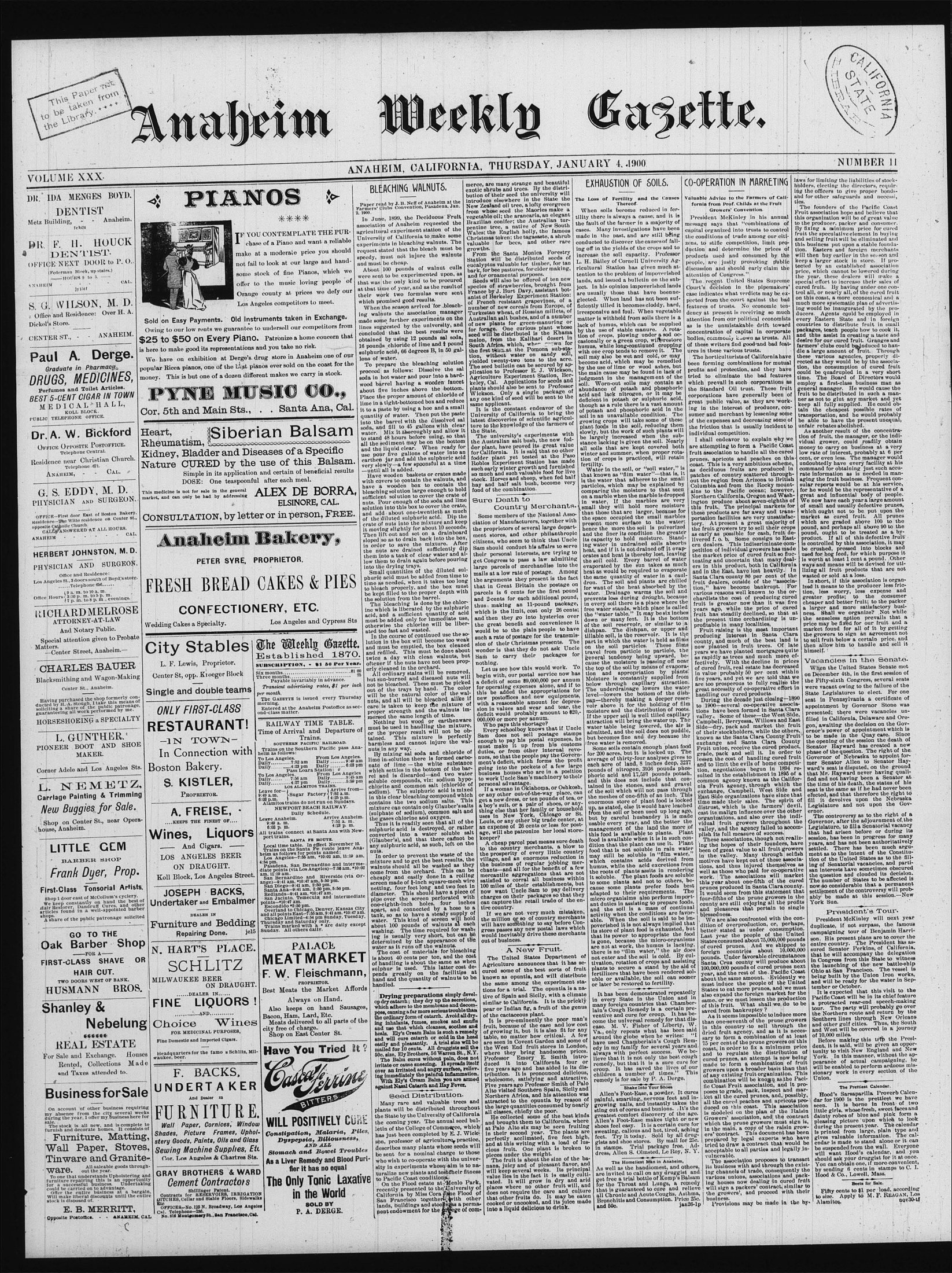
Searchable text
Anaheim
VOLUME XXX.
DR. IDA MENGES BOYD.
DENTIST
Metz Building, Anaheim.
feb24
DR. F. H. HOUCK
DENTIST.
OFFICE NEXT DOOR to P. O.
(Federman Block, up stairs.)
HOURS 9 to 5
ANAHEIM CAL.
jy154f
S. G. WILSON, M. D.
Office and Residence: Over H. A. Dickel's Store.
CENTER ST., Anaheim.
Paul A. Derge.
Graduate in Pharmacy
DRUGS, MEDICINES,
Perfumes and Toilet Articles.
BEST 5-CENT CIGAR IN TOWN
MEDICAL HALL,
KOLL BLOCK.
PUBLIC TELEPHONE OFFICE.
Dr. A. W. Bickford
OFFICE OPPOSITE POSTOFFICE.
Telephone Central.
Residence near Christian Church.
Telephone 671.
PIANOS
*****
IF YOU CONTEMPLATE THE PURCHASE of a Piano and want a reliable make at a moderate price you should not fail to look at our large and handsome stock of fine Pianos, which we offer to the music loving people of Orange county at prices we defy our Los Angeles competitors to meet.
Sold on Easy Payments. Old Instruments taken in Exchange.
Owing to our low rents we guarantee to undersell our competitors from $25 to $50 on Every Piano. Patronize a home concern that is here to make good its representations and you take no risk.
We have on exhibition at Derge's drug store in Anaheim one of our popular Ricca pianos, one of the best pianos ever sold on the coast for the money. This is but one of a dozen different makes we carry in stock.
PYNE MUSIC CO.,
Cor. 5th and Main Sts., Santa Ana, Cal.
Heart,
Rheumatism,
Kidney, Bladder and Diseases of a Specific Nature CURED by the use of this Balsam.
Simple in its application and certain of beneficial results
DRUGS, MEDICINES,
Perfumes and Toilet Articles.
BEST 5-CENT CIGAR IN TOWN
MEDICAL HALL,
KOLL BLOCK.
PUBLIC TELEPHONE OFFICE.
Dr. A. W. Bickford
OFFICE OPPOSITE POSTOFFICE.
Telephone Central.
Residence near Christian Church.
Telephone 671.
ANAHEIM, CAL.
G. S. EDDY, M. D.
PHYSICIAN AND SURGEON.
OFFICE—First door East of Boston Bakery.
Itesidence—The Wilte residence on Center St., opposite Catholic Church.
CALLS ANSWERED AT ALL HOURS.
ANAHEIM, CAL.
HERBERT JOHNSTON, M. D.
PHYSICIAN AND SURGEON.
Office and Residence:
Los Angeles St., 3 doors south of Boyd's store.
Telephone 656....
9 a.m. to 10 a.m.
3:30 p.m. to 5 p.m.
7 p.m. to 8 p.m., evenings.
RICHARD MELROSE
ATTORNEY-AT-LAW
And Notary Public.
Special attention given to Probate Matters.
—Center Street, Anaheim.
CHARLES BAUER
Blacksmithing and Wagon-Making
Center St., Anaheim.
Having purchased the shop formerly conducted by H. A. Stough, I take this means of soliciting a share of the public patronage, guaranteeing all work performed by me.
HORSESHOEING a SPECIALTY
L. GUNTHER.
PIONEER BOOT AND SHOE MAKER.
Corner Adele and Los Angeles Sts.
L. NEMETZ,
Carriage Painting & Trimming
New Buggies for Sale.
Shop on Center St., near Opera-house, Anaheim.
LITTLE GEM
BARBER SHOP
Frank Dyer, Prop.
First-Class Tonsorial Artists.
City Stables
L. F. Lewis, Proprietor.
Center St, opp. Kroeger Block
Single and double teams
ONLY FIRST-CLASS RESTAURANT!
—IN TOWN—
In Connection with Boston Bakery.
S. KISTLER,
PROPRIETOR.
A. FREISE,
...KEEPS THE FINEST OF...
Wines, Liquors
—and Cigars.
LOS ANGELES BEER ON DRAUGHT.
Koll Block, Los Angeles Street.
JOSEPH BACKS,
PYNE MUSIC CO.,
Cor. 5th and Main Sts., . . Santa Ana, Cal.
Heart,
Siberian Balsam
Rheumatism,
Kidney, Bladder and Diseases of a Specific Nature CURED by the use of this Balsam.
Simple in its application and certain of beneficial results DOSE: One teaspoonful after each meal.
This medicine is not for sale in the general market, and can only be had by addressing ALEX DE BORRA,
ELSINORE, CAL.
CONSULTATION, by letter or in person, FREE.
Anaheim Bakery,
PETER SYRE, PROPRIETOR.
FRESH BREAD CAKES & PIES
CONFECTIONERY, ETC.
Wedding Cakes a Specialty.
Los Angeles and Cypress Sts.
The Weekly Gazette
Established 1870
SUBSCRIPTION, - $1 50 Per Year
Six months....$1
Three months....$1
Payable invariably in advance.
Transient advertising rates, $1 per in per month.
The GAZETTE is issued every Thursday morning.
Entered at the Anaheim Postoffice as second-class matter.
RAILWAY TIME TABLE.
Time of Arrival and Departure Trains.
SOUTHERN PACIFIC RAILROAD.
Trains on the Southern Pacific pass Anaheim as follows:
To Los Angeles.
Daily.....7:52 am
Daily.....9:49 am
Daily.....4:23 pm
Daily.....6:03 pm
Pass Loora Station:
To Los Angeles.
Daily.....7:56 am
Daily.....9:45 am
Daily.....4:27 pm
Daily.....5:59 pm
LOS ALAMITOS TRAINS.
Leave for—
9:49 a.m.
Sugar Factory
7:52 a.m.
4:25 p.m.
Alamitos trains do not run on Sundays.
NEWPORT BEACH RAILWAY.
Daily Schedule.
Leave Anaheim.
9:49 a.m.
7:52 a.m.
6:03 p.m.
4:23 p.m.
All trains connect at Santa Ana with Newport trains.
SANTA FE ROUTE.
Local time table. In effect November.
Trains on the Santa Fe route leave Anaheim as follows for points named:
Los Angeles—7:56 am, *10:02 am, 11:19 am
4:54 pm.
Pasadena, San Bernardino and interdiate points (via Los Angeles)—7:56 am, *11:19 am.
San Bernardino and Riverside (via ange)—9:41 am, *10:47 am, 5:50 pm.
San Diego—9:41 am, 2:50 pm.
Santa Ana—9:41 am, 2:50 pm.
Redlands—9:41 am, *10:47 am.
San Jacinto, Temecula and intermed
New Buggies for Sale.
Shop on Center St., near Opera-house, Anaheim.
LITTLE GEM
BARBER SHOP
Frank Dyer, Prop.
First-Class Tonsorial Artists.
Shop 1 door east of McCollum's cyclery.
We keep constantly on hand the best of hair Restorer, Dandruff Cures, and other articles found in a well-appointed barber shops.
A share of the public patronage solicited
GO TO THE Oak Barber Shop
FOR A FIRST-CLASS SHAVE OR HAIR CUT.
TWO DOORS WEST OF BANK.
HUSMANN BROS.
Shanley & Nebelung
REAL ESTATE
For Sale and Exchange. Houses Rented, Collections Made and Taxes attended to.
BusinessforSale
On account of other business requiring my absence from the city several weeks during the year. I offer my business here for sale.
The stock is all new, and is complete to furnish and decorate homes. It consists of Furniture, Matting, Wall Paper, Stoves, Tinware and Granite-ware.
All saleable goods throughout the year.
To one that understands Upholstering and furniture repairing this is an opportunity for a successful business. Undertaking could be carried on to advantage.
Offer the entire business at a bargain, Will make liberal discounts until the entire stock is disposed of.
E. B. MERRITT,
Opposite Postoffice. - ANAHEIM, CAL
A. FREISE,
KEEPS THE FINEST OF...
Wines, Liquors
And Cigars.
LOS ANGELES BEER ON DRAUGHT.
Koll Block, Los Angeles Street.
JOSEPH BACKS,
Undertaker and Embalmer
DEALER IN
Furniture and Bedding Repairing Done.
N. HART'S PLACE.
SCHLITZ
MILWAUKEE BEER ON DRAUGHT.
DEALER IN...
FINE LIQUORS!
AND...
Choice Wines FOR MEDICINAL PURPOSES,
Fine Domestic and Imported Cigars.
Headquarters for the famo's Schlitz, Milwaukee, beer.
F. BACKS,
UNDERTAKER
And Dealer in
FURNITURE.
Wall Paper, Cornices, Window Shades, Picture Frames, Upholstery Goods, Paints, Oils and Glass Sewing Machine Supplies, Etc.
Cor. Los Angeles & Chartres Sts.
GRAY BROTHERS & WARD
Cement Contractors
Shillinger Patent,
Contracts for RESERVOIRS, IRRIGATION DITCHES, Cellar and Stable Floors, Sidewalks Etc.
OFFICES—No. 125 N. Broadway, Los Angeles Cal., Telephone—286.
No. 316 Montgomery St., San Francisco, Cal.
PALACE
MEAT MARKET
F. W. Fleischman
PROPRIETOR.
Best Meats the Market AffeAlways on Hand.
Also keeps on hand Sausa,
Bacon, Ham, Lard, Etc.
Meats delivered to all parts of city free of charge.
Shop on East Center St.
Have You Tried
Cascade Terrins
BITTERS
WILL POSITIVELY CU
Constipation, Malaria, Poisoning, Dyspepsia, Billiousness AND ALL
Stomach and Bowel Troubles
As a Liver Remedy and Blood flier it has no equal
The Only Tonic Laxation in the World
SOLD BY
P. A. DERGE.
ANAHEIM, CALIFORNIA, THURSDAY, JANUARY 4, 1900
BLEACHING WALNUTS.
Paper read by J.B. Neff of Anaheim at the Farmers' Clubs Convention, Pasadena, Jan. 2, 1900.
In June, 1899, the Deciduous Fruit association of Anaheim requested the agricultural experiment station of the University of California to make some experiments in bleaching walnuts. The request stated that the bleach must be speedy, must not injure the walnuts and must be cheap.
About 100 pounds of walnut culls were sent to be experimented upon, as that was the only kind to be procured at that time of year, and as the result of their work two formulas were sent which promised good results.
When the season arrived for bleaching walnuts the association manager made some further experiments on the lines suggested by the university, and concluded that the best results were obtained by using 12 pounds sal soda, 16 pounds chloride of lime and 4 pound sulphuric acid, 66 degrees B, in 50 gallons of water.
To prepare the bleaching solution proceed as follows: Dissolve the sal soda in hot water and pour into a hardwood barrel having a wooden faucet about five inches above the bottom. Place the proper amount of chloride of lime in a tight-bottomed box and reduce it to a paste by using a hoe and a small quantity of water. Then put the paste into the barrel with the dissolved sal soda, and fill to 45 gallons with clear water. Mix it thoroughly and allow it to stand 48 hours before using, so that all the sediment may be on the bottom and the liquid clear. When ready for use pour five gallons of water into an earthen jar and add the sulphuric acid very slowly—a few spoonsful at a time—until all is added.
The wooden baskets or crates made merce, are many strange and beautiful exotic shrubs and trees. By the distribution of their seed the university will introduce elsewhere in the State the New Zealand oil tree, a lofty evergreen from whose seed the Maories make a vegetable oil; the arancaria, an elegant Brazilian conifer; the Australian turpentine tree, a native of New South Wales; the English holly, the famous Christmas token; the tagasaste, a shrub valuable for bees, and other rare growths.
From the Santa Monica Forestry Station will be distributed seeds of eucalyptus valuable for timber, for tan bark, for bee pastures, for cider making, and for ornamental purposes.
Seeds will also be offered of ten new species of strawberries, brought from France by J. Burt Davy, assistant botanist of Berkeley Experiment Station: of French resistant grapevines, of a number of new cereals from Europe, of Turkestan wheat, of Russian millets, of Australian salt bushes, and of a number of new plants for green-manuring or fororage. One curious plant whose seed will be distributed is the Khama melon, from the Kalihari desert in South Africa, which, when grown for the first time at the Pomona sub-station, without water on sandy soil, yielded twenty-two tons to the acre. The seed bulletin can be secured by application to Professor E. J. Wickson, Agriculture Experiment Station, Berkeley, Cal. Applications for seeds and plants should also be sent to Professor Wickson. Only a single package of any one kind of seed will be sent to the same applicant.
It is the constant endeavor of the University of California to bring the latest discoveries of scientific agriculture to the knowledge of the farmers of the State.
The university's experiments with the Australian salt bush, the new fodder plant, have proved its great value for California. It is said that no other fodder plant yet tested at the Paso Robles Experiment Station has made such early winter growth and furnished so much and such valuable food for live vegetation.
EXHAUSTION OF SOILS.
The Loss of Fertility and the Causes Thereof.
When soils become reduced in fertility there is always a cause, and it is the fault of the farmer in a majority cases. Many investigations have been made in the past, and are still being conducted to discover the causes of falling off in the yields of the crops and increase the soil capacity. Professor L. H. Bailey of Cornell University Agricultural Station has given much attention to the problem of impoverished lands, and issued a bulletin on the subject. In his opinion impoverished land are usually those that have been glected. When land has not been sufficiently tilled it becomes cloddy, has irresponsive and foul. When vegetation matter is withheld from soils there is lack of humus, which can be supplied by the use of stable manure. A reduction of crops, plowing under a sod cascading or a green crop, will restrain humus, while long-continued cropping with one crop tends to remove it. Soil may also be wet and cold, or may become acid, which may be remedied by the use of lime or wood ashes; but the main cause may be found in lack judgment in the management of soil. Worn-out soils may contain abundance of potash and phosphoric acid and lack nitrogen, or it may deficient in potash or sulphuric acid though as a rule there is a vast amount of potash and phosphoric acid in soil in an unavailable condition. Growing crops will take some of these plant foods in the soil, reducing slowly, but the work of such plants be largely increased when the resistance lacking is given to the soil. New all soils that are kept covered in winter and summer, when proper fertility is practiced, will re-energize water in the soil, or "soil water" that known as "film water."
Soda in hot water and pour into a hard-wood barrel having a wooden faucet about five inches above the bottom. Place the proper amount of chloride of lime in a tight-bottomed box and reduce it to a paste by using a hoe and a small quantity of water. Then put the paste into the barrel with the dissolved sal soda, and fill to 45 gallons with clear water. Mix it thoroughly and allow it to stand 48 hours before using, so that all the sediment may be on the bottom and the liquid clear. When ready for use five gallons of water into an earthen jar and add the sulphuric acid very slowly—a few spoonsful at a time—until all is added.
Have wooden baskets or crates made with covers to contain the walnuts, and have a wooden box to contain the bleaching solution large enough to hold sufficient solution to cover the crate of nuts. Pour enough of the soda and lime solution into this box to cover the crate, and add about one-twentieth as much of the diluted sulphuric acid. Dip the crate of nuts into the mixture and keep it moving slightly for about 10 seconds. Then lift out and set on a drainboard sloped so as to drain back into the box, in order to save the mixture. After the nuts are drained sufficiently dip them into a tank of clear water and allow them to drain again before pouring into the drying trays.
Small quantities of the diluted sulphuric acid must be added from time to time as needed, when it takes too long to bleach properly, and the box must be kept filled to the proper depth with the solution from the barrel.
The bleaching is done by the chlorine which is liberated by the sulphuric acid, and a sufficient quantity of acid must be added only for immediate use, otherwise the chlorine will be liberated too fast and wasted.
In the course of continued use the solution in the box will become too weak and must be emptied, the box cleaned and reflilled. This must be done about twice a day with clean walnuts, but oftener if the nuts have not been properly cleaned in the orchard.
All ordinary stains will be removed, but sun-burned and diseased nuts will not be bleached. These must be picked out of the trays by hand. The color will be the natural color of the walnuts, and all will be bleached alike if care is taken to keep the mixture of proper strength and the walnuts immersed the same length of time.
Nothing but wood or earthenware must be used in handling the mixture, or the proper result will not be obtained. This mixture is perfectly harmless and cannot injure the walnuts in any way.
By mixing sal soda and chloride of lime in solution there is formed carbonate of lime—the white substance which settles in the bottom of the barrel and is discarded—and two water soluble compounds, viz: sodium hypochlorite and common salt (chloride of sodium). The sulphuric acid is mixed in this clear bleaching compound which contains the two sodium salts. This mixture can contain only Glauber's salts (sulphate of sodium), common salt and the gases chlorine and oxygen.
Thus it is readily seen that all of the sulphuric acid is destroyed, or rather converted into a water soluble salt (Glauber's), and that there cannot be any sulphuric acid, as such, left on the nuts.
In order to prevent the waste of the mixture and to get the best results, the walnuts should all be washed as they come from the orchard. This can be cheaply and easily done in a rolling screen made of 4-inch square-mesh wire netting, four feet long and two feet in diameter. This should have a piece of wire over the screen perforated with soda in hot water and pour into a hard-wood barrel having a wooden faucet about five inches above the bottom. Place the proper amount of chloride of lime in a tight-bottomed box and reduce it to a paste by using a hoe and a small quantity of water. Then put the paste into the barrel with the dissolved sal soda, and fill to 45 gallons with clear water. Mix it thoroughly and allow it to stand 48 hours before using, so that all the sediment may be on the bottom and the liquid clear. When ready for use five gallons of water into an earthen jar and add the sulphuric acid very slowly—a few spoonsful at a time—until all is added.
Have wooden baskets or crates made with covers to contain the walnuts, and have a wooden box to contain the bleaching solution large enough to hold sufficient solution to cover the crate of nuts. Pour enough of the soda and lime solution into this box to cover the crate, and add about one-twentieth as much of the diluted sulphuric acid. Dip the crate of nuts into the mixture and keep it moving slightly for about 10 seconds. Then lift out and set on a drainboard sloped so as to drain back into the box, in order to save the mixture. After the nuts are drained sufficiently dip them into a tank of clear water and allow them to drain again before pouring into the drying trays.
Small quantities of the diluted sulphuric acid must be added from time to time as needed, when it takes too long to bleach properly, and the box must be kept filled to the proper depth with the solution from the barrel.
The bleaching is done by the chlorine which is liberated by the sulphuric acid, and a sufficient quantity of acid must be added only for immediate use, otherwise the chlorine will be liberated too fast and wasted.
In the course of continued use the solution in the box will become too weak and must be emptied, the box cleaned and reflilled. This must be done about twice a day with clean walnuts, but oftener if the nuts have not been properly cleaned in the orchard.
All ordinary stains will be removed, but sun-burned and diseased nuts will not be bleached. These must be picked out of the trays by hand. The color will be the natural color of the walnuts, and all will be bleached alike if care is taken to keep the mixture of proper strength and the walnuts immersed the same length of time.
Nothing but wood or earthenware must be used in handling the mixture, or the proper result will not be obtained. This mixture is perfectly harmless and cannot injure the walnuts in any way.
By mixing sal soda and chloride of lime in solution there is formed carbonate of lime—the white substance which settles in the bottom of the barrel and is discarded—and two water soluble compounds, viz: sodium hypochlorite and common salt (chloride of sodium). The sulphuric acid is mixed in this clear bleaching compound which contains the two sodium salts. This mixture can contain only Glauber's salts (sulphate of sodium), common salt and the gases chlorine and oxygen.
Thus it is readily seen that all of the sulphuric acid is destroyed, or rather converted into a water soluble salt (Glauber's), and that there cannot be any sulphuric acid, as such, left on the nuts.
In order to prevent the waste of the mixture and to get the best results, the walnuts should all be washed as they come from the orchard. This can be cheaply and easily done in a rolling screen made of 4-inch square-mesh wire netting, four feet long and two feet in diameter. This should have a piece of wire over the screen perforated with soda in hot water and pour into a hard-wood barrel having a wooden faucet about five inches above the bottom. Place the proper amount of chloride of lime in a tight-bottomed box and reduce it to a paste by using a hoe and a small quantity of water. Then put the paste into the barrel with the dissolved sal soda, and fill to 45 gallons with clear water. Mix it thoroughly and allow it to stand 48 hours before using, so that allthe sediment may be onthe bottomandtheliquidclear.Whenreadyforusefivegallonsofwaterintotheboxtocoverthecrateandaddaboutone-twentiethasmuchofthedilutedsulphuricacid.Dipthecrataofnusinthemixtureandkeepitmovingslightlyforabout10secondsThenliftoutandsetonadrainboardslopedsoastocmdrainbackintotheboxinordertosavethemixture.Afterthenutsaredrainedsufficientlydipthemintoatankofclearwaterandallowthemtocmdrainagainbeforepouringintothedryingtrays.
Small quantities of the diluted sulphuric acid must be added from time to time as needed, when it takes too long to bleach properly, and the box must be kept filled to the proper depth withthe solutionfromthebarrel.
The bleaching is done bythechlorinewhichisliberatedbythesulphuricacid,anda sufficientquantityofacidmustbeaddedonlyforimmediateuse,otherwisethechlorinewillberelicitedtofastandwasted.
Inthecourseofcontinuedusethesolutionintheboxwillbecometooweakandmustbeemptiedtwiceadaywithcleanwalnuts,bottlecleanedandreflilledThismustbedoneabouttwiceadaywithcleanwalnuts,bottlecleanedandreflilledThismustbedoneabouttwiceadaywithcleanwalnuts,bottlecleanedandreflilledThismustbe doneabouttwiceadaywithcleanwalnuts,bottlecleanedandreflilledThismustbe doneabouttwiceadaywithcleanwalnuts,bottlecleanedandreflilledThismustbe doneabouttwiceadaywithcleanwalnuts,bottlecleanedandreflilledThismustbe doneabouttwiceadaywithcleanwalnuts,bottlecleanedandreflilledThismustbe doneabouttwiceadaywithcleanwalnuts,bottlecleanedandreflilledThismustbe doneabouttwiceadaywithcleanwalnuts,bottlecleanedandreflilledThismustbe doneabouttwiceadaywithcleanwalnuts,bottlecleanedandreflilledThismustbe doneabouttwiceadaywithcleanwalnuts,bottlecleanedandreflilledThismustbe doneabouttwiceadaywithcleanwalnuts,bottlecleanedandreflilledThismustbe doneabouttwiceadaywithcleanwalnuts,bottlecleanedandreflilledThismustbe doneabouttwiceadaywithcleanwalnuts,bottlecleanedandreflilledThismustbe doneabouttwiceadaywith清洁walnuts,bottlecleanedandrefllinedownoranythingelsethatherfamilyorhouseholdusesinNew York,ChesapeakeorSt.Louis,或anyotherbigtradecenter.atanexpenseof26centsorlessforpostage.willpatronizeherlocalstorekeeper?
A cheap parcel post means sure deathtothecountrymerchant,salboweightsoapilyoucanuseitinsuctionthattheplantcanuseitinfoodisavailablewhenitisinused.
Some members oftheNationalAssociationofManufacturers,togetherwiththeproprietorsofseverallargedepartmentstores,andother Philanthropiccitizens,whoseemtothinkThatUncleSamshouldconducthisaffairstoserve theirpersonalinterests,thetrygetCongresstopasslawadmittinglargeparcellsofmerchandiseinthemallatatlowrateofpostage.AmongtheargumentstheypresentisthefactthatinGreatBritainthepostageonparcells6centsfordirecteachpoundand2centsfordirecteachpoundwhichlimitestheheataswouldberequiredtoevapainthewoolinanmarbleistdropinwater.inIfthemarblesaresmalltheywillholdmoremoisthanthosethatarelarger,thespaceoccupiedthesmallmanpresentmoresurfacetothewheelhencethemorethesoilspulverandtheineraiestconditionthegreitscapacitytoholdmoisture.Singingwaterinundrainedsoilsaboveheat,andifitnotdrainedoffitororatesandheatistherebylostleathole硫cold.Everybarrelofvowevaporatedbythesuntakesasheataswouldberequiredtoevapainthewoolinanmarbleistdropinwater.inIfthemarblesaresmalltheywillholdmoremoisthanthosethatarelarger,thespaceoccupiedthesmallmanpresentmoresurfacetothewheelhencethemorebyeatingtheirapplicationsforoperatingexpensesalone,andifthisbecomesoldforwantoftheheatabsorbedbywater.Drainagewarmsthesoilspreventloss during drought,becauseevery soil thereisplacewhentreewaterstandswhichplaceisat“watertable.”Itmaybesixindefoldupothesoilreservoir,或similardispailablesoil_isthereservoir.Ipartinwhichthewaterisheldonthesoilparticles.Thetravelfromparticletoparticlegeneraltendencybeingupwardcausethemoistureispassingoffthetopofthesoilbymeansofevapainthewoolinanmarbleistdropinwater.intheapplicationbymeansofevapainthewoolinanmarbleistdropinwater.intheapplicationbymeansofevapainthewoolintheapplicationbymeansofevapainthewoolintheapplicationbymeansofevapainthewoolintheapplicationbymeansofevapainthewoolintheapplicationbymeansofevapainthewoolintheapplicationbymeansofevapainthewoolintheapplicationbymeansofevapainthewoolintheapplicationbymeansofevapainthewoolintheapplicationbymeansofevapainthewoolintheapplicationbymeansofevapainthewoolintheapplicationbymeansofevapainthewoolintheapplicationbymeansofevapainthewoolintheapplicationbymeansofevapainthewoolintheapplicationbymeansofevapainthewoolintheapplicationbymeansofevapainthewoolintheapplicationbymeansofevapainthewoolintheapplicationbymeansofevapainthewoolintheapplicationbymeansofevapainthewoolintheapplicationbymeansofevapainthewoolintheapplicationbymeansofevapainthewoolintheapplicationbymeansofevapainthewoolintheapplicationbymeansofevapainthewoolintheapplicationbymeansofevapainthewoolintheapplicationbymeansofevapainthewoolintheapplicationbymeansofevapainthewoolintheapplicationbymeansofevapainthewoolintheapplicationbymeansofevapainthewoolintheapplicationbymeansofevapainthewoolintheapplicationbymeansofevapainthewoolintheapplicationbymeansofevapainthewoolintheapplicationbymeansofevapainthewoolintheapplicationbymeansofevapainthewoolintheapplicationbymeansofevapainthewoolintheapplicationbymeansof evapainthewoolintheapplicationbymeansof evapainthewoolintheapplicationbymeansof evapainthewoolinthe applicationbymeansof evapainthewoolinthe applicationbymeansof evapainthewool inthe applicationbymeansof evapainthewool inthe applicationbymeansof evapainthewool inthe applicationbymeansof evapainthewool inthe applicationbymeansOf evapainthewool inthe applicationbymeansOf evapainthewool inthe applicationbymeansOf evapainthewool inthe applicationbymeANSOf evapainthewool inthe applicationbymeANSOf evapainthewool inthe applicationbymeANSOf evapainthewool inthe applicationBYMEANSOf evapainthewool inthe applicationBYMEANSOf evapainthewool inthe applicationBYMEANSOf evapainthewoll inthe applicationBYMEANSOf evapainthewoll inthe applicationBYMEANSOf evapainthewoll inthe applicationBYMEANSOf evapainthewoll inthe applicationBYMEANSOf evapainthewoll inthe applicationBYMEANSOf evAPaint whewsoll inthe applicationBYMEANSOf evAPaint whewsoll inthe applicationBYMEANSOf evAPaint whewsoll inthe applicationBYMEANSOf evAPaint whewsoll inthe applicationBYMEANSOf evAPaint whewsoll inthe applicationBYMEANSOf evAPaint whewsoll inthe applicationBYMEANSOf evAPaint whewsoll intHEApplicationBYMEANSOf evAPaint whewsoll intHEApplicationBYMEANSOf evAPaint whewsoll intHEApplicationBYMEANSOf evAPaint whewsoll intHEApplicationBYMEANSOf evAPaint whewsoll intHEApplicationBYMEANSOf evAPaint whewsoll intHEApplicationBYMEANSOf evAPaint whewsoll intHEApplicationBYMEANSOf evAPaint whewsoll INTHEApplicationBYMEANSOf evAPiant whewsoll INTHEApplicationBYMEANSOf evAPiant whewsoll INTHEApplicationBYMEANSOf evAPiant whewsoll INTHEApplicationBYMEANSOf evAPiant whewsoll INTHEApplicationBYMEANSOf evAPiant whewsoll INTHEApplicationBYMEANSOf evAPiant whewsoll INTHEApplicationBYMEANSOf evAPiant whewsoll INTHEApplicationBYMEANSOf evAPiant whewsoll INTHEApplicationBYMESOF evAPiant whewsoll INTHEApplicationBYMESOF evAPiant whewsoll INTHEApplicationBYMESOF evAPiant whewsoll INTHEApplicationBYMESOF evAPiant whewsoll INTHEApplicationBYMESOF evAPiant whewsoll INTHEApplicationBYMESOF evAPiant whewsoll INTHEApplicationBYMESOF evAPiant whewsoll INTHEApplicationBYMESOF evAPiant whewsoll INTHEApplicationBYMESOF EVAPiant whewsoll INTHEApplicationBYMESOF EVAPiant whewsoll INTHEApplicationBYMESOF EVAPiant whewsoll INTHEApplicationBYMESOF EVAPiant whewsoll INTHEApplicationBYMESOF EVAPiant whewsoll INTHEApplicationBYMESOF EVAPiant whewsoll INTHEApplicationBYMESOF EVAPiant whewsolleINTHEApplicationBYMESOF EVAPiant whewsolleINTHEApplicationBYMESOF EVAPiant whewsolleINTHEApplicationBYMESOF EVAPiant whewsolleINTHEApplicationBYMESOF EVAPiant whewsolleINTHEApplicationBYMESOF EVAPiant whewsolleINTHEApplicationBYMESOF EVAPiant whewsolleINTHEApplicationBYMESOF EVAPiant whewsolleINTHENewApplicationsByMESOF EVAPiant whewsolleINTHENewApplicationsByMESOF EVAPiant whewsolleINTHENewApplicationsByMESOF EVAPiant whewsolleINTHENewApplicationsByMESOF EVAPiant whewsolleINTHENewApplicationsByMESOF EVAPiant whewsolleINTHENewApplicationsByMESOF EVAPiant whewsolleINTHENewApplicationsByMESOFEVAPiant whewsolleINTHENewApplicationsByMESOFEVAPiant whewsolleINTHENewApplicationsByMESOFEVAPiant whewsolleINTHENewApplicationsByMESOFEVAPiant whewsolleINTHENewApplicationsByMESOFEVAPiant whewsolleINTHENewApplicationsByMESOFEVAPiant whewsolleINTHENewApplicationsByMESOFEVAPientWhesolleINTHENewApplicationsByMESOFEVAPientWhesolleINTHENewApplicationsByMESOFEVAPientWhesolleINTHENewApplicationsByMESOFEVAPientWhesolleINTHENewApplicationsByMESOFEVAPientWhesolleINTHENewApplicationsByMESOFEVAPientWhesolleINTHENewApplicationsByMESOFEVAPientWhesolleINTHENewApplicationsByMESOFEVApientWhesolleINTHENewApplicationsByMESOFEVApientWhesolleINTHENewApplicationsByMESOFEVApientWhesolleINTHENewApplicationsByMESOFEVApientWhesolleINTHENewApplicationsByMESOFEVApientWhesolleINTHENewApplicationsByMESOFEVApientWhesolleINTHENewApplicationsByMESOFEVApientWhesolleINTHENewApplicationsByMESOFEVApientWhesolleINTHENewApplicationsByMESOFEVApientWhesolleINTHENewApplicationsByMESOFEVApientWhesolleINTHENewApplicationsByMESSOFEVApientWhesolleINTHENewApplicationsByMESSOFEVApientWhesolleINTHENewApplicationsByMESSOFEVApientWhesolleINTHENewApplicationsByMESSOFEVApientWhesolleINTHENewApplicationsByMESSOFEVApientWhesolleINTHENewApplicationsByMESSOFEVApientWhesolleINTHENewApplicationsByMESSOFFVASPOTIONBYMEMESSOFFVASPOTIONBYMEMESSOFFVASPOTIONBYMEMESSOFFVASPOTIONBYMEMESSOFFVASPOTIONBYMEMESSOFFVASPOTIONBYMEMESSOFFVASPOTION BYMEMESSOFFVASPOTION BYMEMESSOFFVASPOTION BYMEMESSOFFVASPOTION BYMEMESSOFFVASPOTION BYMEMESSOFFVASPOTION BYMEMESSOFFVASPOTION BYMEMESSOFFVASPOTION BYMEMESSOFFVASPOTION BYMEMESSOFFVASPOTION BYMEMESSOFFVASPOTION BYMEMESSOFFVASPOTION BYMEMESSOFFVASPOTION BYMEMESSOFFVASPOTION BYMEMESSOFFVASPOTION BYMEMESSOFFVASPOTION BYMEMESSOFFVASPOTION BYMEMESSOFFVASPOTION BYMEMESSOFFVASPOTION BYMEMESSOFFVASPOTION BYMEMESSOFFVASPOTION BYMEMESSOFFVASPOTION BYMEMESSOFFVASPOTION BYMEMESSOFFVASPOTION BYMEMESSOFFVASPOTION BYMEMESSOFFVASPOTION BYMEMESSOFFVASPOTION BYMEMESSOFFVASPOTION BYMEMESSOFFVASPOTION BYMEMESSOFFVASPOTION BYMEMESSOFFVASPOTION BYMEMESSOFFVASPOTION BYMEMESSOFFVASPOTION BYMEMESSOFFVASPOTION BYMEMESSOFFVASPOTION BYMEMESSOFFVASPOTION BYMEMESSOFFVASPOTION BYMEMESSOFFVASPOTION BYMEMESSOFFVASPOTION BYMEMESSOFFVASPOTION BYMEMESSOFFVASPOTION BYMEMESSOFFVASPOTION BYMEMESSOFFVASPOTION BYMEMESSOFFVASPOTION BYMEMESSOFFVASPOTion ByMEMESSOFFVASPOTion ByMEMESS OFFVASPOTion ByMEMESS OFFVASPOTion ByMEMESS OFFVASPOTion ByMEMESS OFFVASPOTion ByMEMESS OFFVASPOTion ByMEMESS OFFVASPOTion ByMEMESS OFFVASPOTion ByMEMESSAGE OFFVASPOTion ByMEMESSAGE OFFVASPOTion ByMEMESSAGE OFFVASPOTion ByMEMESSAGE OFFVASPOTion ByMEMESSAGE OFFVASPOTE OFFVASPOTE OFFVASPOTE OFFVASPOTE OFFVASPOTE OFFVASPOTE OFFVASPOTE OFFVASPOTE OFFVASPOTE OFFVASPOTE OFFVASPOTE OFFVASPOTE OFFVASPOTE OFFVASPOTE OFFVASPOTE OFFVaspote OFFVaspote OFFvaspote OFFvaspote OFFvaspote OFFvaspote OFFvaspote OFFvaspote OFFvaspote OFFvaspote OFFvaspote OFFvaspote OFFvaspote OFFvaspote OFFvaspote Offvaspote Offvaspote Offvaspote Offvaspote Offvaspote Offvaspote Offvaspote Offvaspote Offvaspote Offvaspote Offvaspote Offvaspotes Offvaspotes Offvaspotes Offvaspotes Offvaspotes Offvaspotes Offvaspotes Offvaspotes Offvaspotes Offvaspotes Offvaspotes Offvaspotes Offvaspotes Offvaspotes Offvaspotes Offvaspotes Offvaspotes Offvaspotes Offvaspotes Offvaspotes Offvaspotes Offvaspotes Offvaspotes Offvaspotes Offvaspotes Offvaspotes Offvaspotes Offvaspotes Offvaspotes Offvaspotes Offvaspotes Offvaspotes Offv aspots Offv aspots Offv aspots Offv aspots Offv aspots Offv aspots Offv aspots Offv aspots Offv aspots Offv aspots Offv aspots Offv aspots Offv aspots Offv aspots Offv aspots Offv aspots Offv aspots Offv aspots Offv aspots Offv aspots Offset v aspots Offset v aspots Offset v aspots Offset v aspots Offset v aspots Offset v aspots Offset v aspots Offset v aspots Offset v aspots Offset v aspots Offset v aspots Offset v aspots Offset v aspots Offset v aspots Offset v aspots Offset v aspots Offset v aspots Offset v aspots Offset v aspots Offset v aspots Offset v aspots Offset v aspots Offset v aspots Offset v aspots Offset v aspotss Offset v aspotss Offset v aspotss Offset v aspotss Offset v aspotss Offset v aspotss Offset v aspotss Offset v aspotss Offset v aspotss Offset v aspotss Offset v aspotss Offset v aspotss Offset v aspotss Offset v aspotss Offset v aspotss Offset v aspotss Offset v aspirotss Offset v aspirotss Offset v aspirotss Offset v aspirotss Offset v aspirotss Offset v aspirotss Offset v aspirotss Offset v aspirotss Offset v aspirotss Offset v aspirotss Offset v aspirotssOffset V aspirotssOffset V aspirotssOffset V aspirotssOffset V aspirotssOffset V aspirotssOffset V aspirotssOffset V aspirotssOffset V aspirotssOffset V aspirotssOffset V aspirotssOffset V aspirotssOffset V aspirotssOffset V aspirotssOffset V aspirotssOffset V aspirotssOffset V aspirotssOffset V aspirotssOffset V aspirotssOffset V aspirotssOffset V aspirotssOffset V aspirotssOffset V aspirotssOffset V aspirotssOffset V aspirotssOffset V aspirotssOffset V aspirotssOffset V aspirotsshoffset V aspirотsshoffset V aspirотsshoffset V aspirотsshoffset V aspirотsshoffset V aspirотsshoffset V aspirотsshoffset V aspirотsshoffset V aspirотsshoffset V aspirотsshoffset V aspirотsshoffset V aspirотsshoffset V aspirотsshoffset V aspirотsshoffset V aspirотsshoffset V aspirотsshoffset V aspirотsshoffset V aspirотsshoffset V aspirотsshoffset V aspirотsshoffset V aspirотsshoffset
The plant food is to some plants prefer food use in their requirements for land use.
NEWPORT BEACH RAILWAY.
Daily Schedule.
Arrive Anaheim.
7:52 a.m.
4:23 p.m.
connect at Santa Ana with Newains.
SANTA RUE.
time table. In effect November 10.
on the Santa Fe route leave Anafollows for points named:
Angeles—7:55 am, *10:02 am, 11:19 am.
Bena, San Bernardino and intermetries (via Los Angeles)—7:56 am, *10:02 am.
Bernardino and Riverside (via Organa, San Bernardino and intermentires (via Los Angeles))—7:56 am, *10:02 am.
Bernardino and Riverside (via Organa, San Bernardino and intermentires (via Los Angeles))—7:56 am, *10:02 am.
Bernardino and Riverside (via Organa, San Bernardino and intermentires (via Los Angeles))—7:56 am, *10:02 am.
Bernardino and Riverside (via Organa, San Bernardino and intermentires (via Los Angeles))—7:56 am, *10:02 am.
Bernardino and Riverside (via Organa, San Bernardino and intermentires (via Los Angeles))—7:56 am, *10:02 am.
Bernardino and Riverside (via Organa, San Bernardino and intermentires (via Los Angeles))—7:56 am, *10:02 am.
Bernardino and Riverside (via Organa, San Bernardino and intermentires (via Los Angeles))—7:56 am, *10:02 am.
Bernardino and Riverside (via Organa, San Bernardino and intermentires (via Los Angeles))—7:56 am, *10:02 am.
Bernardino and Riverside (via Organa, San Bernardino and intermentires (via Los Angeles))—7:56 am, *10:02 am.
Bernardino and Riverside (via Organa, San Bernardino and intermentires (via Los Angeles))—7:56 am, *10:02 am.
Bernardino and Riverside (via Organa, San Bernardino and intermentires (via Los Angeles))—7:56 am, *10:02 am.
Bernardino and Riverside (via Organa, San Bernardino and intermentires (via Los Angeles))—7:56 am, *10:02 am.
Bernardino and Riverside (via Organa, San Bernardino and intermentires (via Los Angeles))—7:56 am, *10:02 am.
Bernardino and Riverside (via Organa, San Bernardino and intermentires (via Los Angeles))—7:56 am, *10:02 am.
Bernardino and Riverside (via Organa, San Bernardino and intermentires (via Los Angeles))—7:56 am, *10:02 am.
Bernardino and Riverside (via Organa, San Bernardino and intermentires (via Los Angeles))—7:56 am, *10:02 am.
Bernardino and Riverside (via Organa, San Bernardino and intermentires (via Los Angeles))—7:56 am, *10:02 am.
Bernardino and Riverside (via Organa, San Bernardino and intermentires (via Los Angeles))—7:56 am, *10:02 am.
Bernardino and Riverside (via Organa, San Bernardino and intermentires (via Los Angeles))—7:56 am, *10:02 am.
Bernardino and Riverside (via Organa, San Bernardino and intermentires ( via Los Angeles ))—7:56 am, *10:02 am.
Bernardino and Riverside ( via Los Angeles ))—7:56 am, *10:02 am.
Bernardino and Riverside ( via Los Angeles ))—7:56 am, *10:02 am.
Bernardino and Riverside ( via Los Angeles ))—7:56 am, *10:02 am.
Bernardino and Riverside ( via Los Angeles ))—7:56 am, *10:02 am.
Bernardino and Riverside ( via Los Angeles ))—7:56 am, *10:02 am.
Bernardino and Riverside ( via Los Angeles ))—7:56 am, *10:02 am.
Bernardino and Riverside ( via Los Angeles ))—7:56 am, *10:02 am.
Bernardino and Riverside ( via Los Angeles ))—7:56 am, *10:02 am.
Bernardino and Riverside ( via Los Angeles ))—7:56am,
*10:02am,
In order to prevent the waste of the mixture and to get the best results, the walnuts should all be washed as they come from the orchard. This can be cheaply and easily done in a rolling screen made of 4-inch square-mesh netting, four feet long and two feet in diameter. This should have a piece of pipe over the screen perforated with one-eighth-inch holes, four inches apart, and connected by a hose to a tank, so as to have a steady supply of water. This kind of screen will hold about 100 pounds of walnuts at each washing. The time required for washing is usually very short, but can be determined by the appearance of the water as it runs off the walnuts.
The cost of materials for bleaching is about 40 cents per ton, and the cost of handling is about the same as when sulphur is used. This latter cost depends greatly on the facilities at hand and the quantity of walnuts to be handled.
Drying preparations simply develop dry catarrh; they dry up the secretions which adhere to the membrane and decompose, causing a far more serious trouble than the ordinary form of catarrh. Avoid all drying inhalants, fumes, smoke and snuffs and use that which cleanses, soothes and heals. Ely's Cream Balm is such a remedy and will cure catarrh or cold in the head easily and pleasantly. A trial size will be mailed for 10 cents. All druggists sell the 50c. size. Ely Brothers, 56 Warren St., N.Y.
The Balm cures without pain does not irritate or cause sneezing. It spreads itself over an irritated and angry surface, relieving immediately the painful inflammation.
With Ely's Cream Balm you are armed against Nasal Catarrh and Hay Fever.
Seed Distribution.
Many rare and valuable trees and plants will be distributed throughout the State by the University of California the coming year. The annual seed bulletin of the College of Commerce, which has just been completed by E. J. Wickson, professor of agriculture practice, describes many plants whose seeds will be sent for a nominal charge to those who wish to co-operate with the university in experiments whose aim is to naturalize new plants and test their fitness to Pacific Coast conditions.
On the Flood estate at Menlo Park recently presented to the University of California by Miss Cora Jane Flood of San Francisco together with other lands, buildings and stools as a permanent endowment for the college of com-
get a new dress, or ten pounds of tea, or a boy's suit, or a pair of shoes, or anything else that her family or household uses in New York, Chicago or St. Louis, or any other big trade center, at an expense of 26 cents or less for postage, will she patronize her local store-keeper?
A cheap parcel post means sure death to the country merchants, a blow to the prosperity of every little country village,and an enormous reduction in the business of regular jobbing merchants—and all for the benefit of a few mercantile aggregations that are not satisfied to corral all business within 100 miles of their establishments,但 now want Uncle Sam to pay delivery charges on their packages so that they can capture the retail trade of the entire country.
If we are not very much mistaken,the million or so of country merchants will have something to say before Congress passes any new postal laws which would inevitably drive these merchants out of business.
A New Fruit.
The United States Department of Agriculture announces that it has secured some of the best sorts of fruit known as opuntia,and will distribute the same among the experiment stations for a trial. The opuntia is a native of Spain and Sicily,a climate similar to California. It is the prickly pear or Indian fig,a fruit of the genus of the cactaceous plant.
It is pre-eminently the poor man's fruit,because of the ease and low cost of growing it,但 it is also fit for any table,noble how critical.A few are seen in Covent Garden and some of the West End fruit stores in Londonwhere they bring handsome prices.Professor Emory E. Smith introduced it into California four or five years ago and has aided in its distribution.It is pronounced deliciouswholesome,satisfying and attractive.Five years ago Professor Smith of Palo Alto visited Southern Spain,Sicily and Northern Africa,and his attention was attracted to the opuntia by reason of the large quantities consumed by nearly all classes,c chiefly the poor.He collected some of the best kindsand brought them to California where at Palo Alto six may be seen fruiting in their second year.The plants are perfectly acclimated,five feet high,and at this writing with a load of luscious fruit.One plant is broken to pieces under the weight.The fruit is about the size of the banana,juicy and of pleasant flavor,and will keep several weeks.Its principal value lies in the fact it is easily cultivated.It will grow in dry and arid places where no other fruit will,and does not require the care and culture that other fruits do.It may be eaten cooked or uncooked,and its juice made into a liquid delicious to drink.
HAUSTION OF SOILS.
of Fertility and the Causes Thereof.
soils become reduced in fertility there is always a cause, and it is not of the farmer in a majority of Many investigations have been made the past, and are still being used to discover the causes of fallen on the yields of the crops and to raise the soil capacity. Professor Bailey of Cornell University Agricultural Station has given much attention to the problem of impoverished lands and issued a bulletin on the subject in his opinion impoverished lands really those that have been neglected. When land has not been sufficiently tilled it becomes cloddy, hard, dense and foul. When vegetable crops withheld from soils there is a humus, which can be supplied by a stable manure. A rotary crop, plowing under a sod occasionally or a green crop, will restore while long-continued cropping the crop tends to remove it. The may also be wet and cold, or may be acid, which may be remedied by use of lime or wood ashes, but in cause may be found in lack of water in the management of the Worn-out soils may contain an abundance of potash and phosphoric acid and lack nitrogen, or it may be present in potash or sulphuric acid, as a rule there is a vast amount of ash and phosphoric acid in the unavailable condition. The big crops will take some of these foods in the soil, reducing them, but the work of such plants will largely increased when the sub-lacking is given the soil. Nearly soils that are kept covered both in summer, when proper rotation crops is practiced, will retain water. In the soil, or "soil water," is known as "film water"—that is, it co-operates in marketing valuable advice to the Farmers of California from Prof. Childs at the Fruit Growers' Convention.
President McKinley in his annual message says that "combinations of capital organized into trusts to control the conditions of trade among our citizens, to stifle competition, limit production and determine the prices of products used and consumed by the people, are justly provoking public discussion and should early claim the attention of Congress."
The recent United States Supreme Court's decision in the pipemakers' case indicates what verdicts may be expected from the court against the bad features of trusts. No economic tendency at present is receiving so much attention from our political economists as is the unmistakable drift toward concentration of capital in corporate bodies, commonly known as trusts. All of these writers find good-and bad features in these various trusts.
The horticulturists of California have been forming combinations for mutual profits and protection, and they have tried to eliminate the bad features which prevail in such corporations as the Standard Oil trust. These fruit corporations have generally been of great public value, as they are working in the interest of producer, consumer and merchant by lessening some of the expenses and decreasing some of the friction that is usually incident to individual competition.
I shall endeavor to explain why we are attempting to form a Pacific Coast fruit association to handle all the cured prunes, apricots and peaches on this coast. This is a very ambitious scheme, as deciduous fruits are produced in patches of country scattered through laws for limiting the liabilities of stockholders, electing the directors, requiring the officers to give proper bonds and for other safeguards and necessities.
The founders of the Pacific Coast Fruit association hope and believe that this organization will be of great value to the producer, packer and consumer. By fixing a minimum price for cured fruit the speculative element in buying and selling fruit will be eliminated and this business put upon a stable foundation. Eastern and foreign merchants will then buy earlier in the season and keep a larger stock in store. If protected by an established association price, which cannot be lowered during the year, these dealers will make a special effort to increase their sales of cured fruit. By having under one control all, or nearly all, of the cured fruit on this coast, a more economical and a much more systematic plan of advertising would be inaugurated by the producers. Agents could be employed in every Eastern State and in foreign countries to distribute fruit in small packages, teach people how to cook it, and thus assist in creating a taste and desire for our cured fruit. Granges and farmers' clubs could be induced to handle a large amount of fruit. Through these various agencies, properly directed as they would be by the association, the consumption of cured fruit could be quadrupled in a very short time. The Board of Directors would employ a first-class business man as general manager. He would cause the fruit to be distributed in such a manner as not to glut any market and yet keep all fully supplied. He could obtain the cheapest possible rates of transportation, and he would probably be able to have the present unequal, unfair rebates abolished.
As another result of the concentration of fruit, the manager, or the individual grower, could readily obtain money to carry on business at a very low rate of interest, probably at 6 per cent, or even less. The manager would undoubtedly have every facility at his command for obtaining just such accurate information as is needed in man-
In the management of the Worn-out soils may contain an abundance of potash and phosphoric acid lack nitrogen, or it may be present in potash or sulphuric acid, as a rule there is a vast amount of ash and phosphoric acid in the soil, reducing them, but the work of such plants will largely increase when the sub-cladding is given the soil. Nearly all that are kept covered both in summer, when proper rotation crops is practiced, will retain water in the soil, or "soil water," is known as "film water." That is, if water that adheres to the small scales, which may be explained by during the moisture to that seen marble when the marble is dropped water. If the marbles are very thick they will hold more moisture those that are larger, because for space occupied the small marbles are not more surface to the water; the more the soil is pulverized the finer its condition the greater capacity to hold moisture. Standwater in undrained soils absorbs and if it is not drained off it evaporates and heat is thereby lost, leaving oil cold. Every barrel of water deposited by the sun takes as much gas would be required to evaporate some quantity of water in a cauldron. The soil and plants are chilled at the heat absorbed by the earth. Drainage warms the soil andenta loss during drought, because every soil there is a place where the water stands, which place is called "water table." It may be six inches on or many feet. It is the bottom of the soil reservoir, or similar to a pan. The dishpan, or upper and middle soil, is the reservoir. It is the main which the water is held as films in the soil particles. These films are left from particle to particle, several tendency being upward, because the moisture is passing off near top of the soil by means of evaporation and appropriation by plants. Texture is constantly supplied from under drainage lowers the water level—lowers the bottom of the dish—thereby making a deeper reservation above it for the holding of film texture and the distribution of roots. The upper soil is well tiled capillary reaction will bring the water up. The terrace table being lowered, the air is silted, and the soil does not puddle, becomes fine and dry because the water is removed. Some soils contain enough plant food 200 acres, but it is locked up. The average of thirty-four analyses gives to each acre of land, 8 inches deep, 3217 tons of nitrogen, 3936 pounds phosphoric acid and 17,597 pounds potash. This does not include that contained in the stones, sand and gravel in the soil which will not pass through meshes of one-fifth of an inch. This enormous store of plant food is locked as stated, else it would have leached from the soil or been used up long ago. By careful husbandry it is made every year, and the better management of the land the more food is available to plants. Plant seed that is not soluble in rain water still be soluble in "film water," which contains acids derived from ammonia, while the root of plants assists in rendering soluble. The plant foods are soluble as some plants and not to others, because some plants prefer foods best adapted to their requirements. The microorganisms also perform import-
tried to eliminate the bad features which prevail in such corporations as Standard Oil trust. These fruit corporations have generally been of great public value, as they are working in the interest of producer, consumer and merchant by lessening some of the expenses and decreasing some of the friction that is usually incident to individual competition.
I shall endeavor to explain why we are attempting to form a Pacific Coast fruit association to handle all the cured prunes, apricots and peaches on this coast. This is a very ambitious scheme, as deciduous fruits are produced in patches of country scattered throughout the region from Arizona to British Columbia and from the Rocky mountains to the Pacific ocean; however, Northern California, Oregon and Washington produce about seven-eighths of this fruit. The principal markets for these products are far away and transportation facilities are very unsatisfactory. At present a great majority of the fruit growers try to sell their crops as early as possible for cash, fruit delivered f.o.b. Some consign to Eastern dealers. This indiscriminate competition of individual growers has made the market price of cured fruit so fluctuating and uncertain that many dealers in this product, both in California and in the East, have lost heavily. In Santa Clara county 80 per cent of the fruit dealers, outside of the "association," have become bankrupt. For various reasons well known to the orchardists the cost of producing cured fruit is greater now than it was five years ago, while the price of cured fruit has steadily declined, so that at present time orchardizing is unprofitable in many localities.
Fruit raising is the most important producing interest in Santa Clara county, and much of the best land is now planted in fruit trees. Of late years we have planted mortgages quite as rapidly as trees and much more effectively. With the decline in prices of cured fruit, real estate has decreased in value probably 50 per cent within five years, and yet we are told that we are too prosperous to fully realize the great necessity of co-operative effort in handling our cured products.
During the decade just closing—1890 to 1900—several co-operative associations have been formed in Santa Clara valley. Some of these—the West Side, Campbell, Berryessa, Willows and East Side—dry, pack and market the fruit of their stockholders, while the others known as the Santa Clara County Fruit exchange and Santa Clara County Fruit union, receive the cured product, grade, pack and sell it. In order to lessen the cost of handling cured fruit and to limit the evils of home competition, negotiations begun in 1894 resulted in the establishment in 1895 of a common agency known as the California Fruit agency, through which the exchange, Campbell, West Side and East Side organizations have since that time made their sales. The spirit of distrust, which is the farmers' devil, cast its malign influence over other organizations, and also over the individual fruit growers throughout the valley, and the agency failed to accomplish its full measure of success.
These associations, though not realizing the hopes of their founders, have been of great value to all fruit growers in the valley. Many through selfish motives have kept out of these associations, and thus injured themselves as well as those who paid for co-operative work. The associations will market this year about one-fifth of the cured prunes produced in Santa Clara county. It would seem from this statement that four-fifths of the prune growers in the
time. The Board of Directors would employ a first-class business man as general manager. He would cause the fruit to be distributed in such manner as not to glut any market and yet keep all fully supplied. He could obtain the cheapest possible rates of transportation, and he would probably be able to have the present unequal, unfair rebates abolished.
As another result of the concentration of fruit, the manager, or the individual grower could readily obtain money to carry on business at a very low rate of interest, probably at 6 per cent or even less. The manager would undoubtedly have every facility at his command for obtaining just such accurate information as is needed in managing the fruit business. Frequent consult reports would be at his service, for he would be the representative of a great and influential body of people.
We now have each year a large amount of small and usually defective prunes, which ought not to be put upon the market as cured fruit. All prunes which are graded above 100 to the pound, and perhaps all above 90 to the pound, ought to be treated as a byproduct. If all of this defective fruit is controlled by this association, it may be crushed, pressed into blocks and used for hog feed, for which purpose it is worth at least 1 cent a pound. Other ways and means will be devised for utilizing all fruit products that are not wasted or sold at a loss.
In short, if this association is organized it means tothe producer less friction, less worry, less expense and greater profits; tothe consumer cheaper and better fruit; tothe packer a larger and more satisfactory business. Shall we organize? Not while the senseless notion prevails that a price may be fixed for our fruit and a market found for all of it by getting the growers to sign an agreement not to sell fruit below a certain price,and then allow him to handle and sell it himself.
Vacancies in the Senate
When the United States Senate met on December 4th,in the first session ofthe Fifty-sixth Congress,several seats were vacant owingtothe failureofthe State Legislatures to elect.For one seat in Pennsylvania a certificate of appointment by Governor Stone was presented;there were vacancies unfilledin California,DelawareandOregonawaitingthe decisionontheGovernor'spowerofappointmentwhichistobemadeintheQuaycase.Sincethe openingofthesessionthe deathofSenator Haywardhas createda newphaseofthequestion.TherightoftheGovernorofNebraskatoappointformerSenator AllentoSenatorHayward'sseatisdisputed,thegroundthatMr.HaywardneverhavingqualifiedandnothavingbeenaSenatoratthetimeofhisdeath,thestatusofhisseatisthe sameasifhehad neverbeeneffected,andthatthereforetherighttofillitdevolvesupontheNebraskaLegislatureandnotupotheGovernor.
The controversyastotherightofaGovernor,aftertheadjournmentoftheLegislature,tomillainbeforeorduringitsession,hasseninprogressformanyyears,andhasnotbeenauthoritativelysettledTherehasbeenmuchargumentastotheintentoftheConstitutionoftheUnitedStatesastothefillingofSenatorialvocaries,andpartisaninterestshave sometimes obscuredthequestionandcloudeditsdecision.ThenumberofStatestobeaffectisednowsoconsiderablethatapermanentsettlementofthecontroversywillprobablybemadeatthissession.-New
A firmorous store of plant food is locked in as stated, else it would have leached from the soil or been used up long ago, by careful husbandry it is made available every year, and the better management of the land the more its food is available to plants. Plant aid is available when it is in such condition that the plant can use it. Plant aid that is not soluble in rain water may still be soluble in "film water," which contains acids derived from ammonia, while the acid excretions from the roots of plants assists in rendering soluble. The plant foods are soluble some plants and not to others, because some plants prefer foods best adapted to their requirements. The microorganisms also perform important duties in assisting to prepare foods and the soil is a mass of continual activity when the conditions are favorable. When the soil is said to be immerished it is not always implied that the store of plant food is exhausted, but that its power to appropriate the food gone, because the micro-organisms do not at work, the humus is lacking. There is no "film water," the air does not enter and the soil is cold. By cultivation, rotation of crops and assistants to secure a stand by the aid of fertilizers that have been rendered soluble or available, the soil can sooner later be restored to fertility.
It has been demonstrated repeatedly in every State in the Union and in many foreign countries that Chamberlain's Cough Remedy is a certain preventive and cure for croup. It has become the universal remedy for that disease. M. V. Fisher of Liberty, W. A., only repeats what has been said around the globe when he writes: "I have used Chamberlain's Cough Remedy in my family for several years and always with perfect success. We believe that it is not only the best cough remedy, but that it is a sure cure for group. It has saved the lives of our children a number of times." This remedy is for sale by P. A. Derge.
Shake Into Your Shoes
Allen's Foot-Ease, a powder. It cures painful, smarting, nervous feet and improving nails, and instantly takes the tearing out of corns and bunions. It's the greatest comfort discovery of the age. Allen's Foot-Ease makes tight or new shoes feel easy. It is a certain cure for sweating, callous and hot, tired, aching feet. Try it today. Sold by all drugstores and shoe stores. By mail for 25c. in stamps. Trial package free. Address, Allen S. Olmsted, Le Roy, N. Y.
The Homeliest Man in Anaheim,
As well as the handsomest, and others, are invited to call on any druggist and get free a trial bottle of Kemp's Balsam for the Throat and Lungs, a remedy that is guaranteed to cure and relieve all Chronic and Acute Coughs, Asthma, Bronchitis and Consumption. Price 25c. and 50c.
jan26-1p
The Homeliest Man in Anaheim,
As well as the handsomest, and others, are invited to call on any druggist and get free a trial bottle of Kemp's Balsam for the Throat and Lungs, a remedy that is guaranteed to cure and relieve all Chronic and Acute Coughs, Asthma, Bronchitis and Consumption. Price 25c. and 50c.
jan26-1p
The spirit of distrust, which is the farmers' devil, cast its malign influence over the other organizations, and also over the individual fruit growers throughout the valley, and the agency failed to accomplish its full measure of success.
These associations, though not realizing the hopes of their founders, have been of great value to all fruit growers in the valley. Many through selfish motives have kept out of these associations, and thus injured themselves as well as those who paid for co-operative work. The associations will market this year about one-fifth of the cured prunes produced in Santa Clara county. It would seem from this statement that four-fifths of the prune growers in the county are still enjoying all the profits and pleasures that pertain to single blessedness.
We are also confronted with the condition of overproduction, or, perhaps, better stated as under consumption. Last year the people of the United States consumed about 75,000,000 pounds of cured prunes. And we shipped to foreign countries about 10,000,000 pounds. Under favorable circumstances Santa Cruz county will produce about 100,000,000 pounds of cured prunes next year, and the rest of the Pacific Coast about the same amount. Evidently we must induce the people of the United States to eat more prunes, and we must also expand the foreign market for the same, or we must lessen the production of this fruit. What shall we do to be saved from bankruptcy?
As it seems impossible to induce more than one-seventh of the prune growers in this country to sell through the dried fruit agency, and as it necessary to form a combination of at least 75 per cent of the prune growers on this coast, in order to fix a minimum price and to regulate the distribution of cured prunes, an attempt is now being made to form a combination of fruit growers upon a broader basis than that of any existing fruit organization. This combination will be known as the Pacific Coast Fruit association, and it proposes to grade, pack, inspect and market all the cured prunes, and possibly all the cured peaches and apricots produced on this coast. This association is modeled on the plan of the Raisin Growers' association, and the contract which the prune growers must sign is in the main, a copy of the raisin growers' contract. This document has been prepared by legal experts who have tried to draw a contract that would be acceptable to all parties and legally invulnerable.
The association proposes to transact its business with and through the existing channels of trade, consequently the various unions, associations and packing houses now dealing in cured fruit will sign a packers' contract, similar to the growers', and proceed with their business.
Provisions may be made in by-
President's Tour.
President McKinley will next year duplicate, if not surpassed, the famous campaigning tour of Benjamin Harrison. His present plans are to cover the entire country. The President has assured Senator Perkins, of California, that he will accompany the delegation in Congress from this State to witness the launching of the new battle-ship Ohio at San Francisco. The vessel is being built by the Union Iron works, and will be ready for the water in September or October.
It is expected that this visit to the Pacific Coast will be in its chief feature a protracted rear-end speech-making tour. The party will probably go over the Northern route and return by the Southern lines through New Orleans and other gulf cities. Thus, the South and West will be covered in a journey of 10,000 miles.
Before making this trip the President it is said, will be given an opportunity to visit New England and New York. In this manner, without the appearance of actual campaigning, he will be enabled to perform arduous mission work in every section of the Union.
The Prettiest Calendar.
Hood's Sarsaparilla Proverb Calendar for 1900 is the prettiest we have seen. It is borne in front of two little girls, whose fresh, sweet faces and dainty robes of blue and pink form a pleasing picture upon which to look during the present year. The calendar is printed from large, plain type and gives valuable information. The calendar is made to stand alone or it can be suspended from the wall. Everyone will want Hood's calendar, and you should ask your druggist for it at once. You can obtain one, if more convenient, by sending 6 cents in stamps to C. I. Hood & Co., Lowell, Mass.
Beets for Sale.
Fifty cents to $1 per load, according to size. Apply to M. F. REAGAN, Los Alamitos. nov30-tf