anaheim-gazette 1899-12-28
Scanned page
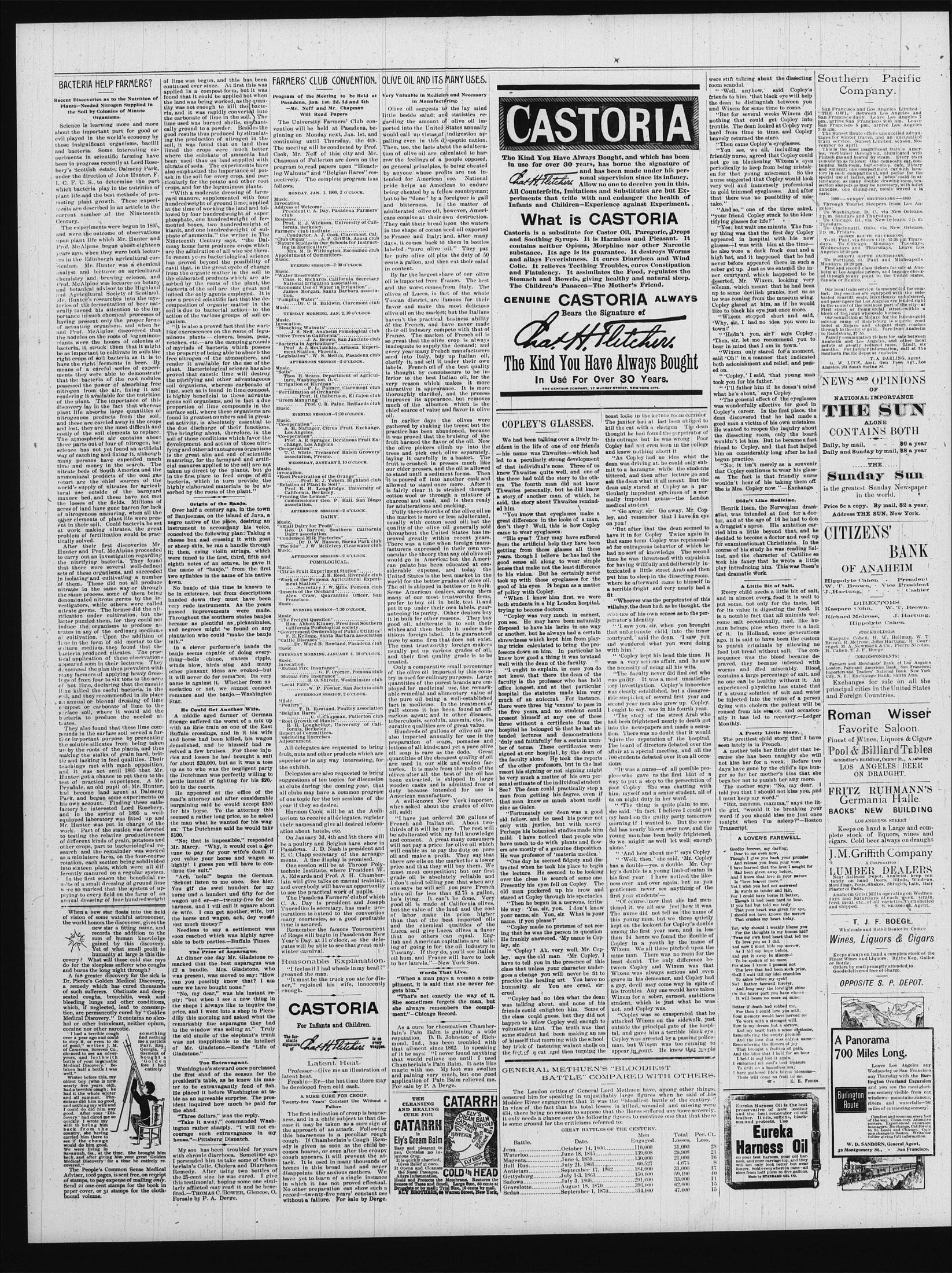
Searchable text
BACTERIA HELP FARMERS?
Recent Discoveries as to the Nutrition of Plants—Needed Nitrogen Supplied in the Soil by Colonies of Minute Organisms.
Science is learning more and more about the important part for good or evil played in the world's economy by those insignificant organisms, bacilli and bacteria. Some interesting experiments in scientific farming have been in progress recently at Lord Rosebery's Scottish estate, Dalmeny Park, under the direction of John Hunter, F.I.C.F.C.S., to determine the part which bacteria play in the nutrition of plant life and the best methods of promoting plant growth. These experiments are described in an article in the current number of the Nineteenth Century.
The experiments were begun in 1895, and were the outcome of observations upon plant life which Mr. Hunter and Prof. McAlpine began about eighteen years ago, when they were both lecturers in the Edinburgh agricultural curriculum. Mr. Hunter was a chemical analyst and lecturer on agricultural chemistry and brewing science, and Prof. McAlpine was lecturer on botany and botanical advisor to the Highland and Agricultural Society of Scotland. Mr. Hunter's researches into the mysteries of the fermentation of beer naturally turned his attention to the importance in such chemical processes of having present only the proper forms of actuating organisms, and when he and Prof. McAlpine discovered that the nodules on the roots of leguminous plants were the homes of colonies of bacteria, it struck them that it might be as important to cultivate in soils the right crops of soil bacteria as it is to have the right ferments in beer. By means of a careful series of experiments they were able to demonstrate that the bacteria of the root nodules possessed the power of absorbing free nitrogen from the air, fixing it and rendering it available for the nutrition of the plant. The importance of this discovery lay in the fact that whereas plant life absorbs large quantities of nitrogenous products from the soil, and these are carried away in the crops and lost, they are the most difficult and costly of the soil elements to replace. The atmospheric air contains about three parts out of four of nitrogen, but science has not yet found an artificial way of catching and fixing it, although many persons have expended much time and money in the search. The nitrate beds of South America and the coal gas of lime was begun, and this has been continued ever since. At first this was applied in a compost form, but it was found that it could be applied hot when the land was being worked, as the quantity was not enough to kill the bacteria, and it was rapidly converted into the carbonate of lime in the soil. The lime used was burned shells, mechanically ground to a powder. Besides the good results thus produced by stimulating the production of nitrogen in the soil, it was found that on land thus limed the crops were much better where the sulphate of ammonia had been used than on land supplied with nitrate of soda. The experiments have also emphasized the importance of potash in the soil for every crop, and particularly for the potato and other root crops, and for the leguminous plants.
"With a moderate dressing of farmyard manure, supplemented with four hundredweight of ground lime, applied at the time of working the land and followed by four hundredweight of super phosphate, one hundredweight of fermented bones, two hundredweight of klanit, and one hundredweight of sulphate of ammonia," the writer in The Nineteenth Century says, "the Dalmeny home farm produces crops which are the admiration of all who see them. In recent years bacteriological science has proved beyond the possibility of cavil that, in the great cycle of change from the organic matter in the soil to the elaborated products which are absorbed by the roots of the plant, the bacteria of the soil are the great and indeed the only agents employed. It is now a proved scientific fact that the decomposition of organic matter in the soil is due to bacterial action—to the action of the various groups of soil organism.
"It is also a proved fact that the wart-like excrescences on the roots of leguminous plants — clovers, beans, peas, vetches, etc.—are the camping grounds of myriads of bacteria which possess the property of being able to absorb the free nitrogen of the atmosphere, and render it available for the use of the plant. Bacteriological science has also proved that caustic lime will destroy the nitrifying and other advantageous soil organisms, whereas carbonate of lime, such as is found in lime compost, is highly beneficial to these advantageous soil organisms, and in fact a due proportion of lime compounds in the surface soil, where these organisms are found in greatest numbers and in greatest activity, is absolutely essential to the due discharge of their functions. The bringing about, therefore, in the soil of those conditions which favor the development and action of those nitrifying and other advantageous organisms is the great aim and end of scientific manuring, for the farmyard and artificial manures applied to the soil are not taken up direct by the plants, but go
ments they were able to demonstrate that the bacteria of the root nodules possessed the power of absorbing free nitrogen from the air, fixing it and rendering it available for the nutrition of the plant. The importance of this discovery lay in the fact that whereas plant life absorbs large quantities of nitrogenous products from the soil, and these are carried away in the crops and lost, they are the most difficult and costly of the soil elements to replace. The atmospheric air contains about three parts out of four of nitrogen, but science has not yet found an artificial way of catching and fixing it, although many persons have expended much time and money in the search. The nitrate beds of South America and the ammoniacal products of the coal gas retort are the chief sources of the world's supply of nitrates for agricultural use outside of the barnyard manure bed, and these have not met the losses of the fields. Millions of acres of land have gone barren for lack of nitrogenous manuring, when all the other elements of plant life were present in their soil. Could bacteria be set at work making nitrates, the great problem of fertilization would be practically solved.
After their first discoveries Mr. Hunter and Prof. McAlpine proceeded to carry out an investigation regarding the nitrifying bacteria. They found that there were several well-defined sets of these organisms, and succeeded in isolating and cultivating a number of them. These did not all produce nitrates in the same way or through the same process, some of them being denominated nitrous germs by the investigators, while others were called nitrate germs. The former did the nitrification under cultivation, but the latter puzzled them, for they could not induce the organisms to produce nitrates in any of the ordinary mediums of cultivation. Upon the addition of lime in the form of old mortar to the culture medium, they found that the bacteria produced nitrates. The practical application of these observations appeared soon in their lectures. They denounced the plan then prevalent with many farmers of applying heavy dressings of from four to six tons to the acre of hot lime, declaring that the caustic lime killed the useful bacteria in the soil, and they recommended in its place an annual or biennial dressing of lime compost or carbonate of lime to the surface soil, where it would aid the bacteria to produce the needed nitrates.
They also found that these lime compounds in the surface soil served a further important purpose by preventing the soluble silicates from being taken up by the roots of the plants, and thus making the stalks of grain hard, brittle and lacking in feed qualities. Their teachings met with much opposition, and it was not until 1895 that Mr. Hunter got a chance to put them to the test of practical experience. A Mr. Drysdale, an old pupil of Mr. Hunter, had become land agent at Dalmeny Park, and began some experiments on his own account. Finding these satisfactory he interested Lord Rosebery, and in the spring of 1895 a well-equipped laboratory was fitted up and Mr. Hunter was put in charge of the work. Part of the station was devoted to testing the relative productiveness of different kinds of grain, potatoes and other crops, part to bacteriological research and the remainder was worked as a miniature farm, on the four-course rotation, each section being subdivided into sixteen plats, which were all differently manured on a regular system.
In the first season the beneficial results of a small dressing of ground lime were so marked that the system of applying to every field on the farm of an
Origin of the Banjo.
Over half a century ago, in the town of Banjoemas, on the island of Java, a negro native of the place, desiring an instrument to accompany his voice, conceived the following plan: Taking a cheese box and crossing it with goat or sheep skin, he ran a handle through it; then, using violin strings, which were tuned to the first, third, fifth and eighth notes of an octave, he gave it the name of "banjo," from the first two syllables in the name of his native town.
No banjo of this time is known to be in existence, but from descriptions handed down they must have been very rude instruments. As the years passed improvements were made. Throughout the southern states banjos became as plentiful as plekaninnies, and negroes might be found on any plantation who could "make the banjo talk."
In a clever performer's hands the banjo seems capable of doing everything—bells chine, waters ripple, winds blow, birds sing and many other pleasant ideas are evoked—but it will never do for romance. Its very name is against it. Whether from association or not, we cannot connect romance and the banjo.—Washington Star.
He Could Get Another Wife.
A middle aged farmer of German lineage suffered the worst of a mix up with an Erie train on one of the East Buffalo crossings, and in it his wife and horse had been killed, his wagon demolished, and he himself had received a few bruises. For these injuries and losses he had brought a suit for about $20,000, but as it was a toss up as to who was the negligent party the Dutchman was perfectly willing to settle instead of fighting for his $20,000 in the courts.
He appeared at the office of the road's attorney and after considerable bargaining said he would accept $200 for his horse. To the attorney this seemed a rather long price, so he asked the man what he wanted for his wagon. The Dutchman said he would take $100.
"No; that is impossible," responded Mr. Marcy. "Why it would cost a fortune for your wife's death if you value your horse and wagon so highly! I guess you will have to continue the suit."
"Ach,'nein!" began the German. "Schust listen to me once. See hier. You gif me swel hundert for my horse und a hundert und fifty for der
EVENING SESSION—7:30 O'CLEARY
Music.
"Co-operation."
A.H. Naftger, Citrus Fruit.
Los Angeles.
"Co-operation."
Prof.A.R Sprague, Deciduous change, Los Angeles.
"Co-operation."
T.C. White, Treasurer Raisin association, Presno.
WEDNDAY, JANUARY 3, 10 O'CLEARY
Music.
invocation.
"Root Penetration of the Orange"
Prof.E.J Yokem, High
"Relation of Plant to Soil"
Prof.B.H Longridge, Uncle California,Berkley
"Pruning the Lemon"
Commissioner Geo.P.Hallassociation.
AFTERNOON SESSION—2 O'CLEARY
DAIRY
Music.
"小Mai Dairy for Proft"
Geo.D.Darron,Southern Dairy association.
"Condensed Milk Factories"
Dr.D.W.Hasson,Buenas
"The Silo"
J.W.McKelvey,Clean Music.
EVENING SESSION—7:30 O'CLEARY
Music.
"The Freight Question"
Hon.Abbott Kinney,President California Pomological Society
"Government Operation of Public F.E.Kellogg,Santa Barbara"
"Cattle Diseases"
Dr.Ward B.Rowland,Pascal
THURSDAY MORNING, JANUARY 4
Music.
Invocation.
"Mutual Fire Insurance"
G.F.Cromer,P
"Mutual Fire Insurance"
R.O.Shively.Westminster
"Local Fairs"
W.P.Fowler,San J
AFTERNOON SESSION,2 O'CLEARY
Music.
Poultry.
T.B.Rowiand,Poultry
Belgian Hares
C.C Chapman,Fuille
Root Growth of Plants
R.H.LoughridgeUniversal BerkleyReport of Committees'oncluding ExercisesAdjournment.
All delegates are requested fruit,nuts and other products superior or in any way interimthe exhibit.
Delegates are also requeststuggestions of ten topics for at clubs during the coming all clubs may have a common one topic for the ten session year if they so desire.
Harmon Cook will be at torium to receive all delegates their names and give all designation about hotels,e etc.
On January 33,4th and 5th be a poultry and Belgian hare Pasadena.J.D.Nash is preE.C.Clapp secretary of thme ments.A fine display is proOne session will be at The technic Institute where Pr.A.Edwards and Prof.A.Hain will give talks on manuand everybody will have an oto see the practical work offThe Pasadena Farmers' clare
When a new star floats into the neld of vision of some watchful astronomer, the world honors the discoverer, gives the new star a fitting name, and records the addition to the sum of human knowledge gained by this discovery. Yet of what small profit to humanity at large is this discovery? What will those cold star rays do for the sleepless sufferer who coughs and burns the long night through?
A far greater discovery for the sick is Dr. Pierce's Golden Medical Discovery, a remedy which has cured thousands of such sufferers. Obstinate and deep-seated coughs, bronchitis, weak and bleeding lungs and other conditions, which, if neglected, lead to consumption, are permanently cured by "Golden Medical Discovery." It contains no alcohol or other intoxicant, neither opium, cocaine nor other narcotic.
"I had a terrible cough over a year ago and could stop it, or even to do of good," writes J. M. of Cameron, Screven Co., chanced to see an adver- yours, and forthwith bottle of your invaluable Medical Discovery. Be-taken half a bottle I was well.
Winter before this, my oldest boy (who is now nearly five years old), had a terrible cough; he had it the whole winter and all summer. Physicians did him no good, and nothing my wife and I could do did him any good. After your Discovery' had cured me so quickly I wrote my wife to bring him back from the country, she having carried him there to see if the change would do him good. We were living in Savannah, Ga., at the time. She brought him back, and after giving him your great Golden Medical Discovery' for a time he entirely recovered."
The People's Common Sense Medical Adviser, 1008 pages, is sent free, on receipt of stamps, to pay expense of mailing only. Send 21 one-cent stamps for the book in paper cover, or 31 stamps for the cloth-bound volume.
At dinner one day Mr. Gladstone remarked that the best asparagus was E2 a bundle. Mrs. Gladstone, who was present, was moved to say: "How can you possibly know that? I am sure we have bought none."
"No, my dear," was his instant reply; "but when I see a new thing in the shops I always like to inquire the price, and I went into a shop in Piccadilly this morning and asked what the remarkably fine asparagus they had in the window was selling at." Truly the old simile of the elephant's trunk was not inapplicable to the intellect of Mr. Gladstone.—Read's "Life of Gladstone."
Too Extravagant.
Washington's steward once purchased the first shad of the season for the president's table, as he knew his master to be extravagantly fond of fish. He placed it before Washington at table as an agreeable surprise. The president inquired how much he paid for the shad.
"Three dollars," was the reply.
"Take it away," commanded Washington rather sharply. "I will not encourage such extravagance in my house."—Pittsburg Dispatch.
My son has been troubled for years with chronic diarrhoea. Sometimes ago I persuaded him to take some of Chamberlain's Colle, Cholera and Diarrhoea Remedy. After using two bottles of the 25-cent size he was cured. I give this testimonial, hoping some one similarly afflicted may read it and be benefited.—THOMAS C. BOWER, Glencoe, O. Forsale by P. A. Derge.
Harmon Cook will be at The technic Institute, where Prof. A. Edwards and Prof. A H. lain will give talks on manuscripts and everybody will have an opportunity to see the practical work of The Pasadena Farmers' Club C. A. Day is president at Thorndike is secretary, has parations to extend to the many courtesies, so a good time is assured.
Remember the famous Tof Roses will begin in Pasadena Year's Day, at 11 o'clock, so gates will be able to see that winter carnival.
Reasonable Explaination
"I feel as if I had wheels in groaned the man.
"It must be the truck you ner," rejoined his wife, enough.
CASTOR
For Infants and Children
Latent Heart
Professor—Give me an ill latent heat.
Freshie—Er—the hot time be developed from cold cash.
A SURE CURE FOR CRITICAL UNSTABLE FAILURE.
The first indication of crowness, and in a child subject to ease it may be taken as a the approach of an attack. This hoarseness is a peculiar cough. If Chamberlain's Ceddy is given as soon as the comes hoarse, or even after cough appears, it will prevail taek. It is used in many homes in this broad land disappoints the anxious moore yet to learn of a singe in which it has not proved No other preparation can record—twenty-five years' without a failure. For sale
FARMERS' CLUB CONVENTION.
Program of the Meeting to be Held at Pasadena, Jan. 1st, 2d, 3d and 4th
—Mr. Neff and Mr. Chapman
Will Read Papers.
The University Farmers' Club convention will be held at Pasadena, beginning on Monday next, Jan. 1st, and continuing until Thursday, the 4th. The meeting will be conducted by Prof. Cook, Mr. Neff of this city and Mr. Chapman of Fullerton are down on the program to read papers upon "Bleaching Walnuts" and "Belgian Hares" respectively. The complete program is as follows.
MONDAY, JAN. 1, 1900, 2 O'CLOCK.
Music.
Invocation.
Address of Welcome.
President C. A. Day, Pasadena Farmers' club response.
Prof. E. J. Wickson, University of California, Berkeley.
Farmers' Club Institute.
Conductor, A. J. Cook, Claremont, Cal.
Club Organ".
A. P. Grimith, Azusa club
Mature Studies in Our Schools for Instructing in Horticulture.
Mrs. M. D. Withington, Escondido club appointment of Committees.
Music.
EVENING SESSION—7:30 O'CLOCK.
Music.
Water Reservoirs".
Umas. E. Richards, California Secretary.
National Irrigation association.
Economic Use of Water in Irrigation".
James Morgan, Santa Barbara association.
Pumping Water".
Dr. C. G. Baldwin, Claremont club music.
TUESDAY MORNING, JAN. 2, 10 O'CLOCK.
Music.
Bleaching Walnuts".
J. B. Neff, Anaheim Pomological club Olive Trees in California".
J. A. Brown, San Jancinto club Bacteria in Agriculture".
Prof. A. J. McLatchie, Arizona Experiment Station, Phoenix.
Legislation".W. S. Melick, Pasadena club AFTERNOON SESSION—2 O'CLOCK.
Music.
Solls".
Thos H. Means, Department of Agriculture, Washington, D.C.
Irrigation of Hardpan".
F. L. Palmer, Claremont club Fertilization of Orchards".
Prof. H. Calbertson, El Cajon club Green Manuring".
Prof. C. R. Paine, Redlands club Music.
EVENING SESSION—7:30 O'CLOCK.
Music.
Co-operation".
A. H. Naftzger, Citrus Fruit Exchange, Los Angeles.
Co-operation".
Prof. A. R Sprague, Deciduous Fruit Exchange, Los Angeles.
Co-operation".
T. C. White, Treasurer Raisin Growers' association, Fresno.
WEDNESDAY, JANUARY 3, 10 O'CLOCK.
Music.
Invocation.
OLIVE OIL AND ITS MANY USES.
Very Valuable in Medicine and Necessary in Manufacturing.
Olive oil suggests to the lay mind little beside salad; and statistics regarding the amount of olive oil imported into the United States annually would call up vistas of indigestion appalling even in this dyspeptic nation. Then, too, the facts about the adulteration of olive oil are calculated to harrow the feelings of a people opposed, on general principles, to being cheated by anyone whose profits are not intended for American use. National pride helps an American to endure being cheated by a fellow countryman; but to be "done" by a foreigner is gall and bitterness. In the matter of adulterated olive oil, however, Americans connive at their own destruction. They cast their bread upon the waters in the shape of cotton seed oil exported to France and Italy; and, after many days, it comes back to them in bottles labeled "pure olive oil." They pay for pure olive oil plus the duty of 50 cents a gallon, and then eat their salad in content.
By far the largest share of our olive oil is imported from France. The best and the worst comes from Italy. The olives of Lucca, in fact of the whole Tuscan district, are famous for their flavor and make the most delicious olive oil on the market; but the Italians haven't the practical business ability of the French, and have never made their oil industry compete with that of France. The market of French oil is so great that the olive crop is always inadequate to supply the demand; and every year many Frech manufacturers send into Italy, buy up Italian oil, clarify it, and sell it under their own labels. French oil of the best quality is thought by connoisseurs to be inferior to the best Italian oil, for the very reason which makes it more attractive in appearance. It is more thoroughly clarified, and the process improves its appearance, but removes much of the albumen which is the chief source of value and flavor in olive oil.
In earlier days the olives were gathered by shaking the trees; but the practice has been abandoned, because it was proved that the bruising of the fruit harmed the flavor of the oil. Now the olive pickers climb up into the trees and pick each olive separately, laying it carefully in a basket. The fruit is crushed in presses much like our cider presses, and the oil is allowed to stand until a sediment forms. Then
CASTORIA
The Kind You Have Always Bought, and which has been used for over 30 years, has borne the signature and has been made under his personal supervision since its infallible Allow no one to deceive you in All Counterfeits, Imitations and Substitutes are buoyed experiments that trifle with and endanger the health Infants and Children—Experience against Experiments What is CASTORIA Castoria is a substitute for Castor Oil, Paregoric Jr., and Soothing Syrups. It is Harmless and Pleasant contains neither Opium, Morphine nor other Narcotic substances. Its age is its guarantee. It destroys Wheat and allays Feverishness. It cures Diarrhoea and Colic. It relieves Teething Troubles, cures Constipation and Flatulency. It assimilates the Food, regulates Stomach and Bowels, giving healthy and natural The Children's Panacca—The Mother's Friend.
GENUINE CASTORIA ALWAYS Bears the Signature of
The Kind You Have Always Born In Usé For Over 30 Years.
THE GENTAUR COMPANY, TT MURRAY STREET, NEW YORK CITY.
COPLEY'S GLASSES.
We had been talking over a lively incident in the life of one of our friends—his name was Thwaites—which had led to a peculiarly strong development of that individual's nose. Three of us knew Thwaites quite well, and one of us demeaned him driving at he co-imit to a harangue while he breathed in the lecture room.
The janitor had at last be killed the cat with a shotgun thought he had found the outrage; but he was Copley had not even seen anything about it.
As Copley had no idea dean was driving at he co-imit to a harangue while he breathed in the lecture room.
CASTORIA
Thos H. Means, Department of Agriculture, Washington, D.C.
Irrigation of Hardpan
F. L. Palmer, Claremont club
Fertilization of Orchards
Prof. R. Culbertson, El Cajon club
Green Manuring
Prof. C. R. Paine, Redlands club
Music.
EVENING SESSION—7:30 o'CLOCK.
Music.
Cooperation"
A. H. Naftzger, Citrus Fruit Exchange, Los Angeles.
Co-operation"
Prof. A. R Sprague, Deciduous Fruit Exchange, Los Angeles.
Co-operation"
T. C. White, Treasurer Raisin Growers association, Fresno.
WEDNESDAY, JANUARY 3, 10 o'CLOCK.
Music.
Invocation.
Root Penetration of the Orange"
Prof. E. J. Yokem, Highland club
Relation of Plant to Soil"
Prof. H. Lehbridge, University of California, Berkeley.
Pruning the Lemon"
Commissioner Geo. P. Hall, San Diego association.
AFTERNOON SESSION—2 o'CLOCK.
DAIRY.
Music.
Small Dairy for Proft"
Geo. D. Harron, Southern California Dairy association
Condensed Milk Factories"
Dr. D. W. Hasson, Buena Park club
The Silo"
J. W. McKelvey, Clearwater club Music.
AFTERNOON SESSION—2 o'CLOCK.
POMOLOGICAL.
Music.
Citrus Fruit Experiment Station"
J. H. Reed, Riverside club
Work of the Pomona Agricultural Experiment Station"
Secretary J. W. Mills, Pomona club
Insects of the Orchard"
Alex Craw, Quarantine Officer, San Francisco.
EVENTING SESSION—7:30 o'CLOCK.
Music.
The Freight Question"
Hon. Abbott Kinney, President Southern California Pomological Society
G. E. Kellogg, Santa Barbara association
Cattle Diseases"
Dr. Ward B. Rowland, Pasadena club
THURSDAY MORNING, JANUARY 4, 10 o'CLOCK.
Music.
Invocation.
Mutual Fire Insurance"
G. F. Cromer, Pomona club
Mutual Fire Insurance"
R. O. Shively, Westminster club
Local Fairs"
W. P. Fowler, San Jacinto club
Music.
Poultry"
T. B. Rowland, Poultry association
Belgian Hares"
C. C. Chapman, Fullerton club
Root Growth of Plants"
E. H. Longridge, University of California Report of Committees,
concluding Exercises.
Adjournment.
All delegates are requested to bring fruit, nuts and other products which are superior or in any way interesting, for the exhibit.
Delegates are also requested to bring suggestions of ten topics for discussion at clubs during the coming year, that all clubs may have a common program of one topic for the ten sessions of the year if they so desire.
Harmon Cook will be at the Auditorium to receive all delegates, register their names and give all desired information about hotels, etc.
On January 3d, 4th and 5th there will be a poultry and Belgian hare show in Pasadena.
J. D. Nash is president and E. C. Clapp secretary of the arrangements.
A fine display is promised.
One session will be at Throop Polytechnic Institute, where President W.A. Edwards and Prof. A H. Chamberlain will give talks on manual training, and everybody will have an opportunity to see the practical work of pupils.
The Pasadena Farmers' club of which In Use For Over 30 Years.
THE CENTAUR COMPANY, 77 MURRAY STREET, NEW YORK CITY.
COPLEY'S GLASSES.
We had been talking over a lively incident in the life of one of our friends—his name was Thwaites—which had led to a peculiarly strong development of that individual's nose. Three of us knew Thwaites quite well, and one of the three had told the story to the others. The fourth man did not know Thwaites personally, but he did know a story of another man, of which, he said, the story about Thwaites reminded him.
"You know that eyeglasses make a great difference in the looks of a man, don't they? Well, this is how Copley came to wear eyeglasses."
His eyes? They may have suffered from the artificial help they have been getting from those glasses all these years, though I believe he has had the good sense all along to wear simple lenses that make not the least difference to his vision. But he certainly never took up with those eyeglasses for the good of his eyes. It began as a matter of policy with Copley.
"When I knew him first, we were both students in a big London hospital trying to become doctors."
Copley was very much in earnest you see. He may have been naturally disposed to have his larks in one way or another, but he always had a certain shrewdness which kept him from playing tricks calculated to bring the professors down on him. In particular he knew how good a thing it was to stand well with the dean of the faculty.
"I ought to explain, in case you do not know, that there the dean of the faculty is the professor who has held office longest, and at that particular hospital the statutes made him very much of an autocrat. For instance, there were three big 'exams' to pass in the five years, and no student could present himself at any one of these three without a certificate from the hospital he belonged to that he had attended lectures and demonstrations 'duly and faithfully' for a certain number of terms. These certificates were signed at our hospital, by the dean of the faculty alone. He took the reports of the other professors, but in the last resort his signing or not signing might be very much a matter of his own personal estimate of the individual student See? The dean could practically stop a man from getting his degree, even if that man knew as much about medicine as Galen.
"Fortunately our dean was a good old fellow, and he used his power not only with justice, but with mercy Perhaps his botanical studies made him mild. I have noticed that people who have much to do with plants and flowers are mostly of a genuine disposition." He was professor of 'materia medica.'
"One day he seemed fidgety and distracted when he took his place to begin the lecture. He seemed to be looking over the class in search of some one Presently his eyes fell on Copley. The old man puckered up his brow and stared at Copley through his spectacles."
beast loosely in the lecture room The janitor had at last be killed the cat with a shotgun thought he had found the outrage; but he was Copley had not even been known nothing about it.
"As Copley had no idea dean was driving at; he committed to a harangue while tittered, and then after he asked the dean what it all meant dean only stared at Copley ticularly impudent specifically mally impudent genius-medical student."
"Go away; sirt! Go away leey, and remember that on you!
But after that the dean have it in for Copley That same term Copley wielded for outrageous behavior had no sort of knowledge time he was threatened with having willfully and d toxicated a little street put him to sleep in the diarie where he afterward came a terrible fright and very fit.
"Whoever was the perp villainy,the dean had.as evidence of his own sense petrator's identity."
"I saw you,sir,when that fortunate child is courtyard,said the dean and wondered what you with him."
"Copley kept his head was a very serious affair the necessity of using all."
"The faculty never did was guilty It was a moreory investigation.Copley was clearly established.table suspicion of several second year men also greedy I ought to say.was in his
"The story of the steward had been frightened near into the newspapers and tion There was no doubt'njure the reputation Of the board of directors deal affair at a special meeting 700 students debated overions."
"It was a nurse—of a people—who gave us the first way to put a stop to the poor Copley She was a him,myself and a senior us on night duty in her."
"The thing is quite she said.In fact.I belied my hand on the guilty p pro morning if I wanted to.Dal has nearly blown over young man has been bad So we might as well lie alone."
"And how about me"
"Well then,'she said has a double—yes,a douley's double is a young girl his first year.I have ness over and over again gentlemen never see an first year students'"
Harmon Cook will be at the Auditorium to receive all delegates, register their names and give all desired information about hotels, etc.
On January 3d, 4th and 5th there will be a poultry and Belgian bare show in Pasadena. J. D. Nash is president and E. C. Clapp secretary of the arrangements. A fine display is promised.
One session will be at Throop Polytechnic Institute, where President W. A. Edwards and Prof. A H. Chamberlain will give talks on manual training, and everybody will have an opportunity to see the practical work of pupils.
The Pasadena Farmers' club of which C. A. Day is president and Joseph Thorndike is secretary, has made preparations to extend to the convention many courtesies, so a good profitable time is assured.
Remember the famous Tournament of Roses will begin in Pasadena on New Year's Day, at 11 o'clock, so the delegates will be able to see that great midwinter carnival.
Reasonable Explanation.
"I feel as if I had wheels in my head!" groaned the man.
"It must be the truck you ate for dinner," rejoined his wife, innocently enough.
CASTORIA
For Infants and Children.
Latent Heat.
Professor—Give me an illustration of latent heat.
Freshie—Er—the hot time there may be developed from cold cash.
A SURE CURE FOR CROUP.
Twenty-five Years’ Constant Use Without a Failure.
The first indication of croup is hoarseness, and in a child subject to that disease it may be taken as a sure sign of the approach of an attack. Following this hoarseness is a peculiar rough cough. If Chamberlain’s Cough Remedy is given as soon as the child becomes hoarse, or even after the croupy cough appears, it will prevent the attack. It is used in many thousands of homes in this broad land and never disappoints the anxious mothers. We have yet to learn of a single instance in which it has not proved effectual. No other preparation can show such a record—twenty-five years’ constant use without a failure. For sale by Derge.
A well-known New York importer, when asked about the grades of olive oil, said:
"I have just ordered 200 gallons of French and Italian oil. About two-thirds of it will be pure. The rest will be adulterated with my full knowledge and consent. A great many consumers will not pay a price for olive oil which will enable us to pay the duty on pure oil and make a profit. They say that there are oils on the market for a lower price and that they will buy them. We must meet competition; but our first grade oil is absolutely reliable and I don't mind telling you that when any one says he will sell you pure French olive oil for less than $2.75 a gallon, he's lying. It can't be done. Very good oil is made of California olives, but the value of the land and the cost of labor make its price higher than that of the best imported oils and the chemical qualities of the Lucca soil give Lucca olives a flavor that no others can equal. English and American capitalists are talking of going in for the oil industry in Tuscany. If they do, you'll see Italian oil hum, and France will have to look to her laurels."—New York Sun.
Words That Live.
"When a man pays a woman a compliment, it is said that she never forgets him."
"That’s not exactly the way of it. She sometimes forgets the man, but she always remembers the compliment."—Chicago Record.
As a cure for rheumatism Chamberlain’s Pain Balm is gaining a wide reputation. D. B. Johnston of Richmond, Ind., has been troubled with that ailment since 1862. In speaking of it he says: "I never found anything that would relieve me until I used Chamberlain’s Pain Balm. It acts like magic with me. My foot was swollen and paining very much, but one good application of Pain Balm relieved me. For sale by P. A Derge."
Fortunately our dean was a good old fellow, and he used his power not only with justice, but with mercy Perhaps his botanical studies made him mild. I have noticed that people who have much to do with plants and flowers are mostly of a genuine disposition He was professor of 'materia medica.'
One day he seemed fidgety and distracted when he took his place to begin the lecture. He seemed to be looking over the class in search of some one Presently his eyes fell on Copley. The old man puckered up his brow and stared at Copley through his spectacles.
Then he began in a nervous, irritable way: 'Yes, sir, you. I don’t know your name, sir. You, sir. What is your name, if you please?'
Copley made no pretense of not seeing that he was the person in question He frankly answered: 'My name is Copley, sir.'
"Copley? Ah, very well, Mr. Copley, says the old man: 'Mr. Copley, I have to tell you in the presence of this class that unless your character undergoes a change you will never be fit to practice the healing art. You have no humanity, sir You are cruel, sir cruel."
Copley had no idea what the dean was talking about, and none of his friends could enlighten him. Some of the class could guess, but they did not happen to know Copley well enough to volunteer a hint. The truth was that some student had been making an ass of himself that morning with the schoolboy trick of fastening walnut shells on the feet of a cat and then turning the
GENERAL METHUEN'S "BLOODIEST BATTLE" COMPARED WITH
The London critics of General Lord Methuen have, among censured him for speaking in unjustifiably large figures when Modder River engagement that it was the "bloodiest battle on In view of the fact that his total losses in killed, wounded and 434, there being no reason to suppose that the Bores suffered and it only needs a glance over the following figures to convince one is some ground for the criticisms referred to:
GREAT BATTLES OF THE CENTURY.
Battle. Date. Men Engaged.
Jena. October 14, 1806. 110,000
Waterloo. June 18, 1815. 139,608
Magenta. June 4, 1829. 130,000
Bull Run. July 21, 1861. 60,527
Antietam. September 17, 1862. 184,000
Gettysburg. July 1-3, 1863. 150,000
Sadowa. July 3, 1866. 291,000
Gravelotte. August 18, 1870. 396,000
Sedan. September 1, 1870. 314,000
were still talking about the dissecting room scandal.
"Well, anyhow," said Copley's friends to him, "that black eye will help the dean to distinguish between you and Wixem for some time to come."
"But for several weeks Wixem did nothing that could get Copley into trouble. The dean looked at Copley very hard from time to time, and Copley bravely returned the stare.
"Then came Copley's eyeglasses.
You see, we all, including the friendly nurse, agreed that Copley could not go on blackening Wixem's eyes periodically to keep from being mistaken for that young miscreant. So the nurse suggested that Copley would look very well and immensely professional in gold trimmed eyeglasses. And after that there was no possibility of mistake."
"And so," one of the three asked, "your friend Copley stuck to the identifying glasses for life?"
"Yes; but wait one minute. The funny thing was that the first day Copley appeared in hospital with his new glasses—I was with him at the time—he also wore a dark frock coat and a high hat, and it happened that he had never before appeared there in such a sober get up. Just as we entered the inner courtyard, which happened to be deserted, Mr. Wixem, looking very solemn, which meant that he had been up to some devilish pranks, met us as he was coming from the museum wing. Copley glared at him, as if he would like to black his eye just once more.
Wixem stopped short and said, 'Why, sir, I had no idea you were in town!'
"Hadn't you, sir?" says Copley. Then, sir, let me recommend you to bear in mind that I am in town.
"Wixem only stared for a moment, said 'Oh!' in a manner that indicated both astonishment and relief, and passed on.
"Copley,' I said, 'that young man took you for his father.'
"I'll father him if he doesn't mind what he's about,' says Copley.
"The general effect of the eyeglasses was wonderfully effective for good in Copley's career. In the first place, the dean discovered that he had made a good man a victim of his own mistakes. He wanted to reopen the inquiry about the dissecting room, only the board wouldn't let him. But he became a fast friend to Copley, and that fact helped him on considerably long after he had begun practice.
"No; it isn't merely as a souvenir that Copley continues to wear his glass-ware still talking about the dissecting room scandal."
beast loose in the lecture room corridor The janitor had at last been obliged to kill the cat with a shotgun. The dean thought he had found the perpetrator of this outrage, but he was wrong. Poor Copley had not even been in the college and knew nothing about it.
"As Copley had no idea what the dean was driving at, he could only submit to a harangue, while the students tittered, and then after lecture go and ask the dean what it all meant. But the dean only stared at Copley as a particularly impudent specimen of a normally impudent genus—the London medical student.
"Go away, sir! Go away, Mr. Copley, and remember that I have an eye on you!
But after that the dean seemed to have it in for Copley Twice again in that same term Copley was reprimanded for outrageous behavior of which he had no sort of knowledge. The second time he was threatened with expulsion for having willfully and deliberately intoxicated a little street Arab and then put him to sleep in the dissecting room, where he afterward came to himself in a terrible fright and very nearly had a fit.
"Whoever was the perpetrator of this villainy, the dean had, as he thought, the evidence of his own senses as to the perpetrator's identity.
"I saw you, sir, when you brought that unfortunate child into the inner courtyard," said the dean. "I saw you and wondered what you were doing with him."
"Copley kept his head this time. It was a very serious affair, and he saw the necessity of using all his wits.
"The faculty never did find out who was guilty. It was a most unsatisfactory investigation. Copley's innocence was clearly established, but a disagreeable suspicion of several first year and second year men also grew up. Copley, I ought to say, was in his fourth year.
"The story of the street Arab who had been frightened nearly to death got into the newspapers and made a sensation. There was no doubt that it would injure the reputation of the hospital. The board of directors debated over the affair at a special meeting, and all the 700 students debated over it on all occasions.
"It was a nurse—of all possible people—who gave us the first hint of a way to put a stop to the persecution of poor Copley She was chatting with him, myself and a senior student, all of us on night duty in her ward.
"The thing is quite plain to me, she said. In fact, I believe I could put my hand on the guilty party tomorrow morning if I wanted to. But the scandal has nearly blown over now, and the young man has been badly frightened. So we might as well let well enough alone."
"And how about me?" says Copley
"Well, then," she said, "Mr. Copley has a double—yes, a double Mr. Copley's double is a young limb of satan in his first year. I have noticed the likeness over and over again, but as you gentlemen never see anything of the first year students'—"
"Copley,' I said, 'that young man took you for his father."
"I'll father him if he doesn't mind what he's about," says Copley.
"The general effect of the eyeglasses was wonderfully effective for good in Copley's career. In the first place, the dean discovered that he had made a good man a victim of his own mistakes. He wanted to reopen the inquiry about the dissecting room, only the board wouldn't let him. But he became a fast friend to Copley, and that fact helped him on considerably long after he had begun practice.
"No; it isn't merely as a souvenir that Copley continues to wear his glasses. The fact is that friendly nurse wouldn't hear of his taking them off. She is Mrs. Copley now." — Exchange.
Didn't Like Medicine.
Henrik Ibsen, the Norwegian dramatist, was intended at first for a doctor, and at the age of 16 he had to do a druggist's apron. His ambition carried him a little beyond that, and he decided to become a doctor and read up for examination at Christiania. In the course of his study he was reading Salust, and the character of Catiline so took his fancy that he wrote a little play introducing him. This was Ibsen's first dramatic work.
A Little Bit of Salt.
Every child needs a little bit of salt, and in almost every food it is well to put some, not only for the taste, but for its value in digesting the food. It is a notable fact that all animals welcome salt occasionally, and like human beings, pine when there is a lack of it. In Holland, some generations ago, it is said to have been the custom to punish criminals by allowing no food but bread without salt. The consequence was the blood became depraved, they became infested with worms and died miserably. Blood contains a large percentage of salt, and no one can be healthy without it. An experienced physician has stated that if a strong solution of salt and water be injected into the veins of a person dying with cholera the patient will be roused from his stool, and occasionally it has led to recovery. — Ledger Monthly.
A Pretty Little Story.
The prettiest child story that I have seen lately is in French.
A mother tells her little girl that because she has been naughty she will not kiss her for a week. Before two days have gone by the child's lips hunger so for her mother's kiss that she begs her not to punish her any more.
The mother says: "No, my dear. I told you that I should not kiss you, and I must keep my word."
"But, mamma, mamma," says the little girl, "would it be breaking your word if you should kiss me just once tonight when I'm asleep?" — Boston Transcript.
A LOVER'S FAREWELL.
Goodby forever, my darling,
Dear to me even now,
Though I give you back your promise
And release you from your vow,
I have learned that the love I sought for
Had been given away before,
And I know that love in your nature
Is "love forever more."
Yet I wish you had not answered
In words so tender and fair,
If I could have borne it better,
NEWS AND OPINIONS OF NATIONAL IMPORTANCE THE SUN ALONE CONTAINS BOTH Daily, by mail, $6 a year Daily and Sunday by mail, $8 a year
THE Sunday Sun is the greatest Sunday Newspaper in the world.
Price 5c a copy. By mail, $2 a year.
Address THE SUN, New York.
CITIZENS' BANK OF ANAHEIM
Hippolyte Cahen President W. T. Brown Vice President J. Hartung,
DIRECTORS Kaspare Cohn, W. T. Brown Richard Melrose, J. Hartung Hippolyte Cahen.
STOCKHOLDERS Kaspare Cohen, H. W. Hellman, W. T. Brown R. Melrose John Hartung R. Courreges M.A. Newmark & Co., Pierre Nicolas H. Cahen, T.J.P.Boege
CORRESPONDENTS Farmers and Merchants' Bank of Los Angeles London, Paris and American Bank, San Francisco; Importers and Traders' National Bank New York City, N.Y.; Exchange Bank, Santa Ana.
Exchanges for sale on all the principal cities in the United States and Foreign Countries.
Roman Wisser Favorite Saloon.
Finest of Wines, Liquors & Cigars Pool & Billiard Tables
Schindler's Building, Center St., Amahlea LOS ANGELES BEER ON DRAUGHT.
FRITZ RUHMANN'S Germania Halle.
BACKS' NEW BUILDING
LOS ANGELES STREET
Keeps on hand a Large and complete stock of liquors, wines and cigars. Cold beer always on draught
J.M.Griffith Company
A CORPORATION
LUMBER DEALERS
Near Railroad Depot, Amahleu, keep con tantly on hand Doors, Blinds Windows Mouldings, Posts, Shakes, Shingles, Lath, Hair Plairs of Paris.
Amahleu Grist Mills operating on Wednesdays and Saturdays on each week. Grain
"‘The thing is quite plain to me, she said. ‘In fact, I believe I could put my hand on the guilty party tomorrow morning if I wanted to. But the scandal has nearly blown over now, and the young man has been badly frightened. So we might as well let well enough alone.’"
"'And how about me?' says Copley
"'Well, then,' she said, 'Mr. Copley has a double—yes, a double Mr. Copley’s double is a young limb of satan in his first year. I have noticed the likeness over and over again, but as you gentlemen never see anything of the first year students’—"
“Of course, now that she had mentioned it, we all saw just how it was. The nurse did not tell us the name of this young man, but we three quietly kept on the lookout for Copley’s double among the first year men, and in less than 24 hours we found the double of Copley in a youth by the name of Wixem. We all three pitched upon the same man. There was no room for the least doubt. The only difference between Copley and Wixem was that Wixem was always serious and even grave in his demeanor, and Copley had a gay, devil may come way in spite of his troubles. Anyone would have taken Wixem for a sober, earnest, ambitious student, which is just what he was not, and Copley was.
“Copley was so exasperated that he attacked Wixem on the sidewalk, just outside the principal gate of the hospital, and gave him a terrible black eye. Copley was arrested by a passing policeman, but Wixem was too cunning to appear in court. He knew that people
N.Y.'S "BLOODIEST COMPARED WITH OTHERS."
Lord Methuen have, among other things, mistifiably large figures when he said of his was the “bloodyest battle of the century.” Losses in killed, wounded and missing were seen that the Bores suffered any more severely. Showing figures to convince one that there referred to:
| Men Engaged | Total | Per. Ct. Loss |
| :--- | :--- | :--- |
| 806 | 110,000 | 31,000 |
| 139,608 | 29,908 | 21 |
| 130,000 | 21,000 | 16 |
| 60,527 | 4,675 | 8 |
| 1862 | 184,000 | 31,000 |
| 150,000 | 59,190 | 40 |
| 201,000 | 33,000 | 11 |
| 396,000 | 62,000 | 15 |
| 314,000 | 47,000 | 15 |
Eureka Harness Oil is the best preservative of new leather and the best renovator of old leather. It oils, softens, blackens and protects. Use
Eureka Harness Oil
on your best harness, your old harbors and your carriage top, and they will not only look better but wear longer. Sold everywhere in canns—all sizes from half pints to five gallons.
Germania Halle
BACKS' NEW BUILDING
LOS ANGELES STREET
Keeps on hand a Large and complete stock of liquors, wines and cigars. Cold beer always on draught
J.M.Griffith Company
A CORPORATION
LUMBER DEALERS
Near railroad Depot, Anaheim, keep con tantly on hand Doors, Blinds, Windows, Mouldings, Posts, Shakes, Shingles, Lath, Hair Plaster of Paris.
Anaheim Grist Mills operating on Wednesdays and Saturdays of each week. Grain feed, meal etc., of all varieties. Cornshellled and shipped.
T. J.F. BOEGE.
Wholesale and Retail Dealer in Choice
Wines, Liquors & Cigars
Keeps always on hand a complete stock of the Finest Wines and Liquors. By the Keg, Gallon or Bottle.
Orders by mail promptly attended to.
Goods delivered free of charge.
OPPOSITE S. P. DEPOT.
A Panorama
700 Miles Long.
Leave Los Angeles any Wednesday or San Francisco any Thursday with the Burlington Overland Excursion and you see the most glorious scenery visible from car windows—mountains,canons,rivers and waterfalls—700 miles of entrancing scenery.
Comfort and economy every foot of the way. Clean cars Attentive patrons Experienced escarpment managers No change California to St Louis and Chicago. Only one change to Boston. Write for folder giving full information.
W.D.SANBORN,GENERALAGENT,
32MontgomerySt.,SanFrancisco.