anaheim-gazette 1899-12-14
Scanned page
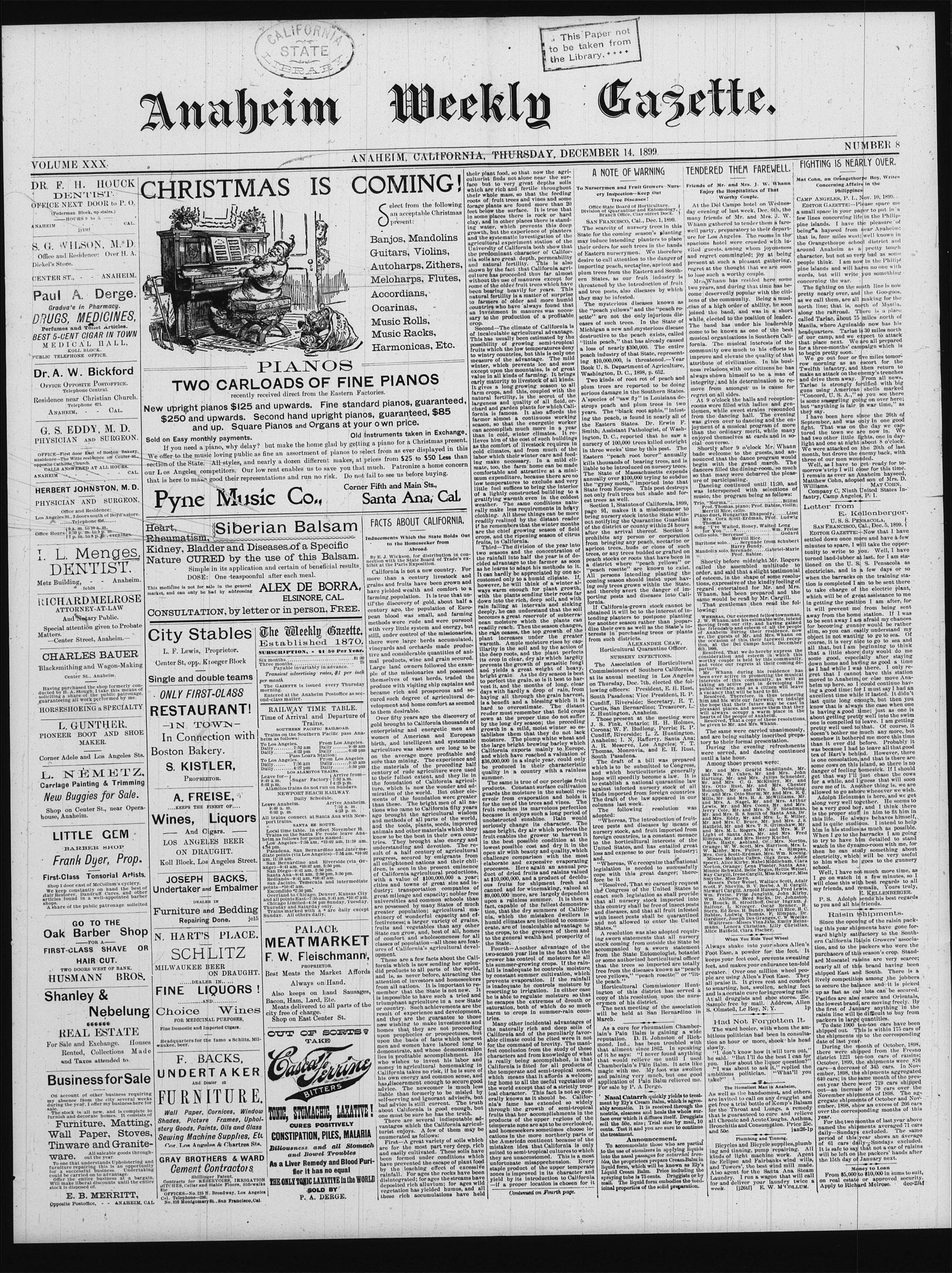
Searchable text
CALIFORNIA
STATE
LIBRARY
Anaheim
VOLUME XXX.
DR. F. H. HOUCK
DENTIST.
OFFICE NEXT DOOR to P. O.
(Federman Block, up stairs.)
HOURS 9 to 5
ANAHEIM CAL.
jy1stf
S. G. WILSON, M. D.
Office and Residence: Over H. A.
Dickel's Store.
CENTER ST., - ANAHEIM.
Paul A. Derge.
Gradua'e in Pharmacy.
DRUGS, MEDICINES,
Perfumes and Toilet Articles.
BEST 5-CENT CIGAR IN TOWN
MEDICAL HALL,
KOLL BLOCK.
PUBLIC TELEPHONE OFFICE.
Dr. A. W. Bickford
OFFICE OPPOSITE POSTOFFICE.
Telephone Central.
Residence near Christian Church.
Telephone 671.
ANAHEIM, - CAL.
G. S. EDDY, M. D.
PHYSICIAN AND SURGEON.
OFFICE—First door East of Boston Bakery.
Residence—The Wilte residence on Center St.
opposite Catholic Church.
CALLS ANSWERED AT ALL HOURS.
CAL.
CHRISTMAS IS ON
PIANOS
TWO CARLOADS OF FIN
recently received direct from the Eastern
New upright pianos $125 and upwards. Fine sta-
$250 and upwards. Second hand upright piand up. Square Pianos and Organs at y
Sold on Easy monthly payments.
If you need a piano, why delay? but make the home glad by geWe offer to the music loving public as fine an assortment of pianos to
section of the State. All styles, and nearly a dozen different makes,
our Los Angeles competitors. Our low rent enables us to save you t
OFFICE OPPOSITE POSTOFFICE.
Telephone Central.
Residence near Christian Church.
Telephone 671.
ANAHEIM, CAL.
G. S. EDDY, M. D.
PHYSICIAN AND SURGEON.
OFFICE—First door East of Boston Bakery.
Residence—The Witte residence on Center St.
opposite Catholic Church.
CALLS ANSWERED AT ALL HOURS.
ANAHEIM, CAL.
HERBERT JOHNSTON, M. D.
PHYSICIAN AND SURGEON.
Office and Residence:
Los Angeles St., 3 doors south of Boyd's store.
Telephone 656....
9 a.m. to 10 a.m.
Office Hours: 3:30 p.m. to 5 p.m.
7 p.m. to 8 p.m., evenings.
I. L. Menges,
DENTIST.
Metz Building, Anaheim.
feb24
RICHARDMELROSE
ATTORNEY-AT-LAW
And Notary Public.
Special attention given to Probate Matters.
—Center Street, Anaheim.
CHARLES BAUER
Blacksmithing and Wagon-Making
Center St., Anaheim.
Having purchased the shop formerly conducted by H. A. Stough, I take this means of soliciting a share of the public patronage, guaranteeing all work performed by me.
HORSESHOEING a SPECIALTY
L. GUNTHER.
PIONEER BOOT AND SHOE MAKER.
Corner Adele and Los Angeles Sts.
L. NEMETZ.
Carriage Painting & Trimming
New Buggies for Sale.
Shop on Center St., near Opera-house, Anaheim.
LITTLE GEM
BARBER SHOP
Frank Dyer, Prop.
First-Class Tonsorial Artists.
Shop 1 door east of McCollum's cyclery.
We keep constantly on hand the best of hair Restorer, Dandruff Cures, and other articles found in a well-appointed barber
TWO CARLOADS OF FINANCE
recently received direct from the Eastern office.
New upright pianos $125 and upwards. Fine staircases $250 and upwards. Second hand upright pianos and up. Square Pianos and Organs at your service.
Sold on Easy monthly payments.
If you need a piano, why delay? but make the home glad by giving it to the music loving public as fine an assortment of pianos to section of the State. All styles, and nearly a dozen different makes, our Los Angeles competitors. Our low rent enables us to save you that is here to make good their representations and run no risk. Do not sell on Easy monthly payments.
Pyne Music Co.,
Heart,
Rheumatism,
Kidney, Bladder and Diseases of a Specific Nature CURED by the use of this Balsam-like medicine. One teaspoonful after each meal.
ALEX DE BORRA
ELSINORE, CAL.
CONSULTATION, by letter or in person, FREE.
City Stables
L. F. Lewis, Proprietor.
Center St, opp. Kroeger Block
Single and double teams
ONLY FIRST-CLASS RESTAURANT!
—IN TOWN—
In Connection with Boston Bakery.
S. KISTLER,
PROPRIETOR.
A. FREISE,
...KEEPS THE FINEST OF...
Wines, Liquors
And Cigars.
LOS ANGELES BEER ON DRAUGHT.
Koll Block, Los Angeles Street.
JOSEPH BACKS,
Undertaker and Embalmer
The Weekly Gazette
Established 1870
SUBSCRIPTION, - $1 50 Per Year
Six months....Three months....Payable invariably in advance.
Transient advertising rates, $1 per month.
The GAZETTE is issued every Thursday morning.
Entered at the Anaheim Postoffice as on-d-class matter.
RAILWAY TIME TABLE
Time of Arrival and Departure Trains.
SOUTHERN PACIFIC RAILROAD.
Trains on the Southern Pacific pass helix as follows:
To Los Angeles....From Los Angeles
Daily.....7:52 am Daily.....9:40 am
Daily.....4:23 pm Daily.....6:00 am
Pass Loara Station:
To Los Angeles....From Los Angeles
Daily.....7:56 am Daily.....9:40 am
Daily.....4:27 pm Daily.....5:55 am
LOS ALAMITOS TRAINS:
Leave for—
Sugar Factory (7:52 a.m.)
6:00 p.m (4:25 p.m)
Alamitos trains do not run on Sundays.
NEWPORT BEACH RAILWAY.
Daily Schedule.
Leave Anaheim.
Arrive Anaheim
9:49 a.m
6:03 p.m
4:23 p.m
All trains connect at Santa Ana with port trains.
SANTA BE ROUTE.
Local time table. In effect November trains on the Santa Fe route leave helix as follows for points named:
Los Angeles—7:55 am, *10:02 am, 11:19 am
4:54 pm.
Pasadena, San Bernardino and interstate points (via Los Angeles)—7:55 am, am. 11:19 am
San Bernardino and Riverside (via Angie)—9:41 am, *10:47 am, 5:50 pm.
Santa Ana—9:41 am, 2:50 pm.
Santa Ana—9:41 am, 2:50 pm, 5:50 pm.
Redlands—9:41 am, *10:47 am.
San Jacinto, Temecula and interstate points—10:47 am.
Escondido to Chicago, Denver, Kansas and all points East—7:55 am, *10:47 am.*
LITTLE GEM
BARBER SHOP
Frank Dyer, Prop.
First-Class Tonsorial Artists.
Shop 1 door east of McCollum's cyclery.
We keep constantly on hand the best of hair Restorer, Dandruff Cures, and other articles found in a well-appointed barber shops.
A share of the public patronage solicited
GO TO THE Oak Barber Shop
FOR A FIRST-CLASS SHAVE OR HAIR CUT.
TWO DOORS WEST OF BANK.
HUSMANN BROS.
Shanley & Nebelung
REAL ESTATE
For Sale and Exchange. Houses Rented, Collections Made and Taxes attended to.
Business for Sale
On account of other business requiring my absence from the city several weeks during the year. I offer my business here for sale.
The stock is all new, and is complete to furnish and decorate homes. It consists of Furniture, Matting, Wall Paper, Stoves, Tinware and Graniteware.
All saleable goods throughout the year.
To one that understands Upholstering and furniture repairing this is an opportunity for a successful business. Undertaking could be carried on to advantage.
Offer the entire business at a bargain. Will make liberal discounts until the entire stock is disposed of.
E. B. MERRITT,
Opposite Postoffice, - - ANAHEIM, CAL
A. PREICE,
...KEeps The Finest Of...
Wines, Liquors
And Cigars.
LOS ANGELES BEER ON DRAUGHT.
Koll Block, Los Angeles Street.
JOSEPH BACKS,
Undertaker and Embalmer
DEALER IN
Furniture and Bedding Repairing Done.
N. HART'S PLACE.
SCHLITZ
MILWAUKEE BEER ON DRAUGHT.
DEALER IN...
FINE LIQUORS!
AND....
Choice Wines
FOR MEDICINAL PURPOSES,
Fine Domestic and Imported Cigars.
Headquarters for the famo's Schlitz, Milwaukee, beer.
F. BACKS,
UNDERTAKER
And Dealer in
FURNITURE.
Wall Paper, Cornices, Window Shades, Picture Frames, Upholstery Goods, Paints, Oils and Glass Sewing Machine Supplies, Etc.
Cor. Los Angeles & Chartres Sts.
GRAY BROTHERS & WARD
Cement Contractors.
Shillinger Patent.
Contracts for RESERVOIRS, IRRIGATION MITCHES, Cellar and Stable Floors, Sidewalks Etc.
OFFICES—No. 125 N. Broadway, Los Angeles Cal., Telephone—236.
No. 315 Montgomery St., San Francisco, Cal.
PALACE MEAT MARKET
F. W. Fleischman
PROPRIETOR.
Best Meats the Market Afternoon on Hand.
Also keeps on hand Sauce Bacon, Ham, Lard, Ete.
Meats delivered to all parts of city free of charge.
Shop on East Center St.
OUT OF SORT TAKE
CASCA FERRI
BITTERS
TONIC, STOMACHIC, LAXATIVE
CURES POSITIVELY CONSTIPATION, PILES, MAN
Billiousness and all Stores and Bowel Troubles
As a Liver Remedy and Blood flier it has no equal
THE ONLY TONIC LAXATIVE in the SOLD BY
P. A. DERGE.
This Paper not to be taken from the Library.
ANAHEIM, CALIFORNIA, THURSDAY, DECEMBER 14, 1899.
IS IS COMING!
Select from the following acceptable Christmas present:
Banjos, Mandolins
Guitars, Violins,
Autoharps, Zithers,
Meloharps, Flutes,
Accordians,
Ocarinas,
Music Rolls,
Music Racks,
Harmonicas, Etc.
PIANOS
ADS OF FINE PIANOS
direct from the Eastern Factories.
Upwards. Fine standard pianos, guaranteed,
and hand upright pianos, guaranteed, $85
pianos and Organs at your own price.
Old instruments taken in Exchange.
Make the home glad by getting a piano for a Christmas present.
An assortment of pianos to select from as ever displayed in this
a dozen different makes, at prices from $25 to $50 less than
enables us to save you that much. Patronize a home concern
their plant food, so that now the agriculturist finds not alone near the surface but to very great depths soils which are rich and fertile throughout their whole mass, so that the feeding roots of fruit trees and vines and some forage plants are found more than 20 feet below the surface. It is true that in some places there is rock or hard clay, and in other places there is standing water, which prevents this deep growth, but the experience of planters and the systematic investigation of the agricultural experiment station of the University of California both show that the predominant character of California soils are great depth, permeability and natural fertility. This is also shown by the fact that California agriculture has proceeded thus far almost without the use of manures except for some of the older fruit trees which have been bearing heavily for years. This natural fertility is a matter of surprise to farmers of older and more humid countries who have always found that an investment in manures was necessary to the production of a profitable crop.
Second—The climate of California is of incalculable agricultural advantage. This has usually been estimated by the possibility of growing semi-tropical fruits which the low temperatures deny to wintry countries, but this is only one measure of the advantage. The mild winter, which prevents ice and snow except upon the mountains, is of great value in all kinds of farming. It brings early maturity to livestock of all kinds. It gives a long growing season to all farm crops, and this, coupled with the natural fertility, is the secret of the largeness and quality of all field, orchard and garden plants for which California is famous. It also affords the farmer almost a continuous working season, so that the energetic worker can accomplish much more in a year than in cold, winter climates. It relieves him of the cost of such buildings as the comfort of livestock requires in cold climates, and from much of the labor which their winter care and feeding make necessary. In a mild climate, too, the farm home can be made comfortable and attractive at a mini-
A NOTE OF WARNING
To Nurserymen and Fruit Growers—Nursery Inspection—Keep Out Tree Diseases!
Office State Board of Horticulture,
Division of Quarantine and Entomology
Branch Office, Clay-street Dock.
SAN FRANCISCO, Cal., Dec. 1, 1899
The scarcity of nursery trees in the State for the coming season's plants may induce intending planters to purchase their orders for such trees in the hands of Eastern nurserymen. We therefore desire to call attention to the danger importing peach, nectarine, apricot plum trees from the Eastern and Southern States, as our fruit industry threatened by the introduction of fire and tree pests, also diseases by which they may be infested.
The mysterious diseases known as "peach yellows" and the "peach sette" are not the only injurious causes of such trees. In the State Michigan a new and mysterious destructive to the peach exists, called "little peach," that has already caused a loss of nearly $300,000. The entire peach industry of that State, representing $10,000,000, is threatened.—W.Book U.S.Department of Agriculture Washington, D.C., 1898, p. 652.
Two kinds of root rot of peach plum trees are reported to be due serious damage in the Southern States of "saw fly" in Louisiana stroys peach and plum trees in years. The "black root aphis," arising from the peach, is found in nearly all the Eastern States. Dr. Erwin Smith; Assistant Pathologist, of Winston, D.C., reported that he saw nursery of 100,000 trees killed out in three weeks' time by this pest.
Eastern "peach root borer" annihilates thousands of bearing trees, liable to be introduced on nurseries. The State of Massachusetts ex
FACTS ABOUT CALIFORNIA.
Inducements Which the State Holds Out to the Homeseeker from Abroad.
By E. J. Wickson, for distribution in connection with the State Board of Trade's exhibit at the Paris Exposition.
California is not a new country. For more than a century livestock and grains and fruits have been grown and have yielded wealth and comfort to a farming population. It is true that until the discovery of gold, about half a century ago, the population of European blood was small, and farming methods were rude and were pursued with very little system and energy, but still, under control of the missionaries, there were large herds accumulated, vineyards and orchards made productive and considerable quantities of animal products, wine and grain secured. Large land owners followed the example of the missionaries and possessed themselves of vast herds, traded the produce with visiting ship captains and became rich and prosperous and secured such degree of agricultural development and home comfort as seemed to them desirable.
Over fifty years ago the discovery of gold brought to California thousands of enterprising and energetic men and women of American and European birth, and intelligent and systematic agriculture was shown ere long to be on the average more profitable and sure than mining. The experience and the materials of the preceding half century of rude agriculture were used to their fullest extent, and they lie in the foundation of California agriculture, which is now the wonder and admiration of the world. But other elements of the foundation were greater than these. The bright men of all nations who came to California fifty years ago brought the agricultural wisdom and methods of all parts of the world, and the tools, plants, seeds, improved animals and other materials which they knew to be the best in their own countries. They brought also energy and understanding and devotion. The result of a half century of agricultural progress, secured by emigrants from all enlightened nations and their children, is seen in the present eminence of California agricultural productions, with a value of $100,000,000 a year; cities and towns of great size and industry; transportation companies of great mileage and capacity; nobler free value in all kinds of farming. It brings early maturity to livestock of all kinds. It gives a long growing season to all farm crops, and this, coupled with the natural fertility, is the secret of the largeness and quality of all field, orchard and garden plants for which California is famous. It also affords the farmer almost a continuous working season, so that the energetic worker can accomplish much more in a year than in cold, winter climates. It relieves him of the cost of such buildings as the comfort of livestock requires in cold climates, and from much of the labor which their winter care and feeding make necessary. In a mild climate, too, the farm home can be made comfortable and attractive at a minimum expenditure, because there are no low temperatures to exclude and very little fuel suffices to bring the interior of a lightly constructed building to a gratifying warmth even in the coldest weather. The same conditions naturally make less requirements in heavy clothing. All these things can be more readily realized by the distant reader if he remembers that the winter months are the chief growing season of field crops, and the ripening season of citrus fruits, in California.
Third—The division of the year into two seasons and the concentration of the rainfall into half the year is of decided advantage to the farmer as soon as he learns to adapt his methods to it. It can hardly be appreciated by one accustomed only to a humid climate. If, however, he will think of a winter always warm enough for plant growth, with the plants sending their roots far down into the rich, deep soil, and with rain falling at intervals and sinking deeply, he can understand that the soil becomes a great reservoir of subterranean moisture which the plants can readily reach. Then the season changes, the rain ceases, the top growth of the plant increases under the greater warmth. Ample moisture rises by capillarity in the soil and by the action of the deep roots, and the plant perfects its crop in clear, dry air which largely prevents the growth of parasitic fungi and yields a great weight of heavy, bright grain. As the dry season is best to perfect the grain, so is it best to harvest it, and the months of long, clear days with hardly a drop of rain, from haying all through the grain harvest, is a benefit and a blessing which it is hard to overestimate. The distant reader must remember that field crops sown at the proper time do not suffer by the long dry season; the preceding growth in a mild, moist winter so establishes them that they do not lack moisture. The plump white wheat and the large bright brewing barley which California exports mainly to Europe, and which have reached a valuation of $36,000,000 in a single year, could only be produced in their characteristic quality in a country with a rainless summer.
The same is true of our peerless fruit products. Constant surface cultivation guards the moisture in the subsolil reservoir from evaporation and holds it for the use of trees and vines. The fruit reaches its marvelous perfection because it enjoys such a long period of unobstructed sunshine. Rain would seriously change its character. The same bright, dry air which perfects the fruit enables the grower to harvest it in the best possible condition at the lowest possible cost and dry it in the open air with beauty and quality, which challenge comparison with the most elaborate and expensive evaporating processes. Here again an annual product of dried fruits and raisins valued at $10,000,000, and a product of deciduous fruits for shipment fresh and canned for winemaking, valued at $9,000,000 more, are largely dependent on Washington, D.C., Iosef Price.
Two kinds of root rot of peach plum trees are reported to be due serious damage in the Southern St. A species of "saw fly" in Louisiana stroys peach and plum trees in years. The "black root aphis," arising in the peach, is found in nearly 24 Eastern States. Dr. Erwin Smith; Assistant Pathologist, of Winston, D.C., reported that he nursery of 100,000 trees killed out in three weeks' time by this pest. Eastern "peach root borer" kills thousands of bearing trees, liable to be introduced on nursery The State of Massachusetts annually over $100,000 trying to sell the "gypsy moth," imported into State from Europe. This pest does not only fruit trees but shade any est trees as well.
Section 1: Statutes of California page 91, makes it a misdemeanor bringing nursery stock into the State outnotifying the Quarantine Guard of the district or county within 24 after the arrival thereof. Secrets prohibits any person or corporation from bringing any peach, nectar apricot trees, buds or clementia trees or any trees budded or grape peach stocks or roots that have been district where "peach yellow" roach rosette are known to all Persons intending planting coming season should insist upon only trees grown within this district and thereby avert the danger positing pests and diseases into California.
If California-grown stock cannot obtain it will be to interest tending planters to postpone planting for another season rather than size their own as well as the State resterts in purchasing trees or from such districts.
ALEXANDER CRANE
Horticultural Quarantine Officer
NURSERY INFECTIONS.
The Association of Horticulture Commissioners of Southern Californias at its annual meeting in Los Angeles on Thursday, Dec. 7th, elected lowlow officers: President E. South Pasadena; Vice President Cundiff; Riverside; Secretary Curtis; San Bernardino; Treasurer Z. Huntington; Anaheim.
Those present at the meeting J. S. Fink; Ontario; H. Hora; W. F. Budlong; Perrie Cundiff; Riverside; L. Z. Hunna; Anaheim; I. N. Rafferty; San A. R. Meserve; Los Angeles Monrovia, and E. E. South Pasadena.
The draft of a bill was which is to be submitted to Oral hope which horticulturists go hope speedily become a law to establish a national quarantine against infected nursery stock kinds imported from foreign cities The draft of the law appears columns last week.
The following resolution adopted:
"Whereas, The introduction tree pests and diseases by nursery stock, and fruit import foreign countries is a constant to the horticultural interests United States, and has entailed loss and expense to our fruiting business."
Whereas We recognize that legislation is needed to supersede with this great danger forebe it
Resolved That we earnestly enact such legislation as shall apply
PALACE
BEAT MARKET
W. Fleischmann,
PROPRIETOR.
Meats the Market Affords
Always on Hand.
also keeps on hand Sausages,
on Ham, Lard, Etc.
meats delivered to all parts of the free of charge.
hop on East Center St.
OUT OF SORTS?
TAKE
GASKA TERRINE
BITTERS
MIC, STOMACHIC, LAXATIVE!
CURES POSITIVELY
CONSTIPATION, PILES, MALARIA
ciousness and all Stomach and Bowel Troubles
a Liver Remedy and Blood Purifier it has no equal
ONLY TONIC LAXATIVE in the WORLD
SOLD BY
P. A. DERGE.
There are several indisputable advantages which the California agriculturist enjoys. A few of them may be enumerated as follows:
First—A great variety of soils which are for the most part very deep, rich and easily cultivated. These soils have been formed under conditions which have prevented the escape of plant food by the leaching effect of excessive rainfall. For ages the rocks have been disintegrated; for ages the streams have deposited rich alluvium; for ages wild vegetation has yielded humus, and all these rich accumulations have heldments of the foundation we greatest than these. The bright men of all nations who came to California fifty years ago brought the agricultural wisdom and methods of all parts of the world, and the tools, plants, seeds, improved animals and other materials which they knew to be the best in their own countries. They brought also energy and understanding and devotion. The result of a half century of agricultural progress, secured by emigrants from all enlightened nations and their children, is seen in the present eminence of California agricultural productions, with a value of $100,000,000 a year; cities and towns of great size and industry; transportation companies of great mileage and capacity; nobler free universities and common schools than are possessed by many States of much greater population; agricultural machinery of wonderful capacity and effectiveness; a larger variety of grains, fruits and vegetables than any other State can grow, and, best of all, homes of comfort and wholesomeness for all classes of population—all these are features of California's agricultural development.
These are a few facts about the California which is now sending her splendid products to all parts of the world, and is, as never before, attracting the attention of investors and homeseekers from all nations. It is important to remember that the State is not new. It is impossible to have such a tried and triumphant agriculture in a new State or country. Such achievements are the result of experience and development, and they are the guarantee to those new wishing to make investments and homes that they are not proceeding upon prophecies or prospectuses, but upon the basis of facts which earnest men and women have labored long to demonstrate, and whose demonstration lies in profitable accomplishment. He wishes to invest his labor and money in agricultural homemaking in California takes no risk, if he is sure of his own energy and common sense, and has discernment enough to secure good advice. The newcomer is much less liable than formerly to be misled by self-serving and ignorant advisers, but bad advice is still current. The truth about California is good enough, but one must be sure he has the truth.
There are several indisputable advantages which the California agriculturist enjoys. A few of them may be enumerated as follows:
First—A great variety of soils which are for the most part very deep, rich and easily cultivated. These soils have been formed under conditions which have prevented the escape of plant food by the leaching effect of excessive rainfall. For ages the rocks have been disintegrated; for ages the streams have deposited rich alluvium; for ages wild vegetation has yielded humus, and all these rich accumulations have heldments of the foundation we greatest than these. The bright men of all nations who came to California fifty years ago brought the agricultural wisdom and methods of all parts of the world, and the tools, plants, seeds, improved animals and other materials which they knew to be the best in their own countries. They brought also energy and understanding and devotion. The result of a half century of agricultural progress, secured by emigrants from all enlightened nations and their children, is seen in the present eminence of California agricultural productions, with a value of $100,000,000 a year; cities and towns of great size and industry; transportation companies of great mileage and capacity; nobler free universities and common schools than are possessed by many States of much greater population; agricultural machinery of wonderful capacity and effectiveness; a larger variety of grains, fruits and vegetables than any other State can grow, and, best of all, homes of comfort and wholesomeness for all classes of population—all these are features of California's agricultural development.
These are a few facts about the California which is now sending her splendid products to all parts of the world, and is, as never before, attracting the attention of investors and homeseekers from all nations. It is important to remember that the State is not new. It is impossible to have such a tried and triumphant agriculture in a new State or country. Such achievements are the result of experience and development, and they are the guarantee to those new wishing to make investments and homes that they are not proceeding upon prophecies or prospectuses, but upon the basis of facts which earnest men and women have labored long to demonstrate, and whose demonstration lies in profitable accomplishment. He wishes to invest his labor and money in agricultural homemaking in California takes no risk, if he is sure of his own energy and common sense, and has discernment enough to secure good advice. The newcomer is much less liable than formerly to be misled by self-serving and ignorant advisers, but bad advice is still current. The truth about California is good enough, but one must be sure he has the truth.
Fourth—Another advantage of the two-season year lies in the fact that the grower has control of moisture for all his summer-growing crops. If the rainfall is inadequate he controls moisture by constant summer cultivation, which prevents evaporation. If the rainfall is inadequate he controls moisture by resorting to irrigation. In either case he is able to regulate moisture so that he escapes the extremes of drought or saturation, both of which do so much harm to crops in summer-rain countries.
Many other incidental advantages of the naturally rich and deep soils of California and of the peculiarly favorable climate could be cited were it not for the command of brevity. The manifest conclusion from the study of these characters and from knowledge of what is really being accomplished, is that California is fitted for all products of the temperate and semi-tropical zones, which means that it affords a welcoming home to all the useful vegetation of the world except that of a strictly tropical character. This fact is not so generally known as it should be. California's fame has extended so widely through the growth of semi-tropical fruits that her accomplishments in the products of the upper regions of the temperate zone are apt to be overlooked, and homeseekers sometimes choose locations in the more northerly parts of the American continent because of the mistaken idea that California is only suited to semi-tropical cultures to which they are unaccustomed. This is a most fortunate misapprehension. Every staple product of the upper temperate zones is improved in its character and yield by its introduction to California—if a proper location is chosen for it
Continued on Fourth page.
The fruit reaches its marvelous perfection because it enjoys such a long period of unobstructed sunshine. Rain would seriously change its character. The same bright, dry air which perfects the fruit enables the grower to harvest it in the lowest possible cost and dry it in the open air with beauty and quality, which challenge comparison with the most elaborate and expensive evaporating processes. Here again an annual product of dried fruits and raisins valued at $10,000,000, and a product of deciduous fruits for shipment fresh and canned and for winemaking, valued at $9,000,000 more, are largely dependent upon a rainless summer. It is then a fact, capable of the fullest demonstration, that the dry summers of California, which mistaken dwellers in humid climates are inclined to commiserate, are of incalculable advantage to the crops, to the growers of them and to the general wealth and prosperity of the State.
Fourth—Another advantage of the two-season year lies in the fact that the grower has control of moisture for all his summer-growing crops. If the rainfall is inadequate he controls moisture by constant summer cultivation, which prevents evaporation. If the rainfall is inadequate he controls moisture by resorting to irrigation. In either case he is able to regulate moisture so that he escapes the extremes of drought or saturation, both of which do so much harm to crops in summer-rain countries.
Many other incidental advantages of the naturally rich and deep soils of California and of the peculiarly favorable climate could be cited were it not for the command of brevity. The manifest conclusion from the study of these characters and from knowledge of what is really being accomplished, is that California is fitted for all products of the temperate and semi-tropical zones, which means that it affords a welcoming home to all the useful vegetation of the world except that of a strictly tropical character. This fact is not so generally known as it should be. California's fame has extended so widely through the growth of semi-tropical fruits that her accomplishments in the products of the upper regions of the temperate zone are apt to be overlooked, and homeseekers sometimes choose locations in the more northerly parts of the American continent because of the mistaken idea that California is only suited to semi-tropical cultures to which they are unaccustomed. This is a most fortunate misapprehension. Every staple product of the upper temperate zones is improved in its character and yield by its introduction to California—if a proper location is chosen for it
Announcement:
To accommodate those who wish to use atomizers in applications into the nasal passages for cathetles, the proprietors prepare C liquid form, which will be knotted Liquid Cream Balm. Price is 25 cents spray tube is 75 cents. Drink mail. The liquid form embodies properties of the solid p
NOTE OF WARNING
Emergency men and Fruit Growers—Nursery Inspection—Keep Out Tree Diseases!
State Board of Horticulture,
Department of Quarantine and Entomology,
Branch Office, Clay-street Dock.
FRANCISCO, Cal., Dec. 1, 1899.
Scarcity of nursery trees in this area for the coming season's planting reduce intending planters to placeorders for such trees in the hands of nurserymen. We therefore call attention to the danger of peach, nectarine, apricot and trees from the Eastern and South-Atlantic, as our fruit industry is enforced by the introduction of fruit tree pests, also diseases by which may be infested.
Mysterious diseases known as peach yellows" and the "peach roofer" are not the only injurious dis- tors of such trees. In the State of Oregon a new and mysterious disease active to the peach exists, called peach," that has already caused nearly $300,000. The entire industry of that State, represent- ting 100,000,000, is threatened.—Year U.S. Department of Agriculture,ington, D.C., 1898, p. 652.
The kinds of root rot of peach and trees are reported to be doing its damage in the Southern States. Cities of "saw fly" in Louisiana de- peach and plum trees in two.
The "black root aphis," infest- tion of peach, is found in nearly all of Eastern States. Dr. Erwin F. Friar, Assistant Pathologist, of Wash-ton, D.C., reported that he saw a variety of 100,000 trees killed outright three weeks' time by this pest. The term "peach root borer" annually thousands of bearing trees, and is due to be introduced on nursery trees. State of Massachusetts expands
TENDERED THEM FAREWELL.
Friends of Mr. and Mrs. J. W. Whann Enjoy the Hospitalities of That Worthy Couple.
At the Del Campo hotel on Wednesday evening of last week, Dec. 6th, the many friends of Mr. and Mrs. J. W. Whann gathered to tender them a farewell party, preparatory to their departure for Los Angeles. The rooms in the spacious hotel were crowded with invited guests, among whom joyousness and regret commingled; joy at being present at such a pleasant gathering, regret at the thought that we are soon to lose such a worthy couple.
Mr. Whann has resided here some two years, and during that time has become deservedly popular with the citizens of the community. Being a musician of a high order of ability, he soon joined the band, and was in a short while, elected to the position of leader. The band has under his leadership come to be known as one of the best musical organizations in Southern California. The musical interests of the community owe much to his efforts to improve and elevate the quality of that attribute of civilization. In his business relations with our citizens he has always shown himself to be a man of integrity, and his determination to remove from amongst us is cause for regret on all sides.
At 9 o'clock the halls and reception- rooms were filled with ladies and gentlemen, while sweet strains resounded from the dancing hall. The evening was given over to dancing and the enjoyment of a musical program of more than the ordinary merit, while many enjoyed themselves at cards and in social converse.
Shortly after 9 o'clock Mr. Whann bade welcome to the guests, and announced that the dance program would begin with the grand march. The dancers filled the dining-room, so much so that many were debarred the pleas-
FIGHTING IS NEARLY OVER.
Mat Cohn, an Orangethorpe Boy, Writes Concerning Affairs in the Philippines.
CAMP ANGELES, P. I., Nov. 10, 1899.
EDITOR GAZETTE:—Please spare me a small space in your paper to put in a few lines concerning life in the Philippine islands. I have the pleasure of being a hayseed from near Anaheim; that is, four miles west; well known in the Orangethorpe school district and around Anaheim as a pretty tough character, but not so very bad as some people think. I am now in the Philippine islands and will harm no one with words, but will write you something concerning the war.
The fighting on the south line is now pretty nearly over, and the Goo-goos, as we call them, are all making for the north line; that is, north of Manila, along the railroad. There is a place called Tarlac, about 75 miles north of Manila, where Aguinaldo now has his headquarters. Tarlac is 30 miles north of our camp, and we expect to attack that place next. We are all prepared for a three-months' campaign which is to begin pretty soon.
We go out four or five miles tomorrow morning as an escort for the Twelfth infantry, and then return to make an attack on the enemy's trenches and drive them away. From all news, Tarlac is strongly fortified with big guns using American shells marked "Concord, U. S. A." so you see there is some snugging going on over here; but "anything is fair in war time," as they say.
I have been here since the 26th of September, and was only in one good fight. That was on the day we captured the town we are now in. We had two other little fights, one in daylight and one at night about 8 o'clock. We were attacked on the 20th of last month, but drove the enemy back, with three of our men wounded.
Well, as I have to get ready for tomorrow's trip I will close for this time.
The "black root aphis," infesting peach, is found in nearly all of Eastern States. Dr. Erwin F. Born, Assistant Pathologist, of Wash. D.C., reported that he saw a variety of 100,000 trees killed outright three weeks' time by this pest. The horn "peach root borer" annually threatens thousands of bearing trees, and is to be introduced on nursery trees. State of Massachusetts expends nearly over $100,000 trying to subdue grypsy moth," imported into that from Europe. This pest destroys only fruit trees but shade and forges as well.
Section 1, Statutes of California, 1899, act 91, makes it misdemeanor to ing nursery stock into the State without notifying the Quarantine Guardian district or county within 24 hours for the arrival thereof. Section 5 prohibits any person or corporation bringing any peach, nectarine or root trees, buds or cions of such trees, or any trees budded or grafted on which stocks or roots have been in district where "peach yellows" or peach rosette" are known to exist. Persons intending planting the spring season should insist upon having only trees grown within the State thereby avert the danger of immiting pests and diseases into California.
California-grown stock cannot be trained it will be to the interest of induding planters to postpone planting another season rather than jeopardize their own as well as the State's interests in purchasing trees or plants from such districts.
ALEXANDER CRAW, Horticultural Quarantine Officer.
NURSERY INFECTIONS.
The Association of Horticultural Commissioners of Southern California, its annual meeting in Los Angeles Thursday, Dec. 7th, elected the following officers: President, E.H. Rust, South Pasadena; Vice President, R.P. Sandifl, Riverside; Secretary, R.T. Hartis, San Bernardino; Treasurer, L.Huntington, Anaheim.
Those present at the meeting were S.F. Fink, Ontario; H.H. Holmes, Prona; W.F. Budlong, Perris; R.P. Sandifl, Riverside; L.Z. Huntington, Anaheim; I.N. Rafferty, Santa Ana; R.R. Mereserve, Los Angeles; T.T. Thomas, Monrovia, and E.H. Huston, South Pasadena.
The draft of a bill was prepared which is to be submitted to Congress, and which horticulturists generally hope will speedily become a law. It is establish a national quarantine law against infected nursery stock of all lands imported from foreign countries. The draft of the law appeared in our columns last week.
The following resolution was adopted:
Whereas, the introduction of fruit-tree pests and diseases by means of nursery stock, and fruit imported from foreign countries, is a constant menace to the horticultural interests of the United States, and has entailed great stress and expense to our fruit industry;
Whereas, We recognize that national legislation is needed to successfully cope with this great danger; therefore we be it.
Resolved, That we earnestly request the Congress of the United States to enact such legislation as shall provide stock imported into
At 9 o'clock the halls and reception rooms were filled with ladies and gentlemen, while sweet strains resounded from the dancing hall. The evening was given over to dancing and the enjoyment of a musical program of more than the ordinary merit, while many enjoyed themselves at cards and in social converse.
Shortly after 9 o'clock Mr. Whann bade welcome to the guests, and announced that the dance program would begin with the grand march. The dancers filled the dining-room, so much so that many were debarred the pleasure of participating.
Dancing continued until 11:30, and was interspersed with selections of music, the program being as follows:
Trio, "Norma," Billint Prof. Thomas, piano; Prof. Babize, violin; Merrill Rice, cello.
Plano duet, Hungarian Rhapsody...Lizst Mrs. Cora Scott-Erdman, Prof. Ludwig Thomas.
Song I've Waited, Honey, Waited Long for You...X...Wm. Freise Cello solo,"Berceuse""Godard Merrill Rice.
Haritone solo...Serenade from Schubert Harry Bundy.
Mandolin solo, Serenade...Gabriel-Marie Prof. Babize.
Shortly before midnight Mr. Rogers called the assembled multitude to order, and said that a slight testimonial of esteem, in the shape of some resolutions, expressive of the kindly feeling of regard entertained for Mr. and Mrs. Whann had been prepared and the same would be read by Mr. Cargill.
That gentleman then read the following:
WHEREAS Our esteemed fellow townman, J.W. Whann and his estimable wife, intend moving from our city, and having gained the friendship and esteem of all people of Anaheim will be hard to till.
Therefore, in thus tendering him and his wife our farewell, we indulge the hope that their future may be cast in pleasant places, and assure them that they will always occupy a warm place in the hearts of the people of Anaheim.
Resolved, That a copy of these resolutions be given to Mr. and Mrs. Whann.
The same were carried unanimously, and are being suitably inscribed preparatory to their formal presentation.
During the evening refreshments were served, and dancing continued until a late hour.
Among those present were:
Mr. and Mrs. Gearld Sandilands, Mr. and Mrs. H.Cahen, Mr. and Mrs. John Hartung, Mr. and Mrs.Julus Schnelder, Mr. and Mrs.C.G.McKinley, Mr. and Mrs.Otto Rust, Mr. and Mrs.Eneur Holcomb, Mr. and Mrs.Borman, Mr. and Mrs.R.C.Mattou McKinley, Mr. and Mrs.H.A.McWilliams, Mr. and Mrs.A.Nagel, Mr. and Mrs.Arthur Lewis, Mr. and Mrs.Coons, Mr. and Mrs.Jerry Cole, Mr. and Mrs.N.F.Steadman, Mr. and Mrs.R.S.Smith of Santa Ana, Dr. and Mrs.Eddy, Mr. and Mrs.L.Elimpandr., Mr. and Mrs.C.Bruce, Mr. and Mrs.J.S.Hatid McKinley, Mr. and Mrs.W.Grimshaw, Mr. and Mrs.M.L.Rogers, Mr. and Mrs.M.P.Light of Santa Ana, Mr. and Mrs.Fred Rimpau, Mr. and Mrs.Henry Kuchel.
Mr.Hasty Ashland Or.; Mrs.Norton Orange; W.W.scott,Mrs.Harrison,Mrs.L.W.Kirby,Mrs.Fuller,Mrs.M.W.corpra Scottt-Carden,Mrs.Wm.Koenig,Mrs.Cora Scott-Carden,Mrs.Wm.Koenig,Mrs.Cora Scottt-Carden,Mrs.Wm.Koenig,Mrs.Cora Scottt-Carden,Mrs.Wm.Koenig,Mrs.Cora Scottt-Carden,Mrs.Wm.Koenig,Mrs.Cora Scottt-Carden,Mrs.Wm.Koenig,Mrs.Cora Scottt-Carden,Mrs.Wm.Koenig,Mrs.Cora Scottt-Carden,Mrs.Wm.Koenig,Mrs.Cora Scottt-Carden,Mrs.Wm.Koenig,Mrs.Cora Scottt-Carden,Mrs.Wm.Koenig,Mrs.Cora Scottt-Carden,Mrs.Wm.Koenig,Mrs.Cora Scottt-Carden,Mrs.Wm.Koenig,Mrs.Cora Scottt-Carden,Mrs.Wm.Koenig,Mrs.Cora Scottt-Carden,Mrs.Wm.Koenig,Mrs.Cora Scottt-Carden,Mrs.Wm.Koenig,Mrs.Cora Scottt-Carden,Mrs.Wm.Koenig,Mrs.Cora Scottt-Carden,Mrs.Wm.Koenig,Mrs.Cora Scottt-Carden,Mrs.Wm.Koenig,Mrs.Cora Scottt-Carden,Mrs.Wm.Koenig,Mrs.Cora Scottt-Carden,Mrs.Wm.Koenig,Mrs.Cora Scottt-Carden,Mrs.Wm.Koenig,Mrs.Cora Scottt-Carden,Mrs.Wm.Koenig,Mrs.Cora Scottt-Carden,Mrs.Wm.Koenig,Mrs.Cora Scottt-Carden,Mrs.Wm.Koenig,Mrs.Cora Scottt-Carden,Mrs.Wm.Koenig,Mrs.Cora Scottt-Carden,Mrs.Wm.Koenig,MRS.CORA CROWDERS Miss Zeyn
Messers Peter Weisel Wallace Scott Adair Scott F., B.V.Reehe A.H.Cargill Cardurgall Arnold Hansen Fred Lewis Wm.Freise Frigg Jungluth John Kirby Wm.Allbhorn Bred Backs Dr.Johnston
Letter from
E.Kellenberger
U.S.S.S.PENSACOLA,
SAN FRANCISCO Cal., Dec.5, 1899.
EDITOR GAZETTE—Now that I have settled down once more and have a few minutes to spare, I will take the opportunity to write to you Well, I have turned land-lubber at last; for I am stationed on the U.S.S.S.Pensacola as electrician,and in a few days or so when the barracks on the training station is completed I am to be sent there to take charge of the electric plantwhich will be of great assistance to me in getting the position I am after; for it will prevent me from being sent away from the home station If I was to be sent away I am afraid my chances for becoming gunner would be rather slimso you can easily understand my object in not wanting to go to sea Of course.it is very nice to go to sea and all thatbut I am beginning to think that a little shore duty would do me some goodespecially after staying down home and having as good a time as I had while I was there.I only regret that I cannot have this station moved to Anaheim.or else move Anaheim up here.so I could continue having a good time;for I must sayI had an excellent time while it lasted.Dit didn't last quite long enoughbut then you know that is always the case when one is having a good timejust as one is about getting pretty well into the swim one is compelled to leave.I am getting pretty well used to that.Of courseit doesn't bother me much any more,but somehow it bothered me more this time than it ever did before.Probably it was because I had to leave all that good tea of Hart's behind.Howeverthere is some cows on this island,sо there is no danger of feelings homickIf I should get that way I'll just chase the cows for a while,and I guess that will soon cure me of it.Another thing iswe are allowed to go ashore whenever we wish.
Adolph Heinzman is here,and we get along very well together.He seems to be a very good boy,and I think there is proper stuff in him to fit him in this life.He always behaves himself,and is quite studious.I intend to help him in his studies as much as possible When I go to the barracks I am going to try to have him detailed to stand watch in the dynamo-room with me,the hen he can study something about electricitywhich will be very useful to him when he goes to the gunnery school.
Well,我 have not much more time.as I go on watch in a few minutes.so I will close this with best regards to all my friends,and remain.Yours truly,
E.KELLENBERGER
Whereas, The introduction of fruit-free pests and diseases by means of nursery stock, and fruit imported from foreign countries, is a constant menace to the horticultural interests of the United States, and has entailed great loss and expense to our fruit industry; and,
Whereas, We recognize that national legislation is needed to successfully cope with this great danger; therefore be it
Resolved, That we earnestly request the Congress of the United States to enact such legislation as shall provide that all nursery stock imported into this country shall be free of insect pests and diseases, and that all fruit infested with insect pests shall be quarantined and not allowed to enter the United States."
A resolution was also adopted requiring sworn statements that all nursery stock coming from outside the State be accompanied by a sworn statement from the State Entomologist, botanist or some authorized horticultural officer that the trees so imported are totally free from the diseases known as "peach tree yellows," "peach rosette" or "little peach."
Horticultural Commissioner Huntington of this district has served a copy of this resolution upon the nurserymen of his district.
The next meeting of the association will be held at San Bernardino in March.
As a cure for rheumatism Chamberlain's Pain Balm is gaining a wide reputation. D. B. Johnston of Richmond, Ind., has been troubled with that alliment since 1862. In speaking of it he says: "I never found anything that would relieve me until I used Chamberlain's Pain Balm. It acts like magic with me. My foot was swollen and paining very much, but one good application of Pain Balm relieved me. For sale by P. A. Derge.
Nasal Catarrh quickly yields to treatment by Ely's Cream Balm, which is agreeably aromatic. It is received through the nostrils, cleanses and heals the whole surface over which it diffuses itself. Druggists sell the 50c. size; Trial size by mail, 10 cents. Test it and you are sure to continue the treatment.
Announcement.
To accommodate those who are partial to the use of atomizers in applying liquids into the nasal passages for catarrhal troubles, the proprietors prepare Cream Balm in liquid form, which will be known as Ely's Liquid Cream Balm. Price including the spraying tube is 75 cents. Druggists or by mail. The liquid form embodies the medicinal properties of the solid preparation.
When You Ride Your Wheel
Always shake into your shoes Allen's Foot Ease, a powder for the feet. It keeps your feet cool, prevents sweating feet, and makes your endurance ten-fold greater. Over one million wheel people are using Allen's Foot Ease. They all praise it. It gives rest and comfort to smarting, hot, swollen, aching feet and is a certain cure for ingrowing nails At all druggists and shoe stores. 25c. Sample free by mail. Address, Allen S. Olmsted, Le Roy, N.Y.
Had Not Forgotten It.
The ward heeler, with whom the ambitious politician had been in consultation an hour or more, shook his head slowly.
"I don't know how it will turn out," he said. "But I'll do the best I can for you. How about to ask it," replied the ambitious politician. "What'll you take?"
The Homeliest Man in Anaheim,
As well as the handsomest, and others, are invited to call on any druggist and get free a trial bottle of Kemp's Balsam for the Throat and Lungs, a remedy that is guaranteed to cure and relieve all Chronic and Acute Coughs, Asthma, Bronchitis and Consumption. Price 25c. and 50c.
Plumbing and Tinning.
Bicycles and Bicycle supplies, plumbing and tinning, pump repairing. All kinds of light machine work. Agent for Eclipse and Fairbanks wind wills, and Towers', the best wind mill made. Also agent for the Santa Ana Steam Laundry. I run a wagon that will call for and deliver your laundry twice a week.
Adopinely Heilzmann in our town together. He seems to be a very good boy, and I think there is proper stuff in him to fit him in this life. He always behaves himself, and is quite studious. I intend to help him in his studies as much as possible. When I go to the barracks I am going to try to have him detailed to stand watch in the dynamo-room with me, for then he can study something about electricity, which will be very useful to him when he goes to the gunnery school.
Well, I have not much more time, as I go on watch in a few minutes, so I will close this with best regards to all my friends, and remain, Yours truly,
E. KELLENBERGER.
P.S. Adolph sends his best regards to you and all his friends.
Raisin Shipments.
Since the opening of the raisin packing this year shipments have gone forward highly satisfactory to the Southern California Raisin Growers' association, and to the packers who were the purchasers of this season's crop. Standard Muscatel raisins are very scarce; nearly all of this brand having been shipped East and South. There is a lively competition among the jobbers to secure the balance and it is picked up as fast as car lots can be secured. Pacifics are also scarce and Orientals, the lowest brand, are moving freely. By the first of January anything in the raisin line will be difficult to buy from packers in large quantities.
To date 1900 ten-ton cars have been shipped out. This is within 175 cars of the shipments up to the corresponding date of last year.
During the month of October, 1898, there were shipped from the Fresno district 1221 ten-ton cars of raisins; October, 1899, the shipments were 876 cars—a decrease of 345 cars. In November, 1898, the shipments aggregated 640 cars; in the same month of the present year there were 719 cars shipped out—an increase of 79 cars over the November shipments of 1898. The aggregate shipments of October and November, 1898, show an excess of 266 cars over the corresponding months of this year.
For two months of last year above named the shipments averaged 71 cars daily—Sundays excluded. The same period of this year shows an average of 61 cars daily—Sundays excluded. It is safe to say that not a car of raisins will be left on the packers' hands after the 15th day of January next.
Money to Loan
From $5,000 to $10,000 in sums to suit on real estate or approved security. Apply to Richard Melrose. dec-23tf