anaheim-gazette 1899-11-30
Scanned page
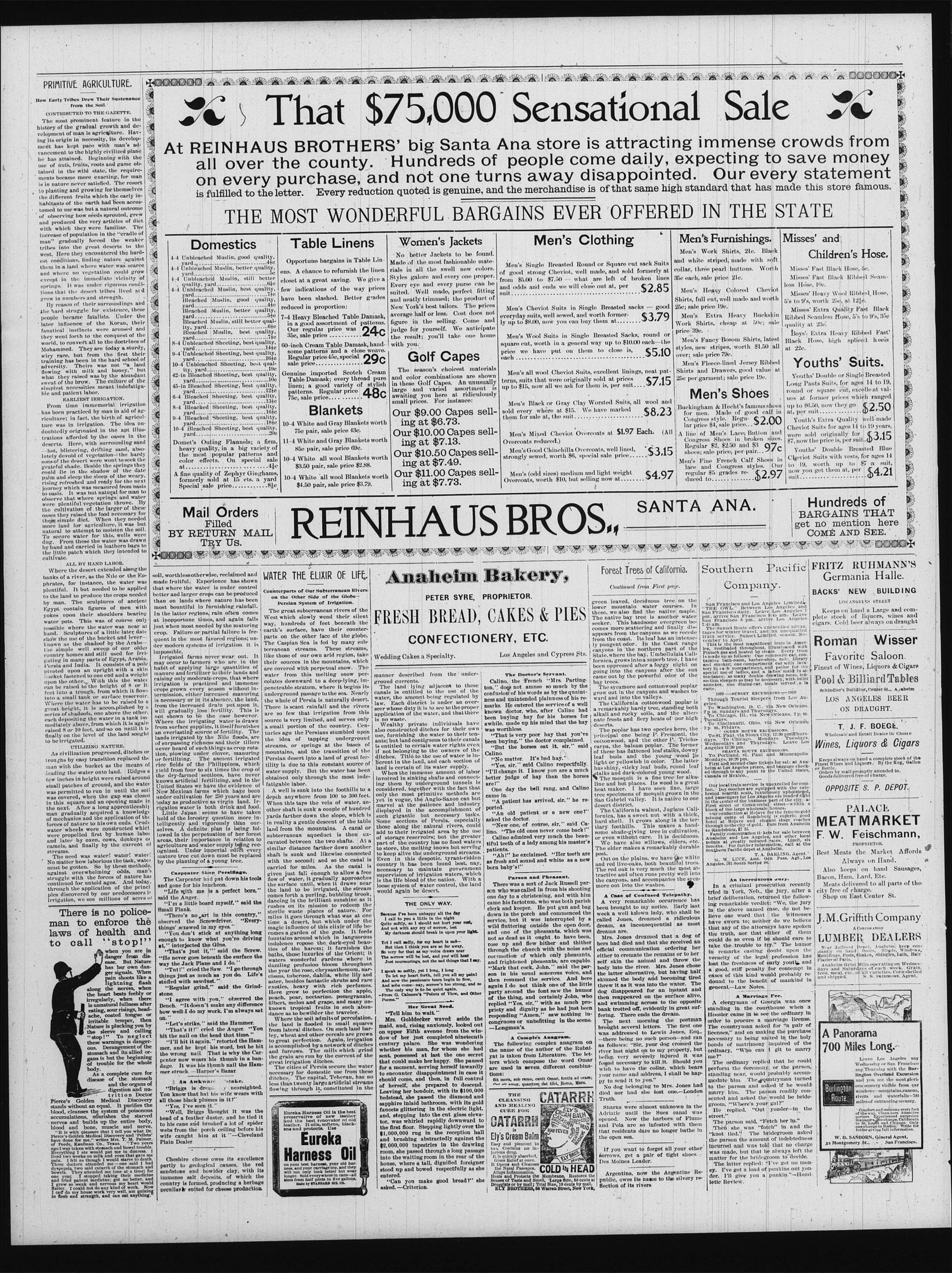
Searchable text
PRIMITIVE AGRICULTURE.
How Early Tribes Drew Their Sustenance from the Soil
CONTRIBUTED TO THE GAZETTE.
The most prominent feature in the history of the gradual growth and development of man is agriculture. Having its origin in necessity, its development has kept pace with man's advancement to the highly civilized plane he has attained. Beginning with the use of nuts, fruits, roots and game obtained in the wild state, the requirements became more exacting, for man is in nature never satisfied. The resort to planting and growing for themselves the different fruits which the early inhabitants of the earth had been accustomed to use was but a natural outcome of observing how seeds sprouted, grew and produced the very articles of diet with which they were familiar. The increase of population in the "eradle of man" gradually forced the weaker tribes into the great deserts to the west. Here they encountered the hardest conditions, finding nature against them in a land where water was scarce and where no vegetation could grow except in the immediate vicinity of springs. It was under rigorous conditions that the desert tribes lived and grew in numbers and strength.
By reason of their surroundings and the hard struggle for existence, these people became fatalists. Under the later influence of the Koran, their fanatical instincts were aroused and they went forth to the conquest of the world, to convert all to the doctrines of Mohammed. They are today a sturdy, wiry race, but from the first their training has been in the hard school of adversity. Theirs was not "a land flowing with milk and honey," but what they raised was by the abundant sweat of the brow. The culture of the simplest necessities meant indefatigable and patient labor.
EARLIEST IRRIGATION.
From time immemorial irrigation has been practiced by man in aid of agriculture; in fact, the birth of agriculture was in irrigation. The idea undoubtedly originated in the apt illustrations afforded by the oases in the deserts. Here, with surrounding sand—hot, blistering, drifting sand, absolutely devoid of vegetation—the hardy sons of the desert were wont to seek the grateful shade. Beside the springs they could lie in the shadow of the date
Domestics
4-4 Unbleached Muslin, good quality, yard...4¢
4-4 Unbleached Muslin, better quality, yard...5¢
4-4 Unbleached Muslin, still better quality, yard...6¢
4-4 Unbleached Muslin, best quality, yard...7¢
Bleached Muslin, good quality, yard...4¢
Bleached Muslin, better quality, yard...5¢
Bleached Muslin, still better quality, yard...6¢
Bleached Muslin, best quality, yard...7¢
8-4 Unbleached Sheeting, best quality, yard...14¢
9-4 Unbleached Sheeting, best quality, yard...16¢
10-4 Unbleached Sheeting, best quality, yard...19¢
42-in Bleached Sheeting, best quality, yard...10¢
45-in Bleached Sheeting, best quality, yard...12¢
6-4 Bleached Sheeting, best quality, yard...13¢
8-4 Bleached Sheeting, best quality, yard...16¢
9-4 Bleached Sheeting, best quality, yard...18¢
10-4 Bleached Sheeting, best quality, yard...20¢
Domet's Outing Flannels; a firm, heavy quality, in a big variety of the most popular patterns and color effects. On special sale at...4¢
A fine quality of Zephyr Gingham,
Table Line
Opportunities in Tens. A chance to refurnish closet at a great saving. few indications of the v have been slashed. Better reduced in proportion:
7-4 Heavy Bleached Table in a good assortment of Our regular price was 35c, sale price ...60-inch Cream Table Damn some patterns and a cl Regular price 45c, special sale price ...Genuine imported Scott Table Damn; every th linen; a good variety y patterns. Regular price 75c, sale price ...Blanket
10-4 White and Gray Blank 75c pair, sale price 43
11-4 White and Gray Blank 85c pair, sale price 69
10-4 White all wool Blank $3.50 pair, sale price ...
FROM TIME IMPERIAL Irrigation has been practiced by man in aid of agriculture; in fact, the birth of agriculture was in irrigation. The idea undoubtedly originated in the apt illustrations afforded by the oases in the deserts. Here, with surrounding sand—hot, blistering, drifting sand, absolutely devoid of vegetation—the hardy sons of the desert were wont to seek the grateful shade. Beside the springs they could lie in the shadow of the date palm and sleep the sleep of the weary, rising refreshed and ready for the next journey which was measured from oasis to oasis. It was but natural for man to observe that where springs and water were plentiful vegetation throve. By the cultivation of the larger of these oases they raised the food necessary for their simple diet. When they needed more land for agriculture, it was but natural to attempt to moisten the soil. To secure water for this, wells were dug. From these the water was drawn by hand and carried in leathern bags to the little patch which they intended to cultivate.
ALL BY HAND LABOR.
Where the desert extended along the banks of a river, as the Nile or the Euphrates, for instance, the water was plentiful. It but needed to be applied to the land to produce the crops needed by man. The sculptures of ancient Egypt contain figures of men with yokes upon their shoulders bearing water pots. This was of course only possible where the water was near at hand. Sculptures of a little later date show the use of the bucket and lever known as the shadoof by the Arabs—the simple well sweep of our older country homes and still used for irrigation in many parts of Egypt, Arabia, Persia and India. It consists of a pole pivoted upon an upright with a skin bucket fastened to one end and a weight upon the other. With this the water can be raised to the height of 8 or 10 feet into a trough, from which it flows into a small tank or surface reservoir. Where the water has to be raised to a great height, it is accomplished by a series of shadoofs, one above the other, each depositing the water in a tank immediately above, from which it is again raised 8 or 10 feet, and so on until it finally on the level of the land sought to be irrigated.
UTILIZING NATURE.
As civilization progressed, ditches or troughs by easy transition replaced the man with the bucket as the means of leading the water onto land. Ridges a few inches in height were raised around small patches of ground, and the water was permitted to run in until the soil was covered, when the gap was closed in this square and an opening made in the next. After a long apprenticeship man gradually acquired a knowledge of mechanics and the application of the forces of nature to his own ends. Crude water wheels were constructed which were propelled first by human labor and later by oxen, cows, donkeys or camels, and finally by the current of streams.
The need was water! water! water! No matter how laborious the task, water must be gotten. So by these methods against overwhelming odds, man's struggle with the forces of nature has continued for untold ages. And today, through the application of the principles discovered by our predecessors in imitation we see millions of acres of soil, worthless otherwise, reclaimed and made fruitful. Experience has shown that where the water is under control better and larger crops can be produced than on lands where nature has been most bountiful in furnishing rainfall. In the latter regions, rain often comes at inopportune times, and again fails just when most needed by the maturing crop. Failure or partial failure is frequent in the most favored regions; under modern systems of irrigation it is impossible.
Irrigated farms never wear out. It may occur to farmers who are in the habit of applying large quantities of manure and fertilizer to their lands and raising only moderate crops, that where irrigation is practiced and immense crops grown every season without intermission, either increased manuring is necessary or in its absence, the land, from the increased drain put upon it, will gradually lose fertility. This is not shown to be the case however. Where the irrigating water is drawn from surface supplies, it itself furnishes an everlasting source of fertility. The lands irrigated by the Nile floods, are of surpassing richness and their tillers never heard of such things as crop rotation, plowing under clover, manuring or fertilizing. The ancient irrigated rice fields of the Philippines, which yield from four to six times the crop of the dry-farmed sections, have never known artificial fertilizing, and in the United States we have the evidence of New Mexican farms which have been under cultivation for 250 years and are today as productive as virgin land. Irrigation water is both drink and food.
Little Japan seems to have taken hold of the forestry question more intelligently and vigorously than ourselves. A definite plan is being followed in the perpetuation of her forest areas, their importance in relation to agriculture and water supply being recognized. Under imperial edict every mature tree cut down must be replaced by the planting of a young tree.
Carpenter Shop Persiage.
The Carpenter had put down his tools and gone for his luncheon.
"Life with me is a perfect bore," said the Auger.
WATER THE ELIXIR OF LAND
Counterparts of Our Subterranean River on the Other Side of the Globe Persian System of Irrigation.
The great subterranean rivers of West which slowly wend their way, hundreds of feet beneath earth's surface, have their coups parts on the other face of the glacier. The Caspian Sea is fed by many terrestrial streams. These streets like those of our own arid region, their sources in the mountains, we are covered with perpetual snow. Water from this melting snow collates downward to a deep-lying penetrable stratum, where it begins underground passage to the sea. None of Persia is naturally deprived so few that irrigation from source is very limited, and serves a small portion of the country.
Turries ago the Persians stumbled on the idea of tapping underground streams, or springs at the base mountains, and the transition of Persian desert into a land of great utility is due to this constant source of water supply. But the water has obtained only through the most fatigable labor.
A well is sunk into the foothill depth anywhere from 100 to 300. When this tapthe vein of water other shaft is sunk a couple of buoyards farther down the slope, whence reality a gentle descent of the land from the mountains. A car subterranean aqueduct is then cavated between the two shafts. Similar distance farther down and shaft is sunk and likewise connected with the second; and so the car carried for miles. As the car given just fall enough to allow flow of water, it gradually approves the surface until, when it draws land to be irrigated, she comes forth a purling, bubbling
There is no police-man to enforce the laws of health and to call "stop!"
when you are in danger from disease. But Nature has her own danger signals. When pain shoots like a lightning flash along the nerves, when the heart beats feebly or irregularly, when there is unnatural fullness after eating, sour risings, headache, coated tongue or irritable temper, then Nature is plucking you by the sleeve and calling "stop!" To neglect these warnings is dangerous. Derangement of the stomach and its allied organs is but the beginning of trouble for the whole body.
As a complete cure for disease of the stomach and the organs of digestion and nutrition Doctor Pierce's Golden Medical Discovery stands without an equal. It purifies the blood, cleanses the system of poisonous accumulations, nourishes the starved nerves and builds up the entire body, blood and bone, muscle and nerve.
"It is with pleasure that I tell you what Dr. Pierce's Golden Medical Discovery and 'Pellets' have done for me," writes Mrs. T. M. Palmer, of Peede, Kaufman Co., Texas. "Two years ago I was taken with stomach and bowel trouble. Everything I ate would put me in distress. I lived two weeks on milk and even that gave me pain. I felt as though I would starve to death. Three doctors attended me—one said I had dyspepsia, two said catarrh of the stomach and bowels. They attended me (one at a time) for one year. I stopped taking their medicine and tried patent medicine; got no better, and I grew so weak and nervous my heart would flutter. I could not do any kind of work. Now I can do my house work very well, am gaining in flesh and strength, and can eat anything."
Carpenter Shop Peralfiage.
The Carpenter had put down his tools and gone for his luncheon.
"Life with me is a perfect bore," said the Auger.
"I'm a little board myself," said the Small Plank.
"There's no art in this country," observed the Screwdriver. "Everything's screwed in my eyes."
"You don't stick at anything long enough to know what you're driving at," interjected the Glue.
"That's just it," said the Screw.
"He never goes beneath the surface the way the Jack Plane and I do."
"Tut!" cried the Saw. "I go through things just as much as you do. Life's stuffed with sawdust."
"Regular grind," said the Grindstone.
"I agree with you," observed the Bench. "It doesn't make any difference how well I do my work. I'm always sat on."
"Let's strike," said the Hammer.
"That’s it!" cried the Auger. "You hit the nail on the head that time."
"I'll hit it again." retorted the Hammer, and he kept his word, but he hit the wrong nail. That is why the Carpenter now wears his thumb in a bandage. It was his thumb nail the Hammer struck. —Harper's Bazar.
An Awkward Stake.
Briggs is dreamily nearsighted. You know that hat his wife wears with all those black plumes in it?
Yes, I've seen it.
Well, Briggs thought it was the head of a feather duster, and he tied it to his cane and brushed a lot of spider webs from the porch ceiling before his wife caught him at it." —Cleveland Plain Dealer.
Cheshire cheese owes its excellence partly to geological causes, the red sandstone and bowlder clay, with its immense salt deposits, of which the country is formed, producing a herbage peculiar suited for cheese production.
When this taps the vein of water other shaft is sunk a couple of bus yards farther down the slope, where in reality a gentle descent of the land from the mountains. A car subterranean aqueduct is there cavated between the two shafts. Similar distance farther down and shaft is sunk and likewise connected with the second; and so the car carried for miles. As the car given just fall enough to allow flow of water, it gradually approves the surface until, when it draws the land to be irrigated, she comes forth a purling, bubbling in dancing in the brilliant sunshine rushes on its mission to redeem sterile waste places of nature miles it goes through what was a time a desert, but which under magic influence of this elixir of life comes a garden of the gods. Its fountains around which in language indolence repose the dark-eyed ties of the harem; it furnishes baths, those luxuries of the Oriental waters wonderful gardens where dazzling profusion bloom through the year the rose, chrysanthemum cissus, tuberose, dahlia, white laster, besides fantastic shrubs and exotics, heavy with rich peril. Here grow to perfection the peach, pear, nectarace, pomegre filbert, melon and grape, and many known tropical fruits in such dance as to bewilder the traveler.
Where the soil admits of percolation the land is flooded in small streams from lateral ditches. On such landy wheat and other cereals are too great perfection. Again, irrigation is accomplished by a network of ores and furrows. The mills which the grain are run by the current great irrigation ditches.
The cities of Persia secure the necessary for domestic use from ditches. The capital, Teheran, less than twenty large artificial streams flowing through it constituted...
That $75,000 Sensations
S BROTHERS' big Santa Ana store is attracting the county. Hundreds of people come daily to purchase, and not one turns away disappointment better. Every reduction quoted is genuine, and the merchandise is of that same high quality.
MOST WONDERFUL BARGAINS EVER OFFERED
Table Linens
Opportunity bargains in Table Linens. A chance to refurnish the linen closet at a great saving. We give a few indications of the way prices have been slashed. Better grades reduced in proportion:
7-4 Heavy Bleached Table Damask, in a good assortment of patterns. Our regular price was 24c
60-inch Cream Table Damask, hand-some patterns and a close weave. Regular price 45c, special sale price 29c
Genuine imported Scotch Cream Table Damask; every thread pure linen; a good variety of stylish patterns. Regular price 75c, sale price 48c
Blankets
10-4 White and Gray Blankets worth 75c pair, sale price 43c.
11-4 White and Gray Blankets worth 85c pair, sale price 69c.
10-4 White all wool Blankets worth $3.50 pair, sale price $2.88.
Women's Jackets
No better Jackets to be found. Made of the most fashionable materials in all the swell new colors. Styles galore and every one proper. Every eye and every purse can be suited. Well made, perfect fitting and neatly trimmed; the product of New York's best tailors. The prices average half or less: Cost does not figure in the selling. Come and judge for yourself. We anticipate the result; you'll take one home with you.
Golf Capes
The season's choicest materials and color combinations are shown in these Golf Capes. An unusually large and varied assortment is awaiting you here at ridiculously small prices. For instance:
Our $9.00 Capes selling at $6.73.
Our $10.00 Capes selling at $7.13.
Our $10.50 Capes selling at $7.49.
Our $11.00 Capes sell-
Men's Clothing
Men's Single Breasted Round or Square cut sack Suits of good strong Cheviot, well made, and sold formerly at from $5.00 to $7.50 — what are left of broken lines and odds and ends we will close out at, per suit...$2.85
Men's Cheviot Suits in Single Breasted sacks — good everyday suits, well sewed, and worth formerly up to $8.00, now you can buy them at...$3.79
Men's Wool Suits in Single Breasted Sacks, round or square cut, worth in a general way up to $10.00 each—the price we have put on them to close is,...$5.10
Men's all wool Cheviot Suits, excellent linings, neat patterns, suits that were originally sold at prices up to $15, now all we ask for them is, per suit...$7.15
Men's Black or Gray Clay Worsted Suits, all wool and sold everywhere at $15. We have marked them for sale at, the suit...$8.23
Men's Mixed Cheviot Overcoats at $1.97 Each. (All Overcoats reduced.)
Men's Good Chinchilla Overcoats, well lined, strongly sewed, worth $6, special sale price...$3.15
Men's (odd sizes) medium and light weight...$4.97
REINHAUS BROS., SAN
Anaheim Bakery,
PETER SYRE, PROPRIETOR.
FRESH BREAD, CAKES & PIES
CONFECTIONERY, ETC.
Wedding Cakes a Specialty. Los Angeles and Cypress Sts.
The Doctor's Servant.
Calino, the French "Mrs. Partington," does not amuse so much by the confusion of his words as by the quintiness and unintended plainness of his remarks. He entered the service of a well known doctor, who, after Calino had been buying hay for his horses for awhile, made up his mind that the hay was worthless.
"That is very poor hay that you've been buying," the doctor complained.
"But the horses eat it, sir." said Calino.
"No matter. It's bad hay."
"Yes, sir." said Calino respectfully.
"I'll change it. I know you are a much better judge of hay than the horses are!"
One day the bell rang, and Calino came in.
"A patient has arrived, sir." he reported.
"An old patient or a new one?" asked the doctor.
"New one, of course, sir." said Calino.
"The old ones never come back!" Calino admired very much the beautiful teeth of a lady among his master's patients.
"Ah!" he exclaimed. "Her teeth are as fresh and sound and white as a new born baby's!"
Parson and Pheasant.
There was a sort of Jack Russell parson who was called in from his shooting one day to a christening, with him
green leaved, deciduous tree lower mountain water count these, we also find the native bay tree is another seeker. This handsome every comes more scattering and finishes from the canyons as we from the coast. Its leaf has anly pungent odor. In the Coast canyons in the northern part State, where the bay, Umbellu fornica, grows into a superb tree been oppressed after a foggy going into the canyons after came out by the powerful ode bay trees.
The sycamore and cottonwood grow out in the canyons and w ward and into the valleys.
The California cottonwood is a remarkably hard tree, stand alktalk and rocky soils, and tate frosts and fiery heats of deserts.
The poplar has two species: principal one being P. Fremont cottonwood, and the other Carpa, the balsam poplar. The of these has flattened leaf buds and the young light or yellowish in color. It has shiny, sticky leaf buds, re stalks and dark-colored young leaves. The mesquit is a fine tree line and hot places. Its wood heat maker. I have seen five tree specimens of mesquit groan San Gabriel valley. It is natural district.
The California walnut, Jug fornica, has a sweet nut with hard shell. It grows along its tiary foothills. This makes some shade-giving tree in care or even without care. It is used we have also willows. The elder makes a remarkable post.
Out on the plains, we have and red live-oaks, both beauti The red oak is very much the tractive and often runs pretty the canyons, and accompanies more out into the washes.
A Case of Confused Tele
this taps the vein of water, an ear shaft is sunk a couple of hundred feet farther down the slope, which is peculiarly a gentle descent of the table from the mountains. A canal or merranican aqueduct is then extended between the two shafts. At a near distance farther down another is sunk and likewise connected to the second; and so the canal is filled for miles. As the canal is just fall enough to allow a free of water, it gradually approaches surface until, when it draws near land to be irrigated, the stream pours forth a purling, bubbling brook, lying in the brilliant sunshine as it lies on its mission to redeem the waste places of nature. For this it goes through what at one moment was a desert, but which under the eerie influence of this elixir of life becomes a garden of the gods. It feeds among around which in languorous silence repose the dark-eyed beauty of the harem; it furnishes the majors, those luxurious of the Orient; it bears wonderful gardens where in rolling profusion bloom throughout year the rose, chrysanthemum, narcissus, tuberose, dahlia, white lily and iris, besides fantastic shrubs and rare heathy, heavy with rich perfumes. He grow to perfection the apple, pear, nectarine, pomegranate, melon and grape, and many unseen tropical fruits in such abunance as to bewilder the traveler.
Here the soil admits of percolation. Land is flooded in small squares on lateral ditches. On such land barren wheat and other cereals are grown great perfection. Again, irrigation accomplished by a network of ditches furrows. The mills which grind grain are run by the current of the hot irrigation ditches.
The cities of Persia secure the water necessary for domestic use from these cities. The capital, Teheran, has no more than twenty large artificial streams flowing through it constituted in the
THE ONLY WAY.
Because I've been unhappy all the day I call to you a little in the night Quite softly, so I should not hurt your rest And now with any cry of sorrow, lest My darkness should break in upon your light.
Yet I call sadly, for my heart is sad— But then I think you are so far away So very far that as my voice draws near The sorrow will be lost, and you will hear Just murmuring, not the sad things that I say.
I speak so softly, yet I long, I long To let my heart forth, tell you all my pain! And now the passionate tears begin to flow, And sobs come—nay, sorrow's too strong, and so The only way is to be quiet again.
From G. Calmore's "Points of View, and Other Poems."
Her Great Need.
"Tell him to wait."
Mrs. Golddecker waved aside the maid, and, rising anxiously, looked out on upper Fifth avenue from the window of her just completed nineteenth century palace. She was wondering whether his man, for whom she had sent, possessed at last the one secret that could make her happy. She paused for a moment, nerving herself inwardly to encounter disappointment in case it should come, and then, in full control of herself, she prepared to descend. Leaving her bondoir, with its $100,000 bedstead, she passed the diamond and sapphire inlaid bathroom, with its gold faucets glittering in the electric light, and, stepping into the cut glass elevator, was whirled rapidly downward to the first floor. Stepping lightly over the $1,000,000 rug in the reception hall and brushing abstractedly against the $2,000,000 tapestries in the drawing room, she passed through a long passage into the waiting room in the rear of the house, where a tall, dignified foreigner stood up and bowed respectfully as she entered.
"Can you make good bread?" she asked.—Criterion.
"A patient has arrived, sir," he reported.
"An old patient or a new one?" asked the doctor.
"New one, of course, sir," said Callino. "The old ones never come back!" Calino admired very much the beautiful teeth of a lady among his master's patients.
"Ahl!" he exclaimed. "Her teeth are as fresh and sound and white as a new born baby's!"
Parson and Pheasant.
There was a sort of Jack Russell parson who was called in from his shooting one day to a christening, and with him came his factotum, who was both parish clerk and keeper. He put gun and bag down in the porch and commenced the service, but it was interrupted by a wild fluttering outside the open door, and one of the pheasants, which was not as dead as it ought to have been, rose up and flew hither and thither through the church with the noise and cormotion of which only pheasants, and frightened pheasants, are capable.
"Mark that cock, John," said the parson in his usual sonorous voice, and then resumed the service. And here again I do not think one of the little party around the font saw the humor of the thing, and certainly John, who replied "Yes, sir," with as much propriety and dignity as he had just been responding "Amen," saw nothing incongruous or unbeitting in the scene.
—Longman's.
A Complex Anagram.
The following complex anagram on the name of the author of the Rubaiyat is taken from Literature. The letters which compose the word Omar are used in seven different combinations:
Sit mora, sub ramo, canit Omar, fontis ad oram;
Calit amor, quantum dat tibi, Roma, Maro.
THE CLEANSING AND HEALING CURE FOR
CATARRH
is Ely's Cream Balm
Easy and pleasant to use. Contains no injurious drug.
It is quickly absorbed,
Gives Relief at once.
It Opens and Cleanses the Nasal Passages.
Allays Inflammation.
Heals and Protects the Membrane. Restores the Senses of Taste and Smell. Large Size: 50 cents at Druggists or by mail; Trial Size: 10 cents by mail.
ELY BROTHERS: 56 Warren Street, New York,
San Gabriel valley.
The California walnut, Jug for fornica, has a sweet nut with hard shell. It grows along diary foothills. This makes some shade-giving tree in cool or even without care. It is easy to have also willows; eels The elder makes a remarkable post.
Out on the plains we have red live-oaks, both beautiful The red oak is very much tracticive and often runs pretty like canyons, and accompanies more out into the washes.
A Case of Confused Telephone
A very remarkable occurrence been brought to my notice. Week a well-known lady, who called Jones, dreamed a dream, as inconsequential dreams are.
Mrs. Jones dreamed that hers had died and that she re-official communication order either to cremate the remains self skin the animal and body into the river. Mrs. Jones later alternative, but he skinned the body and became threw it as it was into the wet dog disappeared for an injury then reappeared on the sun and swimming across to the bank trotted off, evidently in fering. There ends the dream.
The next morning they brought several letters. They were addressed to Lewis J., there being no such person as follows: "Sir, your dog o'river last night on to my property; very severely injured found necessary to kill it. wish to have the collar; wish your name and address; I shyly to send it to you."
No dog belonging to Mrs. died nor had she lost on Truth.
Sharks were almost unknown Adriatic until the Suez opened. Now the harbors and Pola are so infested that residents dare no longer open sea.
If you want to forget all sorrows, get a pair of tiger Des Moines Leader.
Argentina, now the Argentine public, owes its name to the flection of its rivers.
National Sale
It is attracting immense crowds from time daily, expecting to save money disappointed. Our every statement of that same high standard that has made this store famous.
R OFFERED IN THE STATE
clothing
Or Square cut sack Suits made, and sold formerly at the left of broken lines about at, per $2.85
Breasted sacks — good worth former-them at... $3.79
Breasted Sacks; round or pay up to $10.00 each—the to close is, $5.10
Excellent linings, neat pat-told at prices in, per suit... $7.15
Frosted Suits, all wool and have marked $8.23
Pants at $1.97 Each. (All pants, well lined, sale price $3.15
light weight $4.97
Men's Furnishings.
Men's Work Shirts, 21c. Black and white striped, made with soft collar, three pearl buttons. Worth 35c each, sale price 21c.
Men's Heavy Colored Cheviot Shirts, full cut, well made and worth 25c; sale price 19c.
Men's Extra Heavy Buckskin Work Shirts, cheap at 50c; sale price 39c.
Men's Fancy Bosom Shirts, latest styles, new stripes, worth $1.50 all over; sale price 79c.
Men's Fleece-lined Jersey Ribbed Shirts and Drawers, good value at 25c per garment; sale price 19c.
Men's Shoes
Buckingham & Hecht's famous shoes for men. Made of good calf in Congress style. Regular price $4, sale price...
A line of Men's Lace, Button and Congress Shoes in broken sizes. Regular $2, $2.50 and $3 shoes; sale price, per pair...
Men's Fine French Calf Shoes in lace and Congress styles. Our regular $5 grades re- $2.97
Misses' and Children's Hose,
Misses' Fast Black Hose, 5c.
Misses' Fast Black Ribbed Seamless Hose, 10c.
Misses' Heavy Wool Ribbed Hose, 5's to 9's, worth 25c, at 121c.
Misses' Extra Quality Fast Black Ribbed Seamless Hose, 5's to 9's, 35c quality at 23c.
Boys' Extra Heavy Ribbed Fast' Black Hose, high spliced heels at 22c.
Youths' Suits.
Youths' Double or Single Breasted Long Pants Suits, for ages 14 to 19, round or square cut, excellent values at former prices which ranged up to $6.50, now they go at, per suit..... $2.50
Youth's Extra Quality well-made Cheviot Suits for ages 14 to 19 years, were sold originally for $7, now the price is, per suit...
Youths' Double Breasted Blue Cheviot Suits with vests, for ages 14 to 19, worth up to $7 a suit, now you get them at, per $4.21
SANTA ANA.
Forest Trees of California.
Continued from First page.
Green leaved, deciduous tree on the lower mountain water courses. In these, we also find the native maple. The native bay tree is another water beaker. This handsome evergreen becomes more scattering and finally disappears from the canyons as we recede from the coast. Its leaf has an intense pungent odor. In the Coast range anyons in the northern part of the state, where the bay, Umbellulaia California, grows into a superb tree, I have been oppressed after a forgy night on going into the canyons after the sun came out by the powerful odor of the bay trees.
The sycamore and cottonwood poplar grow out in the canyons and washes toard and into the valleys.
The California cottonwood poplar is remarkably hardy tree, standing both kali and rocky soils, and the alternate frosts and fiery heats of our high deserts.
The poplar has two species here, the principal one being P. Fremonti, the cottonwood, and the other P. Tricharpa, the balsam poplar. The former of these has flattened leaf stalks, downy leaf buds and the young wood is light or yellowish in color. The latter is shiny, sticky leaf buds, round leaf tails and dark-colored young wood.
The mesquit is a fine tree for alkaine and hot places. Its wood is a great heat maker. I have seen fine, large tree specimens of mesquit grown in the San Gabriel valley. It is native to one desert district.
The California walnut, Juglans California, has a sweet nut with a thick, hard shell. It grows along in the terriary foothills. This makes a hand-home shade-giving tree in cultivation, or even without care. It is deciduous.
We have also willows, elders, etc. The elder makes a remarkably durable post.
Out on the plains, we have the white and red live-oaks, both beautiful trees. The red oak is very much the most attractive and often runs pretty well into the canyons, and accompanies the sycamore out into the washes.
Southern Pacific Company.
San Francisco and Los Angeles Limited.
"The Owl." Between Los Angeles and San Francisco daily. Leave Los Angeles 7 pm. arrive San Francisco 9:45 am. Leave San Francisco 5 pm., arrive Los Angeles 7:45 am.
The Sunset Route offers unexcelled advantages for winter travel, and an unequaled train service. Sunset Limited, season. November to April.
This is the most magnificent train in America, vestibulated throughout. Illuminated with Pintsch gas and heated by steam. Every train is made up as follows: One commuter car containing bath-room, barbecue shop, cafe library and smoker; on compartment car with law-terrain in each compartment, and parlor for the special use of ladies, and a ladies maid in attendance; as many double drawing room, tension sleepers as may be necessary, with toilet annexes, one dining-car, meals served a la carte.
1809 — SUNSET EXCURSIONS — 1809
Through Tourist Sleepers from Los Angeles:
To Washington, D. C., via New Orleans. 2 p.m. Sundays and Thursdays.
To Chicago, Illinois, via New Orleans. 2 p.m. Tuesdays.
To Cincinnati, Ohio, via New Orleans. 2 p.m. Fridays.
Ogden Route Excursions.
To St. Paul, via Sioux City. 12:30 pm Thursday.
To Chicago. Mondays. Tuesdays.
Wednesdays and Thursdays. Leave Los Angeles 2:30 pm.
Shasta Route Excursions.
To Portland, St. Paul and Minneapolis Mondays. 10:20 pm.
First and second-class tickets for sale at Anaheim at Los Angeles prices, and baggage checked through to any point in the United States, Canada or Mexico.
Our local train service is unexcelled for comfort. Our coaches are equipped with the celebrated Scrritt scats, luxuriously upholstered, and passengers for Los Angeles are landed right in the center of the business part of the city—at first street or commercial street—within a block of the large wholesale houses.
Our connection at Molave for the famous gold mining camp of Randsburg is superb; good hotel at Molave and elegant stage coaches through to the city of gold. Fare from Anaheim to Randsburg, $7 & 8.
Family commutation tickets for sale between Anaheim and Los Angeles, and other local points at greatly reduced rates. Limit six months. For further information, call at the Southern Pacific depot at Anaheim.
T.A.DARLING, Agent.
G.W.LUCE, Asst.Gen.Pass.Agt., Los Angeles. 261 South Spring St.
FRITZ RUHMANN'S Germania Halle.
BACKS' NEW BUILDING
LOS ANGELES STREET
Keeps on hand a Large and complete stock of liquors, wines and cigars. Cold beer always on draught
Roman Wisser
Favorite Saloon.
Finest of Wines, Liquors & Cigars
Pool & Billiard Tables
Rehindler's Building, Center St., Agabeim
LOS ANGELES BEER ON DRAUGHT.
T.J.F.BOEGE.
Wholesale and Retail Dealer in Choice
Wines, Liquors & Cigars
Keeps always on hand a complete stock of the Finest Wines and Liquors. By the Keg, Gallon or Bottle.
Orders by mail promptly attended to.
Goods delivered free of charge.
OPPOSITE S.P. DEPOT.
PALACE
MEAT MARKET
F.W.Feischmann,
PROPRIETOR.
Best Meats the Market Affords
Always on Hand.
Also keeps on hand Sausages,
Bacon, Ham, Lard, Ete.
Meats delivered to all parts of the city free of charge.
Shop on East Center St.
A Case of Confused Telepathy.
A very remarkable occurrence has been brought to my notice. Early last week a well known lady, who shall be called Jones, dreamed a ridiculous dream, as inconsequential as most dreams are.
Mrs. Jones dreamed that a dog of hers had died and that she received an official communication ordering her either to cremate the remains or to her self skin the animal and throw the body into the river. Mrs. Jones chose the latter alternative, but having half skinned the body and becoming tired threw it as it was into the water. The dog disappeared for an instant and then reappeared on the surface alive, and swimming across to the opposite bank trotted off, evidently in great suffering. There ends the dream.
The next morning the postman brought several letters. The first one was addressed to Lewis Jones, Esq.,—there being no such person—and ran as follows: "Sir, your dog crossed the river last night on to my property, but being very severely injured it was found necessary to kill it. Should you wish to have the collar, which bears your name and address, I shall be happy to send it to you."
No dog belonging to Mrs. Jones had died nor had she lost one.—London Truth.
Sharks were almost unknown in the Adriatic until the Suez canal was opened. Now the harbors of Flume and Pola are so infested with them that residents dare no longer bathe in the open sea.
If you want to forget all your other sorrows, get a pair of tight shoes.—Des Moines Leader.
Argentina, now the Argentine Republic, owes its name to the silvery reflection of its rivers.
An Incredulous Jury.
In a criminal prosecution recently tried in York, Neb., the jury, after a brief deliberation, returned the following remarkable verdict: "We, the jury in the above named case, do not believe one word that the witnesses have sworn to; neither do we believe that any of the attorneys have spoken the truth, nor that either of them could do so even if he should care to take the trouble to try." The humor in remarks casting doubt upon the veracity of the legal profession has lost the freshness of early youth, and a good, stiff penalty for contempt in cases of this kind would probably redound to the benefit of mankind in general.—Law Notes.
A Marriage Fee.
A clergyman of Georgia was once standing in the courthouse when a Hoosier came in to see the ordinary in order to procure a marriage license. The countryman asked for "a pair of licenses," and on making the purchase necessary to being united in the holy bonds of matrimony inquired of the ordinary. "Who can I git to marry me?"
The ordinary replied that he could perform the ceremony, or the parson, standing near, would probably accommodate him. The countryman turned to the parson and asked if he would marry him. The parson readily consented and asked the would be bridegroom. "Where's your gal?"
He replied, "Out yonder—in the street."
The parson said, "Fetch her in."
Then she was "fotch" in and the "knot tied." The bridegroom asked the parson the amount of indebtedness incurred and was told that no charge was made, but that he always left the matter for the bridegroom to decide.
The latter replied: "I've got no money. I've got a load of punkins out yonder. I'll give you a punkin."—Homiletic Review.