anaheim-gazette 1899-11-30
Scanned page
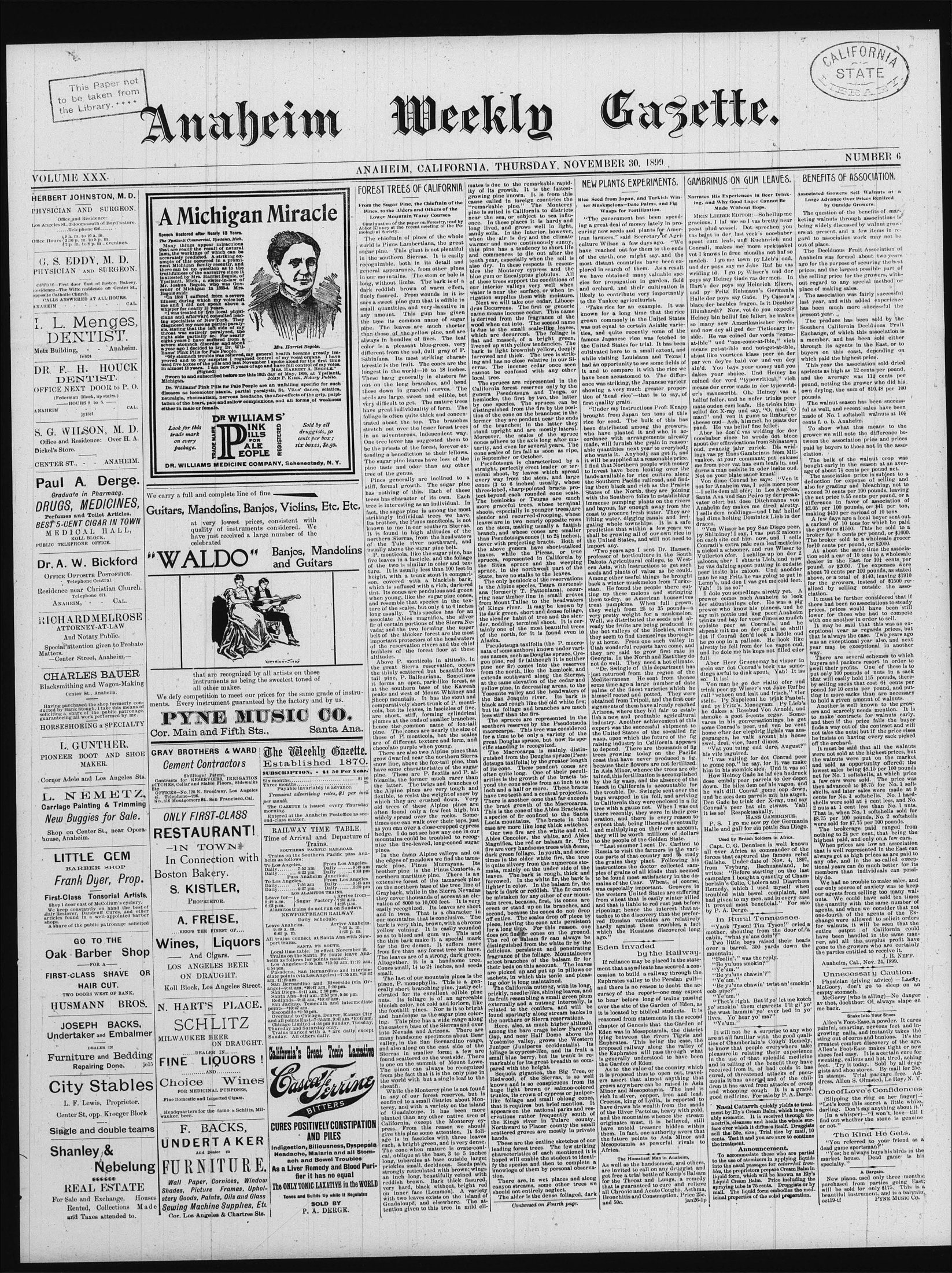
Searchable text
A Michigan Miracle
Speech Restored after Nearly 13 Years.
The Ypsilanti Commercial, Ypsilanti, Mich.
Many things appear miraculous that are really the result of natural laws, the workings of which can be accurately predicted. A striking example of this occurred in a prominent Michigan family recently, and there can be no question as to the truthfulness of the narrative since it is attested by Mrs. Harriet Begole, of Ypsilanti, Mich., a sister-in-law of Mr. Joshua Begole, who was Governor of Michigan in 1883-4. Mrs. Begole said:
"In 1886 I suffered from a severe illness; during which my voice left me and I did not speak above a whisper for nearly 13 years."
"I was treated by five local physicians and afterward consulted leading specialists of New York. They diagnosed my case as partial paralysis stating that the left side of my throat was entirely paralyzed, the right side partially so. For nearly eight years I have suffered from a severe stomach disorder and about a year ago I decided to try Dr. Williams' Pink Pills for Pale People.
"My stomach trouble was relieved, my general health became greatly improved and to my surprise I regained control of my vocal organs. I have used five boxes of the pills and last November I spoke aloud for the first time in almost 18 years. I am now 71 years of age and have full control of my voice.
(Miss Harriet A. Begole."
Sworn to and subscribed before me this 19th day of May, 1899, at Ypsilanti, Michigan.
Dr. Williams' Pink Pills for Pale People are an unfailing specific for such diseases as locomotor ataxia, partial paralysis, St. Vitus' dance, sciatica, neuralgia, rheumatism, nervous headache, the after-effects of the grip, palpitation of the heart, pale and sallow complexions, and all forms of weakness either in male or female.
Look for this trade mark on every package.
DR WILLIAMS'
PINK PILLS FOR PALE PEOPLE
Sold by all druggists, 50 cents per box; six boxes, $2.50.
DR. WILLIAMS MEDICINE COMPANY, Schenectady, N.Y.
DENTIST.
OFFICE NEXT DOOR to P. O.
(Federman Bloek, up stairs.)
HOURS 9 to 5.
ANAHEIM CAL.
jy154f
S. G. WILSON, M. D.
Office and Residence: Over H. A. Dickel's Store.
CENTER ST., - - ANAHEIM.
Paul A. Derge.
Graduate in Pharmacy.
DRUGS, MEDICINES,
Perfumes and Toilet Articles.
BEST 5-CENT CIGAR IN TOWN
MEDICAL HALL,
KOLL BLOCK.
PUBLIC TELEPHONE OFFICE.
Dr. A. W. Bickford
Office Opposite Postoffice.
Telephone Central.
Residence near Christian Church.
Telephone 671.
ANAHEIM, - - CAL.
RICHARD MELROSE
ATTORNEY-AT-LAW
And Notary Public.
Special attention given to Probate Matters.
—Center Street, Anaheim.
CHARLES BAUER
Blacksmithing and Wagon-Making
Center St., Anaheim.
Having purchased the shop formerly conducted by Hank Stough, I take this means of soliciting a share of the public patronage, guaranteeing all work performed by me.
HORSESHOEING a SPECIALTY
L. GUNTHER.
PIONEER BOOT AND SHOE MAKER.
Corner Adele and Los Angeles Sts.
L. NEMETZ,
Carriage Painting & Trimming
New Buggies for Sale.
Shop on Center St., near Opera-house, Anaheim.
LITTLE GEM
BARBER SHOP
Frank Dyer, Prop.
First-Class Tonsorial Artists.
We carry a full and complete line of fine
Guitars, Mandolins, Banjos, Violins, Etc. Eto
at very lowest prices, consistent with quality of instruments considered. We have just received a large number of the celebrated
"WALDO"
Banjos, Mandolin and Guitars
that are recognized by all artists on those instruments as being the sweetest toned of all other makes.
We defy competition to meet our prices for the same grade of instruments. Every instrument guaranteed by the factory and by us.
PYNE MUSIC CO.
Cor. Main and Fifth Sts., Santa An
GRAY BROTHERS & WARD
Cement Contractors
Shillinger Patent.
Contracts for RESERVOIRS, IRRIGATION
DITCHES, Cellar and Stable Floors, Sidewalks
Elk.
OFFICES—No. 125 N. Broadway, Los Angeles
St. Telephone—236.
No. 316 Montgomery St., San Francisco, Cal.
ONLY FIRST-CLASS RESTAURANT!
—IN TOWN+
In Connection with Boston Bakery.
S. KISTLER,
The Weekly Gazette
Established 1875
SUBSCRIPTION, - $1 50 Per Y
Six months...
Three months...
Payable invariably in advance.
Transient advertising rates, $1 per month.
The GAZETTE is issued every Thursday morning.
Entered at the Anaheim Postoffice a day-class matter.
RAILWAY TIME TABLE
Time of Arrival and Departure Trains.
SOUTHERN PACIFIC RAILROAD.
Trains on the Southern Pacific pass heim as follows:
To Los Angeles.
Daily... 7:52 am
Daily... 4:23 pm
Pass Anaheim Junction:
To Los Angeles.
Daily... 7:56 am
Daily... 4:27 pm
Los ALAMITOS TRAINS.
Leave for—
Carrlage Painting & Trimming
New Buggies for Sale.
Shop on Center St., near Opera-house, Anaheim.
LITTLE GEM
BARBER SHOP
Frank Dyer, Prop.
First-Class Tonsorial Artists.
Shop 1 door east of McCollum's cyclery.
We keep constantly on hand the best of hair Restorer, Dandruff Cures, and other articles found in a well-appointed barber shops.
A share of the public patronage solicited
GO TO THE Oak Barber Shop
FOR A FIRST-CLASS SHAVE OR HAIR CUT.
TWO DOORS WEST OF BANK.
HUSMANN BROS.
JOSEPH BACKS, Undertaker and Embalmer
DEALER IN Furniture and Bedding Repairing Done.
City Stables
L. F. Lewis, Proprietor.
Center St, opp. Kroeger Block
Single and double teams
Shanley & Nebelung
REAL ESTATE
For Sale and Exchange. Houses Rented, Collections Made and Taxes attended to.
ONLY FIRST-CLASS RESTAURANT!
IN TOWN In Connection with Boston Bakery.
S. KISTLER, PROPRIETOR.
A. FREISE,
KEEPS THE FINEST OF...
Wines, Liquors And Cigars.
LOS ANGELES BEER ON DRAUGHT.
Koll Block, Los Angeles Street.
N. HART'S PLACE.
SCHLITZ
MILWAUKEE BEER ON DRAUGHT.
DEALER IN...
FINE LIQUORS!
AND Choice Wines FOR MEDICINAL PURPOSES,
Fine Domestic and Imported Cigars.
Headquarters for the famo s Schlitz, Milwaukee, beer.
F. BACKS, UNDERTAKER
And Dealer in FURNITURE.
Wall Paper, Cornices, Window Shades, Picture Frames, Upholstery Goods, Paints, Oils and Glass Sewing Machine Supplies, Etc.
Cor. Los Angeles & Chartres Sts.
RAILWAY TIME TABLE
Time of Arrival and Departure Trains.
SOUTHERN PACIFIC RAILROAD.
Trains on the Southern Pacific pass heim as follows:
To Los Angeles. From Los Angeles
Daily...7:52 am Daily...9:00 am
Daily...4:23 pm Daily...6:00 am
Pass Anaheim Junction:
To Los Angeles From Los Angeles
Daily...7:56 am Daily...9:00 am
Daily...4:27 pm Daily...5:00 am
Los ALAMITOS TRAINS.
Leave for—Sugar Factory 7:52 a.m 4:25 p.m.
Alamitos trains do not run on Sunday NEWPORT BEACH RAILWAY.
Daily Schedule.
Leave Anaheim. Arrive Anaheim 9:49 a.m. 7:52 a.m 6:03 p.m. 4:25 p.m.
All trains connect at Santa Ana-with port trains.
SANTA FE ROUTE.
Local time table. In effect November Trains on the Santa Fe route leave heim as follows for points named:
Los Angeles—7:55 am *10:02 am, 11:14 am 4:54 pm.
Pasadena, San Bernardino and in-diate points (via Los Angeles)—7:55 am am, 11:19 am.
San Bernardino and Riverside (vange)—9:41 am *10:47 am, 5:50 pm.
San Diego—9:41 am, 2:50 pm.
Santa Ana—9:41 am, 2:50 pm, 5:50 pm Redlands—9:41 am *10:47 am.
San Jacinto, Temecula and inter-points—*10:47 am.
Escondido *2:50 pm.
Overland to Chicago, Denver, Kansas and all points East—7:55 am, 9:41 am *10:47 am Chicago Limited-4:54 pm Sunday, Thursday and Saturday only.
Trains marked with a * are daily Sunday. All others daily.
California's Great Tonic Lager
Cascaley BITTERS
CURES POSITIVELY CONSTIPIED AND PILES
Indigestion, Billiousness, Dyspea Headache, Malaria and all ach and Bowel Troublen As a Liver Remedy and Blood flier it has no equal The ONLY TONIC LAXATIVE in th Tones and Builds Up while It Reg SOLD BY P. A. DERGE.
IN WEEKLY GAZETTE
ANAHEIM, CALIFORNIA, THURSDAY, NOVEMBER 30, 1899.
FOREST TREES OF CALIFORNIA
From the Sugar Pine, the Chieftain of the Pines, to the Alders and Others of the Lower Mountain Water Courses.
Continuation of the paper on Forestry, read by Abbot Kinney at the recent meeting of the Poological Society.
The chieftain of pines of the whole world is Pimms Lambertiana, the great sugar pine. This giant is not plentiful in the southern Sierras. It is easily recognizable, both in its detail and general appearance, from other pines in our mountains. The stem or bole is long, without limbs. The bark is of a dark reddish brown of warm effect, finely fissured. From wounds in it issues a sweet pine gum that is edible in small quantities, and very-laxative in any amount. This gum has given the tree its common name of sugar pine. The leaves are much shorter than those of the yellow pine, and are always in bundles of fives. The leaf color is a pleasant blue-green, very different from the sad, dull gray of P. Sabiniana. Its most striking characteristic is the fruit. The cones are the longest in the world—10 to 18 inches. These hang generally in clusters far out on the long branches, and bend these down in graceful curves. The seeds are large, sweet and edible, but very difficult to get. The mature trees have great individuality of form. The foliage is often quite thick and concentrated about the top. The branches stretch out over the lesser forest trees in an adventurous, independent way. One tree lover has suggested them to be the priests of the forest, forever extending a benediction to their fellows. The sugar pine leaves have less of the pine taste and odor than any other tree of the genus.
mates is due to the remarkable rapidity of its growth. It is the fastest-growing pine known. It is from this cause called in foreign countries the "remarkable pine." The Monterey pine is suited in California to districts near the sea, or subject to sea influence. In these places it is hardy and long lived, and grows well in light, sandy soils. In the interior, however, when the air is dry and the climate warmer and more continuously sunny, this pine has a tendency to short life and commences to die out after the tenth year, especially when the soil is also dry. In these respects it resembles the Monterey cypress and the blue gum or Eucalyptus globulus. All of these trees support the conditions of our interior valleys very well when water is near the surface, or when irrigation supplies them with moisture.
Next we will take our cedar, Libocedrus Decurrens. The first or generic name means incense cedar. This name is derived from the fragrance of the wood when cut into. The second name is due to the small scale-like leaves, which are decurrent. The foliage is flat and massed, of a bright green, livened up with yellow tendencies. The bark is light brownish yellow, deeply furrowed and thick. The tree is striking and has no close relative in our Sierra. The incense cedar once seen cannot be confused with any other local tree.
The spruces are represented in the California forest reserves only by the genera Pseudotsuga and Tsuga, or hemlocks, the first by two, the latter by one species. The spruces can be distinguished from the firs by the position of the cone on the branches; in the former they are pendent near the ends of the branches; in the latter they stand upright and are mostly lateral. Moreover, the scales of the spruce cones adhere to the axis long after maturity, and even for several years. The cone scales of firs fall as soon as ripe, in September or October.
Pseudotsuga is characterized by a straight, perfectly erect leader or terminal shoot, by leaves which spread NEW PLANTS EXPERIMENTS
Rice Seed from Japan, and Turkish Water Muskmelons—Date Palms, and Fruitps for Fertilization.
"The government has been spending a great deal of money lately in curing new seeds and plants for American farmers," said Secretary of Agriculture Wilson a few days ago. "We have reached out for them to cover all of the earth, one might say, and most distant countries have been plowed in search of them. As a result we have obtained many valuable crops for propagation in garden and orchard, and their cultivation likely to contribute very important to the Yankee agriculturist."
"Take rice for an example. It was known for a long time that these grown commonly in the United States was not equal to certain Asiatic varieties, and quite recently some of famous Japanese rice was fetched by the United States for trial. It has cultivated here to a small extent while visiting Louisiana and Texas had an opportunity to see some field it and to compare it with the rice have been accustomed to. The disease was striking, the Japanese variety showing a very much greater proportion of 'head rice'—that is to say first quality grain.
"Under my instructions Prof. Kawai brought from Japan ten tons of rice for seed. The bulk of this been distributed among the grower who have planted it and who cordance with arrangements made, will furnish the grain in reasonable quantities next year to ever who wants it. Anybody can get it will be supplied at a reasonable price."
I find that Northern people wish to invest have been looking over available for agriculture...
These hang generally in clusters far out on the long branches, and bend these down in graceful curves. The seeds are large, sweet and edible, but very difficult to get. The mature trees have great individuality of form. The foliage is often quite thick and concentrated about the top. The branches stretch out over the lesser forest trees in an adventurous, independent way. One tree lover has suggested them to be the priests of the forest, forever extending a benediction to their fellows. The sugar pine leaves have less of the pine taste and odor than any other tree of the genus.
Pines generally are inclined to a stiff, formal growth. The sugar pine has nothing of this. Each of these trees has character of its own. Each tree is interesting as an individual. In fact, the sugar pine is among the most strikingly individual trees we have. Its brother, the Pinus monticola, is not known to me in our southern Sierras. It is found in high altitudes of the northern Sierras, from the headwaters of the Tule river northward, and usually above the sugar pine belt.
P. monticola, like the sugar pine, has five leaves in a fascicle, and the foliage of the two is similar in color and texture. It is usually less than 100 feet in height, with a trunk stout in comparison, covered with a blackish bark, which is suffused with a rich, dark-red tint. Its cones are pendulous and green when young, like the sugar pine cones, and resemble that species in the texture of the scales, but only 4 to 6 inches long usually. This species has for an associate Abies magnifica, the silver fir of certain portions of the Sierra Nevada; and the two forming the upper belt of the thicker forest are the most important protectors of the headwaters of the reservation rivers and the chief builders of the forest floor at these altitudes.
Above P. monticola in altitude, in the great Sierra reservation, occurs the thinly scattered but beautiful fox-tail pine, P. Balfouriana. Sometimes it forms an open, park-like forest, as at the southern base of the Kawaeh peaks and west of Mount Whitney and Sheep mountain. It has the stout and comparatively short trunk of P. monticola, but its leaves, in fascicles of five, are short, stiff, forming cylindrical plumes at the ends of smaller branches, hence the common name of fox-tail pine. The cones are nearly the size of those of P. monticola, but the scales are of different texture and form, and chocolate purple when young.
There are also two Alpine pines that grow dwarf near the northern Sierra snow line, above the fox-tail pine, that have some characteristics of the sugar pine. These are P. flexilis and P. albicaulis, the former much rarer than latter. The twigs and branches of the Alpine pines are very tough and flexible, to resist the weight of snow by which they are crushed down. Very old trees of these Alpine pines are often found only a few feet high, but widely spread over the rocks. Sometimes one can walk over their tops, just as you can over a close-cropped cypress hedge. I do not see how any one in our mountains could be troubled to recognize the five-leaved, long-coned sugar pines.
In the damp Alpine valleys and on the edges of meadows we find the tamarack pine, Pinus Murrayana. Its brother pine is the Pinus Contorta, a northern maritime pine. There is an extensive forest of the tamarack pine on the northern base of the tree line of Grayback, while in the Sierra Nevadas they cover thousands of acres at an eleventh tree generally are inclined to a stiff, formal growth. The sugar pine has nothing of this. Each of these trees has character of its own. Each tree is interesting as an individual. In fact, the sugar pine is among the most strikingly individual trees we have. Its brother, the Pinus monticola, is not known to me in our southern Sierras. It is found in high altitudes of the northern Sierras, from the headwaters of the Tule river northward, and usually above the sugar pine belt.
P. monticola, like the sugar pine, has five leaves in a fascicle, and the foliage of the two is similar in color and texture. It is usually less than 100 feet in height, with a trunk stout in comparison, covered with a blackish bark, which is suffused with a rich, dark-red tint. Its cones are pendulous and green when young, like the sugar pine cones, and resemble that species in the texture of the scales, but only 4 to 6 inches long usually. This species has for an associate Abies magnifica, the silver fir of certain portions of the Sierra Nevada; and the two forming the upper belt of the thicker forest are the most important protectors of the headwaters of the reservation rivers and the chief builders of the forest floor at these altitudes.
Above P. monticola in altitude, in the great Sierra reservation, occurs the thinly scattered but beautiful fox-tail pine, P. Balfouriana. Sometimes it forms an open, park-like forest, as at the southern base of the Kawaeh peaks and west of Mount Whitney and Sheep mountain. It has the stout and comparatively short trunk of P. monticola, but its leaves, in fascicles of five, are short, stiff, forming cylindrical plumes at the ends of smaller branches, hence the common name of fox-tail pine. The cones are nearly the size of those of P. monticola, but the scales are of different texture and form, and chocolate purple when young.
There are also two Alpine pines that grow dwarf near the northern Sierra snow line, above the fox-tail pine, that have some characteristics of the sugar pine. These are P. flexilis and P. albicaulis, the former much rarer than latter. The twigs and branches of the Alpine pines are very tough and flexible, to resist the weight of snow by which they are crushed down. Very old trees of these Alpine pines are often found only a few feet high, but widely spread over the rocks. Sometimes one can walk over their tops, just as you can over a close-cropped cypress hedge. I do not see how any one in our mountains could be troubled to recognize the five-leaved, long-coned sugar pines.
In the damp Alpine valleys and on the edges of meadows we find the tamarack pine, Pinus Murrayana. Its brother pine is the Pinus Contorta, a northern maritime pine. There is an extensive forest of the tamarack pine on the northern base of the tree line of Grayback, while in the Sierra Nevadas they cover thousands of acres at an eleventh tree generally are inclined to a stiff, formal growth. The sugar pine has nothing of this. Each of these trees has character of its own. Each tree is interesting as an individual. In fact, the sugar pine is among the most strikingly individual trees we have. Its brother, the Pinus monticola, is not known to me in our southern Sierras. It is found in high altitudes of the northern Sierras, from the headwaters of the Tule river northward, and usually above the sugar pine belt.
P. monticola, like the sugar pine, has five leaves in a fascicle, and the foliage of the two is similar in color and texture. It is usually less than 100 feet in height, with a trunk stout in comparison, covered with a blackish bark, which is suffused with a rich, dark-red tint. Its cones are pendulous and green when young, like the sugar pine cones, and resemble that species in the texture of the scales, but only 4 to 6 inches long usually. This species has for an associate Abies magnifica, the silver fir of certain portions of the Sierra Nevada; and the two forming the upper belt of the thicker forest are the most important protectors of the headwaters of the reservation rivers and the chief builders of the forest floor at these altitudes.
Above P. monticola in altitude, in the great Sierra reservation, occurs the thinly scattered but beautiful fox-tail pine, P. Balfouriana. Sometimes it forms an open, park-like forest, as atthe southern baseofthe Kawaeh peaksandwestofMountWhitneyandSheepmountain.它hasthestoutandcomparativelyshorttrunkofP.monticola,但itsleaves,在fasciclesof五,是short,stiff,formingcylindricalplumesattheendsofmallerbranches,hencethecommonnameoffox-tailpine.TheconesarenearlythesizeofthoseofP.monticola,但itscalescouldformstreetatthealtitudes.
Above P. monticola in altitude,inthegreatSierrareservation,occursthethinlyscatteredbutbeautifulfox-tailpine,P.Balfouriana.Sometimesitformsanopenparklikeforest,asatthesouthernbaseoftheKawaehpeaksandwestofMountWhitneyandSheepmountain.它hasthestoutandcomparativelyshorttrunkofP.monticola,但itsleaves,在fasciclesof五,是short,stiff,formingcylindricalplumesattheendsofmallerbranches,hencethecommonnameoffox-tailpine.TheconesarenearlythesizeofthoseofP.monticola,但itscalescouldformstreetatthealtitudes.
Above P. monticola in altitude,inthegreatSierrareservation,occursthethinlyscatteredbutbeautifulfox-tailpine,P.Balfouriana.Sometimesitformsanopenparklikeforest,asatthesouthernbaseoftheKawaehpeaks和westofMountWhitneyandSheepmountain.它hasthestoutandcomparativelyshorttrunkofP.monticola,但itsleaves,在fasciclesof五,是short,stiff,formingcylindricalplumesattheendsofmallerbranches,hencethecommonnameoffox-tailpine.TheconesarenearlythesizeofthoseofP.monticola,但itscalescouldformstreetatthealtitudes.
Above P. monticola in altitude,inthegreatSierrareservation,occursthethinlyscatteredbutbeautifulfox-tailpine,P.Balfouriana.Sometimesitformsanopenparklikeforest,asatthesouthernbaseoftheKawaehpeaksandwestofMountWhitneyandSheepmountain.它hasthestoutandcomparativelyshorttrunkofP.monticola,但itsleaves,在fasciclesof五,是short,stiff,formingcylindricalplumesattheendsofmallerbranches,hencethecommonnameoffox-tailpine.TheconesarenearlythesizeofthoseofP.monticola,但itscalescouldformstreetatthealtitudes.
Above P. monticola in altitude,inthegreatSierrareservation,occursthethinlyscatteredbutbeautifulfox-tailpine,P.Balfouriana.Sometimesitformsanopenparklikeforest,asatthesouthernbaseoftheKawaehpeaksandwestofMountWhitneyandSheepmountain.它hasthestoutandcomparativelyshorttrunkofP.monticola,但itsleaves,在fasciclesof五,是short,stiff,formingcylindricalplumesattheendsofmallerbranches,hencethecommonnameoffox-tailpine.TheconesarenearlythesizeofthoseofP.monticola,但itscalescouldformstreetatthealtitudes.
Above P. monticola in altitude,inthegreatSierrareservation,occursthethinlyscatteredbutbeautifulfox-tailpine,P.Balfouriana.Sometimesitformsanopenparklikeforest,asatthesouthernbaseoftheKawaehpeaksandwestofMountWhitneyandSheepmountain.它hasthestoutandcomparativelyshorttrunkofP.monticola,但itsleaves,在fasciclesof五,是short,stiff,formingcylindricalplumesattheendsofmallerbranches,hencethecommonnameoffox-tailpine.TheconesarenearlythesizeofthoseofP.monticола但其specificity是如此大而容易看到它们在树干上生长。在树干上生长,它们会从树干中吸收水分并形成树脂。树干中的树脂会吸收水分并形成树脂。树脂会吸收水分并形成树脂。树脂会吸收水分并形成树脂。树脂会吸收水分并形成树脂。树脂会吸收水分并形成树脂。树脂会吸收水分并形成树脂。树脂会吸收水分并形成树脂。树脂会吸收水分并形成树脂。树脂会吸收水分并形成树脂。树脂会吸收水分并形成树脂。树脂会吸收水分并形成树脂。树脂会吸收水分并形成树脂。树脂会吸收水分并形成树脂。树脂会吸收水分并形成树脂。树脂会吸收水分并形成树脂。树脂会吸收水分并形成树脂。树脂会吸收水分并形成树脂。树脂会吸收水分并形成树脂。树脂会吸收水分并形成树脂。树脂会吸收水分并形成树脂。树脂会吸收水分并形成树脂。树脂会吸收水分并形成树脂。树脂会吸收水分并形成树脂。树脂会吸收水分并形成树脂。树脂会吸收水分并形成树脂。树脂会吸收水分并形成树脂。树脂会吸收水分并形成树脂。树脂会吸收水分并形成树脂。树脂会吸收水分并形成树脂。树脂会吸收水分并形成树脂。树脂会吸收水分并形成树脂。树脂会吸收水分并形成树脂。树脂会吸收水分并形成树脂。树脂会吸收水分并形成树脂。树脂会吸收水分并形成树脂。树脂会吸收水分并形成树脂。树脂会吸收水分并形成树脂。树脂会吸收水分并形成树脂。树脂会吸收水分并形成树脂。树脂会吸收水分并形成树脂。树脂会吸收水分并形成树脂。树脂会吸收水分并形成树脂。树脂会吸收水分并形成树脂。树脂会吸收水分并形成树脂。树脂会吸收水分并形成树脂。树脂会吸收水分并形成树脂。树脂会吸收水分并形成树脂。树脂会吸收水分并形成树脂。树脂会吸收水分并形成树林。它们在树干上生长。在树干上生长,它们会从树干中吸收水分并形成树林。它们在树干上生长,它们会从树干中吸收水分并形成树林。它们在树干上生长,它们会从树干中吸收水分并形成树林。它们在树干上生长,它们会从树干中吸收水分并形成树林。它们在树干上生长,它们会从树干中吸收水分并形成树林。它们在树干上生长,它们会从树干中吸收水分并形成树林。它们在树干上生长,它们会从树干中吸收水分并形成树林。它们在树干上生长,它们会从树干中吸收水分并形成树林。它们在树干上生长,它们会从树干中吸收水分并在树干上生长。它们会在树干上生长,它们会在树干上生长,它们会在树干上生长,它们会在树干上生长,它们会在树干上生长,它们会在树干上生长,它们会在树干上生长,它们会在树干上生长,它们会在树干上生长,它们会在树干上生长,它们会在树干上生长,它们会在树干上生长,它们会在树干上生长,它们会在树干上生长,它们会在树干上生长,它们会在树干上生长,它们会在树干上生长,它们会在树干上生长,它们会在树干上生长,它们会在树干上生长,它们会在树干上生长,它们会在树干上生长。它们会在树干上生长,它们会在树干上生长,它们会在树干上生长,它们会在树干上生长,它们会在树干上生长,它们会在树干上生长,它们会在树干上生长,它们会在树干上生长,它们会在树干上生长,它们会在树干上生长,它们会在树干上生长,它们会在树干上生长,它们会在树干上生长,它们会在树干上生长。它们会在树干上生长,它们会在树干上生长。它们会在树干上生长,它们会在树干上生长。它们会在树干上生长,它们会在树干上生长,它们会在树干上生长,它们会在树干上生长,它们会在树干上生长,它们会在树干上生长,它们会在树干上生长,它们会在树干上生长,它们会在树干上生长,它们会在树干上生长。它们会在树千上生长。它们会在树千上生长。它们会在树千上生长。它们会在树千上增长。它们可以在树千上生长。它们可以在树千上生长。它们可以在树千上增长。它们可以在树千上增长。它们可以在树千上增长。它们可以在树千上增长。它们可以在树千上增长。它们可以在树千上增长。它们可以在树千上增长。它们可以在树千上增长。它们可以在树千上增长。它们可以在树千上增长。它们可以在树千上增长。它们可以在树千上增长。它们可以在树千上增长。它们可以在树千上增长。它们可以在tree千上长生。在树木的边缘处,有许多细小的枝条,这些枝条可以延伸到树的顶部,形成一个明显的分界线。
The spruces are represented in their southern reserves by their Pseudotsuga taxifolia (the Pseudotsuga taxifolia), which grows on lowland forests where they seem to find themselves at high elevations.
The spruces are represented in their southern reserves by their Pseudotsuga taxifolia (the Pseudotsuga taxifolia), which grows on lowland forests where they seem to find themselves at high elevations.
The spruces are represented in their southern reserves by their Pseudotsuga taxifolia (the Pseudotsuga taxifolia), which grows on lowland forests where they seem to find themselves at high elevations.
The spruces are represented in their southern reserves by their Pseudotsuga taxifolia (the Pseudotsuga taxifolia), which grows on lowland forests where they seem to find themselves at high elevations.
The spruces are represented in their southern reserves by their Pseudotsuga taxifolia (the Pseudotsuga taxifolia), which grows on lowland forests where they seem to find themselves at high elevations.
The spruces are represented in their southern reserves by their Pseudotsuga taxifolia (the Pseudotsuga taxifolia), which grows on lowland forests where they seem to find themselves at high elevations.
The spruces are represented in their southern reserves by their Pseudotsuga taxifolia (the Pseudotsuga taxifolia), which grows on lowland forests where they seem to find themselves at high elevations.
The spruces are represented in their southern reserves by their Pseudotsuga taxifolia (the Pseudotsuga taxifolia), which grows on lowland forests where they seem to find themselves at high elevations.
The spruces are represented in their southern reserves by their Pseudotsuga taxifolia (the Pseudotsuga taxifolia), which grows on lowland forests where they seem to find themselves at high elevations.
The spruces are represented in their southern reserves by their Pseudotsuga taxifolia (the Pseudotsuga taxifolia), which grows on lowland forests where they seem to find themselves at high elevations.
The spruces are represented in their southern reserves by their Pseudotsuga taxifolia (the Pseudotsuga taxifolia), which grows on lowland forests where they seem to find themselves at high elevations.
The spruces are represented in their southern reserves by their Pseudotsuga taxifolia (the Pseudotsuga taxifolia), which grows on lowland forests where they seem to find themselves at high elevations.
The spruces are represented in their southern reserves by their Pseudotsuga taxifolia (the Pseudotsuga taxifolia), which grows on lowland forests where they seem to find themselves at high elevations.
The spruces are represented in their southern reserves by their Pseudotsuga taxifolia (the Pseudotsuga taxifolia), which grows on lowland forests where they seem to find themselves at high elevations.
The spruces are represented in their southern reserves by their Pseudotsuga taxifolia (the Pseudotsuga taxifolia), which grows on lowland forests where they seem to find themselves at high elevations.
The spruces are represented in their southern reserves by their Pseudotsuga taxifolia (the Pseudotsuga taxifolia), which grows on lowland forests where they seem to find themselves at high elevations.
The spruces are represented in their southern reserves by their Pseudotsuga taxifolia (the Pseudotsuga taxifolia), which grows on lowland forests where they seem to find themselves at high elevations.
The spruces are represented in their southern reserves by their Pseudotsuga taxifolia (the Pseudotsuga taxifolia), which grows on lowland forests where they seem to find themselves at high elevations.
The spruces are represented in their southern reserves by their Pseudotsuga taxifolia (the Pseudotsuga taxifolia), which grows on lowland forests where they seem to find themselves at high elevations.
The spruces are represented in their southern reserves by their Pseudotsuga taxifolia (the Pseudotsuga taxifolia), which grows on lowland forests where they seem to find themselves at high elevations.
The spruces are represented in their southern reserves by their Pseudotsuga taxifolia (the Pseudotsuga taxifolia), which grows on lowland forests where they seem to find themselves at high elevations.
The spruces are represented in their southern reserves by their Pseudotsuga taxifolia (the Pseudotsuga taxifolia), which grows on lowland forests where they seem to find themselves at high elevations.
The spruces are represented in their southern reserves by their Pseudotsuga taxifolia (the Pseudotsuga taxifolia), which grows on lowland forests where they seem to find themselves at high elevations.
The spruces are represented in their southern reserves by their Pseudotsuga taxifolia (the Pseudotsuga taxifolia), which grows on lowland forests where they seem to find themselves at high elevations.
The spruces are represented in their Southern reserves by their Pseudotsuga taxifolia (the Pseudotsuga taxifolia), which grows on lowland forests where they seem to find themselves at high elevations.
The spruces are represented in their Southern reserves by their Pseudotesga taxifolia (the Pseudotesga taxifolia), which grows on lowland forests where they seem to find themselves at high elevations.
The spruces are represented in their Southern reserves by their Pseudotesga taxifolia (the Pseudotesga taxifolia), which grows on lowland forests where they seem to find themselves at high elevations.
The spruces are represented in their Southern reserves by their Pseudotesga taxifolia (the Pseudotesga taxifolia), which grows on lowland forests where they seem to find themselves at high elevations.
The spruces are represented in their Southern reserves by their Psuedotesga taxifolia (the Psuedotesga taxifolia), which grows on lowland forests where they seem to find themselves at high elevations.
The spruces are represented in their Southern reserves by their Psuedotesga taxifolia (the Psuedotesga taxifolia), which grows on lowland forests where they seem to find themselves at high elevations.
The spruces are represented in their Southern reserves by their Psuedotesga taxifolia (the Psuedotesga taxifolia), which grows on lowland forests where they seem to find themselves at high elevations.
The spruces are represented in their Southern reserves by their Psuedotesga TaxIfolia (the Psuedotesga TaxIfolia), which grows on lowland forests where they seem to find themselves at high elevations.
The spruces are represented in their Southern reserves by their Psuedotesga TaxIfolia (the Psuedotesga TaxIfalia), which grows on lowland forests where they seem to find themselves at high elevations.
The spruces are represented in their Southern reserves by their Psuedotesga TaxIfalia (the Psuedotesga TaxIfalia), which grows on lowland forests where they seem to find themselves at high elevations.
The spruces are represented in their Southern reserves by their Psuedotesga TaxIfalia (the Psuedotesga TaxIfalia), which grows on lowland forests where they seem to find themselves at high elevations.
Final check: The last summer I sent Dr. R.
Russia to visit Dr.
Russia to visit Dr.
Russia to visit Dr.
Russia to visit Dr.
Russia to visit Dr.
Russia to visit Dr.
Russia to visit Dr.
Russia to visit Dr.
Russia to visit Dr.
Russia to visit Dr.
Russia to visit Dr.
Russia to visit Dr.
Russia to visit Dr.
Russia to visit Dr.
Russia to visit Dr.
Russia
Russia
Russia
Russia
Russia
Russia
Russia
Russia
Russia
Russia
Russia
Russia
Russia
Russia
Russia
Russia
Russia
Russia
Russia
Russia
Russia
Russia
Russia
Russia
Russia
Russia
Final check: The last summer I sent Dr.
Russia
Russia
Russia
Russia
Russia
Russia
Russia
Russia
Russia
Russia
Russia
R Russias
R Russias
R Russias
R Russias
R Russias
R Russias
R Russias
R Russias
R Russias
R Russias
R Russias
R Russias
R Russias
R Russias
R Russias
R Russias
R Russias
R Russias
R Russias
R Russias
R Russias
Final check: The last summer I sent Dr.
Russias
R Russias
R Russias
R Russias
R Russias
R Russias
R Russias
R Russias
R Russias
R Russias
R Russias
R Russias
R Russias
R Russias
R Russias
R Russias
R Russias
Final check: The last summer I sent Dr.
russianis
Final check: The last summer I sent Dr.
russianis
Final check: The last summer I sent Dr.
russianis
Final check: The last summer I sent Dr.
russianis
Final check: The last summer I sent Dr.
russianis
Final check: The last summer I sent Dr.
russianis
Final check: The last summer I sent Dr.
russianis
Final check: The last summer I sent Dr.
russianis
Final check: The last summer I sent Dr.
russianis
Final check: The last summer I sent Dr.
russianis
Final check: The last summer I sent Dr.
russianis
Final check: The last
RAILWAY TIME TABLE.
of Arrival and Departure of Trains.
Southern Pacific Railroad.
On the Southern Pacific pass Analas follows:
Angles
From Los Angeles.
7:52 am Dally 9:49 am
Daily 6:03 pm
Pass Anaheim Junction:
Los Angeles
From Los Angeles
7:56 am Daily 9:45 am
Daily 4:27 pm
Los Alamitos Trains.
Arrive from—
Sugar Factory
7:52 a.m. 4:25 p.m.
Nitros trains do not run on Sundays.
NEWPORT BEACH RAILWAY.
Daily Schedule.
Anaheim.
Arrive Anaheim.
7:52 a.m. 4:25 p.m.
Connect at Santa Ana with Newtrains.
Santa Fe Route.
Time table. In effect November 10.
In the Santa Fe route leave Analas follows for points named:
Angles—7:55 am *10:42 am, 11:19 am,
adelao, San Bernardino and intermepoints (via Los Angeles)—7:55 am *10:02
1:19 am.
Bernardino and Riverside (via Ordigo—9:41 am, 2:50 pm,
Delta Ana—9:41 am, 2:50 pm,
Islands—9:41 am, 10:47 am,
Jacinto, Temecula and intermediate
is—10:47 am.
Pondido*2:50 pm.
Merland to Chicago, Denver, Kansas City
all points East—7:55 am, 9:41 am, 10:47 am,
Chicago Limited—4:54 pm Sunday, Tuesday,
sunday and Saturday only.
Mains marked with a * are daily except day.
All others daily.
California's Great Tonic Laxative
BIGSTON, BILLIOUSNESS, DYSPEPSIA
HEADACHE, MALARIA and ALL STOMACH and Bowel Troubles
A Liver Remedy and Blood Purifier it has no equal
THE ONLY TONIC LAXATIVE in the WORLD
Tones and Builds Up while It Regulates
SOLD BY
P. A. DERGE.
which they are crushed down. Very old trees of these Alpine pines are often found only a few feet high, but widely spread over the rocks. Sometimes one can walk over their tops, just as you can over a close-cropped cypress hedge. I do not see how any one in our mountains could be troubled to recognize the five-leaved, long-coned sugar pines.
In the damp Alpine valleys and on the edges of meadows we find the tamarack pine, Pinus Murrayana. Its brother pine is the Pinus Contorta, a northern maritime pine. There is an extensive forest of the tamarack pine on the northern base of the tree line of Grayback, while in the Sierra Nevadas they cover thousands of acres at an elevation of 8000 to 10,000 feet. It is very easily recognized. Its leaves are short and in twos. That is a character in our mountains that is conclusive. The bark is very thin, brown, with a chrome yellow veining. It is easily wounded so as to bleed and gum up. This and the thin bark make it a special mark for the fire demon. It suffers more from fire than any forest tree we have. The leaves are of a strong, dark green. Altogether, it is a handsome tree. Cones small, 1½ to 2¼ inches, and seeds small.
The last of our mountain pines is the pinon, P. monophylla. This is a generally short branching pine, justly celebrated for its excellent edible pine nuts. Its foliage is of an agreeable blueish color, not cold and forlorn, like the foothill pines. Nor is it so bright and handsome as the sugar pine coloring. This pine has a wide range along the eastern base of the Sierras and over into Nevada and Arizona. There are many handsome specimens about Bear valley, in the San Bernardino range, and also along on the east side of the Sierras in smaller form; a few are found scattered on the west side. There is one on the summit of Mount Lowe. The pinon can always be recognized from the fact that it is the only pine in the world with but a single leaf to the sheath.
While the Monterey pine is not found in any of our forest reserves, but is confined to a small district about Monterey, and with a variety on the island of Guadalupe, it has been more planted than any other native tree of California, except the Monterey cypress. From this reason we should give this pine some attention. It foliage is in fascicles with three leaves each, a bright green, and very dense. The cone when mature is ovate-conical, oblique at the base, 3 to 5 inches long, tubercles at base outside large; prickles small, deciduous. Seeds pale, strongly reticulated with brown; wings an inch long, beautifully veined with reddish brown. Bark thick fissured, very hard, black without, bright red on inner face (Lemmon). A variety with two leaves exists on the island of Guadalupe, and elsewhere. The attention given to this tree in mild cli-
There is another cone that far exceeds the bract growth of the Macrocarpa. This is the cone of the Abies Bracteata, a species of fir confined to the Santa Lucia mountains. The bracts in that case are more like long thick switches.
Our two firs are the white and red. Abies Concolor, the white, and Abies Magnifica, the red or balsam fir. The firs are very handsome trees with dense, dark green foliage. In youth, and sometimes in the older white firs, the tree is quite silvery from the numerous stomata, mainly on the under side of the leaves. The bark is rough, thick and furrowed. In the white fir, the bark is lighter in color. In the balsam fir, the bark is dark or reddish. The fir cannot be mistaken for any other of our mountain trees, because, first, its cones are erect or stand up on its branches, and second, because the cones do not drop off entire. The scales drop off piece by piece, leaving the cone axis persistent for a long time. For this reason, one does not find fir cones on the ground.
The red or balsam fir can always be distinguished from the white fir by the delicious, persistent and penetrating fragrance of the foliage. Mountainees select branches of the balsam fir for their beds on this account. The leaves are picked up and put up in pillows or sachets, in which this tonic and pleasing odor is long maintained.
The California nutmeg, with its long, prickly, needle-like, shining leaves, and its fruit resembling a small green plum externally and a nutmeg internally, is related to the conifers, and will be found sparingly along stream banks in the northern or Sierra reservations.
Here also, at much higher altitude among the bare crabs below Farewell Gap, and near Half Dome above the Yosemite valley, grows the Western Juniper (Juniperus occidentalis). Its foliage is cypress-like, and its fruit a small blue berry, but its trunk is remarkable for its great breadth as compared with the height.
Sequoia gigantea, the Big Tree, or Redwood, of the Sierras, is so well known and is so conspicuous from its huge light brown or salmon-colored trunks, its crown of cypress or juniper-like foliage and small oblong cones that it requires brief mention. It appears on the national parks and reservations rather frequently south of the Kings river in Tulare county. Northward to Placer county the small scattered groves are mostly in private hands.
These are the outline sketches of our leading forest trees. The few striking characteristics of each mentioned it is hoped will enable the student to identify the species and then to complete a knowledge of them by personal observation.
There are, in wet places and along canyon streams, some other trees we should not entirely neglect.
The alder is the dense foliaged, dark
There is another cone that far exceeds the bract growth of the Macrocarpa. This is the cone of the Abies Bracteata, a species of fir confined to the Santa Lucia mountains. The bracts in that case are more like long thick switches.
Our two firs are the white and red. Abies Concolor, the white, and Abies Magnifica, the red or balsam fir. The firs are very handsome trees with dense, dark green foliage. In youth, and sometimes in the older white firs, the tree is quite silvery from the numerous stomata, mainly on the under side of the leaves. The bark is rough, thick and furrowed. In the white fir, the bark is dark or reddish. The fir cannot be mistaken for any other of our mountain trees because first its cones are erect or stand up on its branches,and second because the cones do not drop off entire. The scales drop off piece by piece leaving the cone axis persistent for a long time. For this reason one does not find fir cones on the ground.
The red or balsam fir can always be distinguished from the white fir by the delicious,persistent和penetrating fragrance ofthe foliage.Mountainees select branches ofthe balsam fir for their beds on this account.The leaves are picked up and put up in pillows or sachets,in which this tonic and pleasing odor is long maintained.
The California nutmeg,with its long,prickly,needle-like,shining leaves,and its fruit resembling a small green plum externallyand a nutmeg internally,is relatedtotheconifers,andwillbefoundsparinglyalongstreambanksinthenorthwardtoPlacercountythesmallscatteredgrovesaremostlyinprivatehands.
Thesearetheoutlinesketchesofourleadingforesttrees.ThefewstrikingspecificitiesofeachmentioneditihospedanywherecanbearainedminorandMesopotamia.Therichinsilver,copper,irownocresus,kingofLydia,iushave drawnhiswealthfromoftheRiverPactolus,thewhoregivestheoriginestmust.itishaveuntoldtreasurehidethem.Infact,foneauthoritythefuturepointstoAsianMesopotamiaaspowerfulAfrica.
The Homeliest Man in Alaska.
As well as the handsomestare invited to call on any day get free a trial bottle of Kevan fortheThroatandLungeshatisguaranteedtocureallChronicandAcuteCoughBronchitisandConsumptionand50c。
Gazette.
NUMBER 30. 1899. NUMBER 6
PLANTS EXPERIMENTS.
Led from Japan, and Turkish Winckmelons—Date Palms, and Fig Wasps for Fertilization.
The government has been spend great deal of money lately in pro- new seeds and plants for Amer- farmers," said Secretary of Agri- Wilson a few days ago. "We reached out for them to the ends of earth, one might say, and the distant countries have been ex- in search of them. As a result we obtained many valuable spe- or propagation in garden, field orchard, and their cultivation is to contribute very importantly to Yankee agriculturist.
Make rice for an example. It was for a long time that the rice was commonly in the United States not equal to certain Asiatic varie- and quite recently some of the Japanese rice was fetched to United States for trial. It has been located here to a small extent, and visiting Louisiana and Texas I am opportunity to see some fields of rice to compare it with the rice we been accustomed to. The differ- was striking, the Japanese variety being a very much greater propor- of 'head rice'—that is to say, of quality grain.
Under my instructions Prof. Knapp right from Japan ten tons of this for seed. The bulk of this has distributed among the growers, have planted it and who, in ac-ance with arrangements already, will furnish the grain in reason- quantities next year to everybody wants it. Anybody can get it, and will be supplied at a reasonable price. And that Northern people with money west have been looking over the available for rice culture along
GAMBRINUS ON GUM LEAVES.
Narrates His Experiences in Beer Drink- ing, and Why Good Lager Cannot Be Made Without Hops.
MEIN LIEBER EDITOR:—So hellup me gracious, I laf me so I vas bretty near poost plud wessel. Dot sprechen you vas baint in der last yeek's noosbaber apout cum leafs, und Kuehnrich und Conradi, makes me more spektaakel vot I knows in dree mondhs not haf so madch. I go me town py Lieb's oud, und der poys say me Jake Ruf he vas wriding id. I go py Wisser's und der poys say Heiney Gade vas der men. In Hart's der poys say Heinrich Elkers, und py Fritz Ruhmann's Germania Halle der poys say Gaide. Py Cassou's blace der beebles fragen. Is it Deothor Blumhardt? Now, vot do you expect?
Heiney bin helluf fine feller; he makes so many new Americanischer vords, und now dey all ged der Tictionary inside. He vas coined der vords "come- at-ible" und "non-come-at-ible," vich means get-at-ible und not-get-at-ible, shus like vourteen klass peer on der par ven dey're baid vor und ven dey ain'd. You bays your money und you dakes your choice. Und Heiney he coined der vord "typewritical," vich means der error made in der typewrider's manuscribt. Oh, Heiney vas a helluf feller, and he nefer trinks peer mate ouden cum leafs. He trinks him-selluf dot X-ray und say, "O, man! O man!" und ven it gums to limburger sheese oud—Ach, himmel, he peats der pand. He vas helluf fine feller.
Aber he don'd vas wriding for der noosbaber since he wrode dot bicep apout der elluvications from Shinatown oud, zwanzigjahr zurück. Dis writings vas py Hans Gambrinus from Milvaakee, at your command; put exkuse me from peer vet has cum leafs in, und durns a man oudsite in oder insite oud.
BENEFITS OF ASSOCIATION.
Associated Growers Sell Walnuts at a Large Advance Over Prices Realized by Outside Growers.
The question of the benefits of marketing walnuts through associations is being widely discussed by walnut growers at present, and a few items in regard to association work may not be out of place.
The Deciduous Fruit Association of Anaheim was formed about two years ago for the purpose of securing the best prices, and the largest possible part of the selling price for the growers, without regard to any special method or place of making sales.
The association was fairly successful last year, and with added experience has been much more successful the present year.
The produce has been sold by the Southern California Deciduous Fruit Exchange, of which this association is a member, and has been sold either through its agents in the East, or to buyers on this coast, depending on which paid the highest price.
This year the association sold dried apricots as high as 12 cents per pound, and the average was 11½ cents per pound, netting the grower who did his own drying, the sum of $10.48 per 100 pounds.
The walnut season has been successful as well, and recent sales have been made of No. 1 softshell walnuts at 10½ cents f. o. b. Anaheim.
To show what this means to the grower we will note the difference between the association price and prices paid by buyers to those not in the association.
The bulk of the walnut crop was bought early in the season at an average of about 7½ cents per pound net.
been accustomed to. The differwas striking, the Japanese variety
ing a very much greater proporof 'head rice'—that is to say, of
quality grain.
Under my instructions Prof. Knapp
right from Japan ten tons of this
for seed. The bulk of this has
distributed among the growers,
have planted it and who, in acceance with arrangements already
will furnish the grain in reasonquantities next year to everybody
wants it. Anybody can get it, and
will be supplied at a reasonable price.
That Northern people with money
vest have been looking over the
is available for rice culture along
Southern Pacific railroad, and findthem black and rich as the Prairie
ties of the North. they are joining
the Southern folks in establishing
dense pumping plants on the rivers
bayous, far enough away from the
tit to procure fresh water. They are
going water, digging canals and irriging whole townships. It is a safe
detection that within a few years we
will be growing all of our own rice in
United States, and will not need to
port any.
Two years ago I sent Dr. Hansen,
professor of horticulture in the South
of Asia, with instructions to get such
suds and plants of value as he could.
Among other useful things he brought
a winter musk melon from Turken. He found the people there cutup these melons and stringing
from todry, as American housewives
pay pumpkins. When full grown,
they weigh from 25 to 35 pounds—a
very pretty weight for a muskmelon.
All, we distributed the seeds and allyde the fruits are being produced in
hot valleys of the Rockies, where
they seem to find themselves thoroughat home. From one such valley in
Aah wonderful reports have come, and
they are said to grow first rate in
georgia. In the North and East they do
not do well. They need a hot climate.
Dr. Swingle of this department has
returned from the region of the
mediterranean. He sent from thence
time ago a large number of date
limbs of the finest varieties which he
himself rooted and potted. They were
obtained from Tripoli, and the first congrments of them have already reached
Prizona, where they bid fair to establish a new and profitable agricultural
industry. Another achievement of this
report was the successful shipment to
the United States of the so-called fig
map, upon which the future of the fig
raising industry in California appears
to depend. There are thousands of fig
trees growing today on the Pacific
coast that have never produced a fig,
because their flowers are not fertilized.
In Asia Minor, whence the trees are obtained, this fertilization is accomplished
by the fig wasp, and the absence of
the insect in California is accountable for
the trouble. Dr. Swingle sent over the
bugs wrapped in tin foli, and arriving
in California they were enclosed in a fig
tree with a gauze net. When I was out
there recently, they were in their genation, and there is every reason to
expect that, being liberated eventually,
and multiplying on their own account,
they will be worth millions of dollars
to the people of the Golden State.
"Last summer I sent Dr. Carlton to Russia to visit the farmers in the variable parts of that country and to study the grains they plant. Following his instructions the doctor collected samples of grains of all kinds that seemed to be found most satisfactory in the domains of the Czar. Wheat, of course,
was especially important. Growers in the western United States are suffering from wheat that is easily winter killed
dakes your choice. Our chief coined der vord "typewritical," vich means der error made in der typewrider's manuscribt. Oh, Heiney was a helluf feller, und he nefer trinks peer mate ouden cum leafs. He trink him-selluf dot X-ray und say, "O man!" und ven it gums to limburger sheese oud—Ach, himmel, he peats der pand. He vas helluf fine feller.
Aber he don't vas wridling for der noosbaber since he wrode dot bicee about der effluvations from Shinatown oud, zwanzig jahr zurück. Dis writings vas py Hans Gambrinus from Milvaeke, at your command; put excuse me from pet va hat cum leafs in, und durna a man oudsite in oder insite oud.
Not on your blate sauer kraut!
Von dime Conrad he says: "Ven it not for Anaheim vas, I sells more peer —I sells dem all offer; in Los Angeles, Santa Ana und San Pedro py der preak-vater ofer; but dose Ditchmanns von Anaheim dey makes me dire alretty. I sells dem noddings—and I haf helluf bad dime holting Dominick Lieb in der draces.
"Ven Wisser he puy San Diego peer, py Shiminey! I say, I vas put 2 zalooons on each site out him now, und I sells Conradi's extra pale cum leaf medicine a nickel a schooner, und run Wisser to Vullerton ofer. I schlips up on der 2 zalooons, aber I shtarts Lieb, und now he vas dalking about putting in oudeste peer insite his zalooon. Und anodder man he say Fritz he vas going to put in Lemp's, und den I vas get me cold feet. Yah! It is so so!"
I dole you somedials alretty yet. A prewer comes nach Anaheim to look der siduationings ofer. He was a pig prewer who know his piziness, und he say mit pottle und keg peer Anaheim trinks und bay for pour dimes so muddh oudsite peer as Conrad's, und he shpeak mit me on der quiet so shill dot if Conrad don'd look a liddle oud he go oop in a palloon. He look like alretty he fell from der ice vagon oud, und he dole me his kegs not filled eder full.
Aber Herr Gruenemay he visper in mein ear dot Conradi's book vas some-dings awful to dink apout. Yah! It is so! It is so!
Von man he go der rialto offer und trink peer py Wisser's vot Jake Ruf he叫 "schoen und kalt und frisch." vier Stein. Py Napoleoni he trink Paabst, und py Fritz's. Monogram. Py Lieb's he dakes a Rosebud Von Arnold, und shmoke a goot 5-cents zegar. Some-vares in his gonversationions he get some Conradi's peer, und veen he vent home efter der elegdrig lights vas ausgangen, he valk around his house zwei drei, vier, fuen difes.
"Vat you tuing oud dere, August?" his vife inguired.
"Ivas waiting for dot Conrad peer to game oop," he say, for it vas make him in his stomick sick. Und it vas so! How Heiney Gade he laf ven he druck dose embry peer parrels to der depot down. He biles dem out his vagon, und he vait dill Conrad gone oop down, und he zeems dem parrels mit his aughe. Den Gade he trink der X-ray, und say Conrad's peer hat ein etwas. Yah! it is so! Respekteaakally,
HANS GAMBRINUS.
P.S. I go me now py der Germania Halle und gall for ein potlle San Diego.
Used by British Soldiers in Africa.
Capt. C. G. Dennison is well known all over Africa as commander of the forces that captured the famous rebel Galishe. Under date of Nov. 4, 1897, from Vryburg, Bechuanaland, he writes: "Before starting on the last campaign I bought a quantity of Chamberlain's Colic, Cholera and Diarrhoea Remedy, which I used myself when troubled with bowel complaint, and had given to my men, and in every case dakes your choice."
Coined der vord "typewritical," vich means der error made in der typewrider's manuscribt. Oh, Heiney was a helluf feller, und he nefer trinks peer mate ouden cum leafs. He trink him-selluf dot X-ray und say, "O man!" und ven it gums to limburger sheese oud—Ach, himmel, he peats der pand. He vas helluf fine feller.
Aber他don't vas wridling for der noosbaber since he wrode dot bicee about der effluvations from Shinatown oud, zwanzig jahr zurück. Dis writings vas py Hans Gambrinus from Milvaeke, at your command; put excuse me from pet va hat cum leafs in, und durna a man oudsite in oder insite oud.
Not on your blate sauer kraut!
Von dime Conrad he says: "Ven it not for Anaheim vas, I sells more peer —I sells dem all offer; in Los Angeles, Santa Ana und San Pedro py der preak-vater ofer; but dose Ditchmanns von Anaheim dey makes me dire alretty. I sells dem noddings—and I haf helluf bad dime holting Dominick Lieb in der draces.
"Ven Wisser he puy San Diego peer, py Shiminey! I say, I vas put 2 zalooons on each site out him now, und I sells Conradi's extra pale cum leaf medicine a nickel a schooner, und run Wisser to Vullerton ofer. I schlips up on der 2 zalooons, aber I shtarts Lieb, und now he vas dalking about putting in oudeste peer insite his zalooon. Und anodder man he say Fritz he vas going to put in Lemp's, und den I vas get me cold feet. Yah! It is so so!"
I dole you somedials alretty yet. A prewer comes nach Anaheim to look der siduationings ofer. He was a pig prewer who know his piziness, und he say mit pottle und keg peer Anaheim trinks und bay for pour dimes so muddh oudsite peer as Conrad's, und he shpeak mit me on der quiet so shill dot if Conrad don'd look a liddle oud he go oop in a palloon. He look like alretty he fell from der ice vagon oud, und he dole me his kegs not filled eder full.
Aber Herr Gruenemay he visper in mein ear dot Conradi's book vas some-dings awful to dink apout. Yah! It is so! It is so!
Von man he go der rialto offer und trink peer py Wisser's vot Jake Ruf he叫 "schoen und kalt und frisch." vier Stein. Py Napoleoni he trink Paabst, und py Fritz's. Monogram. Py Lieb's he dakes a rosebud Von Arnold, und shmoke a goot 5-cents zegar. Some-vares in his gonversationions he get some Conradi's peer, und veen he vent home efter der elegdrig lightsvas ausgangen, he valk around his house zweil drei, vier, fuen difes.
"Vat you tuing oud dere, August?" his vife inguired.
"Ivas waiting for dot Conrad peer to game oop," he say for it vas make him in his stomick sick. Und it vas so! How Heiney Gade he laf ven he druck dose embry peer parrels to der depot down. He biles dem out his vagon,und he zeems dem parrels mit his aughe. Den Gade他 trink der X-ray,and say Conrad's peer hat ein etwas. Yah! it is so so! Respekteaakally,
HANS GAMBRINUS.
P.S. I go me now pyDer Germania Halle und gall for ein potlle San Diego.
Used by British Soldiers in Africa.
Capt.C.G.Dennison is well known all over Africa as commander of the forces that captured the famous rebel Galishe.Under date of Nov.4,1897,从Vryburg,Bechuanaland,他 writes: "Before starting on the last campaign I bought a quantity of Chamberlain's Colic,Cholera和Diarrhoea Remedy,which I used myself when troubled with bowel complaint,and had given to my men,and in every case dakes your choice."
Coined der vord "typewritical," vich means der error made in der typewrider's manuscribt。Oh,Heiney was a helluf feller,und他 nefer trinks peer mate ouden cum leafs。He trink him-selluf dot X-ray und say,"O man!" und ven it gums to limburger sheese oud—Ach,himmel,he peats der pand。He vas helluf fine feller。
Aber他don't vas wridling for der noosbaber since he wrode dot bicee about der effluvations from Shinatown oud,zwanzig jahr挫折。他 was a pig prewer who know his piziness,und he say mit pottle und keg peer Anaheim trinks und bay for pour dimes so muddh oudsite peer as Conrad's,und他 shpeak mit me on der quiet so shill dot if Conrad don'd look a liddle oud他 go oop in a palloon。He looks like alretty他 fell from der ice vagon oud,und他 dole me his kegs not filled eder full.
Aber Herr Gruenemay他 visper in mein ear dot Conradi's book Vas some-dings awful to dink apout.Yah!It is so!It is so!
Von man他 go der rialto offer und trink peer py Wisser's vot Jake Ruf他叫 "schoen und kalt und frisch."vier Stein.Py Napoleoni他 trink Paabst,und py Fritz's.Monogram.Py Lieb's他 dakes a rosebud Von Arnold,und shmoke a goot 5-cents zegar.Some-vares in his gonversationions他 get some Conradi's peer,und veen他 vent home efter der elegdrig lightsvas ausgangen,he valk around his house zweil drei,vier,fuen difes.
"Vat you tuing oud dere,August?"his vife inguired.
"Ivas waiting for dot Conrad peer to game oop,"他 say for it vas make him in his stomick sick。Und it vas so!How Heiney Gade他 laf ven他 druck dose embry peer parrels to der depot down.他 biles dem out his vagon,und他 zeems dem parrels mit his aughe。Den Gade他 trink der X-ray,and say Conrad's peer hat ein etwas.Yah!它 is so so!Respekteaakally,
HANS GAMBRINUS.
P.S.I.go me now pyDer Germania Halle und gall for ein potlle San Diego.
Used by British Soldiers in Africa.
Capt.C.G.Dennison is well known all over Africa as commander of the forces that captured the famous rebel Galishe.Under date of Nov.4,1897,从Vryburg,Bechuanaland,他 writes: "Before starting on the last campaign I bought a quantity of Chamberlain's Colic,Cholera和Diarrhoea Remedy,which I used myself when troubled with bowel complaint,and had given to my men,and in every case dakes your choice."
Eden Invaded
by the Railway.
If reliance may be placed in the statement that a syndicate has secured a concession to build a railway through the Euphrates valley to the Persian gulf—and there is no reason to doubt the accuracy of the report—one may expect to hear before long of trains passing over the site of the Garden of Eden, as it is located by biblical students. It is reasoned from statements in the second chapter of Genesis that the Garden of Eden was in Mesopotamia, the district lying between the rivers Tigris and Euphrates. This being the case, the proposed railway along the valley of the Euphrates will pass through what is generally understood to have been the Garden of Eden.
As to the value of the country which it is proposed thus to open out, travelers assert that almost anything that grows anywhere can be raised in Asia Minor and Mesopotamia. The land is rich in silver, copper, iron and lead. Croesus, king of Lydia, is reported to have drawn his wealth from the sands of the River Pactolus, heavy with gold, and the mountains whence the stream originates must, it is believed, still have untold treasure hidden within them. In fact, one authority avers that the future points to Asia Minor and Mesopotamia as powerful rivals to Africa.
The Homeliest Man in Anaheim,
As well as the handsomest, and others,
are invited to call on any druggist and get free a trial bottle of Kemp's Balsam for the Throat and Lungs, a remedy that is guaranteed to cure and relieve all Chronic and Acute Coughs. Asthma, Bronchitis and Consumption. Price 25c. and 50c.
Jan26-1p
Used by British Soldiers in Africa.
Capt. C. G. Dennison is well known all over Africa as commander of the forces that captured the famous rebel Gallshe. Under date of Nov. 4, 1897, from Vryburg, Bechuanaland, he writes: "Before starting on the last campaign I bought a quantity of Chamberlain's Colle, Cholera and Diarrhoea Remedy, which I used myself when troubled with bowel complaint, and had given to my men, and in every case it proved most beneficial." For sale by P. A. Derge.
In Rural Tennessee.
"Yank Tyson! Tim Tyson!" cried a mother, shouting from the door of a cabin, "what yu'uns doin'?"
Two little boys raised their heads over a barrel, 300 yards down the mountain.
"Foolin'," was the reply.
"Be yu'uns smokin'?"
"Ye'um."
"Be yu'uns chawin'?"
"Ye'um."
"Be yu'uns chawin' twist an' smokin' cob pipe?"
"Ye'um."
"Thet's right. But if yo' let me kotch yo' smokin' them cigarete I'll gl' yo' the wust lammin' yo' ever hed in yo' lives. Yo' hear yo' ma?"
"Ye'um."
It will not be a surprise to anyone who are at all familiar with the good qualities of Chamberlain's Cough Remedy, to know that people everywhere take pleasure in relating their experience in the use of that splendid medicine and in telling of the benefit they have received from it, of bad colds it has cured, of threatened attacks of pneumonia it has averted and of the children it has saved from attacks of croup and whooping cough. It is a grand, good medicine. For sale by P. A. Derge.
Nasal Catarrh quickly yields to treatment by Ely's Cream Balm, which is agreeably aromatic. It is received through the nostrils, cleanses and heals the whole surface over which it diffuses itself. Druggists sell the 50c. size; Trial size by mail, 10 cents. Test it and you are sure to continue the treatment.
Announcement.
To accommodate those who are partial to the use of atomizers in applying liquids into the nasal passages for catarrhal troubles, the proprietors prepare Cream Balm in liquid form, which will be known as Ely's Liquid Cream Balm. Price including the spraying tube is 75 cents. Druggists or by mail. The liquid form embodies the medicinal properties of the solid preparation.
Den Gade he trink der X-ray, und say Conrad's peer hat ein etwas. Yah! it is so! Respektaakally,
HANS GAMBRINUS.
P. S. I go now py der Germania Halle und gall for ein pottle San Diego.
Unnecessary Caution.
Physician (giving advice) — Lastly, McGoory, don't go to sleep on an empty stomach.
McGorry (who is ailing)—No danger avot thot, dochthor: Oi always slape on me back.
Shake Into Your Shoes
Allen's Foot-Ease, a powder. It cures painful, smarting, nervous feet and ingrowing nails, and instantly takes the sting out of corns and bunions. It's the greatest comfort discovery of the age. Allen's Foot-Ease makes tight or new shoes feel easy. It is a certain cure for sweating, callous and hot, tired, aching feet. Try it today. Sold by all drugists and shoe stores. By mail for 25c. in stamps. Trial package free. Address, Allen S. Olmsted, Le Roy, N. Y.
One of Love's Confidences
(Slipping the ring on her finger)—"Let's keep this secret a little while, darling. Don't say anything about it." (In a whisper)—"I won't, love—till I find out whether the stone is genuine or not."
The Kind He Gets.
"You referred to your friend as a dead game sportsman?" "Yes; he always buys his birds in the market house. Dead game is his specialty."
A Bargain.
New piano, used only three months; purchased from parties going East; will be sold for only $175. This is a beautiful instrument, and is a bargain. oct19-tf