anaheim-gazette 1899-11-16
Scanned page
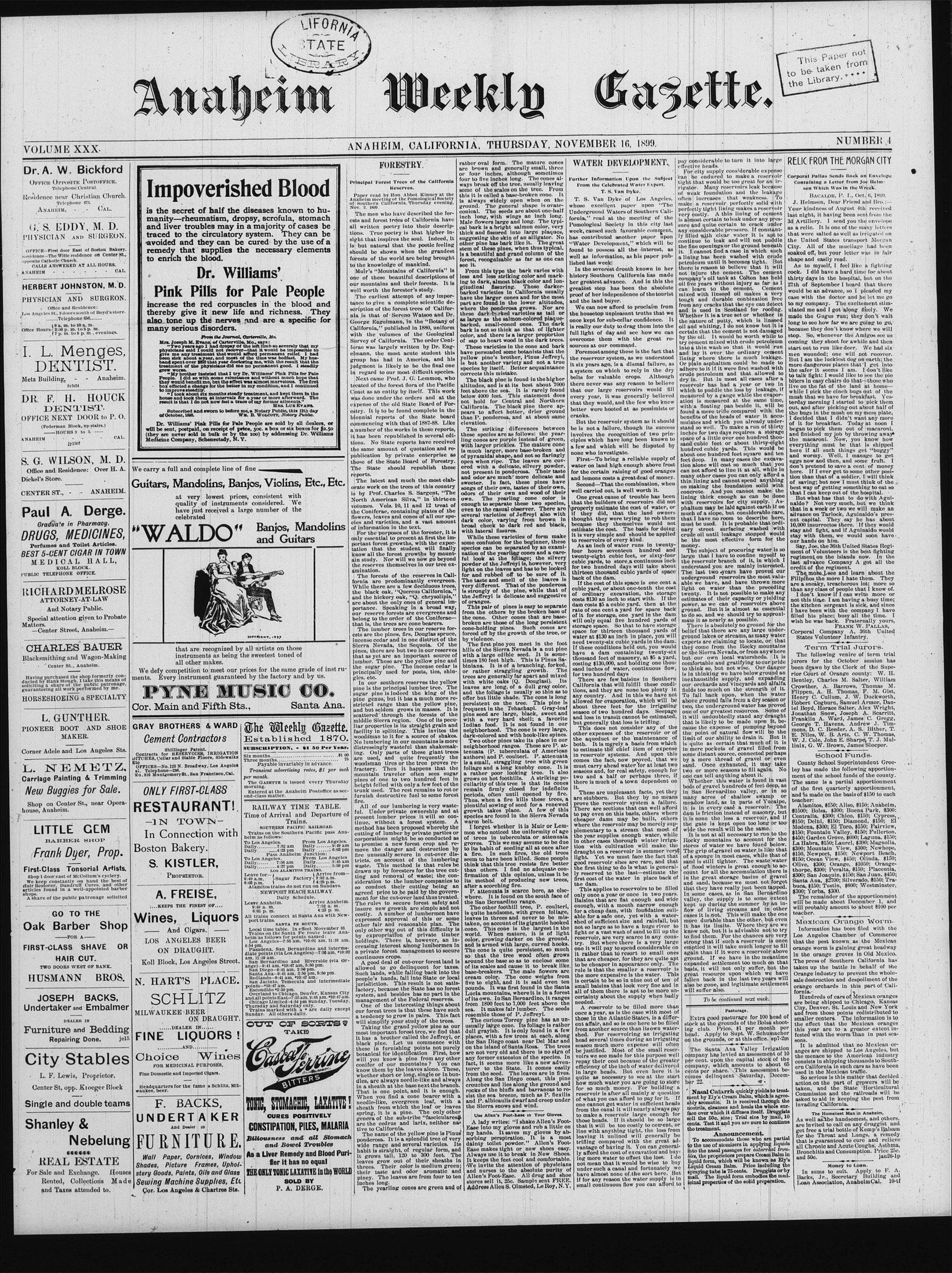
Searchable text
VOLUME XXX.
Dr. A. W. Bickford
OFFICE OPPOSITE POSTOFFICE.
Telephone Central.
Residence near Christian Church.
Telephone 671.
ANAHEIM, CAL.
G. S. EDDY, M. D.
PHYSICIAN AND SURGEON.
OFFICE—First door East of Boston Bakery.
Residence—The Wilte residence on Center St., opposite Catholic Church.
CALLS ANSWERED AT ALL HOURS.
ANAHEIM, CAL.
HERBERT JOHNSTON, M. D.
PHYSICIAN AND SURGEON.
Office and Residence:
Los Angeles St. 3 doors south of Boyd's store.
Telephone 650……
9 a.m. to 10 a.m.
Office Hours: 3:30 p.m. to 5 p.m.
7 p.m. to 8 p.m., evenings.
I. L. Menges,
DENTIST.
Metz Building, Anaheim.
feb24
DR. F. H. HOUCK
DENTIST.
OFFICE NEXT DOOR to P. O.
(Federman Block, up stairs.)
HOURS 9 to 5
ANAHEIM, CAL.
jy154f
S. G. WILSON, M. D.
Office and Residence: Over H. A.
Impoverished Blood
is the secret of half the diseases known to humanity—rheumatism, dropsy, scrofula, stomach and liver troubles may in a majority of cases be traced to the circulatory system. They can be avoided and they can be cured by the use of a remedy that supplies the necessary elements to enrich the blood.
Dr. Williams'
Pink Pills for Pale People
increase the red corpuscles in the blood and thereby give it new life and richness. They also tone up the nerves and are a specific for many serious disorders.
From the Journal, Carterville, Mo.
Mrs. Joseph M. Evans, of Carterville, Mo., says:
"Two years ago I had droopy of the left limb so severely that my physicians said I could not recover—that it would be impossible to give me any treatment that would afford permanent relief. I had been sick about a year, and most of the time was bedfast. My husband spent over $300 that year doctoring me, with the result that the treatment of the physicians did me no permanent good. I steadily grew worse."
My brother insisted that I try Dr. Williams' Pink Pills for Pale People. I did so with some reluctance and without much hope that they would benefit me, but the effect was almost marvelous. The first box effected a change for the better in my condition, and I continued to improve steadily.
"I took about six months steady treatment, and kept them in the house and took them at intervals for a year or more afterward. The result is that I do not now feel a trace of my former ailments."
MRS. LUE EVANS.
Subscribed and sworn to before me, a Notary Public, this 12th day of October, 1898.
Dr. Williams' Pink Pills for Pale People are sold by all dealers, or will be sent, postpaid, on receipt of price, 50c. a box or six boxes for $2.50 (they are never sold in bulk or by the 100) by addressing Dr. Williams Medicine Company, Schenectady, N.Y.
We carry a full and complete line of fine
Metz Building, Anaheim
feb24
DR. F. H. HOUCK
DENTIST.
OFFICE NEXT DOOR to P. O.
(Federman Block, up stairs.)
HOURS 9 to 5
ANAHEIM
jy154f
S. G. WILSON, M. D.
Office and Residence: Over H. A. Dickel's Store.
CENTER ST., ANAHEIM.
Paul A. Derge.
Graduate in Pharmacy.
DRUGS, MEDICINES,
Perfumes and Toilet Articles.
BEST 5-CENT CIGAR IN TOWN
MEDICAL HALL,
KOLL BLOCK.
PUBLIC TELEPHONE OFFICE.
RICHARD MELROSE
ATTORNEY-AT-LAW
And Notary Public.
Special attention given to Probate Matters.
—Center Street, Anaheim—
CHARLES BAUER
Blacksmithing and Wagon-Making
Center St., Anaheim.
Having purchased the shop formerly conducted by Hank Stough, I take this means of soliciting a share of the public patronage, guaranteeing all work performed by me.
HORSESHOEING a SPECIALTY
L. GUNTHER.
PIONEER BOOT AND SHOE MAKER.
Corner Adele and Los Angeles Sts.
L. NEMETZ.
Carriage Painting & Trimming
New Buggies for Sale.
Shop on Center St., near Opera-house, Anaheim.
LITTLE GEM
BARBER SHOP
Frank Dyer, Prop.
First-Class Tonsorial Artists.
Shop 1 door east of McCollum's cycleery.
We keep constantly on hand the best of Hair Restorer, Dandruff Cures, and other articles found in a well-appointed barber shops.
A share of the public patronage solicited
We carry a full and complete line of fine
Guitars, Mandolins, Banjos, Violins, Etc., Etc,
at very lowest prices, consistent with quality of instruments considered. We have just received a large number of the celebrated
"WALDO"
Banjos, Mandolins and Guitars
that are recognized by all artists on those instruments as being the sweetest toned of all other makes.
We defy competition to meet our prices for the same grade of instruents. Every instrument guaranteed by the factory and by us.
PYNE MUSIC CO.
Cor. Main and Fifth Sts., Santa Ana.
GRAY BROTHERS & WARD
Cement Contractors
Shillinger Patent.
Contracts for RESERVOIRS, IRRIGATION DITCHES, Cellar and Stable Floors, Sidewalks Etc.
OFFICES—No. 125 N. Broadway, Los Angeles al. Telephone—236.
No. 816 Montgomery St., San Francisco, Cal.
ONLY FIRST-CLASS RESTAURANT!
—IN TOWN—
In Connection with Boston Bakery.
S. KISTLER,
PROPRIETOR.
A. FREISE,
The Weekly Gazette.
Established 1870.
SUBSCRIPTION, - $1 50 Per Year.
Six months.....$1 00
Three months.....75
Payable invariably in advance.
Transient advertising rates, $1 per inch per month.
The GAZETTE is issued every Thursday morning.
Entered at the Anaheim Postoffice as second-class matter.
RAILWAY TIME TABLE.
Time of Arrival and Departure of Trains.
SOUTHERN PACIFIC RAILROAD.
Trains on the Southern Pacific pass Anaheim as follows:
To Los Angeles....From Los Angeles.
Daily.....7:52 am...Daily.....9:49 am
Daily.....4:33 pm...Daily.....6:03 pm
Pass Anaheim Junction:
To Los Angeles....From Los Angeles.
Daily.....7:56 am...Daily.....9:45 am
Daily.....4:27 pm...Daily.....5:59 pm
LOS ALAMITOS TRAINS.
Leave for—
9:49 a.m.
6:03 p.m.
Sugar Factory
7:52 a.m.
4:28 p.m.
Alamitos trains do not run on Sundays.
NEWPORT BEACH RAILWAY.
Daily Schedule.
LITTLE GEM
BARBER SHOP
Frank Dyer, Prop.
First-Class Tonsorial Artists.
Shop 1 door east of McCollum's cyclery.
We keep constantly on hand the best of hair Restorer, Dandruff Cures, and other articles found in a well-appointed barber shops.
A share of the public patronage solicited
GO TO THE Oak Barber Shop
FOR A FIRST-CLASS SHAVE OR HAIR CUT.
TWO DOORS WEST OF BANK.
HUSMANN BROS.
JOSEPH BACKS, Undertaker and Embalmer
DEALER IN Furniture and Bedding Repairing Done.
City Stables
L. F. Lewis, Proprietor.
Center St, opp. Kroeger Block
Single and double teams
Shanley & Nebelung
REAL ESTATE
For Sale and Exchange. Houses Rented, Collections Made and Taxes attended to.
RESTAURANT!
IN TOWNIn Connection with Boston Bakery.
S. KISTLER,
PROPRIETOR.
A. FREISE,
KEEPS THE FINEST OF...
Wines, Liquors And Cigars.
LOS ANGELES BEER ON DRAUGHT.
Koll Block, Los Angeles Street.
N. HART'S PLACE.
SCHLITZ
MILWAUKEE BEER ON DRAUGHT.
DEALER IN FINE LIQUORS!
AND Choice Wines FOR MEDICINAL PURPOSES,
Fine Domestic and Imported Cigars.
Headquarters for the famo's Schlitz, Milwaukee, beer.
F. BACKS, UNDERTAKER
And Dealer in FURNITURE.
Wall Paper, Cornices, Window Shades, Picture Frames, Upholstery Goods, Paints, Oils and Glass Sewing Machine Supplies, Etc.
Cor. Los Angeles & Chartres Sts.
RAILWAY TIME TABLE.
Time of Arrival and Departure of Trains.
SOUTHERN PACIFIC RAILROAD.
Trains on the Southern Pacific pass Anaheim as follows:
To Los Angeles.
Daily...7:52 am Daily...9:49 am
Daily...4:23 pm Daily...6:03 pm
Pass Anaheim Junction:
To Los Angeles.
Daily...7:56 am Daily...9:45 am
Daily...4:27 pm Daily...5:56 pm
Los ALAMITOS TRAINS.
Leave for—
9:49 a.m. Sugar Factory Arrive from—
6:03 p.m. Alamitos trains do not run on Sundays.
NEWPORT BEACH RAILWAY.
Daily Schedule.
Leave Anaheim.
Arrive Anaheim.
9:49 a.m. 7:52 a.m.
6:03 p.m. 4:23 p.m.
All trains connect at Santa Ana with Newport trains.
SANTA FE ROUTE.
Local time table. In effect November 10.
Trains on the Santa Fe route leave Anaheim as follows for points named:
Los Angeles—7:55 am, *10:02 am, 11:19 am, 4:54 pm.
Pasadena, San Bernardino and intermediate points (via Los Angeles)—7:58 am, *10:02 am, 11:19 am.
San Bernardino and Riverside (via Orange)—9:41 am, *10:47 am, 5:50 pm.
San Diego—9:41 am, 2:56 pm.
Santa Ana—9:41 am, 2:56 pm, 5:50 pm.
Redlands—9:41 am, *10:47 am.
San Jacinto, Temecula and intermediate points—10:47 am.
Overland to Chicago, Denver, Kansas City and all points East—7:55 am, 9:41 am, *10:47 am; Chicago Limited—4:54 pm Sunday, Tuesday, Thursday and Saturday only.
Trains marked with a * are daily except Sunday. All others daily.
OUT OF SORTS?
TAKE
Castle Terreine
BITTERS
TONIC, STOMACHIC, LAXATIVE!
CURES POSITIVELY
CONSTIPATION, PILES, MALARIA
Billiousness and all Stomach and Bowel Troubles
As a Liver Remedy and Blood Purifier it has no equal
THE ONLY TONIC LAXATIVE in the WORLD
SOLD BY
P. A. DERGE.
Weekly Gazette
ANAHEIM, CALIFORNIA, THURSDAY, NOVEMBER 16, 1899.
FORESTRY.
Principal Forest Trees of the California Reserves.
Paper read by Hon. Abbot Kinney at the Anaheim meeting of the Pomoological Society of Southern California, Thursday evening, Nov. 2, 1899.
The men who have described the forests and forest trees of California have all written poetry into their descriptions. True poetry is that higher insight that inspires the soul. Indeed, it is but natural that the poetic feeling should be shown when the grandest forests of the world are being brought to the knowledge of mankind.
Muir's "Mountains of California" is one of these beautiful descriptions of our mountains and their forests. It is well worth the forester's study.
The earliest attempt of any importance to give a complete scientific description of the forest trees of California is that of Sereno Watson and Dr. George Engelmann, in the "Botany of California," published in 1880, uniform with the volumes of the Geological Survey of California. The order Coniferae was largely written by Dr. Engelmann, the most acute student this group has had in America, and his judgment is likely to be the final one in regard to our most difficult species.
Next came Prof. J. G. Lemmon, who treated of the forest flora of the Pacific Coast as an entity by itself. This work was done under the orders and at the expense of the old State Board of Forestry. It is to be found complete in the biennial reports of the State board commencing with that of 1887-88. Like a number of the works in these reports, it has been republished in several editions. No State reports have received the same amount of quotation and re-publication by private enterprise as those of the State Board of Forestry. The State should republish these reports.
rather oval form. The mature cones are brown and generally small, three or four inches, although sometimes four to five inches long. The cones always break off the tree, usually leaving some of the scales on the tree. From this it is called a base-broken cone. It is always widely open when on the ground. The general shape is ovate-conical. The seeds are about one-half inch long, with wings an inch long. Male flowers large and long. The typical bark is a bright salmon color, very thick and fissured into large plaques, suggesting the skin of an alligator. No other pine has bark like it. The great stem of these pines, when thus typical, is a beautiful and grand column of the forest, recoginizable as far as one can see it.
From this type the bark varies with less and less striking color and marking to dark, almost black color and longitudinal fissuring. These darker-barked varieties in California usually have the larger cones and for the most part are found in the lower altitudes, where the ponderosa grows. Nor are these darker-barked varieties as tall or as large as the salmon-colored plaque-barked, small-coned ones. The dark bark is not so thick as that of lighter color, and there is a larger proportion of sap to heart wood in the dark trees.
These varieties in the cone and bark have persuaded some botanists that the yellow pine's brother, Pinus Jeffreyi, is but another variety and not a true species by itself. Better acquaintance corrects this mistake.
The black pine is found in the higher altitudes, and is at its best about 7000 feet above the sea. It is rarely found below 4000 feet. This statement does not hold for Central and Northern California. The black pine there appears to affect hotter, drier ground than P. ponderosa, and at about same elevation.
The striking differences between these species are as follows: the yearling cones are purple instead of green, with larger prickles. The mature cone is much larger, more base-broken and of pyramidal shape, and not so flaringly open when ripe. The leaves are covered with a delicate, silvery powder, not present in ponderosa. Their taste
WATER DEVELOPMENT.
Further Information Upon the Subject From the Celebrated Water Expert.
T. S. Van Dyke.
T. S. Van Dyke,
whose excellent paper upon "The Underground Waters of Southern California," read at the meeting of the Pomological Society in this city last week, caused such favorable comment, has contributed another paper upon "Water Development," which will be found to possess all the interest, as well as information, as his paper published last week:
In the severest drought known in her history Southern California has made her greatest advance. And in this the greatest step has been the absolute proof of her independence of the tourist and the land buyer.
We can now afford to proclaim from the housetop unpleasant truths that we once kept for sub-cellar confidence. It is really our duty to drag them into the full light of day and see how we can overcome them with the great resources at our command.
Foremost among these is the fact that the reservoir system, as we understood it six years ago, is a dismal failure, as a system on which to rely in the dry belts for valuable crops. Although there never was any reason to believe that our large reservoirs would fill every year, it was generally believed that they would, and the few who knew better were hootted at as pessimists or cranks.
But the reservoir system as it should be is not a failure, though its success involves the recognition of two principles which have long been known to a few and which will be disputed by none who investigate.
First—To bring a reliable supply of water on land high enough above frogs for the certain raising of good orange
Next came Prof. J. G. Lemmon, who treated of the forest flora of the Pacific Coast as an entity by itself. This work was done under the orders and at the expense of the old State Board of Forestry. It is to be found complete in the biennial reports of the State board commencing with that of 1887-88. Like a number of the works in these reports, it has been republished in several editions. No State reports have received the same amount of quotation and publication by private enterprise as those of the State Board of Forestry. The State should republish these reports.
The latest and much the most elaborate work on the trees of this country is by Prof. Charles S. Sargent, "The North American Silva," in thirteen volumes. Vols. 10, 11 and 12 treat of the Coniferae, containing plates of the flowers, leaves and cones of all our species and varieties, and a vast amount of information in the text.
For the purposes of the forester, it is only essential to present at first the important forest growths, with the expectation that the student will finally know all the forest growths by mountain study. Nor will we now go beyond the reserves themselves in our tree examination.
The forests of the reserves in California are predominantly evergreen. While there are a few deciduous trees, the black oak, "Quercus Californica," and the hickory oak, "Q. chrysolipis," are about the only ones of general importance. Speaking in a broad way, our reserve forests are evergreens and belong to the order of the Coniferae—that is, the trees are cone bearers.
The lumber trees in our reserve forests are the pines, firs, Douglas spruce, incense cedar and in one district of the Sierra Nevada, the Sequoia. Of the pines, there are but two in our reserves that as yet are an important source of lumber. These are the yellow pine and the sugar pine. The incense cedar is principally used for posts, ties, shingles, etc.
In our southern reserves the yellow pine is the principal lumber tree. The sugar pine is indeed the king of the pine genus, but it has a much more restricted range than the yellow pine, and but soldom grows in masses. It is scattered through the forests of the middle Sierra region. One of its peculiar properties is its straight grain and facility in splitting. This invites the woodsman to it for a source of shakes. No lumbering in our mountains is more distressingly wasteful than shamemaking. Only parts of these giant trees are used, and quite frequently the woodsman tires or the tree proves refractory. Then it happens that the mountain traveler often sees sugar pines of one to two hundred feet in height felled with only a few feet of the trunk used. The rest remains to rot or furnish destructive fuel to some forest fire.
All of our lumbering is very wasteful. Under private ownership and at present lumber prices it will so continue, without a forest system. A method has been proposed whereby the cutting of lumber by private parties or corporations might be so conducted as to promise a new forest crop and remove the danger and destruction by fire unusually severe in cut-over districts, on account of the lumbering waste. This method is that rules be drawn up by foresters for the tree cutting and removal of waste; the consideration to the lumber companies to so conduct their cutting being an agreed price to be paid by the government for the cut-over land thus treated.
The black pine is found in the higher altitudes, and is at its best about 7000 feet above the sea. It is rarely found below 4000 feet. This statement does not hold for Central and Northern California. The black pine there appears to affect hotter, drier ground than P. ponderosa, and at about same elevation.
The striking differences between these species are as follows: the yearling cones are purple instead of green, with larger prickles. The mature cone is much larger, more base-broken and of pyramidal shape, and not so flaringly open when ripe. The leaves are covered with a delicate, silvery powder, not present in ponderosa. Their taste and odor are much more delicate and sweeter. In fact, these pines have songs of their own, tastes of their own, odors of their own and wood of their own.
The yearling cone color is enough to separate these two species, even to the casual observer. There are several varieties of Jeffreyi also with dark color, varying from brown in broad check to dark red and black, with lateral fissures.
While these varieties of form make some confusion for the beginner, these species can be separated by an examination of the yearling cones and a careful look at the foliage; the silvery powder of the Jeffreyi is, however, very light on the leaves and has to be looked for and rubbed off to be sure of it. The taste and smell of the leaves is very different. That of the ponderosa is strongly of the pine, while that of the Jeffreyi is delicate and suggestive of oranges.
This pair of pines is easy to separate from the others by the broken base of the cone. Other cones that are base-broken are those of the long persistent cone-holding pines. Such cones are forced off by the growth of the tree, or by violence.
The first pine you meet in the foot hills of the Sierra Nevada is a nut pine with a large edible seed. It is sometimes 180 feet high. This is Pinus Sabiniana. It is of a branching, forked, or rather straggling growth. The trees are generally far apart and mixed with white oaks (Q. douglasii). Its leaves are long, of a dull gray color, and the foliage is usually so thin as to offer but little shade. The cone is long persistent on the tree. This pine is frequent in the Tehachapi. Gray-leaf pine seed are large, black, sweet and with a very hard shell; a favorite Indian food. It is not found in our neighborhood. The cone is very large, dark-colored and with hook-like spines.
Two other pines take its place in our neighborhood ranges. These are P. attenuata (P. tuberculata of American authors) and P. coulteri. P. attenuata is a small, straggling tree with green foliage and a long knobby cone. It is a rather poor looking tree. It also grows on hot foothills. A striking peculiarity of this tree is that its cones remain firmly closed for indefinite periods, often until opened by fire. Thus, when a fire kills these trees, a plentiful sowing of seed for a renewed growth takes place. A few of this species are found in the Sierra Nevada warm belt.
I forget whether it is Muir or Lemon who noticed the uniformity of age of trees in tuberculata or attenuata groves. This we may assume to be due to its habit of seeding all at once after a fire. In such fires, the old trees seem to have been killed. Some people think that this tree resists fire better than others. I find no adequate confirmation of this opinion, unless it be its method of producing new trees, after a scorching fire.
P. attenuata is scarce here, as elsewhere. It is found on the south face of belts for valuable crops. Although there never was any reason to believe that our large reservoirs would fill every year, it was generally believed that they would, and few who knew better were hooted at as pessimists or cranks.
But the reservoir system as it should be not a failure, though its success involves the recognition of two primi cibles which have long been known to a few and which will be disputed by none who investigate.
First—To bring a reliable supply of water on land high enough above frogs for the certain raising of good orange and lemons costs a great deal of money.
Second—That the combination, when well carried out, is well worth it.
One great cause of trouble has been that the builders of reservoirs did not properly estimate the cost of water, or if they did, that the land owner thought they were trying to rob them because they themselves would not estimate the cost. The basis for doing it is very simple and should be applied to reservoirs of every kind.
As an inch of water runs in twenty four hours seventeen hundred and twenty-eight cubic feet, or sixty-four cubic yards, to store a continuous inch for two hundred days will take about thirteen thousand cubic yards of space back of the dam.
If the cost of this space is one cent cubic yard, or about one-tenth the cost of ordinary excavation, the storage costs $130 an inch to start with. If this dam costs $5 a cubic yard, then at that rate one cent a yard for space back of it for storage, one yard in the dam will only equal five hundred yards or storage space.
So that to have storage space for thirteen thousand yards or water at $130 an inch in place, you will need twenty-six cubic yards in the dam if these conditions held out, you would have a dam containing twenty-six thousand feet of masonry, at $5 a yard costing $130,000, holding one thousand sand inches of water, continuous flow for two hundred days.
There are few balsins in Southern California that will fulfill these conditions, and they are none too plenty in any country. And in this we have allowed for evaporation, which will be about three feet for the irrigation season of two hundred days.
Seepage and loss in transit cannot be estimated but generally that loss is trifling.
This does not consider any of these expenses of the reservoir or any aqueduct or the maintenance both. It is merely a basis from which to estimate the chief item of expense in reservoir systems. And upon this come fact, now proved, that we must carry ahead water for at least two seasons and, for real safety, enough two and a half or perhaps three; there is much of a town dependent on it.
These are unpleasant facts, yet they are stubborn. But they do no mean prove the reservoir system a failure There are sections that can well afford to pay even on this basis; others when cheaper dams may be built; other where the reservoir may be merely supplementary to a stream that most year supplies enough water; which in other cases thorough winter irrigation with cultivation will make draught on a reservoir in summer very light. Yet we must face fact that good reservoir sites are rare; and that first thing to do is what is generally reserved to last—estimate the first cost of the water in place back at the dam.
This applies to reservoirs to be filled only once a year or once in two years.
[Weekly Gazette]
Published 1870.
Near PACific Railroad.
Southern Pacific pass Anatica.
From Los Angeles.
Daily 9:49 am
Daily 6:03 pm
Anaheim function.
From Los Angeles.
Daily 9:45 am
Daily 5:59 pm
Alamitos Trains.
Arrive from:
7:52 am.m.
4:25 p.m.
ORT BEACH RAILWAY.
Lady Schedule.]
All of our lumbering is very wasteful. Under private ownership and at present lumber prices it will so continue, without a forest system. A method has been proposed whereby the cutting of lumber by private parties or corporations might be so conducted as to promise a new forest crop and remove the danger and destruction by fire unusually severe in cut-over districts, on account of the lumbering waste. This method is that rules be drawn up by foresters for the tree cutting and removal of waste; the consideration to the lumber companies to so conduct their cutting being an agreed price to be paid by the government for the cut-over land thus treated. The rules to secure forest safety and insure new growth are simple and not costly. A number of lumbermen have expressed approval of this or some other fair and reasonable plan. The only other way out of this difficulty is by expropriation of private timber holdings. There is, however, an increasing interest among lumbermen in a private forest management to secure continuous crops.
A good deal of cut-over forest land is allowed to go delinquent for taxes. Such lands, while falling into the people's hands, fall into State or local jurisdiction. This result is not satisfactory, because the State has no forest system, and besides has no part in the management of the Federal reserves.
One of the interesting things about our forest trees is that these have such a tendency to grow in pairs. This fact will simplify your study of the trees.
Taking the grand yellow pine as our most important forest tree, we find that it has a brother called the Jeffreyi, or black pine. Let us commence with these in furnishing points not purely botanical for identification First, how will you know a pine from any other conifer of our mountains? You can know them by the leaves alone. These, whether short or long, single or in bundles, are always needle-like and always in a sheath at the base next the branch. That is one point, and it is enough. When you find a cone bearer with a needle-like, evergreen leaf, with a sheath from which the leaf or leaves spring, it is a pine. The only other genera of the sub-tribe "fasciculares" are the cedrus and larix, neither native to California.
The name of the yellow pine is Pinus ponderosa. It is a splendid tree of very wide range and several varieties. Its habit is straight, of regular form, and it grows tall, 120 to 300 feet. The leaves grow out of their sheaths in threes. Their color is medium green; their taste and odor aromatic and piney. The leaves are from four to ten inches long.
The yearling cones are green and of
Thus, when a fire kills these trees, a plentiful sowing of seed for a renewed growth takes place. A few of this species are found in the Sierra Nevada warm belt.
I forget whether it is Muir or Lemmon who noticed the uniformity of age of trees in tuberculata or attenuata groves. This we may assume to be due to its habit of seeding all at once after a fire. In such fires, the old trees seem to have been killed. Some people think that this tree resists fire better than others. I find no adequate confirmation of this opinion, unless it be its method of producing new trees, after a scorching fire.
P. attenuata is scarce here, as elsewhere. It is found on the south face of the San Bernardino range.
The other foothill tree, P. coulteri, is quite handsome, with green foliage, leaves in threes and never to be mistaken, on account of its gigantic hooked cone. This cone is the largest in the world. When mature, it is of light color, growing darker on the ground, and is armed with large, curved hooks. The cone is quite persistent, so much so that the tree wood often grows around the base so as to enclose some of its scales and cause it to break like base-breakers. The male flowers are cream color. The cone weighs from five to eight, and it is said even ten pounds. It was first found in the Santa Lucia mountains, where it is in a forest of its own. In San Bernardino, it ranges from 1800 feet to 7,000 feet above the sea. It makes fair lumber. The seeds resemble those of P. Jeffreyi.
The curious Torrey pine has an unusually large cone. Its foliage is rather dull grayish. It is only found in a few places, with a few trees at each, along the San Diego coast near Del Mar and on the island of Santa Rosa. The trees are not very old and there is no sign of any former extension of the species. In fact, it seems more like a new adventurer to the State. It comes easily from the seed. The leaves are in fives. Along the San Diego coast, this pine crouches and lies along the ground and rocks of the bluffs and barrancas to resist the sea breeze, much as P. flexilis and P. albicaulis dwarf and creep under the Sierra snows and wind.
Use Allen's Foot-base in Your Gloves.
A lady writes: "I shake Allen's Foot-Ease into my gloves and rub a little on my hands. It saves my gloves by absorbing perspiration. It is a most dainty toilet powder." Allen's Foot-Ease makes tight or new shoes easy. Always use it to break in New Shoes. It keeps the feet cool and comfortable.
We invite the attention of physicians and nurses to the absolute purity of Allen's Foot-Ease. All drug and shoe stores sell it, 25c. Sample sent FREE.
Address Allen S. Olmsted, Le Roy, N.Y.,
But they do not need prove the reservoir system a failure There are sections that can well afford to pay even on this basis, others where cheaper dams may be built, other where the reservoir may be merely supplementary to a stream that most of the year supplies enough water, which in other cases thorough winter irrigation with cultivation will make draught on a reservoir in summer very light. Yet we must face the fact that good reservoir sites are rare, and that the first thing to do is what is generally reserved to the last—estimate the first cost of the water in place back in the dam.
This applies to reservoirs to be filled only once a year or once in two years. Balsins that are flat enough and wide enough, with a mouth narrow enough for a cheap dam, with foundation suitable for a safe one, yet with a water shed of sufficient size and rainfall, but not so large as to have a huge river or sight or a vast wash of sand to fill up the reservoir, are very scarce in any country. But where there is a very large one it will pay to spend considerable money it rather than to resort to small ones that are cheaper, for they are quite easy to be cheaper in appearance only.
The rule is that the smaller a reservoir is the more expensive is the water. This is certain to be so in nine out of ten small balsins that look very fine and all of them there is apt to be more useful certainty about the supply when badly needed.
A reservoir to be filled more than once in a year, as is the case with most those in the Atlantic States, is a different affair, and so is one here to be filled from another source than its own water shed. For reservoiring an irrigation head several times during an irrigation season much more expense will often be justified. Most of the small reservoirs we see made for this purpose will repay their cost because of the great efficiency of the inch of water delivered in large heads. But even here it quite as necessary to see at the start how much water you are going to store for so much money. For building reservoirs is after all mainly a question of what you can afford to pay for it.
One cannot get water in sufficient heat from the canal it will nearly always require to make a reservoir large enough those heads. If it should be so large that it will be too costly to cement, line with anything tight, the loss from leaving it unlined will generally be trifling compared with the great advantage of having it. You can generally afford the cost of excavation and building more water to offset the loss. If not mean that it would be wise to build under such a canal and fortunately you have almost none of the sort here.
If for any reason the water supply is small continuous flow you can afford
Gazette.
BER 16, 1899.
FOR DEVELOPMENT.
Information Upon the Subject of the Celebrated Water Expert,
T. S. Van Dyke.
An Dyke of Los Angeles,
excellent paper upon "The Land Waters of Southern California at the meeting of the Real Society in this city last year such favorable comment, butted another paper upon development," which will be possess all the interest, as information, as his paper pub-
week:
Neverest drouth known in her southern California has made last advance. And in this step has been the absolute independence of the tourist and buyer.
Now afford to proclaim from top unpleasant truths that we for sub-cellar confidence. It our duty to drag them into the day and see how we can them with the great re-our command.
Stamong these is the fact that our system, as we understood as ago, is a dismal failure, as on which to rely in the dry valuable crops. Although it was any reason to believe large reservoirs would fill it, it was generally believed would, and the few who knew were hooted at as pessimists or reservoir system as it should a failure, though its success the recognition of two prin-which have long been known to which will be disputed by investigate.
To bring a reliable supply of land high enough above frost certain raising of good oranges pay considerable turn it into large effective heads.
For city supply considerable expense can be endured to make a reservoir tight that would be too great for an irrigator. Many reservoirs leak because of weak foundation and the leakage often increases that weakness. To make a reservoir perfectly solid with perfectly tight lining makes a reservoir very costly. A thin lining of cement is almost certain to leak under any pressure and quite certain to crack under any considerable pressure. If constantly filled with clear water it is apt to continue to leak and will not puddle the fine openings or the ground beneath it. I cannot find a case in which such a lining has been washed with crude petroleum until it becomes tight. But there is reason to believe that it will not injure the cement. The cement company's oil tank at Colton has held five years without injury as far as I can learn to the cement. Cement mixed with linseed oil makes a very tough and durable combination free from any cracks that the eye can detect and is used in Scotland for roofing. Whether it is a true set or whether in the nature of putty, which is linseed oil and whiting, I do not know but it is certain that the cement is not damaged by the oil. It would be worth while to try cement mixed with crude petroleum into a thin wash so that it would run and lay it over the ordinary cement lining where there is much leakage. Or plain asphaltum could be made to adhere to it if it were first washed with crude petroleum and that allowed to dry in. But in most all cases after a reservoir has had a year or two in which to puddle the loss by leakage, if measured by a gauge while the evaporation is measured at the same time, with a floating pan beside it, will be found a mere trifle compared with the benefits of the heads of water it accumulates and which you already understand so well. To make a run of thirty inches for two days requires a storage space of a little over one hundred thousand cubic feet or about thirty-eight hundred cubic yards. This would be about one hundred feet square and ten feet deep. In many cases the excavation alone will cost so much that you can not afford to line it at all, while in other cases you can only afford a
RELIC FROM THE MORGAN CITY
Corporal Pallas Sends Back an Envelope Containing a Letter from Joe Helmsen Which Was in the Wreck.
BACALOR, P. I., Oct. 6, 1899.
J. Helmsen, Dear Friend and Bro.:—Your kindness of August 4th received last night, it having been sent from the 3d Artillery. I send you the envelope as a relic. It is one of the many letters that were salted as well as irrigated on the United States transport Morgan City. All of the mucilage had been soaked off, but your letter was in fair shape and easily read.
As to myself, I feel like a fighting cock. I did have a hard time for about thirty days in the hospital, but on the 27th of September I heard that there would be an advance, so I pleaded my case with the doctor and he let me go to my company. The excitement stimulated me and I got along finely. We made the Gugus run; they don't wait long to see how far we are going to go, because they don't know where we will stop. So, whenever the Amigos see us coming they shoot for awhile and then start out to run like deer. We had six men wounded; one will not recover. But I am the luckiest dog on earth; the more dangerous places that I get into the safer it seems I am. I don't like to talk fight: I would like to see the pie biters in easy chairs do that—those who live on the fat of the land at home—while I pick the cinch bugs out of the mush that we have for breakfast. Yesterday morning I started to pick them out, and after picking out about half of the bugs in the mush on my mess plate, I decided that I didn't want any more of it for breakfast. Today at noon I began to pick them out of macaroni, and finished my job by throwing away the macaroni. Now, you know how everything must be that is shipped here if all such things get "buggy" and wormy. Well, I manage to get eggs now and then, and some fruit. I don't pretend to save a cent of money here. If I ever get to some other posi-
Reservoir system as it should be a failure, though its success the recognition of two princess have long been known to which will be disputed by investigate.
To bring a reliable supply of land high enough above frost certain raising of good oranges costs a great deal of money. That the combination, when used out, is well worth it.
That cause of trouble has been builders of reservoirs did not estimate the cost of water, or did, that the land owners they were trying to rob them they themselves would not the cost. The basis for doing simple and should be applied oirs of every kind.
Each of water runs in twenty-seventeen hundred and eight cubic feet, or sixty-four yards, to store a continuous inch hundred days will take about thousand cubic yards of space one dam.
Most of this space is one cent a yard, or about one-tenth the cost of excavation, the storage an inch to start with. If the $5 a cubic yard, then at the one cent a yard for space back storage, one yard in the dam equal five hundred yards of space. So that to have storage for thirteen thousand yards of $130 an inch in place, you will ninety-six cubic yards in the dam conditions held out, you would dam containing twenty-six feet of masonry, at $5 a yard, $130,000, and holding one thousand of water, continuous flow, hundred days.
Are few balsins in Southern Alabama that will fulfill these conditions they are none too plenty in try. And in this we have not our evaporation, which will be three feet for the irrigating two hundred days. Seepage in transit cannot be estimated, really that loss is trifling.
Does not consider any of the expenses of the reservoir or of product or the maintenance of it is merely a basis from which to the chief item of expense our systems. And upon this fact, now proved, that we very ahead water for at least two and a half or perhaps three, if much of a town dependent on are unpleasant facts, yet they born. But they by no means the reservoir system a failure. Are sections that can well afford even on this basis, others where dams may be built, others the reservoir may be merely supply to a stream that most of supplies enough water, while cases thorough winter irrigation cultivation will make the on a reservoir in summer very. Yet we must face the fact that reservoir sites are rare, and that thing to do is what is generalized to the last—estimate the of the water in place back of supplies to reservoirs to be filled a year or once in two years. Are fat enough, and wide crusty petroleum and that allowed to dry in. But in most all cases after a reservoir has had a year or two in which to puddle the loss by leakage, if measured by a gauge while the evaporation is measured at the same time, with a floating pan beside it, will be found a mere trilike compared with the benefits of the heads of water it accumulates and which you already understand so well. To make a run of thirty inches for two days requires a storage space of a little over one hundred thousand cubic feet or about thirty-eight hundred cubic yards. This would be about one hundred feet square and ten feet deep. In many cases the excavation alone will cost so much that you can not afford to line it at all, while in many other cases you can only afford a thin lining and cannot spend anything on making the foundation solid with concrete. And you cannot make the lining thick enough as can be done with reservoirs for city supply. Asphaltum may be laid against earth if on much of a slope, but considerable care that I have no room to describe here, must be used. It is probable that ordinary street surfacing washed with crude oil until leakage stopped would be the most effective form for the money.
The subject of procuring water is so large that I have to confine myself to the reservoir branch of it, in which I understand you are mainly interested. The last two years have proved our underground reservoirs the most valuable we have, and have thrown more light on water than the preceding twenty. It is not possible to make any estimates of their capacity or yielding power, as we can of reservoirs above ground. But it is almost as essential to do so, and we should try to approximate it as nearly as possible.
There is absolutely no ground for the belief that there are any large underground lakes or streams, as many water experts are claiming to locate, or that they come from the Rocky mountains or the Sierra Nevada, or from anywhere but our own local watersheds. It is comfortable and gratifying to our pride to think so, but not wise. Our danger is in thinking we have below ground an inexhaustible supply, and expanding our orchards and vineyards and alfalfa fields too much on the strength of it. To fall back upon, when the water above ground falls from a dry season or two, the underground water has proved one of our greatest resources. Some of it will undoubtedly stand any draught that is likely to be made upon it, because the expense of pumping beyond the point of natural flow will be the limit of our ability to drain it. But it is quite as certain that much of it is in mere pockets of gravel filled from some distant source, connected perhaps by a mere thread of gravel or even sand. Once exhausted, it may take two or more seasons to fill again. No one can tell anything about it.
Whether this water is found in vast beds of gravel hundreds of feet deep, as in San Bernardino valley, or in so many acres of shallow swamp or meadow land, as in parts of Yucaipa. It is in every case a reservoir. The dam is friction instead of masonry, but it is none the less a reservoir, and if the gate is kept open too long or too wide the result will be the same.
It is not at all necessary to run to the Rocky mountains to account for the stores of water we have found below. The grip of gravel on water is like that of a sponge in most cases, while that of sand is still tighter. The waste water of flood winters is great enough to account for all the accumulation there is in the great storage basins of gravel and sand, because we must not forget that they have really just been tapped. In some cases, as in San Bernardino valley, the supply is to some extent to talk fight: I would like to see the pie biters in easy chairs do that—those who live on the fat of the land at home while I pick the cinch bugs out of the mush that we have for breakfast. Yesday morning I started to pick them out, and after picking out about half of the bugs in the mush on my mess plate, I decided that I didn't want any more of it for breakfast. Today at noon I began to pick them out of macaroni, and finished my job by throwing away the macaroni. Now, you know how everything must be that is shipped here if all such things get "buggy" and wormy. Well, I manage to get eggs now and then, and some fruit. I don't pretend to save a cent of money here. If I ever get to some other position than that of a soldier, I will think of saving; but now I must think of the best way of getting something to eat so that I can keep out of the hospital.
But what has that to do with Aguinaldo? Not very much, but we think that in a week or two we will make an advance on Tarlock, Aguinaldo's present capital. They say he has about 10,000 insurrectos there. If they would stay and fight, and if Aguinaldo would stay with them, we would soon have our hands on him.
Say, Joe, the 36th United States Regiment of Volunteers is the best fighting regiment on the islands now. In the last advance Company A got all the credit of the regiment.
The more I see and learn about the Filipinos the more I hate them. They are a sneaky, treacherous lot; more so than any class of people that I know of.
I don't know if I can write more or not this time. I am having a busy time; the kitchen sergeant is sick, and since I have been with the company I have filled his place; busy all the time. I wish he was back.
Frank W. Pallas,
Corporal Company A, 36th United States Volunteer Infantry.
Term Trial Jurors
The following venire of term trial jurors for the October session has been drawn by the Clerk of the Superior Court of Orange county: W.H. Bentley, Charles M. Salter, William Crowther, A. Barrows, Thomas M. Flippen, A.H. Thomas, F.M.Gist, Henry C.Cullum, J.W.Duckworth, Robert Cogburn, Samuel Armor, Daniel Boyd, Horace Salter, Alex Wright, Jonathan Snow, Joseph A.Scarritt, Franklin A.Ward, James C.Gregg, George T.Havens, Andrew J.Timmons, D.C.Reeder,A.S.Bither,T.E.Niles,W.B.Artz,C.W.Thomas,W.J.Cole,John E.Sharpe,T.J.Mullinix,G.W.Brown,James Sleeper.
School Funds.
County School Superintendent Greeley has made the following apportionment of the first quarterly apportionment,and is made on the basis of $150 to each teacher:
Alamitos,$150; Aliso,$150; Anaheim,$1500; Bolsa,$300; Buena Park,$300; Centralia,$300; Chico,$150; Cypress,$150; Delhi,$150; Diamond,$150; El Modena,$300; El Toro,$150; Fairview,$150; Fountain Valley,$150; Fullerton,$450; Garden Grove,$600; Laguna,$150; La Habra,$150; Laurel,$300; Magnolia,$300; Mountain View,$300; Newhope,$150; Newport,$150; Newport Beach,$150; Ocean View,$450; Olinda,$150; Olive,$300; Orange,$1050; Orange-thorpe,$150; Peralta,$150; Placentia,$300; San Joaquin,$150; San Juan,$450; Santa Ana,$2700; Silverado,$150; Trabuca,$150; Tustin,$600; Westminster,$300; Yorba,$300.
The remainder of the apportionment
Reservoir to be filled more than year, as is the case with most of the Atlantic States, is a differer-ent and so is one here to be filled other source than its own water. For reservoiring an irrigating several times during an irrigation much more expense will often be needed. Most of the small reser-ves see made for this purpose well their cost because of the greater pay to spend considerable on water than to resort to small ones cheaper, for they are quite apt cheaper in appearance only. The smaller a reservoir is the expensive is the water. This can be so in nine out of ten of rivers that look very fine and in them there is apt to be more un-ny about the supply when badly reservoir to be filled more than year, as is the case with most of the Atlantic States, is a differ-ent and so is one here to be filled other source than its own water. For reservoiring an irrigating several times during an irrigation much more expense will often be needed. Most of the small reser-ves see made for this purpose well their cost because of the greater pay to spend considerable on water than to resort to small ones cheaper, for they are quite apt cheaper in appearance only. The smaller a reservoir is the expensive is the water. This can be so in nine out of ten of rivers that look very fine and in them there is apt to be more un-ny about the supply when badly reservoir to be filled more than year, as is the case with most of the Atlantic States, is a differ-ent and so is one here to be filled other source than its own water. For reservoiring an irrigating several times during an irrigation much more expense will often be needed. Most of the small reser-ves see made for this purpose well their cost because of the greater pay to spend considerable on water than to resort to small ones cheaper, for they are quite apt cheaper in appearance only. The smaller a reservoir is the expensive is the water. This can be so in nine out of ten of rivers that look very fine and in them there is apt to be more un-ny about the supply when badly reservoir to be filled more than year, as is the case with most of the Atlantic States, is a differ-ent and so is one here to be filled other source than its own water. For reservoiring an irrigating several times during an irrigation much more expense will often be needed. Most of the small reser-ves see made for this purpose well their cost because of the greater pay to spend considerable on water than to resort to small ones cheaper, for they are quite apt cheaper in appearance only. The smaller a reservoir is the expensive is the water. This can be so in nine out of ten of rivers that look very fine and in them there is apt to be more un-ny about the supply when badly reservoir to be filled more than year, as is the case with most of the Atlantic States, is a differ-ent and so is one here to be filled other source than its own water. For reservoiring an irrigating several times during an irrigation much more expense will often be needed. Most of the small reser-ves see made for this purpose well their cost because of the greater pay to spend considerable on water than to resort to small ones cheaper, for they are quite apt cheaper in appearance only. The smaller a reservoir is the expensive is the water. This can be so in nine out of ten of rivers that look very fine and in them there is apt to be more un-ny about the supply when badly reservoir to be filled more than year, as is the case with most of the Atlantic States, is a differ-ent and so is one here to be filled other source than its own water. For reservoiring an irrigating several times during an irrigation much more expense will often be needed. Most of the small reser-ves see made for this purpose well their cost because of the greater pay to spend considerable on water than to resort to small ones cheaper, for they are quite apt cheaper in appearance only. The smaller a reservoir is the expensive is the water. This can be so in nine out of ten of rivers that look very fine and in them there is apt to be more un-ny about the supply when badly reservoir to be filled more than year, as is the case with most of the Atlantic States, is a differ-ent and so is one here to be filled other source than its own water. For reservoiring an irigrating several times during an irrigation much more expense will often be needed. Most of the small reser-ves see made for this purpose well their cost because of the greater pay to spend considerable on water than to resort to small ones cheaper, for they are quite apt cheaper in appearance only. The smaller a reservoir is the expensive is the water. This can be so in nine out of ten of rivers that look very fine and in them there is apt to be more un-ny about the supply when badly reservoir to be filled more than year, as is the case with most of the Atlantic States, is a differ-ent and so is one here to be filled other source than its own water. For reservoiring an irigrating several times during an irrigation much more expense will often be needed. Most of the small reser-ves see made for this purpose well their cost because of the greater pay to spend considerable on water than to resort to small ones cheaper, for they are quite apt cheaper in appearance only. The smaller a reservoir is the expensive is the water. This can be so in nine out of ten of rivers that look very fine and in them there is apt to be more un-ny about the supply when badly reservoir to be filled more than year, as is the case with most of the Atlantic States, is a differ-ent and so is one here to be filled other source than its own water. For reservoiring an irigrating several times during an irrigation much more expense will often be needed. Most of the small reser-ves see made for this purpose well their cost because of the greater pay to spend considerable on water than to resort to small ones cheaper, for they are quite apt cheaper in appearance only. The smaller a reservoir is the expensive is the water. This can be so in nine out of ten of rivers that look very fine and in them there is apt to be more un-ny about the supply when badly reservoir to be filled more than year, as is the case with most of the Atlantic States, is a differ-ent and so is one here to be filled other source than its own water. For reservoiring an irigrating several times during an irrigation much more expense will often be needed. Most of the small reser-ves see made for this purpose well their cost because of the greater pay to spend considerable on water than to resort to small ones cheaper, for they are quite apt cheaper in appearance only. The smaller a reservoir is the expensive is the water. This can be so in nine out of ten of rivers that look very fine and in them there is apt to be more un-ny about the supply when badly reservoir to be filled more than year, as is the case with most of the Atlantic States, is a differ-ent and so is one here to be filled other source than its own water. For reservoiring an irigrating several times during an irrigation much more expense will often be needed. Most of the small reser-ves see made for this purpose well their cost because of the greater pay to spend considerable on water than to resort to small ones cheaper, for they are quite apt cheaper in appearance only. The smaller a reservoir is the expensive is the water. This can be so in nine out of ten of rivers that look very fine and in them there is apt to be more un-ny about the supply when badly reservoir to be filled more than year, as is the case with most of the Atlantic States, is a differ-ent and so is one here to be filled other source than its own water. For reservoiring an irigrating several times during an irrigation much more expense will often be needed. Most of the small reser-ves see made for this purpose well their cost because of the greater pay to spend considerable on water than to resort to small ones cheaper, for they are quite apt cheaper in appearance only. The smaller a reservoir is the expensive is the water. This can be so in nine out of ten of rivers that look very fine and in them there is apt to be more un-ny about the supply when badly reservoir to be filled more than year, as is the case with most of the Atlantic States, is a differ-ent and so is one here to be filled other source than its own water. For reservoiring an irigrating several times during an irrigation much more expense will often be needed. Most of the small reser-ves see made for this purpose well their cost because of the greater pay to spend considerable on water than to resort to small ones cheaper, for they are quite apt cheaper in appearance only. The smaller a reservoir is the expensive is the water. This can be so in nine out of ten of rivers that looks very fine and in them there is apt to be more un-ny about the supply when badly reservoir to be filled more than year, as is the case with most of the Atlantic States, is a differ-ent and so is one here to be filled other source than its own water. For reservoiring an irigrating several times during an irrigation much more expense will often be needed. Most of the small reser-ves see made for this purpose well their cost because of the greater pay to spend considerable on water than to resort to small ones cheaper, for they are quite apt cheaper in appearance only. The smaller a reservoir is the expensive is the water. This can be so in nine out of ten of rivers that looks very fine and in them there is apt to be more un-ny about the supply when badly reservoir to be filled more than year, as is the case with most of the Atlantic States, is a differ-ent and so is one here to be filled other source than its own water. For reservoiring an irigrating several times during an irrigation much more expense will often be needed. Most of the small reser-ves see made for this purpose well their cost because of the greater pay to spend considerable on water than to resort to small ones cheaper, for they are quite apt cheaper in appearance only. The smaller a reservoir is the expensive is the water. This can be so in nine out of ten of rivers that looks very fine and in them there is apt to be more un-ny about the supply when badly reservoir to be filled more than year, as is the case with most ofthe Atlantic States,is a different and so is one here to be filled other source than its own water. For reservoiring an irigrating several times during an irrigation much more expense will often be needed. Most ofthe small reser-ves see made for this purpose well their cost because of the greater pay to spend considerable on water than to resort to small ones cheaper, for they are quite apt cheaper in appearance only. The smaller a reservoir is the expensive is the water. This can be so in nine out of ten of rivers that looks very fine and in them there is apt to be more un-ny about the supply when badly reservoir to be filled more than year, as isthe case with mostofthe AtlanticStates,is a differentandsoisoneheretobefilledothersourcethanitsownwater.Powerreservinganirrigatingseveraltimesduringanirrigatingmuchmoreexpensewilloftersed.Mostofthesmallreservingseemmadeforthispurposewelltheircostbecauseofthegreaterpaytospendconsiderableonwaterthantoresorttosmallonescheaper,forshearequiteaptcheaperinappearanceonly.Thesmallerareservoiristheexpensiveisthewater.Timenotebefilledmorethanyear.asisthecasewithmostoftheAtlanticStates.isa differenrurder,andsoisoneheretobefilledothersourcethanitsownwater.Powerreservinganirrigatingseveraltimesduringanirrigatingmuchmoreexpensewilloftersed.Mostofthesmallreservingseemmadeforthispurposewelltheircostbecauseofthegreaterpaytospendconsiderableonwaterthantoresorttosmallonescheaper,forshearequiteaptcheaperinappearanceonly.Thesmallerareservoiristheexpensiveisthewater.Timenotebefilledmorethanyear.asisthecasewithmostoftheAtlanticStates.isa differenrurder,andsoisoneheretobefilledothersourcethanitsownwater.Powerreservinganirrigatingseveraltimesduringanirrigatingmuchmoreexpensewilloftersed.Mostofthesmallreservingseemmadeforthispurposewelltheircostbecauseofthegreaterpaytospendconsiderableonwaterthantoresorttosmallonescheaper,forshearequiteaptcheaperinappearanceonly.Thesmallerareservoiristheexpensiveisthewater.Timenotebefilledmorethanyear.asisthecasewithmostoftheAtlanticStates.isa differenrurder,andsoisoneheretobefilledothersourcethanitsownwater.Powerreservinganirrigatingseveraltimesduringanirrigatingmuchmoreexpensewilloftersed.Mostofthesmallreservingseemmadeforthispurposewelltheircostbecauseofthegreaterpaytospendconsiderableonwaterthantoresorttosmallonescheaper,forshearequiteaptcheaperinappearanceonly.Thesmallerareservoiristheexpensiveisthewater.Timenotebefilledmorethanyear.asisthecasewithmostoftheAtlanticStates.isa differenrurder,andsoisoneheretobefilledothersourcethanitsownwater.Powerreservinganirrigatingseveraltimesduringanirrigatingmuchmoreexpensewilloftersed.Mostofthesmallreservingseemmadeforthispurposewelltheircostbecauseofthegreaterpaytospendconsiderableonwaterthantoresorttosmallonescheaper,forshearequiteaptcheaperinappearanceonly.Thesmallerareservoiristheexpensiveisthewater.Timenotebefilledmorethanyear.asisthecasewithmostoftheAtlanticStates.isa differenrurder,andsoisoneheretobefilledothersourcethanitsownwater.Powerreservinganirrigatingseveraltimesduringanirrigatingmuchmoreexpensewilloftersed.MostofthesmallreservingseemmadeforthispurposewelltheircostbecauseofThegreaterpaytospendconsiderableonwaterthantoresorttosmallonescheaper,forshearequiteaptcheaperinappearanceonly.Thesmallerareservoiristheexpensiveisthewater.Timenotebefilledmorethanyear.asisthecasewithmostoftheAtlanticStates.isa differenrurder,andsoisoneheretobefilledothersourcethanitsownwater.Powerreservinganirrigatingseveraltimesduringanirrigatingmuchmoreexpensewilloftersed.MostofthesmallreservingseemmadeforthispurposewelltheircostbecauseofThegreaterpaytospendconsiderableonwaterthantoresorttosmallonescheaper,forshearequiteaptcheaperinappearanceonly.Thesmallerareservoiristheexpensiveisthewater.Timenotebefilledmorethanyear.asisthecasewithmostoftheAtlanticStates.isa differenrurder,andsoisoneheretobefilledothersourcethanitsownwater.Powerreservinganirrigatingseveraltimesduringanirrigatingmuchmoreexpensewilloftersed.MostofthesmallreservingseemmadeforthispurposewelltheircostbecauseOfThegreaterpaytospendconsiderableonwaterthantoresorttosmallonescheaper,forshearequiteaptcheaperinappearanceonly.Thesmallerareservoiristheexpensiveisthewater.Timenotebefilledmorethanyear.asisthecasewithmostoftheAtlanticStates.isa differenrurder,andsoisoneheretobefilledothersourcethanitsownwater.Powerreservinganirrigatingseveraltimesduringanirrigatingmuchmoreexpensewilloftersed.MostofthesmallreservingseemmadeforthispurposewelltheircostbecauseOfThegreaterpaytospendconsiderableonWaterthanToResortToChestInNewYorkAndFromThosePointsRidistributedToSmaller Centers.TheInformationIsToThe Effect That The Mexican Orange Worm.InformationHas Been filed With The Los Angeles Chamber Of CommerceThat The Pest Known As The Mexican Orange WormIs Gaining Great HeadwayIn The Orange Groves In Old Mexico.The Press Of Southern California Has Taken Up The Battle In behalf Of The Orange Industry To Prevent The Whole Sale Destruction And Despairment Of The Orange Orchards In This Part Of California.Hundreds Of Cars Of Mexican Oranges Are Being shipped To Chicago.Kansas City,Denver St.Louis And New YorkAnd From Those Points RidistributedToSmaller Centers.The Information Is ToThe Effect That The Mexican Orange WormIs Gaining Great HeadwayIn The Orange Groves In Old Mexico.The Press Of Southern California Has Taken Up The Battle In behalf Of The Orange Industry To Prevent The Whole Sale Destruction And Despairment Of The Orange Orchards In This Part Of California.Hundreds Of Cars Of Mexican Oranges Are Being shipped To Chicago.Kansas City,Denver St.Louis And New YorkAnd From Those Points RidistributedToSmaller Centers.The Information Is ToThe Effect That The Mexican Orange WormIs Gaining Great HeadwayIn The Orange Groves In Old Mexico.The Press Of Southern California Has Taken Up The Battle In behalf Of The Orange Industry To Prevent The Whole Sale Destruction And Despairment Of The Orange Orchards In This Part Of California.Hundreds Of Cars Of Mexican Oranges Are Being shipped To Chicago.Kansas City,Denver St.Louis And New YorkAnd From Those Points RidistributedToSmaller Centers.The Information Is ToThe Effect That The Mexican Orange WormIs Gaining Great HeadwayIn The Orange Groves In Old Mexico.The Press Of Southern California Has Taken Up The Battle In behalf Of The Orange Industry To Prevent The Whole Sale Destruction And Despairment Of The Orange Orchards In This Part Of California.Hundreds Of Cars Of Mexican Oranges Are Being shipped To Chicago.Kansas City,Denver St.Louis And New YorkAnd From Those Points RidistributedToSmaller Centers.The Information Is ToThe Effect That The Mexican Orange WormIs Gaining Great HeadwayIn The Orange Groves In Old Mexico.The Press Of Southern California Has Taken Up The Battle In behalf Of The Orange Industry To Prevent The Whole Sale Destruction And Despairment Of The Orange Orchards In This Part Of California.Hundreds Of Cars Of Mexican Oranges Are Being shipped To Chicago.Kansas City,Denver St.Louis And New YorkAnd From Those Points RidistributedToSmaller Centers.The Information Is ToThe Effect That The Mexican Orange WormIs Gaining Great HeadwayIn The Orange Groves In Old Mexico.The Press Of Southern California Has Taken Up The Battle In behalf OF THE ORANGE WORMIS GAINING GREAT HEADWAYIN THE ORANGE GROVES IN OLD MEXICO.The Press Of Southern California Has Taken Up The Battle In behalf OF THE ORANGE WORMIS GAINING GREAT HEADWAYIN THE ORANGE GROVES IN OLD MEXICO.The Press Of Southern California Has Taken Up The Battle In behalf OF THE ORANGE WORMIS GAINING GREAT HEADWAYIN THE ORANGE GROVES IN OLD MEXICO.The Press Of Southern California Has Taken Up The Battle In behalf OF THE ORANGE WORMIS GAINING GREAT HEADWAYIN THE ORANGE GROVES IN OLD MEXICO.The Press Of Southern California Has Taken Up THE BATTLE IN BEHALF OF THE ORANGE WORMIS GAINING GREAT HEADWAYIN THE ORANGE GROVES IN OLD MEXICO.The Press Of Southern California Has Taken Up THE BATTLE IN BEHALF OF THE ORANGE WORMIS GAINING GREAT HEADWAYIN THE ORANGE GROVES IN OLD MEXICO.The Press Of Southern California Has Taken UP THE BATTLE IN BEHALF OF THE ORANGE WORMIS GAINING GREAT HEADWAYIN THE ORANGE GROVES IN OLD MEXICO.The Press Of Southern California Has Taken UP THE BATTLE IN BEHALF OF THE ORANGE WORMIS GAINING GREAT HEADWAYIN THE ORANGE GROVES IN OLD MEXICO.The Press Of Southern California Has Taken UP THE BATTLE IN BEHALF OF THE ORANGE WORMIS GAINING GREAT HEADWAYIN THE ORANGE GROVES IN OLD MEXICO.The Press Of Southern California Has Taken UP THE BATTLE IN BEHALF OF THE ORANGE WORMIS GAINING GREAT HEADWAYIN THE ORANGE GROVES IN OLD MEXICO.The Press Of Southern California Has Taken UP THE BATTLE IN BEHALF OF THE ORANGE WORMIS GAINING GREAT HEADWAYIN THE ORANGE GROVES IN OLD MEXICO.The Press Of Southern California Has Taken UP THE BATTLE IN BEHALF OF THE ORANGE WORMIS GAINING GREAT HEADWAYIN THE ORANGE GROVES IN OLD MEXICO.The Press Of Southern California Has Taken UP THE BATTLE IN BEHALF OF THE ORANGE WORMIS GAINING GREAT HEADWAYIN THE ORANGE GROVES IN OLD MEXICO.The Press Of Southern California Has Taken UP THE BATTLE IN BEHALF OF THE ORANGE WORMIS GAINING GREAT HEADWAYIN THE ORANGE GROVES IN OLD MEXICO.The Press Of Southern California Has Taken UP THE BATTLE IN BEHALF OF THE ORANGE WORMIS GAINING GREAT HEADWAYIN THE ORANGE GROVES IN OLD MEXICO.The Press Of Southern California Has Taken UP THE BATTLE IN BEHALF OF THE ORANGE WORMIS GAINING GREAT HEADWAYIN THE ORANGE GROVES IN OLD MEXICO.The Press Of Southern California Has Taken UP THE BATTLE IN BEHALF OF THE ORANGE WORMIS GAINING GREAT HEADWAYIN THE ORANGE GROVES IN OLD MEXICO.The Press Of Southern California Has Taken UP THE BATTLE IN BEHALF OF THE ORANGE WORMIS GAINING GREAT HEADWAYIN THE ORANGE GROVES IN OLD MEXICO.The Press Of Southern California Has Taken UP THE BATTLE IN BEHALF OF THE ORANGE WORMISGAININGGREATHEADDITIONINTHEORANGEROWMISHANDSTOPLITTINGINTHEORANGEROWMISHANDSTOPLITTINGINTHEORANGEROWMISHANDSTOPLITTINGINTHEORANGEROWMISHANDSTOPLITTINGINTHEORANGEROWMISHANDSTOPLITTINGINTHEORANGEROWMISHANDSTOPLITTINGINTHEORANGEROWMISHANDSTOPLITTINGINTHEORANGEROWMISHANDSTOPLITTINGINTHEORANGEROWMISHANDSTOPLITTINGINTHEORANGEROWMISHANDSTOPLITTINGINTHEORANGEROWMISHANDSTOPLITTINGINTHEORANGEROWMISHANDSTOPLITTINGINTHEORANGEROWMISHANDSTOPLITTINGINTHEORANGEROWMISHANDSTOPLITTINGINTHEORANGEROWMISHANDSTOPLITTINGINTHEORANGEROWMISHANDSTOPLITTINGINTHEORANGEROWMISHANDSTOPLITTINGINTHEORANGEROWMISHANDSTOPLITTINGINTHEORANGEROWMISHANDSTOPLITTINGINTHEORANGEROWMISHANDSTOPLITTINGINTHEORANGEROWMISHANDSTOPLITTINGINTHEORANGEROWMISHANDSTOPLITTINGINTHEORANGEROWMISHANDSTOPLITTINGINTHEORANGEROWMISHANDSTOPLITTINGINTHEORANGEROWMISHANDSTOPLITTINGINTHEORANGEROWMISHANDSTOPLITTINGINTHEORANGEROWMISHANDSTOPLITTINGINTHEORANGEROWMISHANDSTOPLITTINGINTHEORANGEROWMISHANDSTOPLITTINGINTHEORANGEROWMISHANDSTOPLITTINGINTHEORANGEROWMISHANDSTOPLITTINGINTHEORANGEROWMISHANDSTOPLITTINGINTHEORANGEROWMISHANDSTOPLITTINGINTHEORANGEROWMISHANDSTOPLITTINGINTHEORANGEROWMISHANDSTOPLITTINGINTHEORANGEROWMISHANDSTOPLITTINGINTHEORANGEROWMISHANDSTOPLITTINGINTHEORANGEROWMishandstoplitteningintheorangermishandstoplitteningintheorangermishandstoplitteningintheorangermishandstoplitteningintheorangermishandstoplitteningintheorangermishandstoplitteningintheorangermishandstoplitteningintheorangermishandstoplitteningintheorangermishandstoplitteningintheorangermishandstoplitteningintheorangermishandstoplitteningintheorangermishandstoplitteningintheorangermishandstoplitteningintheorangermishandstoplitteningintheorangermishandstoplitteningintheorangermishandstoplitteningintheorangermishandstoplitteningintheorangermishandstoplitteningintheorangermishandstoplitteningintheorangermishandstoplitteningintheorangermishandstoplitteningintheorangermishandstoplitteningintheorangermishandstoplitteningintheorangermishandstoplitteningintheorangermishandstoplitteningintheorangermishandstoplitteningintheorangermishandstoplitteningintheorangermishandstoplitteningintheorangermishandstoplitteningintheorangermishandstoplitteningintheorangermishandstoplitteningintheorangermishandstoplitteningintheorangermishandstoplitteningintheorangermishandstoplitteningintheorangermishandstoplitteningintheorangermishandstoplitteningintheorangermishandstoplitteningintheorangermishandstoplitteningintheorangermishandstoplitteningintheorangermishandstoplitteningintheorangermishandstoplitteningintheorangermishandstoplitteningintheorangermishandstoplitteningintheorangermishandstopl