anaheim-gazette 1899-11-09
Scanned page
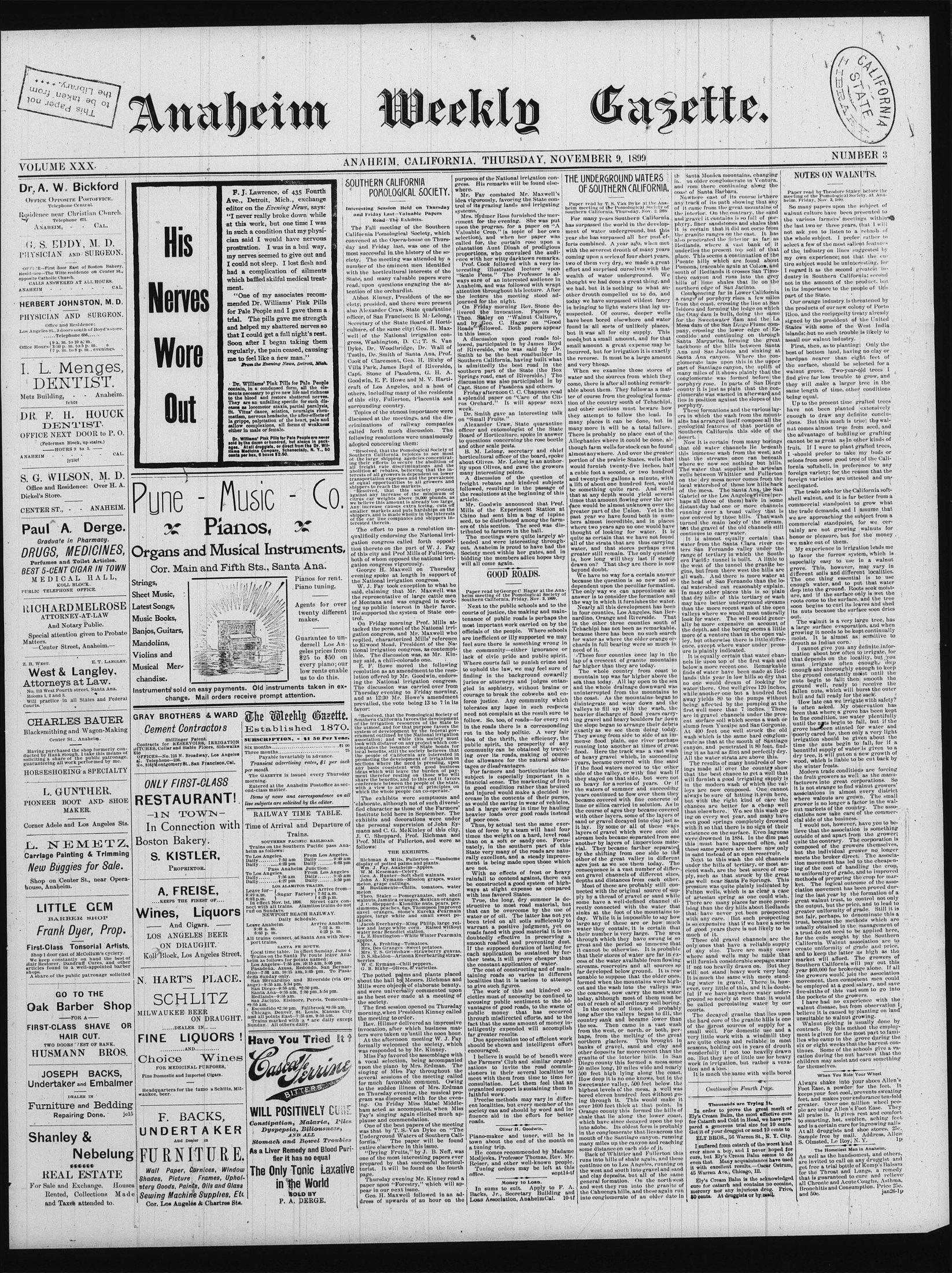
Searchable text
Anaheim
VOLUME XXX.
Dr. A. W. Bickford
OFFICE OPPOSITE POSTOFFICE.
Telephone Central.
Residence near Christian Church.
Telephone 671.
ANAHEIM, CAL.
G. S. EDDY, M. D.
PHYSICIAN AND SURGEON.
OFFICE—First door East of Boston Bakery.
Residence—The Wilte residence on Center St., opposite Catholic Church.
CALLS ANSWERED AT ALL HOURS.
ANAHEIM, CAL.
HERBERT JOHNSTON, M. D.
PHYSICIAN AND SURGEON.
Office and Residence:
Los Angeles St., 3 doors south of Boyd's store.
Telephone 656...
9 a.m. to 10 a.m.
Office Hours: 3:30 p.m. to 5 p.m.
7 p.m. to 8 p.m., evenings.
I. L. Menges,
DENTIST.
Metz Building, Anaheim.
feb24
DR. F. H. HOUCK
DENTIST.
OFFICE NEXT DOOR to P. O.
(Federman Block, up stairs.)
HOURS 9 to 5.
ANAHEIM, CAL.
Jy15tf
F. J. Lawrence, of 435 Fourth Ave., Detroit, Mich., exchange editor on the Evening News, says:
"I never really broke down while at this work, but one time I was in such a condition that my physician said I would have nervous prostration. I was in a bad way, my nerves seemed to give out and I could not sleep. I lost flesh and had a complication of ailments which baffled skilful medical treatment."
"One of my associates recommended Dr. Williams' Pink Pills for Pale People and I gave them a trial. The pills gave me strength and helped my shattered nerves so that I could get a full night's rest. Soon after I began taking them regularly, the pain ceased, causing me to feel like a new man."
From the Evening News, Detroit, Mich.
Dr. Williams' Pink Pills for Pale People contain, in a condensed form, all the elements necessary to give new life and richness to the blood and restore shattered nerves. They are an unfailing specific for such diseases as locomotor ataxia, partial paralysis, St. Vitus' dance, sciatica, neuralgia rheumatism, nervous headache, the after-effects of la gripe, palpitation of the heart, pale and sallow complexions, all forms of weakness either in male or female.
Dr. Williams' Pink Pills for Pale People are never sold by the dozen or hundred, but always in packages. At all druggists, or direct from the Dr. Williams Medicine Company, Schenectady, N. Y., 60 cents per box, 6 boxes $2.50.
DENTIST.
Metz Building, Anaheim.
feb24
DR. F. H. HOUCK
DENTIST.
OFFICE NEXT DOOR to P. O.
(Federman Block, up stairs.)
HOURS 9 to 5.
ANAHEIM
CAL.
jy154f
S. G. WILSON, M. D.
Office and Residence: Over H. A. Dickel's Store.
CENTER ST., ANAHEIM.
Paul A. Derge.
Graduate in Pharmacy.
DRUGS, MEDICINES,
Perfumes and Toilet Articles.
BEST 5-CENT CIGAR IN TOWN
MEDICAL HALL,
KOLL BLOCK.
PUBLIC TELEPHONE OFFICE.
RICHARD MELROSE
ATTORNEY-AT-LAW
And Notary Public.
Special attention given to Probate Matters.
Center Street, Anaheim.
Z. B. WEST.
E. T. LANGLEY.
West & Langley.
Attorneys at Law.
No. 113 West Fourth street, Santa Ana.
Rooms 1, 2 and 3.
Will practice in all States and Federal Courts.
CHARLES BAUER
Blacksmithing and Wagon-Making
Center St., Anaheim.
Having purchased the shop formerly conducted by Hank Stough, I take this means of soliciting a share of the public patronage, guaranteeing all work performed by me.
HORSESHOEING a SPECIALTY
L. GUNTHER.
PIONEER BOOT AND SHOE MAKER.
Corner Adele and Los Angeles Sts.
L. NEMETZ.
Carriage Painting & Trimming
New Buggies for Sale.
Shop on Center St., near Opera-house, Anaheim.
Dr. Williams' Pink Pills for Pale People contain, in a condensed form, all the elements necessary to give new life and richness to the blood and restore shattered nerves. They are an unfailing specific for such diseases as locomotor ataxia, partial paralysis, St. Vitus' dance, sciatica, neuralgia rheumatism, nervous headache, the after-effects of la gripe, palpitation of the heart, pale and shallow complexions, all forms of weakness either in male or female.
Dr. Williams' Pink Pills for Pale People are never sold by the dozen or hundred, but always in packages. At all druggists, or direct from the Dr. Williams Medicine Company, Schenectady, N. Y., 50 cents per box, 6 boxes $2.50.
Pyne - Music - Co.
Pianos,
Organs and Musical Instruments,
Cor. Main and Fifth Sts., Santa Ana.
Strings,
Sheet Music,
Latest Songs,
Music Books,
Banjos, Guitars,
Mandolins,
Violins and
Musical Merchandise.
Pianos for rent.
Piano tuning.
Agents for over twenty different makes.
Guarantee to undersell Los Angeles prices from $25 to $50 on every piano; our low rents enable us to do this.
Instruments sold on easy payments. Old instruments taken in exchange. Mail orders receive prompt attention.
GRAY BROTHERS & WARD
Cement Contractors
Shillinger Patent.
Contracts for RESERVOIRS, IRRIGATION DITCHES, Cellar and Stable Floors, Sidewalks Etc.
OFFICES—No. 125 N. Broadway, Los Angeles al.
Telephone—236.
No. 816J Montgomery St., San Francisco, Cal.
ONLY FIRST-CLASS RESTAURANT!
-IN TOWNIn Connection with Boston Bakery.
S. KISTLER,
PROPRIETOR.
A. FREISE,
The Weekly Gazette.
Established 1870.
SUBSCRIPTION, - $1 50 Per Year.
Six months....$1 00
Three months....75
Payable invariably in advance.
Transient advertising rates, $1 per inch per month.
The GAZETTE is issued every Thursday morning.
Entered at the Anaheim Postoffice as second-class matter.
Items of news and correspondence on all live subjects are solicited by the editor.
RAILWAY TIME TABLE.
Time of Arrival and Departure of Trains.
SOUTHERN PACIFIC RAILROAD.
Trains on the Southern Pacific pass Anaheim as follows:
To Los Angeles... From Los Angeles.
Daily... 7:52 am Daily... 9:49 am
Daily... 4:23 pm Daily... 6:03 pm
Pass Anaheim Junction:
To Los Angeles... From Los Angeles.
Daily... 7:56 am Daily... 9:45 am
Daily... 4:27 pm Daily... 5:59 pm
Los ALAMITOS TRAINS.
Leave for—
9:49 a.m.
Sugar Factory
7:52 a.m.
4:25 p.m.
PIONEER BOOT AND SHOE MAKER.
Corner Adele and Los Angeles Sts.
L. NEMETZ,
Carriage Painting & Trimming
New Buggies for Sale.
Shop on Center St., near Opera-house, Anaheim.
LITTLE GEM
BARBER SHOP
Frank Dyer, Prop.
First-Class Tonsorial Artists.
Shop 1 door east of McCollum's cyclery.
We keep constantly on hand the best of Hair Restorer, Dandruff Cures, and other articles found in a well-appointed barber shops.
A share of the public patronage solicited
GO TO THE Oak Barber Shop
FOR A
FIRST-CLASS SHAVE OR HAIR CUT.
TWO DOORS TEST OF BANK.
HUSMANN BROS.
JOSEPH BACKS,
Undertaker and Embalmer
DEALER IN
Furniture and Bedding Repairing Done. jel5
Shanley & Nebelung
REAL ESTATE
For Sale and Exchange. Houses Rented, Collections Made and Taxes attended to.
IN TOWNIn Connection with Boston Bakery.
S. KISTLER,
PROPRIETOR.
A. FREISE,
KEEPS THE FINEST OF...
Wines, Liquors
And Cigars.
LOS ANGELES BEER ON DRAUGHT.
Koll Block, Los Angeles Street.
N. HART'S PLACE.
SCHLITZ
MILWAUKEE BEER ON DRAUGHT.
DEALER IN...
FINE LIQUORS!
AND...
Choice Wines
FOR MEDICINAL PURPOSES,
Fine Domestic and Imported Cigars.
F. BACKS,
UNDERTAKER
And Dealer in
FURNITURE.
Wall Paper, Cornices, Window Shades, Picture Frames, Upholstery Goods, Paints, Oils and Glass Sewing Machine Supplies, Etc.
Cor. Los Angeles & Chartres Sts.
RAILWAY TIME TABLE.
Time of Arrival and Departure of Trains.
SOUTHERN PACIFIC RAILROAD.
Trains on the Southern Pacific pass Anaheim as follows:
To Los Angeles.
Daily...7:52 am
Daily...9:49 am
Daily...4:23 pm
Daily...6:03 pm
Pass Anaheim Junction:
To Los Angeles.
Daily...7:56 am
Daily...9:45 am
Daily...4:27 pm
Daily...5:59 pm
LOS ALAMITOS TRAINS.
Leave for—
9:49 a.m.
Sugar Factory
7:52 a.m.
6:03 p.m.
Arrive from—
4:25 p.m.
In effect Nov. 1st, 1898.
Street cars connect with all trains. Alamitos trains do not run on Sundays.
NEWPORT BEACH RAILWAY.
Daily Schedule.
Leave Anaheim.
9:49 a.m.
7:52 a.m.
6:03 p.m.
Arrive Anaheim.
9:49 a.m.
7:52 a.m.
6:03 p.m.
All trains connect at Santa Ana with Newport trains.
SANTA FE ROUTE.
Local time table. In effect Sunday, June 4.
Trains on the Santa Fe route leave Anaheim as follows for points named:
Los Angeles-7:55 am; 10:15 am; 5:05 pm.
Pasadena, Azusa, Redondo, San Bernardino-7:55 am; 10:15 am; 5:05 pm. To Pasadena Sunday only.
San Bernardino and Riverside (via Orange)-9:55 am; 5:54 pm.
San Diego-9:55 am; 2:50 pm.
Santa Ana-9:55 am; 2:50 pm; 5:54 pm.
Redlands-9:55 am.
San Jacinto, Elsinore, Perris, Temecula-9:55 am.
Escondido*2:50 pm. Fallbrook*9:55 am.
Chicago, Denver, St. Louis, Kansas City and all points East-7:55 am; 9:55 am.
Trains marked with a * are daily except Sunday. All others daily.
Have You Tried It?
Cascaferrine
BITTERS
WILL POSITIVELY CURE
Constipation, Malaria, Piles, Dyspepsia, Billousness,
AND ALL
Stomach and Bowel Troubles
As a Liver Remedy and Blood Purifier it has no equal
The Only Tonic Laxative in the World
SOLD BY
P. A. DERGE.
ANAHEIM, CALIFORNIA, THURSDAY, NOVEMBER 9, 1899
SOUTHERN CALIFORNIA POMOLOGICAL SOCIETY.
Interesting Session Held on Thursday and Friday Last—Valuable Papers Read—The Exhibits.
The Fall meeting of the Southern California Pomological Society, which convened at the Opera-house on Thursday and Friday last, was one of the most successful in the history of the society. The meeting was attended by a number of the eminent men identified with the horticultural interests of the State, and many valuable papers were read upon questions engaging the attention of the orchardist.
Abbot Kinney, President of the society, presided, and there were present also Alexander Craw, State quarantine officer, of San Francisco; B. M. Lelong, Secretary of the State Board of Horticulture, of the same city; Geo. H. Maxwell of the National irrigation congress, Washington, D. C.; T. S. Van Dyke, Dr. Woodbridge, Dr. Wall of Tustin, Dr. Smith of Santa Ana, Prof. Cook of Claremont, Geo. H. Bixby of Villa Park, James Boyd of Riverside, Capt. Stone of Pasadena, G. H. A. Goodwin, E. F. Howe and M. V. Hartcraft of Los Angeles, and a host of others, including many of the residents of this city, Fullerton, Placentia and surrounding country.
Topics of the utmost importance were discussed at the meetings, and the discriminations of railway companies called forth much discussion. The following resolutions were unanimously adopted concerning them:
“Resolved that the Pomological Society of Southern California rejoices to see most of the large shipping agencies concentrating their efforts to secure the abolition of all freight rate discriminations and the abolition of rebates, believing that the interests of all growers is dependent on lower purposes of the National irrigation congress. His remarks will be found elsewhere.
Mr. Fay combated Mr. Maxwell’s idea vigorously, favoring the State control of its grazing lands and irrigating systems.
Mrs. Sydmer Ross furnished the meritorious for the evening. She was put upon the program, for a paper on “A Valuable Crop.” (a topic of her own selection), and when her paper was called for, the curtain rose upon a plantation Aunt Dinah of prodigious proportions, who convulsed the audience with her witty darktown remarks.
Prof. Cook followed with a very interesting illustrated lecture upon “Scale Pests.” The Professor is always sure of an interested audience in Anaheim, and was followed with wrap attention throughout his lecture. After the lecture the meeting stood adjourned for the night.
On Friday morning Rev. Stone delivered the invocation. Papers by Theo. Staley on “Walnut Culture,” and by Geo. C. Hagar on “Good Roads” followed. Both papers appear in this issue.
A discussion upon good roads followed, participated in by James Boyd of Riverside, who was said by Dr. Smith to be the best roadbuilder in Southern California, having built what is admittedly the best road in the southern part of the State (the Box Springs road, east of Riverside.) The discussion was also participated in by Capt. Stone of Pasadena and others.
Friday afternoon C. C. Chapman read a splendid paper on “Care of the Citrus Orchard.” It will appear next week.
Dr. Smith gave an interesting talk on “Small Fruits.”
Alexander Craw, State quarantine officer and entomologist of the State Board of Horticulture, spoke in answer to questions concerning the rose beetle and other scale pests.
B. M. Lelong, secretary and chief horticultural officer of the board, spoke about Olives. Mr. Lelong is an authority upon Olives, and gave the growers many interesting points.
THE UNDERGROUND WATERS OF SOUTHERN CALIFORNIA.
Paper read by T.S., Van Dyke at the Anaheim meeting of the Pomological Society of Southern California, Thursday, Nov. 2, 1899.
For many years Southern California has surpassed the world in the development of water underground, but this year she has surpassed all her past efforts combined. A year ago, when met with the severest drought of many years coming upon a series of four short years, two of them very dry, we made a great effort and surprised ourselves with the wealth of water underground. We thought we had done a great thing, and we had, but it is nothing to what another drought compelled us to do, and today we have surpassed wildest fancy in bringing to light waters that lay unsuspected. Of course, deeper wells have been bored elsewhere and water found in all sorts of unlikely places, but it was all for city supply. This needs but a small amount, and for that small amount a great expense may be incurred, but for irrigation it is exactly the reverse. It must be a large amount and very cheap.
When we examine these stores of water and the sources from which they come, there is after all nothing remarkable about them. They follow as a matter of course from the geological formation of the country south of Tehachipli, and other sections must beware how they attempt to follow the lead. In many places it can be done, but in many more it will be a total failure. There is probably no place east of the Alleghanies where it could be done, although farm wells for stock can be found almost anywhere. And over the greater portion of the prairie States, wells that would furnish twenty-five inches, half a cubic foot a second, or two hundred
Pilts for Pale People form all the ele-ment new life and richness specific for such dis-axis, partial paralysis, tica, neuralgia rheuthea, the after-effects of the heart, pale and all forms of weakness.
For Pale People are never tired, but always in pack- direct from the Dr. WilSchenectady, N.Y., 50
Instruments, Santa Ana.
Pianos for rent. Piano tuning.
Agents for over twenty different makes.
Guarantee to undersell Los Angeles prices from $25 to $50 on every piano; our low rents enable us to do this.
Instruments taken in ex-ert attention.
Weekly Gazette. Published 1870.
NATION, - $150 Per Year.
$1.00
75
Invariably in advance.
Advertising rates, $1 per inch
Is issued every Thursday
The Anaheim Postoffice as secter.
And correspondence on all
are solicited by the editor.
AY TIME TABLE.
Arrival and Departure of Trains.
NORTH PACIFIC RAILROAD.
Southern Pacific pass Ana-
THE EXHIBITS.
Richman & Mills, Fullerton—Handsome display of potted palms and plants.
W. J. Fay, Anaheim Apples.
W. M. Kaysen, Celery.
Geo. A. Hunter—Soft shell walnuts.
John E. Yamm—Mission grapes, water melon, grape cuttings.
M. Bustamente—Chillis, tomatoes, water melon.
Theo. Staley—Pomegranates, soft shell Theo. Staley—Pomegranates, soft shell Springs road, east of Riverside.) The discussion was also participated in by Capt. Stone of Pasadena and others.
Friday afternoon C. C. Chapman read a splendid paper on "Care of the Citrus Orchard." It will appear next week.
Dr. Smith gave an interesting talk on "Small Fruits."
Alexander Craw, State quarantine officer and entomologist of the State Board of Horticulture, spoke in answer to questions concerning the rose beetle and other scale pests.
B. M. Lelong, secretary and chief horticultural officer of the board, spoke about Olives. Mr. Lelong is an authority upon Olives, and gave the growers many interesting points.
A discussion of the question of freight rebates and kindred subjects followed, resulting in the passage of the resolutions at the beginning of this article.
Mr. Goodwin announced that Prof. Mills of the Experiment Station at Chino had sent him a bag of lupine seed, to be distributed among the farmers of this section. The seed was distributed to farmers in the hall.
The meetings were quite largely attended and were interesting throughout. Anaheim is proud to have had the Society meet within her gates, and in bidding the members adieu hopes they will all come again.
GOOD ROADS.
Paper read by George C. Hagar at the Anaheim meeting of the Pomological Society of Southern California, Friday, Nov. 3, 1899.
Next to the public schools and to the courts of justice, the making and maintenance of public roads is perhaps the most important work carried on by the officials of the people. Where schools are inefficient or ill supported we may feel sure there is something wrong in the community—either ignorance or lack of civic pride and public spirit. Where courts fail to punish crime and to uphold the law, we may feel sure of finding in the background cowardly juries or attorneys and judges entangled in sophistry, without brains or courage to break the cobwebs and enforce justice. Any community which tolerates any lapse in such respects need not complain at the result sure to follow. So, too, of roads—for every rut in the roads there is a corresponding rut in the body politic. A very fair idea of the thrift, the efficiency, the public spirit, the prosperity of any community can be obtained by traveling over its roads, making of course due allowance for the natural advantages or disadvantages.
For farmers and horticulturists the subject is especially important in a financial sense. The marketing of fruit in good condition rather than bruised and injured would make a decided increase in the contents of their purses, as would the saving in wear of vehicles, and a large saving in time by hauling heavier loads over good roads instead of poor ones.
Thus, by actual test the same exer- tion of force by a team will haul four times the weight on a hard, level road than on a soft or sandy one. Fortunately, in the southern part of this State very many of the roads are naturally excellent, and a steady improvement is being made upon those which are not.
With no effects of frost or heavy rainfall to contend against, there can be constructed a good system of highways at slight expense as compared with less favored States.
water and the sources from which they come, there is after all nothing remarkable about them. They follow as a matter of course from the geological formation of the country south of Teehachipi, and other sections must beware how they attempt to follow the lead. In many places it can be done, but in many more it will be a total failure. There is probably no place east of the Alleghanies where it could be done, although farm wells for stock can be found almost anywhere. And over the greater portion of the prairie States, wells that would furnish twenty-five inches, half a cubic foot a second, or two hundred and twenty-five gallons a minute, with a lift of about one hundred feet, would be something quite rare. And wells that at any depth would yield several times that amount flowing over the surface would be almost unknown over the greater part of the Union. Yet in the past year we have found both in numbers almost incredible, and in places where two years ago no one would have thought of looking for water. It is quite as certain that we have not found all of the strata that are thus carrying water, and that stores perhaps ever greater still remain. The only question is, how long will they last if steamed drawn on? That they are there is now beyond doubt.
We have no way for a certain answer because the question is so new and so dependent upon the peculiar formation. The only way we can approximate an answer is to consider the formation and the way in which it furnishes the water.
Nearly all this development has been in four counties, Los Angeles, San Bernardino, Orange and Riverside. That in the other three counties south of Teehachipi has not been as remarkable because there has been no such search for water as where the older orange or chards in full bearing were so much in need of it.
These four counties once lay in the lap of a crescent of granite mountains far higher than they are today.
The whole country from coast to mountain top was far higher above sea than today. All lay open to the sea and the whole drainage downward were uninterrupted from the mountains to the coast. As the mountains began disintegrate and wear down and threw valleys to fill up with the wash, the heavier discharge of flood years carrying gravel and heavy boulders far down the slope began to arrange their debris exactly as we see them doing today. They swung from side to side of an immense flood plain, one river running into another at times of great flood. The track was a vast width of heavy gravel which, in succeeding years, became covered with fine concrete or lime or silica carried in solution. As the course of ages became covered with other layers, some of the layers sand or gravel decayed into clay just it lay. By some or all of these layers of gravel which were once a stream beds became separated from another by layers of impervious material. They became farther separated by the shifting from one side to another of the great valley in different ages just as we see them today.
The consequence is a vast number of different gravel channels of different sizes and distances from each other.
Most of these are probably still connected with the original source of water by a thread of gravel or sand which
The exhibits were sumptuous and elaborate, although not of such diversified character as those of the Farmers' Institute held here in September. The exhibits and decorations were under the personal supervision of John Eymann and C. G. McKinley of this city, J. C. Sheppard, Prof. Richman and Prof. Mills of Fullerton, and were as follows:
THE EXHIBITS.
Richman & Mills, Fullerton — Handsome display of potted palms and plants.
Wm. J. Fay, Anaheim—Apples.
W. M. Keseman—Celery.
Geo. A. Hunter—Soft shell walnuts.
John A. Eymann—Mission grapes, water melon, grape cuttings.
M. Bustamente—Chilis, tomatoes, water melon.
Theo. Staley — Pomegranates, soft shell walnuts, Jamaica oranges, Mexican oranges.
J.C. Sheppard—Klondike nuts, pears, persimmons, peaches, figs, Thompson improved navel oranges, stone's Eureka Pearmain apples, large white and small sweet potatoes.
Jacob Everhardy — King Philip, large yellow and large white corn. Raised without water near Benedict station.
L. Z. Huntington — White Winter Pearmain apples.
Mrs. A. Frohling — Tomatoes.
Mrs. Des Granges — Sweet potatoes.
Mrs. T.S. Grimshaw — Strawberry guavas.
D.S. Sheldon — Arizona Everbearing strawberries.
W.C. Eymann — Chill peppers.
G.B. Bixby — Olives, 37 varieties.
The potted palm and plants placed about the hall by Messrs. Richman and Mills were objects of elaborate beauty, and were universally commented upon as the best ever made at a meeting of the society.
The first session opened on Thursday morning, when President Kinney called the meeting to order.
Rev. Hilmer delivered an impressive invocation, after which business matters were taken up until the noon hour.
At the afternoon meeting W.J.Fay formally welcomed the society, which was responded to by Mr.Kinney.
Miss Fay favored the assemblage with a vocal selection, being accompanied upon the piano by Mrs.Erdman. The singing of Miss Fay throughout the several sessions of the meeting called for much favorable comment. Owing to the sudden illness of Mrs.Erdman on Thursday evening, the musical program was dispensed with for the evening. On Friday Miss Mabel Middleham acted as accompanist, when Miss Fay's singing again elicited much applause and commendation.
One of the best papers of the meeting was that by T.S.Van Dyke on "The Underground Waters of Southern California." The paper will be found entire elsewhere in this issue.
"Drying Fruits," by J.B.Neff, was one of the most interesting papers ever prepared by that successful horticulturist. It will be found on the fourth page.
Thursday evening Mr.Kinney read a paper upon "Forestry," which will appear in our next issue.
Geo.H.Maxwell followed in an address of upwards of an hour on the exhibit.
The cost of constructing and of maintaining roads so varies in different localities that it is useless to attempt to give such figures.
The work of this and kindred societies must of necessity be confined to arousing public sentiment to the advantages of good roads, to the waste of public money that has occurred through misdirected efforts, and to the fact that the same amount of money intelligently expended will accomplish far greater results.
Due appreciation too of efficient work should be shown and intelligent effort encouraged.
I believe it would be of benefit were the Farmers' Club and similar organizations to invite the road commissioners in their several localities to meet with them from time to time for consultation. Let them feel that an organized support is sustaining them in faithful work.
Precise methods may vary in different localities, but every member of the society can and should by word and influence aid in the effort for better roads.
Oliver H.Goodwin,
Piano-maker and tuner, will be in town about the end of the month on a tuning trip.
He comes recommended by Madame Modjeska, Professor Thomas, Rev.Mr.Reiser, and other well-known people.
Tuning orders may be left at this office.
Money to Loan.
In sums to suit. Apply to F.A.Backs, Jr., Secretary Building and Loan Association,AnaheimCal. 10-t
became covered with fine concrete lime or silica carried in solution. As the course of ages they became covered with other layers, some of the layers sand or gravel decayed into clay just it lay. By some or all of these layers of gravel which were once one stream beds became separated from another by layers of impervious material. They became farther separated by the shifting from one side to the other of the great valley in different ages just as we see them today. The consequence is a vast number of different gravel channels of different sizes depths and distances from each other.
Most of these are probably still connected with the original source of soil by a thread of gravel or sand which some have a well-defined channel directly connected with the water that sinks at the foot of the mountains daily. While it is impossible to say how large any of these are or how many water they contain, it is certain that their number is very large. The area through which they have swung is great and the period so immense that it cannot be otherwise. It is probable that their stores of water are far in excess of the water available from flowing streams, reservoirs and all sources far developed below ground. It is reasonable to suppose that the older ones formed when the mountains were high and the wash into the valleys was the coarsest, now carry the most water today, although most of them must out of reach of all ordinary well boring countries sank and became lower than the sea. Then came in a vast stream from the west, or north, or both, perhaps from the melting of the northern glaciers. This brought banks of gravel, sand and clay to other deposits far more recent than granite of the interior hills. In Diego county this formed a mesa so tall 50 miles long, 10 miles wide and nearly 500 feet high lying along the coast How deep it is no one knows, but in Sweetwater valley, 500 feet below highest levels of the mesa, a well-bored eleven hundred feet without ing through it. This would make over 1600 feet thick at that point. Orange county this formed the hill shale that lie along the lower coast which have since decayed upon them into adobe. Its oldest form is probably in the conglomerate that lies across mouth of the Santiago canyon, running many miles up the canyon and reaching some distance on each side of it.
Back of Whittier and Fullerton runs into hills of shale again, and then continue on to Los Angeles, running west and south into gravel and sand and clay deposits, but all of the general formation. On the northwest and west they run into the granitic Cahuenga hills, and these again into conglomerate of an older date
UNDERGROUND WATERS
SOUTHERN CALIFORNIA.
By T.S. Van Dyke at the Analogy of the Pomological Society of
California, Thursday, Nov. 2, 1899
years Southern California
led the world in the development underground, but this
has surpassed all her past effections. A year ago, when met
everest drought of many years
in very dry, we made a great
surprised ourselves with the
water underground. We
had done a great thing, and
it is nothing to what annch compelled us to do, and
have surpassed wildest fancy
to light waters that lay unknown. Of course, deeper wells
obtained elsewhere and water
sorts of unlikely places,
all for city supply. This
small amount, and for that
amount a great expense may be
not for irrigation it is exactly
needed. It must be a large amount
neap.
We examine these stores of
the sources from which they
are after all nothing remarkable. They follow as a matsee from the geological formacountry south of Tehachipli,
sections must beware how
apt to follow the lead. In
cases it can be done, but in
it will be a total failure.
Probably no place east of the
sites where it could be done, almom wells for stock can be found
where. And over the greater
of the prairie States, wells that
fish twenty-five inches, half
not a second, or two hundred
th Santa Monica mountains, changing its an older conglomerate in Ventura,
and from there continuing along the coast of Santa Barbara.
Nowhere east of its course is there any track of its path showing that any of it came from the great mountains of the interior. On the contrary, the sand and gravel it contains is so full of porphyry, finer sandstones and shales that it is certain that it did not come from the granite ranges on the east. It has also penetrated the interior as far as Redlands, where a vast bank of it underlies the present top soil of that place. This seems a continuation of the Puente hills which are found about Pomona, traceable again at Colon, and south of Redlands it crosses San Timo-the canyon and runs into the grey hills of lime shales that lie on the northern edge of San Jacinto.
Compencing far in Lower California a range of porphyry rises a few miles from the coast, crossing the line at San Isidoro and forming the ledge on which the Otay dam is built, doing the same for the Sweetwater dam and the La Mesa dam of the San Diego Flume company, crossing the lower edge of Escondido and continuing on through Santa Margarita, forming the great backbone of the hills between Santa Ana and San Jacinto and sinking at Santa Ana canyon. Where the conglomerate laps upon this in the upper part of Santiago canyon, the uplift of many miles of it shows plainly that the conglomerate was formed before the porphyry rose. In parts of San Diego county it is just as plain that the conglomerate was washed in afterward and lies in position against the slopes of the porphyry.
These formations and the various layers in which the wash from the mountains has arranged itself compose all the geological features of that portion of Southern California this side of the desert.
Now it is certain from many borings that old water channels lie beneath this immense wash from the west, and that the streams once ran beneath where we now see nothing but hills. The water that supplies the artesian wells between Whittier and Fullerton
NOTES ON WALNUTS.
Paper read by Theodore Staley before the meeting of the Pomological Society, at Anaheim, Friday, Nov. 3, 1899.
So many papers upon the subject of walnut culture have been presented to the various farmers' meetings within the last two or three years, that I will not ask you to listen to a rehash of the whole subject. I prefer rather to select a few of the most salient features of the industry on lines suggested by my own experience; not that the entire subject would be uninteresting, for I regard it as the second greatest industry in Southern California; second not in the amount of the product, but in its importance to the people of this part of the State.
Our orange industry is threatened by the products of our new colony of Porto Rico, and the reciprocity treaty already signed by the president of the United States with some of the West India islands; but no such trouble is likely to assail our walnut industry.
First, then, as to planting: Only the best of bottom land, having no clay or hardpan nearer than eight feet of the surface, should be selected for a walnut grove. Two-year-old trees I find give far less trouble to grow, and they will make a larger tree in the same length of time, other conditions being equal.
Up to the present time grafted trees have not been planted extensively enough to draw any definite conclusions. But this much is true; the walnut comes almost true from seed, and the advantage of budding or grafting cannot be as great as in other kinds of fruit. If I were to plant grafted trees, I should prefer to take my buds or seions from some good tree of the California softshell, in preference to any foreign variety; for the reason that the
the sources from which they lie is after all nothing remarked them. They follow as a matrice from the geological forma-country south of Tehachipi, sections must beware how to follow the lead. In cases it can be done, but in case it will be a total failure. Probably no place east of the mesa where it could be done, al-own wells for stock can be found anywhere. And over the greater prairie States, wells that finish twenty-five inches, half a second, or two hundred five-gallons a minute, with about one hundred feet, would quite rare. And wells depth would yield several amount flowing over the sur-urge almost unknown over the start of the Union. Yet in the we have found both in num-hest incredible, and in places years ago no one would have of looking for water. It is certain that we have not found strata that are thus carrying and that stores perhaps even still remain. The only question long will they last if steady. That they are there is now doubt.
No way for a certain answer the question is so new and so upon the peculiar formation, away we can approximate an attempt to consider the formation and on which it furnishes the water. All this development has been counties, Los Angeles, San Ber-orange and Riverside. That other counties south of it has not been as remarkable, there has been no such search as where the older orange or full bearing were so much in four counties once lay in the presence of granite mountains far than they are today.
Whole country from coast to top was far higher above the today. All lay open to the sea whole drainage downward wasrupted from the mountains to. As the mountains began to rotate and wear down and the to fill up with the wash, the discharge of flood years carryel and heavy boulders far down began to arrange their debris as we see them doing today. Lung from side to side of an im-ood plain, one river perhaps into another at times of great here the track was a vast wash gravel which, in succeeding became covered with fine sand good waters moved to the other valley, or with fine wash if lived on that side, but were not dry for a series of years. Or if years of summer and succeeding continued to flow over them they covered with fine concrete of silica carried in solution. As in case of ages they became covered over layers, some of the layers of gravel decayed into clay just as by some or all of these ways of gravel which were once old needs became separated from one by layers of impervious matehey became farther separated shifting from one side to the great valley in different at as we see them today. Theence is a vast number of differ-vel channels of different sizes, and distances from each other, of these are probably still con-with the original source of sup-thread of gravel or sand while
These formations and the various layers in which the wash from the mountains has arranged itself compose all the geological features of that portion of Southern California this side of the desert.
Now it is certain from many borings that old water channels lie beneath this immense wash from the west and that the streams once ran beneath where we now see nothing but hills. The water that supplies the artesian wells between Whittier and Fullerton on the dry mesa never comes from the local watershed of those low hills back of the mesa. The Santa Ana, the San Gabriel or the Los Angeles rivers (perhaps all three of them) have in some distant day had one or more channels running over a broad valley that is now covered by those hills. That washed turned the main body of the stream, but the gravel of the old channels still continues to carry water.
It is almost equally certain that water from the Santa Clara river enters San Fernando valley under the range of tertiary in which the Southern Pacific tunnel is built. A little to the west of the tunnel the granite begins, but from there west the hills are all wash. And there is more water at the head of San Fernando than the local watershed can reasonably explain. In many other places this is so plain that dry hills of this tertiary or wash may have better underground streams than the more recent wash of the open valleys where we would most naturally look for water. The well would generally be more expensive on account of the depth, and the boring seems a little more of a venture than in the open valley, but otherwise there is little difference, except where water under pressure is plainly indicated.
It is equally certain that water channels lie upon top of the first wash and below a more recent one. Remarkable finds of water have been made at Redlands this year in low hills so dry that no one would dream of looking for water there. One well gives 120 inches, while another one but a hundred feet away yields 80 to the pumps without being affected by the pumping at the first well more than 7 inches. These are in gravel channels under the present surface soil which seems a wash or slump from Yucaipa and San Gorgonie. At 400 feet one well struck the old wash which is the same hard conglomerate as that at the mouth of Santiago canyon, and penetrated it 80 feet, finding it as hard as flint and perfectly dry. All the water strata are above this.
The results of many hundreds of borings made all over the country show that will furnish a good irrigating supply is in the modern wash of which the valleys are now composed. One cannot always be sure of hitting it even here, but with the right kind of care the chances are better for a cheap well than elsewhere. We see this wash going on every wet year, and many have seen good springs completely drowned with it so that there is no sign of their existence on the surface. Even lagunas were drowned in 1884. In the dim past this must have happened often, and those same waters are there now only in sand instead of an open reservoir.
Next to this wash the old channels under the hills of tertiary, or most ancient wash, are the best source of supply, such as that struck by the great gas well near Santa Fe Springs. This pressure was quite plainly indicated by Fulton wells, which is as clear a case of artesian spring as one could wish.
Find give far less trouble to grow, and they will make a larger tree in the same length of time, other conditions being equal.
Up to the present time grafted trees have not been planted extensively enough to draw any definite conclusions. But this much is true; the walnut comes almost true from seed, and the advantage of budding or grafting cannot be as great as in other kinds of fruit. If I were to plant grafted trees, I should prefer to take my buds or seions from some good tree of the California softshell, in preference to any foreign variety; for the reason that the foreign varieties are untested and unacclimated.
The trade asks for the California softshell walnut, and it is far better from a commercial standpoint to grow what the trade demands, and I assume that we are approaching the subject from a commercial standpoint, for we certainly are not growing walnuts for honor or pleasure, but for the money we make out of them.
My experience in irrigation leads me to favor the furrow system, which is especially easy to use in a walnut grove. This, however, may vary in different soils and different localities. The one thing essential is to use enough water, and to put that water deep into the ground. Roots seek moisture, and if the surface only is wet the roots come to the surface, and the tree soon begins to curl its leaves and shed its nuts because the surface soon dries out.
The walnut is a very large tree, has a large surface evaporation, and when growing it needs to be kept continually moist. It is almost as sensitive to drought as Indian corn.
I cannot give you any definite information about how often to irrigate, for that depends on the locality, but you must irrigate often enough deep enough and thoroughly enough to keep the ground constantly moist until the nuts begin to fall; then smooth the ground well, ready to receive the fallen nuts, which will burst the outer hull and fail ready for the sack.
How late can we irrigate with safety? Is often asked. My observation has been that where a grove has been kept in fine condition, use water plentifully until the nuts begin to fall, but if the grove has been stinted for water and poorly cared for, then only a very light irrigation should be given about time—the nuts begin to fall, for if a bountiful supply of water is given to a dry树, it will put on a new growth of wood, which is liable to be cut back by the winter frosts.
Modern trade conditions are forcing the fruit growers as well as the manufacturers into great corporations. So it is not strange to find walnut growers' associations in almost every district where walnuts are grown. The small grower is no longer a factor in the walnut markets of the country. The associations now take care of the commercial side of the business.
I would not, however, have you to believe that the association is something outside of and apart from the grower; quite contrary. The corporation is composed of the growers themselves, but the individual grower no longer meets the broker direct. The association movement has led to the cheaping-of cost of handling the crop, to uniformity of grade, and to improved methods of preparing the crop for market. The logical outcome of the association movement has been proved during the last year by the formation of a trust not only
covered with fine concrete of silica carried in solution. As in case of ages they became covered over layers, some of the layers of gravel decayed into clay just as by some or all of these ways of gravel which were once old beds became separated from one by layers of impervious material they became farther separated shifting from one side to the other the great valley in different latitudes as we see them today. The presence is a vast number of different channels of different sizes and distances from each other. Of these are probably still connected with the original source of supply thread of gravel or sand while have a well-defined channel disconnected with the water that at the foot of the mountains to while it is impossible to say how many of these are or how much they contain, it is certain that number is very large. The area in which they have swung is so wide and the period so immense that not be otherwise. It is probable their stores of water are far in extreme water available from flowing reservoirs and all sources so developed below ground. It is reasonable to suppose that the older ones when the mountains were high the wash into the valleys was worst, now carry the most water although most of them must be reach of all ordinary well boring. The course of time, and probably the valleys began to fill, the sank and became lower than then came in a vast wash the west, or north, or both, perfrom the melting of the great glaciers. This brought in of gravel, sand and clay and deposits far more recent than the interior hills. In San County this formed a mesa some long, 10 miles wide and nearly set high lying along the coast keep it is no one knows, but in the water valley, 500 feet below the levels of the mesa, a well was eleven hundred feet without go through it. This would make it 400 feet thick at that point. In the county this formed the hills of what lie along the lower coast, have since decayed upon the top slope. Its oldest form is probably conglomerate that lies across the floor of the Santiago canyon, running miles up the canyon and reaching resistance on each side of it.
Exx of Whittier and Fullerton this into hills of shale again, and these due on to Los Angeles, running on east and south into gravel and sand may deposits, but all of the same formation. On the northwest west they run into the granite of Chuenga hills, and these again run conglomerate of an older date in
Continued on Fourth Page.
Thousands are Trying It.
In order to prove the great merit of Ely's Cream Balm, the most effective cure for Catarrh and Cold in Head, we have prepared a generous trial size for 10 cents. Get it of your druggist or send 10 cents to ELY BROS., 56 Warren St., N. Y. City.
I suffered from catarrh of the worst kind ever since a boy, and I never hoped for cure, but Ely's Cream Balm seems to do even that. Many acquaintances have used it with excellent results.—Oscar Ostrum, 45 Warren Ave., Chicago, Ill.
Ely's Cream Balm is the acknowledged cure for catarrh and contains no cocaine, mercury nor any injurious drug. Price, 50 cents. At druggists or by mail.
Always shake into your shoes Allen's Foot Ease, a powder for the feet. It keeps your feet cool, prevents sweating feet, and makes your endurance ten-fold greater. Over one million wheel people are using Allen's Foot Ease. They all praise it. It gives rest and comfort to smarting, hot, swollen, aching feet and is a certain cure for ingrowing nails. At all druggists and shoe stores, 25c. Sample free by mail. Address, Allen S. Olmsted, Le Roy, N. Y.
The Homeliest Man in Anaheim,
As well as the handsomest, and others,
are invited to call on any druggist and get free a trial bottle of Kemp's Balsam for the Throat and Lungs, a remedy that is guaranteed to cure and relieve all Chronic and Acute Coughs, Asthma, Bronchitis and Consumption. Price 25c. and 50c.