anaheim-gazette 1899-10-12
Scanned page
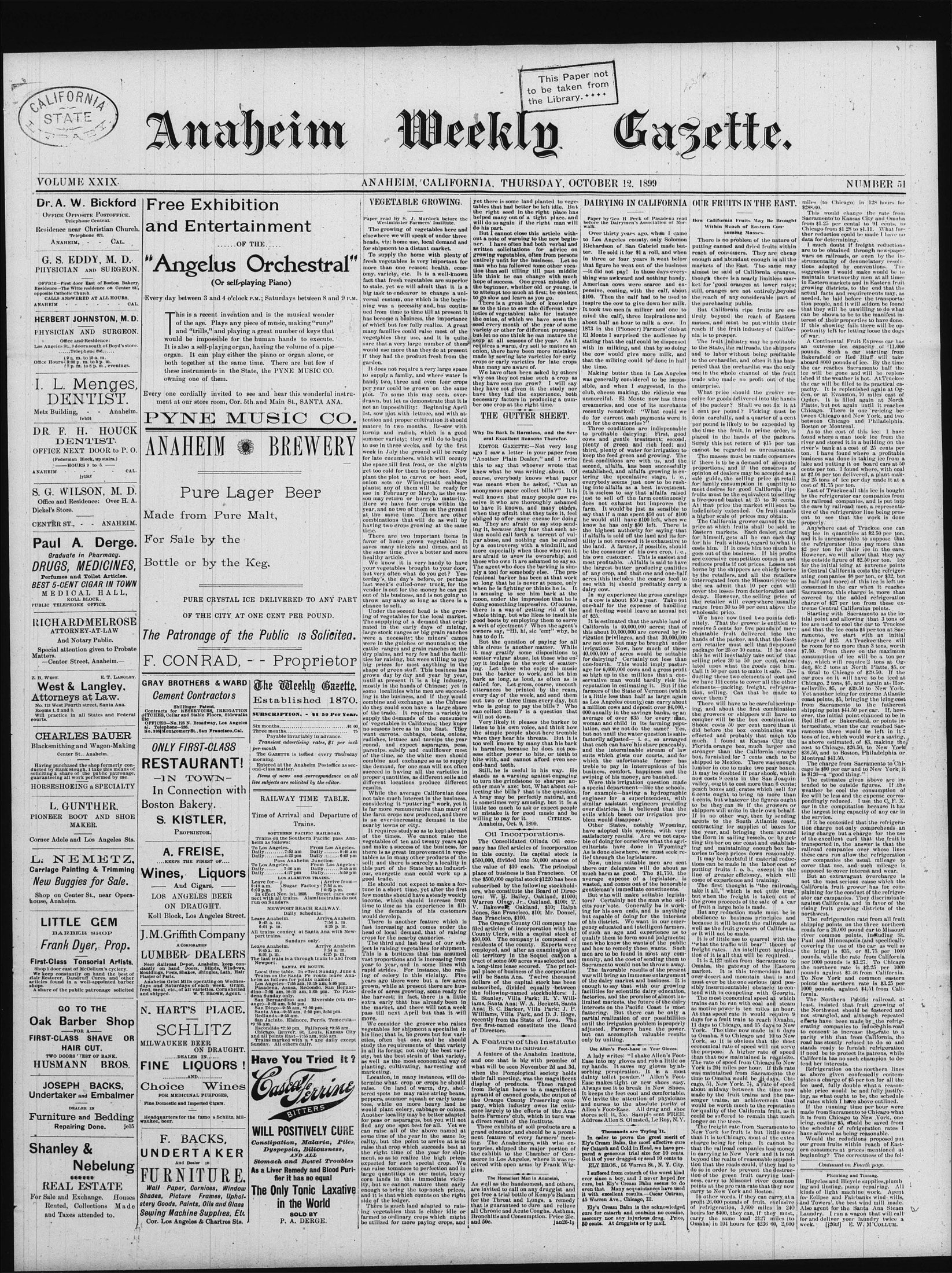
Searchable text
CALIFORNIA STATE
Anaheim
VOLUME XXIX.
Dr. A. W. Bickford
OFFICE OPPOSITE POSTOFFICE.
Telephone Central.
Residence near Christian Church.
Telephone 671.
ANAHEIM, CAL.
G. S. EDDY, M. D.
PHYSICIAN AND SURGEON.
OFFICE—First door East of Boston Bakery.
Residence—The Witte residence on Center St., opposite Catholic Church.
CALLS ANSWERED AT ALL HOURS.
ANAHEIM CAL.
HERBERT JOHNSTON, M. D.
PHYSICIAN AND SURGEON.
Office and Residence:
Los Angeles St., 3 doors south of Boyd's store.
Telephone 656...
9 a.m. to 10 a.m.
Office Hours 3:30 p.m. to 5 p.m.
7 p.m. to 8 p.m., evenings.
I. L. Menges,
DENTIST.
Metz Building, Anaheim.
feb24
DR. F. H. HOUCK
DENTIST.
OFFICE NEXT DOOR to P. O.
(Federman Block, up stairs.)
HOURS 9 to 5
ANAHEIM CAL.
Free Exhibition
and Entertainment
OF THE....
"Angelus Orchestral"
(Or self-playing Piano)
Every day between 3 and 4 o'clock p.m.; Saturdays between 8 and 9 p.m.
This is a recent invention and is the musical wonder of the age. Plays any piece of music, making "runs" and "trills," and playing a great number of keys that would be impossible for the human hands to execute. It is also a self-playing organ, having the volume of a pipe organ. It can play either the piano or organ alone, or both together at the same time. There are but few of these instruments in the State, the PYNE MUSIC CO. owning one of them.
Every one cordially invited to see and hear this wonderful instrument at our store room, Cor. 5th and Main St., SANTA ANA.
PYNE MUSIC CO.
ANAHEIM BREWERY
I. L. Menges,
DENTIST.
Metz Building, Anaheim.
feb24
DR. F. H. HOUCK
DENTIST.
OFFICE NEXT DOOR to P. O.
(Federman Block, up stairs.)
HOURS 9 to 5.
ANAHEIM CAL.
jy15tf
S. G. WILSON, M. D.
Office and Residence: Over H. A. Dickel's Store.
CENTER ST., ANAHEIM.
Paul A. Derge.
Graduate in Pharmacy.
DRUGS, MEDICINES,
Perfumes and Toilet Articles.
BEST 5-CENT CIGAR IN TOWN
MEDICAL HALL,
KOLL BLOCK.
PUBLIC TELEPHONE OFFICE.
RICHARDMELROSE
ATTORNEY-AT-LAW
And Notary Public.
Special attention given to Probate Matters.
Center Street, Anaheim.
Z. B. WEST.
E. T. LANGLEY.
West & Langley,
Attorneys at Law.
No. 113 West Fourth street, Santa Ana.
Rooms 1, 2 and 3.
Will practice in all States and Federal courts.
CHARLES BAUER
Blacksmithing and Wagon-Making
Center St., Anaheim.
Having purchased the shop formerly conducted by Hank Stough, I take this means of soliciting a share of the public patronage, guaranteeing all work performed by me.
HORSESHOEING a SPECIALTY
L. GUNTHER.
PIONEER BOOT AND SHOE
MAKER.
Corner Adele and Los Angeles Sts.
L. NEMETZ,
Carriage Painting & Trimming
New Buggies for Sale.
Shop on Center St., near Operaowning one of them.
Every one cordially invited to see and hear this wonderful instrument at our store room, Cor. 5th and Main St., SANTA ANA.
PYNE MUSIC CO.
ANAHEIM BREWERY
Pure Lager Beer
Made from Pure Malt,
For Sale by the
Bottle or by the Keg.
PURE CRYSTAL ICE DELIVERED TO ANY PART OF THE CITY AT ONE CENT PER POUND.
The Patronage of the Public is Solicitea.
F. CONRAD, - Proprietor
GRAY BROTHERS & WARD
Cement Contractors
Shillinger Patent.
Contracts for RESERVOIRS, IRRIGATION
MITCHES, Cellar and Stable Floors, Sidewalks Etc.
OFFICES—No. 125 N. Broadway, Los Angeles
at. Telephone—236.
No. 316 Montgomery St., San Francisco, Cal.
ONLY FIRST-CLASS RESTAURANT!
-IN TOWNIn Connection with Boston Bakery.
S. KISTLER,
PROPRIETOR.
A. FREISE,
KEEPS THE FINEST OF...
Wines, Liquors
And Cigars.
LOS ANGELES BEER
The Weekly Gazette
Established 1870
SUBSCRIPTION, - $1 50 Per Year
Six months.....$1 00
Three months.....70
Payable invariably in advance.
Transient advertising rates, $1 per inch per month.
The GAZETTE is issued every Thursday morning.
Entered at the Anaheim Postoffice as second-class matter.
Items of news and correspondence on all live subjects are solicited by the editor.
RAILWAY TIME TABLE.
Time of Arrival and Departure of Trains.
SOUTHERN PACIFIC RAILROAD.
Trains on the Southern Pacific pass Anaheim as follows:
To Los Angeles.
Daily...7:52 am
Daily...4:23 pm
Daily...6:08 pm
Pass Anaheim Junction:
To Los Angeles.
Daily...7:56 am
Daily...4:27 pm
Daily...5:59 pm
Los ALAMITOS TRAINS:
Leave for:
9:49 a.m.
Sugar Factory
7:52 a.m.
6:03 p.m.
In effect Nov. 1st, 1898.
Street cars connect with all trains. Alamitos trains do not
L. GUNTHER.
PIONEER BOOT AND SHOE MAKER.
Corner Adele and Los Angeles Sts.
L. NEMETZ,
Carriage Painting & Trimming
New Buggies for Sale.
Shop on Center St., near Opera-house, Anaheim.
LITTLE GEM
BARBER SHOP
Frank Dyer, Prop.
First-Class Tonsorial Artists.
Shop 1 door east of McCollum's cyclery.
We keep constantly on hand the best of Hair Restorer, Dandruff Cures, and other articles found in a well-appointed barber shops.
A share of the public patronage solicited
GO TO THE Oak Barber Shop
FOR A FIRST-CLASS SHAVE OR HAIR CUT.
TWO DOORS '7EST OF BANK.
HUSMANN BROS.
JOSEPH BACKS,
Undertaker and Embalmer
DEALER IN
Furniture and Bedding Repairing Done.
jel5
Shanley & Nebelung
REAL ESTATE
For Sale and Exchange. Houses Rented, Collections Made and Taxes attended to.
Boston Bakery.
S. KISTLER,
PROPRIETOR.
A. FREISE,
Wines, Liquors
And Cigars.
LOS ANGELES BEER ON DRAUGHT.
Koll Block, Los Angeles Street.
J.M.Griffith Company
A CORPORATION
LUMBER DEALERS
Neer Railroad Depot, Anaheim, keep constantly on hand Doors, Blinds, Windows, Mouldings, Posts, Shakes, Shingles, Lath, Hair Plaster of Paris.
Anaheim Grist Mills operating on Wednesdays and Saturdays of each week. Grain, feed, meal, etc., of all varieties. Cornshellled and shipped.
W. T. Brown, Agent.
N. HART'S PLACE.
SCHLITZ
MILWAUKEE BEER ON DRAUGHT.
DEALER IN
FINE LIQUORS!
AND
Choice Wines FOR MEDICINAL PURPOSES,
Fine Domestic and Imported Cigars.
F. BACKS,
UNDERTAKER
And Dealer in
FURNITURE.
Wall Paper, Cornices, Window Shades, Picture Frames, Upholstery Goods, Paints, Oils and Glass Sewing Machine Supplies, Etc.
Cor. Los Angeles & Chartres Sts.
RAILWAY TIME TABLE.
Time of Arrival and Departure of Trains.
SOUTHERN PACIFIC RAILROAD.
Trains on the Southern Pacific pass Anaheim as follows:
To Los Angeles.
Daily...7:52 am Daily...9:49 am
Daily...4:23 pm Daily...6:03 pm
Pass Anaheim Junction:
To Los Angeles.
Daily...7:56 am Daily...9:45 am
Daily...4:27 pm Daily...5:59 pm
LOS ALAMITOS TRAINS.
Leave for—Sugar Factory Arrive from—9:49 a.m. 7:52 a.m. 6:03 p.m.
In effect Nov. 1st, 1898. Street cars connect with all trains. Alamitos trains do not run on Sundays.
NEWPORT BEACH RAILWAY.
Daily Schedule.
Leave Anaheim. Arrive Anaheim
9:45 a.m. 7:54 a.m.
6:01 p.m. 4:25 p.m.
All trains connect at Santa Ana with Newport trains.
Sundays only.
Leave Anaheim. Arrive Anaheim
9:45 a.m. 7:54 a.m.
6:01 p.m. 4:25 p.m.
The last train is a through train to and from Newport.
SANTA FE ROUTE.
Local time table. In effect Sunday, June 4.
Trains on the Santa Fe route leave Anaheim as follows:
Los Angeles—7:55 am, 10:15 am, 5:06 pm.
Pasadena, Azusa, Redondo, San Bernardino—7:55 am, 10:15 am, 5:06 pm. To Pasadena Sunday only.
San Bernardino and Riverside (via Orange)—9:55 am, 5:54 pm.
San Diego—9:55 am, *2:50 pm.
Santa Ana—9:55 am, 2:50 pm, 5:54 pm.
Redlands—9:55 am.
San Jacinto, Elsinore, Perris, Temecula*9:55 am.
Escondido*2:50 pm. Fallbrook*9:55 am.
Chicago, Denver, St. Louis, Kansas City and all points East—7:55 am, 9:55 am.
Trains marked with a * are daily except Sunday. All others daily.
Have You Tried It?
Cascaferrine BITTERS
WILL POSITIVELY CURE
Constipation, Malaria, Piles,
Dyspepsia, Billiousness,
AND ALL
Stomach and Bowel Troubles
As a Liver Remedy and Blood Purifier it has no equal
The Only Tonic Laxative in the World
SOLD BY
P. A. DERGE.
Weekly Gazette
ANAHEIM, CALIFORNIA, THURSDAY, OCTOBER 12, 1899
VEGETABLE GROWING.
Paper read by S. J. Murdock before the Westminster Farmers' Institute.
The growing of vegetables here and elsewhere we will speak of under three heads, viz: home use, local demand and for shipment to a distant market.
To supply the home with plenty of fresh vegetables is very important for more than one reason; health, economy, variety, etc. It is a well-known fact that fresh vegetables are superior to stale, yet we will admit that it is a big task to endeavor to change a universal custom, one which in the beginning was a necessity and has continued from time to time till at present it has become a business, the importance of which but few fully realize. A great many families could raise most of the vegetables they use, and it is quite sure that a very large number of them would use more than they do at present if they had the product fresh from the garden.
It does not require a very large space to supply a family, and where water is handy two, three and even four crops per year could be grown on the same plot. To some this may seem over-drawn, but let us demonstrate that it is not an impossibility: Beginning April 1st, sow plot with lettuce, and with attention and proper cultivation it should mature in two months. Re-sow with turnip and radish, which is a good summer variety; they will do to begin to use in three weeks, and by the first week in July the ground will be ready for late cucumbers, which will occupy the space till first frost, or the nights get too cold for them to produce. Now yet there is some land planted to vegetables that had better be left idle. But the right seed in the right place has helped many out of a tight place, and will do so again if the right man will do his part.
But I cannot close this article without a note of warning to the new beginner. I have often had both verbal and written solicitations for advice on growing vegetables, often from persons entirely unfit for the business. Let no man who has followed some other vocation than soil tilling till past middle life think he can change with much hope of success. One great mistake of the beginner, whether old or young, is to attempt too much at first; be content to go slow and learn as you go.
There is a great lack of knowledge as to the time to sow the different varieties of vegetables; take for instance the onion, of which we have sown the seed every month of the year of some variety or other for different purposes; but let no one think he can mature the crop at all seasons of the year. As it requires a warm, dry soil to mature an onion, there have been more mistakes made by sowing late varieties for early crops or early varieties for late crops than many are aware of.
We have often been asked by others why can they not raise such a crop as they have seen me grow? I will say they have not given it the study nor have they had the experience, both necessary factors in producing a number one crop at the right time.
THE GUTTER SHEET.
Why Its Bark Is Harmless, and the Several Excellent Reasons Therefor.
EDITOR GAZETTE:—Not very long ago I saw a letter in your paper from "Another Plain Dealer," and I write this to say that whoever wrote that knew what he was writing about. Of DAIRYING IN CALIFORNIA.
Paper by Geo H Peck of Pasadena before the Dairymen's Association of walk.
Over thirty years ago, when I to Los Angeles county, only Sol Richardson of San Gabriel made ter. He sold it for $1 a roll, and in three or four years it went bad that figure he went out of the bus —it did not pay! In those days cothing was awkward and nothing had American cows were scarce and pensive, costing, with the calf, at $100. Then the calf had to be used inspire the cow to give down her It took two men (a milkker and one mind the calf), three inspirations about half an hour to milk a cow 1873 in the (Pioneer) Farmers' club El Monte I surprised the audience stating that the calf could be dispensed with in milking, and that by so doing the cow would give more milk, that the milking could be done in the time.
Making butter then in Los An was generally considered to be insible, and when I suggested, in club, cheese making, the ridiculous unmerciful. El Monte now has one creameries, and one of its mercreatively remarked: "What could do for current cash payments we not for the creameries?"
Three conditions are indispensable to profitable dairying: First, cows and gentle treatment; second plenty of green and rich feed; third plenty of water for irrigation keep the feed green and growing. First conditions are with us, and second, alfalfa, has been successfully established, and alfalfa growing...
This wonderful instrument in St., Santa Ana.
BEER
VERED TO ANY PART
MIT PER POUND.
Lic is Solicitea.
Proprietor
Weekly Gazette.
Published 1870.
PPTION, - $150 Per Year.
thanks.
table invariably in advance.
advertising rates, $1 per inch
Lettre is issued every Thursday
at the Anaheim Postoffice as secatter.
news and correspondence on all are solicited by the editor.
WAY TIME TABLE.
Arrival and Departure of Trains.
SHERN PACIFIC RAILROAD.
the Southern Pacific pass Ana-ways.
From Los Angeles.
Daily am
Daily am
Daily am
Mass Anaheim Junction:
From Los Angeles
Daily am
Daily am
Mass Anaheim Trainings:
From Los Angeles
Daily am
Daily am
Mass Anaheim Trainings:
From Los Angeles
Daily am
Daily am
Mass Anaheim Trainings:
From Los Angeles
Daily am
Daily am
Mass Anaheim Trainings:
From Los Angeles
Daily am
Daily am
Mass Anaheim Trainings:
From Los Angeles
Daily am
Daily am
He should not expect to make a fortune in a short time, yet after the first few months should have a steady weekly supply of a family, and where water is handy two, three and even four crops per year could be grown on the same plot. To some this may seen over-drawn, but let us demonstrate that it is not an impossibility: Beginning April 1st, sow plot with lettuce, and with attention and proper cultivation it should mature in two months. Re-sow with turnip and radish, which is a good summer variety; they will do to begin use in three weeks, and by the first week in July the ground will be ready for late cucumbers, which will occupy the space till first frost, or the nights get too cold for them to produce. Now plant the plot to carrot or beet seed, onion sets or Winniigstadt cabbage plants; any of them will be ready for use in February or March, as the season may return or hurry to maturity. Here we have four crops within the year, and no two of them on the ground at the same time. There are other combinations that will do as well by having two crops growing at the same time.
There are two important items in favor of home grown vegetables: It saves many nickels and dimes, and at the same time gives a better and more healthy article.
We know it is very handy to have your vegetables brought to your door, but very often what do you get? Yesterday's, the day's before, or perhaps last week's culled-over truck, for the vendor is out for the money he can get out of his business, and is not going to throw any away so long as there is a chance to sell.
Under the second head is the growing of vegetables (for the local market). The supplying of a demand that originated in the early days of mining, large stock ranges or big grain ranches were a necessity; the miners' camps were in the gulches or mountains; the cattle ranges and grain ranches on the dry plains, and very few had the facilities for raising, but were willing to pay big prices for most anything in the shape of green stuff. This business has grown day by day and year by year, until at present it is a big industry, mostly in the hands of Chinese; yet in some localities white men are succeeding in the business, and if they would combine and exchange as the Chinese do they could soon have a large share of the trade. It requires a variety to supply the demands of the consumers of vegetables in California; they know no seasons here as in the East. They want carrots, cabbage, beets, onions, radishes, lettuce and turnips the year round, and expect asparagus, peas, parsnips, salisbury and cauliflower most of the time, so the white men should combine and exchange so as to supply the demand, for one man will not often succeed in having all the varieties in proper quantities, as different soils and different locations produce different results.
While the average Californian does not take much interest in the business, considering it "puttering" work, yet it is far more remunerative than many of the farm crops now produced, and there is an ever-increasing demand in the nearby towns or city.
It requires study so as to kept abreast of the times. We cannot raise the vegetables of ten and twenty years ago and make a success of the business, for there is as great improvement in vegetables as in many other products of the soil; and there is scarcely a locality in this part of the State but an industrious, energetic man could work up a good trade.
He should not expect to make a fortune in a short time, yet after the first few months should have a steady weekly supply of a family, and where water is handy two, three and even four crops per year could be grown on the same plot. To some this may seen over-drawn, but let us demonstrate that it is not an impossibility: Beginning April 1st, sow plot with lettuce, and with attention and proper cultivation it should mature in two months. Re-sow with turnip and radish, which is a good summer variety; they will do to begin use in three weeks, and by the first week in July the ground will be ready for late cucumbers, which will occupy the space till first frost, or the nights get too cold for them to produce. Now plant the plot to carrot or beet seed, onion sets or Winniigstadt cabbage plants; any of them will be ready for use in February or March, as the season may return or hurry to maturity. Here we have four crops within the year, and no two of them on the ground at the same time. There are other combinations that will do as well by having two crops growing at the same time.
There are two important items in favor of home grown vegetables: It saves many nickels and dimes, and at the same time gives a better and more healthy article.
We know it is very handy to have your vegetables brought to your door, but very often what do you get? Yesterday's, the day's before, or perhaps last week's culled-over truck, for the vendor is out for the money he can get out of his business, and is not going to throw any away so long as there is a chance to sell.
Under the second head is the growing of vegetables (for the local market). The supplying of a demand that originated in the early days of mining, large stock ranges or big grain ranches were a necessity; the miners' camps were in the gulches or mountains; the cattle ranges and grain ranches on the dry plains, and very few had the facilities for raising, but were willing to pay big prices for most anything in the shape of green stuff. This business has grown day by day and year by year, until at present it is a big industry, mostly in the hands of Chinese; yet in some localities white men are succeeding in the business, and if they would combine and exchange as the Chinese do they could soon have a large share of the trade. It requires a variety to supply the demands of the consumers of vegetables in California; they know no seasons here as in the East. They want carrots, cabbage, beets, onions, radishes, lettuce and turnips the year round, and expect asparagus, peas, parsnips, salisbury and cauliflower most of the time, so the white men should combine and exchange so as to supply the demand, for one man will not often succeed in having all the varieties in proper quantities, as different soils and different locations produce different results.
While the average Californian does not take much interest in the business, considering it "puttering" work, yet it is far more remunerative than many of the farm crops now produced, and there is an ever-increasing demand in the nearby towns or city.
It requires study so as to kept abreast of the times. We cannot raise the vegetables of ten and twenty years ago and make a success of the business, for there is as great improvement in vegetables as in many other products of the soil; and there is scarcely a locality in this part of the State but an industrious, energetic man could work up a good trade.
He should not expect to make a fortune in a short time, yet after the first few months should have a steady weekly supply of a family, and where water is handy two, three and even four crops per year could be grown on the same plot. To some this may seen over-drawn, but let us demonstrate that it is not an impossibility: Beginning April 1st, sow plot with lettuce, and with attention and proper cultivation it should mature in two months. Re-sow with turnip and radish, which is a good summer variety; they will do to begin use in three weeks, and by the first week in July the ground will be ready for late cucumbers, which will occupy the space till first frost, or the nights get too cold for them to produce. Now plant the plot to carrot or beet seed, onion sets or Winniigstadt cabbage plants; any of them will be ready for use in February or March, as the season may return or hurry to maturity. Here we have four crops within the year, and no two of them on the ground at the same time. There are other combinations that will do as well by having two crops growing at the same time.
There are two important items in favor of home grown vegetables: It saves many nickels and dimes, and at the same time gives a better and more healthy article.
We know it is very handy to have your vegetables brought to your door, but very often what do you get? Yesterday's, the day's before, or perhaps last week's culled-over truck, for the vendor is out for the money he can get out of his business, and is not going to throw any away so long as there is a chance to sell.
Under the second head is the growing of vegetables (for the local market). The supplying of a demand that originated in the early days of mining, large stock ranges or big grain ranches were a necessity; the miners' camps were in the gulches or mountains; the cattle ranges and grain ranches on the dry plains, and very few had the facilities for raising, but were willing to pay big prices for most anything in the shape of green stuff. This business has grown day by day and year by year, until at present it is a big industry, mostly in the hands of Chinese; yet in some localities white men are succeeding in the business, and if they would combine and exchange as the Chinese do they could soon have a large share of the trade. It requires a variety to supply the demands of the consumers of vegetables in California; they know no seasons here as in the East. They want carrots, cabbage, beets, onions, radishes, lettuce and turnips the year round, and expect asparagus, peas, parsnips, salisbury and cauliflower most of the time, so the white men should combine and exchange so as to supply the demand, for one man will not often succeed in having all these varieties in proper quantities, as different soils and different locations produce different results.
While the average Californian does not take much interest in the business, considering it "puttering" work,yet it is far more remunerative than many of the farm crops now produced,and there is an ever-increasing demand in nearby towns or city.
It requires study so as to kept abreast of the times. We cannot raise the vegetables of ten and twenty years ago和make a success ofthe business,forthereisasgreatimprovementinvegetablesandinotherintendent,similarassistantengineerpresseverdistricts,itisbelievedthatevilwhichbestsourcetheirmercleouldtaiemoreprofitabledairycoon.
In my experiencethe grosscarryofa cowisabout$50ayear.Takeone-halffortheexpenseofhandsandfeedingwouldanannualof$25.
It is estimated thatthearablelaliforniais400000acres;thisabout1000000arecoveredinregistrationprivileges,andthat30000arenotnowbutmaybebroughtuirengration.Nowhowmuchof400000acreswouldbuisfthefarmcontinuedoesnotexhaustbutimprovesdairy.Coverhehighestauthorityforsayingifalfalfis sold offthe landanditstilityisnotreneweditisexhausthuelfarm.A farmer,forsupposehisowncrop,his owncustomer.Thisis easiestmostprofitable.Alalfalfisis saidtothelargestbutterproducingquotaofanycrop,andthatoneandacreats(thisincludesthecoarsefcornsuitswhichglutsoutrounts,andwhichtheunfortunatefarmertrebletopayininterruptionsofbusiness,comfort,happinessandswipingofhoneyandswaintingofthiscornearmsoak.Waitforcollegebills?thatisthequestion.Aspecialdepartment—liketheschoolforexample—havingahydrogrineengineerforasuperintendent,similarassistantengineerspresseverdistricts,itisbelievedthatevilwhichbestsourcetheirmercleouldtaiemoreprofitabledairycoon.
WerethisirrigationquestionAspecialdepartment—liketheschoolforexample—havingahydrogrineengineerforasuperintendent,similarassistantengineerspresseverdistricts,itisbelievedthatevilwhichbestsourcetheirmercleouldtaiemoreprofitabledairycoon.
OtherStates,nobodyhave adoptedthissystemwithsatisfactoryresults.ArewenotableofdoingforourselveswhattheculturistshavedoneinWyonAsisdone elsewhere,我们会see lifelong throughthelegislature.
Now,unless Suitablemenarethereourdelegateswilldoaboumbucharmasgood.The$1750averageexpenditureofalegislatorwasted,andcomesoutofthegonclementman'simmediateconstituentButwhowillmake suitablelegislation
Arrival and Departure of Trains.
Southern Pacific Railroad.
The Southern Pacific pass Ana-owns:
From Los Angeles.
7:52 am Dally ... 9:49 am
4:23 pm Dally ... 6:03 pm
Los Anaheim Junction:
From Los Angeles.
7:56 am Dally ... 9:45 am
4:27 pm Daily ... 5:59 pm
Los Alamitos Trains.
Arrive from—
Sugar Factory ... 7:52 am
Nov. 1st, 1898. Street cars contrains. Alamitos trains do not
lays.
PORT BEACH RAILWAY.
Daily Schedule.
Arrive Anaheim.
7:54 a.m.
4:25 p.m.
Connect at Santa Ana with NewSundays only.
Arrive Anaheim.
7:54 a.m.
4:25 p.m.
Is through train to and from
Santa Fe Route.
In effect Sunday, June 4.
the Santa Fe route leave Anaows for points named:
Azusa, Redondo, San Bernarm, 10:15 am, 5:05 pm. To Pasaway, 9:55 am, 2:50 pm.
9:55 am, 2:50 pm, 5:54 pm.
9:55 am, 2:50 pm, 5:54 pm.
9:55 am, 2:50 pm, 5:54 pm.
Oel Incorporations.
The Consolidated Olinda Oil company has filed articles of incorporation in this county. Its capital stock is $500,000, divided into 50,000 shares of the value of $10 each. The principal place of business is San Francisco. Of the $500,000 capital stock $1220 has been subscribed by the following stockholders, who constitute the Board of Directors:
W. H. Bailey, Oakland, $1000;
Warren Olney, Jr., Oakland, $100; T.
V. Bakewell, Oakland, $10; Ralph
Jones, San Francisco, $10; Mr. Donzel,
San Francisco, $100.
The Orange County Oil company has filed articles of incorporation with the County Clerk, with a capital stock of $50,000. The company is composed of residents of the county. Experts were employed, and after an examination of oil territory in the Soquel canyon a tract of some 500 acres was selected and a long-time lease secured. The principal place of business of the corporation will be Santa Ana. Twelve thousand dollars of the capital stock has been subscribed, divided equally between the following-named stockholders:
I. E. Stanley, Villa Park; R. Y. Williams, Santa Ana; W. A. Beckett, Santa Ana; B. C. Barker, Villa Park; J. P. Williams, Villa Park, and D. J. Hoge,
recently from the State of Iowa. The five first-named constitute the Board of Directors.
A Feature of the Institute
From the Cultivator.
A feature of the Anaheim Institute, and one that is big with promise of what will be seen November 2d and 3d, when the Pomological society holds their fall meeting, was the magnificent display of products. These ranged from Belgian hares to a magnificent pyramid of canned goods, the output of the Orange County Preserving company, which industry owes its existence largely to the efforts of the Anaheim Farmers’ club, which in turn was a direct result of the Institute.
These exhibits of soil products are a grand educator, and should be a prominent feature of every farmers’ meeting. The Anaheimers, with wise enterprise, shipped the major portion of the exhibit to the Chamber of Commerce in Los Angeles, where it was received with open arms by Frank Wiggins.
The Homeliest Man in Anaheim,
As well as the handsomest, and others,
are invited to call on any druggist and get free a trial bottle of Kemp’s Balsam for the Throat and Lungs, a remedy that is guaranteed to cure and relieve all Chronic and Acute Coughs, Asthma, Bronchitis and Consumption. Price 25c. and 50c.
Oil Incorporations.
The Consolidated Olinda Oil companys has filed articles of incorporation in this county. Its capital stock is $500,000, divided into 50,000 shares of the value of $10 each. The principal place of business is San Francisco. Of the $500,000 capital stock $1220 has been subscribed by the following stockholders, who constitute the Board of Directors:
W. H. Bailey, Oakland, $1000;
Warren Olney, Jr., Oakland, $100; T.
V. Bakewell, Oakland, $10; Ralph
Jones, San Francisco, $10; Mr. Donzel,
San Francisco, $100.
The Orange County Oil company has filed articles of incorporation with the County Clerk, with a capital stock of $50,000. The company is composed of residents of the county. Experts were employed, and after an examination of oil territory in the Soquel canyon a tract of some 500 acres was selected and a long-time lease secured. The principal place of business of the corporation will be Santa Ana. Twelve thousand dollars of the capital stock has been subscribed, divided equally between the following-named stockholders:
I. E. Stanley, Villa Park; R. Y. Williams, Santa Ana; W. A. Beckett, Santa Ana; B. C. Barker, Villa Park; J. P. Williams, Villa Park, and D. J. Hoge,
recently from the State of Iowa. The five first-named constitute the Board of Directors.
A Feature of the Institute
From the Cultivator.
A feature of the Anaheim Institute,
and one that is big with promise of what will be seen November 2d and 3d, when the Pomological society holds their fall meeting, was the magnificent display of products. These ranged from Belgian hares to a magnificent pyramid of canned goods, the output of the Orange County Preserving company, which industry owes its existence largely to the efforts of the Anaheim Farmers’ club, which in turn was a direct result of the Institute.
These exhibits of soil products are a grand educator, and should be a prominent feature of every farmers’ meeting. The Anaheimers, with wise enterprise, shipped the major portion of the exhibit to the Chamber of Commerce in Los Angeles, where it was received with open arms by Frank Wiggins.
The Homeliest Man in Anaheim,
As well as the handsomest, and others,
are invited to call on any druggist and get free a trial bottle of Kemp’s Balsam for the Throat and Lungs, a remedy that is guaranteed to cure and relieve all Chronic and Acute Coughs, Asthma, Bronchitis and Consumption. Price 25c. and 50c.
Oil Incorporations.
The Consolidated Olinda Oil companys has filed articles of incorporation in this county. Its capital stock is $500,000, divided into 50,000 shares of the value of $10 each. The principal place of business is San Francisco. Of the $500,000 capital stock $1220 has been subscribed by the following stockholders, who constitute the Board of Directors:
W. H. Bailey, Oakland, $1000;
Warren Olney, Jr., Oakland, $100; T.
V. Bakewell, Oakland, $10; Ralph
Jones, San Francisco, $10; Mr. Donzel,
San Francisco, $100.
The Orange County Oil company has filed articles of incorporation with the County Clerk, with a capital stock of $50,000. The company is composed of residents of the county. Experts were employed, and after an examination of oil territory in the Soquel canyon a tract of some 500 acres was selected and a long-time lease secured. The principal place of business of the corporation will be Santa Ana. Twelve thousand dollars of the capital stock has been subscribed,divided equally between the following-named stockholders:
I. E. Stanley,Villa Park; R.Y.Williams,Santa Ana;W.A.Beckett,Santa Ana;B.C.Barker,Villa Park;J.P.Williams,Villa Park,andD.J.Hoge,
recently from the State of Iowa.The five first-named constitute the BoardofDirectors.
A Feature of the Institute
From the Cultivator.
A feature of the Anaheim Institute,
and one that is big with promise of what will be seen November 2d and 3d,when the Pomological society holds their fall meeting,was the magnificent display of products。这些range了从Belgian hares到大西洋的 pyramidofcannedgoods,theoutputoftheOrangeCountyPreservingcompanywhichindustryowesexistencelargelytotheeffortsoftheAnaheimFarmers’clubwhichinturnwasadirectresultoftheInstitute.
These exhibitsofsoilproductsareagrandeducator,andshouldbeaprominentfeatureofeveryfarmers’meeting.TheAnaheimerswithwiseenterprise.shippedthemajorportionoftheexhibittotheChamberofCommerceinLosAngeleswhereitwasreceivedwithopenarmsbyFrankWiggins.
The HomeliestManinAnaheim,
Aswellasthehandsomest,andothers,
areinvitedtocallonanydruggistandgetfreeatriskbottleofKemp’sBalsamfortheThroatandLungs,aremedythatisguaranteedtocureandrelieveallChronicandAcuteCoughs,Asthma,BronchitisandConsumption.Price25cand50c.
Oil Incorporations.
The Consolidated Olinda Oil companyshasfileddarticlesofincorporationwiththeCountyClerkwithacapitalstockof$50,ooodividedinto50,ooosharesofthevalueof$1oeach.TheprincipalplaceofbusinessisSanFrancisco.Ofthe$5oooo资本stock$122oohassubscribedbythefollowingstockholderswhoconstitutetheBoardofDirectors:
W.H.Bailey,SantaAnia;W.A.Beckett,SantaAnia;B.C.Barker,SantaAnia;D.C.Hoge,
recentlyfromtheStateofIowa.Thefivefirst-namedconstitutetheBoardofDirectors.
A Feature of the Institute
From the Cultivator.
A feature of the Anaheim Institute,
and one that is big with promise of what will be seen November 2d and 3d,when the Pomological society holds their fall meeting,wasthemagnificentdisplayofproducts.这些range了从Belgian hares到大西洋的 pyramidofcannedgoods,theoutputoftheOrangeCountyPreservingcompanywhichindustryowesexistencelargelytotheeffortsoftheAnaheimFarmers’clubwhichinturnwasadirectresultoftheInstitute.
Theseexhibitsofsoilproductsareagrandeducator,andshouldbeaprominentfeatureofeveryfarmers’meeting.TheAnaheimerswithwiseenterprise.shippedthemajorportionoftheexhibittotheChamberofCommerceinLosAngeleswhereitwasreceivedwithopenarmsbyFrankWiggins.
The HomeliestManinAnaheim,
Aswellasthehandsomest,andothers,
areinvitedtocallonanydruggistandgetfreeatriskbottleofKemp’sBalsamfortheThroat和Lungs,aremedythatisguaranteedtocureandrelieveallChronicandAcuteCoughs,Asthma,BronchitisandConsumption.Price25cand50c.
Oil Incorporations.
The Consolidated Olinda Oil companyshasfileddarticlesofincorporationwiththeCountyClerkwithacapitalstockof$5oooodividedinto5oooosharesofthevalueof$1oeach.TheprincipalplaceofbusinessisSanFrancisco.Ofthe$5oooo资本stock$122oohassubscribedbythefollowingstockholderswhoconstitutetheBoardofDirectors:
W.H.Bailey,SantaAnia;W.A.Beckett,SantaAnia;B.C.Barker,SantaAnia;D.C.Hoge,
recentlyfromtheStateofIowa.Thefivefirst-namedconstitutetheBoardofDirectors.
A Use Allen's Foot-Base in Your Glove
A lady writes: "I shake Allen's foot-Ease into my gloves and rub a little my hands. It saves my gloves by sorbing perspiration. It is a dainty toilet powder." Allen's foot-Ease makes tight or new shoes by always use it to break in New Shoe! It keeps the feet cool and comforts you by inviting physical activity and nurses to the absolute purity Allen's Foot-Ease.All drug and stores sell it,25c.Sample sent FILMAddress Allen S.Olmsted,Le Roy,
ELY BROS., 56 Warren St., N.Y.
I suffered from catarrh at the worst ever since a boy,and I never hope cure but Ely's Cream Balm seems even that.Many acquaintances have it with excellent results.-Oscar Osté 45 Warren Ave., Chicago,Ill.
Ely's Cream Balm is the acknowlledge cure for catarrh and contains no coqurency nor any injurious drug.Room 50 cents.at druggists or by mail.
Gazette.
NOBER 12, 1899
DRYING IN CALIFORNIA
How California Fruits May Be Brought Within Reach of Eastern Consuming Masses.
There is no problem of the nature of putting canned and dried fruits within reach of consumers. They are cheap enough and abundant enough in all the markets of the East. The same may almost be said of California oranges, though there is a nearly limitless market for 'good oranges at lower rates; still, oranges are not entirely beyond the reach of any considerable part of the purchasing public.
But California ripe fruits are entirely beyond the reach of Eastern masses, and must be put within their reach if the fruit industry of California is to prosper.
The fruit industry may be profitable to the State, the railroads, the shippers and to labor without being profitable to the orchardist, and often it has happened that the orchardist was the only one in the whole channel of the fruit trade who made no profit out of the enterprise.
What price should the grower receive for goods delivered into the hands of the packer? Shall we not fix it at 1 cent per pound? Picking must be done carefully, and a quarter of a cent per pound is likely to be expended by the time the fruit, in prime order, is placed in the hands of the packers. Surely this net return of $15 per ton cannot be regarded as unreasonable.
The masses must be made consumers if there is to be a demand of adequate proportions, and if the consensus of opinion of dealers may be accepted as miles (to Chicago) in 128 hours for $288.60.
This would change the rate from Sacramento to Kansas City and Omaha from $1.25 per cental to 91 cents, to Chicago from $1.28 to $1.11. What further reduction could be made I have no data for determining.
I much doubt if freight reductions are to be obtained through newspaper wars on railroads, or even by the instrumentality of denunciatory resolutions adopted by conventions. The suggestion I would make would be to maintain trustworthy men at all times in Eastern markets and in Eastern fruit growing districts, to the end that the actual facts and requirements may, as needed, be laid before the transportation people, and it will seldom be found that they will be unwilling to do what can be shown to be to the manifest interest of their properties to have done. If this showing fails there will be opportunity left for letting loose the dogs of war.
A Continental Fruit Express car has an extreme ice capacity of 11,000 pounds. Such a car starting from Bakersfield or Red Bluff will take aboard 8000 pounds of ice. By the time the car reaches Sacramento half the ice will be gone and will be replenished if the weather is hot. At Truckee the car will be filled to its practical capacity. It is replenished again at Ogden, or at Evanston, 70 miles east of Ogden. It is filled again at North Platte, but not again until it reaches Chicago. There is one re-icing between Chicago and New York, and two between Chicago and Philadelphia, Boston or Montreal.
As to the cost of this ice: I have found where a man took ice from the river and stored it in a building on the river's bank at a cost of 25 cents per ton. I have found where a profitable business was done in taking ice from a lake and putting it on board cars at 50 cents per ton. I found where, with coal at $2.06 per ton delivered, a plant made...
Three conditions are indispensable profitable dairying: First, good and gentle treatment; second, pay of green and rich feed; and third, plenty of water for irrigation to the feed green and growing. The conditions are with us, and the land, alfalfa, has been successfully finished, and alfalfa growing is the speculative stage. I.e., body seems just now to be rushto alfalfa as a best investment. Unless to say alfalfa raised to sell off the farm continuously not exhaust but improves the crop. It would be just as sensible to that if a man spent $50 out of $100 should still have $100 left, when we have only $50 left. There is highest authority for saying that alfalfa is sold off the land and its fertility is not renewed it is exhaustive to land. A farmer, if possible, should be consumer of his own crop, i.e., own customer. This is easiest and profitable. Alfalfa is said to have largest butter producing qualities by crop, and that one and one-half (this includes the coarse feed to with it) should profitably carry a cow.
Many experience the gross earnings now is about $50 a year. Take out half for the expense of handling feeding would leave an annual net loss.
It is estimated that the arable land of Oregon is 40,000,000 acres; that of about 10,000,000 are covered by irrigated privileges, and that 30,000,000 not now but may be brought underation. Now, how much of these 20,000 of acres would be suitable dairying? Certainly not less than fourth. This would imply pasture for 6,600,000 cows and a gross profit with up in the millions that a contiive man would barely risk his situation in estimating it. But if the owners of the State of Vermont (which little less than half as large again as Angeles county) can carry about million cows and deposit over $4,000, usually in the savings banks, or an age of over $35 for every man, man and child in its farming population, can we not do the same? Yes, not until the water question is satisfactorily adjusted—i.e., so arranged each can have his share peaceably, the interminal stream of law which gluts our courts, and for whom the unfortunate farmer has to pay in interruptions of his needs, comfort, happiness and the ing of his money, are banished.
Here this irrigation question made special department—like the schools, example—having a hydrographic beer for a superintendent, with assistant engineers presiding districts, it is believed that the which beset our irrigation problem disappear.
Other States, notably Wyoming, adopted this system, with very factory results. Are we not capable doing for ourselves what the agrifarmers have done in Wyoming?done elsewhere, we must seek refrough the legislature.
Now, unless suitable men are sent our delegates will do about as harm as good. The $1,750, the huge expense of a legislator, is indicted, and comes out of the honorableeman's immediate constituents.
Who will make suitable legislation?
What price should the grower receive for goods delivered into the hands of the packer? Shall we not fix it at 1 cent per pound? Picking must be done carefully, and a quarter of a cent per pound is likely to be expended by the time the fruit, in prime order, is placed in the hands of the packers. Surely this net return of $15 per ton cannot be regarded as unreasonable.
The masses must be made consumers if there is to be a demand of adequate proportions, and if the consensus of opinion of dealers may be accepted as a safe guide, the selling price at retail for family consumption in quantity to meet desires for good California ripe fruits must be the equivalent to selling a five-pound basket at 25 to 30 cents. At that price the market will soon be indefinitely extended. On fruit stands a higher scale of prices may obtain.
The California grower cannot fix the price at which fruits shall be sold in Eastern markets. Each dealer acting for himself, gets all he can each day for his fruit without regard to what it costs him. If it costs him too much he goes out of the business. If his profits are excessive competition comes in and reduces profits if not prices. Losses not borne by the shippers are chiefly borne by the retailers, and all the retailers interrogated from the Missouri river to the sea admit that 10 per cent will cover the losses from deterioration and decay. However, the selling price of the retailer will everywhere usually range from 30 to 50 per cent above the wholesale price.
We have now fixed two points definitely. That the grower is entitled to receive 5 cents for five pounds of merchandable fruit delivered into the hands of the packer, and that the Eastern retailer must sell that five-pound package for 25 or 30 cents. If he does this he will inevitably take out of that selling price 30 to 50 per cent, calculated upon what the goods cost him. Call it 50 per cent to make it safe. Deducing these two elements of cost and we have 11 cents to cover all the other elements—packing, freight, refrigeration, selling. Can that be made to cover them?
There will have to be careful scrimping, and about the first combination the growers or shippers will have to conquer will be the box combination. Shook costs 50 per cent more than it did before the box combination was effected and probably much too much. I found at Kansas City the Florida orange box, much larger and stronger than the California orange box, furnished for 7 cents each to be shipped to Mexico. There was enough lumber in one to make two pear boxes. It may be doubted if pear shook, which now costs 9 cents in the San Joaquin valley, ought to cost more than 6 cents; peach boxes and crates which sell for 6 cents ought to bring no more than 4 cents, but whatever the figures ought to be they can be if the growers or shippers will unite in their own behalf. If in no other way, then by sending agents to the South Atlantic coast, contracting for supplies of boxes for the year, and bringing them around the Horn in sailing vessels, or by getting timber on our coast and establishing and maintaining enough box factories to keep prices down reasonably.
It may be doubtful if material reductions can be made in the labor cost of putting fruits f.o.b., except in the line of greater efficiency, which will come of experience and training.
The first thought is "the railroads take it all," which is not quite true, but when the freight is taken out of
air will be gone and will be replenished if the weather is hot. At Truckee the car will be filled to its practical capacity. It is replenished again at Ogden, or at Evanston, 70 miles east of Ogden. It is filled again at North Platte, but not again until it reaches Chicago. There is one re-icing between Chicago and New York, and two between Chicago and Philadelphia, Boston or Montreal.
As to the cost of this ice: I have found where a man took ice from the river and stored it in a building on the river's bank at a cost of 25 cents per ton. I have found where a profitable business was done in taking ice from a lake and putting it on board cars at 50 cents per ton. I found where, with coal at $2.06 per ton delivered, a plant making 25 tons of ice per day made it at a cost of $1.75 per ton.
East of Truckee all this ice is bought by the refrigerator car companies from the railroad companies, and is put into the cars by railroad men, a representative of the refrigerator line being present to see that the work is done properly.
Anywhere east of Truckee one can buy ice in quantities at $2.50 per ton,and it is unreasonable to suppose that the refrigerator lines pay more than $2 per ton for their ice in the cars. However, we will allow that they pay outside figure of $2.50 per ton. Ice for the initial ice at extreme points in Central California costs the refrigerating companies $8 per ton, or $32,但 as half (and more) of this ice is left unconsumed in the car when it reaches Sacramento,这 charge is more than covered by the added refrigeration charge of $27 per ton from these extreme Central Californian points.
Starting with Sacramento as the initial point and allowing that 3 tons of ice are used to cool the car to Truckee and that the ice costs $4 per ton at Sacramento,the start with an initial charge of $12.At Truckee there will be room for no more than 3 tons worth $7.50.From there on the maximum consumption of ice will be a ton per daywhich will require 2 tons at Ogden,$5;2 tons at North Platte,$5,或a total to Chicagoof$29.50Ifthe car goes on it will have to beiced atChicago,2tons,$5,and againatHornellsville,$5,或$39.50toNewYork.Yet another ice for extreme Atlantic coastpoints,$5,bringingthe icecostfromSacramentotothefutherestshippingpoint$44.50percar.Ifhowever,theinitialpointchangedtobeinRedBlufforBakersfield,或pointsintermediate,当thecarreachedSacramentotherewouldbeleftinit2tonsoficewhichwouldworkas saving.asaboveestimated,$3,makingthecosttoChicago,$26.50.toNewYork$36.50,andtoBostonPhiladelphiaorMontreal$41.50.
The charge from Sacramento to Chicagois$90percarandtoNewYorkitis$120—a"good thing."
The estimates given above are intended to be outside figures. Iftheweatherbeacooltheconsumptionoficewillbeleastandtheexpensecorrespondinglyreduced.IusetheC.F.X.carinthecomputationbecauseithasthelargesticingcapacityofanycarinther服务.
Ifitbettencouldthattherefrigerationchargenotonlycomprehendsaniceingchargebutachargefortheuseoftheexcellentcarsthatthefruitistransportedin,theansweristhattherailroadcompaniesoverwhoselinesthecarsrunallowtherefrigerationcarcompaniestheusualmileagetocoverthatuse,andsuchmileageissupposedtocoverinterestandwear.
But anextravagantoverchargeisnotthemostseriouscausingwhichtheCaliforniafruitgrowherhasforcomplainingfortheconductoftherefrigeratorcarcompanies.Thediscriminate
The following is the transcription of the text from the newspaper page:
Deer for a superimendent, with ear assistant engineers presiding districts, it is believed that the which beset our irrigation prowould disappear.
Other States, notably Wyoming, adopted this system, with very factory results. Are we not capable doing for ourselves what the agrifarmers have done in Wyoming? Do we alone here, we must seek re-rough the legislature.
Now, unless suitable men are sent to our delegates will do about as harm as good. The $1,750, the large expense of a legislator, is used, and comes out of the honorable German's immediate constituents.
Certainly not the man who solicits our vote. Generally he is work for his own ends, and is anything capable of doing for the interests of district. We want in our emerger educated and intelligent farmers, with an age and experience as to why them to form sound judgments; who know the wants of the public how to remedy those wants. Such are to be found in most any company, and the cost of sending them toamento would not be thrown away. The favorable results of the present will bring an immense enlargement of dairy market and business. It is easy to say that with our growing bodies for scientific dairy education, studies, and the promise of almost unlimited markets, the future of the dairy industry on the Pacific Coast is most promising. But there can be only a real realization of our possibilities if the irrigation problem is properly solved. Farmers have the power, even accomplish valuable results by uniting.
Allen's Foot-hase in Your Gloves.
Adry writes: "I shake Allen's Foot-hose into my gloves and rub a little on hands. It saves my gloves by abbing perspiration. It is a most dry toilet powder." Allen's Foot-makes tight or new shoes easy. Days use it to break in New Shoes. Hops the feet cool and comfortable. Invite the attention of physicians nurses to the absolute purity of its Foot-Ease. All drug and shoe sell it, 25c. Sample sent FREE. Press Allen S. Olmsted, Le Roy, N.Y.
Thousands are Trying It.
Weorder to prove the great merit of Cream Balm, the most effective cure for catarrh and Cold in Head, we have prevailed trial size for 10 cents of your druggist or send 10 cents to NY BROS., 56 Warren St., N. Y. City.
Affirmed from catarrh of the worst kind since a boy, and I never hoped for about Ely's Cream Balm seems to do what. Many acquaintances have used it excellent results.—Oscar Ostrum, Warren Ave., Chicago, Ill.
As Cream Balm is the acknowledged cure for catarrh and contains no cocaine, nor any injurious drug. Price, rates. At druggists or by mail.
4 cents, but whatever the figures ought to be they can be if the growers or shippers will unite in their own behalf. If in no other way, then by sending agents to the South Atlantic coast, contracting for supplies of boxes for the year, and bringing them around the Horn in sailing vessels, or by getting timber on our coast and establishing and maintaining enough box factories to keep prices down reasonably.
It may be doubtful if material reductions can be made in the labor cost of putting fruits f. o. b., except in the line of greater efficiency, which will come of experience and training.
The first thought is "the railroads take it all," which is not quite true, but when the freight is taken out of the gross proceeds of the sale of a car of fruit a large hole is made.
But any reduction made must be in obedience to business principles and because it will benefit the railroads as well as the fruit growers of California, or it will not be made.
It is of little use to quarrel with the "what the traffic will bear" theory of freight rates. An intelligent application of it is all that will be required.
It is 2,127 miles from Sacramento to Omaha, the gateway of the Eastern market. It is this tremendous haul over desert and mountain that is and must ever be the one serious (and possibly insurmountable) obstacle to contend with in competing with Georgia.
The most economical speed at which trains can be run with coal and steam as motive power is ten miles an hour. At that speed rate it would require 9 days for a fruit train to reach Omaha, 11 days to Chicago, and 15 days to New York. The time now made is 6 days to Omaha, 8 to Chicago and 10 to New York, so it is obvious that the most economical rate of speed will not serve the purpose. A higher rate of speed than that now maintained is requisite. The rate of speed from Chicago to New York is 20 miles per hour. If this rate was maintained from Sacramento the time to Omaha would be 41 days, Chicago, 5½ New York, 7¼ a rate of speed about midway between the time now made by the fruit trains and the passenger trains, an achievement that would be worth much to the reputation for quality of the California fruit, as it could be suffered to remain that much longer on the trees.
The freight rate from Sacramento to New York for fruit is but little more than it is to Chicago, most of the extra charge being for iceing. It cannot be that the railroad companies lose money in carrying to New York and it is not beyond the realm of reasonable supposition that the roads could, if they had to do so in order to prevent the destruction of the green fruit carrying business, carry to Missouri river common points at the pro rata rate that they now carry to New York and Boston.
In other words, if they can carry at a profit 26,000 pounds of fruit, exclusive of refrigeration, 3,600 miles in 240 hours for $400, they can, if they must, carry the same load 2127 miles (to Omaha) in 104 hours for $236 60, 2,600 pondingly reduced. I use the C. F. X. car in the computation because it has the largest iceing capacity of any car in the service.
If it contended that the refrigeration charge not only comprehends an icing charge but a charge for the use of the excellent cars that the fruit is transported in, the answer is that the railroad companies over whose lines these cars run allow the refrigeration car companies the usual mileage to cover that use, and such mileage is supposed to cover interest and wear.
But an extravagant overcharge is not the most serious cause which the California fruit grower has for complaining for the conduct of the refrigerator car companies. They discriminate against California, and in favor of the rising fruit growing districts of the northwest.
The refrigeration rate from all fruit shipping points on the three northern roads for a 20,000 pound car to Missouri river common points, including St. Paul and Minneapolis (and specifically covering the use of the car as well as the icing) is $35, or $1.75 per 1000 pounds, while the rate from California per 1000 pounds is $3.27. To Chicago the northern rate is $2.25 per 1000 pounds against $3.46 from California. To New York and common eastern points the northern rate is $3.25 per 1000 pounds, against $4.51 from California.
The Northern Pacific railroad, at least insisted that fruit growing of the Northwest should be fostered and not strangled, and although repeated efforts have been made by the refrigerating companies to induce this road to consent to increase the rate to a parity with that from California, the road has stoutly refused to do so and stands ready to furnish refrigeration if need be to protect its patrons, while California has no such champion to defend her interests.
Refrigeration on the northern lines as above given confessedly contemplates a charge of $5 per ton for all the ice used, fully double what a reasonable price would be and fully justifying, as what ought to be, the schedule of rates which I have above outlined.
If the running time per hour were made from Sacramento to Chicago what it is from Chicago to New York, one icing, costing $5, would be saved from the schedule of refrigeration rates I have allowed as being reasonable.
Would the reductions proposed put our green fruits within reach of Eastern consumers at prices mentioned at beginning? The correctness of the foli-
Continued on Fourth page.
Plumbing and Tinning.
Bicycles and Bicycle supplies, plumbing and tinting, pump repairing. All kinds of light machine work. Agent for Eclipse and Fairbanks wind wills, and Towers', best wind mill made. Also agent for the Santa Ana Steam Laundry. I run a wagon that will call-for and deliver your laundry twice a week.[j26tf] E.W.M'COLLUM.