anaheim-gazette 1899-09-28
Scanned page
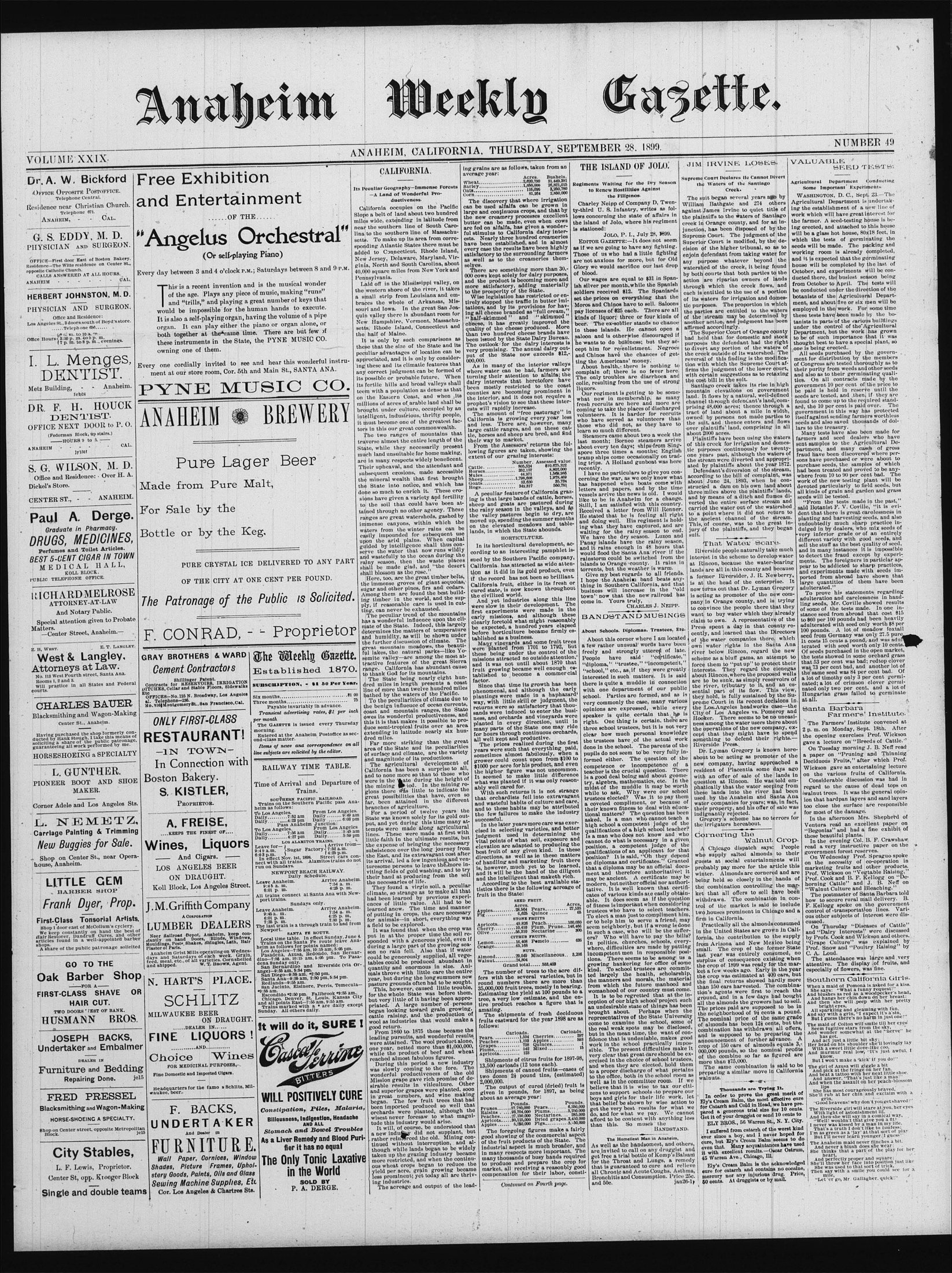
Searchable text
Anaheim
VOLUME XXIX.
Dr. A. W. Bickford
OFFICE OPPOSITE POSTOFFICE.
Telephone Central.
Residence near Christian Church.
Telephone 671.
ANAHEIM, CAL.
G. S. EDDY, M. D.
PHYSICIAN AND SURGEON.
OFFICE—First door East of Boston Bakery.
Residence—The Wilte residence on Center St., opposite Catholic Church.
CALLS ANSWERED AT ALL HOURS.
ANAHEIM CAL.
HERBERT JOHNSTON, M. D.
PHYSICIAN AND SURGEON.
Office and Residence:
Los Angeles St., 3 doors south of Boyd's store.
Telephone 650……
Office Hours: 8 m. to 10 a.m.
3:30 p.m. to 6 p.m.
7 p.m. to 8 p.m., evenings.
I. L. Menges,
DENTIST.
Metz Building, Anaheim.
feb24
DR. F. H. HOUCK
DENTIST.
OFFICE NEXT DOOR to P. O.
(Federman Block, up stairs.)
HOURS 9 to 5.
ANAHEIM CAL.
S. G. WILSON, M. D.
Free Exhibition
and Entertainment
OF THE...
"Angelus Orchestral"
(Or self-playing Piano)
Every day between 3 and 4 o'clock p.m.; Saturdays between 8 and 9 p.m.
This is a recent invention and is the musical wonder of the age. Plays any piece of music, making "runs" and "trills," and playing a great number of keys that would be impossible for the human hands to execute.
It is also a self-playing organ, having the volume of a pipe organ. It can play either the piano or organ alone, or both together at the same time. There are but few of these instruments in the State, the PYNE MUSIC CO. owning one of them.
Every one cordially invited to see and hear this wonderful instrument at our store room, Cor. 5th and Main St., SANTA ANA.
PYNE MUSIC CO.
ANAHEIM BREWERY
Pure Lager Beer
DENTIST.
Metz Building, Anaheim.
feb24
DR. F. H. HOUCK
DENTIST.
OFFICE NEXT DOOR to P. O.
(Federman Block, up stairs.)
HOURS 9 to 5.
ANAHEIM CAL.
jy15tf
S. G. WILSON, M. D.
Office and Residence: Over H. A. Dickel's Store.
CENTER ST., ANAHEIM.
Paul A. Derge.
Graduate in Pharmacy.
DRUGS, MEDICINES,
Perfumes and Toilet Articles.
BEST 5-CENT CIGAR IN TOWN
MEDICAL HALL,
KOLL BLOCK.
PUBLIC TELEPHONE OFFICE.
RICHARD MELROSE
ATTORNEY-AT-LAW
And Notary Public.
Special attention given to Probate Matters.
Center Street, Anaheim.
Z. H. WEST.
E. T. LANGLEY.
West & Langley,
Attorneys at Law.
No. 113 West Fourth street, Santa Ana.
Rooms 1, 2 and 3.
Will practice in all States and Federal courts.
CHARLES BAUER
Blacksmithing and Wagon-Making
Center St., Anaheim.
Having purchased the shop formerly conducted by Harold Stough, I take this means of soliciting a share of the public patronage, guaranteeing all work performed by me.
HORSESHOEING a SPECIALTY
L. GUNTHER.
PIONEER BOOT AND SHOE MAKER.
Corner Adele and Los Angeles Sts.
L. NEMETZ,
Carriage Painting & Trimming
New Buggies for Sale.
Shop on Center St., near Opera-house, Anaheim.
LITTLE GEM
BARBER SHOP
PYNE MUSIC CO.
ANAHEIM BREWERY
Pure Lager Beer
Made from Pure Malt,
For Sale by the
Bottle or by the Keg.
PURE CRYSTAL ICE DELIVERED TO ANY PART OF THE CITY AT ONE CENT PER POUND.
The Patronage of the Public is Solicited.
F. CONRAD, - Proprietor
GRAY BROTHERS & WARD
Cement Contractors
Shillinger Patent.
Contracts for RESERVOIRS, IRRIGATION DITCHES, Cellar and Stable Floors, Sidewalks Etc.
OFFICES—No. 125 N. Broadway, Los Angeles
al. Telephone—236.
No. 316 Montgomery St., San Francisco, Cal.
ONLY FIRST-CLASS RESTAURANT!
-IN TOWNIn Connection with Boston Bakery.
S. KISTLER,
PROPRIETOR.
A. FREISE,
...KEeps the FINEST OF...
Wines, Liquors
And Cigars.
LOS ANGELES BEER ON DRAUGHT.
Koll Block, Los Angeles Street.
The Weekly Gazette.
Established 1870
SUBSCRIPTION, - $1 50 Per Year
Six months....$1 00
Three months....70
Payable invariably in advance.
Transient advertising rates, $1 per inch per month.
The GAZETTE is issued every Thursday morning.
Entered at the Anaheim Postoffice as second-class matter.
Items of news and correspondence on a live subjects are solicited by the editor.
RAILWAY TIME TABLE.
Time of Arrival and Departure of Trains.
SOUTHERN PACIFIC RAILROAD.
Trains on the Southern Pacific pass Anaheim as follows:
To Los Angeles.
Daily.....7:52 am
Daily.....9:49 a.m
Pass Anaheim Junction:
To Los Angeles.
Daily.....7:56 am
Daily.....9:45 p.m
In effect Nov. 1st, 1898.
Street cars connect with all trains. Alamitos trains do not run on Sundays.
NEWPORT BEACH RAILWAY.
Daily Schedule.
Leave Anaheim.
9:45 a.m.
8:01 p.m.
All trains connect at Santa Ana with New York Railroad.
L. NEMETZ,
Carriage Painting & Trimming
New Buggies for Sale.
Shop on Center St., near Opera-house, Anaheim.
LITTLE GEM
BARBER SHOP
Frank Dyer, Prop.
First-Class Tonsorial Artists.
Shop 1 door east of McCollum's cyclery.
We keep constantly on hand the best of hair Restorer, Dandruff Cures, and other articles found in a well-appointed barber shops.
A share of the public patronage solicited
GO TO THE Oak Barber Shop
FOR A FIRST-CLASS SHAVE OR HAIR CUT.
TWO DOORS /TEST OF BANK.
HUSMANN BROS.
JOSEPH BACKS,
Undertaker and Embalmer
DEALER IN
Furniture and Bedding Repairing Done. je15
FRED PRESSEL
Blacksmithing and Wagon-Making
HORSE-SHOEING A SPECIALTY.
Shop on Center street, opposite Metropolitan Block. je15
City Stables,
L. F. Lewis, Proprietor.
Center St, opp. Kroeger Block
Single and double teams
PROPRIETOR.
A. FREISE,
Wines, Liquors
And Cigars.
LOS ANGELES BEER ON DRAUGHT.
Koll Block, Los Angeles Street.
J.M. Griffith Company
A CORPORATION
LUMBER DEALERS
Neer Railroad Depot, Anaheim, keep constantly on hand Doors, Blinds, Windows, Mouldings, Posts, Shakes, Shingles, Lath, Hair Plaster of Paris.
Anaheim Grist Mills operating on Wednesdays and Saturdays of each week. Grain, feed, meal, etc., of all varieties. Cornshellled and shipped.
W. T. Brown, Agent.
N. HART'S PLACE.
SCHLitz
MILWAUKEE BEER ON DRAUGHT.
DEALER IN...
FINE LIQUORS!
AND...
Choice Wines FOR MEDICINAL PURPOSES.
Fine Domestic and Imported Cigars.
Headquarters for the famo's Schlitz, Milwaukee, beer.
F. BACKS,
UNDERTAKER
And Dealer in
FURNITURE.
Wall Paper, Cornices, Window Shades, Picture Frames, Upholstery Goods, Paints, Oils and Glass Sewing Machine Supplies, Etc.
Cor. Los Angeles & Chartres Sts.
SOUTHERN PACIFIC RAILROAD.
Trains on the Southern Pacific pass Anhelm as follows:
To Los Angeles.
Daily...7:52 am Daily...9:49 am
Daily...4:23 pm Daily...6:03 p.m
Pass Anaheim Junction:
To Los Angeles.
Daily...7:56 am Daily...9:45 a.m
Daily...4:27 pm Daily...5:59 p.m
LOS ALAMITOS TRAINS.
Leave for—Sugar Factory 7:52 a.m. 4:25 p.m.
In effect Nov. 1st, 1898. Street cars connect with all trains. Alamitos trains do run on Sundays.
NEWPORT BEACH RAILWAY.
Daily Schedule.
Leave Anaheim. Arrive Anaheim 9:45 a.m. 7:54 a.m. 6:01 p.m. 4:25 p.m.
All trains connect at Santa Ana with Newport trains.
Sundays only.
Leave Anaheim. Arrive Anaheim 9:45 a.m. 7:54 a.m. 6:01 p.m. 4:25 p.m.
The last train is a through train to and from Newport.
SANTA FE ROUTE.
Local time table. In effect Sunday, June Trains on the Santa Fe route leave Anaheim as follows for points named:
Los Angeles -7:55 am, 10:15 am, 5:05 pm.
Pasadena, Azusa, Redondo, San Bernardo -7:55 am, 10:15 am, 5:05 pm. To Pasadena Sunday only.
San Bernardino and Riverside (via Orange) -9:55 am, 5:54 pm.
San Diego -9:55 am, *2:50 pm.
Santa Ana -9:55 am, 2:50 pm, 5:54 pm.
Redlands -9:55 am.
San Jacinto, Elsinore, Perris, Temecula *9:55 am.
Escondido *2:50 pm. Fallbrook *9:55 am.
Chicago, Denver, St. Louis, Kansas City and all points East -7:55 am, 9:55 am.
Trains marked with a * are daily excursion Sunday. All others daily.
It will do it, SURE!
Constipation, Piles, Malaria
Billousness, Indigestion, Headache AND ALL
Stomach and Bowel Troubles
As a Liver Remedy and Blood Poison it has no equal
The Only Tonic Laxation in the World
SOLD BY
P. A. DERGE.
ANAHEIM, CALIFORNIA, THURSDAY, SEPTEMBER 28, 1899.
ENT
Hestral"
Days between 8 and 9 P.M.
musical wonder
making "runs"
number of keys that
binds to execute.
volume of a pipe
organ alone, or
are but few of
NE MUSIC CO.
For this wonderful instruSt., SANTA ANA.
BREWERY
Beer
CALIFORNIA.
Its peculiar Geography—Immense Forests
—A Land of Wonderful Productiveness.
California occupies on the Pacific Slope a belt of land about two hundred miles wide, extending in latitude from near the southern line of South Carolina to the southern line of Massachusetts. To make up its area from corresponding Atlantic States there must be added to Connecticut, Rhode Island, New Jersey, Delaware, Maryland, Virginia, North and South Carolina, about 40,000 square miles from New York and Pennsylvania.
Laid off in the Mississippi valley, on the western shore of the river, it takes a small strip from Louisiana and embraces the whole of Arkansas, Missouri and Iowa. In the great San Joaquin valley there is abundant room for New Hampshire, Vermont, Massachusetts, Rhode Island, Connecticut and the half of Maine.
It is only by such comparisons as these that the size of the State and its peculiar advantages of location can be appreciated, and it is only by considering these and its climatic features that any correct judgment can be formed of its possible or probable future. When its fertile hills and broad valleys shall teem with a population as dense as that on the Eastern Coast, and when its millions of acres of arable land shall be brought under culture, occupied by an intelligent, industrious, thrifty people, it must become one of the greatest factors in this our great commonwealth.
The two ranges of mountains that traverse almost the entire length of the State, while they necessarily present much land unsuitable for home making, are in many respects widely beneficent. Their upheaval, and the attendant and subsequent erosions, made accessible ing grains are as follows, taken from an average year:
Acres. Bushels.
Wheat. 2,620,790 31,449,381
Barley. 1,650,000 25,821,015
Oats. 116,096 3,250,780
Corn. 81,264 2,850,000
The discovery that where irrigation can be used alfalfa can be grown in large and continuous crops, and that by the new creamy processes excellent butter can be made, even when cows are fed on alfalfa, has given a wonderful stimulus to California dairy interests. Nearly three hundred creameries have been established, and in almost every case the results have been highly satisfactory to the surrounding farmers as well as to the creameries themselves.
There are something more than 30,-000 cows kept solely for dairy purposes, and the product is becoming more and more satisfactory, adding materially to the prosperity of the State.
Wise legislation has restricted or entirely stopped the traffic in butter imitations, and by its provisions for having all cheese branded as "full cream," "half-skimmed" and "skimmed" cheese, it has greatly improved the quality of the cheese produced. More than two hundred cheese brands have been issued by the State Dairy Bureau. The outlook for the dairy interests is very promising. The annual dairy output of the State now exceeds $12,-000,000.
As in many of the interior valleys where water can be had, farmers are turning their attention to alfalfa; the dairy interests that heretofore have been mostly restricted to the coast counties are becoming prominent in the interior, and it does not require a prophet's vision to see that these interests will rapidly increase.
The amount of "free pasturage" in California is growing every year less and less. There are, however, many large cattle ranges, and on these cattle, horses and sheep are bred, and find their way to market.
From the Assessors' returns the following figures are taken, showing the extent of our grazing interests:
Number. Assessed value.
Cattle. 805,524 $10,675,322
Horses. 352,157 8,802,000
Milk. 44,971 1,569,985
THE ISLAND OF JOLO.
Regiments Waiting for the Dry Season to Renew Hostilities Against the Filipinos.
Charley Neipp of Company D, Twenty-third U. S. Infantry, writes as follows concerning the state of affairs in the island of Jolo, where his regiment is stationed:
JOLO, P. I., July 28, 1899.
EDITOR GAZETTE:—It does not seem as if we are going to have any fighting Those of us who had a little fighting are not anxious for more, but for O'Glory we would sacrifice our last drop of blood.
Our wages are equal to $31 in Spanish silver per month, while the Spanish soldiers received $12. The Spaniards set the prices on everything that the Moros and Chinos have to sell. Saloons pay licenses of $25 each. There are no kinds of liquor; three or four kinds of beer. The ex-soldier stands no chance in these islands. He cannot open saloon and is otherwise discouraged; he wants to do business; but they accept him for re-enlistment. Negroes and Chinos have the chances of getting the Americans' money.
About health; there is nothing complain of; there is no fever here. The only troubles are diarrhoea and colic, resulting from the use of strong volunteers. It is harder for recruits who have served as volunteers than those who did not; as they have learn so much different.
Steamers came about two a week after last month; Borneo steamers arrived about every ten days; ships from Singapore three times a months; English tramp ships come occasionally on trading trips. A Holland gunboat was recently.
I have no particulars to give you
its fertile hills and broad valleys shall teem with a population as dense as that on the Eastern Coast, and when its millions of acres of arable land shall be brought under culture, occupied by an intelligent, industrious, thrifty people, it must become one of the greatest factors in this our great commonwealth.
The two ranges of mountains that traverse almost the entire length of the State, while they necessarily present much land unsuitable for home making, are in many respects widely beneficent. Their upheaval, and the attendant and subsequent erosions, made accessible the mineral wealth that first brought the State into notice, and which has done so much to enrich it. These erosion have given a variety and fertility to the soil that could have been attained through no other agency. These ranges are great watersheds, gashed by immense canyons, within which the waters from the winter rains can be easily impounded for subsequent use upon the arid plains. When capital guided by intelligence shall thus conserve the water that now runs wildly and wastefully to the ocean during the rainy season, then the waste places shall be made glad, and "the desert shall blossom as the rose."
Here, too, are the great timber belts, the immense groves of giant sequolas, sugar and other pines, firs and cedars. Among them are found the best building timber in the world, and the supply, if reasonable care is used in cutting, can never be exhausted.
The peculiar trend of the mountains has a wonderful influence upon the climate of the State. Indeed, this largely determines the matters of temperature and humidity, as will be shown under the further discussion of climate. The great mountain meadows, the beautiful lakes, the natural parks—like Yosemite valley—are among the most attractive features of the great Sierra range. California has abundant cause to thank God for its mountains.
The State being nearly eight hundred miles in length presents a coast line of more than twelve hundred miles bathed by the waters of the Pacific.
To the peculiarities of climate due to the benign influence of ocean currents, coast and mountain ranges, the State owes its wonderful productiveness, and this it is that makes it possible to produce semi-tropical fruits over an area extending in latitude nearly six hundred miles.
Far more striking than the great area of the State and its peculiarities of surface and climate, are the variety and magnitude of its productions.
The agricultural development of California has been a surprise to all, and to none more so than those who were in the state during the height of the mining regions there was little to indicate the great possibilities that have, even so far, been attained in the different branches of agriculture.
For a period of twelve years the State was known solely for its gold output, and yet during this time many attempts were made along agricultural lines. These were made at first with little faith in the ultimate results, but the expense of bringing the necessary subsistence over the long journey from the East, and its extravagant cost after its arrival, led a few ingenious and venturesome persons to leave the more inviting fields of gold washing, and to try their hand at producing from the soil the necessaries of life.
They found a virgin soil, a peculiar climate, so strange as to make all that had been learned by previous experi-
turning their attention to alfalfa; the dairy interests that heretofore have been mostly restricted to the coast counties are becoming prominent in the interior, and it does not require a prophet's vision to see that these interests will rapidly increase.
The amount of "free pasturage" in California is growing every year less and less. There are, however, many large cattle ranges, and on these cattle, horses and sheep are bred, and find their way to market.
From the Assessors' returns the following figures are taken, showing the extent of our grazing interests:
Number. Assessed value
Cattle. 805,197 $10,675,322
Horses. 352,154 $8,829,000
Mules. 44,971 1,896,985
Sheep. 1,798,608 1,978,469
Goats. 33,630 35,734
Hogs. 349,817 550,781
A peculiar feature of California grazing is that large bands of cattle, horses and goats are pastured during the rainy season in the valleys, and as the valley pastures begin to dry, are moved up, spending the summer months on the elevated meadows and tablelands, in which the State abounds.
HORTICULTURE.
In its horticultural development, according to an interesting pamphlet issued by the Southern Pacific company, California has attracted as wide attention as it did in its gold product, even if the record has not been so brilliant. California fruit, either in its fresh or cured state, is now known throughout the civilized world.
And yet industries along this line were slow in their development. The first experiments were made in the early missions, and although these clearly foretold what might reasonably be expected, a hundred years elapsed before horticulture became firmly established as a business.
Many vineyards and some fruit trees were planted from 1701 to 1792, but these being under the control of the missions attracted no outside attention, and it was not until about 1870 that fruit growing became well enough established to become a commercial factor.
Since that time its growth has been phenomenal, and although the early plantings were made in a haphazard way, with little skill or judgment, the returns were so satisfactory that thousands were induced to enter the business, and orchards and vineyards were planted in every direction, until in many parts of the State one may ride for hours through continuous orchards, all well kept and productive.
The prices realized during the first years were such that everything paid sometimes almost fabulously when a grower could count upon $100 to $1000 per acre for his product, and even higher figure was not uncommon. It seemed to make little difference what was planted if it was only reasonably well cared for.
With such returns it is not strange that orchardists fell into extravagant and wasteful habits of culture and care, and to these habits may be attributed the few failures to make the industry successful.
In the later years more care was exercised in selecting varieties, and better judgment used in determining the vital points of what soil, exposure and elevation are adapted to producing the best fruit of any given kind. In these directions, as well as in these matters of handling and marketing fruit there is, however, much yet to be learned, and it will be the hand of the diligent and the intelligent that maketh rich.
According to the best available statistics there is the following acreage of fruit in the State:
The only troubles are diarrhoea and colic, resulting from the use of strong liquors.
Our regiment is getting to be some what new in membership; as many fresh recruits are here and more come to take the places of discharge volunteers. It is harder for recruit who have served as volunteers than those who did not, as they have learn so much different.
Steamers came about two weeks last month; Borneo steamers arrived about every ten days; ships from Siam apore three times a month; English tramp ships come occasionally on their trips. A Holland gunboat took them recently.
I have no particulars to give you on ceering the war, as we only know what has happened when boats come with letters and papers, and by the t vessels arrive the news is old. I would like to be in Anaheim for a charm Still, I am satisfied with this country. Received a letter from Will René He stated that he is feeling all right and doing well. His regiment is helping what they have captured, and waiting for the rainy season to end.
We have the dry season. Luzon Panay islands have the rainy season and it rains enough in 48 hours would flood the Santa Ana river if rainstorm could be switched from islands to Orange county. It rains torrents, but the weather is warm.
Give my best regards to all friends I hope the Anaheim band beats things in Southern California, and business will increase in this town" now that the new railroad comes in. Yours truly,
CHARLES J. NEILS
BANDSTAND MUSICIAN
About Schools. Diplomas. Trustees.
About this corner where I am located a few rather unusual words have freely and strongly uttered by People have said "certificate diploma," "trustee," "incompetence school," etc., as if they were interested in such matters. It is there is quite a muddle in connection with one department of our school. Parties are formed,and very commonly the case,many various opinions are expressed ,while one speaker is quite certain that right. One thing is certain,the three school trustees,but it is not clear how much personal knowledge they have done in the school.The parents do pupils do not seem to be very fully formed either.The question has competence or incompetence teacher is the crucial question.Is a good deal being said about trying algebra,mathematics,ect.midst of the muddle it may be while to ask.Why were our trustees elected?Was it to pay a coveted compliment,或 because their known fitness to deal with their questions asked.Is a man who cannot teach high school a competent judge of qualifications of a high school teacherIs a man who does not know anything can do what is necessary in an position,a competent judge of qualifications an applicant for position?It is said,"Oh they owe on diplomas and certificates."Given that a diploma may be an official mentation and therefore authoritative may be ancient.A certificate may modern,但 neither official nor academic。它是well known that courses of various kinds are easily available.
For a period of twelve years the State was known solely for its gold output, and yet during this time many attempts were made along agricultural lines. These were made at first with little faith in the ultimate results, but the expense of bringing the necessary subsistence over the long journey from the East, and its extravagant cost after its arrival, led a few ingenious and venerious persons to leave the more inviting fields of gold washing, and to try their hand at producing from the soil the necessaries of life.
They found a virgin soil, a peculiar climate, so strange as to make all that had been learned by previous experiences of little value. All had to be learned anew. The time and manner of putting in crops, the care necessary for animals—in short, everything was a field to be explored.
It was found that when the crop was put in at the proper time the soil responded with a generous yield, even if during a large part of the growing season no rain fell. Also that if water could be generously supplied, all vegetables could be produced abundant in quantity and enormous in size. Animals throve with little care the entire year, but during the long summers new pasture grounds often had to be sought.
This, however, caused little trouble, for the whole State was before them, but very little of it having been appropriated. A large number of persons began looking toward grain growing, cattle raising, and the production of wool as industries that would make a good return.
From 1860 to 1875 these became the leading pursuits, and wonderful results were attained. The wool product alone one year, netted more than $1,000,000, while the product of beef and wheat reached almost fabulous figures.
During this period a new industry was slowly coming to the fore. The wonderful productivity of the old Mission grape gave rich promise of desirable results in viticulture. Other and superior grapes were planted, soon in great numbers, and wine making began. The few fruit trees that had been imported produced so well that orchards were planted, although the wisest never foresaw to what magnitude this industry would arise.
It will, of course, be understood that a new industry did not supplant, but rather reinforced the old. Mining continued without interruption, and although while lands began to be widely taken up the grazing industry became more restricted, and when the continuous wheat crops began to reduce the yield per acre, grain growing became less prominent; yet today all are thriving industries.
The acreage and output of the lead-
Continued on Fourth page.
Gazette.
NOBER 28. 1899.
ISLAND OF JOLO.
Waiting for the Dry Season
Renew Hostilities Against
the Filipinos.
By Neipp of Company D, TwenU. S. Infantry, writes as followering the state of affairs in
Jolo, where his regiment
used:
JOLO, P. I., July 28, 1899.
FOR GAZETTE:—It does not seem
are going to have any fighting.
Of us who had a little fighting
noxious for more, but for Old
we would sacrifice our last drop
Images are equal to $31 in Spanter per month, while the Spanish
received $12. The Spaniards
services on everything that the
and Chipos have to sell. Saloons
buses of $25 each. There are all
of liquor; three or four kinds of
the ex-soldier stands no chance
in islands. He cannot open a
land is otherwise discouraged if
he is to do business; but they action for reenlistment. Negroes
mos have the chances of getAmericans' money.
The health, there is nothing to
on of; there is no fever here;
only troubles are diarrhoea and
resulting from the use of strong
Regiment is getting to be somenew in membership, as many
recruits are here and more are
to take the places of discharged
ers. It is harder for recruits
have served as volunteers than
who did not, as they have to
do much different.
Others came about two a week the
month; Borneo steamers arrive
every ten days; ships from Singthree times a months; English
ships come occasionally on tradions. A Holland gunboat was here
JIM IRVINE LOSES.
Supreme Court Declares He Cannot Divert
the Waters of the Santiago Creek.
The suit began several years ago by William Bathgate and 274 others against James Irvine to quiet title of the plaintiffs to the waters of Santiago creek in Orange county, and for an injunction, has been disposed of by the Supreme Court. The judgment of the Superior Court is modified, by the decision of the higher tribunal, so as to enjoin defendant from taking water for any purpose whatever beyond the watershed of the creek, it being found by both courts that both parties to the action are riparian owners of lands through which the creek flows, and each is entitled to the use of a portion of its waters for irrigation and domestic purposes. The proportion in which the parties are entitled to the waters of the stream may be determined by another action, and judgment has been affirmed accordingly.
The Superior Court of Orange county had held that for domestic and stock purposes the defendant had the right to divert any portion of the waters of the creek outside of its watershed. The reversal of this finding is the modification with which the Supreme Court affirms the judgment of the lower court, with certain suggestions as to retaxing the cost bill in the suit.
Santiago creek takes its rise in high mountain elevations on government land. It flows by a natural, well-defined channel through deficient's land, comprising 48,000 acres; thence through a tract of land about a mile in width, owned by persons not made parties to the suit, and thence enters and flows over plaintiffs' land, comprising in all about 2000 acres.
Plaintiffs have been using the waters of this creek for irrigation and domestic purposes continuously for twenty-one years past, although the waters of the stream were diverted and appropriated by plaintiffs about the year 1872.
Defendant's diversion of the stream,
VALUABLE SEED TESTS:
Agricultural Department Conducting Some Important Experiments.
WASHINGTON, D. C., Sept. 23.—The Agricultural Department is undertaking the establishment of a new line of work which will have great interest for the farmer. A seed-testing house is being erected, and attached to this house will be a glass hot house, 80x18 feet, in which the tests of germinating the seeds will be made. The packing and working room is already completed, and it is expected that the germinating house will be completed by the last of October, and experiments will be conducted there, the busiest season being from October to April. The tests will be conducted under the direction of the botanists of the Agricultural Department, and about five or six men will be employed in the work. For some time these tests have been made by the botanists in parts of the various buildings under the control of the Agricultural Department, but the work has grown to be of such importance that it was thought best to have a special plant, so one is being erected.
All seeds purchased by the government for distribution by the members of Congress are tested thoroughly as to their purity from weeds and other seeds and also as to their germinating qualities. On all contracts made by the government 10 per cent of the price to be paid is held in reserve until the seeds are tested, and then; if they are found to come up to the required standard, the 10 per cent is paid over. The government in this way has protected itself against sending farmers worthless seeds and also saved thousands of dollars to the treasury.
Many tests have also been made for farmers and seed dealers who have sent samples to the Agricultural Department, and many cases of gross fraud have been discovered where persons have purchased or were about to purchase seeds, the samples of which had been treated and proved to be any-where from 10 to 90 per cent bad.
regiment is getting to be somewhat in membership, as many recruits are here and more are to take the places of discharged officers. It is harder for recruits have served as volunteers than who did not, as they have to do much different. Officers came about two a week the month; Borneo steamers arrive every ten days; ships from Singapore three times a month; English ships come occasionally on trade trips. A Holland gunboat was here early.
There no particulars to give you concern the war, as we only know what happened when boats come with land and papers, and by the time they arrive the news is old. I would like to be in Anaheim for a change. I am satisfied with this country. I need a letter from Will Renner, dated that he is feeling all right doing well. His regiment is holding that they have captured, and are going for the rainy season to end. Have the dry season. Luzon and islands have the rainy season, trains enough in 48 hours that flood the Santa Ana river if the storm could be switched from the river to Orange county. It rains in parts, but the weather is warm. My best regards to all friends in the Anaheim band beats any in Southern California, and that stress will increase in the "old" town now that the new railroad has been built. Yours truly,
CHARLES J. NEIPP.
AND STAND MUSINGS
Schools, Diplomas, Trustees, Etc.
About this corner where I am located there rather unusual words have been used and strongly uttered of late. We have said "certificate,"oma,"trustee,"incompetent,"ool," etc., as if they were greatly tested in such matters. It is said that it is quite a muddle in connection with one department of our public school. Parties are formed, and as is commonly the case, many variousions are expressed, while every water is quite certain that he is. One thing is certain, there are school trustees, but it is not very how much personal knowledge trustees have of the actual work in the school. The parents of the children do not seem to be very fully informed either. The question of the competence or incompetence of a teacher is the crucial question. There good deal being said about geomealgebra, mathematics, etc. In the outfit of the muddle it may be worth to ask, Why were our school teachers elected? Was it to pay them devoted compliment, or because of known fitness to deal with educational matters? The question has been asked. Is a man who cannot teach a school a competent judge of the qualifications of a high school teacher? Man who does not know and who do not do what is necessary in a given situation, a competent judge of the qualifications of an applicant for that position? It is said, "Oh they depend diplomas and certificates." Granted a diploma may be an official document and therefore authoritative; it be ancient. A certificate may be borne, but neither official nor authoritative; it be ancient. A certificate may be borne, but neither official nor authoritative; it be ancient. A certificate may be borne, but neither official nor authoritative; it be ancient.
Cornering the Walnut Crop.
A Chicago dispatch says: People who supply salted almonds to their guests at social entertainments will probably pay more for the article this winter. Almonds are cornered and are being held so closely in the hands of the combination controlling the market that all offers to sell have been withdrawn. The combination in con-
Santiago creek takes its rise in high mountain elevations on government land. It flows by a natural, well-defined channel through defendant's land, comprising 48,000 acres; thence through a tract of land about a mile in width, owned by persons not made parties to the suit, and thence enters and flows over plaintiff's land, comprising in all about 2000 acres.
Plaintiffs have been using the waters of this creek for irrigation and domestic purposes continuously for twenty-one years past, although the waters of the stream were diverted and appropriated by plaintiffs about the year 1872.
Defendant's diversion of the stream, according to the bill of complaint, was about June 24, 1893, when he constructed a dam on his own land about three miles above the plaintiff's lands, and by means of a ditch and flumes diverted the entire stream stream and carried the water out of the watershed to a point where it did not return to the ancient channel of the stream. This, of course, was to the great injury of the plaintiffs, and they began suit.
That Water Scare.
Riverside people naturally take much interest in the scheme to develop water at Rincon, because the water-bearing lands are all in this county and because a former Riversider, J. R. Newberry, is at the head of the enterprise. It now turns out that Dr. Lyman Gregory is acting as promoter of the new company in Orange county, and is trying to convince the people there that they want to buy water which they already claim to own. A representative of the Press spent a day in that county recently, and learned that the Directors of the water companies there, which own water rights in the Santa Ana river below Rincon, regard the new scheme as a bluff game, an attempt to force them to "put up" to protect their interests. They regard the cienegas about Rincon, where the proposed wells are to be sunk, as simply reservoirs of the river, tributary to it, and an essential part of its flow. This view, they hold, is fully sustained by the Supreme Court in its recent decisions in the Los Angeles headworks case—the City of Los Angeles vs. Pomeroy and Hooker. There seems to be no uneasiness among the water users there about the operations of the new company, except that they might have to spend something to defend their rights—Riverside Press.
Dr. Lyman Gregory is known hereabout to be acting as promoter of the new company, having approached a resident of Placentia some days ago with an offer of sale of the lands in question at Rincon. He was told emphatically that the water seeping from these lands into the river had been used by the Anaheim and Santa Ana water companies for years; was, in fact, their property, and his offer of sale was indignantly rejected.
Gregory's scheme has no terrors for the irrigators hereabout.
Cornering the Walnut Crop.
A Chicago dispatch says: People who supply salted almonds to their guests at social entertainments will probably pay more for the article this winter. Almonds are cornered and are being held so closely in the hands of the combination controlling the market that all offers to sell have been withdrawn. The combination in con-
Santiago creek takes its rise in high mountain elevations on government land. It flows by a natural, well-defined channel through defendant's land, comprising 48,000 acres; thence through a tract of land about a mile in width, owned by persons not made parties to the suit, and thence enters and flows over plaintiff's land, comprising in all about 2000 acres.
Plaintiffs have been using the waters of this creek for irrigation and domestic purposes continuously for twenty-one years past, although the waters of the stream were diverted and appropriated by plaintiffs about the year 1872.
Defendant's diversion of the stream, according to the bill of complaint, was about June 24, 1893, when he constructed a dam on his own land about three miles above the plaintiff's lands, and by means of a ditch and flumes diverted the entire stream stream and carried the water out of the watershed to a point where it did not return to the ancient channel of the stream. This, of course, was to the great injury of jury of the plaintiffs, and they began suit.
That Water Scare.
Riverside people naturally take much interest in the scheme to develop water at Rincon, because the water-bearing lands are all in this county and because a former Riversider, J. R. Newberry, is at the head of the enterprise. It now turns out that Dr. Lyman Gregory is acting as promoter of the new company in Orange county, and is trying to convince the people there that they want to buy water which they already claim to own. A representative of the Press spent a day in that county recently, and learned that the Directors of the water companies there, which own water rights in the Santa Ana river below Rincon, regard the new scheme as a bluff game, an attempt to force them to "put up" to protect their interests. They regard the cienegas about Rincon, where the proposed wells are to be sunk, as simply reservoirs of the river, tributary to it, and an essential part of its flow. This view, they hold, is fully sustained by the Supreme Court in its recent decisions in the Los Angeles headworks case—the City of Los Angeles vs. Pomeroy and Hooker. There seems to be no uneasiness among the water users there about the operations of the new company, except that they might have to spend something to defend their rights—Riverside Press.
Dr. Lyman Gregory is known hereabout to be acting as promoter of the new company having approached a resident of Placentia some days ago with an offer of sale of the lands in question at Rincon. He was told emphatically that the water seeping from these lands into the river had been used by the Anaheim and Santa Ana water companies for years; was, in fact, their property, and his offer of sale was indignantly rejected.
Gregory's scheme has no terrors for the irrigators hereabout.
Cornering the Walnut Crop.
A Chicago dispatch says: People who supply salted almonds to their guests at social entertainments will probably pay more for the article this winter. Almonds are cornered and are being held so closely in the hands of the combination controlling the market that all offers to sell have been withdrawn. The combination in con-
Santiago creek takes its rise in high mountain elevations on government land. It flows by a natural, well-defined channel through defendant's land, comprising 48,000 acres; thence through a tract of land about a mile in width, owned by persons not made parties to the suit, and thence enters and flows over plaintiff's land, comprising in all about 2000 acres.
Plaintiffs have been using the waters of this creek for irrigation and domestic purposes continuously for twenty-one years past, although the waters of the stream were diverted and appropriated by plaintiffs about the year 1872.
Defendant's diversion of the stream, according to the bill of complaint, was about June 24, 1893, when he constructed a dam on his own land about three miles above the plaintiff's lands, and by means of a ditch and flumes diverted the entire stream stream and carried the water out of the watershed to a point where it did not return to the ancient channel of the stream. This, of course, was tothe great injury of jury ofthe plaintiffs,and they began suit.
That Water Scare.
Riverside people naturally take much interest in the scheme to develop water at Rincon,because the water-bearing lands are all in this county and because a former Riversider,j.J.R.Newberryis attheheadoftheenterprise.IttnowturnoutthatDr.LymanGregoryisactingaspromoterofthenewcompanyinOrangecounty,andistryingtoconvincethepeopletherethattheywanttobuywaterwhichtheyalreadyclaimtoown.ArepresentativeofthePressspentadayinthatcountyrecently,andlearnedthattheDirectorsofthewatercompaniestherewhichownwaterrightsintheSantaAnale RiverbelowRincon,rardentemphaticallythatthewaterseepingfromtheselandsintotheriverhadbeenusedbytheAnaheimandSantaAnaleWatercompaniesforyears;was.infact,theirproperty,andhisofferofsalewasindignantlyrejected.
Gregory'sschemehasnoterrorsfortheirirrigatorshereabout.
CorneringtheWalnutCrop.
A Chicago dispatch says: People who supply salted almonds to their guests at social entertainments will probably pay more forthearticlethiswinter.Almondsarecorneredandarebeingheldsocloselyinthenthandsofthecombinationcontrollingthemarketthatalloffersto sellhavebeenwithdrawn.Thecombinationincon-
Santiago creek takes its rise in high mountain elevations on government land. It flows by a natural,well-definedchannelthroughdefendant'sland,thewatershedtoapointwhereitdidnotreturntotheantichellenormallydifferentvarietywithgoodseeds,andsellthestaffasthebestqualityofseeds,andinmanyinstancesitisimpossibletodetectthefraudexceptbyexperiments.Theforeignersinparticularappeartobeaddictedtosharppractices,andexperimentsmadewithseedimportedfromabroadhave shownthatlargequantitiesofthemhavebeadulterated."
To prove his statements regarding adulterationandcarelessnessinhandlingseeds,Mr.Covilleshowedresultsofsomeofthesestsmade.Inoneinstance seedfromabroadthatcost$15to$60per100poundshadbeen heavilyadulteratedwithseedonlyworth48per100pounds.AlotofmeadowfoaltseedfromGermanywasonly27.5pureItcost15centsa pound,andwasadulteratedwithseedworthonly10cents.Ofseeds purchasedintheopenmarket,thetestowshowedinsomeorchardgrassthat53percentwasbad;redtopcloverwas73percentbad,andanotherlotofthe sameseedwas84percentbad.Olafottimothyonly3percentgerminated;a lotofcrimsonclovergerminatedonlytwopercent,anda lotofHungariangrassfailedtogerminateatall.
SantaBarbara
Farmers'Institute.
The Farmers' Institute convened at 2 p.m.on Monday.Sept.18th.AftertheopenexercisesProf.Wicksongavealectureon"BreedsOfCattle."
OnTuesdaymorningJ.B.Neffreadapaperon"PruningandThinningDeciduousFruits,"afterwhichProf.WicksongaveanentraininglectureonthevariousfruitsofCalifornia.
Considerablediscussionwashadind regardtothecausesofdeadtopsontwalnuttrees。它wasgeneralopinionthathardpanlayersand砂 layerstoclosethesurfaceareresponsibleformostofthedamage.
IntheafternoonMrs.ShepherdonVentura readanexcellentpaperon"Begonias"andhadafineexhibitofthesebeautifulplants.
IntheeveningCol.B.F.Crawshawreadaveryinstructivepaperonthegovernmentforestreserves.
OnWednesdayProf.Sprague spokeonthenecessityofcooperationinmarketingfruitsandotherproducts.Prof.Wicksonon"VegetableRaising,"prof.WicksonbAndB.F.Kelloggon"DehorningCattle"andJ.B.Neffon"WalnutCultureandBleaching."
ThepostmasterofSantaBarbara told
Cornering the Walnut Crop.
A Chicago dispatch says: People who supply salt almonds to their guests at social entertainments will probably pay more for the article this winter. Almonds are cornered and are being held so closely in the hands of the combination controlling the market that all offers to sell have been withdrawn. The combination in control of the market is said to include two houses prominent in Chicago and a firm in California.
Practically all the almonds consumed in the United States are grown in California, the contribution to the supply from Arizona and New Mexico being small. The crop of the former last year was entirely consumed, no surplus of consequence existing when the crop of 1899 was ready for the market a few weeks ago. Early in the year the crop was estimated at 400 cars, but the final returns showed hardly more than 150 cars harvested. The combination's agents were first to reach the ground, and in a few days had bought all the almonds the growers had to sell. The prices paid are supposed to be in the neighborhood of 9½ cents a pound. The nominal price of the same grade of almonds has been 12½ cents, but the combination has withdrawn all offers, and is supposed to be preparing the announcement of further advance. A crop of 150 cars of almonds equals 3,000,000 pounds, so the nominal profits of the combine so far as figured are more than $75,000.
The same combination is said to be preparing a similar move in California walnuts.
Thousands are Trying It.
In order to prove the great merit of Ely's Cream Balm, the most effective cure for Catarrh and Cold in Head, we have prepared a generous trial size for 10 cents. Get it of your druggist or send 10 cents to
ELY BROS., 56 Warren St., N.Y. City.
I suffered from catarrh of the worst kind since a boy, and I never hoped for cure, but Ely's Cream Balm seems to do even that. Many acquaintances have used it with excellent results—Oscar Ostrum, 45 Warren Ave., Chicago, Ill.
Ely's Cream Balm is the acknowledged cure for catarrh and contains no cocaine, mercury nor any injurious drug. Price, 50 cents. At druggists or by mail.
In the afternoon Mrs. Shepherd of Ventura read an excellent paper on "Begonias" and had a fine exhibit of these beautiful plants.
In the evening Col. B. F. Crawshaw read a very instructive paper on the government forest reserves.
On Wednesday Prof. Sprague spoke on the necessity of co-operation in marketing fruits and other products. Prof. Wickson on "Vegtable Raising," Prof. Cook and B. F. Kellogg on "Dehorning Cattle" and J. B. Neff on "Walnut Culture and Bleaching."
The postmaster of Santa Barbara told how to secure rural mail delivery. B. F. Kellogg spoke on the government control of transportation lines. Various other subjects of interest were discussed.
On Thursday "Diseases of Cattle" and "Dairy Interests" were discussed by Profs. Cook and Wickson and others. "Grape Culture" was explained by Prof. Snow and "Poultry Raising" by C. A. Loud.
The attendance was large and very attentive. The display of fruits, and especially of flowers, was fine.
Southern California Girls.
When a maid of Pomona is asked for a kiss. She says: "What a funny request!"
And blushes as red as a woodpecker's head; And hangs her chin down on her breast; And she will peep with her pretty bright eyes.
All sparkling and gleaming with fun. And say with a grin, "I expect it'a sin." But I guess there's no harm in just one!
The maid of Colton will smile till her eyes Seem fugitive stars from the sky. And wonder somewhat at the "nerve" he has got.
And act just a little bit shy. Her head on his shoulder she'll lovingly lay With a sweet little dove-like coo.
And murmur real low, "It's just awful, I know."
But I won't make a 'kick' if you do!
The girl of Azusa will giggle a bit. And pick at the fringe on her fan. And beat a tattoo with her neck little shoe. And answer, "That's just like a man!" And when the assault on her peach-blossom lips She has most courageously braved. She'll rub at her chin and exclaim with a grin.
Good heavens' why don't you get shaved?
The Riverside girl will stare at you, her eyes With light of astonishment ill. And then she will say in a comical way, "Well! wouldn't give you a hit! I never was kissed by a man in my life. That's a truth I don't like to confess; I'm as green as a 'jay' at that sort of play. But I'll never learn younger." I guess!
The Anaheim maid never finches a bit. And never a blush does she wear: She thinks that a part of the play for her heart; And perfectly proper and square; She'll throw her face into position just like She was used to that sort of trick. Then say with a smile you could see for a mile,
"Let er go, Mr. Gallagher, quick!"