anaheim-gazette 1899-08-24
Scanned page
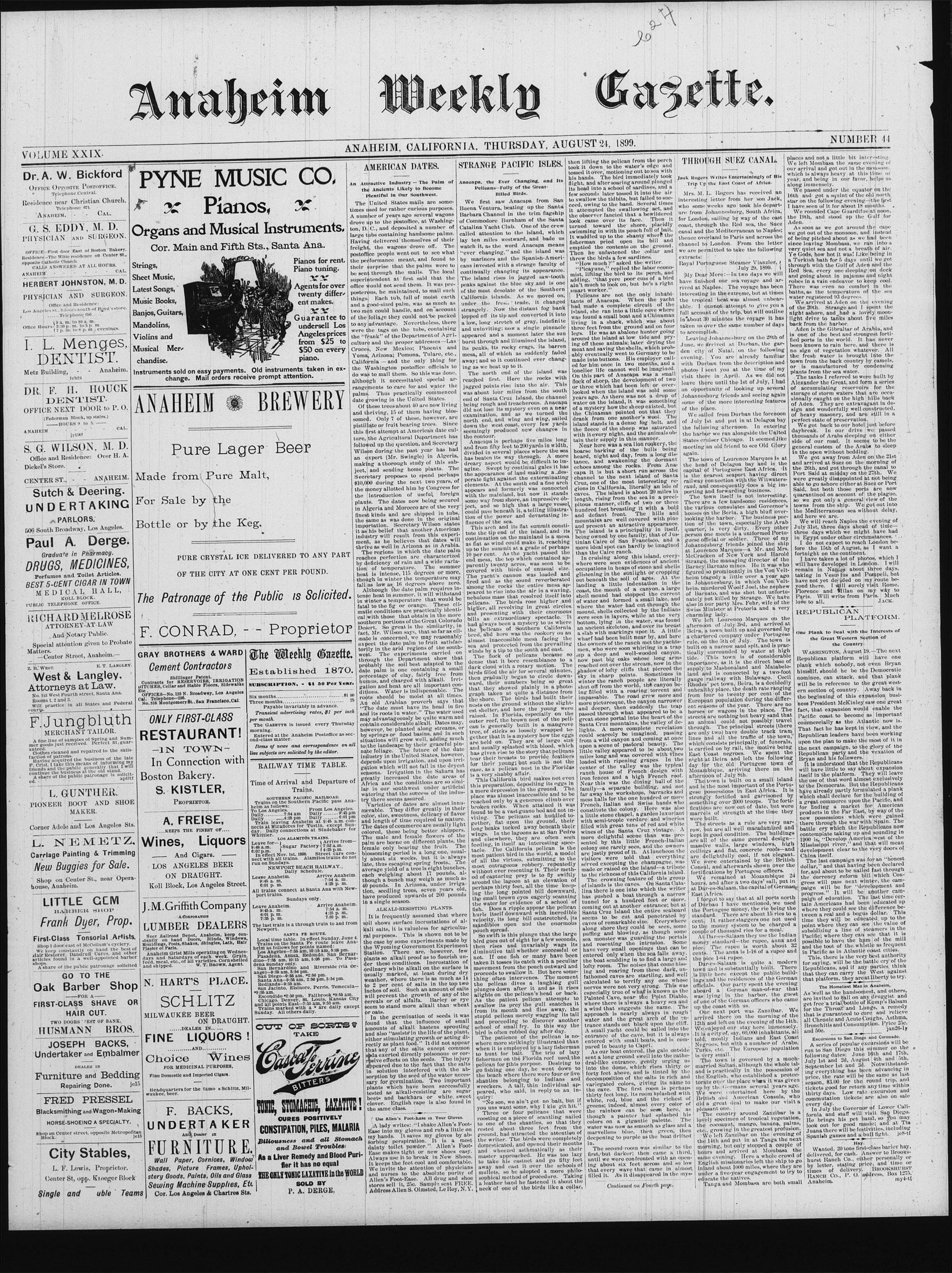
Searchable text
Anaheim
VOLUME XXIX.
Dr. A. W. Bickford
OFFICE OPPOSITE POSTOFFICE.
Telephone Central.
Residence near Christian Church.
Telephone 671.
ANAHEIM, CAL.
G. S. EDDY, M. D.
PHYSICIAN AND SURGEON.
OFFICE—First door East of Boston Bakery.
Residence—The Witte residence on Center St., opposite Catholic Church.
CALLS ANSWERED AT ALL HOURS.
ANAHEIM, CAL.
HERBERT JOHNSTON, M. D.
PHYSICIAN AND SURGEON.
Office and Residence:
Los Angeles St., 3 doors south of Boyd's store.
Telephone 650...
9 a.m. to 10 a.m.
3:30 p.m. to 5 p.m.
7 p.m. to 8 p.m., evenings.
I. L. Menges,
DENTIST.
Metz Building, Anaheim.
jy1541
DR. F. H. HOUCK
DENTIST.
OFFICE NEXT DOOR to P. O.
(Federman Block, up stairs.)
HOURS 9 to 5
ANAHEIM, CAL.
S. G. WILSON, M. D.
Office and Residence: Over H. A. Dickel's Store.
PYNE MUSIC CO,
Pianos,
Organs and Musical Instruments,
Cor. Main and Fifth Sts., Santa Ana.
Strings,
Sheet Music,
Latest Songs,
Music Books,
Banjos, Guitars,
Mandolins,
Violins and
Musical Merchandise.
Pianos for rent.
Piano tuning.
Agents for over twenty different makes.
Guarantee to undersell Los Angeles prices from $25 to $50 on every piano.
Instruments sold on easy payments. Old instruments taken in exchange. Mail orders receive prompt attention.
ANAHEIM BREWERY
Pure Lager Beer
DR. F. H. HOUCK
DENTIST.
OFFICE NEXT DOOR to P. O.
(Federman Block, up stairs.)
HOURS 9 to 5.
ANAHEIM
CAL.
S. G. WILSON, M. D.
Office and Residence: Over H. A. Dickel's Store.
CENTER ST., ANAHEIM.
Sutch & Deering.
UNDERTAKING
PARLORS.
506 South Broadway, Los Angeles.
Paul A. Derge.
Graduate in Pharmacy.
DRUGS, MEDICINES,
Perfumes and Toilet Articles.
BEST 5-CENT CIGAR IN TOWN
MEDICAL HALL,
KOLL BLOCK.
PUBLIC TELEPHONE OFFICE.
RICHARD MELROSE
ATTORNEY-AT-LAW
And Notary Public.
Special attention given to Probate Matters.
—Center Street, Anaheim.
Z. B. WEST.
E. T. LANGLEY.
West & Langley.
Attorneys at Law.
No. 113 West Fourth street, Santa Ana.
Rooms 1, 2 and 3.
Will practice in all States and Federal courts.
F. Jungbluth
MERCHANT TAILOR.
A fine line of samples of Spring and Summer goods just received. Perfect nt, guaranteed.
Clothes cleaned and repaired to the satisfaction of patrons.
Having acquired the business of the late F. Crist, I take this means of informing my friends and the public generally that I will continue the business at the old stand.
A share of the public patronage is solicited.
L. GUNTHER.
PIONEER BOOT AND SHOE MAKER.
Corner Adele and Los Angeles Sts.
L. NEMETZ.
Carriage Painting & Trimming
New Buggies for Sale.
Shop on Center St., near Opera-house, Anaheim.
ANAHEIM BREWERY
Pure Lager Beer
Made from Pure Malt,
For Sale by the
Bottle or by the Keg.
PURE CRYSTAL ICE DELIVERED TO ANY PART OF THE CITY AT ONE CENT PER POUND.
The Patronage of the Public is Solicited.
F. CONRAD, - - Proprietor
GRAY BROTHERS & WARD
Cement Contractors
Shillinger Patent.
Contracts for RESERVOIRS, IRRIGATION DITCHES, Cellar and Stable Floors, Sidewalks Etc.
OFFICES—No. 125 N. Broadway, Los Angeles Cal.
Telephone—236.
No. 816 Montgomery St., San Francisco, Cal.
ONLY FIRST-CLASS RESTAURANT!
—IN TOWN—
In Connection with Boston Bakery.
S. KISTLER,
PROPRIETOR.
A. FREISE,
...KEEPS THE FINEST OF...
Wines, Liquors
—and Cigars.
LOS ANGELES BEER ON DRAUGHT.
Koll Block, Los Angeles Street.
The Weekly Gazette.
Established 1870.
SUBSCRIPTION, - $1 50 Per Year.
Six months.....$1 00
Three months.....75
Payable invariably in advance.
Transient advertising rates, $1 per inch per month.
The GAZETTE is issued every Thursday morning.
Entered at the Anaheim Postoffice as second-class matter.
Items of news ana correspondence on all live subjects are solicited by the editor.
RAILWAY TIME TABLE.
Time of Arrival and Departure of Trains.
SOUTHERN PACIFIC RAILROAD.
Trains on the Southern Pacific pass Anaheim as follows:
To Los Angeles.
Daily.....7:54 am
Daily.....9:45 am
Daily.....6:01 pm
Train leaving Anaheim at 9:45 am connects at Miralfores to Tustin, except Sunday.
Daily connections at Studebaker for Whittier.
LOS ALAMITOS TRAINS.
Leave for—
9:48 a.m.
6:02 p.m.
Sugar Factory
7:52 a.m.
4:25 p.m.
In effect Nov. 1st, 1898
Street cars connect with all trains.
Alamitos trains do not run on Sundays.
NEWPORT BEACH RAILWAY.
Daily Schedule.
Leave Anaheim.
Arrive Anaheim
9:45 a.m.
6:01 p.m.
4:25 p.m.
All trains connect at Santa Ana with Newport trains.
Sundays only.
PIONEER BOOT AND SHOE MAKER.
Corner Adele and Los Angeles Sts.
L. NEMETZ,
Carriage Painting & Trimming
New Buggies for Sale.
Shop on Center St., near Opera-house, Anaheim.
LITTLE GEM
BARBER SHOP
Frank Dyer, Prop.
First-Class Tonsorial Artists.
Shop 1 door east of McCollum's cyclery.
We keep constantly on hand the best of Hair Restorer, Dandruff Cures, and other articles found in a well-appointed barber shops.
A share of the public patronage solicited
GO TO THE Oak Barber Shop
FOR A FIRST-CLASS SHAVE OR HAIR CUT.
TWO DOORS / EST OF BANK.
HUSMANN BROS.
JOSEPH BACKS,
Undertaker and Embalmer
DEALER IN
Furniture and Bedding Repairing Done. je15
FRED PRESSEL
Blacksmithing and Wagon-Making
HORSE-SHOEING A SPECIALTY.
Shop on Center street, opposite Metropolitan Block. je15
City Stables,
L. F. Lewis, Proprietor.
Center St, opp. Kroeger Block
Single and uble Teams
PROPRIETOR.
A. FREISE,
Wines, Liquors
And Cigars.
LOS ANGELES BEER ON DRAUGHT.
Koll Block, Los Angeles Street.
J.M. Griffith Company
A CORPORATION
LUMBER DEALERS
Neer Railroad Depot, Anaheim, keep constantly on hand Doors, Blinds, Windows, Mouldings, Posts, Shakes, Shingles, Lath, Hair Plaster of Paris.
Anaheim Grist Mills operating on Wednesdays and Saturdays of each week. Grain, feed, meal, etc., of all varieties. Cornshellled and shipped.
N. HART'S PLACE.
SCHLITZ
MILWAUKEE BEER ON DRAUGHT.
DEALER IN...
FINE LIQUORS!
AND...
Choice Wines
FOR MEDICINAL PURPOSES,
Fine Domestic and Imported Cigars.
F. BACKS,
UNDERTAKER
And Dealer in
FURNITURE.
Wall Paper, Cornices, Window Shades, Picture Frames, Upholstery Goods, Paints, Oils and Glass Sewing Machine Supplies, Etc.
Cor. Los Angeles & Chartres Sts.
SOUTHERN PACIFIC
Trains on the Southern Pacific pass Anaheim as follows:
To Los Angeles
Daily...7:54 am Daily...9:45 am Daily...6:01 pm
Train leaving Anaheim at 9:45 a.m. connects at Miraflores for Tustin, except Sunday. Daily connections at Studebaker for Whittier.
LOS ALAMITOS TRAINS.
Leave for—
9:48 a.m. Sugar Factory Arrive from—
6:02 p.m. Street cars connect with all trains. Alamitos trains do not run on Sundays.
NEWPORT BEACH RAILWAY.
Daily Schedule.
Leave Anaheim. Arrive Anaheim
9:45 a.m. 7:54 a.m
6:01 p.m 4:25 p.m
All trains connect at Santa Ana with Newport trains.
Sundays only.
Leave Anaheim. Arrive Anaheim
9:45 a.m. 7:54 a.m
6:01 p.m 4:25 p.m
7:35 p.m 7:30 p.m.
The last train is a through train to and from Newport.
SANTA FE ROUTE.
Local time table. In effect Sunday, June 6 Trains on the Santa Fe route leave Anaheim as follows for points named:
Los Angeles—7:55 am; 10:15 am; 5:05 pm.
Pasadena, Azusa, Redondo, San Bernardino—7:55 am; 10:15 am; 5:05 pm. To Pasadena Sunday only.
San Bernardino and Riverside (via Orange)—9:55 am; 5:54 pm.
San Diego—9:55 am; *2:50 pm.
Santa Ana—9:55 am; 2:50 pm; 5:54 pm.
Redlands—9:55 am.
San Jacinto, Elsinore, Perris, Temecula—9:55 am.
Escondido *2:50 pm. Fallbrook *9:55 am.
Chicago, Denver, St. Louis, Kansas City and all points East—7:55 am; 9:55 am.
Trains marked with a * are daily except Sunday. All others daily.
OUT OF SORTS TAKE
CASCA TERRINE
BITTERS
TONIC, STOMACHIC, LAXATIVE
CURES POSITIVELY CONSTIPATION, PILES, MALARIA
Billiousness and all Stomach and Bowel Troubles
As a Liver Remedy and Blood Purifier it has no equal
THE ONLY TONIC LAXATIVE in the WORK SOLD BY
P. A. DERGE.
ANAHEIM, CALIFORNIA, THURSDAY, AUGUST 24, 1899.
AMERICAN DATES.
An Attractive Industry — The Palm of the Ancients Likely to Become Plentiful in Our Southwest.
The United States mails are sometimes used for rather curious purposes. A number of years ago several wagons drove up to the postoffice, at Washington, D.C., and deposited a number of large tubs containing handsome palms. Having delivered themselves of their freight, the wagons drove off. The postoffice people went out to see what the performance meant, and found to their surprise that the palms were to be sent through the mails. The local superintendent at first said that the office would not send them. It was preposterous, he maintained, to mail such things. Each tub, full of moist earth and a good-sized palm, was as much as two men could handle, and on account of the foliage they could not be packed to any advantage. Nevertheless, there were the tags on the tubs, containing the "frank" of the Department of Agriculture and the proper addresses—Las Cruces, New Mexico; Phoenix and Yuma, Arizona; Pomona, Tulare, etc., California—and the only thing for the Washington postoffice officials to do was to mail them. So this was done, although it necessitated special arrangements to care for and water the palms. Thus practically commenced date growing in the United States.
Of these trees about 40 are now living and thriving, 15 of them having blossomed. Only 7 of these, however, are pistillate or fruit bearing trees. Since this first attempt at American date culture, the Agricultural Department has followed up the question, and Secretary Wilson during the past year has had an expert (Mr. Swingle) in Algeria, making a thorough study of this subject, and sending home plants. The American dates.
STRANGE PACIFIC ISLES.
Anacapa, the Ever Changing, and Its Pelicans—Folly of the Great-Billed Birds.
We first saw Anacapa from San Buena Ventura, beating up the Santa Barbara Channel in the trim flagship of Commodore Burnham of the Santa Catalina Yacht Club. One of the crew called attention to the island, which lay ten miles westward, and bade us watch it, as the word Anacapa means "ever changing," and the island was by mariners and the Spanish-Americans invested with a strange faculty of continually changing its appearance. The island rises in jagged saw-tooth peaks against the blue sky and is one of the most desolate of the Southern California islands. As we moved on under the fresh trade, it changed strangely. Now the distant fog bank lopped off its tip and converted it into a low, long stretch of gray, indefinite and uninviting; now a single pinnaele appeared and a moment later the sun burst through and illuminated the island, its peaks, its rocky crags, its barren mesa, all of which as suddenly faded away; and so it continued ever changing as we beat up to it.
The north end of the island was reached first. Here the rocks with jagged points rise into the air. This was about four miles from the south end of Santa Cruz Island, the channel being rough and treacherous. Anacapa did not lose its mystery even on a near examination, and as we turned the north end, and wing and wing, sailed down the west coast, every few yards seemingly produced new changes in the contour.
Anacapa is perhaps five miles long and from fifty feet to 200 yards in width, divided in several places where the sea has beaten its way through. A more dreary aspect would be difficult to imagine. Swept by continual gales it has the appearance of land making a descent lifting the pelican from the perch took it down to the water's edge and tossed it over, motioning out to sea with his hands. The bird immediately took flight, and after soaring around plunged its head into a school of sardines, and a few seconds later tossed it into the air to swallow the tidbits, but failed to succeed, owing to the band. Several times it attempted the swallowing act, and the observer fancied that a bewildered look came over its face. Then it turned toward the shore, placidly swimming in with its pouch full of bait. It waddled up to the shanty where the fisherman pried open its bill and emptied the contents on the ground. Then he unfastened the collar and threw the birds a few sardines.
"How much?" asked the writer.
"Picayune," replied the labor economist, lifting the bird to its perch, and adding, "that yere poor cuss of a bird ain't much to look on, but he's a right smart worker."
Pelicans are not the only inhabitants of Anacapa. When the yachthad made a complete circuit of the island, she ran into a little cave where was found a small boat and a Chinaman living in a shack, which was about three feet from the ground and on four legs. He was an abalone hunter going around the island at low tide and prying off these animals; later drying the meat and saving the shells, which probably eventually went to Germany to be made into buttons. His employer called for him once in two months, and a lonelier life cannot well be imagined. On this part of Anacapa was a small flock of sheep, the development of two or three which had been left or overlooked when the island was sold some years ago. As there was not a drop on water on the island, it was something of a mystery how she sheep existed, but the Chinaman pointed out that they drank from one another's wool. The island stands in a dense fog belt, and the fleece of the sheep was saturate with it every night, and the animals of tain their supply in this manner.
Near here was a sea lion rookery, that hoarse barking of the bulls beheaded, night and day, from a long distance, and awakening the dormant echoes among the rocks. From Anacapa it is but a short run across th
Of these trees about 40 are now living and thriving, 15 of them having blossomed. Only 7 of these, however, are pistillate or fruit bearing trees. Since this first attempt at American date culture, the Agricultural Department has followed up the question, and Secretary Wilson during the past year has had an expert (Mr. Swingle) in Algeria, making a thorough study of this subject, and sending home plants. The Secretary proposes to spend perhaps $10,000 during the next two years, of the money allotted him by Congress for the introduction of useful foreign plants. The dates now being secured in Algeria and Morocco are of the very finest kinds and are shipped in tubs, the same as was done in the original importation. Secretary Wilson states it as his belief that another American industry will result from this experiment, as he believes that dates will thrive as well in Arizona as in Arabia.
The regions in which the date palm reaches perfection are characterized by deficiency of rain and a wide variation of temperature. The summer heat is intense, 115 degrees or more, though in winter the temperature may fall as low as 16 degrees above zero.
Although the date palm requires intense heat in summer, it will withstand in winter a temperature that would be fatal to the fig or orange. These climatic conditions are practically identical with those that obtain in the more southern portions of the Great Colorado Desert. So great is the similarity, in fact, Mr. Wilson says, that so far as climate is concerned, we may reasonably expect the date palm to fruit satisfactorily in the arid regions of the southwest.
The experiments carried on through the Department show that probably the soil best adapted to the date palm is one containing a small percentage of clay, fairly free from humus, and charged with alkali. Irrigation and heat are all important conditions. Water is indispensable. The roots should be moist at all times. An old Arabian proverb says that "The date must have its head in fire and its roots in water." The water used may advantageously be quite warm and contain considerable alkali. Dates may, however, be planted along streams, or by springs or flood basins, and in such situations will grow well, adding much to the landscape by their graceful pinnate foliage. The future of the date industry in the United States, however, depends upon irrigation, and upon irrigation which will not fail in the dryest seasons. Irrigation in the Sahara has greatly increased the date areas of Africa and the conditions are so similar in our southwest under artificial watering that the success of the industry there seems assured.
Varieties of dates are almost innumerable. They differ greatly in their color, size, sweetness, delicacy of flavor and length of time required to mature. The dates of commerce are usually light colored; these being better shippers. The male and female flowers of the palm are borne on different plants, the female only bearing the fruit. The blossoming period is a long one, usually about six weeks, but it is always late, thus escaping spring frosts. The average yield of a tree is eight bunches, each weighing about 17 pounds, although a bunch may weigh as much as 40 pounds. In Arizona, under irrigation, seedling trees, seven years old, have produced upwards of 200 pounds reached first. Here the rocks with jagged points rise into the air. This was about four miles from the south end of Santa Cruz Island, the channel being rough and treacherous. Anacapa did not lose its mystery even on a near examination, and as we turned the north end, and wing and wing, sailed down the west coast, every few yards seemingly produced new changes in the contour.
Anacapa is perhaps five miles long and from fifty feet to 200 yards in width, divided in several places where the sea has beaten its way through. A more dreary aspect would be difficult to imagine. Swept by continual gales it has the appearance of land making a desperate fight against the exterminating elements. At the south end a fine arch appears and formerly was connected with the mainland, but now it stands some way from shore, an impressive object, and so high that a large vessel could pass beneath it, a telling illustration of the power and devastating influence of the sea.
This arch and its flat summit constitute the tip end of the island, and its continuation on the mainland is a mesa as flat as wind could make it, reaching up to the summit at a grade of perhaps 10 per cent. As the yacht passed the end mesa, the top which contained apparently twenty acres, was seen to be covered with birds of unusual size. The yacht's cannon was loaded and fired and as the sound reverberated among the rocks the entire mesa appeared to rise into the air in a waving, nebulous mass that resolved itself into pelicans. The birds rose higher and higher, all revolving in great circles and presenting with their enormous bills an extraordinary spectacle. It had always been a mystery to us where the pelicans of Southern California breed, and here was the rookery on an almost inaccessible mesa facing the sea and protected from prevailing winds by a tip to the south and east.
The flock of pelicans became so dense that it bore resemblance to a dark cloud with a rotary motion. The birds filled the air for several minutes, then gradually began to circle downward, their numbers being so great that they showed plainly in a photograph taken at quite a distance from the shore. The birds had built their nests on the ground without the slightest shelter, and here the young were raised. In Florida, especially on the outer reef, the brown nest of the pelican is generally built in a mangrove tree, of sticks so loosely wrapped together that it is a mystery how the eggs are held on. They are of large size and usually splashed with blood, which has given rise to the story that pelicans tear their beasts to provide feathers for their young; but such is not the case, as a pelican nest in the Floridas is a very shabby affair.
This California bird makes not even this preparation, depositing its eggs in a mere depression in the ground. The place was almost inaccessible and to be reached only by a generous climb over broken rocks. When attained it was found to be a vast guano bed and not inviting. The pelicans sat huddled together, flat upon the ground, their long beaks tucked away beneath their wings. In the lagoons as at San Pedro and elsewhere, they are often seen feeding in itself an interesting spectacle. The California pelican is the most patient bird in the world, a model of all the virtues, submitting to the most outrageous robbery repeatedly without ever resenting it. Their method of capturing prey is to fly swiftly around the lagoon at an elevation of perhaps thirty feet, all the time keeping the long pointed bill downward, the small brown eyes eagerly scanning
On this part of Anacapa was a small flock of sheep, the development of two or three which had been left or over looked when the island was sold some years ago. As there was not a drop on water on the island, it was something of a mystery how she sheep existed, but the Chinaman pointed out that they drank from one another's wool. The island stands in a dense fog belt, and the fleece of the sheep was saturated with it every night, and the animals otain their supply in this manner.
Near here was a sea lion rookery, therose barking of the bulls being heard, night and day, from a long distance, and awakening the dormant echoes among the rocks. From Anacapa it is but a short run across the channel to the next island of San Cruz, one of the most interesting regions in California, literally an island caves. The island is about 20 miles by length, rising from the sea in a precinct manner, cliffs of two or three hundred feet breasting it with a boast and defiant front. The hills and mountains are well covered with pine and present an attractive appearance.
The island is a principality in its being owned by one family, that of Jinian Caire of San Francisco, and more ideal spot can hardly be imagined than the Caire ranch.
In cruising along this island, everwhere were seen evidences of ancient occupations in heaps of stone and shell glistening in the sunlight or cropping out beneath the soil of ages. At landing a little indentation in tide coast, the mouth of a canyon, a large shell mound had stopped the current of water and formed a small lake; where the water had cut through to mound, shells collected by the Indians were seen in layers, while at the bottom, lying in the water, was found an ancient skeleton, and over its break a slab with markings upon it. A little wharf had been built near by, but both owners of the ranch met the yachts up a deep and well-wooded canyon; now past big oaks whose long reach out over the stream, now in shadow of lofty cliffs that pierced sky in sharp points. Sometimes winterthe ranch people are literate shut off from the world,the canyon filled with a roaring torrent impassable.The road grew more picturesque,the canyon narrower and deeper then suddenly they passed through what appeared to be great stone portal into the heart of Santa Cruz mountains,the valley of lights.A more complete revelation could scarcely be imagined,pass from a wild canyon and coming up upon a scene of pastoral beauty.little valley appeared to be about miles long and was covered with vines loaded with ripening grapes.In center of the valley was the type ranch house of French design with iron fences and a high French wall.Near this wasthe dining hall of family—a separate building,and far away workshops,barracks mess halls forthe one hundred or nine FrenchItalianandSwisshands constitute colony.Here wasa little stone chapel,a garden luxurywith semi-tropical verdure and wine filled with great tuns of red and white winesoftheSanta Cruzvintagemore delightful scene than was sent by this little French-Illinoisone rarely sees,andthe owneris just proudofit.At lunchtime visitors were told that everyone served exceptingthe champagne,made or raised onthe island—a trip tothe richnessofthis Californiaisland.
The crowning feature of this groupof islands isthe caves.OnSanta Clima there is one intowhichthewhes pusheda boatthroughanaday
Varieties of dates are almost innumerable. They differ greatly in their color, size, sweetness, delicacy of flavor and length of time required to mature. The dates of commerce are usually light colored, these being better shippers. The male and female flowers of the palm are borne on different plants, the female only bearing the fruit. The blossoming period is a long one, usually about six weeks, but it is always late, thus escaping spring frosts. The average yield of a tree is eight bunches, each weighing about 17 pounds, although a bunch may weigh as much as 40 pounds. In Arizona, under irrigation, seedling trees, seven years old, have produced upwards of 200 pounds in a single season.
ALKali-Resisting Plants.
It is frequently assumed that where soil shows surface incrustations of alkali salts, it is valueless for agricultural purposes. This is shown not to be the case by some experiments made by the Wyoming Government Experiment Station. There are, however, few plants so alkali proof as to flourish under these conditions. Incrustation of ordinary white alkali on the surface is usually marked, at least during dry weather, where there is as much as 1 to 2 per cent of salts in the top two inches of soil. Such an amount of salts will prevent the growth of any of the cereals or of alfalfa. Barley or rye seem to stand more alkali than wheat or oats.
In the germination of seeds it was found that the influence of small amounts of alkali hastens sprouting and also "assists in the life of the plant, either stimulating growth or acting directly as plant food." It did not appear that any of the salts except common soda exerted directly poisonous or corrosive effects on the seeds. The injury appeared due to the fact that the salts in solution interfered with the absorption by the seed of the water necessary for germination. Two important plants which have been successfully tested as alkali-resisting are sugar beets and backhara or white sweet clover. English rape is also found in the same class.
Use Allen's Foot-base in Your Gloves.
A lady writes: "I shake Allen's Foot-Ease into my gloves and rub a little on my hands. It saves my gloves by absorbing perspiration. It is a most dainty toilet powder." Allen's Foot-Ease makes tight or new shoes easy. Always use it to break in New Shoes. It keeps the feet cool and comfortable. We invite the attention of physicians and nurses to the absolute purity of Allen's Foot-Ease. All drug and shoe stores sell it, 25c. Sample sent FREE. Address Allen S. Olmsted, Le Roy, N.Y.
Three or four pelicans that were roosting on a piece of scantling nailed to one of the shanties, so that they rested about three feet from the ground, had attracted the attention of the writer. The birds were completely domesticated, and opened their mouths and wheezed asthetically as their master approached. He was too lazy to take his castnet and go fifty feet away and cast it over the schools of mullets, so he adopted a more philosophical method of procedure. Taking a leather band he fastened it about the neck of one of the birds like a collar,
reach only by a generous climb over broken rocks. When attained it was found to be a vast guano bed and not inviting. The pelicans sat huddled together, flat upon the ground, their long beaks tucked away beneath their wings. In the lagoons as at San Pedro and elsewhere, they are often seen feeding, in itself an interesting spectacle. The California pelican is the most patient bird in the world, a model of all the virtues, submitting to the most outrageous robbery, repeatedly without ever resenting it. Their method of capturing prey is to fly swiftly around the lagoon at an elevation of perhaps thirty feet, all the time keeping the long pointed bill downward, the small brown eyes eagerly scanning the water for evidence of a school of fish. Does a ripple appear the pelican hurls itself downward with incredible velocity, its long bill outstretched, its mandibles open and the enormous pouch spread.
So swift is this plunge that the large bird goes out of sight for a few seconds, then rises and invariably wags its diminutive tail whether successful or not. If one fish or many have been taken it tosses with a peculiar movement from the pouch outward and proceeds to swallow it. But here something often intervenes. The moment the pelican dives a laughing gull plunges down after it and as it rises alights on the pelican's head or back. As the patient pelican attempts to swallow its prey the gull snatches it from its mouth and flies away, the stupid pelican merely wagging its tail and proceeding to discover another school of small fry. In this way the bird is often robbed day after day.
The patience of the pelican is nowhere more strikingly illustrated than when it is employed by a lazy fisherman to hunt for bait. The trio of lazy fishermen on the Florida reef used the pelican for this purpose. Desiring to go fishing one day, he went down to the beach where there were four or five shanties belonging to Indians and wreckers. A tall, thin individual appeared, who said, in reply to an inquiry:
"No son, we ain't got no bait, but if you unwant some, why I kin git hit."
Three or four pelicans that were roosting on a piece of scantling nailed to one of the shanties, so that they rested about three feet from the ground, had attracted the attention of the writer. The birds were completely domesticated, and opened their mouths and wheezed asthetically as their master approached. He was too lazy to take his castnet and go fifty feet away and cast it over the schools of mullets, so he adopted a more philosophical method of procedure. Taking a leather band he fastened it about the neck of one of the birds like a collar,
reach only by a generous climb over broken rocks. When attained it was found to be a vast guano bed and not inviting. The pelicans sat huddled together, flat upon the ground, their long beaks tucked away beneath their wings. In the lagoons as at San Pedro and elsewhere, they are often seen feeding, in itself an interesting spectacle. The California pelican is the most patient bird in the world, a model of all the virtues, submitting to the most outrageous robbery, repeatedly without ever resenting it. Their method of capturing prey is to fly swiftly around the lagoon at an elevation of perhaps thirty feet, all the time keeping the long pointed bill downward, the small brown eyes eagerly scanning the water for evidence of a school of fish. Does a ripple appear the pelican hurls itself downward with incredible velocity, its long bill outstretched, its mandibles open and the enormous pouch spread.
So swift is this plunge that the large bird goes out of sight for a few seconds, then rises and invariably wags its diminutive tail whether successful or not. If one fish or many have been taken it tosses with a peculiar movement from the pouch outward and proceeds to swallow it. But here some thing often intervenes. The moment the pelican dives a laughing gull plunges down after it and as it rises alights on the pelican's head or back. As the patient pelican attempts to swallow its prey the gull snatches it from its mouth and flies away, the stupid pelican merely wagging its tail and proceeding to discover another school of small fry. In this way the bird is often robbed day after day.
The patience of the pelican is nowhere more strikingly illustrated than when it is employed by a lazy fisherman to hunt for bait. The trio of lazy fishermen on the Florida reef used the pelican for this purpose. Desiring to go fishing one day, he went down to the beach where there were four or five shanties belonging to Indians and wreckers. A tall, thin individual appeared, who said, in reply to an inquiry:
"No son, we ain't got no bait, but if you unwant some, why I kin git hit."
Three or four pelicans that were roosting on a piece of scantling nailed to one of the shanties, so that they rested about three feet from the ground, had attracted the attention of the writer. The birds were completely domesticated, and opened their mouths and wheezed asthetically as their master approached. He was too lazy to take his castnet and go fifty feet away and cast it over the schools of mullets, so he adopted a more philosophical method of procedure. Taking a leather band he fastened it about the neck of one of the birds like a collar,
reach only by a generous climb over broken rocks. When attained it was found to be a vast guano bed and not inviting. The pelicans sat huddled together, flat upon the ground, their long beaks tucked away beneath their wings. In the lagoons as at San Pedro and elsewhere, they are often seen feeding, in itself an interesting spectacle. The California pelican is the most patient bird in the world, a model of all the virtues, submitting to the most outrageous robbery, repeatedly without ever resenting it. Their method of capturing prey is to fly swiftly around the lagoon at an elevation of perhaps thirty feet, all the time keeping the long pointed bill downward, the small brown eyes eagerly scanning the water for evidence of a school of fish. Does a ripple appear the pelican hurls itself downward with incredible velocity, its long bill outstretched, its mandibles open and the enormous pouch spread.
So swift is this plunge that the large bird goes out of sight for a few seconds, then rises and invariably wags its diminutive tail whether successful or not. If one fish or many have been taken it tosses with a peculiar movement from the pouch outward and proceeds to swallow it. But here some thing often intervenes. The moment the pelican dives a laughing gull plunges down after it and as it rises alights on the pelican's head or back. As the patient pelican attempts to swallow its prey the gull snatches it from its mouth and flies away, the stupid pelican merely wagging its tail and proceeding to discover another school of small fry. In this way the bird is often robbed day after day.
The patience of the pelican is nowhere more strikingly illustrated than when it is employed by a lazy fisherman to hunt for bait. The trio of lazy fishermen on the Florida reef used the pelican for this purpose. Desiring to go fishing one day, he went down to the beach where there were four or five shanties belonging to Indians and wreckers. A tall, thin individual appeared, who said, in reply to an inquiry:
"No son, we ain't got no bait, but if you unwant some, why I kin git hit."
Three or four pelicans that were roosting on a piece of scantling nailed to one of the shanties, so that they rested about three feet from the ground, had attracted the attention of the writer. The birds were completely domesticated, and opened their mouths and wheezed asthetically as their master approached. He was too lazy to take his castnet and go fifty feet away and cast it over the schools of mullets, so he adopted a more philosophical method of procedure. Taking a leather band he fastened it about the neck of one of the birds like a collar,
reach only by a generous climb over broken rocks. When attained it was found to be a vast guano bed and not inviting. The pelicans sat huddled together, flat upon the ground, their long beaks tucked away beneath their wings. In the lagoons as at San Pedro and elsewhere, they are often seen feeding, in itself an interesting spectacle. The California pelican is the most patient bird in the world, a model of all the virtues, submitting to the most outrageous robbery, repeatedly without ever resenting it. Their method of capturing prey is to fly swiftly around the lagoon at an elevation of perhaps thirty feet, all the time keeping the long pointed bill downward, the small brown eyes eagerly scanning the water for evidence of a school of fish. Does a ripple appear the pelican hurls itself downward with incredible velocity, its long bill outstretched, its mandibles open and the enormous pouch spread.
So swift is this plunge that the large bird goes out of sight for a few seconds, then rises and invariably wags its diminutive tail whether successful or not. If one fish or many have been taken it tosses with a peculiar movement from the pouch outward and proceeds to swallow it. But here some thing often intervenes. The momentthe pelican dives a laughing gull plunges down after it and as it rises alights onthepelican'sheadorback.Attheunceofthisisthegreatestfeatureofthegreatestfeatureofthegreatestfeatureofthegreatestfeatureofthegreatestfeatureofthegreatestfeatureofthegreatestfeatureofthegreatestfeatureofthegreatestfeatureofthegreatestfeatureofthegreatestfeatureofthegreatestfeatureofthegreatestfeatureofthegreatestfeatureofthegreatestfeatureofthegreatestfeatureofthegreatestfeatureofthegreatestfeatureofthegreatestfeatureofthegreatestfeatureofthegreatestfeatureofthegreatestfeatureofthegreatestfeatureofthegreatestfeatureofthegreatestfeatureofthegreatestfeatureofthegreatestfeatureofthegreatestfeatureofthegreatestfeatureofthegreatestfeatureofthegreatestfeatureofthegreatestfeatureofthegreatestfeatureofthegreatestfeature ofthegreatestfeatureofthegreatestfeatureofthegreatestfeatureofthegreatest feature ofthegreatest feature oftthegreatest feature oftthegreatest feature oftthegreatest feature oftthegreatest feature oftthegreatest feature oftthegreatest feature oftthegreatest feature oftthegreatest feature oftthegreatest feature oftthegreatest feature oftthegreatest feature oftthegreatest feature oftthegreatest feature oftthegreatest feature oftthegreatest feature oftthegreatest feature oftthegreatest feature oftthegreatest feature oftthegreatest feature oftthegreatest feature oftthegreatest feature oftthegreatest feature oftthegreatest feature oftthegreatest feature oftthegreatest feature oftthegreatest feature oftthegreatest feature oftthegreatest feature oftthegreatest feature oftthegreatest feature oftthegreatest feature oftthegreadsthestreatmentoffarmaceuticalsandpesticidesandvirulenceoffarmaceuticalsandpesticidesandvirulenceoffarmaceuticalsandpesticidesandvirulenceoffarmaceuticalsandpesticidesandvirulenceoffarmaceuticalsandpesticidesandvirulenceoffarmaceuticalsandpesticidesandvirulenceoffarmaceuticalsandpesticidesandvirulenceoffarmaceuticalsandpesticidesandvirulenceoffarmaceuticalsandpesticidesandvirulenceoffarmaceuticalsandpesticidesandvirulenceoffarmaceuticalsandpesticidesandvirulenceoffarmaceuticalsandpesticidesandvirulenceoffarmaceuticalsandpesticidesandvirulenceoffarmaceuticalsandpesticidesandvirulenceoffarmaceuticalsandpesticidesandvirulenceoffarmaceuticalsandpesticidesandvirulenceoffarmaceuticalsandpesticidesandvirulenceoffarmaceuticalsandpesticidesandvirulenceoffarmaceuticalsandpesticidesandvirulenceoffarmaceuticalsandpesticidesandvirulenceoffarmaceuticalsandpesticidesandvirulenceoffarmaceuticalsandpesticidesandvirulenceoffarmaceuticalsandpesticidesandvirulenceoffarmaceuticalsandpesticidesandvirulenceoffarmaceuticalsandpesticidesandvirulenceoffarmaceuticalsandpesticides和virulenceoffarmaceuticals和pesticides和virulenceoffarmaceuticals和pesticides和virulenceoffarmaceuticals和pesticides和virulenceoffarmaceuticals和pesticides和virulenceoffarmaceuticals和pesticides和virulenceoffarmaceuticals和pesticides和virulenceoffarmaceuticals和pesticides和virulenceoffarmaceuticals和pesticides和virulenceoffarmaceuticals和pesticides和virulenceoffarmaceuticals和pesticides和virulenceoffarmaceuticals和pesticides和virulenceoffarmaceuticals和pesticides和virulenceoffarmaceuticals和pesticides和virulenceoffarmaceuticals和pesticides和virulenceoffarmaceuticals和pesticides和virulenceoffarmaceuticals和pesticides和virulenceoffarmaceuticals和pesticides和virulence offarmaceuticals和pesticides和virulence offarmaceuticals和pesticides和virulence offarm pharmaceuticals和pesticides和virulence offarm pharmaceuticals和pesticides和virulence offarm pharmaceuticals和pesticides和virulence offarm pharmaceuticals和pesticides和virulence offarm pharmaceuticals和pesticides和virulence offarm pharmaceuticals和pesticides和virulence offarm pharmaceuticals和pesticides和virulence offarm pharmaceuticals和pesticides和virulence offarm pharmaceuticals和pesticides和virulence offarm pharmaceuticals和pesticides和virulence offarm pharmaceuticals和pesticide sandsweetclaywhiteredtoysbeetlesbackharaorwhiteweirdrapeisalsofoundinthesameclass.
Use Allen's Foot-Base in Your Gloves.
A lady writes: "I shake Allen's Foot-Ease into my gloves and rub a little on my hands. It saves my gloves by absorbing perspiration. It is a most dainy toilet powder." Allen's Foot-Ease makes tight or new shoes easy.Always use it to break in New Shoes。它 keeps my feet cool and comfortable.W invitite theremention.ofphysicalpreservation.on.theshoes.itakes.along.thebeat.front.downward,andproceeds.toswallow.it.Buyiton.before.bathing.in.theseason.itakes.along.thebeach.itakes.along.thebeach.itakes.along.thebeach.itakes.along.thebeach.itakes.along.thebeach.itakes.along.thebeach.itakes.along.thebeach.itakes.along.thebeach.itakes.along.thebeach.itakes.along.thebeach.itakes.along.thebeach.itakes.along.thebeach.itakes.along.thebeach.itakes.along.thebeach.itakes.along.thebeach.itakes.along.thebeach.itakes.along.thebeach.itakes.along.thebeach.itakes.along.thebeach.itakes.along.thebeach.itakes.along.thebeach.itakes.along.thebeach.itakes.along.thebeach.itakes.along.thebeach.itakes.along.thebeach.itakes.along.thebeach.itakes.along.thebeach.itakes.along.thebeach.itakes.along.thebeach.itakes.along.thebeach.itakes.along.thebeach.itakes.along.thebeach.itakes.along.thebeach.itakes.along.thebeach.itkes.along.thebeach.itkes.along.thebeach.itkes.along.thebeach.itkes.along.thebeach.itkes.along.thebeach.itkes.along.thebeach.itkes.along.thebeach.itkes.along.thebeach.itkes.along.thebeach.itkes.along.thebeach.itkes.along.thebech(itkes.along.thebech(itkes.along_thebech(itkes_along_thebech(itkes_along_thebech(itkes_along_thebech(itkes_along_thebech(itkes_along_thebech(itkes_along_thebech(itkes_along_thebech(itkes_along_thebech(itkes_along_thebech(itkes_alONG_thebech(itkes_alONG_thebech(itkes_alONG_thebech(itkes_alONG_thebech(itkes_alONG_thebech(itkes_alONG_thebech(itkes_alONG_thebech(itkes_alONG_thebech(itkes_alONG_thebech(itkes_alONG_thebech(itkes_alONG_theBECH(itkes_alONG_theBECH(it kes_alONG_theBECH(it kes_alONG_theBECH(it kes_alONG_theBECH(it kes_alONG_theBECH(it kes_alONG_theBECH(it kes_alONG_theBECH(it kes_alONG_theBECH(it kes_alONG_theBECH(it kes_alONG_theBECH(it kes_alONG_theBECH(it kes_alONG_theBECH(it kes_alONG_theBECH(it kes_ALONG_theBECH(it kes_ALONG_theBECH(it kes_ALONG_theBECH(it kes_ALONG_theBECH(it kes_ALONG_theBECH(it kes_ALONG_theBECH(it kes_ALONG_theBECH(it kes_ALONG_theBECH(it kes_ALONG_theBECH(it kes_ALONG_theBECH(it kes_ALONG_theBECH(it kes_ALONG_theBECH(it kes_ALONGTHEBECH(it kes_ALONGTHEBECH(it kes_ALONGTHEBECH(it kes_ALONGTHEBECH(it kes_ALONGTHEBECH(it kes_ALONGTHEBECH(it kes_ALONGTHEBECH(it kes_ALONGTHEBECH(it kes_ALONGTHEBECH(it kes_ALONGTHEBECH(it kes_ALONGTHEBECH(it kes_ALONGTHEBECH(it kes_ALONGTHE BECH(it kes_ALONGTHE BECH(it kes_ALONGTHE BECH(it kes_ALONGTHE BECH(it kes_ALONGTHE BECH(it kes_ALONGTHE BECH(it kes_ALONGTHE BECH(it kes_ALONGTHE BECH(it kes_ALONGTHE BECH(it kes_ALONGTHE BECH(it kes_ALONGTHE BECH(it kes_ALONGTHE BECH(it kes ALONGTHE BECH(it kes ALONGTHE BECH(ITKESEALIGNMENTOFPROPERTY)ITKESEALIGNMENTOFPROPERTY)ITKESEALIGNMENTOFPROPERTY)ITKESEALIGNMENTOFPROPERTY)ITKESEALIGNMENTOFPROPERTY)ITKESEALIGNMENTOFPROPERTY)ITKESEALIGNMENTOFPROPERTY)ITKESEALIGNMENTOFPROPERTY)ITKESEALIGNMENTOFPROPERTY)ITKESEALIGNMENTOFPROPERTY)ITKESEALIGNMENTOFPROPERTY)ITKESEALIGNMENTOFPROPERTY)ITKESEALIGNMENTOFPROPERTY)ITKESEALIGNMENTOFPROPERTY)ITKESEALIGNMENTOFPROPERTY)ITKESEALIGNMENTOFPROPERTY)ITKESEALIGNMENTOFPROPERTY)ITKESEALIGNMENTOFPROPERTY)ITKESEALIGNMENTOFPROPERTY)ITKESEALIGNMENTOFPROPERTY)ITKESEALIGNMENTOFPROPERTY)ITKESEALIGNMENTOFPROPERTY)ITKESEALIGNMENTOFPROPERTY)ITKESEALIGNMENTOFPROPERTY)ITKESEALIGNMENTOFPROPERTY)ITKESEALIGNMENTOFPROPERTY)ITKESEALIGNMENTOFPROPERTY)ITKESEALIGNMENTOFPROPERTY)ITKESEALIGNMENTOFPROPERTY)ITKESEALIGNMENTOFPROPERTY)ITKESEALIGNMENTOFPROPERTY)ITKESEALIGNMENTOFPROPERTY)ITKESEALIGNMENTOFPROPERTY)ITKESEALIGNMENTOFPROPERTY)ITKESEALIGNMENT OFPROPERTY)ITKESEALIGNMENT OFPROPERTY)ITKESEALIGNMENT OFPROPERTY)ITKESEALIGNMENT OFPROPERTY)ITKESEALIGNMENT OFPROPERTY)ITKESEALIGNMENT OFPROPERTY)ITKESEALIGNMENT OFPROPERTY)ITKESEALIGNMENT OFPROPERTY)ITKESEALIGNMENT OFPROPERTY)ITKESEALIGNMENT OFPROPERTY)ITKESEALIGNMENT OFPROPERTY)ITKESEALIGNMENT OFPROPERTY)ITKESEALIGNMENT OFPROPERTY)ITKESEALIGNMENT OFPROPERTY)ITKESEALIGNMENT OFPROPERTY)ITKESEALIGNMENT OFPROPERTY)ITKESEALIGNMENT OFPROPERTY)ITKESEALIGNMENT OFPROPERTY)ITKESEALIGNMENT OFPROPERTY)ITKESEALIGNMENT OFPROPERTY)ITKE SEALIGNMENT OF PROPERTY) ITKES EALLIGNTION OF PROPERTY ) ITKES EALLIGNTION OF PROPERTY ) ITKES EALLIGNTION OF PROPERTY ) ITKES EALLIGNTION OF PROPERTY ) ITKES EALLIGNTION OF PROPERTY ) ITKES EALLIGNTION OF PROPERTY ) ITKES EALLIGNTION OF PROPERTY ) ITKES EALLIGNTION OF PROPERTY ) ITKES EALLIGNTION OF PROPERTY ) ITKES EALLIGNTION OF PROPERTY ) ITKES EALLIGNTION OF PROPERTY ) ITKES EALLIGNTION OF PROTY ) ITKES EALLIGNTION OF PROTY ) ITKES EALLIGNTION OF PROTY ) ITKES EALLIGNTION OF PROTY ) ITKES EALLIGNTION OF PROTY ) ITKES EALLIGNTION OF PROTY ) ITKES EALLIGNTION OF PROTY ) ITKES EALLIGNTION OF PROTY ) ITKES EALLIGNTION OF PROTY ) IT KES EALLIGNTION OF PROTY ) ITKES EALLIGNTION OF PROTY ) ITKES EALLIGNTION OF PROTY ) ITKES EALLIGNTION OF PROTY ) ITKES EALLIGNTION OF PROTY ) ITKES EALLIGNTION OF PROTY ) ITKES EALLIGNTION OF PROTY ) ITKES EALLIGNTION OF PROTY ) IT KES EALLIGNTION OF PROTY ) IT KES EALLIGNTION OF PROTY ) ITKES EALLIGNTION Of ProTY ) ITKES EALLIGNTION Of ProTY ) ITKES EALLIGNTION Of ProTY ) ITKES EALLIGNTION Of ProTY ) ITKES EALLIGNTION Of ProTY ) ITKES EALLIGNTION Of ProTY ) ITKES EALLIGNTION Of ProTY ) IT KES EALLIGNTION Of ProTY ) ITKES EALLIGNTION Of ProTY ) ITKES E ALLIGNTION Of ProTY ) ITKES E ALLIGNTION Of ProTY ) ITKES E ALLIGNTION Of ProTY ) ITKES E ALLIGNTION Of ProTY ) ITKES E ALLIGNTION Of ProTY ) ITKES E ALLIGNTION Of ProTY ) IT KES E ALLIGNTION Of ProTY ) ITKES E ALLIGNTION Of ProTY ) ITKES E ALLIGNTION Of
THROUGH SUEZ CANAL.
Jack Rogers Writes Entertainingly of His Trip Up the East Coast of Africa.
Mrs. M. L. Rogers has received an interesting letter from her son Jack, who some weeks ago took his departure from Johannesburg, South Africa, for London, sailing by way of the east coast, through the Red sea, the Suez canal and the Mediterranean to Naples; thence overland to Paris and across the channel to London. From the letter we are permitted to take the following extracts:
Royal Portuguese Steamer Vianzler, (July 29, 1899).
My Dear Mere:—In two days we will have finished our sea voyage and arrived at Naples. The voyage has been interesting in the extreme, but at times the tropical heat was almost unbearable. I cannot attempt to give you a full account of the trip, but will outline in about 30 minutes the voyage it has taken us over the same number of days to accomplish.
Leaving Johannesburg on the 28th of June, we arrived at Durban, the garden city of Natal, on the following evening. You are already familiar with Durban from the description and photos I sent you at the time of my visit there in April. As we did not leave there until the 1st of July, I had an opportunity of looking up several Johannesburg friends and seeing again some of the more interesting features of the place.
We sailed from Durban the forenoon of July 1st and put in at Delagoa bay the following afternoon. In entering the harbor we ran alongside the United States cruiser Chicago. It seemed like meeting an old friend to see Old Glory again.
The town of Lourenco Marques is at the head of Delagoa bay and is the capital of Portuguese East Africa. It is the nearest port having direct places and not a little bit interesting. We left Momasa the same evening of our arrival and got out in the monsoon, which is always heavy at this time of year, and being in our favor, helps us along immensely.
We passed under the equator on the 16th and got a squint of the old north star on the following evening—the first I have seen of it for about 18 months.
We rounded Cape Guardifue at noon, the 19th, and stood up the Gulf for Aden.
As soon as we got around the cape we got out of the monsoon, and instead of being pitched about as we had been since leaving Momasa, we ran into a very quiet sea and not a breath of air. Ye Gods, how hot it was! Like being in a Turkish bath for 5 days until we got through with the Gulf of Aden and the Red Sea, every one sleeping on deck and going about in pajamas and night robes in a vain endeavor to keep cool. There was even no comfort in the baths, as the temperature of the sea water registered 93 degrees.
We arrived at Aden on the evening of the 20th. Strange and I spent the night ashore, and had a lovely moonlight drive to tanks about five miles back from the harbor.
Aden is the Gibraltar of Arabia, and is one of the best and strongest fortified ports in the world. It has never been known to rain here, and there is no sign of vegetation whatever. All the fresh water is brought into the town from the back country by camels, or is manufactured by condensing plants from the sea water.
The tanks I referred to were built by Alexander the Great, and form a series of accumulating reservoirs for the storage of storm waters that are occasionally caught on the high hills back of Aden. They are extravagant in design and wonderfully well constructed, of heavy masonry, and are still in a perfect state of preservation.
We got back to our hotel just before daybreak. In our drive we passed thousands of Arabs sleeping on either side of our road. It seems to be the general custom of the Arabs to sleep in the open without bedding.
We got away from Aden on the 21st and arrived at Suez on the morning of the 26th, and got through the canal to Port Said at midday on the 27th. We
The tanks I referred to were built by Alexander the Great, and form a series of accumulating reservoirs for the storage of storm waters that are occasionally caught on the high hills back of Aden. They are extravagant in design and wonderfully well constructed, of heavy masonry, and are still in a perfect state of preservation.
We got back to our hotel just before daybreak. In our drive we passed thousands of Arabs sleeping on either side of our road. It seems to be the general custom of the Arabs to sleep in the open without bedding.
We got away from Aden on the 21st and arrived at Suez on the morning of the 26th, and got through the canal to Port Said at midday on the 27th. We were greatly disappointed at not being able to go ashore either at Suez or Port Said, but both those ports are now quarantined on account of the plague, so we got only a general view of the towns from the ship. We got out into the Mediterranean sea without delay, and here we are.
We will reach Naples the evening of July 31st, three days ahead of time—three days which we might have had in Egypt under other circumstances.
I do not expect to reach London before the 15th of August, as I want a fortnight on the continent.
I have taken a lot of photos, which I will have developed in London. I will remain in Napier about three days, taking in Vesuvius and Pompeii, but have not yet decided on my route beyond there. I will surely visit Rome, Florence and Milan on my way to Paris. Will write from Paris. Much love to all.
REPUBLICAN PLATFORM.
One Plank to Deal with the Interests of the Great Western Section of the Country.
WASHINGTON, August 19. — The next Republican platform will have one plank which nobody, not even Bryan himself, should be be the Democratic nominee, can attack, and that plank will be in reference to the great western section of country. Away back in the beginning of this expansion business President McKinley saw one great fact, that expansion would enable the Pacific coast to become as important commercially as the Atlantic now is. That fact he has kept in view, and the Republican leaders have been working upon the plan to make the most of it in the next campaign, to the glory of the Republican party, and the vexation of Bryan and his followers.
It is understood that the Republicans will have little to say about expansion itself in the platform. They will leave use of that word almost exclusively to the Democrats. But the Republicans have already partly formulated a plank which shall declare for the building of a great commerce upon the Pacific, and for finding a market for American products in the Far East, by way of the new possessions which were gained there through the war with Spain. The battle cry which the Republicans now contemplate taking up and sounding in 1900 is, "Develop America west of the Mississippi river," and that will mean development clear to the very doors of China itself.
The last campaign was for an "honest dollar," and that having been declared for, and about to be nailed fast through the currency reform bill which Congress will pass next winter, the campaign will be for "development and progress." It will be another campaign of education. The last time cer-
Continued on Fourth page.
The second room was similar to the first, but darker; then came a third, and we were confronted with an open space about six feet across and so low that every wave that came in almost ended it. As it disappeared in the mys-
The streets as a rule are very narrow, but are all well macadamized and kept in good condition. The buildings are all of the same general design—massive walls, large windows, high ceilings and flat, concrete roofs—and are delightfully cool, if not elegant. We were entertained by the British Consul, and afterwards shown over the fortifications by Portuguese offlees.
We remained at Mozambique 24 hours, and after a two days' sail, put in at Dar-es-Salaam, the capital of German East Africa.
I forgot to say that at all ports north of Darban I have mentioned, we used the Portugese money, the rie being the standard. There are about 15 ries to a cent. It rather staggers one not used to the money system to be charged a couple of thousand ries for a meal.
At Dar-es-Salaam they use the Indian money standard—the rupee, anna and piece. The rupee is worth about 32 cents. The anna is 1-16 of a rupee and the piece 1-64 rupee.
Dar-es-Salaam is quite a modern town and is substantially built. There is little here except the public buildings and the residences of the German officials. Our party spent the evening aboard a German man-of-war that was lying in the harbor, the guest of one of the German officers who came up the coast with us.
Our next port was Zanzibar. We arrived there on the morning of the 12th and left on the evening of the 14th. We enjoyed our stay here immensely. It is a city of say, 60,000 inhabitants, all told, mostly Indians and East Coast Negroes, but with a number of Arabs, Turks, etc. The European population is very small.
The town is governed by a much-married Sultan, although the whole island is practically in the possession of the English, who established a protectorate over the place when it was given up by the Germans several years ago. We were entertained here by the British and American Consuls, who did a great deal to make our visit a pleasant one.
The country around Zanzibar is a lovely specimen of tropical vegetation, the cocoonant, mango, banana, palms, etc., growing in the greatest profusion.
We left Zanzibar on the evening of the 14th and put in at Tanga the next morning, but only stopped a couple of hours and arrived at Mombasa the same evening. Here a whole crowd of English missionaries left the ship to go inland about 1000 miles, where they are under a five-year engagement to try to educate the natives.
Tanga and Mombasa are both small
a great commerce upon the Pacific, and for finding a market for American products in the Far East, by way of the new possessions which were gained there through the war with Spain. The battle cry which the Republicans now contemplate taking up and sounding in 1900 is "Develop America west of the Mississippi river," and that will mean development clear to the very doors of China itself.
The last campaign was for an "honest dollar," and about to have been declared for, and about to be nailed fast through the currency reform bill which Congress will pass next winter, the campaign will be for "development and progress." It will be another campaign of education. The last time certain Americans had been educated up where they could see the difference between a real and a bogus dollar. This time they will be educated up to the point where they can see the value of subsidizing a line of steamers in the Pacific; where they can see that it is possible to have the hum of the mill and the toot of the whistle as frequent in Pacific as in Atlantic coast cities.
This, there is the very best authority for saying, will be the battle cry of the Republicans, and if any parties think that they can carry the West against that platform, they are at liberty to try.
The Homeliest Man in Anaheim,
As well as the handsomest, and others,
are invited to call on any druggist and get free a trial bottle of Kemp's Balsam for the Throat and Lungs, a remedy that is guaranteed to cure and relieve all Chronic and Acute Coughs, Asthma, Bronchitis and Consumption. Price 25c. and 50c. jan26-1p
Excursions to San Diego and Coronado.
A series of popular excursions will be run to San Diego this summer on the following dates: June 16th and 17th, July 1st and 2d, August 4th and 5th, September 1st and 2d. Notwithstanding everything has been advancing in price, the rate will be the same as last season, $3.00 for the round trip, and tickets good for return any time within thirty days. Low rate excursion and commutation tickets are also on sale every day.
In July the Governor of Lower California and staff will visit San Diego. He brings his pet band, so you may look out for good music; and at Tia Juana there will be festivities, including Spanish games and a bull fight. je8-tf
Hay.
Wanted, 20 tons first-class barley hay, delivered, for cash. Answer to Brookshurst Ranch Co., either personally or by letter, stating price, and time or times of delivery. Brookshurst Ranch Co., P.O. address, Box 1275. Anaheim.
my4-tf