anaheim-gazette 1899-08-17
Scanned page
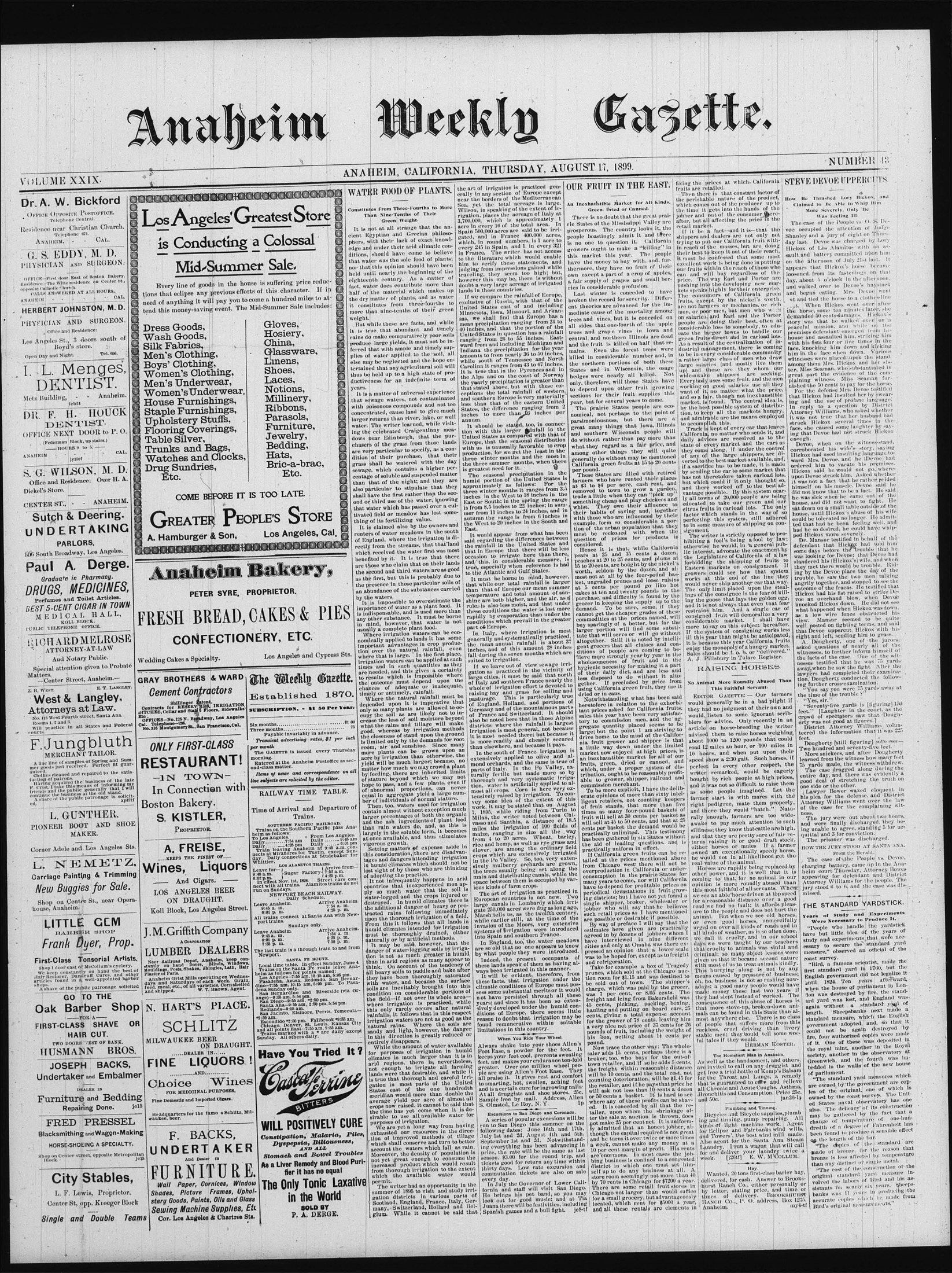
Searchable text
Anaheim
VOLUME XXIX.
Dr. A. W. Bickford
Office Opposite Postoffice.
Telephone Central.
Residence near Christian Church.
Telephone 671.
ANAHEIM, CAL.
G. S. EDDY, M. D.
PHYSICIAN AND SURGEON.
OFFICE—First door East of Boston Bakery.
Residence—The Wilte residence on Center St., opposite Catholic Church.
CALLS ANSWERED AT ALL HOURS.
ANAHEIM, CAL.
HERBERT JOHNSTON, M. D.
PHYSICIAN AND SURGEON.
Office and Residence:
Los Angeles St., 3 doors south of Boyd's store.
Open Day and Night. Tel. 656.
I. L. Menges,
DENTIST.
Metz Building, Anaheim.
feb24
DR. F. H. HOUCK
DENTIST.
OFFICE NEXT DOOR to P. O.
(Federman Block, up stairs.)
HOURS 9 to 5.
ANAHEIM, CAL.
S. G. WILSON, M. D.
Los Angeles' Greatest Store is Conducting a Colossal Mid-Summer Sale.
Every line of goods in the house is suffering price reductions that eclipse any previous efforts of this character. If in need of anything it will pay you to come a hundred miles to attend this money-saving event. The Mid-Summer Sale includes:
Dress Goods,
Wash Goods,
Silk Fabrics,
Men’s Clothing,
Boys’ Clothing,
Women’s Clothing,
Men’s Underwear,
Women’s Underwear,
House Furnishings,
Staple Furnishings,
Upholstery Stuffs,
Flooring Coverings,
Table Silver,
Trunks and Bags,
Watches and Clocks,
Drug Sundries,
Gloves,
Hosiery,
China,
Glassware,
Linens,
Shoes,
Laces,
Notions,
Millinery,
Ribbons,
Parasols,
Furniture,
Jewelry,
Bedding,
Hats,
Bric-a-brac, Etc.
DENTIST.
Metz Building, Anaheim.
feb24
DR. F. H. HOUCK
DENTIST.
OFFICE NEXT DOOR to P. O.
(Federman Block, up stairs.)
HOURS 9 to 5
ANAHEIM
CAL.
S. G. WILSON, M. D.
Office and Residence: Over H. A. Dickel's Store.
CENTER ST., ANAHEIM.
Sutch & Deering.
UNDERTAKING
PARLORS.
506 South Broadway, Los Angeles.
Paul A. Derge.
Graduate in Pharmacy.
DRUGS, MEDICINES,
Perfumes and Toilet Articles.
BEST 5-CENT CIGAR IN TOWN
MEDICAL HALL,
KOLL BLOCK.
PUBLIC TELEPHONE OFFICE.
RICHARD MELROSE
ATTORNEY-AT-LAW
And Notary Public.
Special attention given to Probate Matters.
Center Street, Anaheim.
Z. B. WEST.
E. T. LANGLEY.
West & Langley,
Attorneys at Law.
No. 113 West Fourth street, Santa Ana.
Rooms 1, 2 and 3.
Will practice in all States and Federal courts.
F. Jungbluth
MERCHANT TAILOR.
A fine line of samples of Spring and Summer goods just received. Perfect fit guaranteed.
Clothes cleaned and repaired to the satisfaction of patrons.
Having acquired the business of the late F. Crist, I take this means of informing my friends and the public generally that I will continue the business at the old stand.
A share of the public patronage is solicited.
L. GUNTHER.
PIONEER BOOT AND SHOE MAKER.
Corner Adele and Los Angeles Sts.
L. NEMETZ,
Carriage Painting & Trimming
New Buggies for Sale.
Women's Clothing,
Men's Underwear,
Women's Underwear,
House Furnishings,
Staple Furnishings,
Upholstery Stuffs,
Flooring Coverings,
Table Silver,
Trunks and Bags,
Watches and Clocks,
Drug Sundries,
Etc.
COME BEFORE IT IS TOO LATE.
GREATER PEOPLE'S STORE
A. Hamburger & Son,
Los Angeles, Cal.
Anaheim Bakery,
PETER SYRE, PROPRIETOR.
FRESH BREAD, CAKES & PIES CONFECTIONERY, ETC.
Wedding Cakes a Specialty.
Los Angeles and Cypress Sts.
GRAY BROTHERS & WARD
Cement Contractors
Shillinger Patent.
Contracts for RESERVIER, IRRIGATION DITCHES, Cellar and Stain & Fixtures, Sidewalks Etc.
OFFICES—No. 125 N. Broadway, Los Angeles Cal.
Telephone—236.
No. 316 Montgomery St., San Francisco, Cal.
ONLY FIRST-CLASS RESTAURANT!
IN TOWNIn Connection with Boston Bakery.
S. KISTLER,
PROPRIETOR.
A. FREISE,
KEEPS THE FINEST OF...
Wines, Liquors
And Gigars.
LOS ANGELES BEER ON DRAUGHT.
The Weekly Gazette.
Established 1870.
SUBSCRIPTION, - $1 50 Per Year.
Six months.....$1 00
Three months.....75
Payable invariably in advance.
Transient advertising rates, $1 per inch per month.
The GAZETTE is issued every Thursday morning.
Entered at the Anaheim Postoffice as second-class matter.
Items of news and correspondence on all live subjects are solicited by the editor.
RAILWAY TIME TABLE.
Time of Arrival and Departure of Trains.
SOUTHERN PACIFIC RAILROAD.
Trains on the Southern Pacific pass Anaheim as follows:
To Los Angeles.
Daily.....7:54 am
Daily.....9:45 am
Daily.....4:25 pm
Train leaving Anaheim at 9:45 a.m.connects at Miramar for Tustin, except Sunday.Daily connections at Studebaker for Whittler.
LOS ALAMITOS TRAINS.
Leave for—
9:48 a.m.
Sugar Factory
7:52 a.m.
4:25 p.m.
In effect Nov. 1st, 1898.
Street cars connect with all trains.Alamitos trains do not run on Sundays.NEWPORT BEACH RAILWAY.Daily Schedule.
L. GUNTHER.
PIONEER BOOT AND SHOE MAKER.
Corner Adele and Los Angeles Sts.
L. NEMETZ,
Carriage Painting & Trimming
New Buggies for Sale.
Shop on Center St., near Opera-house, Anaheim.
LITTLE GEM
BARBER SHOP
Frank Dyer, Prop.
First-Class Tonsorial Artists.
Shop 1 door east of McCollum's cyclery.
We keep constantly on hand the best of hair Restorer, Dandruff Cures, and other articles found in a well-appointed barber shops.
A share of the public patronage solicited
GO TO THE Oak Barber Shop
FOR A FIRST-CLASS SHAVE OR HAIR CUT.
TWO DOORS TEST OF BANK.
HUSMANN BROS.
JOSEPH BACKS,
Undertaker and Embalmer
DEALER IN
Furniture and Bedding Repairing Done.
jel5
FRED PRESSEL
Blacksmithing and Wagon-Making
HORSE-SHOEING A SPECIALTY.
Shop on Center street, opposite Metropolitan Block.
City Stables,
L. F. Lewis, Proprietor.
Center St, opp. Kroeger Block
Single and Double Teams
Boston Bakery.
S. KISTLER,
PROPRIETOR.
A. FREISE,
Wines, Liquors
And Cigars.
LOS ANGELES BEER ON DRAUGHT.
Koll Block, Los Angeles Street.
J.M.Griffith Company
A CORPORATION
LUMBER DEALERS
Neer Railroad Depot, Anaheim, keep constantly on hand Doors, Blinds, Windows, Mouldings, Posts, Shakes, Shingles, Lath, Hair Plaster of Paris.
Anaheim Grist Mills operating on Wednesdays and Saturdays of each week. Grain, feed, meal, etc., of all varieties. Cornshellled and shipped.
N. HART'S PLACE.
SCHLITZ
MILWAUKEE BEER ON DRAUGHT.
DEALER IN...
Choice Wines
FOR MEDICINAL PURPOSES,
Fine Domestic and Imported Cigars.
F. BACKS,
UNDERTAKER
And Dealer in
FURNITURE.
Wall Paper, Cornices, Window Shades, Picture Frames, Upholstery Goods, Paints, Oils and Glass Sewing Machine Supplies, Etc.
Cor. Los Angeles & Chartres Sts.
Time of Arrival and Departure of Trains.
SOUTHERN PACIFIC RAILROAD.
Trains on the Southern Pacific pass Anaheim as follows:
To Los Angeles.
Daily...7:54 am Daily...9:45 am Daily...4:25 pm Daily...6:01 pm
Train leaving Anaheim at 9:45 a.m. connects at Miradores for Tustin, except Sunday. Dally connections at Studebaker for Whittier.
LOS ALAMITOS TRAINS.
Leave for—
9:48 a.m. Sugar Factory 7:52 a.m. 6:02 p.m.
In effect Nov. 1st, 1898. Street cars connect with all trains. Alamitos trains do not run on Sundays.
NEWPORT BEACH RAILWAY.
Daily Schedule.
Leave Anaheim.
9:45 a.m. 7:54 a.m. 6:01 p.m. 4:25 p.m.
All trains connect at Santa Ana with Newport trains.
Sundays only.
Leave Anaheim.
9:45 a.m. 7:54 a.m. 6:01 p.m. 4:25 p.m.
7:35 p.m. 7:30 p.m.
The last train is a through train to and fro from Newport.
SANTA FE ROUTE.
Local time table. In effect Sunday, June 1st. Trains on the Santa Fe route leave Anaheim as follows for points named:
Los Angeles—7:55 am; 10:15 am; 5:05 pm.
Pasadena, Azusa, Redondo, San Bernardino—7:55 am; 10:15 am; 5:05 pm. To Pasadena Sunday only.
San Bernardino and Riverside (via Orange)—9:55 am; 5:54 pm.
San Diego—9:55 am; *2:50 pm.
Santa Ana—9:55 am; 2:50 pm; 5:54 pm.
Redlands—9:55 am.
San Jacinto, Elsinore, Perris, Temecula*9:55 am.
Escondido*2:50 pm. Fallbrook*9:55 am.
Chicago, Denver, St. Louis, Kansas City and all points East—7:55 am; 9:55 am.
Trains marked with a * are daily except Sunday. All others daily.
Have You Tried It?
Castagnet BITTERS
WILL POSITIVELY CURVE Constipation, Malaria, Pile Dyspepsia, Billiousness,
AND ALL Stomach and Bowel Troubles
As a Liver Remedy and Blood Pressure it has no equal
The Only Tonic Laxation in the World
SOLD BY
P. A. DERGE.
WATER FOOD OF PLANTS.
Constitutes From Three-Fourths to More Than Nine-Tenths of Their Green Weight.
It is not at all strange that the ancient Egyptian and Grecian philosophers, with their lack of exact knowledge and under their arid climatic conditions, should have come to believe that water was the sole food of plants; nor that this opinion should have been held until nearly the beginning of the eighteenth century. As a matter of fact, water does contribute more than half of the material which makes up the dry matter of plants, and as water constitutes from three-fourths to more than nine-tenths of their green weight.
But while these are facts, and while it is true that abundant and timely rains do make comparatively poor soils produce large yields, it must not be inferred that with ample and timely supplies of water applied to the soil, all else may be neglected and the hope entertained that any agricultural soil will thus be held up to a high state of productivity for an indefinite term of years.
It is a matter of universal experience that sewage waters, not contaminated with poisonous compounds and not too concentrated, cause land to give much larger returns than river, lake, or well water. The writer learned, while visiting the celebrated Craigentinny meadows near Edinburgh, that the purchasers of the grass from those lands are very particular to specify, as a condition of their purchase, that their grass shall be watered with the day sewage, which contains a higher permeability and suspended matter.
the art of irrigation is practiced generally in any section of Europe except near the borders of the Mediterranean Sea, yet the total acreage is large. Wilson, in speaking of the extent of irrigation, places the acreage of Italy at 3,700,000, which is approximately 1 acre in every 16 of the total area. In Spain 500,000 acres are said to be irrigated, and in France 400,000 acres, which, in round numbers, is 1 acre to every 245 in Spain, and 1 in every 321 in France. The writer has not access to the literature which would enable him to verify these statements, and judging from impressions gained while traveling, they seem too high; but, however this may be, there is without doubt a very large acreage of irrigated lands in these countries.
If we compare the rainfall of Europe, exclusive of Russia, with that of the United States east of and including Minnesota, Iowa, Missouri, and Arkansas, we shall find that Europe has a mean precipitation ranging from 24 to 40 inches, and that the portion of the United States in question has a rainfall ranging from 26 to 55 inches. Eastward from and including Michigan and Indiana the precipitation for the year amounts to from nearly 36 to 50 inches, while south of Tennessee and North Carolina it ranges from 43 to 67 inches. It is true that in the Pyrenees and in the Alps and on the coast of Norway the yearly precipitation is greater than that stated above, but with these exceptions the total rainfall of western and southern Europe is very materially less than that of the eastern United States, the difference ranging from 2 inches to more than 10 inches per annum.
It should be stated, too, in connection with this larger rainfall in the United States as compared with that of Europe, that the seasonal distribution with us is unusually favorable to crop production, for we get the least in the three winter months and the most in the three summer months, when there is greatest need for it.
OUR FRUIT IN THE EAST.
An Inexhaustible Market for All Kinds, Green. Dried or Canned.
There is no doubt that the great prairie States of the Mississippi Valley are prosperous. The country looks it, the people boastingly admit it and there is no one to question it. California growers ought to make a "killing" in this market this year. The people have the money to buy with, and furthermore, they have no fruit of their own except a part of a crop of apples, a fair supply of grapes and small berries in considerable profusion.
Last winter is conceded to have broken the record for severity. Different theories are advanced for the immediate cause of the mortality among trees and vines, but it is conceded on all sides that one-fourth of the apple trees and grape vines in Iowa and central and northern Illinois are dead and the fruit is killed on half that remains. Even the forest trees were killed in considerable number and, in the northern portions of both these States and in Wisconsin, the osage hedges were nearly all killed. Not only therefore, will these States have to depend upon other fruit growing sections for their fruit supplies this year, but for several years to come.
The prairie States people are economical, not perhaps to the point of parsimoniousness, but there are a great many things that Iowa, Illinois and southern Wisconsin people will do without rather than pay more than what they regard as a fair price, and among other things they will quit generally do without may be mentionable California green fruits at 15 to 20 cent per pound.
These States are filled with retiree
It is a matter of universal experience that sewage waters, not contaminated with poisonous compounds and not too concentrated, cause land to give much larger returns than river, lake, or well water. The writer learned, while visiting the celebrated Craigentinny meadows near Edinburgh, that the purchasers of the grass from those lands are very particular to specify, as a condition of their purchase, that their grass shall be watered with the day sewage, which contains a higher percentage of soluble and suspended matter than that of the night; and they are also particular to stipulate that they shall have the first rather than the second or third use of the water, knowing that water which has passed over a cultivated field or meadow has lost something of its fertilizing value.
It is claimed also by the owners and renters of water meadows in the south of England, where the irrigation is directly from the streams, that that land which received the water first was most benefited by it. It is true that there are those who claim that on their lands the second and third waters are as good as the first, but this is probably due to the presence in those particular soils of an abundance of the substances carried by the waters.
It is impossible to overestimate the importance of water as a plant food. It is indispensable, and is used more than any other substance. It must be borne in mind, however, that water is not usually a complete plant food.
Where irrigation waters can be economically applied to lands it has important advantages in crop production over the natural rainfall, even where that is large. In the first place, irrigation waters can be applied at such times and in such quantities as they are needed, and this gives a certainty to results which is impossible where the outcome must depend upon the chances of adequate or inadequate timely or untimely rainfall.
Where the natural rainfall must be depended upon it is imperative that only so many plants are allowed to occupy the soil as are likely not to increase the loss of soil moisture beyond what the rains and tillage will make good, whereas by irrigation methods the closeness of stand upon the ground is limited only by the demands for root room, air and sunshine. Since many more plants can be grown upon an acre by irrigation than otherwise, the yield will be much larger; because, no matter how much we may crowd a plant by feeding, there are inherited limits of stature beyond which we may not hope to pass, and a few plants, even if of abnormal proportions, can never equal an aggregate yield a large number of individuals of normal stature.
Then, too, waters used for irrigation contain almost without exception much larger percentages of both the organic and the ash ingredients of plant food than rain waters do, and, as this is largely in the soluble form, it becomes at once available, and thus stimulates vigorous growth.
Setting matters of expense aside in this consideration, there are disadvantages and dangers attending irrigation in humid climates which should not be lost sight of by those who are thinking of adopting the practice.
It not infrequently happens in arid countries that inexperienced men apply so much water that the soil is water-logged and the crops injured or damaged.
The art of irrigation as practiced in European countries is not new. Two alps and on the coast of Norway the yearly precipitation is greater than that stated above, but with these exceptions the total rainfall of western and southern Europe is very materially less than that of the eastern United States, the difference ranging from 2 inches to more than 16 inches per annum.
It should be stated, too, in connection with this larger rainfall in the United States as compared with that of Europe, that the seasonal distribution with us is unusually favorable to crop production, for we get the least in the three winter months and the most in the three summer months, when there is greatest need for it.
The seasonal precipitation in the humid portion of the United States is approximately as follows: For the three winter months it ranges from 3.5 inches in the West to 18 inches in the East or South; in the spring the range is from 8.5 inches to 22 inches; in summer from 11 inches to 24 inches; and in autumn the range is from 6 inches in the West to 20 inches in the South and East.
It would appear from what has been said regarding the differences between the rainfall in the United States and that in Europe that there will be less occasion to irrigate here than there, and this, in considerable measure, is true, especially when reference is had to the Atlantic and Gulf States.
It must be borne in mind, however, that while our total rainfall is larger than that of Europe our mean summer temperature and total amount of sunshine are both higher, and the air, as a rule, is also less moist, and that under these conditions the water is lost more rapidly by evaporation than under the conditions which prevail in the greater part of Europe.
In Italy, where irrigation is most generally and systematically practiced, the mean annual rainfall is about 37 inches, and of this amount 28 inches fall during the seven months which are suited to irrigation.
If we leave out of view sewage irrigation as practiced in the vicinity of large cities, it must be said that north of Italy and southern France nearly the whole of irrigation effort is devoted to raising hay and grass for soiling and pasturage. This is particularly true of England, Holland, and portions of Germany and of the mountainous parts of France and Switzerland. It should also be noted here that in those Alpine districts where the rainfall is largest irrigation is most general, not because it is most needed there; but because it is more readily and cheaply secured than elsewhere, and because it pays.
In the south of France irrigation is extensively applied to olive andalmond orchards, and the same is true of parts of Italy. In the Po Valley,naturally fertile but made more so by thorough and very systematic irrigation,水是 artificially applied to almost all crops. Corn is here very extensively raised by irrigation. To convey some idea of the extent of this work, it may be stated that on August 7,1895,while riding from Turin to Milan,the writer noted between Chivasso and Santhia,a distance of 18.5 milesthe irrigation of 100 fields of maize,ranging in size all the way from 4 to 20 acres.Wheat,barley,rice and hemp.as well as rye grass and clover,and among the ordinary field crops which are extensively irrigated in Po Valley.So,too,very extensively mulberry orchards are grown,the trees usually being set along the main and distributing canals,而the space between them is occupied by various kinds of farm crops.
The art of irrigation as practiced in European countries is not new. Two alps and on the coast of Norway the yearly precipitation is greater than that stated above,但with these exceptions the total rainfall of western and southern Europe is very materially less than that of the eastern United States,the difference ranging from 2 inches to more than 16 inches per annum.
It should be stated, too,在connection with this larger rainfall in the United States as compared with that of Europe,该 seasonal distribution with usis unusually favorable to crop production,对we gettheleastinthreewintermonthsandthemostinthreesummermonths,当thereisgreatlybyevaporationthanundertheconditionswhichprevailinthegreaterpartofEurope.
In Italywhereirrigationismostgenerallyandsystematicallypracticed,themeanannualrainfallabout37inches,andofthisamount28inchesfallduringthesemonthswhicharesuitedtoirrigation.
IfweleaveoutofviewsewagirriationaspracticedinthevicinityofthemainyearsbeenverylongyearbyyearinwholesomenessoffruitandinhygieneNecessityformakingitapartofdailydiet,andarelessdisposedtodowithoutitagetherifprecludedbypriceframingCaliforniagreenfruitsat15to20centersperpound.
TheseStatesarefillered farmerswhohaverented theirplaceat$3to$4peracre,cashrent,andremovedtowntogrowthsardetraightwhentheycan"pickup somethingcheapandplaycheckersandwhist.Theyowe theiraffluencewiththosewhoare influencedbytheexample.formsoconsiderableapositionoftheurbanpopulationthatmustbereckonedwithwhenthequestionofpricesfordruptionsconsidered.
Henceitisthat,whileCaliforniapearsat25and35centsadozenpeachesat20to25cents,andplumsat15to20centsareboughtbythenickeworth,seldombyselden,andmostnotatallbythefour-poundbasketungradedprunesandlooseraisedat5centsperpoundgo likethecakesattenandtwentypoundshtopurchase,anddifficultyisfoundbythegrocerinkeepingthesupplyuptothedemand.Tobe sure,someifthencannotgetthecheapergradesofthecommoditiesatthepricesnamed.waybuysparinglyofabetter,b farlargerportionwillfindsomesubstitutethatwillserveorwillgowithaltogether.StillitisnotobservedgentrocersthatallclassesandconditionsofpeoplearecomingtolivemorestronglyyearbyyearinwholesomenessoffruitandinhygieneNecessityformakingitapartofdailydiet,andarelessdisposedtodowithoutitagetherifprecludedbypriceframingCaliforniagreenfruits,theymustbe gatheredin sixStateswithpracticallyuniformin effect.
IfCaliforniagreenfruitscanbetailledatthepricesmentionedaboveoverproductioninCaliforniaorconsumptionintheprairieStatesmanyyearstocome,norwillCaliforniahavetodependforprofitableperiodicaldevastationsin fruitingdistricts;但Ihavenotyetfo
Arrival and Departure of Trains.
Then, too, waters used for irrigation contain almost without exception much larger percentages of both the organic and the ash ingredients of plant food than rain waters do, and, as this is largely in the soluble form, it becomes at once available, and thus stimulates vigorous growth.
Setting matters of expense aside in this consideration, there are disadvantages and dangers attending irrigation in humid climates which should not be lost sight of by those who are thinking of adopting the practice.
It not infrequently happens in arid countries that inexperienced men apply so much water that the soil is water-logged and the crops injured or destroyed. In humid climates there is the additional danger of heavy or protracted rains following immediately upon the thorough irrigation of a field. From this it follows that all lands in humid climates intended for irrigation must be thoroughly drained, either naturally or by artificial methods.
It may be said, however, that the danger of water-logging soils by irrigation is not as much greater in humid than in arid regions as many appear to think. On account of the tendency of all heavy soils to puddle and bake after they have been thoroughly saturated with water, and because the surface soils are inevitably brought into this condition on considerable portions of the field—if not over its whole area—where irrigation is practiced, while this only rarely occurs after natural rainfalls, it follows that in this respect irrigation waters are not as good as the natural rains. Where the soils are sandy and light, however, the danger in this direction is greatly reduced or entirely disappears.
While the amount of water available for purposes of irrigation in humid climates is much larger than it is in arid regions, there is, nevertheless, not enough to irrigate all farming lands were that desirable, and while it is true that thorough and careful irrigation in most parts of the United States east of the one hundredth meridian would more than double the average yield per acre of almost all crops now raised, it cannot be said that the time has yet come when it is desirable to use all available water for purposes of irrigation.
We are yet a long way from having exhausted our resources in the direction of improved methods of tillage which shall conserve and turn to better account the waters which fall as rain. Moreover, the density of population is not yet great enough to consume the increased product which would result from thorough irrigation to the extent which the available water would permit.
The writer had an opportunity in the summer of 1895 to visit and study irrigation districts in various parts of Scotland, England, France, Italy, Germany, Switzerland, Holland and Belgium. While it cannot be said thatvey some idea of the extent of this work, it may be stated that on August 7, 1895, while riding from Turin to Milan, the writer noted between Chiwaso and Santhia, a distance of 18.5 miles the irrigation of 100 fields of maize, ranging in size all the way from 4 to 20 acres. Wheat, barley, rice and hemp, as well as rye grass and clover, are among the ordinary field crops which are extensively irrigated in the Po Valley. So, too, very extensively mulberry orchards are grown, the trees usually being set along the main and distributing canals, while the space between them is occupied by various kinds of farm crops.
The art of irrigation as practiced in European countries is not new. Two large canals in Lombardy which irrigate 250,000 acres were dug as long ago, Marsh tells us, as the twelfth century, while earlier still, at the time of the invasion of the Moors, very extensive systems of irrigation were introduced into Spain and southern France.
In England, too, the water meadows are so old that no one appears to know by what people they were introduced.
Indeed, the present occupants of these lands speak of them as always been irrigated in this manner.
It will be evident, therefore, from these facts, that irrigation under the climatic conditions of Europe must possess some substantial merits or it would not have persisted through all these years; and since it has been so extensively developed under the humid conditions of Europe, there seems little reason to doubt that irrigation may be found remunerative within suitable limitations in this country.
When You Ride Your Wheel
Always shake into your shoes Allen's Foot Ease, a powder for the feet. It keeps your feet cool, prevents sweating feet, and makes your endurance ten-fold greater. Over one million wheel people are using Allen's Foot Ease. They all praise it. It gives rest and comfort to smarting, hot, swollen, aching feet and is a certain cure for ingrowing nails. At all druggists and shoe stores, 256. Sample free by mail. Address, Allen S. Olmsted, Le Roy, N. Y.
Excursions to San Diego and Coronado.
A series of popular excursions will be run to San Diego this summer on the following dates: June 16th and 17th, July 1st and 2d, August 4th and 5th, September 1st and 2d. Notwithstanding everything has been advancing in price, the rate will be the same as last season, $3.00 for the round trip, and tickets good for return any time within thirty days. Low rate excursion and commutation tickets are also on sale every day.
In July the Governor of Lower California and staff will visit San Diego. He brings his pet band, so you may look out for good music; and at Tia Juana there will be festivities, including Spanish games and a bull fight.
Now trace the other way: The saler adds 15 cents, perhaps three broker, too, who buys for the town retailer, and if he adds five freight within reasonable days will be 10 cents, and the total counting deterioration will be $5 for the retailer, and if he pays that price will ask not less than 10 cents or 50 cents a basket. It is hard where any of these profits can be ed. It is conceded by all that tailor, upon whom the shrinkter the sale at auction is thrown pot make 25 per cent net. It is unadmitted that an honest job though the capital required is not and he turns it over twice or more a week, cannot make any money 10 per cent margin of profit. It are enormous. In most cases a big business is confined to a co-limit district in which one must sell up to do any business at store room seemingly not more by 70 rents in Chicago for $720. There are some retail fruit sales Chicago not larger than would for a small grocery but advantageous connections which rent for $5000 and all these rentals are ele-
FUIT IN THE EAST.
Mostible Market for All Kinds, even Dried or Canned.
No doubt that the great prairie of the Mississippi Valley are in The country looks it, the astingly admit it and there to question it. California ought to make a "killing" in this year. The people money to buy with, and, further they have no fruit of their part of a crop of apples, only of grapes and small berriesable profusion.
Enter is conceded to have no record for severity. Differents are advanced for the imouse of the mortality among wines, but it is conceded on what one-fourth of the apple grape vines in Iowa and northern Illinois are dead. It is killed on half that re-ven the forest trees were considerable number and, in certain portions of both these areas in Wisconsin, the osage were nearly all killed. Not before, will these States have upon other fruit growing for their fruit supplies this for several years to come.
Airie States people are eco-not perhaps to the point of obsessness, but there are a few things that Iowa, Illinoisthern Wisconsin people will not rather than pay more than they regard as a fair price, and other things they will quite do without may be mentioned in green fruits at 15 to 20 cents.
States are filled with retired fixing the prices at which California fruits are retailed.
Then there is that constant factor of the perishable nature of the product, which comes out of the producer up to the time it gets into the hands of the jobber and out of the consumer here-after, but all affecting the price in the retail market.
If it be a fact—and it is—that the shippers and dealers are not only not trying to put our California fruit within reach of the masses, but are doing their best to keep it out of their reach, it must be confessed that some most excellent work is being done in putting our fruits within the reach of those who can and will buy regardless of the price. The way Earl and Porter are pushing into the developing new markets speaks highly for their enterprise. The consumers of California green fruits, except by the nickel's worth, are not farmers or mechanics, or rich men, or poor men, but men who work on salaries, and Earl and the Porter people are doing their best, often at considerable loss to somebody, to educate the larger towns to handle our green fruits direct and in carload lots. As a result of the centralization of industrial management, there is coming to be in every considerable community a rather large class of men who draw large salaries (and mostly live them up) and these are they whom our wide-awake shippers are seeking. Everybody uses some fruit, and the men working on good salaries use all they want of it; no matter what the price, and so a fair, though not inexhaustible market, is found. The central idea is, by the best possible system of distribution, to keep all the markets hungry, and admirable are the means employed to accomplish this.
Track is kept of every car that leaves California, no matter who sends it, and daily advises are received as to the state of every market and the cars as they come along, if under the control of any of the large shippers, are diverted to the best market available, and, if a sacrifice has to be made, it is made by sending the car to some market that
STEVE DEVOE UPPERCUTS.
How He Thrashed Lory Hickox, and Claimed to Be Able to Whip Him More Severely, Only He Was Feeling Ill.
The case of the People vs. O. S. Devoe occupied the attention of Judge Shanley and a jury of eight on Thursday last. Devoe was charged by Lory Hickox of Los Alamitos with an assault and battery committed upon him on the afternoon of July 21st last. It appears that Hickox's horse became loosened from its fastenings on that day, about 5 o'clock in the afternoon, and walked over to Devoe's haystack and began eating. Mrs. Devoe went out and tied the horse to a clothes-line.
When Hickox went over after the horse, some ten minutes later, she demanded 50 cents damages. Hickox's story was that he walked over on a peaceful mission, and while on the premises defendant emerged from his house and assaulted him, striking him with his fists four or five times in the face, knocking him down and kicking him in the face when down. Various witnesses were placed upon the stand, among them Mrs. Hickox and her sister, Miss Seaman, who substantiated in great part the evidence of the complaining witness. Miss Seaman furnished the 50 cents to pay for the horse.
For the defense Mrs. Devoe testified that Hickox had insulted her by swearing and the use of profane language! In reply to a question by District Attorney Williams, who asked whether it was not true that her husband had struck Hickox several times in the face, she caused some laughter by saying that Devoe had not struck Hickox enough.
Devoe, when on the witness-stand, corroborated his wife's story, saying Hickox had used insulting language toward Mrs. Devoe, and he (Devoe) had ordered him to vacate his premises. Hickox said he would not go where-
before, will these States have upon other fruit growing for their fruit supplies this for several years to come.
Airlie States people are eco-not perhaps to the point of obsessness, but there are any things that Iowa, Illinois Northern Wisconsin people will rather than pay more than they regard as a fair price, and other things they will quite do without may be mentioned in green fruits at 15 to 20 cents.
States are filled with retired who have rented their places $4 per acre, cash rent, and to town to grow a garden, little when they can "pick up," cheap and play checkers and They owe their affluence to bits of saving and, together who are influenced by their form so considerable a porch the urban population that they reckoed with when the prices of products is used.
It is that, while California at 25 and 35 cents a dozen, at 20 to 25 cents, and plums at cents, are bought by the nickel's seldom by the dozen, and all at all by the four-pound bas-graded prunes and loose raisins cents per pound go like hot ten and twenty pounds to the tree, and difficulty is found by the man keeping the supply up to the To be sure, some, if they get the cheaper grades of these cities at the prices named, will strongly of a better, but far the proportion will find some substitution will serve or will go without further. Still it is noted by intelligents that all classes and concerns of people are coming to be more strongly year by year in theomeness of fruit and in the necessity for making it a part of daily diet, and are less and disposed to do without it altogether.
If precluded by price from California green fruit, they use it for cans.
Withstanding what has been said before in relation to the exhorbitions asked for California fruits, this year have been very satisfactory commission men, and the aggregate quantity placed seems to be about the point I am striving to come to the mind of the California fruit grower and shipper is that the way down under the limited but now enjoyed at high prices, is exhaustible market for all of our green, dried or canned, and under a proper system of distribution, ought to be reasonably profitable grower, shipper, railroad and mission merchant.
More explicit, I have the delib- opinions of more than sixty intellective retailers, not counting keepers stands, that more than five as many four-pound baskets of will sell at 30 cents per basket as well at 45 to 50 cents, and that at 25 upper basket the demand would be locally unlimited. This testimony been gathered in six States without aid of leading questions, and is especially uniform in effect.
California green fruits can be real at the prices mentioned above Chicago west there will not be production in California or undermining in the prairie States for two years to come, nor will California to depend for profitable prices on medical devastations in fruit grow-stricts; but I have not yet found a wide-awake shippers are seeking Everybody uses some fruit, and the men working on good salaries use all they want of it, no matter what the price, and so a fair, though not inexhaustible market, is found. The central idea is by the best possible system of distribution, to keep all the markets hungry, and admirable are the means employed to accomplish this.
Track is kept of every car that leaves California, no matter who sends it, and daily advises are received as to the state of every market and the cars as they come along, if under the control of any of the large shippers, are diverted to the best market available, and, if a sacrifice has to be made, it is made by sending the car to some market that has not theretofore taken carload lots, but which could if it only thought so, and there worked off to the best advantage possible. By this system nearly all towns of 20,000 people are being educated to take our green and our citrus fruits in carload lots. The only factor which stands in the way of so perfecting this system, still adhered to in some measure of shipping on consignment.
The writer is strictly opposed to prohibiting a fool's being a fool by law; otherwise he would, in a general public interest, advocate the enactment by the Legislature of California of a law for bidding the shipping of fruits to Eastern markets on consignment. If growers could see how that system works at this end of the line they would never ship another car that way. The only limit placed upon the stealings of the consignee is the fear of killing the goose that lays the golden egg, and it is not always that even fear restraints him. And a single car of consigned fruit will demoralize a very considerable market. I shall have more to say on this subject hereafter. If the system of consigning works less ill this year than might be anticipated, it is because this year California fruits enjoy the monopoly of a hungry market. Sales should be f. o. b. or "delivered."
A. J. Pillsbury in Tulare Register.
RAISING HORSES
No Animal More Roundly Abused Than This Faithful Servant.
EDITOR GAZETTE: — Our farmers would generally be in a bad plight if they had no judgment of their own and would listen to some ignorant scribblers for advice. Only recently in an article on horse-breeding the writer advised them to raise horses weighing about 1000 to 1200 pounds that could road 12 miles an hour, or 100 miles in 10 hours, and when put upon their speed show a 2:30 gait. Such horses, if perfect in every other respect, the writer remarked, would be eagerly bought by rich people at high prices, and it was not so difficult to raise them as some people imagined. Let the farmer start in with mares with the right pedigree, mate them properly, and there they would "hatch." Naturally enough, farmers are too wide awake to pay much attention to suchilliness; they know that cattle are high. and that they are pretty sure of fair returns raising it or good draft stock, either horses or mules. If a farmer owned an exceptionally speedy horse, he would not in all likelihood get the real value of the animal.
Horses are rapidly being replaced by other power, and it is well that it is coming to that, for no animal in our opinion is more roundly abused than this most faithful of all servants. Where we see an able horsedrive at top speed wide-awake shippers are seeking to work on good salaries use all they want of it, no matter what the price, and so a fair, though not inexhaustible market is found. The central idea is by the best possible system of distribution, to keep all the markets hungry, and admirable are the means employed to accomplish this.
Track is kept of every car that leaves California, no matter who sends it, and daily advises are received as to the state of every market and the cars as they come along, if under the control of any of the large shippers, are diverted to the best market available,and if a sacrifice has to be made,它 is made by sending the car to some market that has not theretofore taken carload lots,但 which could if it only thought so,and there worked off to the best advantage possible. By this system nearly all towns of 20,000 people are being educated to take our green and our citrus fruits in carload lots. The only factor which stands in the way of so perfecting this system still adhered to in some measure of shipping on consignment.
The writer is strictly opposed to prohibiting a fool's being a fool by law; otherwise he would in a general public interest,advocate the enactment by the Legislature of California of a law for bidding the shipping of fruits to Eastern markets on consignment. If growers could see how that system works at this end of the line they would never ship another car that way.The only limit placed upon the stealings of the consignee is the fear of killing the goose that lays the golden egg,and it is not always that even fear restraints him.And a single car of consigned fruit will demoralize a very considerable market.I shall have more to say on this subject hereafter.If the system of consigning works less ill this year than might be anticipated.it is because this year California fruits enjoy the monopoly of a hungry market.Sales should be f.o.b.or "delivered."
A. J. Pillsbury in Tulare Register.
DR. Mansur testified in behalf of the defendant that Hickox had told him some days before the trouble that he was looking for Devoe; that Devoe had slandered his (Hickox's) wife,and when they met there would be trouble.Riding by the Devoe place the day of the trouble,他 saw the two men talking angrily together,and stopped to see the outcome of the fractas.Hestified that Hickox had his first raised to strike Devoe an overhand blow,Hen devoeknocked Hickox down.Hen did not see what happened when Hickox was down,a low wire fence obstructed his view.Mansur seemed to be quite well posted on fighting terms,and said that Devoe uppercut Hickox with his right and left,sending him to grass.
A. Dougherty,一名 jurors,asked questions of nearly all ofthe witnesses,to further inform himselfofthe facts ofthe case。一方Ofthe witnessestestified that he was 75 yards awaywhen he sawthe fight.Afterthe lawyershad completed their examination,Dougherty conductedthe following further cross-examination:
"You say you were 75 yards awayat timeofthetrouble?"
"Yes,sir."
"Seventy-five yards is [figuring] 150 feet."[Laughterinthe court,asthe crowdof spectatorssawthatDoughertywasnotgoodatfigures.]District AttorneyWilliams volunteeredthe informationthatitwas225feet.Dougherty[stillfiguring]sottorace—Twohundredandseventy-fivefeet.More snickers,and after Doughertylearnedfromthewitnesshowmanyfeet75yardsmade,the witnesswithdrew.Thecase draggedalong duringthe entireday,andtherewas evidentagooddealofstretchingthe truthonone sideorother.LawyerBowerwaxedeloquentinhispleaforthedefense,andDistrictAttorneyWilliamswentoverthelawofthecaseforthecomplainingwitness.Thejurywereoutabouttwohours,andwerefinallydischarged,theybeingunabletoagree,standing5foracquittaland3forconviction.Theprisonerwasdischarged.
HOWTHEJURYSTOODATSANTAANA.FromtheHerald.
The caseofthePeoplevs.Devoe充电 battery,cameupinthe Anaheim courtThursday,AttorneyBowesappearingfordefendantandDistrictAttorneyWilliamsforthepeople.Thejurystood6to6,andthecasewas dismissed.
Retailers, not counting keepers, must stand, that more than five will sell at 30 cents per basket as well at 45 to 50 cents, and that at 25 per basket the demand would be locally unlimited. This testimony often gathered in six States without aid of leading questions, and is generally uniform in effect.
California green fruits can be relied on at the prices mentioned above in Chicago west there will not be production in California or underruption in the prairie States for many years to come, nor will California depend for profitable prices on medical devastations in fruit grow-striets; but I have not yet found a store shipper, broker, wholesaler or merchant who will say that he believes retail prices as I have mentioned possible or desirable if possible.
A way of preface I will say that the states here given are practically used in by dozens of jobbers whom I interviewed in nine different cities and only at Omaha was there exposed an opinion that a lower scale to be hoped for, except as to freight refrigeration.
Take for example a box of Tragedy bees, which sold at the Chicago auction for $1.15 and was destined to hold out of town. The shipper's age, which was paid by the grocer, was 7 per cent, or 8.05 cents. The right and ice from Bakersfield was accents, picking, packing, boxing, selling and putting on board cars, 25 cents, giving a total expense account to the grower of 78 cents, leaving him very nice net price of 37 cents for 26 kinds of fruit, including the weight of the box, netting about 1½ cents per pound.
Now trace the other way: The whole market adds 15 cents, perhaps there is a baker, too, who buys for the out-of-town retailer, and if so he adds 5 cents, freight within reasonable distance will be 10 cents, and the total cost, notunting deterioration, will be $1.45 for the retailer, and if he pays that price he will ask not less than 10 cents a dozen 50 cents a basket. It is hard to see where any of these profits can be shav-
It is conceded by all that the retailer, upon whom the shrinkage affords the sale at auction is thrown, does not make 25 per cent net. It is uniformly admitted that an honest jobber, although the capital required is not great and he turns it over twice or more times week, cannot make any money at a per cent margin of profit. His rents are enormous. In most cases the jobbing business is confined to a congested district in which one must set himself up to do any business at all. A more room seemingly not more than 40 by 70 rents in Chicago for $7200 a year. There are some retail fruit stores in Chicago not larger than would suffice for a small grocery, but advantageously located, which rent for $5000 a year.
And all these rentals are elements in farmer start in with mats right pedigree, mate them properly, and there they would "hatch." Naturally enough, farmers are too wide-awake to pay much attention to such silliness; they know that cattle are high. and that they are pretty sure of fair returns raising it or good draft stock, either horses or mules. If a farmer owned an exceptionally speedy horse, he would not in all likelihood get the real value of the animal.
Horses are rapidly being replaced by other power, and it is well that it is coming to that, for no animal in our opinion is more roundly abused than this most faithful of all servants. Where we see an able horse driven at top speed for a reasonable distance over a good road we find no fault; it affords pleasure to the people and does not hurt the animal. But when we see old horses, or even good horses, unmercifully urged on over all kinds of roads and in all kinds of weather, as is so often done, we call it cruelty, and in our school days we were taught by our teachers that cruelty to animals was sinful and criminal; so many object lessons were given us that it became second nature with most of us to treat animals kindly. This hurrying along is not by any means caused by pressure of business; oh, no, business is not so rushing nowadays; a good many people would have made money these last two years if they had slept instead of worked. The consequence of this abuse of horses is that more stove-up, broken-down animals can be found in this State than almost anywhere else. There is no class of people that suffers more from this reckless, cruel driving than livery stable men; they would tell some woeful tales if they would.
HERMAN KOSTER.
The Homeliest Man in Anaheim,
As well as the handsomest, and others,
are invited to call on any druggist and get free a trial bottle of Kemp’s Balsam for the Throat and Lungs, a remedy that is guaranteed to cure and relieve all Chronic and Acute Coughs. Asthma, Bronchitis and Consumption. Price 25c. and 50c.
jan26-19
Plumbing and Tinning.
Bicycles and Bicycle supplies, plumbing and tinning, pump repairing. All kinds of light machine work. Agent for Eclipse and Fairbanks wind wills, and Towers’, the best wind mill made. Also agent for the Santa Ana Steam Laundry. I run a wagon that will call for and deliver your laundry twice a week.
[126tf] E.W.M'COLLUM.
Hay.
Wanted, 20 tons first-class barley hay, delivered for cash. Answer to Brookshurst Ranch Co., either personally or by letter, stating price, and time or time of delivery. BROOKSHURST RANCH CO., P.O. address, Box 1275. Anaheim.
my4-tf
Attorney Williams went over the law of the case for the complaining witness.
The jury were out about two hours, and were finally discharged, they being unable to agree, standing 5 for acquittal and 3 for conviction.
The prisoner was discharged.
HOW THE JURY STOOD AT SANTA ANA.
From the Herald.
The case of the People vs. Devoe, charging battery, came up in the Anaheim court Thursday. Attorney Bowes appearing for defendant and District Attorney Williams for the people. The jury stood 6 to 6, and the case was dismissed.
THE STANDARD YARDSTICK.
Years of Study and Experiments
Were Necessary to Produce It.
"People who handle the yardstick have but little idea of the years of study and experiments that were necessary to secure the standard yard measure," observed an official of the coast survey.
"Bird, a famous scientist, made the first standard yard in 1760, but the English government did not legalize it until 1824. Ten years afterward, when the house of parliament in London was destroyed by fire, the standard yard was lost, and England was again without a standard yard of length. Sheepsbanks next made a standard measure, which the English government adopted, and, so that it could not be again destroyed by fire, four authorized copies were made of it. One of these was deposited in the royal mint, another in the Royal society, another in the observatory at Greenwich, and the fourth was imbedded in the walls of the new house of parliament.
"The standard yard measures which are owned by the government are copies of the original, one of which is owned by the coast survey. The United States naval observatory has one also. The delicacy of its construction may be gathered by the fact that a change of temperature of one-hundredth of a degree of Fahrenheit has been found to produce a sensible effect on the length of the bar."
"The copies of the standard are made of bronze; for the reason that bronze is less affected by temperature than any distinct or single metal."
"The cost of the construction of the original standard yard measure involved the labors of Bird and his assistants for nearly six years. Sheepsbanks was 11 years in producing the accurate copies which he made from Bird's original measurements."