anaheim-gazette 1899-08-10
Scanned page
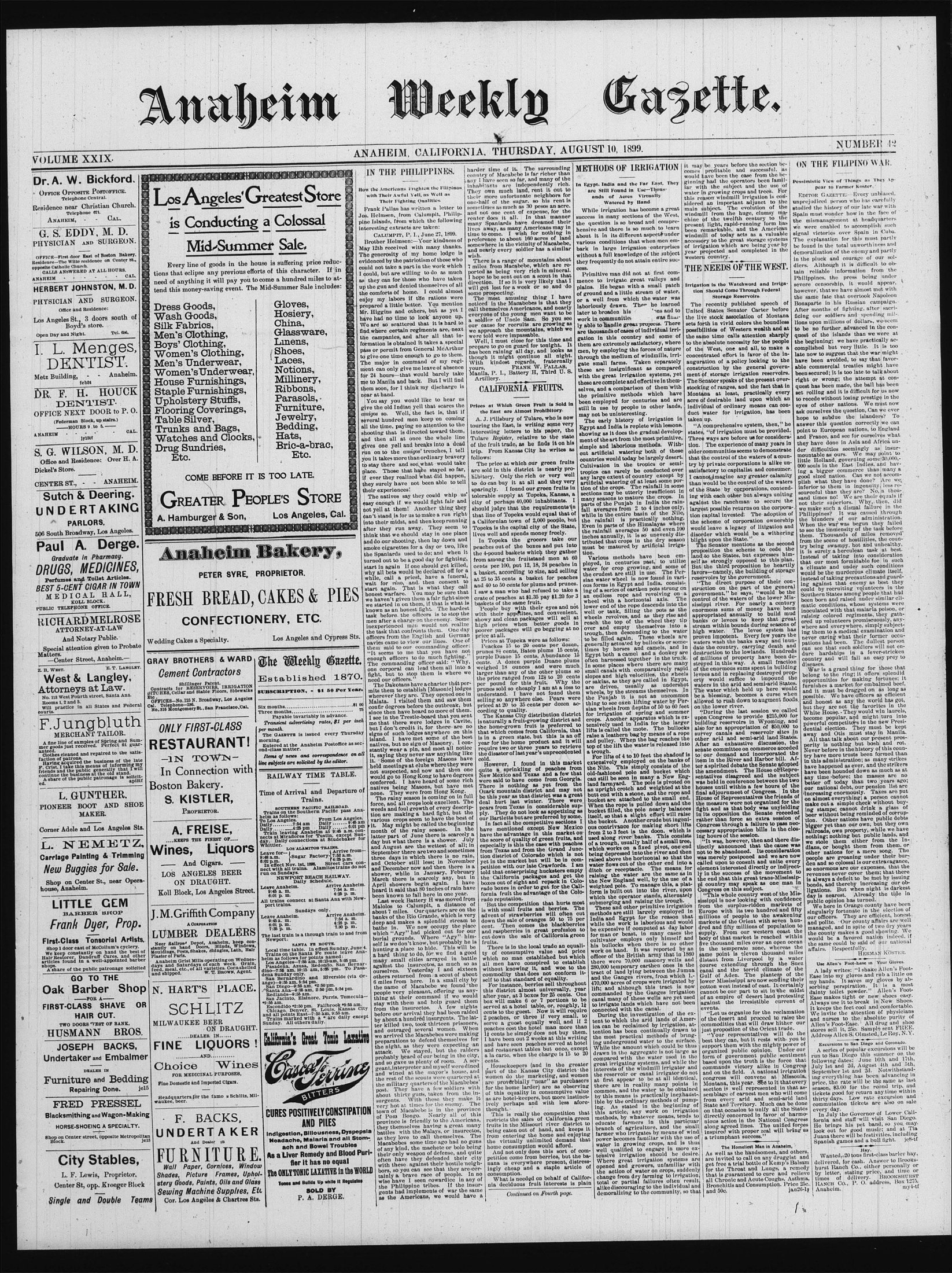
Searchable text
Anaheim
VOLUME XXIX.
Dr. A. W. Bickford.
OFFICE OPPOSITE POSTOFFICE.
Telephone Central.
Residence near Christian Church.
Telephone 671.
ANAHEIM, CAL.
G. S. EDDY, M. D.
PHYSICIAN AND SURGEON.
OFFICE—First door East of Boston Bakery.
Residence—The Wilte residence on Center St., opposite Catholic Church.
CALIS ANSWERED AT ALL HOURS.
ANAHEIM CAL.
HERBERT JOHNSTON, M. D.
PHYSICIAN AND SURGEON.
Office and Residence:
Los Angeles St., 3 doors south of Boyd's store.
Open Day and Night. Tel. 606,
I. L. Menges,
DENTIST.
Metz Building, Anaheim.
feb24
DR. F. H. HOUCK
DENTIST.
OFFICE NEXT DOOR to P. O.
(Federman Block, up stairs.)
HOURS 9 to 5.
ANAHEIM CAL.
S. G. WILSON, M. D.
Office and Residence: Over H. A. Dickel's Store.
Los Angeles' Greatest Store is Conducting a Colossal Mid-Summer Sale.
Every line of goods in the house is suffering price reductions that eclipse any previous efforts of this character. If in need of anything it will pay you to come a hundred miles to attend this money-saving event. The Mid-Summer Sale includes:
Dress Goods,
Wash Goods,
Silk Fabrics,
Men’s Clothing,
Boys’ Clothing,
Women’s Clothing,
Men’s Underwear,
Women’s Underwear,
House Furnishings,
Staple Furnishings,
Upholstery Stuffs,
Flooring Coverings,
Table Silver,
Trunks and Bags,
Watches and Clocks,
Drug Sundries,
Etc.
Gloves,
Hosiery,
China,
Glassware,
Linens,
Shoes,
Laces,
Notions,
Millinery,
Ribbons,
Parasols,
Furniture,
Jewelry,
Bedding,
Hats,
Bric-a-brac,
Etc.
DR. F. H. HOUCK
DENTIST.
OFFICE NEXT DOOR to P. O.
(Federman Block, up stairs.)
HOURS 9 to 5.
ANAHEIM
CAL.
Jy15tf
S. G. WILSON, M. D.
Office and Residence: Over H. A. Dickel's Store.
CENTER ST., - - ANAHEIM.
Sutch & Deering.
UNDERTAKING
PARLORS.
506 South Broadway, Los Angeles.
Paul A. Derge.
Graduate in Pharmacy.
DRUGS, MEDICINES,
Perfumes and Toilet Articles.
BEST 5-CENT CIGAR IN TOWN
MEDICAL HALL,
KOLL BLOCK.
PUBLIC TELEPHONE OFFICE.
RICHARDMELROSE
ATTORNEY-AT-LAW
And Notary Public.
Special attention given to Probate Matters.
—Center Street, Anaheim.
Z. B. WEST.
E. T. LANGLEY.
West & Langley,
Attorneys at Law.
No. 113 West Fourth street, Santa Ana.
Rooms 1, 2 and 3.
Will practice in all States and Federal courts.
F.Jungbluth
MERCHANT TAILOR.
A fine line of samples of Spring and Summer goods just received. Perfect fit guaranteed.
Clothes cleaned and repaired to the satisfaction of patrons.
Having acquired the business of the late F. Crist, I take this means of informing my friends and the public generally that I will continue the business at the old stand.
A share of the public patronage is solicited.
L. GUNTHER.
PIONEER BOOT AND SHOE MAKER.
Corner Adele and Los Angeles Sts.
L. NEMETZ,
Carriage Painting & Trimming
New Buggies for Sale.
Shop on Center St., near Opera-house, Anaheim.
WOMEN'S CLUBWEAR,
House Furnishings,
Staple Furnishings,
Upholstery Stuffs,
Flooring Coverings,
Table Silver,
Trunks and Bags,
Watches and Clocks,
Drug Sundries,
Etc.
COME BEFORE IT IS TOO LATE.
GREATER PEOPLE'S STORE
A. Hamburger & Son,
Los Angeles, Cal.
Anaheim Bakery,
PETER SYRE, PROPRIETOR.
FRESH BREAD, CAKES & PIES CONFECTIONERY, ETC.
Wedding Cakes a Specialty.
Los Angeles and Cypress St.
GRAY BROTHERS & WARD
Cement Contractors
Shillinger Patent.
Contracts for RESERVOIRS, IRRIGATION DITCHES, Cellar and Stable Floors, Sidewalks Etc.
OFFICES—No. 125 N. Broadway, Los Angeles Cal.
Telephone—236.
No. 316 Montgomery St., San Francisco, Cal.
ONLY FIRST-CLASS RESTAURANT!
-IN TOWNIn Connection with Boston Bakery.
S. KISTLER,
PROPRIETOR.
A. FREISE,
...KEEPS THE FINEST OF...
Wines, Liquors
And Cigars.
LOS ANGELES BEER ON DRAUGHT.
Koll Block, Los Angeles Street.
The Weekly Gazette
Established 1870
SUBSCRIPTION, - $1 50 Per Year
Six months....$3
Three months....$4
Payable invariably in advance.
Transient advertising rates,$1 per month.
The GAZETTE is issued every Thursday morning.
Entered at the Anaheim Postoffice as on-d-class matter.
Items of news and correspondence on live subjects are solicited by the editor.
RAILWAY TIME TABLE:
Time of Arrival and Departure Trains.
SOUTHERN PACIFIC RAILROAD.
Trains on the Southern Pacific pass Anaheim as follows:
To Los Angeles.
Daily.....7:54 am
Daily.....9:48 am
Daily.....4:25 pm
Daily.....6:00 pm
Train leaving Anaheim at 9:45 a.m.; nectes at Miradores for Tustin; except day. Daily connections at Studebaker Whittier.
LOS ALAMITOS TRAINS.
Leave for—
9:48 a.m.
Sugar Factory
7:52 a.m.
4:25 p.m.
In effect Nov. 1st, 1898.
Street cars necte with all trains. Alamitos trains do run on Sundays.
NEWPORT BEACH RAILWAY.
Daily Schedule.
Leave Anaheim.
9:45 a.m.
4:25 p.m.
L. NEMETZ,
Carriage Painting & Trimming
New Buggies for Sale.
Shop on Center St., near Opera-house, Anaheim.
LITTLE GEM
BARBER SHOP
Frank Dyer, Prop.
First-Class Tonsorial Artists.
Shop 1 door east of McCollum's cyclery.
We keep constantly on hand the best of Hair Restorer, Dandruff Cures, and other articles found in a well-appointed barber shops.
A share of the public patronage solicited
GO TO THE Oak Barber Shop
FOR A FIRST-CLASS SHAVE OR HAIR CUT.
TWO DOORS VEST OF BANK.
HUSMANN BROS.
JOSEPH BACKS,
Undertaker and Embalmer
DEALER IN
Furniture and Bedding Repairing Done. je15
FRED PRESSEL
Blacksmithing and Wagon-Making
HORSE-SHOEING A SPECIALTY.
Shop on Center street, opposite Metropolitan Block. je15
City Stables,
L. F. Lewis, Proprietor.
Center St, opp. Kroeger Block
Single and Double Teams
S. KISTLER,
PROPRIETOR.
A. FREISE,
Wines, Liquors
And Cigars.
LOS ANGELES BEER ON DRAUGHT.
Koll Block, Los Angeles Street.
J.M. Griffith Company
A CORPORATION
LUMBER DEALERS
Neer Railroad Depot, Anaheim, keep constantly on hand Doors, Blinds, Windows, Mouldings, Posts, Shakes, Shingles, Lath, Hair Plaster of Paris.
Anaheim Grist Mills operating on Wednesdays and Saturdays of each week. Grain, feed, meal, etc., of all varieties. Cornshellled and shipped.
N. HART'S PLACE.
SCHLitz
MILWAUKEE BEER ON DRAUGHT.
DEALER IN
FINE LIQUORS!
AND
Choice Wines
FOR MEDICINAL PURPOSES,
Fine Domestile and Imported Cigars.
F. BACKS,
UNDERTAKER
And Dealer in
FURNITURE.
Wall Paper, Cornices, Window Shades, Picture Frames, Upholstery Goods, Paints, Oils and Glass Sewing Machine Supplies, Etc.
Cor. Los Angeles & Chartres Sts.
SOUTHERN PACIFIC RAILROAD.
Trains on the Southern Pacific pass A helm as follows:
To Los Angeles.
Daily...7:54 am Daily...9:46 am
Daily...4:25 pm Daily...6:00 pm
Train leaving Anaheim at 9:45 a.m. nectes at Miraflores for Tustin, except Sunday. Dally connections at Studebaker Whittier.
LOS ALAMITOS TRAINS.
Leave for—
9:48 a.m. Sugar Factory 7:52 a.m. 4:25 p.m.
In effect Nov. 1st, 1898. Street cars necte with all trains. Alamitos trains do run on Sundays.
NEWPORT BEACH RAILWAY.
Daily Schedule.
Leave Anaheim.
9:45 a.m. 7:54 a.m. 4:25 p.m.
6:01 p.m. 4:25 p.m.
All trains connect at Santa Ana with Newport trains.
Sundays only.
Leave Anaheim.
9:45 a.m. 7:54 a.m. 4:25 p.m.
6:01 p.m. 4:25 p.m.
The last train is a through train to and from Newport.
SANTA FE ROUTE.
Local time table. In effect Sunday, Ju Trains on the Santa Fe route leave Anaheim as follows for points named:
Los Angeles—7:55 am 10:15 am 5:06 pm Pasadena, Azusa, Redondo. San Benito—7:55 am 10:15 am 5:06 pm Dena Sunday only.
San Bernardino and Riverside (via ange)—9:55 am 5:54 pm.
San Diego—9:55 am 2:50 pm.
Santa Ana—9:55 am 2:50 pm, 5:54 pm.
Redlands—9:55 am.
San Jacinto, Elsinore, Perris, Temeco—9:55 am.
Escondido*2:50 pm. Fallbrook*9:55 a Chicago, Denver, St. Louis, Kansas and all points East—7:55 am 9:55 am.
Trains marked with a * are daily e Sunday. All others daily.
California's Great Tonic Laxe
Cascade Terrine
BITTERS
CURES POSITIVELY CONSTIPAT AND PILES
Indigestion, Billousness, Dyspnea Headache, Malaria and all Sick and Bowel Troubles As a Liver Remedy and Blood Alter it has no equal The ONLY TONIC LAXATIVE in the Wones and Bulids Up while it Regulates
SOLD BY
P.A. DERGE.
IN THE PHILIPPINES.
How the Americans Frighten the Filipinos with Their Awful Yell, as Well as Their Fighting Qualities.
Frank Pallas has written a letter to Jos. Helmsen, from Calumpit, Philippine Islands, from which the following interesting extracts are taken:
CALUMPIT, P. I., June 27, 1899.
Brother Helmsen:—Your kindness of May 12th received with many thanks. The generosity of my home lodge is evidenced by the patriotism of those who could not take a part in the work which I could, but are willing to do as much as they can for those who have taken up the gun and denied themselves of all the comforts of home. I could almost enjoy my labors if the rations were prepared a little better. You mention Mr. Higgins and others, but as yet I have had no time to look anyone up. We are so scattered that it is hard to find where certain regiments are, next the companies, and after all that information is obtained it takes a special pass or permit from General McArthur to give one time enough to go to them. The major in command of my regiment can only give me leave of absence for 24 hours—that would barely take me to Manila and back. But I will find them soon, for I think my discharge is near at hand.
You say you would like to hear us give the old Indian yell that scares the amigos so. Well, the fact is, that if several hundred men keep on coming all the time, paying no attention to the shooting that is directed toward them, and then all at once the whole line gives one yell and breaks into a dead run on to the amigos’ trenches, I tell you it takes more than ordinary bravery to stay there and see what would take place. Those that have stayed so far, harder time of it. The surrounding country of Macabebe is far rich than any I have seen so far, and many of the inhabitants are independently rich. They own much land, rent it out to their more unfortunate neighbors for one-half of the sugar. so his rent is sometimes as much as 30 pesos an acre. and not one cent of expense, for the renter does it all. In that manner many Spaniards have dreamed their lives away, as many Americans may in time to come. I wish for nothing in preference to about 160 acres of land somewhere in the vicinity of Macabebe, and nearly every soldier has a similar wish.
There is a range of mountains about 7 miles from Macabebe, which are reported as being very rich in mineral. I hope to be sent out on a scout in that direction. If so it is very likely that I will get lost for a week or so and do some prospecting.
The most amusing thing I have noticed in the Macabebes is that they call themselves Americanos, and nearly everyone of the young men want to be a soldier of Uncle Sam. So you see our cause for recruits are growing as we approach the mountains, which we were told were impassable.
Well, I must close for this time and prepare to go on guard for tonight. It has been raining all day, and looks as though it might continue all night. With kindest regards, fraternally yours,
FRANK W. PALLAS,
Manila, P. I., Battery H, Third U.S. Artillery.
CALIFORNIA FRUITS.
Prices at Which Green Fruit is Sold in the East are Almost Prohibitory.
A J. Pillsbury of Tulare, who is now touring the East, is writing some very interesting letters to his paper, the Tulare Register, relative to the state of the fruit trade, as he finds it on his trip. From Kansas City he writes as follows:
The price at which our green fruits are sold in this district is nearly pro-
METHODS OF IRRIGATION
In Egypt, India and the Far East, There are Still Found in Use—Thousands of Acres Virtually Watered by Hand.
While irrigation has become a great success in many sections of the West, the question is so broad and comprehensive and there is so much to learn about it in its different aspects under various conditions that when men bark in large irrigation enterprises without a full knowledge of the subject they frequently do not attain entire success.
Primitive man did not at first commence to irrigate great valleys and plains. He began with a small path of ground and a little stream of water or a well from which the water was laboriously drawn. Then he learned later to broaden his fences and work in communities; was finally able to handle great projects. There are thousands of cases of individual irrigation in this country and some them are extremely satisfactory, when men, by employing the forces of nature through the medium of windmills, ingrate small farms. Taken separately these are insignificant as compared with the great irrigation systems, these are complete and effective in the selves, and a comparison of them with the primitive methods which have been employed for centuries and still in use by people in other lands may not be uninteresting.
The early history of irrigation in Egypt and India is replete with lessons showing as it does the gradual development of the art from the most primitive simple and laborious methods. While out artificial watering both of these countries would today be largely desolate Cultivation in the tropics or seas tropics can rarely be conducted...
Millinery, Ribbons, Parasols, Furniture, Jewelry, Bedding, Hats, Bric-a-brac, Etc.
O LATE.
E S STORE
Los Angeles, Cal.
BRIETOR.
Los Angeles and Cypress Sts.
Weekly Gazette.
Published 1870.
SCRIPTION, - 91 50 Per Year.
hours. $1 00 months. 75 available invariably in advance.
ment advertising rates, $1 per inch.
AZETTE is issued every Thursday.
at the Anaheim Postoffice as secmatter.
of news and correspondence on all
sets are solicited by the editor.
ALWAY TIME TABLE.
Of Arrival and Departure of Trains.
NORTHERN PACIFIC RAILROAD.
On the Southern Pacific pass Anafollows:
Angeles. From Los Angeles.
Daily. 4:45 pm Dally. 6:01 pm
leaving Anaheim Postoffice as secmatter.
of news and correspondence on all
sets are solicited by the editor.
ALWAY TIME TABLE.
Of Arrival and Departure of Trains.
NORTHERN PACIFIC RAILROAD.
On the Southern Pacific pass Anafollows:
Anglesea. From Los Angeles.
Daily. 4:45 pm Dally. 6:01 pm
leaving Anaheim Postoffice as secmatter.
of news and correspondence on all
sets are solicited by the editor.
ALWAY TIME TABLE.
Of Arrival and Departure of Trails.
NORTHERN PACIFIC RAILROAD.
On the Southern Pacific pass Anafollows:
Anglesea. From Los Angeles.
Daily. 4:45 pm Dally. 6:01 pm
leaving Anaheim Postoffice as secmature.
of news and correspondence on all
sets are solicited by the editor.
ALWAY TIME TABLE.
Of Arrival and Departure of Trails.
NORTHERN PACIFIC RAILROAD.
On the Southern Pacific pass Anafollows:
Anglesea. From Los Angeles.
Daily. 4:45 pm Dally. 6:01 pm
leaving Anaheim Postoffice as secmature.
of news and correspondence on all
sets are solicited by the editor.
CALIFORNIA FRUITS.
Prices at Which Green Fruit is Sold in
the East are Almost Prohibitory.
A. J. Pillsbury of Tulare, who is now
touring the East, is writing some very
interesting letters to his paper, the
Tulare Register, relative to the state
of the fruit trade, as he finds it on his
triip. From Kansas City he writes as
follows:
The price at which our green fruits
are sold in this district is nearly prohibitory. Only the rich or very well
to do can buy it at all and they very
sparingly. I found our green fruits in
tolerable supply at Topeka, Kansas,
a city of perhaps 40,000 inhabitants. I
should judge that the requirements in
that line of Topeka would equal that of
a California town of 2,000 people, but
Topeka is the capital city of the State,
lives well and spends money freely.
In Topeka the grocers take our
peaches out of the boxes and put into
the 4-pound baskets which they gather
from among the fruitstand at 60
cents per 100, put 12, 18, 24 peaches in a
basket, according to size, and selling
at 25 to 35 cents a basket for peaches
and 40 to 50 cents for plums and prunes.
I saw a man who had refused to take a
crate of peaches at $1.35 pay $1.20 for 3
baskets of the same fruit.
People buy with their eyes and not
with their appetites, and convenient,
showy and clean packages will sell at
high prices when better goods in
poorer packages will go begging at no
price at all.
Prices at Topeka were as follows:
Peaches 15 to 20 cents per dozen,
prunes 84 cents, Baton plums 15 cents,
purple Duane 15 cents, Abundance 15
cents. A dozen purple Duane plums
weighed 18 ounces and were much
larger than any of the other plums so
the price ranged from 124 to 20 cents
per pound for this fruit. Why the
prunes sold so cheaply I am at a loss to
understand. I have not found them
selling so anywhere else. Pears were
priced at 20 to 35 cents per dozen acording to quality.
The Kansas City distribution district is naturally a fruit-growing district and the home-grown fruit is preferred to that which comes from California, that is in a green state, but this is an off year for the home product and it will require two or three years to retrieve the disaster of last year's unprecedented cold.
However, I found in this market quite a sprinkling of peaches from New Mexico and Texas and a few that were said to have come from Georgia. There is nothing as yet from the Ozark mountain district and may not be this year as that district was a great deal hurt last winter. There were pears from Texas in considerable supply. They do not look as appetizing as our Bartletts but are preferred by some.
In fact all the competitive sections I have mentioned except New Mexico have the advantage in this market on the score of quality of green fruits, and especially is this case with peaches from Texas and from the Grand Junction district of Colorado which is not yet in the market but will be in competition with our late Crawfords. I am told that enterprising hucksters empty the California packages and get the boxes out of sight and repack in Colorado boxes in order to get for the California fruit the advantage of the Colorado reputation.
CALIFORNIA FRUITS.
Prices at Which Green Fruit is Sold in
the East are Almost Prohibitory.
A. J. Pillsbury of Tulare, who is now
touring the East, is writing some very interesting letters to his paper, the Tulare Register, relative to the state of the fruit trade, as he finds it on his trip. From Kansas City he writes as follows:
The price at which our green fruits are sold in this district is nearly prohibitory. Only the rich or very well to do can buy it at all and they very sparingly. I found our green fruits in tolerable supply at Topeka, Kansas, a city of perhaps 40,000 inhabitants. I should judge that the requirements in that line of Topeka would equal that of a California town of 2,000 people, but Topeka is the capital city of the State, lives well and spends money freely.
In Topeka the grocers take our peaches out of the boxes and put into the 4-pound baskets which they gather from among the fruitstand at 60 cents per 100, put 12, 18, 24 peaches in a basket, according to size, and selling at 25 to 35 cents a basket for peaches and 40 to 50 cents for plums and prunes. I saw a man who had refused to take a crate of peaches at $1.35 pay $1.20 for 3 baskets of the same fruit.
People buy with their eyes and not with their appetites, and convenient, showy and clean packages will sell at high prices when better goods in poorer packages will go begging at no price at all.
Prices at Topeka were as follows:
Peaches 15 to 20 cents per dozen,
prunes 84 cents, Baton plums 15 cents,
purple Duane 15 cents, Abundance 15
cents. A dozen purple Duane plums
weighed 18 ounces and were much larger than any of the other plums so the price ranged from 124 to 20 cents per pound for this fruit. Why the prunes sold so cheaply I am at a loss to understand. I have not found them selling so anywhere else. Pears were priced at 20 to 35 cents per dozen according to quality.
The Kansas City distribution district is naturally a fruit-growing district and the home-grown fruit is preferred to that which comes from California, that is in a green state, but this is an off year for the home product and it will require two or three years to retrieve the disaster of last year's unprecedented cold.
However, I found in this market quite a sprinkling of peaches from New Mexico and Texas and a few that were said to have come from Georgia. There is nothing as yet from the Ozark mountain district and may not be this year as that district was a great deal hurt last winter. There were pears from Texas in considerable supply. They do not look as appetizing as our Bartletts but are preferred by some.
In fact all the competitive sections I have mentioned except New Mexico have the advantage in this market on the score of quality of green fruits, and especially is this case with peaches from Texas and from the Grand Junction district of Colorado which is not yet in the market but will be in competition with our late Crawfords. I am told that enterprising hucksters empty the California packages and get the boxes out of sight and repack in Colorado boxes in order to get for the California fruit the advantage of the Colorado reputation.
CALIFORNIA FRUITS.
Prices at Which Green Fruit is Sold in
the East are Almost Prohibitory.
A. J. Pillsbury of Tulare, who is now touring the East, is writing some very interesting letters to his paper, the Tulare Register, relative to the state of the fruit trade, as he finds it on his trip. From Kansas City he writes as follows:
The price at which our green fruits are sold in this district is nearly prohibitory. Only the rich or very well to do can buy it at all and they very sparingly. I found our green fruits in tolerable supply at Topeka, Kansas, a city of perhaps 40,000 inhabitants. I should judge that the requirements in that line of Topeka would equal that of a California town of 2,000 people, but Topeka is the capital city of the State, lives well and spends money freely.
In Topeka the grocers take our peaches out of the boxes and put into the 4-pound baskets which they gather from among the fruitstand at 60 cents per 100, put 12, 18, 24 peaches in a basket, according to size, and selling at 25 to 35 cents a basket for peaches and 40 to 50 cents for plums and prunes. I saw a man who had refused to take a crate of peaches at $1.35 pay $1.20 for 3 baskets of the same fruit.
People buy with their eyes and not with their appetites, and convenient, showy and clean packages will sell at high prices when better goods in poorer packages will go begging at no price at all.
Prices at Topeka were as follows:
Peaches 15 to 20 cents per dozen,
prunes 84 cents, Baton plums 15 cents,
purple Duane 15 cents, Abundance 15
cents. A dozen purple Duane plums
weighed 18 ounces and were much larger than any of the other plums so the price ranged from 124 to 20 cents per pound for this fruit. Why the prunes sold so cheaply I am at a loss to understand. I have not found them selling so anywhere else. Pears were priced at 20 to 35 cents per dozen according to quality.
The Kansas City distribution district is naturally a fruit-growing district and the home-grown fruit is preferred to that which comes from California, that is in a green state, but this is an off year for the home product and it will require two or three years to retrieve the disaster of last year's unprecedented cold.
However, I found in this market quite a sprinkling of peaches from New Mexico and Texas and a few that were said to have come from Georgia. There is nothing as yet from the Ozark mountain district and may not be this year as that district was a great deal hurt last winter. There were pears from Texas in considerable supply. They do not look as appetizing as our Bartletts but are preferred by some.
In fact all the competitive sections I have mentioned except New Mexico have the advantage in this market on the score of quality of green fruits, and especially is this case with peaches from Texas and from the Grand Junction district of Colorado which is not yet in the market but will be in competition with our late Crawfords. I am told that enterprising hucksters empty the California packages and get the boxes out of sight and repack in Colorado boxes in order to get for the California fruit the advantage of the Colorado reputation.
CALIFORNIA FRUITS.
Prices at Which Green Fruit is Sold in
the East are Almost Prohibitory.
A. J. Pillsbury of Tulare, who is now touring the East, is writing some very interesting letters to his paper, the Tulare Register, relative to the state of the fruit trade, as he finds it on his trip. From Kansas City he writes as follows:
The price at which our green fruits are sold in this district is nearly prohibitory. Only the rich or very well to do can buy it at all and they very sparingly. I found our green fruits in tolerable supply at Topeka, Kansas, a city of perhaps 40,000 inhabitants. I should judge that the requirements in that line of Topeka would equal that of a California town of 2,000 people, but Topeka is the capital city of the State, lives well and spends money freely.
In Topeka the grocers take our peaches out of the boxes and put into the 4-pound baskets which they gather from among the fruitstand at 60 cents per 100, put 12, 18, 24 peaches in a basket, according to size, and selling at 25 to 35 cents a basket for peaches and 40 to 50 cents for plums and prunes. I saw a man who had refused to take a crate of peaches at $1.35 pay $1.20 for 3 baskets of these fruits.
People buy with their eyes and not with their appetites, and convenient, showy and clean packages will sell at high prices when better goods in poorer packages will go begging at no price at all.
Prices at Topeka were as follows:
Peaches 15 to 20 cents per dozen,
prunes 84 cents, Baton plums 15 cents,
purple Duane 15 cents, Abundance 15
cents. A dozen purple Duane plums
weighed 18 ounces and were much larger than any of the other plums so the price ranged from 124 to 20 cents per pound for this fruit. Why the prunes sold so cheaply I am at a loss to understand. I have not found them selling so anywhere else. Pears were priced at 20 to 35 cents per dozen according to quality.
The Kansas City distribution district is naturally a fruit-growing district and the home-grown fruit is preferred to that which comes from California, that is in a green state, but this is an off year for the home product and it will require two or three years to retrieve the disaster of last year's unprecedented cold.
However, I found in this market quite a sprinkling of peaches from New Mexico and Texas and a few that were said to have come from Georgia. There is nothing as yet from the Ozark mountain district and may not be uninterested.
The early history of irrigation Egypt and India is replete with lessen showing as it does the gradual development of areas from much earlier time since we started on them; if that is what we need it has been an honest notice! It one day officers from The English and German navies came to view our lines.
One of them said to our commanding officer: "It seems to me that you have not enough officers to do much fighting." The commanding officer said: "Why one corporal can lead them all into a fight; but stop them is where we need our officers."
The Dakotans have a charter that permits them to establish [Masonic] lodges wherever they are.] They opened one in Malata. I visited them and saw them conferring before the outbreak; but since have heard no more of them.I see in the Trestle-board that you sent me there were lodges in Cavite; but I don't credit it for there are no signs of such lodges anywhere on this island.I have met some of the best natives; but no sign of Masonry.I constantly wear a pin; and most all notice it,saying they never saw anything like it.Some of the foreign Masonics have held meetings at clubs where they were not suspected; and now and then one would go to Hong Kong to have degrees conferred.I have heard of some rich natives being Masons; but have met none.Theywere from Hong Kong.I
The Dakotans have a charter that permits them to establish [Masonic] lodges wherever they are.] They opened one in Malata.I see in the Trestle-board that you sent me there were lodges in Cavite; but I don't credit it for there are no signs of Masonry.I constantly wear a pin; and most all notice it,saying they never saw anything like it.Some of the foreign Masonics have held meetings at clubs where they were not suspected; and now和then one would go to Hong Kong to have degrees conferred.I have heard of some rich natives being Masons; but have met none.Theywere from Hong Kong.I
Salt Lake City Table.
Of Arrival and Departure of Trains.
Northern Pacific Railroad.
On The Southern Pacific pass Anabu follows:
Angeles.Angeles.Dallas.Daly.Dallas.Daly.Daly.Daly.Daly.Daly.Daly.Daly.Daly.Daly.Daly.Daly.Daly.Daly.Daly.Daly.Daly.Daly.Daly.Daly.Daly.Daly.Daly.Daly.Daly.Daly.Daly.Daly.Daly.Daly.Daly.Daly.Daly.Daly.Daly.Daly.Daly.Daly.Daly.Daly.Daly.Daly.Daly.Daly.Daly.Daly.Daly.Daly.Delay.
Los Alamitos Train.
Arrive from Los Angeles.Mainline Postoffice every Thursday.Andreas Anaheim Postoffice as securities matter.New News and correspondence on all trains are solicited by The editor.New News and correspondence on all trains are solicited by The editor.New News和correspondence on all trains are solicited by The editor.New News和correspondence on all trains are solicited by The editor.New News和correspondence on all trains are solicited by The editor.New News和correspondence on all trains are solicited by The editor.New News和correspondence on all trains are solicited by The editor.New News和correspondence on all trains are solicited by The editor.New News和correspondence on all trains are solicited by The editor.New News和correspondence on all trains are solicited by The editor.New News和correspondence on all trains are solicited by The editor.New News和correspondence on all trains are solicited by The editor.New News和correspondence on all trains are solicited by The editor.New News和correspondence on all trains are solicited by The editor.New News和correspondence on all trains are solicited by The editor.New News和correspondence on all trains are solicited by The editor.New News和correspondence on all trains are solicited by The editor.New News和correspondence on all trains are solicited by The editor.New News和correspondence on all trains are solicited by The editor.New News和correspondence on all trains are solicited by The editor.New News和correspondence on all trains are solicited by The editor.New News和correspondence on all trains are solicited by The editor.New News和correspondence on all trains are solicited by The editor.New News和correspondence on all trains are solicited by The editor.New News和correspondence on all trains are solicited by The editor.New News和correspondence on all trains are solicited by The editor.New News和correspondence on all trains are solicited by The editor.New News和correspondence on all trains are solicited by The editor.New News和correspondence on all trains are solicited by The editor.New News和correspondence on all trains are solicited by The editor.New News和correspondence on all trains are solicited by The editor.New News和correspondence on all trains are solicited by The editor.New News和correspondence on all trains are solicited by The editor.New News和correspondence on all trains are solicited by The editor.New News和correspondence on all trains are solicited by The editor.New News和correspondence on all trains are solicited by The editor.New News和correspondence on all trains are solicited by The editor.New News和correspondence on all trains are solicited by The editor.New News和correspondence on all trains are solicited by The editor.New News和correspondence on all trains are solicited by The editor.New News和correspondence on all trains are solicited by The editor.New News和correspondence on all trains are solicited by The editor.New News和correspondence on all trains are solicited by The editor.New News和correspondence on all trains are solicited by The editor.New News和correspondence on all trains are solicited by The editor.New News和correspondence on all trains are solicited by The editor.New News和correspondence on all trains are solicited by The editor.New NewsandcorrespondenceonalltrainsaresolicitatedbytheeditorNewNewsandcorrespondenceonalltrainsaresolicitatedbytheeditorNewNewsandcorrespondienceonalltrainsaresolicitatedbytheeditorNewNewsandcorrespondienceonalltrainsaresolicitatedbytheeditorNewNewsandcorrespondienceonalltrainsaresolicitatedbytheeditorNewNewsandcorrespondienceonalltrainsaresolicitatedbytheeditorNewNewsandcorrespondienceonalltrainsaresolicitatedbytheeditorNewNewsandcorrespondienceonalltrainsaresolicitatedbytheeditorNewNewsandcorrespondienceonalltrainsaresolicitatedbytheeditorNewNewsandcorrespondienceonalltrainsaresolicitatedbytheeditorNewNewsandcorrespondienceonalltrainsaresolicitatedbytheeditorNewNewsandcorrespondienceonalltrainsaresolicitatedbytheeditorNewNewsandcorrespondienceonalltrainsaresolicitatedbytheeditorNewNewsandcorrespondienceonalltrainsaresolicitatedbytheeditorNewNewsandcorrespondienceonalltrainsaresolicitatedbytheeditorNewNewsandcorrespondienceonalltrainsaresolicitatedbytheeditorNewNewsandcorrespondienceonalltrainsaresolicitatedbytheeditorNewNewsandcorrespondienceonalltrainsaresolicitatedbytheeditorNewNewsandcorrespondienceonalltrainsaresolicitatedbytheeditorNewNewsandcorrespondienceonalltrainsaresolicitatedbytheeditorNewNewsandcorrespondienceonalltrainsaresolicitatedbytheeditorNewNewsandcorrespondienceonalltrainsaresolicitatedbytheeditorNewNewsandcorrespondienceonalltrainsaresolicitatedbytheeditorNewNewsandcorrespondienceonalltrainsaresolicitatedbytheeditorNewNewsandcor respondienceonalltrainsaresolicitatedbytheeditorNewNewsandcor respondienceonalltrainsaresolicitatedbytheeditorNewNewsandcor respondienceonalltrainsaresolicitatedbythe EditorNewNewsandcor respondienceonalltrainsaresolicitatedbytheEditorNewNewsandcor respondienceonalltrainsaresolicitatedbytheEditorNewNewsandcor respondienceonalltrainsaresolicitatedbytheEditorNewNewsandcor respondienceonalltrainsaresolicitatedbytheEditorNewNewsand cor respondienceonalltrainsaresolicitatedbytheEditorNewNewsand cor respondienceonalltrainsare solicitatedbytheEditorNewNewsand cor respondienceonalltrainsare solicitatedbytheEditorNewNewsand cor respondienceonalltrainsare solicitatedbytheEditorNewNewsand cor respondienceonalltrainsare solicitatedbytheEditorNewNewsand cor respondienceonalltrainsare solicitatedbytheEditorNewNewsand cor respondienceonalltrainsare solicitatedbytheEditorNewNewsand cor respondienceonalltrainsare solicitatedbytheEditorNewNewsand cor respondienceonalltrainsare solicitatedbytheEditorNewNewsand cor respondienceonalltrainsare solicitatedbytheEditorNewNewsand cor respondienceonalltrainsare solicitatedbytheEditorNewNewsand cor respondienceonalltrainsare solicitatedbytheEditorNewNewsand cor respondienceonalltrainsare solicitatedbytheEditorNewNewsand cor respondienceonalltrainsare solicitatedbytheEditorNewNewsand cor respondienceonalltrainsare solicitatedbytheEditorNewNewsand cor respondienceonalltrainsare solicitatedbytheEditorNewNewsand cor respondienceonalltrainsare solicitatedbytheEditorNewNewsand cor respondienceonalltrainsare solictatedbytheEditorNewNewsand cor respondcienceonalltraintsaresolicitatedbytheEditorNewNewsand cor respondcienceonalltraintsaresolicitutedbytheEditorNewNewsand cor respondcienceonalltraintsaresolicitutedbytheEditorNewNewsand cor respondcienceonalltraintsaresolicitutedbytheEditorNewNewsand cor respondcienceonalltraintsaresolicitutedbytheEditorNewNewsand cor respondcienceonalltraintsaresolicitutedbytheEditorNewNewsand cor respondcienceonalltraintsaresolicitutedbytheEditorNewNewsand cor respondcienceonalltraintsaresolicitutedbytheEditorNewNewsand cor respondcienceonalltraintsaresolicitutedbytheEditorNewNewsand cor respondcienceonalltraintsaresolicitutedbytheEditorNewNewsand cor respondcienceonalltraintsaresoligitizedbytheEditorNewNewsand cor respondcienceonalltraintsaresoligitizedbytheEditorNewNewsand cor respondcienceonalltraintsaresoligitizedbytheEditorNewNewsand cor respondcienceonalltraintsaresoligitizedbythe EditorNewNewsand cor respondcienceonalltraintsareSoligitizedbythe EditorNewNewsand cor respondcienceonalltraintsAreSoligitizedByThe EditorNewNewsAndCorRespondibleByThe EditorNewNewsAndCorRespondibleByThe EditorNewNewsAndCorRespondibleByThe EditorNewNotesAndCorRespondibleByThe EditorNotesAndCorRespondibleByThe EditorNotesAndCorRespondibleByThe EditorNotesAndCorRespondibleByThe EditorNotesAndCorRespondibleByThe EditorNotesAndCorRespondibleByThe EditorNotesAndCorRespondibleByThe EditorNotesAndCorRespondibleByThe EditorNotesAndCorRespondibleBy
The rainy season is coming, and all crops look excellent. The weeds and foul growth of every description are making a hard fight, but the various crops seem to have the best of it. May might be called the beginning month of the rainy season. In the latter part of June there is scarcely a day but what there is a shower. July and August are the wettest of all; in September there are two and sometimes three days in which there is no rain, and October still less; in November and December now and then there is a shower, while in January, February March there is scarcely any, but in April showers begin again. I have heard it said that 80 inches of rain have been known to fall in one year.
Last week Battery H was moved from Malolos to Calumpit, a distance of about 7 miles. Our quarters are on the banks of the Rio Grande, which is very deep and makes a splendid stream to bathe in. We now occupy the place which "Agy" had picked out for our burial grounds. Where "Agy" himself is we don't know, but probably he is hunting a place to hide. This will be a hard thing to do, for we find a good many small cities arrayed in battle against the insurectos, as much so as ourselves. Yesterday I and sixteen others returned from a scout of about 6 miles from here. In a small city by the name of Macabebe we found the people very pleasant, offering us anything at their command if we would stay with them and help guard them from the insurectos. A few nights before our arrival they had been raided by about a hundred insurgents. The latter killed two, took thirteen prisoners, and outraged several women. When we arrived the Macabebes were making preparations to defend themselves for the night, as they were expecting an attack. We stayed, but the raiders probably beard of our being in the city, and so gave us plenty of room. A sergeant, interpreter and myself were dined and wined at the mayor's house, and the rest of the scouts were quartered at the military quarters of the Macabebes' post. They have a few soldiers with about thirty guns, taken from the insurgents. With these they make it very hot at times for the enemy. The town of Macabebe is in the province of Pom Bongo. Nearly all of this province is friendly to the Americans, they themselves having a great many battles with the Malays, or insurectos, as they love to call themselves. The Macabebes some time ago had no guns of any kind, the machete or bolo being their only weapon of defense, and quite often have they defended their city with these against their hostile neighbors, so you can see that they are certainly a brave race of people. In no wise have I seen cowardice in any of the Philippine tribes. If the insurgents had implements of war the same as the Americans, we would have a deal hurt last winter. There were pears from Texas in considerable supply. They do not look as appetizing as our Bartletts but are preferred by some.
In fact all the competitive sections I have mentioned except New Mexico have the advantage in this market on the score of quality of green fruits, and especially is this case with peaches from Texas and from the Grand Junction district of Colorado which is not yet in the market but will be in competition with our late Crawfords. I am told that enterprising hucksters empty the California packages and get the boxes out of sight and repack in Colorado boxes in order to get for the California fruit the advantage of the Colorado reputation.
But the competition that hurts most is with small fruits and berries. The advent of strawberries will often cut down the sale of oranges 50 to 75 per cent. Then comes the blackberries and raspberries in great profusion to cut down the sale of California green fruits.
There is in the local trade an equality of consumptive value and price which no man established but which all men have conspired to establish without knowing it, and woe to the commodity that does not conform itself to that standard of equality.
For instance, berries sell throughout this district almost universally, year after year, at 3 boxes for 25 cents. One box will make 6 or 7 portions to be served at a hotel table, or roughly 1¼ cents to the guest. Now it will require 2 peaches, or three if very small, to serve a guest equally well, and if 2 peaches cost the hotel man more than 1¼ cents he simply does not buy them. I have been out 2 weeks at this writing and have seen peaches served at hotel and restaurant tables but once, except a la carte, when the charge is 15 to 20 cents.
Housekeepers (and in the greater part of the Kansas City district—the women do the marketing, and women are proverbially "near" as purchasers for the home larder) are as observing of this equality in consumptive value as are hotel-keepers, but more instinctively perhaps and with less aforethought.
This is really the competition that restricts the sales of California green fruits in the Missouri river district to being eaten out of hand, and keeps it from entering the home and enjoying virtually unlimited demand that home consumption would afford.
And not only does this sort of competition come from berries, but the banana is everywhere present, distressingly cheap and a staple article of consumption.
What is needed on behalf of California deciduous fruit interests is plain
Continued on Fourth page.
Gazette.
APRIL 10, 1899. NUMBER 42
METHODS OF IRRIGATION
India and the Far East, They Still Found in Use—Thousands of Acres Virtually Watered by Hand.
The irrigation has become a great force in many sections of the West. Question is so broad and comprehensive that there is so much to learn about its different aspects under various conditions that when men employ large irrigation enterprises it frequently do not attain entire successive man did not at first come to irrigate great valleys and hills. He began with a small patch land and a little stream of water, well from which the water was easily drawn. Then he learned to broaden his lands and to communicate with communities to handle great projects. There thousands of cases of individual irrigations in this country and some of these extremely satisfactory, where by employing the forces of nature on the medium of windmills, irrigation farms. Taken separately are insignificant as compared to the great irrigation systems, yet are complete and effective in them and a comparison of them with primitive methods which have employed for centuries and are used by people in other lands, but be uninteresting.
The early history of irrigation in India is replete with lessons, as it does the gradual development of the art from the most primitive and laborious methods. With artificial watering both of these cities would today be largely desertation in the tropics or semisert can rarely be conducted over it may be years before the section becomes profitable and successful. As would have been the case from the beginning had the operators been familiar with the subject and the use of water in growing crops and trees. For this reason windmill irrigation is considered an important adjunct to the main subject. The evolution of the windmill from the huge, clumsy machine of the twelfth century to the present light, rapid-running form has been remarkable, and the American windmill of today acts as a valuable accessory to the great storage systems of irrigation which are being year by year projected and completed in the western country.
THE NEEDS OF THE WEST.
Irrigation is the Watchword and Irrigation Should Come Through Federal Storage Reservoirs.
The recently published speech of United States Senator Carter before the live stock association of Montana sets forth in vivid colors the boundless possibilities of Western wealth and at the same time calls attention sharply to the absolute necessity for the people of the West, one and all, to make a concentrated effort in favor of the inauguration of a policy looking to the construction by the general government of storage irrigation reservoirs. The Senator speaks of the present overstocking of ranges, and the fact that in Montana at least, practically every acre of desirable land upon which an individual of ordinary means can conduct water for irrigation, has been taken up.
"A comprehensive system, then," he states, "of irrigation must be provided. Three ways are before us for consideration. The experience of many years in older communities seems to demonstrate that the control of the waters of a country by private corporations is alike unsatisfactory to capitalist and consumer.
ON THE FILIPINO WAR.
Pessimistic View of Things as They Appear to Farmer Koster.
EDITOR GAZETTE: Every unbiased, unprejudiced person who has carefully studied the history of our late war with Spain must wonder how in the face of the mismanagement at headquarters we were enabled to accomplish such signal victories over Spain in Cuba. The explanation for this must partly be found in the total unworthiness and demoralization of the enemy and partly in the pluck and courage of our soldiers. Although it is difficult to obtain reliable information from the Philippines, the press being under severe censorship, it would appear, however, that we have almost met with the same fate that overtook Napoleon Bonaparte in his Russian campaign. After months of fighting, after sacrificing our soldiers and spending millions upon millions of dollars, we seem to be no further advanced in the conquest of the islands than we were at the beginning; we have practically accomplished but very little. It is too late now to suggest that the war might have been avoided, to say that favorable commercial treaties might have been secured; it is too late to talk about right or wrong; the attempt at conquest has been made, the ball has been set rolling and it is difficult for us now to recede without losing prestige in the eyes of other nations. We must now ask ourselves the question, Can we ever hope to subdue the islanders? To answer this question correctly we can point to European nations, to England and France, and see for ourselves what they have done in Asia and Africa under difficulties seemingly as insurmountable as ours. We may point to little Holland, governing some 30,000,000 souls in the East Indies, and having a bigger commerce than many a
The early history of irrigation in India and India is replete with lessons, as it does the gradual development of the art from the most primitive and laborious methods. With artificial watering both of these societies would today be largely deserted in the tropics or semi-arid can rarely be conducted over large extent of country except by natural watering at least some portions of the crops. The rainfall in some states may be utterly insufficient in seasons to mature the crops. In the Punjab in India the rain averages from 2 to 4 inches only in the entire basin of the Nile. Rainfall is practically nothing in parts of the Himalayas where rainfall averages 50 and even 100 annually, it is so unevenly distributed that crops in the dry season are borne by artificial irrigation.
Several methods have been employed, in centuries past, to utilize water for crop growing, and some of their are still in use. The Per-water wheel is now found in variegated forms in Egypt and India, consisted of a series of earthen pots strung on endless rope and revolving on a metal with a horizontal axis. The end of the rope descends into the river or tank, filling the pots as the wheels revolves, and as they rise and then drop down, then descending to the water they fill again. These wheels are usually actuated by bullocks or sometimes by horses and camels, and in not both a camel and a donkey are often harnessed together in the trunk. Some places where there are many canalis with comparatively rapid rates and high velocities, the wheels skikers, as they are called in Egypt, driven, usually as undershot wheels, by the streams themselves. In Punjab it is not an uncommon dog to see oxen lifting water by Per-water wheels from depths of 50 to 60 feet in irrigation of spring and summer months. Another apparatus which is extensively used in India for the larger dogs is called the mote. The bullocks are a leathern bag by means of a rope pulley. When the bag reaches the bottom of the lift the water is released intoough.
For lifts of 4 to 10 feet the shadouf is intensively employed on the banks of Nile. This simply consists of the fashioned pole and bucket which still be seen in many a New England farmyard. The pole is pivoted on upright crotch and weighted at the end with a stone, and the rope and ticket are attached to the small end. When the rope is pulled down and the ticket filled, the pole nearly balances itself, so that a slight effort will raise bucket. Another crude but ingenious contrivance for making short lifts from 2 to 3 feet is the doon, which is held along river banks. This consists of though, usually half of a small tree, which works on a fixed pivot, one end being depressed into the river and then raised above the horizontal so that the water flows out of the other end into autch or receptacle. The means for raising the water are the same as in New England well, by the use of a lighted pole. To manage this, a platform is built into the river, upon which the operator stands, alternately.
The Senator speaks of the present overstocking of ranges, and the fact that in Montana at least, practically every acre of desirable land upon which an individual of ordinary means can conduct water for irrigation, has been taken up.
"A comprehensive system, then," he states, "of irrigation must be provided. Three ways are before us for consideration. The experience of many years in older communities seems to demonstrate that the control of the waters of a country by private corporations is alike unsatisfactory to capitalist and consumer. I cannot imagine any greater calamity than would be the control of the waters of the State by corporations, contending with each other but always uniting against the ranchman to secure the largest possible returns on the corporation capital invested. The adoption of the scheme of corporation ownership would leave a legacy of litigation and disorder which would be a withering blight upon the State."
The Senator mentions as the second proposition the scheme to cede land to the States, but expresses himself as strongly opposed to this plan. But the third proposition he heartily favors—namely, the building of storage reservoirs by the government.
"The direct purpose of their construction on the part of the general government," he says, "would be the control of the waters of the lower Mississippi river. For nearly a century enormous sums of money have been appropriated annually to build mud banks or levees to keep that great stream within bounds during seasons of high water. The levee system has proven impotent. Every few years the waters wash the banks away and inundate the country, carrying death and destruction to the lowlands. Hundreds of millions of property have been destroyed in this way. A small fraction of the enormous sums spent in building levees and in replacing destroyed property would suffice to impound the waters in the arid and semi-arid States. The water which held up here would be a blessing, becomes a curse when allowed to rush down to augment floods, on the lower river.
"During the last session we called upon Congress to provide $215,000 for building reservoirs in Wyoming, and also for an appropriation of $50,000 to survey canals and reservoir sites in other arid and semi-arid land States. After an exhaustive discussion, the senate committee on commerce acceded to our demand and incorporated them in River and Harbor bill. After a spirited debate the Senate adopted the amendment. The House of Representatives disagreed and the subject was held in conference between the two houses until within a few hours of the final adjournment of Congress. In the House of Representatives the friends of the measure were not organized for the fight and as that body was unyielding in its opposition the Senate succeeded rather than force an extra session of Congress through a failure to pass necessary appropriations bills in the closing hours of the session.
"It was, however, then and there distinctly announced that the cause was not to be abandoned. Its consideration was merely postponed and we are now called upon to consult and unite every element interested directly or indirectly in the success of the movement to the end that this great trans-Mississippi country may speak as one man in Congress on this subject."
This whole country west of Mississippi is now seeking with confidence
The Senator speaks of the present overstocking of ranges, and the fact that in Montana at least, practically every acre of desirable land upon which an individual of ordinary means can conduct water for irrigation, has been taken up.
"A comprehensive system, then," he states, "of irrigation must be provided. Three ways are before us for consideration. The experience of many years in older communities seems to demonstrate that the control of the waters of a country by private corporations is alike unsatisfactory to capitalist and consumer. I cannot imagine any greater calamity than would be the control of the waters of the State by corporations, contending with each other but always uniting against the ranchman to secure the largest possible returns on the corporation capital invested. The adoption of the scheme of corporation ownership would leave a legacy of litigation and disorder which would be a withering blight upon the State."
The Senator mentions as the second propositionthe scheme to cede land tothe States,but expresses himself as strongly opposedto this plan.Butthethirdpropositionheheartily favors—namely,thebuildingofstoragereservoirsbythegovernment.
"The direct purposeof theirconstructiononthepartofthegeneralgovernment,"he says,"wouldbethecontrolofthewatersofthelowerMississippiriver.Forearlyacentremoussumsofmoneyhavebeenappropriatedannuallytobuildmudbanksorleveestokeepthatgreatstreamwithboundsbundlesduringseasonsofhighwater.Theleveeystemhasprovenimpotent.Everyfewyearsthewaterswashthebanksawayandinundatethecountry,carryingdeathanddestructiontothelowlands.Hundredsofmillionsofpropertyhavebeendestroyedinthisway.Asmallfractionoftheenormoussumspentinbuildingleveesandinplacingsoldentherwaterinthesaridandsemi-aridStates.Afteranexhaustivediscussion,thesenatecommitteeoncmerceaccededtoourdemandandincorporatediteminRiverandHarborbill.AfteraspiriteddebateTheSenateadoptedtheamendment.TheHouseOfRepresentativesdisagreedandthesubjectwasheldinconferencebetweenthetwohousesuntilwithafewhoursofthefinaladjournemeetofCongress.IntheHouseOfRepresentativesthefriendsofthemeasurewerenotorganizedforthefightandasthatbodywasunyieldinginitsoppositionTheSenaterecederedratherthanforceanextrasessionOfCongressthroughafailuretousecessaryappropriationsbillsintheclosinghoursofthesession.
"Itwashowever,thenandtheredistinctlyannouncedthatthecausewasnottobeabsorbed.Itsconsiderationwasmerelypostponedandwearenowcalledupontoconsultanduniteeveryelementinteresteddirectlyorindirectlyinthesuccessofthemovementtotheendthatthisgreattrans-MississippicountrymayspeakasonemaninCongressonthissubject."
ThiswholecountrywestofMississippiisnowlookingwithconfidence
The Senator speaks of the present overstocking of ranges, and the fact that in Montana at least, practically every acre of desirable land upon which an individual of ordinary means can conduct water for irrigation, has been taken up.
"A comprehensive system, then," he states, "of irrigation must be provided. Three ways are before us for consideration. The experience of many years in older communities seems to demonstrate that the control ofthewatersofacountrybyprivatecorporationsisalikeunsatisfactorytocapitalistandconsumer. I cannot imagine any greater calamity than would bethecontrolofthewatersoftheStatebycorporationscontrollingwitheachotherbutalwaysunitingagainstthat enemyasbesttheyfrequentlyaskefromsuchtrusteesbecausebestsoldundertherunkenandsocolossalisowestravagance,somenequiresareourexpenses;thattherevenuesnevercoverthem;thatthereisalwaysdeficittobetimey issuingbonds,andtherebyincreasingourobligations.Butwhennightisdarkestdayisnearest.Alreadythetidein
The market are attached to the small end when the rope is pulled down and the basket filled, the pole nearly balances itself, so that a slight effort will raise it bucket. Another crude but ingenious contrivance for making short lifts from 2 to 3 feet is the doom, which is held along river banks. This consists of a trough, usually half of a small tree, which works on a fixed pivot, one end depressed into the river and then raised above the horizontal so that the water flows out of the other end into a trench or receptacle. The means for raising the water are the same as in the New England well, by the use of a lighted pole. To manage this, a plattern is built out into the river, upon which the operator stands, alternately emerging and raising the trough.
These and other primitive irrigation methods are still largely employed in India and Egypt for the reason that while the work is laborious and would be expensive if computed at day labor for man or beast, in many cases the cultivator employs only himself and his bullocks when there is no other work on hand. It was reported by an officer of the British army that in 1860 there were 70,000 masonry wells and 50,000 temporary earthen ones in the spot of land lying between the Jumna and the Ganges rivers, from which 10,000 acres of crops were irrigated by water; and although this tract is now commanded by the Ganges irrigation canal many of these wells are yet used in irrigate lands which have not been connected with the canal.
During the investigation of the extent to which the arid lands of America can be reclaimed by irrigation, attention has been continually drawn to the most practical methods of bringing underground water to the surface. While the amount which could be thus drawn in the aggregate is not large as compared with the water used in the great irrigating systems, and while the interests of the windmill irrigator and the reservoir or canal irrigator do not first appear to be at all identical, there are in reality many points in common, and the water to be obtained by this means is practically inexhaustible by the ordinary methods of pumping. As stated in the beginning of this article, any work on irrigation methods, by whatever means, tends to educate farmers in this particular branch of agriculture, and the small farmer who irrigates by means of wind power becomes familiar with the use of water in growing crops, and is thus well qualified to engage in more extensive irrigation should he desire.
Where great irrigation systems are opened and growers, unfamiliar with the action of water on crops, suddenly change from dry farming to irrigation, total or partial failures often result, alike discouraging to the individual and demoralizing to the community, so that House of Representatives take the measure were not organized for the fight and as that body was unyielding in its opposition the Senate receded rather than force an extra session of Congress through a failure to pass necessary appropriation bills in the closing hours of the session.
"It was, however, then and there distinctly announced that the cause not to be abandoned. Its consideration was merely postponed and we are now called upon to consult and unite every element interested directly or indirectly in the success of the movement to the end that this great trans-Mississippi country may speak as one man in Congress on this subject.
"This whole country west of the Mississippi is now looking with confidence from the surplus-ridden markets of Europe with its two hundred and fifty millions of people to the awakening markets of the Orient with seven hundred and fifty millions of population to supply. From our western coast the body of that market is reached within five thousand miles over an open ocean in the temperate zone, whereas the same point is eleven thousand miles distant from Liverpool by a water course extending through the Suez canal and the torrid climate of the Gulf of Aden. The planters of the lower Mississippi are now sending their cotton west instead of east. It certainly cannot be our part to sit in the midst of an empire of desert land protesting against the irresistible current of events.
"Let us organize for the reclamation of the desert and proceed to raise the commodities that will draw hither our just proposition of the Orient trade.
"Your representatives will do best they can, but it rests with you to support them with the mighty power of organized public opinion. Under our form of government public sentiment based upon the truth is the force that commands victory alike in Congress and on the field. A national irrigation congress will convene at Missoula, Montana, this year. See it to that every section is well represented in thatsemblage of earnest men who will come from every arid and semi-arid land State and Territory. Much can be done on that occasion to unify all the States directly concerned in favor of harmonious action in the National Congress along agreed lines. The unified forces inspired with proper zeal will bring us a triumphant success."
The Homeliest Man in Anaheim,
As well as the handsomest, and others, are invited to call on any druggist and get free a trial bottle of Kemp's Balsam for the Throat and Lungs, a remedy that is guaranteed to cure and relieve all Chronic and Acute Coughs. Asthma, Bronchitis and Consumption. Price 25c. and 50c.
jan26-1p
Herman Koster.
Use Allen's Foot-Ease in Your Gloves.
A lady writes: "I shake Allen's Foot-Ease into my gloves and rub a little on my hands. It saves my gloves by absorbing perspiration. It is a most dainty toilet powder." Allen's Foot-Ease makes tight or new shoes easy. Always use it to break in New Shoes. It keeps the feet cool and comfortable. We invite the attention of physicians and nurses to the absolute purity of Allen's Foot-Ease. All drug and shoe stores sell it, 25c. Sample sent FREE. Address Allen S. Olmsted, Le Roy, N.Y.
Excursions to San Diego and Coronado.
A series of popular excursions will be run to San Diego this summer on the following dates: June 16th and 17th, July 1st and 2d, August 4th and 5th, September 1st and 2d. Notwithstanding everything has been advancing in price, the rate will be the same as last season, $3.00 for the round trip, and tickets good for return any time within thirty days. Low rate excursion and commutation tickets are also on sale every day.
In July the Governor of Lower California and staff will visit San Diego. He brings his pet band, so you may look out for good music; and at Tia Juana there will be festivities, including Spanish games and a bull fight. je8-tf
Hay.
Wanted, 20 tons first-class barley hay, delivered, for cash. Answer to Brookshurst Ranch Co., either personally or by letter, stating price, and time or times of delivery. Brookshurst Ranch Co., P. O. address, Box 1275. Anaheim.
my4-tf