anaheim-gazette 1899-07-27
Scanned page
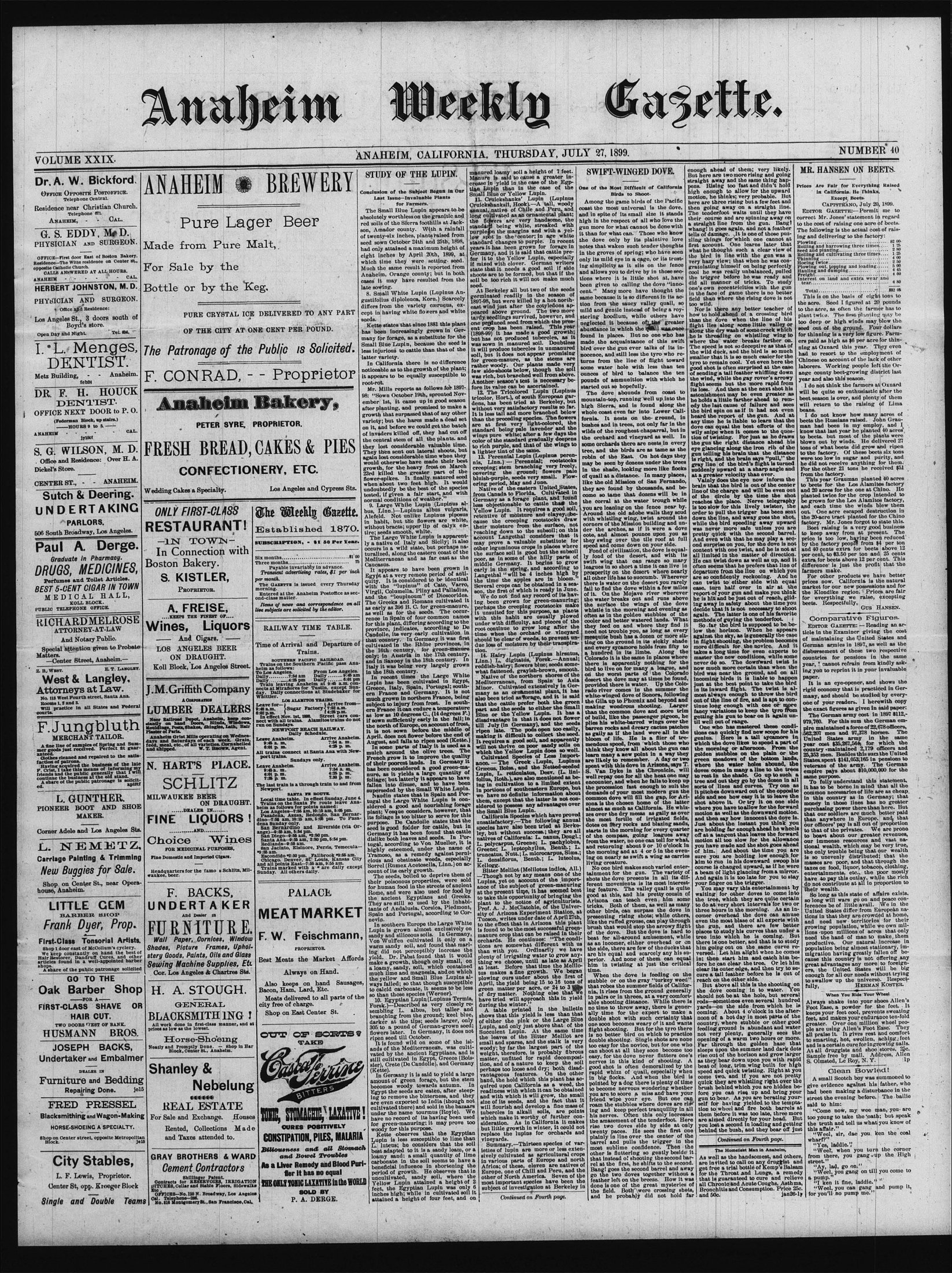
Searchable text
Anaheim
VOLUME XXIX.
Dr. A. W. Bickford.
OFFICE OPPOSITE POSTOFFICE.
Telephone Central.
Residence near Christian Church.
Telephone 671.
ANAHEIM, CAL.
G. S. EDDY, M. D.
PHYSICIAN AND SURGEON.
OFFICE—First door East of Boston Bakery.
Residence—The Witte residence on Center St., opposite Catholic Church.
CALLS ANSWERED AT ALL HOURS.
ANAHEIM CAL.
HERBERT JOHNSTON, M. D.
PHYSICIAN AND SURGEON.
Office and Residence:
Los Angeles St., 3 doors south of Boyd's store.
Open Day and Night. Tel. 824.
I. L. Menges,
DENTIST.
Metz Building, Anaheim.
feb24
DR. F. H. HOUCK
DENTIST.
OFFICE NEXT DOOR to P. O.
(Federman Block, up stairs.)
HOURS 9 to 5
ANAHEIM CAL.
S. G. WILSON, M. D.
Office and Residence: Over H. A. Dickel's Store.
ANAHEIM BREWERY
Pure Lager Beer
Made from Pure Malt,
For Sale by the
Bottle or by the Keg.
PURE CRYSTAL ICE DELIVERED TO ANY PART OF THE CITY AT ONE CENT PER POUND.
The Patronage of the Public is Solicited.
F. CONRAD, - Proprietor
Anaheim Bakery,
PETER SYRE, PROPRIETOR.
FRESH BREAD, CAKES & PIES
CONFECTIONERY, ETC.
DR. F. H. HOUCK
DENTIST.
OFFICE NEXT DOOR to P. O.
(Federman Block, up stairs.)
HOURS 9 to 5
ANAHEIM
CAL.
Jy1541
S. G. WILSON, M. D.
Office and Residence: Over H. A. Dickel's Store.
CENTER ST., - ANAHEIM.
Sutch & Deering.
UNDERTAKING
PARLORS.
506 South Broadway, Los Angeles.
Paul A. Derge.
Graduate in Pharmaoy.
DRUGS, MEDICINES,
Perfumes and Toilet Articles.
BEST 5-CENT CIGAR IN TOWN
MEDICAL HALL,
KOLL BLOCK.
PUBLIC TELEPHONE OFFICE.
RICHARD MELROSE
ATTORNEY-AT-LAW
And Notary Public.
Special attention given to Probate Matters.
—Center Street, Anaheim—
Z. B. WEST.
E. T. LANGLEY.
West & Langley,
Attorneys at Law.
No. 113 West Fourth street, Santa Ana.
Rooms 1,2 and 3.
Will practice in all States and Federal courts.
F. Jungbluth
MERCHANT TAILOR.
A fine line of samples of Spring and Summer goods just received. Perfect fit guaranteed.
Clothes cleaned and repaired to the satisfaction of patrons.
Having acquired the business of the late F. Jungbluth, I take this means of informing my friends and the public generally that I will continue the business at the old stand.
A share of the public patronage is solicited.
L. GUNTHER.
PIONEER BOOT AND SHOE MAKER.
Corner Adele and Los Angeles Sts.
L. NEMETZ.
Carriage Painting & Trimming
New Buggies for Sale.
Shop on Center St., near Opera-house, Anaheim.
ONLY FIRST-CLASS RESTAURANT!
IN TOWNIn Connection with Boston Bakery.
S. KISTLER,
PROPRIETOR.
A. FREISE,
Wines, Liquors
And Cigars.
LOS ANGELES BEER ON DRAUGHT.
Koll Block, Los Angeles Street.
J.M. Griffith Company
A CORPORATION
LUMBER DEALERS
Neer Railroad Depot, Anaheim, keep constantly on hand Doors, Blinds, Windows, Mouldings, Posts, Shakes, Shingles, Lath, Hair Plaster of Paris.
Anaheim Grist Mills operating on Wednesdays and Satursdays of each week. Grain, feed, meal, etc., of all varieties, Cornshellled and shipped.
N. HART'S PLACE.
SCHLITZ
MILWAUKEE BEER ON DRAUGHT.
DEALER IN...
FINE LIQUORS!
AND
Choice Wines FOR MEDICINAL PURPOSES,
Fine Domestic and Imported Cigars.
Headquarters for the famo s Schlitz, Milwaukee, beer.
F. BACKS,
Anaheim Bakery,
PETER SYRE, PROPRIETOR.
FRESH BREAD, CAKES & PIES CONFECTIONERY, ETC.
Wedding Cakes a Specialty.
Los Angeles and Cypress Sts
The Weekly Gazette
Established 1870
SUBSCRIPTION, - $1 50 Per Year
Six months....$1
Three months....$1
Payable invariably in advance.
Transient advertising rates,$1 per in per month.
The GAZETTE is issued every Thursday morning.
Entered at the Anaheim Postoffice as second-class matter.
Items of news and correspondence on a live subject are solicited by the editor.
RAILWAY TIME TABLE.
Time of Arrival and Departure Trains.
SOUTHERN PACIFIC RAILROAD.
Trains on the Southern Pacific pass Anaheim as follows:
To Los Angeles... From Los Angeles
Daily... 7:54 am Daily... 9:45 am
Daily... 4:25 pm Daily... 6:01 pm
Train leaving Anaheim at 9:45 a.m. connects at Mirandares for Tustin, except Sunday. Daily connections at Studebaker fWhittier.
LOS ALAMITOS TRAINS.
Leave for...
Sugar Factory
Arrive from
9:48 a.m.
6:02 p.m.
In effect Nov. 1st, 1898. Street cars connect with all trains. Alamitos trains do not run on Sundays.
NEWPORT BEACH RAILWAY.
Daily Schedule.
Leave Anaheim.
Arrive Anaheim
9:45 a.m.
6:01 p.m.
All trains connect at Santa Ana with Newport trains.
Sundays only.
Leave Anaheim.
Arrive Anaheim
9:45 a.m.
6:01 p.m.
7:35 p.m.
7:30 p.m.
The last train is a through train to and from Newport.
SANTA FE ROUTE.
Local time table. In effect Sunday, June Trains on the Santa Fe route leave Anaheim as follows named:
Los Angeles-7:55 am; 10:15 am; 5:06 pm.
Pasadena, Azusa, Redondo, San Bernardo-7:55 am; 10:15 am; 5:06 pm. To Pasadena Sunday only.
San Bernardino and Riverside (via Orange)-9:55 am; 5:54 pm.
San Diego-9:55 am; 2:50 pm;
San Isaac-9:55 am; 2:50 pm; 5:54 pm.
Redlands-9:55 am;
San Jacinto, Elsinore, Perris, Temecula-9:55 am;
Escondido*2:50 pm; Fallbrook*9:55 am;
Chicago, Denver, St. Louis, Kansas City and all points East-7:55 am; 9:55 am。
Trains marked with a * are daily excursion Sunday. All others daily.
PALACE
L. GUNTHER.
PIONEER BOOT AND SHOE
MAKER.
Corner Adele and Los Angeles Sts.
L. NEMETZ,
Carriage Painting & Trimming
New Buggies for Sale.
Shop on Center St., near Opera-house, Anaheim.
LITTLE GEM
BARBER SHOP
Frank Dyer, Prop.
First-Class Tonsorial Artists.
Shop 1 door east of McCollum's cyclery.
We keep constantly on hand the best of Hair Restorer, Dandruff Cures, and other articles found in a well-appointed barber shops.
A share of the public patronage solicited
GO TO THE Oak Barber Shop
FOR A FIRST-CLASS SHAVE OR HAIR CUT.
TWO DOORS TEST OF BANK.
HUSMANN BROS.
JOSEPH BACKS,
Undertaker and Embalmer
DEALER IN
Furniture and Bedding Repairing Done. jel5
FRED PRESSEL
Blacksmithing and Wagon-Making
HORSE-SHOEING A SPECIALTY.
Shop on Center street, opposite Metropolitan Block. jel5
City Stables,
L. F. Lewis, Proprietor.
Center St, opp. Kroeger Block
Single and Double Teams
MILWAUKEE BEER ON DRAUGHT.
...DEALER IN...
FINE LIQUORS!
AND...
Choice Wines
FOR MEDICINAL PURPOSES,
Fine Domestic and Imported Cigars.
Headquarters for the famo s Schlitz, Milwaukee, beer.
F. BACKS,
UNDERTAKER
And Dealer in
FURNITURE.
Wall Paper, Cornices, Window Shades, Picture Frames, Upholstery Goods, Paints, Oils and Glass Sewing Machine Supplies, Etc.
Cor. Los Angeles & Chartres Sts.
H. A. STOUGH.
GENERAL BLACKSMITHING!
All work done in first-class manner, and at prices as low as the lowest.
Horse-Shoeing
Neatly and Promptly Done. — Shop in Har Block, Center St., Anaheim.
Shanley &
Nebelung
REAL ESTATE
For Sale and Exchange. Houses Rented, Collections Made and Taxes attended to.
GRAY BROTHERS & WARD
Cement Contractors
Shillinger Patent.
Contracts for RESERVOIRS, IRRIGATION FITCHES, Cellar and Stable Floors, Sidewalks Etc.
OFFICES—No. 125 N. Broadway, Los Angeles Cal. Telephone—236.
No. 816 Montgomery St., San Francisco, Cal.
Weekly Gay
ANAHEIM, CALIFORNIA, THURSDAY, JULY 27, 1899.
BREWERY
Beer
VERED TO ANY PART
NOT PER POUND.
Public is Solicited.
Proprietor
Bakery,
ETOR.
KES & PIES
Y, ETC.
STUDY OF THE LUPIN.
Conclusion of the Subject Begun in Our Last Issue—Invaluable Plants for Farmers.
The Small Blue Lupin appears to be absolutely worthless on the granitic and red soils of the Sierra foothills at Jackson, Amador county. With a rainfall of twenty-six inches, plants raised from seed sown October 24th and 25th, 1898, had only attained a maximum height of eight inches by April 20th, 1899, at which time they were setting seed. Much the same result is reported from Anaheim, Orange county; but in both cases it may have resulted from the late sowing.
8. Small White Lupin (Lupinus Angustifolius diploleuca, Korn.) Scarcely differs from the variety carneus, except in having white flowers and white seeds.
Kette states that since 1881 this plant has been increasingly grown in Germany for forage, as a substitute for the Small Blue Lupin, because the seed is less injurious to cattle than that of the latter variety.
In California there is no difference noticeable as to the growth of the plant; it appears to be equally susceptible to root-rot.
Mr. Mills reports as follows for 1897-98: "Sown October 19th, sprouted November 1st, it came up in good season after planting, and promised to make a growth that surpassed that of any other variety; but the hares made a dead set on it, and before we could get the batch of invaders killed off, they had cut off the central stem of all the plants. and they lost considerable valuable time. They then sent out lateral shoots, but again lost considerable time when they would otherwise have made their best growth, for the heavy frost on March 23rd killed the greater part of the manured loamy soil a height of 7 feet. Manure is said to cause a greater increase in yield in the case of the Egyptian Lupin than in the case of the Small Blue or Yellow Lupin.
11. Cruickshanks' Lupin (Lupinus Cruickshanksii, Hook).—A tall, woody annual, native of Chile and Peru, and long cultivated as an ornamental plant; the flowers are very handsome, the standard being white, streaked with purple on the margins and with a yellow spot in the center; in age white standard changes to purple. In recent years it has been grown for forage in Germany, and it is said that cattle prefer it to the Yellow Lupin, especially if mixed with clover. German writers state that it needs a good soil if side shoots are to be formed, but that if the soil be too rich it will not make much seed.
At Berkeley all but two of the seeds germinated readily in the season of 1897-98, but were killed by a hot north-east wind just after the cotyledons appeared above ground. The two more tardy seedlings survived, however, and one produced seed from which the present crop has been raised. This year (1898-99) it has made a good growth; but has not produced tubercles, as it was sown in manured soil. Doubtless it will produce tubercles in unmanured soil, but it does not appear promising for green-manure, as the stems are rather woody. Our plants made very few side-shoots below, though the soil was rich, but branched well from above. Another season's test is necessary before its value can be ascertained.
12. The Tricolored Lupin (Lupinus tricolor, Hort.), of south European gardens, has been tried at Berkeley, but without very satisfactory results so far. It is less tall and more branched below than the preceding species. The flowers are at first very light-colored, the standard being pale lavender and the wings pure white; after a few days the color of the standard gradually deepens to rich purple, and that of the wings to a lighter tint of the same.
13. Perennial Lupin (Lupinus perennis, Linn.) — Perennial; rootstocks creeping; stem branching very freely, covering the ground; flowers pale
SWIFT-WINGED DOVES
One of the Most Difficult of Californian Birds to Shoot.
Among the game birds of the Pacific coast the most universal is the duck and in spite of its small size it stands high in the respect of all who love gun more for what cannot be done with it than for what can. Those who know the dove only by its plaintive notes that waken such tender thoughts in the groves of spring; who have only its mild eye in a cage, or its tough simplicity as it sits on the feathers and allows you to drive by in those situations where it is little shot at, he been given to calling the dove "cent." Many more have thought same because it is so different in its formation from the saucy valley quality mild and gentle instead of being a stering hoodlum, while others neglected it because of the great abundance in which the quail was found in places. But no one who made the acquaintance of this bird over the gun ever talks of its nocence, and still less the tyro who turns from the line of flight toward some water hole with less than ounces of bird to balance its pounds of ammunition with which started out so hopefully.
The dove abounds from coastal mountain-top, running well up into high Sierra, and is found along whole coast even far into Lower Fornia. It nests on the ground bushes and in trees, not only far in wilds of the roughest chaparral, but the orchard and vineyard as well some orchards there are nests in eagle tree, and the birds are as tame as robin of the East. On hot days may be seen by dozens under the shade, looking more like a distant stream.
It appears to have been grown in Egypt at a very remote period of antiquity. It is considered to be identical with the "lupinus" of Cato, Varo, Virgil, Columella, Pliny and Palladius, and the "loupnoum" of Dioscorides. The Greeks and Romans cultivated it as early as 396 B.C. for green-manure, as well as for the seeds. The occurrence in Spain of four common names for this plant, differing according to the province, indicates, according to De Candolle, its very early cultivation in that country. In Germany it was first cultivated in the Rhine provinces, in the 16th century, for green-manure only; in Austria in the 17th century, and in Saxony in the 18th century.
In recent times the Large White Lupin has been cultivated in Egypt, Greece, Italy, Spain, Portugal; southern France and Germany. It is not much grown in northern France, being subject to injury from frost. In southern France it can endure a temperature as low as 10 degrees C., (14 degrees F.). If sown sufficiently early in the fall; in the north of Europe, on account of frost, it is not sown before the middle of April, does not flower before the end of August, and falls to ripen seed (Kette.) In some parts of Italy it is used as a mulch around the olive trees. The French grow it to improve the quality of their poorest lands. In Germany it has been considered a good green-manure, as it yields a large quantity of foliage; but latterly it appears to have fallen into disuse, and to have been superseded by the Small White Lupin.
Naudin states that the seed is good fodder for cattle, but in Germany it has been found that cattle dislike both leaves and seeds. In Portugal, according to Von Mueller, it is highly esteemed, under the name of Tramoso, as a remedy against pernicious and obstinate weeds, especially Sorrel (Runex Acetosella, Linn.) on account of its early growth.
The seeds, boiled to deprive them of their poisonous properties, were sold for human food in the streets of ancient Rome, and were also used for food by the ancient Egyptians and Greeks.
Mr. Mills reports as follows for 1897-98: "Sown October 19th, sprouted November 1st, it came up in good season after planting, and promised to make a growth that surpassed that of any other variety; but the hares made a dead set on it, and before we could get the batch of invaders killed off, they had cut off the central stem of all the plants, and they lost considerable valuable time. They then sent out lateral shoots, but again lost considerable time when they would otherwise have made their best growth, for the heavy frost on March 23rd killed the greater part of the flower-spikes. It finally matured seed when about two feet high. It would undoubtedly be the best of the species tested, if given a fair start, and with normal conditions of weather."
9. Large White Lupin (Lupinus albus, Linn.)—Lupinus albus vulgaris, Alefeld. Not unlike Lupinus piposus in habit, but the flowers are white, without bracts; upper lip of calyx entire; seeds smooth, white.
The Large White Lupin is apparently a native of Italy and Sicily; it also occurs in a wild state, but perhaps naturalized, along the eastern coast of the Mediterranean and as far east as the Caucasus.
It appears to have been grown in Egypt at a very remote period of antiquity. It is considered to be identical with the "lupinus" of Cato, Varo, Virgil, Columella, Pliny and Palladius, and the "loupnoum" of Dioscorides. The Greeks and Romans cultivated it as early as 396 B.C. for green-manure, as well as for the seeds. The occurrence in Spain of four common names for this plant, differing according to the province, indicates, according to De Candolle, its very early cultivation in that country. In Germany it was first cultivated in the Rhine provinces, in the 16th century, for green-manure only; in Austria in the 17th century. In Italy it was being largely grown in the 18th century.
In recent times the Large White Lupin has been cultivated in Egypt, Greece, Italy, Spain, Portugal; southern France and Germany. It is not much grown in northern France, being subject to injury from frost. In southern France it can endure a temperature as low as 10 degrees C., (14 degrees F.). If sown sufficiently early in the fall; in the north of Europe, on account of frost, it is not sown before the middle of April, does not flower before the end of August, and falls to ripen seed (Kette.) In some parts of Italy it is used as a mulch around the olive trees. The French grow it to improve the quality of their poorest lands. In Germany it has been considered a good green-manure, as it yields a large quantity of foliage; but latterly it appears to have fallen into disuse, and to have been superseded by the Small White Lupin.
Naudin states that the seed is good fodder for cattle, but in Germany it has been found that cattle dislike both leaves and seeds. In Portugal, according to Von Mueller, it is highly esteemed, under the name of Tramoso, as a remedy against pernicious and obstinate weeds, especially Sorrel (Runex Acetosella, Linn.) on account of its early growth.
The seeds, boiled to deprive them of their poisonous properties, were sold for human food in the streets of ancient Rome, and were also used for food by the ancient Egyptians and Greeks.
Mr. Mills reports as follows for 1897-98: "Sown October 19th, sprouted November 1st, it came up in good season after planting, and promised to make a growth that surpassed that of any other variety; but the hares made a dead set on it, and before we could get the batch of invaders killed off, they had cut off the central stem of all the plants. And they lost considerable value time. They then sent out lateral shoots, but again lost considerable time when they would otherwise have made their best growth, for the heavy frost on March 23rd killed the greater part of the flower-spikes. It finally matured seed when about two feet high. It would undoubtedly be the best of the species tested, if given a fair start, and with normal conditions of weather."
9. Large White Lupin (Lupinus albus, Linn.)—Lupinus albus vulgaris, Alefeld. Not unlike Lupinus piposus in habit, but the flowers are white without bracts; upper lip of calyx entire; seeds smooth, white.
The Large White Lupin is apparently a native of Italy and Sicily; it also occurs in a wild state, but perhaps naturalized, along the eastern coast of the Mediterranean and as far east as the Caucasus.
It appears to have been grown in Egypt at a very remote period of antiquity. It is considered to be identical with the "lupinus" of Cato, Varo, Virgil, Columella, Pliny and Palladius, and the "loupnoum" of Dioscorides. The Greeks and Romans cultivated it as early as 396 B.C. for green-manure, as well as for the seeds. The occurrence in Spain of four common names for this plant, differing according to the province, indicates, according to De Candolle, its very early cultivation in that country. In Germany it was first cultivated in the Rhine provinces, in the 16th century, for green-manure only; in Austria in the 17th century. In Italy it was being largely grown in the 18th century.
In recent times the Large White Lupin has been cultivated in Egypt, Greece, Italy, Spain, Portugal; southern France and Germany. It is not much grown in northern France, being subject to injury from frost. In southern France it can endure a temperature as low as 10 degrees C., (14 degrees F.). If sown sufficiently early in the fall; in the north of Europe, on account of frost, it is not sown before the middle of April does not flower before the end of August,and falls to ripen seed (Kette.) In some parts of Italy it is used as a mulch around the olive trees. The French grow it to improve the quality of their poorest lands. In Germany it has been considered a good green-manure,as it yields a large quantity of foliage; but latterly it appears to have fallen into disuse,and to have been superseded by the Small White Lupin.
Naudin states that the seed is good fodder for cattle,but in Germany it has been found that cattle dislike both leaves and seeds. In Portugal,according to Von Mueller,it is highly esteemed,under the name of Tramoso,as a remedy against pernicious and obstinate weeds,especially Sorrel (Runex Acetosella,Linn.) on account of its early growth.
The seeds,boiled to deprive them of their poisonous properties,were sold for human food in the streets of ancient Rome,and were also used for food by the ancient Egyptians and Greeks.
Mr. Mills reports as follows for 1897-98: "Sown October 19th,sprouted November 1st,it came up in good season after planting,and promised to make a growth that surpassed that of any other variety;but the hares made a dead set on它,and before we could get the batch of invaders killed off,they had cut off the central stem of allthe plants. And they lost considerable value time when they would otherwise have made their best growth,for the heavy frost on March 23rd killed the greater part ofthe flower-spikes. It finally matured seed when about two feet high. It would undoubtedly be the best ofthe species tested,if given a fair start,and with normal conditions of weather."
9. Large White Lupin (Lupinus albus,Linn.)—Lupinus albus vulgaris,Alefeld.Not unlike Lupinus piposus in habit,但the flowers are white without bracts;upper lip of calyx entire;seeds smooth,white.
The Large White Lupin is apparently a native of Italy and Sicily; it also occurs in a wild state,but perhaps naturalized,alongthe eastern coastoftheMediterraneanandasfar eastastheCaucasus.
It appears to have been grown in Egypt at a very remote period of antiquity. It is considered to be identical withthe "lupinus"ofCato,Varo,Virgil,Columella,Plinny&Palladius,andthe"loupnoum"ofDioscorides.TheGreeksandRomanscultivateditasearlyas396B.C.forgreen-manure.aswellasfortheseeds.itwasfirstcultivatedintheRhineprovincies.inthe16thcentury.forgreen-manureonly.inAustria.inthe17thcentury.InItalyitwasbeinglargelygrowninthe18thcentury.
In recent times the Large White Lupin has been cultivated in Egypt,Greece Italy Spain Portugal;southFranceandGermany.itisnotmuchgrowninnorthernFrance.beatingsubjecttoinjuryfromfrost.InsouthernFranceitcanendurea温度aslowas10degreesC.(14degreesF.)ifsownsufficientlyearlyinthefall;在northofEurope.onaccountoffrost.itisnotsownbeforethemiddleofAprildoesnotflowerbeforetheendofAugust,andfallstoripenseed(Kette.)InsomepartsofItalyitisusedasamulcharoundtheolivetrees.TheFrenchgrowittoimprovethequalityofthepoorestlands.InGermanyitbeensoldforgreen-manure;perhapscreepingrootstocksmakeitunsuitedforthispurpose.asplantswiththishabitatareusuallypleovedundwithdifficulty,andpiecesoftherootcontinuetocroplongafterthetimewhentheorchardorvineyardshouldbeclearofweeds.topreventuniduelossofmoisturebythetranspira-tion.YellowLupindoessowell.canishighestandcoversmallindicatethedose.islikelyfondofdesert,thedovemaycontainbeyondshorttimeandproblemsofthe沙漠wherenoallotherlifehastosucumb.Wherethereiswateronthedesertyoufailtofindthedove withina fewofit.OntheMojaveriverwhenthewaterbreaksoutandrunstherespectivelyonthedesertwherenoallotherlifehastosucumb.Wherethereiswateronthedesertyoufailtofindthedove withina fewofit.OntheMojaveriverwhenthewaterbreaksoutandrunstherespectivelyonthedesertwherenoallotherlifehastosucumb.Wherethereiswateronthedesertyoufailtofindthedove withina fewofit.OntheMojaveriverwhenthewaterbreaksoutandrunstherespectivelyonthedesertwherenoallotherlifehastosucumb.Wherethereiswateronthedesertyoufailtofindthedove withina fewofit.OntheMojaveriverwhenthewaterbreaksoutandrunstherespectivelyonthedesertwherenoallotherlifehastosucumb.Wherethereiswateronthedesertyoufailtofindthedove withina fewofit.OntheMojaveriverwhenthewaterbreaksoutandrunstherespectivelyonthedesertwherenoallotherlifehastosucumb.Wherethereiswateronthedesertyoufailtofindthedove withina fewofit.OntheMojaveriverwhenthewaterbreaksoutandrunstherespectivelyonthedesertwherenoallotherlifehastosucumb.Wherethereiswateronthedesertyoufailtofindthedove withina fewofit.OntheMojaveriverwhenthewaterbreaksoutandrunstherespectivelyonthedesertwherenoallotherlifehastosucumb.Wherethereiswateronthedesertyoufailtofindthedove withina fewofit.OntheMojaveriverwhenthewaterbreaksoutandrunstherespectivelyonthedesertwherenoallotherlifehastosucumb.Wherethereiswateronthedesertyoufailtofindthedove withina fewofit.OntheMojaveriverwhenthewaterbreaksoutandrunstherespectivelyonthedesertwherenoallotherlifehastosucumb.Wherethereiswateronthedesertyoufailtofindthedove withina fewofit.OntheMojaveriverwhenthewaterbreaksoutandrunstherespectivelyonthedesertwherenoallotherlifehastosucumb.Wherethereiswateronthedesertyoufailtofindthedove withina fewofit.OntheMojaveriverwhenthewaterbreaksoutandrunstherespectivelyonthedesertwherenoallotherlifehastosucumb.Wherethereiswateronthedesertyoufailtofindthedove withina fewofit.OntheMojaveriverwhenthewaterbreaksoutandrunstherespectivelyonthedesertwherenoallotherlifehastosucumb.Wherethereiswateronthedesertyoufailtofindthedove withina fewofit.OntheMojaveriverwhenthewaterbreaksoutandrunstherespectivelyonthedesertwherenoallotherlifehastosucumb.Wherethereiswateronthedesertyoufailtofindthedove withina fewofit.OntheMojaveriverwhenthewaterbreaksoutandrunstherespectivelyonthedesertwherenoallotherlifehastosucumb.Wherethereiswateronthedesertyoufailtofindthedove withina fewofit.OntheMojaveriverwhenthewaterbreaksoutandrunstherespectivelyonthedesertwherenoallotherlifehastosucumb.Wherethereiswateronthedesertyoufailtofindthedove withina fewofit.OntheMojaveriverwhenthe水breaksoutandrunstherespectivelyonthedesertwherenoallotherlifehastosucumb.Wherethereiswateronthedesertyoufailtofindthedove withina fewofit.OntheMojaveriverwhenthe水breaksout和runstherespectivelyonthedesertwherenoallotherlifehastosucumb.Wherethereiswateronthedesertyoufailtofindthedove withina fewofit.OntheMojave Riverwhenthe水breaksout和runstherespectivelyonthe desertspectivelyon-the desertspectively-on-the desertspectively-on-the desertspectivity-on-the desertspectivity-on-the desertspectivity-on-the desertspectivity-on-the desertspectivity-on-the desertspectivity-on-the desertspectivity-on-the desertspectivity-on-the desertspectivity-on-the desertspectivity-on-the desertspectivity-on-the desertspectivity-on-the desertspectivity-on-the desertspectivity-on-the desertspectivity-on-the desertspectivity-on-the desertspectivity-on-the desertspectivity-on-the desertspectivity-on-the desertspectivity-on-the desertspectivity-on-the desertspectivity-on-the desertspectivity-on-the desertspectivity-on-the desertspectivity-on-the desertspectivity-on-the desertspectivity-on-the desertspectivity-on-the desertspectivity-on-the desertspectivity-on-the desertspectivity-on-the desertspectivity-on-the desertspectivity-on-the desertspectivity-on-the deserts spectitivity-on-the deserts spectitivity-on-the desends spectitivity-on-the desends spectitivity-on-the desends spectitivity-on-the desends spectitivity-on-the desends spectitivity-on-the desends spectitivity-on-the desends spectitivity-on-the desends spectitivity-on-the desends spectitivity-on-the desends spectitivity-on_the desends spectitivity_on_the desends spectitivity_on_the desends spectitivity_on_the desends spectitivity_on_the desends spectitivity_on_the desends spectitivity_on_the desends spectitivity_on_the desends spectitivity_on_the desends spectitivity_on_the desends spectitivity_on_the desends spectitivity_on_the desends spectitivity_on_the desends spectitivity_on_the desends spectensity_on_the desends spectensity_on_the desends spectensity_on_the desends spectensity_on_the desends spectensity_on_the desends spectensity_on_the desends spectensity_on_the desends spectensity_on_the desends spectensity_on_the desends spectensity_on_the desends spectensity_on_the desends spectensity_on_the desends spectensity_on_the desends spectensity_on_the desends spectensity_on_the desends spectensity_on_the desends spectensity_on_the deseases spectinity_on_the deseases spectinity_on_the deseases spectinity_on_the deseases spectinity_on_the deseases spectinity_on_the deseases spectinity_on_the deseases spectinity_on_the deseases spectinity_on_the deseases spectinity_on_the deseases spectinity_on_the deseases spectinity_on_the deseases spectinity_on_the deseases spectinity_on_the deseases spectinity_on_the deseases spectinity_on_the deseases specturity_on_the deseases specturity_on_the deseases specturity_on_the deseases specturity_on_the deseases specturity_on_the deseases specturity_on_the deseases specturity_on_the deseases specturity_on_the deseases specturity_on_the deseases specturity_on_the deseases specturity_on_the deseases specturity_on_the deseases specturity_on_the deseases specturity_on_the deseases specirtiy on_the deseases specirtiy on_the deseases specirtiy on_the deseases specirtiy on_the deseases specirtiy on_the deseases specirtiy on_the deseases specirtiy on_the deseases specirtiy on_the deseases specirtiy on_the deseases specirtiy on_the deseases specirtiy on_the deseases specirtiy on_the deseases specirtiy on_the deseases specirtiy on_the desease speciety on_the desease speciety on_the desease speciety on_the desease speciety on_the desease speciety on_the desease speciety on_the desease speciety on_the desease speciety on_the desease speciety on_the desease speciety on_the desease speciety on_the desease speciety on_the desease speciety on_The desease speciety on_The desease speciety on_The desease speciety on_The desease speciety on_The despise speciety on_The despise speciety on_The despise speciety on_The despise speciety on_The despise speciety on_The despise speciety on_The despise speciety on_The despise speciety on_The despise speciety on_The despise speciety on_The despise speciety on_The despise speciety on_The despise speciety on_The despise speciety on_The despise speciety on_The despise speciety on_The despise speciety on_The despise speciety on_The despise speciety on_The despise speciety on_The despise speciety on_The despise speciety on_The despise speciety on_The despise speciety on_The despise speciety on_The despise speciety on_The despise speciety on_The despise speciety on_The despise speciety on_The despise speciety on_The despise speciety on_The despise speciety on_The despise speciety on_The despise speciety on_The despise speciety on_The despise speciety on_The despise speciety on_The despise speciety on_The despise speciety on_The despise speciety on_The despise speciety on_The despise speciety on_The despise speciety on_The despise spaciety on_The despise spaciety on_The despise spaciety on_The despise spaciety on_The despise spaciety on_The despise spaciety on_The despise spaciety on_The despise spaciety on_The dispisiye spaciety on_The dispisiye spaciety on_The dispisiye spaciety on_The dispisiye spaciety on_The dispisiye spaciety on_The dispisiye spaciety on_The dispisiye spaciety on_The dispisiye spaciety on_The dispisiye spaciety On _ The dispisiye spaciety On _ The dispisiye spaciency On _ The dispisiye spaciency On _ The dispisiye spaciency On _ The dispisiye spaciency On _ The dispisiye spaciency On _ The dispisiye spaciency On _ The dispisiye spaciency On _ The dispisiye spaciency On _ The dispisiye spaciency On _ The dispisiye spaciency On _ The dispisiye spaciency On _ The dispisiye spaciency On _ The dispisiye spaciency On _ The dispisiye spaciency On _ The dispisiye spaciency On _ The dispisiye spaciency On _ The dispisiye spaciency On _ The dispisiye spaciency On _ The dispisiye spaciencyOn _ The dispisiye spaciency On _ The dispisiye spaciency On _ The dispisiye spaciency On _ The dispisiye spaciency On _ The dispisiye spaciency On _ The dispisiye spaciency On _ The dispisiye spaciency On _ The dispisiye spaciency On _ The dispisiye spaciency On _ The dispisiye spaciency On _ The dispisiye spaciency On _ The dispisiye spaciency On _ The dispisiye spaciency On _ The dispisiye spaciencyOn _ The dispisiye spaciency On _ The dispisiye spaciency On _ The dispisiye spapiancy On _ The dispsiveyspapiancy On _ The dispsiveyspapiancy On _ The dispsiveyspapiancy On _ The dispsiveyspapiancy On _ The dispsiveyspapiancy On _ The dispsiveyspapiancy On _ The dispsiveyspapiancy On _ The dispsiveyspapiancy On _ The dispsiveyspapiancy On _ The dispsiveyspapiancy On _ The dispsiveyspapiancyOn _ The dispsiveyspapiancyOn _ The dispsiveyspapiancyOn _ The dispsiveyspapiancyOn _ The dispsiveyspapiancyOn _ The dispsiveyspapiancyOn _ The dispsiveyspapiancyOn _ The dispsiveyspapiancyOn _ The dispsiveyspapiancyOn _ The dispsiveyspapiancyOn _ The dispsiveyspapiancyOn _ The dispsiveyspapiancyOn_
THE DOGLE IN THE CHRONICLE WALNUPOLY WALNUPOLY WALNUPOLY WALNUPOLY WALNUPOLY WALNUPOLY WALNUPOLY WALNUPOLY WALNUPOLY WALNUPOLY WALNUPOLY WALNUPOLY WALNUPOLY WALNUPOLY WALNUPOLY WALNUPOLY WALNUPOLY WALNUPOLY WALNUPOLY WALNUPOLY WALNUPOLY WALNUPOLYWALNUPOLY WALNUPOLY WALNUPOLY WALNUPOLY WALNUPOLY WALNUPOLY WALNUPOLY WALNUPOLY WALNUPOLY WALNUPOLY WALNUPOLY WALNUPOLY WALNUPOLY WALNUPOLY WALNUPOLY WALNUPOLY WALNUPOLYWALN UPOLY WALN UPOLY WALN UPOLY WALN UPOLY WALN UPOLY WALN UPOLY WALN UPOLY WALN UPOLY WALN UPOLY WALN UPOPOLY WALN UPOPOLY WALN UPOPOLY WALN UPOPOLY WALN UPOPOLY WALN UPOPOLY WALN UPOPOLY WALN UPOPOLY WALN UPOP
PALACE
AT MARKET
V. Feischmann,
PROPRIETOR.
Meats the Market Affords
Always on Hand.
keeps on hand Sausages,
Ham, Lard, Etc.
is delivered to all parts of the
use of charge.
be on East Center St.
IN southern Europe the Large White Lupin is grown almost exclusively on sandy and siliceous soils. In Germany, Von Wulffen cultivated it only on a warm sandy soil, and found that marling did not perceptibly increase the yield. Dr. Pabst found that it would make a growth, though only small, on a loamy, sandy, soil, which contained much lime and magnesia, and on which the yellow and Small Blue Lupins always failed; so that though susceptible to calcid carbonate, it seems to be less than those species (Werner).
10. Egyptian Lupin (Lupinus Termis, Forsk.)—Described as very closely resembling L. albus, but taller and branching from the ground; keel blue, darker at the tips; seeds larger, only 305 to a pound of German-grown seed; flowers later. In Germany, it does not ripen seed till October.
It is found wild on some of the islands of the Mediterranean, was cultivated by the ancient Egyptians, and is still cultivated in Egypt, Greece (Boissier), Crete (De Candolle), and Germany (Kette).
In Germany it is said to yield a large amount of green forage, but the stem becomes woody towards autumn. In Egypt the seeds are eaten, after steeping to remove the bitterness, and they are even exported to India (though not cultivated there) and sold in the bazaars under the name tourmus (Royle). We have no record of its having been used for green-manuring; it may prove too woody for this purpose.
Kette observes that the Egyptian Lupin is less susceptible to lime than L. luteus; he considers that the soil best adapted to it is a sandy loam, or a loamy sand: a small quantity of lime carbonate in the soil seems to have a beneficial influence in shortening the period of growth. He observes that in uncultivated, sandy soil, where the Yellow Lupin attained a height of 2 feet, the Egyptian Lupin was only 6 inches high; while in cultivated soil it attained a height of four feet, and on tugal the Large White Lupin is considered a good and nourishing forage; Vesque considers, however, that its foliage is too bitter to serve for this purpose. De Candolle states that the seed is good fodder for cattle, but in Germany it has been found that cattle dislike both leaves and seeds. In Portugal, according to Von Mueller, it is highly esteemed, under the name of 'Tramoso', as a remedy against pernicious and obstinate weeds, especially Sorrel (Rumex Acetosella, Linn.) on account of its early growth.
The seeds, boiled to deprive them of their poisonous properties, were sold for human food in the streets of ancient Rome, and were also used for food by the ancient Egyptians and Greeks. They are still so used by the inhabitants of Andalusia, Corsica, Piedmont, Spain and Portugal, according to Cornevin.
In southern Europe the Large White Lupin is grown almost exclusively on sandy and siliceous soils. In Germany, Von Wulffen cultivated it only on a warm sandy soil, and found that marling did not perceptibly increase the yield. Dr. Pabst found that it would make a growth, though only small, on a loamy, sandy, soil, which contained much lime and magnesia, and on which the yellow and Small Blue Lupins always failed; so that though susceptible to calcid carbonate, it seems to be less than those species (Werner).
10. Egyptian Lupin (Lupinus Termis, Forsk.)—Described as very closely resembling L. albus, but taller and branching from the ground; keel blue, darker at the tips; seeds larger, only 305 to a pound of German-grown seed; flowers later. In Germany, it does not ripen seed till October.
It is found wild on some of the islands of the Mediterranean, was cultivated by the ancient Egyptians, and is still cultivated in Egypt, Greece (Boissier), Crete (De Candolle), and Germany (Kette).
In Germany it is said to yield a large amount of green forage, but the stem becomes woody towards autumn. In Egypt the seeds are eaten, after steeping to remove the bitterness, and they are even exported to India (though not cultivated there) and sold in the bazaars under the name tourmus (Royle). We have no record of its having been used for green-manuring; it may prove too woody for this purpose.
Kette observes that the Egyptian Lupin is less susceptible to lime than L. luteus; he considers that the soil best adapted to it is a sandy loam, or a loamy sand: a small quantity of lime carbonate in the soil seems to have a beneficial influence in shortening the period of growth. He observes that in uncultivated, sandy soil, where the Yellow Lupin attained a height of 2 feet, the Egyptian Lupin was only 6 inches high; while in cultivated soil it attained a height of four feet, and on tugal the Large White Lupin is considered a good and nourishing forage; Vesque considers, however, that its foliage is too bitter to serve for this purpose. De Candolle states that the seed is good fodder for cattle, but in Germany it has been found that cattle dislike both leaves and seeds. In Portugal, according to Von Mueller, it is highly esteemed, under the name of 'Tramoso', as a remedy against pernicious and obstinate weeds, especially Sorrel (Rumex Acetosella, Linn.) on account of its early growth.
The seeds, boiled to deprive them of their poisonous properties, were sold for human food in the streets of ancient Rome, and were also used for food by the ancient Egyptians and Greeks. They are still so used by the inhabitants of Andalusia, Corsica, Piedmont, Spain and Portugal, according to Cornevin.
In southern Europe the Large White Lupin is grown almost exclusively on sandy and siliceous soils. In Germany, Von Wulffen cultivated it only on a warm sandy soil, and found that marling did not perceptibly increase the yield. Dr. Pabst found that it would make a growth, though only small, on a loamy, sandy, soil, which contained much lime and magnesia,and on which the yellow and Small Blue Lupins always failed; so that though susceptible to calcid carbonate,它 seems to be less than those species (Werner).
10. Egyptian Lupin (Lupinus Termis, Forsk.)—Described as very closely resembling L. albus,but taller and branching from the ground; keel blue,darker at the tips;seeds larger,only 305 to a pound of German-grown seed;flowers later。In Germany,它 does not ripen seed till October.
It is found wild on some of the islands of the Mediterranean,was cultivated by the ancient Egyptians,and is still cultivated in Egypt,Greece(Boissier),Crete(De Candolle),and Germany(Kette)。
In Germany它是 said to yield a large amount of green forage,但the stem becomes woody towards autumn。在Egypt的种子是 eaten After stepping to remove the bitterness,and they are even exported to India(though not cultivated there)和 sold in the bazaars under the name tourmus(Royle)。We have no record of its having been used for green-manuring;it may prove too woody for this purpose。
Kette observes that the Egyptian Lupin is less susceptible to lime than L.luteus;he considers that the soil best adapted to it is a sandy loam,或a loamy sand:a small quantity of lime carbonate in the soil seems to have a beneficial influence in shortening the period of growth。He observes that in uncultivated,sandy soil,where the Yellow Lupin attained a height of 2 feet,the Egyptian Lupin was only 6 inches high;while in cultivated soil it attained a height of four feet,and on tugal the Large White Lupin is considered a good and nourishing forage;Vesque considers,however,that its foliage is too bitter to serve for this purpose。De Candolle states that the seed is good fodder for cattle,但in Germany it has been found that cattle dislike both leaves和 seeds。In Portugal,according to Von Mueller,它 is highly esteemed,under the name of 'Tramoso',as a remedy against pernicious and obstinate weeds,especially Sorrel(Rumex Acetosella,Linn.) on account of its early growth.
The seeds,boiled to deprive them of their poisonous properties,were sold for human food in the streets of ancient Rome,and were also used for food by the ancient Egyptians和 Greeks。They are still so used by the inhabitants of Andalusia,Corsica,Piedmont,Spain和Portugal,according to Cornevin.
In southern Europe the Large White Lupin is grown almost exclusively on sandy and siliceous soils.In Germany,Von Wulffen cultivated it only on a warm sandy soil,and found that marling did not perceptibly increase the yield.Dr.Pabst found that it would make a growth,theough only small.on a loamy,sandy,soll,andwhich contained much lime and magnesia,and on whichthe yellow and Small Blue Lupins always failed;so that though susceptibleto calcid carbonate,它 seems to be less than those species(Werner).
10.Egyptian Lupin(Lupinus Termis,Forsk.)—Described as very closely resembling L.albus,但taller和branching fromtheground;keelblue,darkeratthe tips;seedslarger,only305toa poundofGerman-grownseed;flowers later.InGermany,它doesnotripenseed tillOctober.
It is found wild on some ofthe islandsoftheMediterranean,was cultivatedbythecientEgyptians,andisstillcultivatedinEgypt,Greece(Boissier),Crete(DeCandolle),andGermany(Kette).
InGermany它是 said to yielda largeamountofgreenforage,但the stembecomeswoodytowardsautumn。在Egypt的种子是 eatenAftersteppingtoremovethebitterness,andtheyareevenexportedtoIndia(thoughnotcultivatedthere)和soldinthebazaarsunderthenametourmus(Royle)。Wehavenorecordofitshavingbeensusedforgreen-manuring;itmayprovetoowooilyforthispurpose。
KetteobservesthattheEgyptianLupinislesssusceptibletolimethanL.luteus;heconsidersthatthesoilbestadaptedtoitisas Sandyloamorlaomy;sandy,soll,andwhichthe yellowandSmallBlueLupinsalwaysfailed;sothatthoughsusceptibletocalcidcarbonate,它 seemstobe lessthanthosespecies(Werner).
10.EgyptianLupin(LupinusTermis,Forsk.)—DescribedasverycloselyresemblingL.albus,但tallerandbranchingfromtheground;keelblue,darkeratthe tips;seedslarger,only305toa poundofGerman-grownseed;flowers later.InGermany,它doesnotripenseed tillOctober.
It is found wild on someofthe islandsoftheMediterranean,was cultivatedbythecientEgyptians,andisstillcultivatedinEgypt,Greece(Boissier),Crete(DeCandolle),andGermany(Kette).
InGermany它是 said to yielda largeamountofgreenforage,但the stembecomeswoodytowardsautumn。在Egypt的种子是 eatenAftersteppingtoremovethebitterness,andtheyareevenexportedtoIndia(thoughnotcultivatedthere)和soldinthebazaarsunderthenametourmus(Royle)。Wehavenorecordofitshavingbeensusedforgreen-manuring;itmayprovetoowooilyforthispurpose。
KetteobservesthattheEgyptianLupinislesssusceptibletolimethanL.luteus;heconsidersthatthesoilbecomeswoodytowardsautumn。在Egypt的种子是 eatenAftersteppingtoremovethebitterness,andtheyareevenexportedtoIndia(thoughnotcultivatedthere)和soldinthebazaarsunderthenametourmus(Royle)。Wehavenorecordofitshavingbeensusedforgreen-manuring;itmayprovetoowooilyforthispurpose。
Continued on Fourth page.
Gazette.
27, 1899. NUMBER 40
WIFT-WINGED DOVE.
The Most Difficult of California Birds to Shoot.
Using the game birds of the Pacific, spite of its small size it stands in the respect of all who love the store for what cannot be done with it for what can. Those who know love only by its plaintive love that waken such tender thoughts groves of spring; who have seen a mild eye in a cage, or its trust-implicity as it sits on the fenceows you to drive by in those sec-where it is little shot at, have given to calling the dove "inno-Many more have thought the because it is so different in its ac-from the saucy valley quail, so and gentle instead of being a roy-g hoodlum, while others have tested it because of the greater chance in which the quail was once in places. But no one who has the acquaintance of this swift over the gun ever talks of its ince- and still less the tyro who re-from the line of flight toward the water hole with less than ten tons of bird to balance the ten tons of ammunition with which he had out so hopefully.
In dove abounds from coast to main-top, running well up into the Sierra, and is found along the coast even far into Lower Cali-It. It nests on the ground, in trees and in trees, not only far in the of the roughest chaparral, but in orchard and vineyard as well. Inorchards there are nests in every and the birds are as tame as the of the East. On hot days they see seen by dozens under the trees shade, looking more like flocks enough ahead of them; very likely. But here are two more rising and going straight away and the same thing happens. Rising too fast and didn't hold high enough to allow for the upward motion, he thinks; very probable. But here are three rising but a few feet and then going away on a straight line. The tenderfoot waits until they have their course and are spinning away on a straight line from the gun. Bang! whang! it goes again, and not a feather tells of damage. It is one of those puzzling things for which one cannot at first account. One learns later that what he thought such a clear view of the bird in line with the gun was a very hazy view; that when he was congratulating himself on being perfectly cool he was really unbalanced, pulled the trigger before he was ready and did all manner of tricks. To study one's own eccentricities with the gun in the face of game there is no better field than where the rising dove is not too wild.
Nor is there any better teacher of how to hold ahead of a crossing bird than the dove when the line of his flight lies along some little valley or along the dry wash of some creek which he is threading on whistling wing to where the water breaks farther on. The speed is not so deceptive as that of the wild duck, and the bird is so much smaller that it is so much easier for the tyro to remain cool. Yet even here the good shot is often surprised at the ease of sending a tall feather whifling down the wind, while the gay rover's arrowy flight seems but the more rapid from its loss. And then at the next shot his astonishment may be even greater as he holds a little farther ahead to remedy the last cause of failure and sees the bird spin on as if it had not even heard the report of the gun. And at any time he is liable to learn that the dove can equal the best efforts of the wily snipe when it comes to the question of twisting. For just as he draws the gun the right distance ahead his eye glancing along the iron rib of the gun telling his brain that the distance is right, and the brain says "pull," the gray line of the bird's flight is turned suddenly upward at a greater velocity than ever.
MR. HANSEN ON BEETS.
Prices Are Fair for Everything Raised in California. He Thinks.
Except Beets.
CAPISTRANO, July 20, 1899.
EDITOR GAZETTE;—Permit me to correct Mr. Jones' statement in regard to the cost of raising one acre of beetles. The following is the actual cost of raising and delivering to the factory:
Plowing... $2.00
Rolling and harrowing three times... 1.25
Seed and planting... 1.25
Rolling and cultivating three times... 1.25
Thinning... 4.00
Hoeing twice... 2.50
Plowing out, lopping and loading... 5.00
Hawking and dumping... 4.45
Freight... 4.00
Interest on land and extra wear and tear... 4.80
Total... $32.08
This is on the basis of eight tons to the acre. Seed I figured at 20 pounds to the acre, as often the farmer has to plant twice. The first planting may be too deep or high winds may blow the seed out of the ground. Four dollars for thianing is a very low figure. Farmers paid as high as $6 per acre for thinning at Oxnard this year. They even had to resort to the employment of Chinese on account of the lack of other laborers. Working people left the Orange county beet-growing district last year and also this season.
I do not think the farmers at Oxnard will be quite so enthusiastic after the beet season is over, and plenty of them will return to the raising of Lima beans.
I do not know how many acres of beets the Russians raised. John Grauman had been in my employ, and I know that last year he planted 40 acres to beets, but most of the plants were blown out by winds. He delivered 27 tons of what beets did grow and ripen to the factory. Of these beets six tons were too low in sugar and purity, and he did not receive anything for them. For the other 21 tons he received $51 from the factory.
In dove abounds from coast to main-top, running well up into the Sierra, and is found along the coast even far into Lower California. It nests on the ground, in trees and in trees, not only far in the midst of the roughest chaparral, but in orchard and vineyard as well. In orchards there are nests in every land and the birds are as tame as the foothills of the East. On hot days they come seen by dozens under the trees, the shade, looking more like flocks tail at a distance. In many places, the old Mission of San Fernando, are found by thousands, and be so tame that dozens will be corral at the water trough while there leaning on the fence near by. And the old adobe walls they sound whistling wing, twist around the arms of the Mission building and unite the arches, as if it were a dove and almost pounce upon you as swerving over the tile roof at full height and come down on your side. And of civilization, the dove is equal to the desert, and with its wing that can range so many miles in so short a time it can live in perity on the desert where nearly other life has to succumb. Wherever he is water on the desert you rarely find the dove within a few miles. On the Mojave river wherever water breaks out and runs above surface the wings of the dove settle in the morning and evening as in the golden stubbles of the air and better watered lands. What feed on and where they find it is not trouble you, as long as every quite bush has a dozen or more siton the ground in its sickly shade every sycamore holds from fifty to hundred in its limbs. Along the rado it is the same in places where he is apparently nothing for the bird to live on for many a league, and the worst parts of the Colorado part the dove may at times be found, dived there is water. Up the Colorado comes in the summer the one-winged dove of Sonora, following Gila up to Phoenix and beyond and being wondrous shooting. Larger than the common dove and more trim mild, like the passenger pigeon, he his white-barred wings over the pen rocks and dreary cactus patches daily as if the land were all in the form of life. He is a flier of tedious speed, from which those who know all about the gun can many a new point in a way they likely to remember. A day or two it with this dove in Arizona, says T. Van Dyke in the Chronicle, will repay for all the heat one may counter, and when he falls to keep up procession fast enough to suit the bands of your most modern gun the mono dove will fill the gap, for Arliss is the chosen home of the latter cost as much as California. He whiz-over the dry mesas as gaily as over most fertile of irrigated fields, as on fiery rocks and blazing sands, sits in the morning for every quarter the compass, going leagues away at the water, no one can tell for what returning about 9 or 10 o'clock in morning and at 4 or 5 in the evening nearly as swift a wing as carrying creature.
So one bird makes such varied entirement for the gun. The variety of birds present in all its different movements is its most interest-feature. The valley quail is quite at this, and his pretty cousin of this, and his pretty cousin of him some
Vainly does the eye now inform the brain that the bird is out of the center line of the charge and will be even out of the circle by the time she shot reaches the place. Nerve telegraphy is too slow for this lively twister, the order to pull the trigger has been sent down the line, and away goes the shot, while the bird speeding away upward was never more safe unless you are pretty quick with the second barrel. And even with that he may play a second surprise on you, for the dove is not content with one twist, and he is not at all limited in the matter of direction. He can twist down as well as up, and it often seems that he prefers that line of departure from the line on which you are so confidently reckoning. And he can twist to either side with equal ease, turn half over in air at the report of your gun and make you think he is hit and be just out of reach, gliding away in safety about the time you decide that it is not necessary to shoot again. The latter is one of his favorite methods of buying the tenderfoot.
So far the bird is supposed to be below the horizon. When he appears against the sky, as is generally the case in flight shooting, the problem becomes more difficult for the novice. And it takes a long time for even experts to master the new conditions, while some never do so. The downward twist is now much more certain than when the bird was near the ground, and on all incoming birds it is liable to happen just at the best point to take the bird in its inward flight. The twist is almost always enough to throw the bird out of the line of fire, and is apt to continue long enough with one or more fancy variations to keep the tyro from getting his gun to bear on it again until well out of range.
One who has mastered these conditions can quickly find new scope for his genius. Here is a tall sycamore in which the dove likes to spend a part of the morning or afternoon. From the golden stubbles on the plain or the green meadows of the bottom lands, where the water holes abound, the doves come in many a line to the trees to rest in the shade. Go up to such a tree and out they go by the dozen in all sorts of lines and curves. Try one as it pitches downward out of the opposite side and see how easy it is to leave the shot above it. Or try it on one side where you have to allow for the forward motion as well as downward motion. And then say how innocent the dove is. Just about the instant you think you are holding far enough ahead he wheels off at a tangent that leaves he wheels all too slow for the allowance you have made and the shot goes ahead of him. And about the time you are sure you are holding low enough for him to run in his downward swoop his course is changed upward, as if he were a beam of light glancing from a mirror. And again it is too late for you to stay your finger on the trigger.
You may vary this entertainment by waiting for other doves to come into the tree which they are quite certain
Vainly does the eye now inform the brain that the bird is out of the center line of the charge and will be even out of the circle by the time she shot reaches the place. Nerve telegraphy is too slow for this lively twister, the order to pull the trigger has been sent downthe line, and away goesthe shot, whilethe bird speeding away upward was never more safe unless you are pretty quick withthe second barrel. And even with that he may play a second surprise on you, forthe dove is not content with one twist,and he is not at all limited inthe matterof direction.He can twist downas well asup,andit often seems thathe prefers thatlineofdeparturefromthelineonwhichyouaresoconfidentreckoning.Andhecantwisttoeithersidewithequalcase,turnhalfoverinairatthereportofyourgunandmakeyouthinkheishitandbejustoutofreach,gldingawayinsafetyaboutthetimeyoudecidethatitisnotnecessarytoshootagain.Thelatterisoneofhisfavoritemethodsfuyingthetenderfoot.
So farthebirdissupposedtobebelowthehorizonWhenheappearsagaintsgeneriathwhichdovelikestospendapartofthemorningorafternoon.Fromthegoldenstubblesontheplainorthegreenmeadowsofthebottomlands,thewaterholesabound,thedovescomeinmanyalinetothetreestotheintheshade.Gouptotsuchatreeandouttheygobythedozeninallsortsoflinesandcurves.Tryoneasitpitchesdownwardoutoftheoppositesideandseehoweasyitistoleavetheshotaboveit.Ortryitononeasidewhereyouhavetoallowfortheforwardmotionaswellasdownwardmotion.Andthen sayhowinnocentthedoveis.Justabouttheinstantyouthinkyouareholdfarenoughaheadhewelsoffatangentthattleleavestheforwardmotionalltooslowforsalowanceyouhavemadeandtheshotgoesaheadofhim.Andaboutthetimeyouaresureyouareholdlowenoughforhimruninhindwardsw swoophiscourseischangedupward.asifhewerea beamoflightglancingfromamirror.Andagainitistoo lateforyoustayyour fingeronthetrigger.
Youmayvarithisentertainmentbywaitingforotherdovestocomeintoethetreewhichtheywouldcertain
Comparative Figures.
EDITOR GAZETTE: — Reading an article intheExaminer givingthecostofmaintainingtheUnitedStatesandGermanarmiesin1897aswellasthedisbursementofthesetworespectivecountriesforpensionsinthereyear,cannotrefrainkindlyaskingyoutoreprintitinyourinvaluablepaper.
Itisaneye-opener,andshowstherigideconomythatispracticedinGermany,andshouldbedereliedbyeveryoneofyourreaders.Iherewithcopytheexactfiguressgiveninsaidedpaper:
TheGermanarmycostin1897$112,-979,760.FornissumtheGermanempiremaintainedaforceof22,678officers,$662,207menand97,378horses.TheUnitedStatesarmyinthesameyearcost$35,267,564forwhichcountrymaintained2,179officersand25,353men.BesidesthissumtheUnitedStatesspent$141,053,165inpensionstoveteransofthearmy.TheGermanempirepayabout$10,000,000forthesamepurpose.
Tofullyunderstandthisstatement.ithastobearborneindimindthatallthecommon necessariesoflifeareascheapinthiscountryasinGermany;thatmoneyinthoselineshasnogreaterpurchasingpowertherehanhere.Butthatour SoldiersareamuchbetterpaidthananywhereinEurope,andthatourofficers'payisalloutofproportiontothatoftheprivates.Wewerepronetoboastaboutourgreaterrevenues,
ourimmenseresourcesandvastnationalwealth,mightmaybeverytrue,theonlytroublebeingthatourwealthissounevendistributed;thatthemassesarepoor,andthatthroughthetaxsonfood,Liquor,Tobacco,Cotting,eventhomethatisprovidedatallinproportionto theirwealth.
Solongasthisstateofaffairsexists.nolongwillgoonandpeacecon-
When the dove is feeding on the rubble or on the gray "turkey weed" it robes the summer fields of California. It rises from the ground generally in pairs or in threes, at a very comfortable shooting distance. While there is time to throw away, there is generously time for the expert to make a stable shot with such certainty that soon becomes weary of it and wants night shooting. But for the tyro there is no better bird on which to practice stable shooting. Single shots are none easy for the novice, but for one who shoot at all they soon become too lazy, for the dove never flutters one's wings in this kind of shooting. A good shot is often demoralized by the cold whizz of quail, especially when in big flocks. And when the bird is hunted by a dog there is plenty of time to become nervous wondering whether you are to score a miss and have your friend wipe your eye. But one can then the stubbles where doves are rising and keep perfect tranquility in all nerves. Often this only increases the amazement of the tenderfoot. Here are two doves side by side at only twenty paces. He sees the first one mainly in line over the center of the barrel and pulls the trigger in the most sublime confidence. Then the hunter is fluttering so gently beside it that instead of shooting the second barbary at the first, he shifts to the second. Angling goes the second barrel and away from the two doves together without a feather left on the breeze. How it was done is one of the great mysteries of the field. Both were crossing shots, and he probably did not hold far shot above it. Or try it on one side where you have to allow for the forward motion as well as the downward motion and then say how innocent the doye is. Just about the instant you think you are holding far enough ahead he wheels off at a tangent that leaves the forward motion all too slow for the allowance you have made and the shot goes ahead of him. And about the time you are sure you are holding low enough for him to run in his downward swoop his course is changed upward, as if he were a beam of light glancing from a mirror. And again it is too late for you to stay your finger on the trigger.
You may vary this entertainment by waiting for other doves to come into the tree, which they are quite certain to do at very short intervals for two or three hours in the morning. As an income overhead the dove can amuse even the most blase of all experts with the gun, and there are few better places to study his curves than under a tree into which he is coming. But there is one better, and that is to study him going out on the same curve reversed. Let him alight when he comes in; then start him and catch him before he can clear the tree. Or let him clear its outer edge, and then try to secure a tall feather before he is out of reach on the other side.
But above all this is the shooting on the dove coming in to water. You should not be at the hole, but several rods—sometimes even several hundred yards—on the side from which he is coming. About 4 o'clock in the afternoon of a hot day in most parts of the country, where stubble or other good feeding ground is abundant and water not very plenty, generally sees the opening of a warm two hours or more. Far through the golden haze that sleeps upon the summer land dark dots rise out of the horizon and grow larger as they bear down upon you with rapid beat of long, trim wing built for high speed and quick twisting. Right at you come two, and if you are not pretty quick they are whistling right over the brush behind which you are hidden before you can rise up and bring your gun to bear. As you are berating yourself for having yielded to the temptation to wheel and fire both barrels at them before it was too late, three more are aimed directly for your head. But you lost a second in loading and getting behind the bush, and they bear off just
Continued on Fourth page.
The Homeliest Man in Anabelm,
As well as the handsomest, and others, are invited to call on any druggist and get free a trial bottle of Kemp's Balsam for the Throat and Lung, a remedy that is guaranteed to cure and relieve all Chronic and Acute Coughs, Asthma, Bronchitis and Consumption. Price 25c. and 50c.
In this country as in Germany money in those lines has no greater purchasing power there than here. But that our soldiers are much better paid than anywhere in Europe, and that our officers' pay is all out of proportion to that of the privates. We are prone to boast about our greater revenues, our immense resources and vast national wealth, which may be very true, the only trouble being that our wealth is so unevenly distributed; that the masses are poor, and that through the taxes on food, liquor, tobacco, clothing, entertainments, etc., the poor mostly have to pay this outlay, while the rich do not contribute at all in proportion to their wealth.
So long as this state of affairs exists, so long will wars go on and peace conferences be of little avail. We in the United States differ from European nations in that they are crowded at home, and need new territories for their growing population, while we own millions upon millions of acres that only need the hand of man to make them productive. Our natural increase in population being almost stationary, immigration having greatly fallen off because this country is not offering any great advantages any more to foreigners, the United States will be big enough for all our needs without trying to swallow up the universe. Respectfully,
HERMAN KOSTER.
When You Ride Your Wheel
Always shake into your shoes Allen's Foot Ease, a powder for the feet. It keeps your feet cool, prevents sweating feet, and makes your endurance ten-fold greater. Over one million wheel people are using Allen's Foot Ease. They all praise it. It gives rest and comfort to smarting, hot, swollen, aching feet and is a certain cure for ingrowing nails. At all druggists and shoe stores, 25c. Sample free by mail. Address, Allen S. Olmsted, Le Roy, N.Y.
Clean Bowled!
A small Scotch boy was summoned to give evidence against his father, who had been making a disturbance in the street the evening before. The baillie said to him:
"Come now, my wee man, you are too young to take the 'oath'; but speak the truth and tell us what you know of this affair."
"Weel, sir, dae you ken the coal wharf?"
"Yes, laddie."
"Weel, when you turn the corner from there, you gang-up the High street."
"Ay, lad, go on."
"Weel, you gang on till you come to a pump."
"I ken it fine, laddie."
"Weel, you can gang and pump it, for you'll no pump me."