anaheim-gazette 1899-07-20
Scanned page
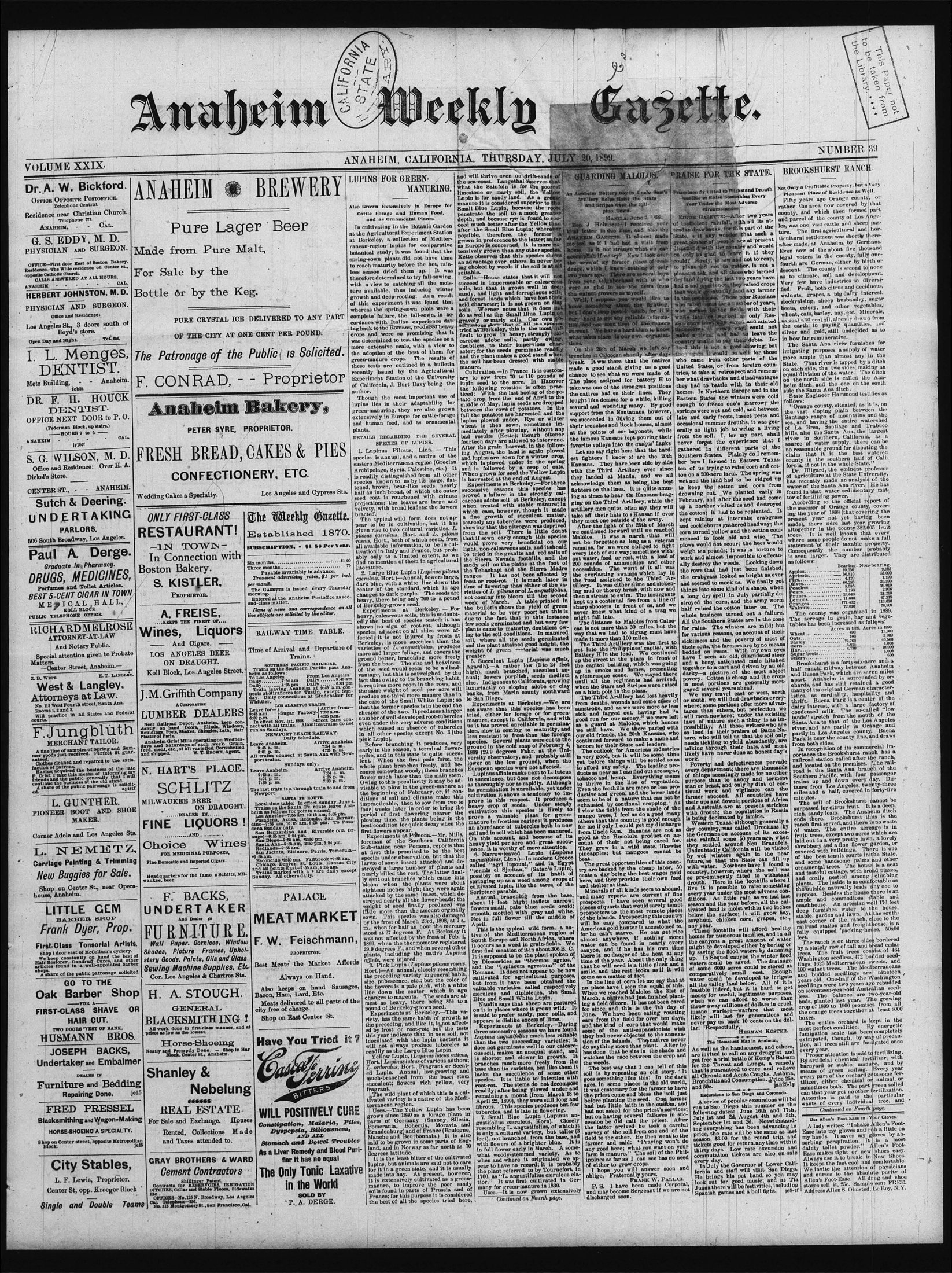
Searchable text
Anaheim
VOLUME XXIX.
Dr. A. W. Bickford.
OFFICE OPPOSITE POSTOFFICE.
Telephone Central.
Residence near Christian Church.
Telephone 671.
ANAHEIM, CAL.
G. S. EDDY, M. D.
PHYSICIAN AND SURGEON.
OFFICE—First door East of Boston Bakery.
Residence—The Witte residence on Center St., opposite Catholic Church.
CALLS ANSWERED AT ALL HOURS.
ANAHEIM CAL.
HERBERT JOHNSTON, M. D.
PHYSICIAN AND SURGEON.
Office and Residence:
Los Angeles St., 3 doors south of Boyd's store.
Open Day and Night. Tel. 656.
I. L. Menges,
DENTIST.
Metz Building, Anaheim.
feb24
DR. F. H. HOUCK
DENTIST.
OFFICE NEXT DOOR to P. O.
(Federman Block, up stairs.)
HOURS 9 to &
ANAHEIM CAL.
S. G. WILSON, M. D.
Office and Residence: Over H. A.
ANAHEIM BREWERY
Pure Lager Beer
Made from Pure Malt,
For Sale by the
Bottle or by the Keg.
PURE CRYSTAL ICE DELIVERED TO ANY PART OF THE CITY AT ONE CENT PER POUND.
The Patronage of the Public is Solicited.
F. CONRAD, - Proprietor
Anaheim Bakery,
PETER SYRE, PROPRIETOR.
FRESH BREAD, CAKES & PIES
CONECTIONERY ETC.
DR. F. H. HOUCK
DENTIST.
OFFICE NEXT DOOR to P. O.
(Federman Block, up stairs.)
HOURS 9 to 6.
ANAHEIM CAL.
S. G. WILSON, M. D.
Office and Residence: Over H. A. Dickel's Store.
CENTER ST., - ANAHEIM.
Sutch & Deering.
UNDERTAKING
PARLORS.
506 South Broadway, Los Angeles.
Paul A. Derge.
Graduate in Pharmacy.
DRUGS, MEDICINES,
Perfumes and Toilet Articles.
BEST 5-CENT CIGAR IN TOWN
MEDICAL HALL,
KOLL BLOCK.
PUBLIC TELEPHONE OFFICE.
RICHARD MELROSE
ATTORNEY-AT-LAW
And Notary Public.
Special attention given to Probate Matters.
Center Street, Anaheim.
Z. B. WEST.
E. T. LANGLEY.
West & Langley,
Attorneys at Law.
No. 118 West Fourth street, Santa Ana.
Rooms 1, 2 and 3.
Will practice in all States and Federal courts.
F.Jungbluth
MERCHANT TAILOR.
A fine line of samples of Spring and Summer goods just received. Perfect fit guaranteed.
Clothes cleaned and repaired to the satisfaction of patrons.
Having acquired the business of the late F. Crist. Take this means of informing my friends and the public generally that I will continue the business at the old stand.
A share of the public patronage is solicited.
L.GUNTHER.
PIONEER BOOT AND SHOE MAKER.
Corner Adele and Los Angeles Sts.
L.NEMETZ,
Carriage Painting & Trimming
New Buggies for Sale.
Shop on Center St., near Opera-house, Anaheim.
F.CONRAD, - Proprietor
Anaheim Bakery,
PETER SYRE, PROPRIETOR.
FRESH BREAD, CAKES & PIES
CONFECTIONERY, ETC.
Wedding Cakes a Specialty. Los Angeles and Cypress Sts.
ONLY FIRST-CLASS RESTAURANT!
—IN TOWN—
In Connection with Boston Bakery.
S. KISTLER,
PROPRIETOR.
A. FREISE,
Wines, Liquors
—and Cigars.
LOS ANGELES BEER ON DRAUGHT.
Koll Block, Los Angeles Street.
J.M.Griffith Company
A CORPORATION
LUMBER DEALERS
Neer Railroad Depot, Anaheim, keep constantly on hand Doors, Blinds, Windows, Mouldings, Posts, Shakes, Shingles, Lath, Hair Plaster of Paris.
Anaheim Grist Mills operating on Wednesdays and Saturdays of each week. Grain feed, meal, etc., of all varieties. Cornshelled and shipped.
W.T.Brown, Agent.
N.HART'S PLACE.
SCHLITZ
MILWAUKEE BEER ON DRAUGHT.
DEALER IN...
FINE LIQUORS!
AND
Choice Wines FOR MEDICINAL PURPOSES,
Fine Domestic and Imported Cigars.
Headquarters for the famo m Schlitz, Milwaukee, beer.
The Weekly Gazette.
Established 1870.
SUBSCRIPTION, - $1 50 Per Year.
Six months... $1 00
Three months... 75
Payable invariably in advance.
Transient advertising rates, $1 per inch per month.
The GAZETTE is issued every Thursday morning.
Entered at the Anaheim Postoffice as second-class matter.
Items of news and correspondence on all live subjects are solicited by the editor.
RAILWAY TIME TABLE.
Time of Arrival and Departure of Trains.
SOUTHERN PACIFIC RAILROAD.
Trains in the Southern Pacific pass Anaheim as follows:
To Los Angeles.... From Los Angeles.
Daily..... 7:54 am Daily..... 9:45 am
Daily..... 4:25 pm Daily..... 6:01 pm
Train leaving Anaheim at 9:45 a.m. connects at Miranores for Tustin, except Sunday. Daily connections at Studebaker for Whittier.
LOS ALAMITOS TRAINS.
Leave for—Arrive from—
9:48 a.m. Sugar Factory 7:52 a.m.
6:02 p.m.在 effect Nov. 1st, 1898. Street cars connect with all trains. Alamitos trains do not run on Sundays.
NEWPORT BEACH RAILWAY.
Daily Schedule.
Leave Anaheim. Arrive Anaheim.
9:45 a.m. 7:54 a.m.
6:01 p.m. 4:25 p.m.
All trains connect at Santa Ana with Newport trains.
Sundays only.
Leave Anaheim. Arrive Anaheim.
9:45 a.m. 7:54 a.m.
6:01 p.m. 4:25 p.m.
7:30 p.m.The last train is a through train to and from Newport.
SANTA FE ROUTE.
Local time table. In effect Sunday, June 4.
Trains on the Santa Fe route leave Anaheim as follows for points named:
Los Angeles—7:55 am, 10:15 am, 5:06 pm
Passadena, Azusa, Redondo, San Bernardino—7:55 am, 10:15 am, 5:06 pm.To Pasadena Sunday only.
San Bernardino and Riverside (via Orange)—9:55 am, 5:54 pm
San Diego—9:55 am
Santa Ana—9:55 am, 2:50 pm
Santa Ana—9:55 am, 2:50 pm, 5:54 pm
Redlands—9:55 am
San Jacinto, Elsinore, Perris, Temecula—9:55 am。
Escondido—2:50 pm.Fallbrook*9:55 am。
Chicago.Denver.St.Louis.Kansas City and all points East—7:55 am, 9:55 am.Trains marked with a star are daily except Sunday.All others daily。
L. GUNTHER.
PIONEER BOOT AND SHOE
MAKER.
Corner Adele and Los Angeles Sts.
L. NEMETZ,
Carriage Painting & Trimming
New Buggies for Sale.
Shop on Center St., near Opera-house, Anaheim.
LITTLE GEM
BARBER SHOP
Frank Dyer, Prop.
First-Class Tonsorial Artists,
Shop 1 door east of McCollum's cyclery.
We keep constantly on hand the best of Hair Restorer, Dandruff Cures, and other articles found in a well-appointed barber shops.
A share of the public patronage solicited
GO TO THE Oak Barber Shop
FOR A FIRST-CLASS SHAVE OR HAIR CUT.
TWO DOORS 'VEST OF BANK.
HUSMANN BROS.
JOSEPH BACKS,
Undertaker and Embalmer
DEALER IN Furniture and Bedding Repairing Done. je15
FRED PRESSEL
Blacksmithing and Wagon-Making
HORSE-SHOEING A SPECIALTY.
Shop on Center street, opposite Metropolitan Block. je15
City Stables,
L. F. Lewis, Proprietor.
Center St, opp. Kroeger Block
Single and Double Teams
MILWAUKEE BEER ON DRAUGHT.
...DEALER IN...
FINE LIQUORS!
AND....
Choice Wines
FOR MEDICINAL PURPOSES,
Fine Domestic and Imported Cigars.
Headquarters for the famo & Schlitz, Milwaukee, beer.
F. BACKS,
UNDERTAKER
And Dealer in FURNITURE.
Wall Paper. Cornices, Window Shades, Picture Frames, Upholstery Goods, Paints, Oils and Glass Sewing Machine Supplies, Etc.
Cor. Los Angeles & Chartres Sts.
H. A. STOUGH.
GENERAL BLACKSMITHING!
All work done in first-class manner, and at prices as low as the lowest.
Horse-Shoeing
Neatly and Promptly Done. — Shop in Har Block, Center St., Anaheim.
Shanley &
Nebelung
REAL ESTATE
For Sale and Exchange. Houses Rented, Collections Made and Taxes attended to.
GRAY BROTHERS & WARD
Cement Contractors
Shillinger Patent.
Contracts for RESERVOIES, IRRIGATION DITCHES, Cellar and Stable Floors, Sidewalks Etc.
OFFICES—No. 125 N. Broadway, Los Angeles Cal., Telephone—236.
No. 316 Montgomery St., San Francisco, Cal.,
Local time table. In effect Sunday, June 4.
Trains on the Santa Fe route leave Anaheim as follows for points named:
Los Angeles—7:55 am, 10:15 am, 5:06 pm.
Pasadena, Azusa, Redondo, San Bernardino—7:55 am, 10:15 am, 5:06 pm. To Pasadena Sunday only.
San Bernardino and Riverside (via Orange)—9:55 am, 5:54 pm.
San Diego—9:55 am, 2:50 pm.
Santa Ana—9:55 am, 2:50 pm, 5:54 pm.
Redlands—9:55 am.
San Jacinto, Elsinore, Perris, Temecula—9:55 am.
Escondido*2:50 pm. Fallbrook*9:55 am.
Chicago, Denver, St Louis, Kansas City and all points East—7:55 am, 9:55 am.
Trains marked with a * are daily except Sunday. All others daily.
PALACE
MEAT MARKET
F. W. Feischmann
PROPRIETOR.
Best Meats the Market Afford Always on Hand.
Also keeps on hand Sausages Bacon, Ham, Lard, Etc.
Meats delivered to all parts of the city free of charge.
Shop on East Center St.
Have You Tried It?
Constipation, Malaria, Pile Dyspepsia, Billiousness,
AND ALL
Stomach and Bowel Troubles
As a Liver Remedy and Blood Purifier it has no equal
The Only Tonic Laxative in the World
SOLD BY
P. A. DERGE.
ANAHEIM, CALIFORNIA, THURSDAY, JULY 20, 1899.
BREWERY
Beer
LUPINS FOR GREEN-MANURING.
Also Grown Extensively in Europe for Cattle Forage and Human Food, and as Ornamental Plants.
In cultivating in the Botanic Garden at the Agricultural Experiment Station at Berkeley, a collection of Mediterranean-region lupins for comparative botanical study, it was found that the spring-sown plants did not have time to reach maturity before the hot, rainless season dried them up. It was therefore determined to try fall-sowing, with a view to catching all the moisture available, thus inducing winter growth and deep-rooting. As a result of this experiment it was found that whereas the spring-sown plots were a complete failure, the fall-sown, in accordance with Italian experience dating back to the Romans, produced heavy crops and were so promising that it was determined to test the species on a more extensive scale, with a view to the adoption of the best of them for green-manure crops. The results of these tests are outlined in a bulletin recently issued by the Agricultural Experiment Station of the University of California, J. Burt Davy being the author.
Though the most important use of lupins lies in their adaptability for green-manuring, they are also grown extensively in Europe for cattle-forage and human food, and as ornamental plants.
DETAILS REGARDING THE SEVERAL SPECIES OF LUPINS.
1. Lupinus Pilosus, Linn. — This species is annual, and a native of the eastern Mediterranean region (Grecian Archipelago, Syria, Palestine, etc.) It will thrive even on drift-sands of the sea-coast. Langethall observes that what the Sainfoin is for the poorest limestone or marly soil, the Yellow Lupin is for sandy land. As a green-manure it is considered superior to the Small Blue Lupin, because the roots penetrate the soil to a much greater depth, and because rye is found to succeed much better after the Yellow than after the Small Blue Lupin; wherever possible, therefore, the former is grown in preference to the latter; as far as Europe is concerned, it is more extensively grown than any other species. Kette observes that this species shows an advantage over others in never being choked by weeds if the soil is at all suitable.
Soils.—Heuze states that it will not succeed in impermeable or calcareous soils, but that it grows well in deep sandy, and light and ferruginous soils, and forest lands which have lost their acid character; it is not grown on clay soils. Werner notes that it does not do as well as the Small Blue Lupin on gravelly or marly soils. Our own observations show that of all the species tried at Berkeley, this is the most difficult to grow in heavy, strongly calcareous adobe soils, partly owing, doubtless, to their impervious character; for the seeds germinate readily and the plant makes a good stand when the soil has been dressed with stable manure.
Cultivation.—In France it is customary to sow from 70 to 110 pounds of lupin seed to the acre. In Hanover the following rotation is often practiced: With the last hoofing of the potato crop, from the end of April to the middle of May, lupin seeds are dropped between the rows of potatoes. In the fall the potatoes are harvested and the lupins plowed under. Rye or winter wheat is then sown, sometimes immediately after plowing, without any bad results (Kette); though oftener fourteen days are allowed to intervene. After the grain harvest, in the following August, the land is again plowed and lupins are sown for a winter crop, which is plowed under in the spring and is followed by a crop of oats. When grown for seed the Yellow Lupin
GUARDING MALOLOS.
An Anaheim Battery Boy in Uncle Sam's Artillery Helps Hold the Stars and Stripes Over the Philippine Town.
MANILA, June 7, 1899.
Bro. J. Helmsen: I received your kind letter in due time, and also the Anaheim Gazette. It almost made me feel as if I had had a visit from home. Is it not strange what we can accomplish if we try? Now I look over the news of my former place of residence, which I know nothing of only two years ago. There are several boys from your neighborhood with us who were as glad to see the news from the walnut growers as myself.
Well, I suppose you would like to know something about the fighting, but I don't keep posted much; for it is very hard to get any reliable information, and one soon tires of the rumors current. We have a hard time to know what takes place in our own organizations.
On the 25th of March we left our trenches at Caloocan shortly after daybreak. It was there that the natives made a good stand, giving us a good chance to see what we were made of. The place assigned for battery H to take was one of the strongest positions the natives had on their lines. They fought like demons for a while, killing several and wounding many. By good support from the Nontanans, however, we succeeded in driving them out of their trenches and block houses, almost at the points of our bayonets, while the famous Kansans kept pouring their favorite volleys into the amigos' flanks.
Let me say right here that the hardest fighters I know of are the 20th Kansans. They have seen side by side with the Third Artillery ever since
Experiment Station of the University of California, J. Burt Davy being the author.
Though the most important use of lupins lies in their adaptability for green-manuring, they are also grown extensively in Europe for cattle-forage and human food, and as ornamental plants.
DETAILS REGARDING THE SEVERAL SPECIES OF LUPINS.
1. Lupinus Pilosus, Linn. — This species is annual, and a native of the eastern Mediterranean region (Grecian Archipelago, Syria, Palestine, etc.) It is readily distinguished from all other species known to us by its large, flattened, brown, bean-like seeds, nearly half an inch broad, of which the outer seed coat is roughened with minute projections; the leaves are large and velvety, with broad leaflets; the flowers bracted.
The typical wild form does not appear to be in cultivation, but it has given rise to two cultural varieties, L. pilosus caeruleus, Hort., and L. pilosus roseus, Hort., both of which seem from all available information, to be in cultivation in Italy and France, but probably only to a limited extent, as we find no mention of them in agricultural literature.
2. Large Blue Lupin (Lupinus pilosus caeruleus, Hort.)—Annual, flowers large, dark blue, with a white line down the center of the standard, which in age changes to dark purple. The seeds are heavy, there being only 760 to a pound of Berkeley-grown seed.
Experiments at Berkeley. — For heavy, calcareous soils, this is undoubtedly the best of species tested; it has shown no sign of root-rot, although species adjacent on all sides were affected; it is not injured by frosts at Berkeley, is more succulent than the varieties of L. angustifolius, produces more and larger foliage, and covers the ground better, branching more freely from the base. The size and heaviness of the seed would seem to be a disadvantage, but this is outweighed by the fact that owing to its branching habit, it requires more room in the rows, and the same weight of seed per acre will produce one-third more manure than in the case of the Small White Lupin; so that the former species is in the end cheaper of the two. It produces a larger number of well-developed root-tubercles even under the very adverse conditions which caused an absence of tubercles in all other species except No. 3 (the pink Lupin).
Before branching it produces, very early in the season, a terminal flower-spike, and in this state is quite succulent. When the first pod forms, the whole plant branches freely, and becomes somewhat woody; these branches flower much later than the main stem. Owing to this peculiarity it may be advisable to plow in the green-manure at the beginning of February, or, if conditions of soil and climate make this impracticable, then to sow from two to four weeks later in order to bring the period of first flowering nearer the plowing time, the plants being in the best condition for quick decay when the first flowers appear.
Experiments at Pomona. — Mr. Mills, foreman of the Southern California Sub-station near Pomona, reports that at first this promised to be the best species under observation, but that the larvae of some insect attacked and destroyed a large number of plants and nearly killed the rest. The latter finally sent out branches which came into bloom when the plants were about eighteen inches high; they were again attacked by the same insect, which dared artery to sow from 70 to 110 pounds of lupin seed to the acre. In Hanover the following rotation is often practiced: With the last hoeing of the potato crop, from the end of April to the middle of May, lupin seeds are dropped between the rows of potatoes. In the fall the potatoes are harvested and the lupins plowed under. Rye or winter wheat is then sown, sometimes immediately after plowing, without any bad results (Kette); though oftener fourteen days are allowed to intervene. After the grain harvest, in the following August, the land is again plowed and lupins are sown for a winter crop, which is plowed under in the spring and is followed by a crop of oats. When grown for seed the Yellow Lupin is harvested at the end of August.
Experiments at Berkeley. — For three successive seasons this species has proved a failure in the strongly calcareous adobe soil at Berkeley, except when treated with stable manure; in which case, however, though it made a fine growth of succulent matter, scarcely any tubercles were produced, showing that the nitrogen was deprived from the soil. There is little doubt that if sown early enough this species would prove very beneficial on our light, non-calcareous soils, and it should be tried in the granite and red soils of the Sierra Nevada foothills, and the sandy soil on the plains at the foot of the Tehachapi and the Sierra Madre ranges. It has not been affected by frost or root-rot. It is much later in time of flowering than either of the varieties of L. pilus or of L. angustifolius, not coming into bloom till the second week of March. A table printed in the bulletin shows the yield of green material to be very poor; but this is due to the fact that in this instance few seeds germinated and but very few plants came to maturity, doubtless owing to the soil conditions. In manured soil, where all the seeds germinated and the plant attained good height, the weight of green material was much greater.
5. Succulent Lupin (Lupinus affinis, Agardh). —A rather low (2 to 24 feet high), much branched, succulent annual; flowers purplish, seeds medium size. Indigenous to California,growing luxuriantly on sloping adobe or clay banks, from Marin county southward to San Diego.
Experiments at Berkeley. —We are not aware that this species has been tried, either for forage or for green-mature, except in California,and with us it has proved unreliable in germination,slow in coming to maturity,and less resistant to frost than the foreign plants. Several plants were cut out to the ground in the cold snap of February 4, 1899 (29.9 degrees Fahrt.at the University observatory,and probably still lower on the low ground),when the European species were not affected.
Lupinus affinis ranks next to L. luteus in suculence,但 does not decompose as thoroughly nor as rapidly.Although its germination is unreliable,yet under cultivation it shows a tendency to improve in this respect.It produces a heavy crop of seeds.Under steady cultivation this species is likely to prove a valuable plant for green-mature in frostless regions;it produces an abundance of tubercles both in new soil and in soil which has been manured.On this account,and because of its heavy yield per acre and great succeu-lence,它是 worthy of more attention.
6. Narrow-leaved Lupin (Lupinus angustifolius,Linn.).—In modern Greece called "agri lupunoi,"and in Egypt "termis el Sjueitan."(Satan's Lupin), possibly on account of its habit of springing up as a weed among crops of cultivated lupin,the like the tarea of the Scripture parable.
Annual branching from the base,
ary to sow from 70 to 110 pounds of lupin seed to the acre.In Hanover the following rotation is often practiced:With the last hoeing of the potato crop,从the end of April tothe middle of May,Lupin seeds are dropped between the rows of potatoes.Inthe fallthe potatoes are harvested andthe lupins plowed under.Rye or winter wheat is then sown,sometimes immediately after plowing Without any bad results(Kette);though oftener fourteen days are allowed to intervene.After the grain harvest,在the following August,the land is again plowed and lupins are sown for a winter cropwhich is plowed under in the springand is followed by a crop of oatsWhen grown for seedthe Yellow Lupin is harvested atthe end of August.
Experiments at Berkeley. —For three successive seasons this species has proved a failure in the strongly calcareous adobe soil at Berkeley,the excepted with stable manure;在which casehoweverthoughitmadea fine growthofsucculent matter,scarcelyany tubercleswereproduced,showingthatthenitrogenwasdeprivedfromthesoil。Thereis little doubtthatifsownearlyenoughthisspecieswouldproveverybeneficialonourlight,nocalcareoussoils,anditshouldbettriedinthegraniteandredsoilsoftheSierraNevadafoothills,andthesandysoilontheplainsatthefootoftheTehachapiandtheSierraMadreranges.Thelastfactofthe25thMarchwecontinuedforwarduntillwe reachedMalosols。它wasa marchthatwillnotbeforgottenaslongasa Veterainremainsforwerewereobligedtofightevery寸ofourway;sometimeswithoutwater,foodorrestitution,andloadon200roundsofammunition和其他necessities.TheworstoftothelasteverlastswamwhichtlaylawtheroadassignedtotheThirdArtillery.itwasitherslimeandsickingtodororthnybrush.withnowandthenstreamtoswim.Theinsurgentkeptapoincirallfirefromalineofsharpshootersinfrontofus,andneverknewwhatkindofa trapwouldfallinto.ThedistancetoMalosolsfromCalocanosisnotmorethan30milesbutthattwaythatwehadzigzagmusthavemadeitmorethan100miles.TheThirdArtillerywasthefirsttogetintoThePhilippines'capital,BatteryHinhlead.Wecountupthestreettotheplazainfrontofthecapitolbuildingwhichwasgivenupinsmokeandflames,presentingapicturesquescene.Westeyend untilalltheregiments hadarrivedwhentheStarsandStripeswereraisedonahighpoleintheplaza.
The ThirdArtilleryhad lostheavyfrom deaths,wounds和some casesofsunstroke,andaswemoreorleastsickandfaggedout,havingledgoodrunforourmoney,"wewereledasaguardatMaloslos,"wehoundewillhave.Werepartwedwithourold friends,the20thKansanswouldcontinueformakenameahonorsforfutureStateandleaders.
The outlookforAmericanindustryisverygood,butitwillbeforethingswillbesettledsofortheaffordany Safety.TheleadingproductsasnearasIcanfindoutaresugentebaccoandhemp.Everythingseethoveltheevenflooringandgreen,andthelowerseemtobeofa naturethatcannotexhaustedbycontinualcropping.Iviewthefieldsfromtheshadeofftangoothersthatthiscountryisgoodenoumefricluchannowfor我ifonlyIcouldgetmydischargeUncleSaman.BananasarenotgoodastheHonoluluproductoncounteroftheirnotbeingcausedTheygrowinawildstatelikepangapples;butmangoescannotbeat.
The great opportunities this countryarebackbythecheaplab,centsa daybeingthebest wagesforehere,andtheyprovidetheirownfundsand shelteratthat.Mineralsofallkindsseemtoaboveandmanyreportscurrentof
Experiments at Pomona.—Mr. Mills, foreman of the Southern California Sub-station near Pomona, reports that at first this promised to be the best species under observation, but that the larvae of some insect attacked and destroyed a large number of plants and nearly killed the rest. The latter finally sent out branches which came into bloom when the plants were about eighteen inches high; they were again attacked by the same insect, which destroyed nearly all the flower-heads; the weight of seed finally produced was little more than the amount originally sown. This species was also damaged by the frost of March 23rd, 1898, at 7 a.m., when for half an hour the mercury stood at 27 degrees F. At Berkeley it was not affected by the frost of Feb. 4, 1899, when the thermometer registered 29.9 degrees F., and when several other plants, including the native Lupinus affinis, were injured.
3. Pink Lupin (Lupinus pilosus roseus, Hort.)—An annual, closely resembling the preceding variety in general habit, size, pubescence, etc.; but the color of the flowers is a pale pink, with a white line down the center which in age changes to magenta. The seeds are almost as heavy, there being 864 to a pound of Berkeley-grown seed.
Experiments at Berkeley.—This variety, has the same habit of growth as the preceding, and like it, is not affected by frost or root-rot; but the tests this year indicate that in new soil, not inoculated with the lupin bacteria it will not always produce tubercles as readily as the Large Blue Lupin.
Yellow Lupin (Lupinus luteus sativus, Hort.) Lupinus luteus of various authors; L. ordoratus, Hort., Fragrant or Scented Lupin. Annual, low-growing and much-branched from the base; stem succulent; flowers rich yellow, very fragrant.
The wild plant of which this is a cultivated variety is a native of the Mediterranean region.
Uses.—The Yellow Lupin has been grown since 1840 as a forage plant in parts of Germany (Saxony, Silesia, Pomerania, Bohemia, Moravia and Brandenburg) and of France (Boulogne, Manche and Bourbonnais.) It is also said to be grown in some parts of England, and in Norway as far north as 70 degrees latitude.
It is the least bitter of the cultivated lupins, but animals are said not to care for it in a green state, and it is usually made into hay. At present, however, it is extensively cultivated as a green-manure, to improve the poor sandy soils found in parts of Prussia and of France; for this purpose it is considered the best of all the species tried here,
prove in this respect. It produces a heavy crop of seeds. Under steady cultivation this species is likely to prove a valuable plant for green-mature in frostless regions; it produces an abundance of tubercles both in new soil and in soil which has been manured. On this account, and because of its heavy yield per acre and great succulence, it is worthy of more attention.
6. Narrow-leaved Lupin (Lupinus angustifolius, Linn.)—In modern Greece called "agri lupouni," and in Egypt "termls el Sjaitan," (Satan's Lupin), possibly on account of its habit of springing up as a weed among crops of cultivated lupin, like the tarea of the Scripture parable.
Annual, branching from the base, about 14 feet high; leaflets narrow; flowers small, pale blue; seeds ovoid; smooth, mottled with gray and white. Not in full flower till the middle of April.
This is the typical wild form, a native of the Mediterranean region of South Europe and North Africa, where it occurs as a weed in grain-fields. We first find mention of it in about 306 B.C. It is supposed to be the plant spoken of by Dioscorides as "thermos agrios," and the "lupinoum agrestum" of the Romans. It does not appear to be now cultivated for agricultural purposes, but from it have been obtained the valuable varieties called respectively caeruleus and diploleuca, the Small Blue and Small White Lupin.
Naudin says that sheep are pastured on it in places where it grows wild. It is said to prefer sandy, poor soils, and appears to dislike excess of lime.
Experiments at Berkeley.—During three successive seasons we have found Lupinus angustifolius much less reliable than the two succeeding varieties; it does not germinate well in our calcareous soil, makes an unequal stand, and is shorter and slower in growth. It branches much more freely from the base than its varieties, but like them it lacks the succulence of some other species. It is liable to infection with root-rot. The stems do not decompose readily; after being plowed under and remaining a month (from March 18 to April 22, 1899), they were still long and fibrous. This species produces but few tubercles, and is late in flowering.
7. Small Blue Lupin (Lupinus angustifolius caeruleus, Korn). Closely resembling L. angustifolius, of which it is only a cultural variety, but taller (3 feet), not branched from the base, and with flowers of a brighter blue. It is in full flower early in March. A somewhat woody-stemmed variety. As to when and where it originated we appear to have no record; it is probably the plant referred to by Tournefort, in 1700, as "L. angustifolius caeruleus eliator." It was first cultivated in Germany for green-manure in 1830.
Uses.—It is now grown extensively
Continued on Fourth page.
I hope you will answer soon oblige, Fraternally yours.
P.S. I have been made Count and may become Sergeant if we see discharged soon.
BADING MALOOS.
Battery Boy in Uncle Sam's help helps the Stars stripes over the Philippine town.
MANILA, June 7, 1899.
Helmsen:—I received your in due time, and also the Gazette. It almost made if I had had a visit from it not strange what we can if we try? Now I look over of my former place of rest which I knew nothing of only ago. There are several boys neighborhood with us who had to see the news from growers as myself.
purpose you would like to bring about the fighting, four posted couch, for it is to get any reliable information soon tires of the rumors We have a hard time to know place in our own organization.
25th of March we left our Caloocan shortly after day was there that the natives good stand, giving us a good see what we were made of. Assigned for battery H to one of the strongest positions is had on their lines. They demons for a while, killing and wounding many. By good from the Montanans, however, died in dividing them out of patches and block houses, almost limits of our bayonets, while Kansans kept pouring their molleys into the amigos' flanks. Say right here that the hardners I know of are the 20th They have been side by side Third Artillery ever since
PRAISE FOR THE STATE.
Preminently fitted to Withstand Drought — possible to Raise Something Every Year Under the Most Adverse Circumstances.
EDROR GAZETTE:—After two years of insufficient rainfall, with all its attendant drawbacks, for this part of the State, it any wonder that such a great number of people are at present dissatisfied with the country and would be only to glad to leave it if they could? Surely, to sow and not to reap, to plant and not to gather, is not a pleasant task, and all those who farmed dry land during the last two years have had a sad experience; they raised crops that would eventually land any farmer in the poor houses. Those poor Russians who raised pants for a number of years, who worked in the fields with their white families worked as only Russian know how, who saved and stituted themselves in every way, could not make a living and had to leave the country unable to pay their debts. Indeed, this is not a good showing; but then again it would be well for those who came from other parts of the United States, or from foreign countries, to take a retrospect and remember what drawbacks and disadvantages they had to battle with in their old homes. In Northern Europe and in the Eastern States the winters were cold enough to freeze one's marrow; the springs were wet and cold, and between late and early frosts, insect pests and occasional summer drouths, it was generally no light job to wring a living from the soil. I, for my part, shall never forget the experience that I gathered in different parts of the Southern States. Plainly do I remember how I farmed in Eastern Texas, ten of us trying to raise corn and cotton on a 200-acre farm. The spring was
BROOKSHURST RANCH.
Not Only a Profitable Property, but a Very Pleasant Place of Residence as Well.
Fifty years ago Orange county, or rather the area now covered by that county, and which then formed part and parcel of the county of Los Angeles, was one vast cattle and sheep pasture. The first agricultural and horticultural settlement was shortly thereafter made, at Anaheim, by Germans. Even now of the about five thousand legal voters in the county, fully one-fourth are German, either by birth or descent. The county is second to none as to climate, soil and development. Very few have industries so diversified. Fruit, both citrus and deciduous, walnuts, grapes, a big dairy interest, stockraising, sheep husbandry, sugar beets, celery, and other vegetables, wheat, oats, barley, hay, etc. Minerals, as coal and coal oil, already drawn from the earth in paying quantities, and silver and gold, still undecided as to in how far remunerative.
The Santa Ana river furnishes for irrigating purposes a supply of water more ample than almost any in the State. That river is tapped by a ditch on each side, the two sides making an equal division of the water. The ditch on the north side is called the Anaheim ditch, and the one on the south side the Santa Ana ditch.
State Engineer Hammond testifies as follows:
"Orange county, situated, as it is, on the vast sloping plain between the Santiago range of mountains and the sea, and having the entire watershed of La Brea, Santiago and Trabuco bills, also the Santa Ana, the largest river in Southern California, as a source of water supply, there can be no reasonable ground for disputing the claim that it is the best watered county in the southern half of California, if not in whole State."
Dr. Hilgard, the eminent professor of agriculture at the State University.
The image contains a historical newspaper page with text discussing agricultural practices and events. The headline is "Third Artillery ever since we headed at Manila, and we all agreed them as being the best in the lines." It mentions the Kansans' bragging rights into the amigos' flanks and their right here that the hardships I know of are the 20th. They have been seen by side by side.
The article discusses the history of the 25th March United forward until we reached it was a march that will forgotten as long as a veteran of our way; sometimes with food or rest, with a load of ammunition and other supplies. The worst of it all was causing swamps which lay in assigned to the Third Artillery. It was either slime and sickening thorny brush, with now andream to swim. The insurgents of continual fire from a line of footers in front of us, and we knew what kind of a trap we will into.
Distance to Malolos from Caloocat more than 30 miles, but the we had to zigzag must have more than 100 miles.
Third Artillery was the first to attack the Philippines' capital, with HH in the lead. We continued street to the plaza in front of total building, which was going smoke and flames, presenting a sequestre scene. We stayed there all the regiments had arrived, the Stars and Stripes were raised with pole in the plaza.
Third Artillery had lost heavily inaths, wounds and some cases of frost, and as we were more or less faded out, having had "a knot for our money," we were left guard at Malolos, which honors have. We there parted with friends, the 20th Kansans who had forward to make a name and for their State and leaders.
Outlook for American industries good, but it will be some time more things will be settled so as any safety. The leading proponent as I can find out are sugar, and hemp. Everything seems live in the line of vegetation. The foothills are more or less protected and green, and the lower lands be of a nature that can not be used by continual cropping. As the fields from the shade of the trees, I feel as do a good many that this country is good enough if only I could get my discharge uncle Sam. Bananas are not as the Honolulu product on account of their not being cared for. Grow in a wild state, likewise apples; but mangoes cannot be great opportunities of this countryside backed by the cheap labor, 50 day being the best wages paid and they provide their own food better at that.
Rurals of all kinds seem to abound, many reports are current of fine goodness.
Plainly do I remember how I farmed in Eastern Texas, ten of us trying to raise corn and cotton on a 200-acre farm. The spring was wet and the land had to be ridged up to keep the cotton and corn from drowning out. We planted early in February, and after the seed had come up a norther visited us and destroyed the cotton; it had to be replanted. It kept raining at intervals; crabgrass and cockleburts gathered headway; the corn turned yellow and the cotton commenced to look old and wise. The plows would not scour: the heeves would weigh ten pounds; it was a torture to work and almost impossible to effectively destroy the weeds. Looking down the rows that had just been finished, the crabgrass looked as bright as ever and seemed to mock us. We finally got things into some kind of a shape, when a long dry spell in July partially destroyed the corn, and the army worm half ruined the cotton later on. The whole business turned out a failure. All the Southern States are in the zone for rains. The winters are mild; but for various reasons, on account of their sickliness and the poverty of most of their soils, the farmers are by no means bedded on reyes. With my own eyes I seen an old, dilapidated steer and a bony antiquated mule hitched together to a cart and driven by an old darky—a picture of the most objective poverty. Cotton is cheap and the crops in most portions are generally mortgaged several years ahead.
We may travel east or west, north or south, we will find drawbacks everywhere; some portions offer more advantages than others, but perfection we will meet nowhere; under the existing laws of nature such a thing is an impossibility. All those writers who are so loud in their praises of Dame Nature, who will tell us that the soil only needs tickling to yield abundantly, are talking through their hats, and most likely have never done an honest day's work.
Poverty and defectiveness pervade every department; there are thousands of things seemingly made for no other purpose than to annoy and torment man or beast, and only by dint of continual work and vigilance can the farmer succeed. All countries have their ups and downs; portions of Africa and Australia are at present stricken with drought; the population in Russia is being decimated by famine.
Western Texas, although generally a dry country, was called Dreckxas by the Germans on account of its excessive rainfall some 50 years ago, when they settled around Neu Braunfels. Undoubtedly California will be visited by wet winters again in the near future, so that the State can fill up with water. Nowhere have I found a country, however, where the soil was so pre-eminently fitted to withstand drought. Here in the foothills where I live it is possible to raise something every year under the most adverse conditions. As little rain as we had last equal division of the water on the north side is called the Anaheim ditch, and one on the south side the Santa Ana ditch.
State Engineer Hammond testifies as follows:
"Orange county, situated, as it is, on the vast sloping plain between the Santiago range of mountains and the sea, and having the entire watershed of La Brea, Santiago and Trabuco hills, also the Santa Ana, the largest river in Southern California, as a source of water supply, there can be no reasonable ground for disputing the claim that it is the best watered county in the southern half of California, if not in the whole State."
Dr. Hilgard, the eminent professor of agriculture at the State University, has recently made an analysis of the water of the Santa Ana river. He has found in that water sedimentary matter of fertilizing power.
According to the official report of the assessor of Orange county, covering the year of 1898 (that covering the present year not yet having been made), there were last year growing altogether in the counties 382,605 fruit trees. It is well known that every where some people do not make a full statement of their taxable property. Consequently the number probably is even larger. They are distributed as follows:
Bearing. Non-bearing.
Apples...10,050...9,985
Apricots...50,810...53,000
Fisgs...4,120...1490
Olives...60,285...20,390
Peaches...8,595...26,010
Pears...3,190...2,906
Prunes...26,640...21,210
Lemons...11,640...47,315
Oranges...177,402...113,610
Walnuts...72,610...76,809
The county was organized in 1889. The agrimage in grain, hay and vegetables has been increased as follows:
Acres in 1889. Acres in 1888.
Wheat...490...15,000
Oats...190...3,000
Barley...19,760...40,500
Corn...5,675...4,000
Hay...4,780...10,000
Sugar beets...6,000
Celery...600
Brookshurst is a forty-six-acre and a half ranch midway between Anaheim and Buena Park, which are seven miles apart. Anaheim is surrounded by orchards, and has still retained a good many of its original German characteristics as cordiality, hospitality and thrift. Buena Park is a center of the dairy interest with a large factory of condensed milk. The so-called "low lands" stretch from the mouth of the Santa Ana to that of the Los Angeles river,and are partly in Orange and partly in Los Angeles county. Buena Park is near the county line,and draws from both sides.
In recognition of its commercial importance the Brookshurst ranch has a railroad station called after the ranch,and located on the premises.The railroad is the Santa Ana branch of the Southern Pacific.with four passenger trains up and down every day.Distance from Los Angeles,twenty-three miles and a half,covers in forty-five minutes.
The soil of Brookshurst cannot be surpassed for citrus fruit.It is a deep,rich,sandy loam.The Anaheim ditch ends there.Brookshurst thus is the ranch first served,and there is no waste of water.The entire acreage is in fruit trees.except two acres which are laid out in a very pretty lawn,a lovely shrubbery and a fine flower garden,或 covered with buildings There is one ofthe best tennis courts inthe State,and some handsome palms and other ornamental trees.The house is a neat and tasteful cottagewith broad piazza,and cozy nestled among climbing plants.The inside is as comfortable as outside naturally leads any one to suppose.Besidesthe house there is an ample and commodious stable and
great opportunities of this county backed by the cheap labor, 50 per day being the best wages paid and they provide their own food shelter at that.
Several of all kinds seem to abound, many reports are current of fine facts. I have seen several good quartz that would surely tempt doctors to the most remote places inlands. Prospecting this country is easy compared to what the cann gold hunter is accustomed to, can't starve. He can get rice anywhere, if nothing more; can be found in nearly every city, and if he has his own time, is no danger of the heat at any of the year. About the only thing he will need is a little pluck and a rest looks as if it will was a matter of fact.
The line of corn let me say that at once have seen the equal of this. We reached Malolos the 31st of June, a native had just finished plant-field of corn. It has not been cared since, and this is the 7th day of June. We have been eating roasting from the field for over ten days, the kind of corn that would make of the anti-expansionists wish had never objected to the annexation of the islands. The natives never anything more than plant. After he done that he sits in the shade and nurses the race between the crop and seeds.
The best way that I can tell of this is by repeating an old story. It's something like this: In the dark in some places in the old world, we customary for the farmer to have earliest come and bless the soil just after planting the seed. One farmer but little faith in the custom, and not asked for the priest's services; then having several failures in success he did call the priest. After latter arrived he took a careful key of the soil from one end of the other. He then went to the other and said: "Praying won't do good here; what you want on your land is manure." The soil of the Philippines as far as I can see has no need either to grow crops.
hope you will answer soon and urge, Fraternally yours.
FRANK W. PALLAS.
M.S. I have been made Corporal, may become Sergeant if we are not charged soon.
Western Texas, although generally a dry country, was called Dreckxas by the Germans on account of its excessive rainfall some 50 years ago, when they settled around Neu Braunfels. Undoubtedly California will be visited by wet winters again in the near future, so that the State can fill up with water. Nowhere have I found a country, however, where the soil was so pre-eminently fitted to withstand drought. Here in the foothills where I live it is possible to raise something every year under the most adverse conditions. As little rain as we had last season and the year before, all the cultivated land is moist within two inches below the surface; it will grow hay, sorghum, chicken corn, grapes, etc., any year.
These foothills will afford healthy homes for numerous families, and in all the canyons a great amount of water might be developed either by boring or by saving the flood waters by damming up. In Soquel canyon the winter flood waters could be saved. The drainage of some 6000 acres could be stored at comparatively small cost. Enough water could be developed to irrigate all the valley land below. All of it is feasible indeed, but it is hard to get money for useful, legitimate purposes, when we can afford to worse than throw away millions of dollars in cruel, insane warfare—warfare that most likely will last for generations and never pay us back 10 cents on the dollar. Respectfully,
HERMAN KOSTER.
The Homeliest Man in Anaheim,
As well as the handsomest, and others, are invited to call on any druggist and get free a trial bottle of Kemp's Balsam for the Throat and Lungs, a remedy that is guaranteed to cure and relieve all Chronic and Acute Coughs, Asthma, Bronchitis and Consumption. Price 25c. and 50c.
Excursions to San Diego and Coronado.
A series of popular excursions will be run to San Diego this summer on the following dates: June 16th and 17th, July 1st and 24, August 4th and 5th, September 1st and 2d. Notwithstanding everything has been advancing in price, the rate will be the same as last season, $3.00 for the round trip. and tickets good for return any time within thirty days. Low rate excursion and commutation tickets are also on sale every day.
In July the Governor of Lower California and staff will visit San Diego. He brings his pet band, so you may look out for good music; and at Tia Juana there will be festivities, including Spanish games and a bull fight. je8-tf
The soil of Brookshurst cannot be surpassed for citrus fruit. It is a deep, rich, sandy loam. The Anaheim ditch ends there. Brookshurst thus is the ranch first served, and there is no waste of water. The entire acreage is in fruit trees, except two acres which are laid out in a very pretty lawn, a lovely shrubbery and a fine flower garden, or covered with buildings. There is one of the best tennis courts in the State, and some handsome palms and other ornamental trees. The house is a neat and tasteful cottage, with broad piazza, and cozy nestled among climbing plants. The inside is as comfortable as the outside naturally leads any one to suppose. Besides the house there is an ample and commodious stable and coachhouse. An artesian well 176 feet deep furnishes water to the house, stable, garden and lawn. At the southeast corner of the ranch, close to the railroad station and freighthouse, is a fully equipped 'packing-house', 50x96 feet.
The ranch is on three sides bordered by a stately row of tall and broad cedar trees. The fruit trees consist of 464 Washington seedless, 472 budded seedlings, 1625 Mediterranean sweets, and 100 walnut trees. The Mediterraneans and budded seedlings are nineteen years old. One-half of the Washington seedlings were two years ago rebudded on seventeen-year-old Australian seedless. The balance are two-year-old buds, planted last year. The growing crop of 1899 to 1900 promises from all the orange trees together at least 8000 boxes.
The entire orchard is kept in the most perfect condition. By energetic fumigation scale has been completely extirpated, though, by way of precaution, all trees still are fumigated once every year.
Proper attention is paid to fertilizing. By artificial chemical fertilizer, with barnyard or stable manure, and by means of green soiling. Every year every part of the orchard gets some fertilizer, either chemical or animal, or sometimes both. The part green soiled can that year get no other fertilization. Attention is paid to the particular wants of every individual tree, and
Continued on Fourth page.
Use Allen's Foot-base in Your Gloves.
A lady writes: "I shake Allen's Foot-Ease into my gloves and rub a little on my hands. It saves my gloves by absorbing perspiration. It is a most dainty toilet powder." Allen's Foot-Ease makes tight or new shoes easy. Always use it to break in New Shoes. It keeps the feet cool and comfortable. We invite the attention of physicians and nurses to the absolute purity of Allen's Foot-Ease. All drug and shoe stores sell it, 25c. Sample sent FREE. Address Allen S. Olmsted, Le Roy, N.Y.