anaheim-gazette 1899-06-29
Scanned page
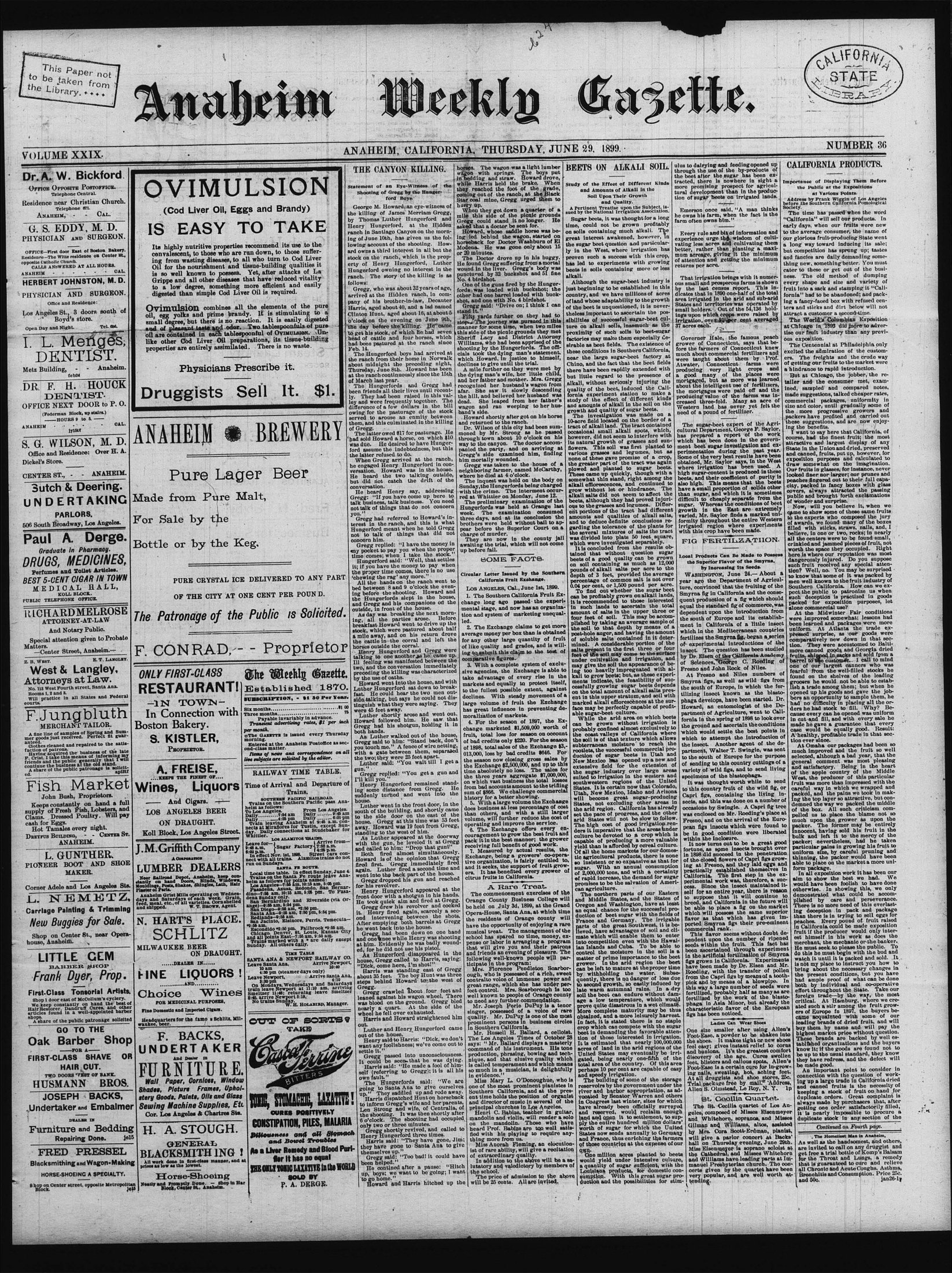
Searchable text
This Paper not to be taken from the Library.
Anaheim
VOLUME XXIX.
Dr. A. W. Bickford.
OFFICE OPPOSITE POSTOFFICE.
Telephone Central.
Residence near Christian Church.
Telephone 671.
ANAHEIM, CAL.
G. S. EDDY, M. D.
PHYSICIAN AND SURGEON.
OFFICE—First door East of Boston Bakery.
Residence—The Wilte residence on Center St., opposite Catholic Church.
CALLS ANSWERED AT ALL HOURS.
ANAHEIM, CAL.
HERBERT JOHNSTON, M. D.
PHYSICIAN AND SURGEON.
Office and Residence:
Los Angeles St., 3 doors south of Boyd's store.
Open Day and Night. Tel. 656.
I. L. Menges,
DENTIST.
Metz Building, Anaheim.
feb24
DR. F. H. HOUCK
DENTIST.
OFFICE NEXT DOOR to P. O.
(Federman Block, up stairs.)
HOURS 9 to 8
ANAHEIM, CAL.
S. G. WILSON, M. D.
Office and Residence: Over H. A. Dickel's Store.
OVIMULSION
(Cod Liver Oil, Eggs and Brandy)
IS EASY TO TAKE
Its highly nutritive properties recommend its use to the convalescent, to those who are run down, to those suffering from wasting diseases, to all who turn to Cod Liver Oil for the nourishment and tissue-building qualities it is so well known to possess. Yet, after attacks of La Grippe and all other diseases that have reduced vitality to a low degree, something more efficient and easily digested than simple Cod Liver Oil is required.
Ovimulsion combines all the elements of the pure oil, egg yolks and prime brandy. It is stimulating to a small degree, but there is no reaction. It is easily digested and of pleasant taste and odor. Two tablespoonfuls of pure oil are contained in each tablespoonful of Ovimulsion. Unlike other Cod Liver Oil preparations, its tissue-building properties are entirely assimilated. There is no waste.
Physicians Prescribe it.
Druggists Sell It. $1.
ANAHEIM BREWERY
Pure Lager Beer
DR. F. H. HOUCK
DENTIST.
OFFICE NEXT DOOR to P. O.
(Wederman Block, up stairs.)
HOURS 9 TO 5
ANAHEIM
CAL.
jy154t
S. G. WILSON, M. D.
Office and Residence: Over H. A. Dickel's Store.
CENTER ST., - ANAHEIM.
Sutch & Deering.
UNDERTAKING
PARLORS.
506 South Broadway, Los Angeles.
Paul A. Derge.
Graduate in Pharmaoy.
DRUGS, MEDICINES,
Perfumes and Toilet Articles.
BEST 5-CENT CIGAR IN TOWN
MEDICAL HALL,
KOLL BLOCK.
PUBLIC TELEPHONE OFFICE.
RICHARDMELROSE
ATTORNEY-AT-LAW
And Notary Public.
Special attention given to Probate Matters.
—Center Street, Anaheim.
Z. B. WEST.
E. T. LANGLEY.
West & Langley,
Attorneys at Law.
No. 113 West Fourth street, Santa Ana.
Rooms 1, 2 and 8.
Will practice in all States and Federal courts.
F.Jungbluth
MERCHANT TAILOR.
A fine line of samples of Spring and Summer goods just received. Perfect fit guaranteed.
Clothes cleaned and repaired to the satisfaction of patrons.
Having acquired the business of the late F. Crist. I take this means of informing my friends and the public generally that I will continue the business at the old stand.
A share of the public patronage is solicited.
Fish Market
John Bush, Proprietors.
Keeps constantly on hand a full supply of Fresh Fish, Lobsters, and Clams. Dressed Poultry. Will pay cash for Eggs.
Hot Tamales every night.
DREYFUS BUILDING, - CENTER ST. ANAHEIM.
L. GUNTHER.
PIONEER BOOT AND SHOE MAKER.
Corner Adele and Los Angeles Sts.
Druggists Sell It. $1.
ANAHEIM BREWERY
Pure Lager Beer
Made from Pure Malt,
For Sale by the
Bottle or by the Keg.
PURE CRYSTAL ICE DELIVERED TO ANY PART OF THE CITY AT ONE CENT PER POUND.
The Patronage of the Public is Solicited.
F. CONRAD, -- Proprietor
ONLY FIRST-CLASS RESTAURANT!
-IN TOWNIn Connection with Boston Bakery.
S. KISTLER,
PROPRIETOR.
A. FREISE,
...KEEPS THE FINEST OF...
Wines, Liquors
And Cigars.
LOS ANGELES BEER ON DRAUGHT.
Koll Block, Los Angeles Street.
J.M.Griffith Company
A CORPORATION
LUMBER DEALERS
The Weekly Gazette.
Established 1870.
SUBSCRIPTION, - $1 50 Per Year.
Six months.....$1 00
Three months.....75
Payable invariably in advance.
Transient advertising rates, $1 per inch per month.
The GAZETTE is issued every Thursday morning.
Entered at the Anaheim Postoffice as second-class matter.
Items of news and correspondence on all live subjects are solicited by the editor.
RAILWAY TIME TABLE.
Time of Arrival and Departure of Trains.
SOUTHERN PACIFIC RAILROAD.
Trains on the Southern Pacific pass Anaheim as follows:
To Los Angeles.
From Los Angeles.
Daily....7:54 am Daily....9:45 am
Daily....4:25 pm Daily....6:01 pm
Train leaving Anaheim at 9:45 a.m. connects at Mirandos for Tustin, except Sunday.
Daily connections at Studebaker for Whittier.
LOS ALAMITOS TRAINS.
Leave for—
9:48 a.m.
Sugar Factory
8:02 p.m.
In effect Nov. 1st, 1898.
Street cars connect with all trains. Alamitos trains do not run on Sundays.
SANTA FE ROUTE.
Local time table. In effect Sunday, June 4.
Trains on the Santa Fe route leave Anaheim as follows for points named:
Los Angeles—7:56 am, 10:15 am, 5:06 pm.
Passdena, Azusa, Redondo, San Bernardo—7:56 am, 10:15 am, 5:06 pm. To Pasadena Sunday only.
KEeps constantly on hand a full supply of Fresh Fish, Lobsters, and Clams. Dressed Poultry. Will pay cash for Eggs.
Hot Tamales every night.
DREYFUS BUILDING, CENTER ST. ANAHEIM.
L. GUNTHER.
PIONEER BOOT AND SHOE MAKER.
Corner Adele and Los Angeles Sts.
L. NEMETZ.
Carriage Painting & Trimming
New Buggies for Sale.
Shop on Center St., near Opera-house, Anaheim.
LITTLE GEM
BARBER SHOP
Frank Dyer, Prop.
First-Class Tonsorial Artists.
Shop 1 door east of McCollum's cyclery.
We keep constantly on hand the best of Hair Restorer, Dandruff Cures, and other articles found in a well-appointed barber shops.
A share of the public patronage solicited
GO TO THE Oak Barber Shop
FOR A FIRST-CLASS SHAVE OR HAIR CUT.
TWO DOORS VEST OF BANK.
HUSMANN BROS.
JOSEPH BACKS,
Undertaker and Embalmer
DEALER IN
Furniture and Bedding Repairing Done.
FRED PRESSEL
Blacksmithing and Wagon-Making
HORSE-SHOEING A SPECIALTY.
Shop on Center street, opposite Metropolitan Block.
And Cigars.
LOS ANGELES BEER ON DRAUGHT.
Koll Block, Los Angeles Street.
J.M. Griffith Company
A CORPORATION
LUMBER DEALERS
Neer Railroad Depot, Anaheim, keep constantly on hand Doors, Blinds, Windows, Mouldings, Posts, Shakes, Shingles, Lath, Hair Plaster of Paris.
Anaheim Grist Mills operating on Wednesdays and Saturdays of each week. Grain, feed, meal, etc., of all varieties. Cornshellled and shipped.
N. HART'S PLACE.
SCHLITZ
MILWAUKEE BEER ON DRAUGHT.
DEALER IN...
FINE LIQUORS!
AND...
Choice Wines
FOR MEDICINAL PURPOSES,
Fine Domestic and Imported Cigars.
Headquarters for the famo s Schlitz, Milwaukee, beer.
F. BACKS,
UNDERTAKER
And Dealer in
FURNITURE.
Wall Paper, Cornloes, Window Shades, Plature Frames, Upholstery Goods, Palnts, Oils and Glass Sewing Machine Supplies, Etc.
Cor. Los Angeles & Chartres Sts.
H. A. STOUGH.
GENERAL BLACKSMITHING!
All work done in first-class manner, and at prices as low as the lowest.
Horse-Shoeing
Neatly and Promptly Done. — Shop in Har Block, Center St., Anaheim.
SOUTHERN PACIFIC RAILROAD.
Trains on the Southern Pacific pass Anaheim as follows:
To Los Angeles.
Daily...7:54 am Daily...9:45 am
Daily...4:25 pm Daily...6:01 pm
Train leaving Anaheim at 9:45 a.m. connects at Mirafores for Tustin, except Sunday. Daily connections at Studebaker for Whittier.
LOS ALAMITOS TRAINS.
Leave for—
Sugar Factory
Arrive from—
6:02 p.m
In effect Nov. 1st, 1898.
Street cars connect with all trains. Alamitos trains do not run on Sundays.
SANTA FE ROUTE.
Local time table. In effect Sunday, June 4.
Trains on the Santa Fe route leave Anaheim as follows for points named:
Los Angeles-7:55 am, 10:15 am, 5:05 pm.
Pasadena-Asusa, Redondo, San Bernardo-dino-7:55 am, 10:15 am, 5:05 pm. To Pasadena Sunday only.
San Bernardino and Riverside (via Orange)-9:55 am, 5:54 pm.
San Diego-9:55 am, *2:50 pm.
Santa Ana-9:55 am, 2:50 pm, 5:54 pm.
Redlands-9:55 am.
San Jacinto, Elsinore, Perris, Temecula-*9:55 am.
Escondido *2:50 pm. Fallbrook *9:55 am.
Chicago Denver, St. Louis Kansas City and all points East-7:55 am, 9:55 am.
Trains marked with a * are daily except Sunday. All others daily.
TIME TABLE
SANTA ANA & NEWPORT RAILWAY CO.
Leave Santa Ana,
10 am
10:40
4:20 pm (steamer days only)
Leave Newport,
3:30 pm
On Mondays, Wednesdays and Saturday8 train leave Newport at 11:10 am, arriving Smeltzer 11:48; returning leave Smeltzer 8:40; arrive Newport 8:18.
No trains Sunday.
W.H. HOLABIER, Manager.
OUT OF SORTS?
TAKE
Castel Ferrine
BITTERS
TONIC, STOMACHIC, LAXATIVE!
CURES POSITIVELY CONSTIPATION, PILES, MALARIA
Billousness and all Stomach and Bowel Troubles
As a Liver Remedy and Blood Puri-fler it has no equal
THE ONLY TONIC LAXATIVE in the WORLD
SOLD BY
P.A. DERGE.
THE CANYON KILLING.
Statement of an Eye-Witness of the Shooting of Gregg by the Hungerford Boys
George M. Howard, an eye-witness of the killing of James Merriam Gregg, by Thomas Luther Hungerford and Henry Hungerford, at the Hidden ranch in Santiago Canyon on the morning of June 10th, has given us the following account of the shooting. Howard owns a third interest in all but the stock on the ranch, which is the property of Henry Hungerford, Luther Hungerford owning no interest in the ranch. The story of the killing is as follows:
Gregg, who was about 32 years of age, arrived at the Hidden ranch, in company of his brother-in-law, Decauter Harris, aged about 40, and a lad named Clinton Hunt, aged about 16, at about 5 o'clock on the evening on June 9th, the day before the killing. He came to get his stock, of which he had seven head of cattle and four horses, which had been pastured at the ranch since Feb. 14.
The Hungerford boys had arrived at the ranch from their home in Norwalk about midnight the preceding night, Thursday, June 8th. Howard has been at the ranch continuously since the 15th of March last year.
The Hungerfords and Gregg had been friends all their lives until recently. They had been raised in this valley and were frequently together. The difference of a few dollars in the bill owing for the pasturage of the stock served to arouse an enmity between them, and this culminated in the killing of Gregg.
The latter owed $17 for pasturage. He had sold Howard a horse, on which $10 was due. He desired to have Hungerford assume the indebtedness, but this latter refused to do.
When Gregg arrived at the ranch, he engaged Henry Hungerford in conversation. Howard was in the house.
horses. The wagon was a light lumber wagon with springs. The boys put in bedding and straw. Howard drove, while Harris held the brake. When they reached the foot of the grade, coming out of the ranch, at the Black Star coal mine, Gregg urged them to hurry up.
When they got down a quarter of a mile this side of the picnic grounds Gregg could stand it no longer. He asked that a doctor be sent for.
Howard, whose saddle horse was being led behind the wagon, started on horseback for Doctor Washburn of El Modena. He was gone only about 15 or 20 minutes.
The Doctor drove up in his buggy. He found Gregg suffering from a mortal wound in the liver. Gregg's body was punctured by 32 buckshot and 51 fine No. 4 birdshot.
One of the guns fired by the Hungerfords was loaded with buckshot; the other had one barrel loaded with buckshot, and one with No. 4 birdshot.
Gregg said: "Drive on; I think I can stand it."
Fifty yards further on they had to stop. The journey was pursued in this manner for some time, when two miles this side of the picnic grounds they met Sheriff Lacy and District Attorney Williams, who had been apprised of the shooting by the Hungerfords. The officials took the dying man's statement, which Howard, in justice to himself, declines to give until the trial.
A mile further on they were met by the dying man's wife, her little child, and her father and mother. Mrs. Gregg recognized her husband's wagon from afar. She saw it slowly descending the hill, and believed her husband was dead. She leaped from her father's wagon and ran weeping to her husband's side.
Howard shortly after got on his horse and returned to the ranch.
Dr. Wilson of this city had been summoned by Mr. Strong as he passed through town about 10 o'clock on his way to the canyon. The doctor accompanied the party, and on arriving at Gregg's side examined him, finding him mortally wounded.
Gregg was taken to the house of a neighboring farmer, named McCarthy, who died at 4 o'clock.
BEETS ON ALKALI SOIL.
Study of the Effect of Different Kinds and Amounts of Alkali in the Soil Upon Their Growth and Quality.
A Pertinent Treatise upon the Subject, issued by the National Irrigation Association.
Sugar beets, it was thought for a long time, could not be grown profitably on soils containing much alkali. The great interest awakened, however, in the sugar beet question and particularly in the West, where irrigation has proven such a success with this crop, has led to experiments with growing beets in soils containing more or less alkali.
Although the sugar-beet industry is just beginning to be established in this country, and we have millions of acres of land whose adaptability to the growth of the beet is unquestioned, it is nevertheless important to ascertain the possibilities of successful sugar-beet culture on alkali soils, inasmuch as the proximity of such soils to beet-sugar factories may make them especially desirable as beet fields. The existence of these conditions in Southern California, near the large sugar-beet factory at Chino, and the fact that the beet fields there have been rapidly extended with but little regard to the presence of alkali, without seriously injuring the quality of the beet, induced the California experiment station to make a study of the effect of different kinds and amounts of alkali in the soil on the growth and quality of sugar beets.
The investigation was made on a 10-acre field located on the border of a tract of alkali land. The tract contained occasional small alkali spots, which, however, did not seem to interfere with its natural growth of grasses and sunflowers. This soil was first planted to various grasses and legumes, but as none of these gave promise of a crop, the greater part of the tract was again plowed and planted to sugar beets. These came up quickly, though with a
at the ranch continuously since the 10th of March last year.
The Hungerfords and Gregg had been friends all their lives until recently. They had been raised in this valley and were frequently together. The difference of a few dollars in the bill owing for the pasturage of the stock served to arouse an enmity between them, and this culminated in the killing of Gregg.
The latter owed $17 for pasturage. He had sold Howard a horse, on which $10 was due. He desired to have Hungerford assume the indebtedness, but this latter refused to do.
When Gregg arrived at the ranch, he engaged Henry Hungerford in conversation. Howard was in the house. He heard the two talking outside, but did not catch the drift of the conversation.
He heard Henry say, addressing Gregg: "If you have come up here to talk business, talk business. You need not talk of things that do not concern you."
Gregg had referred to Howard's interest in the ranch, and this is what Hungerford meant when he told Gregg not to talk of things that did not concern him.
Gregg replied: "I have the money in any pocket to pay you when the proper time comes; when I take the stock."
Hungerford said: "Well, that settles it; if you have the money to pay when the proper time comes, there is no use 'chewing the rag' any more."
All the hands on the ranch went to bed between 8 and 9 o'clock the evening before the shooting. Howard and the Hungerfords slept in the house, and Gregg and his companions on the outside, in front of the house.
As day was breaking the next morning, all the parties arose. Before breakfast Howard went to drive up the stock, which were pastured about half a mile away, and on his return drove the cattle in the corral and left the horses outside the corral.
Henry Hungerford and Gregg were talking to one another as he came up. Ill feeling was manifested between the two, and the conversation immediately preceding the killing was characterized by the use of oaths.
Howard went into the house, and with Luther Hungerford sat down to breakfast. He could hear the two men outside talking, but says he could not distinguish what they were saying. They were 45 feet away.
Luther shortly arose and went out. Howard followed him. He saw that Gregg had his shotgun, holding it in both hands.
As Luther walked out of the house, Gregg said to him: "Stand back, don't you touch me." A fence of wire netting, with a gate between them, separated the two; they were 25 feet apart.
Luther said: "You wait till I get a gun."
Gregg replied: "You get a gun and I'll kill you."
Henry Hungerford remained standing some distance from Gregg. He suddenly turned and went into the house.
Luther went in the front door, in the south of the building, and shortly came to the side door on the east of the house. Gregg at this time was 53 feet away. Howard was 19 feet from Gregg, standing to the west of him.
As Luther appeared at the doorway with the gun, he leveled it at Gregg and called to him: "Drop that gun!"
Both fired almost simultaneously. Howard is of the opinion that Gregg fired first. Gregg immediately fired again. Luther fired a second time and went into the back part of the house.
Gregg dropped his gun and reached for his revolver.
Henry Hungerford appeared at the front door with a shotgun in his hands,
the dying man's wife, her little child, and her father and mother. Mrs. Gregg recognized her husband's wagon from afar. She saw it slowly descending the hill, and believed her husband was dead. She leaped from her father's wagon and ran weeping to her husband's side.
Howard shortly after got on his horse and returned to the ranch.
Dr. Wilson of this city had been summoned by Mr. Strong as he passed through town about 10 o'clock on his way to the canyon. The doctor accompanied the party, and on arriving at Gregg's side examined him, finding him mortally wounded.
Gregg was taken to the house of a neighboring farmer, named McCarthy, where he died at 4 o'clock.
The inquest was held on the body on Sunday, the Hungerfords being charged with the crime. The interment occurred at Whittier on Monday, June 12.
The preliminary examination of the Hungerfords was held at Orange last week. The examination consumed three days, and at its conclusion the brothers were held without ball to appear before the Superior Court on a charge of murder.
They are now in the county jail awaiting the trial, which will not come up before fall.
SOME FACTS.
Circular Letter Issued by the Southern California Fruit Exchange.
Los Angeles, Cal., June 1st, 1899.
1. The Southern California Fruit Exchange long ago passed the experimental stage, and now has an organization and system of marketing unequalled.
2. The Exchange claims to get more average money per box than is obtained for any other large quantity of fruit like quality and grades, and is willing to submit this claim to the test of comparative figures.
3. With a complete system of exclusive agencies, the Exchange is able to take advantage of every rise in the markets and equally to protect itself, to the fullest possible extent, against declines. With steady movement of a large volume of fruit the Exchange has great influence in preventing demoralization of markets.
4. For the season of 1897, the Exchange marketed $1,509,000 worth of fruit, total loss for season on account of bad credits only $220. For the season of 1898, total sales of the Exchange $-013,000, loss by bad credits $646. For the season now closing gross sales by the Exchange $2,500,000, and up to this time absolutely no loss. The sales for three years aggregate $7,000,000, on which vast business total losses from bad accounts amount to the trifling sum of $866. We challenge commercial history for a better showing.
5. With a large volume the Exchange does business at less percentage of cost than others, and with a still larger volume, will further reduce the cost of operating and improve the service.
6. The Exchange offers every encouragement to grow best fruit and pack it in the best manner; the grower receiving full benefit of good work.
7. Measured by actual results, the Exchange, being a growers' co-operative organization, is fairly entitled to, and it seeks, the support of fruit growers. It has benefited every grower of citrus fruits in California.
A Rare Treat.
The commencement exercises of the Oregon County Business College will but little regard to the presence of alkali without seriously injuring the quality of beetle, induced the California experiment station to make a study of the effect of different kinds and amounts of alkali in the soil on the growth and quality of sugar beets.
The investigation was made on a 10-acre field located on the border of a tract of alkali land. The tract contained occasional small alkali spots, which however, did not seem to interfere with its natural growth of grasses and sunflowers. This soil was first planted to various grasses and legumes, but as none of these gave promise of a crop, the greater part of the tract was again plowed and planted to sugar beets. These came up quickly, though with a somewhat thin stand, right among the alkali efflorescences, and continued to grow without let or hindrance. The alkali salts did not seem to affect the beets, although they had proved injurious to the grasses and legumes. Different portions of the tract had different amounts and qualities of alkali salts, and to deduce definite conclusions regarding the tolerance of the plants for several mixtures of salts the tract was divided into plots 50 feet square, which were investigated separately.
It is concluded from the results obtained that without question sugar beets of a good quality can be grown on soil containing as much as 12,000 pounds of alkali salts per acre to the depth of 3 feet, provided the average percentage of common salt is not over 0.04 per cent, or 1,500 pound per acre.
To find out whether the sugar beet can be profitably grown on alkali lands it is recommended to those interested in such lands to ascertain the total amount of salts in the upper three or four feet of soil. This may be accomplished by taking an average sample of the soil to that depth by means of a post-hole auger, and having the amount of soluble salts contained in it determined. A considerable portion of the salts present in first three or fourth feet of soil may come to the surface under cultivation and irrigation, and may give soil the appearance of being too heavily impregnated with alkali to grow beets; but as these experiments indicate, the feasibility of successfully growing sugar beets depends on the total amount of alkali salts present in this upper stratum; and soil with marked alkali efflorescences at this face may be perfectly capable of profitable sugar-beet culture.
While the arid area on which beet can be grown without irrigation is probably confined almost exclusively to the coast valleys of California where the soil is of that texture which allows subterranean moisture to reach throttles,the successful commercial production of sugar beets in Utah and New Mexico has opened up a new extensive field for the extension othe sugar industry over large areas suited to irrigation in western and southwestern regions of United States. It is certain now that Colorado Utah,新 Mexico Idaho和 Arizona will become great sugar-producing states,不 excluding other areas in this arid region.California has already set pace of progress,and other arid States will not be slow to follow.The high cost of good irrigation renders it imperative that these areas handle culture be devoted to a crop which can produce a more valuable yield than is afforded by cereal culture.Olfice of all home markets for our domestic agricultural products there is no insistent or so expansive as that sugar.With an annual consumption of 2,000,000 tons,and with a certain rapid increase,the demand for sugars promises to be the salvation of America.The northern parts of our Eastern Middle States,andtheStates
Luther went in the front door, in the south of the building, and shortly came to the side door on the east of the house. Gregg at this time was 53 feet away. Howard was 19 feet from Gregg, standing to the west of him.
As Luther appeared at the doorway with the gun, he leveled it at Gregg and called to him: "Drop that gun!"
Both fired almost simultaneously. Howard is of the opinion that Gregg fired first. Gregg immediately fired again. Luther fired a second time and went into the back part of the house.
Gregg dropped his gun and reached for his revolver.
Henry Hungerford appeared at the front door with a shotgun in his hands. He took quick aim and fired at Gregg.
Gregg drew his revolver and cocked it. Henry fired again, scarcely a second intervening between the shots. After emptying both barrels at Gregg he went back into the house.
Gregg had been down on one hand and one knee while Henry was shooting at him. Evidently he was badly wounded, for he did not use his pistol.
As Hungerford disappeared in the house, Gregg called to Harris, saying: "Dick, come here, I'm shot!"
Harris was standing east of Gregg about 35 feet. The boy Hunt was three steps behind Howard to the west of Gregg.
Gregg crawled about four feet and leaned against his wagon wheel. There was blood on the ground. Gregg bled nearly a quart. At the side of the wheel he fell over exhausted.
Harris and Howard straightened him out.
Luther and Henry Hungerford came out of the house.
Henry said to Harris: "Dick, we don't want any foolishness; we've come out to settle it."
Gregg passed into unconsciousness. It could be seen that he was dying.
Harris said: "He made a fool of himself (referring to Gregg); it is all his own fault."
The Hungerfords said: "We are going to Santa Ana to give ourselves up." They saddled up and rode away.
Harris dispatched Hunt on horseback to inform Gregg's wife and her parents, Len Strong and wife, of Centralia, of the shooting. It was then shortly after 6 o'clock. The shooting had occupied only two or three minutes.
Gregg shortly revived, and called to Henry Hungerford three times.
Harris said: "They have gone, Jim; they have gone to Santa Ana to give themselves up."
Gregg said: "Too bad! it could have been helped."
He continued after a pause: "Hitch up, boys; we want to be going; I want to go home."
Howard and Harris hitched up the
5. With a large volume the Exchange does business at less percentage of cost than others, and with a still larger volume, will further reduce the cost of operating and improve the service.
6. The Exchange offers every encouragement to grow the best fruit and pack it in the best manner; the grower receiving full benefit of good work.
7. Measured by actual results, the Exchange, being a growers' co-operative organization, is fairly entitled to, and it seeks, the support of fruit growers. It has benefited every grower of citrus fruits in California.
A Rare Treat.
The commencement exercises of the Orange County Business College will be held on July 3d, 1899, at the Grand Opera-House, Santa Ana, at which time the residents of Orange county will have the opportunity of enjoying a rare musical treat.
The management of the school has spared no time, money, expense or labor in arranging a program that will give you and their patrons and friends an evening of pleasure. The following well-known people will participate in the program:
Mrs. Florence Pendleton Scarborough, who is possessed of a rich, sweet contralto voice of immense power and great range, which she has under perfect control. Mrs. Scarborough is too well known to people of Orange county to need any further commendation.
Mr. Joseph Perle DuPuy is a tenor singer, possessed of a voice of rare quality. Mr. DuPuy is one of the most prominent persons in business circles in Southern California.
Mr. Russell H. Ballard, a celloist. The Los Angeles Times of October 28 says: "Mr. Ballard displays a masterly command of his instrument. His tone production, phrasing, bowing and technique, and that elusive quality which is called temperament and which means so much in a musician, is delightfully in evidence."
Miss Mary L. O'Donoughue, who is one of the most prominent pianists in Southern California, and at the present time holds the position of organist and director of music in several of the principal churches in Los Angeles.
Henri C. Babize, teacher in guitar, mandolin and violin, will render a solo on the mandolin. Those who have heard Prof. Babize are too well satisfied with his playing to require anything more from us.
Miss Anorah Fleming, an elocutionist of rare ability, will give a recitation of extraordinary quality.
In addition to the above will be a satutory and valedictory by members of the school.
The price of admission to the above will be 25 cents. All are invited,
will become great sugar-producing States, not excluding other areas in the arid region. California has already set the pace of progress, and the other arid States will not be slow to follow. The high cost of good irrigation reduces it imperative that the areas under culture be devoted to a crop which can capable of producing a more valuable yield than is afforded by cereal culture. Of all the home markets for our domestic agricultural products, there is now insistent or so expansive as that for sugar. With an annual consumption of 2,000,000 tons, and with a certain rate increase, the demand for sugar promises to be the salvation of America can agriculture.
The northern parts of our Eastern and Middle States, and the States of Oregon and Washington, have at least an equal chance for the successful production of beet sugar with the fields France and Germany. The irrigated parts of the great Southwest, it is believed, have advantages of soil and manure which will enable them to enter into competition even with the Hawaiian Islands and Cuba. To be able control the moisture in the soil is matter of prime importance to the beet grower. In the arid region the beet can be left to mature at the proper time by withholding the water. Subsequently there is no danger of loss to second growth, so easily induced by late warm autumn rains. In a soil the beet can endure without damage a low temperature, which would prove quite disastrous in a wet olmma. More complete maturity may be obtained, and a more leisurely harvest. In fact, it is stated there is no stagnant crop which can compete with the supersweet bean in demanding the favorable attention of those interested in irrigation. It is estimated that nearly 100,000 acres of land in the arid regions of United States may eventually be irrigated, being nearly one-fifth of total area of the country. Of this a perhaps 10 per cent are capable of easy speed irrigation.
The building of some of the store reservoirs by the government under river and harbor appropriation, as vested by Senator Warren and others in Congress last winter, sites for which have already been officially surveyed and reserved, would reclaim once land and open it to settlement, to apply the entire hundred million dollars worth of sugar for which the United States now sends annually to Germany and France, thus enriching the farm of those countries at the expense of own.
One million acres planted to be would yield under intensive cultivation a quantity of sugar sufficient with Louisiana products for domestic supply. With this great sugar production and the possibilities for s
CALIFORNIA PRODUCTS.
Importance of Displaying Them Before the Public at the Expositions at Various Points.
Address by Frank Wiggin of Los Angeles before the Southern California Pomological Society.
The time has passed when the word "California" will sell our products. In early days, when our fruits were new to the average consumer, the name of our glorious fruit-producing State went a long way toward inducing its sale; but competition has sprung up; tastes and fancies are daily demanding something new, something better. You must cater to these or get out of the business. The old method of dumping every shape and size and variety of fruit into a sack and stamping it "California" had to be abandoned; and packing a fancy-faced box with refused centers and sticks and dirt below will not attract a customer a second-time.
The World's Columbian Exposition at Chicago in 1893 did more to advertise our fruit industry than any previous exposition.
The Centennial at Philadelphia only excited the admiration of the customers. The freights and the crude way of getting our fruits to the market were a hindrance to rapid introduction.
But at Chicago, the jobber, the retailer and the consumer met, examined, sampled and compared notes, made suggestions, talked cheaper rates, commercial packages, uniformity in size and color, until gradually some of the more progressive growers and packers have profited and carried out these suggestions, and are now enjoying the benefits.
I want to say here that California, of course, had the finest fruit; the most attractive and largest display of any State in the Union and dried, preserved and canned, fruits put up, however, for exposition purposes and calculated to draw somewhat on the imagination. Our fruits in glasses, for instance, never looked finer nor larger. Our prunes and
about seriously injuring the beet, induced the Calimentation station to make a large effect of different kinds of alkali in the soil on the quality of sugar beets.
Investigation was made on a field located on the border of a small land. The tract contained small alkali spots, which did not seem to interfere with growth of grasses and sun-this soil was first planted to grasses and legumes, but as part of the tract was again planted to sugar beets. He up quickly, though with a thin stand, right among the crevices, and continued to about let or hindrance. The did not seem to affect the tough they had proved injurious and legumes. Differ-ences of the tract had different sound qualities of alkali salts, reduce definite conclusions regarding tolerance of the plants for all mixtures of salts the tract into plates 50 feet square, were investigated separately.
Excluded from the results object without question sugar good quality can be grown containing as much as 12,000 alkali salts per acre to the 433 feet, provided the average size of common salt is not over amount, or 1,500 pound per acre. Out whether the sugar beet suitably grown on alkali lands, amended to those interested lands to ascertain the total salts in the upper three or four of soil. This may be accomplying taking an average sample of so that depth by means of a sauger, and having the amount of salts contained in it deter-able considerable portion of the extent in the first three or four soil may come to the surface cultivation and irrigation, and the soil the appearance of heavily impregnated with allow beets; but, as these experdiate, the feasibility of sucgrowing sugar beets depends on the amount of alkali salts pres-sus upper stratum, and soil with alkali efflorescences at the surbe perfectly capable of profit-beet culture.
In the arid area on which beets grown without irrigation is confined almost exclusively to valleys of California where no of that texture which allows mean moisture to reach the successful commercial producing sugar beets in Utah and Colorado has opened up a new and field for the extension of our industry over large areas irrigation in the western and eastern regions of the United States is certain now that Colorado, New Mexico, Idaho and Arizona some great sugar-producing not excluding other areas in region. California has already face of progress, and the other states will not be slow to follow. A cost of good irrigation remperative that the areas under devoted to a crop which is of producing a more valuable man is afforded by cereal culture.
We home markets for our domestural products, there is none present or so expansive as that for With an annual consumption 2000 tons, and with a certainty increase, the demand for sugar is to be the salvation of Ameri-culture.
Northern parts of our Eastern Middle States, and the States of
a good many of the places were mortgaged, but as more was learned about the intelligent use of fertilizers, the mortgages were paid off and the producing value of the farms was increased three-fold. Many an acre of Western land has never yet felt the need of a pound of fertilizer.
The sugar-beet expert of the Agricultural Department, George F. Saylor, has prepared a report of the work which has been done in the government beet sugar investigation and experimentation during the past year. Some of the very best results have been obtained, Mr. Saylor says, in the West where irrigation has been used. A high sugar-content is produced in these beets, and their coefficient of purity is also high. This means that the beets have a small proportion of solids other than sugar, and which it is sometimes difficult to cheaply separate from the sugar. Whereas the conditions of beet growth in the East are extremely varied, Mr. Saylor finds a marked uniformity throughout the entire Western irrigated region where experiments with this crop have been made.
FIG FERTILIZATION.
Local Products Can Be Made to Possess the Superior Flavor of the Smyrna, by Increasing Its Seeds.
WASHINGTON, June 24. About a year ago the Department of Agriculture, convinced that the fruiting of the Smyrna fig in California and the consequent production of a fig which should equal the standard fig of commerce, was dependent upon the introduction from the south of Europe and its establishment in California of a little insect which in the Mediterranean countries fertilizes the Smyrna fig, began a series of experimental introductions of the insect. The question has been studied by Dr. Eisen of this California Academy of Sciences, George C. Roeding of Fresno and John Rock of Niles.
At Fresno and Niles numbers of Smyrna figs, as well as wild figs from the south of Europe, in which the fertilizing insect known as the blastophaga develops, have been started. Dr. Howard, an entomologist of the Department of Agriculture, went to California in spring of 1898 to look over the ground and ascertain the conditions which would settle the best points in which to attempt the introduction of the insect. Another agent of the department, Walter T. Swingle, was sent to the south of Europe for the purpose of sending to this country cuttings of a variety of wild figs, and to send living specimens of the blastophaga.
It was thought worth while to send to this country fruit of the wild fig, or Capri fig, containing the living insects, and this was done on a number of occasions by Swingle. A Capri fig tree was enclosed on Mr. Roeding's place at Fresno, and on the arrival of the European fig insects which were found to be in good condition were liberated within the inclosure.
It now turns out to be a great good fortune, as some insects brought over in 1898 did succeed in the penetration of the closed flowers of Capri figs growing at Fresno, and they laid eggs and practically established themselves in California. The first step in the experimental work was, therefore, a success. Since the insect maintained itself for an entire year, there is reason to suppose that it will continue to But at Chicago, the jobber, the retailer and the consumer met, examined, sampled and compared notes, made suggestions, talked cheaper rates,
commercial packages, uniformity in size and color, until gradually some of the more progressive growers and packers have profited and carried out these suggestions, and are now enjoying the benefits.
I want to say here that California, of course, had the finest fruit; the most attractive and largest display of any State in the Union and dried, preserved and canned, fruits, put up, however, for exposition purposes and calculated to draw somewhat on the imagination. Our fruits in glasses, for instance, never looked finer nor larger; our prunes and peaches fingered out to their full capacity, packed in fancy boxes with glass covers, always attracted the passing public and brought forth exclamations of wonder and surprise.
Now, will you believe it, when came to show some of these same fruits to the experts who composed the jury awards, we found many of the boxes filled with sticks, straws, nails,and I believe, in one or two rocks; in nearly all the centers were to be found small, crinkled and jammed pieces of fruit, not worth the space they occupied. Right here is where our reputation was most dangerously injured. Do you suppose such fruit received any special attention? Well, no. You may be surprised to know that some of it was packed by men well known to the fruit industry of Southern California. How can we expect public to patronize us when such deception is practiced in goods packed for exposition purposes, let alone commercial use?
At the Midwinter Fair conditions were improved somewhat: lessons had been learned and packages were more uniform. At Atlanta the trade expressed surprise, as our goods were comparatively new down in that section. They were accustomed to Baltimore canned goods and Georgia dried fruits shipped in sacks and sold from a barrel to the customer. I call to mind one of our largest canners who was fearful from the well-filled stocks he found on the shelves of the leading grocers he would not be able to establish a trade among them; but when he opened up his goods and gave the jobbers an opportunity to sample them he had no difficulty in placing all the orders he had stock to fill. Why? Because every can he opened was uniform in cut and fill, and with every sale he made he gave a guarantee that every case would be equally good. Result: A healthy, profitable trade in that section ever since.
At Omaha our packages had been so much improved and the fruit so well selected, although a bad year, that the general comment was most pleasing and satisfactory. Being in the heart of the apple country of the Middle West,the producer of this particular fruit was more than impressed with the careful way in which we wrapped and packed,and the pains we took in making top layer so attractive,但 condemned the way we packed middle of the box.All such criticism compelled us to place the blame not so much upon the grower as upon the packer.The former may be entirely innocent,having sold his fruit inthe bulk and left it tothe mercyofthe packer;nevertheless,hadhe taken particular pains in growing his fruitto uniform size,bey careful pruning and thinning,the packer would have been able to place onthe marketa more uniform package.
In all exposition work it has been our aim to showthe bestwe had.We would have been foolishto have done otherwise.In showing this,the only demonstrated what could be accomplished
some great sugar-producing areas not excluding other in the region. California has already placed of progress, and the other states will not be slow to follow. The cost of good irrigation remunerative that the areas under devoted to a crop which is of producing a more valuable man is afforded by cereal culture. The home markets for our domesticated products, there is none present or so expansive as that for with an annual consumption 1000 tons, and with a certain increase, the demand for sugar is to be the salvation of America.
Northern parts of our Eastern Middle States, and the States of Florida and Washington, have at least one chance for the successful production of beet sugar with the fields of Iowa and Germany. The irrigable land of the great Southwest, it is behave advantages of soil and climate will enable them to enter competition even with the Hawaiians and Cuba. To be able to handle the moisture in the soil is a prime importance to the beet industry. In the arid region the beet left to mature at the proper time holding the water. Subsequently, there is no danger of loss due to growth, so easily induced by warm autumnal rains. In a dry beet can endure without dampness temperature, which would quite disastrous in a wet climate. Complete maturity may be thus reached, and a more leisurely harvest.
It is stated there is no staple which can compete with the sugar demanding the favorable attention those interested in irrigation. Estimated that nearly 100,000,000 acres of land in the arid regions of the States may eventually be irrigated nearly one-fifth of the area of the country. Of this area 10 per cent are capable of easy ready irrigation.
Building of some of the storage farms by the government under the land harbor appropriation, as adduled by Senator Warren and others last winter, sites for which already been officially surveyed reserved, would reclaim enough land open it to settlement, to support entire hundred million dollars' worth of sugar for which the United States sends annually to Germany finance, thus enriching the farmers in countries at the expense of our million acres planted to beets yield under intensive culture, quantity of sugar sufficient, with the ana products, for domestic consumption. With this great sugar pro-duction and the possibilities for stimulating seects, and this was done on a number of occasions by Swingle. A Capri fig tree was enclosed on Mr. Roeding's place at Fresno, and on the arrival of the European figs insects which were found to be in good condition were liberated within the enclosure.
It now turns out to be a great good fortune, as some insects brought over in 1898 did succeed in the penetration of the closed flowers of Capri figs growing at Fresno, and they laid eggs and practically established themselves in California. The first step in the experimental work was, therefore, a success. Since the insect maintained itself for an entire year, there is reason to suppose that it will continue to breed, and California in the future will be able to place a fig on the market which will possess the same superior flavor as that which has given imported Smyrna figs their pre-eminent commercial rank.
This flavor seems without doubt dependent upon the number of ripened seeds within the fruit. This fact has been ascertained through experiment in the artificial fertilization of Smyrna figs grown in California. Experiments have been made by Dr. Eisen and Mr. Roeding, with the transfer of pollen from the Capri figs by means of a toothpick and by means of a blowpipe. In this way a large number of seeds were fertilized, probably half as many as are fertilized by the work of the blastophaga in Asia Minor, but already the characteristic flavor of the European figs has been noticed.
Ladies Can Wear Shoes
One size smaller after using Allen's Foot-Ease, a powder to be shaken into the shoes. It makes tight or new shoes feel easy; gives instant relief to corns and bunions. It's the greatest comfort discovery of the age. Cures swollen feet, blisters and callous spots. Allen's Foot-Ease is a certain cure for in-growing nails, sweating, hot, aching feet. At all druggists and shoe stores, 25c. Trial package free by mail. Address, Allen S. Olmstead, Le Roy, N.Y.
St. Cecilia Quartet.
The St. Cecilia quartet of Los Angeles, composed of Misses Eisenmeyer and Whitehorn, sopranos, and Misses Gilman and Williams, altos, assisted by Mrs. Cora Scott-Erdman, pianist, will give a parlor concert at Backs hall on Thursday evening, June 29th. Miss Eisenmeyer is soprano soloist at the Cathedral, and Misses Whitehorn and Williams have leading parts at Immanuel Presbyterian church. The concerts given by the quartet have been very popular, and are well worth attending.
Continued on Fourth page.
The Homeliest Man in Anaheim,
As well as the handsomest, and others, are invited to call on any druggist and get free a trial bottle of Kemp's Balsam for the Throat and Lungs, a remedy that is guaranteed to cure and relieve all Chronic and Acute Coughs, Asthma, Bronchitis and Consumption. Price 25c. and 50c.