anaheim-gazette 1899-06-22
Scanned page
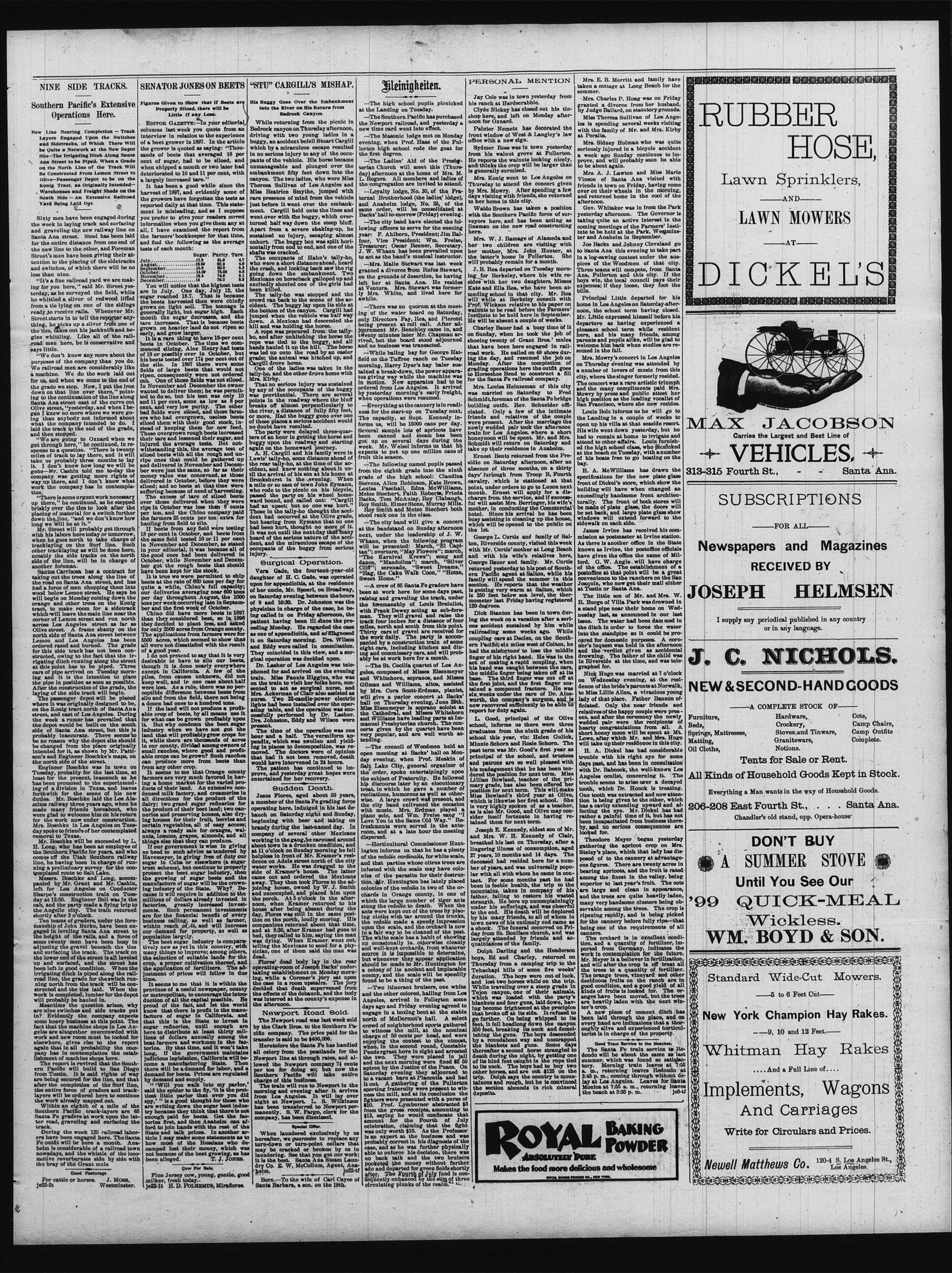
Searchable text
NINE SIDE TRACKS.
Southern Pacific's Extensive Operations Here.
New Line Nearing Completion — Track Layers Engaged Upon the Switches and Sidetracks, of Which There Will be Quite a Network at the New Depot Site—The Irrigating Ditch Along Santa Ana Street to be Piped. When a Grade on the North Line of the Track Will Be Constructed From Lemon Street to Olive—Passenger Depot to be on the Konig Tract, as Originally Intended—Warehouses and Freight Sheds on the South Side—An Extensive Railroad Yard Being Laid Out.
Sixty men have been engaged during the week in laying track and surfacing and graveling the new railway line on Santa Ana street. Steel has been laid for the entire distance from one end of the new line to the other, and Foreman Street's men have been giving their attention to the placing of the sidetracks and switches, of which there will be no less than nine.
"It's a fine railroad yard we are making for you here," said Mr. Street yesterday, as he surveyed the field, while he whittled a sliver of redwood lifted from a tie lying on one of the sidings ready to receive rails. Whenever Mr. Street starts in to tell the reporter anything, he picks up a silver from one of the ties, takes out his jackknife and begins whittling. Like all of the railroad men here, he is conservative and says little.
"We don't know any more about the purposes of the company than you do. We railroad men are considerably like a machine. We do the work laid out for us, and when we come to the end of the grade we stop. Now, I put the iron down on that line over there," pointing to the continuation of the line along Santa Ana street east of the curve out Olive street, "yesterday, and when I began I knew no more where we were going than anybody not informed about what the company intended to do. I laid the track to the end of the grade, and then stopped."
"We are going to Oxnard when we get through here," he continued, in response to a question. "There is twenty miles of track to lay there, and it will take us probably three months to lay it. I don't know how long we will be gone—Mr. Cashin told me today the senator jones on beets figures given to show that if beets are properly siloed, there will be little if any loss.
EDITOR GAZETTE: In your editorial columns last week you quote from an interview in relation to the experience of a beet grower in 1897. In the article the grower is quoted as saying: "Thousands of beets that averaged 18 percent of sugar, had to be siloed, and when shipped a month or two later had deteriorated to 10 and 11 per cent, with a largely increased tare."
It has been a good while since the harvest of 1897, and evidently some of the growers have forgotten the tests reported daily at that time. This statement is misleading, and as I suppose you prefer to give your readers correct information when you give them any at all, I have examined the report from the farmers' bookkeeper for that time, and find the following as the average tests of each month:
Sugar. Purity. Tare.
July...17.5 81.9 4.7
August...16.59 80.9 4.9
September...15.6 80.2 5.3
October...14.09 78.66 6.6
November...13.5 74.9 9.1
December...14 78.2 8.3
You will notice that the highest tests are in July. One day, July 12, the sugar reached 18.7. That is because the beets harvested then were chiefly grown on light soil. The tonnage is generally light, but sugar high. Each month the sugar decreases, and the tare increases. That is because beets grown on heavier land do not ripen so early, and grow larger.
It is a rare thing to have 18-per cent beets in October. The time we commenced siloing, Alex Henry had tests of 18 or possibly over in October, but his beets tested over 174 per cent out of the silo. In 1897 there were some fields of large beets that would not ripen, consequently were not ordered out. One of those fields was not siloed. In November and December the owner wanted to deliver them; he was permitted to do so, but his test was only 10 and 11 per cent, some as low as 8 per cent, and very low purity. The other bad fields were siloed, and those farmers who had overgrown, useless beets siloed them with their good stock, instead of keeping them for cow feed. These overgrown rough beets increased their tare and lessened their sugar, and injured the average tests. But notwithstanding this, the average test of siloed beets with all the rough and unripe ones that could be gathered up and delivered in November and December were just the same, so far as their size was concerned as those figures given to Show that if Beets are Properly Siloed, there will be Little if any Loss.
EDITOR GAZETTE: In your editorial columns last week you quote from an interview in relation to the experience of a beet grower in 1897. In the article the grower is quoted as saying: "Thousands of beets that averaged 18 percent of sugar, had to be siloed, and when shipped a month or two later had deteriorated to 10 and 11 per cent, with a largely increased tare."
It has been a good while since the harvest of 1897, and evidently some of the growers have forgotten the tests reported daily at that time. This statement is misleading, and as I suppose you prefer to give your readers correct information when you give them any at all, I have examined the report from the farmers' bookkeeper for that time, and find the following as the average tests of each month:
Sugar. Purity. Tare.
July...17.5 81.9 4.7
August...16.59 80.9 4.9
September...15.6 80.2 5.3
October...14.09 78.66 6.6
November...13.5 74.9 9.1
December...14 78.2 8.3
You will notice that the highest tests are in July. One day, July 12, the sugar reached 18.7. That is because the beets harvested then were chiefly grown on light soil. The tonnage is generally light, but sugar high. Each month the sugar decreases, and the tare increases. That is because beets grown on heavier land do not ripen so early, and grow larger.
It is a rare thing to have 18-per cent beets in October. The time we commenced siloing, Alex Henry had tests of 18 or possibly over in October, but his beets tested over 174 per cent out of the silo. In 1897 there were some fields of large beets that would not ripen, consequently were not ordered out. One of those fields was not siloed. In November and December the owner wanted to deliver them; he was permitted to do so, but his test was only 10 and 11 per cent, some as low as 8 per cent, and very low purity. The other bad fields were siloed, and those farmers who had overgrown, useless beets siloed them with their good stock, instead of keeping them for cow feed. These overgrown rough beets increased their tare and lessened their sugar, and injured the average tests. But notwithstanding this, the average test of siloed beets with all the rough and unripe ones that could be gathered up and delivered in November and December were just the same, so far as their size was concerned as those figures given to Show that if Beets are Properly Siloed, there will be Little if any Loss.
EDITOR GAZETTE: In your editorial columns last week you quote from an interview in relation to the experience of a beet grower in 1897. In the article the grower is quoted as saying: "Thousands of beets that averaged 18 percent of sugar, had to be siloed, and when shipped a month or two later had deteriorated to 10 and 11 per cent, with a largely increased tare."
It has been a good while since the harvest of 1897, and evidently some of the growers have forgotten the tests reported daily at that time. This statement is misleading, and as I suppose you prefer to give your readers correct information when you give them any at all, I have examined the report from the farmers' bookkeeper for that time, and find the following as the average tests of each month:
Sugar. Purity. Tare.
July...17.5 81.9 4.7
August...16.59 80.9 4.9
September...15.6 80.2 5.3
October...14.09 78.66 6.6
November...13.5 74.9 9.1
December...14 78.2 8.3
You will notice that the highest tests are in July. One day, July 12, the sugar reached 18.7. That is because the beets harvested then were chiefly grown on light soil. The tonnage is generally light, but sugar high. Each month the sugar decreases, and the tare increases. That is because beets grown on heavier land do not ripen so early, and grow larger.
It is a rare thing to have 18-percent beets in October. The time we commenced siloing, Alex Henry had tests of 18 or possibly over in October, but his beets tested over 174 per cent out of the silo. In 1897 there were some fields of large beeds that would not ripen, consequently were not ordered out. One of those fields was not siloed. In November and December the owner wanted to deliver them; he was permitted to do so, but his test was only 10 and 11 per cent, some as low as 8 per cent, and very low purity. The other bad fields were siloed, and those farmers who had overgrown, useless beets siloed them with their good stock, instead of keeping them for cow feed. These overgrown rough beets increased their tare and lessened their sugar, and injured the average tests.
But notwithstanding this,the average test of siloed beets with all the rough and unripe ones that could be gathered up and delivered in November and December were just the same, so far as their size was concerned as those figures given to Show that if Beets are Properly Siloed, there will be Little if any Loss.
EDITOR GAZETTE: In your editorial columns last week you quote from an interview in relation to the experience of a beet grower in 1897. In the article the grower is quoted as saying: "Thousands of beets that averaged 18 percent of sugar, had to be siloed, and when shipped a month or two later had deteriorated to 10 and 11 per cent, with a largely increased tare."
It has been a good while since the harvest of 1897, and evidently some of the growers have forgotten the tests reported daily at that time. This statement is misleading, and as I suppose you prefer to give your readers correct information when you give them any at all, I have examined the report from the farmers' bookkeeper for that time, and find the following as the average tests of each month:
Sugar. Purity.Tare.
July...17.5 81.9 4.7
August...16.59 80.9 4.9
September...15.6 80.2 5.3
October...14.09 78.66 6.6
November...13.5 74.9 9.1
December...14 78.2 8.3
You will notice that the highest tests are in July. One day, July 12, the sugar reached 18.7. That is because the beets harvested then were chiefly grown on light soil.The tonnage is generally light but sugar high.Each monththe sugar decreases,andthetareincreasesThatisbecausebeetstillgrowdownthesteepbluff.Apartfromasevereshaking-up,hestrainednoinjuryescapingalmostunhurt.Thebuggyboxwassplithorizontallyfromendtoend,andoneoftheshaftswerecracked.
The occupants of Hahn's tally-ho.wherewerea short distanceahead,thecrash,andlookingback sawtheriggoingdowntheembankment.TwoMexicansonhorsebackgallopedupandexcitedlyshootedoneofthegirlshadbeenkilled.
The tally-ho.wherewerea short distanceahead,thecrash,andlookingback sawtheriggingdowntheembankment.TwoMexicansonhorsebackgallopedupandexcitedlyshootedoneofthegirlshadbeenkilled.
The tally-ho.wherewerea short distanceahead,thecrash,andlookingback sawtheriggingdowntheembankment.TwoMexicansonhorsebackgallopedupandexcitedlyshootedoneofthegirlshadbeenkilled.
The tally-ho.wherewerea short distanceahead,thecrash,andlookingback sawtheriggingdowntheembankment.TwoMexicansonhorsebackgallopedupandexcitedlyshootedoneofthegirlshadbeenkilled.
The tally-ho.wherewerea short distanceahead,thecrash,andlookingback sawtheriggingdowntheembankment.TwoMexicansonhorsebackgallopedupandexcitedlyshootedoneofthegirlshadbeenkilled.
The tally-ho.wherewerea short distanceahead,thecrash,andlookingback sawtheriggingdowntheembankment.TwoMexicansonhorsebackgallopedupandexcitedlyshootedoneofthegirlshadbeenkilled.
The tally-ho.wherewerea short distanceahead,thecrash,andlookingback sawtheriggingdowntheembankment.TwoMexicansonhorsebackgallopedupandexcitedlyshootedoneofthegirlshadbeenkilled.
The tally-ho.wherewerea short distanceahead,thecrash,andlookingback sawtheriggingdowntheembankment.TwoMexicansonhorsebackgallopedupandexcitedlyshootedoneofthegirlshadbeenkilled.
The tally-ho.wherewerea short distanceahead,thecrash,andlookingback sawtheriggingdowntheembankment.TwoMexicansonhorsebackgallopedupandexcitedlyshootedoneofthegirlshadbeenkilled.
The tally-ho.wherewerea short distanceahead,thecrash,andlookingback sawtheriggingdowntheembankment.TwoMexicansonhorsebackgallopedupandexcitedlyshootedoneofthegirlshadbeenkilled.
The tally-ho.wherewerea short distanceahead,thecrash,andlookingback sawtheriggingdowntheembankment.TwoMexicansonhorsebackgallopedupandexcitedlyshootedoneofthegirlshadbeenkilled.
The tally-ho.wherewerea short distanceahead,thecrash,andlookingback sawtheriggingdowntheembankment.TwoMexicansonhorsebackgallopedupandexcitedlyshootedoneofthegirlshadbeenkilled.
The tally-ho.wherewerea short distanceahead,thecrash,andlookingback sawtheriggingdowntheembankment.TwoMexicansonhorsebackgallopedupandexcitedlyshootedoneofthegirlshadbeenkilled.
The tally-ho.wherewerea short distanceahead,thecrash,andlookingback sawtheriggingdowntheembankment.TwoMexicansonhorsebackgallopedupandexcitedlyshootedoneofthegirlshadbeenkilled.
The tally-ho.wherewerea short distanceahead,thecrash,andlookingback sawtheriggingdowntheembankment.TwoMexicansonhorsebackgallopedupandexcitedlyshootedoneofthegirlshadbeenkilled.
The tally-ho.wherewerea short distanceahead,thecrash,andlookingback sawtheriggingdowntheembankment.TwoMexicansonhorsebackgallopedupandexcitedlyshootedoneofthegirlshadbeenkilled.
The tally-ho.wherewerea short distanceahead,thecrash,andlookingback sawtheriggingdowntheembankment.TwoMexicansonhorsebackgallopedupandexcitedlyshootedoneofthegirlshadbeenkilled.
The tally-ho.wherewerea short distanceahead,thecrash,andlookingback sawtheriggingdowntheembankment.TwoMexicansonhorsebackgallopedupandexcitedlyshootedoneofthegirlshadbeenkilled.
The tally-ho.wherewerea short distanceahead,thecrash,andlookingback sawtheriggingdowntheembankment.TwoMexicansonhorsebackgallopedupandexcitedlyshootedoneofthegirlshadbeenkilled.
The tally-ho.wherewerea short distanceahead,thecrash,andlookingback sawtheriggingdowntheembankment.TwoMexicansonhorsebackgallopedupandexcitedlyshootedoneofthegirlshadbeenkilled.
The tally-ho.wherewerea short distanceahead,thecrash,andlookingback sawtheriggingdowntheembankment.TwoMexiciansonhorsebackgallopedupandexcitedlyshootedoneofthegirlshadbeenkilled.
The tally-ho.wherewerea short distanceahead,thecrash,andlookingback sawtheriggingdowntheembankment.TwoMexiciansonhorsebackgallopedupandexcitedlyshootedoneofthegirlshadbeenkilled.
The tally-ho.wherewerea short distanceahead,thecrash,andlookingback sawtheriggingdowntheembankment.TwoMexiciansonhorsebackgallopedupandexcitedlyshootedoneofthegirlshadbeenkilled.
The tally-ho.wherewerea short distanceahead,thecrash,andlookingback sawtheriggingdowntheembankment.TwoMexiciansonhorsebackgallopedupandexcitedlyshootedoneofthegirlshadbeenkilled.
The tally-ho.wherewerea short distanceahead,thecrash,andlookingback sawtheriggingdowntheembankment.TwoMexiciansonhorsebackgallopedupandexcitedlyshootedoneofthengirlsshouldhaveresultedingettinghe horseandbuggy upon-the roadway和startingagainon-thehomewardjourney.A.H.Cargill和hisfamilywereinbayisrullivethetail-taho.athishomeat
We are going to Oxnard when we get through here," he continued, in response to a question. "There is twenty miles of track to lay there, and it will take us probably three months to lay it. I don't know how long we will be gone. Mr. Cashin told me to-day the company was getting more rights of way up there, and I don't know what work the company has in contemplation.
"There is some urgent work necessary up there," he continued, as he stepped briskly over the ties to look after the placing of material for a switch further down the line, "and we don't know how long we will be at it."
Mr. Street will probably get through with his labors here today or tomorrow, when he goes north to take charge of tracklaying on the Surf line. Such other tracklaying as will be done here, notably the side tracks on the north side of the line, will be in charge of another foreman.
Santos Carrisosa has a contract for taking out the trees along the line of the road on Santa Ana street, and has had a force of men chopping them into wood below Lemon street. He says he will begin on Monday cutting down the orange and other trees on the Konig tract, to make room for a sidetrack which will leave the main line near the corner of Lemon street and run north across Los Angeles street as far as Olive street. A frame shanty on the north side of Santa Ana street between Lemon and Los Angeles has been ordered razed and burned. The grade for this side track has not been constructed, owing to the fact that the irrigating ditch running along the street at this point has to be piped. Three cars of pipe arrived on Tuesday morning and it is the intention to place the pipe in position as soon as possible. After the construction of the grade, the laying of the side track will begin.
The passenger depot will be placed where it was originally designed to be, on the Konig tract north of Santa Ana street, and east of Los Angeles. During the week a rumor has prevailed that the depot would be built on the south side of Santa Ana street, but this is probably inaccurate. There seems to be no reason why the depot site should be changed from the place originally intended for it, as shown by Mr. Pattison's and Engineer Boschke's maps, on the north side of the street.
Engineer Boschke was in town on Tuesday, probably for the last time, at least for the present, inasmuch as he has been promoted to the superintending of a division in Texas, and leaves forthwith for the scene of his new duties. Mr. Boschke laid the Los Alamitos railway three years ago, when he made many friends hereabout, who were glad to welcome him on his return for the work now under construction. Mrs. Boschke in Los Angeles on Tuesday spoke to friends of her contemplated removal to Texas.
Mr. Boschke will be succeeded by L. H. Long, who has been an employee of the Southern Pacific for years, and who comes off the Utah Southern railway line, he having been in charge of running a preliminary survey for the contemplated route to Salt Lake.
Messrs. Boschke and Long, accompanied by Mr. Grant and Mr. Cashin, left for Los Angeles on Conductor Sharpe's construction train on Tuesday at 1:30. Engineer Bell was in the ripen, consequently were not ordered out. One of those fields was not siloled. In November and December the owner wanted to deliver them; he was permitted to do so, but his test was only 10 and 11 per cent, some as low as 8 per cent, and very low purity. The other bad fields were siloled, and those farmers who had overgrown, useless beets silolved them with their good stock, instead of keeping them for cow feed. These overgrown rough beets increased their tare and lessened their sugar, and injured the average tests. But notwithstanding this, the average test of silosed beets with all the rough and unripe ones that could be gathered up and delivered in November and December were just the same, so far as their money value was concerned, as those delivered in October, before they were siloded; and no beets at that time were suffering because of need of harvesting.
The excess of tare of silosed beets over those delivered when they were ripe in October was less than 8 cents per ton, and the Chino company paid the farmers 25 cents per ton extra for hauling from field to silo.
If beets from any field were testing 18 per cent in October, and beets from the same field tested 10 or 11 per cent in November and December, as stated in your editorial, it was because all of the good ones had been delivered in October, while November and December got the rough beets that should have been kept for the stock.
It is true we were permitted to ship beets at the rate of 800 tons per day for quite a while, Chino's full capacity; our deliveries averaging near 600 tons per day throughout August, the 1000 tons per week occurring late in September and the first week of October.
Chino did have more beets in 1897 than they considered best, so in 1898 they decided to plant less, and asked for only 2500 acres from Orange county. The applications from farmers were for 5500 acres, which seemed to show that all were not dissatisfied with the result of a good year.
I do not pretend to say that it is very desirable to have to siloe our beets, though it is done nearly everywhere except in California. A few of the piles, from causes unknown, did not keep well, and in one case about half were lost. As a rule, there was no perceptible difference between beets from siloe and from the field, there not being a dozen bad ones to a hundred tons.
If the land will not produce a profitable crop of beets, by all means use it for what can be grown profitably upon it. But why condemn the beet sugar industry when we have not got the land that will profitably grow crops for it, while there are thousands of acres in our county, divided among owners of small ranches, where good and profitable crops can be grown? Such ranches can produce more from beets than from any other crop.
It seems to me that Orange county farmers are very much favored in having a home market for the varied products of their land. An extensive condensed milk factory, and creameries in all directions for the product of the dairy; two grand sugar refineries for the product of their beet land; two caneries and preserving houses; also drying houses for their fruit, berries and certain vegetables, all of easy access; always a ready sale for oranges, walnuts, lemons, grapes, almonds, and all things else that they can produce.
If our government is wise in giving no heed to such advice as tendered by Havemeyer, in giving free of duty our sugar in Cuba or elsewhere (a sugar trust scheme), but continue properly protect the beet sugar industry, then the growing of sugar beets and the manufacture of sugar will be the crowning industry of the State. Why? Because it will require in addition to the millions of dollars already invested in tipping consequence were not ordered out. One of those fields was not siloled. In November and December the owner wanted to deliver them; he was permitted to do so, but his test was only 10 and 11 per cent, some as low as 8 per cent, and very low purity. The other bad fields were siloled, and those farmers who had overgrown, useless beets silolved them with their good stock, instead of keeping them for cow feed. These overgrown rough beets increased their tare and lessened their sugar, and injured the average tests. But notwithstanding this, the average test of silosed beets with all the rough and unripe ones that could be gathered up and delivered in November and December were just the same, so far as their money value was concerned, as those delivered in October, before they were siloded; and no beets at that time were suffering because of need of harvesting.
The excess of tare of silosed beets over those delivered when they were ripe in October was less than 8 cents per ton, and the Chino company paid the farmers 25 cents per ton extra for hauling from field to silo.
If beets from any field were testing 18 per cent in October, and beets from the same field tested 10 or 11 per cent in November and December, as stated in your editorial, it was because all of the good ones had been delivered in October, while November and December got the rough beets that should have been kept for the stock.
It is true we were permitted to ship beets at the rate of 800 tons per day for quite a while, Chino's full capacity; our deliveries averaging near 600 tons per day throughout August, the 1000 tons per week occurring late in September and the first week of October.
Chino did have more beets in 1897 than they considered best, so in 1898 they decided to plant less, and asked for only 2500 acres from Orange county. The applications from farmers were for 5500 acres, which seemed to show that all were not dissatisfied with the result of a good year.
I do not pretend to say that it is very desirable to have to siloe our beets, though it is done nearly everywhere except in California. A few of the piles, from causes unknown, did not keep well, and in one case about half were lost. As a rule, there was no perceptible difference between beets from siloe and from the field, there not being a dozen bad ones to a hundred tons.
If the land will not produce a profitable crop of beets, by all means use it for what can be grown profitably upon it. But why condemn the beet sugar industry when we have not got the land that will profitably grow crops for it, while there are thousands of acres in our county, divided among owners of small ranches, where good and profitable crops can be grown? Such ranches can produce more from beeds than from any other crop.
It seems to me that Orange county farmers are very much favored in having a home market for the varied products of their land. An extensive condensed milk factory, and creameries in all directions for the product of their beet land; two caneries and preserving houses; also drying houses for their fruit, berries and certain vegetables, all of easy access; always a ready sale for oranges, walnuts, lemons, grapes, almonds,and all things else that they can produce.
If our government is wise in giving no heed to such advice as tendered by Havemeyer, in giving free of duty our sugar in Cuba or elsewhere (a sugar trust scheme), but continue properly protect the beet sugar industry, then the growing of sugar beets and the manufacture of sugar will be the crowning industry of the State. Why? Because it will require in addition to the millions of dollars already invested in tipping consequence were not ordered out. One of those fields was not siloled. In November and December the owner wanted to deliver them; he was permitted to do so, but his test was only 10 and 11 per cent, some as low as 8 per cent,and very low purity. The other bad fields were siloled,and those farmers who had overgrown,useless beets silolved them with their good stock,instead of keeping them with their wheel homeward bound,and called out: "Cargill had an upset," but no one was hurt." Those in the tally-ho thought the accident had occurred at the Olive grade,but hearing from Eymann no one had been hurt,thought no more of it. It was not until the next day that many heard of the serious nature of the accident,and the miraculous escape of the occupants of the buggy from serious injury.
Surgical Operation.
Vera Gade,the fourteen-year-old daughter of H.C.Gade,was operated upon for appendicitis,at the residence of her uncle,Mr.Spoerl,on Broadway,on Saturday evening betweenthe hoursof 9和10:30。Dr.Johnston wasthe physicianinchargeofthecase,hebeingcalledinonFridayafternoon,thepatienthavingbeenilllsetheprecedingMonday.Hereregardedthecaseasoneofappendicitis,andso diagnoseditonSaturdaymorning.Dr.WsllowandEddywerecalledinconsultation.Theyconciledinthisview,anda surgicaloperationwasdecidedupon.
Dr.LasherofLosAngeleswastelephonedforandarrivedontheeveningtrain.MissFannieHiggins,whowaston_traintovisitherfolkshere,conservedtoactas Surgical nurse,andMrs.AckermanofClairalsoassistedas Nurse.Two32-candle-powerelectriclightshadbadbenefitsovertheoperatingtable,andtheoperationwassuccessfullyperformedbyDr.Lasher.Dr.Johnston.EddyandWilsonwerepresent.
Thetimeoftheoperationwasonehouranda半half.Thevermiformappendix,whichwasswollenandyieldinginplacesdecomposition.wasremoved.Thedoctorswereofopinionthathaditnotbeenremoved.deathwouldhaveintervenedin24hours.
Thepatienthascontinuedtoimprove,andyesterdaygreathopeswerent entertainedforherrecovery.
Sudden Death.
Jesus Flores,aged about50years,amemberoftheSantaFegradingforceoperatinghere,intudgedinhislastdebauchonSaturdaynightandSunday,beginningwithbeerandtakingonbrandyduringthelast-namedday.IncompanyofseveralotherMexicansworkinginthegang,hcarousedaroundabouttownaindrunkencondition,andat11o'clockonSundaymorninghehelplessinfrontofMr.Kramer'sresidenceonAdelestreetnorthofthecitywaterworks.Hewas draggedtothesideofKramer'shouse.The lattercameoutandorderedtheMexicanaway.Thetheythen tookFloresto治adjoiningshouse,ownedbyW.J.Smithandunoccupied,andplacedhimupontheporch.At5o'clockintheafter-
Mr. Boschke laid the Los Alamitos railway three years ago, when he made many friends hereabout, who were glad to welcome him on his return for the work now under construction. Mrs. Boschke in Los Angeles on Tuesday spoke to friends of her contemplated removal to Texas.
Mr. Boschke will be succeeded by L. H. Long, who has been an employee of the Southern Pacific for years, and who comes off the Utah Southern railway line, he having been in charge of running a preliminary survey for the contemplated route to Salt Lake.
Messrs. Boschke and Long, accompanied by Mr. Grant and Mr. Cashin, left for Los Angeles on Conductor Sharpe's construction train on Tuesday at 12:50. Engineer Bell was in the cab, and the party made a flying trip to the Angelic city. The train returned shortly after 3 o'clock.
Ten teams of graders, under the foremanship of John Burke, have been engaged in leveling Santa Ana street to the height of the rails, and a force of some twenty men have been busy in adjusting the gravel beneath the ties and surfacing the track. The track on the lower end of the street is all leveled up and surfaced, and the street has been left in good condition. When the irrigating ditch is piped along the railroad line, the grade for the switch running north from the track will be constructed and the ties laid. When the work is completed, lumber for the depot will probably be hauled in.
Meantime the question arises; why are nine switches and side tracks put in? Evidently the company expects some heavy business at this point. The fact that the machine shops in Los Angeles are altogether overcrowded with work and new room must be looked for elsewhere, gives rise to the report again that in all probability the company has in contemplation the establishment of machine shops here.
The report is revived that the Southern Pacific will build to San Diego from Tustin. It is said rights of way are being secured for the line, and that after the completion of the Surf line, the entire force of graders and track-layers will be ordered here to continue the work already mapped out.
Within an eighth of a mile of the Southern Pacific track-layers are 65 Santa Fe graders at work upon the latter road, graveling and surfacing the track.
During the week 125 railroad laborers have been engaged here. The Santa Fe outfit will be here a month. Anaheim is considerable of a railroad town nowadays, and the whistle of the locomotive reverberates side by side with the bray of the Grant mule.
Good Pasturage
For cattle or horses. J. Moss, je22-2t Westminster.
Cow For Sale.
Fine Jersey cow, young, gentle, good milker, fresh today.
je22-1t H.D. POLHEMUS, Mirafores.
A member of the Santa Fe grading force operating here, indulged in his last debauch on Saturday night and Sunday, beginning with beer and taking on brandy during the last-named day. In company of several other Mexicans working in the gang, he caroused around about town in a drunken condition, and at 11 o'clock on Sunday morning he fell helpless in front of Mr. Kramer's residence on Adele street north of the city water works. He was dragged to the side of Kramer's house. The latter came out and ordered the Mexicans away. They then took Flores to the adjoining house, owned by W. J. Smith and unoccupied, and placed him upon the porch. At 5 o'clock in the afternoon, when Kramer returned to his house after being absent during the day, Flores was still in the same position on the porch, loudly snoring. His companions returned about that time, and at 8:30, after Kramer had gone to bed, they called to him, saying the man was dying. When Kramer went out telling the Mexicans to send for a physician, one of them said the man was dead.
Flores' dead body lay in the rear operating-room of Joseph Backs' undertaking establishment on Monday morning, while a Coroner's jury sat upon the case in a room upstairs. The jury decided that death supervised from the effects of the debauch, and the body was interred at the county's expense in the afternoon.
Newport Road Sold.
The Newport road was last week sold by the Clark Bros. to the Southern Pacific company. The price paid for the transfer is said to be $400,000.
Heretofore the Santa Fe has handled all celery from the peatlands for the Newport line at through rates, and allowed the Newport company 7½ cent per ton for doing so; but now that Southern Pacific will take entire charge of this business.
The train will run to Newport in the morning and evening after it arrived from Los Angeles. It will lay overnight at Newport. L. S. Wilkinson has been transferred to Newport permanently. S. W. Fargo, clerk for the company, has been dismissed.
Special Offer.
When laundered exclusively by us hereafter, we guarantee to replace and turn-down or turn-point collars that may be cracked or broken by us if laundered. See that you get our work it is the best. Santa Ana Steam Launch Co. E.W., McCollum, Agent, Anheim,
Born.-To the wife of Carl Cayce of Santa Barbara, a son, on the 19th.
HEARGILL'S MISHAP.
GOES OVER THE EMBANKMENT ON RIVER ON HIS RETURN FROM BEDROOK CANYON.
Returning from the picnic in Canyon on Thursday afternoon, with two young ladies in a accident befell Stuart Cargill miraculous escape resulted in injury to any of the occupants vehicle. His horse became stable and plunged over the front fifty feet down into the two ladies, who were Miss Sullivan of Los Angeles and Price Smythe, jumped with force of mind from the vehicle it went over the embankment held onto the lines and with the buggy, which over-wind way down the steep bluff. In a severe shaking-up, he no injury, escaping almost the buggy box was split horizontally end to end, and one of the cracked. Impacts of Hahn's tally-ho, short distance ahead, heard and looking back saw the rig in the embankment. Two men horseback galloped up and routed one of the girls had been yoyo-ho was stopped and the back to the scene of the accident the buggy lay upon its side at the canyon. Cargill had seen the vehicle halfway Mexican had descended the road holding the horse. Was procured from the tally-ho or unhitching the horse the tied to the buggy, and all led it up the hill. The horseonto the road by an easier animal was hitched up, and home. The ladles was taken in and the other drove home with serious injury was sustained the occupants of the buggy essential. There are several on the roadway where the bluff almost perpendicularly to distance of fully fifty feet, and the buggy gone over one place a serious accident would have resulted.
Jay Cole was in town yesterday from his ranch at Hardscrabble.
Clyde Nickey has closed out his tin-shop here, and left on Monday afternoon for Oxnard.
Painter Nemetz has decorated the front window of West & Langley's law office with a new sign.
Sydmer Ross was in town yesterday from his walnut grove at Fullerton. He reports the walnuts looking nicely, and thinks the crop will be larger than is generally surmised.
Mrs. Konig went to Los Angeles on Thursday to attend the concert given by Mrs. Mowry. After spending a few days visiting with friends, she returned to her home in this city.
Waldo Brown has taken a position with the Southern Pacific force of surveyors here, and has been acting as lineman on the new road constructing here.
Mrs. W.J. Ramage of Alameda and her two children are visiting with her mother, Mrs. John Hunter, at the latter's home in Fullerton. She will probably remain for a month.
J.B. Rea departed on Tuesday morning for Berkeley, where his wife resides with her two daughters, Misses Kate and Ella Rea, who have been attending school in that city. Mr.Rea will while at Berkeley consult with Prof.Wickson relative to his paper on walnuts to be read before the Farmers' Institute to be held here in September. He will be absent a couple of weeks.
Charley Bauer had a busy time of it on Sunday, when he took the job of shoeing twenty of Grant Bros.' mules that have been here engaged in railroad work. He nailed on 49 shoes during the day, and resumed the job on Monday. After the completion of grading operations here the outfit goes to Horseshoe Bend to construct a fill for the Santa Fe railroad company.
Mrs.Louisa Heinzeman of this city was married on Saturday to Fred Schmidt, foreman of the Santa Fe bridge building outfit. Rev.Schneider officiated. Only a few of the intimate friends and relatives of the couple were present. After the marriage the newly wedded pair took the afternoon train for Los Angeles, where a short honeynoon will be spent. Mr. and Mrs.Schmidt will return on Saturday and take up their residence in Anaheim.
Ernest Bentz returned from the Presidio on Saturday afternoon, after an absence of three months, on a thirty days' furlough from Troon B.Fourth
Mrs.E.B.Merritt and family have taken a cottage at Long Beach for the summer.
Mrs.Charles P.Hoag was on Friday granted a divorce from her husband by Judge Ballard, on statutory ground.
Miss Theresa Sullivan of Los Angeles is spending several weeks visiting with the family of Mr. and Mrs.Kin at Peralta.
Mrs.Sidney Holman who was seriously injured in a bicycle accident a week ago Sunday continues to prove, and will probably soon be able to be again.
Mrs.A.J.Lawton and Miss Mary Vinson of Santa Ana visited w friends in town on Friday, having co-own on their wheels in the morning and returned home in the cool of the afternoon.
Gov. Whitaker was in from the Presidium taking quite an active interest in upcoming meetings of the Farmers' Institute to be held at the Park, Westminster and Anaheim in September.
Joe Backs and Johnny Cleveland did to Santa Ana this evening to take in a log-sawing contest under the prices of the Woodmen of that city Three teams will compete, from Santa Ana, Fullerton and this city. If they boys win, the local council pays their expenses; if they loose, they foot their bills.
Principal Little departed for home in Los Angeles on Saturday afternoon, the school term having close Mr.Little expressed himself before departure as having experienced pleasant school term while residing here, and his many friends, among parents and pupils alike, will be glad welcome him back when studies are summed in the fall.
Mrs.Mowry's concert in Los Angeles on Thursday evening was attended by a number of lovers of music from this city, where the singer formerly resided.The concert was a rare artistic triumph and the many compliments paid Mr.Mowry by press and public attest his high position as the leading vocalist San Francisco, where she now resides.
Louie Bolz informs us he will go to the Landing in a couple of weeks open up his villa at that seaside resort His wife went down yesterday, but had to remain at home to irrigate as attend to other affairs. Louie furnished the high school class, who Sicilian at the beach on Tuesday, with a number of his boats free to go boating on the bay.
H.A.McWilliams has drawn
Mogical Operation.
Adobe, the fourteen-year-old of H. C. Gade, was operated dependently at the residence of Mr. Spoerl, on Broadway, by evening between the hours of 10:30. Dr. Johnston was the en charge of the case, he bein on Friday afternoon, the being ill since the pre-day. He regarded the case dependently, and so diagnosed tardy morning. Drs. Wilson were called in consultation. In this view, and a surjection was decided upon.
Burden Death.
Hores, aged about 50 years, of the Santa Fe grading force there, indulged in his last de-Saturday night and Sunday, with beer and taking on the last-named day. In several other Mexicans the gang, he caroused around in a drunken condition, and took on Sunday morning he fell front of Mr. Kramer's residence street north of the city kicks. He was dragged to the trammer's house. The latter and ordered the Mexicans they then took Flores to the adjoining owned by W. J. Smith supplied, and placed him upon At 5 o'clock in the after-
Magical Operation.
Adobe, the fourteen-year-old of H. C. Gade, was operated dependently at the residence of Mr. Spoerl, on Broadway, by evening between the hours of 10:30. Dr. Johnston was the en charge of the case, he bein on Friday afternoon, the being ill since the pre-day. He regarded the case dependently, and so diagnosed tardy morning. Drs. Wilson were called in consultation. In this view, and a surjection was decided upon.
Burden Death.
Hores, aged about 50 years, of the Santa Fe grading force there, indulged in his last de-Saturday night and Sunday, with beer and taking on the last-named day. In several other Mexicans the gang, he caroused around in a drunken condition, and took on Sunday morning he fell front of Mr. Kramer's residence street north of the city kicks. He was dragged to the trammer's house. The latter and ordered the Mexicans they then took Flores to the adjoining owned by W. J. Smith supplied, and placed him upon At 5 o'clock in the after-
Magical Operation.
Adobe, the fourteen-year-old of H. C. Gade, was operated dependently at the residence of Mr. Spoerl, on Broadway, by evening between the hours of 10:30. Dr. Johnston was the en charge of the case, he bein on Friday afternoon, the being ill since the pre-day. He regarded the case dependently, and so diagnosed tardy morning. Drs. Wilson were called in consultation. In this view, and a surjection was decided upon.
Burden Death.
Hores, aged about 50 years, of the Santa Fe grading force there, indulged in his last de-Saturday night and Sunday, with beer and taking on the last-named day. In several other Mexicans the gang, he caroused around in a drunken condition, and took on Sunday morning he fell front of Mr. Kramer's residence street north of the city kicks. He was dragged to the trammer's house. The latter and ordered the Mexicans they then took Flores to the adjoining owned by W. J. Smith supplied, and placed him upon At 5 o'clock in the after-
ROYAL BAKING POWDER
ABSOLUTELY PURE
Makes the food more delicious and wholesome
A large crowd was present, and the city band enlivened the occasion with music. Mrs. Erdman played a piano solo, and Wm. Freise sang "I Love You in the Same Old Way." Freshments were served in the ante room, and at a late hour the meeting dispersed.
Horticultural Commissioner Huntington informs us that he has a plenty of the vedalia cardinalis, for white scale, and that parties whose citrus trees are infested with the scale may have colonies of the parasite for their destruction. Mr. Huntington has lately placed colonies of the vedalia in two of the orchards in Orange county, in one of which the large number of tiger ants stung the vedalia to death. When the ants were kept out of the trees by placing cloths with tar around the trunks, the vedalia made a speedy impression upon the scale, and the orchard is now in a fair way to be cleaned of the pest. The white scale has a habit of showing up occasionally in otherwise cleanly and well-kept orchards, from whatever source it is impossible to determine, but whenever they appear application should be made to Mr. Huntington for a colony of its ancient and implacable enemy, and the scale will be speedily found to be a thing of the past.
Two itinerant bruisers, one white and the other colored, halling from Los Angeles, arrived in Fullerton some days ago and Friday evening agreed to engage in a boxing bout at the stable north of McDermot's hall. A select crowd of neighborhood sports gathered to witness the mill, at the nominal charge of 50 cents per head, and were enjoying the contest to the utmost, when, in the second round, Constable Pendergrast hove in sight and arrested the two. They were placed in jail and the next morning were fined $2 50 apiece by the Justice of the Peace. On Saturday evening they adjourned to a vacant barn at Placentia and had it out. A gathering of the Fullerton sporting fraternity were present to witness the mill, and at its conclusion the fighters were presented with a purse of $10. Prof. Lymburner abstracted $3 from the gross receipts, amounting to $13, saying he would confiscate that amount for the Fourth of July celebration, claiming that the fight was only worth $10. As the Professor is an expert at the business and was probably correct in his diagnosis of the case, and as he was further physically able to enforce his decision, there was no back talk and the two bruisers pocketed the money without further ado and departed for green fields shortly after. The Fourth of July fund is consequently enhanced by the sum of three circulating planks of the realm.
Joseph E. Kennedy, eldest son of Mr. and Mrs. W. H. Kennedy of Clair, breathed his last on Thursday, after a lingering illness of consumption, aged 27 years, 10 months and 14 days. The deceased had resided here for a number of years, and was universally popular with all with whom he came in contact. For some months past he had been in feeble health, the trip to the mountains, taken in company of his father, failing to restore his wasted strength. He bore up uncomplainingly under his sufferings, and was cheerful to the end. His death will be deplored by his many friends, to all of whom in town news of his untimely end came as a shock. The funeral occurred on Friday from St. Boniface church, and was largely attended by friends and acquaintances of the family.
Dolph Darling and the Henderson boys, Ed and Charley, returned on Thursday from a camping trip to the Teachapi hills of some five weeks' duration. The boys were out of luck, and lost two horses while on the trip. While traveling over a steep grade in Tejon canyon, one of their animals, which was loaded with the party's blankets and four guns, laid down, having become frightened at the precipice that broke off at its side. It refused to go further. On being whipped to its feet, it fell headlong down the canyon 350 feet, breaking its neck and demolishing the guns. The boys descended by a roundabout way and unstrapped the blankets and guns. Some days thereafter a second horse strangled to death during the night, by getting one of its hind feet caught in the rope tied to its neck. The boys had to buy two other horses, and are out $125 on the trip. Dolph says the country is mountainous and rough, but he is convinced the section abounds in rich mineral deposits.
Theodore Meyer began yesteryear gathering the apricot crop on Steley's place, which that lady has posed of to the cannery at advantageous figures. There are twenty acres bearing apricots, and the fruit is among the finest in the valley, best superior to last year's fruit. The area large and clean in appearance and the trees are quite heavily laden many very handsome clusters being servable among the trees. The crops ripening rapidly, and is being picked for the cannery before fully ripe—being one of the requirements of canners.
The orchard is in excellent condition, and a quantity of fertilizer, ported from Germany, indicates work in contemplation for the future. Mr. Meyer is a believer in fertilization and will after the crop is off till the trees to a quantity of fertilizer. The orange trees, vineyard and good condition, and a good yield of kinds of fruits is looked for. The anges have been moved, but the trees are heavily laden with the next year's crop.
A new piece of cement ditch been laid through the place, and every hand are indications that a toughly alive and experienced hornet turist is in charge of the property.
Good Train Service to the Beaches.
The Santa Fe train service today will be about same as summer, which was found so satisfactory. Morning train leaves at a.m., returning leaves Redondo at 3:45 p.m., coming through without lay at Los Angeles. Leaves for San Monica at 7:55 a.m., returning lee
RUBBER HOSE,
Lawn Sprinklers,
AND
LAWN MOWERS
AT
DICKEL'S
MAX JACOBSON
Carries the Largest and Best Line of
VEHICLES.
313-315 Fourth St., Santa Ana.
MAX JACOBSON
Carries the Largest and Best Line of
VEHICLES,
313-315 Fourth St., Santa Ana.
SUBSCRIPTIONS
FOR ALL
Newspapers and Magazines
RECEIVED BY
JOSEPH HELMSEN
I supply any periodical published in any country
or in any language.
J. C. NICHOLS.
NEW & SECOND-HAND GOODS
A COMPLETE STOCK OF
Furniture, Hardware, Cots,
Beds, Crockery, Camp Chairs,
Springs, Mattresses, Stoves and Tinware, Camp Outfits
Matting, Graniteware, Complete.
Oil Cloths, Notions.
Tents for Sale or Rent.
All Kinds of Household Goods Kept in Stock.
Everything a Man wants in the way of Household Goods.
206-208 East Fourth St., Santa Ana.
Chandler's old stand, opp. Opera-house
DON'T BUY
A SUMMER STOVE
Until You See Our
DON'T BUY
A SUMMER STOVE
Until You See Our
'99 QUICK-MEAL
Wickless.
WM. BOYD & SON.
Standard Wide-Cut Mowers.
—5 to 6 Feet Cut—
New York Champion Hay Rakes.
—9, 10 and 12 Feet.
Whitman Hay Rakes
...And a Full Line of...
Implements, Wagons
And Carriages
Write for Circulars and Prices.
Newell Matthews Co.
120-4 S. Los Angeles St., Los Angeles.