anaheim-gazette 1899-06-08
Scanned page
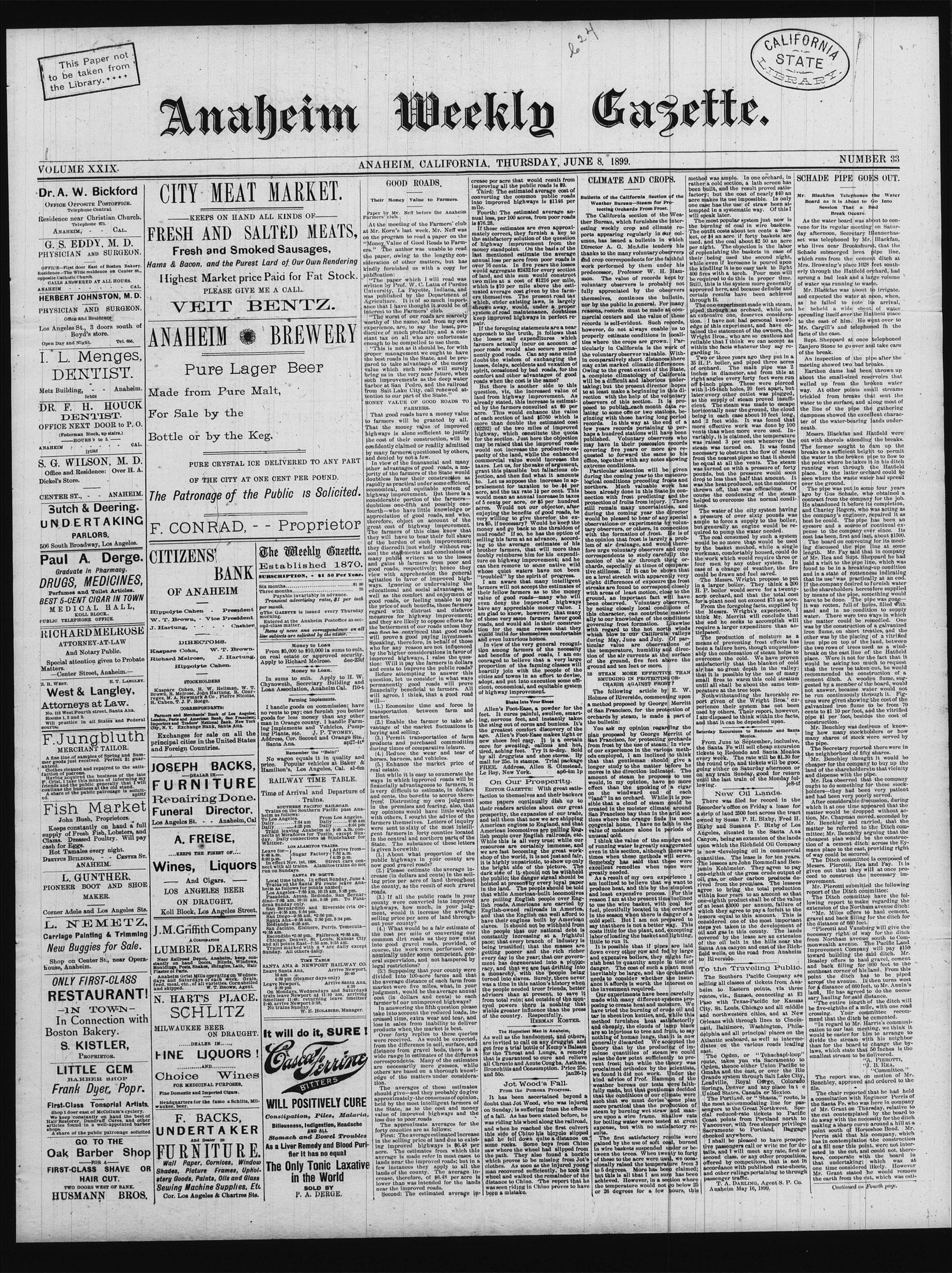
Searchable text
This Paper not to be taken from the Library.
Anaheim
VOLUME XXIX.
Dr. A. W. Bickford
OFFICE OPPOSITE POSTOFFICE.
Telephone Central.
Residence near Christian Church.
Telephone 671.
ANAHEIM, CAL.
G. S. EDDY, M. D.
PHYSICIAN AND SURGEON.
OFFICE—First door East of Boston Bakery.
Residence—The White residence on Center St., opposite Catholic Church.
CALLS ANSWERED AT ALL HOURS.
ANAHEIM CAL.
HERBERT JOHNSTON, M. D.
PHYSICIAN AND SURGEON.
Office and Residence:
Los Angeles St., 3 doors south of Boyd's store.
Open Day and Night. Tel. 606.
I. L. Menges,
DENTIST.
Metz Building, Anaheim feb24
DR. F. H. HOUCK
DENTIST.
OFFICE NEXT DOOR to P. O.
(Federman Block, up stairs.)
HOURS 9 to 5
ANAHEIM CAL.
S. G. WILSON, M. D.
Office and Residence: Over H. A.
CITY MEAT MARKET.
KEEPS ON HAND ALL KINDS OF
FRESH AND SALTED MEATS,
Fresh and Smoked Sausages,
Hams & Bacon, and the Purest Lard of Our Own Rendering
Highest Market price Paid for Fat Stock
PLEASE GIVE ME A CALL.
VEIT BENTZ.
ANAHEIM BREWERY
Pure Lager Beer
Made from Pure Malt,
For Sale by the
Bottle or by the Keg.
PURE CRYSTAL ICE DELIVERED TO ANY PAR
DENTIST.
Metz Building, Anaheim.
feb24
DR. F. H. HOUCK
DENTIST.
OFFICE NEXT DOOR to P. O.
(Federman Block, up stairs.)
HOURS 9 to 5.
ANAHEIM CAL.
jy154f
S. G. WILSON, M. D.
Office and Residence: Over H. A. Dickel's Store.
CENTER ST., ANAHEIM.
Sutch & Deering.
UNDERTAKING
PARLORS.
506 South Broadway, Los Angeles.
Paul A. Derge.
Graduate in Pharmaoy.
DRUGS, MEDICINES,
Perfumes and Toilet Articles.
BEST 5-CENT CIGAR IN TOWN
MEDICAL HALL,
KOLL BLOCK.
PUBLIC TELEPHONE OFFICE.
RICHARD MELROSE
ATTORNEY-AT-LAW
And Notary Public.
Special attention given to Probate Matters.
—Center Street, Anaheim—
Z. B. WEST.
E. T. LANGLEY.
West & Langley,
Attorneys at Law.
No. 118 West Fourth street, Santa Ana.
Rooms 1, 2 and 3.
Will practice in all States and Federal courts.
F.Jungbluth
MERCHANT TAILOR.
A fine line of samples of Spring and Summer goods just received. Perfect at guaranteed.
Clothes cleaned and repaired to the satisfaction of patrons.
Having acquired the business of the late F. Crist, I take this means of informing my friends and the public generally that I will continue the business at the old stand.
A share of the public patronage is solicited apistf.
Fish Market
John Bush, Proprietors.
Keeps constantly on hand a full supply of Fresh Fish, Lobsters, and Clams. Dressed Poultry. Will pay cash for Eggs.
Hot Tamales every night.
DREYFUS BUILDING, - CENTER ST.
ANAHEIM.
L. GUNTHER.
PIONEER BOOT AND SHOE MAKER.
CITIZENS'
BANK
OF ANAHEIM
Hippolyte Cahen President
W. T. Brown, Vice President
J. Hartung, Cashier
DIRECTORS:
Kaspare Cohn, W. T. Brown.
Richard Melrose, J. Hartung.
STOCKHOLDERS:
Kaspare Cohen, H. W. Hellman, W. T. Brown, R. Melrose, John Hartung, R. Courreges, M.A. Newmark & Co., Pierre Nicolas, H. Cahen, T. J. F. Boege.
CORRESPONDENTS:
Farmers and Merchants' Bank of Los Angeles; London, Paris and American Bank, San Francisco; Importers and Traders' National Bank, New York City, N.Y. Exchange Bank, Santa Ana.
Exchanges for sale on all the principal cities in the United States and Foreign Countries.
JOSEPH BACKS,
DEALER IN
FURNITURE
Repairing Done.
Funeral Director.
Los Angeles St. - Anaheim, Cal
A. FREISE,
...KEEPS THE FINEST OF...
Wines, Liquors
And Cigars.
LOS ANGELES BEER
The Weekly Gazette
Established 1876
SUBSCRIPTION, - $1 50 Per Year
Six months....$3 three months....$2 Payable invariably in advance.
Transient advertising rates,$1 per month.
The GAETTE is issued every Thursday morning.
Entered at the Anaheim Postoffice as ood-class matter.
Items of news and correspondence on live subjects are solicited by the editor.
Money to Loan
From $5,000 to $10,000 in sums to secure real estate or approved security Apply to Richard Melrose.
Money to Loan.
In sums to suit. Apply to H. Chynoweth, Secretary Building Loan Association, Anaheim Cal.
Farming Implements.
I handle goods on commission; no rents to pay; can furnish you bet goods for less money than any other man in Orange county. I handle Farming Implements and Vehicles, Putting Plants, etc.
J. P. Twomey,
Address Cor. Second and Orange Santa Ana.
Remember the "Bain!"
No wagon equals it in quality price. Popular vehicles at Baker Hamilton's, Los Angeles, Cal.
RAILWAY TIME TABLE
Time of Arrival and Departure Trains.
SOUTHERN PACIFIC RAILROAD.
Trains on the Southern Pacific pass Anaheim as follows:
To Los Angeles.
Daily.....7:54 am Daily.....9:54 Dailly
Train leaving Anaheim at 9:45 a.m.; nectets at Miranfores for Tustin, except day; Daily connections at Studebaker Whittier.
LOS ALAMITOS TRAINS:
Leave for—
9:48 a.m.
Sugar Factory
7:52 a.m.
6:02 p.m.
Infect Nov. 1st, 1880. Street cars nect with all trains. Alamitos trains do run on Sundays.
SANTA FE ROUTE.
Local time table. In effect Sunday, Ju Trains on the Santa Fe route leave Anaheim as follows for points named:
Los Angeles—7:58 am, 10:15 am, 5:06 pm Pasadena, Azusa, Redondo, San Benito
Fish Market
John Bush, Proprietors.
Keeps constantly on hand a full supply of Fresh Fish, Lobsters, and Clams. Dressed Poultry. Will pay cash for Eggs.
Hot Tamales every night.
DREYFUS BUILDING, - CENTER ST.
ANAHEIM.
L. GUNTHER.
PIONEER BOOT AND SHOE MAKER.
Corner Adele and Los Angeles Sts.
L. NEMETZ,
Carriage Painting & Trimming
New Buggies for Sale.
Shop on Center St., near Opera-house, Anaheim.
ONLY FIRST-CLASS RESTAURANT!
IN TOWNIn Connection with Boston Bakery.
S. KISTLER,
PROPRIETOR.
LITTLE GEM
BARBER SHOP
Frank Dyer, Popr.
First-Class Tonsorial Artists.
Shop 1 door east of McCollum's cyclery.
We keep constantly on hand the best of Hair Restorer, Dandruff Cures, and other articles found in a well-appointed barber shops.
A share of the public patronage solicited
GO TO THE Oak Barber Shop
FOR A FIRST-CLASS SHAVE OR HAIR CUT.
TWO DOORS WEST OF BANK.
HUSMANN BROS.
Rebairring Done.
Funeral Director.
Los Angeles St. - Anaheim, Cal
A. FREISE,
...KEeps THE FINEST OF....
Wines, Liquors
And Cigars.
LOS ANGELES BEER ON DRAUGHT,
Koll Block, Los Angeles Street.
J.M.Griffith Company
A CORPORATION
LUMBER DEALERS
Neer Railroad Depot, Anaheim, keep constantly on hand Doors, Blinds, Windows, Mouldings, Posts, Shakes, Shingles, Lath, Hair Plaster of Paris.
Anahejm Grist Mills operating on Wednesdays and Saturdays of each week. Grain, feed, meal, etc., of all varieties. Cornshellled and shipped.
W. T. Brown, Agent.
N. HART'S PLACE.
SCHLITZ
MILWAUKEE BEER ON DRAUGHT.
DEALER IN...
FINE LIQUORS!
AND...
Choice Wines
FOR MEDICINAL PURPOSES,
Fine Domestic and Imported Cigars.
Headquarters for the famo s Schlitz, Milwaukee, beer.
F. BACKS,
UNDERTAKER
And Dealer in
FURNITURE.
Wall Paper, Cornices, Window Shades, Picture Frames, Upholstery Goods, Paints, Oils and Glass Sewing Machine Supplies, Etc.
Cor. Los Angeles & Chartres Sts.
SOUTHERN PACIFIC RAILROAD.
Trains on the Southern Pacific pass A heim as follows:
To Los Angeles,
Daily.....7:54 am Daily.....9:48 am
Daily.....4:25 pm Daily.....6:00 pm
Train leaving Anaheim at 9:45 a.m. next at Mirafores for Tustin, except Sunday. Daily connections at Studebaker Whittier.
LOS ALAMITOS TRAINS.
Leave for—
9:48 a.m.
6:02 p.m.
Arrive fro
9:48 a.m.
6:02 p.m.
Street cars nect with all trains. Alamitos trains do run on Sundays.
SANTA FE ROUTE.
Local time table. In effect Sunday. Ju Trains on the Santa Fe route leave A heim as follows for points named:
Los Angeles—7:55 am; 10:15 am; 5:05 pm
Pasadena, Azusa, Redondo, San Berdino—7:55 am; 10:15 am; 5:05 pm. To P dena Sunday only.
San Bernardino and Riverside (via ange)—9:55 am; 5:54 pm.
San Diego—9:55 am; *2:50 pm.
Santa Ana—9:55 am; 2:50 pm; 5:54 pm.
Redlands—9:55 am.
San Jacinto, Elsinore, Perris, Temecula—9:55 am.
Escondido *2:50 pm. Fallbrook *9:55 am Chicago, Denver, St. Louis, Kansas and all points East—7:55 am; 9:55 am. Trains marked with a * are daily ex Sunday. All others daily.
TIME TABLE
SANTA ANA & NEWPORT RAILWAY
Leave Santa Ana,
10 am
4:30 pm (steamer days only)
Leave Newport,
3:30 pm
On Mondays, Wednesdays and Saturn train leave Newport at 11:10 am; arrr Smeltzer 11:48; returning leave Smelter 2:40; arrive Newport 3:18.
No trains Sunday.
It will do it, SURGE
Cascaferrine
BITTERS
WILL POSITIVELY CUL
Constipation, Piles, Malaria
Billiousness, Indigestion, Headache AND ALL
Stomach and Bowel Trouble
As a Liver Remedy and Blood Filler it has no equal
The Only Tonic Laxation in the World
SOLD BY
P. A. DERGE.
Heim Weekly Gazette
ANAHEIM, CALIFORNIA, THURSDAY, JUNE 8, 1899.
MARKET.
KINDS OF
FED MEATS,
Sausages,
of Our Own Rendering
and for Fat Stock.
CALL.
NTZ.
BREWERY
Beer
GOOD ROADS.
Their Money Value to Farmers.
Paper by Mr. Neff before the Anaheim Farmers' club.
At the meeting of the Farmers' club at Mr. Korn's last week, Mr. Neff was on the program to read a paper on the "Money Value of Good Roads to Farmers." The author was unable to read the paper, owing to the lengthy consideration of other matters, but has kindly furnished us with a copy for publication:
"The paper which I will read was written by Prof. W. C. Latta of Purdue University, La Fayette, Indiana, and was published by the Department of Agriculture. It is of so much importance that I have thought it would be of interest to the Farmers' club."
"The worst of our roads are scarcely worthy of the name, and from my own experience, are, to say the least, productive of much profanity, and a constant tax on all who are unfortunate enough to be compelled to use them.
"This is not as it should be, for with proper management we ought to have the best roads in the State, and be prepared to take advantage of the money value which such roads will surely bring us in the very near future, when such improvements as the deep water harbor at San Pedro, and the railroad from Salt Lake City, call renewed attention to our part of the State."
MONEY VALUE OF GOOD ROADS TO FARMERS.
That good roads have a money value to farmers will be granted by all. That the money value of improved highways is alone sufficient to justify the cost of their construction, will be confidently claimed or readily admitted by many farmers, questioned by others, and denied by not a few.
In view of the financial and many other advantages of good roads, a majority of the farmers of the State would increase per acre that would result from improving all the public roads is $9.
Third: The estimated average cost of converting the common public roads into improved highways is $1146 per mile.
Fourth: The estimated average annual loss, per 100 acres, from poor roads is $76.28.
If these estimates are even approximately correct, they furnish a key to the satisfactory solution of the question of highway improvement from the money standpoint. On the basis of the last mentioned estimate the average annual loss per acre from poor roads is over 76 cents. In five years the losses would aggregate $2432 for every section of land, and this sum would construct two miles at a cost of $1216 per mile, which is $70 per mile above the estimated average cost given by the farmers themselves. The present road tax which, under existing laws, is largely thrown away, would, under a proper system of road maintenance, doubtless keep improved highways in perfect repair.
If the foregoing statements are a near approach to the truth, it follows that the losses and expenditures which farmers actually incur on account of poor roads would also secure permanently good roads. Can any sane mind doubt the wisdom of exchanging the losses, delays, accidents and vexation of spirit, occasioned by bad roads, for the comfort and other advantages of good roads when the cost is the same?
But there is another side to this question, viz., the increased value of land from highway improvement. As already stated, this increase is estimated by the farmers consulted at $9 per acre. This would enhance the value of each section of land $5760 which is more than double the estimated cost ($2292) of the two miles of improved highway, which constitute the quota for the section. Just here the objection may be raised that the improved roads would not increase the productive capacity of the land, while the enhanced commercial value would increase the taxes. Let us, for the sake of argument, grant this plausible but fallacious objection.
CLIMATE AND CROPS.
Bulletin of the California Section of Weather Bureau—Steam for Protecting Orchards From Frost.
The California section of the Weather Bureau, which furnishes the latest weekly crop and climate ports appearing regularly in our umms, has issued a bulletin in w Director A. G. McAdie tenders thanks to the many voluntary observers and crop correspondents for the fait work performed by them under predecessor, Professor W. H. B. mon. The value of records kept voluntary observers is probably fully appreciated by the observers themselves, continues the bulldoor by the public in general. For many reasons, records must be made at commercial centers and the value of these records is self-evident. Such records however, do not always enable properly estimate conditions in localities where the crops are grown.
ticularly in California is the work of voluntary observer valuable. We in comparatively short distances may exist marked climatic difference. Owing to the great extent of the Sage complete climatology of California will be a difficult and laborious undertaking; but the present director leads to at least make a beginning in this reaction with the help of the volunteer observers of this section. It is posed to publish each month dating to some one or two stations gaining with those having long records. In this way at the end few years records pertaining to haps a hundred stations will have published. Voluntary observers may have in their possession recovering five years or more an enquired to forward the same office together with any notes she extreme conditions.
Particular attention will be
MONEY VALUE OF GOOD ROADS TO FARMERS.
That good roads have a money value to farmers will be granted by all. That the money value of improved highways is alone sufficient to justify the cost of their construction, will be confidently claimed or readily admitted by many farmers, questioned by others, and denied by not a few.
In view of the financial and many other advantages of good roads, a majority of the farmers of the State would doubtless favor their construction as rapidly as practical under some efficient, economical, and equitable system of highway improvement. But there is a considerable portion of the farmers—doubtless one-fifth and possibly one-fourth—who have little knowledge or appreciation of good roads, and who, therefore, object on account of the great cost of highway improvement. The farmers of this class know that they will have to bear their full share of the burden of such improvement; they discredit (not wholly without reason) the statements and conclusions of many public writers as to the losses and gains to farmers from poor and good roads, respectively; hence they view with apprehension the general agitation in favor of improved highways. Ignoring or undervaluing the educational and social advantages, as well as the comfort and enjoyment of good roads, or feeling unable to pay the price of such benefits, these farmers regard with distrust and disfavor measures for highway improvement; and they are likely to oppose efforts for the betterment of our roads unless they can first be convinced that good roads will prove a good paying investment. Speaking, therefore, in behalf of those who for any reason are not influenced by the higher considerations in favor of improved highways, I raise the question: Will it pay the farmers in dollars and cents to improve the public roads?
Before attempting to answer this question, let us consider in what ways permanently good roads will prove financially beneficial to farmers. All will agree, I think, that a good road will—
(1) Economize time and force in transportation between farm and market.
(2) Enable the farmer to take advantage of the market fluctuations in buying and selling.
(3) Permit transportation of farm products and purchased commodities during times of comparative leisure.
(4) Reduce the wear and tear of horses, harness, and vehicles.
(5) Enhance the market price of real estate.
But while it is easy to enumerate the ways in which improved roads will be financially advantageous to farmers, it is very difficult to estimate, in dollars and cents, the benefits to accrue therefrom. Distrusting my own judgment in the premises and fearing also, that my opinions would have little weight with others, I sought the advice of the farmers themselves. Letters of inquiry were sent to sixty of the most intelligent farmers in forty counties located in the central and northern parts of the State. The substance of these letters is given herewith:
(1) About what proportion of the public highways in your county are now good gravel roads?
(2) Please estimate the average increase (in dollars and cents) in the selling price per acre of land throughout the county, as the result of such gravel roads.
(3) If all the public roads in your county bring us in the very near future, when such improvements as the deep water harbor at San Pedro, and the railroad from Salt Lake City, call renewed attention to our part of the State.”
MONEY VALUE OF GOOD ROADS TO FARMERS.
That good roads have a money value to farmers will be granted by all. That the money value of improved highways is alone sufficient to justify the cost of their construction, will be confidently claimed or readily admitted by many farmers, questioned by others, and denied by not a few.
In view of the financial and many other advantages of good roads, a majority of the farmers of the State would doubtless favor their construction as rapidly as practical under some efficient, economical, and equitable system of highway improvement. But there is a considerable portion of the farmers—doubtless one-fifth and possibly one-fourth—who have little knowledge or appreciation of good roads, and who, therefore, object on account of the great cost of highway improvement. The farmers of this class know that they will have to bear their full share of the burden of such improvement; they discredit (not wholly without reason) the statements and conclusions of many public writers as to the losses and gains to farmers from poor and good roads, respectively; hence they view with apprehension the general agitation in favor of improved highways. Ignoring or undervaluing the educational and social advantages, as well as the comfort and enjoyment of good roads, or feeling unable to pay the price of such benefits, these farmers regard with distrust and disfavor measures for highway improvement; and they are likely to oppose efforts for the betterment of our roads unless they can first be convinced that good roads will prove a good paying investment. Speaking, therefore, in behalf of those who for any reason are not influenced by the higher considerations in favor of improved highways, I raise the question: Will it pay the farmers in dollars and cents to improve the public roads?
Before attempting to answer this question, let us consider in what ways permanently good roads will prove financially beneficial to farmers. All will agree, I think, that a good road will—
(1) Economize time and force in transportation between farm and market.
(2) Enable the farmer to take advantage of the market fluctuations in buying and selling.
(3) Permit transportation of farm products and purchased commodities during times of comparative leisure.
(4) Reduce the wear and tear of horses, harness, and vehicles.
(5) Enhance the market price of real estate.
But while it is easy to enumerate the ways in which improved roads will be financially advantageous to farmers, it is very difficult to estimate, in dollars and cents, the benefits to accrue therefrom. Distrusting my own judgment in the premises and fearing also, that my opinions would have little weight with others, I sought the advice of the farmers themselves. Letters of inquiry were sent to sixty of the most intelligent farmers in forty counties located in the central and northern parts of the State. The substance of these letters is given herewith:
(1) About what proportion of the public highways in your county are now good gravel roads?
(2) Please estimate the average increase (in dollars and cents) in the selling price per acre of land throughout the county, as the result of such gravel roads.
(3) If all the public roads in your county bring us in the very near future, when such improvements as the deep water harbor at San Pedro, and the railroad from Salt Lake City, call renewed attention to our part of the State.”
MONEY VALUE OF GOOD ROADS TO FARMERS.
That good roads have a money value to farmers will be granted by all. That the money value of improved highways is alone sufficient to justify the cost of their construction, will be confidently claimed or readily admitted by many farmers, questioned by others, and denied by not a few.
In view of the financial and many other advantages of good roads, a majority of the farmers of the State would doubtless favor their construction as rapidly as practical under some efficient, economical, and equitable system of highway improvement. But there is a considerable portion of the farmers—doubtless one-fifth and possibly one-fourth—who have little knowledge or appreciation of good roads, and who, therefore, object on account of the great cost of highway improvement. The farmers of this class know that they will have to bear their full share of the burden of such improvement; they discredit (not wholly without reason) the statements and conclusions of many public writers as to the losses and gains to farmers from poor and good roads, respectively; hence they view with apprehension the general agitation in favor of improved highways. Ignoring or undervaluing the educational and social advantages, as well as the comfort and enjoyment of good roads, or feeling unable to pay the price of such benefits, these farmers regard with distrust and disfavor measures for highway improvement; and they are likely to oppose efforts for the betterment of our roads unless they can first be convinced that good roads will prove a good paying investment. Speaking, therefore, in behalf of those who for any reason are not influenced by the higher considerations in favor of improved highways, I raise the question: Will it pay the farmers in dollars and cents to improve the public roads?
Before attempting to answer this question, let us consider in what ways permanently good roads will prove financially beneficial to farmers. All will agree, I think, that a good road will—
(1) Economize time and force in transportation between farm and market.
(2) Enable the farmer to take advantage of the market fluctuations in buying and selling.
(3) Permit transportation of farm products and purchased commodities during times of comparative leisure.
(4) Reduce the wear and tear of horses, harness, and vehicles.
(5) Enhance the market price of real estate.
But while it is easy to enumerate the ways in which improved roads will be financially advantageous to farmers, it is very difficult to estimate, in dollars and cents, the benefits to accrue therefrom. Distrusting my own judgment in the premises and fearing also, that my opinions would have little weight with others, I sought the advice of the farmers themselves. Letters of inquiry were sent to sixty of the most intelligent farms in forty counties located in the central and northern parts of the State. The substance of these letters is given herewith:
(1) About what proportion of the public highways in your county are now good gravel roads?
(2) Please estimate the average increase (in dollars and cents) in the selling price per acre of land throughout the county, as the result of such gravel roads.
(3) If all the public roads in your county bring us in the very near future, when such improvements as the deep water harbor at San Pedro, and the railroad from Salt Lake City, call renewed attention to our part of the State.”
MONEY VALUE OF GOOD ROADS TO FARMERS.
That good roads have a money value to farmers will be granted by all. That the money value of improved highways is alone sufficient to justify the cost of their construction, will be confidently claimed or readily admitted by many farmers, questioned by others, and denied by not a few.
In view of the financial and many other advantages of good roads, a majority of the farmers of the State would doubtlessly favor their construction as rapidly as practical under some efficient, economical, and equitable system of highway improvement. But there is a considerable portion of the farmers—doubtless one-fifth and possibly one-fourth—who have little knowledge or appreciation of good roads, or feeling unable to pay the price of such benefits, these farmers regard with distrust and disfavor measures for highway improvement; and they are likely to oppose efforts for the betterment of our roads unless they can first be convinced that good roads will prove a good paying investment. Speaking, therefore, in behalf of those who for any reason are not influenced by the higher considerations in favor of improved highways, I raise the question: Will it pay the farmers in dollars and cents to improve the public roads?
Before attempting to answer this question, let us consider in what ways permanently good roads will prove financially beneficial to farmers. All will agree, I think, that a good road will—
(1) Economize time and force in transportation between farm和市场.
(2) Enablethe farmerto take advantageofthemarketfluctuationsinbuyingandselling.
(3) Permittransportationoffarmerproductsandpurchasedcommoditiesduringtimesofcomparativeleisure.
(4) Reducethewearandtearofhorses,harness,andvehicles.
(5) Enhancethemarketpriceofrealestate.
But while it is easy to enumeratethewaysinwhichimprovedroadswillbefinanciallyadvantageoustofarmersitverydifficulttostimateindollarsandcents,thebenefitstocaccrueretherefrom.Distrustingmyownjudgmentinthepremisesandfeearingsalso,themyopinionswouldhavelittleweightwithothers.Iseighttheadviceofthefarmerswillbecorrectforsweating,callousandhot,tired,aachingfeet.Tryit today.Soldbyalldrugristrialsandshoestores.Bymailfor25c.instamps.TrialpackageFREE.Addlen,SternS.Olmstead LeRoyNew York ap6-4m1p
On Our Prosperity.
EDITOR GAZETTE: With great satisfactiontothemselvesandthebackersomepaperscontinually dishupuptotheirreadersarticlesaboutthegreatprosperity,theexpansionofourtrade,andtellthemthatnowweareshippingAmericanenginestoEngland,andthatAmericanlocomotivesarepullingEnglishpeopleoverEnglishrailroads,eToWhilethisisallverytrue;whileourresourcesarecertainimmense,andwearefastbecomingthegreatworkshopoftheworld,它isnotjustandfair.itishighunpatriotic,toshowuponlybrightsideofthepicture.Thedarksideoftitshouldnotbewithheldthepublic;the danger signal shouldbehostedatpresentbyeveryloyalpaperintheland.ThepeopleshouldbelthatwhileAmerico-builtlocomotivespullingEnglishpeopleoverEnglisheverfollowedthesmoothedirectorbefoundinthewindwardendofland"inanorchard.WhileisablethatcloudofsteamcoatedinthemoisterclimateSanFriscobaytanintheauncieswhereorangefindsitscongenialhome.Ihavenofaithvalueofmoisturealoneinpermanentcolossalold.
Asaresultofmyownexperimentaininclinedtobelievethatweproduceheat,andthisbythesecondandleastexpensiveprocess.IreasonatlmosttimewhenthemethodswillbeSomebodyhassaidthattheexcellentremedieswhennonegreatened.
Asaresultofmyownexperimentaininclinedtobelievethatweproduceheat,andthisbythesecondandleastexpensiveprocess.IreasonatlmosttimewhenthemethodswillbeSomebodyhassaidthattheexcellentremedieswhennonegreatened.
```markdown
Weekly Gazette.
Published 1870.
Dec-23rd
April 1st
May 1st
June 1st
July 1st
August 1st
September 1st
October 1st
November 1st
December 1st
January 1st
February 1st
March 1st
April 1st
May 1st
June 1st
July 1st
August 1st
September 1st
October 1st
November 1st
December 1st
January 1st
February 1st
March 1st
April 1st
May 1st
June 1st
July 1st
August 1st
September 1st
October 1st
November 1st
December 1st
January 1st
February 1st
March 1st
April 1st
May 1st
June 1st
July 1st
August 1st
September 1st
October 1st
November 1st
December 1st
January 1st
February 1st
March 1st
April 1st
May 1st
June 1st
July 1st
August 1st
September 1st
October 1st
November 1st
December 1st
January 1st
February 1st
March 1st
April 1st
May 1st
June 1st
July 1st
August 1st
September 1st
October 1st
November 1st
December 1st
January 1st
February 1st
March 1 st
April 1 st
May 1 st
June 1 st
July 1 st
August 1 st
September 1 st
October 1 st
November 1 st
December 1 st
January 1 st
February 1 st
March 1 st
April 1 st
May 1 st
June 1 st
July 1 st
August 1 st
September 1 st
October 1 st
November 1 st
December 1 st
January 1 st
February 1 st
March
St
A
N
O
T
R
S
E
D
J
K
L
M
N
O
T
R
S
E
D
J
K
L
M
N
O
T
R
S
E
D
J
K
L
M
N
O
T
R
S
E
D
J
K
L
M
N
O
T
R
S
E
D
J
K
L
M
N
O
T
R
S
E
D
J
K
L
M
N
O
T
R
S
E
D
J
K
L
M
N
O
T
R
S
E
D
J
K
L
M
N
O
T
R
S
E
D
J
K
L
M
N
O
T
R
S
E
D
J
K
On Our Prosperity.
EDITOR GAZETTE: With great satisfactiontothemselvesandthebackersomepaperscontinually dishupuptotheirreadersarticlesaboutthegreatprosperity,theexpansionofourtrade,andtellthemthatnowweareshippingAmericanenginestoEngland,andthatAmericanlocomotivesarepullingEnglishpeopleoverEnglisheverfollowedthesmoothedirectorbefoundinthewindwardendofland"inanorchard.WhileisablethatcloudofsteamcoatedinthemoisterclimateSanFriscobaytanintheauncieswhereorangefindsitscongenialhome.Ihavenofaithvalueofmoisturealoneinpermanentcolossalold.
```
will do it, SURE!
ILL POSITIVELY CURE
estipation, Piles, Malaria,
lousness, Indigestion, Headache
AND ALL
mach and Bowel Troubles
Liver Remedy and Blood Purifier it has no equal
The Only Tonic Laxative in the World
SOLD BY
P. A. DERGE.
from. Distrusting my own judgment in the premises and fearing, also, that my opinions would have little weight with others, I sought the advice of the farmers themselves. Letters of inquiry were sent to sixty of the most intelligent farmers in forty counties located in the central and northern parts of the State. The substance of these letters is given herewith:
1. About what proportion of the public highways in your county are now good gravel roads?
2. Please estimate the average increase (in dollars and cents) in the selling price per acre of land throughout the county, as the result of such gravel roads.
3. If all the public roads in your county were converted into improved highways, how much, in your judgment, would it increase the average selling price per acre of land through-out your county?
4. What would be a fair estimate of the cost per mile of converting our common dirt roads as they now exist into good gravel roads, provided, of course, the work were performed economically under some competent, general supervision, and not hampered by legal restrictions?
5. Supposing that your county were divided into 100-acre farms and that the average distance of each farm from market were five miles, what, in your judgment, would be the average annual cost (in dollars and cents) to each farmer of our unimproved highways?
In answering the fifth question please take into account the reduced loads, increased time, extra wear and tear, and loss in sales from inability to deliver products when the market is best.
Over forty replies to these queries were received. As would be expected, from the difference in soil, surface, and distance from gravel beds, there is a wide range in estimates of the different correspondents. Many of the estimates are necessarily mere guesses, while others are based on a thorough knowledge of the matters under consideration.
The averages of these estimates should give—and they probably do give approximately-the consensus of opinion, held by the most intelligent farmers of the State, as to the cost and money value of improved highways and the loss due to poor roads.
The approximate averages for the forty counties are as follows:
First: The average estimated increase in the selling price of land due to existing improved highways is $6.48 per acre. The estimates from which this average is made refer in most cases to lands near the improved roads; but in a few instances they apply to all the lands of the county. The average increase, therefore, of $6.48 per acre is lower than was intended for the lands near the improved roads.
Second: The estimated average income from Distrusting my own judgment in the premises and fearing, also, that my opinions would have little weight with others, I sought the advice of the farmers themselves. Letters of inquiry were sent to sixty of the most intelligent farmers in forty counties located in the central and northern parts of the State. The substance of these letters is given herewith:
1. About what proportion of the public highways in your county are now good gravel roads?
2. Please estimate the average increase (in dollars and cents) in the selling price per acre of land throughout the county, as the result of such gravel roads.
3. If all the public roads in your county were converted into improved highways, how much, in your judgment, would it increase the average selling price per acre of land through-out your county?
4. What would be a fair estimate of the cost per mile of converting our common dirt roads as they now exist into good gravel roads, provided, of course, the work were performed economically under some competent, general supervision, and not hampered by legal restrictions?
5. Supposing that your county were divided into 100-acre farms and that the average distance of each farm from market were five miles, what, in your judgment, would be the average annual cost (in dollars and cents) to each farmer of our unimproved highways?
In answering the fifth question please take into account the reduced loads, increased time, extra wear and tear, and loss in sales from inability to deliver products when the market is best.
Over forty replies to these queries were received. As would be expected, from the difference in soil, surface, and distance from gravel beds, there is a wide range in estimates of the different correspondents. Many of the estimates are necessarily mere guesses, while others are based on a thorough knowledge of the matters under consideration.
The averages of these estimates should give—and they probably do give approximately-the consensus of opinion, held by the most intelligent farmers of the State, as to the cost and money value of improved highways and the loss due to poor roads.
The approximate averages for the forty counties are as follows:
First: The average estimated increase in the selling price of land due to existing improved highways is $6.48 per acre. The estimates from which this average is made refer in most cases to lands near the improved roads; but in a few instances they apply to all the lands of the county. The average increase, therefore, of $6.48 per acre is lower than was intended for the lands near the improved roads.
Second: The estimated average income from Distrusting my own judgment in the premises and fearing, also, that my opinions would have little weight with others, I sought the advice of the farmers themselves. Letters of inquiry were sent to sixty of the most intelligent farmers in forty counties located in the central and northern parts of the State. The substance of these letters is given herewith:
1. About what proportion of the public highways in your county are now good gravel roads?
2. Please estimate the average increase (in dollars and cents) in the selling price per acre of land throughout the county, as the result of such gravel roads.
3. If all the public roads in your county were converted into improved highways, how much, in your judgment, would it increase the average selling price per acre of land through-out your county?
4. What would be a fair estimate of the cost per mile of converting our common dirt roads as they now exist into good gravel roads, provided, of course, the work were performed economically under some competent, general supervision, and not hampered by legal restrictions?
5. Supposing that your county were divided into 100-acre farms and that the average distance of each farm from market were five miles, what, in your judgment, would be the average annual cost (in dollars and cents) to each farmer of our unimproved highways?
In answering the fifth question please take into account the reduced loads, increased time, extra wear and tear, and loss in sales from inability to deliver products when the market is best.
Over forty replies to these queries were received. As would be expected, from the difference in soil, surface, and distance from gravel beds, there is a wide range in estimates of the different correspondents. Many of the estimates are necessarily mere guesses, while others are based on a thorough knowledge of the matters under consideration.
The averages of these estimates should give—and they probably do give approximately-the consensus of opinion, held by the most intelligent farmers of the State, as to the cost and money value of improved highways and the loss due to poor roads.
The approximate averages for the forty counties are as follows:
First: The average estimated increase in the selling price of land due to existing improved highways is $6.48 per acre. The estimates from which this average is made refer in most cases to lands near the improved roads; but in a few instances they apply to all the lands of the county. The average increase, therefore, of $6.48 per acre is lower than was intended for the lands near the improved roads.
Second: The estimated average income from Distrusting my own judgment in the premises and fearing, also, that my opinions would have little weight with others, I sought the advice of the farmers themselves. Letters of inquiry were sent to sixty of the most intelligent farmers in forty counties located in the central and northern parts of the State. The substance of these letters is given herewith:
1. About what proportion of the public highways in your county are now good gravel roads?
2. Please estimate the average increase (in dollars and cents) in the selling price per acre of land throughout the county, as the result of such gravel roads.
3. If all the public roads in your county were converted into improved highways, how much, in your judgment, would it increase the average selling price per acre of land through-out your county?
4. What would be a fair estimate of the cost per mile of converting our common dirt roads as they now exist into good gravel roads, provided, of course, the work were performed economically under some competent, general supervision, and not hampered by legal restrictions?
5. Supposing that your county were divided into 100-acre farms and that the average distance of each farm from market were five miles, what, in your judgment, would be the average annual cost (in dollars and cents) to each farmer of our unimproved highways?
In answering the fifth question please take into account the reduced loads, increased time, extra wear and tear, and loss in sales from inability to deliver products when the market is best.
Over forty replies to these queries were received. As would be expected, from the difference in soil, surface, and distance from gravel beds, there is a wide range in estimates of the different correspondents. Many of the estimates are necessarily mere guesses, while others are based on a thorough knowledge of the matters under consideration.
The averages of these estimates should give—and they probably do give approximately-the consensus of opinion, held by the most intelligent farmers of the State, as to the cost and money value of improved highways and the loss due to poor roads.
The approximate averages for the forty counties are as follows:
First: The average estimated increase in the selling price of land due to existing improved highways is $6.48 per acre. The estimates from which this average is made refer in most cases to lands near the improved roads; but in a few instances they apply to allthe lands ofthe county.The average increase thereof,of$6.48peracreislowerthanwasintendedforthelandsneartheimprovedroads.
Second: The estimated average income from Distrusting my own judgment inthe premisesandfearing,theiropportunitytobeusedbythemselfortheremainderofthepressuretobeartheburningtolucrativeinthesheetironkettles,andcheaply,thecloudsoflamaresoinjurioustotreeandfrust nothingofhumanlungsthatisgenerallydiscarded.Were theorythatbytheproducingmeasurequantitiesofsteamwraisedewpointsufficientventrostbutwhiletheproclaimedorthodoxbythesewefounditdidnotwork.UntkindadviceofProf.Hammweather bureauourtestswouldbecreatedinthemoistclimateSanFrancisco baythaninthissectionalthoughtimeswhenthesemethodswillcostlittlefortheplant,andexlaboreffordingthebasketandlittleredealspell.ButIamnotprepareaythatthereisnotabetterwaycostlittlefortheplant,andexlaboreffordingthebasketandlittleredealspell.ButIamnotprepareaythatthereisnotabetterwaycostlittlefortheplant,andexlaboreffordingthebasketandlittleredealspell.ButIamnotprepareaythatthereisnotabetterwaycostlittlefortheplant,andexlaboreffordingthebasketandlittleredealspell.ButIamnotprepareaythatthereisnotabetterwaycostlittlefortheplant,andexlaboreffordingthebasketandlittleredealspell.ButIamnotprepareaythatthereisnotabetterwaycostlittlefortheplant,andexlaboreffordingthebasketandlittleredealspell.ButIamnotprepareaythatthereisnotabetterwaycostlittlefortheplant,andexlaboreffordingthebasketandlittleredealspell.ButIamnotprepareaythatthereisnotabetterwaycostlittlefortheplant,andexlaboreffordingthebasketandlittleredealspell.ButIamnotprepareaythatthereisnotabetterwaycostlittlefortheplant,andexlaboreffordingthebasketandlittleredealspell.ButIamnotprepareaythatthereisnotabetterwaycostlittlefortheplant,andexlaboreffordingthebasketandlittleredealspell.ButIamnotprepareaythatthereisnotabetterwaycostlittlefortheplant,andexlaboreffordingthebasketandlittleredealspell.ButIamnotprepareaythatthereisnotabetterwaycostlittlefortheplant,andexlaboreffordingthebasketandlittleredealspell.ButIamnotprepareaythatthereisnotabetterwaycostlittlefortheplant,andexlaboreffordingthebasketandlittleredealspell.ButIamnotprepareaythatthereisnotabetterwaycostlittlefortheplant,andexlaboreffordingthebasketandlittleredealspell.ButIamnotprepareaythatthereisnotabetterwaycostlittlefortheplant,andexlaboreffordingthebasketandlittleredealspell.ButIamnotprepareaythatthereisnotabetterwaycostlittlefortheplant,andexlaboreffordingthebasketandlittleredealspell.ButIamnotprepareaythatthereisnotabetterwaycostlittlefortheplant,andexlaboreffordingthebasketandlittleredealspell.ButIamnotprepareaythatthereisnotabetterwaycostlittlefortheplant,andexlaboreffordingthebasketandlittleredealspell.ButIamnotprepareaythatthereisnotabetterwaycostlittlefortheplant,andexlaboreffordingthebasketandlittleredealspell.ButIamnotprepareaythatthereisnotabetterwaycostlittleforthe plant,andexlaboreffordingthebasketandlittleredealspell.ButIamnotprepareaythatthereisnotabetterwaycostlittleforthe plant,andexlaboreffordingtheb basketandlittleredealspell.ButIamnotprepareaythatthereisnota bettleredealspell.ButIamnotprepareaythatthereisnota bettleredealspell.ButIamnotprepareaythatthereisnota bettleredealspell.ButIamnotprepareaythatthereisnota bettleredealspell.ButIamnotprepareaythatthereisNOTA bettleredealspell.ButIamnotprepareaythatthereisNOTA bettleredealspell.ButIamnotprepareaythatthereisNOTA bettleredealspell.ButIamnotprepareaythatthereisNOTA bettleredealspell.ButIamnotprepareaythatthereisNOTA bettleredealspell.ButIamnotprepareaythatThereISNOTA bettleredefealspell.ButIamnotprepareaythatThereISNOTA bettleredefealspell.ButIamnotprepareaythatThereISNOTA bettleredefealspell.ButIamnotprepareaythatThereISNOTA bettleredefealspell.ButIamnotprepareaythatThereISNOTA bettleredefealspell.ButIamnotprepareaythatThereISNOTA bettleredefealspell.ButIam not pre prepare ay that there is not a bettleredefeal spells BOTTLE GENERAL WORK FOR THE USE OF SOIL COATING IN THE MOIST CLIMATE AND MOST POPULAR TREATMENT OF FOOD FOR THE USE OF SOIL COATING IN THE MOIST CLIMATE AND MOST POPULAR TREATMENT OF FOOD FOR THE USE OF SOIL COATING IN THE MOIST CLIMATE AND MOST POPULAR TREATMENT OF FOOD FOR THE USE OF SOIL COATING IN THE MOIST CLIMATE AND MOST POPULAR TREATMENT OF FOOD FOR THE USE OF SOIL COATING IN THE MOIST CLIMATE AND MOST POPULAR TREATMENT OF FOOD FOR THE USE OF SOIL COATING IN THE MOIST CLIMATE AND MOST POPULAR TREATMENT OF FOOD FOR THE USE OF SOIL COATING IN THE MOIST CLIMATE AND MOST POPULAR TREATMENT OF FOOD FOR THE USE OF SOIL COATING IN THE MOIST CLIMATE AND MOST POPULAR TREATMENT OF FOOD FOR THE USE OF SOIL COATING IN THE MOIST CLIMATE AND MOST POPULAR TREATMENT OF FOOD FOR THE USE OF SOIL COATING IN THE MOIST CLIMATE AND MOST POPULAR TREATMENT OF FOOD FOR THE USE OF SOIL COATING IN THE MOIST CLIMATE AND MOST POPULAR TREATMENT OF FOOD FOR THE USE OF SOIL COATING IN THE MOIST CLIMATE AND MOST POPULAR TREATMENT OF FOOD FOR THE USE OF SOIL COATING IN THE MOIST CLIMATE AND MOST POPULAR TREATMENT OF FOOD FOR THE USE OF SOIL COATING IN THE MOIST CLIMATE AND MOST POPULAR TREATMENT OF FOOD FOR THE USE OF SOIL COATING IN THE MOIST CLIMATE AND MOST POPULAR TREATMENT OF FOOD FOR THE USE OF SOIL COATING IN THE MOIST CLIMATE AND MOST POPULAR TREATMENT OF FOOD FOR THE USE OF SOIL COATING IN THE MOIST CLIMATE AND MOST POPULAR TREATMENT OF FOOD FOR THE USE OF SOIL COATING IN THE MOIST CLIMATE AND MOST POPULAR TREATMENT OF FOOD FOR THE USE OF SOIL COATING IN THE MOIST CLIMATE AND MOST POPULAR TREATMENT OF FOOD FOR THE USE OF SOIL COATING IN THE MOIST CLIMATE AND MOST POPular TREATMENT OF FOOD FOR THE USE OF SOIL COATING IN THE MOIST CLIMATE AND MOST POPular TREATMENT OF FOOD FOR THE USE OF SOIL COATING IN THE MOIST CLIMATE AND MOST POPular TREATMENT OF FOOD FOR THE USE OF SOIL COATING IN THE MOST CLIMATE AND MOST POPular TREATMENT OF FOOD FOR THE USE OF SOIL COATING IN THE MOST CLIMATE AND MOST POPular TREATMENT OF FOOD FOR THE USE OF SOIL COATING IN THE MOST CLIMATE AND MOST POPular TREATMENT OF FOOD FORTHEUSEOFSOILCOATCHINTHEMOSTCLIMATEANDMOSTPOPULARTREATMENTOFFOODFORTHEUSEOFSOILCOATCHINTHEMOSTCLIMATEANDMOSTPOPULARTREATMENTOFFOODFORTHEUSEOFSOILCOATCHINTHEMOSTCLIMATEANDMOSTPOPULARTREATMENTOFFOODFORTHEUSEOFSOILCOATCHINTHEMOSTCLIMATEANDMOSTPOPULARTREATMENTOFFOODFORTHEUSEOFSOILCOATCHINTHEMOSTCLIMATEANDMOSTPOPULARTREATMENTOFFOODFORTHEUSEOFSOILCOATCHINTHEMOSTCLIMATEANDMOSTPOPULARTREATMENTOFFOODFORTHEUSEOFSOILCOATCHINTHEMOSTCLIMATEANDMOSTPOPULARTREATMENTOFFOODFORTHEUSEOFSOILCOACHINTHEMOSTCLIMATEANDMOSTPOPULARTREATMENTOFFOODFORTHEUSEOFSOILCOACHINTHEMOSTCLIMATEANDMOSTPOPULARTREATMENTOFFOODFORTHEUSEOFSOILCOACHINTHEMOSTCLIMATEANDMOSTPOPULARTREATMENTOFFOODFORTHEUSEOFSOILCOACHINTHEMOSTCLIMATEANDMOSTPOPularTREATMENTOFFOODFORTHEUSEOFSOILCOACHINTHEMOSTCLIMATEANDMOSTPOPularTREATMENTOFFOODFORTHEUSEOFSOILCOACHINTHEMOSTCLIMATEANDMOSTPOPularTREATMENTOFFOODFORTHEUSEOFSOILCOACHINTHEMOSTCLIMATEANDMOSTPOPularTREATMENTOFFOODFORTHEREUSIONOFFOUNDATIONINTHEMOSTCLIMATEANDMOSTPOPularTREATMENTOFFOUNDATIONINTHEMOSTCLIMATEANDMOSTPOPularTREATMENTOFFOUNDATIONINTHEMOSTCLIMATEANDMOSTPOPularTREATMENTOFFOUNDATIONINTHEMOSTCLIMATEANDMOSTPOPularTREATMENTOFFOUNDATIONINTHEMOSTCLIMATEANDMOSTPOPularTREATMENTOFFOUNDATIONINTHEMOSTCLIMATEANDMOSTPOPularTREATMENTOFFOUNDATIONINTHEMOSTCLIMATEANDMOSTPOPularTREATMENTOFFOUNDATIONINTHEMOSTCLIMATEANDMOSTPOPularTREATMENTOFFOUNDATIONINTHENOWESTONESYSTEMINTHEMOSTCLIMATEANDMOSTPOPularTREATMENTOFFOUNDATIONINTHENOWESTONESYSTEMINTHENOWESTONESYSTEMINTHENOWESTONESYSTEMINTHENOWESTONESYSTEMINTHENOWESTONESYSTEMINTHENOWESTONESYSTEMINTHENOWESTONESYSTEMINTHENOWESTONESYSTEMINTHENOWESTONESYSTEMINTHENOWESTONESYSTEMINTHENOWESTONESYSTEMINTHENOWESTONESYSTEMINTHENOWESTONESYSTEMINTHENOWESTONESYSTEMINTHENOWESTONESYSTEMINTHENOWESTONESYSTEMINTHENOWESTONESYSTEMINTHENOWESTONESYSTEMINTHENOWESTONESYSTEMINTHENOWESTONESYSTEMINTHENOWESTONESYSTEMINTHENOWESTONESYSTEMINTHENOWESTONESYSTEMINTHENOWESTONESYSTEMINTHENOWESTONESYSTEMINTHENOWESTONESYSTEMINTHENOWESTONESYSTEMINTHENOWESTONESYSTEMINTHENOWESTONESYSTEMINTHENOWESTONESYSTEMINTHENOWESTONESYSTEMINTHENOWESTONESYSTEMINTHENOWESTTONESYSTEMINTHENOWESTTONESYSTEMINTHENOWESTTONESYSTEMINTHENOWESTTONESYSTEMINTHENOWESTTONESYSTEMINTHENOWESTTONESYSTEMINTHENOWESTTONESYSTEMINTHENOWESTTONESYSTEMINTHENOWESTTONESYSTEMINTHENOWESTTONESYSTEMINTHENOWESTTONESYSTEMINTHENOWESTTONESYSTEMINTHENOWESTTONESYSTEMINTHENOWESTTONESYSTEMINThENOWESTTONESYSTEMINThENOWESTTONESystemInThenowesttonesSystemInThenowesttonesSystemInThenowesttonesSystemInThenowesttonesSystemInThenowesttonesSystemInThenowesttonesSystemInThenowesttonesSystemInThenowesttonesSystemInThenowesttonesSystemInThenowesttonesSystemInThenowesttonesSystemInThenowesttonesSystemInThenowesttonesSystemInThenowesttonesSystemInThenowesttonesSystemInThenowesttonesSystemInThenowesttonesSystemInThenowesttonesSystemInThenowesttonesSystemInThenowesttonesSystemInThenowesttonesSystemInThenowesttonesSystemInThenowesttonesSystemInThenowesttonesSystemInThenowesttonesSystemInThenowesttonesSystemInThenowesttonesSystemInThenowesttonesSystemInThenowesttonesSystemInThenowesttonesSystemInThenowesttonesSystemInThenowesttonesSystemInThenowesttonesSystemInThenowesttonesSystemInThenowesttonesSystemInThenowesttonesSystemInThenowesttonesSystemInThenowesttonesSystemInThenowesttonesSystemInThenowesttonesSystemInThenowesttonesSystemInThenowesttonesSystemInThenowesttonesSystemInThenowesttonesSystemInThenowesttonesSystemInThenowesttonesSystemInThenowesttonesSystem InThenowesttonesSystemInThenowesttonesSystemInThenowesttonesSystemInThenowesttones系统In Thenowesttones系统 In Thenowesttones系统 In Thenowwesttonnes系统 In Thенowsystem In Thенowsystem In Thенowsystem In Thенowsystem In Thенowsystem In Thенowsystem In Thенowsystem In Thенowsystem In Thенowsystem In Thенowsystem In Thенowssystem In Thенowsystem In Thенowsystem In Thенowsystem In Thенowsystem In Thенowsystem In Thенowsystem In Thенowsystem In Thенowsystem In Thенowsystem In Thенowsystem In Thенowsystem In Thенowsystem In Thенowsystem In Thенowsystem In Thенowsystem In Thенowsystem In Thенowsystem In Thенowsystem In Thенowsystem In Thенowsystem In Thенowsystem In Thénowsystem In Thénowsystem In Thénowsystem In Thénowsystem In Thénowsystem In Thénowsystem In Thénowsystem In Thénowsystem In Thénowsystem In Thénowsystem In Thénowsystem In Thénowsystem In Thénowsystem In Thénowsystem In Thénowsystem In Thénowsystem In Thénowsystem In Thénowsystem In Thénowsystem In Thénowsystem In thenhoses system In thenhoses system In thenhoses system In thenhoses system In thenhoses system In thenhoses system In thenhoses system In thenhoses system In thenhoses system In thenhoses system In thenhoses system In thenhoses system In thenhoses system In thenhoses system In thenhoses system In thenhoses system In thenhoses system In thenhoses system In thenhoses system In thenhoses system In thenhoses system
BUT WHOOO
weather bureau our tests we will make but that gentleman who can determine our climate such that we must devise so more practical than their produce量
CALIFORNIA STATE LIBRARY
28, 1899. NUMBER 33
CLIMATE AND CROPS.
A man of the California Section of the Weather Bureau—Steam for Protecting Orchards From Frost.
The California section of the Weather Bureau, which furnishes the inter-weekly crop and climate reappearing regularly in our collias has issued a bulletin in which Mr. A. G. McAdie tenders his wish to the many voluntary observers who correspondents for the faithful performed by them under his supervisor, Professor W. H. HamThe value of records kept by meteorologists is probably not appreciated by the observers themselves, continues the bulletin, by the public in general. For many years, records must be made at commercial centers and the value of these is self-evident. Such records, ever, do not always enable us to rarely estimate conditions in localities where the crops are grown. Partly in California is the work of voluntary observer valuable. With comparatively short distances there exist marked climatic differences. Going to the great extent of the State, complete climatology of California does a difficult and laborious undertaking; but the present director hopes least make a beginning in this direction with the help of the voluntary observers of this section. It is proposed to publish each month data relevant to some one or two stations, being with those having long periods. In this way at the end of a year's records pertaining to perma-turbid stations will have been ashened. Voluntary observers who have in their possession records during five years or more are referred to forward the same to his wife, together with any notes showing some conditions.
Particular attention will be given method was ample. In one orchard, in rather a cold section, a lath screen has been built, and the result proved satisfactory; but the cost of nearly $40 an acre makes its use impossible. In only one case has the use of straw been attempted in a systematic way. Of this I will speak later.
The most popular system just now is the burning of coal in wire baskets. The outfit costs about ten cents a basket, or $4 an acre if forty baskets are used, and the coal about $2 50 an acre per night. The objection is the labor of replenishing the baskets in case of their being used the second night, while even if kerosene is poured upon the kindling it is no easy task to light 400 fires with a torch. Four men will be required to do this in proper time. Still, this is the system more generally approved here, and because definite and certain results have been achieved through it.
The one experiment made with steam, piped through an orchard, while not an extensive one, deserves consideration. I have not had personal knowledge of this experiment, and have obtained the statement of the owners, the Wright Bros., who are so cautious and reliable that I think we can accept as within the facts whatever they say regarding it.
Two or three years ago they put in a 35 H. P. boiler, and piped three acres of orchard. The main pipe was 2 inches in diameter, and from this at right angles every forty feet were run off 4-inch pipes. These were pierced with 1-16-inch holes, 20 feet apart, but later every other outlet was plugged, as the supply of steam proved insufficient. The steam was made to escape horizontally near the ground, the cloud being in each case about 10 feet long, and 2 feet wide. It was found that more effective work was done by 100 vents than when more were used. Invariably, it is claimed, the temperature was raised 3 per cent whenever the steam was turned on. It was found necessary to obstruct the flow of steam from the nearest pipes so that it should be equal at all the vents. The steam was turned on with a pressure of forty pounds, but the pressure would soon
SCHADE PIPE GOES OUT.
Mr. Blackfan Telephones the Water Board as it is About to Go Into Session That a Bad Break Occurs.
As the water board was about to convene for its regular meeting on Saturday afternoon, Secretary Blennnerhasset was telephoned by Mr. Blackfan, who lives near Brookshurst, that the Schade submerged brea pipe line, which runs from the cement ditch at Mrs. Browning's place 1028 feet south-erly through the Hatfield orchard, had sprung a bad leak and a large volume of water was running to waste.
Mr. Blackfan was about to irrigate, and expected the water at noon, when, as he failed to note its arrival, he beheld a wide sheet of water spreading itself over the Hatfield place to the east of him. He went over to Mr. Cargill's and telephoned in the facts of the case.
Supt. Sheppard at once telephoned Zanjero Stone to go over and take care of the break.
An inspection of the pipe after the meeting showed two bad breaks.
Earthen dams had been thrown up about the small-sized reservoirs that welled up from the broken water way. At other points small streams trickled from breaks that sent the water to the surface, and along most of the line of the pipe the gathering dampness showed the excellent character of the water-bearing lands underneath.
Messrs. Blackfan and Hatfield were out with shovels attending the breaks. The former sought to dam up the breaks to a sufficient height to permit the water in the broken pipe to flow to the point where he takes it in his ditch running west through the Hatfield place. In the latter orchard could be
complete climatology of California
be a difficult and laborious endeavor; but the present director hopes
least make a beginning in this division with the help of the voluntary
verses of this section. It is provided to publish each month data
regarding some one or two stations, being with those having long period
days. In this way at the end of a
years records pertaining to perhundred stations will have been
published. Voluntary observers who
have in their possession records
being five years or more are requested to forward the same to his
together with any notes showing
some conditions.
Particular attention will be given
to the coming year to the meteorological conditions preceding frosts and thunderstorms. Much valuable work has
already done in this State in condition with frost predicting and the
section of fruits from injury. There
remain many uncertainties, and
the coming year the director
had be pleased to hear of any special
observations or experiments by volunobserver, or others, in connection
with the formation of frost. He is of
opinion that frost is largely a problem of air drainage, and would therefore voluntary observers and crop
respondents to study carefully the
cone of the air through their orders, especially at times of comparasilliness. If it can be shown that
level stretch with apparently very
that differences of exposure the frost
tasks are found to correspond closely
to areas of least motion, close to the
land, an important fact will have
been observed. Voluntary observers,
noting closely local conditions of
character, can contribute materily to our knowledge of the conditions
of morning frost formation. Likewise
we regard to the hot north winds
which blow in our California valleys
in May, June and July. Of parlar value are observations of temperature, humidity and direction of the air currents at the surface
of the ground, five feet above the
ground and ten feet or more.
STEAM MORE EFFECTIVE THAN SMUDGING IN PROTECTING ORCHARDS AGAINST FROST?
The following article by E. W.
James of Riverside, commenting upon method proposed by George Merritt
Dan Francisco, for the protection of orchards by steam, is made a part of a bulletin:
You ask my opinion regarding the proposed by George Merritt of Francisco, for protecting orchards from frost by the use of steam. In view your experience in the various methomployed, I am inclined to think that gentleman should give a larger study to the matter before he lives in the direction indicated. The amount of steam he proposes to use could, in my opinion, have no more than the smoking of a cigar on the windward end of each land" in an orchard. While it is possible that a cloud of steam could be located in the moist climate around Francisco bay than in the arid seas where the orange finds its most general home, I have no faith in the ease of moisture alone in periods of unusual cold.
I think the value of the smudge and running water is greatly exaggerated when these methods will serve somebody has said that these were excellent remedies when none were really needed.
As a result of my own experience I am inclined to believe that we want to introduce heat, and this by the simplest least expensive process. For this reason Lam at the present time inclined
Saturday Excursions to Redondo and Santa Monica.
From June to September, inclusive,
the Santa Fe will sell cheap excursion tickets to Redondo and Santa Monica every week. The rate will be $1.30 for the round trip, and tickets will be good going either on Saturday afternoon or on any train Sunday, good for return until the last train of the Monday following.
New Oil Lands.
There was filed for record in the Recorder's office on Friday a lease for a strip of land 2500 feet across the tract owned by Susan P. H. Bixby, Fred H. Bixby and Susanna P. Bixby of Los Angeles, situated in the Santa Ana Canyon, being an extension of the lands upon which the Richfield Oil Company is now developing oil in commercial quantities. The lease is for ten years.
The lessees are John Romell and Benjamin Kohlmeier. They agree to pay one-eighth of the gross crude output of oil, gas, or other carbon products derived from the premises. The lessees agree to bring the total production within four years to an amount so that more effective work was done by 100 vents than when more were used. Invariably, it is claimed, the temperature was raised 3 per cent whenever the steam was turned on. It was found necessary to obstruct the flow of steam from the nearest pipes so that it should be equal at all the vents. The steam was turned on with a pressure of forty pounds, but the pressure would soon drop to less than half that amount. It was the heat produced, not the moisture thrown off, that was efficacious. Of course the condensing of the steam helped to overcome the normal conditions.
The water of the city system having a pressure of over sixty pounds was ample to force a supply to the boiler, but generally an engine would be required to pump the water needed.
The coal consumed by such a system would be no more than would be used by the basket method, while a single workman, comfortably housed, could do the work which would require three or four men by any system. In case of a change of weather, the fire could be drawn and fuel saved.
The Messrs Wright propose to put in a larger boiler. They think a 200 H.P. boiler would serve for a twenty-acre orchard, and that the total cost for a plant need not exceed $75 an acre.
From the foregoing facts, supplied by the Messrs Wright's experience, I think Mr. Merritt will conclude that the end he seeks to accomplish will require a larger expenditure than anticipated.
The production of moisture as a means of preventing frost effects has been a failure here, though unquestionably the condensation of steam helps to overcome the cold. We have proven satisfactorily that the blanket of cold air has no great depth in the valley: that it is possible by the use of many small fires to warm this cold stratum until all shall be about the same temperature at the tree tops.
Nothwithstanding the favorable report given of the Wright Bros.' experience their system has not been used by others. Their report, however, I am disposed to think within the facts, and that it can be depended upon.
Saturday Excursions to Redondo and Santa Monica.
From June to September, inclusive,
the Santa Fe will sell cheap excursion tickets to Redondo and Santa Monica every week. The rate will be $1.30 for the round trip, and tickets will be good going either on Saturday afternoon or on any train Sunday, good for return until the last train of the Monday following.
New Oil Lands.
There was filed for record in the Recorder's office on Friday a lease for a strip of land 2500 feet across the tract owned by Susan P. H. Bixby, Fred H. Bixby and Susanna P. Bixby of Los Angeles, situated in the Santa Ana Canyon, being an extension of the lands upon which the Richfield Oil Company is now developing oil in commercial quantities. The lease is for ten years.
The lessees are John Romell and Benjamin Kohlmeier. They agree to pay one-eighth of the gross crude output of oil, gas, or other carbon products derived from the premises. The lessees agree to bring the total production within four years to an amount so that more effective work was done by 100 vents than when more were used. Invariably, it is claimed, the temperature was raised 3 per cent whenever the steam was turned on. It was found necessary to obstruct the flow of steam from the nearest pipes so that it should be equal at all the vents. The steam was turned on with a pressure of forty pounds, but the pressure would soon drop to less than half that amount. It was the heat produced, not the moisture thrown off, that was efficacious. Of course the condensing of the steam helped to overcome the normal conditions.
The water of the city system having a pressure of over sixty pounds was ample to force a supply to the boiler, but generally an engine would be required to pump the water needed.
The coal consumed by such a system would be no more than would be used by the basket method, while a single workman, comfortably housed, could do the work which would require three or four men by any system. In case of a change of weather, the fire could be drawn and fuel saved.
The Messrs Wright propose to put in a larger boiler. They think a 200 H.P. boiler would serve for a twenty-acre orchard, and that the total cost for a plant need not exceed $75 an acre.
From the foregoing facts, supplied by the Messrs Wright's experience, I think Mr. Merritt will conclude that the end he seeks to accomplish will require a larger expenditure than anticipated.
The production of moisture as a means of preventing frost effects has been a failure here, though unquestionably the condensation of steam helps to overcome the cold. We have proven satisfactorily that the blanket of cold air has no great depth in the valley: that it is possible by the use of many small fires to warm this cold stratum until all shall be about the same temperature at the tree tops.
Nothwithstanding the favorable report given of the Wright Bros.' experience their system has not been used by others. Their report, however, I am disposed to think within the facts, and that it can be depended upon.
Saturday Excursions to Redondo and Santa Monica.
From June to September, inclusive,
the Santa Fe will sell cheap excursion tickets to Redondo and Santa Monica every week. The rate will be $1.30 for the round trip, and tickets will be good going either on Saturday afternoon or on any train Sunday, good for return until the last train of the Monday following.
New Oil Lands.
There was filed for record in the Recorder's office on Friday a lease for a strip of land 2500 feet across the tract owned by Susan P. H. Bixby, Fred H. Bixby and Susanna P. Bixby of Los Angeles, situated in the Santa Ana Canyon, being an extension of the lands upon which the Richfield Oil Company is now developing oil in commercial quantities. The lease is for ten years.
The lessees are John Romell and Benjamin Kohlmeier. They agree to pay one-eighth of the gross crude output of oil, gas, or other carbon products derived from the premises. The lessees agree to bring the total production within four years to an amount so that more effective work was done by 100 vents than when more were used. Invariably, it is claimed, the temperature was raised 3 per cent whenever the steam was turned on. It was found necessary to obstruct the flow of steam from the nearest pipes so that it should be equal at all the vents. The steam was turned on with a pressure of forty pounds, but the pressure would soon drop to less than half that amount. It was the heat produced, not the moisture thrown off, that was efficacious. Of course the condensing of the steam helped to overcome the normal conditions.
The water of the city system having a pressure of over sixty pounds was ample to force a supply to the boiler, but generally an engine would be required to pump the water needed.
The coal consumed by such a system would be no more than would be used by the basket method, while a single workman, comfortably housed, could do the work which would require three or four men by any system. In case of a change of weather, the fire could be drawn and fuel saved.
The Messrs Wright propose to put in a larger boiler. They think a 200 H.P. boiler would serve for a twenty-acre orchard, and that the total cost for a plant need not exceed $75 an acre.
From the foregoing facts, supplied by the Messrs Wright's experience, I think Mr. Merritt will conclude that the end he seeks to accomplish will require a larger expenditure than anticipated.
The production of moisture as a means of preventing frost effects has been a failure here, though unquestionably the condensation of steam helps to overcome the cold. We have proven satisfactorily that the blanket of cold air has no great depth in the valley: that it is possible by the use of many small fires to warm this cold stratum until all shall be about the same temperature at the tree tops.
Nothwithstanding the favorable report given ofthe Wright Bros.' experience their system has not been used by others. Their report, however, I am disposed to think withinthe facts,and that it can be depended upon.
Saturday Excursions to Redondo and Santa Monica.
From June to September, inclusive,
the Santa Fe will sell cheap excursion tickets to Redondo and Santa Monica every week. The rate will be $1.30 forthe round trip,and tickets will be good going either on Saturday afternoon or on any train Sunday,good for return untilthe last trainoftheMondayfollowing.
New Oil Lands.
There was filed for record inthe Recorder's office on Friday a lease fora strip of land 2500 feet acrossthe tractownedbySusanP.H.Bixby,FredH.BixbyandSusannaP.BixbyofLosAngeles,situatedintheSantaAnaCanyon,bemainanextensionofthelandsuponwhichtheRichfieldOilCompanyisnowdevelopingol油incommercialquantities.Theleaseisfortenyears.
The lesseesareJohnRomellandBenjaminKohlmeierTheyagreetopayone-eighthofthe grosscrudoutputofol油,Gas.orothercarbonproductsdriedfromthepremiere.Thelesseesagreetobringthetotalproductionwithfouryearstoanamountsothatmoreefectiveworkwasdoneby100ventsthanwhenmorewereused.Invariably,thetemperaturewasraised3percentwheneverthesteamwasturnedon.Atotherpointsmallstreaks trickledfrombreaksthatsentthewatertothesurface,andalongmostofthepointwherehetakeitinhisditchrunningwestthroughtheHatfieldplace.Inthelatterorchardcouldbeseenwherewastewaterhadspreadovertheground.
ThepipewasputinsomefewyearsagobyGusSchade,theobtaineditbeforeits completion,andCharleyRogers,theobtaineditbesthecouldapatientbeenaneyesoundandacourseofcontinualexpensetothecompanyeverthelesssuppliedbymeansofthepipe,somethingwouldhavetobedone.Thepipewasgone-itwasrotten,fullofholes,filledwithsandandinnoconditiontwisswater.Thethereweretwowaysinhichthemattercouldberemed.Ionewasbytheconstructionofgalvanizedironflume.onshorttreetles,andtherewasbytheplacingofavitrifiedironpipeontopoftheland,betweenthetworowsoftreetsusedasawbreakonthe eastlineoftheHatfieldplace.Wereitnotforthefactthatitwouldbeaskingtooutrightmuchtorequestthatthetreesbe takenout,thepipewouldrecommendedtheconstructionofcementditch.A woodenflume,suggestedbyamemberoftheboardhitheretoformbuttechniquesweregivenshowingthecostofthegalvanizedironflumetobearfrom70centsto$110perfoot,andthevitrifiedpipe$1perfootbesidesthecostofconstruction.
Mr.Benchleywasdesirableofknowinghowmanystockholdersorhowmanysharesofstockwereservedbythepipe.
TheSecretaryreportedtherewereinneighbourhoodsfiftyshares.
Mr.Benchleythoughtitwouldbethecheaperforthecompanytobuyupthelandoftheshareholdersinterelevantimpactwithmeansofthepipe,somethingwouldbeusedbecausewaterwouldnotberuncontinuouslythroughit.Figuresweregivenshowingthecostofthegalvanizedironflumetobearfrom70centsto$110perfoot,andthevitrifiedpipe$1perfootbesidesthecostofconstruction.
Mr.BenchleysubmittedthefollowingreportoftheDitchcommittee:
TheDitchcommitteehavefolldown
This page contains text extracted from multiple sources related to climate change monitoring efforts during winter months in California due to extreme weather events affecting agricultural practices and forestry management strategies implemented under specific circumstances (e.g., droughts). The document outlines how different stockholders interact with these measures using data collected from various sources like satellite imagery (e.g., remote sensing), weather reports (e.g., weather stations), soil samples (e.g., soil samples), hydrological data (e.g., rainfall measurements), and economic indicators (e.g., GDP growth rates). The document also discusses potential impacts on ecosystem health due to human activities (e.g., deforestation), urbanization (e.g., road construction), industrial pollution (e.g., air pollution), and climate change effects (e.g., rising sea levels).
think the value of the smudge and burning water is greatly exaggerated when in this section, although there are cases when these methods will serve. Somebody has said that these were excellent remedies when none were really needed.
As a result of my own experience I am inclined to believe that we want to produce heat, and this by the simplest and least expensive process. For this reason I am at the present time inclined to use the wire basket, with coal for fuel, plentifully located in the orchard during the season when there is danger of a cold spell. But I am not prepared to that there is not a better way. This tests little for the plant, and, excepting poor loading the basket and lighting, it can run it.
It is possible that if pipes are laid down every other row and fed by large and expensive boilers, they might furnish heat in quantity ample in time of danger. The cost of such a plant must inevitably be large, and the orchardist needs to consider whether the insurance it affords is worth the interest on the investment required.
Our experiments have been carefully made with many different systems proving to create heat and moisture. We have tried the burning of crude oil and in sheet iron kettles, and, while this method furnishes heat satisfactorily and cheaply, the clouds of lamp black smoke so injurious to tree and fruit, to say nothing of human lungs, that it is now generally discarded. We accepted the theory that by the producing of intense quantities of steam we could raise the dew point sufficiently to prevent frost; but while the theory was proclaimed orthodox by the scientists, we found it did not work. Under the kind advice of Prof. Hammon of the weather bureau our tests were faithfully made, but that gentleman decided that the conditions of our climate were much that we must devise some plan more practical than the production of steam by burning wet straw and manure upon a wire frame. Shallow vats for boiling water were tested at great expense, but with no satisfactory results.
The first satisfactory results were obtained by the use of soft coal, burned in wire baskets suspended under or between the trees. When twenty to forty of these to the acre were used, we occasionally raised the temperature from 30 to 5 degrees. More has been claimed; but this is all that I am sure has been achieved. However, in a section where the temperature would not go below 25 or 26 degrees for a few hours, this was filed for record in the Recorder's office on Friday a lease for a strip of land 2500 feet across the tract owned by Susan P. H. Bixby, Fred H. Bixby and Susanna P. Bixby of Los Angeles, situated in the Santa Ana Canyon, being an extension of the lands upon which the Richfield Oil Company is now developing oil in commercial quantities. The lease is for ten years. The lessees are John Rommell and Benjamin Kohlmeier. They agree to pay one-eighth of the gross crude output of oil, gas, or other carbon products derived from the premises. The lessees agree to bring the total production within four years to an amount so that one-eighth product shall be of the value of at least $3000 per annum, failure of which agree to pay a forfeit to the lessors - equal to this amount. This is considered one of the most important steps yet taken in the development of oil and gas in this county. The lands covered by the lease are an extension of the oil belt in the hills near the Santa Ana canyon and east of the Richfield wells, on the road from Anaheim to Riverside.
To the Traveling Public.
The Southern Pacific Company are selling all classes of tickets from Anaheim to Eastern points, via three routes, viz., Sunset, connecting at El Paso with Texas-Pacific for Kansas City, St. Louis, Chicago and all middle and northwestern cities, and at New Orleans with through lines to Cincinnati, Baltimore, Washington, Philadelphia and all principal places on the Atlantic seaboard, as well as intermediates on the various roads leading east.
The Ogden, or "Tehachapi-loop" route, takes you via Sacramento to Ogden, then either Union Pacific to Omaha and the east, or over the Rio Grande system through Salt Lake City, Leadville, Royal Gorge, Colorado Springs, Denver and any place in t e United States, Canada or Mexico.
The Portland, or "Shasta," route, is the most accommodating line for passengers to the Great Northwest. Special reduced-rate tickets to Pacific Coast points from Portland north to Vancouver, with free sleeper privilege Sacramento to Portland. Baggage checked anywhere.
I shall be pleased to have prospective passengers call or write me for details, and I will meet any rate, first or second class, or any other proposition offered by competitors, that is not in accordance with published rate-sheets, and other rulings pertaining to through passenger traffic.
T. A. DARLING, Agent S. P. Co.
Anaheim May 16, 1899.
After considerable discussion, during which it at one time appeared that the matter would be dropped without action, Mr. Chapman moved, seconded by Mr. Benchley and carried, that the matter be referred to the Ditch committee; Mr. Benchley arguing that the cheapest plan would be the construction of a cement ditch across the Eymann place to the east, providing right of way could be secured.
The Ditch committee is composed of Messrs. Pierotti, Rea and Fay. It is given out that they will at once proceed to construct the necessary improvement.
Mr. Pierotti submitted the following report of the Ditch committee:
The Ditch committee have the following report to make regarding the extension of the Northam avenue ditch:
"Mr. Miles offers to haul cement, gravel and back filling for the ditch for the distance of 660 feet.
"Pierotti and Vausburg will give the necessary right of way for the ditch from Northam avenue south to Commonwealth avenue. The Pacific Land Improvement Company will pay $150 toward building the said ditch. Mr. Beasley offers to haul gravel, cement and back filling for 660 feet to the southeast corner of his land. From this point the ditch has to be piped across the avenue. It then turns west for a distance of 660 feet, to Mr. Annin's land. He has agreed to do the necessary hauling for said distance.
"The entire length of the ditch will be five-eighths of a mile, with one road crossing. Your committee recommend that the ditch be cemented.
"In regard to Mr. Harris's communication to our last meeting, we think it would be easier for him to arrange to divide the stream with his neighbor than for the board to change the bylaws, which state that 50 inches is the smallest stream to be delivered."
"A. PIEROTTI,
"J. B. REA,
"Committee."
The report was on motion of Mr. Benchley, approved and ordered to file.
The chair reported that he had held a consultation with Engineer Perris of the Santa Fe, who was here in company of Mr. Grant on Thursday, relative to the cut contemplated by the board to do away with the necessity for the ditch making a sharp curve around a hill at a point south of Horseshoe Bend. Mr. Perris said that his company, which has in contemplation the construction of a fill near this point, were not interested in the cut, and could not therefore cooperate with the board in that undertaking; which was at one time considered likely. However Mr. Grant stated he would remove the earth from the cut, which was esti-
Continued on Fourth page.