anaheim-gazette 1899-05-25
Scanned page
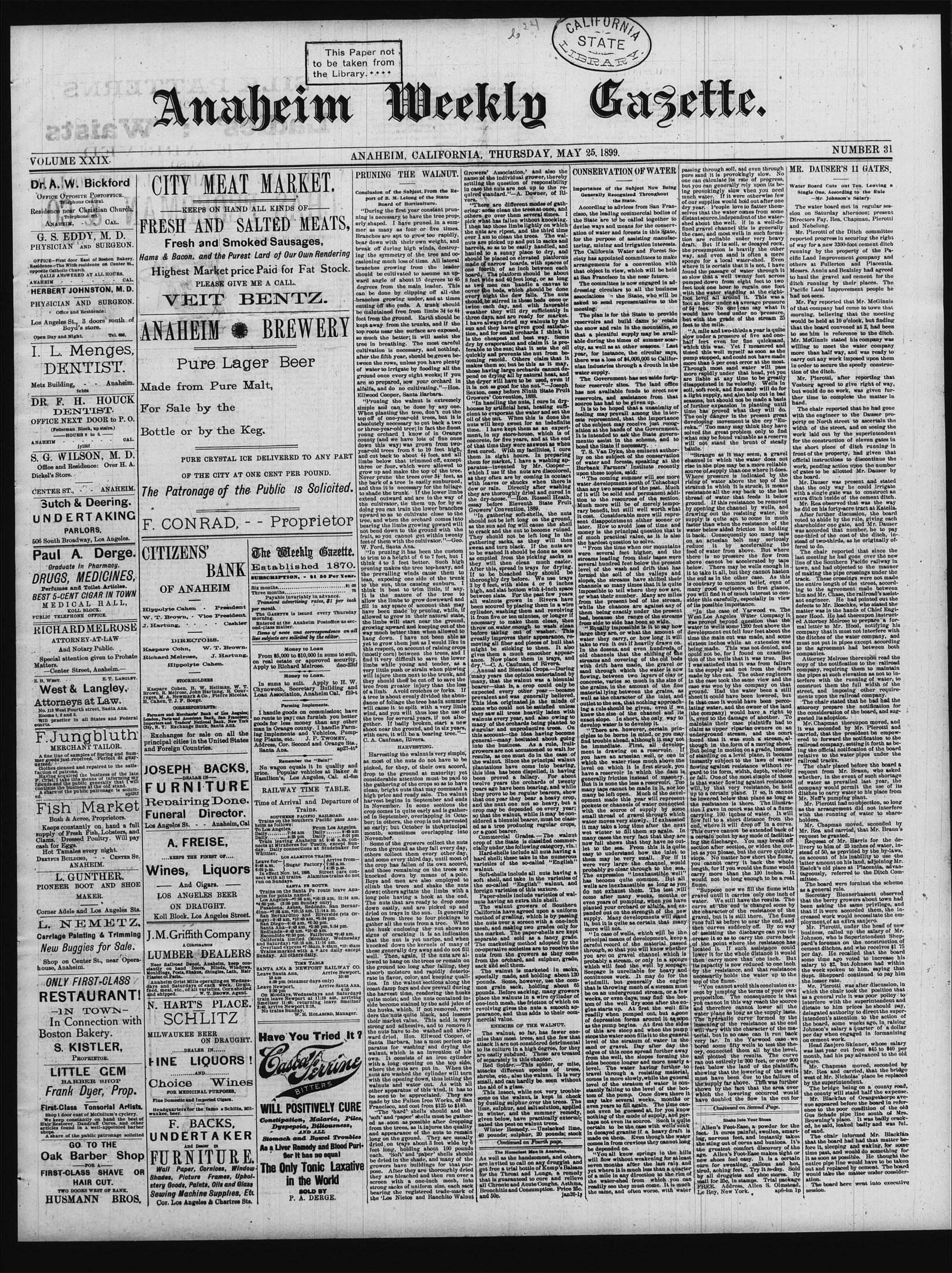
Searchable text
VOLUME XXIX.
Dr. A. W. Bickford
OFFICE OPPOSITE POSTOFFICE.
Telephone Central.
Residence near Christian Church.
Telephone 671.
ANAHEIM, CAL.
G. S. EDDY, M. D.
PHYSICIAN AND SURGEON.
OFFICE—First door East of Boston Bakery.
Residence—The White residence on Center St., opposite Catholic Church.
CALLS ANSWERED AT ALL HOURS.
ANAHEIM CAL.
HERBERT JOHNSTON, M. D.
PHYSICIAN AND SURGEON.
Office and Residence:
Los Angeles St., 3 doors south of Boyd's store.
Open Day and Night. Tel. 656.
I. L. Menges,
DENTIST.
Metz Building, Anaheim feb24
DR. F. H. HOUCK
DENTIST.
OFFICE NEXT DOOR to P. O.
(Federman Block, up stairs.)
HOURS 9 to 5
ANAHEIM CAL.
S. G. WILSON, M. D.
Office and Residence: Over H. A. Dickel's Store.
CITY MEAT MARKET.
KEeps on hand all kinds of
FRESH AND SALTED MEATS,
Fresh and Smoked Sausages,
Hams & Bacon, and the Purest Lard of Our Own Rendering
Highest Market price Paid for Fat Stock.
PLEASE GIVE ME A CALL.
VEIT BENTZ.
ANAHEIM BREWERY
Pure Lager Beer
Made from Pure Malt,
For Sale by the
Bottle or by the Keg.
PURE CRYSTAL ICE DELIVERED TO ANY PART OF THE CITY AT ONE CENT PER POUND.
Metz Building, Anaheim
feb 24
DR. F. H. HOUCK
DENTIST.
OFFICE NEXT DOOR to P. O.
(Federman Block, up stairs.)
HOURS 9 to 8
ANAHEIM CAL.
jy154t
S. G. WILSON, M. D.
Office and Residence: Over H. A. Dickel's Store.
CENTER ST., ANAHEIM.
Sutch & Deering.
UNDERTAKING
PARLORS.
506 South Broadway, Los Angeles.
Paul A. Derge.
Graduate in Pharmacy.
DRUGS, MEDICINES,
Perfumes and Toilet Articles.
BEST 5-CENT CIGAR IN TOWN
MEDICAL HALL,
KOLL BLOCK.
PUBLIC TELEPHONE OFFICE.
RICHARD MELROSE
ATTORNEY-AT-LAW
And Notary Public.
Special attention given to Probate Matters.
—Center Street, Anaheim.
Z. B. WEST.
E. T. LANGLEY.
West & Langley,
Attorneys at Law.
No. 113 West Fourth street, Santa Ana.
Rooms 1, 2 and 8.
Will practice in all States and Federal courts.
F. Jungbluth
MERCHANT TAILOR.
A fine line of samples of Spring and Summer goods just received. Perfect at guaranteed.
Clothes cleaned and repaired to the satisfaction of patrons.
Hayline acquired the business of the late R. Christ I take this means of informing my friends and the public generally that I will continue the business at the old stand.
A share of the public patronage is solicited.
Fish Market
Bush & Acree, Proprietors.
Keeps constantly on hand a full supply of Fresh Fish, Lobsters, and Clams. Dressed Poultry. Will pay cash for Eggs.
Hot Tamales every night.
DREYPUS BUILDING, - - CENTER ST.
ANAHEIM.
L. GUNTHER.
PIONEER BOOT AND SHOE MAKER.
Made from Pure Malt,
For Sale by the
Bottle or by the Keg.
PURE CRYSTAL ICE DELIVERED TO ANY PART OF THE CITY AT ONE CENT PER POUND.
The Patronage of the Public is Solicited.
F. CONRAD, - - Proprietor
CITIZENS'
BANK
OF ANAHEIM
Hippolyte Cahen · President
W. T. Brown, Vice President.
J. Hartung, Cashier
DIRECTORS:
Kaspare Cohn, W. T. Brown.
Richard Melrose, J. Hartung.
STOCKHOLDERS:
Kaspare Cohen, H. W. Hellman, W. T. Brown, R. Melrose, John Hartung, R. Courreges, M. A. Newmark & Co., Pierre Nicolas, H. Cahen, T. J. P. Boege.
CORRESPONDENTS:
Farmers and Merchants' Bank of Los Angeles; London, Paris and American Bank, San Francisco; Importers and Traders' National Bank, New York City, N.Y. Exchange Bank, Santa Ana.
Exchanges for sale on all the principal cities in the United States and Foreign Countries.
JOSEPH BACKS,
DEALER IN
FURNITURE
Repairing Done.
Funeral Director.
Los Angeles St. - - Anaheim, Cal.
A. FREISE,
...KEeps THE FINEST OF...
Wines, Liquors
And Cigars.
LOS ANGELES BEER
The Weekly Gazette.
Established 1870.
SUBSCRIPTION, - $1 50 Per Year.
Six months.....$1 00
Three months.....75
Payable invariably in advance.
Transient advertising rates,$1 per inch per month.
The GAZETTE is issued every Thursday morning.
Entered at the Anaheim Postoffice as second-class matter.
Items of news and correspondence on all live subjects are solicited by the editor.
Money to Loan
From $5,000 to $10,000 in sums to suit on real estate or approved security;
Apply to Richard Melrose.
Money to Loan
In sums to suit. Apply to H. W. Chynoweth, Secretary Building and Loan Association, Anaheim Cal.
Farming Implements.
I handle goods on commission; have no rents to pay; can furnish you better goods for less money than any other man in Orange county. I handle Farming Implements and Vehicles, Pumping Plants, etc. J. P. Twomey,
Address, Cor. Second and Orange Sts.
Santa Ana.
Remember the "Bain!"
No wagon equals it in quality and price. Popular vehicles at Baker & Hamilton's, Los Angeles, Cal. s1-6n
RAILWAY TIME TABLE.
Time of Arrival and Departure of Trains.
SOUTHERN PACIFIC RAILROAD.
Trains on the Southern Pacific pass Anheim as follows:
To Los Angeles.
Daily.....7:54 am Daily.....9:45 am Daily.....4:25 pm Daily.....8:01 pm
Train leaving Anaheim at 9:45 am connects at Miradores for Tustin, except Sunday. Daily connections at Studebaker for Whittler.
LOS ALAMITOS TRAINS.
Leave for
9:48 a.m.
Sugar Factory
7:58 a.m.
6:02 p.m.
In effect Nov. 1st, 1898.
Street cars connect with all trains. Alamitos trains do not run on Sundays.
SANTA FE ROUTE.
Trains on the Santa Fe route leave Anheim for points named:
Fish Market
Bush & Acree, Proprietors.
Keeps constantly on hand a full supply of Fresh Fish, Lobsters, and Clams. Dressed Poultry. Will pay cash for Eggs.
Hot Tamales every night.
DREYFUS BUILDING, - CENTER ST.
ANAHEIM.
L. GUNTHER.
PIONEER BOOT AND SHOE MAKER.
Corner Adele and Los Angeles Sts.
L. NEMETZ,
Carriage Painting & Trimming
New Buggies for Sale.
Shop on Center St., near Opera-house, Anaheim.
ONLY FIRST-CLASS RESTAURANT!
IN TOWNIn Connection with Boston Bakery.
S. KISTLER,
PROPRIETOR.
LITTLE GEM
BARBER SHOP
Frank Dyer, Prop.
First-Class Tonsorial Artists.
Shop 1 door east of McCollum's cyclery.
We keep constantly on hand the best of Hair Restorer, Dandruff Cures, and other articles found in a well-appointed barber shop.
A share of the public patronage solicited
GO TO THE Oak Barber Shop
FOR A
FIRST-CLASS SHAVE OR HAIR CUT.
TWO DOORS WEST OF BANK.
HUSMANN BROS.
Repairing Done.
Funeral Director.
Los Angeles St. - Anaheim, Cal
A. FREISE,
...KEeps the Finest Of...
Wines, Liquors
And Cigars.
LOS ANGELES BEER ON DRAUGHT.
Koll Block, Los Angeles Street.
J.M. Griffith Company
A CORPORATION
LUMBER DEALERS
Neer Railroad Depot, Anaheim, keep constantly on hand Doors, Blinds, Windows, Mouldings, Posts, Shakes, Shingles, Lath, Hair Plaster of Paris.
Anaheim Grist Mills operating on Wednesdays and Saturdays of each week. Grain feed, meal, etc., of all varieties. Corn shelled and shipped.
W. T. BROWN, Agent.
N. HART'S PLACE.
SCHLITZ
MILWAUKEE BEER ON DRAUGHT.
DEALER IN.....
HINE LIQUORS !
AND....
Choice Wines FOR MEDICINAL PURPOSES,
Fine Domestic and Imported Cigars.
Headquarters for the famo s Schlitz, Milwaukee, beer.
F. BACKS,
UNDERTAKER
And Dealer in
FURNITURE.
Wall Paper, Cornices, Window-Shades, Picture Frames, Upholstery Goods, Paints, Oils and Glass Sewing Machine Supplies, Etc.
Cor. Los Angeles & Chartres Sts.
SOUTHERN PACIFIC RAILROAD.
Trains on the Southern Pacific pass Anaheim as follows:
To Los Angeles.
Daily.....7:54 am Dally.....9:45 am
Daily.....4:25 pm Dally.....6:01 pm
Train leaving Anaheim at 9:45 a.m. connects at Mirrafores for Tustin, except Sunday. Daily connections at Studebaker Hotel Whittler.
LOS ALAMITOS TRAINS.
Leave for—
9:48 a.m.
Sugar Factory
Arrive from
6:02 p.m.
In effect Nov. 1st, 1898.
Street cars connect with all trains. Alamitos trains do not run on Sundays.
SANTA FE ROUTE.
Trains on the Santa Fe route leave Anaheim for points named:
Los Angeles—7:55 am *10:15 am, 11:14 am *4:55 pm. (3:55 pm Sunday only)
Passadena, Azusa, Redondo, San Bernardo—7:55 am *10:15 am, 11:14 a.m.
San Bernardino and Riverside (via Orange)—9:43 am *10:45 am, 9:54 pm.
San Diego—9:43 am *2:50 pm.
Santa Ana—9:43 am *2:50 pm, 5:54 pm.
Redlands—9:43 am *10:45 am.
Exconido*2:50 pm. Fallbrook*9:43 am.
California limited (Monday, Wednesday and Saturday) *10:15 am, 11:14 am.
Overland express*7:55 am, 9:43 am *10:45 a.m.
Trains marked with a are daily except Sunday. All others daily.
TIME TABLE
SANTA ANA & NEWPORT RAILWAY CO.
Leave Santa Ana,
Arrive Newport
10 am 10:40
4:20 pm (steamer days only)
Leave Newport,
Arrive Santa An3:30 pm
On Mondays; Wednesdays and Saturday train leave Newport at 11:10 am; arrives Smeltzer 11:68; returning leave Smeltzer 2:40; arrive Newport 3:18.
No trains Sunday.
Have You Tried It?
Constipation, Malaria, Pill Dyspopsia, Billousness,
AND ALL
Stomach and Bowel Troubles
As a Liver Remedy and Blood Purifier it has no equal
The Only Tonic Laxative in the World
SOLD BY
P. A. DERGE.
This Paper not to be taken from the Library.
ANAHEIM, CALIFORNIA, THURSDAY, MAY 25, 1899.
MARKET.
BANDS OF
OLD MEATS,
ausages,
of Our Own Rendering
for Fat Stock.
NTZ.
BREWERY
Beer
PRUNING THE WALNUT.
Conclusion of the Subject. From the Report of B. M. Lelong of the State Board of Horticulture.
"During the first year constant pruning is necessary to have the tree properly shaped. I have pruned in a summer as many as four or five times. Branches are apt to grow too rapidly, bear down with their own weight, and break off during high winds, destroying the symmetry of the tree and occasioning much loss of time. All lateral branches growing from the leader should be cultivated to assume an upward angle of about 15 degrees to 45 degrees from the main leader. This can be done by clipping off all the branches growing under, and at times cutting off the ends. A trunk should be maintained free from limbs 3¼ to 4¼ feet from the ground. Earth should be kept away from the trunks, and if the top roots near the surface are exposed, so much the better; it will assist the tree in breathing. The most careful cultivation is necessary, and nothing, after the fifth year, should be grown between the rows, unless you have plenty of water to irrigate by flooding all the ground once every eight weeks; if you are so prepared, sow your orchard in alfalfa, and do no cultivating."—Hon. Ellwood Cooper, Santa Barbara.
"Pruning the walnut is extremely simple and can be done by any one. When planting the tree, don't cut the top off of one-year-old trees, but it is absolutely necessary to cut back a two or three-year-old tree; in fact the finest young orchard I know of in Orange county (and we have lots of fine ones down this way) was grown from two-year-old trees from 8 to 10 feet high, and cut back to about 4½ feet, and all limbs below that trimmed off, except three or four, which were allowed to grow up and make the top of the tree.
Growers' Association,' and also the name of the individual grower, thereby settling the question of responsibility in case the nuts are not up to the required standard."—A. Downer, of Riversa.
"There are different modes of gathering: some clean the trees at once, and others go over them several times. I pick what has fallen without knocking. I then tap those limbs lightly on which the nuts are ripest, and the third time over I am to clean the trees. The walnuts are picked up and put in sacks and barrels, so as to be easily handled, and hauled to a sunny place to dry, and should be placed on elevated platforms made of narrow boards, with spaces of one fourth of an inch between each board. The platform should be about 8 feet wide and 40 feet long, or as long as two men can handle a canvas to cover the beds, which should be done every night the dew falls. The nuts should be stirred in these beds once or twice each day, and with favorable weather they will dry sufficiently in three days, and are ready for market. I have always drilled my walnuts by the sun and they have given good satisfaction, and for small orchards I think it is the cheapest and best way. Some dry by evaporation and claim it is preferable to the sun; that it sets the oil quickly and prevents the nut from becoming rancid. Others claim that it makes them so; but be this as it may, those having large orchards cannot depend on drying all by natural heat, and the dryer will have to be used, even if it is not so good for the nut."—Joseph Sexton, essay before Ninth State Fruit Growers' Convention, 1888.
"In handling the nuts, I cure in dry-houses by artificial heat, heating sufficient to evaporate the water and set the oil of the nut. When this is done the nuts will keep sweet for an indefinite time. I have kept them as an experiment, in my store-house, which is of concrete, for five years, and at the end of that time they were as sweet as when first cured. With my facilities, I cure them in eight hours. In preparing them for market, I have a washing apparatus—invented by Mr. Cooper—which I use if the nuts are discolored,
CONSERVATION OF WATER
Importance of the Subject Now Being Generally Recognized Throughout the State.
According to advices from San Francisco, the leading commercial bodies of the State are to be called together to devise ways and means for the conservation of water and forests in this State for the purpose of assisting manufacturing, mining and irrigation interests. The California Water and Forest Society has appointed committees to make arrangements for a convention with that object in view, which will be held at San Francisco in the near future.
The committee is now engaged in dressing circulars to all the business associations in the State, who will be asked to send representatives to the meeting.
The plan is for the State to provide reservoirs and build dams to retain the snow and rain in the mountains; that a plentiful supply may be available during the times of summer scarce city, as well as at other seasons. Last year, for instance, the circular says there was a loss of $4,000,000 to California industries through a drought in water supply.
The Government has set aside forty-four reservoir sites. The land office has not available funds to erect new reservoirs, and assistance from this source has had to be given up.
It is to be hoped that a unanimity feeling may prevail among theests represented, that the importance of the subject may receive just recognition at the hands of the Government. It is intended to ask the State government to assist in the scheme, and bond the State if necessary.
T. S. Van Dyke, the eminent author on the subject of the conservation of water and forests, speaking at the Burbank Farmers' Institute recent upon these tables; said:
PRINING THE WALNUT IS EXTREMELY SIMPLE AND CAN BE DONE BY ANY ONE. WHEN PLANTING THE TREE, DON'T CUT THE TOP OFF OF ONE-YEAR-OLD TREES, BUT IT IS ABSOLUTely NECESSARY TO CUT BACK A TWO OR THREE-YEAR-OLD TREE; IN FACT THE FINEST YOUNG ORCHARD I KNOW OF IN ORANGE COUNTY (AND WE HAVE LOTS OF FINE ONES DOWN THIS WAY) WAS GROWN FROM TWO-YEAR-OLD Trees FROM 8 TO 10 FEET HIGH, AND CUT BACK TO 44 FEET, AND ALL LIMITS BELLOW THAT TRIMMED OFF, EXCEPT THREE OR FOUR, WHICH WERE ALLOWED TO GROW UP AND MAKE THE TOP OF THE TREE. NEVER PRUNE THE TREES OVER 34 FEET, AS THE BARK OF A TREE IS EASILY SUNBURNED, AND THUS IT IS NECESSARY FOR THE foliage TO SHADDEW. IF THE LOWER limbs extend outward and ARE IN THE WAY OF THE CULTIVATOR, TIE THEM UP, FOR BY DOING YOU CAN TRAIN THE LOWER BRANCHES UPWARD SO AS TO CULTIVATE CLOSE TO THE TREE, AND WHEN THE ORCHARD COMES INTO BEARING THE LIMBS GROWING UPWARD WILL NOT BEND DOWN TO THE GROUND WITH THE FRUIT, SO YOU CANNOT GET WITHIN Twenty FEET OF THEM WITH THE CULTIVATOR."—Geo W. Ford, Santa Ana.
"In pruning it has been the custom to trim to a height of 6 to 7 feet, but I think 4 to 5 feet better. Such high pruning makes the tree top-heavy, and the prevailing winds cause them to lean, exposing one side of the trunk to the sun, thus causing sunburn. I think it best to trim little, if any. It is the nature of the tree to allow the limbs to grow downward and fill in any space of account that may have been made by pruning, while, if allowed to grow in their natural state, the limbs will start near the ground, growing upward and keeping out of the way much better than when allowed to hang down. I have not been able as yet to grow them just as I would like in this respect, on account of raising crops (mostly corn) between the trees, and I find it very difficult to save the lower limbs while young and tender, as a very little push or strain when plowing will injure them next to the trunk, and they should be cut off to save the tree from greater injury than the loss of a limb. Avoid crotches or forks. If a tree is about evenly divided the abundance of foliage the tree has in summer will cause it to split with a very little wind, and you will thus lose the use of the tree for several years, if not altogether. If badly broken, start a new shoot near the ground, and in six years, with care, it will be a bearing tree."—C. A. Caufman, Rivera.
HARVESTING.
Harvesting the walnut is very simple, as most of the nuts do not have to be picked, for they, of their own accord, drop to the ground at maturity; yet considerable attention must be paid to the gathering of the crops so as to have clean, bright nuts that may command a high price and ready sale. The walnut harvest begins in September and ends in November. In some sections the crop comes in quite early and is gathered in September, overlapping in October; in others, the crop is not harvested so early; but October is the principal month, sometimes overlapping into November.
Some of the growers collect the nuts from the ground as they fall every day, others collect them every other day, and some every third day, until most of the crop has fallen of its own accord, and those remaining on the trees are knocked down by means of a pole. Boys and men are also employed to climb the trees and shake the nuts down; others agitate the limbs with a long pole having a hook at the end.
Pend on drying all by natural heat, and the dryer will have to be used, even if it is not so good for the nut."—Joseph Sexton, essay before Ninth State Fruit Growers' Convention, 1888.
"In handling the nuts, I cure in dry-houses by artificial heat, heating sufficient oil of the nut. When this is done the nuts will keep sweet for an indofinite time. I have kept them as an experiment, in my store-house, which is of concrete, for five years, and at the end of that time they were as sweet as when first cured. With my facilities, I cure them in eight hours. In preparing them for market, I have a washing apparatus—invented by Mr. Cooper—which I use if the nuts are discolored, as they often are by coming in contact with leaves or shucks when there is dew or rain. Directly after washing they are thoroughly dried and cured in the dry-house."—Hon. Russell Heath, essay before Eleventh State Fruit Growers' Convention, 1889.
"In gathering soft-shells, the nuts should not be left long on the ground, as the sun and fog will cause the shell to crack and the nut to become ruined. They should not be left long in the gathering sacks, as they will then sweat and turn black. If the nuts are to be washed it should be done as soon as emptied from the picking sacks as they will then clean much easier. After this, spread in trays for drying. If to be bleached they should be thoroughly dry before. We use trays 3 by 6 feet, with sides 4 or 6 inches high, and slat bottom with 1-inch space between slats. For the past few years all walnuts grown in Rivera have been scoured by placing them in a wire cylinder, washing them and revolving it from five or ten minutes, or longer if necessary to make them clean, then throw on water enough to wash clean before taking out of washer. This greatly improves their appearance, removing all fiber and pieces of hull that might be sticking to them. It also gives them a much smoother appearance. Now place them in trays, and dry."—C. A. Caufman, Rivera.
Annual and Biennial Crops.
During many years the opinion entertained by many that the walnut was a biennial bearer—that is, a crop could only be expected every other year—became prevalent and was generally believed. This idea originated in the minds of some who could not be satisfied unless they saw all trees heavily laden with walnuts every year, and also owing to many of the orchards being planted to singular and unproductive trees. On this account—the idea having become general—many hesitated about going into the business. As a rule, fruit-growers are not accustomed to wait for results, as one must do in the case of the walnut. Since the principal walnut plantations have come into bearing, this idea has been dispelled, it having been proved a fallacy. For about twelve years the orchards of twenty years ago have been bearing, and while they prove to be regular bearers, show that one year they bear a heavy crop, and the next one not so heavy, but a crop may be depended on every year; so that the walnut, while it may be considered a bienniel bearer, must be classed as a tree producing regular crops, or a good bearer.
Commercial Grades.
The walnut crop of the State is classified commercially under the following category: viz.: Hard-shells include all nuts having a hard shell; these take in the numerous varieties of the so-called "English" walnut.
Soft-shells include all nuts having a soft shell, and take in the varieties of so-called "English" walnut, and foreign varieties of this texture.
Paper-shells include varieties of wal-nuts.
The Government has set aside forty four reservoir sites. The land office has not available funds to erect new reservoirs; and assistance from the source has had to be given up.
It is to be hoped that a unanimity feeling may prevail among the interests represented; that the importance of the subject may receive just recognition at the hands of the Government; it is intended to ask the State government assist in the scheme; and bond the State if necessary.
T. S. Van Dyke, the eminent author on the subject of the conservation of water and forests; speaking at the Burbank Farmers' institute recently upon these topics; said:
"The coming summer will see more water development south of Teehaka; it will be solid and permanent addition to the resources of the section Much more will be of merely temporary benefit; but still well worth it cost. Considerable more will represent disappointment either sooner later. How to avoid loss of time since money is the principal question that of much practical value; as it is at the hardest question to solve."
From the time when our mountains were several feet higher; and streams leading from their bases were several hundred feet below the pressure level of the wash and drift that formed of the soil of the valleys so slopes; the streams have shifted their channels so many times that it is impossible to tell where they now sit or what their number. Many are made whilethe chances are against any them being exactly under the press bed; because the range ofthe streets from side to side has been so wide.
"Equally impossible is it to say large they are; or what the amount water they carry; or how long it takes to run it out if heavily drawn.In the dozens,and even hundreds old channels thatthe shifting of streams and covering ofthe old bays with drift have made,the gravel sand through whichthe water is flowing,between two layers of concrete,varies so much in size,the material lying betweenthe grainswell asthe characterofthe inlet outlettothe sea;that nothing approvinga rule should be given,know ifknewthe sizeofthe channelandexact slope.In short,the only way developwateristodevelopit."
There are however,certain cipeis to borne in mind;or you find trouble aheadalthoughit maybe immediate.First.all devemt is drawing on a reservoiryou have an artesian well,或one whichthe water rises much abovelevel onwhich itisfirst struckhavea reservoirinwhichdela generally friction insteadofmasButit isnonethelessa reservoirmany taps cannotbemadeinit.no manybe left open.Muchofthe departmentmadethisyearwillrepresepcocketsorchannelsofwaterconnectwiththesourceofsupplybyasmallthreadofgravelthroughwatermovesvery slowlyIfexhaustitmaytakealongtimeafterthewetwintertofilltheupagain,manycasesthevastfactthattheynowallowlettothesea.Fromthisitiseasytounderstandhowtheinlakethemmaybeverysmall.Forewereverylargethechannel,nobecausegoclearthroughtotheThe expression "inexhaustiblewouldbecomequitecommon.Buywellsareinexhaustibleaslongasdo not exhaustthem.Thetestcomeaftermanyweeks.monthly."
Arrival and Departure of Trains.
Southern Pacific Railroad.
In the Southern Pacific pass Ana-lows:
From Los Angeles.
7:54 am Dally...9:45 am
4:25 pm Daily...8:01 pm
Having Anaheim at 9:46 a.m. connections for Tustin, except Sunny connections at Studebaker for Los Alamitos Trains.
Santa Fe Route.
On the Santa Fe route leave Ana-lows named:
Beles—7:55 am, 10:15 am, 11:14 am.
Azusa, Redondo San Bernardo and Riverside (via Ornardino and Riverside) via Ornardino and Riverside (via Ornardino and Riverside) via Ornardino and Riverside (via Ornardino and Riverside) via Ornardino and Riverside (via Ornardino and Riverside) via Ornardino and Riverside (via Ornardino and Riverside) via Ornardino and Riverside (via Ornardino and Riverside) via Ornardino and Riverside (via Ornardino and Riverside) via Ornardino and Riverside (via Ornardino and Riverside) via Ornardino and Riverside (via Ornardino and Riverside) via Ornardino and RiverSide (via Ornardino and RiverSide) via Ornardino and RiverSide (via Ornardino and RiverSide) via Ornardino and RiverSide (via Ornardino and RiverSide) via Ornardino and RiverSide (via Ornardino and RiverSide) via Ornardino and RiverSide (via Ornardino and RiverSide) via Ornardino and RiverSide (via Ornardino and RiverSide) via Ornardino and RiverSide (via Ornardino and RiverSide) via Ornardino and RiverSide (via Ornardino and RiverSide) via Ornardino and RiverSide (via Ornardino and RiverSide) via Ornardino and RiverSide (via Ornardino and RiverSide) via Ornardino and RiverSide (via Ornardino and RiverSide) via Ornardino and RiverSide (via Ornardino and RiverSide) via Ornardino and RiverSide (via Ornardino and RiverSide) via Ornardino and RiverSide (via Ornardino and RiverSide) via Ornardino and RiverSide (via Ornardingo and River Side)
and all trains do not run on Sundays.
TIME TABLE
NANA & NEWPORT RAILWAY CO.
Nana Ana,
Arrive Newport,
10:40
(steamer days only)
Newport,
Arrive Santa Ana,
4:10
days, Wednesdays and Saturdays
are Newport at 11:10 am, arriving at Newport at 3:18.
as Sunday.
W. H. HOLABIRD, Manager.
Be You Tried It?
Positively Cure
Pation, Malaria, Piles,
Myepesta, Billiousness,
AND ALL
Back and Bowel Troubles
Water Remedy and Blood Purifier it has no equal
Only Tonic Laxative in the World
SOLD BY
P. A. DERGE.
Arrival and Departure of Trains.
Southern Pacific Railroad.
In the Southern Pacific pass Ana-lows:
From Los Angeles.
7:54 am Dally...9:45 am
4:25 pm Daily...8:01 pm
Having Anaheim at 9:46 a.m. connections for Tustin, except Sunny connections at Studebaker for Los ALAMITOS TRAINS.
Santa FE Route.
On the Santa Fe route leave Ana-lows named:
Beles—7:55 am, 10:15 am, 11:14 am.
Azusa, Redondo San Bernardo and Riverside (via Ornardino and Riverside) via Ornardingo and River-side (via Ornardingo and River-side) via Ornardingo and River-side) via Ornardingo and River-side) via Ornardingo and River-side) via Ornardingo and River-side) via Ornardingo和River-side) viaOrrnordingo和River-side) viaOrrnordingo和River-side) viaOrrnordingo和River-side) viaOrrnordingo和River-side) viaOrrnordingo和River-side) viaOrrnordingo和River-side) viaOrrnordingo和River-side) viaOrrnordingo和River-side) viaOrrnordingo和River-side) viaOrrnordingo和River-side) viaOrrnordingo和River-side) viaOrrnordingo和River-side) viaOrrnordingo和River-side) viaOrrnordingo和River-side) viaOrrnordingo和River-side) viaOrrnordingo和River-side) viaOrrnordingo和River-side) viaOrrnordingo和River-side) viaOrrnordingo和River-side) viaOrrnordingo和River-side) viaOrrnordingo和River-side) viaOrrnordingo和River-side) viaOrrnordingo和River-side) viaOrrnordingo和River-side) viaOrrnordingo和River-side) viaOrrnordingo和River-side) viaOrrnordingo和River-side) viaOrrnordingo和River-side) viaOrrnordingo和River-side) viaOrrnordingo和River-side) viaOrrnordingo和River-side) viaOrrnordingo和River-side) viaOrrnordingo和River-side) viaOrrnordingo和River-side) viaOrrnordingo和River-side) viaOrrnordingo和River-side) viaOrrnordingo和River-side) viaOrrnordingo和River-side) viaOrrnordingo和River-side) viaOrrnordingo和River-side) viaOrrnordingo和River-side) viaOrrnordingo和River-side) viaOrrnordingo和River-side) viaOrrnordingo和River-side) viaOrrnordingo和River-side) viaOrrnordingo和River-side) viaOrrnordingo和River-side) viaOrrnordingo和River-side) viaOrrnordingo和River-side)viaOrrnordigoandRiver-side)viaOrrnodigoandRiver-side)viaOrrnodigoandRiver-side)viaOrrnodigoandRiver-side)viaOrrnodigoandRiver-side)viaOrrnodigoandRiver-side)viaOrrnodigoandRiver-side)viaOrrnodigoandRiver-side)viaOrrnodigoandRiver-side)viaOrrnodigoandRiver-side)viaOrrnodigoandRiver-side)viaOrrnodigoandRiver-side)viaOrrnodigoandRiver-side)viaOr-
ENEMIES OF THE WALNUT.
The walnut, so far, has fewer enemies than most trees, and the few that attack it are not considered detrimental to its culture in a high degree, for they are easily subdued. These are treated of separately in this chapter.
Red Spider.—This spider, or mite, attacks different species of trees, shrubs, etc., also the walnut. It is very small, and can hardly be seen without the aid of a glass.
This insect, while not very troublesome on the walnut, is kept in check by dusting sulphur over the trees. The lime, sulphur, and salt solution, applied in winter, and the summer remedy, given below, have practically exterminated the pest on walnut trees.
Winter Remedy.—Unslacked lime, 40 pounds; sulphur, 20 pounds; stock
Continued on Fourth page.
The Homestead Man in Anahim,
As well as the handsomest, and others, are invited to call on any druggist and get free a trial bottle of Kemp's Balsam for the Throat and Lungs, a remedy that is guaranteed to cure and relieve all Chronic and Acute Coughs, Asthma, Bronchitis and Consumption. Price 25c. and 50c.
jan26-lg
1899. NUMBER 31
ERVATION OF WATER
of the Subject Now Being
really Recognized Throughout
the State.
going to advices from San Franleigh leading commercial bodies of
are to be called together to
ays and means for the conservwater and forests in this State,
purpose of assisting manufacmining and irrigation interests.
California Water and Forest Soappointed committees to make
ments for a convention with
sect in view, which will be held
francisco in the near future.
committee is now engaged in adcirculars to all the business
in the State, who will be
send representatives to the
can is for the State to provide
ers and build dams to retain
and rain in the mountains, so
plentiful supply may be availing the times of summer scarwell as at other seasons. Last
for instance, the circular says,
as a loss of $4,000,000 to Califorustries through a drought in the
supply.
Government has set aside fortyservoir sites. The land office
available funds to erect new
ers, and assistance from that
has had to be given up.
to be hoped that a unanimity of
may prevail among the interpresented, that the importance
subject may receive just recogist the hands of the Government.
ended to ask the State governassist in the scheme, and to
State if necessary.
Van Dyke, the eminent author
the subject of the conservation
er and forests, speaking at the
Farmers' Institute recently
these topics, said:
passing through soil, aid even through pure sand it is provokingly slow. No one can calculate its rate of progress, but you can generally rely upon its being provokingly slow when you need much water. If it were otherwise few of our supplies would hold out after one dry year. People love to flatter themselves that the water comes from some distant source, independent of the water-shed about the well. If in a well-defined gravel channel this is generally the case, and most wells in such formation are reliable under very heavy draft. But if in soil, or decayed rock, the presumption is heavily the other way, and even sand is often a mere sponge for a local water-shed. Even where it is certain that it is not, I have found the passage of water through it so slow that a well twenty feet across pumped down from eight feet to two feet took one hour to regain one foot with the water standing at the eight-foot level all around it. This was a foot an hour under an average pressure of 5¼ feet. No one can say what it would have been under no pressure, but with the grade of the stream 25 feet to the mile.
"A mile and two-thirds a year is quite slow under a pressure of five and one-half feet even for fine quicksand, which this was. Yet I measured and timed this well myself as soon as the pump stopped, and could not have made more than 5 per cent error at the most. Through most sand water will pass more rapidly under that head, yet you are liable at any time to be greatly disappointed in its velocity. Wells in soil, soft rock, and fine sand will do for a light supply, and also help out in bad seasons, but should not be made a basis of further expansion in planting until time has proved what they will do. The only danger in the present great developing movement is the cry "Eureka." Too many may think they have solved the great problem only to find what may be found valuable as a reserve will not stand the brunt of steady battle.
"Strange as it may seem, a gravel channel in which the water does not rise in the pipe may be a more reliable source of supply than one where it does."
MR. DAUSER'S 11 GATES.
Water Board Cuts out Ten. Leaving a Single One, According to the Rule
Mr. Johnson's Salary.
The water board met in regular session on Saturday afternoon; present Directors Fay, Rea, Chapman, Pierotti and Nebelung.
Mr. Pierotti of the Ditch committee reported progress in securing the right of way for a new 3300-foot cement ditch running by the property of the Pacific Land Improvement company and others at Fullerton and Placentia. Messrs. Annin and Bealzley had agreed to haul the gravel and cement for the ditch running by their places. The Pacific Land Improvement people he had not seen.
Mr. Fay reported that Mr. McGinnis of that company had come to town that morning, believing that the meeting would be held at 10 o'clock, but finding that the board convened at 2, had been to see him in reference to the ditch. Mr. McGinnis stated his company was willing to meet the water company more than half way, and was ready to carry out any work imposed upon them in order to secure the speedy construction of the ditch.
Mr. Pierotti, after reporting that Vosburg agreed to give right of way, but would do no work, was given further time to complete the matter in hand.
The chair reported that he had gone with the engineer to the Dauer property on North street to ascertain the width of the street, and on seeing the work laid out by the superintendent for the construction of eleven gates in the short piece of ditch running in front of the property, had given that official instructions to discontinue the work, pending action upon the number of gates to be allotted Mr. Dauser by
Government has set aside forty-volver sites. The land office is available funds to erect new farms, and assistance from that has had to be given up.
It may prevail among the inter-connected subject may receive just recognition of the hands of the Government. It should ask the State governors in the scheme, and to the State if necessary.
Van Dyke, the eminent author, the subject of the conservation park and forests, speaking at the York Farmers' Institute recently these topics, said:
"Coming summer will see more development south of Tehachapi by two seasons of the past. Much will be solid and permanent addition to the resources of the section. More will be of merely tempo-nefit, but still well worth what Considerable more will repre-s appointment either sooner or How to avoid loss of time and how is the principal question that is with practical value, as it is also best question to solve.
From the time when our mountains several feet higher, and the leading from their bases were hundred feet below the present soil of the wash and drift that has so many times that it is quite able to tell where they now are, at their number. Many are miles the present bed of the stream, the chances are against any of being exactly under any of because the range of the streams side to side has been so wide. Usually impossible is it to say how they are, or what the amount of they carry, or how long it will run it out if heavily drawn on. And dozens, and even hundreds, of channels that the shifting of the was and covering of the old beds drift have made, the gravel or through which the water is now rate, between two layers of clay or stone, varies so much in the size of grains, in the amount of the fine lining between the grains, as the character of the inlet and to the sea, that nothing approach-rule should be given, even if we size of the channel and its slope. In short, the only way to tap water is to develop it.
There are, however, certain prin-tiple to be borne in mind, or you may double ahead, although it may not immediate. First, all developments drawing on a reservoir. If have an artesian well, or one in the water rises much above on which it is first struck, you a reservoir in which the dam is fully friction instead of masonry. Is none less a reservoir. Too taps cannot be made in it, nor too left open. Much of the devel-iat made this year will represent the source of supply by some thread of gravel through which moves very slowly. If exhausted by take a long time after the next winter to fill them up again. In cases the very fact that they are no to the sea. From this it is quite understand how the inlet to may be very small. For if it very large the channel, wouldibly go clear through to the sea, expression "inexhaustible well" become quite common. But all are inexhaustible as long as you not exhaust them. The test will after many weeks, months or years be liable at any time to be greatly disappointed in its velocity. Wells in soil, soft rock, and fine sand will do for a light supply, and also help out in bad seasons, but should not be made a basis of further expansion in planting until time has proved what they will do.
The only danger in the present great developing movement is the cry "Eureka." Too many may think they have solved the great problem only to find what may be found valuable as a reserve will not stand the brunt of steady battle.
"Strange as it may seem, a gravel channel in which the water does not rise in the pipe may be a more reliable source of supply than one where it does. Where pressure is indicated by the rising of water above the top of the stratum in which it is struck, it means resistance all the way back to the last thread of water that feeds it below ground. If this resistance be removed by opening the channel by wells, and drawing out the resisting water, the supply is quite apt to come in much faster than when the resistance of the water below aided friction in holding it back. Consequently too many taps on an artesian belt may seriously reduce it by accelerating the feed of water from above. But where there is no pressure the flow from above cannot be accelerated by taps below. There may be wells enough in it to take it all, but they cannot hasten the end as in the other case. As this contrary to common belief, even of many good engineers, at first glance, you will find it of much interest to consider this carefully, especially in view of its possible importance.
In the case of Yarwood vs. West Los Angeles Water Company it was proved beyond question that the water in wells some 1200 feet above the development cut fell four feet about the time main cut was made, and some sixteen inches while an extension was being made. This was not denied, and could not be, for I found on examination of the wells that it was true. But I was satisfied that it was from failure in the supply and not from the draft made by the cut. The other engineers in the case took the same view and the case won by the company on that ground. Had the water been a still sheet it could have been lowered, but in that case it would have been percolating water, and the owner of the land (the company) would have a right to it, even to the damage of another. To maintain their case plaintiffs had to claim as upper riparian owners on an underground stream, and the court found that it was such a stream, although in the form of a moving sheet. But being in motion on a grade, instead of standing on a level plane, it became instantly subject to the laws of water flowing against resistance without regard to its form, width, depth, velocity or fall. One of the most simple of these is that water flowing against resistance will, by that very resistance, be held up to a certain plane. If so, it cannot be lowered below that plane as long as the resistance is there. The illustration I gave in court was that of a flume carrying 100 inches of water. It will flow full to a short distance from the end, where it will drop off in a curve. This curve cannot be extended back of a certain point by any mode of facilitating the discharge. You may break off section after section, or widen out let as you please, but the curve quickly stops. No matter how short the flume you cannot carry it back whole length, for if you would the flume would carry more than 100 inches. It would not be long enough to be a real flume.
"Suppose now we fill the flume with gravel until it carries only one inch of ore liable at any time to be greatly disappointed in its velocity. Wells in soil, soft rock, and fine sand will do for a light supply, and also help out in bad seasons, but should not be made a basis of further expansion in planting until time has proved what they will do.
The only danger in the present great developing movement is the cry "Eureka." Too many may think they have solved the great problem only to find what may be found valuable as a reserve will not stand the brunt of steady battle.
"Strange as it may seem, a gravel channel in which the water does not rise in the pipe may be a more reliable source of supply than one where it does. Where pressure is indicated by the rising of water above the top of the stratum in which it is struck, it means resistance all the way back to the last thread of water that feeds it below ground. If this resistance be removed by opening the channel by wells, and drawing out the resisting water, the supply is quite apt to come in much faster than when the resistance of the water below aided friction in holding it back. Consequently too many taps on an artesian belt may seriously reduce it by accelerating the feed of water from above. But where there is no pressure the flow from above cannot be accelerated by taps below. There may be wells enough in it to take it all, but they cannot hasten the end as in the other case. As this contrary to common belief, even of many good engineers, at first glance, you will find it of much interest to consider this carefully, especially in view of its possible importance."
In the case of Yarwood vs. West Los Angeles Water Company it was proved beyond question that the water in wells some 1200 feet above the development cut fell four feet about the time main cut was made, and some sixteen inches while an extension was being made. This was not denied, and could not be, for I found on examination of the wells that it was true. But I was satisfied that it was from failure in the supply and not from the draft made by the cut. The other engineers in the case took the same view and the case won by the company on that ground. Had the water been a still sheet it could have been lowered, but in that case it would have been percolating water, and the owner of the land (the company) would have a right to it, even to the damage of another. To maintain their case plaintiffs had to claim as upper riparian owners on an underground stream, and the court found that it was such a stream, although in form of a moving sheet. But being in motion on a grade, instead of standing on a level plane, it became instantly subject to the laws of water flowing against resistance without regard to its form, width, depth, velocity or fall. One of the most simple of these is that water flowing against resistance will, by that very resistance, be held up to a certain plane. If so, it cannot be lowered below that plane as long as the resistance is there. The illustration I gave in court was that of a flume carrying 100 inches of water. It will flow full to a short distance from the end where it will drop off in a curve. This curve cannot be extended back of a certain point by any mode of facilitating the discharge. You may break off section after section, or widen out let as you please, but the curve quickly stops. No matter how short the flume you cannot carry it back whole length; for if you would the flume would carry more than 100 inches. It would not be long enough to be a real flume.
"Suppose now we fill the flume with gravel until it carries only one inch of ore liable at any time to be greatly disappointed in its velocity. Wells in soil, soft rock, and fine sand will do for a light supply, and also help out in bad seasons, but should not be made a basis of further expansion in planting until time has proved what they will do.
The only danger in the present great developing movement is the cry "Eureka." Too many may think they have solved the great problem only to find what may be found valuable as a reserve will not stand the brunt of steady battle.
"Strange as it may seem, a gravel channel in which the water does not rise in the pipe may be a more reliable source of supply than one where it does. Where pressure is indicated bythe rising of water abovethe topofthestratuminwhichitisstruck,themeswouldbemovedtownthework,pendingactionuponthenumbergatestobeallottedMr.Dauserbytheboard.
Mr.Dauserwaspresentandstatedthattheonlywayhecouldirrigatewithasinglegatewastoconstructanextraditchinsideofthe cementditch.
Mr.Reaobservedthatwheydidonhiforty-acre tractatKatella.
Afterfurtherdiscussion,theboardvotedtoabidebytherule,givingeachshareholderonegate,andMr.Dauserwasaccordedthatnumber,htepayone-thirdofthecostoftheditch,isteadoftwo-thirds,sasheoriginallyofferedtodo.
The chairreportedthatsincelastmeetinghehad goneoverthenewlineoftheSouthernPacificrailwayin town,andhadobjectedtothemorningmakingthepipecrossingsunderthetrack.
Thesecrossingswerenotmadeenthelengthofthestreak,andcordingtotheagreementmadebetweenhimandMrChase,therailroad'sassistantengineer.HehadpointedoutthedefectstoMr.Boschkewho statedthematterwouldinthehandsofChiefEngineerHood.HehadthereuponinstructedAttorneyMelrosetoprepareformallettertoMr.Hood,nowifyinghiscompanythatitmustnotinterferwiththeduringofwater,andmustnotputinpipesexceptaccordingtotheagreementhadbetweenbothcompanies.
AttorneyMelrosethereuponreadthecopyofthenotificationtotherailroadcompanyrequiringthetemporarytotherailroadcompany.setting forthasbeingtheofficialnotificationoftheboardrelativetothewaterpipesundertherailroadtracks.
ThechairplacedbeforetheboardrequestfromMr.Braun whoaskedwhether,在theeventofsuchshortageofwaterasprevailedlastyear,thecompanywouldpermittheuseofitsditchestocarrywatertohisplacefromMr.Neff'spumpingplant.
Mr.Pierottihadnoobjection,solongasthearrangement didnot interferewiththeruningofwatershareholders.
Mr.Caphammoved,secondlybyMr.Reauandcarried,thatMr.Braun'srequestbegranted.
RequestofMr.Harrisforthedeliverytohimof25inchesofwater.insteadof50,asprovidedbytheby-laws,onaccountofhisinabilitytousethelatteramountonhisland,adjoiningMr.Esslick'soldplaceAtPlacentia,advantageously,referredto-theDitchCommittee.
Theboardwerefornistheschemaasgeneralrule.
SecretaryBlennnerhassettobserved
that made this year will represent the source of supply by some threads of gravel through which moves very slowly. If exhausted they take a long time after the next winter to fill them up again. In cases the very fact that they are full shows that they have no outflow to the sea. From this it is quite easy to understand how the inlet to the may be very small. For if it very large the channel, would probably go clear through to the sea, expression "inexhaustible well" become quite common. But all these are inexhaustible as long as you do not exhaust them. The test will be after many weeks, months or years of pumping, when you have used your orchard or alfalfa, and exited out on the strength of the new yay. Many developments will stand out that it is quite as certain that many others will not.
In case of wells, which will be the principal means of development, keep a full record of the material passed through, so that you will know whether there are on gravel channel which is easily a stream, or only in a sponge which will feed the well by seepage. Age is unreliable for heavy and continuous work. It may do for the mill, but generally the engine is throwing much of a stream must run an underground stream, or a few rivers, or even days, may find the bottom of the well dry soon after the starts up. At first the well fills when pumped out, but a gone depression forms around it as soon as the pump begins. At first the sides of the hills are steep and when the pump is the water soon fills it to the general level of the stratum of water in the river or gravel. Day after day the depth of this cone spread further away from the well, the slopes forming the slope become longer and more nearly all. The water having further to travel through a resisting material, lies in more slowly, while the general level of the stratum of water is constantly falling to the level of the bottom of the pump. Once down there it can take several weeks, months or years to fill again. The time can even be guessed at, for you knowing of the mode of supply, and perhaps not even its source. Such is quite often to be the case with wells sunk decayed granite if a heavy draft is made on them. Even though the water comes in from crevices they cannot long depended on.
You all know springs in the hills flow without weakening for at least ten months after the last rain and where it is much less than a quarter mile in any direction to the rim of the water-shed from which you can readily see they must come. It is much same, and often worse, with water be lowered below that plane as long as the resistance is there. The illustration I gave in court was that of a flume carrying 100 inches of water. It will flow full to a short distance from the end, where it will drop off in a curve. This curve cannot be extended back of a certain point by any mode of facilitating the discharge. You may break off section after section, or widen the outlet as you please, but the curve quickly stops. No matter how short the flume, you cannot carry it back the whole length, for if you would the flume would carry more than the 100 inches. It would not be long enough to be a real flume.
"Suppose now we fill the flume with gravel until it carries only one inch of water. We still have the results. The curve at the end is changed some by the character of the resistance of the gravel, but it is still there. The flume runs full as before to near the end, and then curves suddenly off. By no way of assisting the discharge can you increase it so as to carry the curve back of the point where the resistance has located it. If such assistance could lower it for the whole distance it would then carry more than one inch. But its capacity is now reduced to one inch by the resistance, and that resistance necessarily holds the water up to the top of the flume.
"You cannot avoid this conclusion except by jumping the terms of your own proposition. The consequence is that you cannot in this way reach the source and therefore cannot lower all the water plane as long as the supply lasts. The hydraulic curve formed by the lessening of the resistance at the end will vary with the character of the material, but in no case can it run back very far. In the Yarwood case we bored some fifty wells to test the theory, connected them all by the level, and plotted the results. The curve ran out entirely in 300 feet, or over 900 feet below the land of the plaintiffs, showing that the lowering of the wells must have been due to the failure of the supply far above. This was further shown by the fact that the area over which the lowering occurred would have doubled the flow in the cut for
Continued on Second Page.
Shake Into Your Shoes
Allen's Foot-Ease, a powder for the feet. It cures painful, swollen, smarting, nervous feet, and instantly takes the sting out of corns and bunions. It's greatest comfort discovery of the age. Allen's Foot-Ease makes tight or new shoes feel easy. It is a certain cure for sweating, callous and hot tired, aching feet. Try it to-day. Sold by all druggists and shoe stores. By mail for 25c, in stamps. Trial package FREE. Address, Allen S. Olmstead, Le Roy, New York.
Mr Neil's pumping plant.
Mr. Pierotti had no objection, so long as the arrangement did not interfere with the running of water to shareholders.
Mr Chapman moved, seconded by Mr Rea and carried, that Mr Braun's request be granted.
Request of Mr. Harris for the delivery to him of 25 inches of water, instead of 50, as provided by the by-laws, on account of his inability to use the latter amount on his land, adjoining Mr. Essick's old place at Placentia, advantageously, referred to the Ditch Committee.
The board were forinstthe scheme as a general rule.
Secretary Blennnerhassett observed that the berry growers about town had been asking the same privilege, and that if it were accorded them, the increased work would necessitate the employment of an extra zanjero.
Mr. Pierotti, under the head of new business, called up the salary of Mr. Johnson, who is Superintendent Sheppard's foreman on the construction of cement ditches, and who receives $1 75 per day. He recalled that he board some time ago voted to increase his salary to $2, but Johnson had within week spoken to him, saying that Supt. Sheppard continued to pay him the lesser rate.
Mr. Pierotti was after discussion, in which she chair took the position that as a general rule it was poor policy to interfere with the superintendent and dictate to him prices he should pay, delegated authority to direct the superintendent's attention to the action of the board, some weeks ago, in raising Johnson's salary a quarter of a dollar per day when engaged in formanizing on cement work.
Head Zanjero Skinner, whose salary was last year cut from $45 to $40 per month, had his pay advanced to the old figure.
Mr. Chapman moved, seconded by Mr Rea and carried, that the bridge west of Mr. Nicholas' place be replaced by the superintendent.
The bridge being on a county road, the county will stand half the expense.
Mr. Blackfan of Orangesthorpe avenue appeared before the board in reference to the poor condition of the old Gus Schade pipe line south of Mrs.Browning's place. It was badly cracked, he said, leaked badly and was ful-of sand.
The chair informed Mr. Blackfan that the board had had that matter before it, sleeping and waking, for sometime past, and would do something for it as soon as possible. He thought the entire pipe line would have to be taken out and replaced by cement. The board would take the matter under consideration.
The board here went into executive session.