anaheim-gazette 1899-05-18
Scanned page
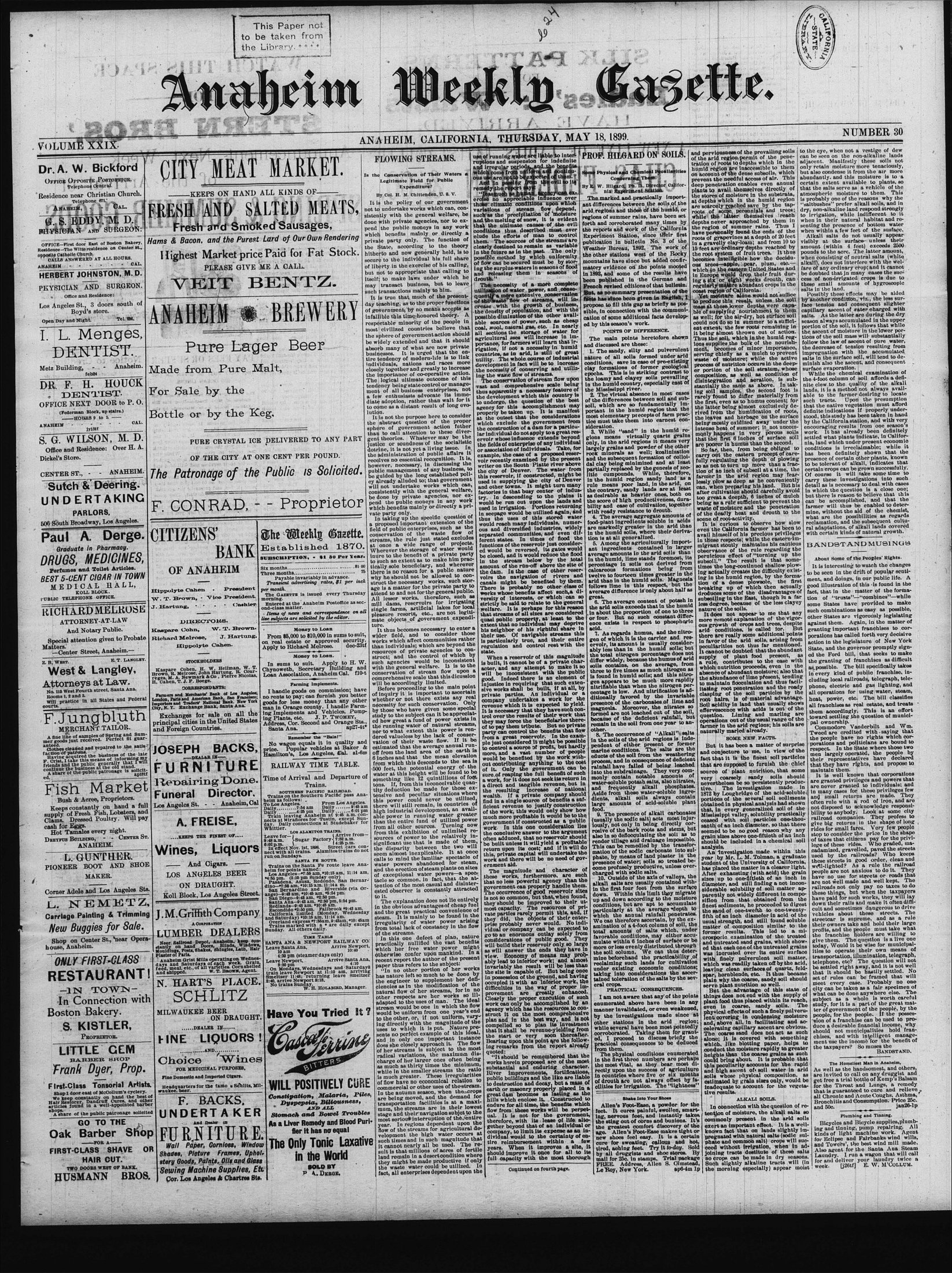
Searchable text
Anaheim
VOLUME XXIX.
Dr. A. W. Bickford
Office Opposite Postoffice.
Telephone Central.
Residence near Christian Church.
Telephone 671:
ANAHEIM, CAL.
G. S. EDDY, M. D.
PHYSICIAN AND SURGEON:
OFFICE—First door East of Boston Bakery.
Residence—The Witte residence on Center St., opposite Catholic Church.
CALLS ANSWERED AT ALL HOURS.
ANAHEIM, CAL.
HERBERT JOHNSTON, M. D.
PHYSICIAN AND SURGEON.
Office and Residence:
Los Angeles St., 3 doors south of Boyd’s store.
Open Day and Night. Tel. 086.
I. L. Menges,
DENTIST.
Metz Building, Anaheim, feb24
DR. F. H. HOUCK
DENTIST.
OFFICE NEXT DOOR to P. O.
(Federman Block, up stairs.)
HOURS 9 to 5
ANAHEIM, CAL.
S. G. WILSON, M. D.
Office and Residence: Over H. A. Dickel’s Store.
CITY MEAT MARKET.
KEEPS ON HAND ALL KINDS OF
FRESH AND SALTED MEATS
Fresh and Smoked Sausages,
Hams & Bacon, and the Purest Lard of Our Own Rendering
Highest Market price Paid for Fat Stock
PLEASE GIVE ME A CALL.
VEIT BENTZ.
ANAHEIM BREWERY
Pure Lager Beer
Made from Pure Malt,
For Sale by the
Bottle or by the Keg.
PURE CRYSTAL ICE DELIVERED TO ANY PART OF THE CITY AT ONE CENT PER POUND.
The Patronage of the Public is Solicited
DR. F. H. HOUCK
DENTIST.
OFFICE NEXT DOOR to P. O.
(Federman Block, up stairs.)
HOURS 9 to 5
ANAHEIM
CAL.
jy181t
S. G. WILSON, M. D.
Office and Residence: Over H. A. Dickel's Store.
CENTER ST., - ANAHEIM.
Sutch & Deering.
UNDERTAKING
PARLORS.
506 South Broadway, Los Angeles.
Paul A. Derge.
Graduate in Pharmacy.
DRUGS, MEDICINES,
Perfumes and Toilet Articles.
BEST 5-CENT CIGAR IN TOWN
MEDICAL HALL,
KOLL BLOCK.
PUBLIC TELEPHONE OFFICE.
RICHARD MELROSE
ATTORNEY-AT-LAW
And Notary Public.
Special attention given to Probate Matters.
Center Street, Anaheim.
Z. B. WEST.
E. T. LANGLEY.
West & Langley,
Attorneys at Law.
No. 118 West Fourth street, Santa Ana.
Rooms 1, 2 and 3.
Will practice in all States and Federal courts.
F.Jungbluth
MERCHANT TAILOR.
A fine line of samples of Spring and Summer goods just received. Perfect fit guaranteed.
Clothes cleaned and repaired to the satisfaction of patronage.
Having acquired the business of the late F. Crisi, take this means of informing my friends and the public generally that I will continue the business at the old stand.
A share of the public patronage is solicited ed.
Fish Market
Bush & Acree, Proprietors.
Keeps constantly on hand a full supply of Fresh Fish, Lobsters, and Clams. Dressed Poultry. Will pay cash for Eggs.
Hot Tamales every night.
DREYFUS BUILDING, - CENTER ST.
ANAHEIM.
L. GUNTHER.
PIONEER BOOT AND SHOE MAKER.
Corner Adele and Los Angeles Sts.
For Sale by the Bottle or by the Keg.
PURE CRYSTAL ICE DELIVERED TO ANY PARLOR OF THE CITY AT ONE CENT PER POUND.
The Patronage of the Public is Solicited
F. CONRAD, - Proprietor
CITIZENS'
BANK
OF ANAHEIM
Hippolyte Cahen - President
W. T. Brown, Vice President.
J. Hartung, Cashier
DIRECTORS:
Kaspare Cohn, W. T. Brown.
Richard Melrose, J. Hartung.
Hippolyte Cahen.
STOCKHOLDERS:
Kaspare Cohen, H. W. Hellman, W. T. Brown, H. Melrose, John Hartung, R. Courreges, M. A. Newmark & Co., Pierre Nicolas, H. Cahen, T. J. F. Boege.
CORRESPONDANTS:
Farmers and Merchants' Bank of Los Angeles; London, Paris and American Bank; San Francisco; Importers and Traders' National Bank. New York City, N.Y. Exchange Bank, Santa Ana.
Exchanges for sale on all the principal cities in the United States and Foreign Countries.
JOSEPH BACKS,
DEALER IN
FURNITURE
Repairing Done.
Funeral Director.
Los Angeles St. - Anaheim, Cal
A. FREISE,
...KEEPS THE FINEST OF...
Wines, Liquors
And Cigars.
LOS ANGELES BEER ON DRAUGHT.
Koll Block, Los Angeles Street.
The Weekly Gazette
Established 1874
SUBSCRIPTION, - $1 50 Per Year
Six months....Three months....Payable invariably in advance.
Transient advertising rates, $1 per month.
The GAZETTE is issued every Thursday morning.
Entered at the Anaheim Postoffice as one-class matter.
Items of news and correspondence on live subjects are solicited by the editor.
Money to Loan
From $5,000 to $10,000 in sums to be on real estate or approved secure Apply to Richard Melrose.
Money to Loan.
In sums to suit. Apply to H.Chyneweth, Secretary Building Loan Association, Anaheim Cal.
Farming Implements.
I handle goods on commission; no rents to pay; can furnish you be goods for less money than any other man in Orange county. I handle Farming Implements and Vehicles, Piling Plants, etc. J.P.Twomey, Address, Cor.Second and Orange Santa Ana.
Remember the "Baisl!"
No wagon equals it in quality price. Popular vehicles at Baker Hamilton's, Los Angeles, Cal.
RAILWAY TIME TABLET
Time of Arrival and Departure Trains.
SOUTHERN PACIFIC RAILROAD.
Trains on the Southern Pacific pass heim as follows:
To Los Angeles
Daily.....7:54 am Daily.....9:54 am
Daily.....4:25 pm Daily.....6:54 pm
Train leaving Anaheim at 9:45 a.m nects at Miradores for Tustin, except day. Daily connections at Studebaker Whittier.
LOS ALAMITOS TRAINS.
Leave for—
9:43 a.m Sugar Factory 7:52 a.m 6:54 p.m
In effect Nov. 1st, 1898 Street cars nect with all trains. Alamitos trains run on Sundays.
SANTA FE ROUTE.
Trains on the Santa Fe route leave heim for points named:
Los Angeles—7:55 am *10:15 am, 11:15 am*
*4:55 pm.* (3:55 pm Sunday only)
Passadena Azusa San Benito 7:58 am 11:14 a.m
San Bernardino and Riverside (vienge)—9:43 am *10:45 am*, *5:54 pm*
San Diego—9:43 am *2:50 pm*.
Bush & Acree, Proprietors.
Keeps constantly on hand a full supply of Fresh Fish, Lobsters, and Clams. Dressed Poultry. Will pay cash for Eggs.
Hot Tamales every night.
DREYFUS BUILDING, - CENTER ST.
ANAHEIM.
L. GUNTHER.
PIONEER BOOT AND SHOE MAKER.
Corner Adele and Los Angeles Sts.
L. NEMETZ,
Carriage Painting & Trimming
New Buggies for Sale.
Shop on Center St., near Opera-house, Anaheim.
ONLY FIRST-CLASS RESTAURANT!
IN TOWNIn Connection with Boston Bakery.
S. KISTLER,
PROPRIETOR.
LITTLE GEM
BARBER SHOP
Frank Dyer, Prop.
First-Class Tonsorial Artists.
Shop 1 door east of McCollum's cyclery.
We keep constantly on hand the best of Hair Restorer, Dandruff Cures, and other articles found in a well-appointed barber shop.
A share of the public patronage solicited
GO TO THE Oak Barber Shop
FOR A FIRST-CLASS SHAVE OR HAIR CUT.
TWO DOORS WEST OF BANK.
HUSMANN BROS.
Los Angeles St. - Anaheim, Cal
A. FREISE,
...KEeps THE FINEST OF...
Wines, Liquors
And Cigars.
LOS ANGELES BEER ON DRAUGHT.
Koll Block, Los Angeles Street.
J.M.Griffith Company
A CORPORATION
LUMBER DEALERS
Neer Railroad Depot, Anaheim, keep constantly on hand Doors, Blinds, Windows, Mouldings, Posts, Shakes, Shingles, Lath, Hair Plaster of Paris.
Anaheim Grist Mills operating on Wednesdays and Saturdays of each week. Grain, feed, meal, etc., of all varieties. Cornshellled and shipped.
W.T.BROWN, Agent.
N. HART'S PLACE.
SCHLITZ
MILWAUKEE BEER ON DRAUGHT.
DEALER IN...
FINE LIQUORS!
AND...
Choice Wines FOR MEDICINAL PURPOSES,
Fine Domestic and Imported Cigars.
Headquarters for the famo s Schlitz, Milwaukee, beer.
F. BACKS,
UNDERTAKER
And Dealer in
FURNITURE.
Wall Paper, Cornices, Window Shades, Picture Frames, Upholstery Goods, Palnts, Oils and Glass Sewing Machine Supplies, Etc.
Cor. Los Angeles & Chartres Sts.
Have You Tried Casca Ferrini
BITTERS
WILL POSITIVELY Causeipation, Malaria, Dyspepsia, Billiousness AND ALL Stomach and Bowel Trouble As a Liver Remedy and Blood flier it has no equal
The Only Tonic Laxation in the World
SOLD BY
P.A.Derge.
ANAHEIM, CALIFORNIA, THURSDAY, MAY 18, 1899.
MARKET.
KINDS OF
ED MEATS,
Sausages,
of Our Own Rendering
Ed for Fat Stock.
CALL.
ENTZ.
BREWERY
Beer
FLOWING STREAMS.
Is the Conservation of Their Waters a Legitimate Field for Public Expenditure?
By Col. H. M. Chittenden, U. S. V.
It is the policy of our government not to undertake works which can, consistently with the general welfare, be done with private agencies, nor to expend the public moneys in any work which benefits mainly or directly a private party only. The function of the State, according to the theory hitherto and now generally held, is to secure to the individual his full share of liberty in the exercise of his calling, but not to appropriate that calling to itself; to make laws under which he may transact business, but to leave such transactions mainly to him.
It is true that much of the present-day teaching, as to the proper functions of government, by no means accepts as infallible this time-honored theory. A respectable minority of the people in most civilized countries believe that the sphere of government action should be widely extended and that it should absorb many of what are now private businesses. It is urged that the entire tendency of modern-life is to link individuals, nations and races more closely together and greatly to increase the importance of co-operative action. The logical ultimate outcome of this tendency being state control or management of all business enterprises, not a few enthusiasts advocate its immediate adoption, rather than wait for it to come as a distant result of long evolution.
It is not the purpose here to consider the abstract question of the proper sphere of government action further than to call attention to these divergent theories. Whatever may be the justice or soundness of the socialistic doctrine, it is not yet a living issue. In the administration of public affairs it receives no essential recognition. It is, however, necessary, in discussing the public management of any business, to provide for the long established pollutant use of running water are liable to interruptions and suspension for indefinite and irregular periods, and the benefits which come from uniform and continuous use are not to be expected of them."
And in passing from the evil to its remedy the report says:
"Iasmuch as human agency can exercise no appreciable influence over those climatic conditions upon which variations of stream flow depend, such as the precipitation of moisture and the melting of snow, it is evident that the ultimate causes of the evil conditions thus described must ever elude the efforts of man to control them. The sources of the streams are clearly destined to remain as variable in the future as in the past. The only possible method by which uniformity of flow can be secured must be by storing the surplus-waters in seasons of flood and releasing them in seasons of drouth."
The necessity of a more complete utilization of water power, and consequently a more extensive conservation of the waste flow of streams, will increase with the growth of business, the density of population, and with the possible diminution of the other available sources of power, such as cheap coal, wool, natural gas, etc. In nearly all sections the storage of water for agricultural uses will increase in importance, for farmers will learn that irrigation, if not a necessity in humid countries, as in arid, is still of great utility. The whole course of industrial development in fact will be to increase the necessity of conserving and utilizing the waste flow of streams.
The conservation of stream flow upon vast and comprehensive scale being thus apparently a necessary feature of the development which this country is to undergo, the question of the best agency for this accomplishment may properly be taken up. It is manifest at the outset that the considerations which exclude the government from the construction of a dam for a particular individual do not apply to a great reservoir whose influence extends beyond the fields of enterprise of any individual or association of individuals. Take, for example, the case of a proposed reservoir recently examined by the present writer on the South Platte river above the city of Denver. The water from constructed might be used for running water are liable to interruptions and suspension for indefinite and irregular periods, and the benefits which come from uniform and continuous use are not to be expected of them."
PROF. HILGARD ON SOIL.
Some Physical and Chemical peculiar concerns them.
By E. W. Hilgard, Ph. D., Director California Experiment Station.
The marked and practically important differences between the soils of arid regions and those of the humid regions of summer rains, have been forth and corroborated many times—the reports and work of the CaliforniExperiment Station, since their publication in bulletin No. 3 of Weather Bureau, 1892. The work on other stations west of the mountains have since but added material evidence on the points made in 1892, and some of the results been published in the German French revised editions of that bulletin.
But, as no summary presentation facts has since been given in English propose to fill this gap as briefly as possible, in connection with the comparison of some additional facts derived by this season's work.
POINTS OF DIFFERENCE.
The main points heretofore and discussed are these:
1. The sandy, silty and pulver nature of all soils formed under conditions, save in case of pre-exclay formations of former geologic epochs. This is in striking contrast to the loamy and clayey soils prevailing in the humid country, especially in the Mississippi river.
2. The virtual absence in most of the differences between soil and soil, which are so fundamentally portant in the humid region that most elementary precepts of farmrice must take them into earnest consideration.
3. While "sand" in the humigons means virtually quartz only, in the arid regions it means largely grains and powder of rock minerals as well; koalina and subsequent formation of dal clay being minimized and partially replaced by the genesis of little compounds. While
The importance of co-operative action. The logical ultimate outcome of this tendency being state control or management of all business enterprises, not a few enthusiasts advocate its immediate adoption, rather than wait for it to come as a distant result of long evolution.
It is not the purpose here to consider the abstract question of the proper sphere of government action further than to call attention to these divergent theories. Whatever may be the justice or soundness of the socialistic doctrine, it is not yet a living issue. In the administration of public affairs it receives no essential recognition. It is, however, necessary, in discussing the public management of any business, to be guided by the long established policy already alluded to; that government will not undertake works which can consistently with the general welfare, be done by private agencies, nor expend the public monies in any work which benefits mainly or directly a private party only.
In taking up the specific question of a proposed important extension of the field of public enterprises, such as the conservation of the waste flow of streams, the rule just stated excludes at once a wide range of projects. Wherever the storage of water would intrude to the benefit of a private party to such an extent as to make him practically sole beneficiary, and wherever there is no reason for a public nature why he should not be allowed to construct the necessary works, such storage is a matter for the private party to attend to and not for the general public. All lesser works, therefore, such as mill dams, reservoirs for irrigating single farms, artificial lakes for local pleasure resorts, etc., are not legitimate objects of government expenditure.
It thus becomes necessary to enter a wider field, and to consider those works which affect communities rather than individuals; which are beyond the resources of private agencies to construct; and the control of which by such agencies would be inconsistent with the general welfare. It is to the conservation of stream flow upon a comprehensive scale that this discussion will be accordingly limited.
Before proceeding to the main point of inquiry it is important to ascertain whether or not there exists any real necessity for such conservation. Only by those who have given some special study to the subject can it be appreciated how great a fund of power exists in the running water of natural streams, nor to what extent this power is rendered valueless by the lack of conservation of their waste flow. If it be estimated that the average annual runoff from the land area of the earth is 6 inches and that the mean elevation from which this descends to the sea is 500 feet, the potential energy of the water at this height will be found to be something like 12 quintillions of foot tons. If, from this inconceivable quantity deduction be made for those extensive and peculiar situations where this power could never be utilized, there will still remain, in countries of high industrial development, an available power in running water greater than the entire fund of utilized power from all other sources. Turning now from this exhibition of unlimited resources of power to the relatively insignificant use that is made of them, the disparity between the two will seem almost inexplicable. It at once calls to mind the familiar spectacle of water powers abandoned for steam, and the erection of steam plants on sites of exceptional water powers—a spectacle so common, in fact, that the attention of the most casual and disinterested observer is constantly attracted to it.
The conservation of stream flow upon vast and comprehensive scale being thus apparently a necessary feature of the development which this country is to undergo, the question of the best agency for this accomplishment may properly be taken up. It is manifest at the outset that the considerations which exclude the government from the construction of a dam for a particular individual do not apply to a great reservoir whose influence extends beyond the fields of enterprise of any individual or association of individuals. Take, for example, the case of a proposed reservoir recently examined by the present writer on the South Platte river above the city of Denver. The water from this reservoir, if constructed, might be used in supplying the city of Denver and other towns. It might turn many factories in that busy center of industry. In descending to the plains it would be run out upon the lands and used in irrigation. Portions returning in seepage would be utilized again, and thus uses of this stored water would reach many individuals numerous and diversified industries, widely separated communities, and even different states. In times of flood the functions of the reservoir just considered would be reversed, its gates would be closed, and it would reduce the flood in the stream below by the total amount of the run-off above the site of the dam. In the case of other reservoirs the navigation of rivers and canals might be benefited by them. There is probably no other class of works whose benefits affect such a diversity of interests, or which can so strictly be said to relate to the general welfare. It is perhaps for this reason that streams of all sizes are considered quasi public property, at least to the extent that no individual may deprive his neighbor of his rightful share in their use. Of navigable streams this is particularly true, and their entire regulation and control rest with the state.
When a reservoir of this magnitude is built, it cannot be of a private character, and any attempt to make it so will be inconsistent with the public good. Indeed there is an element of injustice in requiring that such extensive works shall be built, if at all, by private parties. An individual or a company undertakes a work for the revenue which it is expected yield. It is necessary that they have such control over the results of their work that they may force the beneficiaries thereof to pay them tribute. But no private party can control the benefits that flow from a great reservoir. In the example just considered it might be possible to control a source of profit, but hardly more, and a vast number of people would be benefited by the work without contributing anything to the cost of it. Only the government can be sure of reaping the full benefit of such a work, for it does not seek its return in a direct and tangible revenue, but in the resulting increase of national wealth. If a private company should find in a single source of benefits a sufficient revenue to justify construction of the work, this would only show how much more profitable it would be to the government if constructed as a public work. In this one consideration lies the conclusive answer to the argument often adduced, that no reservoir should be built unless it will yield a profitable return upon its cost; and if it will do this, private capital will undertake the work and there will be no need of government aid.
The magnitude and character of these works, furthermore, are such that no less powerful agency than the government can properly handle them. The occurrence of good reservoir sites is not so common, but that when found,
the loamy and clayey soils prevail in the humid country, especially in the Mississippi river.
2. The virtual absence in most of the differences between soil and soil, which are so fundamentally portant in the humid region that most elementary precepts of farmtice must take them into earnest sidering.
3. While “sand” in the humgons means virtually quartz only, in the arid regions it means largely grains and powder of rock minerals as well; koalins and the subsequent formation of dal clay being minimized and partially replaced by the genesis litic compounds. While, then in the humid region sandy land rule means poor land, in the arid contrary, sandy lands are as desirable as heavier ones, but the score of high productivity and ease of cultivation, too with ready resistance to drought.
4. The average aggregate among food-plant ingredients soluble in are markedly greater in the arid in the humid soils, where their irritation is at all generalized.
5. Among the agriculturally important ingredients contained in average amounts in the arid soils in the humid, lime stands foremost percentage in soils not derive calcareous formations being twelve to fourteen times greater arid than in the humd soils. More follows lime in this respect. The average difference is only about great.
6. The average content of peat in arid soils exceeds that in in about proportion of one or four. But no such constant existence exists in respect to phoac acid.
7. As regards humus, and then genof which it is the carrier arvloir, its amount is usually ably less than in the humid soils on total nitrogen percentage differ widely because the humuos contains, on the average three to five times as much nitrate found in humd soils; and then gen appears to be much more nitrifiable than when the nitrocentage is low. And nitrification ditionally favored by the introduction of carbonates of magnesia. Moreover, the nitrate formed are not leached out of it because of the deficient rain remain in the soil from one year other.
8. The occurrence of “Alkalis” in the soils of the arid regions pendant of either present or marine conditions. The salts educts of the soil from the wet process, and in consequence of rainfall have failed of being into the subdrainage. They vary mainly contain notable ammonium-water-soluble potash salts also and frequently alkali photosideal forms, alkali soils always large amounts of acid-solubilized food.
9. The presence of alkali car (usually the sodic salt) acts rossively on bark roots and also in so deflocculating the soil render dilute and drainage imminent. This can be remedied bythe motion of sodic carbonate plate by means of land plastic presence of water; soils troc come profusely productive, uncharged with sodic salts.
10. Outside of the axis of valkalk salts are usually contained in first four feet fromthe down. Within this limit they can move down according to therelative importance or position securityto Richard Melrose.dec-23tf
Money to Loan
$5,000 to $10,000 in sums to suit real estate or approved securityto Richard Melrose.dec-23tf
Money to Loan
Bums to suit. Apply to H.W. sweth, Secretary Building and Association,Anaheim Cal.f10-t
Farming Implements.
Handle goods on commission; have bills to pay; can furnish you better for less money than any other Orange county.I handle Farm supplements and Vehicles,Pumpants,e.t.
J.P.Twomey,Cor. Second and Orange Sts.,Ala Ana.
ap27-4t*
Remember "the Bala!"
wagon equals it in quality and Popular vehicles at Baker &inton's,Los Angeles,Cal.s1-6m
AILWAY TIME TABLE.
of Arrival and Departure of Trains.
SOUTHERN PACIFIC RAILROAD.
on Southern Pacific pass Ana-follows:
Angeles....from Los Angeles....from Orange County.I handle Farm supplements and Vehicles,Pumpants,e.t.
J.P.Twomey,Cor. Second and Orange Sts.,Ala Ana.
ap27-4t*
SANTA FE ROUTE.
on Santa Fe route leave Ana-for points named:
Angles.....from Los Angeles....from Orange County.I handle Farm supplements and Vehicles,Pumpants,e.t.
J.P.Twomey,Cor. Second and Orange Sts.,Ala Ana.
ap27-4t*
SANTA FE ROUTE.
on Santa Fe route leave Ana-for points named:
Angles.....from Los Angeles....from Orange County.I handle Farm supplements and Vehicles,Pumpants,e.t.
J.P.Twomey,Cor. Second and Orange Sts.,Ala Ana.
ap27-4t*
SANTA FE ROUTE.
on Santa Fe route leave Ana-for points named:
Angles.....from Los Angeles....from Orange County.I handle Farm supplements and Vehicles,Pumpants,e.t.
J.P.Twomey,Cor. Second and Orange Sts.,Ala Ana.
ap27-4t*
SANTA FE ROUTE.
on Santa Fe route leave Ana-for points named:
Angles.....from Los Angeles....from Orange County.I handle Farm supplements and Vehicles,Pumpants,e.t.
J.P.Twomey,Cor. Second and Orange Sts.,Ala Ana.
ap27-4t*
SANTA FE ROUTE.
on Santa Fe route leave Ana-for points named:
Angles.....from Los Angeles....from Orange County.I handle Farm supplements和Vehicles,Pumpants,e.t.
J.P.Twomey,Cor. Second and Orange Sts.,Ala Ana.
ap27-4t*
SANTA FE ROUTE.
on Santa Fe route leave Ana-for points named:
Angles.....from Los Angeles....from Orange County.I handle Farm supplements和Vehicles,Pumpants,e.t.
J.P.Twomey,Cor. Second and Orange Sts.,Ala Ana.
ap27-4t*
SANTA FE ROUTE.
on Santa Fe route leave Ana-for points named:
Angles.....from Los Angeles....from Orange County.I handle Farm supplements和Vehicles,Pumpants,e.t.
J.P.Twomey,Cor. Second and Orange Sts.,Ala Ana.
ap27-4t*
SANTA FE ROUTE.
on Santa Fe route leave Ana-for points named:
Angles.....from Los Angeles....from Orange County.I handle Farm supplements和Vehicles,Pumpants,e.t.
J.P.Twomey,Cor. Second and Orange Sts.,Ala Ana.
ap27-4t*
SANTA FE ROUTE.
on Santa Fe route leave Ana-for points named:
Angles.....from Los Angeles....from Orange County.I handle Farm supplements和Vehicles,Pumpants,e.t.
J.P.Twomey,Cor. Second and Orange Sts.,Ala Ana.
ap27-4t*
SANTA FE ROUTE.
on Santa Fe route leave Ana-for points named:
Angles.....from Los Angeles....from Orange County.I handle Farm supplements和Vehicles,Pumpants,e.t.
J.P.Twomey,Cor. Second and Orange Sts.,Ala Ana.
ap27-4t*
SANTA FE ROUTE.
on Santa Fe route leave Ana-for points named:
Angles.....from Los Angeles....from Orange County.I handle Farm supplements和Vehicles,Pumpants,e.t.
J.P.Twomey,Cor. Second and Orange Sts.,Ala Ana.
ap27-4t*
SANTA FE ROUTE.
on Santa Fe route leave Ana-for points named:
Angles.....from Los Angeles....from Orange County.I handle Farm supplements和Vehicles,Pumpants,e.t.
J.P.Twomey,Cor. Second and Orange Sts.,Ala Ana.
ap27-4t*
SANTA FE ROUTE.
on Santa Fe route leave Ana-for points named:
Angles.....from Los Angeles....from Orange County.I handle Farm supplements和Vehicles,Pumpants,e.t.
J.P.Twomey,Cor. Second and Orange Sts.,Ala Ana.
ap27-4t*
SANTA FE ROUTE.
on Santa Fe route leave Ana-for points named:
Angles.....from Los Angeles....from Orange County.I handle Farm supplements和Vehicles,Pumpants,e.t.
J.P.Twomey,Cor. Second and Orange Sts.,Ala Ana.
ap27-4t*
SANTA FE ROUTE.
on Santa Fe route leave Ana-for points named:
Angles.....from Los Angeles....from Orange County.I handle Farm supplements和Vehicles,Pumpants,e.t.
J.P.Twomey,Cor. Second and Orange Sts.,Ala Ana.
ap27-4t*
SANTA FE ROUTE.
on Santa Fe route leave Ana-for points named:
Angles.....from Los Angeles....from Orange County.I handle Farm supplements和Vehicles,Pumpants,e.t.
J.P.Twomey,Cor. Second and Orange Sts.,Ala Ana..
ap27-4t*
SANTA FE ROUTE.
on Santa Fe route leave Ana-for points named:
Angles.....from Los Angeles....from Orange County.I handle Farm supplements和Vehicles,Pumpants,e.t.
J.P.Twomey,Cor. Second and Orange Sts.,Ala Ana..
ap27-4t*
SANTA FE ROUTE。
on Santa Fe route leave Ana-for points named:
Angles.....from Los Angeles....from Orange County.I handle Farm supplements和Vehicles,Pumpants,e.t.
J.P.Twomey,Cor. Second and Orange Sts.,Ala Ana..
ap27-4t*
SANTA FE ROUTE。
on Santa Fe route leave Ana-for points named:
Angles.....from Los Angeles....from Orange County.I handle Farm supplements和Vehicles,Pumpants,e.t.
J.P.Twomey,Cor. Second and Orange Sts.,Ala Ana..
ap27-4t*
SANTA FE ROUTE。
on Santa Fe route leave Ana-for points named:
Angles.....from Los Angeles....from Orange County.I handle Farm supplements和Vehicles,Pumpants,e.t.
J.P.Twomey,Cor. Second and Orange Sts.,Ala Ana..
ap27-4t*
SANTA FE ROUTE。
on Santa Fe route leave Ana-for points named:
Angles.....from Los Angeles....from Orange County.I handle Farm supplements和Vehicles,Pumpants,e.t.
J.P.Twomey,Cor. Second and Orange Sts.,Ala Ana..
ap27-4t*
SANTA FE ROUTE。
on Santa Fe route leave Ana-for points named:
Angles.....from Los Angeles....from Orange County.I handle Farm supplements和Vehicles,Pumpants,e.t.
J.P.Twomey,Cor. Second and Orange Sts.,Ala Ana..
ap27-4t*
SANTA FE ROUTE。
on Santa Fe route leave Ana-for points named:
Angles.....from Los Angeles....from Orange County.I handle Farm supplements和Vehicles,Pumpants,e.t.
J.P.Twomey,Cor. Second and Orange Sts.,Ala Ana..
ap27-4t*
SANTA FE ROUTE。
on Santa Fe route leave Anna-for points named:
Angles.....from Los Angeles....from Orange County.I handle Farm supplements和Vehicles,Pumpants,e.t.
J.P.Twomey,Cor. Second and Orange Sts.,Ala Ana..
ap27-4t*
SANTA FE ROUTE。
on Santa Fe route leave Anna-for points named:
Angles.....from Los Angeles....from Orange County.I handle Farm supplements和Vehicles,Pumpants,e.t.
J.P.Twomey,Cor. Second and Orange Sts.,Ala Ana..
ap27-4t*
SANTA FE ROUTE。
on Santa Fe route leave Anna-for points named:
Angles.....from Los Angeles....from Orange County.I handle Farm supplements和Vehicles,Pumpants,e.t.
J.P.Twomey,Cor. Second and Orange Sts.,Ala Ana..
ap27-4t*
SANTA FE ROUTE。
on Santa Fe route leave Anna-for points named:
Angles.....from Los Angeles....from橙色Country.I handle Farm supplements和Vehicles,Pumpants,e.t.
J.P.Twomey,Cor. Second and橙色Country.I handle Farm supplements和Vehicles,Pumpants,e.t.
J.P.Twomey,Cor. Second和橙色Country.I handle Farm supplements和Vehicles,Pumpants,e.t.
J.P.Twomey,Cor.Second和橙色Country.I handle Farm supplements和Vehicles,Pumpants,e.t.
J.P.Twomey,Cor.Second和橙色Country.I handle Farm supplements和Vehicles,Pumpants,e.t.
J.P.Twomey,Cor.Second和橙色Country.I handle Farm supplements和Vehicles,Pumpants,e.t.
J.P.Twomey,Cor.Second和橙色Country.Ihandle Farm supplements和Vehicles,Pumpants,e.t.
J.P.Twomey,Cor.Second和橙色Country.Ihandle Farm supplements和Vehicles,Pumpants,e.t.
J.P.Twomey,Cor.Second和橙色Country.Ihandle Farm supplements和Vehicles,Pumpants,e.t.
J.P.Twomey,Cor.Second和橙色Country.Ihandle Farm supplements和Vehicles,Pumpants,e.t.
J.P.Twomey,Cor.Second和橙色Country.Ihandle Farm supplementsandVehicles,Pumpants,e.t.
J.P.Twomey,Cor.Second和橙色Country.Ihandle Farm supplementsandVehicles,Pumpants,e.t.
J.P.Twomey,Cor.Second和橙色Country.Ihandle Farm supplementsandVehicles,Pumpants,e.t.
J.P.Twomey,Cor.Second和橙色Country.Ihandle Farm supplementsandVehicles,Pumpants,e.t.
J.P.Twomeny,Cor.Second和橙色Country.Ihandle Farm supplementsandVehicles,Pumpners,andVehicles,Pumpners,andVehicles,Pumpners,andVehicles,Pumpners,andVehicles,Pumpners,andVehibles,Pumpners,andVehibles,Pumpners,andVehibles,Pumpners,andVehibles,Pumpners,andVehibles,Pumpners,andVehibles,Pumpners,andVehibles,Pumpners,andVehibles,Pumpners,andVehibles,Pumpners,andVehibles,Pumpners,andVehibles,Pumpners,andVehibles,Pumpners,andVehibles,Pumpners,andVehibles,Pumpners,andVehiblesPumpners,andVehiblesPumpners,andVehiblesP pumpners,andVehiblesP pumpners,andVehiblesP pumpners,andVehiblesP pumpners,andVehiblesP pumpners,andVehiblesP pumpners,andVehiblesP pumpners,andVehiblesP pumpners,andVehiblesP pumpners,andVehiblesP pumpners,andVehiblesP pumpners,andVehiblesP pumpners,andVehiblesP pumpners,andVehiblesP pumpners,andVehiblesP pumpners,
andVehlichesP pumpners,andVехlichesP pumpmers,andVехlichesP pumpmers,and,VехlichesP pumpmers,and,VехlichesP pumpmers,and,VехlichesP pumpmers,and,VехlichesP pumpmers,and,VехlichesP pumpmers,and,VехlichesP pumpmers,and,VехlichesP pumpmers,and,VехlichesP pumpmers,and,VехlichesP pumpmers,and,VехlichesP pumpmers,and,VехlichesP pumpmers,and,VехlichesP pumpmers,
and,VехlichesP pumpmers,
and,VехlichesP pumpmers,
and,VехlichesP pumpmers,
and,VехlichesP pumpmers,
and,VехlichesP pumpmers,
and,VехlichesP pumpmers,
and,VехlichesP pumpmers,
and,VехlichesP pumpmers,
and,VехlichesP pumpmers,
and,VехlichesP pumpmers,
and,VехlichesP pumpmers,
and,VехlichesP pumpmers,
and,VехlichesP pumpmers,
and,VехichesP pumpmers,
and,VехichesP pumpmers,
and,VехichesP pumpmers,
and,VехichesP pumpmers,
and,VехichesP pumpmers,
and,VехichesP pumpmers,
and,VехichesP pumpmers,
and,VехichesP pumpmers,
and,VехichesP pumpmers,
and,VехichesP pumpmers,
and,VехichesP pumpmers,
and,VехichesP pumpmers,
and,VехichesP pumpmers,
and,VехichesPs泵mers,
and,V哮chesPs泵mers,
and,V哮chesPs泵mers,
and,V哮chesPs泵mers,
and,V哮chesPs泵mers,
and,V哮chesPs泵mers,
and,V哮chesPs泵mers,
and,V哮chesPs泵mers,
and,V哮chesPs泵mers,
and,V哮chesPs泵mers,
and,V哮chesPs泵mers,
and,V哮chesPs泵mers,
and,V哮chesPs泵mers,
and,V哮chesPs泵mers,
and,V哮chesPs泵merers,
and,V哮chesPs泵merers,
and,V哮chesPs泵merers,
and,V哮chesPs泵merers,
and,V哮chesPs泵merers,
and,V哮chesPs泵merers,
and,V哮chesPs泵merers,
and,V哮chesPs泵merers,
and,V哮chesPs泵merers,
and,V哮chesPs泵merers,
and,V哮chesPs泵merers,
and,V哮chesPs泵merers,
and,V哮chesPs泵merers,
and,V哮chesPs泵merers,
and,V哮chesPs泵merers,
and,V哮chesPs泵merers,
and,V哮chesPs泵merers,
and,V哮chesPs泵merers,
and,V哮chesPs泵merers,
and,V哮chesPs泵merers,
and,V哮chesPs泵merers,
and,V哮chesPs泵merers,
and,v哮chesPs泵merers,
and,v哮achesPs泵merers,
and,v哮achesPs泵merers,
and,v哮achesPs泵merers,
and,v哮achesPs泵merers,
and,v哮achesPs泵merers,
and,v哮achesPs泵merers,
and,v哮achesPs泵merers,
and,v哮achesPs泵merers,
and,v哮achesPs泵merers,
and,v哮achesPs泵merers,
anda,v哮achesPs泵merers,
anda,v哮achesPS泵merers,
anda,v哮achesPS泵merers,
anda,v哮achesPS泵merers,
anda,v哮achesPS泵merers,
anda,v哮achesPS泵merers,
anda,v哮achesPS泵merers,
anda,v哮achesPS泵merers,
anda,v哮achesPS泵merers,
anda,v哮achesPS泵merers,
anda,v哮achesPS泵merers,
anda,v哮achesPS泵merers,
anda,v哮喘PS泵merers,
anda,v哮喘PS泵merers,
anda,v哮喘PS泵merers,
anda,v哮喘PS泵merers,
anda,v哮喘PS泵merers,
anda,v哮喘PS泵merers,
anda,v哮喘PS泵merers,
anda,v哮喘PS泵merers,
anda,v哮喘PS泵merers,
anda,v哮喘PS泵mer者,
anda,v哮喘PS泵mer者,
anda,v哮喘PS泵mer者,
anda,v哮喘PS泵mer者,
anda,v哮喘PS泵mer者,
anda,v哮喘PS泵mer者,
anda,v哮喘PS泵mer者,
anda,v哮喘PS泵 mer者 ,
anda,v哮喘PS泵 mer者 ,
anda,v哮喘PS泵 mer者 ,
anda,v哮喘PS泵 mer者 ,
anda,v哮喘PS泵 mer者 ,
anda,v哮喘PS泵 mer者 ,
anda,v哮喘PS泵 mer者 ,
anda,v哮喘PS泵 mer者 ,
anda,v哮喘PS泵 mer者 ,
anda,v哮喘PS泵 mer者 ,
anda,v哮喘PS泵 mer者 ,
anda,v哮喘PS泵 mer者 ,
anda.v哮喘PS泵 mer者 ,
anda.v哮喘PS
pumbers ,anda,pumbers ,anda,pumbers ,ando,pumbers ,ando,pumbers ,ando,pumbers ,ando,pumbers ,ando,pumbers ,ando,pumbers ,ando,pumbers ,ando,pumbers ,ando,pumbers ,ando,pumbers ,ando,pumbers ,ando,pumbers ,ando,pumbers ,ando,pumbers ,ando,pumbers ,ando,pumbers ,ando,pumbers ,ando,pumbers ,ando,pumbers ,ando,pumbers ,
ando,pumbers ,ando,pumbers ,ando,pumbers ,ando,pumbers ,ando,pumbers ,ando,pumbers ,ando,pumbers ,ando,pumbers ,ando,pumbers ,ando,pumbers ,ando,pumbers ,ando,pumbers ,ando,pumbers ,ando,pumbers ,ando,pumbers ,ando,pumbers ,
ando,pumbers ,
endo,pumbers ,
endo,pumbers ,
endo,pumbers ,
endo,pumbers ,
endo,pumbers ,
endo,pumbers ,
endo,pumbers ,
endo,pumbers ,
endo,pumbers ,
endo,pumbers ,
endo,pumbers ,
endo,p
this power could never be utilized; there will still remain, in countries of high industrial development, an available power in running water greater than the entire fund of utilized power from all other sources. Turning now from this exhibition of unlimited resources of power to the relatively insignificant use that is made of them, the disparity between the two will seem almost inexplicable. It at once calls to mind the familiar spectacle of water powers abandoned for steam, and the erection of steam plants on sites of exceptional water powers—a spectacle so common, in fact, that the attention of the most casual and disinterested observer is constantly attracted to it.
The explanation does not lie entirely in the obvious advantages of cheap fuel and the great practical convenience of steam. It is mainly to be found in the irregularity of water power arising from total lack of constancy in the flow of the streams.
In this one defect of plan, nature practically nullified the vast benefits which her free water power might otherwise confer upon mankind. In a recent report the author of the present paper thus refers to the subject:
"In no other portion of her works has nature left so much to be done by the engineer to supplement her deficiencies as in the modification of the natural flow of her streams, for in no other respects are her works so ill-adapted to the uses of man. The ideal stream would be one in which the flow would be uniform from one year's end to the other, or, if not uniform, varying directly with the magnitude of the uses to which it is put. Nature presents no perfect example of this ideal, and in only one important instance does she closely approach it. The flow of her streams is subject to the most radical variations, the maximum discharge of her larger ones often being as much as thirty times the minimum, while in the smaller streams the ratio is much greater. These irregularities of flow have no economical relation to commercial or other uses of the stream. In the autumn season, when the crops are being moved, and the demand for transportation facilities is at a maximum, the streams are in their lowest stage and their navigation subject to the most serious interruption of the entire year. In regions dependent upon the flow of the streams for agricultural development the high water occurs at such times and in such magnitude that it cannot nearly all be used. The result is that millions of acres of fertile land remain in a desert condition where they might be made productive if only the waste water could be utilized. In fact, all enterprises dependent upon the
find in a single source of benefits a sufficient revenue to justify construction of work, this would only show how much more profitable it would be to the government if constructed as a public work. In this one consideration lies the conclusive answer to the argument often adduced, that no reservoir should be built unless it will yield a profitable return upon its cost; and if it will do this, private capital will undertake the work and there will be no need of government aid.
The magnitude and character of these works, furthermore, are such that no less powerful agency than the government can properly handle them. The occurrence of good reservoir sites is not so common, but that, when found, they should be improved to their utmost capacity. The resources of private parties rarely permit this, and if they did, the objects of their enterprise probably never would. No individual or company can be expected to go to an enormous outlay solely from considerations of public good. They will build their reservoir only so large as will answer the ends they have in view. Economy of means may probably invariably the result will be less than the site is capable of. But being once in possession of the ground, and having occupied it with an inferior work, the difficulties in the way of proper improvement are greatly enhanced. Clearly the proper execution of such works herein proposed are of the most substantial and enduring character. River improvements, fortifications, public buildings and the like are liable to destruction and decay, but a mass of earth or masonry properly placed in a great dam becomes as lasting as the hills which enclose it. Constructed to endure for all time, the benefits which flow from these works will be perpetual. It is not for the government, therefore, with its lease of life altogether beyond that of an individual or company, to limit its expense as an individual would to the certainty of entire reimbursement within a few years. When it improves a site, it should improve it once for all to its full capacity with the most thorough
Continued on fourth page.
9. The presence of alkali caustics (usually the sodic salt) acts magnificently, not only in being directive of the bark roots and stems also in so deflocculating the soil render tillage and drainage important. This can be remedied by the formation of the sodic carbonate phase, by means of land plastering, presence of water; solids so thick come profusely productive, uncharged with sodic salts.
10. Outside of the axis of valleys salts are usually contained in first four feet from the down. Within this limit they up and down according to their conditions, but are apt to accrue particularly at the average width which the annual rainfall per annum can therefore ascertain, by amination of a 4-foot column or total amounts of salts which favorable conditions may elicit malleate within 6 inches of surplus or less evenly distributed in the soil column. We can then mine beforehand the practice reclaiming such lands for cultivation under existing economic conditions taking into considerations trained toleration of the salts being eral crops.
PRACTICAL CONSEQUENCE
I am not aware that any of these enumerated above have been manner invalidated, or even wrong by the investigations made other stations in the arid while several have been most corroborated. Taking them ed, I proceed to discuss practical consequences to be seen from them.
The physical conditions en in the first three numbers are the most vital, as they bear rectly upon the success of agriculture in countries where five or six drought are not always offillies for irrigation. The ""
Shake Into Your Shoes
Allen's Foot-Ease, a powder-feet. It cures painful, swolling, nervous feet, and instills the sting out of corn and bungee grafts greatest comfort discovery age. Allen's Foot-Ease make new shoes feel easy. It is cure for sweating, callous tired, aching feet. Try it too by all drummers and shoe sizes small for 25c. in stamps. Trifree. Address, Allen S. Le Roy, New York.
OF. HILGARD ON SOILS.
Physical and Chemical peculiarities Concerning Them.
W. Hilgard, Ph. D., Director California Experiment Station.
A marked and practically important differences between the soils of the regions and those of the humid, or moist of summer rains, have been set aside and corroborated many times by reports and work of the California Experiment Station, since their first location in bulletin No. 3 of the other Bureau, 1892. The work of other stations west of the Rocky Mountains have since but added confirmatory evidence on the points mooted in 1892, and some of the results have been published in the German and which revised editions of that bulletin. As no summary presentation of the has since been given in English, I propose to fill this gap as briefly as possible, in connection with the communication of some additional facts developing this season's work.
POINTS OF DIFFERENCE.
The main points heretofore shown discussed are these:
The sandy, silty and pulverulent nature of all soils formed under arid conditions, save in case of pre-existing formations of former geological rocks. This is in striking contrast to loamy and clayey soils prevailing in the humid country, especially east of Mississippi river.
The virtual absence in most cases of differences between soil and subsoil which are so fundamentally immanent in the humid region that the elementary precepts of farm prac must take them into earnest consideration.
While "sand" in the humid recess means virtually quartz grains, in the arid regions it means veryely grains and powder of the other minerals as well; koalinization of the subsequent formation of colloidal being minimized and at least usually replaced by the genesis of zeo-compounds. While, therefore,
and perviousness of the prevailing soils of the arid region permit of the penetration of roots to depths which in the humid region are inaccessible to them on account of the dense subsols, which prevent the needful access of air. This deep penetration enables even annual plants to avail themselves directly of the stores of moisture in the substrata, at depths which in the humid region are scarcely reached save by the taproots of some perennials and trees; while the latter themselves reach depths never approached by them in the region of summer rains. Thus I have personally found the ends of the roots of grapevines at a depth of 20 feet in a gravelly clay-loam; and from 10 to 15 feet are ordinary depths reached by the root system of fruit trees. It thus becomes intelligible how the deciduous trees—apple, pear, plum, etc.—which in the eastern United States and in Europe would drop their fruit during a six or eight weeks drought, can regularly mature abundant crops in the coast region of California.
Yet moisture alone would not suffice to produce this result, unless the soil mass at these lower depths were capable of supplying nourishment to them as well; for the air-dry, hot surface soil could not do so in summer to a sufficient extent, the few roots remaining in it being almost thrown out of action. Thus the soil, which in the humid regions supplies the bulk of the nourishment, becomes of minor importance, serving chiefly as a mulch to prevent waste of moisture; while the active process of nutrition occurs in the deeper portion of the soil stratum, whose composition, as well as condition of disintegration and aeration, is substantially the same as above. In taking soil samples, the second foot is rarely found to differ materially from the first, even as to humus content; for the latter being almost exclusively derived from the humification of roots, the leaves and herbage on the surface being mostly oxidized away under the intense heat of summer; it not uncommonly happens in very porous soils that the first 6 inches of surface soil are poorer in humus than the second.
So far, then, from being obliged to carry out the eastern precept of carefully regulating the depth of plowing so as not to turn up more than a fraction of an inch of subsol at a time, the deep penetration enables even annual plants to avail themselves directly of the stores of moisture in the substrata, at depths which in the humid region are scarcely reached save by the taproots of some perennials and trees; while the latter themselves reach depths never approached by them in the region of summer rains. Thus I have personally found the ends of the roots of grapevines at a depth of 20 feet in a gravelly clay-loam; and from 10 to 15 feet are ordinary depths reached by the root system of fruit trees. It thus becomes intelligible how the deciduous trees—apple, pear, plum, etc.—which in the eastern United States and in Europe would drop their fruit during a six or eight weeks drought, can regularly mature abundant crops in the coast region of California.
Yet moisture alone would not suffice to produce this result, unless the soil mass at these lower depths were capable of supplying nourishment to them as well; for the air-dry, hot surface soil could not do so in summer to a sufficient extent, the few roots remaining in it being almost thrown out of action. Thus the soil, which in the humid regions supplies the bulk of the nourishment, becomes of minor importance, serving chiefly as a mulch to prevent waste of moisture; while the active process of nutrition occurs in the deeper portion of the soil stratum, whose composition, as well as condition of disintegration and aeration, is substantially the same as above. In taking soil samples, the second foot is rarely found to differ materially from the first, even as to humus content; for the latter being almost exclusively derived from the humification of roots, the leaves and herbage on the surface being mostly oxidized away under the intense heat of summer; it not uncommonly happens in very porous soils that the first 6 inches of surface soil are poorer in humus than the second.
So far, then, from being obliged to carry out the eastern precept of carefully regulating the depth of plowing so as not to turn up more than a fraction of an inch of subsol at a time, the deep penetration enables even annual plants to avail themselves directly of the stores of moisture in the substrata, at depths which in the humid region are scarcely reached save by the taproots of some perennials and trees; while the latter themselves reach depths never approached by them in the region of summer rains. Thus I have personally found the ends of the roots of grapevines at a depth of 20 feet in a gravelly clay-loam; and from 10 to 15 feet are ordinary depths reached by the root system of fruit trees. It thus becomes intelligible how the deciduous trees—apple, pear, plum, etc.—which in the eastern United States and in Europe would drop their fruit during a six or eight weeks drought, can regularly mature abundant crops in the coast region of California.
Yet moisture alone would not suffice to produce this result, unless the soil mass at these lower depths were capable of supplying nourishment to them as well; for the air-dry, hot surface soil could not do so in summer to a sufficient extent, the few roots remaining in it being almost thrown out of action. Thus the soil, which in the humid regions supplies the bulk of the nourishment, becomes of minor importance, serving chiefly as a mulch to prevent waste of moisture; while the active process of nutrition occurs in the deeper portion of the soil stratum, whose composition, as well as condition of disintegration and aeration, is substantially the same as above. In taking soil samples, the second foot is rarely found to differ materially from the first, even as to humus content; for the latter being almost exclusively derived from the humification of roots, the leaves and herbage on the surface being mostly oxidized away under the intense heat of summer; it not uncommonly happens in very porous soils that the first 6 inches of surface soil are poorer in humus than the second.
So far, then, from being obliged to carry out the eastern precept of carefully regulating the depth of plowing so as not to turn up more than a fraction of an inch of subsol at a time, the deep penetration enables even annual plants to avail themselves directly of the stores of moisture in the substrata, at depths which in the humid region are scarcely reached save by the taproots of some perennials and trees; while the latter themselves reach depths never approached by them in the region of summer rains. Thus I have personally found the ends of the roots of grapevines at a depth of 20 feet in a gravelly clay-loam; and from 10 to 15 feet are ordinary depths reached by the root system of fruit trees. It thus becomes intelligible how the deciduous trees—apple, pear, plum, etc.—which in the eastern United States and in Europe would drop their fruit during a six or eight weeks drought, can regularly mature abundant crops in the coast region of California.
Yet moisture alone would not suffice to produce this result, unless the soil mass at these lower depths were capable of supplying nourishment to them as well; for the air-dry, hot surface soil could not do so in summer to a sufficient extent, the few roots remaining in it being almost thrown out of action. Thus the soil, which in the humid regions supplies the bulk ofthe nourishment, becomes of minor importance, serving chiefly as a mulch to prevent waste of moisture; while the active process of nutrition occurs in the deeper portion ofthe soil stratum, whose composition, as well as condition of disintegration and aeration, is substantiallythe same as above. In taking soil samples,the second foot is rarely found to differ materially fromthe first,even as to humus content;forthe latter being almost exclusively derivedfromthehumificationofrootstheleavesandherbageontherasilyoxidifiedawayundertheintenseheatofsummer;itnotuncommonlyhappensinveryporoussoilsthatthefirst6inchesofsurfacesoilarepoorerinhumusthanthesecond.
So far,then,frombeingobligedtocarryoutetheeasternpreceptofcarefullyregulatingthedepthofplowingsoasnotturnupmorethanafractionofaninchofsubsolatattime,thedeeppenetrationenablesevenannualplantstoavailthemselftodaywhennotavestigeofdewcanbeseenonthenon-alkalinelandsadjacent.Manifestlythesesoilsnotonlyretainmoisturemoretenaciouslybutalsocondenseitfromtheairmoreabundantly,andthismoistureistoacertainextantavailabletoplants,sоthatthesaltsserveasvehicleoftheatsphericmoisturetohem.Isprobablyoneofthereasonswhythe“saltbushes”preferalkalisoils,andindry,non-alkalinelandrespondstronglytorrigation,andindifferentiateitwheninthenaturalhabitatandresentthepresenceofbottomwaterwhenwithinafewfeetofthesurface.Alkali saltsdonotusuallyappearvisiblyatthesurface-unlessyouramount(within4feet)exceeds2500poundstotheacre.Thelatteramount,wheneverconsistingofneutralsalts(whitealkall),doesnotinterferewiththewelfareofanyordinarycrop;andit cannotb doubtedthatinmanycasesthesuccessofnon-irrigatedcropsisduetothesesmallamountsofhygroscopicsaltsintheland.
Possiblytheeffectsmaybeaidedbyanothercondition,viz.,thelesssurface tensionandconsequentslightercapillaryascentofwaterchargedwithsalts.Asthe latterareduringthedryseasonalwaysaccumulatedintheupperportionofthesoil,它followthatwhiletheascentofmoisturewill-substantiallyfollowthelawofascentofpurewater,thedecreaseoftensionresultingfromimpregnationwiththeaccumulatedsaltsinthesurfacesoilwill tendtodeminishalsotheascent,andconsequentsurfaceevaporation.
Whilethechemicalexaminationofthe4-footcolumnofsoilaffordsadefiniteclewtothequalityofthealkalilands,它isamethodnotalwaysavailabletother farmerdesiringtocuchtracts.UponthepresumptionthatthenativevegetationmustafforddefiniteindicationsIfproperlyunderstood,这studyhasbeen takeninhandbytheCaliforniastation,andwithveryencouragingresultsfromoneseason’swork。它has alreadybeendefinitelysettledwhatplantsindicate,在CaliforniaLandwhichunderpresenteconomicconditionsisirreclaimable;而它hasbeendefinitelyshownthatthepresenceofcertainotherplants,knowntobe tolerantofalkali,indicatesthatcertainecropscanbegrownsuccessfully.Ofcourse,它willtakesometimeto
The virtual absence in most cases of the differences between soil and subsoil which are so fundamentally important in the humid region that the elementary precepts of farm prac must take them into earnest convention.
While "sand" in the humid results means virtually quartz grains, in the arid regions it means very likely grains and powder of the other minerals as well; koalinization of the subsequent formation of colloidal being minimized and at least partially replaced by the genesis of zeolite compounds. While, therefore, the humid region sandy land as a means poor land, in the arid, on contrary, sandy lands are at least desirable as heavier ones, both on score of high productivity, durability and ease of cultivation, together with ready resistance to drought.
The average aggregate amounts of soil-plant ingredients soluble in acids markedly greater in the arid than the humid soils, where their derivation is at all generalized.
Among the agriculturally import-able ingredients contained in larger storage amounts in the arid soils than the humid, lime stands foremost, its percentage in soils not derived from separate formations being from above to fourteen times greater in the arid than in the humid soils. Magnesia shows lime in this respect, but the average difference is only about half as great.
The average content of potash in arid soils exceeds that in the humid about the proportion of one to three fourth. But no such constant difference exists in respect to phosphoric acid.
As regards humus, and the nitromin of which it is the carrier and resulator, its amount is usually considerably less than in the humid soils; but the total nitrogen percentage does not differ widely, because the humus of arid soils contains, on the average, from three to five times as much nitrogen as found in humid soils; and this nitrogen appears to be much more rapidly diffractable than when the nitrogen per centage is low. And nitrification is additionally favored by the invariable presence of the carbonates of lime and magnesia. Moreover, the nitrates so formed are not leached out of the soil, because of the deficient rainfall, but remain in the soil from one year to another.
The occurrence of "Alkali" salts in the soils of the arid regions is independent of either present or former marine conditions. The salts are the products of the soil from the weathering process, and in consequence of deficient rainfall have failed of being leached to the subdrainage. They very commonly contain notable amounts of water-soluble potash salts, also nitrates and frequently alkali phosphates.aside from these water-soluble ingredients, alkali soils always contain large amounts of acid-soluble plant food.
The presence of alkali carbonates usually (the sodic salt) acts most injuriously, not only in being directly corrosive of the bark roots and stems, but also in so deflocculating the soil as to render tillage and drainage impossible. This can be remedied by the transformation of the sodic carbonate into sulphate, by means of land plaster in the presence of water; so treated become profusely productive, unless overcharged with sodic salts.
Outside of the axis of valleys, the alkali salts are usually contained within the first four feet from the surface. Within this limit they migrate down according to the moisture composition, as well as condition of disintegration and aeration, is substantially the same as above. In taking soil samples, the second foot is rarely found to differ materially from the first, even as to humus content; for the latter being almost exclusively derived from the humification of roots, the leaves and herbage on the surface being mostly oxidized away under the intense heat of summer; it not uncommonly happens in very porous soils that the first 6 inches of surface soil are poorer in humus than the second.
So far, then, from being obliged to carry out the eastern precept of carefully regulating the depth of plowing so as not to turn up more than a fraction of an inch of subsoll at a time, the farmer in the arid region may fearlessly plow as deep as he conveniently can, when preparing his land. But his after cultivation should carefully avoid too great a depth, 6 inches of mulch being as a rule sufficient to prevent the waste of moisture and the penetration of the deadly heat and drought to the scene of root-activity.
It is curious to observe how slow even the California farmer has been to avail himself of his precious privileges. In these respects; while the eastern immigrant stoutly maintains his cautious observance of the rule regarding the pernicious effect of "turning up the subsoll." The result is that sometimes the long-continued shallow plowing actually creates the difficulty existing in the humid region, by the formation of a dense plowsole, the first breaking up of which then actually produces some of the disadvantages of subsolling in the East, though in a far less degree, because of the less clayey nature of the soils.
It does not appear to me that any more remote explanation of the vigorous growth of crops and trees, despite arid conditions, is called for. But there are really some additional points in favor of the arid soils, arising from peculiarities not thus far mentioned. It cannot be doubted that the abundant supply of plant food present, as a rule, contributes to the ease with which nutrition proceeds, even in the absence of abundant moisture; also that the abundance of lime present, tending to maintain flocculation and thus facilitating root penetration and the ready clasping of the soil particles by the root hairs, is of material advantage. Soil acidity in land that usually shows effervescence with acids is out of question. Limiting and marbling are operations out of the usual range of the farmer in the arid regions; his soils are naturally marled already.
SOME NEW FACTS.
But it has been a matter of surprise and conjecture to me, in view of the fact that it is the finest soil particles that are supposed to furnish the chief source of plant nutrition, that some very coarsely sandy soils should nevertheless be so persistently productive. The investigation made in 1872 by Loughridge of the acid-soluble portions of the several soil sediments obtained in physical analysis had shown that, in every generalized soil of the Mississippi valley, solubility practically ceased with soil particles one-thousandth of an inch diameter, so that there seemed to be no good reason why any grain sizes above one-fifteenth of an inch should be included in a chemical soil analysis.
An investigation made within this year by Mr. L. M. Tolman, a graduate student of the University of California, has placed matter in a clearer light. After exhausting (with acid) the grain sizes up to one-fifteenth of an inch in diameter, and still finding a not inconsiderable solubility of soil matter apparently not widely different in composition from that obtained from the
While the chemical examination for 4-foot column of soil affords a definite clew to the quality of the alkali lands, it is a method not always available to the farmer desiring to locate such tracts. Upon the presumption that the native vegetation must afford definite indications if properly understood, this study has been taken in hand by the California station, and with very encouraging results from one season's work. It has already been definitely settled what plants indicate, in California, land which under present economic conditions is irreclaimable; while it has been definitely shown that the presence of certain other plants, known to be tolerant of alkali, indicates that certain crops can be grown successfully. Of course it will take some time to carry these investigations into such detail as is necessary to deal with cases in which the question is a close one; but there is reason to believe that this can be accomplished, and that the farmer will thus be enabled to determine, without the aid of the chemist, what are the possibilities as regards reclamation, and the subsequent cultural adaptations, of alkali lands covered with certain kinds of natural growth.
BANDSTANDMUSINGS
About Some of The Peoples' Rights.
It is interesting to watch changes to be seen in the drift of popular sentiment, and doings, in our public life. A good illustration of this is found in the fact that in the matter of the formation of "trusts"—combines—while some States have provided to make such combinations as easy as possible, other States are vigorously legislating against them. Again, in the matter of granting important franchises to corporations has called forth very decisive action in the legislature of New York State, and the governor promptly signed the Ford bill, that seeks to make the granting of franchises as difficult as possible. The bill specifically takes in every kind of public franchise, including local railroads, telegraph, telephone, electric and gas lighting, and all operations for using water, steam, heat, power, etc. The bill classifies all franchises as real estate, and treats them accordingly. This is an effort toward settling the question of municipal ownership.
Commodore Vanderbilt and Wm. Tweed are credited with saying that people have no rights which corporations and politicians are bound to respect. In The State where those two men largely operated, the people by their representatives have declared that they have rights, and propose to maintain them.
It is well known that corporations are granted privileges and powers that are never granted to individuals; and in many cases for these privileges few and small returns are made. They often rule with a rod of iron, and are not disposed to acknowledge responsibility to anybody. Look at some city railroad companies. They profess to give big returns in the shape of long rides for small fares. Very few people stop to consider the price in their shape of taxes that citizens pay for their privilege of these rides. Who graded, macadamized, gravelled, paved the streets used by the railroads? Who keeps these streets in good order, clean and well-lighted? As a rule the railroad people are not anxious to do it. They have no use for streets or roads that are not well made and well kept. The railroads not only pay no taxes to do these things, but when they taxpayers have paid for such works, they will lay
The presence of alkali carbonates (usually the sodic salt) acts most injuriously, not only in being directly corrosive of the bark roots and stems, but also in so deflocculating the soil as to render tillage and drainage impossible. This can be remedied by the transformation of the sodic carbonate into sulphate, by means of land plaster in the presence of water; solls so treated become profusely productive, unless overcharged with sodic salts.
10. Outside of the axes of valleys, the alkali salts are usually contained within the first four feet from the surface down. Within this limit they migrate up and down according to the moisture conditions, but are apt to accumulate particularly at the average depth to which the annual rainfall penetrates. We can therefore ascertain, by the examination of a 4-foot column of soil, the total amounts of salts which, under favorable conditions, may either accumulate within 6 inches of surface or be more or less evenly distributed through the soil column. We can thus determine beforehand the practicability of reclaiming such lands for cultivation under existing economic conditions; taking into considerations the ascertained toleration of the salts by the several crops.
PRACTICAL CONSEQUENCES.
I am not aware that any of the points enumerated above have been in any manner invalidated, or even weakened, by the investigations made since at other stations in the arid region; while several have been most pointedly corroborated. Taking them for granted, I proceed to discuss briefly the practical consequences to be deduced from them.
The physical conditions enumerated on the first three numbers are perhaps the most vital, as they bear most directly upon the success of agriculture in countries where five or six months of drought are not always offset by facilities for irrigation. The "lightness"
Shake Into Your Shoes
Allen's Foot-Ease, a powder for the feet. It cures painful, swollen, smarting, nervous feet, and instantly takes the sting out of corn and bunions. It's the greatest comfort discovery of the age. Allen's Foot-Ease makes tight or new shoes feel easy. It is a certain cure for sweating, callous and hot, tired, aching feet. Try it to-day. Sold by all druggists and shoe stores. By small for 25c. in stamps. Trial package FREE. Address, Allen S. Olmstead, Le Roy, New York.
ALKALI SOILS.
In connection with the question of retention of moisture, the alkali salts so commonly present in the arid soils exert an important effect. It is a well-known fact that on lands slightly impregnated with natural salts (sodic sulphate and common salt) crops will succeed without irrigation, when in adjoining tracts destitute of these salts no crops can be made in dry seasons. Such slightly alkaline tracts will (in the morning especially) appear moist often rule with a rod of iron, and are not disposed to acknowledge responsibility to anybody. Look at some city railroad companies. They profess to give big returns in the shape of long rides for small fares. Very few people stop to consider the price in the shape of taxes that citizens pay for the privilege of these rides. Who graded, macadamized, gravelled, paved the streets used by the railroads? Who keeps these streets in good order, clean and well-lighted? As a rule the railroad people are not anxious to do it. They have no use for streets or roads that are not well made and well kept. The railroads not only pay no taxes to do these things, but when the taxpayers have paid for such works, they will lay down their rails and make it often difficult and sometimes dangerous to drive vehicles about these streets. The streetcar is supreme, and as a rule their owners take and hold their large profits, and the people must take what the franchise holders are willing to give them. The question is a live one today. Would it be wise for municipalities to operate their own means of transportation, illumination, telegraph, telephone, etc? The question will not be settled right away, and it is not well that it should be hastily settled. No set of rules can be framed that will meet every case. Probably no one city can be taken as a fair specimen of what can be done anywhere else. The subject as a whole is worth careful study, for it is a part of the great matter of government of the people, by the people, for the people. If the possession of a franchise can be used to produce a desirable financial income, why should not municipalities hold franchises, and with intelligent management use the income for the benefit of the taxpayers? So muses the BANDSTAND.
The Homeliest Man in Anaheim,
As well as the handsomest, and others,
are invited to call on any druggist and get free a trial bottle of Kemp's Balsam for the Throat and Lungs, a remedy that is guaranteed to cure and relieve all Chronic and Acute Coughs, Asthma, Bronchitis and Consumption. Price 25c. and 50c.
jan26-1p
Plumbing and Tinning.
Bicycles and Bicycle supplies, plumbing and tinning, pump repalring. All kinds of light machine work. Agent for Eclipse and Fairbanks wind wills, and Towers', the best wind mill made. Also agent for the Santa Ana Steam Laundry. I run a wagon that will call for and deliver your laundry twice a week.
[j26tf] E.W.M'COLLUM.