anaheim-gazette 1899-05-11
Scanned page
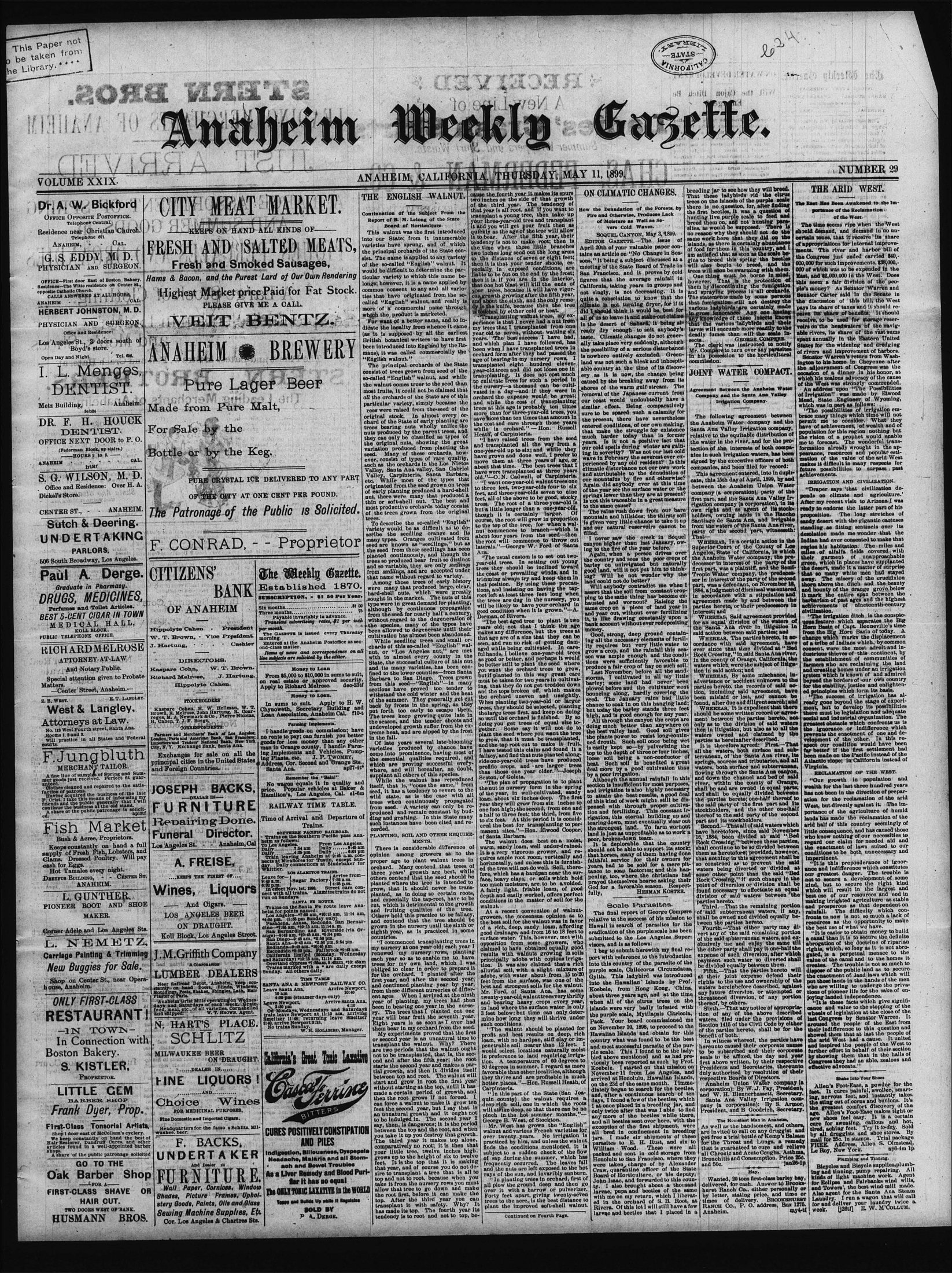
Searchable text
VOLUME XXIX.
Dr. A. W. Bickford
OFFICE OPPOSITE POSTOFFICE.
Telephone Central.
Residence near Christian Church.
Telephone 671.
ANAHEIM, CAL.
G. S. EDDY, M. D.
PHYSICIAN AND SURGEON.
OFFICE—First door East of Boston Bakery.
Residence—The Witte residence on Center St., opposite Catholic Church.
CALLS ANSWERED AT ALL HOURS.
ANAHEIM CAL.
HERBERT JOHNSTON, M. D.
PHYSICIAN AND SURGEON.
Office and Residence:
Los Angeles St., 3 doors south of Boyd's store.
Open Day and Night. Tel. 656.
I. L. Menges,
DENTIST.
Metz Building, Anaheim feb24
DR. F. H. HOUCK
DENTIST.
OFFICE NEXT DOOR to P. O.
(Federman Block, up stairs.)
HOURS 9 to 5
ANAHEIM CAL.
CITY MEAT MARKET.
KEeps on hand all kinds of
FRESH AND SALTED MEATS,
Fresh and Smoked Sausages,
Hams & Bacon, and the Purest Lard of Our Own Rendering
Highest Market price Paid for Fat Stock.
PLEASE GIVE ME A CALL.
VEIT BENTZ.
ANAHEIM BREWERY
Pure Lager Beer
Made from Pure Malt,
For Sale by the
Bottle or by the Keg.
DENTIST.
Metz Building, Anaheim.
feb84
DR. F. H. HOUCK
DENTIST.
OFFICE NEXT DOOR to P. O.
(Federman Block, up stairs.)
HOURS 9 to A.
ANAHEIM
Jy1547
S. G. WILSON, M. D.
Office and Residence: Over H. A.
Dickel's Store.
CENTER ST., ANAHEIM.
Sutch & Deering.
UNDERTAKING
PARLORS.
506 South Broadway, Los Angeles.
Paul A. Derge.
Graduate in Pharmacy.
DRUGS, MEDICINES,
Perfumes and Toilet Articles.
BEST 5-CENT CIGAR IN TOWN
MEDICAL HALL,
KOLL BLOCK.
PUBLIC TELEPHONE OFFICE.
RICHARD MELROSE
ATTORNEY-AT-LAW
And Notary Public.
Special attention given to Probate Matters.
—Center Street, Anaheim.
Z. B. WEST.
E. T. LANGLEY.
West & Langley.
Attorneys at Law.
No. 118 West Fourth street, Santa Ana.
Rooms 1, 2 and 3.
Will practice in all States and Federal courts.
F.Jungbluth
MERCHANT TAILOR.
A fine line of samples of Spring and Summer goods just received. Perfect fit guaranteed.
Clothes cleaned and repaired to the satisfaction of patrons.
Having acquired the business of the late P. Crist. I take this means of informing my friends and the public generally that I will continue the business at the old stand.
A share of the public patronage is solicited.
Fish Market
Bush & Acree, Proprietors.
Keeps constantly on hand a full supply of Fresh Fish, Lobsters, and Clams. Dressed Poultry. Will pay cash for Eggs.
Hot Tamales every night.
DEEYFUS BUILDING, - CENTER ST,
ANAHEIM.
L.GUNTHER.
Pure Lager Beer
Made from Pure Malt,
For Sale by the
Bottle or by the Keg.
PURE CRYSTAL ICE DELIVERED TO ANY PART OF THE CITY AT ONE CENT PER POUND.
The Patronage of the Public is Solicited
F.CONRAD, - - Proprietor
CITIZENS'
BANK
OF ANAHEIM
Hippolyte Cahen - President
W. T. Brown - Vice President
J. Hartung, Cashier
DIRECTORS:
Kaspare Cohn, W. T. Brown.
Richard Melrose, J. Hartung.
STOCKHOLDERS:
Kaspare Cohen, H. W. Hellman, W. T. Brown, R. Melrose, John Hartung, R. Courreges, M.A. Newmark & Co., Pierre Nicolas, H. Cahen, T.J.F. Boege.
CORRESPONDENTS:
Farmers and Merchants' Bank of Los Angeles; London, Paris and American Bank; San Francisco; Importers and Trader National Bank; New York City, N.Y. Exchange Bank, Santa Ana.
Exchanges for sale on all the principal cities in the United States and Foreign Countries.
JOSEPH BACKS,
DEALER IN
FURNITURE
Repairing Done.
Funeral Director.
Los Angeles St. - Anaheim, Cal.
A. FREISE,
...KEeps THE FINEST OF...
Wines, Liquors
The Weekly Gazette
Established 1870
SUBSCRIPTION, - $1 50 Per Year
Six months....$3
Three months....$2
Payable invariably in advance.
Transient advertising rates,$1 per month
The GAETTE is issued every Thursday morning.
Entered at the Anaheim Postoffice as one-class matter.
Items of news and correspondence on live subjects are solicited by the editor.
Money to Loan
From $5,000 to $10,000 in sums to suit on real estate or approved security.
Apply to Richard Melrose.
Money to Loan.
In sums to suit. Apply to H. Chynoweth, Secretary Building and Loan Association, Anaheim Cal.
Farming Implements:
I handle goods on commission; he no rents to pay; can furnish you better goods for less money than any other man in Orange county. I handle Farming Implements and Vehicles, Pumping Plants, etc. J.P.Twomey, Address Cor. Second and Orange St., Santa Ana.
Remember the "Bain!"
No wagon equals it in quality price. Popular vehicles at Baker Hamilton's, Los Angeles, Cal.
RAILWAY TIME TABLE
Time of Arrival and Departure Trains.
SOUTHERN PACIFIC BAILBOAD.
Trains on the Southern Pacific pass A-heim as follows:
To Los Angeles:
Daily: From Los Angeles
Daily: 7:54 am Daily: 9:45 am Daily: 4:25 pm Daily: 6:00 pm
Train leaving Anaheim at 9:45 am; nects at Mirarores for Tustin, except Sunday; Daily connections at Studebaker Whittier.
LO ALAMITOS TRAINS
Leave for -
9:48 a.m Sugar Factory Arrive fro8:00 p.m.
In effect Nov. 1st, 1888 Street cars nect with all trains Alamitos trains do run on Sundays.
FISH MARKET
Bush & Acree, Proprietors.
Keeps constantly on hand a full supply of Fresh Fish, Lobsters, and Clams. Dressed Poultry. Will pay cash for Eggs.
Hot Tamales every night.
DEBYFUS BUILDING, - CENTER ST.
ANAHEIM.
L. GUNTHER.
PIONEER BOOT AND SHOE MAKER.
Corner Adele and Los Angeles Sts.
L. NEMETZ.
Carriage Painting & Trimming
New Buggies for Sale.
Shop on Center St., near Opera-house, Anaheim.
ONLY FIRST-CLASS RESTAURANT!
IN TOWNIn Connection with Boston Bakery.
S. KISTLER,
PROPRIETOR.
LITTLE GEM
BARBER SHOP
Frank Dyer, Prop.
First-Class Tonsorial Artists.
Shop 1 door east of McCollum's cycleery.
We keep constantly on hand the best of Hair Restorer, Dandruff Cures, and other articles found in a well-appointed barber shops.
A share of the public patronage solicited
GO TO THE Oak Barber Shop
FOR A FIRST-CLASS SHAVE OR HAIR CUT.
TWO DOORS WEST OF BANK.
HUSMANN BROS.
FURNITURE
Repairing Done.
Funeral Director.
Los Angeles St. - Anaheim, Cal
A. FREISE,
...KEeps THE FINEST OF...
Wines, Liquors
And Cigars.
LOS ANGELES BEER ON DRAUGHT.
Koll Block, Los Angeles Street.
J.M. Griffith Company
A CORPORATION
LUMBER DEALERS
Neer Railroad Depot, Anaheim, keep constantly on hand Doors, Blinds, Windows, Mouldings, Posts, Shakes, Shingles, Lath, Hair Plaster of Paris.
Anaheim Grist Mills operating on Wednesdays and Saturdays of each week. Grate, feed, meal, etc., of all varieties, Cornshellled and shipped.
W. T. Brown, Agent.
N. HART'S PLACE.
SCHLITZ
MILWAUKEE BEER ON DRAUGHT.
DEALER IN.....
FINE LIQUORS!
AND....
Choice Wines FOR MEDICINAL PURPOSES,
Fine Domestic and Imported Cigars.
Headquarters for the famo s Schlitz, Milwaukee, beer.
F. BACKS,
UNDERTAKER
And Dealer in FURNITURE.
Wall Paper, Cornices, Window Shades, Picture Frames, Upholstery Goods, Paints, Oils and Glass Sewing Machine Supplies, Etc.
Cor. Los Angeles & Chartres Sts.
RAILWAY TIME TABLE
Time of Arrival and Departure Trains.
SOUTHERN PACIFIC RAILBOAD.
Trains on the Southern Pacific pass A heim as follows:
To Los Angeles.
Daily.....7:54 am Daily.....9:46 am
Daily.....4:28 pm Daily.....6:00 pm
Train leaving Anaheim at 9:46 a.m. on necta at Miradores for Tustin, except Sunday. Daily connections at Studebaker Whittier.
LOS ALAMITOS TRAINS.
Leave for—
9:49 a.m.
6:02 p.m.
In effect Nov. 1st, 1898.
Street cars nect with all trains. Alamitos trains do run on Sundays.
SANTA FE ROUTE.
Trains on the Santa Fe route leave A heim for points named:
Los Angeles—7:56 am; *10:15 am; 11:14 am; 8:55 pm. (3:56 pm Sunday only).
Pasadena, Anasua, Redondo, San Bernardo—7:56 am; *10:15 am; 11:14 a.m.
San Bernardino and Riverside (via arango)—9:43 am; *10:45 am; 6:54 pm.
San Diego—9:43 am; *2:50 pm;
Santa Ana—9:43 am; *2:50 pm; 5:54 pm.
Redlands—9:43 am; *10:45 am.
Escondido*2:50 pm. Fallbrook*9:43 am California limited (Monday, Wednesday and Saturday)*10:15 am; 11:14 am.
Overland express*7:58am; 9:48am; *10:15 am; 11:14 am.
Trains marked with a are daily ex Sunday. All others daily.
TIME TABLE
SANTA ANA & NEWPORT RAILWAY
Leave Santa Ana,
10 am
4:00 pm (steamer days only)
Leave Newport,
9:00 pm
On Mondays, Wednesdays and Saturs train leave Newport at 11:10 am; arrive Smeltzer 11:42; returning leave Smeltzer 8:40; arrive Newport 3:18;
No trains Sunday.
W. H. HOLABIRD, Manag
CALIFORNIA'S GREAT TONIC LAZY
CASCA FERRINI
BITTERS
CURES POSITIVELY CONSTIPATE AND PILES
Indigestion, Billiousness, Dyspea Headache, Malaria and all Staph and Bowel Troubles As a Liver Remedy and Blood Filler has no equal
The ONLY TONIC LAXATIVE in the Woman and Builds Up while it Regulates
SOLD BY
P.A.DERGE.
HEIM WEEKLY GAZETTE
ANAHEIM, CALIFORNIA, THURSDAY, MAY 11, 1899.
MARKET.
KINDS OF
ED MEATS,
Sausages,
of Our Own Rendering
and for Fat Stock.
CALL.
NTZ.
BREWERY
Beer
THE ENGLISH WALNUT.
Continuation of the Subject From the Report of B. M. Lelong of the State Board of Horticulture.
This walnut was the first introduced into our State; from it innumerable varieties have sprung, and of which the principal orchards of the State consist. The name is applied to any variety of the so-called "English" walnut. It would be difficult to determine the particular variety to which this name belongs; however, it is a name applied by common consent to any and all varieties that have originated from the so-called "English" walnut, and really is more of a commercial name through which the product is marketed.
For want of a better name, and to indicate the locality from whence it came (as it is supposed by all the earliest British botanical writers to have first been introduced into England by the Romans), it was called commercially the "English walnut."
The principal orchards of the State consist of trees grown from seed of the so-called "English" walnut, and while the walnut comes truer to the seed than most fruits, it could not be claimed that all the orchards of the State are of this particular variety, simply because the trees were raised from the seed of the original stock. In almost every orchard of the State of early planting are trees bearing nuts wholly unlike the nuts produced by the parent trees, and they can only be classified as types of the original nuts, showing the great variation produced from planting the seed. Many of these orchards, however, consist of types of rare quality, such as the orchards in the Los Nietos Valley, Santa Ana valley, San Gabriel Valley, Carpinteria, Santa Barbara, cause the fourth year it makes its spurs two inches on the side of that growth of the third year. The tendency of that year is all root, and if you want to transplant a young tree, then take up your three-year-old tree and transplant it and you will get your fruit then as quickly as the age of the tree will allow it to bear. After the fifth year, their tendency is not to make root; then is the time when those little branches two inches long send out the long arms to the distance of seven or eight feet; then it is that your tender shoots, especially in exposed conditions, are liable to be cut out on the end by the frost; then it is, if you are in the interior, that one hot blast will kill the ends of your trees, because it will have vigorous growth growing after the fifth year, and about the sixth, and the only remedy is the knife, because then the tree is touched by either cold or heat.
Transplanting walnut trees, my experience is that I never had a nut from my trees that I transplanted from one year old to seven, without waiting six years. The best success I have had, and which plan I have followed, has been when I have transplanted trees in orchard form after they had passed the age of bearing in my nursery rows. I transplanted eight hundred eleven-year-old trees and did not loose one in transplanting. It does not cost much to cultivate trees for such a period in the nursery—a thousand can be cultivated in a day—and if they were in orchard the expense would be great; and while the cost of transplanting trees at this age is probably ten times more than for three-year-old trees, you save more than ten times that amount in the cost and care through those years while in orchard." — Hon. Russell Heath, of Carpinteria.
"I have raised trees from the seed and transplanted all the way from a one-year-old up to six; and while they have grown and done well, I prefer to move them at three years of age, or about that time. The best trees that I have were transplanted at three years cause the fourth year it makes its spurs two inches on the side of that growth of the third year. The tendency of that year is all root, and if you want to transplant a young tree, then take up your three-year-old tree and transplant it and you will get your fruit then as quickly as the age of the tree will allow it to bear. After the fifth year, their tendency is not to make root; then is the time when those little branches two inches long send out the long arms to the distance of seven or eight feet; then it is that your tender shoots, especially in exposed conditions, are liable to be cut out on the end by the frost; then it is, if you are in the interior, that one hot blast will kill the ends of your trees, because it will have vigorous growth growing after the fifth year, and about the sixth, and the only remedy is the knife, because then the tree is touched by either cold or heat."
ON CLIMATIC CHANGES
How the Denudation of the Forests Fire and Otherwise Produces Lack of Moisture as Well as Severe Cold Waves.
SOQUEL CANYON, May 3, 1899.
EDITOR GAZETTE.—The issue April 20th of your valuable paper contains an article on "No Change in Sons," it being a subject discussed in meeting of the State Board of Trade San Francisco, and it proves by figures that the average rainfall California, taking years in groups not singly, is not decreasing. It quite a consolation to know that climate is not turning dryer, for did I should think it would be best all of us to leave it and stake-out clima in the desert of Sabara, it being dry enough to suit anybody taste. Climatic changes do not generally take place very suddenly, although the possibility of a serious disturbance is nowhere entirely excluded. Grassland was not such a bleak and inhospitable country at the time of its disarray as it is now, the change caused by the breaking away from shores of the warm gulf stream. removal of the Japanese current from our coast would undoubtedly have similar effect. Being comparatively sure to be spared such a calamity, the present, there have nevertheless entered conditions, of our own making that make the struggle for existent much harder today than in four years. Is it not a positive fact that our cold spells during winter are lingering in severity? Was not our last wave in February the severest ever experienced by any old resident? In climatic disturbance not our own attributable to the denudation.
BEER
PROPRIETOR
WEEKLY GAZETTE
BROADCASTED 1870.
IVERED TO ANY PART
MENT PER POUND.
Public is Solicited.
Proprietor
Weekly Gazette.
Published 1870.
RECEPTION, - $150 Per Year.
hours. $1,000
months. 75
variable invariably in advance.
agent advertising rates, $1 per inch.
GAETTE is issued every Thursday
at the Anaheim Postoffice as sect matter.
new and correspondence on all
acts are solicited by the editor.
Money to Loan.
$5,000 to $10,000 in sums to suit,
estate or approved security.
to Richard Melrose.
deo-23ft
Money to Loan.
$5,000 to $10,000 in sums to suit,
estate or approved security.
to Richard Melrose.
deo-23ft
Farming Implements.
hard goods on commission; have
to pay; can furnish you better
or less money than any other
Orange county. I handle Farmplements and Vehicles, Pumppkins, etc.
J. P. Twomey,
Corr. Second and Orange Sta.,
a Ana.
ap27-4t
Remember the "Balal!"
Dragon equals it in quality and
Popular vehicles at Baker & Son's.
Los Angeles, Cal. s1-6m
AILWAY TIME TABLE.
of Arrival and Departure of Trains.
SOUTHERN PACIFIC pass Anafollows.
From Los Angeles.
Daily. 9:45 am
Daily. 6:01 pm
leaving Anaheim at 9:45 am. conMirafores for Tustin, except Sunally connections at Studebaker for
LOS ALAMITOS TRAINS.
Arrive from—
Sugar Factory.
7:58 a.m.
A.M.
Set Nov. 1st, 1886.
Street cars contain all trains.
Alamitos trains do not
Sundays.
so-called "English" walnut, and while
the walnut comes truer to the seed than most fruits, it could not be claimed that all the orchards of the State are of this particular variety, simply because the rees were raised from the seed of the original stock. In almost every orchard of the State of early planting are trees bearing nuts wholly unlike the nuts produced by the parent trees, and they can only be classified as types of the original nuts, showing the great variation produced from planting the seed.
Many of these orchards, however, consist of types of rare quality, such as the orchards in the Los Nietos Valley, Santa Ana valley, San Gabriel Valley, Carpinteria, Santa Barbara, etc. While most of the types that originated from the seed grown on trees of early planting produced a hard-shell nut, there were many that produced a thin or soft-shell nut. The best and most productive orchards today consist of the trees grown from the original trees.
To describe the so-called "English" variety would be as difficult as to describe the seedling orange and its many types. Oranges cultivated from seed are known as "seedlings," but as the seed from these seedlings has been planted continuously, and though the trees so produced bear fruit so distinct and so variable, they are only seedlings from seedlings, and are accepted under that name without regard to variety.
Among those trees of early history were many that produced large, clear, hard-shell nuts, which were greatly sought in the market. The nuts of this type were in great demand for planting, although by continuous propagation from the seed for nearly half a century, without regard to the degeneration of the species, many of the types have allowed to degenerate until their cultivation has almost been abandoned.
While seedling trees and small orchards of this so-called "English" walnut, or "Los Angeles nut," are met with in almost every county in the State, the successful culture of this nut and its many varieties, has been confined to the lower counties—from Santa Barbara to San Diego. Trees grown from this seed—"English"—in many sections have proved too tender to withstand the cold winter and the heat of the summer. They generally get cut back by frosts in the spring, as they put forth too early to escape them. The trees keep growing quite late in the season, and the tender shoots and undeveloped growth suffer from extreme heat, and are nipped by the frost in the fall.
Of late years several late-blooming varieties produced by chance have come into prominence, having most of the essential qualities required, and which are proving successful everywhere, and will hereafter, no doubt, supplant all others of this species.
While the walnut has reproduced itself, that is, "come the same," from seed, it has a tendency to revert to the wild state, as is the case with all trees when continuously propagated from seed. A variety can only be reproduced and remain constant by budding and grafting. In this State many such instances have been cited and recorded.
PLANTING, SOIL AND OTHER REQUIREMENTS.
There is considerable difference of opinion among growers as to the proper age to plant walnut trees in orchard. Many contend that trees of three years' growth are best, while others contend that the seed should be planted where the tree is intended to grow, that it should never be transplanted, as in doing so certain roots, and especially the tap-root, have to be so-called "English" walnut, and while the walnut comes truer to the seed than most fruits, it could not be claimed that all the orchards of the State are of this particular variety, simply because the rees were raised from the seed of the original stock. In almost every orchard of the State of early planting are trees bearing nuts wholly unlike the nuts produced by the parent trees, and they can only be classified as types of the original nuts, showing the great variation produced from planting the seed.
Many of these orchards, however, consist of types of rare quality, such as the orchards in the Los Nietos Valley, Santa Ana valley, San Gabriel Valley, Carpinteria, Santa Barbara, etc. While most of the types that originated from the seed grown on trees of early planting produced a hard-shell nut, there were many that produced a thin or soft-shell nut. The best and most productive orchards today consist of the trees grown from the original trees.
To describe the so-called "English" variety would be as difficult as to describe the seedling orange and its many types. Oranges cultivated from seed are known as "seedlings," but as the seed from these seedlings has been planted continuously, and though the trees so produced bear fruit so distinct and so variable, they are only seeds from seedlings and are accepted under that name without regard to variety.
Among those trees of early history were many that produced large, clear, hard-shell nuts, which were greatly sought in the market. The nuts of this type were in great demand for planting, although by continuous propagation from the seed for nearly half a century, without regard to the degeneration of the species, many of the types have allowed to degenerate until their cultivation has almost been abandoned.
While seedling trees and small orchards of this so-called "English" walnut, or "Los Angeles nut," are met with in almost every county in the State, the successful culture of this nut and its many varieties, has been confined to the lower counties—from Santa Barbara to San Diego. Trees grown from this seed—"English"—in many sections have proved too tender to withstand the cold winter and the heat of the summer. They generally get cut back by frosts in the spring, as they put forth too early to escape them. The trees keep growing quite late in the season, and the tender shoots and undeveloped growth suffer from extreme heat, and are nipped by the frost in the fall.
Of late years several late-blooming varieties produced by chance have come into prominence, having most of the essential qualities required, and which are proving successful everywhere, and will hereafter, no doubt, supplant all others of this species.
While the walnut has reproduced itself, that is, "come the same," from seed, it has a tendency to revert to the wild state, as is the case with all trees when continuously propagated from seed. A variety can only be reproduced and remain constant by budding and grafting. In this State many such instances have been cited and recorded.
PLANTING, SOIL AND OTHER REQUIREMENTS.
There is considerable difference of opinion among growers as to the proper age to plant walnut trees in orchard. Many contend that trees of three years' growth are best, while others contend that the seed should be planted where the tree is intended to grow, that it should never be transplanted, as in doing so certain roots, and especially the tap-root, have to be so-called "English" walnut, and while the walnut comes truer to the seed than most fruits, it could not be claimed that all the orchards of the State are of this particular variety, simply because the rees were raised from the seed of the original stock. In almost every orchard of the State of early planting are trees bearing nuts wholly unlike the nuts produced by the parent trees, and they can only be classified as types of the original nuts, showing the great variation produced from planting the seed.
Many of these orchards, however, consist of types of rare quality, such as the orchards in the Los Nietos Valley, Santa Ana valley, San Gabriel Valley, Carpinteria, Santa Barbara, etc. While most of the types that originated from the seed grown on trees of early planting produced a hard-shell nut, there were many that produced a thin or soft-shell nut. The best and most productive orchards today consist of the trees grown from the original trees.
To describe the so-called "English" variety would be as difficult as to describe the seedling orange and its many types. Oranges cultivated from seed are known as "seedlings," but as the seed from these seedlings has been planted continuously, and though the trees so produced bear fruit so distinct and so variable, they are only seeds from seedlings and are accepted under that name without regard to variety.
Among those trees of early history were many that produced large, clear, hard-shell nuts,which were greatly sought in the market. The nuts of this type were in great demand for planting,although by continuous propagation fromthe seed for nearly half a century,without regard tothe degenerationofthespecies,manyofthetypeshaveallowedtodegenerateuntilthecultivationhasalmostbeenabandoned.
While seedling trees and small orchards of this so-called "English" walnut,or "Los Angeles nut,"are met with in almost every county intheState,thesuccessfulcultureofthisnutanditsanyvarieties,hasbeenconfinedtothelowercounties-fromSantaBarbaratoSanDiego.Treegrowthfromthiscountryisalmostbeenabandoned.
While seedling trees and small orchards of this so-called "English" walnut,or "Los Angeles nut,"are met with in almost every county intheState,thesuccessfulcultureofthisnutanditsanyvarieties,hasbeenconfinedtothelowercounties-fromSantaBarbaratoSanDiego.Treegrowthfromthiscountryisalmostbeenabandoned.
While seedling trees and small orchards of this so-called "English" walnut,or "Los Angeles nut,"are met with in almost every county intheState,thesuccessfulcultureofthisnutanditsanyvarieties,hasbeenconfinedtothelowercounties-fromSantaBarbaratoSanDiego.Treegrowthfromthiscountryisalmostbeenabandoned.
While seedling trees and small orchards of this so-called "English" walnut,or "Los Angeles nut,"are met with in almost every county intheState,thesuccessfulcultureofthisnutanditsanyvarieties,hasbeenconfinedtothelowercounties-fromSantaBarbaratoSanDiego.Treegrowthfromthiscountryisalmostbeenabandoned.
While seedling trees and small orchards of this so-called "English" walnut,or "Los Angeles nut,"are met with in almost every county intheState,thesuccessfulcultureofthisnutanditsanyvarieties,hasbeenconfinedtothelowercounties-fromSantaBarbaratoSanDiego.Treegrowthfromthiscountryisalmostbeenabandoned.
While seedling trees and small orchards of this so-called "English" walnut,or "Los Angeles nut,"are met with in almost every county intheState,thesuccessfulcultureofthisnutanditsanyvarieties,hasbeenconfinedtothelowercounties-fromSantaBarbaratoSanDiego.Treegrowthfromthiscountryisalmostbeenabandoned.
While seedling trees and small orchards of this so-called "English" walnut,or "Los Angeles nut,"are met with in almost every county intheState,thesuccessfulcultureofthisnutanditsanyvarieties,hasbeenconfinedtothelowercounties-fromSantaBarbaratoSanDiego.Treegrowthfromthiscountryisalmostbeenabandoned.
While seedling trees and small orchards of this so-called "English" walnut,or "Los Angeles nut,"are met with in almost every county intheState,thesuccessfulcultureofthisnutanditsanyvarieties,hasbeenconfinedtothelowercounties-fromSantaBarbaratoSanDiego.Treegrowthfromthiscountryisalmostbeenabandoned.
While seedling trees and small orchards of this so-called "English" walnut,or "Los Angeles nut,"are met with in almost every county intheState,thesuccessfulcultureofthisnutanditsanyvarieties,hasbeenconfinedtothelowercounties-fromSantaBarbaratoSanDiego.Treegrowthfromthiscountryisalmostbeenabandoned.
While seedling trees and small orchards of this so-called "English" walnut,or "Los Angeles nut,"are met with in almost every county intheState,thesuccessfulcultureofthisnutanditsanyvarieties,hasbeenconfinedtothelowercounties-fromSantaBarbaratoSanDiego.Treegrowthfromthiscountryisalmostbeenabandoned.
While seedling trees和small或orchardsofthisso-called“English”walnut,或“Los Angeles nut”,are met with in almost every county intheState,thesuccessfulcultureofthisnutanditsanyvarieties,hasbeenconfinedtothelowercounties-fromSantaBarbara.toSanDiego.Treegrowthfromthiscountryisalmostbeenabandoned.
While seedling trees和small或orchardsofthisso-called“English”walnut,或“Los Angeles nut”,are met with in almost every county intheState,thesuccessfulcultureofthisnutanditsanyvarieties,hasbeenconfinedtothelowercounties-fromSantaBarbara.toSanDiego.Treegrowthfromthiscountryisalmostbeenabandoned.
While seedling树木和small或orchardsofthisso-called“English”walnut,或“Los Angeles nut”,are met with in almost every county intheState,thesuccessfulcultureofthisnutanditsanyvarieties,hasbeenconfinedtothelowercounties-fromSantaBarbara.toSanDiego.Treegrowthfromthiscountryisalmostbeenabandoned.
While seedling树木和small或orchardsofthisso-called“English”walnut,或“Los Angeles nut”,are met with in almost every county intheState,thesuccessfulcultureofthisnutanditsanyvarieties,hasbeenconfinedtothelowercounties-fromSantaBarbara.toSanDiego.Treegrowthfromthiscountryisalmostbeenabandoned.
While tree和small或orchardsofthisso-called“English”walnut,或“Los Angeles nut”,are met with in almost every county intheState,thesuccessfulcultureofthisnutanditsanyvarieties,hasbeenconfinedtothelowercounties-fromSantaBarbara.toSanDiego.Treegrowthfromthiscountryisalmostbeenabandoned.
While tree和small或orchardsofthisso-called“English”walnut,或“Los Angeles nut”,are met with in almost every county intheState,thesuccessfulcultureofthisnutanditsanyvarieties,hasbeenconfinedtothelowercounties-fromSantaBarbara.toSanDiego.Treegrowthfromthiscountryisalmostbeenabandoned.
While tree和small或orchardsofthisso-called“English”walnut,或“Los Angeles nut”,are met with in almost every county intheState,thesuccessfulcultureofthisnutanditsanyvarieties,hasbeenconfinedtothelowercounties-fromSantaBarbara.toSanDiego.Treegrowthfromthiscountryisalmostbeenabandoned.
While tree和small或orchardsofthisso-called“English”walnut,或“Los Angeles nut”,are met with in almost every county intheState,thesuccessfulcultureofthisnutanditsanyvarieties,hasbeenconfinedtothelowercounties-fromSantaBarbara.toSanDiego.Treegrowthfromthiscountryisalmostbeenabandoned.
While tree和small或orchardsofthisso-called“English”walnut,或“Los Angeles nut”,are met with in almost every county intheState,thesuccessfulcultureofthisnutanditsanyvarieties,hasbeenconfinedtothelowercounties-fromSantaBarbara.toSanDiego.Treegrowthfromthis countryisalmostbeenabandoned.
While tree和small或orchardsofthisso-called“English”walnut,或“Los Angeles nut”,are met with in almost every county intheState,thesuccessfulcultureofthis Nutrichedule,anditwillnotbereasonforbudgingandgrafting.In this State many such instances have been cited and recorded.PLANTING,SOIL AND OTHER REQUIREMENTS.
There is considerable difference of opinion among growers as to the proper age to plant walnut trees in orchard.Many contend that trees of three years' growth are best,while others contend that they will grow from six inches to one foot high;the second,从 one half to three feet;the third,从 five to six feet.At this period it is considered best for transplanting to permanent sites."Joseph Sexton,of Goleta,
"The plan of propagation is to plant nut in nursery form in the spring of year,在 well-cultured,sandy loam,well under-drained。It is a very vigorous grower,and requires ample root room, vertically and horizontally,and unless it is furnished taller than six inches deep.The first year they will grow from six inches to one foot high;the second,从 one half to three feet;the third,从 five to six feet.At this period it is considered best for transplanting to permanent sites."Joseph Sexton,of Goleta,
"The plan of propagation is to plant nut in nursery form in the spring of year,在 well-cultured,sandy loam,well under-drained。It is a very vigorous grower,and requires ample root room, vertically and horizontally,and unless it is furnished taller than six inches deep.The first year they will grow from six inches to one foot high;the second,从 one half to three feet;the third,从 five to six feet.At this period it is considered best for transplanting to permanent sites."Joseph Sexton,of Goleta,
"The plan of propagation is to plant nut in nursery form in the spring of year,在 well-cultured,sandy loam,well under-drained。It is a very vigorous grower,and requires ample root room, vertically and horizontally,and unless it is furnished taller than six inches deep.The first year they will grow from six inches to one foot high;the second,从 one half to three feet;the third,从 five to six feet.At this period it is considered best for transplanting to permanent sites."Joseph Sexton,of Goleta,
"The plan of propagation is to plant nut in nursery form in the spring of year,在 well-cultured,sandy loam,well under-drained。It is a very vigorous grower,and requires ample root room, vertically and horizontally,and unless it is furnished taller than six inches deep.The first year they will grow from six inches to one foot high;the second,从 one half to three feet;the third,从 five to six feet.At this period it is considered best for transplanting to permanent sites."Joseph Sexton,of Goleta,
"The plan of propagation is to plant nut in nursery form in the spring of year,在 well-cultured,sandy loam,well under-drained。It is a very vigorous grower,and requires ample root room, vertically and horizontally,and unless it is furnished taller than six inches deep.The first year they will grow from six inches to one foot high;the second,从 one half to three feet;the third,从 five to six feet.At this period it is considered best for transplanting to permanent sites."Joseph Sexton,of Goleta,
"The plan of propagation is to plant nut in nursery form in the spring of year,在 well-cultured,sandy loam,well under-drained。It is a very vigorous grower,and requires ample root room, vertically and horizontally,and unless it is furnished taller than six inches deep.The first year they will grow from six inches to one foot high;the second,从 one half to three feet;the third,从 five to six feet.At this period it is considered best for transplanting to permanent sites."Joseph Sexton,of Goleta,
"The plan of propagation is to plant nut in nursery form in the spring of year,在 well-cultured,sandy loam,well under-drained。It is a very vigorous grower,and requires ample root room, vertically and horizontally,and unless it is furnished taller than six inches deep.The first year they will grow from six inches to one foot high;the second,从 one half to three feet;the third,从 five to six feet.At this period it is considered best for transplanting to permanent sites."Joseph Sexton,of Goleta,
"The plan of propagation is to plant nut in nursery form in the spring of year,在 well-cultured,sandy loam,well under-drained。It is a very vigorous grower,and requires ample root room, vertically and horizontally,and unless it is furnished taller than six inches deep.The first year they will grow from six inches到 one foot high;the second,从 one half到 three feet;the third,从 five到 six feet.At this period it is considered best for transplanting to permanent sites."Joseph Sexton,of Goleta,
"The plan of propagation is to plant nut在 nursery form在或whereforeground中种植。在这种环境中种植,是为了促进土壤的改良,从而提高作物产量。但这种种植方式并不适合所有类型的作物,如棉花、玉米、甘蔗、油菜等。因此,这种种植方式必须与土壤的适应性相符合。
When a person drives a car parked on a roadside during heavy rainfall due to heavy snowfall during wintertime due to poor soil condition after heavy rainfall due to heavy snowfall during wintertime due to poor soil condition after heavy rainfall due to heavy snowfall during wintertime due to poor soil condition after heavy rainfall due to heavy snowfall during wintertime due to poor soil condition after heavy rainfall due to heavy snowfall during wintertime due to poor soil condition after heavy rainfall due to heavy snowfall during wintertime due to poor soil condition after heavy rainfall due
There is considerable difference of opinion among growers as to the proper age to plant walnut trees in orchard. Many contend that trees of three years' growth are best, while others contend that the seed should be planted where the tree is intended to grow, that it should never be transplanted, as in doing so certain roots, and especially the tap-root, have to be cut, which is detrimental to the growth and fruiting qualities of the tree. Others hold this practice to be fallacy, and contend that the tree should be grown in the nursery until the sixth or eighth year, as is practiced in some countries.
"I commenced transplanting trees in my nursery at one year old; each year I renewed my nursery rows, planting each year so as to enable me to have trees for my own land, which I was obliged to clear in order to prepare it for the orchard. I planted after the first year, and after the second year, and continued planting year by year, from these different nurseries of different ages. When I arrived at the ninth year of planting, my trees had then been in bearing one year in the nursery. The trees that I planted out one year will bear fruit the seventh year. Eight years is as soon as I ever had them bear in my orchard from the seed.
My experiments proved that the first or second year is an unnatural time to transplant the walnut. Why? There are two periods that the walnut ought not to be transplanted, that is, the second and after the fifth year; the root starts the second year and makes a partial growth, and then it divides itself between top and root. The walnut will start and grow in root the first year without starting at the top, until it has made a certain period of growth, and then the root grows if not forced. I can force a walnut to make it grow ten feet the second year, but I say that is an unnatural growth and it ought not to be indulged in. The second year I say, then, is dangerous; it is the period between the top and the root, and when you take it up you destroy that growth.
The third year it makes top alone, comparatively no root; it is then that your little tree, twelve inches high, grows up to the height of six to twelve feet. It is the top that it is making that year, and of course you do not desire to transplant a tree that is all to top and not to root, because when you take it from the nursery rows you must allow that tree to go down and make the root first, before it can make the top. After the third year you can transplant it with safety. Why? It has made its top. The fourth year its tendency is to root and not to top, beano, about six inches deep. The first year they will grow from six inches to one foot high: the second, from one and a half to three feet; the third, from five to six feet. At this period it is considered the best for transplanting to permanent sites."—Hon. Elwood Cooper, of Santa Barbara.
The walnut does best on a moist, warm, sandy loam, well under-drained. It is a very vigorous grower, and requires ample root room, vertically and horizontally, and unless this is furnished the tree will not do well. Soil, therefore, which has a hardpan near the surface, heavy clays, or solls which hold too much moisture, are to be avoided. A fairly light, friable loam, of good depth and easily worked, offers perfect conditions in the matter of soil for the walnut.
At a recent convention of walnut-growers, the consensus opinion as to the best soil for the walnut was in favor of a rich, deep, sandy loam, affording good drainage, and from 16 to 18 feet to surface water. This, however, met with opposition from some growers, who claimed to have obtained equally good results with walnuts growing in soils principally adobe with copious irrigation. It was also claimed that a rich alluvial soil, with a slight mixture of adobe, with water about from 15 to 20 feet from the surface, was one of the best and strongest soils for the walnut. Mr. Ford, of Santa Ana, has some twenty-year-old walnuts very thrifty and bearing heavy crops every year, in land where the surface water is only 3 feet below; but time can only determine how long they will thrive under such conditions.
"The walnut should be planted for profit and best results on deep, rich loam, with no hardpan, stiff clay or impenetrable soil nearer than 12 feet. I would select locations naturally moist in preference to land requiring irrigation. A temperature of 60 degrees to 80 degrees in summer, I regard as more favorable than other localities, although they thrive and are profitable in much hotter places."—Hon. Russell Heath, of Carpinteria.
"In this part of the State (San Joaquin county) the walnut requires a deep rich soil, one in which the roots will strike deep, so that there can be no pinch in the hot summer months."—George B. West, of Stockton.
Mr. West has grown the "English" walnut and various French varieties for over twenty years. No irrigation is practiced by him, and unless the walnut finds the conditions mentioned, it is subject to a sudden check of the flow of sap during the summer, which has frequently occurred. The leaves fall and the nuts are left exposed to the hot rays of the sun, and invariably sunburn.
"In planting trees in orchard, first of all plow the ground deep and then go over it with a harrow or pulverizer. Forty feet apart, giving twenty-seven trees to the acre, is the best distance to plant the improved soft-shell walnut."
Continued on Fourth Page.
CLIMATIC CHANGES.
The Denudation of the Forests, by and Otherwise, Produces Lack of Moisture as Well as Severe Cold Waves.
SOQUEL CANYON, May 3, 1899.
FOR GAZETTE.—The issue of 20th of your valuable paper contains an article on "No Change in Sea-It being a subject discussed at a meeting of the State Board of Trade in Francisco, and it proves by cold that the average rainfall in Vennia, taking years in groups and singly, is not decreasing. It is a consolation to know that the ice is not turning dryer, for if it should think it would be best for us to leave it and stake-out claims of desert of Sabara, it being already dry enough to suit anybody's climatic changes do not generate place very suddenly, although possibility of a serious disturbance there entirely excluded. Green was not such a bleak and inhospit-tountry at the time of its discoveries it is now, the change being made by the breaking away from its coast of the warm gulf stream. The result of the Japanese current from coast would undoubtedly have a major effect. Being comparatively large be spared such a calamity for present, there have nevertheless been conditions, of our own making, make the struggle for existence harder today than in former times. Is it not a positive fact that old spells during winter are gaining severity? Was not our last cold in February the severest ever experienced by any old resident? Is this little disturbance not our own work attributable to the denudation of breeding jar to see how they will breed. That these ladybirds rid the citrus trees on the islands of the purple scale there is no question, for, after finding the first beetles, it was a question of hunting live purple scale to feed and breed them on, and not hunting parasites, as would be supposed. There is no reason why they should not do the same work here that they did on the islands, as there is certainly abundance of food for them in this country, and I am satisfied that as soon as the scale begins to breed this spring the beetles will also begin to breed, and the trees will soon be swarming with them.
One thing must be borne in mind, however. That is the protection of them by discontinuing the fumigation and spraying process in all orchards. The statements made by some persons that fumigation will not destroy the various ladybirds are certainly made in gross ignorance. Any one having any knowledge of these insects knows that the various ladybirds and their larvae will succumb more readily to the deadly fumes than will the scale insects.
The clerk was instructed to notify Mr. Compere to turn over any parsesite in his possession to the horticultural commission.
JOINT WATER COMPACT.
Agreement Between the Anaheim Water Company and the Santa Ana Valley Irrigation Company.
The following agreement between the Anaheim Water company and the Santa Ana Valley Irrigation company, relative to the equitable distribution of the water in the river, and for the protection of the interests of both companies in such irrigation waters, has been signed by the executive officers of both companies, and been filed for record:
This agreement entered into in duplicate.
THE ARID WEST.
The East Has Been Awakened to the Importance of the Reclamation of the West.
The time seems ripe when the West should demand, and demand in no uncertain tones, that it receive its share of appropriations for internal improvements. The river and harbor bill of the Congress just ended carried $40,-000,000 for such improvements,$38,000,-000 of which was to be expended in the East, and $2,000,000 in the West. Does this seem a fair division of the people's money? As Senator Warren and Senator Carter said in the Senate in the discussion of this bill, the West pays its share of taxes and it should receive its share of benefits. It should receive, to be used for storage reservoirs on the headwaters of the navigable rivers, its share of the vast sums spent annually in the Eastern United States for the widening and dredging of rivers and improvement of harbors.
Senator Warren's return from Washington to his home in Cheyenne after the adjournment of Congress was the occasion of a dinner in his honor, at which his zealous advocacy of the cause of the West was strongly commended.
An address upon "The Possibilities of Irrigation" was made by Elwood Mead, State Engineer of Wyoming, which was in part as follows:
"The possibilities of irrigation embrace many things which time will not permit me to consider. What they have of achievement, of wealth and of population for this region nothing but the vision of a prophet would enable me to forecast. The wonderful transformation already wrought in the appearance, resources and popular estimation of the value of the arid West makes it difficult in many respects for future possibilities to surpass past achievements."
Agreement Between the Anaheim Water Company and the Santa Ana Valley Irrigation Company.
The following agreement between the Anaheim Water company and the Santa Ana Valley Irrigation company, relative to the equitable distribution of the water in the river, and for the protection of the interests of both companies in such irrigation waters, has been signed by the executive officers of both companies, and been filed for record:
This agreement entered into duplicate, this 15th day of April, 1899, by and between the Anaheim Union Water company (a corporation), party of the first part, and the Santa Ana Valley Irrigation company (a corporation), in its own right and as agent of its stockholders, owning lands in the Rancho Santiago de Santa Ana, and irrigable from the waters of the Santa Ana river, party of the second part, witnesses: That—
WHEREAS, In a certain action in the Superior Court of the County of Los Angeles, State of California, in which the Anaheim Water company, the predecessor in interest of the party of the first part, was a plaintiff, and the Semi-Tropic Water company, the predecessor in interest of the party of the second part, was a defendant, on November 16, 1884, a judgment of dismissal was entered in accordance with a stipulation and agreement made by and between the parties hereto, or their predecessors in interest; and
WHEREAS, Said agreement provided for an equal division of the waters of the Santa Ana river in litigation in said action between said parties; and
WHEREAS, The parties hereto, in accordance with said agreement, have ever since that time divided at "Bed Rock Crossing," in said Santa Ana river, in the county of Orange, California, the waters which were the subject of litigation in said action; and
WHEREAS, By some mischance, in advertisence or accident unknown to the parties hereto, the records of said action, including said agreement, have been mislaid or lost, and cannot be found, after due and diligent search; and
WHEREAS, It is expedient that there should be some written record or agreement between the parties hereto, not only as to the division of said waters then in litigation, but also as to all the waters owned and claimed by the parties as hereinafter described.
It is therefore agreed: First—That all the waters, both surface and subterranean, of the Santa Ana river, its springs, sources and tributaries, and all waters, both surface and subterranean, flowing through the Santa Ana canyon, and down the channel and bed of said river, within the county of Orange, shall be and are owned in equal parts; and shall be equally divided between the parties hereto; one-half thereof to the said party of the first part and its stockholders, and the other one-half thereof to the said party of the second part and its stockholders.
Second—That all of said waters which have heretofore, since said November 16, 1884, been divided at said "Bed Rock Crossing," between these parties, shall continue to be so divided between them as heretofore; provided, however, that nothing in this agreement shall be so construed as to prevent the said waters being diverted or divided at some other point than the said "Bed Rock Crossing." If such change in the point of diversion or division shall be found necessary to effectuate an equal division of said waters between the
Irrigation and Civilization.
"Draper says 'that civilization depends on climate and agriculture.' After my recent visit to Arizona I was ready to endorse the latter part of his proposition. The long stretches of sandy desert with the gigantic oceans standing as fitting sentinels over its desolation made me wonder that the Indian had ever consented to make that region his habitat. The miles and miles of alfalfa fields covered with their garment of unapproachable green, which in places have supplanted the desert, made it a matter of surprise that so many white men had stayed away. The misery of the crucifixion thorn above the ditch and the beauty and bounty of the orange grove below it mark the entire span between the barbarism of past ages and the highest achievements of nineteenth-century civilization.
"The irrigation ditch is the conspicuous feature which separates the Big Horn Basin of Capt. Bonneville's time from the Big Horn Basin of today. A change which marks the displacement of a tribe of Indians which, by common consent, were the most adroit and industrious thieves of this continent, by the establishment of communities of farmers who are reclaiming the land and creating homes under an irrigation system which is known of and admired beyond the borders of our own country for the stability, justice and enlightened principles which form its basis.
"The success of irrigation has already gone beyond the stage of experiment, but to develop its possibilities there must be legislation and adequate social and industrial organization. The greatest obstacle which confronts us is the ignorance or indifference which prevents the enactment of one and development of the other. In this respect our condition would have been far better if the first settlement had been made on the Pacific instead of the Atlantic slope; in California instead of Virginia.
RECLAMATION OF THE WEST.
"Our growth in population and wealth for last three hundred years has not been in the direction of preparation for the reclamation of the arid West, but directly against it. The importance of the agriculture of humid lands has made the reclamation of the arid half of this country seemingly of little consequence, and has caused those who know nothing of our necessities to regard our claim for needed aid and the enactment of laws suited to our conditions to be both unnecessary and impertinent.
"It is this preponderance of ignorance and indifference which constitutes our greatest danger. The trouble is not to secure a development of some kind, but to secure the right kind which will result in the largest and best use of our resources and end in
Scale Parasites.
The final report of George Compere native to the success of his mission to Hawaii in search of parasites for the dedication of the purple scale has been submitted to the Los Angeles Superiors, and is as follows:
I beg to submit herewith my final report with reference to the introduction to this country of the parasite of the purple scale, Chilocorus Circumdatus, which this ladybird was introduced into the Hawaiian Islands by Prof. Rebele, from Hong Kong, China, about three years ago, and at the time when all of the citrus trees on the islands were very badly infested with the purple scale, Mytilopsis Citriola, Rock. Your board commissioned me November 10, 1898, to proceed to the Hawaiian Islands and obtain for this country what was found to be the best and most successful parasite of the purple scale. This I found to be the ladybird above mentioned and as had previously been reported as such by Prof. Rebele. I started on that mission on November 11 from Los Angeles, and arrived at Honolulu, Hawaiian Islands, on the 23d of the same month. I immediately began to search for the beetles, and after a continuous search of ten days, I found a few of the beetles, which once placed in a breeding jar, and only twice after that was able to find any more of the beetles while there, and all beetles sent over here, with the exception of the first shipment, were still bred in confinement in breeding tanks. I made six shipments of these parasites to E. H. Rust, and six to William Wood. These were all hacked and sent in cold storage from Honolulu to San Francisco, where they were taken charge of by Alexander Hawk, quarantine officer of the State Board of Horticulture, or his deputy, John Isaac, and forwarded to this county. I also brought about a thousand larvae, pupa and beetles of the same with me on my return, which I liberated in the orchard of S. B. Root, at Tiviera. Of this lot I will still have a few larvae and beetles that I placed in a party hereto; one-half thereof to the said party of the first part and its stockholders, and the other one-half thereof to the said party of the second part and its stockholders.
Second.—That all of said waters which have heretofore, since November 16, 1884, been divided at said "Bed Rock Crossing," between these parties, shall continue to be so divided between them as heretofore; provided, however, that nothing in this agreement shall be so construed as to prevent the said waters being diverted or divided at some other point than the said "Bed Rock Crossing." If such change in the point of diversion or division shall be found necessary to effectuate an equal division of said waters between the parties hereto.
Third.—That the remaining portion of said subterranean waters, if any, shall be owned and divided equally between the parties hereto.
Fourth.—That either party may divert any of the said remaining portion of said subterranean waters, and exclusively use and enjoy the same till the other party shall pay it one-half the expense of such diversion, after which payment such water so diverted shall be divided equally between them.
Fifth.—That the parties hereto will at their joint expense defend their rights to the use and ownership of the waters hereinbefore described, against any future diversion, or attempted or threatened diversion, of any portion thereof, by others.
Sixth.—That any notice of appropriation of any of the above described waters, filed under the provisions of Section 1415 of the Civil Code by either of the parties hereto, shall be for the benefit of both.
In witness whereof, the parties have hereunto caused their corporate names to be subscribed and their corporate seals to be affixed, the day and year first above written, by their respective Presidents and Secretaries, thereunto duly authorized by resolution of their respective Boards of Directors.
Anaheim Union Water company (a corporation): By W. J. Fay, President, and W. H. Blennnerhassett, Secretary.
Santa Ana Valley Irrigation company (a corporation): By S. Armor, President, and B Goodrich, Secretary.
The Homestead Man in Anaheim.
As well as the handsomest, and others, are invited to call on any druggist and get free a trial bottle of Kemp's Balsam for the Throat and Lungs, a remedy that is guaranteed to cure and relieve all Chronic and Acute Coughs, Asthma, Bronchitis and Consumption. Price 25c. and 50c. jan26-1p
Hay.
Wanted, 20 tons first-class barley hay, delivered for cash. Answer to Brookhurst Ranch Co., either personally or by letter, stating price, and time or times of delivery. Brookhurst Ranch Co., P. O. address, Box 1275. Anaheim,
Shake Into Your Shoes
Allen's Foot-Ease, a powder for the feet. It cures painful, swollen, smarting, nervous feet, and instantly takes the sting out of corns and bunions. It's the greatest comfort discovery of the age. Allen's Foot-Ease makes tight or new shoes feel easy. It is a certain cure for sweating, callous and hot tired, aching feet. Try it to-day. Sold by all druggists and shoe stores. By mail for 25c. in stamps. Trial package FREE. Address, Allen S. Olmstead, Le Roy, New York.
Plumbing and Tinning.
Bicycles and Bicycle supplies, plumbing and tinning, pump repairing. All kinds of light machine work. Agent for Eclipse and Fairbanks wind wills, and Towers', best wind mill made. Also agent for the Santa Ana Steam Laundry. I run a wagon that will call for and deliver your laundry twice a week.[j26tf] E. W. M'COLLUM.